1 Timothy — A Complete Review
The church is the household of God — guard the gospel, pray for all people, lead by example and keep the trust · Bible study by Hollis McGehee · verse by verse
Click or tap any Scripture reference to read it in the ESV right here. Select BLB to open it in Blue Letter Bible.
Large Print edition (PDF) — easy to read and print
Before you begin: BibleProject’s 1 Timothy guide and overview video (outside site)
Just want to read 1 Timothy?
Skip the study notes and go straight to the Scripture. Click or tap a chapter to read it right here on this page.
1 Timothy 1:1–20 1 Timothy 2:1–15 1 Timothy 3:1–16 1 Timothy 4:1–16 1 Timothy 5:1–25 1 Timothy 6:1–21
Who wrote it
The apostle Paul wrote 1 Timothy. He names himself in the first line, “an apostle of Christ Jesus by command of God our Savior” (1 Timothy 1:1), and the whole letter speaks in his voice: his testimony of mercy (1 Timothy 1:12–16), his travel plans (1 Timothy 3:14), his charge to a younger co-worker (1 Timothy 6:20). Some modern scholars question whether Paul wrote the three “Pastoral Letters” (1 Timothy, 2 Timothy and Titus) himself, pointing to differences in vocabulary and church order; others defend his authorship or allow for a secretary. The church has read them as Paul’s letters from the earliest days, and so does this study.
Paul was once Saul of Tarsus, a Pharisee who sincerely believed he served God by persecuting the followers of Jesus. On the road to Damascus the risen Jesus met him, and the persecutor became a follower of Christ (Acts 9:1–22). In this very letter he tells the story in one breath: “formerly I was a blasphemer, persecutor, and insolent opponent. But I received mercy” (1 Timothy 1:13). He always credited his changed life to God’s grace (1 Corinthians 15:9–10).
Who Timothy was
Timothy came from Lystra, in the south of what is now Türkiye. His mother Eunice was a Jewish believer and his father was Greek; his grandmother Lois shared the same sincere faith, and Timothy had known the Scriptures from childhood (2 Timothy 1:5; 3:14–15). When Paul came back through Lystra on his second missionary journey, the believers spoke so well of Timothy that Paul took him along (Acts 16:1–5). From then on Timothy was Paul’s trusted co-worker, sent on hard assignments to Thessalonica, Corinth and Philippi (1 Thessalonians 3:1–6; 1 Corinthians 4:17; Philippians 2:19–22).
Paul calls him “my true child in the faith” (1 Timothy 1:2). Timothy was younger than many of the people he led (1 Timothy 4:12), he had recurring stomach trouble (1 Timothy 5:23), and by nature he seems to have been more timid than bold (2 Timothy 1:7). Paul loved him, trusted him, and did not go easy on him. That is the tone of this letter: a father’s affection joined to a commander’s charge.
Where they were
Timothy was in Ephesus. Paul had urged him to stay there and deal with people teaching “different doctrine” (1 Timothy 1:3). Ephesus was the great city of the Roman province of Asia, on the west coast of present-day Türkiye, famous for its temple of Artemis. Paul had spent about three years there, longer than anywhere else (Acts 19; 20:31), and when he said goodbye to its elders he warned them that “fierce wolves” would come in among them (Acts 20:28–31). By the time of this letter, the wolves had arrived.
Paul himself was somewhere on the road. He mentions going toward Macedonia, in the north of modern Greece, where Philippi and Thessalonica lay (1 Timothy 1:3), and he hopes to come to Timothy soon but allows that he may be delayed (1 Timothy 3:14–15). That is why he writes: if he cannot be there in person, Timothy must know “how one ought to behave in the household of God.”
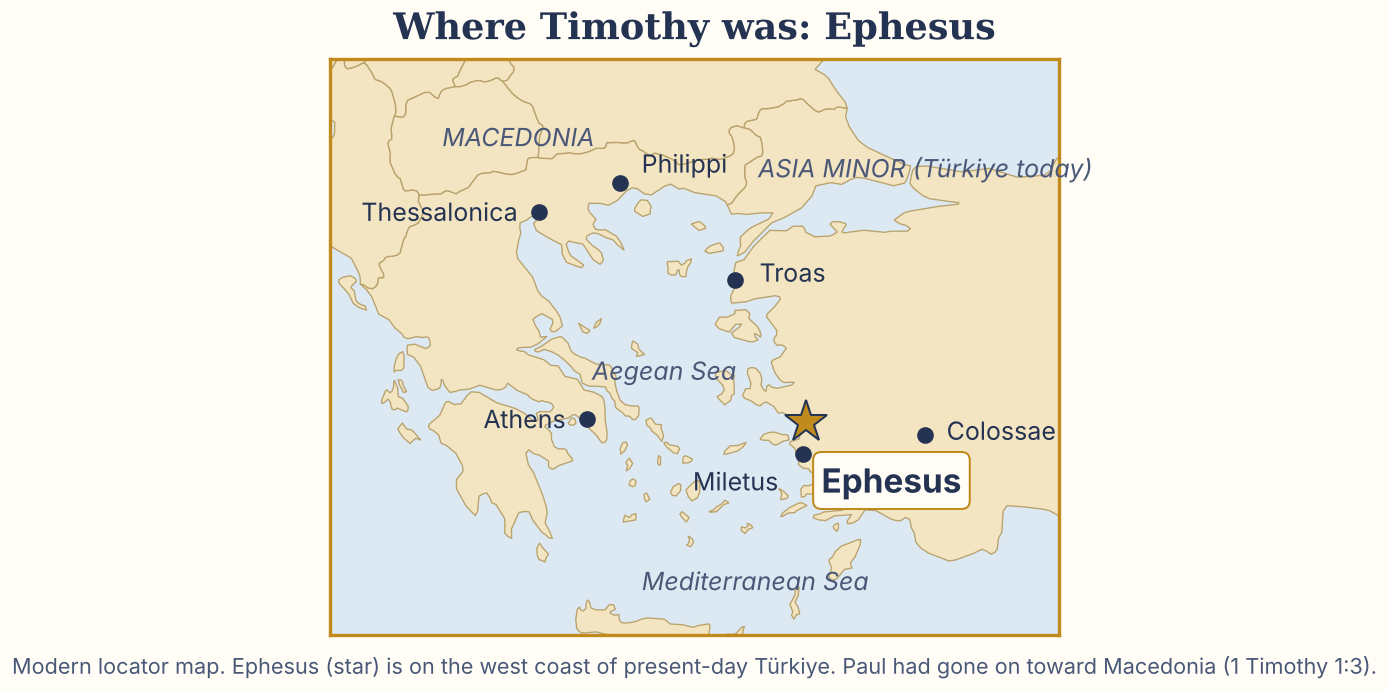
Modern locator map. Ephesus, where Timothy was serving, is marked by a star on the west coast of present-day Türkiye. Paul had gone on toward Macedonia, across the Aegean to the north-west (1 Timothy 1:3).
1 Timothy among the New Testament books
Matthew · Mark · Luke · John · Acts · Romans · 1 Corinthians · 2 Corinthians · Galatians · Ephesians · Philippians · Colossians · 1 Thessalonians · 2 Thessalonians · 1 Timothy · 2 Timothy · Titus · Philemon · Hebrews · James · 1 Peter · 2 Peter · 1 John · 2 John · 3 John · Jude · Revelation
1 Timothy is the fifteenth of the 27 books in the New Testament. It comes after 2 Thessalonians and before 2 Timothy.
When and where it was written
On the traditional reading, Paul wrote 1 Timothy after the Roman imprisonment described at the end of Acts, when he was free again and travelling, about AD 63–65. Acts does not tell us about that release, so the exact year and the place of writing are not stated. 1 Timothy, Titus and 2 Timothy are the last letters Paul wrote; together they are called the “Pastoral Letters” because they are written to pastors rather than to churches. 1 Timothy and Titus belong close together; 2 Timothy was written later, from prison, near the end of Paul’s life.
Meet the letter
First Timothy is a letter from an old apostle to a young pastor about how to run a church, and it is far warmer than that sounds. Paul opens with a charge: stop the false teachers (1 Timothy 1:3). Then he cannot help himself; he breaks into his own testimony and a burst of praise, because he was the worst of sinners and Christ Jesus came into the world to save sinners (1 Timothy 1:12–17). That is the heartbeat of the whole letter. Everything Paul says about prayer, worship, leaders, widows, elders, slaves, the rich and the pursuit of godliness grows out of the gospel of mercy.
The trouble in Ephesus was teaching that had wandered from the gospel into myths, genealogies and arguments about the law (1 Timothy 1:3–7), that forbade marriage and certain foods (1 Timothy 4:1–5), and that treated godliness as a way to get rich (1 Timothy 6:3–10). Paul’s answer is not a new set of rules but a healthy church: people praying for everyone, men and women behaving with dignity in worship, overseers and deacons whose lives match their office, a pastor who sets an example and keeps a close watch on himself and his teaching, a church family that honors its older members and cares for its widows, and believers who have learned that “godliness with contentment is great gain.”
Why does it matter so much? Paul tells us in the center of the letter: the church is “the household of God, which is the church of the living God, a pillar and buttress of the truth” (1 Timothy 3:15). God’s family holds up the truth about Jesus in the world. How we live together is not a side issue; it is part of the witness.
The central message The church is the household of the living God, entrusted with the truth about Jesus Christ. So guard the gospel, pray for all people, choose leaders whose lives match their calling, care for the family of God, and pursue godliness with contentment, until the appearing of our Lord Jesus Christ (1 Timothy 3:14–16; 6:11–16).
A verse to carry through the study 1 Timothy 1:15 BLB
Find your way
Main teachings
The goal of the charge is love
1 Timothy 1:3–11 Sound teaching is not an end in itself; its aim is love from a pure heart, a good conscience and a sincere faith, and the law is good when it is used as God intended.
Mercy for the worst of sinners
1 Timothy 1:12–17 Paul’s own story is the gospel in miniature: a blasphemer and persecutor received mercy so that Christ could display His perfect patience, and praise is the only right response.
Fight the good fight
1 Timothy 1:18–20 Timothy is to wage the good warfare holding faith and a good conscience, because those who throw conscience away make shipwreck of their faith.
Pray for all people
1 Timothy 2:1–7 The church prays for everyone, kings included, because God desires all people to be saved and there is one mediator between God and men, the man Christ Jesus, who gave Himself as a ransom for all.
Worship with dignity
1 Timothy 2:8–15 Men are to pray without anger or quarreling, and women to adorn themselves with good works and to learn quietly; this much-discussed passage is read carefully and in context in the notes.
Overseers whose lives match the office
1 Timothy 3:1–7 The overseer must be above reproach, a one-woman man, sober-minded, hospitable, able to teach, gentle, not a lover of money, and a good manager of his own household.
Deacons and faithful service
1 Timothy 3:8–13 Deacons too must be dignified, sincere, tested and sound in the faith; those who serve well gain a good standing and great confidence in Christ.
The household of God and the mystery of godliness
1 Timothy 3:14–16 The purpose of the letter in one sentence, and then the church’s confession of Christ: manifested in the flesh, vindicated by the Spirit, proclaimed among the nations, taken up in glory.
Everything created by God is good
1 Timothy 4:1–5 Teaching that forbids marriage and foods comes from deceitful spirits; God’s gifts are received with thanksgiving and made holy by the word of God and prayer.
Train yourself for godliness
1 Timothy 4:6–10 Bodily training has some value, but godliness holds promise for this life and the life to come, and our hope is set on the living God, the Savior of all people, especially those who believe.
Set the believers an example
1 Timothy 4:11–16 A young pastor earns respect by example in speech, conduct, love, faith and purity, by devoting himself to the public reading of Scripture, exhortation and teaching, and by keeping a close watch on himself and the teaching.
Treat the church as family
1 Timothy 5:1–2 Older men as fathers, younger men as brothers, older women as mothers, younger women as sisters, in all purity.
Honor widows who are truly widows
1 Timothy 5:3–16 Families care for their own first, the church cares for widows who are truly alone, and younger widows are encouraged to marry and manage their households.
Elders: support and accountability
1 Timothy 5:17–25 Elders who rule well deserve double honor, an accusation against an elder needs witnesses, persistent sin is rebuked openly, and no one is to be ordained in a hurry.
Believers under slavery
1 Timothy 6:1–2 Bondservants are to honor their masters so that God’s name and the teaching are not reviled, and believing masters are brothers to be served all the better.
Godliness with contentment is great gain
1 Timothy 6:3–10 False teachers imagine godliness is a means of gain; the love of money is a root of all kinds of evils, and the cure is contentment with food and clothing.
Keep the commandment until He appears
1 Timothy 6:11–16 The man of God flees greed, pursues righteousness, godliness, faith, love, steadfastness and gentleness, fights the good fight of the faith, and keeps the charge until the appearing of our Lord, the King of kings.
Rich in good works
1 Timothy 6:17–19 The rich are not to be haughty or to trust in uncertain riches but in God, who richly provides everything to enjoy, and to be rich in good works, generous and ready to share.
Guard the deposit
1 Timothy 6:20–21 The gospel is a deposit entrusted to Timothy; he must guard it, avoid what is falsely called knowledge, and live by grace.
Praying through 1 Timothy
First Timothy is a letter about the praying church. Paul can hardly begin before he breaks into thanksgiving and praise for the mercy shown to him (1 Timothy 1:12–17). His first instruction for the life of the church is that prayer be made for all people (1 Timothy 2:1–8), and he closes with a doxology to the King of kings (1 Timothy 6:15–16). Below are the prayers and praises in the letter, followed by a prayer built out of its own words. Pray it as it is, then pray it again in your own words, for yourself and for people you name.
The prayers in this letter
1 Timothy 1:12–17 — Thanksgiving and praise for mercy. Paul thanks Christ Jesus for appointing him to service, confesses what he once was, marvels at the grace that overflowed to him, and ends in praise to the King of the ages, immortal, invisible, the only God.
1 Timothy 2:1–8 — Pray for all people. Supplications, prayers, intercessions and thanksgivings are to be made for everyone, including kings and all in high positions, so that believers may live quiet and godly lives, because God desires all people to be saved and Christ gave Himself as a ransom for all.
1 Timothy 4:4–5 — Receiving God’s gifts with thanksgiving. Everything created by God is good, received with thanksgiving and made holy by the word of God and prayer; the Christian’s table grace comes from here.
1 Timothy 6:15–16 — Praise to the King of kings. The blessed and only Sovereign, the King of kings and Lord of lords, who alone has immortality and dwells in unapproachable light: to Him be honor and eternal dominion.
A prayer from 1 Timothy
Pray it with 1 Timothy 1:12–17; 2:1–6; 6:11–16
Lord Jesus, I thank You, because You judged me faithful and appointed me to Your service, though I did not deserve it. Like Paul, I know what I was before You found me, and I know that I received mercy. The grace of our Lord overflowed for me with the faith and love that are in You. This saying is trustworthy and deserving of full acceptance: You came into the world to save sinners, and I am one of them. Thank You for Your perfect patience with me.
Father, You have told us to pray for all people, so I bring them to You now: the people in my family and my church, my neighbors and the people I find hard to love, and those who govern our nation, our state and our town. Give us quiet and peaceful lives, godly and dignified in every way. You desire all people to be saved and to come to the knowledge of the truth, so I pray for the people I know who do not yet know You. There is one God, and one mediator between God and men, the man Christ Jesus, who gave Himself as a ransom for all. Thank You for Jesus.
And Lord, make me a man of God, a woman of God. Help me flee the love of money and the pull of this world, and pursue righteousness, godliness, faith, love, steadfastness and gentleness. Help me fight the good fight of the faith and take hold of the eternal life to which You called me. Keep me faithful until the appearing of our Lord Jesus Christ, which You will bring about at the proper time. You are the blessed and only Sovereign, the King of kings and Lord of lords. To You be honor and eternal dominion. In Jesus’ name, amen.
Read 1 Timothy
Select a chapter to read it in the ESV in a reading window, right here on this page.
1 Timothy 1:1–20 1 Timothy 2:1–15 1 Timothy 3:1–16 1 Timothy 4:1–16 1 Timothy 5:1–25 1 Timothy 6:1–21
Find a topic
Where the letter speaks to a subject. The references are chapter and verse within 1 Timothy; tap any verse number in the study below to go to it.
Accountability and discipline: 1:19–20; 5:19–22
Apostolic calling and stewardship: 1:1,11–12,18; 2:7; 6:20–21
Christ as mediator and ransom: 2:5–6
Christology and confession: 1:1,15; 2:5–6; 3:16; 6:13–16
Church as God’s household: 3:14–15; 5:1–2
Conscience and integrity: 1:5,19; 3:9; 4:2; 5:22
Contentment and generosity: 6:6–10,17–19
Creation and gratitude: 4:3–5; 6:17
Deacons and faithful service: 3:8–13
Elders and overseers: 3:1–7; 5:17–22
Eternal life and perseverance: 1:16; 4:8–10,16; 6:12,19
Faith and sound teaching: 1:3–11; 4:6,13,16; 6:3–5,20–21
Family responsibilities: 3:4–5,12; 5:4,8,16
False teaching and speculation: 1:3–7,19–20; 4:1–7; 6:3–5,20–21
Godliness and training: 2:2; 3:16; 4:7–8; 6:3,6,11
Grace and mercy: 1:2,12–16; 6:21
Greed and financial motives: 3:3,8; 6:5–10,17–19
Hope and God’s sovereignty: 1:1,17; 4:10; 5:5; 6:13–17
Law and the gospel: 1:7–11
Love as the goal: 1:5,14; 4:12; 6:11
Modesty and self-control: 2:9–10,15; 3:2,11
Prayer and public authorities: 2:1–8; 5:5
Public reading and teaching: 4:11–16; 5:17–18
Purity and respectful relationships: 4:12; 5:1–2,22
Slavery and Christian witness: 1:10; 6:1–2
Timothy’s calling and example: 1:2–3,18; 4:12–16; 6:11–14,20
Widows and care for the vulnerable: 5:3–16
A brief outline
1. Guard the gospel (1:1–20)
1:3–11 Different teaching and the proper use of the law
1:12–17 Paul’s testimony of mercy and praise
1:18–20 Timothy’s charge and the danger of shipwreck
2. Pray and worship faithfully (2:1–15)
2:1–7 Prayer for all people and the one mediator
2:8–15 Conduct in worship and the disputed teaching passage
3. Order the household of God (3:1–16)
3:1–7 Qualifications for overseers
3:8–13 Qualifications for deacons and the women of verse 11
3:14–16 The church’s purpose and confession of Christ
4. Practice faithful ministry (4:1–16)
4:1–5 False asceticism and the goodness of creation
4:6–10 Training in godliness and hope in God
4:11–16 Timothy’s example and teaching
5. Care for the church family (5:1–6:2)
5:1–2 Respectful relationships
5:3–16 Widows and household responsibility
5:17–25 Support and accountability for elders
6:1–2 Believers living under slavery
6. Pursue true riches and keep the trust (6:3–21)
6:3–10 False teaching and the danger of greed
6:11–16 The good fight and the coming King
Study every verse
Begin with the Scripture, then read the study note, the key Greek words and the two passages to read alongside. Where a trusted teacher has something to add, his comment follows in a gold box, with a link to the source. Each chapter ends with three questions for reflection. The aim is to understand Paul’s meaning and put it into practice in dependence on Christ.
Chapter 1 1:1 1:2 1:3 1:4 1:5 1:6 1:7 1:8 1:9 1:10 1:11 1:12 1:13 1:14 1:15 1:16 1:17 1:18 1:19 1:20
Chapter 2 2:1 2:2 2:3 2:4 2:5 2:6 2:7 2:8 2:9 2:10 2:11 2:12 2:13 2:14 2:15
Chapter 3 3:1 3:2 3:3 3:4 3:5 3:6 3:7 3:8 3:9 3:10 3:11 3:12 3:13 3:14 3:15 3:16
Chapter 4 4:1 4:2 4:3 4:4 4:5 4:6 4:7 4:8 4:9 4:10 4:11 4:12 4:13 4:14 4:15 4:16
Chapter 5 5:1 5:2 5:3 5:4 5:5 5:6 5:7 5:8 5:9 5:10 5:11 5:12 5:13 5:14 5:15 5:16 5:17 5:18 5:19 5:20 5:21 5:22 5:23 5:24 5:25
Chapter 6 6:1 6:2 6:3 6:4 6:5 6:6 6:7 6:8 6:9 6:10 6:11 6:12 6:13 6:14 6:15 6:16 6:17 6:18 6:19 6:20 6:21
Chapter 1 — Guard the gospel
Follow the movement from correcting error to remembering mercy and renewing Timothy’s commission.
Greek reference for this chapter: Bible Hub interlinear, 1 Timothy 1 (outside site)
Greeting and commission
1 Timothy 1:1
Read the verse: 1 Timothy 1:1 BLB
Study Notes
Paul begins with a commission, not a personal credential. Calling both God and Christ the source of his mission anchors Timothy’s responsibility in divine authority. Christ is also the believer’s hope, so the letter’s demanding instructions belong within the promise of salvation.
Greek words apostolos – authorized messenger or apostle; elpis – hope.
Read alongside
Galatians 1:1 BLB — Paul’s apostleship comes through Jesus Christ.
Colossians 1:27 BLB — Christ is the hope of glory.
1 Timothy 1:2
Read the verse: 1 Timothy 1:2 BLB
Study Notes
“True child” describes their spiritual and ministerial bond, not biological parentage. Paul knows Timothy’s tested character and sends him the grace, mercy, and peace his difficult work requires. The family language prepares for the letter’s description of the church as God’s household.
Greek words gnēsios – genuine or true; teknon – child.
Read alongside
1 Corinthians 4:17 BLB — Timothy is Paul’s beloved and faithful child in the Lord.
Philippians 2:19–22 BLB — Timothy serves with Paul like a son with a father.
Different teaching and the proper use of the law
1 Timothy 1:3
Read the verse: 1 Timothy 1:3 BLB
Study Notes
Timothy’s assignment is to stay in Ephesus and confront teaching that departs from the apostolic gospel. Paul recalls traveling toward Macedonia; the verse does not name the exact town from which he later wrote. Faithful ministry sometimes means remaining with a difficult responsibility rather than seeking a more comfortable one.
Greek words heterodidaskaleō – teach a different doctrine.
Teacher’s comment — John MacArthur (paraphrase, source)
MacArthur connects the command to stop false teaching with the positive goal of love. He describes that love as deliberate, costly concern for God and other people, arising from an inwardly cleansed life, an unaccusing conscience, and genuine trust in Christ. In his exposition, theological correction is not an end in itself: Timothy must protect the conditions in which Christian love grows, rather than allow teaching driven by status, profit, or empty speculation.
Read alongside
Acts 20:28–31 BLB — Paul warns Ephesian elders about destructive teachers.
Titus 1:9 BLB — an elder must teach sound doctrine and answer opponents.
1 Timothy 1:4
Read the verse: 1 Timothy 1:4 BLB
Study Notes
The objection is to speculative teaching that displaces God’s saving work received through faith. Paul does not prohibit historical inquiry or all family records. The question is whether an interpretation serves God’s gospel or generates unproductive speculation and rivalry.
Greek words oikonomia – stewardship or administration; mythos – myth.
Read alongside
Titus 1:14 BLB — reject myths and commands that turn people from truth.
Titus 3:9 BLB — avoid foolish controversies and genealogies.
1 Timothy 1:5
Read the verse: 1 Timothy 1:5 BLB
Study Notes
The goal of the charge is love shaped by inward integrity. A pure heart, good conscience, and sincere faith belong together. Doctrinal correction is therefore not an end in itself: it should form people who trust God honestly and love others faithfully.
Greek words telos – aim or goal; anupokritos – sincere, without hypocrisy.
Teacher’s comment — J. Vernon McGee (paraphrase, source)
McGee says a church’s teaching should lead to practical love, genuine faith, and a sensitive conscience. Love must appear in how people treat one another, including refusing gossip and deliberate harm. Without these qualities, a well-organized congregation can function like a religious club rather than a living Christian community.
Read alongside
Romans 13:8–10 BLB — love fulfills the law’s purpose.
2 Timothy 1:5 BLB — Timothy’s faith is sincere.
1 Timothy 1:6
Read the verse: 1 Timothy 1:6 BLB
Study Notes
Turning away from love and integrity can lead to impressive but fruitless speech. Paul measures teaching by its faithfulness to the gospel and its moral fruit, not by how much discussion it generates. Consider whether a disputed topic produces obedience or simply sustains controversy.
Greek words astocheō – miss the mark or deviate; mataiologia – empty talk.
Read alongside
2 Timothy 2:16–18 BLB — empty talk can spread and overturn faith.
Titus 1:10–11 BLB — empty talkers can upset households.
1 Timothy 1:7
Read the verse: 1 Timothy 1:7 BLB
Study Notes
These teachers claim authority while misunderstanding the material they teach. Their confidence is not evidence of competence. Timothy must protect the church from this mismatch, while teachers themselves should welcome study, correction, and the humility needed to distinguish knowledge from assertion.
Greek words nomodidaskalos – teacher of the law.
Read alongside
James 3:1 BLB — teachers face stricter judgment.
Romans 2:17–24 BLB — confidence in teaching the law can coexist with disobedience.
1 Timothy 1:8
Read the verse: 1 Timothy 1:8 BLB
Study Notes
Paul’s criticism is not a rejection of God’s law. The law is good when used according to its purpose rather than as a platform for speculation or self-righteousness. Its exposure of sin must be understood within the gospel rather than set against it.
Greek words nomimōs – lawfully or in a proper manner.
Teacher’s comment — J. Vernon McGee (paraphrase, source)
McGee explains the law’s proper use as revealing God’s moral standard and exposing human sin. It cannot supply the salvation sinners need. He contrasts attempts to earn acceptance through conduct with salvation through Christ, while insisting that receiving grace should result in good conduct rather than excuse wrongdoing.
Read alongside
Romans 7:12 BLB — the law is holy, righteous, and good.
Galatians 3:24 BLB — the law served as guardian until Christ, with justification by faith as the goal.
1 Timothy 1:9
Read the verse: 1 Timothy 1:9 BLB
Study Notes
The law confronts conduct that resists God’s will. Paul’s list recalls the moral concerns of the Ten Commandments. “Not laid down for the just” should not be detached from this argument and made to mean that believers have no moral obligations; the focus is the law’s function in exposing wrongdoing.
Greek words anomos – lawless; anypotaktos – insubordinate.
Read alongside
Exodus 20:12–13 BLB — honor parents and do not murder.
Romans 3:19–20 BLB — the law exposes sin and closes self-justifying mouths.
1 Timothy 1:10
Read the verse: 1 Timothy 1:10 BLB
Study Notes
The list continues with sexual wrongdoing, human trafficking, and falsehood. The ESV renders arsenokoitēs as “men who practice homosexuality”; its precise historical scope is debated. Paul places these wrongs within a wider moral indictment, not a license for contempt toward any group. The gospel offers mercy to sinners, as verses 12–16 immediately demonstrate.
Greek words andrapodistēs – kidnapper or slave trader; hygiainō – be healthy or sound.
Read alongside
Exodus 21:16 BLB — kidnapping and selling a person are condemned.
1 Corinthians 6:9–11 BLB — sin is named within a testimony of cleansing and grace.
1 Timothy 1:11
Read the verse: 1 Timothy 1:11 BLB
Study Notes
Healthy teaching agrees with the gospel of God’s glory. Paul does not own this message or have permission to reshape it for personal advantage. Timothy inherits the same stewardship: to preserve and communicate what has been entrusted rather than trade it for novelty.
Greek words euangelion – good news; pisteuō – trust, here in the sense of being entrusted.
Read alongside
Romans 1:16–17 BLB — the gospel displays God’s saving power and righteousness.
1 Thessalonians 2:4 BLB — the gospel is a trust from God.
Paul’s testimony of mercy and praise
1 Timothy 1:12
Read the verse: 1 Timothy 1:12 BLB
Study Notes
Paul’s thanksgiving prevents his charge against error from becoming self-congratulation. Christ strengthened and appointed a man who had opposed him. Faithful service is a responsibility received through mercy, not proof that the servant has earned God’s favor.
Greek words endynamoō – strengthen or empower; diakonia – service.
Teacher’s comment — John Piper (paraphrase, source)
Piper reads Paul’s conversion as an intentionally public demonstration of Christ’s patience toward deeply hostile sinners. He argues that Paul’s violent opposition did not place him beyond God’s mercy, and that the example should encourage both struggling believers and those praying for apparently unreachable people. Because Paul’s change was sudden and undeserved, Christians should continue praying and speaking truth lovingly even when they see no preliminary interest in conversion.
Read alongside
1 Corinthians 15:9–10 BLB — grace transforms Paul’s unworthiness into service.
2 Corinthians 3:5–6 BLB — God supplies competence for ministry.
1 Timothy 1:13
Read the verse: 1 Timothy 1:13 BLB
Study Notes
Paul names his former sins plainly. His ignorance explains something about his condition but does not make persecution innocent. Mercy, not ignorance, saves him. His testimony helps Timothy oppose error without forgetting that God can change the people who presently resist the truth.
Greek words blasphēmos – blasphemous; hybristēs – violent or insolent aggressor.
Read alongside
Acts 9:1–6 BLB — the persecutor encounters the risen Jesus.
Acts 26:9–11 BLB — Paul describes his former opposition to believers.
1 Timothy 1:14
Read the verse: 1 Timothy 1:14 BLB
Study Notes
Grace does more than cancel a record of wrongs. Paul now has the faith and love that were absent from his former life. His story illustrates the goal of verse 5: the gospel produces genuine trust and love rather than merely supplying religious information.
Greek words hyperpleonazō – overflow or abound exceedingly.
Read alongside
Romans 5:20–21 BLB — grace abounds beyond sin.
Ephesians 2:8–10 BLB — salvation by grace leads to good works.
1 Timothy 1:15
Read the verse: 1 Timothy 1:15 BLB
Study Notes
This verse gives a concise statement of Christ’s saving mission. Paul’s description of himself as foremost highlights the depth of his need and the greatness of mercy. It is a confession, not a competition to rank sinners. Christ’s purpose gives hope to people who think their past puts them beyond rescue.
Greek words pistos ho logos – the saying is trustworthy; prōtos – first or foremost.
Teacher’s comment — Charles H. Spurgeon (paraphrase, source)
Paul’s own conversion is evidence that Christ saves sinners. Spurgeon urges burdened sinners to see Paul’s mercy as encouragement to trust Christ, and ministers to make their lives a living confirmation of the gospel they proclaim.
Read alongside
Luke 19:10 BLB — the Son of Man came to seek and save the lost.
Mark 2:17 BLB — Jesus calls sinners rather than the self-satisfied.
1 Timothy 1:16
Read the verse: 1 Timothy 1:16 BLB
Study Notes
Paul’s conversion serves later believers as a demonstration of Christ’s patience. His former hostility was real, yet it did not exhaust God’s mercy. The point is not permission to postpone repentance; it is confidence that the Savior can receive those who turn to him.
Greek words makrothymia – patience or long-suffering; hypotypōsis – pattern or example.
Read alongside
2 Peter 3:9 BLB — God’s patience is connected with repentance.
Ephesians 2:7 BLB — grace displays God’s kindness in Christ.
1 Timothy 1:17
Read the verse: 1 Timothy 1:17 BLB
Study Notes
The testimony becomes worship. God is not confined by the ages he rules, and his glory is not dependent on human recognition. Doxology is a fitting response to grace: Paul moves from what God has done for him to who God eternally is.
Greek words aphthartos – imperishable; aoratos – invisible.
Read alongside
Romans 11:33–36 BLB — reflection on salvation ends in praise.
Jude 24–25 BLB — glory and dominion belong to God through Jesus Christ.
Timothy’s charge and the danger of shipwreck
1 Timothy 1:18
Read the verse: 1 Timothy 1:18 BLB
Study Notes
Timothy’s commission is reinforced by earlier prophetic recognition. The military picture concerns fidelity, endurance, and resistance to false teaching, not physical violence against opponents. Remembering a calling can steady a servant, but it must lead to the faithful conduct described in the next verse.
Greek words paratithēmi – entrust; strateia – warfare or campaign.
Read alongside
1 Timothy 4:14 BLB — prophecy and the elders’ laying on of hands accompany Timothy’s gift.
2 Timothy 2:3–4 BLB — Timothy is urged to endure hardship like a soldier.
1 Timothy 1:19
Read the verse: 1 Timothy 1:19 BLB
Study Notes
Doctrine and conscience cannot safely be separated. Persistently rejecting moral correction can damage a person’s relationship to the faith. Paul gives a warning rather than a full account of every theological question about apostasy; its immediate purpose is to make Timothy vigilant.
Greek words syneidēsis – conscience; nauageō – suffer shipwreck.
Read alongside
1 Timothy 3:9 BLB — faith must be held with a clear conscience.
Hebrews 3:12–14 BLB — believers are warned against unbelief and urged to persevere.
1 Timothy 1:20
Read the verse: 1 Timothy 1:20 BLB
Study Notes
“Handed over to Satan” describes severe discipline, commonly understood as exclusion from the church’s fellowship. Its stated aim is corrective: that the offenders learn not to blaspheme. The Alexander named here cannot be confidently identified with every other Alexander in the New Testament.
Greek words paideuō – train or discipline.
Read alongside
1 Corinthians 5:5 BLB — severe church discipline is ordered with a saving aim.
2 Timothy 2:17–18 BLB — Hymenaeus is associated with destructive error.
Questions for reflection
- How does the goal of love in 1:5 evaluate the way I discuss doctrine?
- What does Paul’s testimony teach me about mercy toward people who currently oppose the faith?
- Where do I need to hold a good conscience together with sound belief?
Chapter 2 — Prayer and conduct in worship
Observe how prayer for all people is grounded in the one God and one mediator before the letter turns to conduct in worship.
Greek reference for this chapter: Bible Hub interlinear, 1 Timothy 2 (outside site)
Prayer for all people and the one mediator
1 Timothy 2:1
Read the verse: 1 Timothy 2:1 BLB
Study Notes
Prayer belongs at the front of the church’s shared life. The overlapping terms show a broad practice of asking, interceding, and giving thanks. “All people” widens the church’s concern beyond its own circle, including people whose position or conduct might otherwise make prayer for them difficult.
Greek words deēsis – petition; enteuxis – intercession; eucharistia – thanksgiving.
Teacher’s comment — Billy Graham (paraphrase, source)
Continuing conflict is no reason to abandon prayer for leaders. Graham treats Paul’s instruction as an obligation of obedience and warns against cynicism: believers do not need to see every effect of their prayers before continuing to pray.
From Hollis’s own writing — Aiming for Jesus, Arrow #3: Prayer (source)
Hollis places Paul’s call to prayer at the beginning of a chapter about becoming like Jesus. Prayer is a first response and a daily expression of dependence, not a specialty for unusually mature Christians. Its essential posture concerns the heart’s trust in God more than the physical position of the person praying.
Teacher’s comment — J. Vernon McGee (paraphrase, source)
Before discussing women’s roles, McGee emphasizes that gathered believers should pray for the world and for public officials. He reads God’s saving desire in verse 4 as excluding the idea that some people are predestined to be lost. This is his theological interpretation of the verse and should be identified as such.
Read alongside
Ephesians 6:18 BLB — pray at all times for all the saints.
Philippians 4:6 BLB — bring requests to God with thanksgiving.
1 Timothy 2:2
Read the verse: 1 Timothy 2:2 BLB
Study Notes
Prayer for rulers seeks conditions in which people can live faithfully and peaceably. It is neither an endorsement of every policy nor an instruction to obey wrongdoing. The church prays for those in authority while keeping its first allegiance to God.
Greek words ēremos – tranquil; hēsychios – quiet or peaceable.
Read alongside
Jeremiah 29:7 BLB — seek the welfare of the place where God’s people live.
Romans 13:1–7 BLB — civil authority and public responsibilities are addressed.
1 Timothy 2:3
Read the verse: 1 Timothy 2:3 BLB
Study Notes
The goodness of broad intercession is measured by God’s approval. Prayer for outsiders is consistent with the character of God our Savior, rather than merely a strategy for social comfort. Verses 4–6 explain why the church’s concern must be expansive.
Greek words apodektos – acceptable or pleasing.
Teacher’s comment — Charles H. Spurgeon (paraphrase, source)
Spurgeon refuses to shrink the passage’s all people into only some people to protect a theological system. He distinguishes God’s benevolent desire from a decree guaranteeing universal salvation, then emphasizes that saving knowledge is personal trust in Christ rather than mere familiarity with doctrines.
Teacher’s comment — John Piper (paraphrase, source)
Piper distinguishes God’s genuine compassion toward all people from God’s decision about whom to bring to salvation. He maintains that Scripture reveals different aspects of divine willing without implying frustration or contradiction in God. Explicitly favoring a Calvinist explanation, he argues that God’s purpose to display sovereign grace takes precedence over universal salvation. This is Piper’s theological reading of the verse, rather than an interpretation shared by every Christian tradition.
Read alongside
Titus 3:4–5 BLB — God our Savior acts in kindness and mercy.
Hebrews 13:15–16 BLB — praise and practical good are pleasing to God.
1 Timothy 2:4
Read the verse: 1 Timothy 2:4 BLB
Study Notes
Paul links salvation with coming to know the truth. Christians differ on how God’s saving desire relates to election and human response, and whether “all” emphasizes every individual or people of every kind. The immediate point is clear: the church must not restrict its prayers and witness to favored groups.
Greek words thelō – desire or will; epignōsis – knowledge or recognition.
Read alongside
Ezekiel 18:23 BLB — God takes no pleasure in the death of the wicked.
2 Peter 3:9 BLB — God’s patience calls people to repentance.
1 Timothy 2:5
Read the verse: 1 Timothy 2:5 BLB
Study Notes
The one God is approached through the one mediator, Jesus Christ. His humanity is emphasized here because he represents and redeems human beings; the verse is not a denial of his deity. The unity of God supports the worldwide scope of the gospel.
Greek words mesitēs – mediator; anthrōpos – human being.
Read alongside
John 14:6 BLB — Jesus is the way to the Father.
Hebrews 9:15 BLB — Christ mediates the new covenant.
1 Timothy 2:6
Read the verse: 1 Timothy 2:6 BLB
Study Notes
Christ’s self-giving grounds the call to prayer and mission. The verse presents his death as a ransom, not simply an inspiring example. Disagreements about the extent and application of the atonement should not obscure Paul’s practical conclusion: the gospel testimony must reach all kinds of people.
Greek words antilytron – ransom, emphasizing a price given on behalf of others.
Read alongside
Mark 10:45 BLB — the Son of Man gives his life as a ransom.
Titus 2:14 BLB — Christ gives himself to redeem and purify a people.
1 Timothy 2:7
Read the verse: 1 Timothy 2:7 BLB
Study Notes
Paul’s Gentile mission embodies the broad scope of the preceding verses. His emphatic statement of truth underscores the seriousness of his commission. The message is to be proclaimed and taught, so evangelism and instruction belong together rather than being rival ministries.
Greek words kēryx – herald or preacher; ethnē – nations or Gentiles.
Read alongside
Acts 9:15 BLB — Paul is chosen to bear Christ’s name before Gentiles and rulers.
Romans 11:13 BLB — Paul identifies his ministry as apostle to the Gentiles.
Conduct in worship and the disputed teaching passage
1 Timothy 2:8
Read the verse: 1 Timothy 2:8 BLB
Study Notes
Lifted hands are a posture of prayer; “holy” directs attention to the worshiper’s life. Anger and contentiousness contradict the act of approaching God together. Paul addresses men directly here, but the wider biblical call to prayer is not limited to men.
Greek words hosios – holy or devout; dialogismos – reasoning, dispute, or argument.
Teacher’s comment — J. Vernon McGee (paraphrase, source)
McGee understands holy hands as a life devoted to God that agrees with the words being prayed. He also rejects resentful prayers and prayers aimed at correcting other listeners. Public prayer should address God sincerely, rather than disguise an argument or sermon directed toward somebody in the room.
Read alongside
Psalm 24:3–4 BLB — clean hands and a pure heart belong to approaching God.
Matthew 5:23–24 BLB — reconciliation matters in worship.
1 Timothy 2:9
Read the verse: 1 Timothy 2:9 BLB
Study Notes
Paul challenges self-display through costly adornment and status. Modesty includes thoughtful restraint and concern for others, not simply a dress-code measurement. The positive counterpart appears in verse 10: the beauty of a profession of godliness is visible in good works.
Greek words aidōs – modesty or a sense of propriety; sōphrosynē – self-control.
Read alongside
1 Peter 3:3–4 BLB — inward character outweighs outward adornment.
James 2:1–4 BLB — clothing and wealth must not determine honor in the church.
1 Timothy 2:10
Read the verse: 1 Timothy 2:10 BLB
Study Notes
Good works are the proper expression of a claim to worship God. Paul is not replacing salvation by grace with salvation by appearance or achievement. He is asking whether outward life fits a person’s profession of reverence for God.
Greek words theosebeia – reverence for God or godliness.
Read alongside
Ephesians 2:10 BLB — believers are created in Christ for good works.
Titus 2:3–5 BLB — mature women teach what is good through life and instruction.
1 Timothy 2:11
Read the verse: 1 Timothy 2:11 BLB
Study Notes
The verse positively commands that a woman learn. “Quietly” can describe a peaceable, receptive manner rather than absolute silence in every setting. Christians interpret this paragraph differently, but it should be read with Paul’s wider recognition of women as learners and coworkers.
Greek words manthanō – learn; hēsychia – quietness or silence.
Read alongside
Acts 18:26 BLB — Priscilla and Aquila explain God’s way more accurately to Apollos.
1 Corinthians 14:26–33 BLB — learning and orderly worship serve the church’s upbuilding.
1 Timothy 2:12
Read the verse: 1 Timothy 2:12 BLB
Study Notes
Complementarian readings understand a lasting restriction on authoritative teaching of men in the gathered church. Egalitarian readings commonly understand a local restriction tied to error or wrongful authority. The rare verb does not settle the debate by itself. Read the command with verses 13–15 and the letter’s concern about false teaching; neither view should be presented as undisputed.
Greek words authenteō – exercise or assume authority; its nuance here is disputed.
Teacher’s comment — John Piper (paraphrase, source)
Piper interprets the quietness in verses 11–12 as respect for church leadership, not a ban on every word spoken by a woman. He cites women instructing younger women, children, and Apollos to show that Paul does not prohibit all teaching. He links the prohibited combination of governing and authoritative teaching to the elder’s responsibilities, concluding that this office is reserved for qualified men. This is his complementarian interpretation of a disputed passage.
Read alongside
1 Corinthians 11:5 BLB — women pray and prophesy in Paul’s discussion of worship.
Titus 2:3–5 BLB — older women are instructed to teach what is good.
1 Timothy 2:13
Read the verse: 1 Timothy 2:13 BLB
Study Notes
Paul grounds his argument in the creation narrative, not only in Ephesian social habits. Interpreters differ about precisely how that order applies to church teaching. Creation sequence should not be turned into a claim that women have less value, intelligence, or access to God.
Greek words plassō – form or shape; prōtos – first.
Read alongside
Genesis 2:7,18–23 BLB — the creation narrative places Adam before the formation of Eve.
1 Corinthians 11:8–12 BLB — Paul discusses creation order and mutual dependence.
1 Timothy 2:14
Read the verse: 1 Timothy 2:14 BLB
Study Notes
Paul highlights Eve’s deception in the Genesis story. He does not excuse Adam, whom Romans 5 treats as responsible for humanity’s fall. Nor does this verse establish that all women are inherently more gullible than all men. The narrative’s use within this paragraph remains part of the interpretive debate.
Greek words exapataō – deceive thoroughly; parabasis – transgression.
Read alongside
Genesis 3:1–13 BLB — the serpent’s deception and both humans’ disobedience are narrated.
Romans 5:12–19 BLB — Paul assigns representative responsibility for sin to Adam.
1 Timothy 2:15
Read the verse: 1 Timothy 2:15 BLB
Study Notes
Interpretations include faithful motherhood as an expression of Christian perseverance, spiritual salvation through or despite childbirth’s trials, physical preservation, and reference to the Messiah’s birth. The latter two readings face significant objections. Bearing children neither earns salvation nor guarantees safe delivery, and childlessness does not exclude a woman from salvation. The shift from “she” to “they” and the condition of enduring faith require care. See the NET translation notes in General sources [G3].
Greek words teknogonia – childbearing; sōzō – save or deliver.
Teacher’s comment — John Piper (paraphrase, source)
Following an interpretive suggestion from Henry Alford, Piper understands salvation through childbearing as coming safely through a threatening ordeal, not earning salvation by having children. He compares the construction with salvation through fire in 1 Corinthians 3:15. On his reading, childbirth’s suffering does not cancel God’s saving promise: enduring faith, with its moral fruit, joins women to Christ. He explicitly extends the hope to women who never bear children and presents this explanation as his proposed reading.
Read alongside
Genesis 3:15–16 BLB — childbirth and the promised offspring follow the fall.
Ephesians 2:8–9 BLB — salvation is God’s gift, not earned by works.
Questions for reflection
- Who is missing from my prayers, including people in authority?
- How does Christ’s unique mediation shape prayer and mission?
- Where must I distinguish a passage’s clear teaching from a disputed interpretation?
Chapter 3 — Leadership and the household of God
Notice how character dominates the leadership qualifications, then read them in light of the church’s identity and confession.
Greek reference for this chapter: Bible Hub interlinear, 1 Timothy 3 (outside site)
Qualifications for overseers
1 Timothy 3:1
Read the verse: 1 Timothy 3:1 BLB
Study Notes
Leadership is a noble work, not merely an honorable title. Desire for the task is legitimate, but the qualifications that follow test its character. The New Testament connects oversight with shepherding and eldership; later denominational office structures should not be assumed without argument.
Greek words episkopē – oversight; oregomai – aspire or reach toward.
Teacher’s comment — John MacArthur (paraphrase, source)
MacArthur emphasizes that aspiring to oversight means wanting the labor of ministry, not merely its title, influence, or income. He distinguishes an inward desire to serve from the outward steps of preparation and qualification that should follow it. The worthy aspiration is therefore tested by motives and character, as well as activity. His broader application is that a church’s health depends heavily on whether its leaders actually meet the biblical standards for the work.
Read alongside
Acts 20:17,28 BLB — the Ephesian elders are charged to oversee and shepherd.
1 Peter 5:1–4 BLB — elders shepherd willingly without domineering.
1 Timothy 3:2
Read the verse: 1 Timothy 3:2 BLB
Study Notes
The dominant emphasis is trustworthy character. “Husband of one wife,” literally a one-woman man, highlights marital and sexual faithfulness; traditions differ over its application to singleness, remarriage, and divorce. “Above reproach” means a credible life, not sinless perfection, while teaching ability remains a real requirement.
Greek words anepilēmptos – above reproach; didaktikos – able to teach.
Read alongside
Titus 1:6–9 BLB — an overseer’s household, character, and teaching are examined.
2 Timothy 2:24–25 BLB — the Lord’s servant must teach with gentleness.
1 Timothy 3:3
Read the verse: 1 Timothy 3:3 BLB
Study Notes
Private appetites and public manner both matter. An overseer must not dominate through aggression, alcohol, quarrels, or financial motives. Gentleness is strength governed for another person’s good. These are qualifications to assess before appointment, not optional refinements after a leader becomes influential.
Greek words epieikēs – gentle or considerate; aphilargyros – not loving money.
Teacher’s comment — Chuck Swindoll (paraphrase, source)
Swindoll treats the elder qualifications as safeguards for Christ’s reputation, not optional leadership preferences. Gentleness, freedom from greed, responsible household leadership, maturity, and a good reputation outside the church belong together. A leader’s private conduct and public witness cannot be separated from the credibility of the ministry.
Read alongside
Titus 1:7–8 BLB — an overseer must not be violent or greedy.
James 3:17 BLB — wisdom from above is peaceable and gentle.
1 Timothy 3:4
Read the verse: 1 Timothy 3:4 BLB
Study Notes
Household leadership provides observable evidence of character. Dignity and care should shape the home, not coercion disguised as discipline. The verse directs attention to the way a candidate manages responsibilities and relationships, rather than allowing public skill to conceal destructive private behavior.
Greek words proistēmi – lead or manage; semnotēs – dignity.
Read alongside
Titus 1:6 BLB — a leader’s family life is relevant to qualification.
Ephesians 6:4 BLB — fathers are to nurture rather than provoke children.
1 Timothy 3:5
Read the verse: 1 Timothy 3:5 BLB
Study Notes
Paul explains the household test by analogy: responsibility in a smaller sphere illuminates fitness for a larger one. The church belongs to God, and its leaders are caregivers. Administrative competence alone is insufficient if people under a leader’s care are neglected or harmed.
Greek words epimeleomai – take care of.
Read alongside
Acts 20:28 BLB — shepherd the church that belongs to God.
1 Peter 5:2–3 BLB — care for the flock through willing, exemplary service.
1 Timothy 3:6
Read the verse: 1 Timothy 3:6 BLB
Study Notes
Spiritual maturity takes time. Rapid promotion can feed pride and expose an inexperienced believer to ruin. “Condemnation of the devil” is interpreted as condemnation like the devil’s or condemnation associated with him; either way, the warning is against pride, not against the value of new believers.
Greek words neophytos – newly planted, hence a recent convert; typhoō – become conceited.
Read alongside
Proverbs 16:18 BLB — pride precedes a fall.
1 Peter 5:5–6 BLB — humility is required before God.
1 Timothy 3:7
Read the verse: 1 Timothy 3:7 BLB
Study Notes
A candidate’s reputation beyond church circles is part of the evidence. Outsiders do not define Christian truth, but credible reports of dishonesty, exploitation, or misconduct must not be dismissed because a person is popular inside the church. Leadership requires a consistent public and private life.
Greek words martyria – testimony or reputation; pagis – trap or snare.
Read alongside
Colossians 4:5 BLB — act wisely toward outsiders.
1 Thessalonians 4:11–12 BLB — honorable conduct matters before outsiders.
Qualifications for deacons and the women of verse 11
1 Timothy 3:8
Read the verse: 1 Timothy 3:8 BLB
Study Notes
Deacons likewise need tested character. Paul rejects speech that changes with the audience, substance abuse, and financial dishonesty. Acts 6 illustrates the importance of trustworthy service, though it does not explicitly identify the seven as the later office of deacon.
Greek words diakonos – servant or deacon; dilogos – double-tongued.
Read alongside
Acts 6:1–6 BLB — trusted servants are selected to meet practical needs.
Titus 2:7–8 BLB — integrity and sound speech support faithful service.
1 Timothy 3:9
Read the verse: 1 Timothy 3:9 BLB
Study Notes
Practical service is not detached from doctrine. Deacons must hold the revealed faith with moral integrity. “Mystery” here does not mean a private code for an elite group; it points to God’s disclosed saving truth, which the church confesses and lives.
Greek words mystērion – a truth once hidden and now disclosed.
Read alongside
1 Timothy 1:19 BLB — faith and a good conscience belong together.
2 Timothy 1:13–14 BLB — guard the good deposit of sound teaching.
1 Timothy 3:10
Read the verse: 1 Timothy 3:10 BLB
Study Notes
Suitability is demonstrated over time rather than assumed from enthusiasm or prominence. Testing should examine the actual qualifications in the passage. A careful process protects both the church and the candidate, and does not require a claim of absolute sinlessness.
Greek words dokimazō – examine or test; anenklētos – blameless or not open to a valid charge.
Read alongside
1 Timothy 5:22 BLB — do not appoint people hastily.
2 Corinthians 8:22 BLB — a trusted coworker has been tested repeatedly.
1 Timothy 3:11
Read the verse: 1 Timothy 3:11 BLB
Study Notes
The ESV reads “their wives,” but the Greek has a word meaning “women” or “wives” without an explicit “their.” Interpreters debate whether Paul means deacons’ wives or women serving as deacons. In either case, dignity, truthful speech, sobriety, and faithfulness are required. The translation choice alone does not settle the office question.
Greek words gynē – woman or wife, depending on context.
Read alongside
Romans 16:1–2 BLB — Phoebe is commended as a servant or deacon of the church.
Titus 2:3 BLB — mature women must not be slanderers.
1 Timothy 3:12
Read the verse: 1 Timothy 3:12 BLB
Study Notes
Deacons’ service must be backed by faithfulness in marriage and household responsibilities. Public usefulness is no substitute for reliability at home. The interpretive questions about marital history noted at verse 2 also arise here and should be handled consistently rather than selectively.
Greek words mias gynaikos andres – husbands of one wife, literally one-woman men.
Read alongside
1 Timothy 3:2–5 BLB — comparable household faithfulness is required of overseers.
Ephesians 5:25–28 BLB — husbands are called to self-giving love.
1 Timothy 3:13
Read the verse: 1 Timothy 3:13 BLB
Study Notes
Good service carries its own honorable standing and strengthens confidence in the faith. The verse does not promise promotion into a higher church office. Its encouragement is that faithful service matters to God and can deepen a servant’s credibility and assurance.
Greek words bathmos – standing or position; parrēsia – confidence or boldness.
Read alongside
Matthew 25:21 BLB — faithful service is honored by the master.
Hebrews 6:10 BLB — God does not overlook love shown in service.
The church’s purpose and confession of Christ
1 Timothy 3:14
Read the verse: 1 Timothy 3:14 BLB
Study Notes
Paul hopes for a visit, but the letter ensures that instruction is not postponed until he arrives. The line reveals a personal relationship within an authoritative communication. Responsible leadership makes provision for possible delay rather than allowing necessary care to depend on one person’s presence.
Greek words elpizō – hope or expect.
Teacher’s comment — Voddie Baucham (paraphrase, source)
Baucham develops Paul’s description of the church as God’s household. Family language implies shared belonging and responsibilities, not merely attendance at a religious event. It also implies standards of conduct. A church cannot justify everything that attracts a crowd if its methods contradict the instructions God gives his household.
Read alongside
1 Timothy 4:13 BLB — Timothy is to read, exhort, and teach until Paul comes.
1 Corinthians 16:5–7 BLB — Paul’s travel plans are expressed with flexibility.
1 Timothy 3:15
Read the verse: 1 Timothy 3:15 BLB
Study Notes
This is the letter’s central purpose statement. The living God’s household must embody conduct appropriate to its identity and uphold the truth entrusted to it. The church supports and displays God’s truth; it does not gain permission to invent a different gospel.
Greek words oikos – house or household; hedraiōma – support or buttress.
Teacher’s comment — Charles H. Spurgeon (paraphrase, source)
The church guards a priceless gospel, not a minor religious opinion. Spurgeon reads the confession as a summary centered on Christ and stresses that Jesus’ genuine humanity and divine identity call for faithful proclamation rather than indifference.
Teacher’s comment — Voddie Baucham (paraphrase, source)
Baucham distinguishes supporting truth from creating it. In his reading, the church preserves, announces, defends, and obeys truth received from God; it does not determine truth by institutional authority or majority vote. He therefore treats Scripture as a standard that judges the church, including its leaders and popular opinions.
Read alongside
Ephesians 2:19–22 BLB — believers are God’s household and dwelling.
2 Timothy 2:19 BLB — God’s firm foundation is joined to holy living.
1 Timothy 3:16
Read the verse: 1 Timothy 3:16 BLB
Study Notes
The six lines form a compact confession centered on Christ. Many regard it as traditional confessional or hymnic material, although its precise origin is uncertain. The ESV’s “He” reflects a textual reading different from the “God” found in some translations; the subject remains Christ. Godliness grows from this gospel reality.
Greek words eusebeia – godliness; phaneroō – reveal or make visible.
Teacher’s comment — John MacArthur (paraphrase, source)
MacArthur connects the church’s responsibility to uphold truth in verse 15 with the Christ-centered confession in verse 16. He treats the six clauses as an early Christian hymn and explains the mystery as divine truth formerly concealed but now disclosed in Christ. The church’s message centers on Jesus’ person and saving work, including incarnation, vindication, worldwide proclamation, faith, and heavenly glory. For MacArthur, neglecting that message means losing the purpose behind the church’s other activities.
Read alongside
John 1:14 BLB — the Word became flesh.
Philippians 2:6–11 BLB — Christ’s humiliation and exaltation are confessed.
Questions for reflection
- Which qualities in this chapter receive too little attention when leaders are chosen?
- What would it mean for our church to behave more clearly as God’s household?
- How does the confession in 3:16 keep church organization centered on Christ?
Chapter 4 — Truth and faithful ministry
Contrast artificial religious restrictions with gratitude, steady training, and a faithful life of teaching.
Greek reference for this chapter: Bible Hub interlinear, 1 Timothy 4 (outside site)
False asceticism and the goodness of creation
1 Timothy 4:1
Read the verse: 1 Timothy 4:1 BLB
Study Notes
False teaching is not only an intellectual mistake; it can have spiritual and moral roots. Paul warns of departure from the faith and prepares Timothy to resist it through truth. “Later times” need not mean only a distant final generation, since Timothy must address the danger in his own ministry.
Greek words aphistēmi – depart or fall away; planos – misleading or deceitful.
Read alongside
Acts 20:29–30 BLB — Paul predicts destructive teaching within the church.
2 Timothy 4:3–4 BLB — some will abandon sound teaching for myths.
1 Timothy 4:2
Read the verse: 1 Timothy 4:2 BLB
Study Notes
The falsehood is spread by people whose moral judgment is damaged. The searing or branding image conveys a deeply compromised conscience; interpreters differ over its exact force. The warning calls for discernment about both a teacher’s message and the honesty of the life behind it.
Greek words hypokrisis – hypocrisy; kaustēriazō – sear or brand.
Read alongside
Titus 1:15–16 BLB — corrupt consciences can accompany a profession of knowing God.
Ephesians 4:18–19 BLB — moral insensitivity can deepen through persistent sin.
1 Timothy 4:3
Read the verse: 1 Timothy 4:3 BLB
Study Notes
The teachers turn restrictions on marriage and food into religious requirements. Paul opposes treating God’s good gifts as inherently defiling. Voluntary fasting, celibacy, or dietary restraint for appropriate reasons is a different matter from making such practices necessary for holiness or salvation.
Greek words kōlyō – forbid; apechomai – abstain.
Read alongside
Genesis 1:27–31 BLB — human life and God’s creation are declared good.
Colossians 2:20–23 BLB — man-made ascetic rules cannot cure sinful desire.
1 Timothy 4:4
Read the verse: 1 Timothy 4:4 BLB
Study Notes
Gratitude, rather than contempt for creation, characterizes faithful reception of God’s gifts. The statement concerns the false restrictions of verse 3. It does not declare every possible use of every created thing wise or harmless; gratitude cannot justify abuse or disregard for another person’s needs.
Greek words ktisma – created thing; apoblētos – to be rejected.
Read alongside
Genesis 1:31 BLB — God sees that his creation is very good.
Romans 14:6 BLB — receiving food with thanks can honor the Lord.
1 Timothy 4:5
Read the verse: 1 Timothy 4:5 BLB
Study Notes
God’s word authorizes the good use of his gifts, and prayer receives them in gratitude. Holiness is not produced by inventing taboos around what God has given. The verse invites an ordinary practice of thanksgiving in which everyday provision is consciously received from God.
Greek words hagiazō – sanctify or set apart; enteuxis – prayer or intercession.
Read alongside
Genesis 9:3 BLB — God grants food for human use.
1 Corinthians 10:30–31 BLB — eating and drinking are to be done with thanks and for God’s glory.
Training in godliness and hope in God
1 Timothy 4:6
Read the verse: 1 Timothy 4:6 BLB
Study Notes
A good servant first receives nourishment from the truth and then places that truth before others. Timothy must not merely denounce error; he must strengthen believers with sound teaching. Ministry that ceases to learn can become thin even while it remains busy.
Greek words entrephō – nourish or train; diakonos – servant.
Read alongside
2 Timothy 3:14–17 BLB — continue in Scripture that equips for good work.
Titus 2:1 BLB — teach what accords with sound doctrine.
1 Timothy 4:7
Read the verse: 1 Timothy 4:7 BLB
Study Notes
Timothy is to reject degrading myths and devote his energy to godliness. The athletic image points to repeated, purposeful practice. Spiritual maturity is not automatic, and training should be directed by the gospel rather than by techniques detached from faith and obedience.
Greek words gymnazō – train or exercise; bebēlos – profane or irreverent.
Read alongside
1 Timothy 1:4 BLB — speculative myths distract from faithful stewardship.
Hebrews 5:14 BLB — discernment is trained through practice.
1 Timothy 4:8
Read the verse: 1 Timothy 4:8 BLB
Study Notes
Paul grants bodily training genuine but limited value. Godliness reaches further, shaping the present life and carrying promise into the life to come. The comparison should not become an excuse to neglect physical health; it establishes the wider and lasting priority of a life devoted to God.
Greek words eusebeia – godliness; epangelia – promise.
Teacher’s comment — Billy Graham (paraphrase, source)
Spiritual maturity requires nourishment and practice. Graham connects Paul’s training comparison to regular Scripture, prayer, fellowship, and service, urging weak believers to use these ordinary means rather than wait for a special visible appearance of Jesus.
Read alongside
1 Corinthians 9:24–27 BLB — disciplined athletic imagery explains purposeful Christian living.
2 Peter 1:5–8 BLB — growth in godly qualities makes faith fruitful.
1 Timothy 4:9
Read the verse: 1 Timothy 4:9 BLB
Study Notes
The trustworthy-saying formula underlines teaching worth wholehearted reception. Interpreters differ over whether it principally points backward to verse 8 or forward to verse 10. Either connection joins the value of godliness to the living God who sustains Christian labor and hope.
Greek words apodochē – acceptance or welcome.
Read alongside
1 Timothy 1:15 BLB — another trustworthy saying presents Christ’s saving mission.
Titus 3:8 BLB — a trustworthy saying supports devotion to good works.
1 Timothy 4:10
Read the verse: 1 Timothy 4:10 BLB
Study Notes
The wording is debated. Some read God as the preserver and benefactor of all, uniquely the eternal Savior of believers; others emphasize salvation offered broadly and received by believers. The verse should not be flattened into automatic universal salvation or used to erase its universal concern. Its practical force is hopeful, strenuous service.
Greek words sōtēr – savior or deliverer; malista – especially.
Teacher’s comment — John MacArthur (paraphrase, source)
MacArthur rejects reading verse 10 as a promise that everyone ultimately receives eternal salvation. While acknowledging another possible distinction between potential and actual salvation, he prefers to distinguish God’s present preservation of all humanity from his eternal salvation of believers. In this interpretation, God’s worldwide provision supplies confidence for strenuous ministry: servants labor because they trust the living God and believe that their work has consequences beyond this life.
Read alongside
Titus 2:11–14 BLB — saving grace trains a people for godliness.
John 3:16–18 BLB — God’s love and the distinction made by belief appear together.
Timothy’s example and teaching
1 Timothy 4:11
Read the verse: 1 Timothy 4:11 BLB
Study Notes
Timothy must make the preceding truths part of the church’s instruction. Command without explanation can become harsh, while teaching without a call to obedience can remain abstract. His authority is delegated and bound to the gospel rather than to personal preference.
Greek words parangellō – command or charge; didaskō – teach.
Read alongside
Titus 2:15 BLB — teach, exhort, and correct with authority.
2 Timothy 4:2 BLB — proclaim the word patiently and persistently.
1 Timothy 4:12
Read the verse: 1 Timothy 4:12 BLB
Study Notes
Timothy answers contempt for his relative youth by credible conduct. Paul does not tell him to demand respect through status. Speech, behavior, love, faith, and purity make an integrated example. The verse does not disclose Timothy’s exact age; calling him a teenager would go beyond the evidence.
Greek words typos – model or example; hagneia – purity.
Teacher’s comment — Chuck Swindoll (paraphrase, source)
Swindoll observes that Timothy’s youth supplied energy but could also make older Christians reluctant to follow him. Paul’s answer was an exemplary life, a clear conscience, and faithful use of spiritual gifts. Churches should therefore evaluate leaders by sound teaching, personal purity, and lived faith rather than merely by age or position.
Read alongside
Titus 2:7 BLB — show yourself a pattern of good works.
1 Corinthians 11:1 BLB — imitate Paul as he imitates Christ.
1 Timothy 4:13
Read the verse: 1 Timothy 4:13 BLB
Study Notes
The public reading of Scripture, encouragement to respond, and explanation of its meaning belong together. Timothy’s ministry is not sustained chiefly by novelty or personality. The congregation needs regular access to God’s word and patient help in understanding and obeying it.
Greek words anagnōsis – reading; paraklēsis – exhortation or encouragement.
Teacher’s comment — Charles H. Spurgeon (paraphrase, source)
Spurgeon applies Paul’s charge to serious ministerial preparation and then to all believers. Dependence on the Spirit does not excuse laziness: readers should study diligently, pray for understanding, meditate, and let Scripture shape them rather than merely finishing a reading.
Read alongside
Nehemiah 8:8 BLB — Scripture is read and its meaning explained.
2 Timothy 4:2 BLB — preach with exhortation and instruction.
1 Timothy 4:14
Read the verse: 1 Timothy 4:14 BLB
Study Notes
A recognized gift must be exercised rather than left unused. The verse connects Timothy’s ministry with prophecy and the elders’ laying on of hands, while 2 Timothy 1:6 also mentions Paul. These accounts need not compete, but the precise sequence is not supplied.
Greek words charisma – gracious gift; presbyterion – council of elders.
Read alongside
2 Timothy 1:6 BLB — Timothy is to rekindle the gift associated with Paul’s laying on of hands.
Acts 13:2–3 BLB — prayer and laying on of hands accompany a ministry commission.
1 Timothy 4:15
Read the verse: 1 Timothy 4:15 BLB
Study Notes
Timothy should give himself visibly to growth in the duties just described. Progress, not a performance of perfection, is expected. A congregation benefits when a leader’s learning and obedience are evident; continual improvement is a sign of faithfulness rather than an admission of failure.
Greek words meletaō – practice or give careful attention; prokopē – progress.
Read alongside
2 Timothy 2:15 BLB — present yourself as an approved worker.
Philippians 3:12–14 BLB — Paul presses forward rather than claiming completion.
1 Timothy 4:16
Read the verse: 1 Timothy 4:16 BLB
Study Notes
Life and teaching require sustained attention. God uses faithful ministry as a means of preserving and bringing people to salvation; Timothy is not an independent savior. Read this warning with the letter’s clear confession of Christ as Savior and mediator, and take its call to perseverance seriously.
Greek words epechō – pay close attention; epimenō – persist.
Read alongside
Acts 20:28 BLB — leaders first attend to themselves and then to the flock.
James 5:19–20 BLB — turning a wanderer back is described as saving a soul.
Questions for reflection
- Have I confused man-made restrictions with godliness?
- What ordinary habits will help me grow in Scripture, prayer, and obedience?
- What would visible progress in both life and teaching look like?
Chapter 5 — Care and accountability
Trace the responsibilities of individuals, households, and the whole church. Fairness and compassion belong together.
Greek reference for this chapter: Bible Hub interlinear, 1 Timothy 5 (outside site)
Respectful relationships
1 Timothy 5:1
Read the verse: 1 Timothy 5:1 BLB
Study Notes
Correction must respect the church’s family relationships. Paul forbids a harsh, lashing rebuke, not every necessary confrontation of an older person. The comparison with a father and brothers governs the manner of correction without making age an exemption from accountability.
Greek words presbyteros – older person or elder, here an older man; parakaleō – exhort or encourage.
Read alongside
Leviticus 19:32 BLB — honor those who are older.
Galatians 6:1 BLB — restore a person gently while watching yourself.
1 Timothy 5:2
Read the verse: 1 Timothy 5:2 BLB
Study Notes
Women in the congregation are to be treated as family, with respect and moral integrity. The explicit reference to purity rules out manipulation or sexual exploitation under the cover of spiritual care. The family analogy should make ministry safer, never provide an excuse for secrecy or blurred boundaries.
Greek words hagneia – purity.
Read alongside
Romans 12:10 BLB — show family affection and honor to one another.
1 Thessalonians 4:3–7 BLB — holiness excludes sexual exploitation.
Widows and household responsibility
1 Timothy 5:3
Read the verse: 1 Timothy 5:3 BLB
Study Notes
Honor includes material care, as the following verses show. “Truly widows” identifies those genuinely left without adequate support, not women whose bereavement is more authentic than another’s. The paragraph coordinates family responsibility with the church’s care for vulnerable people.
Greek words timaō – honor, including practical support; ontōs – truly or really.
Teacher’s comment — John MacArthur (paraphrase, source)
MacArthur argues that honoring widows involves practical support, with children and grandchildren bearing the first responsibility when they can provide it. He treats this care as a concrete test of godliness within the family and a fitting response to the care parents previously gave. The church must take the needs of unsupported widows seriously while assessing existing family support, so public religious activity does not become an excuse for neglecting relatives at home.
Read alongside
James 1:27 BLB — care for widows and orphans belongs to pure religion.
Acts 6:1–6 BLB — the church addresses the neglect of widows.
1 Timothy 5:4
Read the verse: 1 Timothy 5:4 BLB
Study Notes
Children and grandchildren should return care to those who cared for them. Godliness is tested in ordinary household obligations. The church’s generosity must not become an excuse for capable relatives to abandon responsibilities, though real inability should be distinguished from unwillingness.
Greek words amoibē – repayment or return; eusebeō – practice piety.
Read alongside
Exodus 20:12 BLB — honoring parents is a covenant duty.
Mark 7:9–13 BLB — religious excuses must not cancel care for parents.
1 Timothy 5:5
Read the verse: 1 Timothy 5:5 BLB
Study Notes
Paul portrays a widow without support whose trust is fixed on God. Her prayerfulness shows that receiving care does not make her spiritually unimportant. The church should recognize the dignity and contribution of those whose vulnerability might otherwise make them invisible.
Greek words elpizō – hope; prosmenō – remain or continue.
Read alongside
Luke 2:36–37 BLB — Anna’s widowhood is marked by worship and prayer.
Psalm 68:5 BLB — God is a defender of widows.
1 Timothy 5:6
Read the verse: 1 Timothy 5:6 BLB
Study Notes
Biological life and spiritual vitality are not identical. Paul’s contrast concerns self-indulgent living, not the claim that grief, pleasure, or financial security is inherently sinful. The community’s support should serve faithful life rather than sustain a pattern of harmful indulgence.
Greek words spatalaō – live self-indulgently or luxuriously.
Read alongside
Luke 15:24 BLB — alienation from the father is described as death followed by restored life.
Ephesians 2:1–5 BLB — spiritual death is contrasted with life given by grace.
1 Timothy 5:7
Read the verse: 1 Timothy 5:7 BLB
Study Notes
Clear instruction protects families and the church from avoidable neglect and scandal. “Without reproach” calls for conduct that can withstand fair scrutiny. Timothy is to establish these expectations openly so that care for widows does not depend on favoritism or guesswork.
Greek words anepilēmptos – above reproach.
Read alongside
1 Timothy 3:2 BLB — an overseer must be above reproach.
Titus 2:7–8 BLB — sound conduct prevents a justified accusation.
1 Timothy 5:8
Read the verse: 1 Timothy 5:8 BLB
Study Notes
Deliberate refusal to care for dependent relatives contradicts a profession of faith. Paul is not condemning poverty, disability, or circumstances beyond someone’s control. His rebuke falls on neglect where responsibility and capacity are present; family support and church compassion should work together.
Greek words pronoeō – provide for or take thought for; oikeios – member of one’s household.
Read alongside
James 2:15–17 BLB — faith must respond to material need.
2 Thessalonians 3:10–12 BLB — those able to work are urged to do so responsibly.
1 Timothy 5:9
Read the verse: 1 Timothy 5:9 BLB
Study Notes
The age and character criteria concern a recognized enrollment, probably involving sustained church support and possibly service. The exact institution is not fully described. They should not be turned into a rule that younger widows can never receive emergency help or Christian compassion.
Greek words katalegō – enroll or put on a list.
Read alongside
1 Timothy 3:2 BLB — faithful marriage is relevant to recognized church service.
Titus 2:3–5 BLB — mature women contribute through godly example and instruction.
1 Timothy 5:10
Read the verse: 1 Timothy 5:10 BLB
Study Notes
The listed works show a lifetime of practical care: family nurture, hospitality, humble service, and help for the afflicted. Foot washing was a concrete act in that setting and also illustrates lowly service. The purpose is to recognize demonstrated character, not to purchase worthiness through accomplishments.
Greek words xenodocheō – receive strangers hospitably; thlibō – afflict or press hard.
Read alongside
John 13:14–15 BLB — Jesus gives foot washing as an example of humble service.
Hebrews 13:2 BLB — hospitality is a Christian duty.
1 Timothy 5:11
Read the verse: 1 Timothy 5:11 BLB
Study Notes
One common reading sees a problem with enrollment commitments a younger widow might later abandon; another sees abandonment of fidelity to Christ. Paul is not condemning remarriage itself, since verse 14 positively encourages it. The exact terms of enrollment are uncertain, so a vow of remaining unmarried should be presented as an inference rather than a stated fact.
Greek words katastrēniaō – become restive under strong desires.
Read alongside
1 Corinthians 7:8–9 BLB — marriage is permitted for the unmarried and widows.
1 Timothy 5:14 BLB — Paul positively encourages younger widows to marry.
1 Timothy 5:12
Read the verse: 1 Timothy 5:12 BLB
Study Notes
“Former faith” may refer to an earlier pledge associated with enrollment or to prior fidelity to Christ. The wording and setting require caution. Paul is warning against abandoning a serious commitment; the surrounding verses prevent the conclusion that he simply condemns widows for marrying again.
Greek words pistis – faith or pledge of fidelity, depending on context.
Read alongside
Matthew 5:37 BLB — commitments should be truthful and dependable.
Ecclesiastes 5:4–5 BLB — promises to God are not to be made lightly.
1 Timothy 5:13
Read the verse: 1 Timothy 5:13 BLB
Study Notes
Support that removes responsibility can, in this setting, encourage idle visiting and damaging speech. The warning should not stereotype all widows or all women. It identifies conduct to avoid and prepares for Paul’s constructive alternative of purposeful household life.
Greek words phlyaros – gossip or empty talker; periergos – meddlesome or busybody.
Read alongside
2 Thessalonians 3:11–12 BLB — idleness and meddling are corrected.
Proverbs 20:19 BLB — gossip betrays confidences.
1 Timothy 5:14
Read the verse: 1 Timothy 5:14 BLB
Study Notes
Paul recommends a constructive path for younger widows in this situation. The command to manage a household attributes real responsibility to them. It is not a declaration that every woman must marry or that unmarried life lacks value; elsewhere Paul explicitly honors singleness.
Greek words oikodespoteō – manage a household; aphormē – occasion or opportunity.
Read alongside
1 Corinthians 7:39 BLB — a widow is free to marry in the Lord.
Titus 2:4–5 BLB — household faithfulness protects the witness of God’s word.
1 Timothy 5:15
Read the verse: 1 Timothy 5:15 BLB
Study Notes
This brief statement explains why the warnings are urgent: some departures have already occurred. Paul does not describe every detail, and the reader should not invent a scandal to fill the gap. The danger calls for timely care and correction, not suspicion toward every vulnerable person.
Greek words ektrepō – turn aside.
Read alongside
1 Timothy 1:19–20 BLB — rejection of faith and conscience can lead to severe failure.
2 Timothy 2:25–26 BLB — repentance can bring escape from the devil’s trap.
1 Timothy 5:16
Read the verse: 1 Timothy 5:16 BLB
Study Notes
Capable family members should support their widowed relatives so church resources can reach those without other help. The ESV follows the shorter reading referring to a believing woman; some manuscripts add a believing man. The practical principle is coordinated care, not permission for a church to become indifferent.
Greek words eparkeō – help or support; bareō – burden.
Read alongside
Galatians 6:2–5 BLB — shared burdens and personal responsibility belong together.
Acts 4:34–35 BLB — the church distributes help according to need.
Support and accountability for elders
1 Timothy 5:17
Read the verse: 1 Timothy 5:17 BLB
Study Notes
“Double honor” includes esteem and material provision, as verse 18 makes clear. It does not establish a numerical salary multiplier. Elders who lead well deserve recognition, with special attention to the demanding work of preaching and teaching.
Greek words timē – honor, here including support; kopiaō – labor to the point of weariness.
Read alongside
1 Corinthians 9:13–14 BLB — gospel workers may receive material support.
1 Thessalonians 5:12–13 BLB — honor those who labor in leadership and admonition.
1 Timothy 5:18
Read the verse: 1 Timothy 5:18 BLB
Study Notes
Paul places an agricultural law beside Jesus’ saying about workers to support material provision for ministry. The pairing shows how Scripture informs practical church responsibility. The exact history of how the Gospel saying reached this letter is debated; the text’s argument does not depend on reconstructing that process.
Greek words misthos – wages or reward.
Read alongside
Deuteronomy 25:4 BLB — do not muzzle the working ox.
Luke 10:7 BLB — the laborer deserves wages.
1 Timothy 5:19
Read the verse: 1 Timothy 5:19 BLB
Study Notes
Leaders must be protected from careless or malicious accusations, but this is not immunity from investigation. Corroborating evidence matters. The verse should never be used to silence reports of abuse, require a victim to find eyewitnesses before seeking safety, or prevent reporting alleged crimes to appropriate authorities.
Greek words martys – witness; katēgoria – accusation.
Read alongside
Deuteronomy 19:15 BLB — serious charges require corroborating witnesses.
Matthew 18:16 BLB — witnesses help establish a matter fairly.
1 Timothy 5:20
Read the verse: 1 Timothy 5:20 BLB
Study Notes
Persisting sin must not be hidden to preserve a leader’s reputation. Public correction has a protective and sobering function for the community. Verse 19’s fairness and verse 20’s accountability belong together, with a careful response proportionate to the established facts.
Greek words elenchō – expose, convict, or rebuke.
Read alongside
Galatians 2:11–14 BLB — Paul confronts Peter publicly over public misconduct.
Ephesians 5:11 BLB — expose works of darkness rather than participating.
1 Timothy 5:21
Read the verse: 1 Timothy 5:21 BLB
Study Notes
The solemn charge places Timothy’s judgments before God, Christ, and the elect angels. No friendship, status, donor influence, or personal dislike may determine an outcome. Fair processes are an expression of reverence for God, not merely an administrative preference.
Greek words prokrima – prejudgment; prosklisis – partiality or favoritism.
Read alongside
James 2:1–9 BLB — partiality contradicts faith in Christ.
Deuteronomy 1:17 BLB — judgment must not favor the powerful.
1 Timothy 5:22
Read the verse: 1 Timothy 5:22 BLB
Study Notes
The most common reading concerns hasty appointment to leadership; some connect it with restoration after discipline. In either case, Timothy must not lend public endorsement without discernment. Personal purity includes care about the conduct one enables or legitimizes.
Greek words koinōneō – share in or participate.
Teacher’s comment — Charles H. Spurgeon (paraphrase, source)
Timothy must not endorse untested leaders too quickly, because appointment can make him share responsibility for their failures. Spurgeon extends the warning to enabling other people’s wrongdoing, including teachers who conceal hard truths or leave destructive conduct unchallenged.
Read alongside
1 Timothy 3:10 BLB — servants should be tested before appointment.
2 John 10–11 BLB — support can make someone a participant in wrongdoing.
1 Timothy 5:23
Read the verse: 1 Timothy 5:23 BLB
Study Notes
Paul inserts practical concern for Timothy’s recurring ailments. The verse is not a promise of universal healing, a command for everyone to drink alcohol, or modern medical advice. It shows that spiritual responsibility and attention to bodily health are compatible.
Greek words oligos – little or a small amount; astheneia – weakness or illness.
Read alongside
Luke 10:34 BLB — wine appears in ordinary care for a wounded man.
Colossians 4:14 BLB — Luke is identified as a physician.
1 Timothy 5:24
Read the verse: 1 Timothy 5:24 BLB
Study Notes
Some wrongdoing is immediately visible; other wrongdoing becomes evident later. This observation supports patience in assessing candidates and cases. First impressions can mislead in either direction, so a careful process should allow time and evidence to clarify character.
Greek words prodēlos – evident beforehand or conspicuous.
Read alongside
Numbers 32:23 BLB — sin cannot finally be hidden.
1 Corinthians 4:5 BLB — the Lord will disclose what is concealed.
1 Timothy 5:25
Read the verse: 1 Timothy 5:25 BLB
Study Notes
The same patience applies to goodness. Some service is easy to notice, while other faithfulness becomes apparent only over time. Timothy must not mistake prominence for virtue or obscurity for insignificance. God’s knowledge is more complete than the church’s present assessment.
Greek words kryptō – hide or conceal; kalos – good or noble.
Read alongside
Matthew 5:16 BLB — good works can point others toward the Father.
Hebrews 6:10 BLB — God remembers faithful work and love.
Questions for reflection
- Who needs practical care that I or my household can responsibly provide?
- Do our practices protect both fair investigation and genuine accountability?
- Whose quiet good works deserve patient recognition?
Chapter 6 — Contentment and the entrusted faith
Watch for the contrasts between exploitation and service, greed and contentment, uncertain riches and hope in God.
Greek reference for this chapter: Bible Hub interlinear, 1 Timothy 6 (outside site)
Believers living under slavery
1 Timothy 6:1
Read the verse: 1 Timothy 6:1 BLB
Study Notes
Paul addresses people under Roman slavery, a coercive institution rather than ordinary voluntary employment. He calls for conduct that will not bring the Christian message into disrepute. The passage regulates behavior within that setting; it does not directly offer an abolition argument. Its modern application must not excuse owning people or abuse. Read alongside 1:10 on kidnapping and slave trading and 1 Corinthians 7:21 on freedom.
Greek words doulos – enslaved person; zygos – yoke.
Read alongside
Titus 2:9–10 BLB — enslaved believers are addressed with concern for gospel witness.
1 Peter 2:18–23 BLB — unjust suffering is addressed through Christ’s example.
1 Timothy 6:2
Read the verse: 1 Timothy 6:2 BLB
Study Notes
Paul tells enslaved Christians not to show less respect to believing masters because they share Christian identity, but instead to provide even better service to fellow believers. The text regulates conduct within an existing slave system. Its modern application must not excuse slavery or abuse. Shared faith also leaves masters accountable to God, as Ephesians 6:9 makes clear; Philemon emphasizes receiving an enslaved Christian as a beloved brother.
Greek words adelphos – brother; agapētos – beloved.
Read alongside
Philemon 15–16 BLB — Onesimus is to be received as a beloved brother.
Ephesians 6:9 BLB — masters are accountable to the same Lord without partiality.
False teaching and the danger of greed
1 Timothy 6:3
Read the verse: 1 Timothy 6:3 BLB
Study Notes
The letter returns to its opening concern about different teaching. The standard is agreement with Christ’s sound words and teaching that produces godliness. Faithful doctrine is recognizable both by its content and by its direction toward a life devoted to God.
Greek words hygiainō – be healthy or sound; heterodidaskaleō – teach differently.
Read alongside
Titus 1:9 BLB — sound teaching must be held and defended.
2 Timothy 1:13 BLB — retain the pattern of sound words.
1 Timothy 6:4
Read the verse: 1 Timothy 6:4 BLB
Study Notes
Pride can masquerade as intellectual seriousness. The false teacher’s fixation on disputes produces envy, hostility, and suspicion rather than the love of 1:5. Paul is not forbidding careful theological argument; he exposes argument driven by conceit and destructive appetite.
Greek words noseō – be sick, here unhealthy craving; logomachia – quarrel about words.
Read alongside
2 Timothy 2:23–25 BLB — avoid foolish controversies and correct gently.
James 3:14–16 BLB — jealous ambition produces disorder.
1 Timothy 6:5
Read the verse: 1 Timothy 6:5 BLB
Study Notes
A corrupted view of ministry treats godliness as a revenue source. Financial motives can distort teaching and relationships alike. The warning applies to exploiting religious trust for personal advantage; it should be read beside 5:17–18, which supports fair provision for faithful workers.
Greek words porismos – means of gain or profit.
Teacher’s comment — D. L. Moody (collected notes) (paraphrase, source)
The notes collected by Moody distinguish possession of money from greed: the desire to become rich, love of money, and reliance on riches are the dangers. Contentment is therefore not measured simply by how little a person owns, but by whether the heart continually demands more.
Read alongside
Titus 1:11 BLB — some teach what they should not for shameful gain.
2 Peter 2:3 BLB — false teachers exploit others through greed.
1 Timothy 6:6
Read the verse: 1 Timothy 6:6 BLB
Study Notes
Paul answers the false teachers’ idea of profit with a different account of gain. Godliness joined to contentment does not require constant acquisition to sustain peace. Christian contentment rests in God’s provision and presence, not in the claim that people are self-sufficient without him.
Greek words autarkeia – contentment or sufficiency.
Teacher’s comment — Chuck Swindoll (paraphrase, source)
Swindoll distinguishes three audiences: people with little money need contentment, people pursuing riches need to heed the danger, and wealthy people need humility and generosity. Wealth itself is not the enemy. The spiritual problems are greed, envy, pride, and treating possessions as ultimate security rather than trusting God and sharing with others.
Teacher’s comment — John Piper (paraphrase, source)
Piper defines covetousness as a desire that displaces satisfaction in God. Connecting Paul’s instruction to flee greed with the command to fight for faith, he argues that resistance requires more than suppressing a craving: believers must renew their trust that Christ can satisfy them. He recommends confronting acquisitiveness with Scripture’s warnings about wealth and its promises of God’s provision, pursuing contentment as an expression of faith rather than treating religion as a route to profit.
Read alongside
Philippians 4:11–13 BLB — Paul learns contentment in varying circumstances.
Hebrews 13:5 BLB — freedom from love of money is grounded in God’s presence.
1 Timothy 6:7
Read the verse: 1 Timothy 6:7 BLB
Study Notes
The limits of birth and death expose the false promise of accumulation. Possessions can be useful during life, but they cannot become permanent security. This perspective prepares both the warning to those who want to be rich and the instruction to those who already are.
Greek words eispherō – bring in; ekpherō – carry out.
Read alongside
Job 1:21 BLB — human life begins and ends without possessions carried along.
Ecclesiastes 5:15 BLB — wealth cannot be taken beyond death.
1 Timothy 6:8
Read the verse: 1 Timothy 6:8 BLB
Study Notes
Basic provision should be received with contentment. Paul does not prohibit planning, helping others, or enjoying God’s gifts. He challenges the assumption that a good life requires ever-expanding consumption. The verse invites a concrete examination of what one has come to regard as necessary.
Greek words diatrophē – nourishment; skepasma – covering, including clothing.
Read alongside
Matthew 6:25–33 BLB — trust the Father for ordinary necessities.
Proverbs 30:8–9 BLB — pray for sufficient provision rather than either extreme.
1 Timothy 6:9
Read the verse: 1 Timothy 6:9 BLB
Study Notes
The danger is not limited to people who are already wealthy. The resolve to become rich can trap a person in desires and decisions that destroy faith and relationships. Paul’s vivid language exposes the hidden cost of letting wealth become a controlling life goal.
Greek words boulomai – desire or intend; olethros – ruin.
Read alongside
Proverbs 23:4–5 BLB — riches can disappear suddenly.
James 1:14–15 BLB — desire can develop into sin and destruction.
1 Timothy 6:10
Read the verse: 1 Timothy 6:10 BLB
Study Notes
The verse identifies the love of money, not money itself, as a root of all kinds of evil. The ESV rendering emphasizes the wide reach of greed rather than claiming that every sin has a financial cause. Its deepest warning is spiritual: craving wealth can draw people away from the faith and leave them wounded by what they pursued.
Greek words philargyria – love of money; oregomai – reach after or crave.
Teacher’s comment — Billy Graham (paraphrase, source)
Graham corrects the claim that money itself is evil: Paul warns about loving and misusing it. Resources can accomplish good when received as God’s gifts and managed under Christ’s rule, with generosity and good deeds as the practical response.
Read alongside
Matthew 6:24 BLB — serving wealth competes with serving God.
Hebrews 13:5 BLB — keep life free from the love of money.
The good fight and the coming King
1 Timothy 6:11
Read the verse: 1 Timothy 6:11 BLB
Study Notes
Timothy must do more than avoid greed. He must actively pursue the character appropriate to a man of God. The paired commands to flee and pursue turn discernment into action: leave destructive patterns and practice the virtues that replace them.
Greek words pheugō – flee; diōkō – pursue; hypomonē – steadfast endurance.
Read alongside
2 Timothy 2:22 BLB — flee corrupting desires and pursue righteousness, faith, love, and peace.
Galatians 5:22–23 BLB — the Spirit produces faithful, gentle character.
1 Timothy 6:12
Read the verse: 1 Timothy 6:12 BLB
Study Notes
The good fight is the persevering struggle of faith, not hostility toward people. Timothy is called to live in the reality of eternal life already promised. His public confession may refer to baptism, commissioning, or another witnessed occasion; the letter does not identify it precisely.
Greek words agōnizomai – struggle or contend; epilambanomai – take hold of.
Teacher’s comment — Chuck Swindoll (paraphrase, source)
Swindoll applies Paul’s call to fight the faith’s good fight to pastoral courage. Defending the faith does not authorize bullying congregations or becoming habitually argumentative. Pastors should resist intimidation, protect people from spiritual harm, and combine firm convictions with tenderness. The congregation is not the enemy in this spiritual struggle.
Read alongside
1 Corinthians 9:25–27 BLB — an athlete’s disciplined contest illustrates faithful effort.
2 Timothy 4:7 BLB — Paul later speaks of having fought the good fight.
1 Timothy 6:13
Read the verse: 1 Timothy 6:13 BLB
Study Notes
Timothy’s charge is placed before the God who gives life and the Christ who testified under pressure. Jesus’ example makes faithful witness more than a verbal formula. Timothy can endure because his Lord has already shown the path of truthfulness and obedience in costly circumstances.
Greek words homologia – confession or acknowledgment; zōogoneō – give or preserve life.
Read alongside
John 18:36–37 BLB — Jesus speaks before Pilate about his kingdom and truth.
1 Peter 2:21–23 BLB — Christ remains faithful under unjust treatment.
1 Timothy 6:14
Read the verse: 1 Timothy 6:14 BLB
Study Notes
Timothy must keep the command faithfully until Christ appears. The exact scope of “the commandment” is not spelled out; it naturally gathers up the charge he has received. Future hope should strengthen present obedience rather than fuel attempts to calculate the date of Christ’s return.
Greek words epiphaneia – appearing or manifestation; aspilos – unstained.
Read alongside
Titus 2:11–13 BLB — godly living is shaped by expectation of Christ’s appearing.
2 Peter 3:14 BLB — believers await the Lord with diligence and integrity.
1 Timothy 6:15
Read the verse: 1 Timothy 6:15 BLB
Study Notes
The timing of Christ’s appearing belongs to divine sovereignty. The titles place all earthly power beneath God’s ultimate rule. This confession gives stability to a church praying for rulers and living under their authority: no human ruler controls the final outcome of history.
Greek words dynastēs – ruler or sovereign; kairos – appointed time.
Read alongside
Revelation 19:16 BLB — Christ is called King of kings and Lord of lords.
Acts 1:7 BLB — the Father holds the times and seasons in his authority.
1 Timothy 6:16
Read the verse: 1 Timothy 6:16 BLB
Study Notes
God alone possesses life and immortality intrinsically; creatures receive life from him. The language of unapproachable light honors his transcendence. Statements that God cannot be seen must be read with passages about his self-revelation, especially through Christ, rather than treated as a denial that God can make himself known.
Greek words athanasia – immortality; aprositos – unapproachable.
Teacher’s comment — Francis Chan (paraphrase, source)
Chan uses Paul’s description of God’s inaccessible glory to encourage sober reflection on meeting God after death. He argues that remembering mortality can correct ordinary financial and lifestyle decisions. His practical suggestion is to consider one’s funeral and coming encounter with God before making major choices about possessions and where to live.
Read alongside
John 1:18 BLB — God is made known through the Son.
1 Corinthians 15:53–54 BLB — mortal people receive immortality as a gift.
Instructions for the wealthy
1 Timothy 6:17
Read the verse: 1 Timothy 6:17 BLB
Study Notes
Those who are rich are not simply ordered to stop possessing things; they are charged to abandon pride and misplaced hope. God is the generous giver who may be thanked for enjoyment. Gratitude and dependence should replace the illusion that wealth makes a person secure or superior.
Greek words adēlotēs – uncertainty; hypsēlophroneō – be proud or high-minded.
Read alongside
Matthew 6:19–21 BLB — treasure reveals the direction of the heart.
Proverbs 23:5 BLB — riches are uncertain and fleeting.
1 Timothy 6:18
Read the verse: 1 Timothy 6:18 BLB
Study Notes
Wealth creates a responsibility and opportunity to do good. Paul redirects attention from the size of an account to the richness of a person’s generosity. Readiness to share is a settled posture, not merely an occasional response that leaves the rest of one’s priorities untouched.
Greek words eumetadotos – generous or ready to give; koinōnikos – willing to share.
Read alongside
Acts 20:35 BLB — giving is blessed.
2 Corinthians 9:6–11 BLB — God’s provision enables generous good work.
1 Timothy 6:19
Read the verse: 1 Timothy 6:19 BLB
Study Notes
Generosity reflects an investment in the future God gives. This is not a mechanism for buying eternal life; it is the concrete expression of trust that takes hold of life beyond wealth. The image reverses the false teachers’ profit-seeking account of godliness.
Greek words apothēsaurizō – store up treasure; ontōs – truly or really.
Read alongside
Matthew 6:20 BLB — lay up treasure in heaven.
Luke 12:33–34 BLB — generosity reflects lasting treasure and the heart’s allegiance.
Guard the deposit and receive grace
1 Timothy 6:20
Read the verse: 1 Timothy 6:20 BLB
Study Notes
The final appeal returns to stewardship. Timothy must guard the gospel and avoid impressive claims that contradict it. The reference to falsely named knowledge does not prove that a fully developed second-century Gnostic system is in view, nor does it justify hostility to honest learning or scientific inquiry.
Greek words parathēkē – a deposit entrusted for safekeeping; gnōsis – knowledge.
From Hollis’s own writing — Follow Him in Thought and Word, chapter 13: Power Tool Safety (source)
Hollis applies the warning about empty speech to ordinary conversation, texting, and social-media posts. He asks whether our words honor God and benefit people, and suggests that reducing unhelpful chatter makes room for prayer and meditation on Scripture. The application follows a cited lexical discussion connecting the term with 1 Timothy 6:20.
Read alongside
2 Timothy 1:13–14 BLB — guard the good deposit through the Holy Spirit.
Jude 3 BLB — contend for the faith entrusted to the saints.
1 Timothy 6:21
Read the verse: 1 Timothy 6:21 BLB
Study Notes
The warning is personal and pastoral: professed knowledge can end in departure from the faith. The final word is grace, which Timothy and the church need to carry out the charge. The Greek “you” is plural, widening the closing blessing beyond Timothy to the community hearing the letter.
Greek words astocheō – miss the mark or deviate; charis – grace.
Read alongside
1 Timothy 1:6 BLB — some have wandered from the letter’s intended goal.
2 Timothy 2:18 BLB — false assertions can unsettle the faith of others.
Questions for reflection
- Is financial desire controlling decisions that should be governed by trust in God?
- What concrete generosity would express the priorities of 6:17–19?
- What does guarding the gospel require me to pursue, and what must I leave behind?
Teachers quoted and source notes
This study was prepared for Aiming For Jesus with the help of an AI assistant from the Scriptures cited and the sources listed below, including two of Hollis’s own books. Teacher comments are paraphrases, not quotations, and each one points to its source so you can read the teacher for yourself.
Teacher comments: where they come from
C01 Charles H. Spurgeon on 1 Timothy 1:15–17 — A Great Gospel for Great Sinners (sermon 1837) · Delivered June 2, 1884; intended for reading May 3, 1885
Source form: attributed sermon transcript, study guide, article, or book overview at the linked ministry archive.
C02 Charles H. Spurgeon on 1 Timothy 2:3–4 — Salvation by Knowing the Truth (sermon 1516) · 1880; the archive displays January 16, 1880, but delivery date is not independently established
Source form: attributed sermon transcript, study guide, article, or book overview at the linked ministry archive.
C03 Charles H. Spurgeon on 1 Timothy 3:15–16 (sermon text: 3:16) — The Great Mystery of Godliness (sermon 786) · December 22, 1867
Source form: historical sermon transcript in the Spurgeon Library. Spurgeon uses the KJV wording of 3:16; the study’s Scripture text retains the ESV wording.
C04 Charles H. Spurgeon on 1 Timothy 4:13 — How to Read the Bible · Delivered June 21, 1866; published September 5, 1912
Source form: attributed sermon transcript, study guide, article, or book overview at the linked ministry archive.
C05 Charles H. Spurgeon on 1 Timothy 5:22 — Accomplices in Sin (sermon 3055) · Delivered March 30, 1873; published August 29, 1907
Source form: attributed sermon transcript, study guide, article, or book overview at the linked ministry archive.
C06 D. L. Moody on 1 Timothy 6:5–6, 9–10, 17 — Notes from My Bible: From Genesis to Revelation, section ‘1 Timothy’ · 1895
Source form: transcription of Notes from My Bible (1895), “1 Timothy” section, hosted by Precept Austin. Moody’s preface explains that he collected thoughts from multiple sources. These notes are therefore attributed to his collection, not assumed to be sayings he originated.
C07 Billy Graham on 1 Timothy 2:1–2 — Why Keep Praying for World Peace When It Never Happens? (My Answer) · Undated on the accessible official page
Source form: official archived written answer at the Billy Graham Evangelistic Association.
C08 Billy Graham on 1 Timothy 4:8 — God Has Given You Everything You Need to Strengthen Your Faith (My Answer) · Undated on the accessible official page
Source form: official archived written answer at the Billy Graham Evangelistic Association.
C09 Billy Graham on 1 Timothy 6:10, 18 — Does the Bible Really Say That Money is Evil? (My Answer) · Undated on the accessible official page
Source form: official archived written answer at the Billy Graham Evangelistic Association.
C10 Chuck Swindoll on 1 Timothy 3:3–7 — Another Look at the Checklist
Source form: official Insight for Living message page and written summary, rather than an independently transcribed audio recording.
C11 Chuck Swindoll on 1 Timothy 4:12–16 — First Timothy: Book Overview · 2010 (copyright year)
Source form: attributed sermon transcript, study guide, article, or book overview at the linked ministry archive.
C12 Chuck Swindoll on 1 Timothy 6:6–10, 17–19 — Strengthening Your Grip on Money · 1982 (original book excerpt)
Source form: official ministry article excerpted from Strengthening Your Grip: Essentials in an Aimless World (Word, 1982), pages 71–87.
C13 Chuck Swindoll on 1 Timothy 6:12 — Our Calling: What We Fight For · 2025-01-27
Source form: attributed sermon transcript, study guide, article, or book overview at the linked ministry archive.
C14 Francis Chan on 1 Timothy 6:16 — Do You Think About Your Death? · 2016-05-11
Source form: attributed sermon transcript, study guide, article, or book overview at the linked ministry archive.
C15 Voddie Baucham on 1 Timothy 3:14–15 — A Family’s Guide to the Church · 2007-08-01 (archive-listed sermon date)
Source form: Grace Family Baptist Church’s sermon archive, transcript of A Family’s Guide to the Church. The two comments use its discussion of the church as a household and as the support of truth.
C16 Hollis McGehee on 1 Timothy 2:1–2 — Aiming for Jesus, Arrow #3: Prayer · 2021 (copyright year)
Source form: author-hosted book, Aiming for Jesus (2021), Arrow 3, “Prayer,” PDF pages 85–89. A devotional application of 1 Timothy 2:1–2.
C17 Hollis McGehee on 1 Timothy 6:20 (discussed alongside 2 Timothy 2:16–17) — Follow Him in Thought and Word, chapter 13: Power Tool Safety · 2016 (copyright year)
Source form: author-hosted book, Follow Him in Thought and Word (2016), chapter 13, printed pages 71–73. The 1 Timothy reference occurs within a cited lexical discussion; the practical application around it is McGehee’s.
C18 J. Vernon McGee on 1 Timothy 1:5 — Thru the Bible: 1 Timothy 1
Source form: third-party republication of Thru the Bible with J. Vernon McGee. The verse-specific commentary was consulted. Original delivery or publication date is not established by this page.
C19 J. Vernon McGee on 1 Timothy 2:1–4 — Women’s Place in the Local Church
Source form: Thru the Bible ministry booklet, Women’s Place in the Local Church, printed page 6. The two comments in this study use its treatments of 2:1–4 and 2:8.
C20 John MacArthur on 1 Timothy 1:3–6 — How to Treat False Teachers, Part 1 · 1985-10-06
Source form: attributed sermon transcript, study guide, article, or book overview at the linked ministry archive.
C21 John Piper on 1 Timothy 1:12–16 — Overflowing Grace for All Who Believe: The Conversion of the Chief of Sinners · 1991-06-09
Source form: attributed sermon transcript, study guide, article, or book overview at the linked ministry archive.
C22 John Piper on 1 Timothy 2:3–4 — If God Desires All to Be Saved, Why Aren’t They? · 2023-04-07
Source form: attributed sermon transcript, study guide, article, or book overview at the linked ministry archive.
C23 John Piper on 1 Timothy 2:8–15 — Manhood, Womanhood, and the Freedom to Minister · 1989-06-18
Source form: attributed sermon transcript, study guide, article, or book overview at the linked ministry archive.
C24 John Piper on 1 Timothy 2:15 — How Does Childbirth Save Women? · 2023-03-13
Source form: attributed sermon transcript, study guide, article, or book overview at the linked ministry archive.
C25 John MacArthur on 1 Timothy 3:1 — The Call to Lead the Church–Elders, Part 1 · 1986-04-06
Source form: attributed sermon transcript, study guide, article, or book overview at the linked ministry archive.
C26 John MacArthur on 1 Timothy 3:16 — The Heart of the Church’s Mission and Message, Part 2 · 1986-07-20
Source form: attributed sermon transcript, study guide, article, or book overview at the linked ministry archive.
C27 John MacArthur on 1 Timothy 4:10–11 — Qualities of an Excellent Servant, Part 2 · 1986-09-28
Source form: attributed sermon transcript, study guide, article, or book overview at the linked ministry archive.
C28 John MacArthur on 1 Timothy 5:3–4 — Widows in the Church, Part 1 · 1986-11-16
Source form: attributed sermon transcript, study guide, article, or book overview at the linked ministry archive.
C29 John Piper on 1 Timothy 6:6–12 — Battling the Unbelief of Covetousness · 1988-10-30
Source form: attributed sermon transcript, study guide, article, or book overview at the linked ministry archive.
Background and Greek references
G1 Charles R. Swindoll, First Timothy, Insight for Living · Traditional setting and approximate date; overview copyright 2010. The traditional reconstruction is distinguished from details explicitly stated in the letter. · Read the source
G2 New American Bible, Introduction to First Timothy, Vatican archive · Overview of the authorship and dating debate. Historical context is not an assertion that every position summarized by the introduction is settled. · Read the source
G3 NET Bible translation notes on 1 Timothy 2 verses 12 to 15 · Lexical and grammatical notes, including the difficulty of 2:15 and competing interpretations. Only the ESV is reproduced as the study’s Scripture text. · Read the source
G4 Bible Hub Greek interlinear and linked lexicons for First Timothy · Chapter-specific interlinear links appear at the start of each study chapter. These supply Greek forms, transliteration, and access to lexical entries. Word meanings are interpreted in context; the interlinear’s English wording is not substituted for the ESV. · Read the source · Biblical cross references and background references throughout this study identify their book, chapter, and verse directly. The full 1 Timothy text, including the extracts under Key verses, comes from the ESV.
Source acknowledgments
Prepared with the help of an AI assistant from the Scriptures cited; reviewed and affirmed by Hollis McGehee. Every statement is to be tested against the Word.
Commentary offered not as authoritative but as a view of the verse drawn from the scriptures presented, other scriptures, and various commentaries. If these thoughts do not line up with the Word then they must be rejected. It is my belief and prayer they are consistent with the Word and are offered as a simple teaching on the Word and as every teaching on the Word each must be carefully compared with the one true and living Word of God.
Scripture quotations are from the ESV® Bible (The Holy Bible, English Standard Version®), copyright © 2001 by Crossway, a publishing ministry of Good News Publishers. Used by permission. All rights reserved.
Verses to memorize
Begin with one selection. Read its surrounding passage, say the words aloud, and return to them during the day. For a longer selection, learn one verse at a time and then join the verses together.
The goal of the charge
1 Timothy 1:5 BLB
Christ came to save sinners
1 Timothy 1:15 BLB
To the King of the ages
1 Timothy 1:17 BLB
One God, one mediator
1 Timothy 2:5–6 BLB
The household of God
1 Timothy 3:15 BLB
The mystery of godliness
1 Timothy 3:16 BLB
Godliness is of value in every way
1 Timothy 4:8 BLB
Set the believers an example
1 Timothy 4:12 BLB
Keep a close watch
1 Timothy 4:16 BLB
Godliness with contentment
1 Timothy 6:6–8 BLB
The love of money
1 Timothy 6:10 BLB
Fight the good fight
1 Timothy 6:12 BLB
Guard the deposit
1 Timothy 6:20 BLB