Colossians — A Complete Review
Christ Is All, and in All — Christ supreme over everything and sufficient for everything · Bible study by Hollis McGehee · verse by verse
Click or tap any Scripture reference to read it in the ESV right here. Select BLB to open it in Blue Letter Bible.
Large Print edition (PDF) — easy to read and print
Before you begin: BibleProject’s Colossians guide and overview video (outside site)
Just want to read Colossians?
Skip the study notes and go straight to the Scripture. Click or tap a chapter to read it right here on this page.
Colossians 1:1–29 Colossians 2:1–23 Colossians 3:1–25 Colossians 4:1–18
Who wrote it
The apostle Paul wrote Colossians. He names himself as the writer (Colossians 1:1; 1:23; 4:18), and at the end he takes the pen and signs the greeting with his own hand, asking the church to remember his chains (Colossians 4:18). Timothy, his younger co-worker, joins him in the opening greeting.
Paul was once Saul of Tarsus, a Pharisee who sincerely believed he served God by persecuting the followers of Jesus. On the road to Damascus the risen Jesus met him, and the persecutor became a follower of Christ (Acts 9:1–22). Jesus called him as an apostle, especially to the Gentiles, and Paul spent the rest of his life planting churches and writing letters to strengthen them. He always credited his changed life to God’s grace (1 Corinthians 15:9–10).
Where is Colossae
Colossae was a small city in the Lycus River valley in the region of Phrygia, in Asia Minor (modern-day Turkey). It sat near two larger cities, Laodicea and Hierapolis. Paul mentions all three together (Colossians 4:13) and asks that this letter also be read in Laodicea (Colossians 4:16).
Paul had most likely never visited Colossae; he speaks of believers “who have not seen me face to face” (Colossians 2:1). The gospel came to them through Epaphras, a man from Colossae (Colossians 1:7; 4:12), who most likely heard it during Paul’s two years of teaching in Ephesus, when “all the residents of Asia heard the word of the Lord” (Acts 19:10), and carried it home.
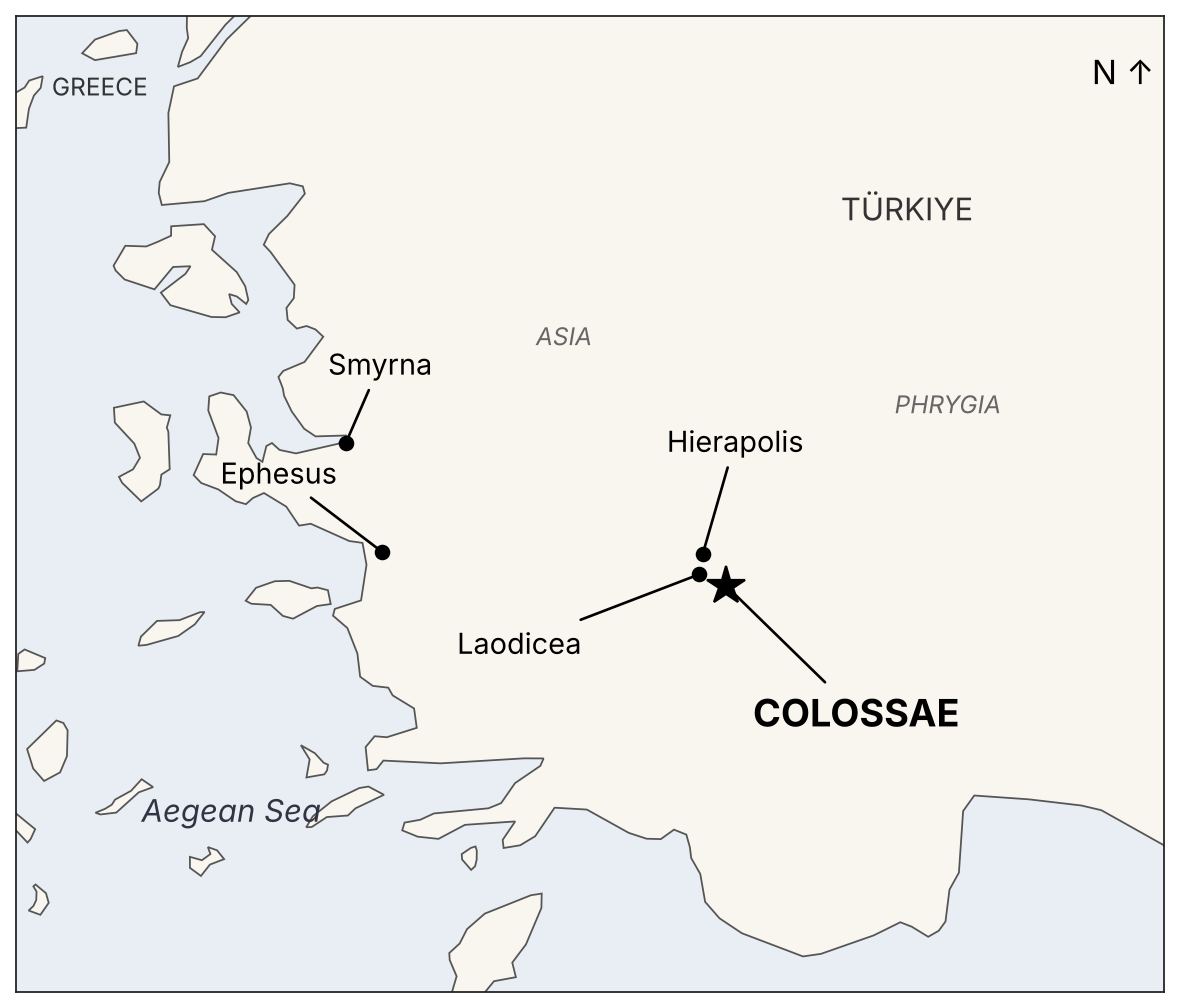
Modern locator map. Colossae is marked by a star, with its neighbors Laodicea and Hierapolis close by in the Lycus valley. Rome, where Paul most likely wrote, lies nearly 900 miles to the west.
Colossians among the New Testament books
Matthew · Mark · Luke · John · Acts · Romans · 1 Corinthians · 2 Corinthians · Galatians · Ephesians · Philippians · Colossians · 1 Thessalonians · 2 Thessalonians · 1 Timothy · 2 Timothy · Titus · Philemon · Hebrews · James · 1 Peter · 2 Peter · 1 John · 2 John · 3 John · Jude · Revelation
Colossians is the twelfth of the 27 books in the New Testament. It comes after Philippians and before 1 Thessalonians.
When and where it was written
Paul wrote Colossians as a prisoner (Colossians 4:3, 10, 18), most likely during his first imprisonment in Rome, about AD 60–62. Some scholars suggest an earlier imprisonment in Ephesus or Caesarea, but the message of the letter is the same either way. That places Colossians in the middle years of Paul’s letter writing. By then he had already written Galatians, 1 and 2 Thessalonians, 1 and 2 Corinthians and Romans. Colossians was written at about the same time as Ephesians and Philemon (Tychicus carried Colossians and Ephesians together, and Onesimus traveled with him back to Philemon), and near the time of Philippians. These four are often called the “Prison Letters.” Paul’s letters to Timothy and Titus (1 Timothy, Titus and 2 Timothy) came later, near the end of his life.
Meet the letter
Colossians is a short letter, only four chapters, written by Paul to a young church he had never visited. Epaphras, who first brought them the gospel, was now with Paul, praying hard for his home church (Colossians 4:12–13). The church was healthy; Paul thanks God for their faith in Christ, their love for all the saints, and the hope laid up for them in heaven (Colossians 1:4–5; 2:5). The letter travels with two others: Tychicus carried it, the same man who carried Ephesians, and with him went Onesimus, returning to his master Philemon (Colossians 4:7–9). Reading Colossians, Ephesians and Philemon together gives a warm picture of this church and its people.
But a dangerous teaching was knocking at the door. Paul never names it, but from his warnings we can see its outline: human philosophy and “empty deceit” (Colossians 2:8), Jewish rules about circumcision, food, festivals and Sabbaths pressed on Gentile believers (Colossians 2:11, 16), strict rules of self-denial (Colossians 2:20–23), and the worship of angels and boasting about visions (Colossians 2:18). Behind it all was the suggestion that Jesus was not enough. Many Bible teachers see in it a mix of Jewish legalism and early forms of ideas that later grew into Gnosticism; scholars debate the exact details, but Paul’s answer is clear. His answer to every “Jesus plus” teaching is not a new rule but a better look at Jesus: in Him the whole fullness of deity dwells bodily, and believers are “filled in him” (Colossians 2:9–10).
Paul wrote as a prisoner (Colossians 4:3, 10, 18), and he wants the church to be strong in Christ. Chapters 1–2 teach who Christ is and what He has done; chapters 3–4 show how to live because of it, at home, at work and in the church.
The central message Christ is supreme over all things and all-sufficient for salvation and life, so believers need nothing added to Him. Because we have died and been raised with Him, we live out our new identity in Him in everyday life, for “Christ is all, and in all” (Colossians 3:11).
A verse to carry through the study Colossians 1:18 BLB
Find your way
Main teachings
Faith, love and hope
Colossians 1:3–8 The true gospel produces faith in Christ, love for all the saints and hope laid up in heaven, and it bears fruit wherever it goes.
A worthy walk
Colossians 1:9–14 Paul prays that believers be filled with the knowledge of God’s will so they live to please the Lord, strengthened for joyful endurance and thankful for their rescue into the kingdom of His Son.
The preeminent One
Colossians 1:15–20 Jesus is the image of the invisible God, the Creator and sustainer of all things and the Head of the church, so that in everything He might be first.
Reconciled by the cross
Colossians 1:21–23 Those once alienated from God are reconciled through Christ’s death to be presented holy and blameless, as they continue steadfast in the faith.
Christ in you, the hope of glory
Colossians 1:24–29 Paul gladly labors and suffers to make known God’s mystery, Christ in His people, so that everyone may be presented mature in Christ.
Rooted and built up
Colossians 2:1–7 All the treasures of wisdom and knowledge are hidden in Christ, so as we received Him we keep walking in Him, rooted, built up and abounding in thanksgiving.
Complete in Christ
Colossians 2:8–15 In Christ the whole fullness of deity dwells bodily, and believers are filled in Him, forgiven, raised with Him and freed by His triumph on the cross.
The shadow and the substance
Colossians 2:16–23 Rules about food, days and self-denial were shadows; the substance is Christ, and man-made rules have no power to stop the flesh.
Set your minds on things above
Colossians 3:1–4 Since we have been raised with Christ and our life is hidden with Him in God, we seek and think about the things above, where He is.
Put off the old, put on the new
Colossians 3:5–17 Put to death the old sinful ways and put on compassion, kindness, humility, forgiveness and above all love, doing everything in the name of the Lord Jesus with thanks.
As to the Lord at home and at work
Colossians 3:18–4:1 Wives and husbands, children and fathers, servants and masters each live “as to the Lord,” remembering that everyone has a Master in heaven.
Prayer and gracious speech
Colossians 4:2–6 Continue steadfastly in prayer with thanksgiving, pray for open doors for the gospel, and let your speech toward outsiders be gracious and seasoned with salt.
Praying through Colossians
Colossians is a letter soaked in prayer. Paul opens by thanking God for the believers and praying for them (Colossians 1:3–14), tells them how hard he struggles for them (Colossians 2:1), and closes by asking them to keep praying with thanksgiving (Colossians 4:2–4) and by telling them that Epaphras is always wrestling in prayer on their behalf (Colossians 4:12). Paul’s prayer in chapter 1 is a model for our own praying: thanks for faith and love, wisdom to know God’s will, a walk worthy of the Lord, fruit and growth, strength for joyful endurance, and gratitude for our inheritance.
One of the best ways to study this letter is to pray it. Read a passage slowly, then say it back to God as your own prayer, for yourself and for people you name. Let God’s Word shape what you ask, what you confess and what you thank Him for. The two prayers below are my own, prayed aloud as I read through Colossians 1 and Colossians 3:1–17. Pray them as they are, then pray them again in your own words.
The prayers in this letter
Colossians 1:3–8 — Thanksgiving for the church. Paul thanks God for the Colossians’ faith in Christ and love for all the saints, which spring from the hope laid up in heaven and the gospel they learned from Epaphras.
Colossians 1:9–14 — Paul’s prayer for a worthy walk. Paul asks that they be filled with the knowledge of God’s will so they may walk worthy of the Lord, bear fruit, grow in knowing God, be strengthened for joyful endurance, and give thanks to the Father who rescued them into the kingdom of His Son.
Colossians 2:1–3 — Paul’s struggle for them. Paul tells believers he has never met how great a struggle he has for them, that their hearts may be encouraged, knit together in love, and brought to the full knowledge of Christ, in whom all the treasures of wisdom are hidden.
Colossians 4:2–4 — Pray for an open door. Paul urges them to continue steadfastly in prayer, watchful and thankful, and to pray that God would open a door for the word so he can make the mystery of Christ clear.
Colossians 4:12–13 — Epaphras struggling in prayer. Epaphras, one of their own, is always struggling for them in his prayers, that they may stand mature and fully assured in all the will of God.
A prayer from Colossians 1
Pray it with Colossians 1:9–14 BLB
Father of our Lord Jesus Christ, we always thank You when we pray for one another. May those words sink into our hearts; may we be ever prayerful for one another. Lord, help me, help each of us, all of us, to have faith in You so strong, because of You, that others would hear of our faith and be encouraged by it. And not just our faith in Christ Jesus, but the love that we have for all the saints, all the brothers and sisters in Christ, resting on the hope laid up for us in heaven.
Lord, may we not cease to pray for one another, asking that each of us would be filled with the knowledge of Your will, O God, in all spiritual wisdom and understanding, so as to walk in a manner worthy of You. Help me, help each of us, to be fully pleasing to You: that we would bear fruit in every good work and increase in the knowledge of You, O God; that we would be strengthened with all power, according to Your glorious might, for all endurance and patience with joy.
We give thanks to You, Father. You have qualified us to share in the inheritance of the saints in light. What a great inheritance! Nothing this world offers can compare to it. You have delivered us from the domain of darkness; we have come from darkness to light.
And Lord, You transferred us to the kingdom of Your beloved Son. Thank You for the transfer! I didn’t put in for it. You sought me out. It is not that I first loved You, but You first loved me. In Your beloved Son we have redemption, the forgiveness of sins. In Jesus’ name, amen.
A prayer from Colossians 3
Pray it with Colossians 3:1–17 BLB
Lord, we seek those things that are above, where Christ is seated at Your right hand. May we set our minds on things that are above and not on things of this earth. For we have died, and our life is hidden with Christ in You, God. When Christ, who is our life, appears, then we also will appear with Him in glory, and we look forward to that day.
We need to put to death what is earthly: our sexual immorality, impurity, passion, evil desires and covetousness. Now we must put them all away. Put away anger and wrath and malice and slander and obscene talk from our mouths. May we not lie to one another. We have put off the old self with its practices and put on the new self, being renewed after the image of its Creator.
Thank You, Lord, that we can put those things away. And then we put on, as God’s chosen ones, holy ones, hearts of compassion, kindness, humility, meekness and patience, bearing with one another, and forgiving each other. As the Lord has forgiven me, as the Lord has forgiven us, so we also must forgive. And above all these, we put on love, which binds everything together in perfect harmony. Love is not an emotion; love is a commitment for God’s best for other people.
Let the peace of Christ rule in our hearts, to which indeed we were called in one body, and may we be thankful. Let the word of the Lord dwell in me, in us, richly, with thankfulness in our hearts. And whatever we do, in word or deed, may we do everything in the name of the Lord Jesus, giving thanks to You, O God our Father, through Him. In Jesus’ name, amen.
Read Colossians
Select a chapter to read it in the ESV in a reading window, right here on this page.
Colossians 1:1–29 Colossians 2:1–23 Colossians 3:1–25 Colossians 4:1–18
A brief outline
1:3–1:14 Thanksgiving and Prayer
1:15–1:23 The Preeminence of Christ
1:24–2:5 Paul’s Ministry to the Church
Study every verse
Begin with the Scripture, then read the study notes and the passages to read alongside. After each section, pause over the question. The aim is to understand Paul’s meaning and put it into practice in dependence on Christ.
Chapter 1 1:1 1:2 1:3 1:4 1:5 1:6 1:7 1:8 1:9 1:10 1:11 1:12 1:13 1:14 1:15 1:16 1:17 1:18 1:19 1:20 1:21 1:22 1:23 1:24 1:25 1:26 1:27 1:28 1:29
Chapter 2 2:1 2:2 2:3 2:4 2:5 2:6 2:7 2:8 2:9 2:10 2:11 2:12 2:13 2:14 2:15 2:16 2:17 2:18 2:19 2:20 2:21 2:22 2:23
Chapter 3 3:1 3:2 3:3 3:4 3:5 3:6 3:7 3:8 3:9 3:10 3:11 3:12 3:13 3:14 3:15 3:16 3:17 3:18 3:19 3:20 3:21 3:22 3:23 3:24 3:25
Chapter 4 4:1 4:2 4:3 4:4 4:5 4:6 4:7 4:8 4:9 4:10 4:11 4:12 4:13 4:14 4:15 4:16 4:17 4:18
Chapter 1
Greeting
Colossians 1:1
Read the verse: Colossians 1:1 BLB
Study Notes
Paul opens the way letters opened in his day: first the writer, then the readers, then a greeting. Think of this first verse as the letterhead. But even his name carries a testimony. He is an apostle, one sent out by Christ with a commission, and he holds that office “by the will of God,” not by his own ambition. Paul was not one of the Twelve, but he did see the risen Christ (1 Corinthians 9:1; 15:8–9), and God gave him the signs that marked a true apostle (2 Corinthians 12:12). The man who once hunted Christians now serves Christ because God called him.
Ask yourself: who was Paul, and who are we? In one sense, the same: sent by God and belonging to Christ Jesus, by the will of God. Our new birth is God’s will, not our own idea, and it is God’s will for us to be in Christ Jesus. Notice too that Paul calls Timothy “our brother”: not mine or yours, but ours. The great apostle does not stand alone or above others; he stands in a family. How do we become more Timothys? By the same road: humbly submitted to Christ (Romans 12:1).
Read alongside 2 Corinthians 1:1 BLB; 1 Corinthians 15:8–10 BLB; Galatians 1:15–16 BLB; Romans 12:1 BLB
Colossians 1:2
Read the verse: Colossians 1:2 BLB
Study Notes
Paul calls ordinary believers in a small town “saints.” In the Bible a saint is not a super-Christian but every person God has set apart for Himself in Christ. They are also “faithful brothers,” a family word that includes the sisters too (the NLT says “brothers and sisters”). Read the verse as a letter to our own church: “To the saints and faithful brothers in Christ at Mandeville Bible Church.” Are we saints? Faithful brothers and sisters? Then we are called to live like it, and to follow the saints to the end of the trail.
Then comes the greeting: grace and peace. Grace is God’s undeserved favor; peace is what grace produces, first peace with God and then His peace within us. There is no lasting peace without grace, and both come “from God our Father.” We might open a letter with “Dear John.” Paul opens with a blessing, and that sets a standard for how believers greet one another. We can turn it into prayer: “Lord, we make this same prayer for all of the body of Christ: grace to the body of Christ, and peace from God our Father.”
Read alongside 1 Corinthians 1:2 BLB; Romans 1:7 BLB; Ephesians 1:1–2 BLB; Numbers 6:24–26 BLB
Put it into practice This week, open a text, card or email to a fellow believer the way Paul did: tell them you count them as family in Christ, and bless them with grace and peace from God our Father. Then pray that same blessing over your own church by name.
Thanksgiving and Prayer
Colossians 1:3
Read the verse: Colossians 1:3 BLB
Study Notes
Paul had never met most of the Colossians, yet he says he always thanks God for them when he prays. His prayers begin with thanksgiving, not with complaints or requests. And he thanks God, not the Colossians, for their faith, because faith is God’s work in them. He addresses God as “the Father of our Lord Jesus Christ”: we come to God through His Son, and in Christ the Almighty becomes our Father too.
Slow down over the pieces: “we always thank God” — “the Father of our Lord Jesus Christ” — “when we pray” — “for you.” Who are we thanking God for? Who are we praying for, and when, and how, and to what end? My prayer is simple: “Lord, may those words sink into our hearts: when we pray for you. May we be ever prayerful for one another.” As Matthew Henry put it, “Thanksgiving ought to be a part of every prayer.”
Read alongside Philippians 1:3–4 BLB; 1 Thessalonians 1:2–3 BLB; Ephesians 1:15–16 BLB; Colossians 4:2 BLB
Colossians 1:4
Read the verse: Colossians 1:4 BLB
Study Notes
Word had traveled to Paul in prison that the Colossians had two marks of real Christianity: faith in Christ Jesus and love for all the saints. Faith looks up to God; love reaches out to others. Their faith was “in Christ Jesus,” and faith is only as good as the One it rests on. Their love was for “all” the saints, not only the ones who were easy to love.
Reading it as a letter to us, ask: what report is going out about our faith in Christ Jesus? How are we doing in the “love you have for all the saints” category, and what are we doing to act on that love? I pray for faith so strong, because of Christ, that others would hear of it and be encouraged by it.
Read alongside Ephesians 1:15–16 BLB; John 13:35 BLB; 1 Thessalonians 1:3 BLB; Galatians 5:6 BLB
Colossians 1:5
Read the verse: Colossians 1:5 BLB
Study Notes
Where do faith and love come from? Paul says they spring “because of the hope laid up for you in heaven.” Faith, hope and love are a favorite trio of Paul’s and Peter’s: faith looks up to God, love looks out to others, and hope looks ahead. Christian hope is not a maybe. It is confident expectation, a sure inheritance stored up and guarded by God. It is kept in heaven because Christ, the heart of our hope, is there, interceding for us (Hebrews 7:25). When we know what is waiting for us, we can trust God today and love others freely, even at a cost.
The Colossians first heard of this hope in “the word of the truth, the gospel.” The good news is not one opinion among many; it is the truth. Ask yourself: just how good is the good news? Does our sharing match up with the magnitude of how great the good news is?
Read alongside 1 Corinthians 13:13 BLB; 1 Peter 1:3–4 BLB; Titus 2:13 BLB; Ephesians 1:13 BLB
Colossians 1:6
Read the verse: Colossians 1:6 BLB
Study Notes
The gospel is alive. Paul pictures it like a healthy plant, bearing fruit and growing, both across the whole world and right there in Colossae. What is the “which” and the “it” doing all this? The gospel itself, carried by God’s power. We can pray, “The power, O Lord, is in the gospel. Not in our words, but in the truth and the power of Your words.” Even when we don’t think so, it is bearing fruit bountifully today, then and now. Is it increasing among us, in my life and in yours?
It all began “the day you heard it and understood the grace of God in truth.” The grace of God is this: God gives us salvation through Jesus and His finished work on the cross, a gift we could never earn or deserve. Hearing is not enough; the seed must be received and understood. When grace is truly grasped, it always produces fruit.
Read alongside Mark 4:20 BLB; Isaiah 55:10–11 BLB; Ephesians 2:8–9 BLB; Romans 1:16 BLB
Colossians 1:7
Read the verse: Colossians 1:7 BLB
Study Notes
Epaphras was from Colossae (Colossians 4:12). He most likely heard the gospel during Paul’s long ministry in Ephesus, when “all the residents of Asia heard the word of the Lord” (Acts 19:10), and carried it home. Paul honors him with three titles: “beloved,” “fellow servant” (literally “fellow slave,” serving the same Master), and “faithful minister of Christ.” The Colossians did not receive a second-rate gospel from a second-rate teacher.
Every believer learned the gospel from someone. Ask yourself: who did you learn it from? Is that person a faithful minister of Christ on your behalf, and what about you for him? Then pray, “Lord, help each one of us to be faithful ministers of Christ on behalf of others.”
Read alongside Colossians 4:12–13 BLB; 1 Corinthians 4:1–2 BLB; Acts 19:10 BLB; Philemon 23 BLB
Colossians 1:8
Read the verse: Colossians 1:8 BLB
Study Notes
Epaphras brought Paul a good report: the Colossians had “love in the Spirit.” This is the only direct mention of the Holy Spirit in Colossians, and it is tied to love. The Spirit produces love in believers (Galatians 5:22). It is not simply people being friendly; it is God’s own love flowing through His people. Are there people around us who are making known our love in the Spirit? Let us pray that we too “may be known by our love in the Spirit.”
Read alongside Galatians 5:22–23 BLB; Romans 5:5 BLB; Romans 15:30 BLB; John 13:35 BLB
Colossians 1:9
Read the verse: Colossians 1:9 BLB
Study Notes
Now Paul tells us what he prays, and he never stopped praying it. He asks that believers be “filled” with the knowledge of God’s will. The false teachers at Colossae offered a special, secret knowledge. Paul prays for something better: full, personal knowledge of God’s will, given to every believer through His Word and Spirit. It is not mere head knowledge; it comes “in all spiritual wisdom and understanding,” the kind that knows how to apply God’s truth to real life.
It helps to set knowledge beside truth. Knowledge implies truth; “knowledge” of a thing that is not true is only a false belief. And something can be true without our knowing it: Jesus is the Truth, but if you do not know Him you have no knowledge of the ultimate truth. That is where the Word of God and the people of God, led by the Spirit of God, come into play: reading, understanding, a crisis of belief (think of Psalm 23), course correction, and thriving while applying.
Read alongside Ephesians 1:17 BLB; Philippians 1:9–10 BLB; John 14:6 BLB; James 1:5 BLB
Colossians 1:10
Read the verse: Colossians 1:10 BLB
Study Notes
“So as to.” Does that little phrase mean anything to us? It should, because everything hangs on it. Knowledge of God’s will has a purpose: “to walk in a manner worthy of the Lord.” Paul never separates what we know from how we live. A worthy walk is everyday conduct, step by step, that fits the One we belong to, the way a good son brings honor to his father’s name. How is your walk? Is it worthy of the Lord?
Paul fills out what that walk looks like: fully pleasing to Him, bearing fruit in every good work, and increasing in the knowledge of God. Knowing leads to doing, and doing God’s will leads to knowing Him better still. We can pray it plainly: “Lord, help me, help each of us, to be fully pleasing to You.” This is the heart of our purpose, to glorify God by trusting and obeying Him as we follow Jesus as Savior and Lord (1 Corinthians 10:31).
Read alongside Ephesians 4:1 BLB; John 15:8 BLB; 1 Corinthians 10:31 BLB; 2 Peter 3:18 BLB
Colossians 1:11
Read the verse: Colossians 1:11 BLB
Study Notes
A worthy walk is impossible in our own strength, so Paul prays that believers be “strengthened with all power, according to his glorious might.” The measure of the strength is not our weakness but His might. And what is that power for? Not showy miracles, but “all endurance and patience.” Endurance holds up under hard circumstances without giving up; patience bears with hard people.
Then Paul adds two words that change everything: “with joy.” God’s strength lets us not merely survive trials but go through them, as we pray, “enduring it with patience, and with joy.”
Read alongside Ephesians 3:16 BLB; Nehemiah 8:10 BLB; James 1:2–4 BLB; Philippians 4:13 BLB
Colossians 1:12
Read the verse: Colossians 1:12 BLB
Study Notes
Take this verse as a personal review: review your record of thankfulness before God, and review just what all He has done for you. The Father “has qualified you to share in the inheritance of the saints in light.” We did not qualify ourselves; no one earns a place in God’s family. God Himself made us fit. The picture recalls Israel receiving its shares of the Promised Land, but believers share in something far greater, the kingdom of light.
“What a great inheritance!” I pray. “Nothing this world offers can compare to it.” When we remember that we were given what we could never earn, thankfulness becomes the natural response.
Read alongside Acts 26:18 BLB; Romans 8:17 BLB; 1 Peter 1:3–4 BLB; Ephesians 1:11 BLB
Colossians 1:13
Read the verse: Colossians 1:13 BLB
Study Notes
Here is the gospel in two actions. God “delivered us from the domain of darkness,” snatching us out of the rule of sin and Satan, which we could not escape on our own. Then He “transferred us to the kingdom of his beloved Son,” a word used of moving a whole people from one land to another. We did not wander out of darkness; God carried us out and brought us under a new King. Both verbs speak of something already done. A believer is not trying to get into the kingdom; by God’s grace he already lives there.
I love this verse: “Lord, thank You for the transfer! Lord, I didn’t put in for it. You sought me out. It is not that I first loved You, but You first loved me” (1 John 4:19).
Read alongside 1 Peter 2:9 BLB; John 8:12 BLB; Acts 26:18 BLB; 1 John 4:19 BLB
Colossians 1:14
Read the verse: Colossians 1:14 BLB
Study Notes
In Christ “we have redemption, the forgiveness of sins.” Redemption means release by the payment of a ransom. We were captives to sin, and Jesus paid our ransom with His own blood (Ephesians 1:7). The result is forgiveness: our sins sent away, the debt canceled. All have sinned, but we are justified by His grace as a gift (Romans 3:23–24), and “if the Son sets you free, you will be free indeed” (John 8:36).
Notice the word “have.” This is not a future hope or a reward for good behavior; it is the present possession of everyone who is “in whom,” that is, in Christ. And this verse leads straight into Paul’s great hymn about who that beloved Son is (verses 15–20).
Read alongside Ephesians 1:7 BLB; Romans 3:23–24 BLB; John 8:36 BLB; Hebrews 9:22 BLB
Put it into practice Choose one line of Paul’s prayer in verses 9–12 and pray it every day this week for someone you name. Begin each time by thanking God for that person, and end by thanking Him for your own “transfer” into the kingdom of His beloved Son.
The Preeminence of Christ
Colossians 1:15
Read the verse: Colossians 1:15 BLB
Study Notes
Who is “He”? Look back at verses 13–14: He is the beloved Son in whom we have redemption, the forgiveness of sins. Paul has just told us what Jesus has done; now he stops to show us the fullness of who He is. Jesus is King, and this whole passage is about His exaltation and preeminence. He is uniquely qualified: the image of God, the firstborn over all creation, the Creator of the universe, the Head of the church, the firstborn from the dead, the fullness of God, and the reconciler of all things.
“The image of the invisible God.” The Greek word is eikōn, an exact representation and revelation, like the image stamped on a coin (Hebrews 1:3). No one has ever seen God, but in Jesus the unseen God has been made visible. As Jesus told Philip, “Whoever has seen me has seen the Father.” “The firstborn of all creation” does not mean Jesus was the first thing created; that idea would contradict the very next two verses. He is firstborn not “in” creation but “over” it: absolutely first in time and sovereign in rank, the Heir and Lord of all. And a question to carry with you: whose image are you bearing?
Read alongside Hebrews 1:3 BLB; John 14:9 BLB; John 1:18 BLB; 1 Timothy 1:17 BLB; Psalm 89:27 BLB
Colossians 1:16
Read the verse: Colossians 1:16 BLB
Study Notes
Why is Christ supreme over creation? Because He made it. “All things” means the entire universe, material and immaterial, in heaven and on earth, seen and unseen. The “thrones or dominions or rulers or authorities” point to a highly organized order in the spirit world, yet every one of those powers was made by Jesus and answers to Him. Even the demons knew who He was: “What have you to do with me, Jesus, Son of the Most High God?” (Mark 5:7).
All things were created “through him and for him.” Jesus is not only the builder of the universe but its purpose, the final cause, the reason it exists. How clear can that be? We were not just created through Jesus; we were created for Jesus. Lord, may we live for Him.
Read alongside John 1:3 BLB; Romans 11:36 BLB; Hebrews 1:2 BLB; Mark 5:7 BLB
Colossians 1:17
Read the verse: Colossians 1:17 BLB
Study Notes
“He is before all things”: Jesus existed before anything was made, and He ranks above everything that exists. “Before Abraham was, I am” (John 8:58). And “in him all things hold together.” He is the conserving cause of all life and all non-living things; everything continues to exist in, through and by Him. Christ did not create the world and then step away.
All things includes us. Our lives, our families and our troubles are held together in Him too. Let us pray: Lord, may we put Jesus before everything. He is before everything, so let Him occupy that place in our minds and hearts, in our thinking, our being, our doing and our speaking.
Read alongside John 1:1–2 BLB; John 8:58 BLB; Hebrews 1:3 BLB; Acts 17:28 BLB
Colossians 1:18
Read the verse: Colossians 1:18 BLB
Study Notes
In addition to being Lord of the universe, Jesus is Head of the church, His body. A body takes its life and direction from its head. If we have been born again, we are part of the body of Christ, and Jesus is our Head.
He is “the beginning, the firstborn from the dead”: the first to rise with an immortal body, never to die again, and so the Head of all who come after Him, a whole new order of beings. He conquered sin, death and the grave; He is the only One who could. Paul sums it all up: “that in everything he might be preeminent,” first place over all creation, over the church, and in each of our lives. Lord, help me to see and live Jesus as preeminent in everything.
Read alongside Ephesians 1:22–23 BLB; 1 Corinthians 15:20 BLB; Revelation 1:5 BLB; Romans 8:29 BLB
Colossians 1:19
Read the verse: Colossians 1:19 BLB
Study Notes
Place huge significance in this verse. It is the highest description of the deity of Christ: completeness. Not a part of God, not a spark of the divine, but “all the fullness of God” lives in Jesus, and it lives there to stay. Some at Colossae may have taught that God’s fullness was spread out among many spiritual beings. Paul says it is all in Christ, and he will say it again even more plainly in 2:9.
This is why we need nothing added to Jesus. Everything God is, is found in Him, and from His fullness we have all received, grace upon grace (John 1:16).
Read alongside Colossians 2:9 BLB; John 1:16 BLB; John 1:14 BLB
Colossians 1:20
Read the verse: Colossians 1:20 BLB
Study Notes
Through Jesus, God reconciles “all things” to Himself, all things redeemed, in heaven and on earth. To reconcile is to bring back together. Our sinfulness had separated us from God, because His righteousness can have nothing to do with sin. Jesus bridged that gap.
“Making peace by the blood of his cross.” That is counterintuitive, counter to the world’s way of thinking, but peace is in the cross. The peace that matters most is not the absence of trouble; it is being reconciled, brought back together with God. That is us being brought to the God of peace, and the peace of God being in us. And God has given those who are reconciled the ministry of reconciliation, to tell others (2 Corinthians 5:18).
Read alongside 2 Corinthians 5:18–19 BLB; Romans 5:1 BLB; Ephesians 2:14–16 BLB
Colossians 1:21
Read the verse: Colossians 1:21 BLB
Study Notes
Now Paul makes it personal: “And you.” Before Christ the Colossians were alienated from God, strangers to Him. Worse, they were “hostile in mind,” set against Him in their thinking, and that hostility showed in “evil deeds.” Paul does not soften the picture. Only when we see how deep our problem was can we see how great the rescue is: God reconciled His enemies.
Read alongside Romans 5:10 BLB; Ephesians 2:12–13 BLB; Romans 8:7 BLB
Colossians 1:22
Read the verse: Colossians 1:22 BLB
Study Notes
How did God reconcile His enemies? “In his body of flesh by his death”: a real body and a real death. From the cross Jesus said, “It is finished” (John 19:30). Everything was paid for in full.
The goal is “to present you holy and blameless and above reproach before him.” Blameless is a sacrifice word, without blemish; above reproach means no charge is left that can stand. I can pray, “I’m not holy and blameless in myself, but in Christ I am.” All who are in Christ are the righteousness of God in Him (2 Corinthians 5:21).
Read alongside John 19:30 BLB; 2 Corinthians 5:21 BLB; Ephesians 5:27 BLB; Jude 24 BLB
Colossians 1:23
Read the verse: Colossians 1:23 BLB
Study Notes
“If indeed you continue in the faith.” Paul is not planting doubt about salvation; he is saying that true faith lasts. If we are truly in the faith, we will continue in the faith. If we have been born again, we won’t become unborn. Continuing, “stable and steadfast,” is the evidence of real faith, not the price of it.
“Not shifting from the hope of the gospel” may well be the purpose of the whole letter, since the Colossians were being pressed to move off the gospel toward attractive new teaching. That gospel came by hearing, for faith comes from hearing (Romans 10:17), and it has gone out into all the world. Paul became its minister, and we too are called to proclaim it (Matthew 28:19–20).
Read alongside Hebrews 3:14 BLB; 1 Corinthians 15:58 BLB; Romans 10:17 BLB; Matthew 28:19–20 BLB
Put it into practice Paul says Jesus is to be preeminent “in everything” (verse 18). Name one thing that competes with Jesus for first place in your thinking, your time or your affections, and this week deliberately put Him before it, praying, “Lord, may we put Jesus before everything.”
Paul’s Ministry to the Church
Colossians 1:24
Read the verse: Colossians 1:24 BLB
Study Notes
Paul writes from prison, yet he can say, “I rejoice in my sufferings for your sake.” He gladly spends himself so that the church will hear and take in the gospel. Paul is filling in the gap, so to speak, helping believers like the Colossians embrace the good news he preached.
“Filling up what is lacking in Christ’s afflictions” does not mean Jesus’ death was not enough to save us; this same letter says we are forgiven and made complete in Him (Colossians 1:14, 22; 2:13–14). Many Bible teachers understand Paul to mean that Christ’s body, the church, still shares in suffering as the gospel goes out, and Paul willingly takes his share for the sake of others.
Read alongside 2 Corinthians 1:5–6 BLB; Philippians 3:10 BLB; 2 Timothy 2:10 BLB; Acts 9:15–16 BLB
Colossians 1:25
Read the verse: Colossians 1:25 BLB
Study Notes
Paul became a minister of the church “according to the stewardship from God that was given to me for you.” A steward manages what belongs to someone else. That stewardship was for those at Colossae, and it reaches to us today. We too are stewards of the gospel, caretakers of it. We should be doing the things God has called us to do, and doing them well, “to make the word of God fully known,” to proclaim the good news of Jesus.
Read alongside 1 Corinthians 4:1–2 BLB; 1 Peter 4:10 BLB; Ephesians 3:2 BLB; Acts 20:24 BLB
Colossians 1:26
Read the verse: Colossians 1:26 BLB
Study Notes
“The mystery hidden for ages and generations but now revealed to his saints.” In the Bible a mystery is not a puzzle for a select few; it is a truth God once kept hidden and has now made known. It had been told from the beginning: throughout the Old Testament we see that a Savior is coming, a Messiah who comes to save His people. Now it has been revealed. This is the Jesus of whom they had been reading.
Read alongside Romans 16:25–26 BLB; Ephesians 3:4–6 BLB; 1 Peter 1:10–12 BLB
Colossians 1:27
Read the verse: Colossians 1:27 BLB
Study Notes
God chose to make known “how great among the Gentiles are the riches of the glory of this mystery.” The wonder is not only that the Messiah came, but that He comes to live in people of every nation, including the Gentile believers at Colossae, and including us.
The mystery is “Christ in you, the hope of glory.” Paul’s words in Galatians 2:20 say the same: “It is no longer I who live, but Christ who lives in me.” Christ living in us now is our guarantee of the glory to come. Let us pray: Lord, let that be true day by day, moment by moment, in each of our lives.
Read alongside Galatians 2:20 BLB; Romans 8:10–11 BLB; Ephesians 3:6 BLB; John 14:20 BLB
Colossians 1:28
Read the verse: Colossians 1:28 BLB
Study Notes
“Him we proclaim.” Not a system or a set of rules, but Jesus. Proclaiming Him includes “warning everyone,” warning that Jesus is coming back and there is a day of reckoning, and “teaching everyone” that we were created to be in a relationship with God through Jesus. Warning and teaching everyone is love; it is not intolerance. We are to be ready to give a reason for the hope we have, yet with gentleness and respect (1 Peter 3:15).
The goal is “that we may present everyone mature in Christ.” Not just in Christ, but mature. The power is not in us but in the good news of Jesus, the Word of God. Lord, help each of us to mature.
Read alongside 1 Peter 3:15 BLB; Ephesians 4:13 BLB; Colossians 4:12 BLB; Acts 20:20–21 BLB
Colossians 1:29
Read the verse: Colossians 1:29 BLB
Study Notes
“For this I toil, struggling with all his energy that he powerfully works within me.” Paul worked hard; the word “struggling” pictures an athlete straining in a contest. Yet the strength was not his own. God powerfully works that same energy within us when we yield ourselves, surrender ourselves and give ourselves to Him. Praise be to God.
Read alongside Philippians 2:12–13 BLB; 1 Corinthians 15:10 BLB; Ephesians 3:20 BLB
Chapter 2
Colossians 2:1
Read the verse: Colossians 2:1 BLB
Study Notes
Paul had never visited Colossae or nearby Laodicea, yet he tells them how great a “struggle” he has for them. The Greek word agōn (our word “agony” comes from it) is the word for an athlete’s hard contest. Paul’s struggle was mostly in prayer and pastoral concern, just as Epaphras was “always struggling on your behalf in his prayers” (Colossians 4:12).
Ask yourself: What is the struggle? Who are you struggling for? Do you struggle only for those you have met in person? Love for God’s people does not depend on having met them. We can carry real concern, and real prayer, for believers we have never seen.
Read alongside Colossians 1:29 BLB; Colossians 4:12–13 BLB; 2 Corinthians 11:28 BLB
Colossians 2:2
Read the verse: Colossians 2:2 BLB
Study Notes
Paul’s aim is threefold: that their hearts would be encouraged, that they would be “knit together in love,” and that they would have the full riches of a settled understanding of God’s mystery, which is Christ Himself. Love and understanding go together. Believers joined to one another in love grow together in knowing Christ, and knowing Christ draws them closer to one another.
Questions for discussion: How might you encourage hearts? What does it mean for members of the body of Christ to be knit together in love? And where are you with the knowledge of “God’s mystery,” Christ?
Read alongside Colossians 1:27 BLB; Ephesians 4:16 BLB; Ephesians 3:17–19 BLB
Colossians 2:3
Read the verse: Colossians 2:3 BLB
Study Notes
Everything we need to know about God, life and salvation is found in Christ. The treasures of wisdom and knowledge are “hidden” in Him, not so they cannot be found, but so they are found only in Him. The false teachers claimed a deeper, secret knowledge. Paul answers that there is nothing deeper than Christ. We do not need to go beyond Him; we need to go further into Him, through His Word, prayer and obedience.
This touches what we saw about knowledge and truth at 1:9. Knowledge of something that is not true is only false belief. Jesus is the truth, and if you do not know Him you have no knowledge of the ultimate truth. That is where the Word of God, and the people of God led by the Spirit of God, come into play.
Read alongside 1 Corinthians 1:30 BLB; Romans 11:33 BLB; John 14:6 BLB; Proverbs 2:6 BLB
Colossians 2:4
Read the verse: Colossians 2:4 BLB
Study Notes
Paul explains why he has stressed that all wisdom is in Christ: so “that no one may delude you with plausible arguments.” These are ideas that sound reasonable, even spiritual, but lead away from Christ. The best protection is not to study every error but to know the truth so well that the counterfeit is easy to spot. Ask yourself: What is the danger of being deluded? And how do you prevent it from happening?
Read alongside Ephesians 4:14 BLB; Romans 16:18 BLB; 2 Timothy 4:3–4 BLB; 1 John 4:1 BLB
Colossians 2:5
Read the verse: Colossians 2:5 BLB
Study Notes
Though Paul was far away, and in prison, his heart was with them. He rejoiced at their “good order” and the “firmness” of their faith, words used of soldiers standing in rank and holding a steady line. Even under the pressure of false teaching, they were standing together and standing firm.
Let me press it home: How are you with someone in spirit? Do we rejoice in how others are doing? Is your faith firm, and is that known by others? How?
Read alongside 1 Corinthians 5:3 BLB; 1 Corinthians 16:13 BLB; Philippians 1:27 BLB; 1 Thessalonians 3:7–8 BLB
Put it into practice Paul struggled in prayer for believers he had never met. Choose one believer or church you have never seen face to face, perhaps a missionary or a persecuted church, and pray for them each day this week that their hearts would be encouraged, knit together in love, and firm in Christ (Colossians 2:1–2).
Alive in Christ
Colossians 2:6
Read the verse: Colossians 2:6 BLB
Study Notes
This verse is the hinge of the chapter. The way we began with Christ is the way we go on with Him. We received Christ Jesus as Lord by faith, trusting His grace, and we are to “walk in him” the same way: by faith, under His lordship, depending on His grace every step.
The word for “received” was used of something handed down, like a teaching passed from one person to the next, and “walk” means to live day by day. The Christian life is not a matter of starting with Christ and then adding something else to finish the job. As Matthew Henry put it, “All Christians have, in profession at least, received Jesus Christ the Lord.” The question for each of us is whether we are walking in Him the way we received Him.
Read alongside Colossians 1:10 BLB; Galatians 5:25 BLB; Galatians 3:3 BLB; John 1:12 BLB
Colossians 2:7
Read the verse: Colossians 2:7 BLB
Study Notes
Paul uses pictures of a tree and a building. “Rooted” is a finished act: when we came to Christ we were planted in Him. “Built up” and “established” describe ongoing growth: day by day He builds us and makes us firm.
This growth follows what they “were taught,” the apostolic gospel, not new ideas. And the mark of a healthy believer is overflowing thankfulness, a grateful heart that others can see. It is fair to ask ourselves: what evidence is there of our thanks, and how would others know?
Read alongside Ephesians 3:17 BLB; 1 Thessalonians 5:18 BLB; Psalm 1:3 BLB; 1 Corinthians 3:11 BLB
Colossians 2:8
Read the verse: Colossians 2:8 BLB
Study Notes
“See to it” is a warning to stay alert. The word for “takes you captive” pictures a thief carrying off people as plunder. The danger is any teaching that rests on human tradition or on “the elemental spirits of the world” (the world’s basic ideas and the spiritual powers behind them) rather than on Christ.
Paul is not against careful thinking. He is against any system of thought, religious or not, that pushes Christ out of the center or claims to improve on Him. Matthew Henry wrote, “There is a philosophy which is vain and deceitful, which is prejudicial to religion.” The times change, but the temptation to be carried off by the world’s ideas does not.
Read alongside Romans 12:2 BLB; 1 Timothy 6:20 BLB; Colossians 2:4 BLB; Ephesians 4:14 BLB
Colossians 2:9
Read the verse: Colossians 2:9 BLB
Study Notes
This is one of the Bible’s clearest statements that Jesus is fully God. All the fullness of deity, not part of it, lives in Him, and it lives in Him “bodily,” in His true human nature. Jesus is not one spiritual power among many, as the false teachers suggested. He is God in the flesh.
That is why we need nothing more than Christ: in Him we have God Himself. Matthew Henry said that the fullness “dwells in him bodily; not as the body is opposed to the spirit, but as the body is opposed to the shadow.”
Read alongside John 1:14 BLB; Colossians 1:19 BLB; Hebrews 1:3 BLB; John 14:9 BLB
Colossians 2:10
Read the verse: Colossians 2:10 BLB
Study Notes
Because all the fullness of God is in Christ, those who belong to Christ “have been filled” in Him. The tense points to something already done, with lasting results. We are not half-saved, waiting for some extra experience or ritual to complete us. In Christ we already have all we need for life and godliness.
And He is the head over every power, earthly or spiritual, so there is no other authority to fear or to serve. This is Paul’s answer to every “Jesus plus” teaching: nothing needs to be added.
Read alongside John 1:16 BLB; Ephesians 1:22–23 BLB; 2 Peter 1:3 BLB; Colossians 1:16 BLB
Colossians 2:11
Read the verse: Colossians 2:11 BLB
Study Notes
Circumcision was the sign of belonging to God’s covenant people. Paul says believers have received a better circumcision, one “made without hands,” done by Christ Himself. It is the cutting away of the old sinful nature’s rule over us, the change of heart God promised long before in Deuteronomy 30:6.
So believers do not need an outward ritual to make them acceptable to God; Christ has already done the inward work. Matthew Henry: “It consists in putting off the body of the sins of the flesh, in renouncing sin and reforming our lives, not in mere external rites.”
Read alongside Romans 2:29 BLB; Deuteronomy 30:6 BLB; Philippians 3:3 BLB; Romans 6:6 BLB
Colossians 2:12
Read the verse: Colossians 2:12 BLB
Study Notes
Baptism pictures what happens when we are joined to Christ by faith. We share in His burial, the end of the old life, and in His resurrection, the start of a new life. Paul is careful to say this happens “through faith in the powerful working of God.”
The word for “working” means power in action. The same power that raised Jesus from the dead is at work in those who believe, and that is our hope for real change. Matthew Henry: “We are both buried and rise with him, and both are signified by our baptism.”
Read alongside Romans 6:4 BLB; Ephesians 1:19–20 BLB; Colossians 3:1 BLB; Galatians 3:27 BLB
Colossians 2:13
Read the verse: Colossians 2:13 BLB
Study Notes
Before Christ we were not merely weak or sick; we were spiritually dead, unable to make ourselves alive. God did what we could not do: He made us alive together with Christ. And He did it by forgiving “all our trespasses,” not some of them. The word for “forgiven” comes from the word for grace; it is forgiveness given freely as a gift.
Notice that Paul changes from “you” to “us.” He includes himself. Every believer, whatever his past, stands on the same ground of free forgiveness. As Matthew Henry put it, “The pardon of the crime is the life of the criminal.”
Read alongside Ephesians 2:4–5 BLB; Psalm 103:12 BLB; Ephesians 2:1 BLB; Romans 5:8 BLB
Colossians 2:14
Read the verse: Colossians 2:14 BLB
Study Notes
The “record of debt” was like a signed IOU listing everything we owed God and could never pay. God’s law stood against us with its just demands. At the cross God did not ignore the debt; He cancelled it by laying it on Christ, who paid it in full.
The picture is of the charges being nailed to the cross, where Jesus died for them. Nothing remains on the record against those who are in Christ. Matthew Henry: “When he was nailed to the cross, the curse was as it were nailed to the cross.”
Read alongside 1 Peter 2:24 BLB; Romans 8:1 BLB; Isaiah 53:5–6 BLB; 2 Corinthians 5:21 BLB
Colossians 2:15
Read the verse: Colossians 2:15 BLB
Study Notes
At the cross Christ disarmed the spiritual powers of evil that held people captive through guilt and accusation. With the debt cancelled, they have nothing left to charge us with. Paul pictures a Roman general leading defeated enemies through the streets in a victory parade.
What looked like Jesus’ defeat was His triumph. The “he” is God, and the victory is won “in him,” in Christ, through His cross. Matthew Henry: “The devil and all the powers of hell were conquered and disarmed by the dying Redeemer.”
Read alongside Hebrews 2:14 BLB; John 12:31 BLB; 1 John 3:8 BLB; Romans 8:33–34 BLB
Put it into practice Paul says your record of debt has been nailed to the cross (verse 14). Name one guilt or fear you are still carrying that Christ has already cancelled, and this week, each time it comes to mind, thank God out loud that it was nailed to the cross.
Let No One Disqualify You
Colossians 2:16
Read the verse: Colossians 2:16 BLB
Study Notes
“Therefore” ties this verse to everything before it. Because believers are complete in Christ and their debt has been nailed to the cross, no one has the right to sit in judgment over them. Some in Colossae were pressing Jewish rules on Gentile believers: food laws, festivals, new moons and Sabbaths, as if keeping them made a person more acceptable to God.
Paul is not saying these things are evil in themselves. He is saying they cannot be made a test of who truly belongs to Christ. Our standing with God rests on what Christ has done, not on what we eat or which days we keep.
Read alongside Romans 14:5–6 BLB; Romans 14:17 BLB; Galatians 4:9–10 BLB; Mark 7:18–19 BLB
Colossians 2:17
Read the verse: Colossians 2:17 BLB
Study Notes
Food laws, festivals and Sabbaths were shadows; the substance is Christ. A shadow is real, and it tells you something about the one who casts it, but no one would hold on to the shadow once the person himself had arrived.
The Old Testament rules pointed ahead to Jesus. Now that He has come, going back to the shadows is going backward. This fits what Matthew Henry said of verse 9, that the fullness dwells in Christ “bodily,” “as the body is opposed to the shadow.” In Christ we have the real thing.
Read alongside Hebrews 10:1 BLB; Hebrews 8:5 BLB; Matthew 5:17 BLB; John 1:17 BLB
Colossians 2:18
Read the verse: Colossians 2:18 BLB
Study Notes
Paul now names other parts of the false teaching: a show of self-denial, the worship of angels, and boasting about visions. Those who taught these things were “puffed up,” proud of a spirituality they thought set them above ordinary believers. Behind it all was the suggestion that Jesus was not enough.
“Disqualify” is a word from the games, like an umpire ruling a runner out of the race. Do not let anyone tell you that you have lost the prize because you lack their special experiences. Scripture forbids the worship of angels; even the angel in Revelation told John, “Worship God.”
Read alongside Revelation 19:10 BLB; 1 Corinthians 8:1 BLB; 1 Corinthians 9:24 BLB; Hebrews 1:14 BLB
Colossians 2:19
Read the verse: Colossians 2:19 BLB
Study Notes
The real problem with the false teachers was that they were “not holding fast to the Head.” Christ is the head of the body, the church (Colossians 1:18), and every bit of true growth flows from Him.
Paul uses the same word here, “knit together,” that he used in verse 2. Believers who are joined to Christ and to one another in love grow together, and that growth is “from God.” No human rule or private experience can add to it. Stay close to the Head and you will not be cut off from the life of the body.
Read alongside Ephesians 4:15–16 BLB; Colossians 1:18 BLB; Colossians 2:2 BLB; John 15:5 BLB
Colossians 2:20
Read the verse: Colossians 2:20 BLB
Study Notes
Paul reminds them of what verses 11–12 already taught: “with Christ you died.” A dead man no longer answers to his old masters. If we died with Christ to the world’s basic principles, why live as if those rules still controlled us?
We are in the world, but we are not of the world. We live and deal with the circumstances of daily life, but we do not operate from the same playbook as someone who is not in Christ. We are here for a season, but this world is not the controller of our lives.
Read alongside Galatians 2:19–20 BLB; Romans 6:6 BLB; Romans 7:4 BLB; Galatians 4:3–5 BLB
Colossians 2:21
Read the verse: Colossians 2:21 BLB
Study Notes
These were strict rules of self-denial: “Do not handle, Do not taste, Do not touch.” The list grows tighter as it goes, from handling to tasting to even touching. That is how man-made religion works: one rule always seems to need another to protect it.
Paul is not against self-control, which is a fruit of the Spirit. He is against rules of self-denial presented as the way to become more spiritual or more acceptable to God.
Read alongside 1 Timothy 4:1–5 BLB; Galatians 5:22–23 BLB; Romans 14:17 BLB
Colossians 2:22
Read the verse: Colossians 2:22 BLB
Study Notes
Paul gives two reasons these rules miss the mark. First, they deal with things that “all perish as they are used”: food and drink are gone once they are eaten. Jesus taught that it is not what goes into a man that defiles him, but what comes out of his heart.
Second, they are “according to human precepts and teachings.” Jesus quoted Isaiah against those who taught as doctrines the commandments of men. Anything that rests on human tradition rather than God’s Word cannot change the heart. Jesus warned the Pharisees that they were rejecting God’s Word and placing human traditions ahead of the Word of God.
Read alongside Mark 7:6–8 BLB; Mark 7:18–23 BLB; Isaiah 29:13 BLB; Matthew 15:9 BLB
Colossians 2:23
Read the verse: Colossians 2:23 BLB
Study Notes
Rules like these look wise, but they have no power to stop the flesh. They carry “an appearance of wisdom”: self-made religion, a show of humility, harsh treatment of the body. People can admire that kind of discipline.
But they are “of no value in stopping the indulgence of the flesh.” Outward rules can restrain behavior for a while, but they cannot give a new heart. Only the life of Christ in us, the new life Paul has described in verses 11–13, can do that. This sets up chapter 3: since you have been raised with Christ, set your minds on things above.
Read alongside Romans 8:3 BLB; Galatians 5:16 BLB; Romans 13:14 BLB; Colossians 3:1–3 BLB
Put it into practice Write down one “Jesus plus” idea you have felt pressure from, a rule, practice or experience that someone (perhaps you yourself) treats as necessary to be right with God. Set it beside Colossians 2:9–10 and ask: am I holding fast to the Head, or to this?
Chapter 3
Put On the New Self
Colossians 3:1
Read the verse: Colossians 3:1 BLB
Study Notes
These are not gentle self-help tips; they are commands. Read “if then you have been raised with Christ” as “since you have been raised with Christ.” Paul is writing to believers, to all who by grace alone, through faith alone, in Jesus alone have been born again. Having been buried and raised with Christ (Colossians 2:12), we now seek the things above, where Jesus is seated at the right hand of God, interceding for us and pleading our case.
Seeking things above does not mean ignoring the world around us. We are in the world but not of it. We still live with the circumstances of daily life, but we do not work from the same set of notes as someone who is not saved. That does not make us better or more important than anyone else; it means we have received the gift of eternal life by God’s grace, and so we have a different agenda, a different playbook, a different plan for each day.
Read alongside Colossians 2:12 BLB; Ephesians 1:3 BLB; Romans 8:34 BLB; Hebrews 7:25 BLB; John 17:15–16 BLB
Colossians 3:2
Read the verse: Colossians 3:2 BLB
Study Notes
To set our minds is to fix them, to focus our attention intentionally on eternal things rather than temporary things. Paul says the same in Philippians: whatever is true, whatever is pure, whatever is lovely, think about such things. When we are born again we are a new creation, and our reality is that “it is no longer I who live, but Christ who lives in me” (Galatians 2:20). Understanding that truth transforms how we approach each day.
There will be trouble every day: challenges, hurts, heartaches and struggles. They are real, and we do not just brush them off, but we do not set our minds on them. Jesus told us we would have trouble in this world and to take heart, because He has overcome the world. We see our troubles through the lens of eternity, not of time. Our troubles all have an expiration date, but everlasting joy has none.
Read alongside Philippians 4:8 BLB; Galatians 2:20 BLB; John 16:33 BLB; 2 Corinthians 4:17–18 BLB; Romans 12:2 BLB
Colossians 3:3
Read the verse: Colossians 3:3 BLB
Study Notes
Pray this verse personally: “For I have died. We have died. All who are in Christ Jesus have died.” The old life that was ruled by sin ended when we were joined to Christ in His death. Now our life is “hidden with Christ in God”: kept safe in Him, out of reach of anything that could take it away. This is the reason we can set our minds on things above; our true life is already there.
Read alongside Galatians 2:20 BLB; Romans 6:4–6 BLB; 2 Corinthians 5:17 BLB; John 10:28–29 BLB
Colossians 3:4
Read the verse: Colossians 3:4 BLB
Study Notes
Christ is not only the giver of our life; He is our life. One day He will appear, and we will appear with Him in glory. What is hidden now will be seen then. As we pray, “we look forward to that day.” That sure hope is the joy that has no expiration date, both now and later.
Read alongside 1 John 3:2 BLB; Philippians 3:20–21 BLB; John 14:6 BLB; Titus 2:13 BLB
Colossians 3:5
Read the verse: Colossians 3:5 BLB
Study Notes
Because we have died with Christ (verse 3), we are now to put to death what is earthly in us. Paul names sins of sexual immorality, impurity, passion and evil desire, and then covetousness, which he calls idolatry. Greed is idolatry because whatever we crave more than God has taken His place in our hearts. This is not a call to earn salvation but to live out the new life we have already been given.
Turn this verse into prayer, asking God to help us put these things to death in our own lives. Notice that it begins with “therefore”: we fight sin because of who we already are in Christ.
Read alongside Romans 8:13 BLB; Galatians 5:24 BLB; Ephesians 5:3–5 BLB; 1 John 2:15–16 BLB
Colossians 3:6
Read the verse: Colossians 3:6 BLB
Study Notes
God is holy, and His wrath against sin is real and coming. Paul does not say this to frighten believers but to show how serious sin is. The very things Christ died to free us from are the things that bring God’s judgment on the world, and we should never treat them lightly.
Read alongside Romans 1:18 BLB; Ephesians 5:6 BLB; John 3:36 BLB; 1 Thessalonians 1:10 BLB
Colossians 3:7
Read the verse: Colossians 3:7 BLB
Study Notes
“In these you too once walked.” Paul reminds the Colossians, and us, of where we came from. We were once alienated and hostile in mind, doing evil deeds (Colossians 1:21). But that is the past tense. We can pray, “In these we too once walked, when we were living in them, but now we must put them all away.”
Read alongside Ephesians 2:1–3 BLB; Titus 3:3–5 BLB; 1 Corinthians 6:9–11 BLB; Colossians 1:21–22 BLB
Colossians 3:8
Read the verse: Colossians 3:8 BLB
Study Notes
Now Paul turns to sins of the heart and mouth: anger, wrath, malice, slander and obscene talk. These may look more respectable than the sins of verse 5, but they tear apart families and churches just as surely. Pray it plainly: “Put away anger and wrath and malice and slander and obscene talk from our mouths. Put it away.” Then give thanks: “Thank You, Lord, that we can put those things away.” In Christ, we are not stuck with our old habits.
Read alongside Ephesians 4:29–31 BLB; James 1:19–20 BLB; James 3:9–10 BLB; Matthew 12:34–36 BLB
Colossians 3:9
Read the verse: Colossians 3:9 BLB
Study Notes
Do not lie to one another. Honesty matters among believers because we belong to one another in one body. Paul gives the reason: we have put off the old self with its practices. Paul uses the picture of changing clothes. The old self, with its sinful habits, is like filthy clothing to be taken off.
Matthew Henry: “Those who have put off the old man have put it off with its deeds; and those who have put on the new man must put on all its deeds.” (Commentary on the Whole Bible, Colossians 3:9–10)
Read alongside Ephesians 4:22–25 BLB; Romans 6:6 BLB; Zechariah 8:16 BLB; Romans 13:14 BLB
Colossians 3:10
Read the verse: Colossians 3:10 BLB
Study Notes
We have put on the new self, and it is “being renewed in knowledge after the image of its creator,” after the image of God. The new self, which God is shaping into the image of Christ, is like fresh clothing to be put on. The renewal is ongoing: God keeps working in us day by day, renewing our minds so that we think and live more and more like Jesus.
Read alongside Romans 12:2 BLB; 2 Corinthians 3:18 BLB; Ephesians 4:23–24 BLB; Romans 8:29 BLB; Genesis 1:27 BLB
Colossians 3:11
Read the verse: Colossians 3:11 BLB
Study Notes
This verse sums up the whole letter: “Christ is all, and in all.” In the new self there is no Greek and Jew, circumcised and uncircumcised, barbarian, Scythian, slave or free. In Christ the old dividing lines of race, religion and social class lose their power. Some in Colossae taught that believers needed something more than Jesus; Paul answers that Jesus is everything, and He lives in every believer alike.
Read alongside Galatians 3:28 BLB; Ephesians 2:14–16 BLB; 1 Corinthians 12:13 BLB; Colossians 2:9–10 BLB
Colossians 3:12
Read the verse: Colossians 3:12 BLB
Study Notes
We do not change clothes to become God’s children; Paul calls us “God’s chosen ones, holy and beloved” before he tells us what to wear. Because we already belong to Him, we dress the part. And what we put on is the character of Jesus: compassionate hearts, kindness, humility, meekness and patience. Each one is turned toward other people.
Read alongside Ephesians 4:1–2 BLB; Galatians 5:22–23 BLB; 1 Peter 2:9 BLB; Romans 13:14 BLB
Colossians 3:13
Read the verse: Colossians 3:13 BLB
Study Notes
Bearing with one another means putting up with each other’s faults, and forgiving means letting go of real complaints. The measure is high: “as the Lord has forgiven you, so you also must forgive.” Make it personal in prayer: “As the Lord has forgiven me, as the Lord has forgiven us, so we also must forgive.”
Matthew Henry: “The consideration that we are forgiven by Christ so many offences is a good reason why we should forgive others.” (Commentary on the Whole Bible, Colossians 3:13)
Read alongside Ephesians 4:32 BLB; Matthew 6:14–15 BLB; Matthew 18:21–22 BLB; Colossians 2:13–14 BLB
Colossians 3:14
Read the verse: Colossians 3:14 BLB
Study Notes
Above all these, put on love, which binds everything together in perfect harmony. Love is the outer garment that holds all the rest together. Here is a simple definition worth remembering: “Love is not an emotion. Love is a commitment for God’s best for other people.” Love is something we choose and do, not just something we feel.
Read alongside 1 Corinthians 13:4–7 BLB; 1 Corinthians 13:13 BLB; John 13:34–35 BLB; 1 Peter 4:8 BLB
Colossians 3:15
Read the verse: Colossians 3:15 BLB
Study Notes
Let the peace of Christ rule in your hearts, like an umpire who settles every dispute. This peace is the peace He made by the blood of His cross (Colossians 1:20): being reconciled to God and having the peace of God in us. We were called to it “in one body,” so it governs how we treat one another in the church. And Paul adds three simple words: “And be thankful.”
Read alongside Philippians 4:7 BLB; John 14:27 BLB; Ephesians 4:3–4 BLB; Colossians 1:20 BLB; 1 Thessalonians 5:18 BLB
Colossians 3:16
Read the verse: Colossians 3:16 BLB
Study Notes
Let the word of Christ dwell in you richly, making itself at home in us. Pray it: “Let the word of the Lord dwell in me, in us, richly.” When it does, we teach and admonish one another in all wisdom, and we sing psalms, hymns and spiritual songs with thankful hearts. God’s Word feeds both our worship and our care for one another.
Matthew Henry: “Then the soul prospers when the word of God dwells in us richly, when we have abundance of it in us, and are full of the scriptures and of the grace of Christ.” (Commentary on the Whole Bible, Colossians 3:16)
Read alongside Ephesians 5:18–20 BLB; Psalm 119:11 BLB; 2 Timothy 3:16–17 BLB; Psalm 1:2 BLB
Colossians 3:17
Read the verse: Colossians 3:17 BLB
Study Notes
This verse takes in all of life: whatever you do, in word or deed. To do something “in the name of the Lord Jesus” is to do it as His representative, in a way that honors Him. I close my prayer this way: “whatever we do, in word or deed, may we do everything in the name of the Lord Jesus, giving thanks to You, O God our Father, through Him.” Ordinary days become worship when they are lived this way.
Matthew Henry: “Those who do all things in Christ’s name will never want matter of thanksgiving to God, even the Father.” (Commentary on the Whole Bible, Colossians 3:17)
Read alongside 1 Corinthians 10:31 BLB; Colossians 3:23 BLB; Romans 12:1 BLB; Ephesians 5:20 BLB
Put it into practice Read verses 5–9 and verses 12–14 slowly, then pause after each list. Name before God one thing from the “put away” list you most need His help to put off, and one person you can show love to this week, love that is a commitment to God’s best for them.
Christian Households
Colossians 3:18
Read the verse: Colossians 3:18 BLB
Study Notes
Paul now carries the new life of verses 1–17 into the home. Wives, husbands, children, fathers, bondservants and masters are each to live “as to the Lord.” For wives, that means submitting to their husbands “as is fitting in the Lord.” This is not a statement about worth (verse 11 says Christ is all, and in all) but a willing, Christ-honoring choice to support and follow a husband’s leadership. The phrase “in the Lord” sets its shape and its limits: no one is asked to disobey Christ.
Read alongside Ephesians 5:22–24 BLB; 1 Peter 3:1–6 BLB; Colossians 3:11 BLB; Galatians 3:28 BLB
Colossians 3:19
Read the verse: Colossians 3:19 BLB
Study Notes
Husbands are given an equally demanding command: love your wives, and do not be harsh with them. Ephesians shows the pattern, to love as Christ loved the church and gave Himself up for her. Remember the definition from verse 14: love is not an emotion; it is a commitment to God’s best for the other person. A husband who loves that way will not be bitter, cold or harsh at home.
Read alongside Ephesians 5:25–29 BLB; 1 Peter 3:7 BLB; 1 Corinthians 13:4–7 BLB; Colossians 3:14 BLB
Colossians 3:20
Read the verse: Colossians 3:20 BLB
Study Notes
Paul speaks directly to children, which shows they were part of the church gathering where this letter was read aloud. They are to obey their parents in everything, “for this pleases the Lord.” A child’s obedience at home is not small in God’s eyes; it is one way even the youngest believer lives to please Him.
Read alongside Ephesians 6:1–3 BLB; Exodus 20:12 BLB; Luke 2:51 BLB; Proverbs 1:8 BLB
Colossians 3:21
Read the verse: Colossians 3:21 BLB
Study Notes
Fathers, do not provoke your children, lest they become discouraged. Parental authority is real, but it is not to be used in ways that exasperate a child: constant criticism, unfairness or harshness can crush a young spirit. Fathers are to bring their children up gently in the training and instruction of the Lord, so that obeying is not a burden but a blessing.
Read alongside Ephesians 6:4 BLB; Deuteronomy 6:6–7 BLB; Psalm 103:13 BLB; Proverbs 22:6 BLB
Colossians 3:22
Read the verse: Colossians 3:22 BLB
Study Notes
Paul gives the longest word to bondservants, people bound to serve in a household. Slavery was woven into the Roman world, and the church included both slaves and masters. Onesimus, a runaway slave now “our faithful and beloved brother,” was travelling home to Colossae with this very letter (Colossians 4:9). Paul does not approve the system; he reaches past it to the heart and tells believers how to live within it.
They are to work with sincerity of heart, not just when someone is watching (“eye-service”) and not merely to please people, but “fearing the Lord.” The same principle speaks to anyone who works under another today: do honest work whether or not the boss is looking, because the Lord is always looking.
Read alongside Ephesians 6:5–6 BLB; Philemon 15–16 BLB; 1 Peter 2:18–19 BLB; Titus 2:9–10 BLB
Colossians 3:23
Read the verse: Colossians 3:23 BLB
Study Notes
Whatever you do, work heartily, as for the Lord and not for men. This verse lifts ordinary work into service to Christ. It echoes verse 17: just as we do everything in the name of the Lord Jesus, so we work with our whole heart for Him. The letter moves from doctrine to daily life, and here daily life includes the job in front of us.
Read alongside Colossians 3:17 BLB; 1 Corinthians 10:31 BLB; Ecclesiastes 9:10 BLB; Ephesians 6:7 BLB
Colossians 3:24
Read the verse: Colossians 3:24 BLB
Study Notes
The reward does not come from an earthly master but from the Lord: “the inheritance as your reward.” This is the same inheritance of the saints in light that Paul thanked God for in 1:12. A slave in Roman law could not inherit, yet in Christ a believing slave is an heir. Paul sums it up: “You are serving the Lord Christ.” That changes how we see every task.
Read alongside Colossians 1:12 BLB; 1 Peter 1:3–4 BLB; Romans 8:17 BLB; Matthew 25:21 BLB
Colossians 3:25
Read the verse: Colossians 3:25 BLB
Study Notes
“For the wrongdoer will be paid back for the wrong he has done, and there is no partiality.” God judges fairly, and He does not play favorites. A servant cannot excuse poor or dishonest work because of hard circumstances, and a master cannot expect special treatment because of his rank. Everyone stands equal before the Lord.
Read alongside Romans 2:11 BLB; Galatians 6:7 BLB; Ephesians 6:8–9 BLB; 2 Corinthians 5:10 BLB
Chapter 4
Colossians 4:1
Read the verse: Colossians 4:1 BLB
Study Notes
Masters, treat your bondservants justly and fairly, knowing that you also have a Master in heaven. Everyone in the household, from the least to the greatest, answers to the same Lord. That truth humbles those who hold authority and gives dignity to those under it. For anyone who leads or supervises others today, the question is the same: am I treating them the way my Master in heaven treats me?
Read alongside Ephesians 6:9 BLB; Leviticus 25:43 BLB; James 5:4 BLB; Philemon 15–17 BLB
Put it into practice Pick one instruction from Colossians 3:18–4:1 that fits your place in life right now, as a spouse, parent, child, worker or leader, and practice it this week. Decide ahead of time what it will look like at home or at work, and do it “as for the Lord.”
Further Instructions
Colossians 4:2
Read the verse: Colossians 4:2 BLB
Study Notes
Paul closes his teaching the way he opened it, with prayer. He began by telling the Colossians that he prayed for them without ceasing (Colossians 1:3, 9); now he calls them to be devoted to prayer themselves, with watchfulness and with thanksgiving. Thanksgiving runs all through this letter (Colossians 1:3, 12; 2:7; 3:15–17; 4:2). A thankful heart and a praying heart belong together. Reading it as a letter to us: may we be ever prayerful for one another, and may we not cease to pray.
“Continue steadfastly” means to keep at it, to stay devoted and not give up when answers seem slow. “Being watchful” means staying awake and alert, the way Jesus told His disciples to watch and pray in the garden. Prayer is not a once-in-a-while emergency call; it is the steady habit of a life that is paying attention to God.
Read alongside Colossians 1:9 BLB; Ephesians 6:18 BLB; 1 Thessalonians 5:17–18 BLB; Philippians 4:6 BLB; Matthew 26:41 BLB
Colossians 4:3
Read the verse: Colossians 4:3 BLB
Study Notes
Paul, the great apostle, asks for prayer. He writes as a prisoner (Colossians 4:3, 10, 18), yet he does not ask that the prison door be opened; he asks that God open “a door for the word.” His concern is the gospel, not his own comfort. And he wants the believers to “strive together” with him in their prayers (Romans 15:30). The power is not in our words but in the truth and power of God’s Word.
“The mystery of Christ” is the message Paul unfolded in chapter 1: hidden for ages and generations, promised all through the Old Testament, and now revealed: “Christ in you, the hope of glory” (Colossians 1:27). That is the message worth being in chains for, and it is still the message the world needs to hear.
Read alongside Romans 15:30 BLB; Ephesians 6:19–20 BLB; Colossians 1:26–27 BLB; 2 Thessalonians 3:1 BLB; Acts 14:27 BLB
Colossians 4:4
Read the verse: Colossians 4:4 BLB
Study Notes
Paul asks for one more thing: that he may make the gospel clear, “which is how I ought to speak.” Even the most gifted preacher depends on God for clarity. The aim is not to impress people but to make Christ plain. When we share our faith, we can pray the same prayer: Lord, help me say it clearly and say it the way I ought.
Read alongside 1 Corinthians 2:1–5 BLB; 2 Corinthians 4:2 BLB; Ephesians 6:19 BLB
Colossians 4:5
Read the verse: Colossians 4:5 BLB
Study Notes
“Outsiders” are those who do not yet know Christ. We are in the world, but not of the world. We live and deal with the same daily circumstances as everyone else, but we operate from a different playbook. That does not make us better than anyone else or more important than them; it means we have received the gift of eternal life by God’s grace. So we walk wisely, because others are watching how a believer lives.
“Making the best use of the time” is literally “buying up the opportunity.” Our days here are short, and the openings to show and share Christ come and go. A wise believer watches for those moments and uses them, living with one eye on eternity.
Read alongside Ephesians 5:15–16 BLB; 1 Peter 2:12 BLB; 1 Thessalonians 4:11–12 BLB; Matthew 5:16 BLB
Colossians 4:6
Read the verse: Colossians 4:6 BLB
Study Notes
Our speech is to be “always gracious.” Christlike speech stays gracious, even in disagreement; civility is not weakness, it is strength under control. Peter says the same: always be ready to give a reason for the hope we have in Christ Jesus, but do it with gentleness and respect (1 Peter 3:15). Telling people the truth about Jesus is love, not intolerance, and gracious words help that love be heard.
Salt gives flavor and keeps food from spoiling. Speech “seasoned with salt” is wholesome and worth hearing: not bland, not crude, but fitting for the moment. Paul adds that we should know “how you ought to answer each person.” People are different, and wise words fit the person in front of us.
Read alongside 1 Peter 3:15 BLB; Ephesians 4:29 BLB; Proverbs 15:1 BLB; Proverbs 25:11 BLB; Matthew 5:13 BLB
Put it into practice Take one line of Colossians 4:2–6, read it slowly, and pray it back to God in your own words. Then name one person outside the faith you see regularly, pray this week for an open door with them, and ask God to make your words gracious and clear when the moment comes.
Final Greetings
Colossians 4:7
Read the verse: Colossians 4:7 BLB
Study Notes
Tychicus carried this letter to Colossae. He is the same man who carried the letter to the Ephesians (Ephesians 6:21–22). Paul gives him three titles: “beloved brother,” “faithful minister,” and “fellow servant in the Lord.” Paul could not travel, so he trusted a faithful friend to bring both his letter and his news.
Tychicus is not famous, but he was faithful. Much of God’s work is done by people like him, who carry the message, show up where they are sent, and serve without needing the spotlight.
Read alongside Ephesians 6:21–22 BLB; Acts 20:4 BLB; 2 Timothy 4:12 BLB; Titus 3:12 BLB
Colossians 4:8
Read the verse: Colossians 4:8 BLB
Study Notes
Paul sent Tychicus for two reasons: so the Colossians would know how Paul and his companions were doing, and so Tychicus could encourage their hearts. Paul had prayed that their hearts would be encouraged and knit together in love (Colossians 2:2); now he sends a man to help answer that prayer. Sometimes God answers our prayers for others by sending us to them.
Read alongside Colossians 2:2 BLB; Ephesians 6:22 BLB; 1 Thessalonians 3:2 BLB
Colossians 4:9
Read the verse: Colossians 4:9 BLB
Study Notes
With Tychicus came Onesimus, the runaway slave who was now “our faithful and beloved brother,” returning to his master Philemon, who most likely lived in Colossae. Paul’s short letter to Philemon tells his story. The one who ran away as a slave comes home as a brother in Christ.
Paul calls Onesimus “one of you.” Here is the truth of 3:11 lived out: in Christ there is neither slave nor free, but Christ is all, and in all. The gospel does not just change where we stand with God; it changes how we stand with one another.
Read alongside Philemon 10–12 BLB; Philemon 15–16 BLB; Colossians 3:11 BLB; Galatians 3:28 BLB
Colossians 4:10
Read the verse: Colossians 4:10 BLB
Study Notes
Aristarchus had traveled with Paul and had been in danger with him (Acts 19:29; 27:2); now he shares Paul’s imprisonment. Mark is the young man who had left Paul and Barnabas partway through their first journey, and over whom Paul and Barnabas once parted ways (Acts 15:37–39). Now Paul tells the church to welcome him. Mark’s story is a story of restoration: a man who once fell short became, in Paul’s words elsewhere, “very useful to me for ministry” (2 Timothy 4:11). God does not give up on His people, and neither should we.
Read alongside Acts 15:37–39 BLB; 2 Timothy 4:11 BLB; Acts 27:2 BLB; Philemon 23–24 BLB
Colossians 4:11
Read the verse: Colossians 4:11 BLB
Study Notes
We know nothing else of Jesus called Justus, only that he stood with Paul. Paul notes that these three were the only Jewish believers among his fellow workers at that time, and that they had been “a comfort” to him. Even an apostle needed friends. The quiet comfort of faithful companions is one of God’s good gifts, and we can be that comfort to someone else.
Read alongside 2 Corinthians 7:6 BLB; Philippians 2:19–20 BLB; Romans 16:3–4 BLB
Colossians 4:12
Read the verse: Colossians 4:12 BLB
Study Notes
Epaphras was “one of you,” from Colossae (Colossians 1:7; 4:12). He most likely heard the gospel during Paul’s long ministry in Ephesus, when “all the residents of Asia heard the word of the Lord” (Acts 19:10), and carried it home. Now he was with Paul, “always struggling” for his home church in prayer. The word for struggle is the word for an athlete’s hard contest; our word “agony” comes from it.
Look at what Epaphras prays: that they would “stand mature and fully assured in all the will of God.” That is the same goal Paul has throughout the letter, to present everyone mature in Christ (Colossians 1:28). Reading it as a letter to us: who did you learn the gospel from, and is there someone you are struggling for in prayer like that?
Read alongside Colossians 1:7–8 BLB; Colossians 1:28–29 BLB; Colossians 2:1 BLB; Acts 19:10 BLB; Romans 15:30 BLB
Colossians 4:13
Read the verse: Colossians 4:13 BLB
Study Notes
Colossae sat in the Lycus River valley near two larger cities, Laodicea and Hierapolis, and Paul mentions all three together here. Epaphras had “worked hard” for all of them. His love was not limited to one congregation. Paul himself said he struggled “for you and for those at Laodicea and for all who have not seen me face to face” (Colossians 2:1). Love for God’s people does not depend on having met them; we can carry real concern, and real prayer, for believers we have never seen.
Read alongside Colossians 2:1 BLB; 2 Corinthians 11:28 BLB; Revelation 3:14 BLB
Colossians 4:14
Read the verse: Colossians 4:14 BLB
Study Notes
Luke and Demas send greetings. Both names appear again in Paul’s letter to Philemon, among his fellow workers (Philemon 24). Luke is “the beloved physician,” the doctor who wrote the Gospel of Luke and the book of Acts and who traveled with Paul.
Later, Paul would write, “Demas, in love with this present world, has deserted me,” and in the same breath, “Luke alone is with me” (2 Timothy 4:10–11). Two men stood side by side in this greeting; only one finished faithfully. It is a sober reminder to keep our minds set on things above and not on things on earth (Colossians 3:2).
Read alongside Philemon 24 BLB; 2 Timothy 4:10–11 BLB; Colossians 3:2 BLB; Luke 1:1–4 BLB
Colossians 4:15
Read the verse: Colossians 4:15 BLB
Study Notes
Paul sends greetings to the believers in nearby Laodicea, the church he had told the Colossians he struggled for (Colossians 2:1). He also greets Nympha and “the church in her house.” The early churches had no church buildings; believers met in homes. A church is not a building but a family of believers gathered around Jesus, and an ordinary home opened to God’s people can become a place of real ministry.
Read alongside Romans 16:5 BLB; 1 Corinthians 16:19 BLB; Philemon 2 BLB; Acts 2:46 BLB
Colossians 4:16
Read the verse: Colossians 4:16 BLB
Study Notes
Paul wanted this letter read in Laodicea as well (Colossians 4:16). Laodicea later received one of the seven letters in Revelation, a sharp warning to a church that had grown lukewarm (Revelation 3:14–22). The message of Colossians, that Christ is supreme and all-sufficient, was exactly what that church would need.
“The letter from Laodicea” is a letter we do not have, and Scripture does not tell us what it said. Some Bible teachers think it may have been a letter Paul sent around to several churches, but we cannot know for sure, and we do not need to. What is clear is that Paul’s letters were meant to be read aloud and shared among the churches. God’s Word is not just for private study; it is for the whole church to hear together.
Read alongside 1 Thessalonians 5:27 BLB; Revelation 3:14–22 BLB; Colossians 2:1 BLB
Colossians 4:17
Read the verse: Colossians 4:17 BLB
Study Notes
Archippus is also named in Philemon, where Paul calls him “our fellow soldier” (Philemon 2). Paul asks the church to give him a public word of encouragement: “See that you fulfill the ministry that you have received in the Lord.” We are not told what his ministry was. The point is that it was received “in the Lord,” given by Him, and it needed to be finished.
Reading it as a letter to us: every believer has received some ministry from the Lord. Are we fulfilling it? And are we, like the Colossians, willing to encourage one another to keep going?
Read alongside Philemon 2 BLB; 2 Timothy 4:5 BLB; Acts 20:24 BLB; 1 Corinthians 4:1–2 BLB
Colossians 4:18
Read the verse: Colossians 4:18 BLB
Study Notes
Paul usually dictated his letters, but here he takes the pen himself and signs the greeting with his own hand: “I, Paul, write this greeting with my own hand. Remember my chains.” He wrote as a prisoner (Colossians 4:3, 10, 18), most likely during his first imprisonment in Rome.
“Remember my chains” is not a complaint. It is a call to pray for him and to remember what the gospel cost. And the letter ends where it began, with grace (Colossians 1:2). From first to last, everything we have in Christ is a gift of God’s grace.
Read alongside Philemon 19 BLB; 2 Thessalonians 3:17 BLB; Hebrews 13:3 BLB; Colossians 1:2 BLB
Put it into practice Who did you learn the gospel from? Thank God for that person by name, and if you can, send them a word of thanks this week. Then ask: is there someone I am being a faithful minister of Christ to, as Epaphras was to Colossae?
Related teaching and source notes
These are the Colossians teachings, prayers and class notes this study was drawn from.
Colossians — Overview: Christ Is All, and in All — Front door to the collection: who wrote it and why, a walk through all four chapters, the great themes and key verses.
Colossians 1:1–14 — Thanksgiving and Prayer for a Worthy Walk — Verse-by-verse study of Paul’s greeting, thanksgiving and prayer.
Praying Through Colossians 1 — Spoken prayer-teaching that turns chapter 1, line by line, into prayer.
Colossians 1:15–23 — The Preeminent One — Verse-by-verse study of the supremacy of Christ and our reconciliation through the cross.
Colossians 2:1–15 — Rooted in Christ, Complete in Him — Verse-by-verse study of Paul’s answer to the false teaching: we are complete in Christ.
Praying Colossians 3:1–17 — Seek Things Above, Put Off the Old, Put On the New — Hollis’s prayer through the passage, tidied from a recording.
A Comprehensive Study of the Book of Colossians — Book overview with a twelve-part summary, most important verses, major themes and map notes.
Get Your Mind Right! — Set Your Minds on Things Above (Colossians 3:1–2) — Recorded teaching on our new identity in Christ and setting our minds on things above.
Teaching and Praying Through Colossians 1 — Recorded morning teaching reading and praying through chapter 1.
Paul’s Letter to the Colossians — Summary Notes — Bullet-point summary of themes and key verses, with a podcast outline for chapter 1.
Colossians 2:1–15 — Tuesday Night Men’s Group — Study notes and passage text for the men’s Bible study.
Colossians 1 Memory Verses (4.6.23) — Class handout of Colossians 1:1–10 for memorizing.
Class Handout — Colossians 1 (2.16.25) — Teacher’s notes on knowledge versus truth and Gnosticism, with the chapter 1 text set out phrase by phrase.
Colossians 1 — Adult Education Class, Winter 2024–2025 — Class notes on glorifying God as our purpose and on the opening verses of the letter.
Colossians 1:15–23 — The Preeminence of Christ (Teaching Outline) — Phrase-by-phrase outline with cross references, including notes on “image” and “firstborn.”
Colossians 1:1–23 — Tuesday Night Group — Reading the letter as written to us, with discussion questions on each verse.
Colossians Full Letter Handout (1.2.25) — The whole letter set out as a single reading handout.
The Preeminent One — Colossians 1:15–20 — Lesson notes on who Jesus is, including the Greek word eikon (image).
Praying Colossians 3:1–17 (Original Recording) — The original transcript of Hollis’s spoken prayer through Colossians 3:1–17.
Source acknowledgments
Prepared for Aiming For Jesus from Hollis McGehee’s Colossians studies, prayers, class handouts and teaching notes. Teaching explanations have been edited for clarity. Scripture is distinguished from commentary.
Scripture quotations are from the ESV® Bible (The Holy Bible, English Standard Version®), copyright © 2001 by Crossway, a publishing ministry of Good News Publishers. Used by permission. All rights reserved.
Verses to memorize
Begin with one selection. Read its surrounding passage, say the words aloud, and return to them during the day. For a longer selection, learn one verse at a time and then join the verses together.
Christ before all things
Colossians 1:15–17 BLB
Christ in you
Colossians 1:27 BLB
Walk in Him
Colossians 2:6–7 BLB
Filled in Him
Colossians 2:9–10 BLB
Minds set on things above
Colossians 3:1–4 BLB
Put on love
Colossians 3:12–14 BLB
Everything in His name
Colossians 3:17 BLB
Work heartily for the Lord
Colossians 3:23–24 BLB
Steadfast in prayer
Colossians 4:2 BLB