Galatians — A Complete Review
Free in Christ — justified by faith, not by works of the law, and set free to walk by the Spirit · Bible study by Hollis McGehee · verse by verse
Click or tap any Scripture reference to read it in the ESV right here. Select BLB to open it in Blue Letter Bible.
Large Print edition (PDF) — easy to read and print
Before you begin: BibleProject’s Galatians guide and overview video (outside site)
Just want to read Galatians?
Skip the study notes and go straight to the Scripture. Click or tap a chapter to read it right here on this page.
Galatians 1:1–24 Galatians 2:1–21 Galatians 3:1–29 Galatians 4:1–31 Galatians 5:1–26 Galatians 6:1–18
Who wrote it
The apostle Paul wrote Galatians. He names himself in the very first words (Galatians 1:1) and writes together with “all the brothers who are with me” (Galatians 1:2). Near the end he takes the pen himself: “See with what large letters I am writing to you with my own hand” (Galatians 6:11).
In this letter Paul tells his own story. He was once a zealous Pharisee who “persecuted the church of God violently and tried to destroy it” (Galatians 1:13). But God, who had set him apart before he was born, “was pleased to reveal his Son” to him so that he might preach Christ among the Gentiles (Galatians 1:15–16; Acts 9:1–22). That is why he can say his gospel came “not from men nor through man, but through Jesus Christ and God the Father” (Galatians 1:1). The persecutor became the preacher of the very faith he once tried to destroy (Galatians 1:23).
Where is Galatia
Galatia was in the highlands of central Asia Minor, in what is now modern Türkiye. The name first belonged to the region where Celtic tribes had settled in the third century BC. In Paul’s day it was also the name of a larger Roman province that reached south to take in the cities of Pisidian Antioch, Iconium, Lystra and Derbe, where Paul and Barnabas planted churches on the first missionary journey (Acts 13–14). Paul writes to “the churches of Galatia” (Galatians 1:2), a group of congregations, not one city church.
Bible teachers have long debated which churches Paul meant. Many believe he wrote to those southern churches of the province, the ones we read about in Acts 13–14. Others believe he wrote to churches in the northern region, the older ethnic Galatia, visited later on his journeys (Acts 16:6; 18:23). Either way the message is the same. Paul reminds them that he first preached to them because of “a bodily ailment,” and that they received him “as an angel of God, as Christ Jesus” (Galatians 4:13–14).
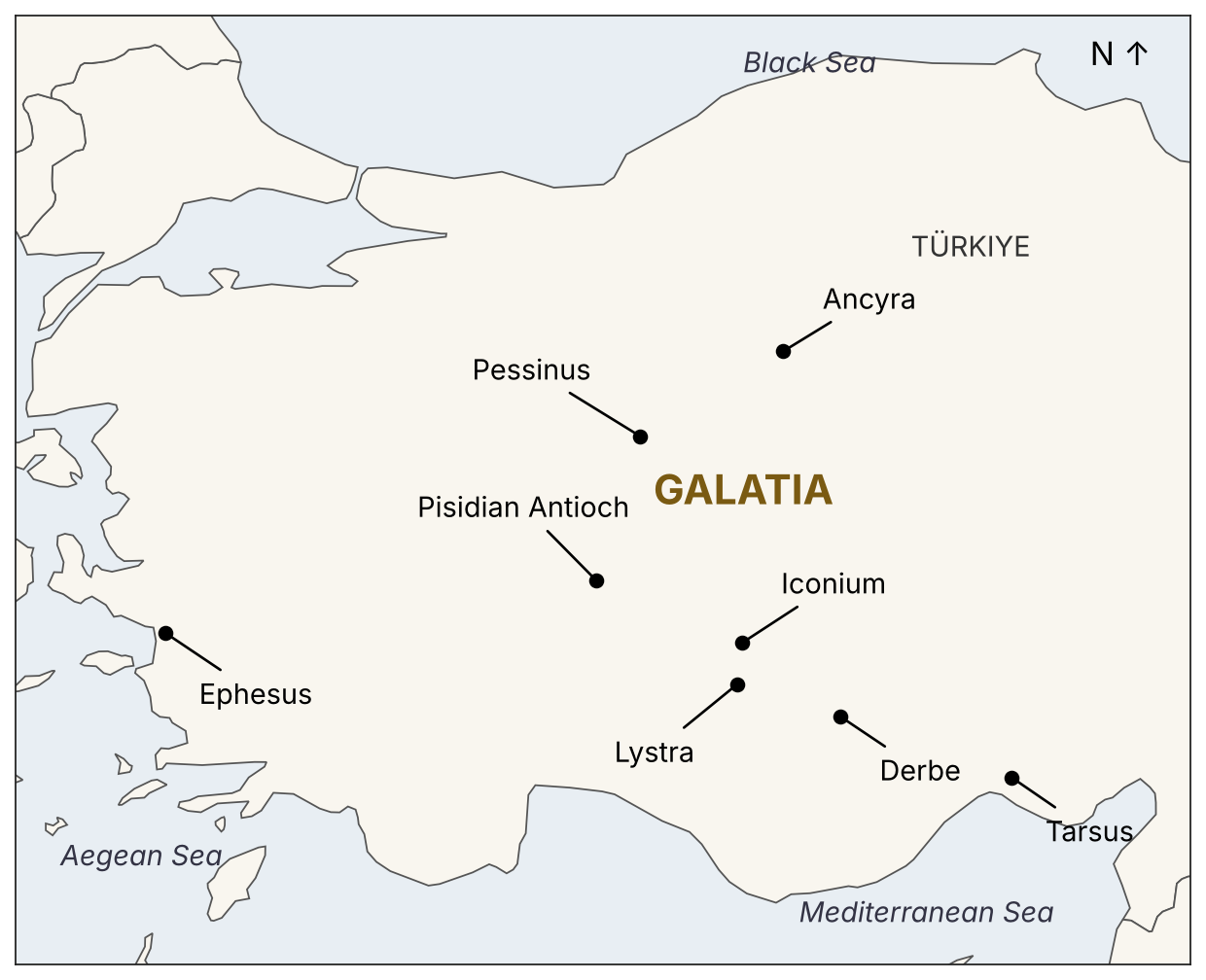
Modern locator map of the region of Galatia. Pisidian Antioch, Iconium, Lystra and Derbe are the southern churches Paul planted on his first journey (Acts 13–14); Ancyra and Pessinus lay in the north.
Galatians among the New Testament books
Matthew · Mark · Luke · John · Acts · Romans · 1 Corinthians · 2 Corinthians · Galatians · Ephesians · Philippians · Colossians · 1 Thessalonians · 2 Thessalonians · 1 Timothy · 2 Timothy · Titus · Philemon · Hebrews · James · 1 Peter · 2 Peter · 1 John · 2 John · 3 John · Jude · Revelation
Galatians is the ninth of the 27 books in the New Testament. It comes after 2 Corinthians and before Ephesians.
When and where it was written
Galatians was probably written between about AD 48 and the mid-50s. The exact date depends on which Galatian churches Paul meant. Many believe he wrote to the southern churches of Pisidian Antioch, Iconium, Lystra and Derbe soon after the first missionary journey (Acts 13–14), perhaps around AD 48–49, before the Jerusalem council of Acts 15. Others believe he wrote to churches in the northern region, visited later (Acts 16:6; 18:23), and date the letter to the mid-50s. Either way the message is the same.
If the early date is right, Galatians may be the first letter Paul wrote that we have, written before the council in Jerusalem settled that Gentile believers did not have to be circumcised (Acts 15:1–29). If the later date is right, Paul wrote it during his third missionary journey, from Ephesus or from Macedonia, about the same time as 1 and 2 Corinthians and not long before Romans, which teaches the same gospel more fully and calmly. Either way, unlike Ephesians, Philippians, Colossians and Philemon, it is not one of the “Prison Letters.” Paul wrote it as a free man, with the urgency of a spiritual father whose children were in danger of losing the gospel.
Meet the letter
Galatians is Paul’s fiery letter of freedom. Soon after he had planted churches in Galatia, teachers arrived who told the Gentile believers that faith in Jesus was not enough; they must also be circumcised and keep the law of Moses (Galatians 5:2–4; 6:12–13). To make their case they also attacked Paul, saying his gospel and his authority were second-hand. Paul answers with all his strength: we are made right with God by grace, through faith in Christ alone, and anyone who adds to that gospel is preaching “a different gospel” (Galatians 1:6).
The letter has three parts. Chapters 1–2 are Paul’s personal defense: his gospel came by revelation from Jesus Christ, the apostles in Jerusalem recognized it, and he even confronted Peter to his face when the truth of the gospel was at stake. Chapters 3–4 teach justification by faith: Abraham believed God and it was counted to him as righteousness, Christ redeemed us from the curse of the law, and we are now sons and heirs, not slaves. Chapters 5–6 show life in the freedom of the Spirit: stand firm, serve one another in love, walk by the Spirit, bear one another’s burdens, and sow to the Spirit.
Notice how serious Paul is. The false teachers did not deny Jesus; they added to Him. But a gospel of “Jesus plus” is not good news at all, because it puts the weight back on our own performance. Paul’s shock (Galatians 1:6) and his strong warning (Galatians 1:8–9) show how precious the pure gospel of grace is. Any message that makes our standing with God depend on Christ and something else has lost the gospel. Yet the freedom Christ gives is not a license to sin. It is freedom to love and serve, and to walk by the Spirit, who produces in us what the law never could.
The central message A person is justified by faith in Christ, not by works of the law, so believers must stand firm in the freedom Christ has won and walk by the Spirit.
A verse to carry through the study Galatians 2:20 BLB
Find your way
Main teachings
No other gospel
Galatians 1:6–10 Paul is astonished that the Galatians are turning to a different gospel. There is only one gospel of grace, and anyone, even an angel from heaven, who preaches another is under God’s curse.
A gospel received from Christ
Galatians 1:11–2:10 Paul’s gospel came not from man but by a revelation of Jesus Christ. God called him, a former persecutor, and the leaders in Jerusalem later recognized the grace given to him and did not require Titus, a Greek, to be circumcised.
The truth of the gospel at the table
Galatians 2:11–14 In Antioch Peter drew back from eating with Gentile believers, and others followed. Paul opposed him to his face, because their conduct was not in step with the truth of the gospel.
Justified by faith; crucified with Christ
Galatians 2:15–21 No one is justified by works of the law, but only through faith in Jesus Christ. The believer has been crucified with Christ, and now Christ lives in him; if righteousness came through the law, Christ died for no purpose.
Faith like Abraham’s
Galatians 3:1–14 The Galatians received the Spirit by hearing with faith, not by works of the law. Abraham believed God and it was counted to him as righteousness, and Christ redeemed us from the curse of the law by becoming a curse for us.
The law and the promise
Galatians 3:15–29 The law, coming centuries later, cannot cancel God’s promise to Abraham. It showed sin and guarded us until Christ came; now all who belong to Christ are one in Him and heirs according to the promise.
Sons, not slaves
Galatians 4:1–7 In the fullness of time God sent His Son to redeem those under the law, so that we might be adopted as sons, and He sent the Spirit of His Son into our hearts, crying, “Abba! Father!”
Until Christ is formed in you
Galatians 4:8–31 Paul pleads with the Galatians not to go back to slavery, and labors over them like a mother in childbirth until Christ is formed in them. Hagar and Sarah picture two covenants: slavery under the law and freedom under the promise.
Stand firm in freedom
Galatians 5:1–15 For freedom Christ has set us free, so we must not submit again to a yoke of slavery. What counts is faith working through love, and freedom is not an opportunity for the flesh but a call to serve one another in love.
Walk by the Spirit
Galatians 5:16–26 Every believer faces a daily, lifelong battle between the flesh and the Spirit. Walking by the Spirit, one step at a time, overcomes the desires of the flesh, and the Spirit produces His fruit: love, joy, peace, patience, kindness, goodness, faithfulness, gentleness and self-control.
Bear burdens; sow to the Spirit
Galatians 6:1–10 Restore a fallen brother gently and bear one another’s burdens. God is not mocked: whatever one sows, that he will reap, so let us not grow weary of doing good.
Boasting only in the cross
Galatians 6:11–18 Writing in his own large hand, Paul refuses to boast in anything except the cross of our Lord Jesus Christ. Neither circumcision nor uncircumcision counts for anything, but a new creation.
Praying through Galatians
Galatians is not a letter of long prayers like Ephesians or Colossians. Paul is too alarmed to begin with his usual thanksgiving; he goes straight to “I am astonished” (Galatians 1:6). Yet the letter is full of moments where prayer and worship break through. Paul gives glory to God in his opening lines (Galatians 1:3–5). He reminds us that God has sent the Spirit of His Son into our hearts, crying, “Abba! Father!” (Galatians 4:6). Abba is the warm family word for “father.” We do not come to God as subjects to a throne, though He is King. We come as children to a Father. And the letter ends, as it began, with grace (Galatians 6:18).
One good way to study this letter is to pray it. Take a verse such as 2:20 or 5:22–23, read it slowly, and say it back to God as your own prayer, for yourself and for people you name. But we can also start with the opening words and pray straight through the letter by personalizing it as a prayer to the LORD. The prayers below are my own, gathered from my prayer journal and my teaching, where I have prayed these verses back to the Lord. Pray them as they are, then pray them again in your own words.
The prayers in this letter
Galatians 1:3–5 — Grace, peace and glory forever. Paul’s greeting turns into worship. He asks grace and peace for the churches from God our Father and the Lord Jesus Christ, who gave Himself for our sins to deliver us from the present evil age, and he ends with praise: “to whom be the glory forever and ever. Amen.”
Galatians 4:6 — “Abba! Father!”. Not a prayer Paul prays, but the prayer every believer is given. Because we are sons, God has sent the Spirit of His Son into our hearts, and He teaches us to call on God as our own dear Father.
Galatians 4:19–20 — Labor until Christ is formed in you. Paul is not praying here in words, but his longing for the Galatians reads like a prayer. He is “again in the anguish of childbirth until Christ is formed in you.” It is a pattern for how we can carry the people we love before God.
Galatians 6:16 — Peace and mercy on all who walk by this rule. Paul asks peace and mercy upon all who walk by the rule of the cross and the new creation, and upon the Israel of God.
Galatians 6:18 — A closing blessing. After all his sharp words, Paul’s last word is grace: “The grace of our Lord Jesus Christ be with your spirit, brothers. Amen.” He still calls them brothers.
A prayer from Galatians 2:20
Pray it with Galatians 2:20 BLB
Lord, living a day for You is too hard for me, but not for Christ in me. So, dear Lord, may I die to self and live today in the strength and grace of Christ, and so please and honor You. I surrender all to You, O Lord my God, forever and ever. I have no will but Yours and no way but Christ and Him crucified, dead, buried and raised on the third day, and my life surrendered to You in Christ Jesus, my Savior and my Lord, by Your grace.
Lord, I know I cannot live my life, or even a minute, worthy of You. No way! Yes, there is a way, and the way is Jesus. When we live with our eyes on Jesus, we are living in a manner worthy of the Lord, because it is no longer we who live, but Christ in us, and He is worthy.
It is no longer I who live, but it is Christ living in us, and the life we now live we live by faith in the Son of God. Lord, let that be true day by day, moment by moment, in each of our lives. Amen.
A prayer for the fruit of the Spirit (Galatians 5:16–23)
Pray it with Galatians 5:16–23 BLB
Lord, why do I feel like I have a double PhD in the flesh and a date for graduation from kindergarten in the Spirit? You tell us that the desires of the flesh are against the Spirit, and the desires of the Spirit are against the flesh. Lord, I want to fully surrender to the Spirit, so help me today to win the battle against the flesh.
Lord, I pray for the fruit of the Spirit: that love, joy, peace, patience, kindness, goodness, faithfulness, gentleness and self-control would fill us and abundantly work in and through us, now and always, in Christ Jesus.
Where I have shown self-control today, I give You the credit. Where I have failed, I receive Your grace, and I pray for more of the Spirit’s transforming power. In Jesus’ name, amen.
Read Galatians
Select a chapter to read it in the ESV in a reading window, right here on this page.
Galatians 1:1–24 Galatians 2:1–21 Galatians 3:1–29 Galatians 4:1–31 Galatians 5:1–26 Galatians 6:1–18
A brief outline
2:1–2:10 Paul Accepted by the Apostles
3:1–3:9 By Faith, or by Works of the Law?
3:10–3:14 The Righteous Shall Live by Faith
3:15–3:22 The Law and the Promise
3:23–3:29 Sons of God Through Faith
4:8–4:20 Paul’s Concern for the Galatians
4:21–4:31 Example of Hagar and Sarah
5:1–5:15 Christ Has Set Us Free
5:16–5:26 Keep in Step with the Spirit
Study every verse
Begin with the Scripture, then read the study notes and the passages to read alongside. After each section, pause over the question. The aim is to understand Paul’s meaning and put it into practice in dependence on Christ.
Chapter 1 1:1 1:2 1:3 1:4 1:5 1:6 1:7 1:8 1:9 1:10 1:11 1:12 1:13 1:14 1:15 1:16 1:17 1:18 1:19 1:20 1:21 1:22 1:23 1:24
Chapter 2 2:1 2:2 2:3 2:4 2:5 2:6 2:7 2:8 2:9 2:10 2:11 2:12 2:13 2:14 2:15 2:16 2:17 2:18 2:19 2:20 2:21
Chapter 3 3:1 3:2 3:3 3:4 3:5 3:6 3:7 3:8 3:9 3:10 3:11 3:12 3:13 3:14 3:15 3:16 3:17 3:18 3:19 3:20 3:21 3:22 3:23 3:24 3:25 3:26 3:27 3:28 3:29
Chapter 4 4:1 4:2 4:3 4:4 4:5 4:6 4:7 4:8 4:9 4:10 4:11 4:12 4:13 4:14 4:15 4:16 4:17 4:18 4:19 4:20 4:21 4:22 4:23 4:24 4:25 4:26 4:27 4:28 4:29 4:30 4:31
Chapter 5 5:1 5:2 5:3 5:4 5:5 5:6 5:7 5:8 5:9 5:10 5:11 5:12 5:13 5:14 5:15 5:16 5:17 5:18 5:19 5:20 5:21 5:22 5:23 5:24 5:25 5:26
Chapter 6 6:1 6:2 6:3 6:4 6:5 6:6 6:7 6:8 6:9 6:10 6:11 6:12 6:13 6:14 6:15 6:16 6:17 6:18
Chapter 1
Greeting
Galatians 1:1
Read the verse: Galatians 1:1 BLB
Study Notes
Paul opens by settling the question his opponents had raised. The false teachers in Galatia said his gospel and his authority were second‑hand, borrowed from other men. So in the very first line Paul declares that his apostleship came “not from men nor through man, but through Jesus Christ and God the Father.” He was sent by the risen Lord Himself, by the God “who raised him from the dead.”
Paul’s words here and elsewhere are not his own. They are the living Word of God – put on paper by the Apostle Paul but fully from God as the Holy Spirit led him. Someone once asked a friend of mine (when he was speaking about Paul’s writings and Paul being human) “Don’t you think Paul ever had a bad day?” Brother Mike Childs said “Yes, we know he had bad days. He just didn’t write scripture on those days.” Suffice it to say we can trust the Word of God in the canon of Scripture.
Read alongside Galatians 1:11–12 BLB; Acts 9:15 BLB; Acts 13:2 BLB; Romans 1:1 BLB
Galatians 1:2
Read the verse: Galatians 1:2 BLB
Study Notes
Paul does not write alone; he includes “all the brothers who are with me.” And he writes not to one city church but to “the churches of Galatia,” a group of congregations planted in that Roman province. As Matthew Henry put it: “This epistle of Paul is directed not to the church or churches of a single city, as some others are, but of a country or province, for so Galatia was.”
Notice what is missing. In most of his letters Paul quickly gives thanks for his readers, but here he moves straight to the matter at hand. The danger to the gospel was too urgent to wait.
Read alongside Acts 14:21–23 BLB; Acts 16:6 BLB; 1 Corinthians 16:1 BLB
Galatians 1:3
Read the verse: Galatians 1:3 BLB
Study Notes
“Grace to you and peace” is far more than a polite hello. The usual Greek greeting was chairein, “greetings,” but Paul replaces it with charis, grace, God’s unmerited favor. Grace always comes first, and peace with God follows from it.
“God our Father” and “the Lord Jesus Christ” are two persons named in one greeting. The Trinity is woven into the very opening of the letter, and both Father and Son are the source of every blessing we receive.
Read alongside Romans 1:7 BLB; Ephesians 1:2 BLB; John 14:27 BLB; Philippians 1:2 BLB
Galatians 1:4
Read the verse: Galatians 1:4 BLB
Study Notes
Here, in a single verse, is the whole gospel Paul will defend: Jesus “gave himself for our sins.” We did not earn rescue; He gave Himself. And He did it “according to the will of our God and Father,” to deliver us from “the present evil age.” Scripture sees only two spiritual locations: belonging to God, or lying under the sway of this world and its ruler. That is why we must stay distinct from worldly patterns and cling to who we are in Christ.
When I pray through this verse it becomes very personal: Heavenly Father, You gave it all for me; how in the world could I not do likewise? A Savior who gave Himself completely calls for a life given completely back to Him.
Read alongside Ephesians 2:1–2 BLB; 1 John 5:19 BLB; Titus 2:14 BLB; Romans 12:2 BLB
Galatians 1:5
Read the verse: Galatians 1:5 BLB
Study Notes
Paul cannot mention what God has done without breaking into praise: “to whom be the glory forever and ever.” Salvation is God’s work from beginning to end, so all the glory belongs to Him and none to us. Then the “Amen.” So be it. Paul means it. And so should we.
Read alongside Romans 11:36 BLB; Ephesians 3:21 BLB; 1 Timothy 1:17 BLB; Revelation 4:11 BLB
Put it into practice Take Galatians 1:4 into your prayer time this week and make it your own: “Heavenly Father, You gave it all for me; how could I not do likewise?” Then name one area of your life you have been holding back from Him, and commit it into His hands.
No Other Gospel
Galatians 1:6
Read the verse: Galatians 1:6 BLB
Study Notes
Notice how serious Paul is. “I am astonished,” he says, that they are “so quickly deserting him who called you in the grace of Christ.” Turning from the gospel is not simply changing an opinion; it is turning away from the God who called them by grace. Paul’s shock shows how precious the pure gospel of grace is.
Read alongside Galatians 3:1–3 BLB; Galatians 5:7 BLB; 2 Corinthians 11:3–4 BLB
Galatians 1:7
Read the verse: Galatians 1:7 BLB
Study Notes
The false teachers did not deny Jesus; they added to Him. But a gospel of “Jesus plus” is not good news at all, because it puts the weight back on our own performance. That is why Paul says it is “not that there is another one.” Any message that makes our standing with God depend on Christ and something else has lost the gospel. These teachers offered religion without reality, and they only “trouble” the people of God.
Read alongside Acts 15:1–2 BLB; Philippians 3:2–3 BLB; Galatians 5:10 BLB; Galatians 5:12 BLB
Galatians 1:8
Read the verse: Galatians 1:8 BLB
Study Notes
Paul’s warning could not be stronger. Even “if we,” Paul himself, “or an angel from heaven” should preach a different gospel, “let him be accursed.” The message stands above the messenger. No impressive preacher, no new revelation and no heavenly visitor can change what God has spoken in Christ.
False teaching breaks the heart of a true pastor. Paul does not write this with anger alone; he writes as one who loves these believers and knows what is at stake for their souls.
Read alongside 2 Corinthians 11:13–15 BLB; Romans 16:17–18 BLB; 2 John 1:10–11 BLB; Jude 1:4 BLB
Galatians 1:9
Read the verse: Galatians 1:9 BLB
Study Notes
Paul says it again so no one can miss it: anyone preaching a gospel contrary to the one they received is accursed. This is the test for every teaching we hear, including my own. If what is taught does not line up with the Word, it must be rejected; every teaching on the Word must be carefully compared with the one true and living Word of God. Like the Bereans, we search the Scriptures to see if these things are so.
Read alongside Acts 17:10–12 BLB; 1 John 4:1 BLB; Jude 1:3 BLB; 2 Timothy 4:3–4 BLB
Galatians 1:10
Read the verse: Galatians 1:10 BLB
Study Notes
Paul calls himself a servant, in Greek a doulos, a bondservant of Christ. Being a doulos of Christ means you are freed from trying to please the world, from legalistic expectations and from the tyranny of your own ego. Your purpose is simplified into pleasing just one Master.
Paul’s opponents may have accused him of softening the gospel to win people over. His strong words in verses 8 and 9 answer that charge. A man trying to please people would not speak this way. We too must choose whose approval we live for. We must live for the Lord.
Read alongside 1 Corinthians 7:22–23 BLB; 1 Thessalonians 2:4 BLB; John 12:43 BLB; Colossians 3:23–24 BLB
Put it into practice The Galatians were tempted to add rules to faith in Christ. Ask yourself: are there “Jesus plus” ideas I have leaned on to feel right with God? Name them, lay them down, and thank God that Christ alone is enough.
Paul Called by God
Galatians 1:11
Read the verse: Galatians 1:11 BLB
Study Notes
Now Paul answers the second charge against him. His critics said his gospel was second‑hand, something he picked up from others and changed. Paul says plainly that the gospel he preached “is not man’s gospel.” It did not begin with human ideas, and it was not shaped to suit human tastes.
Read alongside 1 Corinthians 15:1–3 BLB; 1 Thessalonians 2:13 BLB; 2 Peter 1:20–21 BLB
Galatians 1:12
Read the verse: Galatians 1:12 BLB
Study Notes
Paul did not receive the gospel from any man, nor was he taught it in a classroom; he received it “through a revelation of Jesus Christ.” The risen Lord Himself met him and showed him the truth. This is why Paul can speak with such certainty: the message came from Christ, and it is about Christ. Paul had the apostolic authority given to him directly by Jesus Christ on the road to Damascus. (Acts 9).
Read alongside Acts 26:15–18 BLB; Ephesians 3:2–3 BLB; 1 Corinthians 11:23 BLB
Galatians 1:13
Read the verse: Galatians 1:13 BLB
Study Notes
Paul does not hide his past. He “persecuted the church of God violently and tried to destroy it.” He says this not to boast but to prove a point: no man talked him into the gospel. Only God could turn a man like that around.
The same zeal remained, but it was redirected. Paul later uses the word diōkō for pressing on toward Christ, the same word for persecution. Now he pursues Christ with the same intensity he once used to hunt Christians.
Read alongside Acts 8:3 BLB; Acts 9:1–2 BLB; Acts 26:9–11 BLB; 1 Timothy 1:13 BLB
Galatians 1:14
Read the verse: Galatians 1:14 BLB
Study Notes
Paul was a Pharisee, part of the most rigorous sect of Judaism: the most serious, the most studied, the most zealous. He was “advancing in Judaism” beyond his peers. His credentials were the best possible, and he is about to tell us they could not save him. Zeal without knowledge is fire without light.
Read alongside Acts 22:3 BLB; Philippians 3:5–6 BLB; Romans 10:2–3 BLB; Acts 26:4–5 BLB
Galatians 1:15
Read the verse: Galatians 1:15 BLB
Study Notes
Everything changes with the words “But when he.” Paul never presented his conversion as the reward for religious achievement. God had set him apart before he was born and called him “by his grace.” Christ arrested an enemy and made him an apostle.
Just as God formed His servant from the womb (Isaiah 49:5), we too, in Christ, are formed to be servants of God. Our calling rests on His grace, not on our record.
Read alongside Jeremiah 1:5 BLB; Isaiah 49:1–5 BLB; 1 Timothy 1:12–16 BLB; Ephesians 2:8–10 BLB
Galatians 1:16
Read the verse: Galatians 1:16 BLB
Study Notes
God was pleased “to reveal his Son to me,” Paul says, “in order that I might preach him among the Gentiles.” One encounter with Christ on the Damascus road rewrote the ledger forever. What Paul once counted as gain he now counted as loss for the sake of Christ.
Paul did not run to “consult with anyone.” His message was from God, and his mission came with it. Every believer who has met Christ is called to go and make disciples of all nations, teaching them all that Jesus has taught us (from His Word) and baptizing them in the name of the Father, Son, and Holy Spirit. (Matthew 28:19–20)
Read alongside Acts 9:3–6 BLB; Acts 9:15 BLB; Acts 26:16–18 BLB; Philippians 3:7–8 BLB
Galatians 1:17
Read the verse: Galatians 1:17 BLB
Study Notes
Paul did not go up to Jerusalem to be approved or trained by the apostles who came before him. Instead he went away into Arabia and then returned to Damascus. Scripture does not tell us all that happened in Arabia, and we should not guess, but Paul’s point is clear: his gospel did not come from the Jerusalem leaders.
Read alongside Acts 9:19–22 BLB; Acts 9:23–25 BLB; Galatians 1:12 BLB
Galatians 1:18
Read the verse: Galatians 1:18 BLB
Study Notes
Only “after three years” did Paul go up to Jerusalem, and then just to visit Cephas, that is, Peter, for fifteen days. The word ‘visit’ means to get to know him. It was a visit of fellowship between brothers, not a course of instruction, and Paul honors Peter while showing his gospel did not depend on him.
Read alongside Acts 9:26–28 BLB; John 1:42 BLB; 2 Peter 3:15 BLB
Galatians 1:19
Read the verse: Galatians 1:19 BLB
Study Notes
The only other apostle Paul saw was “James the Lord’s brother.” James did not believe in Jesus during His ministry, but the risen Lord appeared to him, and he became a leader, a “pillar,” of the church in Jerusalem. Early Christians called him “James the Just” because of his godly life.
Think of the grace in this one verse: a former persecutor and a once‑doubting brother of Jesus, both transformed by the risen Christ, now meeting as fellow servants.
Read alongside John 7:5 BLB; 1 Corinthians 15:7 BLB; Acts 15:13 BLB; Galatians 2:9 BLB
Galatians 1:20
Read the verse: Galatians 1:20 BLB
Study Notes
Paul pauses to make a solemn promise: “before God, I do not lie!” He knows his critics are twisting his story, so he calls God as his witness. Truthfulness matters in the service of the gospel; the message of truth must be carried with honesty.
Read alongside Romans 9:1 BLB; 2 Corinthians 11:31 BLB; 1 Timothy 2:7 BLB
Galatians 1:21
Read the verse: Galatians 1:21 BLB
Study Notes
After the short visit to Jerusalem, Paul went to the regions of Syria and Cilicia, including his hometown of Tarsus. He was far from Jerusalem and was not working under the apostles’ direction, yet he was faithfully preaching Christ. God was preparing him in those quieter years for the wider work to come.
Read alongside Acts 9:30 BLB; Acts 11:25–26 BLB; Acts 15:41 BLB
Galatians 1:22
Read the verse: Galatians 1:22 BLB
Study Notes
The churches of Judea did not even know Paul by sight. This underlines his point again: he was not a student or a representative of the Jerusalem church. Notice too that these churches (the believers who made up these local churches) were “in Christ”; whatever their location, every true local body of believers – church belongs to Him.
Read alongside Acts 9:31 BLB; 1 Thessalonians 2:14 BLB
Galatians 1:23
Read the verse: Galatians 1:23 BLB
Study Notes
What they heard was astonishing: “He who used to persecute us is now preaching the faith he once tried to destroy.” The change in Paul was so complete that his story spread from church to church. Only the grace of God can turn a destroyer of the faith into its preacher.
Read alongside Acts 9:20–21 BLB; 1 Timothy 1:15–16 BLB; 2 Corinthians 5:17 BLB
Galatians 1:24
Read the verse: Galatians 1:24 BLB
Study Notes
“And they glorified God because of me.” They did not praise Paul; they praised God for what He had done in Paul. That is the right response to every changed life.
My prayer is that the candle in my soul may burn brightly for all to see, so that people see the good works God does in us and give glory to our Father in heaven.
Read alongside Matthew 5:14–16 BLB; 1 Peter 2:12 BLB; Acts 21:19–20 BLB
Put it into practice Paul told his story so that people would glorify God. This week, write out in a few sentences how God called you to be His own by His grace: who you were, how He met you, and what He has changed. Then share it with one person, giving all glory to God always.
Chapter 2
Paul Accepted by the Apostles
Galatians 2:1
Read the verse: Galatians 2:1 BLB
Study Notes
Paul now tells of a second visit to Jerusalem, fourteen years later. He did not go alone. He took Barnabas, a Jewish believer, and Titus, a Gentile believer who had never been circumcised. Bringing Titus was no accident. He was living proof of what God was doing among the nations. It is no small matter that Titus was accepted by the believers there – thus recognizing the broader work that God was (is) about.
Read alongside Acts 15:1–2 BLB; Galatians 1:18 BLB; Acts 11:25–26 BLB
Galatians 2:2
Read the verse: Galatians 2:2 BLB
Study Notes
Paul went up “because of a revelation.” God sent him; he was not summoned by men to defend himself. In private he laid before the leaders the gospel he preached among the Gentiles, not because he doubted it, but so that no one could divide the church over it.
Paul’s concern was that his labor would count, that the race would not be wasted. That is what drove him, not applause but faithfulness proven. It is a good question for every servant of Christ: Am I running in a way that will matter on the day of Christ?
Read alongside Philippians 2:16 BLB; Acts 20:24 BLB; 1 Corinthians 9:26–27 BLB
Galatians 2:3
Read the verse: Galatians 2:3 BLB
Study Notes
Here is the test case. The leaders in Jerusalem did not require Titus, a Greek, to be circumcised. They recognized that he was already fully accepted by God through faith in Christ. Nothing needed to be added to make him a true member of God’s family, and nothing needs to be added for us either.
Read alongside Acts 15:10–11 BLB; Galatians 5:6 BLB; Galatians 6:15 BLB
Galatians 2:4
Read the verse: Galatians 2:4 BLB
Study Notes
Paul calls the teachers who pressed for circumcision “false brothers” who slipped in to spy out the freedom believers have in Christ Jesus, to bring them back into slavery. We must never add to nor take away from the truth of the Good News of the Gospel as revealed by Jesus.
Notice what the false teachers did. They did not deny Jesus; they added to Him. But a gospel of “Jesus plus” is not good news at all, because it puts the weight back on our own performance. Any message that makes our standing with God depend on Christ and something else has lost the gospel.
Read alongside Galatians 5:1 BLB; Galatians 1:6–7 BLB; 2 Peter 2:1 BLB; Jude 1:4 BLB
Galatians 2:5
Read the verse: Galatians 2:5 BLB
Study Notes
Paul did not give way to these men, “not for a moment.” His firmness was not stubbornness; it was love. He held the line “so that the truth of the gospel might be preserved for you.” What we give up in one generation, the next may never receive. We are called to be gentle with people, but we must never be soft on the gospel.
Read alongside Jude 1:3 BLB; Galatians 1:8–9 BLB; 1 Timothy 6:20 BLB
Galatians 2:6
Read the verse: Galatians 2:6 BLB
Study Notes
The leaders in Jerusalem were highly respected, but Paul reminds us that God shows no partiality. Their reputation did not make the gospel true, and they added nothing to the message Paul preached. What matters is not who is impressed with us, but whether we are faithful to what God has said.
Read alongside Acts 10:34–35 BLB; Romans 2:11 BLB; 1 Samuel 16:7 BLB
Galatians 2:7
Read the verse: Galatians 2:7 BLB
Study Notes
The leaders saw that God had entrusted Paul with the gospel to the Gentiles, just as He had entrusted Peter with the gospel to the Jews. There was one gospel and two mission fields. The message was the same; only the people it was carried to were different. The gospel is something entrusted to us, a treasure to guard, a ‘torch’ to hold high before the nations, to live it out and to pass it on.
Read alongside 1 Thessalonians 2:4 BLB; 1 Timothy 1:11 BLB; Romans 11:13 BLB
Galatians 2:8
Read the verse: Galatians 2:8 BLB
Study Notes
The same God worked through Peter and through Paul. Apostleship means being sent with a purpose, and Paul was sent to the Gentiles. Grace is God’s undeserved favor that saves us, and it also equips us for the work He gives us. It is only by the power and authority of Christ that anyone can carry out that mission, and every believer has a part in it.
Read alongside Acts 9:15 BLB; Acts 15:12 BLB; Romans 1:5 BLB
Galatians 2:9
Read the verse: Galatians 2:9 BLB
Study Notes
James, the brother of the Lord who led the church in Jerusalem, together with Peter and John, “perceived the grace that was given” to Paul. They gave him and Barnabas “the right hand of fellowship.” That handshake was a public sign that they stood together in one gospel, even as they went to different people. Unity in the church rests on the truth of the gospel, not on everyone doing the same work.
Read alongside Acts 15:13–19 BLB; Ephesians 2:19–20 BLB; Romans 15:7 BLB
Galatians 2:10
Read the verse: Galatians 2:10 BLB
Study Notes
The one thing the leaders asked was that Paul remember the poor, and he says it was “the very thing I was eager to do.” Over and over in Scripture God points us to our duty to help others, especially those who are in great need. A gospel received by grace will always open our hands to people who are struggling.
Read alongside Acts 11:29–30 BLB; Romans 15:26 BLB; 1 John 3:17 BLB
Put it into practice The one thing the apostles asked of Paul was to remember the poor. This week, name one person in need whom God has placed near you, and do one concrete thing to help them, as an overflow of the grace you have received.
Paul Opposes Peter
Galatians 2:11
Read the verse: Galatians 2:11 BLB
Study Notes
When Peter (Cephas) came to Antioch, Paul “opposed him to his face, because he stood condemned.” Paul did not talk about Peter behind his back; he went to him directly.
Notice that Paul publicly corrected Peter. Peter was a great apostle, but he was not beyond error. No leader stands above the Word of God. Scripture alone is the final authority for what we believe and how we live, and every teacher, however respected, must be measured by it. The minute we ever think we are beyond correction is the very moment we have departed from the path of humble service God has given us.
Read alongside Matthew 18:15 BLB; Proverbs 27:6 BLB; 2 Timothy 3:16–17 BLB
Galatians 2:12
Read the verse: Galatians 2:12 BLB
Study Notes
Peter had been eating freely with Gentile believers, which showed that he understood they were fully accepted in Christ. But when certain men came from James, he drew back and separated himself, “fearing the circumcision party.” Peter knew better; God had already shown him not to call any person unclean. Fear of what others think can pull even a mature believer away from what he knows is true.
Read alongside Acts 10:28 BLB; Acts 11:2–3 BLB; Proverbs 29:25 BLB
Galatians 2:13
Read the verse: Galatians 2:13 BLB
Study Notes
Peter’s example spread. The other Jewish believers joined in the hypocrisy, “so that even Barnabas was led astray.” Barnabas, the encourager who had stood beside Paul among the Gentiles, was carried along. Our choices are never only our own; others are watching and following. A little compromise does not stay little.
Read alongside Galatians 5:9 BLB; Acts 4:36–37 BLB; Hebrews 12:15 BLB
Galatians 2:14
Read the verse: Galatians 2:14 BLB
Study Notes
Paul saw that their conduct was “not in step with the truth of the gospel.” The gospel is not only something we believe; it is something we walk in line with. If God has accepted a brother or sister in Christ, we cannot treat them as second-class. Paul asks Peter plainly how he could expect Gentiles to live like Jews when he himself had lived like a Gentile.
Read alongside Philippians 1:27 BLB; Ephesians 4:1 BLB; Colossians 3:11 BLB
Put it into practice Ask yourself honestly: Is there a fellow believer I keep at a distance, or a truth I go quiet about, because I fear what others will think? Ask the Lord for courage to walk in step with the truth of the gospel, and take one step toward that person this week.
Justified by Faith
Galatians 2:15
Read the verse: Galatians 2:15 BLB
Study Notes
Paul speaks as a Jew to Peter, a fellow Jew. They were born into the people of God’s covenant and had the law, not “Gentile sinners” on the outside. Yet even with every privilege of birth and religion, they still needed a Savior. No background, family or religious upbringing can make a person right with God.
Read alongside Romans 3:9 BLB; Romans 3:23 BLB; Philippians 3:4–7 BLB
Galatians 2:16
Read the verse: Galatians 2:16 BLB
Study Notes
Here is the heart of the letter. There is nothing you can do to save yourself, nothing. A person is not justified, declared right with God, by works of the law, but through faith in Jesus Christ. Salvation does not come, in any part, from good works or anything else we can do. It is a gift of God, the result of the finished work of Jesus Christ. Our part is to receive the gift, by faith alone, and God alone enables us to have such faith.
Every religion says you must pass certain tests and do certain things to qualify. Christianity is a relationship, not a religion. We are accepted from the beginning by a gift from God, based on what Jesus has already done, not on what we have or have not done. If we make salvation a checklist of things we must do, it no longer sounds like a Savior is needed. But Jesus purchased our pardon on the cross and said, “It is finished”: paid in full. Our obedience, repentance and holiness are the aftermath of what He did, not our contribution to it.
Read alongside Romans 3:20 BLB; Romans 3:28 BLB; Ephesians 2:8–9 BLB; Titus 3:5 BLB; Philippians 3:9 BLB
Galatians 2:17
Read the verse: Galatians 2:17 BLB
Study Notes
Some objected that if we are justified by faith alone, apart from the law, then Christ is encouraging people to sin. Paul answers, “Certainly not!” Grace does not make Christ a servant of sin. The one who has truly come to Christ for righteousness has come to the One who frees us from sin, not the One who excuses it.
Read alongside Romans 6:1–2 BLB; Romans 6:15 BLB; Romans 3:31 BLB
Galatians 2:18
Read the verse: Galatians 2:18 BLB
Study Notes
If Paul tore down the law as a way of being right with God, and then built it back up again, he would only prove himself a lawbreaker, because the law can only show us our sin. That is exactly what Peter had done at Antioch. Going back to rule-keeping as the basis of our acceptance with God is not a step forward in holiness; it is a step back into bondage.
Read alongside Galatians 4:9 BLB; Galatians 3:3 BLB; Galatians 5:1 BLB
Galatians 2:19
Read the verse: Galatians 2:19 BLB
Study Notes
“Through the law I died to the law.” The law showed Paul his sin and pronounced its sentence of death, and in Christ that sentence was carried out. Now the law’s claim on him as a way of earning life is finished. But he did not die to the law to live as he pleased; he died to it “so that I might live to God.” The cross is the end of the old way of trying to earn God’s favor and the beginning of a life lived for Him.
Read alongside Romans 7:4 BLB; Romans 6:11 BLB; Matthew 10:38 BLB
Galatians 2:20
Read the verse: Galatians 2:20 BLB
Study Notes
This is the foundational reality of the Christian life. We do not simply improve our old nature; we crucify it. When we are born again, we are “crucified with Christ,” identified with His death, burial and resurrection. It is no longer we who live, but Christ who lives in us. This is our spiritual position, the reality of every Christian from the moment of new birth. It is not based on our performance, good or bad. It does not change and cannot change, because we did not put ourselves in this position and we cannot be taken out of it. It is all from God and not from us.
It is also the daily experience we are to live out, acting on that reality in our thoughts, words and actions. Following Jesus means denying what our worldly self wants: losing self-righteousness, self-pity, self-centeredness and all the other “selfs.” Frank Sinatra sang, “I did it my way.” Jesus calls us to another confession: “Not my will, but Yours be done.” We do not reflect Christ by trying harder to act like Him; we reflect Him because He actually lives in us. Our calling is not to manufacture an imitation of Jesus, but to surrender ourselves so that His life, love and character become visible through us.
How could we ever live in a manner worthy of the gospel? We can’t! Christ in us can. So we can pray each morning: “Lord, living a day for You is too hard for me, but not for Christ in me. May I die to self and live today in the strength and grace of Christ, and so please and honor You.” And never forget the last words of the verse: the Son of God “loved me and gave himself for me.” It is personal. The life we now live, we live by faith in the One who loved us first.
Read alongside Luke 9:23 BLB; Romans 6:6 BLB; Colossians 3:3–4 BLB; Colossians 1:27 BLB; John 15:5 BLB
Galatians 2:21
Read the verse: Galatians 2:21 BLB
Study Notes
To go back to the law for righteousness would be to “nullify the grace of God.” If righteousness came through the law, then Christ died for no purpose. Salvation cannot be a mixture of grace and works; if it is by works, it is no longer grace. Either the cross was enough, or it was wasted, and it was enough. As the old hymn says, “Nothing in my hand I bring, simply to Thy cross I cling” (Augustus Toplady, “Rock of Ages”).
Read alongside Romans 11:6 BLB; Ephesians 2:8–9 BLB; Galatians 5:4 BLB; Hebrews 10:14 BLB
Put it into practice Read Galatians 2:20 aloud each morning this week and pray, “Lord, living a day for You is too hard for me, but not for Christ in me.” Then go and live Galatians 2:20: when conviction comes during the day, respond right away instead of negotiating, and ask, “What would change in my day if I lived it as ‘Christ who lives in me’?”
Chapter 3
By Faith, or by Works of the Law?
Galatians 3:1
Read the verse: Galatians 3:1 BLB
Study Notes
Paul’s tone is sharp because the stakes are high. He calls the Galatians “foolish,” not because they lack intelligence, but because they are acting against what they plainly know. The word “bewitched” pictures someone under a spell, as though the false teachers had cast a charm over them. Yet Jesus Christ had been “publicly portrayed as crucified” before their eyes when Paul preached the cross to them. Once you have seen the cross clearly, how could you look anywhere else?
The cross of Christ is the answer to every wrong turn in the Christian life. One of those wrong turns is legalism, the idea that “God accepts me more when I perform.” Galatians 3:1–3 says no.
Read alongside 1 Corinthians 2:2 BLB; 1 Peter 2:24 BLB; John 19:18 BLB; Galatians 1:6 BLB
Galatians 3:2
Read the verse: Galatians 3:2 BLB
Study Notes
Paul asks one simple question that settles the argument. How did you receive the Holy Spirit? The Galatians received the Spirit by hearing with faith, not by works of the law. They had not earned Him by keeping rules; God gave Him when they believed the gospel. Their own experience proves that the Christian life begins with grace.
Read alongside Acts 15:8–9 BLB; Ephesians 1:13–14 BLB; Romans 10:17 BLB
Galatians 3:3
Read the verse: Galatians 3:3 BLB
Study Notes
Having begun by the Spirit, were they now trying to finish in their own strength? This is the error of “Jesus plus.” The false teachers did not deny Jesus; they added to Him. But a gospel of “Jesus plus” is not good news at all, because it puts the weight back on our own performance.
The life we began by grace is the same life we continue by grace. We do not start with God’s Spirit and then switch to our own effort to make ourselves more acceptable. The Spirit who gave us new life is the One who grows us.
Read alongside Philippians 1:6 BLB; Romans 8:1 BLB; Colossians 2:6 BLB
Galatians 3:4
Read the verse: Galatians 3:4 BLB
Study Notes
The Galatians had already paid a price for their faith; Acts tells of hardship and persecution in those cities. Paul asks whether all of that was for nothing. If they now trade grace for the law, they will have suffered for a gospel they are walking away from. Yet his words “if indeed it was in vain” show that he still hopes for them.
Read alongside Acts 14:21–22 BLB; Hebrews 10:32–35 BLB
Galatians 3:5
Read the verse: Galatians 3:5 BLB
Study Notes
God was still at work among them, supplying His Spirit and working miracles. Paul asks again whether that comes by works of the law or by hearing with faith. The answer is plain: God’s blessing flows to us because we believe Him, not because we have earned it. The same faith that receives salvation keeps receiving from God every day.
Read alongside Galatians 3:2 BLB; Acts 14:3 BLB; Hebrews 2:4 BLB
Galatians 3:6
Read the verse: Galatians 3:6 BLB
Study Notes
Now Paul turns to Abraham, the father of the Jewish people. Abraham “believed God, and it was counted to him as righteousness.” Abraham is sometimes called “the father of the faithful” because he believed and trusted what God said to him.
Abraham’s faith is quite astonishing. He was not raised in a God-honoring home. And God promised that he would be the father of a great nation when he and Sarah were well beyond child-bearing years; when Isaac was born, Abraham was a hundred and Sarah was ninety. Abraham was saved by faith, and so are we. The faith of Abraham is very inspiring.
Read alongside Genesis 15:6 BLB; Romans 4:3 BLB; Romans 4:18–22 BLB; Hebrews 11:8–12 BLB
Galatians 3:7
Read the verse: Galatians 3:7 BLB
Study Notes
If Abraham was made right with God by believing, then his true children are those who share his faith. Belonging to Abraham’s family is not a matter of birth or ritual but of trusting God as he did. Christians do not all agree on how Israel and the church relate, but this much Paul states plainly: those of faith are the sons of Abraham.
Read alongside Romans 9:6–8 BLB; Romans 4:11–12 BLB; John 8:39 BLB
Galatians 3:8
Read the verse: Galatians 3:8 BLB
Study Notes
When God called Abraham, He promised that through him “all the families of the earth” would be blessed. Paul says this promise was the gospel preached ahead of time, because it is fulfilled in Jesus Christ, the offspring of Abraham. From the beginning, God planned to bring people from every nation to Himself by faith.
Read alongside Genesis 12:1–3 BLB; Genesis 22:18 BLB; Acts 3:25–26 BLB
Galatians 3:9
Read the verse: Galatians 3:9 BLB
Study Notes
The blessing Abraham received is the blessing all believers share. We are blessed “along with” him, on the same ground: faith. Saving faith is fully trusting in Jesus Christ, in who He is and in what He has done for us by His life, death, burial and resurrection. There is nothing we can ever add to what Jesus has done. Nothing. Ever.
Read alongside Romans 4:16 BLB; Titus 3:3–5 BLB; Ephesians 2:8–9 BLB
Put it into practice The Galatians were tempted to add rules to faith in Christ. Are there “Jesus plus” ideas you have leaned on to feel right with God? Name one this week, and thank God that His Spirit came to you by hearing with faith, not by your performance.
The Righteous Shall Live by Faith
Galatians 3:10
Read the verse: Galatians 3:10 BLB
Study Notes
Paul now shows the other side. Those who rely on the law to make them right with God are under a curse, because the law demands that we do everything written in it, always. No one does. To lean on the law is to stand before a standard we have already broken. The law is a mirror to show us our dirt, not a soap to wash it away.
Read alongside Deuteronomy 27:26 BLB; James 2:10 BLB; Romans 3:19–20 BLB
Galatians 3:11
Read the verse: Galatians 3:11 BLB
Study Notes
Paul quotes the prophet Habakkuk: “The righteous shall live by faith.” Habakkuk wrote as Babylon was rising; though God’s ways are sometimes mysterious, the righteous live by faith while they wait for His salvation. Those words are quoted three times in the New Testament.
No one is justified before God by the law. Righteousness is received by trusting God, and it is then lived out by trusting Him day by day.
Read alongside Habakkuk 2:4 BLB; Romans 1:17 BLB; Hebrews 10:38 BLB
Galatians 3:12
Read the verse: Galatians 3:12 BLB
Study Notes
The law works on a different principle from faith. Its message is “do this and live.” It has been well said, “The law says, ‘do this,’ and it is never done. Grace says, ‘believe in this,’ and everything is already done.” The law points to a perfect obedience we cannot give; faith rests on the perfect obedience Christ has already given.
Read alongside Leviticus 18:5 BLB; Romans 10:5–6 BLB; Romans 10:4 BLB
Galatians 3:13
Read the verse: Galatians 3:13 BLB
Study Notes
This is one of the great verses of Galatians. We were under the curse of the law, and Christ redeemed us, bought us back, by becoming a curse for us. The cross was the ultimate punishment and humiliation, yet it was also the fullest demonstration of the love of God, who gave His Son for the world. Jesus truly did bear the curse for others.
Redemption from the curse of the law is one of the “membership benefits” of the redeemed. It is not something we earn; it is what Jesus did for all who trust Him.
Read alongside Deuteronomy 21:23 BLB; 2 Corinthians 5:21 BLB; Romans 5:8 BLB; 1 Peter 2:24 BLB
Galatians 3:14
Read the verse: Galatians 3:14 BLB
Study Notes
Christ took the curse so that the blessing promised to Abraham might reach the Gentiles, and so that we might receive the promised Spirit through faith. The Holy Spirit is another of our membership benefits. These benefits are out of this world, but they are ours in this world, in Jesus Christ.
Read alongside Galatians 3:8 BLB; Acts 2:38–39 BLB; Ephesians 1:13–14 BLB; Ezekiel 36:26–27 BLB
Put it into practice Think about the “membership benefits” of the redeemed in verses 13–14: freedom from the curse and the gift of the Spirit. Take time today to thank Jesus for each one by name.
The Law and the Promise
Galatians 3:15
Read the verse: Galatians 3:15 BLB
Study Notes
Paul uses an everyday example. Even a human covenant, once it has been ratified, cannot be cancelled or added to by someone else. If that is true of people, how much more of God. His promise stands as He made it.
Read alongside Hebrews 6:13–18 BLB; Numbers 23:19 BLB
Galatians 3:16
Read the verse: Galatians 3:16 BLB
Study Notes
God made His promises to Abraham “and to his offspring.” Paul points out that the word is singular, pointing to one person, and that person is Christ. All of God’s promises to Abraham come to their fulfillment in Jesus, and we share in them by belonging to Him.
Read alongside Genesis 22:18 BLB; 2 Corinthians 1:20 BLB; Galatians 3:29 BLB
Galatians 3:17
Read the verse: Galatians 3:17 BLB
Study Notes
The law of Moses came about 430 years after God’s promise to Abraham. A later law cannot cancel an earlier promise that God Himself confirmed. God’s word to Abraham was not overturned at Sinai; it stood firm then and it stands firm now.
Read alongside Exodus 12:40–41 BLB; Romans 4:13–14 BLB; Hebrews 6:17–18 BLB
Galatians 3:18
Read the verse: Galatians 3:18 BLB
Study Notes
If the inheritance came by keeping the law, it would no longer be a promise; it would be a wage. But God gave it to Abraham freely, by promise. That is the nature of grace: a gift received, not a payment earned.
Read alongside Romans 4:13–16 BLB; Romans 11:6 BLB
Galatians 3:19
Read the verse: Galatians 3:19 BLB
Study Notes
Why then the law? The law is not evil. It was added because of transgressions; it showed people their sin and guarded them until Christ, the promised offspring, came. Its job was to lead us to Christ.
Read alongside Romans 5:20 BLB; Romans 7:7 BLB; Acts 7:53 BLB
Galatians 3:20
Read the verse: Galatians 3:20 BLB
Study Notes
This is one of the harder verses in Galatians. The law came through a go-between, through angels and Moses. But the promise came from God Himself, who is one, speaking directly to Abraham. The promise rests on God alone, and He does not fail.
Read alongside Deuteronomy 6:4 BLB; 1 Timothy 2:5 BLB; Genesis 15:17–18 BLB
Galatians 3:21
Read the verse: Galatians 3:21 BLB
Study Notes
Is the law then against God’s promises? Certainly not. The law and the promise have different purposes. The law could never give life or make anyone righteous. If it could, righteousness would have come by the law and Christ would not have needed to die.
Read alongside Romans 8:3–4 BLB; Galatians 2:21 BLB; Romans 3:20 BLB
Galatians 3:22
Read the verse: Galatians 3:22 BLB
Study Notes
The Scripture “imprisoned everything under sin.” The Greek idea Paul also uses in Romans 11:32 is synekleisen, “shut up together”: all of us, Jew and Gentile alike, are locked in under sin with no way out on our own. Why must all be recognized as sinners before any can receive mercy? Because only then is it plain that the promise is a gift, given to those who believe.
Faith is something everyone has; even an atheist has faith in his belief that there is no God. The only question is what or whom you are putting your faith in. Through faith in the Lord Jesus Christ we are saved, and in the same way the promises of God are ours in faith.
Read alongside Romans 11:32 BLB; Romans 3:9 BLB; Romans 3:23 BLB; 2 Corinthians 1:20 BLB
Put it into practice Ask yourself honestly: what or whom am I putting my faith in? Then pray, “Lord, help me to have faith in You through the Lord Jesus Christ, and so receive every one of Your promises as yes and amen in my life in Christ Jesus.”
Sons of God Through Faith
Galatians 3:23
Read the verse: Galatians 3:23 BLB
Study Notes
Before faith in Christ came, God’s people were “held captive under the law,” kept in custody until the faith that was coming would be revealed. The law guarded and restrained, but it could not set anyone free. Freedom came with Christ.
Read alongside Romans 7:6 BLB; Galatians 4:4–5 BLB; Romans 10:4 BLB
Galatians 3:24
Read the verse: Galatians 3:24 BLB
Study Notes
So then, the law was our guardian until Christ came, in order that we might be justified by faith. The guardian in Paul’s day was a household servant who watched over a child until he came of age. The law did that work, showing us our sin and leading us to Christ.
Read alongside Matthew 5:17 BLB; Romans 10:4 BLB; Romans 3:21–22 BLB
Galatians 3:25
Read the verse: Galatians 3:25 BLB
Study Notes
Now that faith has come, we are no longer under a guardian. The law was part of God’s covenant with Israel, and Jesus fulfilled it. We do not live under the law but under grace. That is why, for example, the Sabbath command is not binding on New Covenant believers in the same way; Jesus Himself is our Sabbath rest.
The law is still important; it reveals God’s holiness and our need. But it is no longer the guardian over us, because the One it pointed to has come.
Read alongside Romans 6:14 BLB; Ephesians 2:15 BLB; Hebrews 4:9–11 BLB; Colossians 2:16–17 BLB
Galatians 3:26
Read the verse: Galatians 3:26 BLB
Study Notes
“In Christ Jesus you are all sons of God, through faith.” Not through birth, ritual or law-keeping, but through faith in Christ. God gives the right to become His children to all who receive Jesus and believe in His name. That is the believer’s new identity and our great blessing in Christ Jesus.
Read alongside John 1:12–13 BLB; Romans 8:14–16 BLB; 1 John 3:1–2 BLB; Galatians 4:6–7 BLB
Galatians 3:27
Read the verse: Galatians 3:27 BLB
Study Notes
To “put on” Christ is to be so joined to Him that He is what others see when they look at us. In one sense it happened once, when we came to faith; baptism shows our identification with Christ in His death, burial and resurrection.
In another sense it is a daily choice: to take on His character, His humility, His love. We all have clothes we love to wear and feel at home in. Jesus is meant to be what we put on every day, not just on Sunday.
Read alongside Romans 13:14 BLB; Romans 6:3–4 BLB; Colossians 3:12–14 BLB; Ephesians 4:24 BLB
Galatians 3:28
Read the verse: Galatians 3:28 BLB
Study Notes
In Jesus Christ there are to be no divisions by ethnicity, status or sex. Paul is not saying these differences disappear; he is saying none of them makes anyone more or less valuable in Christ. The distinctions that so easily breed disrespect are overcome at the foot of the cross. All come to God on the same ground: His grace.
That does not mean there will be no diversity or disagreement. We are all unique and wonderfully made, but as Christ followers we find our unity in the Person of Jesus Christ. We are to show the world how the power of the gospel changes us into agents of reconciliation, of the same mind and the same love.
Read alongside Colossians 3:11 BLB; Ephesians 2:14 BLB; Philippians 2:2 BLB; Philemon 1:15–16 BLB
Galatians 3:29
Read the verse: Galatians 3:29 BLB
Study Notes
If you belong to Christ, then you are Abraham’s offspring, heirs according to promise. Those who belong to Christ by faith are counted Abraham’s offspring and heirs of the promise. Sincere believers differ on how God’s promises to Israel will be worked out, but every believer can rejoice in this: in Christ we are part of God’s family and share in all He promised.
Read alongside Romans 9:6–8 BLB; Romans 8:17 BLB; Galatians 4:7 BLB
Put it into practice Each morning this week, as you get dressed, “put on Christ” too. Ask Him for His humility and love, and look for one person of a different background or station from yours to honor as a brother or sister in Christ.
Chapter 4
Sons and Heirs
Galatians 4:1
Read the verse: Galatians 4:1 BLB
Study Notes
Paul continues the picture he began at the end of chapter 3. A child who will one day inherit his father’s whole estate is, while he is young, no better off than a household slave. He owns everything on paper, but he controls nothing. That was the condition of God’s people under the law: heirs of the promise, but not yet living in the freedom of sons.
Read alongside Galatians 3:24–26 BLB; Galatians 3:29 BLB; Romans 8:17 BLB
Galatians 4:2
Read the verse: Galatians 4:2 BLB
Study Notes
The young heir lives under “guardians and managers” until the day his father has set. The law served in that role. It guarded and directed God’s people for a season, but it was never meant to be permanent. The father, not the child, chose the day the season would end, and God chose the day Christ would come.
Read alongside Galatians 3:23–25 BLB; Galatians 4:4 BLB; Romans 7:6 BLB
Galatians 4:3
Read the verse: Galatians 4:3 BLB
Study Notes
Paul says “we,” including himself and his fellow Jews. Before Christ, all of us were “enslaved to the elementary principles of the world,” the basic, outward rules and religious systems by which people try to reach God. Whether it was the law of Moses or the pagan religions the Galatians had come out of, it all held people in bondage. Only Christ sets us free.
Read alongside Colossians 2:8 BLB; Colossians 2:20–23 BLB; Galatians 4:9 BLB
Galatians 4:4
Read the verse: Galatians 4:4 BLB
Study Notes
“The fullness of time” tells us that God is never late and never early. The cross was not an accident of history; it was God’s plan from the beginning. This Jesus was “delivered up according to the definite plan and foreknowledge of God” (Acts 2:23). The cross is the greatest demonstration of both God’s love and His sovereignty. As R.C. Sproul put it, “Why do bad things happen to good people? That only happened once—and He volunteered.”
God sent forth His Son “born of woman,” the promised offspring of the woman who would crush the serpent’s head (Genesis 3:15), and “born under the law,” so that He could keep it perfectly in our place. After four hundred silent years, God spoke His loudest Word.
Read alongside Acts 2:23 BLB; Genesis 3:15 BLB; John 1:14 BLB; Mark 1:15 BLB
Galatians 4:5
Read the verse: Galatians 4:5 BLB
Study Notes
Redemption means ransom. To redeem is to buy back or set free by paying a price, and Jesus paid that price with His own blood. We have been redeemed from our slavery to sin; we are no longer in bondage to the cruel slave master called sin. These “membership benefits” are out of this world, but they are ours in this world, in Jesus Christ.
And redemption is not the end of the story. God did not only set us free; He brought us into His family “so that we might receive adoption as sons.” Beyond pardon, adoption is the Christian’s highest privilege. A judge may pardon a prisoner, but in adoption the judge takes the prisoner home as his own son. We move from subject to child.
Read alongside Galatians 3:13 BLB; Matthew 20:28 BLB; Colossians 1:13–14 BLB; Ephesians 1:5 BLB
Galatians 4:6
Read the verse: Galatians 4:6 BLB
Study Notes
Because we are sons, God has sent “the Spirit of his Son” into our hearts. The Spirit who comes from the Father is the Spirit of the Son, and it is the Spirit who leads the children of God to cry out, “Abba! Father!” Abba was the tender word a child used for his father, the word Jesus Himself used in the garden (Mark 14:36).
This is the language of prayer. Believers experience the Spirit most deeply when they call on God as Father. The Spirit gives a deep awareness that we have been accepted through the love of God. We do not come to God as subjects to a throne, though He is King. We come as children to a Father.
Read alongside Romans 8:15–16 BLB; Mark 14:36 BLB; Matthew 6:9 BLB; Romans 5:5 BLB
Galatians 4:7
Read the verse: Galatians 4:7 BLB
Study Notes
“So you are no longer a slave, but a son.” Paul now speaks to each believer personally. If we are sons, we are also heirs, and the inheritance comes “through God,” not through our own effort. That a holy God would cherish such dirty-faced orphans is almost beyond imagining, yet through the blood of Jesus the unclean are made His beloved children.
I am adopted—so what now? “Act like you are somebody”—not in a worldly way, but in a Christlike way, doing only the will of my Father. That is the “somebody” I am. I am His.
Read alongside Romans 8:17 BLB; 1 John 3:1 BLB; Galatians 3:29 BLB; Titus 3:7 BLB
Put it into practice I am adopted—so what now? This week, before each decision, ask, “What would my Father want His child to do here?” Then “act like you are somebody” in a Christlike way: begin each prayer by calling Him Father, and live as one who belongs to Him.
Paul’s Concern for the Galatians
Galatians 4:8
Read the verse: Galatians 4:8 BLB
Study Notes
Before they knew God, the Galatians were “enslaved to those that by nature are not gods.” They had served idols that could not hear, save or love them. Scripture is honest about what we all were before Christ: “foolish, disobedient, led astray, slaves to various passions and pleasures” (Titus 3:3). But our old self was crucified with Christ so that we would no longer be enslaved to sin.
Read alongside Titus 3:3 BLB; Romans 6:6 BLB; 1 Corinthians 8:4–6 BLB; 1 Thessalonians 1:9 BLB
Galatians 4:9
Read the verse: Galatians 4:9 BLB
Study Notes
Preach this verse slowly. Paul starts to say one thing and then catches himself: “or rather.” It is as if the Spirit taps him on the shoulder mid-sentence. He reverses the priority. Your knowing of God is real, but it is not the foundation. The foundation is His knowing of you. We love Him because He first loved us, and we know Him because He first knew us. In the Bible, God’s “knowing” His people means His choosing, covenant love: “The Lord knows those who are his” (2 Timothy 2:19).
That is why a believer can be secure even on days when his grasp of God feels weak. The feeling of distance is not the measure of the reality; He knows you, fully, already, and that does not move with your emotions. Deeper than knowing God is being known by God. And that is exactly why Paul is so astonished: how could people known and loved like this turn back to “weak and worthless” rules and become slaves once more?
Read alongside 1 Corinthians 8:3 BLB; 2 Timothy 2:19 BLB; John 10:14 BLB; Matthew 7:21–23 BLB
Galatians 4:10
Read the verse: Galatians 4:10 BLB
Study Notes
Paul gives an example of the slavery they were turning back to: observing “days and months and seasons and years.” The false teachers were pressing the Jewish calendar of sabbaths, new moons and feasts on them as a way of being right with God. These things were “a shadow of the things to come, but the substance belongs to Christ” (Colossians 2:17). When anything becomes a ladder to earn God’s favor, we have traded the substance for the shadow.
Read alongside Colossians 2:16–17 BLB; Romans 14:5–6 BLB; Hebrews 10:1 BLB
Galatians 4:11
Read the verse: Galatians 4:11 BLB
Study Notes
These are the words of a pastor’s heart. Paul had poured himself into these churches, and now he fears his labor among them may come to nothing. He is not worried about his own reputation but about their souls. Every faithful teacher knows this ache: the fear that people who once received the gospel with joy will drift away from it. We know this is true for anyone of us – when we don’t stay grounded in Christ (in Word, prayer, trust, obedience, fellowship with other believers, serving the LORD) we are in danger of drifting away from the path God has for us. We must be vigilant and we must be intentional – not as a means of being right with God but because He has made us right in Christ Jesus.
Read alongside 1 Thessalonians 3:5 BLB; Philippians 2:16 BLB; 1 Thessalonians 5:12 BLB
Galatians 4:12
Read the verse: Galatians 4:12 BLB
Study Notes
Paul turns from argument to a personal appeal and calls them “brothers.” He had set aside his Jewish customs to become like them, a Gentile living by grace; now he begs them to become like him, free from the law. “You did me no wrong,” he adds, so his strong words come from love, not from wounded pride.
Read alongside 1 Corinthians 9:20–22 BLB; Galatians 2:14 BLB; 1 Corinthians 11:1 BLB
Galatians 4:13
Read the verse: Galatians 4:13 BLB
Study Notes
Paul reminds them how the gospel first came to them. It was “because of a bodily ailment” that he first preached in Galatia. We are not told what the illness was. What we do know is that God used Paul’s weakness to bring the good news to people who might never have heard it. God often works through our limitations, not in spite of them.
Read alongside 2 Corinthians 12:7–10 BLB; Acts 13:49–52 BLB; Acts 14:21–22 BLB
Galatians 4:14
Read the verse: Galatians 4:14 BLB
Study Notes
Paul’s condition was a trial to them, something that might have made them turn away from him. Yet they did not scorn or despise him. Instead they received him “as an angel of God, as Christ Jesus.” They welcomed the messenger because they welcomed the message, and they saw Christ in His servant. We too can and must trust God when hard seasons come – and they will come. (John 16:33)
Read alongside Matthew 10:40 BLB; Matthew 25:40 BLB; 1 Thessalonians 2:13 BLB
Galatians 4:15
Read the verse: Galatians 4:15 BLB
Study Notes
“What then has become of your blessedness?” At first the Galatians were full of joy in the gospel. Their love for Paul was so great that they would have torn out their own eyes and given them to him. Now that joy is gone. Legalism always steals the joy of salvation, because it replaces a gift we receive with a burden we must carry.
Read alongside Psalm 51:12 BLB; Revelation 2:4 BLB; Acts 13:48 BLB
Galatians 4:16
Read the verse: Galatians 4:16 BLB
Study Notes
It is a painful question: “Have I then become your enemy by telling you the truth?” The false teachers flattered; Paul told the truth. Sometimes the truest friend is the one willing to say what we do not want to hear. Speaking the truth in love may cost us a friendship for a season, but it is still love. There is no greater service we can give and no greater service that we can receive than the speaking of truth in love in a hard season.
Read alongside Ephesians 4:15 BLB; Proverbs 27:6 BLB; Amos 5:10 BLB
Galatians 4:17
Read the verse: Galatians 4:17 BLB
Study Notes
Paul exposes the motives of the false teachers. They “make much of” the Galatians, courting them with attention and zeal, but not for a good purpose. They want to shut them out from Paul and from the freedom of grace, so that the Galatians will depend on them instead. Real ministry points people to Christ; false ministry binds people to itself. My personal prayer is often something like this: “Lord, may they not remember me at all but rather may they recall the presence of Jesus.” Amen
Read alongside Galatians 6:12–13 BLB; Matthew 23:15 BLB; Acts 20:29–30 BLB
Galatians 4:18
Read the verse: Galatians 4:18 BLB
Study Notes
Zeal is not wrong in itself. It is good to be eagerly sought after and to be eager, Paul says, as long as it is “for a good purpose,” and not only when he is present. Faithfulness that depends on who is watching is not faithfulness at all. The question is always what our zeal is for.
Read alongside Romans 10:2 BLB; Philippians 2:12 BLB; Titus 2:14 BLB
Galatians 4:19
Read the verse: Galatians 4:19 BLB
Study Notes
Paul calls them “my little children” and describes himself as a mother in the anguish of childbirth, going through labor pains a second time. His goal is not that they follow his rules or his party, but “until Christ is formed in you.” That is the goal of all true ministry and of the whole Christian life: Christlikeness.
This verse shapes how we pray for others. Pray for those who are unbelievers, or who believe but have wandered away or have been offended by Christians. Pray for them to be visited again by the love of God, whether through dreams, visions, friendships, or something they see, hear or read.
Read alongside Romans 8:29 BLB; 2 Corinthians 3:18 BLB; 1 Thessalonians 2:7–8 BLB; 2 Peter 3:9 BLB
Galatians 4:20
Read the verse: Galatians 4:20 BLB
Study Notes
Paul wishes he could be with them in person and “change my tone.” A letter can sound harsh, and he would rather speak face to face, tenderly. He is perplexed about them. His frustration and his love are both real, and both come from a heart that cares deeply for their souls – but according to the truth of the Gospel not as a sentimentality.
Read alongside 2 Corinthians 2:4 BLB; 1 Thessalonians 2:17 BLB; 2 John 12 BLB
Put it into practice If you have walked with God for twenty, thirty, forty years and you are no more hungry for Him today than you were a decade ago, something has gone quiet that should be alive. That is not condemnation; it is an invitation. Read Galatians 4:9 slowly this week, thank God that He knows you, and ask Him to rekindle the fire. Then name one person who has wandered, and pray for them every day to be visited again by the love of God.
Example of Hagar and Sarah
Galatians 4:21
Read the verse: Galatians 4:21 BLB
Study Notes
Paul speaks directly to those who “desire to be under the law.” If they want the law, he says, let them really listen to it. The law itself, in the books of Moses, tells a story that shows where law-keeping leads. Those who take the law seriously should see that it points beyond itself to the promise.
Read alongside Romans 3:19 BLB; Luke 24:27 BLB; John 5:46 BLB
Galatians 4:22
Read the verse: Galatians 4:22 BLB
Study Notes
Abraham had two sons. Ishmael was born to Hagar, the slave woman, and Isaac was born to Sarah, the free woman. Both were truly Abraham’s sons, yet their stories were very different. Being physically descended from Abraham was never enough; what mattered was being a child of the promise. Abraham believed God and it was counted to him as righteousness.
Read alongside Genesis 16:1–4 BLB; Genesis 21:1–3 BLB; Romans 9:6–8 BLB; Romans 4:3 BLB
Galatians 4:23
Read the verse: Galatians 4:23 BLB
Study Notes
Ishmael was born “according to the flesh,” the result of Abraham and Sarah trying to accomplish God’s promise by their own human plan. Isaac was born “through promise,” when Abraham was a hundred years old and Sarah was long past childbearing. Only God could give Isaac. Here is the whole difference between law and grace: what we try to produce by our own effort, and what God alone gives by His promise.
Read alongside Genesis 16:2 BLB; Genesis 18:10–14 BLB; Romans 4:18–21 BLB; Hebrews 11:11 BLB
Galatians 4:24
Read the verse: Galatians 4:24 BLB
Study Notes
Paul says these things may be “interpreted allegorically.” He is not denying that the events happened; they did. He is showing that the two women picture two covenants. Hagar stands for the covenant from Mount Sinai, the law, which “bears children for slavery.” Trying to be right with God by keeping the law can only produce slaves, never sons.
Read alongside Exodus 19:1–6 BLB; 2 Corinthians 3:6–9 BLB; Romans 8:15 BLB
Galatians 4:25
Read the verse: Galatians 4:25 BLB
Study Notes
Hagar corresponds to Mount Sinai in Arabia and to “the present Jerusalem,” the earthly center of the religion of law in Paul’s day. In spite of the temple and all its ceremonies, Jerusalem was “in slavery with her children,” because it was seeking righteousness by the law and had rejected the promised Messiah.
Read alongside Matthew 23:37–38 BLB; Romans 10:2–4 BLB; Hebrews 12:18–21 BLB
Galatians 4:26
Read the verse: Galatians 4:26 BLB
Study Notes
“But the Jerusalem above is free, and she is our mother.” Believers belong to a different city, the heavenly Jerusalem, the city of the living God. Our citizenship is not in a place on earth or in a system of rules, but in heaven, where we are free children of God’s promise.
Read alongside Hebrews 12:22–24 BLB; Philippians 3:20 BLB; Revelation 21:2 BLB
Galatians 4:27
Read the verse: Galatians 4:27 BLB
Study Notes
Paul quotes Isaiah 54:1, a promise to barren Jerusalem after the exile that she would have more children than the one who has a husband. Like Sarah, who was barren for so long, the people of promise seemed to have no future. But God makes the barren fruitful, and the children of the promise, Jew and Gentile together, now outnumber all expectations.
Read alongside Isaiah 54:1 BLB; Genesis 17:15–16 BLB; Galatians 3:7–9 BLB
Galatians 4:28
Read the verse: Galatians 4:28 BLB
Study Notes
“Now you, brothers, like Isaac, are children of promise.” This is Paul’s point. The Galatian believers did not become God’s children by circumcision or law-keeping, but by God’s promise, received through faith. Like Isaac, every believer’s new life is a miracle that only God could give.
Read alongside Galatians 3:29 BLB; Romans 9:8 BLB; John 1:12–13 BLB
Galatians 4:29
Read the verse: Galatians 4:29 BLB
Study Notes
Just as Ishmael mocked and harassed Isaac (Genesis 21:9), “so also it is now.” Those who trust their own efforts have always opposed those who rest in God’s grace. The Galatian believers were feeling that pressure from the false teachers. We should not be surprised when grace is resisted; especially within religious circles.
Read alongside Genesis 21:8–10 BLB; 2 Timothy 3:12 BLB; John 15:18–20 BLB
Galatians 4:30
Read the verse: Galatians 4:30 BLB
Study Notes
Paul answers with Scripture: “Cast out the slave woman and her son,” the words Sarah spoke and God confirmed to Abraham (Genesis 21:10–12). Law and grace cannot live together in the same house as ways of being right with God. The son of the slave will not share the inheritance with the son of the free. We cannot mix a little law into grace; the two must be kept apart.
Read alongside Genesis 21:10–12 BLB; Romans 11:6 BLB; Galatians 5:4 BLB
Galatians 4:31
Read the verse: Galatians 4:31 BLB
Study Notes
“So, brothers, we are not children of the slave but of the free woman.” Paul ends the chapter with a settled declaration of who we are. In Christ we are free sons and daughters, heirs of the promise. This truth leads straight into the great call of the next verse: “For freedom Christ has set us free; stand firm therefore.”
Read alongside Galatians 5:1 BLB; John 8:34–36 BLB; Romans 8:2 BLB
Put it into practice The Galatians were tempted to add rules to faith in Christ. Are there “Jesus plus” ideas you have leaned on to feel right with God? Write them down, and then, like Abraham, “cast out” each one by thanking God that you are a child of the free woman, accepted by grace alone, through faith alone, in Christ alone.
Chapter 5
Christ Has Set Us Free
Galatians 5:1
Read the verse: Galatians 5:1 BLB
Study Notes
This verse is God’s ultimate Emancipation Proclamation. Christ did not set us free so that we could trade one master for another; He set us free so that we would live free. Freedom is not the ability to do whatever we desire. Freedom is the grace-enabled ability to live as God created us to live. If the Son sets us free, we are free indeed.
So Paul says, “stand firm.” Christ has set us free; don’t go back and get stuck. The “yoke of slavery” may be a list of religious rules we lean on to feel right with God, or a habit or sin that has mastered us. Either way, plant your feet in Christ. You may not be where you want to be, but you are not where you were. Hold the ground.
Read alongside John 8:36 BLB; Romans 6:18 BLB; 2 Peter 2:19 BLB; Philippians 4:1 BLB
Galatians 5:2
Read the verse: Galatians 5:2 BLB
Study Notes
The false teachers did not deny Jesus; they added to Him. They told the Galatians that circumcision was also needed to be right with God. Paul says plainly that if they accept circumcision as part of what saves them, Christ will be of no advantage to them. A gospel of “Jesus plus” is not good news at all, because it puts the weight back on our own performance.
Read alongside Galatians 2:21 BLB; Acts 15:1 BLB; Ephesians 2:8–9 BLB
Galatians 5:3
Read the verse: Galatians 5:3 BLB
Study Notes
Paul warns that the man who takes on circumcision to be made right with God has signed up for the whole law. The law is all or nothing; no one can keep one piece of it and call himself righteous. And no one keeps all of it. That is exactly why we need a Savior and not a rulebook. It is not the speed limit sign that makes us right, it simply advises us what is right.
Read alongside Galatians 3:10 BLB; James 2:10 BLB; Romans 3:20 BLB
Galatians 5:4
Read the verse: Galatians 5:4 BLB
Study Notes
To seek to be justified by the law is to step away from the only ground we have to stand on: the grace of God in Christ. Paul is not saying the Galatians can earn their way into God’s favor and then lose it; he is saying that if they turn to law-keeping as their hope, they have turned their backs on grace as the way to God. Christ and self-effort cannot both be our hope. We must choose to rest wholly on Him.
Read alongside Romans 4:4–5 BLB; Romans 11:6 BLB; Galatians 2:16 BLB
Galatians 5:5
Read the verse: Galatians 5:5 BLB
Study Notes
In contrast to those trusting in the law, believers wait by faith, through the Spirit, for “the hope of righteousness.” The word Paul uses for waiting means to wait eagerly, expectantly, looking ahead. We are already declared righteous in Christ, and we look forward with confidence to the day when that righteousness is fully revealed at His coming. Our hope rests on what God has promised, not on what we have achieved.
Read alongside Romans 8:23–25 BLB; Philippians 3:20 BLB; Titus 2:13 BLB
Galatians 5:6
Read the verse: Galatians 5:6 BLB
Study Notes
In Christ, neither circumcision nor uncircumcision counts for anything. Outward marks do not make anyone right with God. What counts is “faith working through love.”
True faith, dependence, reliance and trust in God, cannot help but show itself in our actions, our thought life and our priorities. A saving relationship with the Creator and Sustainer of the universe results in nothing less than a radical readjustment of our whole worldview. We will love God with all our hearts and love others as we love ourselves. If that is not the attitude of our hearts, it would be wise to ask God to search us, cleanse us and strengthen our faith.
Read alongside James 2:17–18 BLB; 1 Thessalonians 1:3 BLB; Philippians 2:12–13 BLB; Galatians 6:15 BLB
Galatians 5:7
Read the verse: Galatians 5:7 BLB
Study Notes
Paul pictures the Christian life as a race. The Galatians had started well; they were running in the truth of the gospel. Then someone “cut in” on them, like a runner who cuts across the track and trips another. Paul’s question is one we can ask ourselves: who or what has hindered me from obeying the truth?
Read alongside Hebrews 12:1–2 BLB; 1 Corinthians 9:24 BLB; Galatians 3:1 BLB
Galatians 5:8
Read the verse: Galatians 5:8 BLB
Study Notes
The pressure to add the law to faith did not come from God. The One who called the Galatians called them “in the grace of Christ” (Galatians 1:6). Any teaching that pulls us away from grace, however religious it sounds, does not come from Him. We test every message by the gospel God has already given.
Read alongside Galatians 1:6 BLB; 1 John 4:1 BLB
Galatians 5:9
Read the verse: Galatians 5:9 BLB
Study Notes
Leaven, or yeast, works quietly until it spreads through the whole lump of dough. A little false teaching works the same way. Adding “just one” requirement to the gospel may seem small, but it will in time spread through a whole church and change everything. We cannot be careless with small departures from the truth.
Read alongside 1 Corinthians 5:6 BLB; Matthew 16:6 BLB; Matthew 16:12 BLB
Galatians 5:10
Read the verse: Galatians 5:10 BLB
Study Notes
Even after strong words, Paul expresses confidence that the Galatians will come around to the truth. His confidence is “in the Lord,” not in them. At the same time, the one troubling them will answer to God. God is both patient with His wandering children and just with those who lead them astray.
Read alongside Philippians 1:6 BLB; 2 Thessalonians 3:4 BLB; James 3:1 BLB
Galatians 5:11
Read the verse: Galatians 5:11 BLB
Study Notes
Some apparently claimed that Paul himself still preached circumcision. Paul answers: if that were so, why am I still being persecuted? The cross is an offense to human pride because it says we cannot save ourselves. Add circumcision or any other work, and the offense disappears, because now man has something to boast about. Have we softened the cross to make it easier to accept? The call of Jesus is still to take up the cross and follow Him.
Read alongside 1 Corinthians 1:23 BLB; Galatians 6:12 BLB; Mark 8:34 BLB
Galatians 5:12
Read the verse: Galatians 5:12 BLB
Study Notes
Paul’s words here are sharp, almost sarcastic. If the false teachers are so eager to cut the flesh, he wishes they would go all the way and cut themselves off. In Philippians he calls such teachers those “who mutilate the flesh” — cutting without meaning. These teachers offered religion without reality. Paul’s anger shows how precious the pure gospel of grace is, and how serious it is to lead God’s people away from it.
Read alongside Philippians 3:2 BLB; Galatians 1:8–9 BLB; Romans 16:17–18 BLB
Galatians 5:13
Read the verse: Galatians 5:13 BLB
Study Notes
We were called to freedom. But freedom is not a license for the flesh; it is a call to serve one another in love. The highest law in every area of Christian freedom is love, because Christ calls us to seek the good of others before insisting on our own rights.
In ministering to the homeless, I have seen people take off a warm jacket on a freezing day and give it to someone who had none. I have watched a believer take off their own shoes and give them to a woman whose feet could not fit into ordinary shoes. I have seen young people give up their summer vacation to pick up trash under a high-rise where homeless friends sleep. That is freedom used the way God intends: through love, serving one another.
Read alongside 1 Peter 2:16 BLB; 1 Corinthians 8:9 BLB; Romans 14:19 BLB; Philippians 2:3–4 BLB
Galatians 5:14
Read the verse: Galatians 5:14 BLB
Study Notes
The whole law is fulfilled in one word: love your neighbor as yourself. But which neighbor? Don’t think of the neighbor who lives on your right, who is easy to love. Think of your other neighbor, the one who is not so easy to love. This neighbor may be one who would rather see you dead than alive. It is easy to love those who love you. Loving those who hate you — that is how Jesus calls us to love.
Read alongside Leviticus 19:18 BLB; Matthew 22:39–40 BLB; Romans 13:8–10 BLB; Luke 6:27–28 BLB
Galatians 5:15
Read the verse: Galatians 5:15 BLB
Study Notes
This is the opposite of serving one another in love. Paul pictures wild animals biting and tearing at each other until there is nothing left. Gossip, harsh words, criticism and quarreling do not merely hurt the other person; they destroy the whole fellowship. A church that devours itself has no strength left for the gospel. Before we speak, we can ask: will these words build up, or will they bite?
Read alongside James 3:5–6 BLB; Ephesians 4:29 BLB; Proverbs 18:21 BLB
Put it into practice Christ has set you free; don’t go back and get stuck. Name one “yoke” you have been tempted to take up again — a rule you lean on to feel right with God, or a habit that has mastered you. Bring it to Jesus in prayer today, and tell one trusted believer about it, because freedom grows in community, accountability and grace.
Keep in Step with the Spirit
Galatians 5:16
Read the verse: Galatians 5:16 BLB
Study Notes
Every born-again Christian is indwelt by the Holy Spirit, and every living Christian still lives in a body of flesh. So the battle is daily, and the battle is lifelong. This is not a question of how to be saved or how to stay saved; that is by grace alone, through faith alone, in Christ alone. But we can miss the whole purpose of our life and our salvation if we let the flesh lead. How do we walk by the Spirit? To walk is to take one step at a time. Walking by the Spirit is a daily, moment-by-moment dependence on Him. It is not self-powered willpower, and it is not passive waiting; it is dependent obedience in the next faithful step.
You never get wrong directions from the Holy Spirit. He doesn’t speak loudly like the voices we hear in commercials; He is not selling. He is giving us directions for life. His is a still, quiet voice, and His direction is rock solid. To tune in to Him, be still and listen. Ask yourself honestly: is my life led more by the Spirit, or by the desires of my own flesh? Victory is certain, but it is not instant. Matthew Henry: “The best antidote against the poison of sin is to walk in the Spirit, to be much in conversing with spiritual things, to mind the things of the soul, which is the spiritual part of man, more than those of the body, which is his carnal part, to commit ourselves to the guidance of the word, wherein the Holy Spirit makes known the will of God concerning us, and in the way of our duty to act in a dependence on his aids and influences.” (Commentary on the Whole Bible, Galatians 5:16)
Read alongside Romans 8:4 BLB; Romans 8:13 BLB; Romans 13:14 BLB; John 16:13 BLB
Galatians 5:17
Read the verse: Galatians 5:17 BLB
Study Notes
The flesh and the Spirit are lifelong enemies. There is nothing good in the flesh; its desires oppose the Spirit. The new birth gives us a new nature, not a reformed flesh. The flesh wants immediate satisfaction without trusting God. It says, “I need this now,” “I deserve this,” or “I cannot live without this.”
Some days I feel like I have a double PhD in the flesh and a graduation date from kindergarten in the Spirit. When my flesh comes to the front, I find myself in despair, because I don’t like who I am. But that reminds me of my place before God: it is only through Jesus Christ that I stand right before Him; on my own I don’t stand at all. God has given us the way out. We walk by the Spirit, and He gives us the victory. We can pray, “Lord, I want to fully surrender to the Spirit, so help me today to win the battle against the flesh.”
Read alongside Romans 7:18–19 BLB; Romans 8:7–8 BLB; 1 Peter 2:11 BLB; 1 Corinthians 10:13 BLB
Galatians 5:18
Read the verse: Galatians 5:18 BLB
Study Notes
To be “led by the Spirit” is to be under a new and better guide. The law could show us our sin, but it could not set us free from it. Sin imprisons us, but the Spirit removes the hindrances, past and present, so that we may be free and become all God has called us to be. Where the Spirit of the Lord is, there is freedom.
Read alongside Romans 8:14 BLB; Romans 6:14 BLB; 2 Corinthians 3:17 BLB
Galatians 5:19
Read the verse: Galatians 5:19 BLB
Study Notes
A person yielded to the flesh bears the fruit of the flesh. Paul calls these “works,” and says they are “evident,” because they come from us; the fruit of the Spirit comes from Him. The list begins with sins of the body: sexual immorality, impurity and sensuality. This list is also why we need the gospel. Left to ourselves, this is what our flesh produces.
Read alongside Matthew 15:19 BLB; Matthew 7:17 BLB; 1 Corinthians 6:18 BLB; Ephesians 5:3 BLB
Galatians 5:20
Read the verse: Galatians 5:20 BLB
Study Notes
The list moves from the body to false worship (idolatry and sorcery) and then to the sins that tear relationships apart: enmity, strife, jealousy, fits of anger, rivalries, dissensions and divisions. These are not only sins “out there”; they show up in churches too. Churches then, and churches now, contain people with mixed motives. The word Paul uses for “rivalries” or “selfish ambition” (eritheia) originally referred to a day-laborer working only for personal gain.
Read alongside Philippians 1:15–17 BLB; James 3:14–16 BLB; 1 Corinthians 3:3 BLB
Galatians 5:21
Read the verse: Galatians 5:21 BLB
Study Notes
Paul ends the list with envy, drunkenness and orgies, “and things like these” — the list is not complete. Then he gives a sober warning he had given before: those who do such things will not inherit the kingdom of God. He is speaking of a life that is marked and ruled by these works. A healthy tree bears good fruit, and a diseased tree bears bad fruit. This warning should drive us to examine ourselves and run to Christ, who alone can make us new.
Read alongside 1 Corinthians 6:9–11 BLB; Matthew 7:16–20 BLB; Ephesians 5:5 BLB; 2 Corinthians 13:5 BLB
Galatians 5:22
Read the verse: Galatians 5:22 BLB
Study Notes
This is not a buffet! Paul does not say “fruits” of the Spirit but “fruit” — one great fruit, one harvest with nine flavors: love, joy, peace, patience, kindness, goodness, faithfulness, gentleness, self-control. Isn’t that a sweet, sweet fruit! These are not nine separate achievements we produce by effort. They are the character of Jesus growing in a life where the Spirit is at home. They are fruit He produces within us, not decorations we fasten to the outside.
The Holy Spirit works in every believer with one common goal: to make us more like Jesus Christ. He convicts us of sin and leads us to repentance; through repentance He cleans out what was dirty in us and lets us bear good fruit. As He keeps nourishing that fruit, we grow to resemble Jesus more and more. Joy is not something we manufacture but something the Spirit produces. And peace is His fruit because He brings the very presence of God. We must stay connected to Jesus: He is the vine, and we are the branches.
Read alongside John 15:4–5 BLB; 2 Corinthians 3:18 BLB; Ephesians 5:9 BLB; Colossians 3:12 BLB
Galatians 5:23
Read the verse: Galatians 5:23 BLB
Study Notes
The list ends with gentleness and self-control, and then Paul adds, “against such things there is no law.” No law was ever needed to forbid love or kindness. The Spirit produces what the law could only command. When Christ is before us and we walk by His Spirit, His character becomes visible: love where selfishness ruled, patience where anger erupted, kindness where harshness wounded, gentleness where pride demanded, and self-control where desire ruled.
Christlikeness is not vague. The character of Jesus becomes visible in ordinary life — in how we respond when we are interrupted, criticized, disappointed, overlooked, tempted or tired.
Read alongside Romans 13:10 BLB; 1 Timothy 1:9 BLB; 2 Peter 1:5–8 BLB
Galatians 5:24
Read the verse: Galatians 5:24 BLB
Study Notes
Those who belong to Christ Jesus have crucified the flesh with its passions and desires. Notice that Paul speaks of this as already done; it happened when we were joined to Christ in His death. There is no humility without dying to self, and dying to self is not a self thing; it is a God thing. We will never kill the pride in our flesh by our own effort. But by God’s grace alone we can die daily to self, because God has already accomplished the task, and He gives grace sufficient.
Read alongside Galatians 2:20 BLB; Romans 6:6 BLB; Luke 9:23–24 BLB; Colossians 3:5 BLB
Galatians 5:25
Read the verse: Galatians 5:25 BLB
Study Notes
If the Spirit has given us life, let us also keep in step with Him. The Christian life is walking with God, step by step, moment by moment. I cannot live tomorrow’s moment today, but when the next moment arrives, I can follow Him there too. We keep in step with the Spirit through the Word, prayer and obedience, like a branch staying in the vine. What does keeping in step with the Spirit actually look like in your daily rhythm?
Read alongside Romans 8:14 BLB; Colossians 2:6 BLB; Galatians 5:16 BLB
Galatians 5:26
Read the verse: Galatians 5:26 BLB
Study Notes
If we live by the Spirit and keep in step with Him, we will not become conceited, provoking one another and envying one another. Pride says “me, I, my, mine, self”; the Spirit turns our eyes to others. Count others more significant than yourself. Do not wait until you feel it. Count it. Do the math deliberately, and let the feelings follow. Think of the fellowship that grows out of this work of the Spirit as His fruit grows in us more and more!
Read alongside Philippians 2:3 BLB; Romans 12:10 BLB; 1 Peter 5:5 BLB
Put it into practice Each morning this week, ask the Holy Spirit to lead you in every step and decision and to produce His fruit in you. Each evening, look back: where you showed love, patience or self-control, give God the credit; where you gave in to the flesh, receive His grace and ask for more of the Spirit’s transforming power. Which work of the flesh pulls at you most, and which fruit of the Spirit is its opposite?
Chapter 6
Bear One Another’s Burdens
Galatians 6:1
Read the verse: Galatians 6:1 BLB
Study Notes
Paul has just warned against the works of the flesh and called us to keep in step with the Spirit (Galatians 5:25–26). Now he shows what that looks like when a brother or sister stumbles. Those “who are spiritual,” those walking by the Spirit, are not to stand back and judge but to “restore” the one caught in sin. The word pictures setting a broken bone or mending a torn net: the aim is healing, not punishment.
Galatians 6:1 is the model for how we correct one another. Start with relationship, not argument, because correction received from a friend lands differently than correction from an opponent. Go in humility and gentleness, as a fellow learner and not a prosecutor; aim to win your brother, not the argument. We restore the wandering gently, speak truth privately, and help one another return to the path. And Paul adds the warning every helper needs: “Keep watch on yourself, lest you too be tempted.”
Read alongside Matthew 18:15 BLB; James 5:19–20 BLB; Matthew 7:3–5 BLB; Romans 15:1 BLB
Galatians 6:2
Read the verse: Galatians 6:2 BLB
Study Notes
Selflessness has a practical shape. It shows up not in grand gestures but in the daily willingness to carry what someone else is carrying. Community shows its worth most clearly when someone is struggling, and this is what the body of Christ looks like: you enter one another’s trouble. We were never meant to walk this road alone.
The word “bear” is the same word Paul uses in Romans 15:1, where the strong are to bear with the failings of the weak. When we carry one another’s loads we “fulfill the law of Christ,” the law of love that Jesus gave when He said, “love one another: just as I have loved you” (John 13:34). The Galatians wanted to put themselves under the law of Moses; Paul points them to a better law, fulfilled by love (Galatians 5:14).
Read alongside Romans 15:1 BLB; John 13:34 BLB; Galatians 5:13–14 BLB; Romans 12:15 BLB
Galatians 6:3
Read the verse: Galatians 6:3 BLB
Study Notes
Pride is the sin we most easily see in others and least easily see in ourselves. A person who thinks he is too important or too strong to stoop and carry another’s burden “deceives himself.” Before God none of us is “something” on our own; whatever we have is a gift of grace. The grace of God leading to humility is what frees us to bend low and help.
Read alongside Romans 12:3 BLB; Proverbs 26:12 BLB; 1 Corinthians 4:7 BLB; Philippians 2:3 BLB
Galatians 6:4
Read the verse: Galatians 6:4 BLB
Study Notes
The antidote to comparison is measuring your life against your own calling, not someone else’s. Paul tells each believer to “test his own work” honestly before God. Comparing ourselves with others either puffs us up or pulls us down, and both are a trap. When Peter asked about John, Jesus answered, “What is that to you? You follow me!” In short: you be you, the person God made and called you to be.
Read alongside John 21:21–22 BLB; 2 Corinthians 10:12 BLB; 2 Corinthians 13:5 BLB; 1 Corinthians 4:4–5 BLB
Galatians 6:5
Read the verse: Galatians 6:5 BLB
Study Notes
At first this seems to contradict verse 2, but Paul is speaking of two different things. Some burdens are too heavy for one person, and we are to help carry them. But there is also a load that belongs to each of us alone: our own responsibility before God, which no one else can carry for us.
In this sense we are all responsible for our actions. When consequences come, we need to take responsibility and set the example, showing people that we are not perfect and that we make mistakes too. This is a virtue worth praying into our children and grandchildren: to learn responsibility, because each one will have to carry his own load.
Read alongside Romans 14:12 BLB; 2 Corinthians 5:10 BLB; Proverbs 9:12 BLB
Galatians 6:6
Read the verse: Galatians 6:6 BLB
Study Notes
Paul turns to a practical matter. Those who are taught the Word should share “all good things” with those who teach them. Teachers of the gospel give themselves to sowing spiritual things, and it is right for those who receive from them to support them in return. This is not a burden but a partnership in the gospel, and it leads naturally into Paul’s teaching on sowing and reaping that follows.
Read alongside 1 Corinthians 9:11 BLB; 1 Corinthians 9:14 BLB; 1 Timothy 5:17–18 BLB; Philippians 1:5 BLB
Galatians 6:7
Read the verse: Galatians 6:7 BLB
Study Notes
“Do not be deceived: God is not mocked.” No one can turn up their nose at God and escape the consequences. The direction of our daily choices, toward the flesh or toward the Spirit, will bear its harvest. God will only abide sin so long, and we must not take His warnings lightly.
I know this from my own life. For many years I sowed seeds that were destructive of my marriage covenant, and in 2013 my “crop failed.” Let me be clear: marriages do not fail; people fail at marriage. What we sow, we reap. Yet the same God who allows the harvest is the God of grace who forgives, restores and lets us begin to sow again.
Read alongside Job 4:8 BLB; Hosea 8:7 BLB; Proverbs 22:8 BLB; Luke 6:38 BLB
Galatians 6:8
Read the verse: Galatians 6:8 BLB
Study Notes
Every born-again Christian is indwelt by the Holy Spirit and still lives in the body of flesh, and the battle between the two is daily and lifelong. A person yielded to the flesh bears the fruit of the flesh (Galatians 5:19–21); a person led by the Spirit bears the fruit of the Spirit (Galatians 5:22–23). There is no overlap and no shared dwelling between the two harvests.
To sow to the flesh is to invest our time, desires and energy in pleasing our sinful nature; its harvest is “corruption,” decay and ruin. To sow to the Spirit is to give ourselves to what the Spirit loves: the Word, prayer, obedience and love for others. Its harvest is eternal life, which begins now in knowing God and is completed in glory.
Read alongside Romans 8:5–6 BLB; Romans 8:13 BLB; Galatians 5:16 BLB; John 6:63 BLB
Galatians 6:9
Read the verse: Galatians 6:9 BLB
Study Notes
This verse is for anyone who is tired: tired of a hard situation, or tired of doing good with no visible result. If you feel exhausted or discouraged, maybe you did good but see no results, take heart. God promises a harvest “in due season” if we do not give up. Bring your weariness to Him and exchange it for renewed hope.
Waiting means resting in God’s timing and activity while taking care of our responsibilities, the things we can do and should do as set forth in the Word of God. The harvest is His to bring; the faithful sowing is ours. And He gives the strength to keep going.
Read alongside 1 Corinthians 15:58 BLB; Isaiah 40:31 BLB; 2 Thessalonians 3:13 BLB; Hebrews 12:3 BLB
Galatians 6:10
Read the verse: Galatians 6:10 BLB
Study Notes
“As we have opportunity,” Paul says, so look for chances to help and bless others today. No matter how hard the situation, we need to act in kindness. We need our brothers and sisters to be able to count on it, and non-believers to know where they can find it. Our good is to reach “everyone,” yet with a special care for the household of faith, the family God has made us part of.
Read alongside Romans 12:13 BLB; Hebrews 10:24–25 BLB; 1 Peter 4:9 BLB; Matthew 5:16 BLB
Put it into practice Think of one person who is carrying a heavy load right now. This week, take one concrete step to help carry it: a visit, a meal, a phone call, or praying with them. And where do you feel like giving up on doing good? Ask God for strength instead.
Final Warning and Benediction
Galatians 6:11
Read the verse: Galatians 6:11 BLB
Study Notes
Paul often used a helper to write his letters and then added a greeting in his own hand.
Here he takes the pen himself for the closing words, and he writes with “large letters.” The large letters may come from poor eyesight or simply from wanting to underline what matters most, so that no one could miss it.
Read alongside 1 Corinthians 16:21 BLB; 2 Thessalonians 3:17 BLB; Colossians 4:18 BLB; Galatians 4:15 BLB
Galatians 6:12
Read the verse: Galatians 6:12 BLB
Study Notes
Paul exposes the real motive of the false teachers. They wanted to “make a good showing in the flesh,” to look impressive by an outward mark, and to avoid being “persecuted for the cross of Christ.” The message of the cross offends human pride because it says we can contribute nothing to our salvation. By adding circumcision, they hoped to make the gospel more acceptable and to spare themselves trouble.
Read alongside 1 Corinthians 1:17 BLB; 1 Corinthians 1:23 BLB; Galatians 5:11 BLB; Philippians 3:18–19 BLB
Galatians 6:13
Read the verse: Galatians 6:13 BLB
Study Notes
The teachers who pressed circumcision on the Galatians did not even keep the law themselves. What they really wanted was to “boast in your flesh,” to count converts and point to them as trophies. Religion that is about looking good and keeping score always ends up using people. True ministry seeks Christ’s glory, not our own.
Read alongside Romans 2:17–24 BLB; Matthew 23:15 BLB; Matthew 23:4 BLB; Acts 15:10 BLB
Galatians 6:14
Read the verse: Galatians 6:14 BLB
Study Notes
Paul will not boast in circumcision, in his record or in the number of his followers; he boasts only “in the cross of our Lord Jesus Christ.” The cross reminds us that we are sinners in need of grace. Do I exalt myself, or walk humbly, knowing my salvation cost Jesus His life? Every gift God gives, every answer to prayer, is meant to increase glory in Christ Jesus, not in the one who received it.
So center your heart on the gospel. Boast not in achievements or blessings, but in the fact that Christ loved you and gave Himself for you. Through the cross the world, with its pride and its scorekeeping, has been crucified to us, and we to it. Start each day humbled and grateful at the foot of the cross.
Read alongside 1 Corinthians 2:2 BLB; 1 Corinthians 1:31 BLB; Galatians 2:20 BLB; Philippians 3:7–8 BLB
Galatians 6:15
Read the verse: Galatians 6:15 BLB
Study Notes
Here is the heart of the whole letter in one sentence. Circumcision counts for nothing, and neither does uncircumcision. Outward religious marks cannot make anyone right with God or change a heart. What counts is “a new creation”: the new life God gives to everyone who is in Christ by faith. The false teachers were busy with the outside; God is making people new from the inside.
Read alongside 2 Corinthians 5:17 BLB; Galatians 5:6 BLB; 1 Corinthians 7:19 BLB; Ephesians 2:10 BLB
Galatians 6:16
Read the verse: Galatians 6:16 BLB
Study Notes
The word “rule” here comes from a Greek word, kanōn, meaning a measuring rod or standard. It is the same word from which we get “canon,” the list of books recognized as Scripture: the rule for faith and life. Paul pronounces peace and mercy on all who walk by this rule, the gospel of the cross and the new creation.
Faithful Christians differ on what “the Israel of God” means. Many read it as all believers, Jew and Gentile, who belong to Christ and are Abraham’s offspring by faith (Galatians 3:29). Others read it as Jewish believers in Jesus, whom Paul blesses alongside the Gentiles. Either way, peace and mercy rest on all who trust in Christ alone.
Read alongside Galatians 3:29 BLB; Romans 2:28–29 BLB; Romans 9:6–8 BLB; Philippians 3:16 BLB
Galatians 6:17
Read the verse: Galatians 6:17 BLB
Study Notes
Paul is done arguing. The false teachers pointed to the mark of circumcision, but Paul carries different marks: the scars of beatings, stoning and hardship suffered for Jesus. In that day a slave or servant might bear his master’s brand; Paul’s scars show plainly whose servant he is. Let no one trouble him further, for his body itself testifies that he belongs to Christ.
Read alongside 2 Corinthians 11:23–27 BLB; Acts 14:19 BLB; 2 Corinthians 4:10 BLB; Colossians 1:24 BLB
Galatians 6:18
Read the verse: Galatians 6:18 BLB
Study Notes
The last word of Galatians is the first word of the Christian life: grace. Paul opened the letter with “grace to you” (Galatians 1:3), and now he closes it the same way. After all the battles over law and works, the final word is not a rule to keep but grace to receive. It is enough. It was always enough.
Notice too that Paul calls them “brothers.” After all his strong words, his heart toward them is still the heart of family. He commends them, and us, to the grace of our Lord Jesus Christ.
Read alongside Galatians 1:3 BLB; Philippians 4:23 BLB; Philemon 1:25 BLB; 2 Timothy 4:22 BLB
Put it into practice Ask yourself: what am I tempted to boast in — my record, my religion, my achievements? Write it down, then pray through Galatians 6:14, giving that thing to God and thanking Jesus that the cross alone is your boast.
Related teaching and source notes
These are the Galatians teachings, prayers and class notes this study was drawn from.
Galatians — Overview: Free in Christ — Front door to the collection: who wrote it and why, where and when, a walk through all six chapters, the great teachings and key verses, with my sermon outline on Galatians 5:16, “Walking by the Spirit, Not the Flesh.”
The Book of Galatians: A Comprehensive Biblical Summary — Reference summary of the book, kept for background: author, date, setting, chapter-by-chapter summary, major doctrines and key characters.
From my other teachings and books — This study also draws on passages where I speak about Galatians in other places, especially When You Pray, Living for Jesus, Target Practice, Christlikeness — The Image, Who Is the Holy Spirit? and The Cross of Christ.
Source acknowledgments
Prepared for Aiming For Jesus from Hollis McGehee’s Galatians studies, prayers, class handouts and teaching notes. Teaching explanations have been edited for clarity. Scripture is distinguished from commentary.
Scripture quotations are from the ESV® Bible (The Holy Bible, English Standard Version®), copyright © 2001 by Crossway, a publishing ministry of Good News Publishers. Used by permission. All rights reserved.
Verses to memorize
Begin with one selection. Read its surrounding passage, say the words aloud, and return to them during the day. For a longer selection, learn one verse at a time and then join the verses together.
Justified through faith in Christ
Galatians 2:16 BLB
Crucified with Christ
Galatians 2:20 BLB
Redeemed from the curse
Galatians 3:13 BLB
All one in Christ Jesus
Galatians 3:28 BLB
In the fullness of time
Galatians 4:4–5 BLB
Stand firm in freedom
Galatians 5:1 BLB
Through love serve one another
Galatians 5:13–14 BLB
Walk by the Spirit
Galatians 5:16–17 BLB
The fruit of the Spirit
Galatians 5:22–23 BLB
Bear one another’s burdens
Galatians 6:2 BLB
Whatever one sows
Galatians 6:7–9 BLB
Boast only in the cross
Galatians 6:14 BLB