Romans — A Complete Review
From Guilt to Glory — the gospel of God’s righteousness, received by faith, lived out by the Spirit, and shared with the nations · Bible study by Hollis McGehee · verse by verse
Click or tap any Scripture reference to read it in the ESV right here. Select BLB to open it in Blue Letter Bible.
Large Print edition (PDF) — easy to read and print
Before you begin: BibleProject’s Romans guide and overview video (outside site)
Just want to read Romans?
Skip the study notes and go straight to the Scripture. Click or tap a chapter to read it right here on this page.
Romans 1:1–32 Romans 2:1–29 Romans 3:1–31 Romans 4:1–25 Romans 5:1–21 Romans 6:1–23 Romans 7:1–25 Romans 8:1–39 Romans 9:1–33 Romans 10:1–21 Romans 11:1–36 Romans 12:1–21 Romans 13:1–14 Romans 14:1–23 Romans 15:1–33 Romans 16:1–27
Study Romans verse by verse
Romans is a long letter, so the verse-by-verse study is in four parts.
Part 1: Romans 1–4 — The Gospel and Our NeedThe gospel is the power of God for salvation, and the whole world, Jew and Gentile alike, stands guilty before Him. God’s answer is a righteousness that comes as a gift through faith in Jesus Christ, just as Abraham believed God and it was counted to him as righteousness.Part 2: Romans 5–8 — New Life in ChristJustified by faith, we have peace with God, we are dead to sin and alive to God, and we live by the Spirit. The section climbs from “no condemnation” (Romans 8:1) to “no separation” (Romans 8:39).Part 3: Romans 9–11 — God’s Faithfulness to Israel and the NationsHas God’s Word failed because so many in Israel rejected Christ? Paul answers no: God’s mercy, His remnant and His promises still stand, the Gentiles are grafted in, and it all ends in worship.Part 4: Romans 12–16 — Living the Gospel TogetherBy the mercies of God we offer ourselves as living sacrifices, love one another genuinely, welcome one another as Christ welcomed us, and join Paul in carrying the gospel to the nations, all to the glory of God.Who wrote it
The apostle Paul wrote Romans. He names himself in the first verse (Romans 1:1). He dictated the letter to a helper named Tertius, who adds his own greeting near the end: “I Tertius, who wrote this letter, greet you in the Lord” (Romans 16:22).
Paul introduces himself first as “a servant of Christ Jesus” (Romans 1:1). The Greek word means a bondservant, one who belongs wholly to his master. Before he says anything about the Romans, he points to Jesus: truly human, “descended from David,” and declared to be the Son of God in power by His resurrection from the dead (Romans 1:3–4).
Paul was once Saul of Tarsus, a Pharisee who persecuted the followers of Jesus, until the risen Lord met him on the road to Damascus (Acts 9:1–22). Jesus called him as an apostle to the Gentiles, and that calling runs all through this letter: Paul has received “grace and apostleship to bring about the obedience of faith … among all the nations” (Romans 1:5), and he longs to preach the gospel in Rome and then go on to Spain (Romans 1:15; 15:23–24).
Where is Rome
Rome was the capital and the epicenter of the powerful Roman Empire, ruling over many of the great ancient centers of the world. The believers there probably met in several house churches (see 16:5), yet Paul writes to them as one church.
Paul did not start the church in Rome, and when he wrote he had never been there (Romans 1:10–13). So how did the church get there? On the day of Pentecost there were “visitors from Rome, both Jews and proselytes” in Jerusalem (Acts 2:10). I believe the most likely beginning is that some of them were converted, returned home as believers, and started a church in their home city. Others may have come later, when persecution scattered the believers from Jerusalem (Acts 8:1–4). Either way, the church most likely began as a Jewish church.
From there it probably went through stages: all Jewish, then Jews and Gentiles together, then mainly Gentile when Emperor Claudius “commanded all the Jews to leave Rome” (Acts 18:2), and then Jews and Gentiles again when the Jews returned under Nero. Priscilla and Aquila, forced out under Claudius, were back in Rome when Paul wrote (Romans 16:3–5). A church learning to live together across that Jew–Gentile line needed exactly this letter.
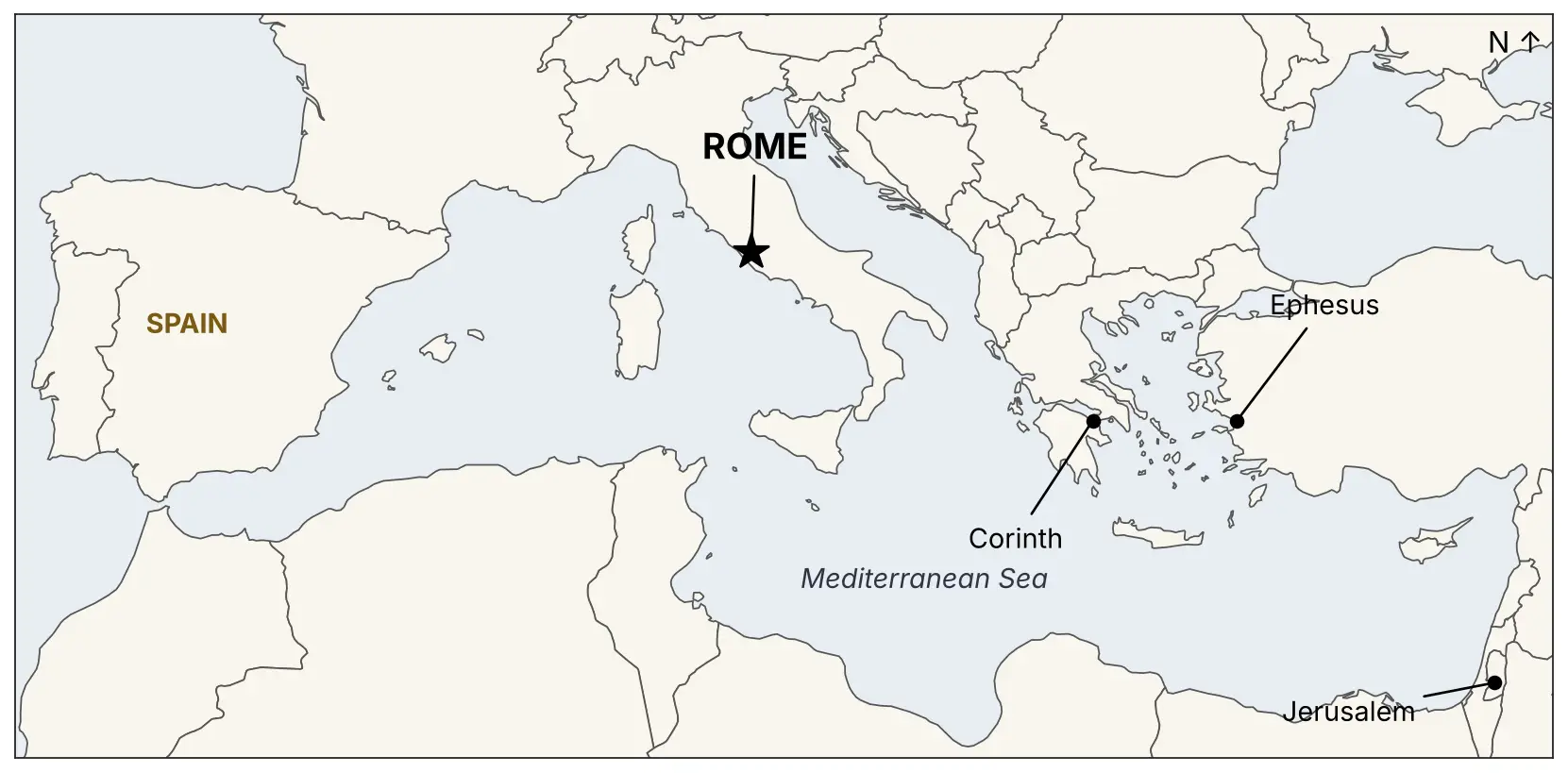
Modern locator map. Rome is marked by a star. Paul most likely wrote from Corinth, planned to carry a gift to Jerusalem, and hoped to visit Rome on his way to Spain (Romans 15:24–28).
Romans among the New Testament books
Matthew · Mark · Luke · John · Acts · Romans · 1 Corinthians · 2 Corinthians · Galatians · Ephesians · Philippians · Colossians · 1 Thessalonians · 2 Thessalonians · 1 Timothy · 2 Timothy · Titus · Philemon · Hebrews · James · 1 Peter · 2 Peter · 1 John · 2 John · 3 John · Jude · Revelation
Romans is the sixth of the 27 books in the New Testament. It comes after Acts and before 1 Corinthians.
When and where it was written
Paul most likely wrote Romans from Corinth, in Greece, about AD 56–57, near the end of his third missionary journey (compare Acts 20:2–3). He was staying with Gaius (Romans 16:23), and he was about to go to Jerusalem “bringing aid to the saints,” carrying a gift from the believers in Macedonia and Achaia for the poor among the saints there (Romans 15:25–26). After that he hoped to visit Rome and, with the church’s help, go on to Spain (Romans 15:23–24). The letter was carried by Phoebe, “a servant of the church at Cenchreae” (Romans 16:1–2), the port of Corinth. Romans is the longest of Paul’s letters, about 7,100 words in Greek, and Paul trusted it to her on the long journey across the sea to Rome. Imagine if she had lost it!
That places Romans in the middle of Paul’s letter writing. By then he had already written Galatians, 1 and 2 Thessalonians, and 1 and 2 Corinthians. Paul did reach Rome a few years later, but as a prisoner (Acts 28:14–16), and from there came the “Prison Letters”: Ephesians, Philippians, Colossians and Philemon. His letters to Timothy and Titus came later, near the end of his life. Though it was not the first of his letters, Romans stands first among them in our New Testament.
Meet the letter
I have called Paul’s letter to the Romans “the most important words ever written.” It gives us one of the clearest and fullest explanations of the gospel in the Bible. Paul wrote more of the New Testament than anyone else, yet Romans somewhat eclipses everything else he wrote. It is not more important, but it is more foundational. One of my favorite mentors, Tom Dake of Meadville Presbyterian Church in Meadville, Mississippi, once told me: “If a Christian can obtain a firm grip on and understanding of the books of Genesis and Romans that person is well on their way to understanding God, His ways, and the path of life God has for us.” I have never forgotten it.
Paul states the theme of the whole letter in 1:16–17: the gospel is the power of God for salvation to everyone who believes, and in it the righteousness of God is revealed, “from faith for faith.” Everything that follows unpacks those two verses. The letter moves from the gospel announced, to the problem of sin (Romans 1:18–3:20), to God’s answer in justification by faith (Romans 3:21–5:21), to the new life of the believer (chapters 6–8), to God’s faithfulness to Israel (chapters 9–11), to the gospel lived out (Romans 12:1–15:13), and finally to the gospel going out to the nations (Romans 15:14–16:27). Three great “therefore” turns mark the way: 5:1 changes our standing, 8:1 changes our security, and 12:1 changes our life.
God has used this one letter to turn lives and the life of the church. Augustine was converted reading Romans 13:13–14. Martin Luther’s new understanding of “the righteousness of God” in 1:17 became the doorway to the Reformation: “Thus that place in Paul was for me truly the gate to paradise.” John Wesley heard Luther’s preface to Romans read in Aldersgate Street in 1738 and “felt my heart strangely warmed.” The Swiss commentator Frédéric Godet saw the pattern: “every great spiritual revival in the church will be connected as effect and cause with a deeper understanding of this book.” That is a revival worth praying for.
THE CENTRAL MESSAGE: All humanity is guilty before a righteous God, but God graciously saves sinners through faith in Jesus Christ, gives them new life through His Spirit, and transforms them into a people who live for His glory.
A passage to carry through the study Romans 1:16–17 BLB
Find your way
Study Romans verse by verse (four parts)
Main teachings
Not ashamed of the gospel
Romans 1:1–17 Paul, a servant set apart for the gospel, thanks God for the believers in Rome and longs to visit them. Then he states the theme of the letter: the gospel is the power of God for salvation to everyone who believes, and in it the righteousness of God is revealed, for “the righteous shall live by faith.”
The whole world guilty before God
Romans 1:18–3:20 God has made Himself plain in creation, so no one has an excuse. When people refuse to honor Him and give Him thanks, their thinking grows dark and they slide downward. Moral and religious people are accountable too, and Paul’s verdict covers us all: “None is righteous, no, not one.”
Righteousness through faith in Jesus
Romans 3:21–31 All have sinned and fall short of the glory of God, and all who believe are justified by His grace as a gift, through the redemption that is in Christ Jesus. His death displays both God’s justice and His mercy, and it leaves no room for boasting.
Abraham, the father of faith
Romans 4:1–25 Abraham believed God, and it was counted to him as righteousness, before circumcision and apart from the law. David, too, celebrates the blessing of forgiveness. God’s promise comes through faith, so it rests on grace and is sure to all Abraham’s children of faith.
Peace with God; Adam and Christ
Romans 5:1–21 Justified by faith, we have peace with God, access to His grace and hope that does not put us to shame, because God shows His love in that Christ died for us while we were still sinners. Adam’s sin brought condemnation and death; Christ’s gift brings righteousness and life, and where sin increased, grace abounded all the more.
Dead to sin, alive to God
Romans 6:1–23 Grace is no license to keep on sinning. Believers are united with Christ in His death and resurrection, called to walk in newness of life and to consider themselves dead to sin and alive to God. The wages of sin is death, but the free gift of God is eternal life in Christ Jesus our Lord.
The war within
Romans 7:1–25 The law is holy and reveals sin, but it cannot save. Paul describes the struggle every believer knows, doing what he hates and failing to do the good he wants, until it ends in a cry for deliverance and its answer: thanks be to God through Jesus Christ our Lord.
No condemnation, no separation
Romans 8:1–39 There is no condemnation for those in Christ Jesus. The Spirit gives life, leads God’s children, and helps us in our weakness, even praying for us. God works all things together for good to conform us to the image of His Son, and nothing in all creation can separate us from His love.
God’s Word has not failed
Romans 9:1–29 Paul grieves for his own people, Israel. Yet God’s Word has not failed: not all descended from Israel belong to Israel, and the children of promise are counted. Salvation depends not on human will or exertion, but on God, who has mercy.
The word is near you
Romans 9:30–10:21 Israel had zeal for God without knowledge, seeking to establish their own righteousness. But Christ is the end of the law for righteousness to everyone who believes. Confess with your mouth that Jesus is Lord, believe in your heart that God raised Him from the dead, and you will be saved, for faith comes from hearing the word of Christ.
God has not rejected His people
Romans 11:1–36 There is a remnant chosen by grace. Gentiles are grafted into the olive tree and warned against pride, and Israel’s partial hardening will last until the fullness of the Gentiles comes in. The chapter ends in worship: from Him and through Him and to Him are all things.
A living sacrifice; love overcoming evil
Romans 12:1–21 By the mercies of God, present your bodies as a living sacrifice and be transformed by the renewal of your mind. Use your gifts humbly, let love be genuine, rejoice in hope, be patient in tribulation, be constant in prayer, and overcome evil with good.
Authorities, love and waking up
Romans 13:1–14 Be subject to the governing authorities, which are instituted by God. Owe no one anything except to love each other, for love fulfills the law. The night is far gone, so cast off the works of darkness and put on the Lord Jesus Christ.
Welcome one another
Romans 14:1–15:13 Believers who differ on secondary matters must not judge or despise one another, since each of us will give an account to God. The strong bear with the weak, liberty is governed by love, and Jew and Gentile welcome one another as Christ welcomed them, filled with joy and peace by the God of hope.
The gospel to the nations
Romans 15:14–16:27 Paul describes his priestly ministry to the Gentiles, his plans for Jerusalem, Rome and Spain, and asks the church to strive with him in prayer. He greets a real family of servants and co-workers, warns against those who cause divisions, and ends with glory to the only wise God.
Praying through Romans
Romans is a letter full of prayer. Paul opens with thanks to God for the believers in Rome and tells them that he mentions them in his prayers “without ceasing” (Romans 1:8–10). He tells us that the Holy Spirit helps us in our weakness and prays for us when we do not know what to pray (Romans 8:26–27). His heart’s desire and prayer to God for Israel is that they may be saved (Romans 10:1). He prays for harmony among believers (Romans 15:5–6) and that the God of hope would fill them with joy and peace (Romans 15:13). He asks the church to strive together with him in prayer (Romans 15:30–33), and he closes with glory to the only wise God (Romans 16:25–27). Along the way he tells us to “be constant in prayer” (Romans 12:12). As Matthew Henry wrote, “One of the greatest kindnesses we can do our friends, and sometimes the only kindness that is in the power of our hands, is, by prayer to recommend them to the loving-kindness of God.”
One of the best ways to study Romans is to pray it. In my notes on Romans 1, I take each section and ask what foundational truth it teaches, then turn that truth into a short first-person statement to meditate on and pray over, so the truth moves from the page into the heart. The first prayer below is built from those lines. The second is my prayer from Romans 12 for those who suffer and for the persecuted church. Pray them slowly, pause to name the people God puts on your heart, then pray them again in your own words.
The prayers in this letter
Romans 1:8–10 — Thanks for their faith. Paul thanks God through Jesus Christ for all the believers in Rome, because their faith is proclaimed in all the world. God is his witness that he mentions them always in his prayers, asking that by God’s will he may at last come to them.
Romans 8:26–27 — The Spirit helps us pray. When we do not know what to pray for as we ought, the Spirit Himself intercedes for us with groanings too deep for words. The Father who searches hearts knows the mind of the Spirit, who always prays according to the will of God. No believer ever prays alone.
Romans 10:1 — A heart’s desire for the lost. Paul’s heart’s desire and prayer to God for his own people, Israel, is that they may be saved. Though they opposed his preaching, he kept praying for them.
Romans 15:5–6 — A prayer for harmony. Paul asks the God of endurance and encouragement to grant believers to live in harmony with one another, in accord with Christ Jesus, so that together, with one voice, they may glorify the God and Father of our Lord Jesus Christ.
Romans 15:13 — The God of hope. Paul prays that the God of hope will fill believers with all joy and peace in believing, so that by the power of the Holy Spirit they may abound in hope.
Romans 15:30–33 — Strive together with me in prayer. By our Lord Jesus Christ and by the love of the Spirit, Paul asks the church to strive together with him in prayer: that he be delivered from unbelievers in Judea, that his service for Jerusalem be acceptable to the saints, and that by God’s will he may come to them with joy and be refreshed. He closes, “May the God of peace be with you all.”
Romans 16:25–27 — To the only wise God. Paul ends the letter with praise to Him who is able to strengthen believers according to the gospel and the preaching of Jesus Christ, the mystery now made known to all nations to bring about the obedience of faith. To the only wise God be glory forevermore through Jesus Christ.
Foundational truths and prayers from Romans 1
Pray it with Romans 1:1–32 BLB
Lord, I am called to be fully devoted to You, living as Your servant with wholehearted commitment. Jesus’ resurrection declares Him the Son of God. Because He died and rose for me, I now live fully for Him. As one born again, I belong to Jesus Christ, and by His grace I am empowered to live in faithful obedience to His call.
I am not ashamed of the gospel. Through faith in Jesus, who died for my sins, I am born again and declared righteous before You. By Your power I live by faith; let my life bear witness to His righteousness in me. If I know the truth but remain silent, I am guilty of withholding life. Help me speak the truth of the gospel and declare life in Jesus.
You have clearly revealed Yourself in creation; its order, beauty and design reflect Your nature. You are eternal, without beginning or end, and Your creation displays Your divine power, leaving no excuse for denying You. Because You reveal Yourself, I will honor You as God and give You thanks. Keep me from the futile thinking and darkened heart that come when I fail to honor and thank You, and from exchanging the glory of the one true God for created things.
Every moment in life presents a choice between serving You, O Lord, or turning away. Help me to choose You — to choose to follow Jesus, my Savior and my example in all things. May I always, by Your grace, choose to walk in the light as Jesus is in the light. You alone, O Lord, are the right path, the right choice, the only true choice. May You be blessed forever. In Jesus’ name, amen.
A prayer from Romans 12
Pray it with Romans 12:10–12 BLB
Lord, we praise You that even in trials You give us hope to rejoice, strength to endure, and the invitation to remain in prayer. Help us grow by loving deeply, serving wholeheartedly, and staying fervent in spirit, not letting weariness steal our devotion to Christ.
Heavenly Father, we lift up those who are burdened with suffering and hardship. Strengthen their hearts with hope, give them patience in tribulation, and let them feel Your nearness as they endure. Remind them that You are the God who redeems pain and brings joy in the morning.
Lord Jesus, we especially remember our brothers and sisters facing persecution for Your name. Surround them with courage, shield them with Your presence, and let their witness shine brightly in dark places. May they know they are not forgotten but upheld by the prayers of Your people around the world. Fill them with the Spirit so they may rejoice in hope and remain constant in prayer, even under pressure. Amen.
A brief outline
Part 1: Romans 1–4 — The Gospel and Our Need
1:8–1:15 Longing to Go to Rome
1:16–1:17 The Righteous Shall Live by Faith
1:18–1:32 God’s Wrath on Unrighteousness
2:1–2:16 God’s Righteous Judgment
2:17–2:29 God’s Judgment and the Law
3:1–3:8 God’s Righteousness Upheld
3:21–3:31 The Righteousness of God Through Faith
4:1–4:12 Abraham Justified by Faith
4:13–4:25 The Promise Realized Through Faith
Part 2: Romans 5–8 — New Life in Christ
5:1–5:11 Peace with God Through Faith
5:12–5:21 Death in Adam, Life in Christ
6:1–6:14 Dead to Sin, Alive to Christ
6:15–6:23 Slaves to Righteousness
8:31–8:39 God’s Everlasting Love
Part 3: Romans 9–11 — God’s Faithfulness to Israel and the Nations
9:1–9:5 Paul’s Anguish over Israel
9:6–9:29 God’s Sovereign Choice
10:5–10:21 The Message of Salvation to All
11:1–11:10 The Remnant of Israel
11:11–11:24 Gentiles Grafted In
11:25–11:36 The Mystery of Israel’s Salvation
Part 4: Romans 12–16 — Living the Gospel Together
12:9–12:21 Marks of the True Christian
13:1–13:7 Submission to the Authorities
13:8–13:10 Fulfilling the Law Through Love
13:11–13:14 The Day Is at Hand
14:1–14:12 Do Not Pass Judgment on One Another
14:13–14:23 Do Not Cause Another to Stumble
15:1–15:7 The Example of Christ
15:8–15:13 Christ the Hope of Jews and Gentiles
15:14–15:21 Paul the Minister to the Gentiles
15:22–15:33 Paul’s Plan to Visit Rome
Related teaching and source notes
These are the Romans studies, class notes, sermons and prayers this study was drawn from.
The Book of Romans — Overview, Outline and Quick Reference: From Guilt to Glory — Front door to the collection: Romans in one sentence, a chapter-by-chapter map, several outlines, five key words, the three “therefore” turns, the Great Gospel Road and key verses.
Introducing Romans — Why This Letter Matters — Who wrote it, how the church in Rome began, why Paul wrote, how Romans changed Augustine, Luther and Wesley, and a study guide on Romans 1:8–17.
Romans 1 — Foundational Truths and Prayers — Each section of Romans 1 written out as a foundational truth, then turned into first-person lines for meditation and prayer.
Romans 1:5–7 — Called to Belong to Jesus Christ — Verse-by-verse study of Paul’s greeting: grace, the obedience of faith, and belonging to Jesus Christ.
Romans 1:18–21 — No Excuse — Devotional study on God revealed in creation and the danger of not honoring Him or giving Him thanks.
Romans 3 — Key Truths — Section-by-section outline of Romans 3: God is faithful, all have sinned, and we are made right through faith in Jesus.
Romans 5:1–11 — Peace Through the Resurrection (Easter Sermon by Pastor Chris Berg) — Notes I compiled from Pastor Chris Berg’s Easter sermon (April 5, 2026): what we have, what we will have, and why we rejoice. The thoughts are his, summarized, not word for word.
Romans 6:1–14 — Dead to Sin, Alive to God: A Greek Word Study — The key Greek phrases of Romans 6:1–14 and what Paul means by “continue in sin.”
Romans 7:14–25 — The War Within: Why I Do What I Don’t Want to Do — Teaching notes on flesh, Spirit and the believer’s struggle with sin, drawing on an article by Bob Deffinbaugh (Bible.org).
Romans 8:24–30 — Saved in Hope; the Spirit Helps Us — Verse-by-verse notes from our Tuesday night group on hope, the Spirit’s help in prayer, and God’s unbreakable chain from calling to glory.
Romans 8:28–29 — All Things Work Together for Good — A close study of the promise of Romans 8:28 and God’s purpose to conform us to the image of His Son.
Romans 8:29–39 — More Than Conquerors — The high point of Romans 1–8: if God is for us, who can be against us? Nothing can separate us from the love of God.
Romans 9:1–29 — God’s Sovereign Mercy — Study guide for Tuesday Night Bible Study on Paul’s anguish for Israel, the children of promise, and the remnant.
Romans 10:1–21 — The Word Is Near You — Study guide for the Tuesday Night Men’s Group, taught over two sessions: zeal without knowledge, Christ the end of the law, and faith that comes by hearing.
Romans 11:1–27 — Has God Rejected His People? — Study guide for the Tuesday Night Men’s Group on the remnant, the olive tree, and the mystery of Israel’s future.
Romans 11:28–36 — Mercy That Has the Last Word — Verse-by-verse study of God’s irrevocable gifts and calling, and the doxology that closes chapters 1–11.
Romans 11:32–12:2 — From the Depths of God’s Wisdom to a Living Sacrifice — The great turn of the letter from doctrine to daily life: from worship of God’s wisdom to presenting ourselves as living sacrifices.
Romans 12:9–21 — Love Overcoming Evil — Verse-by-verse study of what genuine love looks like among believers and toward enemies.
Romans 13:8–14 — Love Fulfills the Law; Put On the Lord Jesus — Study of owing nothing but love, waking from sleep, and putting on the Lord Jesus Christ.
Romans 14:1–23 — Welcoming the Weak: Liberty Governed by Love — Verse-by-verse study of the strong, the weak, and the lordship of Christ over disputable matters.
Romans 15:1–7 — Welcome One Another as Christ Welcomed You — Study of bearing with the weak, Christ our pattern, and the encouragement of the Scriptures.
Romans 15:8–33 — Paul’s Mission and Plans: The Gospel to the Nations — Christ the servant, the God of hope, Paul’s priestly ministry to the Gentiles, and his request for prayer.
Romans 16:1–27 — Greetings, Warnings and the Final Doxology — Paul’s friends and fellow workers, a final warning against division, and glory to the only wise God.
Romans 12:9–21 — 29 Commands for Us to Be Like Jesus — The commands of Romans 12:9–21, listed and numbered one by one.
Romans 12:10–12 — A Prayer from Romans 12 — My written prayer for those who suffer and for the persecuted church: rejoice in hope, be patient in tribulation, be constant in prayer.
A Walk Down the Roman Road — Basic Christianity, Lesson 1 — A discovery study I wrote in 2021 for Basic Christianity groups in Kenya, walking through Romans 3:23, 6:23 and 10:9–10.
Romans 8:28 — The Svea Flood Story — A true missionary story I keep as an illustration of Romans 8:28. It is not my own writing; it comes from the account of Aggie Hurst.
Romans 13:14 — A Real Put On: Putting On Jesus — Sermon outline on putting on the Lord Jesus Christ like our favorite clothes and like a suit of armor.
Romans 1 — Verse-by-Verse Study — My earlier website study of Romans 1, verse by verse, with verses to memorize.
Romans 2 — Verse-by-Verse Study — My earlier website study of Romans 2, verse by verse, with memory verses.
Romans 3 — Verse-by-Verse Study — My earlier website study of Romans 3, verse by verse, with memory verses.
Introduction to Romans — My written introduction: the theme, the truths we will meet, purpose, key themes, an outline and the setting of the letter.
Paul’s Letter to the Romans — Introduction (Teaching Notes) — My original teaching notes introducing Romans as “the most important words ever written,” with the questions on Romans 1:8–17.
Romans 1 — Full Text Broken Down — The ESV text of Romans 1 laid out phrase by phrase for slow reading.
Romans 13:1–7 — Authority From God — A study on Romans 13:1–7, still being prepared.
Source acknowledgments
Prepared for Aiming For Jesus from Hollis McGehee’s Romans studies, class notes, sermons and prayers. Teaching explanations have been edited for clarity. Scripture is distinguished from commentary.
Scripture quotations are from the ESV® Bible (The Holy Bible, English Standard Version®), copyright © 2001 by Crossway, a publishing ministry of Good News Publishers. Used by permission. All rights reserved.
Verses to memorize
Begin with one selection. Read its surrounding passage, say the words aloud, and return to them during the day. For a longer selection, learn one verse at a time and then join the verses together.
The power of God for salvation
Romans 1:16–17 BLB
All have sinned
Romans 3:23 BLB
Justified by His grace as a gift
Romans 3:24 BLB
Peace with God
Romans 5:1 BLB
While we were still sinners
Romans 5:8 BLB
The free gift of God
Romans 6:23 BLB
No condemnation
Romans 8:1 BLB
All things work together for good
Romans 8:28 BLB
Nothing can separate us
Romans 8:38–39 BLB
Confess and believe
Romans 10:9–10 BLB
Faith comes from hearing
Romans 10:17 BLB
To Him be glory forever
Romans 11:36 BLB
A living sacrifice, a renewed mind
Romans 12:1–2 BLB
The God of hope
Romans 15:13 BLB