HIM or me?
Living for Jesus — He died to save me. Now I must die to follow Him. · by Hollis McGehee
Click or tap any Scripture reference to read it in the ESV right here. Select BLB to open it in Blue Letter Bible.
Large Print edition (PDF) — easy to read and print
The real obstacle is not my anger. The real obstacle is me.
I have a sin problem, and Jesus fixed it. He paid it all. By grace alone, through faith alone, I am forgiven, born again, a new creation. Sin is no longer my master — but the old self has not given up. It still wants the throne. That is the real problem. Not my anger, my pride, my bitterness or my jealousy. Those are only the fruit. The root is me: me first, me in charge, me trying to live for God in my own strength.
The answer is not trying harder. It is surrender. Jesus died to save me; now I must die to follow Him — deny myself, take up my cross daily and follow Him (Luke 9:23 BLB). I must come to the end of myself and give Jesus the throne, and the throne alone. I cannot do that by determination; I depend on His Spirit, moment by moment. The struggle will not end in this life, but the war is won. And every day, in every moment, the question is the same: HIM or me? Jesus must be first.
Contents
Select a part or chapter to go there. Scripture references open the ESV right here on the page; the BLB button opens the passage in Blue Letter Bible.
Introduction
Part One — The Big Questions
Part Two — The War
Part Three — The Skirmishes
Part Four — Dependence Day
Part Five — The Other Side Of The Rainbow
Class Leader Guide
INTRODUCTION
IF YOU ARE A BORN AGAIN FOLLOWER OF JESUS – YOU KNOW THIS STRUGGLE ALL TOO WELL
IF YOU DON’T KNOW THIS STRUGGLE YOU DON’T TRULY KNOW JESUS!
Being a good person.
Being a religious person.
Being a little better than you used to be.
NONE OF THOSE GETS US INTO THIS
TUG OF WAR
The Apostle Paul gives us a clear picture of this battle in Romans Ch. 7 where he says:
For I do not understand my own actions. For I do not do what I want, but I do the very thing I hate…. (Romans 7:15 BLB ESV)
Then Paul goes on to say (paraphrase) ‘my heart wants the right thing but my hands keep making the wrong choices’…. ’who will get me out of this mess….” (Romans 7:21–24 BLB) and then he declares:
“Thanks be to God through Jesus Christ our Lord! So then, I myself serve the law of God with my mind, but with my flesh I serve the law of sin. There is therefore now no condemnation for those who are in Christ Jesus.” (Romans 7:25–8:1 BLB ESV)
We never ‘grow’ out of this battle but we can surrender out of it. Die to ourselves and escape it. But be prepared to see the ‘old man’ (our flesh) jump back up and start tugging us again towards the old way. This is an every minute of every hour of every day of every week – lifelong battle until we meet Jesus face to face. BUT the joy of living for the LORD and finding those little victories where our old man is put away is indescribably wonderful and rewarding. There is no joy on earth of any kind no matter how many ways you want to think it or say it that even approaches the joy of dying to our self and living for Jesus. It is not a mystery – in that moment we realize what we were created for. It’s like when you find the right size socket wrench for the stubborn bolt you are trying to loosen – when it slips over the nut and fits so well and it breaks loose – like they say “it just doesn’t get any better than that.”!
Don’t ever think you will outgrow this battle – we won’t. But we can get so good at dying to self and living all in for Jesus that it becomes our ‘natural’ move rather than having to scramble. The old man (our old sin nature) will never give up in this physical life but he can be so beat down that it’s almost like he was gone – never think he is gone because at that moment our pride will topple us and we will ‘grab for some gusto’ and find out we have nothing but empty space and we fall on our face again. My face is way tired of being planted in the hard rough soil of my pride. Lord, here I am I give myself to You – over and over and over again. The great joy of living for Jesus.
THIS WILL NOT JUST HAPPEN – IT REQUIRES SURRENDER – INTENTIONALITY TO STAY SURRENDERED AND HUMILITY TO RECOGNIZE OUR OWN ABJECT FAILURES AND TRUSTING GOD.
To copy a saying from back in the day:
WE HAVE TO JUST SAY ‘NO’ TO SELF AND YES TO JESUS!
But don’t be surprised when day after day you keep bumping into yourself – trying to live out that ill advised song “I did it my way”!
ARE YOU READY FOR DEPENDENCE DAY! DYING TO SELF AND LIVING ALL IN FOR JESUS? HERE IS HOW YOU CAN KNOW – WHEN THE THINGS LISTED BELOW START TO LOSE THEIR GRIP ON YOUR EMOTIONS, WHEN YOU LEARN NOT TO REACT (EVER), WHEN WE BEGIN TO LEARN TO LOSE SELF-FOCUS AND GAIN JESUS FOCUS THEN WE WILL START TO EXPERIENCE ‘DEPENDENCE DAY’ AND REALIZE IT IS THE BEST DAY BY FAR.
When someone cuts in front of me, when someone races me to the parking place, the check-in desk at the doctor’s office (restaurant / ball game…..)
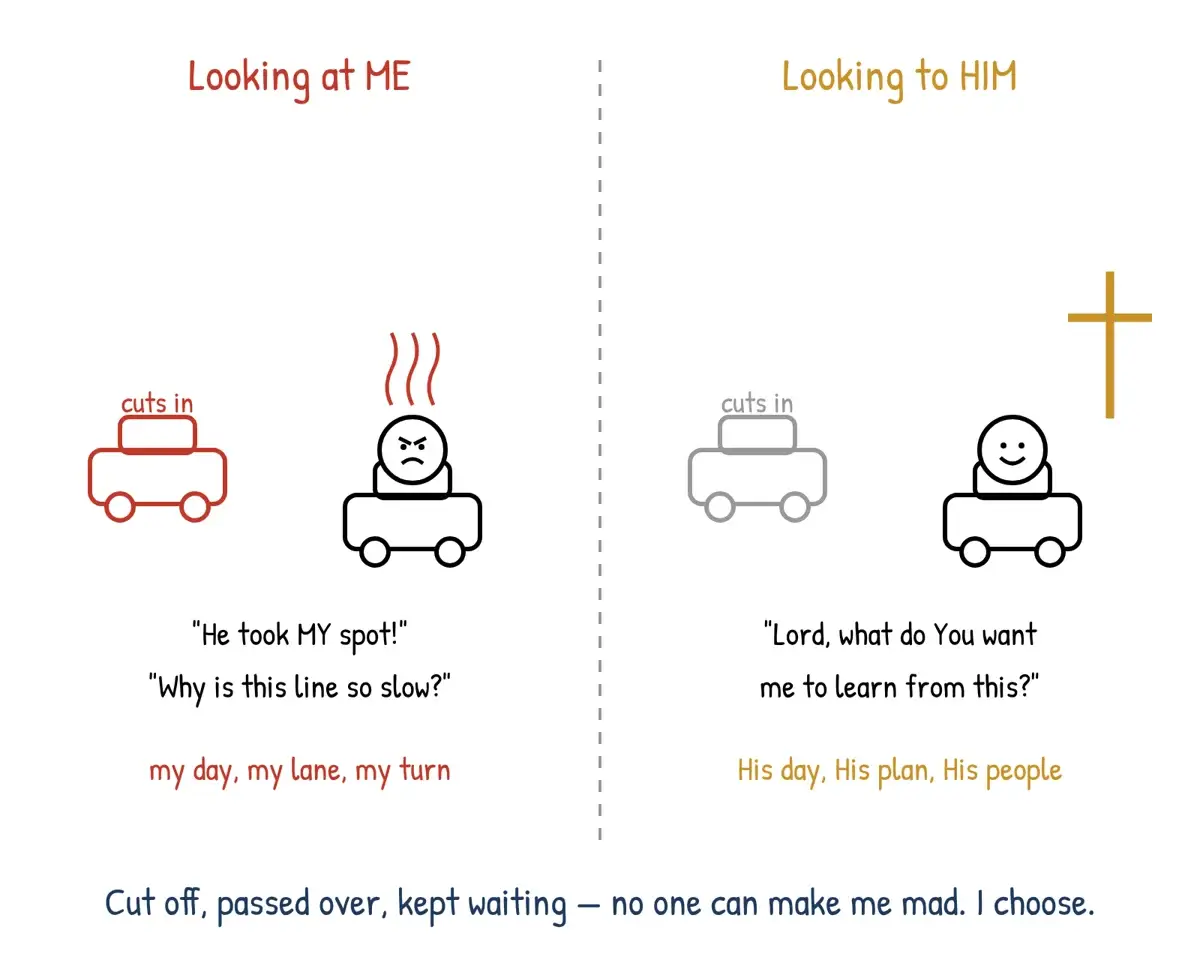
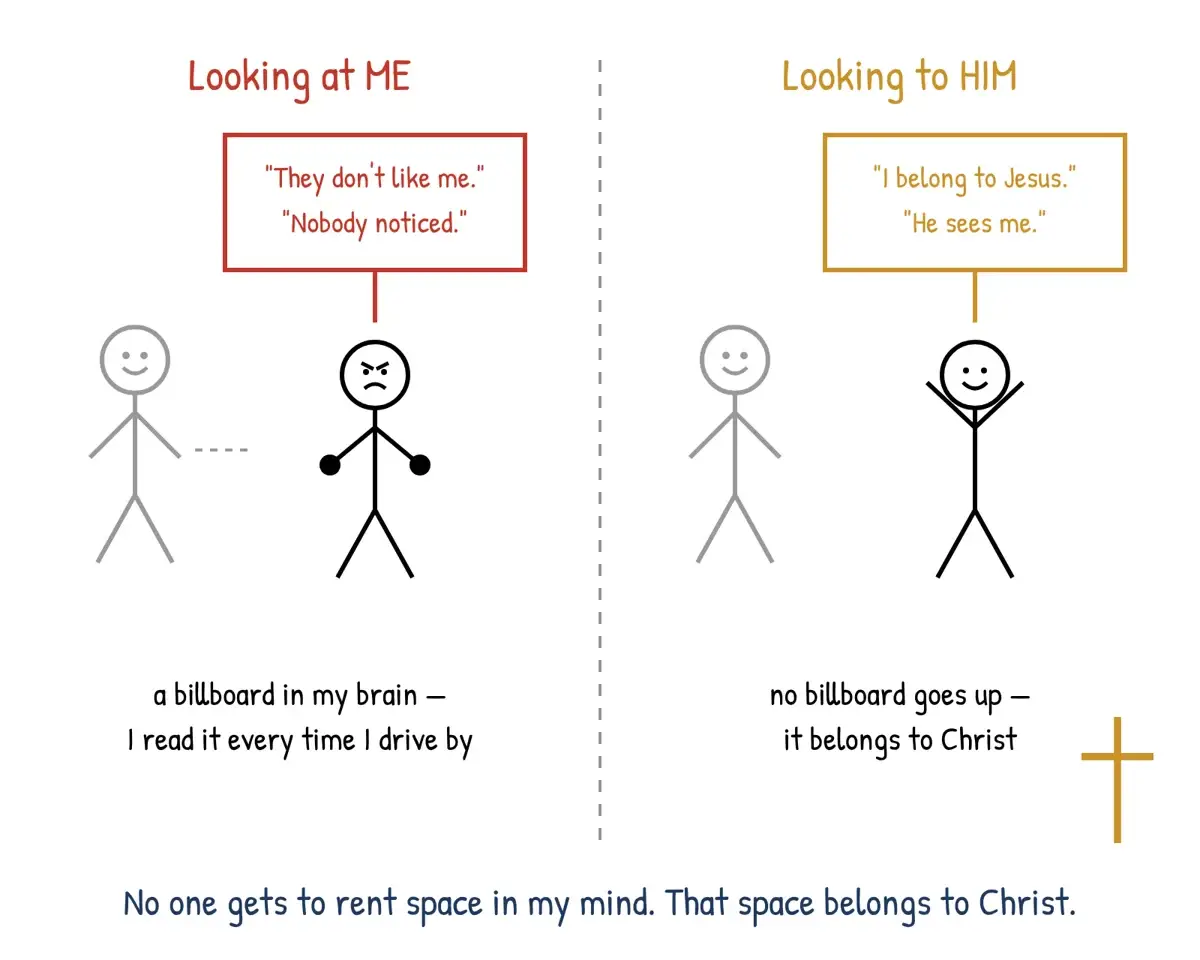
When someone doesn’t speak to me / notice me, when a sharp cutting comment is made about me, when someone else is preferred above me, when what I accomplished doesn’t get noticed while someone else’s ‘far less superior’ accomplishment does get the notice….
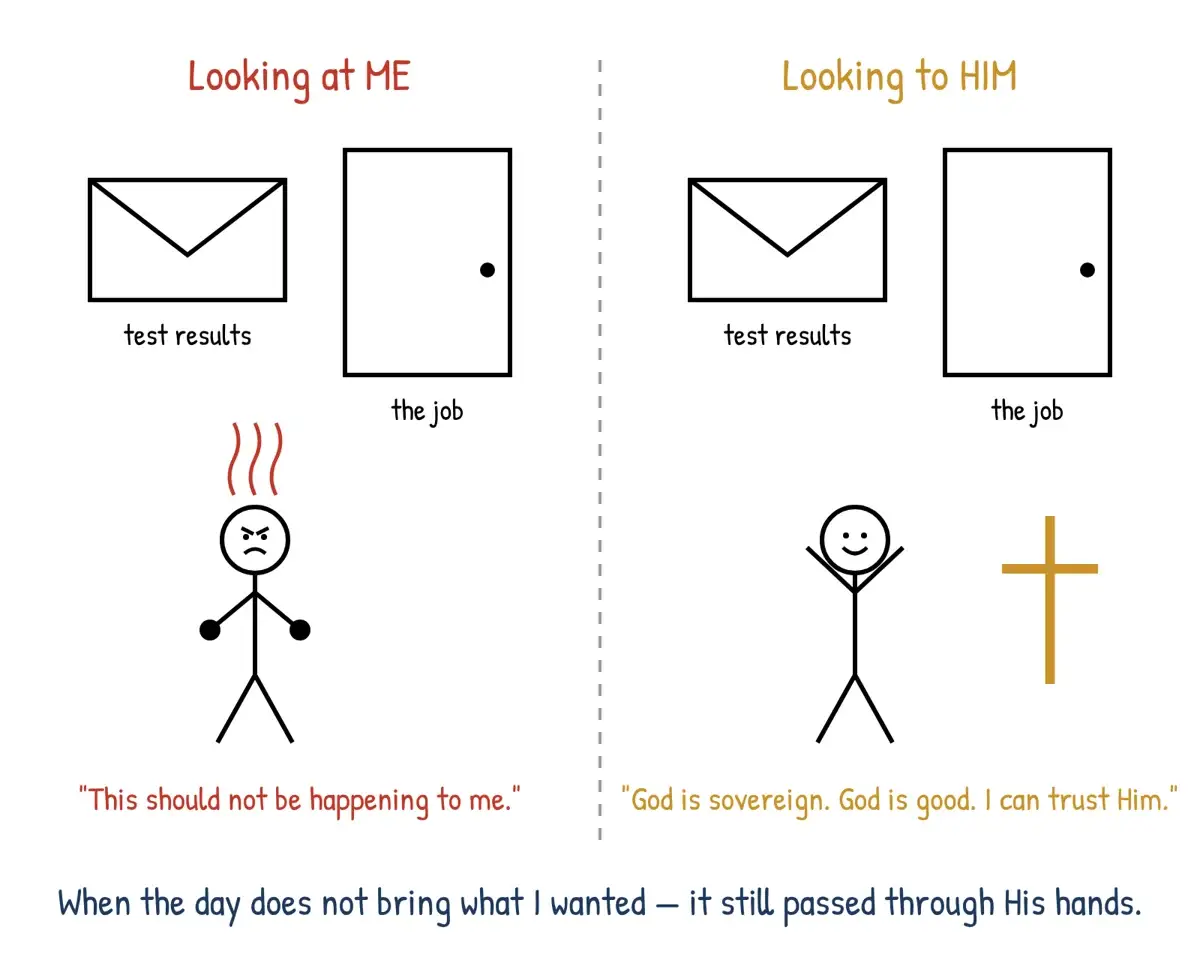
When the day doesn’t bring what I wanted, when the test results aren’t what I hoped for, when the job goes to the other person . . .
But until then, get ready to keep getting your spiritual chin scraped and nose busted as you fall for (me) the old man’s lies.
JUST SAY NO! TO SELF!
OVER
OVER
OVER
AND AGAIN
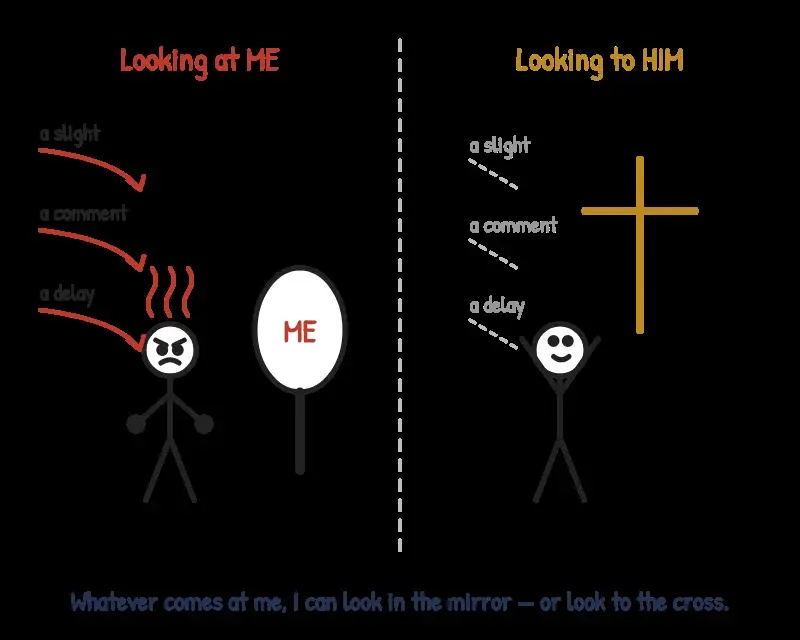
It is almost never about me. And even when it is, I don’t want to let it become about me in my mind. My obligation is always to do the right thing, and me-centered is never going to be the right thing.
The answer never changes – it is always JESUS!
PART ONE — THE BIG QUESTIONS
The ground everything else stands on.
Question 1: Who Is God?
Read Romans 12:9–21 BLB
Before I can deal with my anger, I have to settle a bigger question. Who is God? Everything else in this study rests on the answer.
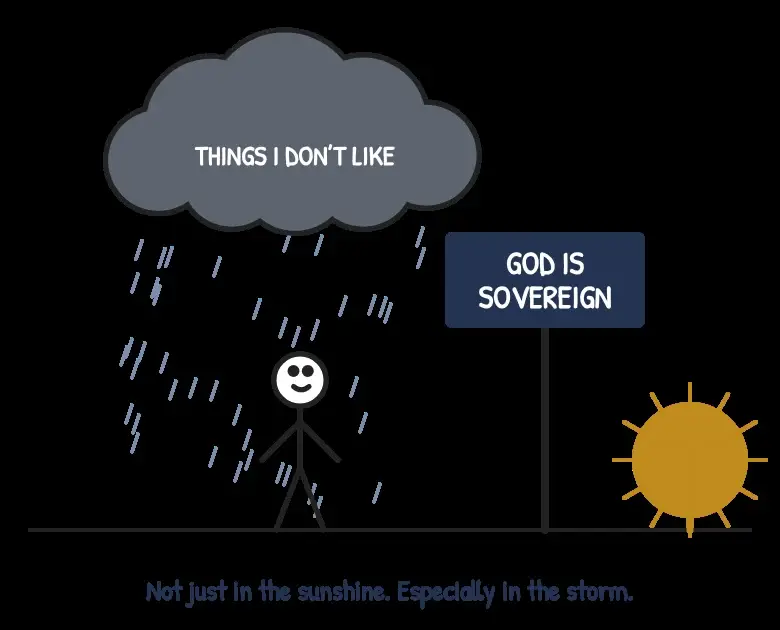
God is sovereign. He rules. He does whatever He pleases, and nothing reaches me that has not first passed through His hands. Not the diagnosis. Not the traffic. Not the cutting remark at the dinner table.
“Our God is in the heavens; he does all that he pleases.” Psalm 115:3 BLB
God is sovereign. God is good. I can trust Him.
It is easy to trust God when life goes my way. The promotion comes through. The children call. The test comes back clear. The real question is whether I trust Him in the circumstances I don’t like. Especially those. That is where trust is tested, and that is where independence begins to die or ‘me’ is back on the throne and I am miserable trying to honor God while stealing His place on His throne.
When I get angry, selfish, bitter, resentful . . . I am usually saying, “This should not be happening to me.” But God has not lost control of my day. His thoughts are not my thoughts. His ways are not my ways. He sees what I cannot see.
“For my thoughts are not your thoughts, neither are your ways my ways, declares the LORD. For as the heavens are higher than the earth, so are my ways higher than your ways and my thoughts than your thoughts.” Isaiah 55:8–9 BLB
Picture the pharmacy line that hasn’t moved in twenty minutes. The clerk is new. The man ahead of me has a long story. I feel the heat rising. But who put me in this line today? If God is sovereign, this line is not an accident, and the people in it are not obstacles. They are people He loves, and this moment is one He is using for His glory and my growth. Will I trust Him and allow myself to be trained in Christlikeness by getting over myself?
And He is not only in control. He is good. He takes even the hard things and works them together for the good of those who love Him.
“And we know that for those who love God all things work together for good, for those who are called according to his purpose.” Romans 8:28 BLB
Notice what that verse does not say. It does not say all things are good. It says God works all things together for good. The hurt is real. So is the God who rules over it.
“Count it all joy, my brothers, when you meet trials of various kinds, for you know that the testing of your faith produces steadfastness. And let steadfastness have its full effect, that you may be perfect and complete, lacking in nothing.” (James 1:2–4 BLB, ESV)
So what does trusting a sovereign God look like on any given day? Paul shows us in Romans 12:9–21 BLB, the marks of a true Christian. Read it slowly. Love without pretending. Hate what is evil and hold on to what is good. Honor others ahead of myself. Keep hoping, keep enduring, keep praying. Bless the people who hurt me. Refuse to pay back evil for evil. Leave vengeance with God. Overcome evil with good.
“Rejoice in hope, be patient in tribulation, be constant in prayer.” Romans 12:12 BLB
Every one of those marks requires trust. I can leave vengeance with God only if I believe He is just. I can be patient in trouble only if I believe He is in charge of the trouble. I can bless the person who cursed me only if I believe God is bigger than what that person did.
Anger says, “I am in charge.” Trust says, “God is.”
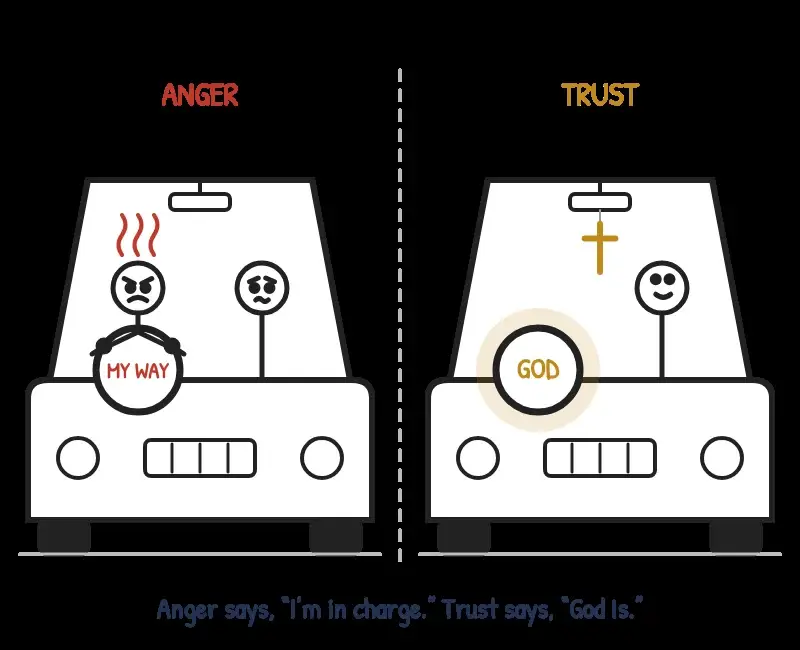
This is where the study starts. Not with my anger, but with my God. If He is sovereign and good, then nothing that comes at me today is outside His reach, and I don’t have to take the wheel back from Him.
Your turn
Where do I find it hardest to trust God right now? (check all that apply)
☐ my health
☐ my family
☐ money
☐ my work
☐ how people treat me
☐ the news
☐ other:
When life does not go my way, how quickly do I turn to God instead of to anger, rage, bitterness, and / or resentment? (circle one)
○ Rarely ○ Sometimes ○ Often ○ Almost always
Sort these responses into the right column.
| Item | Trusting God | Taking control |
|---|---|---|
| Praying before I answer | ||
| Replaying the argument at night | ||
| Blessing someone who insulted me | ||
| Getting even “just a little” | ||
| Waiting patiently in a long line | ||
| Telling everyone how I was wronged | ||
| Leaving justice with God | ||
| Insisting on the last word |
The circumstance I most need to trust God with this week is __________.
Marks of a true Christian
Re-read Romans 12:9–21 BLB. The mark that is hardest for me right now is:
One way I will practice it this week:
Think it through: Name one hard circumstance from your past that God worked for good. What did you learn about Him?
Hide it in your heart
“And we know that for those who love God all things work together for good, for those who are called according to his purpose.” Romans 8:28 BLB
Write it out once from memory:
Let’s pray
Father, You are sovereign. You rule over my day, my family, my health and every word spoken to me. I confess that I trust You easily when things go my way and fight You when they don’t. Forgive me for acting as if I were in charge. Teach me that Your ways are higher than mine. Grow in me the marks of a true Christian: genuine love, patience in trouble, and a heart that blesses instead of curses. When life goes the way I don’t like, help me trust You most of all. In Jesus’ name, amen.
God is sovereign and good — especially in the circumstances I don’t like.
Question 2: Who Am I?
Read Ephesians 2:1–10 BLB
If God is sovereign and good, the next question is harder. Who am I?
I am a sinner.
Not a sinner compared to the people around me. A sinner before a holy God. I can always find someone whose anger is worse than mine. That doesn’t help me. God does not grade on a curve.
“for all have sinned and fall short of the glory of God,” Romans 3:23 BLB
All means all. The judge and the man in the courtroom. The chaplain and the patient. The preacher and the person who hasn’t been to church in thirty years. Me.
Sin is not just the bad things I do. It is me trying to occupy the throne that belongs soley to God. My way instead of His way. That is why anger, self-centeredness, selfishness all matter so much. When I explode, or when I go cold and silent, my anger is showing me what is on the throne of my heart. The biggest struggle is always about me.
And sin does something terrible. It separates.
“but your iniquities have made a separation between you and your God, and your sins have hidden his face from you so that he does not hear.” Isaiah 59:2 BLB
That is the honest truth about every one of us. There are only two places I can stand. Either I have been born again, or I am still separated from God by my sin. There is no third place. Being a good neighbor is not a third place. Going to church is not a third place. Being nicer than my brother is not a third place.
Either I have been born again, or I am separated from God by my sin.
Paul does not soften it. He says we were dead. Not sick. Not struggling. Dead. A dead man cannot clean himself up, try harder or turn over a new leaf. He needs life from outside himself.
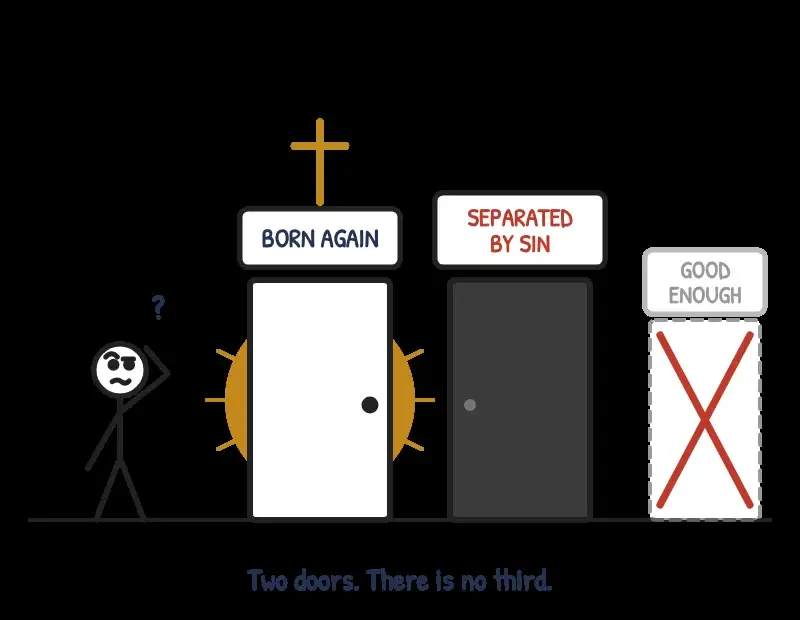
Then come two of the most beautiful words in the Bible: “But God.”
“But God, being rich in mercy, because of the great love with which he loved us, even when we were dead in our trespasses, made us alive together with Christ—by grace you have been saved—” Ephesians 2:4–5 BLB
Picture a man who has spent his life keeping score. He pays his bills, mows his lawn, and has never been arrested. Yet he is impatient with his wife, harsh with the waiter, and quietly sure he is better than most. Good manners have covered a heart that is still on its own throne. That can be any of us.
God, rich in mercy, made us alive with Christ while we were still dead. By grace. Not because we earned it. Because He loved us.
Here is why this belongs in a study about all of the ‘self’ stuff (anger, rage, malice, bitterness…). When I truly see myself as a sinner, I lose my seat as the judge of everyone else. I am slower to be outraged at someone else’s sin when I remember how much of mine God has carried. The person who hurt me is not my enemy to punish. He is a sinner like me, who needs the same mercy I need.
So I have to answer for myself. Not for my spouse, my parents or my pastor. Where do I stand?
Your turn
Ways I have tried to feel right with God on my own (check all that apply)
☐ going to church
☐ being better than someone else
☐ doing good deeds
☐ my family’s faith
☐ keeping the rules
☐ being sincere
☐ other:
When I am being honest with myself and God, do I see myself as a sinner before a holy God? (circle one)
○ Rarely ○ Sometimes ○ Often ○ Almost always
Sort what I tell myself into the right column.
| Item | Excuse | Confession |
|---|---|---|
| “I’m not as bad as some people.” | ||
| “I put myself on the throne.” | ||
| “They pushed me to it.” | ||
| “I need God’s mercy as much as anyone.” | ||
| “That’s just how I am.” | ||
| “My anger showed what is in my heart.” |
Say it better: rewrite this as an honest confession.
Harsh: “At least I’m not a sinner like THAT person.”
Better:
I am a sinner. Today, honestly, I believe I am __________ (born again / separated from God / not sure).
Think it through: When my anger flares, what does it show me is sitting on the throne of my heart?
Hide it in your heart
“But God, being rich in mercy, because of the great love with which he loved us, even when we were dead in our trespasses, made us alive together with Christ—by grace you have been saved—” Ephesians 2:4–5 BLB
Write it out once from memory:
Let’s pray
Holy God, I confess that I am a sinner. Not just a person who makes mistakes, but someone who has put myself on Your throne. I have compared myself to others to feel better. I have judged people for sins I carry too. Thank You that You are rich in mercy, and that You make dead people alive in Christ. Show me honestly where I stand with You. Take me off the judge’s bench, and make me humble and grateful. In Jesus’ name, amen.
I am a sinner — so I am not anyone else’s judge.
Question 3: Am I Born Again?
Read John 3:1–21 BLB
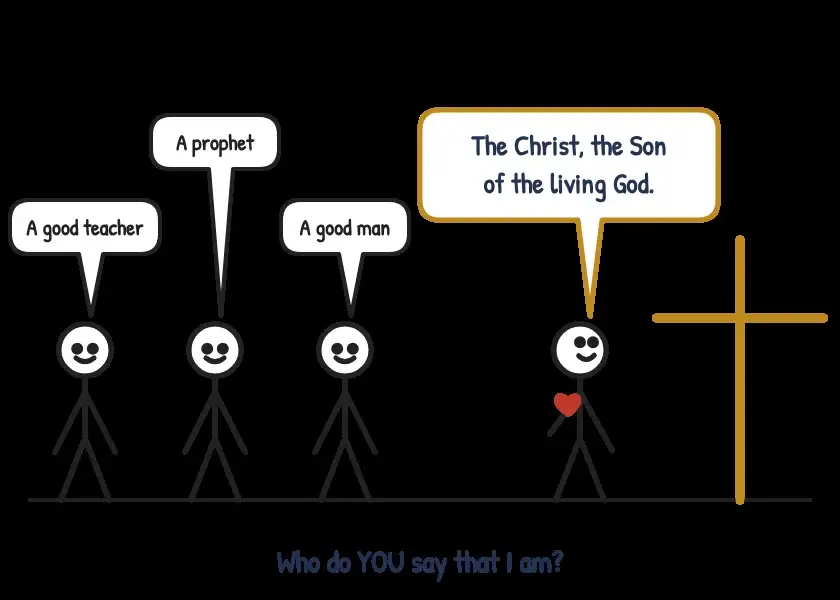
One day Jesus asked His disciples what people were saying about Him. They had answers. A prophet. John the Baptist come back. Then Jesus made it personal.
“He said to them,”But who do you say that I am?” Simon Peter replied, “You are the Christ, the Son of the living God.”“ Matthew 16:15–16 BLB
“Who do you say that I am?”
That question is the most important one I will ever answer. Not what my parents believed. Not what my church teaches. Who do I say Jesus is?
Peter answered: the Christ, the Son of the living God. Jesus told him that answer did not come from flesh and blood but from the Father. That is how it always works. God opens our eyes to see who Jesus really is.
A religious leader named Nicodemus came to Jesus at night. He was moral, educated and respected. Jesus told him he still needed to be born again.
“Jesus answered him,”Truly, truly, I say to you, unless one is born again he cannot see the kingdom of God.”“ John 3:3 BLB
Nicodemus did not understand. How can a grown man be born a second time? Jesus explained that this birth comes from above, by the Spirit of God. I did not choose my first birth, and I cannot produce my second one. It is God’s work.
Being born again is not turning over a new leaf. It is new life from God. Here is how it happens.
First, all have sinned and fall short of the glory of God. We saw that in the last lesson. Second, sin earns a wage, and the wage is death. But God offers a free gift: eternal life in Christ Jesus.
“For the wages of sin is death, but the free gift of God is eternal life in Christ Jesus our Lord.” Romans 6:23 BLB
Third, God did not wait for me to clean up. While I was still a sinner, Christ died for me. He took the punishment my sin deserved.
“but God shows his love for us in that while we were still sinners, Christ died for us.” Romans 5:8 BLB
Fourth, I cannot earn it. It is by grace, through faith. Not my works, not my church attendance, not my good intentions. A gift is received, not earned.
“For by grace you have been saved through faith. And this is not your own doing; it is the gift of God, not a result of works, so that no one may boast.” Ephesians 2:8–9 BLB
Fifth, I respond. I confess with my mouth that Jesus is Lord, and I believe in my heart that God raised Him from the dead. That is not a magic formula. It is a heart turning from my way to His way, trusting Jesus alone to save me.
“because, if you confess with your mouth that Jesus is Lord and believe in your heart that God raised him from the dead, you will be saved. For with the heart one believes and is justified, and with the mouth one confesses and is saved.”
Romans 10:9–10 BLB
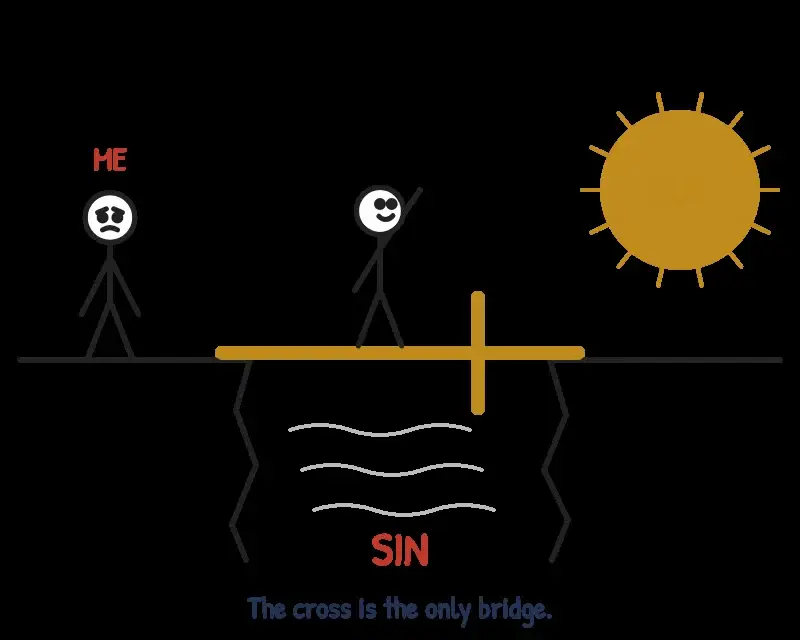
Born again is not something I achieve. It is something God gives.
Living a Christ centered life (all about Him / not me) is not something that we can ‘fix’. This only happens when we are born again and there is born in us a new creation that never existed. We are that new creation. When God gives new life, His Spirit comes to live in me, and the fruit of the Spirit begins to grow where “I” “Me” use to rule.
If you have never trusted Jesus, you can do it today. You don’t need special words. Tell God you know you are a sinner, that you believe Jesus died for you and rose again, and that you want Him as your Savior and Lord.1 The prayer at the end of this lesson is one way to say it. If you already know Him, thank Him again for the gift. And if you want to talk with someone, visit aimingforjesus.com/how-to-know-jesus/.
Your turn
Who do I say Jesus is? In my own words:
Sort these into the right column.
| Item | Trying to earn it | Receiving it as a gift |
|---|---|---|
| Being a good neighbor | ||
| Trusting that Jesus died for me | ||
| Going to church every week | ||
| Believing God raised Jesus from the dead | ||
| Being baptized as a child | ||
| Confessing Jesus as Lord | ||
| Giving money to the church | ||
| Being better than I used to be |
How sure am I that I have been born again? (circle one)
○ Not sure at all ○ Somewhat ○ Mostly ○ Completely sure
I know I can be right with God not because of what I have done, but because __________.
My response today (check the one that fits)
☐ Today I trust Jesus as my Savior and Lord for the first time.
☐ I have already been born again, and today I thank Him.
☐ I am not ready yet, but I want to keep asking.
☐ I want to talk with someone about this.
My response to Jesus
Date:
Who I say Jesus is:
One person I will tell:
Questions I still have:
Hide it in your heart
“For by grace you have been saved through faith. And this is not your own doing; it is the gift of God, not a result of works, so that no one may boast.” Ephesians 2:8–9 BLB
Write it out once from memory:
Let’s pray
Lord Jesus, I know that I am a sinner and that my sin has separated me from God. I cannot save myself. I believe You are the Christ, the Son of the living God. I believe You died on the cross for my sins and that God raised You from the dead. I turn from my way to Your way. I trust You alone to save me, and I receive Your free gift of eternal life. Be my Savior and my Lord. Make me new. In Jesus’ name, amen.
Who do I say Jesus is? Everything turns on my answer.
(my answer doesn’t define Jesus – He is God – but my answer reveals everything about who Jesus really is in my life).
Question 4: What Does Jesus Require of Me?
Read Matthew 18:21–35 BLB
If I am born again, I am no longer my own. I belong to Jesus. So what does He require of me?
I am a follower.
A follower doesn’t set the direction. He goes where the leader goes. Jesus said it plainly: deny yourself, take up your cross daily, and follow Me.
“And he said to all,”If anyone would come after me, let him deny himself and take up his cross daily and follow me.” Luke 9:23 BLB
Denying myself is the exact opposite of a me-centered life. And it is daily. Yesterday’s surrender does not cover today’s insult.
As a follower, I have to trust and obey. Trust is knowing God is sovereign and good no matter how my day goes. Obedience is doing what He says when I don’t feel like it. Jesus ties obedience to love.
““If you love me, you will keep my commandments.” John 14:15 BLB
I don’t get to say I love Jesus and then keep my grudges. To trust and obey requires forgiveness without measure.
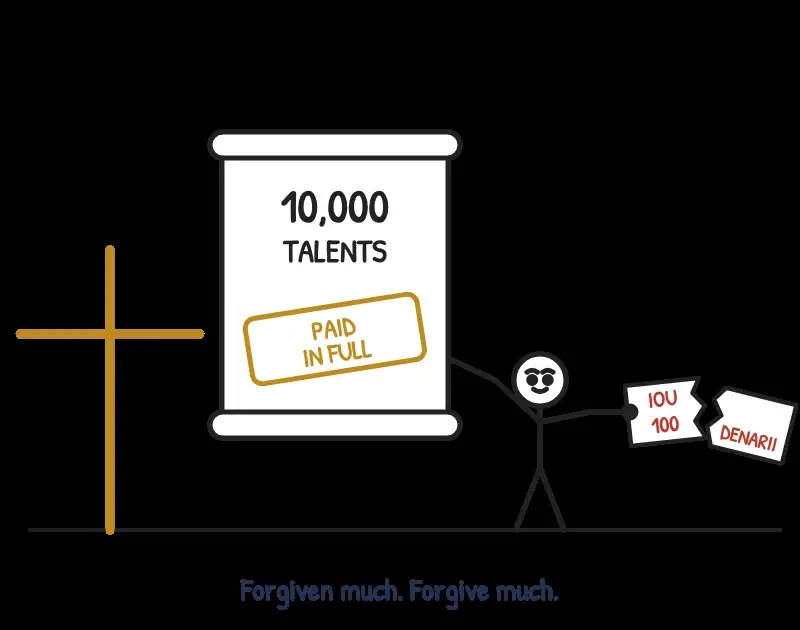
Peter thought seven times was generous. Jesus said seventy-seven times. Then He told a story. A servant owed the king ten thousand talents, a debt he could never repay in many lifetimes. The king forgave it all. That same servant found a fellow servant who owed him a few months’ wages and had him thrown into prison.
When the king heard what the forgiven servant had done, he called him wicked. The man who had received so much mercy refused to show any. Jesus ended the story with a sober warning: forgive your brother from the heart. Not just with our lips. From the heart.
We are the servant with the ten-thousand-talent debt. Jesus paid it in full at the cross. We do not forgive in order to be saved; we forgive because we have been. Think of all God has forgiven us. How can we not also forgive whatever has been done against us? No matter what.
Forgiven much. Forgive much.
Forgiveness is not forgetting, and it does not always mean trusting again right away. Trust is rebuilt over time. If someone is harming you, forgiving them does not mean staying in danger; get to safety and get help.
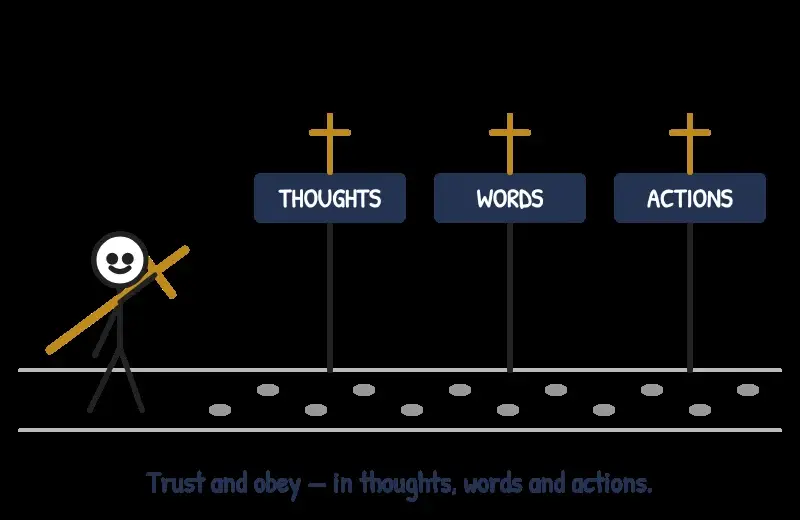
And more than anything, it is my job to glorify God in my thoughts, my words and my actions. Not just some of the time. In whatever I do.
“So, whether you eat or drink, or whatever you do, do all to the glory of God.” 1 Corinthians 10:31 BLB
Paul tells the Colossians the same thing: everything I say and everything I do belongs to the Lord Jesus, offered with thanks to the Father (Colossians 3:17 BLB). Every thought, word, and action is me living in a way that honors God and gives glory to Him and thus being an example for others.
The ‘me’ centered life abides in all three places. It starts in my thoughts, the replay, the story I tell myself about what they did. It comes out in my words. It shows up in my actions: the slammed door, the silent treatment, the getting even. God wants all three.
“Let the words of my mouth and the meditation of my heart be acceptable in your sight, O LORD, my rock and my redeemer.” Psalm 19:14 BLB
That is the standard for the rest of this study. Not, “Did I keep from yelling?” but, “Did I glorify God in what I thought, what I said and what I did?” Am I dying to self and living to God?
Your turn
Where does each of these happen? Write T (thoughts), W (words) or A (actions).
| Item | Thoughts | Words | Actions |
|---|---|---|---|
| Replaying the argument | |||
| A sarcastic answer | |||
| Slamming the door | |||
| Imagining what I should have said | |||
| The silent treatment | |||
| Telling others what they did | |||
| Keeping score | |||
| Driving too close behind someone |
How freely do I forgive the same person for the same thing? (circle one)
○ Rarely ○ Sometimes ○ Often ○ Almost always
Debt cancelled
What God has forgiven me (my ten thousand talents):
What I am still holding against someone (their hundred denarii):
Today I cancel this debt and leave justice with God. Signed:
Say it better: rewrite this the way a follower of Jesus would say it.
Harsh: “I forgave you once. Don’t expect it again.”
Better:
This week I will glorify God in my words by __________.
Where do I most need to glorify God this week? (check all that apply)
☐ my thoughts about someone
☐ my words at home
☐ my words at work
☐ how I drive
☐ what I post or text
☐ my reactions when I’m tired
☐ other:
Hide it in your heart
“Let the words of my mouth and the meditation of my heart be acceptable in your sight, O LORD, my rock and my redeemer.” Psalm 19:14 BLB
Write it out once from memory:
Let’s pray
Lord Jesus, I am Your follower. Help me deny myself today, take up my cross and follow You. Teach me to trust You and obey You even when I don’t feel like it. You have forgiven me a debt I could never pay. Give me a heart that forgives without measure, again and again. Let my words and the quiet thoughts of my heart please You. In my thoughts, my words and my actions, may I glorify You. In Jesus’ name, amen.
My job is to glorify God in my thoughts, words and actions.
PART TWO — THE WAR
Chapter 5: In God’s Economy There Is No “Him or Me?”
It is all Jesus — or it is not Jesus at all.
Jesus, responding to the crowd, said:
“If anyone comes to me and does not hate his own father and mother and wife and children and brothers and sisters, yes, and even his own life, he cannot be my disciple. Whoever does not bear his own cross and come after me cannot be my disciple.” Luke 14:26–27 BLB
Jesus is not telling us to despise our families — He tells us to honor them. He is saying that next to loving Him, every other love, even love of my own life, must look like hate by comparison to my love for Jesus (see Matthew 10:37 BLB).
Paul, who wrote a large part of the New Testament, lamented that the good he wanted to do, he did not do — and the bad he did not want to do, that was the very thing he did (Romans 7:15–20 BLB). This is the great battle — war, even — between the new creation and the old self, the flesh.
James, in his very practical letter, says the war is within us. Our quarrels and fights come from the passions at war inside us (James 4:1 BLB). We want the wrong things, because we want the things of the world — and friendship with the world is enmity with God (James 4:4 BLB). So we ask and do not receive, because we ask wrongly, to spend it on ourselves (James 4:3 BLB). Paul names the two sides of that war: the desires of the flesh are against the Spirit, and the desires of the Spirit are against the flesh (Galatians 5:17 BLB). That war goes on as long as we are in these “clothes,” these fleshly bodies.
We have to shake off the “me” thing — like Paul shaking the viper off into the fire on Malta (Acts 28:3–5 BLB) — and surrender fully to the Lord. To give ourselves away.
The flesh wants its way — all the time. That is never the way God does things. God says we must deny self, take up our cross, and follow Jesus daily (Luke 9:23 BLB).
The point
The real enemy is never the person or the circumstance. It is me seeking to be on the throne that belongs to God alone. As the old Pogo cartoon put it, “We have met the enemy and he is us” – I have met the enemy, and it is me! I have to settle this once and for all – Lord I die to myself and go all in for Jesus. Even with my commitment I know I will need several ‘booster’ shots throughout the day.
Every skirmish in Part Three traces back here.
Hide it in your heart
• James 4:1 BLB — Where do quarrels come from? From the passions at war within me.
• Luke 9:23 BLB — Deny self. Take up the cross. Daily.
• Philippians 2:3–4 BLB — Count others more significant than myself.
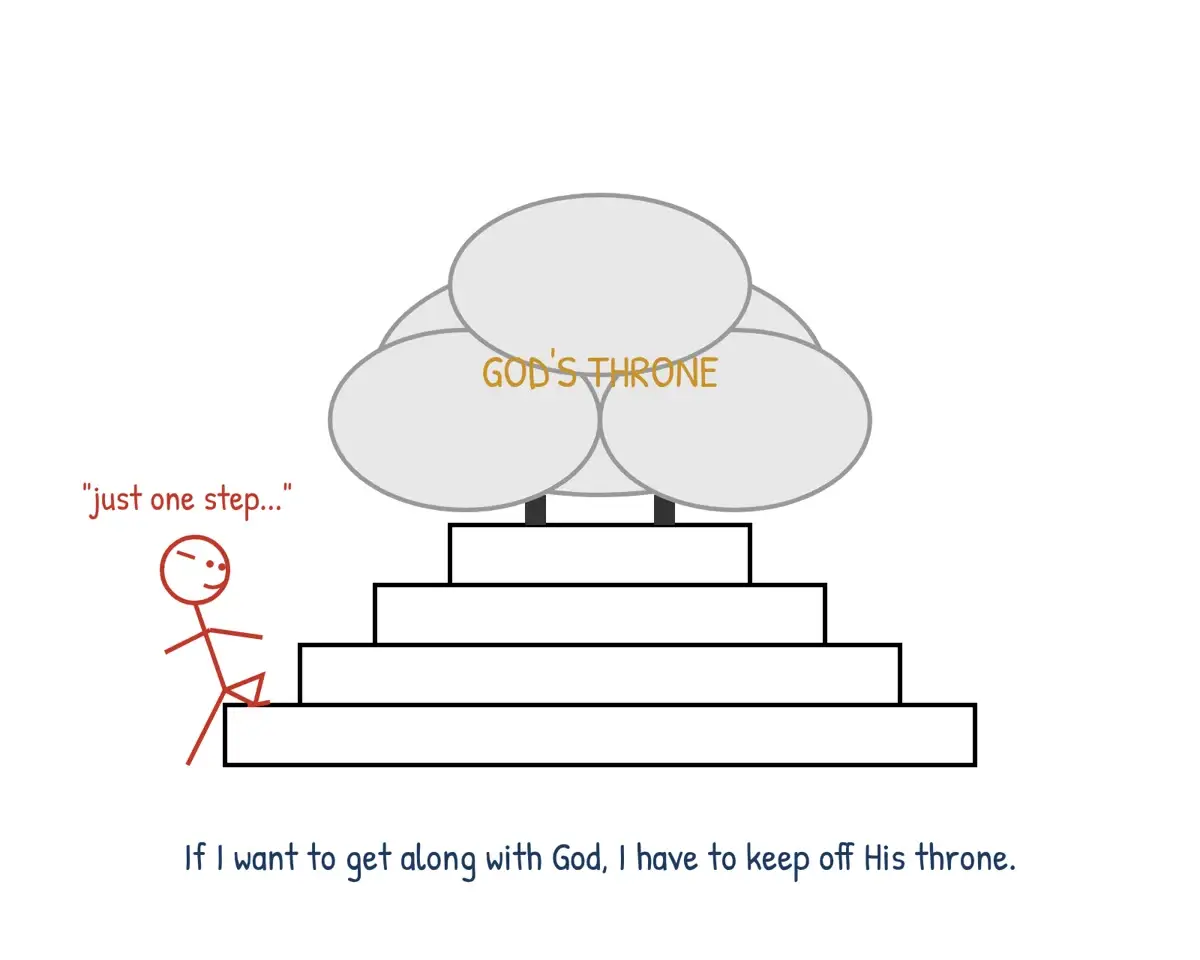
• Isaiah 14:13–14 BLB — “I will” five times. The oldest sin is wanting the throne.
Drawing
Your turn
Of the loves in Luke 14:26 BLB — family, or my own life — which one is hardest for me to put second to Jesus?
Where this week did I pray for something and, if I am honest, I was really asking for my way?
Which step on His throne have I been sneaking up on — my time, my plans, my pride, my comfort?
Let’s pray
The only place ‘I’ fits is in S I N ! Lord help me to keep I / me / my / mine off the throne and out of the way – Fully yielded and surrendered to the King of Kings and the Lord of Lords, my Savior Jesus. Amen.
Chapter 6: Flesh vs. Spirit — The Tug of War
Read Galatians 5:16–26 BLB
“But I say, walk by the Spirit, and you will not gratify the desires of the flesh. For the desires of the flesh are against the Spirit, and the desires of the Spirit are against the flesh, for these are opposed to each other, to keep you from doing the things you want to do.” Galatians 5:16–17 BLB
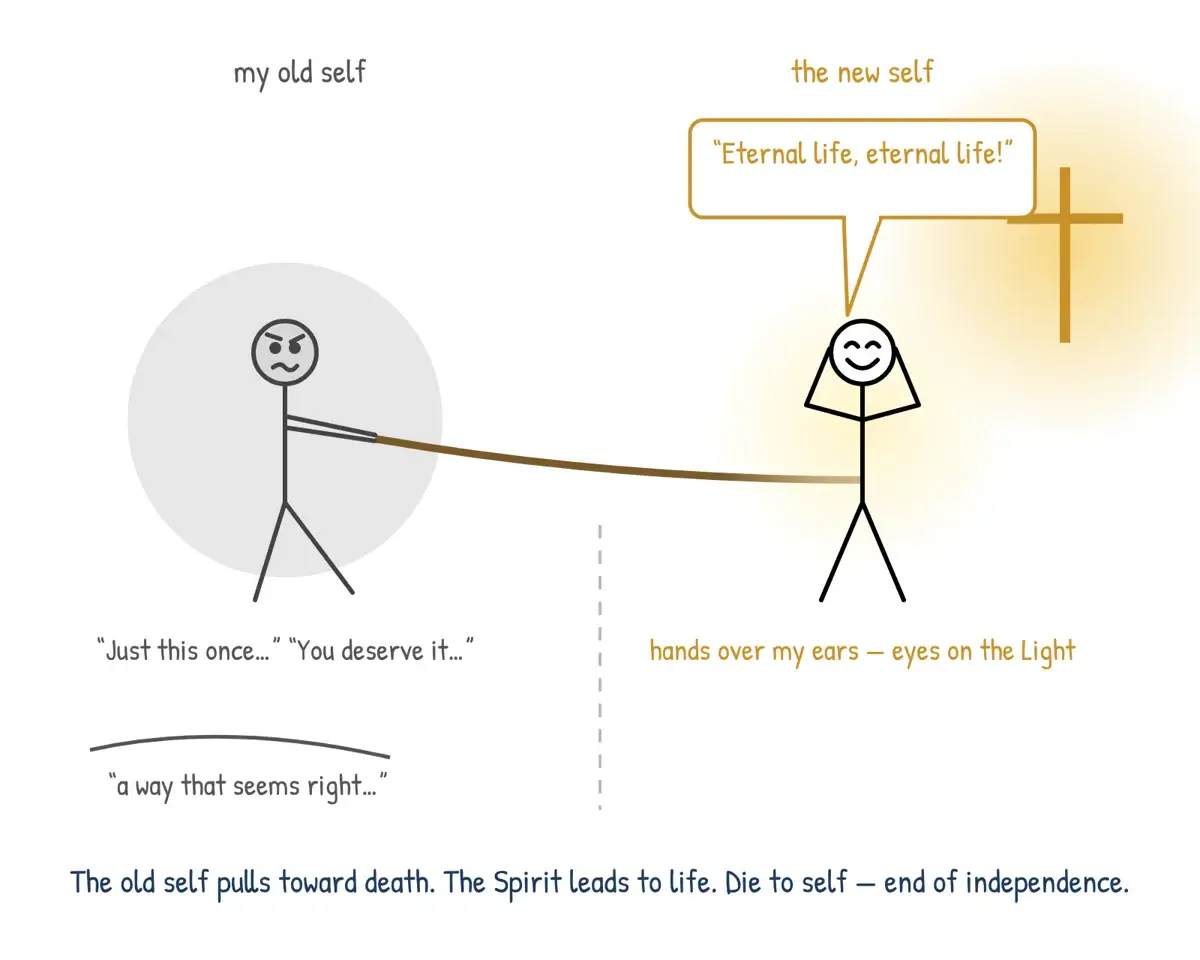
Picture a tug of war. A thick rope. A muddy line in the middle. Two teams digging in their heels. That is my heart on any ordinary Tuesday. On one end of the rope is my flesh, the old me, the one who wants his way. On the other end is the Holy Spirit, pulling me toward Jesus. And I am the rope.
Paul does not say this war is for the weak Christian or the new Christian. He says it is for every Christian. The flesh and the Spirit are opposed to each other. Always. I will not outgrow it. I will not retire from it. As long as I am in these “clothes,” the rope is going to be pulled.
We read in Proverbs 14:12 BLB (and again in Proverbs 16:25 BLB) there is a way that seems right to a man but the end thereof is death. My ‘old self’ is always pulling me towards death. The Holy Spirit is truth, life, and light. This is the battle, the ‘tug of war’ that I want the Holy Spirit to win. This requires trust and obedience. To have a settled mind that trusts God and knows assuredly that God’s way is always the right way (no matter what my flesh may be saying).
“There is a way that seems right to a man, but its end is the way to death.” Proverbs 14:12 BLB
Notice the word “seems.” The flesh never shows up looking like death. It shows up looking right. Reasonable. Deserved. “I have a right to be upset.” “Somebody needs to put him in his place.” “I’ll pray about it after I handle it.” It all seems right to me — because it is all about me.
So how does the Spirit win? Here is the key, and it is the key to this whole book. I do not win the tug of war by pulling harder. I win it by letting go of my end of the rope. I die to self. My independence has to end.
THE KEY IS TO DIE TO SELF — END OF INDEPENDENCE!
“And those who belong to Christ Jesus have crucified the flesh with its passions and desires. If we live by the Spirit, let us also keep in step with the Spirit.” Galatians 5:24–25 BLB
Crucified. Not trained. Not improved. Not given a little more time to behave. The flesh is put to death — and then I keep in step with the Spirit, one step at a time, all day long. That is Dependence Day. Not a feeling. A decision to stop running my own life and let Jesus run it.
The battle we speak of here is spiritual and must be fought as such.
“For we do not wrestle against flesh and blood, but against the rulers, against the authorities, against the cosmic powers over this present darkness, against the spiritual forces of evil in the heavenly places.” Ephesians 6:12 BLB
The person who cut in front of me is not the enemy. The relative who always knows best is not the enemy. The enemy wants me to think they are, so I will swing at people while he keeps pulling on my rope. And I cannot fight a spiritual war with fleshly weapons. My temper, my sharp tongue, my clever comeback — those are his weapons, not mine.
So God gives me armor. Paul tells me to take up the whole armor of God, that I may be able to withstand in the evil day, and having done all, to stand firm (Ephesians 6:13 BLB). Not some of it. All of it. Every piece is a way of living by the Spirit and not by the flesh.
Putting on the armor
The belt of truth. The flesh runs on lies: “You deserve better.” “It’s all about you.” The belt holds everything together, and it is God’s truth, not my feelings, that holds me together. When my emotions are screaming, I fasten on what God says.
The breastplate of righteousness. It guards the heart. Not my righteousness — I have none to offer — but His, given to me, and then lived out in right choices that honor Him. A heart guarded by His righteousness is hard for the old man to stab.
Shoes — the readiness given by the gospel of peace. I am ready to move toward people with peace instead of digging in my heels to win. The flesh plants its feet. The Spirit sends me out.
The shield of faith, with which I can extinguish all the flaming darts of the evil one. The darts come fast: the slight, the insult, the bad report. Faith says God is sovereign and God is good, and the dart goes out before it sets my mind on fire.
The helmet of salvation. It guards my mind. I belong to Jesus. Settled. Bought. That is the settled mind I need when the old me starts arguing for his rights.
The sword of the Spirit, which is the word of God. The only offensive weapon in the list. Jesus answered every temptation in the wilderness with “It is written” (Matthew 4:1–11 BLB). That is why every chapter of this book asks you to hide the Word in your heart. You cannot swing a sword you left at home.
Then prayer — praying at all times in the Spirit, with all prayer and supplication, keeping alert (Ephesians 6:18 BLB). Prayer is how I put the armor on, and how I keep it on. Lord, here I am. Again.
Martin Luther knew this battle. In the old hymn “A Mighty Fortress Is Our God” (translated by Frederic H. Hedge, 1853) he wrote:
“Did we in our own strength confide, / Our striving would be losing; / Were not the right Man on our side, / The Man of God’s own choosing: / Dost ask who that may be? / Christ Jesus, it is He.”
That is the tug of war in six lines. If it is me pulling, I lose. Every time. But I am not pulling alone. The right Man is on my side — and the battle is won when I let Him hold the rope.
Two kinds of fruit
How can I tell which side is winning? Look at the fruit. Paul lists the fruit of the Spirit in Galatians 5:22–23 BLB: love, joy, peace, patience, kindness, goodness, faithfulness, gentleness, self-control. Opposite every one of them is something that grows when I am on the throne. Love or self-centeredness. Joy or what I want. Peace or having things my way. Patience or wanting it now. You will meet this side-by-side chart in the next chapter — the chart you will see again in every skirmish. Each time, the question is the same: whose fruit is growing in me today — His, or mine?
Your turn
Where is the rope being pulled hardest in my life right now? (check all that apply)
☐ my words
☐ my thoughts about someone
☐ my time
☐ my pride
☐ my comfort
☐ my need to be right
other: __________
When the flesh starts pulling, how often do I try to win by pulling harder instead of letting go and trusting God? (circle one)
○ Rarely ○ Sometimes ○ Often ○ Almost always
Name one thing this week that “seemed right” to me but was really my way and not God’s way.
Which piece of the armor do I most often leave at home? (check one)
☐ the belt of truth
☐ the breastplate of righteousness
☐ the shoes of the gospel of peace
☐ the shield of faith
☐ the helmet of salvation
☐ the sword of the Spirit, the Word of God
☐ prayer
Tomorrow morning I will put on the __________ by __________
Hide it in your heart
“But I say, walk by the Spirit, and you will not gratify the desires of the flesh.” Galatians 5:16 BLB
Write it out once from memory:
Let’s pray
Lord, here I am. You know how hard I pull on my end of the rope. So much of what seems right to me is really just me wanting my way. Today I let go. I die to self — again. Dress me in Your armor: Your truth, Your righteousness, Your peace, faith to put out the darts, the helmet of my salvation, and Your Word in my hand. Keep me praying. Did I in my own strength confide, my striving would be losing — so be the right Man on my side, Lord Jesus. Grow Your fruit in me, not mine. In Jesus’ name, amen.
I don’t win the tug of war by pulling harder. I win it by letting go — and letting the Spirit win.
Chapter 7: My Job Is to Honor God — Always
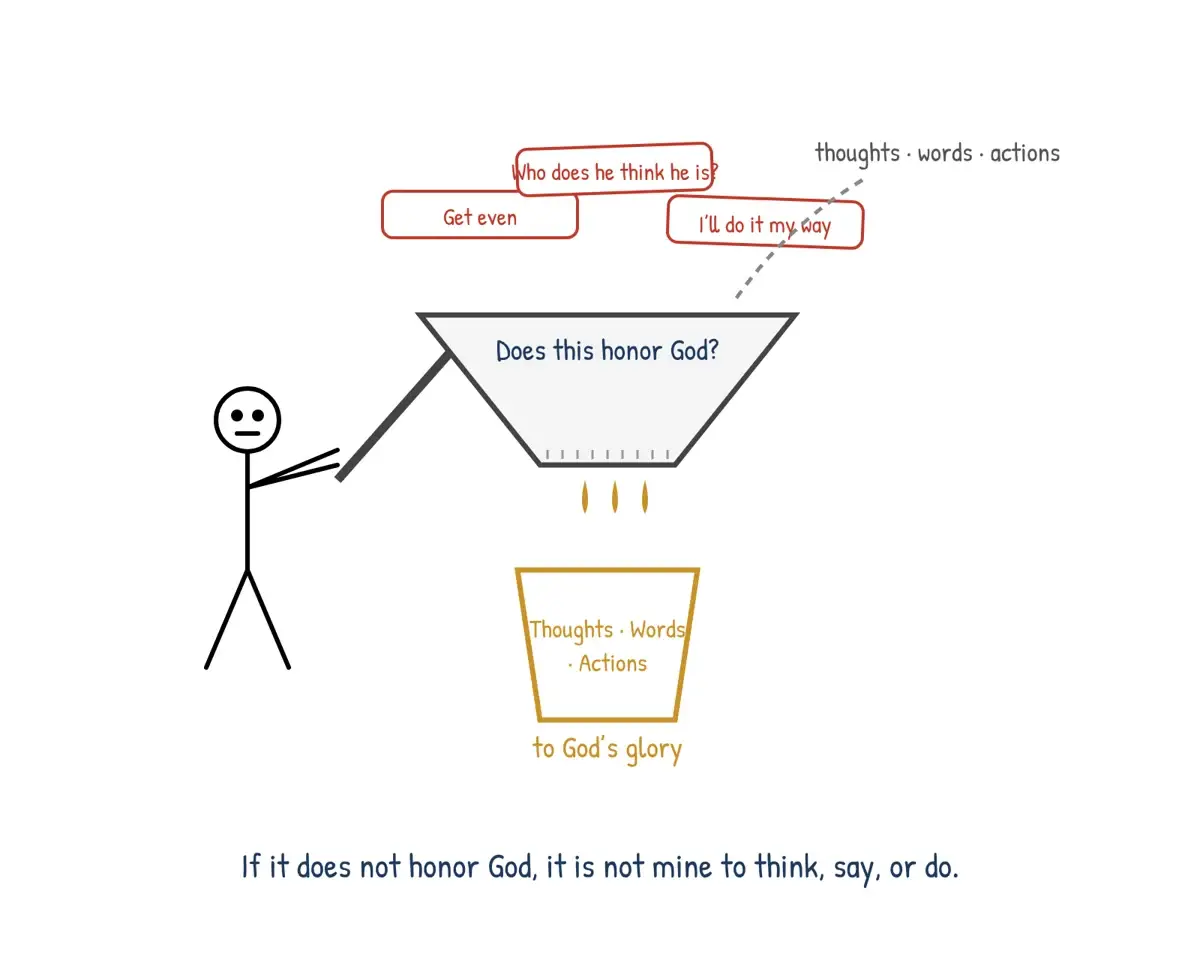
As a thought begins to form in my mind I must pass that thought through the filter of honoring God. If my thought does not honor God then I must not think it. If my word does not build others up (Ephesians 4:29 BLB) then I must not say it. If my action does not demonstrate love for others (Matthew 7:12 BLB) then I must not do it. So as the scripture says:
“And whatever you do, in word or deed, do everything in the name of the Lord Jesus, giving thanks to God the Father through him.” Colossians 3:17 BLB
If it can’t meet that test then it is not mine to think, say, or do.
Three filters. Every thought, every word, every action has to pass through them.
• My thoughts: does this honor God?
• My words: “Let no corrupting talk come out of your mouths, but only such as is good for building up, as fits the occasion, that it may give grace to those who hear.” (Ephesians 4:29 BLB)
• My actions: “So whatever you wish that others would do to you, do also to them, for this is the Law and the Prophets.” (Matthew 7:12 BLB)
Here is the rule I want written over this whole book: My job is to honor God — always — to make right choices, and it is never the right choice if it dishonors God. Not “do the right thing” because it is polite, or because people are watching, or because it makes me look good. A right choice is right because it honors God. If it dishonors Him, it is wrong — no matter how right it seems to me.
MY JOB IS TO HONOR GOD — ALWAYS!
This must be a settled rule – no exceptions. Why? Because in an hour from now I will encounter people / circumstances that will be screaming for me to handle things my way (old way of the flesh). If I am not settled in my mind that I must do all to God’s glory then I will lose this mental battle and give in to my flesh. But if I am settled and fixed, living intentionally for God “no matter what” then I will stand through that challenge.
Picture the email that lands at 4:55 on a Friday. Unfair. Accusing. The reply writes itself in my head, and it is a good one — sharp, clever, and true enough. My finger is on the keys. If the rule is not settled before that email comes, I will not settle it in the moment. The flesh is faster than my good intentions. A settled rule decides ahead of time: this reply goes through the filter or it does not go.
Another practical check point for thoughts, words, actions is this: would I think this (say this / do this) if I knew God was standing beside me and knew my every thought before I thought it. Well, He is. He does. And how can I live that low life with God looking on?
“Even before a word is on my tongue, behold, O LORD, you know it altogether.” Psalm 139:4 BLB
Every thing I do (say or think) today must be done in a way that is pleasing to God, that brings honor to God. If a thought, word, action, attitude doesn’t match those standards I must not allow it to remain. I must cast it out – quickly. No excuses. No exceptions.
Quickly matters. A bad thought that stays becomes a tenant, renting space in my mind. Paul says we take every thought captive to obey Christ (2 Corinthians 10:5 BLB). Captive. Arrested at the door — not invited in for coffee.
It is good to have one or more persons who you know are committed to calling you out if they see you doing anything that is not God honoring. We must be open to correction from above and from our side.
That takes humility. Pride says, “Who are you to tell me?” Humility says, “Thank you. You may have just saved me from myself.” “Iron sharpens iron, and one man sharpens another” (Proverbs 27:17 BLB).
Start the day by surrendering my life to the LORD
“I appeal to you therefore, brothers, by the mercies of God, to present your bodies as a living sacrifice, holy and acceptable to God, which is your spiritual worship. Do not be conformed to this world, but be transformed by the renewal of your mind, that by testing you may discern what is the will of God, what is good and acceptable and perfect.” Romans 12:1–2 BLB
A living sacrifice has one problem: it keeps crawling off the altar. So I climb back on — every morning, and several booster shots through the day. Before my feet hit the floor: Lord, here I am. This body, this mind, this tongue, this day — they are Yours. Renew my mind so I can tell Your way from mine.
Here are key Bible verses about doing all things to honor and glorify God:
• 1 Corinthians 10:31 BLB — “So, whether you eat or drink, or whatever you do, do all to the glory of God.” Even the ordinary things.
• Colossians 3:17 BLB — Whatever I do, in word or deed, in the name of the Lord Jesus, with thanks.
• Colossians 3:23 BLB — “Whatever you do, work heartily, as for the Lord and not for men.” My real audience is God.
• Psalm 19:14 BLB — “Let the words of my mouth and the meditation of my heart be acceptable in your sight, O LORD, my rock and my redeemer.” Words and thoughts both.
• Matthew 5:16 BLB — “In the same way, let your light shine before others, so that they may see your good works and give glory to your Father who is in heaven.” The glory goes to Him, not me.
• Micah 6:8 BLB — Do justice, love kindness, walk humbly with my God.
• 2 Corinthians 10:5 BLB — Take every thought captive to obey Christ.
• 1 Peter 4:11 BLB — Speak and serve in the strength God supplies, so that in everything God may be glorified through Jesus Christ.
Your turn
Which filter do I fail most often? (check one)
☐ My thoughts — does this honor God?
☐ My words — does this build others up? (Ephesians 4:29 BLB)
☐ My actions — is this how I would want to be treated? (Matthew 7:12 BLB)
How settled is the rule “My job is to honor God — always” in my mind before the day starts? (circle one)
○ Not at all ○ A little ○ Mostly ○ Fully settled
Say it better: rewrite this so it honors God.
Harsh: “I don’t care what they think — I’m going to tell them exactly what I think of them.”
Better: __________
Who is one person I will ask to call me out when I am not honoring God?
Write the short prayer I will pray tomorrow morning to present myself as a living sacrifice.
Hide it in your heart
“And whatever you do, in word or deed, do everything in the name of the Lord Jesus, giving thanks to God the Father through him.” Colossians 3:17 BLB
Write it out once from memory:
Let’s pray
Lord, here I am. I give You this day before it gives me anything. I present my body as a living sacrifice — my thoughts, my words, my actions. Put every thought through Your filter before it takes root. Guard my mouth so I build up and do not tear down. Teach me to treat others the way I want to be treated. When a thought does not honor You, help me cast it out — quickly, ‘nip it in the bud’ – no excuses and no exceptions. Give me friends who will tell me the truth, and the humility to hear it. Settle it in me: my job is to honor You — always. In Jesus’ name, amen.
It is never the right choice if it dishonors God.
PART THREE — THE SKIRMISHES
The many faces of “Me.”
Chapter 8: Anger — “No One Can Make Me Mad”
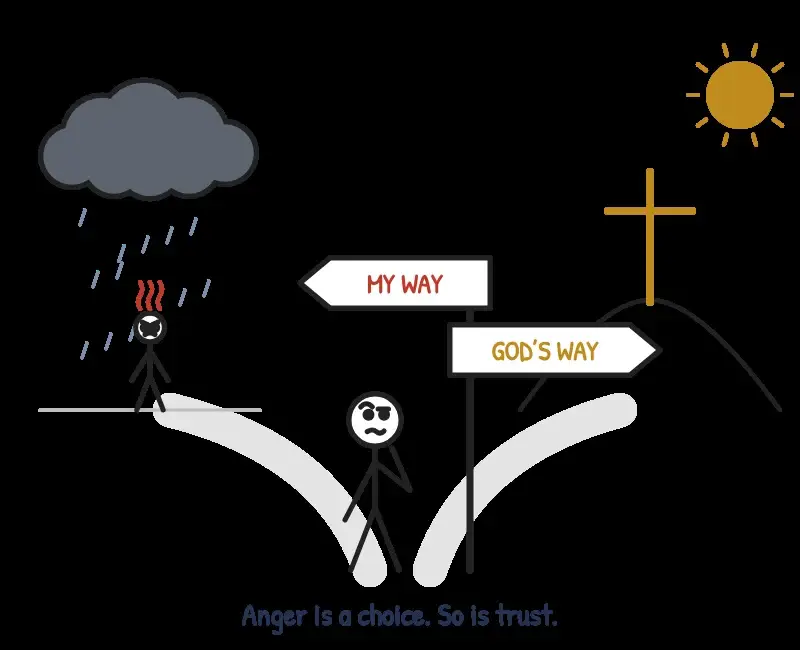
Anger is a choice.
If I choose anger, then I have first chosen my way rather than God’s way.
“Know this, my beloved brothers: let every person be quick to hear, slow to speak, slow to anger; for the anger of man does not produce the righteousness of God.” James 1:19–20 BLB
Instead of checking whether something is going the way I want it to go, let me ask the better question:
God, what do You want me to learn from this?
From this insult. This slight. This verbal assault. What are You teaching me?
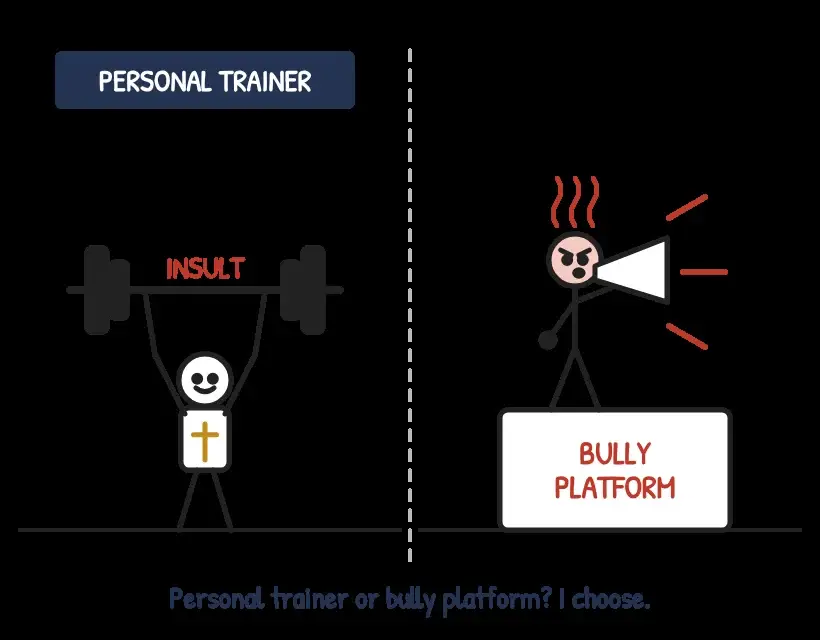
Is it more important for me to trust God and let my immediate circumstance be my personal trainer? Or will I make it my bully platform, a stage to act out my childish, self-centered response to the world around me?
Here is what is so crucial:
No one can ever make me mad.
No one can make me angry, or sad, or bitter. Those are choices I make in response to life happening around me. People may hurt me. They may be wrong. But they do not get to choose my response. I do. If I allow the ‘story’ they are telling to be my story then I am giving them a place in my mind and from there it only goes downhill. God is the one who tells my story – He says I am the righteousness of God in Christ Jesus. I need to live that out moment by moment.
James tells me where my anger really comes from.
“What causes quarrels and what causes fights among you? Is it not this, that your passions are at war within you?” James 4:1 BLB
I want something. I don’t get it. And I fight. Picture the family running ten minutes late for church. Dad is behind the wheel, and everyone in the car hears about it. Being on time is a good thing. But the moment he is willing to wound his family to get it, a good desire has become a demand. He chose his way.
A trainer doesn’t make me comfortable. He makes me strong. He adds weight on purpose. The rude driver, the sharp email, the relative who always knows best: each one is weight on the bar. I can lift it with God’s help and grow, or I can drop it on someone else’s foot. Either way, I am choosing.
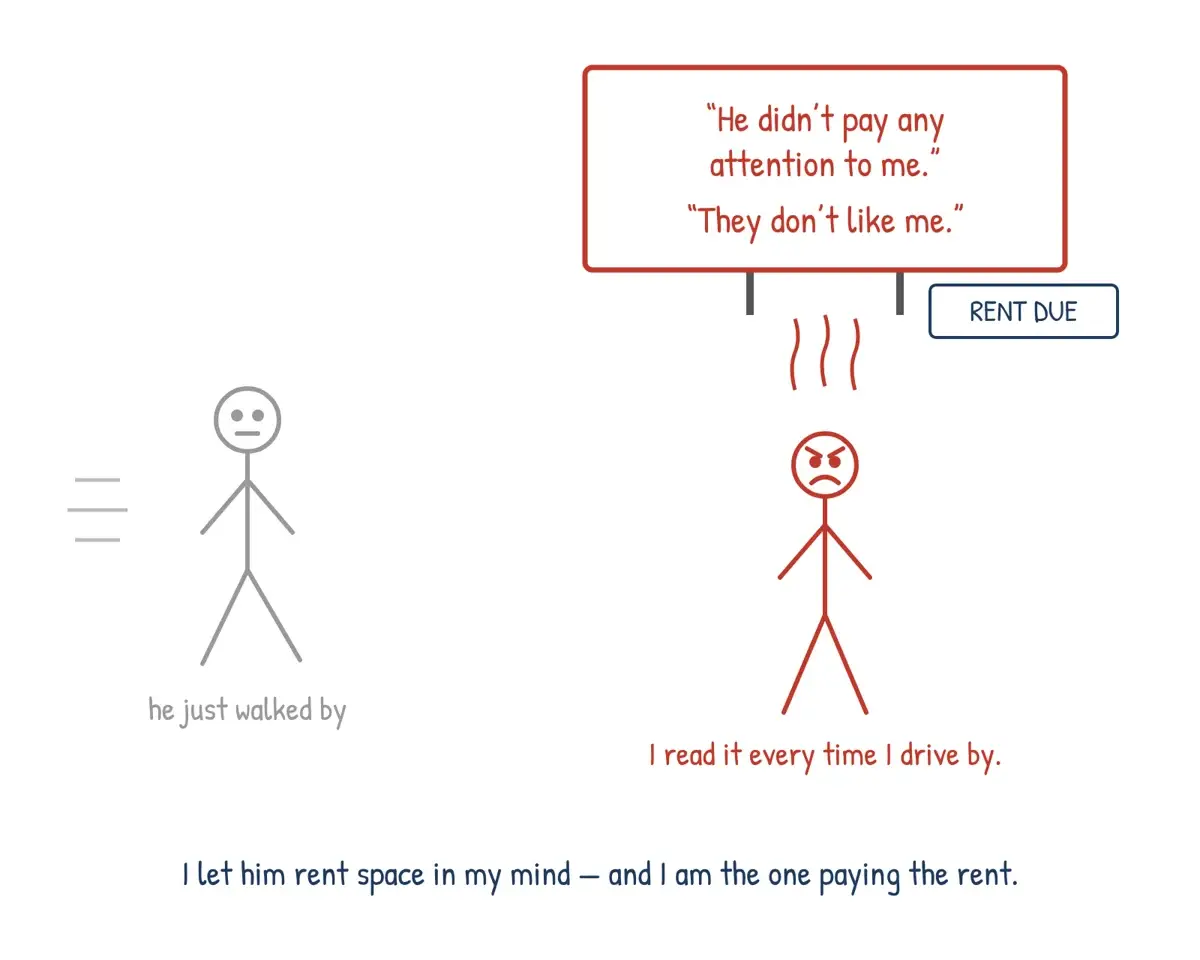
When I choose anger, I let someone put up a billboard in my brain. I read it every time I drive past. I don’t have to give anyone that space. That space belongs to Christ.
Isn’t some anger right? Jesus was angry at hard hearts (Mark 3:5 BLB), and Scripture speaks of an anger that does not sin (Ephesians 4:26 BLB). Even then, anger is a choice: choosing to be grieved by what grieves God, and to respond His way, without sin. Right anger never needs my revenge.
And if someone is threatening or abusing you, choosing not to rage does not mean staying in danger; get to safety and get help.
I need to make God-honoring choices. I must. And not just in my words and actions, but deep inside. That is where the Holy Spirit works. Paul lists the fruit He grows in a heart surrendered to God.
“But the fruit of the Spirit is love, joy, peace, patience, kindness, goodness, faithfulness, gentleness, self-control; against such things there is no law.” Galatians 5:22–23 BLB
Opposite every fruit of the Spirit stands something that grows when I am on the throne. Love or self-centeredness. Joy or what I want. Peace or having things my way. Each one is a choice.
Will I choose God’s way or my way?
Your turn
Fruit of the Spirit — or the fruit of me?
| The fruit of the Spirit | What grows when I am on the throne |
|---|---|
| Love | Self-centeredness |
| Joy | What I want |
| Peace | Having things my way |
| Patience | Wanting it now |
| Kindness | Getting even |
| Goodness | Looking out for me |
| Faithfulness | Only when it suits me |
| Gentleness | Forcing my point |
| Self-control | Giving in to the moment |
Looking at the chart, which of the right-hand column grew in me this week? (check all that apply)
☐ Self-centeredness
☐ What I want
☐ Having things my way
☐ Wanting it now
☐ Getting even
☐ Looking out for me
☐ Only when it suits me
☐ Forcing my point
☐ Giving in to the moment
Say it better: rewrite this so I own my choice.
Harsh: “You made me so mad!”
Better:
Personal trainer
The insult, slight or circumstance I faced this week:
God, what do You want me to learn from this?
The God-honoring choice I will make next time:
How often do I blame someone else for my anger? (circle one)
○ Rarely ○ Sometimes ○ Often ○ Almost always
The next time __________ happens, I will stop and ask, “God, what do You want me to learn from this?”
Hide it in your heart
“Know this, my beloved brothers: let every person be quick to hear, slow to speak, slow to anger; for the anger of man does not produce the righteousness of God.” James 1:19–20 BLB
Write it out once from memory:
Let’s pray
Lord, I confess that I have blamed other people for choices that were mine. No one made me angry. I chose my way instead of Yours. Forgive me. When the next insult or slight comes, help me ask, “What do You want me to learn from this?” Make my hard circumstances my personal trainer, not my bully platform. Grow Your fruit in me deep inside: love instead of self-centeredness, joy instead of what I want, peace instead of having things my way. Make me quick to hear, slow to speak and slow to anger. In Jesus’ name, amen.
No one can make me mad. Anger is a choice — and so is trust.
Chapter 9: Bitterness — Renting Space in My Mind
Read Hebrews 12:14–15 BLB
Picture this. Someone walks past me in the hallway at church. No nod. No “good morning.” Nothing.
That is all that happened. A man walked by.
But by the time I get to my car, something else has happened. A billboard has gone up in my mind. In big letters it says: HE DIDN’T PAY ANY ATTENTION TO ME. By Tuesday the sign has been repainted: THEY DON’T LIKE ME. By the end of the month I have driven past that billboard a hundred times, and every time I read it, the letters get bigger and the lights get brighter.
He has no idea. He was probably thinking about a sick grandchild or a bill he can’t pay. He never asked for the space. I handed it to him. I let him rent space in my mind — and I am the one paying the rent and dishonoring God and my brother in Christ.
I MUST NOT RENT OUT THE SPACE THAT BELONGS TO JESUS ALONE! I MUST CONFINE MY THOUGHTS TO THOSE THAT ARE CHRIST CENTERED, GOD HONORING, AND HOLY SPIRIT LED.
What it looks like
Bitterness rarely shouts. Anger slams the door. Bitterness quietly locks it and keeps the key. It is quiet anger — anger that has been stored instead of surrendered. It doesn’t blow up. It settles in.
Stored resentment can look like this:
• Replaying the conversation at night, and winning it this time.
• Saying “I’m fine” when I am not fine at all.
• Being polite — cool, careful, two degrees colder than before.
• Bringing up something from years ago as if it happened this morning.
• Finding it hard to be glad when good things happen to them.
• Keeping a file in my head of every time they let me down.
None of that looks like much from the outside. Most people would never know. But God knows. And I know, every time I drive past that billboard.
The “me” underneath it
Look closely at every billboard I put up. They all have the same subject. Me.
He didn’t notice me. They left me out. She got the credit that should have been mine. Nobody thanked me.
Bitterness is self-pity with a long memory. It is me on the throne, keeping a careful record of every wrong done to me. Paul says love “does not insist on its own way; it is not irritable or resentful, and it keeps no record of wrongs” (real or imagined). (1 Corinthians 13:5 BLB). Resentment is love turned inside out — love for me.
Remember where this study began. If I am looking at myself in response to anything that comes at me — an event, a comment, a slight — I am seeing it wrong. It is almost never about me. And even when it is, I don’t want to let it become about me in my mind.
What the Word says
“See to it that no one fails to obtain the grace of God; that no ‘root of bitterness’ springs up and causes trouble, and by it many become defiled;” Hebrews 12:15 BLB
A root grows underground. Nobody sees it at first. I may not even see it myself. But roots don’t stay hidden. Sooner or later bitterness springs up — in my tone, in my face, in what I say about them when they are not in the room. And it doesn’t defile just me. My wife breathes it. My children learn it. My church catches it. One root can poison a whole garden.
So what do I do with it? Paul doesn’t tell me to manage it. He tells me to get rid of it.
“Let all bitterness and wrath and anger and clamor and slander be put away from you, along with all malice. Be kind to one another, tenderhearted, forgiving one another, as God in Christ forgave you.” Ephesians 4:31–32 BLB
Notice the word all. Not most of it. Not all of it except that one person. All of it — put away.
And notice that Paul doesn’t stop at verse 31. Tearing down a billboard is not enough. If I leave the frame standing, something else will go up on it by Friday. Verse 32 tells me what goes up in its place: kindness, a tender heart, and forgiveness — the same forgiveness God gave me in Christ.
Paul also tells me to take every thought captive to obey Christ (2 Corinthians 10:5 BLB), and to fill my mind with whatever is true, honorable, just, pure, lovely and commendable (Philippians 4:8 BLB). A captured thought can’t put up a sign.
The choice that honors God
Bitterness is a choice, just like anger. No one can make me bitter. People may hurt me. They may be wrong. But they do not get to decide what I put up in my mind. I do.
My job is to honor God — always — to make right choices, and it is never the right choice if it dishonors God. Letting a root of bitterness grow in the heart He bought dishonors Him. So here is the choice:
• Catch the sign the first time it goes up, not the hundredth.
• Ask, “Is that true? What do I actually know?” Most billboards are built on guesses.
• Ask the better question: “God, what do You want me to learn from this?”
• Pray for the person by name. It is very hard to keep a billboard up about someone I am blessing before God every day.
• If something real happened, go to them quietly and honestly (Matthew 18:15 BLB), or give it to God and leave justice with Him (Romans 12:19 BLB). Either way, don’t let the sun go down on it (Ephesians 4:26 BLB).
And when the old sign tries to go back up tomorrow — and it will — I take it down again. Over. Over. Over. And again.
Your turn
Which signs of quiet anger and stored resentment do I see in myself? (check all that apply)
☐ replaying the conversation at night
☐ saying “I’m fine” when I’m not
☐ being polite but cold
☐ bringing up the past
☐ struggling to be glad when they succeed
☐ keeping a mental file of wrongs
☐ other:
How often do I replay an old hurt in my mind? (circle one)
○ Rarely ○ Sometimes ○ Often ○ Almost always
The billboard up in my mind right now says: __________
Is it true? What do I actually know — and what am I guessing?
Say it better: rewrite this so it honors God.
Harsh: “I’m not upset. I just won’t forget it.”
Better:
This week, every time that billboard goes up, I will pray for __________ by name.
Hide it in your heart
“See to it that no one fails to obtain the grace of God; that no ‘root of bitterness’ springs up and causes trouble, and by it many become defiled;” Hebrews 12:15 BLB
Write it out once from memory:
Let’s pray
Lord, here I am. I confess that I have let people rent space in my mind that belongs to You. I have put up billboards about slights that were never meant, and I have read them over and over until they grew roots. Most of them were about me. Forgive me. Dig out every root of bitterness before it springs up and troubles the people I love. Help me catch the next sign the first time it goes up. Put kindness, a tender heart and forgiveness in its place, as You in Christ forgave me. In Jesus’ name, amen.
No one rents space in my mind. That space belongs to Christ.
Chapter 10: Self-Centeredness and Pride
Read Philippians 2:1–11 BLB
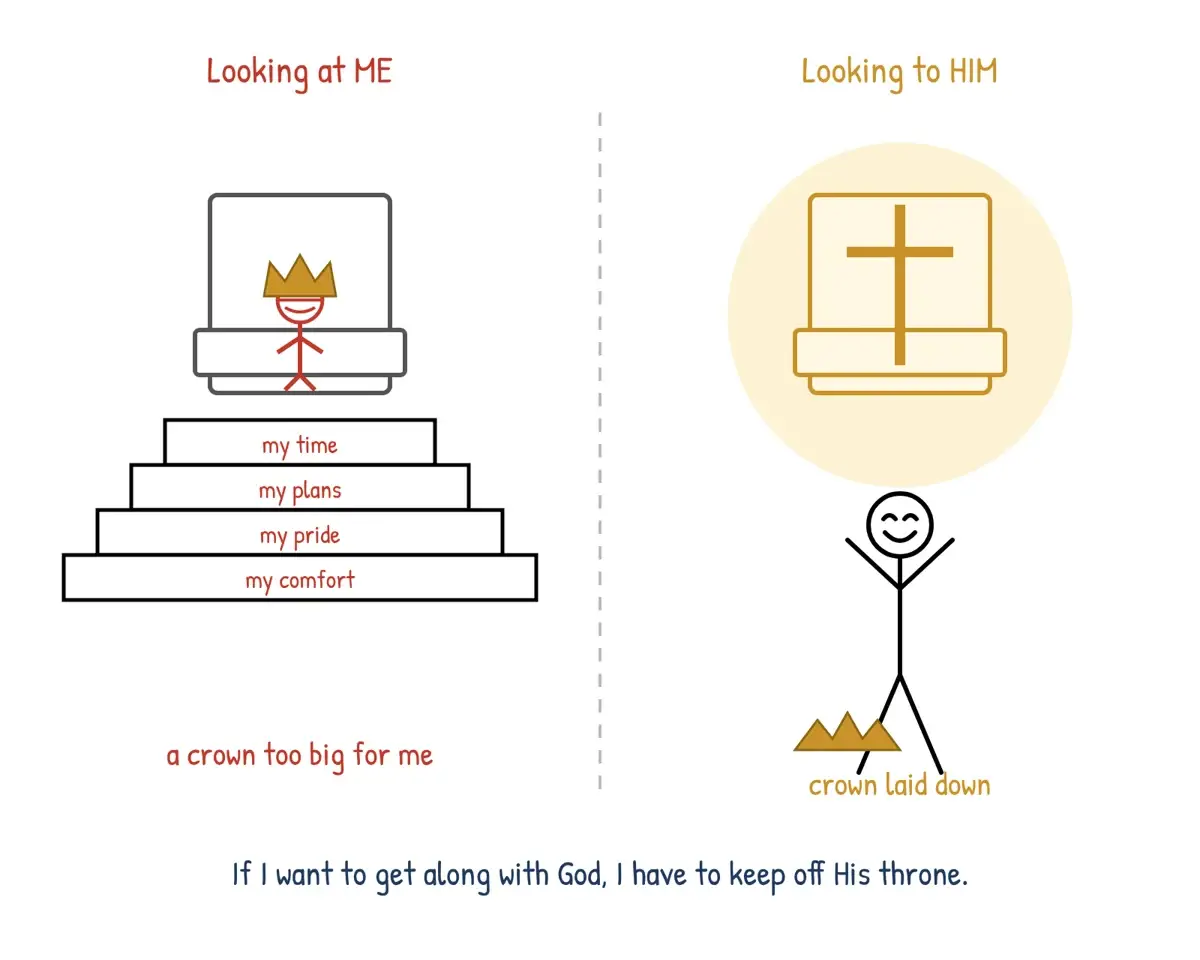
There is only one throne in my heart. And only one of us can sit on it.
Him or me?
Back in Question 2 we said it plainly: sin is me trying to occupy the throne that belongs solely to God. Anger, bitterness, worry, a sharp tongue — every skirmish in this part of the book is the same fight over the same chair. This chapter looks at the fight itself. Its name is pride.
The oldest sin
Pride wanted the throne before there was ever a man to want it. Listen to the voice Isaiah describes:
“You said in your heart, ‘I will ascend to heaven; above the stars of God I will set my throne on high; I will sit on the mount of assembly in the far reaches of the north; I will ascend above the heights of the clouds; I will make myself like the Most High.’” Isaiah 14:13–14 BLB
Count them. I will ascend. I will set my throne. I will sit. I will ascend. I will make myself like the Most High. Five times “I will.” Not once “Your will.”
Isaiah spoke those words against the proud king of Babylon, and many through the centuries have heard in them the fall of the one who stood behind that king. Either way, the song is the same, and I know the tune. I hum it every time I make my plans and never ask the Lord (James 4:13–15 BLB).
What it looks like
Picture a dinner with friends. Someone is telling a story, and I am not really listening. I am waiting — waiting for the pause, so I can tell a better one.
Pride doesn’t always wear a crown. Most days it looks like this:
• I need the last word.
• I need the credit — or at least for someone to notice.
• I can’t say “I was wrong” without adding “but.”
• I turn the conversation back to me.
• I am quietly sure I could do it better.
• I serve, but I need to be seen serving.
And pride has a quiet side. Pride doesn’t always strut. Sometimes it sulks. “Nobody appreciates me.” “I’m no good at anything.” That sounds humble, but look who it is still about. Me. Putting myself down is just another way of keeping myself at the center of the room.
The “me” underneath it
This one doesn’t have a “me” underneath it. It is the me. Every other skirmish grows out of this root. I am angry because my way was blocked. I am bitter because I was not noticed. I worry because I am not in control. Underneath each one sits a little king who thinks the throne is his.
THE ONLY PLACE ‘I’ FITS IS IN S I N !
My face is way tired of being planted in the hard rough soil of my pride.
What the Word says
“But he gives more grace. Therefore it says, ‘God opposes the proud but gives grace to the humble.’” James 4:6 BLB
Think about that. When I climb onto the throne, I am not just making a mistake. I am setting myself against God — and God sets Himself against me. I do not want God opposing me. But to the humble He gives grace, and then more grace. “Pride goes before destruction, and a haughty spirit before a fall” (Proverbs 16:18 BLB). I have the scraped chin to prove it.
“Do nothing from selfish ambition or conceit, but in humility count others more significant than yourselves. Let each of you look not only to his own interests, but also to the interests of others.” Philippians 2:3–4 BLB
Then Paul shows me the picture that turns Isaiah 14 upside down.
“Have this mind among yourselves, which is yours in Christ Jesus, who, though he was in the form of God, did not count equality with God a thing to be grasped, but emptied himself, by taking the form of a servant, being born in the likeness of men. And being found in human form, he humbled himself by becoming obedient to the point of death, even death on a cross.” Philippians 2:5–8 BLB
Pride says, “I will ascend.” Jesus, who had every right to the throne, stepped down. He emptied Himself. He took the form of a servant. He humbled Himself. He obeyed — all the way to a cross. One climbed up and fell. The other stepped down, and God highly exalted Him (Philippians 2:9 BLB).
Five steps up. Five steps down. Which way am I walking today?
The choice that honors God
Humility is not me thinking less of myself. Humility is not me thinking I am worthless. Those are just other forms of pride. God paid too high a price for me to call me worthless. Humility is getting off the throne and letting Jesus have it — and then looking at the people around me the way He does. Humility is not me thinking less of myself but thinking of myself less – others more.
That is not a one-time decision. I will need booster shots throughout the day. But here is what getting off the throne can look like this week:
• Let someone else have the last word.
• Ask, “What do you think?” — and then really listen.
• Say “I was wrong.” Period. No “but.”
• Do something kind that no one will ever see (Matthew 6:3–4 BLB).
• Be glad — out loud — when someone else gets the credit.
• Before I say “I will,” say, “If the Lord wills.”
My job is to honor God — always. Every time I climb back onto His throne, I dishonor Him. Every time I step down, I make room for Him to be seen.
Your turn
Where does pride show up in me? (check all that apply)
☐ needing the last word
☐ needing credit
☐ “I was wrong, but…”
☐ turning the conversation to me
☐ sure I could do it better
☐ putting myself down so others will notice
☐ other:
How easily do I say, “I was wrong,” with no excuse attached? (circle one)
○ Rarely ○ Sometimes ○ Often ○ Almost always
Count my “I will”s. Write one plan I made this week without asking God:
Now rewrite it, beginning “If the Lord wills…”: __________
Say it better: rewrite this with humility.
Harsh: “Well, if they had just done it my way…”
Better:
One kind thing I will do this week that no one will see: __________
Think it through: Which step on the throne have I been sneaking up on — my time, my plans, my pride, my comfort?
Hide it in your heart
“But he gives more grace. Therefore it says, ‘God opposes the proud but gives grace to the humble.’” James 4:6 BLB
Write it out once from memory:
Let’s pray
Lord, here I am. I confess that I keep climbing onto Your throne. I say “I will” when I should say “Your will.” I want the last word, the credit and my own way, and even when I put myself down, I am still thinking about me. Forgive me. Thank You, Jesus, that You did not grasp at equality with God but emptied Yourself and went all the way to the cross for me. Give me that same mind. Help me count others more significant than myself. I step down. You take the throne. Today, and again tomorrow. In Jesus’ name, amen.
There is one throne — and it is not mine.
Chapter 11: Unforgiveness
Read Colossians 3:12–17 BLB
Back in Question 4 we met the servant with the ten-thousand-talent debt. Forgiven everything. Then out the door and grabbing a fellow servant by the throat over a few months’ wages. We already know how that story ends, and we already know who that servant is.
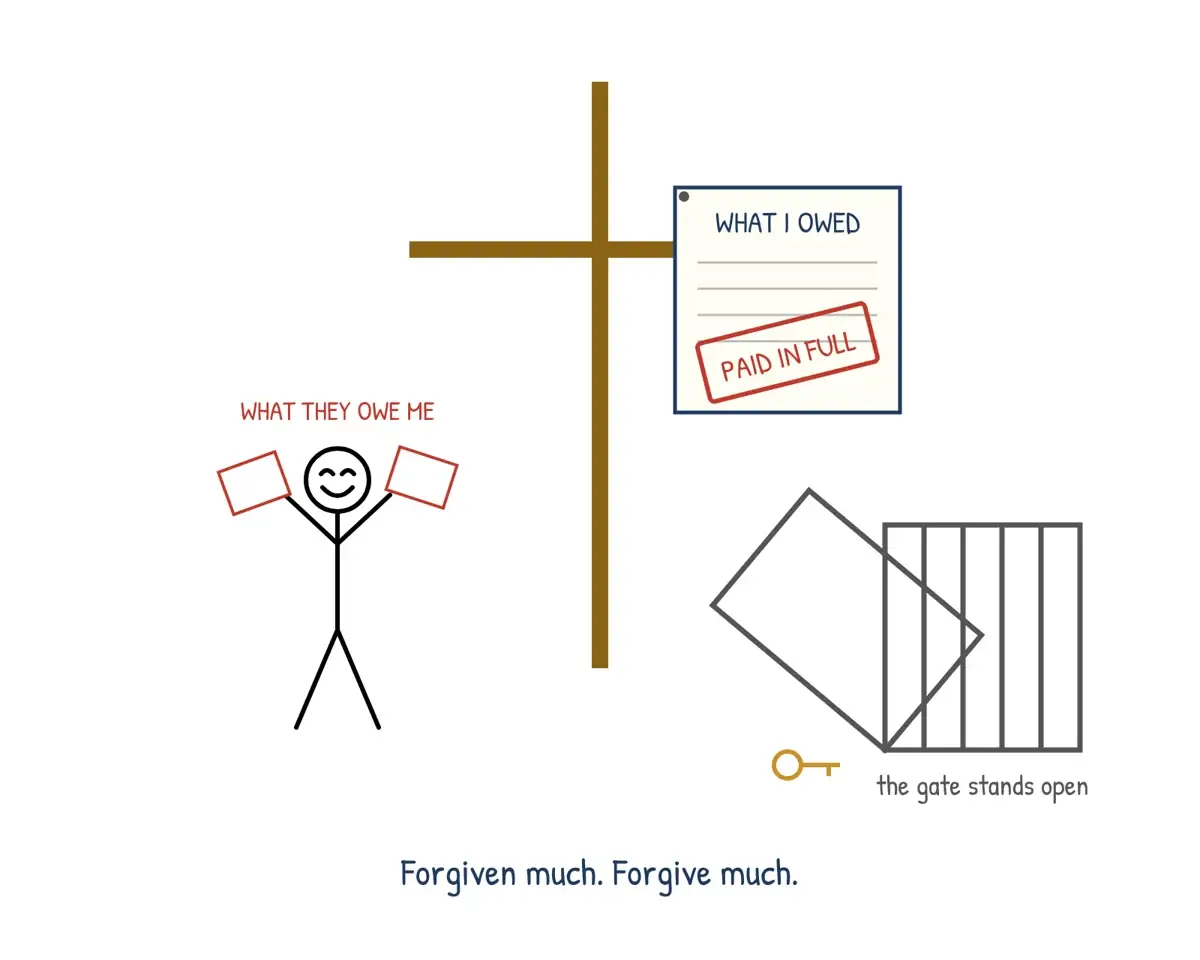
We are the servant with the ten-thousand-talent debt. Jesus paid it in full at the cross. We do not forgive in order to be saved; we forgive because we have been forgiven.
Forgiven much. Forgive much.
So this chapter is not about whether I should forgive. I know I should. This chapter is about what happens when I know all that — and I still won’t let it go.
What it looks like
If bitterness is the billboard, unforgiveness is me refusing to let anyone take it down. I have the ledger open. I know exactly what they owe me. And I am not closing the book until they pay.
Picture a man whose phone lights up with his brother’s name. They haven’t spoken since the argument over Mom’s house. He lets it ring. “I’ve forgiven him,” he tells his wife. “I just don’t need to talk to him.”
Unforgiveness hides in phrases like these:
• “I forgive you, but…”
• “I’ll forgive when they say they’re sorry.”
• “I forgave it” — and then I bring it up in every argument.
• “They need to hurt the way I hurt first.”
• “I can forgive, but I’ll never forget.” (said as a threat, not a sorrow)
The “me” underneath it
Unforgiveness says that what was done to me is bigger than what was done for me. It keeps me on the throne as the collector of debts — the one who decides when the account is paid. That chair is not mine. “Beloved, never avenge yourselves, but leave it to the wrath of God, for it is written, ‘Vengeance is mine, I will repay, says the Lord’” (Romans 12:19 BLB).
Here is the hard truth. When I won’t let go of something, it is not really me holding on it is the ‘thing’ holding me. I am captive to my own unforgiveness. My refusal to forgive leaves me in bitterness. I think I am holding them. I am not. I am held prisoner in my own dungeon of unforgiveness. They have gone on with their day. I am the one still standing in the prison yard, keeping the gate locked from the inside.
What the Word says
“bearing with one another and, if one has a complaint against another, forgiving each other; as the Lord has forgiven you, so you also must forgive.” Colossians 3:13 BLB
“Be kind to one another, tenderhearted, forgiving one another, as God in Christ forgave you.” Ephesians 4:32 BLB
Both verses give the same measure: as the Lord forgave me. Not as much as they deserve. Not as much as I feel like. As much as God forgave me. That measure has no bottom.
Sobering words from the Savior:
“For if you forgive others their trespasses, your heavenly Father will also forgive you, but if you do not forgive others their trespasses, neither will your Father forgive your trespasses.” Matthew 6:14–15 BLB
Jesus is not saying I earn God’s forgiveness by forgiving others. He is saying a heart that refuses to forgive shows it has never really understood how much it was forgiven. A man who knows he was pulled out of the river does not hold another man’s head under the water.
Repentance, forgiveness and trust
A lot of people stay stuck because they think forgiving means pretending nothing happened. It doesn’t. Three different things are going on, and it helps to pull them apart.
• Forgiveness is my part. I cancel the debt and hand justice to God. I can do it today, whether or not they ever ask. It is between me and the Lord.
• Repentance is their part. They turn around. I can pray for it, but I can’t make it happen. When they repent, the door to healing the relationship opens (Luke 17:3–4 BLB).
• Trust is rebuilt over time. Forgiveness is a gift. Trust is earned back, a step at a time. Forgiving the man who took money from me does not mean handing him my checkbook.
Forgiveness is not forgetting. I may remember for the rest of my life. When God says He will remember our sins no more (Hebrews 8:12 BLB), He means He will not hold them against us. I can do the same. I may remember. I choose not to collect. Having been forgiven much, I choose to trust and obey God by forgiving others.
And if someone is harming you, forgiving them does not mean staying in danger. Get to safety and get help. Forgiveness cancels my claim to revenge. It does not cancel wisdom, protection or the law.
When I am the one who did the harm, the same three things apply from the other side. I own it, with no excuse. I ask to be forgiven. And I am patient while trust is rebuilt — I don’t demand it back on my schedule.
The choice that honors God
My job is to honor God — always — and anything that does not honor God is sin. Holding a debt Jesus told me to cancel dishonors Him. So:
• Name the debt. Be honest about what they did. Forgiveness is not calling it nothing.
• Look at my own ten thousand talents. Set their debt beside mine.
• Say it to God out loud: “Lord, I cancel this debt. I leave justice with You.”
• Pray for them by name (Matthew 5:44 BLB). Blessing and bookkeeping don’t live long in the same heart.
• When the feelings come back tomorrow, forgive again. Seventy-seven times if that is what it takes. Feelings follow faith; they don’t lead it.
Your turn
Which of these do I hear myself say? (check all that apply)
☐ “I forgive you, but…”
☐ “I’ll forgive when they say they’re sorry.”
☐ “I forgave it” — and then I bring it up again
☐ “They need to hurt first.”
☐ “I’ll never forget.”
☐ other:
Once I say I forgive, how often do I bring it up again later? (circle one)
○ Rarely ○ Sometimes ○ Often ○ Almost always
Have I been waiting for someone to repent before I forgive? Who?
Have I been confusing forgiving someone with trusting them again? Where?
Say it better: rewrite this the way a forgiven person would say it.
Harsh: “I’ll forgive you when you’ve paid for what you did.”
Better:
Lord, today I cancel the debt __________ owes me, and I leave justice with You.
Someone I need to ask to forgive me: __________
Hide it in your heart
“Be kind to one another, tenderhearted, forgiving one another, as God in Christ forgave you.” Ephesians 4:32 BLB
Write it out once from memory:
Let’s pray
Father, You forgave me a debt I could never pay. Jesus paid it in full. And still I have kept a ledger on other people. I confess it. Today I close the book. I cancel what __________ owes me and I leave justice with You. Where I need to forgive, give me a tender heart. Where I need to rebuild trust, give me wisdom and patience. Where I need to be safe, give me courage. Where I am the one who did the harm, give me the humility to own it and ask. Forgiven much — help me forgive much. In Jesus’ name, amen.
Forgiveness is free. Trust is rebuilt. Justice belongs to God.
Chapter 12: Worry and the Need to Control
Read Matthew 6:25–34 BLB
I don’t worry about everything. I worry about the things I can’t control. And if I am honest, that is most things.
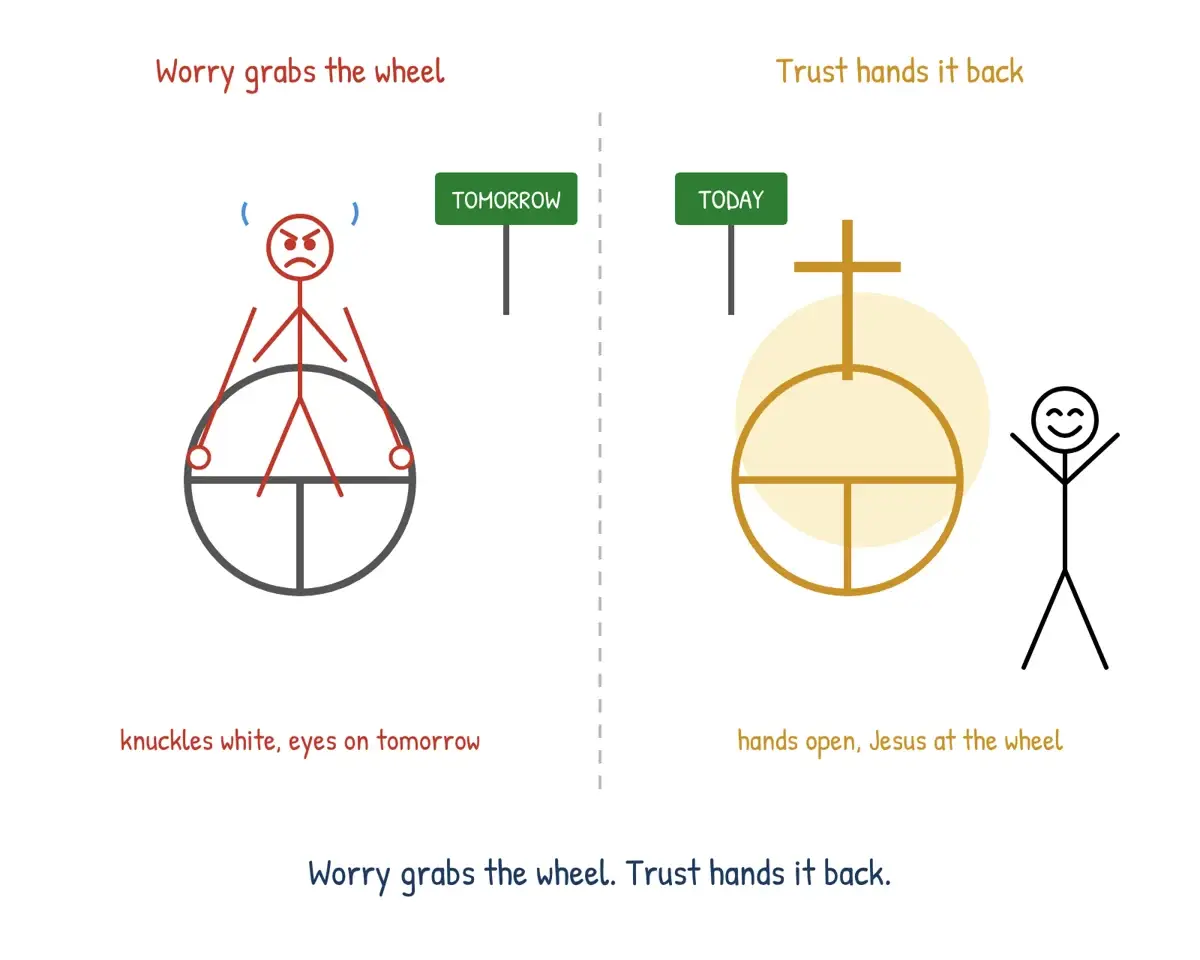
Back in Question 1 we said it plainly: “Anger says, ‘I am in charge.’ Trust says, ‘God is.’” Worry is anger’s quieter cousin. Anger grabs the wheel and yanks it. Worry grabs the wheel and won’t let go. Knuckles white. Eyes fixed on the troubles that I expect to find on a road I haven’t even reached.
What it looks like
Picture the waiting room. The test was this morning. The results come Tuesday. It is only Friday. By Saturday night I have already had the bad news, told the family, planned the treatment and lived through three outcomes that have not happened. Not one of them is real. All of them feel real. I must grasp this great truth – God I choose faith over anxiety and Your presence is enough for me.
Or picture the phone that doesn’t ring. I thought that surely they would call me back with an answer before now. “They don’t care.” “They have forgotten all about me.” “If I want to get ahead in this life I will have to pull myself up by my bootstraps, there is no one I can count on anymore.” Maybe someone doesn’t care. The more likely scenario is that the person I am waiting on got delayed. I have to learn to trust God in all ‘weather’ – to learn to be content in all circumstances. To trust God and declare with the old hymn by Horatio Spafford:
When peace like a river attendeth my way,
When sorrows like sea billows roll;
Whatever my lot, Thou hast taught me to say,
It is well, it is well with my soul.
— Horatio G. Spafford, “It Is Well with My Soul” (1873)
Worry wears a lot of disguises. Planning that never stops. Checking and re-checking. Lying awake rehearsing conversations. Needing to know. Needing to fix it. Needing everyone to do it my way so nothing goes wrong. It looks responsible. It even looks like love. But underneath it is something else.
The “me” underneath it
Worry is me trying to sit on God’s throne over tomorrow. Worry is me stealing today’s peace over anxiety about tomorrow’s trouble that likely will never come anyway.
That is hard to hear. But worry says, “If I don’t hold this together, nobody will.” Nobody? Really? Worry quietly takes God out of the picture and puts me in His place. It assumes I am the one who has to make tomorrow turn out right.
“And he is before all things, and in him all things hold together.” Colossians 1:17 BLB
God has never asked me to run tomorrow. He has not even given it to me yet. When I worry, I am reaching for something that is not in my hands and never was. No wonder my grip aches.
WORRY IS ME TRYING TO SIT ON GOD’S THRONE OVER TOMORROW.
What the Word says
Jesus did not tell us to worry less. He told us not to be anxious at all — and then He gave us reasons. Look at the birds. They don’t plant or harvest, and the Father feeds them. Look at the lilies. They don’t work or spin, and they are dressed better than Solomon. Are you not of more value than they?
“And which of you by being anxious can add a single hour to his span of life?” Matthew 6:27 BLB
Not one hour. Worry has never added a minute to anyone’s life. It has taken plenty.
Then Jesus tells me what to do instead. Seek first His kingdom and His righteousness. Put Him first, and the Father who knows what I need will see to the rest (Matthew 6:32–33 BLB). And then the line I need to tape to my bathroom mirror:
“Therefore do not be anxious about tomorrow, for tomorrow will be anxious for itself. Sufficient for the day is its own trouble.” Matthew 6:34 BLB
Today has enough in it. God gives grace for today, not for the imaginary Tuesday I keep living in my head. When Tuesday comes, His grace will be there too.
Corrie ten Boom told of a night when she was a little girl in Holland and was afraid that the people she loved would die. Her father, Casper ten Boom, sat on the edge of her bed and asked her when he gave her the train ticket for a trip to Amsterdam. Weeks before? No — just before they got on the train. Our wise Father in heaven, he told her, knows when we will need things too. Don’t run out ahead of Him. When the time comes, He will give the strength we need, just in time. Worry is trying to get tomorrow’s ticket today. God hands it to me at the station. (Told by Corrie ten Boom in The Hiding Place.)
Paul does not just say “don’t.” He gives me something to do with my hands when I let go of the wheel. Pray. Ask. Give thanks. Hand it over.
“do not be anxious about anything, but in everything by prayer and supplication with thanksgiving let your requests be made known to God. And the peace of God, which surpasses all understanding, will guard your hearts and your minds in Christ Jesus.” Philippians 4:6–7 BLB
Notice the order. I do not get the peace and then let go. I let go — I pray — and then the peace comes and stands guard. And Peter tells me where to put the load:
“casting all your anxieties on him, because he cares for you.” 1 Peter 5:7 BLB
All of them. Not just the small ones I don’t mind letting go of. The test results. The grown children. The money. The future. And the reason is not that God is strong enough (though He is). The reason is that He cares for me. If things go differently than I anticipate or want, I must still trust God and know His presence and His peace.
The choice that honors God
Worry is not just a feeling that happens to me. Like anger, it is a choice I keep making — a choice to pick tomorrow back up after I have handed it to God. My job is to honor God — always — to make right choices, and it is never the right choice if it dishonors God. Worry dishonors Him, because it tells everyone watching that I don’t really believe He is in charge.
So when the what-ifs start, I go back to the three sentences from Question 1:
God is sovereign. God is good. I can trust Him.
God is sovereign: tomorrow is in His hands, not mine. God is good: whatever tomorrow holds will pass through the hands of a Father who cares for me. I can trust Him: so I hand Him the wheel. Again. And again. Over and over and over, as many times as it takes today.
That is not giving up. That is Dependence Day. Every time I hand back the wheel, my independence dies a little more, and I find out I was never built to carry tomorrow in the first place.
LORD, HERE I AM — I GIVE YOU TOMORROW. AND I GIVE YOU TODAY.
Your turn
What do I worry about most? (check all that apply)
☐ my health
☐ my children or grandchildren
☐ money
☐ my work or retirement
☐ what people think of me
☐ the future of my country or my church
☐ other: __________
How often do I take the wheel back after I have prayed about something? (circle one)
○ Rarely ○ Sometimes ○ Often ○ Almost always
Signs I am trying to control what belongs to God (check all that apply)
☐ I replay what-ifs at night
☐ I get short with people when plans change
☐ I need to know every detail before I can rest
☐ I do it myself because no one else will do it right
☐ I pray about it, then keep worrying anyway
Say it better: turn this worry into a prayer.
Worry: “What if the test comes back bad? What will we do?”
Prayer:
The tomorrow I keep trying to carry is __________.
Today I hand it to God by __________.
Think it through: Name a time you worried for days about something that never happened — or that God carried you through. What did that teach you about who is really in charge?
Hide it in your heart
“casting all your anxieties on him, because he cares for you.” 1 Peter 5:7 BLB
Write it out once from memory:
Let’s pray
Father, You are sovereign. You are good. I can trust You. I confess that I have tried to sit on Your throne over tomorrow. I have gripped the wheel of things You never asked me to carry, and I have been tired and short with the people I love because of it. Forgive me. Today I hand You back the wheel — my health, my family, my money, my future, all of it. Teach me to pray instead of worry, to give thanks instead of rehearse the what-ifs, and to live in today’s grace. Guard my heart and mind with Your peace in Christ Jesus. When I grab the wheel again, and I will, remind me gently to let go. In Jesus’ name, amen.
Worry grabs the wheel. Trust hands it back. God is sovereign. God is good. I can trust Him.
Chapter 13: The Tongue
Read James 3:1–12 BLB
Every word I have ever regretted was once only a thought.
That is why I wrote a book called Before A Word Becomes A Wound, built on one verse:
“Let no corrupting talk come out of your mouths, but only such as is good for building up, as fits the occasion, that it may give grace to those who hear.” Ephesians 4:29 BLB
There is a moment — sometimes only half a second long — between the thought and the word. That half second is where the battle is won or lost. Once the word is out, it is out. I can apologize. I can be forgiven. But I cannot un-say it. The wound has been made.
What it looks like
Picture the supper table after a long day. Someone asks a simple question. I answer with an edge. Nobody says anything, but everybody feels it. The meal goes quiet.
Picture the sarcastic “joke” that wasn’t really a joke. The little correction in front of other people. The sigh, the eye roll, the “Well, I guess I’ll just do it myself.” The story about what she did, told to three friends “so they can pray about it.” The last word I just had to have.
And now picture the phone in my hand. The ‘tongue’ has become angry fingers stabbing the keys as I punctuate my anger with each jab. A text fired off in the heat of the moment. An email with the boss copied. A post that I know will get a reaction. A comment under a stranger’s post that I would never say to his face. A screen makes it easier to be cruel, faster to send, and impossible to take back. Screenshots last forever. James was not thinking about phones, but he was describing them.
The “me” underneath it
Jesus said where words come from:
“The good person out of the good treasure of his heart produces good, and the evil person out of his evil treasure produces evil, for out of the abundance of the heart his mouth speaks.” Luke 6:45 BLB
My tongue is not the problem. It is the messenger. It just delivers what my heart has been storing up. We have to put the right ingredients in so that we get good things out. In Question 4 we saw that the me-centered life lives in three places: my thoughts, my words and my actions. It starts in my thoughts — the replay, the story I tell myself about what they did. If I let that story run long enough, it comes out of my mouth. Thoughts become words. Words become actions. And by the time the word is out, me is already sitting on the throne.
The cutting word almost always says the same thing underneath: I matter more than you do right now. My point. My feelings. My being right. My getting even. The biggest struggle is always about me.
THOUGHTS BECOME WORDS. WORDS BECOME WOUNDS. STOP IT AT THE THOUGHT. NIP IT IN THE BUD, DON’T EVEN LET IT REST IN YOUR MIND – REJECT IT – KICK IT OUT.
What the Word says
James does not soften it. A bit turns a whole horse. A small rudder steers a great ship. And the tongue, small as it is, can burn down a forest.
“So also the tongue is a small member, yet it boasts of great things. How great a forest is set ablaze by such a small fire! And the tongue is a fire, a world of unrighteousness. The tongue is set among our members, staining the whole body, setting on fire the entire course of life, and set on fire by hell.” James 3:5–6 BLB
One match. One word. One text. A whole forest. Families, churches and friendships have gone up in smoke over a sentence somebody wished they had kept.
Then James puts his finger on the real hypocrisy:
“With it we bless our Lord and Father, and with it we curse people who are made in the likeness of God. From the same mouth come blessing and cursing. My brothers, these things ought not to be so.” James 3:9–10 BLB
Sunday morning on the way to my local church I get angry with the slow driver in front of me because I want to get to church and sing praises to God. I may fool the people sitting around me, but God is not impressed. He is looking at my heart. The person I take special care to cut down to size is made in God’s image. Jesus died to give him life. When I wound him, I am taking a swing at something God made and loves, Jesus died for, and the Holy Spirit wants to live in and guide. These things must not be.
But God does not just tell me what not to say. He shows me the better way.
“A soft answer turns away wrath, but a harsh word stirs up anger.” Proverbs 15:1 BLB
A soft answer is not weak. It takes far more strength to answer gently than to fire back. And James gives me the order of things that keeps the soft answer possible: “let every person be quick to hear, slow to speak, slow to anger” (James 1:19 BLB). Listen first. Speak slowly. Most wounds happen because I reversed those two.
Before a word becomes a wound
Here is the practice. Before a word leaves my mouth — or my stabbing fingers — I run it through Ephesians 4:29 BLB. Three questions:
• Is it good for building up? Or will it tear down?
• Does it fit the occasion? Is this the time, the place and the tone?
• Will it give grace to the one who hears it?
If it fails, I don’t think it. I don’t say it. I don’t send it. I don’t post it. Not later, either. And when it comes to the screen, I add one more rule: if I am angry, I don’t hit send. I set the phone down and pray first. A text that passes the test and is still a good idea tomorrow can be sent just as well tomorrow. (Rarely does that text ever get sent).
The choice that honors God
My job is to honor God — always — to make right choices, and it is never the right choice if it dishonors God. When I wound someone I have dishonored God. A word that wounds someone made in His image dishonors Him. A word that builds up gives Him glory.
So I go back to the prayer we hid in our hearts in Question 4. It covers both the word and the thought that comes before it:
“Let the words of my mouth and the meditation of my heart be acceptable in your sight, O LORD, my rock and my redeemer.” Psalm 19:14 BLB
Words of my mouth. Meditation of my heart. God wants both. If He has the meditation, the words will follow.
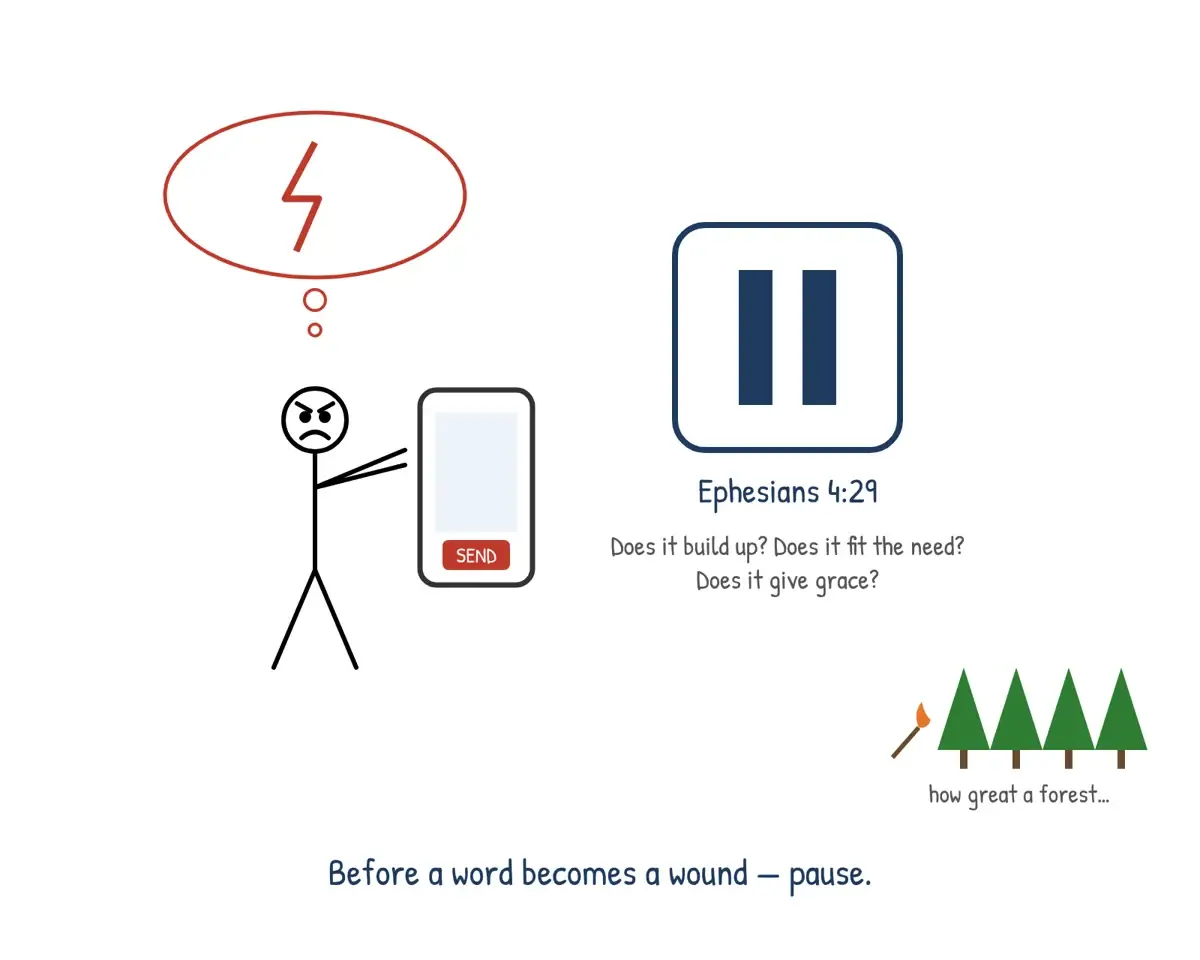
Your turn
Where does my tongue do the most damage? (check all that apply)
☐ at home
☐ at work
☐ at church
☐ in the car
☐ in texts or email
☐ on social media
☐ talking about people who aren’t there
☐ other: __________
How often do I say something I wish I could take back? (circle one)
○ Rarely ○ Sometimes ○ Often ○ Almost always
Which wounding words do I use most? (check all that apply)
☐ sarcasm
☐ criticism
☐ gossip
☐ complaining
☐ the last word
☐ the silent treatment (a word by leaving it out)
Say it better: rewrite this so it builds up and gives grace.
Harsh: “You never listen to a word I say.”
Better:
Say it better: rewrite this text before it is sent.
Harsh text: “Thanks for nothing. Typical.”
Better:
One word I spoke this week that became a wound: __________.
The person I need to go back to and make it right with is __________.
Think it through: What thought usually comes right before my sharpest words? What would it look like to stop it there?
Hide it in your heart
“Let no corrupting talk come out of your mouths, but only such as is good for building up, as fits the occasion, that it may give grace to those who hear.” Ephesians 4:29 BLB
Write it out once from memory:
Let’s pray
Lord, I confess that the same mouth I use to praise You I have used to cut down people You made and love. My words have left wounds — at home, at work, and on a screen where I thought it didn’t count. Forgive me. Clean out the storehouse of my heart, so that what comes out of my mouth is good. Set a guard at that half second between the thought and the word. Make me quick to hear, slow to speak and slow to anger. Give me a soft answer when I want a sharp one. Let every word I say, write, text or post build up and give grace. Let the words of my mouth and the meditation of my heart be acceptable in Your sight, O LORD, my rock and my redeemer. In Jesus’ name, amen.
Stop it at the thought — before a word becomes a wound.
PART FOUR — DEPENDENCE DAY
The end of me separate from Jesus Christ.
Chapter 14: The Deed
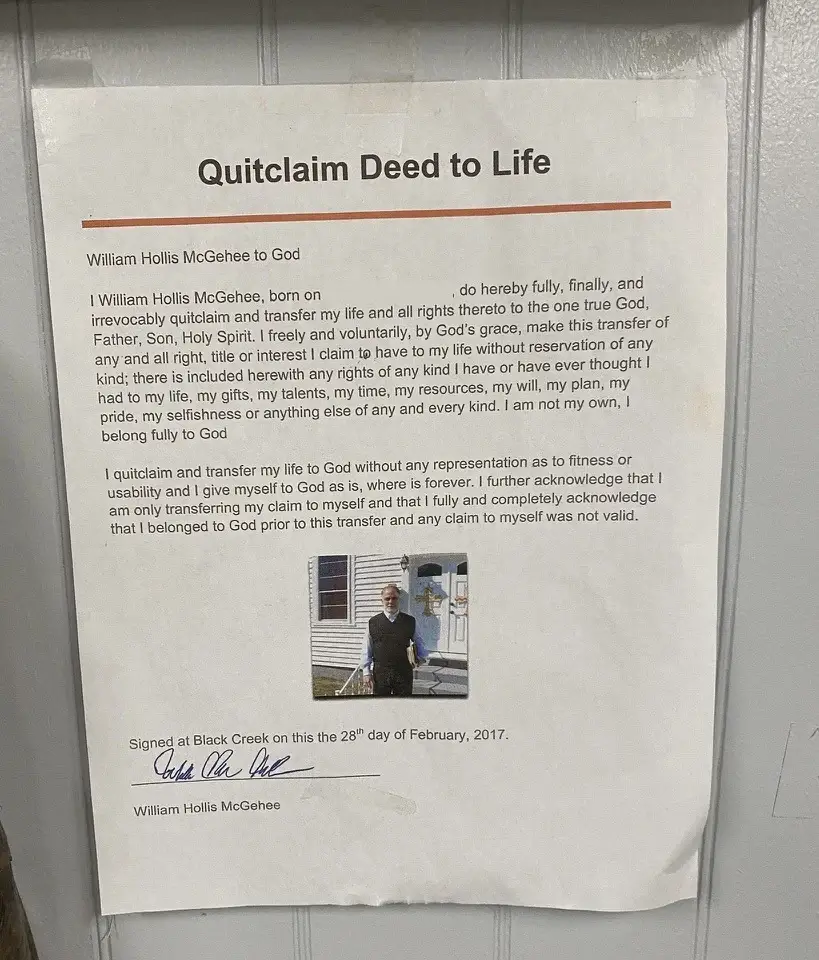
Quitclaim Deed to Life
William Hollis McGehee to God
I William Hollis McGehee, do hereby fully, finally, and irrevocably quitclaim and transfer my life and all rights thereto to the one true God, Father, Son, Holy Spirit. I freely and voluntarily, by God’s grace, make this transfer of any and all right, title or interest I claim to have to my life without reservation of any kind; there is included herewith any rights of any kind I have or have ever thought I had to my life, my gifts, my talents, my time, my resources, my will, my plan, my pride, my selfishness or anything else of any and every kind. I am not my own, I belong fully to God.
I quitclaim and transfer my life to God without any representation as to fitness or usability and I give myself to God as is, where is forever. I further acknowledge that I am only transferring my claim to myself and that I fully and completely acknowledge that I belonged to God prior to this transfer and any claim to myself was not valid.
Signed at Black Creek on this the 28th day of February, 2017.
William Hollis McGehee
“Or do you not know that your body is a temple of the Holy Spirit within you, whom you have from God? You are not your own, for you were bought with a price. So glorify God in your body.” 1 Corinthians 6:19–20 BLB
Chapter 15: Galatians 2:20 — From Spiritual Reality to Daily Experience
Read Romans 6:1–14 BLB
“I have been crucified with Christ. It is no longer I who live, but Christ who lives in me. And the life I now live in the flesh I live by faith in the Son of God, who loved me and gave himself for me.” Galatians 2:20 BLB
Is this already true of every believer, or is it something I must do? The answer is both.
Galatians 2:20 BLB describes a spiritual reality that belongs to every believer at conversion. The new birth captures the death, burial, and resurrection –the old self was crucified so that we would no longer be enslaved to sin (Romans 6:3–11 BLB). In Christ a person is a new creation; the old has passed away (2 Corinthians 5:17 BLB). This is not earned, and there is no higher level still to be reached.
Yet Paul’s language holds a tension. Believers must “consider yourselves dead to sin and alive to God in Christ Jesus” (Romans 6:11 BLB) — a command to acknowledge and act on what is already true. His standing command is to “walk by the Spirit” (Galatians 5:16 BLB). Jesus says, “Abide in me” (John 15:4–5 BLB); fruit depends on that sustained connection.
So the pattern is not that I achieve the reality by effort — in spiritual reality it is already mine. I have to act on that truth. I have to live out what Christ has already placed in me. This is a type of ‘working out my own salvation’ (Philippians 2:12–13 BLB). Rather, if I reckon my self-life crucified with Christ, I may reckon on Him living in me in the power of His resurrection. “Reckoning,” counting something as true, is the act of faith that lets the spiritual reality become operative in lived experience. The crucifixion with Christ and His indwelling life are completed realities for every believer; I must actively align myself with them through faith, obedience and dependence on the Spirit for that reality to change my daily practice.
Sources for the commentary above: Scott E. McClelland, “Galatians,” in Evangelical Commentary on the Bible (Baker, 1995), 3:1011; Johnny Cisneros, “Cutting Edge: Spirit vs Flesh,” Bible Study Magazine, Sept–Oct 2010, 42; James Smith and Robert Lee, Handfuls on Purpose (Eerdmans, 1971), 278–279.
Chapter 16: The Breaking of My Independence
With credit to Oswald Chambers, My Utmost for His Highest, November 3 — “A Bondservant of Jesus.” His reading on Galatians 2:20 BLB is what opened my eyes to the breaking of my independence.
As Oswald Chambers helped me see in his reading for November 3, “A Bondservant of Jesus,” Galatians 2:20 BLB is not something God does to me while I sit still and wait. The breaking of my independence has to come by my own hand. God will not do it for me. He brings me right up to that point — again and again, more times than I can count — and then He waits. He will not shove me through. He will not drag me off the throne. I have to choose. I have to let my independence fall apart and bow to the supremacy of the Lord Jesus. Not my rights. Not my plans. Not my way. Him. That is the door, and I am the one who has to walk through it.
If even one of us can get this — the effort will have been greatly rewarding. The sole purpose of this is for God to help Himself to a life — to lives.
Will I allow Him to help Himself to mine?
Will you allow God to help Himself to yours — or are we more concerned with our own idea of what we ought to be, or are going to be?
Am I a willing bondservant of Jesus?
“Paul, a servant of Christ Jesus, called to be an apostle, set apart for the gospel of God,” Romans 1:1 BLB
Paul was so comfortable with his role as a slave he had his stationery embossed with his status “a servant” a doulos slave.
Chapter 17: The Day Self Died
Read John 12:24–26 BLB
We begin to celebrate the day we die to self.
Most people my age know the phrase “the day the music died.” Don McLean gave it to us in his 1971 song “American Pie.” He was looking back to a cold February day in 1959 when a small plane went down in Iowa and took the lives of Buddy Holly, Ritchie Valens, J.P. “The Big Bopper” and Roger Peterson, the pilot. If you say “the day the music died” people know what you mean. It was a real day. It happened. You can put your finger on it on the calendar.
We need a recognizable date when ‘self’ died in us. Not a vague someday. Not “I’m working on it.” Not “I’m a little better than I used to be.” A day. A date. A place. The time when the music of self died.
My day was February 28, 2017. You read about it in Chapter 14. At Black Creek I signed a Quitclaim Deed to Life and handed it all over to God — my gifts, my time, my will, my plan, my pride, my selfishness. I was not saved that day. I came to Jesus as a young person. February 28, 2017 was something different. It was the day my independence ended and my dependence began. Dependence Day.
DEPENDENCE DAY — THE BEST DAY BY FAR!
Why would anybody celebrate a death? Because of what grows out of it. Jesus put it this way:
“Truly, truly, I say to you, unless a grain of wheat falls into the earth and dies, it remains alone; but if it dies, it bears much fruit.” John 12:24 BLB
A seed in the packet is safe. Dry. Kept. Alone. It can sit on the shelf for years and never be anything but a seed. Put it in the ground and it looks like it is lost. But that is the only way it ever becomes what it was made to be.
Same with me. As long as I hold on to my life I keep it — small, dry, alone, all about me. When I let go of it, Jesus does something with it I never could.
“For whoever would save his life will lose it, but whoever loses his life for my sake and the gospel’s will save it.” Mark 8:35 BLB
Picture someone who sells a house. He signs the papers. He takes the money. But he keeps a key. On the weekends he lets himself in. He moves the furniture around. He hangs his own pictures on the wall. He even tells the new owner which rooms are off limits. That is how many of us live with God. We gave Him the house — on paper. We just never gave Him the key.
A quitclaim deed hands over the key. All of it. As is, where is. No rooms held back.
Now, let me be honest. Signing that deed did not mean I never again reached for the steering wheel. The old man still jumps up. But when he does, I am not deciding all over again who owns me. That was settled at Black Creek. I am just a man trying to take back what he already gave away — and what was never his to begin with. That last line of my deed is the whole thing: I belonged to God before I ever signed a word. The deed did not make it true. The deed said yes to what was already true. What has been true (but very poorly carried out) since a new birth that occurred in youth rally in the mid 1960s.
That is what Chapter 15 was saying. If you belong to Jesus, you have already been crucified with Christ. That is a spiritual reality. A deed is the day you stop arguing with it and start living it.
So there is a day — and there is every day. The day settles who owns me. Every day after that lives it out. Chapter 19 is about the every day. This chapter is about the day.
Do you have a day? If someone asked you, “When did your independence end?” could you name it? If not, the deed below is for you. It is modeled on mine. Read it slowly. Don’t sign it because a book told you to. Sign it when you mean it — and you may need to sit with it a while before you do. When you sign it, put the date on it. Put the place on it. Then that day is yours to celebrate.
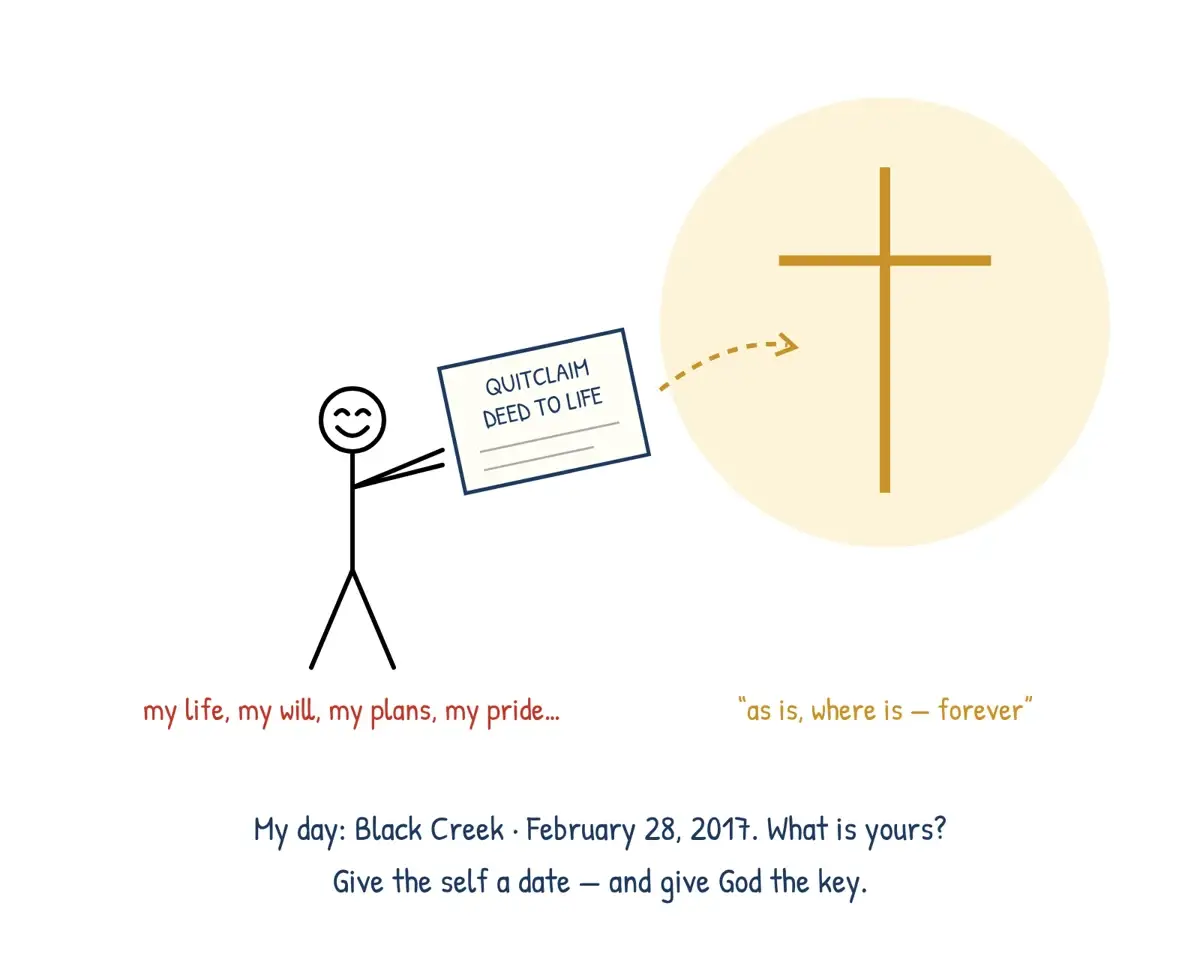
Your turn
Here is the deed. Fill in your name, the place and the date. Then sign it.
Quitclaim Deed to Life
__________________ to God
I, __________________, born on __________________, do hereby fully, finally, and irrevocably quitclaim and transfer my life and all rights thereto to the one true God, Father, Son, Holy Spirit.
I freely and voluntarily, by God’s grace, make this transfer of any and all right, title or interest I claim to have to my life without reservation of any kind; there is included herewith any rights of any kind I have or have ever thought I had to my life, my gifts, my talents, my time, my resources, my will, my plan, my pride, my selfishness or anything else of any and every kind. I am not my own, I belong fully to God.
I quitclaim and transfer my life to God without any representation as to fitness or usability and I give myself to God as is, where is forever. I further acknowledge that I am only transferring my claim to myself and that I fully and completely acknowledge that I belonged to God prior to this transfer and any claim to myself was not valid.
Signed at __________________ on this the ____ day of __________________, 20__.
Signature: __________________
Hide it in your heart
“I have been crucified with Christ. It is no longer I who live, but Christ who lives in me. And the life I now live in the flesh I live by faith in the Son of God, who loved me and gave himself for me.” Galatians 2:20 BLB
Write it out once from memory:
Let’s pray
Lord, here I am. I have held on to the key long enough. I have let myself back into rooms that belong to You. I confess it. Today I hand it all over — my time, my plans, my pride, my rights, my way. As is, where is. I was never my own. You bought me, and I belong to You. Let this be the day my independence ends and my dependence on You begins. And tomorrow, when the old man jumps back up, remind me whose I am. In Jesus’ name, amen.
Give the self a date — and give God the key.
PART FIVE — THE OTHER SIDE OF THE RAINBOW
Chapter 18: The Christ-Centered Life
Read Ephesians 3:14–21 BLB
We have spent most of this book fighting. Flesh against Spirit. Me against Him. Skirmish after skirmish. Now I want to lift our eyes to what is on the other side of the deed.
That ‘somewhere over the rainbow’ beauty of living a Christ-centered life that is greater than anything we ever imagined in our wildest dreams — not easy but the true picture of a life in Christ.
“Somewhere over the rainbow” comes from the song “Over the Rainbow,” written by Harold Arlen and Yip Harburg for The Wizard of Oz in 1939. Dorothy dreamed of a place far away from her troubles. That is the world’s rainbow — somewhere else, someday, if I can just get away from here.
The Christ-centered life is not that. It is not escape. It is not a place far away. It is right here, in the middle of my ordinary Tuesday, with Christ on the throne and me off it. And it is better than anything I could dream up.
“Now to him who is able to do far more abundantly than all that we ask or think, according to the power at work within us, to him be glory in the church and in Christ Jesus throughout all generations, forever and ever. Amen.” Ephesians 3:20–21 BLB
Far more abundantly than all that I ask. Than all that I think. My wildest dreams are too small. When I am on the throne, the best I can get is what I want. When Christ is on the throne, I get what He wants for me — and that is always more.
Notice where that power is: “at work within us.” Not over the rainbow. Within us. The same Jesus who lives in me (Galatians 2:20 BLB) is the One who is able.
“The thief comes only to steal and kill and destroy. I came that they may have life and have it abundantly.” John 10:10 BLB
The me-centered life always feels like it ought to be the full one. I get my way. I get noticed. I get the parking place. But it never fills. It steals. It kills. It destroys — my peace, my joy, my relationships. Jesus came to give life, and to give it abundantly.
So what does it look like? Remember the list in the Introduction. Someone cuts in front of me. Someone doesn’t notice me. The test results aren’t what I hoped for. Picture the pharmacy line from Question 1. Twenty minutes. Same new clerk. Same man ahead of me with the long story. But this time the heat doesn’t rise. I am not checking whether this is going my way. I am asking, “Lord, what are You doing here?” And I notice the clerk is nervous. I notice the man is lonely. Nothing outside me changed. Everything inside me did.
That is the Christ-centered life. The things that used to grab my emotions start to lose their grip. Not because I am trying harder. Because I am not the center anymore. It’s not about me. I don’t need it to be about me. I don’t want it to be about me.
And there is joy in it — the kind you can’t manufacture. Remember the socket wrench on the stubborn bolt. You try one size, then another. Nothing. Then the right one slips over the nut, fits just right, and the bolt breaks loose. That is the moment I realize what I was made for. I was not made to sit on the throne. I was made to live for Jesus. When I do, it fits.
“You make known to me the path of life; in your presence there is fullness of joy; at your right hand are pleasures forevermore.” Psalm 16:11 BLB
Now, I said it was not easy, and I meant it. The rainbow comes after the storm, not instead of it. Living Christ-centered takes surrender, and then more surrender. But it is the true goal. Everything else in this book points here.
“and he died for all, that those who live might no longer live for themselves but for him who for their sake died and was raised.” 2 Corinthians 5:15 BLB
No longer for themselves. That is the whole difference. The old hymn said it plainly back in 1887:
“Trust and obey, for there’s no other way to be happy in Jesus, but to trust and obey.” — John H. Sammis, “Trust and Obey”
NOT OVER THE RAINBOW — CHRIST IN ME, RIGHT HERE, RIGHT NOW.
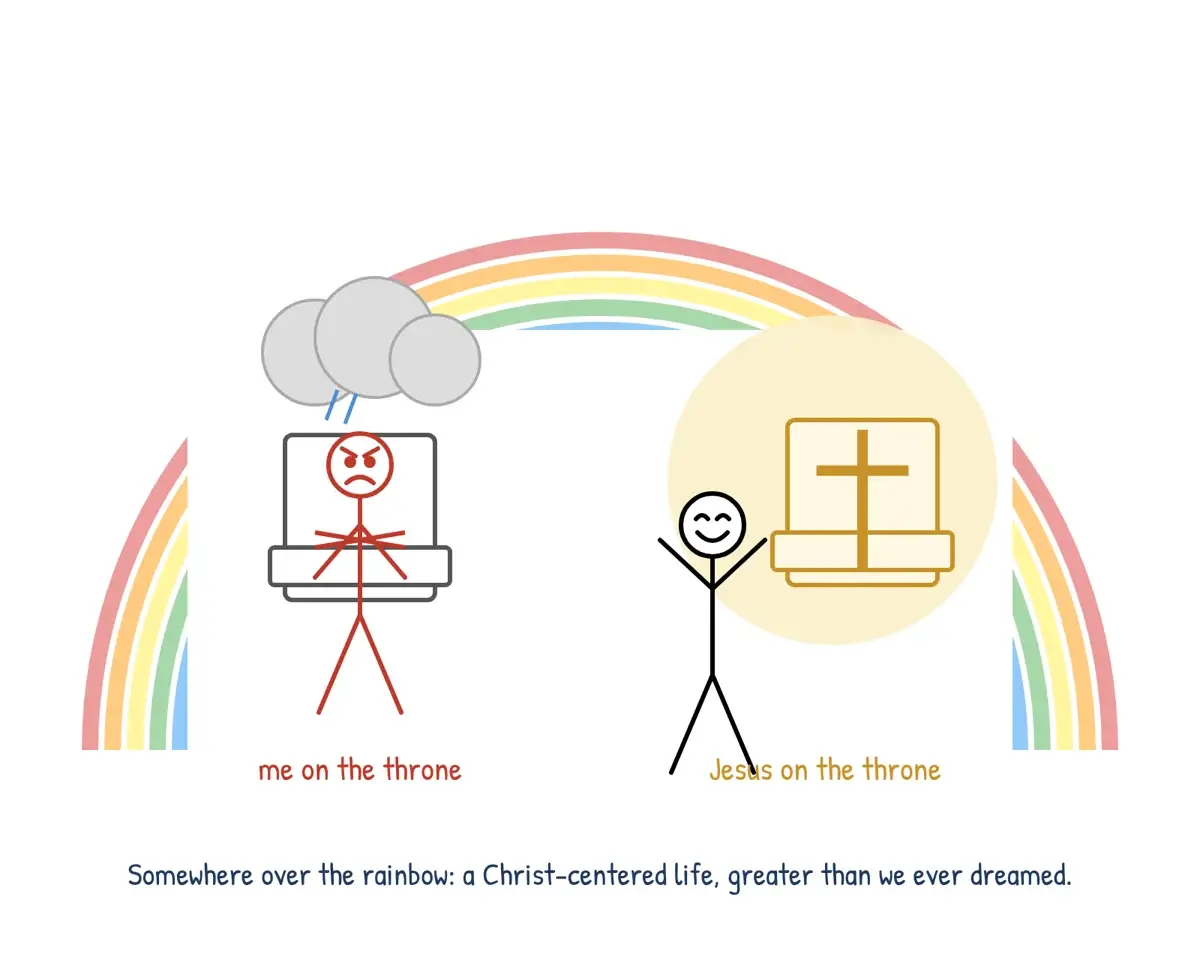
Your turn
Where have I been looking for life “somewhere over the rainbow” instead of in Christ? (check all that apply)
☐ getting my way
☐ being noticed or appreciated
☐ comfort and ease
☐ money or possessions
☐ being right
☐ other: __________
How much of an ordinary day is Christ-centered for me right now? (circle one)
○ Rarely ○ Sometimes ○ Often ○ Almost always
Have I ever had a “socket wrench” moment — a time I chose Jesus over myself and knew, “This is what I was made for”? What happened?
Picture your own “pharmacy line.” Where will you be tested this week?
What would the Christ-centered response look like there?
Hide it in your heart
“Now to him who is able to do far more abundantly than all that we ask or think, according to the power at work within us, to him be glory in the church and in Christ Jesus throughout all generations, forever and ever. Amen.” Ephesians 3:20–21 BLB
Write it out once from memory:
Let’s pray
Lord Jesus, my dreams are too small. I keep looking for life somewhere else — in getting my way, in being noticed, in having things my way. You came to give me life, abundant life, and You are able to do far more than I ask or think. Take the center. Take the throne. When the storm comes, keep me trusting and obeying, and let me find the joy of living for You — the joy of knowing this is what I was made for. To You be the glory. In Jesus’ name, amen.
The Christ-centered life is not easy — but it is what I was made for.
Chapter 19: Reckoning Daily and Abiding
Read John 15:1–11 BLB
Signing the deed settles who owns me. Living it out happens one day at a time. Two words from Scripture carry the whole daily life of a surrendered believer: reckon and abide.
Reckon
“So you also must consider yourselves dead to sin and alive to God in Christ Jesus.” Romans 6:11 BLB
Older translations say “reckon.” Down South we say “I reckon” all the time. “I reckon it’ll rain.” That’s a guess. Paul’s reckoning is no guess. It is the word a bookkeeper uses — count it, add it up, write it down, it is so. I am dead to sin. I am alive to God. That is already true of me in Christ (Chapter 15). Reckoning is counting on it.
So when the old man jumps up and says, “You’ve got a right to be angry,” I don’t argue with him on his terms. I reckon. “No. I died. That man doesn’t run things anymore. I have died to sin. I am alive to God in Christ Jesus.”
Abide
“Abide in me, and I in you. As the branch cannot bear fruit by itself, unless it abides in the vine, neither can you, unless you abide in me. I am the vine; you are the branches. Whoever abides in me and he in him, he it is that bears much fruit, for apart from me you can do nothing.” John 15:4–5 BLB
Abide means stay. Stay put. Remain. A branch doesn’t strain and grunt to make grapes. It just stays connected to the vine, and the life of the vine flows through it. The fruit comes from staying.
Apart from Him I can do nothing. Not a little. Nothing. That is not bad news. That is the end of my independence put in one sentence. And it is the beginning of real fruit — love instead of self-centeredness, joy instead of what I want, peace instead of having things my way.
Daily
“And he said to all, ‘If anyone would come after me, let him deny himself and take up his cross daily and follow me.’” Luke 9:23 BLB
Daily. Not once at an altar. Not once at a creek. Every day. Paul said, “I die every day!” (1 Corinthians 15:31 BLB). The deed is the day. This is the every day.
I said back in Chapter 5 that even with my commitment I know I will need several booster shots throughout the day. That is still true. A booster shot doesn’t mean the first shot failed. It means I live in a world full of the same old infections — pride, impatience, self-pity — and I need fresh protection.
And God has plenty. His mercies don’t run out.
“The steadfast love of the LORD never ceases; his mercies never come to an end; they are new every morning; great is your faithfulness.” Lamentations 3:22–23 BLB
A simple daily practice
Morning — surrender
Before my feet hit the floor, before the phone, before the news — I give myself to God. Out loud if I can. “Lord, here I am. I give myself to You. Today I am dead to sin and alive to You. Take the throne.”
“I appeal to you therefore, brothers, by the mercies of God, to present your bodies as a living sacrifice, holy and acceptable to God, which is your spiritual worship. Do not be conformed to this world, but be transformed by the renewal of your mind, that by testing you may discern what is the will of God, what is good and acceptable and perfect.” Romans 12:1–2 BLB
A living sacrifice has one problem: it keeps crawling off the altar. That is why I do this every morning.
Midday — a booster shot
Somewhere in the middle of the day, stop. Thirty seconds is enough. In the car, at the sink, between meetings. Ask: Who is on the throne right now? Then reckon and abide: “I am dead to that, Lord. I am alive to You. I stay with You.” If something has already gone wrong, don’t wait for evening to deal with it. Give it to Him right there.
Evening — check: thoughts, words, actions
Before I sleep, I walk back through the day with the Lord. Three questions. Did my thoughts honor God? Did my words build others up? Did my actions show love? Where the answer is no, I don’t make excuses. I confess it, I make it right where I need to, and I leave it with Him.
“Search me, O God, and know my heart! Try me and know my thoughts! And see if there be any grievous way in me, and lead me in the way everlasting!” Psalm 139:23–24 BLB
“If we confess our sins, he is faithful and just to forgive us our sins and to cleanse us from all unrighteousness.” 1 John 1:9 BLB
Then I go to sleep forgiven, and I wake up to new mercies — and do it again.
MORNING — SURRENDER. MIDDAY — BOOSTER. EVENING — CHECK. OVER AND OVER AND AGAIN.
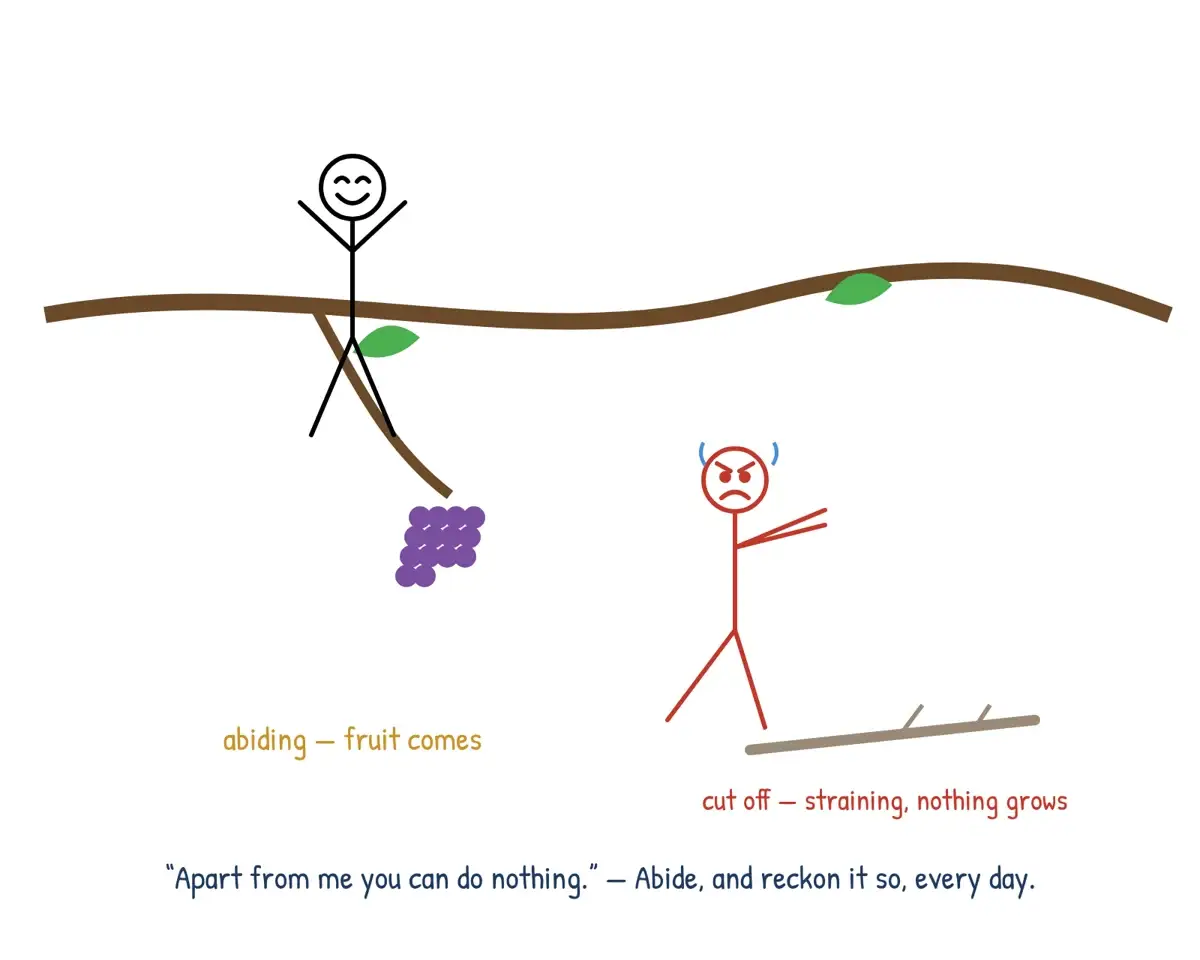
Your turn
Which part of the day is hardest for me to stay surrendered? (circle one)
○ Morning ○ Midday ○ Evening ○ Late at night
What usually crowds out my morning surrender? (check all that apply)
☐ my phone
☐ the news
☐ rushing out the door
☐ worry about the day
☐ I just forget
☐ other: __________
Write a short morning surrender prayer in your own words:
My midday booster-shot time will be: __________
When the old man jumps up this week, what will I “reckon” back to him?
Evening check — tonight:
A thought that did not honor God: __________
A word that did not build up: __________
An action that did not show love: __________
Hide it in your heart
“I am the vine; you are the branches. Whoever abides in me and he in him, he it is that bears much fruit, for apart from me you can do nothing.” John 15:5 BLB
Write it out once from memory:
Let’s pray
Lord, here I am again this morning. I give myself to You — a living sacrifice. Help me count it true that I am dead to sin and alive to You. Keep me close, like a branch on the vine, because apart from You I can do nothing. When the day gets loud, give me the booster shot I need. Tonight, search my heart — my thoughts, my words, my actions — and where You find anything that doesn’t honor You, forgive me and make me clean. Then let me do it all again tomorrow. In Jesus’ name, amen.
Reckon it true. Stay with Him. Do it again tomorrow.
Chapter 20: Not Easy — But the True Goal
Read Philippians 3:12–14 BLB
I want to be honest with you as we come near the end. Signing the deed did not end the skirmishes. Reckoning and abiding do not end them. The old man will keep tugging until the day I see Jesus face to face. Every minute of every hour of every day.
We never ‘grow’ out of this battle but we can surrender out of it.
Read that again. You won’t outgrow it. You won’t graduate from it. There is no level in the Christian life where the flesh stops wanting the throne. Anyone who tells you otherwise is about to get his nose busted on the hard rough soil of his own prideful fall. But you can surrender out of it — this time, and the next time, and the time after that.
Even Paul said he hadn’t arrived.
“Not that I have already obtained this or am already perfect, but I press on to make it my own, because Christ Jesus has made me his own.” Philippians 3:12 BLB
Paul didn’t press on so that Christ would make him His own. He pressed on because Christ already had. That is the order. I don’t surrender to get God to love me. I surrender because He already does, and because He already owns me.
So what do I do with the failures? I have them. You will too. Picture a man who signs his deed with tears on a Sunday and snaps at his wife on Monday morning over burnt toast. Did the deed fail? No. The deed is still good. He just reached for something that isn’t his anymore. The right move is not to tear up the deed. The right move is to confess it, make it right with his wife, and give the key back to God — again.
Don’t let the enemy tell you that one bad Monday proves the whole thing was fake. God finishes what He starts.
“And I am sure of this, that he who began a good work in you will bring it to completion at the day of Jesus Christ.” Philippians 1:6 BLB
And here is the other half of honesty: the joy is real. I’m not selling you a long, hard grind with a reward at the end. The joy shows up along the way. Those little victories when the old man is put away — when someone cuts in front of me and I just let it go, when somebody else gets the credit and I am actually glad for them — there is nothing on earth like it. It is indescribably wonderful.
The skirmishes go on. But the war has already been won.
“But thanks be to God, who gives us the victory through our Lord Jesus Christ.” 1 Corinthians 15:57 BLB
My job in the meantime has not changed. My job is to honor God — always — to make right choices, and it is never the right choice if it dishonors God. Not easy. But the true goal.
NOT EASY. NOT OPTIONAL. NOT ALONE. AND SO WORTH IT.
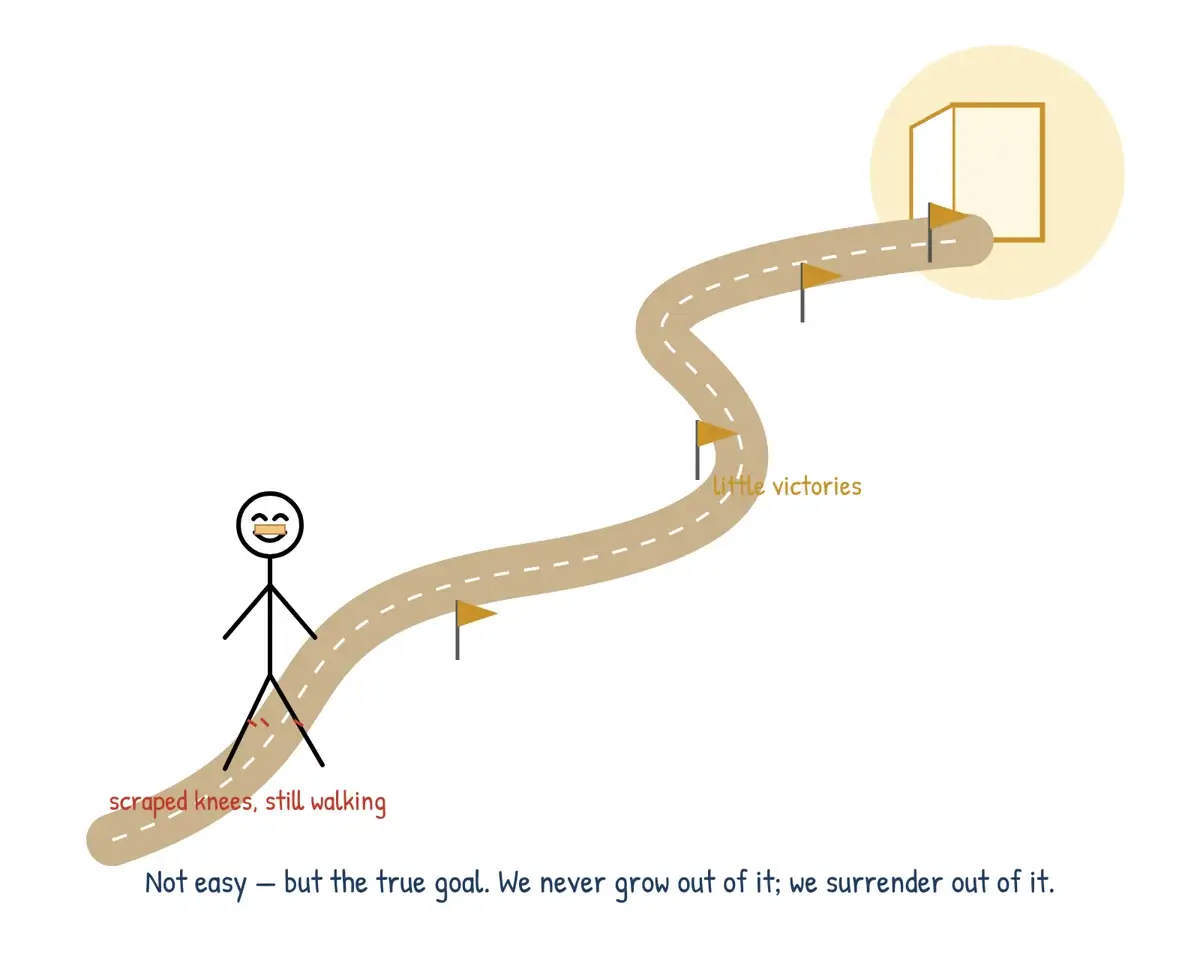
A Week of Honest Practice
Here is a week to put all of this into practice. It started as the last lesson of my anger study, but it fits every skirmish in this book. One step a day. Be honest. Check the box only if you did it. If you miss a day, don’t quit — surrender out of it and pick up the next day.
Day 1 — Start with surrender
Before anything else this morning, present yourself to God (Romans 12:1 BLB). Sign your name again in your mind under the deed.
☐ I surrendered my day to God this morning.
What tried to take the throne today: __________
Day 2 — Name the demand
When you feel the heat rise, ask: What do I want that I’m not getting? (James 4:1 BLB)
☐ I named the demand underneath my reaction.
What I wanted: __________
Day 3 — Ask the better question
When something goes against you today, ask, “God, what do You want me to learn from this?” Let it be your personal trainer, not your bully platform.
☐ I asked the better question at least once.
What I think He was teaching me: __________
Day 4 — Guard the tongue
Be quick to hear, slow to speak, slow to anger (James 1:19 BLB). Before you answer, wait. Pray first.
☐ I held back a word that would have wounded.
The word I didn’t say: __________
Day 5 — Take down a billboard
Is someone renting space in your mind? Name the slight you keep replaying. Give it to God and stop driving past that billboard.
☐ I gave God a hurt I have been replaying.
The billboard I took down: __________
Day 6 — Make it right
Is there someone you need to apologize to? Go and make it right (Matthew 5:23–24 BLB). Don’t explain. Don’t defend. Just own it.
☐ I made something right with someone.
Who, and what I said: __________
Day 7 — Look back and give thanks
Walk back through the week with the Lord. Thank Him for every little victory. Confess every stumble. Then get ready to do it again.
☐ I thanked God for the week’s victories and confessed the stumbles.
My biggest little victory this week: __________
Where I most need a booster shot next week: __________
Hide it in your heart
“And I am sure of this, that he who began a good work in you will bring it to completion at the day of Jesus Christ.” Philippians 1:6 BLB
Write it out once from memory:
Let’s pray
Lord, I am tired of falling on my face, and I know I will fall again. Thank You that the deed is still good when I fail. Thank You that You began a good work in me and You will finish it. When the old man jumps up, help me surrender out of the battle instead of fighting it in my own strength. Let me taste the joy of the little victories, and keep my eyes on the true goal — Jesus, and nothing but Jesus. In His name, amen.
The skirmishes don’t stop — but I can surrender out of every one of them.
Closing: Will You Let God Help Himself to You?
We have come a long way together. We started with a tug of war. We looked at the many faces of “me” — anger, bitterness, pride, unforgiveness, worry, the tongue. We came to a deed, and a day, and the every day after it.
Now it comes down to one question. It is the question I keep asking myself.
Will you allow God to help Himself to you?
Not, “Will you do more for God?” Not, “Will you try harder?” Will you let Him freely and continually help Himself to you? Will you open the door, hand over the key and say, “Lord, take whatever You want — all of it”? “All of me, please take all of me. Lord, you can see that I am no good without you!”
That is a different thing than being a good person. Different than being a religious person. Different than being a little better than you used to be. None of those gets us there. Only surrender does.
Most of us are more worried about our own idea of what we ought to be. Our plans. Our reputation. Our rights. But God doesn’t need my plans. He wants me. As is, where is.
“I appeal to you therefore, brothers, by the mercies of God, to present your bodies as a living sacrifice, holy and acceptable to God, which is your spiritual worship.” Romans 12:1 BLB
If even one person reading this gets it, the whole effort will have been worth it.
So here is my invitation. Go back to Chapter 17. The deed is waiting for you. If you have already signed it, read it again today and say yes to it again. If you haven’t, sit with it. Pray over it. Count the cost. And when you are ready, sign it. Write down the place. Write down the date. Then you will have a day of your own — the day your music died and the music of Jesus “All to Jesus I surrender, all to Him I freely give….” kicked in. The day your independence ended and your dependence on Jesus began.
Then celebrate it. Dependence Day is the best day by far.
Let’s pray
Lord, here I am. You have been patient with me. You have brought me to this point again and again, and You have waited. I am done holding on. Help Yourself to me — my time, my gifts, my plans, my pride, my will, my way. I am not my own. I was bought with a price. Take the throne, and keep me off it. Let the rest of my life be all in for Jesus. And for every person who reads these pages, do the same thing in them. In Jesus’ name, amen.
It is always Jesus. Lord, help Yourself to me.
CLASS LEADER GUIDE
Session F1: Who Is God?
Goal: Help each person see that trusting a sovereign, good God is the foundation for dealing with anger — especially in circumstances they don’t like.
Open: Ask: “What is one thing this week that did not go the way you planned?” Keep it light — traffic, weather, a broken appliance. No stories about other people.
Teach: Read Psalm 115:3 BLB and Isaiah 55:8–9 BLB: God is sovereign and His ways are higher. Then Romans 8:28 BLB: God doesn’t call all things good, but He works all things for good. Show the steering-wheel drawing and make the point: anger grabs the wheel; trust hands it back.
Talk:
• Why is it easier to trust God in good circumstances than in hard ones?
• What is the difference between “all things are good” and “God works all things together for good”?
• Which mark of a true Christian in Romans 12:9–21 BLB depends most on trusting God? Why?
• When I get angry, what am I usually saying about God, even if I don’t say it out loud?
Practice: Do the “Trusting God / Taking control” sort together. Then each person quietly fills in the blank: the circumstance I most need to trust God with this week.
Close: Read Romans 12:9–21 BLB aloud, each person taking a verse. Say Romans 8:28 BLB together and pray the lesson prayer.
This week: Each time something doesn’t go your way, say quietly, “God is sovereign. God is good. I can trust Him.” Practice one mark from Romans 12 on purpose.
Session F2: Who Am I?
Goal: Help each person honestly face that they are a sinner and ask where they personally stand with God.
Open: Ask: “When you were a child, what was your favorite excuse when you got in trouble?” Keep it light and about yourselves.
Teach: Romans 3:23 BLB: all have sinned — no curve. Isaiah 59:2 BLB: sin separates. Ephesians 2:1–5 BLB: we were dead, but God made us alive. Show the two-doors drawing: either born again or separated, and “good enough” is not a door.
Talk:
• Why do we compare ourselves to other people instead of to God?
• What is the difference between seeing sin as “bad things I do” and as “me on the throne”?
• Why does Paul say “dead” instead of “sick”? What does that change?
• How does seeing myself as a sinner change the way I respond when someone wrongs me?
Practice: Do the “Excuse / Confession” sort together. Then each person quietly tries the “Say it better” rewrite. Share only if willing.
Close: Read Ephesians 2:4–5 BLB together slowly. Pray the lesson prayer. Let people know you’re available to talk privately about where they stand.
This week: When you catch yourself judging someone, stop and say, “I am a sinner too, and God has been merciful to me.”
Session F3: Am I Born Again?
Goal: Help each person answer Jesus’ question for themselves and understand clearly how a person is born again.
Open: Ask: “What is the best gift you ever received that you did nothing to earn?”
Teach: Start with Matthew 16:13–17 BLB: Jesus asks, “Who do you say that I am?” Then walk the gospel simply: Romans 3:23, 6 BLB:23, 5:8, Ephesians 2:8–9 BLB, Romans 10:9–10 BLB, and John 3:3 BLB. Show the bridge drawing: the cross is the only way across the gap.
Talk:
• Why do you think Jesus asked what people were saying before He asked what the disciples said?
• Nicodemus was a good, religious man. Why did he still need to be born again?
• Why is it so hard for us to receive something we didn’t earn?
• How does being born again change the root of anger, not just the behavior?
Practice: Do the “Trying to earn it / Receiving it as a gift” sort together. Then give quiet time to write, “Who do I say Jesus is?”
Close: Read the lesson prayer slowly. Invite anyone who wants to pray it to pray silently along. Do not ask for raised hands. Stay afterward for anyone who wants to talk.
This week: Fill in “My response to Jesus.” If you have trusted Him, tell one person what Jesus means to you.
Session F4: What Does Jesus Require of Me?
Goal: Help each person see themselves as a follower who trusts, obeys, forgives without measure and aims to glorify God in thoughts, words and actions.
Open: Ask: “Who taught you to do something by letting you follow them — a parent, a coach, a boss?”
Teach: Luke 9:23 BLB and John 14:15 BLB: a follower trusts and obeys. Matthew 18:21–35 BLB: we are the servant with the ten-thousand-talent debt; forgiveness without measure. Then 1 Corinthians 10:31 BLB, Colossians 3:17 BLB and Psalm 19:14 BLB: glorify God in thoughts, words and actions. Show the PAID IN FULL drawing.
Talk:
• Why does Jesus say “daily” in Luke 9:23 BLB? What does that mean for anger?
• Why does forgiving someone the second or tenth time feel harder than the first?
• What is the difference between forgiving someone and trusting them again?
• Which is hardest for me to surrender to God: my thoughts, my words or my actions?
Practice: Do the Thoughts / Words / Actions sort together. Then each person quietly fills in the “Debt cancelled” box. No sharing of names.
Close: Read Colossians 3:17 BLB aloud. Say Psalm 19:14 BLB together and pray the lesson prayer.
This week: Each evening, ask: “Did I glorify God today in my thoughts, my words and my actions?” Thank Him for one, and confess one.
Session 5: There Is No “Him or Me?”
Goal: Help each person see that the real enemy is never the person or the circumstance but me seeking the throne, and settle it: Lord, I die to myself and go all in for Jesus.
Open: Ask: “What is one thing you like to have your own way about — the thermostat, the TV remote, where to eat?” Keep it light; no stories about other people.
Teach: Read Luke 14:26–27 BLB and Luke 9:23 BLB: next to loving Jesus, every other love must look like hate by comparison, and we deny self, take up the cross and follow daily. Read James 4:1 BLB and Galatians 5:17 BLB: the war is within us, flesh against Spirit. Read Isaiah 14:13–14 BLB: “I will” five times — the oldest sin is wanting the throne. Make the point: “We have met the enemy and he is us” — the only place ‘I’ fits is in S I N.
Talk:
• Why does Jesus use such a strong word as “hate” in Luke 14:26 BLB? What is He really asking for?
• James says our quarrels come from the passions at war within us. Why do we usually blame the other person instead?
• What does it look like to shake off the “me” thing, like Paul shaking the viper into the fire?
• Why do I need “booster shots” throughout the day, even after I have gone all in for Jesus?
Practice: Each person quietly answers the Your turn question: Which step on His throne have I been sneaking up on — my time, my plans, my pride, my comfort? Share only if willing.
Close: Say Luke 9:23 BLB together. Pray the lesson prayer.
This week: Each morning, pray, “Lord, keep I / me / my / mine off the throne today.” When you catch yourself praying for your own way, stop and ask for His.
Session 6: The Tug of War
Goal: Help each person see that the Spirit wins the tug of war not when I pull harder but when I let go of my end of the rope and die to self.
Open: Ask: “Did you ever play tug of war as a child? Which side usually won?” Keep it light.
Teach: Read Galatians 5:16–17 BLB and Proverbs 14:12 BLB: the flesh never looks like death; it “seems right.” Read Galatians 5:24–25 BLB: the flesh is crucified, not trained or improved, and I keep in step with the Spirit. Read Ephesians 6:12–18 BLB: the enemy is not flesh and blood, so God gives me the whole armor. Show the tug-of-war drawing and make the point: the key is to die to self — end of independence.
Talk:
• What are some things that “seemed right” to me but were really my way? (“I have a right to be upset.”)
• Why do we try to win by pulling harder instead of letting go?
• If the person who cut in front of me is not the enemy, who is — and what changes when I see that?
• Which piece of the armor do I most often leave at home, and why?
Practice: Each person quietly checks where the rope is being pulled hardest in their life, then fills in: “Tomorrow morning I will put on the ______ by ______.”
Close: Say Galatians 5:16 BLB together. Read the lines from “A Mighty Fortress Is Our God” and pray the lesson prayer.
This week: Each morning, put on the armor in prayer, piece by piece. When the flesh starts pulling, say, “I let go. Lord, You hold the rope.”
Session 7: My Job Is to Honor God — Always
Goal: Help each person settle the rule, before the day starts, that every thought, word and action must pass through the filter of honoring God.
Open: Ask: “What is one ordinary thing you do every day almost without thinking?” Keep it light.
Teach: Read Colossians 3:17 BLB: whatever I do, in word or deed, in the name of the Lord Jesus. Teach the three filters: thoughts (does this honor God?), words (Ephesians 4:29 BLB) and actions (Matthew 7:12 BLB). Read 2 Corinthians 10:5 BLB and Romans 12:1–2 BLB: take every thought captive, and climb back on the altar every morning. Show the strainer drawing: “Does this honor God?” — it is never the right choice if it dishonors God.
Talk:
• Why must the rule be settled ahead of time and not in the moment, like the email at 4:55 on a Friday?
• Would I think, say or do this if I knew God was standing beside me? How does Psalm 139:4 BLB change things?
• Why does a bad thought have to be cast out quickly, before it becomes a tenant?
• Why is it hard to welcome someone who calls us out? What does humility say instead of “Who are you to tell me?”
Practice: Each person quietly marks which filter they fail most often, then tries the “Say it better” rewrite of “I’m going to tell them exactly what I think of them.” Share only if willing.
Close: Say Colossians 3:17 BLB together. Pray the lesson prayer.
This week: Before your feet hit the floor each morning, pray, “Lord, here I am. This body, this mind, this tongue, this day — they are Yours.”
Session 8: Anger Is a Choice
Goal: Help each person own anger as a choice and begin asking, “God, what do You want me to learn from this?”
Open: Ask: “Finish this sentence about yourself: ‘It really gets to me when…’” Keep it light; no stories about other people.
Teach: Read James 1:19–20 BLB: if I choose anger, I have first chosen my way over God’s. Read James 4:1 BLB: I want, I don’t get, I fight. Teach “No one can ever make me mad” and the better question, “God, what do You want me to learn from this?” Show the personal-trainer / bully-platform drawing.
Talk:
• “No one can ever make me mad.” Do you agree? Why does that feel hard to accept?
• How can an insult become a personal trainer instead of a bully platform?
• Jesus was angry in Mark 3:5 BLB. How was His anger different from mine?
• Which pair on the fruit chart do I see most often in myself?
Practice: Walk through the fruit-of-the-Spirit chart together. Then each person quietly checks what grew in them this week and tries the “You made me so mad!” rewrite.
Close: Say James 1:19–20 BLB together. Pray the lesson prayer.
This week: Each time anger rises, stop and ask, “God, what do You want me to learn from this?” Fill in the Personal trainer box once this week.
Session 9: Renting Space in My Mind
Goal: Help each person catch the billboard of bitterness the first time it goes up and give that space back to Jesus.
Open: Ask: “What is the silliest billboard or road sign you remember seeing?” Keep it light; no stories about other people.
Teach: Read Hebrews 12:15 BLB: a root of bitterness springs up and defiles many. Bitterness is quiet anger, stored instead of surrendered — self-pity with a long memory, with me as the subject of every sign (1 Corinthians 13:5 BLB). Read Ephesians 4:31–32 BLB: put it all away, and put kindness, a tender heart and forgiveness in its place. Show the billboard drawing: “This space belongs to Jesus.”
Talk:
• Why is bitterness so much quieter than anger? Which signs of stored resentment are easiest to hide?
• Look at the billboards we put up. Why are they almost always about me?
• Why is it not enough just to tear down the billboard? What goes up in its place?
• Why is it very hard to keep a billboard up about someone I am praying for by name every day?
Practice: Each person quietly fills in “The billboard up in my mind right now says…” and asks, “Is it true? What do I actually know — and what am I guessing?” No sharing of names.
Close: Say Hebrews 12:15 BLB together. Pray the lesson prayer.
This week: Every time an old billboard goes up, take it down and pray for that person by name. Over and over, and again.
Session 10: Self-Centeredness and Pride
Goal: Help each person see pride as the fight over the one throne in the heart, and choose to step down and let Jesus have it.
Open: Ask: “What is one thing you are quietly sure you could do better than most people?” Keep it light and about yourselves.
Teach: Read Isaiah 14:13–14 BLB: five times “I will,” not once “Your will.” Read James 4:6 BLB: God opposes the proud but gives grace to the humble. Read Philippians 2:3–8 BLB: Jesus stepped down, emptied Himself and humbled Himself to the cross — five steps up, five steps down. Humility is not thinking less of myself but thinking of myself less — others more. Show the throne drawing.
Talk:
• Why is pride the root under every other skirmish — anger, bitterness, worry?
• How can putting myself down still be pride? Who is it still about?
• Why is it so hard to say “I was wrong” with no “but”?
• Which way am I walking today — up the steps or down them? What would stepping down look like this week?
Practice: Each person quietly writes one plan they made this week without asking God, then rewrites it beginning, “If the Lord wills…”
Close: Say James 4:6 BLB together. Pray the lesson prayer.
This week: Each day, do one way of getting off the throne: let someone else have the last word, say “I was wrong” with no “but,” or do something kind no one will see.
Session 11: Unforgiveness
Goal: Help each person cancel the debt they are holding, leave justice with God, and understand the difference between forgiveness, repentance and trust.
Open: Ask: “Have you ever lost something and found it right where it should have been?” Keep it light.
Teach: Remember the servant with the ten-thousand-talent debt: forgiven much, forgive much. Read Colossians 3:13 BLB and Ephesians 4:32 BLB: the measure is as the Lord forgave me. Read Romans 12:19 BLB and Matthew 6:14–15 BLB: the collector’s chair is not mine, and the one who won’t forgive is the one held prisoner. Teach the three parts — forgiveness is my part, repentance is their part, trust is rebuilt over time — and that getting to safety is not unforgiveness. Show the PAID IN FULL drawing with the open prison gate.
Talk:
• Why do we say “I forgive you, but…”? What does the “but” show?
• What is the difference between forgiving someone and trusting them again?
• How is it true that the ‘thing’ I won’t let go of is really holding me?
• What does it mean that I may remember, but I choose not to collect?
Practice: Each person quietly fills in, “Lord, today I cancel the debt ______ owes me, and I leave justice with You.” No sharing of names.
Close: Say Ephesians 4:32 BLB together. Pray the lesson prayer.
This week: When the old feelings come back, forgive again and pray for that person by name. Feelings follow faith; they don’t lead it.
Session 12: Worry and the Need to Control
Goal: Help each person see worry as me trying to sit on God’s throne over tomorrow, and practice handing Him back the wheel.
Open: Ask: “What is one small thing you checked twice before leaving the house this week?” Keep it light.
Teach: Read Matthew 6:25–34 BLB: look at the birds and the lilies; worry cannot add a single hour, and today has enough trouble of its own. Read Colossians 1:17 BLB, Philippians 4:6–7 BLB and 1 Peter 5:7 BLB: in Him all things hold together; pray, give thanks and cast all your anxieties on Him, because He cares for you. Tell Corrie ten Boom’s train-ticket story. Show the steering-wheel drawing: worry grabs the wheel; trust hands it back.
Talk:
• Why does worry so often look responsible, or even like love?
• What does worry quietly say about who is in charge?
• Notice the order in Philippians 4:6–7 BLB. Why does the peace come after I let go, not before?
• What does the train ticket teach us about God’s grace for today and for tomorrow?
Practice: Do the “Say it better” together: turn “What if the test comes back bad?” into a prayer. Then each person quietly fills in, “The tomorrow I keep trying to carry is ______.”
Close: Say 1 Peter 5:7 BLB together. Pray the lesson prayer.
This week: Each time the what-ifs start, say, “God is sovereign. God is good. I can trust Him,” and hand Him the wheel again.
Session 13: The Tongue
Goal: Help each person stop a wounding word at the thought, in that half second before a word becomes a wound.
Open: Ask: “What is a favorite saying or phrase you heard growing up?” Keep it light; no stories about other people.
Teach: Read Luke 6:45 BLB: the tongue is the messenger; out of the abundance of the heart the mouth speaks. Read James 3:5–6 BLB and 9–10: a small fire sets a whole forest ablaze, and blessing and cursing should not come from the same mouth. Read Proverbs 15:1 BLB and James 1:19 BLB: a soft answer turns away wrath; quick to hear, slow to speak. Teach the three Ephesians 4:29 BLB questions — building up, fits the occasion, gives grace — and show the PAUSE-before-SEND drawing.
Talk:
• Why is it true that every word I have ever regretted was once only a thought?
• Why does a screen make it easier to be cruel? What does the rule “if I am angry, I don’t hit send” protect?
• What is the cutting word usually saying underneath? (“I matter more than you do right now.”)
• Why does a soft answer take more strength than firing back?
Practice: Do the “Say it better” together: rewrite “You never listen to a word I say” and the text “Thanks for nothing. Typical.” Then each person quietly asks, “What thought usually comes right before my sharpest words?”
Close: Say Ephesians 4:29 BLB together, then Psalm 19:14 BLB. Pray the lesson prayer.
This week: Before you speak, send or post, ask the three questions: Is it good for building up? Does it fit the occasion? Will it give grace?
Session 14: The Deed
Goal: Help each person see what it means to say, “I am not my own, I belong fully to God,” by reading Hollis’s own Quitclaim Deed to Life.
Open: Ask: “Have you ever signed something that really mattered — a lease, a car title, a wedding license?” Keep it light; no details, no stories about other people.
Teach: Read the Quitclaim Deed to Life slowly, the way Hollis signed it at Black Creek on February 28, 2017 — nothing held back: “my gifts, my talents, my time, my resources, my will, my plan, my pride, my selfishness.” Point to “as is, where is forever” and the last line: I belonged to God before this transfer, and any claim to myself was not valid. Then read 1 Corinthians 6:19–20 BLB: you are not your own; you were bought with a price. Show the photo of the deed.
Talk:
• What does “quitclaim” mean — and why is it a good picture of handing my life over to God?
• The deed says “without any representation as to fitness or usability.” Why does it matter that God takes me as is, where is?
• The deed lists gifts, time, will, plan, pride, selfishness. Why do you think Hollis named so many things instead of just saying “my life”?
• The last line says any claim to myself “was not valid.” How does 1 Corinthians 6:19–20 BLB say the same thing?
Practice: Read the deed aloud together, slowly. Then give quiet time for each person to underline the one phrase that is hardest for them to say. No sharing; this stays between each person and God.
Close: Say 1 Corinthians 6:19–20 BLB together. Close with a short prayer of thanks that we are not our own, but belong fully to God. Leave room for silence; ask nothing of anyone.
This week: Read the deed once each day, slowly. Each time, say quietly, “I am not my own. I belong fully to God.”
Session 15: Galatians 2:20 BLB — Already True, Lived Daily
Goal: Help each person see that being crucified with Christ is already true of every believer, and that they must reckon on it and live it out every day.
Open: Ask: “What is something you own but hardly ever use?” Keep it light — a gadget, a tool, a gift card in a drawer.
Teach: Read Galatians 2:20 BLB and Romans 6:1–14 BLB. Is this already true, or something I must do? The answer is both: at the new birth the old self was crucified (Romans 6:3–11 BLB; 2 Corinthians 5:17 BLB), and there is no higher level still to be reached. Yet Paul says “consider yourselves dead to sin and alive to God” (Romans 6:11 BLB), “walk by the Spirit” (Galatians 5:16 BLB), and Jesus says “Abide in me” (John 15:4–5 BLB). I don’t achieve the reality by effort; I act on what Christ has already placed in me — reckoning, counting it true.
Talk:
• Why does it matter that being crucified with Christ is already true, not something I earn or reach?
• If it is already true, why don’t I always live like it?
• What does it mean to “reckon” or “consider” something true? How is that an act of faith?
• Romans 6:11 BLB, Galatians 5:16 BLB and John 15:4–5 BLB all call me to act. Which one speaks most to me right now?
Practice: Read Galatians 2:20 BLB together, one phrase at a time, and stop after each phrase to say what it means in plain words. Then each person quietly writes: “Today I will count it true that…”
Close: Say Galatians 2:20 BLB together. Close in prayer, thanking God that the old self was crucified with Christ and asking Him to help us live it out.
This week: Each morning, read Galatians 2:20 BLB and say, “This is already true of me. Today I will count on it.”
Session 16: The Breaking of My Independence
Goal: Help each person see that God brings them to the point of surrender again and again, but they must choose to let their independence fall and bow to Jesus.
Open: Ask: “As a child, what was the first thing you insisted on doing all by yourself?” Keep it light and about yourselves.
Teach: With credit to Oswald Chambers (My Utmost for His Highest, November 3, “A Bondservant of Jesus”): Galatians 2:20 BLB is not something God does to me while I sit still and wait. He brings me right up to that point — again and again — and then He waits. He will not shove me through or drag me off the throne. Not my rights. Not my plans. Not my way. Him. Read Romans 1:1 BLB: Paul called himself “a servant of Christ Jesus” — a doulos, a slave — and was comfortable with it.
Talk:
• Why do you think God waits for me to choose instead of shoving me through the door?
• What does it look like when God brings me “right up to that point” and I back away?
• Paul put “a servant” on his stationery. Why would anyone be glad to be called a slave of Jesus?
• Are we more concerned with our own idea of what we ought to be than with letting God help Himself to us?
Practice: Read the three questions from the chapter slowly and give quiet time after each: Will I allow Him to help Himself to mine? Will you allow God to help Himself to yours? Am I a willing bondservant of Jesus? Each person answers silently; no sharing.
Close: Read Romans 1:1 BLB aloud. Close with a short prayer asking God to help us bow to the supremacy of the Lord Jesus — not my rights, not my plans, not my way.
This week: Each day, ask yourself the chapter’s question: “Am I a willing bondservant of Jesus?” Name one place you can say, “Not my way. Yours.”
Session 17: The Day Self Died
Goal: Help each person see the need for a recognizable day when self died, and invite them to consider the deed without pressure.
Open: Ask: “What is a date everyone your age remembers?” Keep it light — the day the music died, a big game, a snowstorm.
Teach: Read John 12:24–26 BLB: unless a grain of wheat falls into the earth and dies, it remains alone; if it dies, it bears much fruit. Read Mark 8:35 BLB. We need a recognizable date when self died — not “I’m working on it.” Hollis’s day was February 28, 2017 at Black Creek: Dependence Day. Tell the story of the man who sells the house but keeps a key; a quitclaim deed hands over the key. The deed did not make it true; it said yes to what was already true (Chapter 15). Show the drawing of the picnic table, the circled date and the empty throne.
Talk:
• Why would anybody celebrate a death? What grows out of it?
• How is a seed in the packet like me holding on to my life?
• In the house story, what rooms do we tend to keep a key to?
• Hollis says the old man still jumps up, but he isn’t deciding all over again who owns him. Why does that difference matter?
Practice: Walk through the blank deed together, reading it slowly. Remind everyone: “Don’t sign it because a book told you to. Sign it when you mean it.” Give quiet time; no one is asked to sign or share.
Close: Say Galatians 2:20 BLB together. Pray the lesson prayer. Stay afterward for anyone who wants to talk privately.
This week: Sit with the deed. Read it each day and pray over it. If and when you sign it, write down the place and the date.
Session 18: The Christ-Centered Life
Goal: Help each person see that the Christ-centered life is not somewhere over the rainbow but right here, with Christ on the throne and me off it.
Open: Ask: “When you were a kid, where did you dream of living someday?” Keep it light.
Teach: Read Ephesians 3:14–21 BLB: He is able to do far more abundantly than all we ask or think, by the power at work within us — not over the rainbow, within us. Read John 10:10 BLB: the me-centered life steals, kills and destroys; Jesus came to give life abundantly. Picture the pharmacy line again — nothing outside changed, everything inside did. Read Psalm 16:11 BLB and 2 Corinthians 5:15 BLB: no longer for ourselves. Remember the socket wrench: when I live for Jesus, it fits. Show the two-thrones drawing with the rainbow.
Talk:
• How is the world’s rainbow — somewhere else, someday — different from the Christ-centered life?
• Why does the me-centered life always feel like it ought to be the full one, but never fills?
• In the pharmacy line, nothing outside changed. What changed inside?
• “It’s not about me. I don’t need it to be about me. I don’t want it to be about me.” Which of those three is hardest for me?
Practice: Do the “somewhere over the rainbow” checklist together. Then each person quietly pictures their own “pharmacy line” this week and writes what the Christ-centered response would look like there.
Close: Say Ephesians 3:20–21 BLB together. Pray the lesson prayer.
This week: When you are tested this week, ask, “Lord, what are You doing here?” instead of checking whether it is going your way.
Session 19: Reckoning Daily and Abiding
Goal: Help each person live out the deed one day at a time by reckoning themselves dead to sin and abiding in Christ.
Open: Ask: “What is the first thing you do when your feet hit the floor in the morning?” Keep it light.
Teach: Read Romans 6:11 BLB: reckon is a bookkeeper’s word — count it, it is so. When the old man says, “You’ve got a right to be angry,” I reckon: “No. I died.” Read John 15:1–11 BLB: abide means stay; the fruit comes from staying, and apart from Him I can do nothing. Read Luke 9:23 BLB and Lamentations 3:22–23 BLB: daily, with new mercies every morning. Teach the daily practice: morning — surrender (Romans 12:1–2 BLB); midday — a booster shot; evening — check thoughts, words, actions (Psalm 139:23–24 BLB; 1 John 1:9 BLB). Show the grapevine drawing.
Talk:
• How is Paul’s “reckon” different from “I reckon it’ll rain”?
• In the grapevine drawing, one branch strains and pushes. Where do I do that?
• Why does a booster shot not mean the first shot failed?
• Which part of the day is hardest for me to stay surrendered — and why?
Practice: Have each person write a short morning surrender prayer in their own words and choose a midday booster-shot time. Then walk through the evening check together: thoughts, words, actions.
Close: Say John 15:5 BLB together. Pray the lesson prayer.
This week: Morning — surrender. Midday — booster. Evening — check. Do it each day, and if you miss one, start again the next morning.
Session 20: Not Easy — But the True Goal
Goal: Help each person see that they will never grow out of the battle but can surrender out of it — and close the class by asking, “Will you let God help Himself to you?”
Open: Ask: “What is something you are still learning to do, no matter how long you’ve been at it?” Keep it light and about yourselves.
Teach: Read Philippians 3:12–14 BLB: Paul pressed on because Christ had already made him His own. We never grow out of this battle but we can surrender out of it. Tell the burnt-toast story: the deed is still good; confess it, make it right and give the key back to God — again. Read Philippians 1:6 BLB and 1 Corinthians 15:57 BLB: God finishes what He starts, and the war has already been won. Show the drawing of the winding road with the flags. Then read the Closing: not “Will you try harder?” but “Will you allow God to help Himself to you?” (Romans 12:1 BLB).
Talk:
• Why is it good news that we won’t outgrow the battle but can surrender out of it?
• After a bad Monday, what does the enemy want me to believe — and what does Philippians 1:6 BLB say instead?
• What little victory have you seen in yourself during this class?
• What is the difference between being a good person, a religious person, or a little better than I used to be — and surrender?
Practice: Walk through A Week of Honest Practice together and have each person pick a start day. Remind them: if you miss a day, don’t quit — surrender out of it and pick up the next day.
Close: Say Philippians 1:6 BLB together and pray the lesson prayer. Then, as the final moment of the class, read the Closing’s invitation: go back to the deed in Chapter 17 — read it again, or sit with it until you are ready. Read Romans 12:1 BLB aloud, give a moment of silence for each person to answer quietly, “Will I let God help Himself to me?” and pray the Closing prayer. End with: “It is always Jesus. Lord, help Yourself to me.” Stay afterward for anyone who wants to talk.
This week: Do A Week of Honest Practice, one step a day. Each morning pray, “Lord, help Yourself to me.”
Notes
1.
A word about “Savior and Lord.” When I invite someone to trust Jesus as Savior and Lord, I am not saying that complete surrender or perfect obedience must come first, as a condition of being saved. Salvation is by grace alone, through faith alone, in Christ alone. Yet the two titles cannot be separated. As one commentary puts it, “it is only because Jesus is the Lord that he can be the Savior, and if he is the Savior then he owns those he has saved and has the right to be their Lord.”¹ Another rightly calls for “a balance … that acknowledges the lordship and authority of Jesus without making complete surrender to him a condition of salvation.”²
His Lordship is fully true, spiritually, from the moment I am born again; my experience of yielding to it grows across a lifetime. Saving faith is more than agreeing with facts about Jesus; it is personal trust in Him, the beginning of a lifelong relationship of continuing trust and faithfulness.³ And the strength to follow Him comes from Christ Himself, not from me.⁴ Surrender is not the price of salvation. It is the fruit of a heart that truly trusts Him — and that is what this book is about.
¹ R. C. Lucas and Christopher Green, The Message of 2 Peter & Jude, The Bible Speaks Today (InterVarsity Press, 1995), 41. ² Kenneth Boa and William Kruidenier, Romans, Holman New Testament Commentary (Broadman & Holman, 2000), 6:325. ³ Brenda B. Colijn, “Saving Faith,” in Lexham Survey of Theology (Lexham Press, 2018). ⁴ Geerhardus Vos, Reformed Dogmatics, trans. Richard B. Gaffin Jr. (Lexham Press, 2012–2016), 4:203.
Scripture quotations are from the ESV® Bible (The Holy Bible, English Standard Version®), copyright © 2001 by Crossway, a publishing ministry of Good News Publishers. Used by permission. All rights reserved.