2 Timothy — A Complete Review
Paul’s last letter — keep the faith, guard the gospel and pass it on · Bible study by Hollis McGehee · verse by verse
Click or tap any Scripture reference to read it in the ESV right here. Select BLB to open it in Blue Letter Bible.
Large Print edition (PDF) — easy to read and print
Before you begin: BibleProject’s 2 Timothy guide and overview video (outside site)
Just want to read 2 Timothy?
Skip the study notes and go straight to the Scripture. Click or tap a chapter to read it right here on this page.
2 Timothy 1:1–18 2 Timothy 2:1–26 2 Timothy 3:1–17 2 Timothy 4:1–22
Who wrote it
The apostle Paul wrote 2 Timothy, and it is the last letter we have from his hand. He names himself in the first line (2 Timothy 1:1), and no other letter is so personal: he remembers Timothy’s tears (2 Timothy 1:4), names the friends who deserted him and the one who searched Rome to find him (2 Timothy 1:15–18), asks for his cloak and his books (2 Timothy 4:13), and tells Timothy plainly that “the time of my departure has come” (2 Timothy 4:6). As with 1 Timothy and Titus, some modern scholars question whether Paul wrote it himself; the church has read it as Paul’s farewell since the earliest days, and so does this study.
Paul was once Saul of Tarsus, the persecutor whom the risen Jesus met on the Damascus road (Acts 9:1–22). Thirty years later, at the end of the road, he could say, “I have fought the good fight, I have finished the race, I have kept the faith” (2 Timothy 4:7). This letter is how he finished.
Who Timothy was
Timothy came from Lystra; his mother Eunice and grandmother Lois were believers, and he had known the sacred writings from childhood (2 Timothy 1:5; 3:14–15; Acts 16:1–5). Paul took him along on his second missionary journey, and for the rest of Paul’s life Timothy was his most trusted co-worker, his “beloved child” (2 Timothy 1:2). He had watched Paul’s teaching, conduct, aim in life, faith, patience, love, steadfastness, persecutions and sufferings at close range (2 Timothy 3:10–11).
Timothy was not a natural hero. Paul has to remind him that God gave us a spirit not of fear but of power and love and self-control (2 Timothy 1:7), to tell him not to be ashamed of the testimony about our Lord or of Paul His prisoner (2 Timothy 1:8), and to fan into flame the gift of God that was in him (2 Timothy 1:6). That is good news for the rest of us. The gospel is passed on by ordinary, sometimes timid people who are strengthened by the grace that is in Christ Jesus (2 Timothy 2:1).
Where they were
Paul was in Rome, in chains (2 Timothy 1:8, 16–17; 2:9). This is not the house arrest at the end of Acts, where he could receive all who came to him (Acts 28:30–31); this time Onesiphorus had to search hard to find him (2 Timothy 1:17), nearly everyone had left him (2 Timothy 4:10–11, 16), and he expected to die (2 Timothy 4:6–8). Tradition holds that Paul was executed in Rome under the emperor Nero, around AD 67.
Timothy was most likely still in Ephesus, where 1 Timothy had placed him (1 Timothy 1:3). Paul mentions Timothy’s knowledge of what happened at Ephesus (2 Timothy 1:18), sends greetings to the Ephesian household of Onesiphorus (2 Timothy 4:19), and says he has sent Tychicus to Ephesus (2 Timothy 4:12). The letter does not name Timothy’s city outright, so this is a strong inference rather than a stated fact. Paul asks him to come before winter, by way of Troas, to pick up the cloak and the books (2 Timothy 4:13, 21).
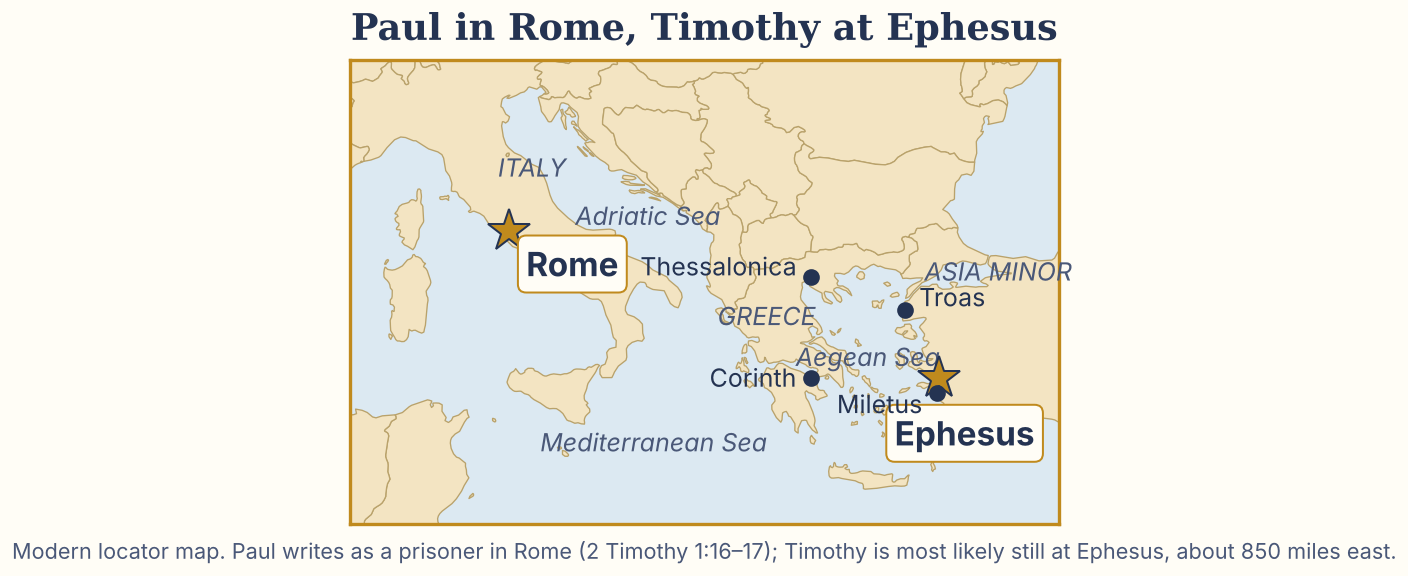
Modern locator map. Paul writes as a prisoner in Rome (star, left); Timothy is most likely still at Ephesus (star, right), about 850 miles to the east. Troas, where Paul left his cloak and books, and Miletus, where he left Trophimus sick, are also marked (2 Timothy 4:13, 20).
2 Timothy among the New Testament books
Matthew · Mark · Luke · John · Acts · Romans · 1 Corinthians · 2 Corinthians · Galatians · Ephesians · Philippians · Colossians · 1 Thessalonians · 2 Thessalonians · 1 Timothy · 2 Timothy · Titus · Philemon · Hebrews · James · 1 Peter · 2 Peter · 1 John · 2 John · 3 John · Jude · Revelation
2 Timothy is the sixteenth of the 27 books in the New Testament. It comes after 1 Timothy and before Titus.
When and where it was written
On the traditional reading, Paul was released after the imprisonment at the end of Acts, travelled again, wrote 1 Timothy and Titus, and was then arrested a second time and held in Rome. 2 Timothy comes from that second imprisonment, about AD 64–67, with AD 67 the date most often given. Acts does not narrate the release or the second arrest, so these dates come from piecing the letters together with early church tradition; the letter itself simply presents Paul as a prisoner near the end of his life. It is the last of the three Pastoral Letters and the last letter of Paul we have.
Meet the letter
Second Timothy is a dying man’s letter to the person he loved most in the world. Paul is in a Roman prison; the trial has gone badly; friends have deserted; winter is coming; and he knows his departure is near. He could have written about himself. Instead he writes about Timothy, about the gospel, and about the Lord who stood by him when no one else did (2 Timothy 4:17). The letter is full of affection, honest about suffering, and completely confident in Christ: “I know whom I have believed, and I am convinced that he is able to guard until that day what has been entrusted to me” (2 Timothy 1:12).
Three charges run through it. Guard the gospel: hold the pattern of sound words, keep the good deposit, do not be ashamed (2 Timothy 1:13–14). Pass it on: what you heard from me, entrust to faithful men who will be able to teach others also (2 Timothy 2:2). Preach the word: in season and out of season, with complete patience and teaching, because a time is coming when people will not endure sound teaching (2 Timothy 4:1–5). Around those charges Paul sets pictures of the faithful life, the soldier, the athlete, the farmer, the unashamed workman, the vessel for honorable use, the Lord’s servant who is kind to everyone, and he gives us the great statement about Scripture: all of it breathed out by God and profitable, making the man of God complete (2 Timothy 3:16–17).
Then the finish line. “I have fought the good fight, I have finished the race, I have kept the faith. Henceforth there is laid up for me the crown of righteousness” (2 Timothy 4:7–8). Paul wrote those words for Timothy, and for all who have loved His appearing. They are for us.
The central message Keep the faith and pass it on. Guard the gospel without shame, entrust it to faithful people who will teach others, continue in the God-breathed Scriptures, and preach the word with patience, because the Lord who stood by Paul will bring His servants safely into His heavenly kingdom (2 Timothy 1:13–14; 2:1–2; 3:14–17; 4:1–8, 18).
A verse to carry through the study 2 Timothy 1:12 BLB
Find your way
Main teachings
The promise of life
2 Timothy 1:1–2 Paul is an apostle “according to the promise of the life that is in Christ Jesus,” and he writes to his beloved child with grace, mercy and peace.
Fan into flame the gift of God
2 Timothy 1:3–7 Paul thanks God for Timothy’s sincere faith, inherited from Lois and Eunice, and urges him to stir up his gift, because God gave us a spirit of power and love and self-control, not of fear.
Do not be ashamed
2 Timothy 1:8–12 Share in suffering for the gospel by the power of God, who saved us and called us to a holy calling, not because of our works but because of His purpose and grace given in Christ before the ages began.
Guard the good deposit
2 Timothy 1:13–14 Follow the pattern of sound words in the faith and love that are in Christ Jesus, and guard the gospel by the Holy Spirit who dwells within us.
Desertion and loyalty
2 Timothy 1:15–18 All in Asia turned away, but Onesiphorus often refreshed Paul, was not ashamed of his chains, and searched Rome until he found him.
Entrust it to faithful men
2 Timothy 2:1–7 Be strengthened by grace, pass the gospel on to people who will teach others, and endure like a good soldier, a disciplined athlete and a hard-working farmer.
Remember Jesus Christ
2 Timothy 2:8–13 Paul is bound, but the word of God is not; he endures everything for the sake of the elect, because if we died with Him we will live with Him, and if we are faithless He remains faithful.
A worker who has no need to be ashamed
2 Timothy 2:14–19 Rightly handle the word of truth, avoid irreverent babble that spreads like gangrene, and rest on God’s firm foundation: the Lord knows those who are His.
A vessel for honorable use
2 Timothy 2:20–26 Cleanse yourself from what is dishonorable, flee youthful passions, pursue righteousness with those who call on the Lord from a pure heart, and correct opponents with gentleness, since God may grant them repentance.
The last days
2 Timothy 3:1–9 People will be lovers of self, lovers of money and lovers of pleasure rather than lovers of God, having the appearance of godliness but denying its power; avoid such people.
Follow a tested example
2 Timothy 3:10–13 Timothy has followed Paul’s teaching, conduct, faith and sufferings, and all who desire to live a godly life in Christ Jesus will be persecuted.
Continue in the Scriptures
2 Timothy 3:14–17 The sacred writings make a person wise for salvation through faith in Christ Jesus, and all Scripture is breathed out by God and profitable, so that the man of God may be complete, equipped for every good work.
Preach the word
2 Timothy 4:1–5 In the presence of God and of Christ Jesus the Judge, preach the word in season and out of season, reprove, rebuke and exhort with complete patience, do the work of an evangelist and fulfill your ministry.
I have finished the race
2 Timothy 4:6–8 Paul is being poured out as a drink offering; he has fought the good fight, finished the race and kept the faith, and the crown of righteousness awaits him and all who have loved Christ’s appearing.
Come before winter
2 Timothy 4:9–15 Demas has deserted him, Luke alone is with him, Mark is useful again, and Paul wants his cloak and especially the parchments.
The Lord stood by me
2 Timothy 4:16–18 At his first defense no one stood with him, but the Lord strengthened him so that the message was proclaimed, and the Lord will rescue him from every evil deed and bring him safely into His heavenly kingdom.
Greetings and grace
2 Timothy 4:19–22 Last greetings to Prisca and Aquila and the household of Onesiphorus, news of Erastus and Trophimus, and the final blessing: the Lord be with your spirit; grace be with you.
Praying through 2 Timothy
Second Timothy opens with prayer and closes with a blessing. Paul tells Timothy that he remembers him constantly in his prayers night and day (2 Timothy 1:3), prays mercy on the household of the friend who stood by him (2 Timothy 1:16–18), and, with the end in sight, praises the Lord who stood by him and will bring him safely home (2 Timothy 4:17–18). Below are the prayers in the letter, followed by a prayer built out of its own words. Pray it as it is, then pray it again in your own words, for yourself and for someone you are passing the faith on to.
The prayers in this letter
2 Timothy 1:3–5 — Thanksgiving and constant remembrance. Paul thanks God, whom he serves with a clear conscience, as he remembers Timothy constantly in his prayers night and day, longing to see him and remembering his sincere faith.
2 Timothy 1:16–18 — Mercy for a faithful friend. May the Lord grant mercy to the household of Onesiphorus, who often refreshed Paul and was not ashamed of his chains, and may he find mercy from the Lord on that day.
2 Timothy 4:16–18 — Praise to the Lord who stood by him. When everyone deserted him, the Lord stood by him and strengthened him; the Lord will rescue him from every evil deed and bring him safely into His heavenly kingdom. To Him be the glory forever and ever.
2 Timothy 4:22 — The closing blessing. The Lord be with your spirit. Grace be with you.
A prayer from 2 Timothy
Pray it with 2 Timothy 1:6–12; 2:1–2; 3:14–17; 4:7–8, 18
Father, I thank You for the people who passed the faith on to me, the Loises and Eunices and Pauls in my own life, and I ask You to fan into flame the gift You have given me. You did not give us a spirit of fear but of power and love and self-control. So take away my fear of what people think. Do not let me be ashamed of the testimony about our Lord, or of Your people when it costs something to stand with them. Let me share in suffering for the gospel by Your power, for You saved us and called us to a holy calling, not because of our works but because of Your own purpose and grace, given us in Christ Jesus before the ages began.
Lord Jesus, I know whom I have believed, and I am convinced that You are able to guard until that day what has been entrusted to me. Help me to hold fast the pattern of sound words, in the faith and love that are in You, and to guard the good deposit by the Holy Spirit who lives in me. Strengthen me by Your grace, and show me the faithful people to whom I should entrust what I have received, so that they will be able to teach others also.
Thank You for the Scriptures, which make us wise for salvation through faith in You. All of it is breathed out by God and profitable for teaching, for reproof, for correction and for training in righteousness. Make me complete, equipped for every good work. And when my own departure comes, let it be said of me that I fought the good fight, finished the race and kept the faith. You stood by Paul when everyone else left him; stand by me. Rescue me from every evil deed and bring me safely into Your heavenly kingdom. To You be the glory forever and ever. Amen.
Read 2 Timothy
Select a chapter to read it in the ESV in a reading window, right here on this page.
2 Timothy 1:1–18 2 Timothy 2:1–26 2 Timothy 3:1–17 2 Timothy 4:1–22
Find a topic
Where the letter speaks to a subject. The references are chapter and verse within 2 Timothy; tap any verse number in the study below to go to it.
Affection and friendship: 1:2–5,16–18; 4:9–13,19–21
Apostolic calling and gospel ministry: 1:1,8–12; 4:1–5
Books and continued learning: 4:13
Christ’s appearing and kingdom: 1:10; 4:1,8,18
Courage and freedom from shame: 1:6–8,12,16; 2:15
Death and eternal life: 1:1,10; 2:8–13; 4:6–8,18
Discernment and false teaching: 2:14–19,23; 3:1–9,13; 4:3–4
Faithfulness and endurance: 1:13–14; 2:1–13; 3:14; 4:5–8
Family faith and spiritual formation: 1:5; 3:14–15
Gentleness and repentance: 2:24–26
Grace and salvation: 1:9–10; 2:1,10; 3:15; 4:22
Holy living and useful service: 1:9; 2:19–22; 3:16–17
Last days and misplaced loves: 3:1–5; 4:3–4,10
Mentoring and teaching others: 1:13; 2:2; 3:10–15
Prayer and mercy: 1:3,16–18; 4:16
Resurrection: 1:10; 2:8,11–13,18
Scripture and sound teaching: 1:13–14; 2:15; 3:14–17; 4:1–4
Suffering and persecution: 1:8,12; 2:3,9–10; 3:10–12; 4:5,14–18
The Holy Spirit: 1:7,14
The Lord’s presence and protection: 1:12; 2:19; 4:17–18,22
A brief outline
1. Guard the gospel without shame (1:1–18)
1:1–2 Greeting and the promise of life
1:3–7 Gratitude and a renewed gift
1:8–12 Suffer for the gospel in God’s power
1:13–14 Hold the pattern and guard the deposit
1:15–18 Desertion and faithful friendship
2. Entrust the truth to faithful people (2:1–26)
2:1–7 Grace and the soldier athlete and farmer
2:8–13 Remember Christ and endure with him
2:14–19 Handle the word faithfully amid error
2:20–26 Be useful to the Master and correct gently
3. Continue in the Scriptures (3:1–17)
3:1–9 Corrupt loves and deceptive religion
3:10–13 Follow a tested example through suffering
3:14–17 Continue in the God breathed Scriptures
4. Fulfill your ministry and finish faithfully (4:1–22)
4:1–5 Preach the word with patience
4:6–8 Paul’s departure and hope of reward
4:9–15 Friends coworkers and personal requests
Study every verse
Begin with the Scripture, then read the study note, the key Greek words and the two passages to read alongside. Where a trusted teacher has something to add, his comment follows in a gold box, with a link to the source. Each chapter ends with three questions for reflection. The aim is to understand Paul’s meaning and put it into practice in dependence on Christ.
Chapter 1 1:1 1:2 1:3 1:4 1:5 1:6 1:7 1:8 1:9 1:10 1:11 1:12 1:13 1:14 1:15 1:16 1:17 1:18
Chapter 2 2:1 2:2 2:3 2:4 2:5 2:6 2:7 2:8 2:9 2:10 2:11 2:12 2:13 2:14 2:15 2:16 2:17 2:18 2:19 2:20 2:21 2:22 2:23 2:24 2:25 2:26
Chapter 3 3:1 3:2 3:3 3:4 3:5 3:6 3:7 3:8 3:9 3:10 3:11 3:12 3:13 3:14 3:15 3:16 3:17
Chapter 4 4:1 4:2 4:3 4:4 4:5 4:6 4:7 4:8 4:9 4:10 4:11 4:12 4:13 4:14 4:15 4:16 4:17 4:18 4:19 4:20 4:21 4:22
Chapter 1 — Guard the Gospel Without Shame
The opening chapter joins deep personal affection to a demanding call to courage. Paul remembers Timothy’s tears, his family’s sincere faith, and the gift God has given him. These memories are not sentimental decoration: they strengthen Timothy to serve when association with the gospel brings suffering. The foundation of courage is God’s gracious purpose, revealed in the Savior who has defeated death. Timothy must preserve the apostolic message through the indwelling Spirit, holding truth together with faith and love. The chapter closes with contrasting responses to Paul’s imprisonment: painful abandonment and Onesiphorus’s practical loyalty. Faithfulness becomes visible in whom we refuse to abandon.
Greek reference for this chapter: Bible Hub interlinear, 2 Timothy 1 (outside site)
Greeting and the promise of life
2 Timothy 1:1
Read the verse: 2 Timothy 1:1 BLB
Study Notes
Paul introduces himself through God’s calling rather than his circumstances. Though imprisonment and death loom over the letter, its opening word of hope is life in Christ. Apostolic authority serves that promise; it is not a claim to personal prestige. Timothy is being asked to preserve a message whose truth and future do not depend on Paul remaining alive or free.
Greek words apostolos – An authorized messenger; here Paul’s commission comes from God, not self-appointment; epangelia – A promise or pledged assurance, here concerning life in Christ.
Read alongside
Titus 1:1–2 BLB — Paul’s commission is joined to the hope of eternal life promised by God.
John 11:25–26 BLB — Jesus locates resurrection and enduring life in himself.
2 Timothy 1:2
Read the verse: 2 Timothy 1:2 BLB
Study Notes
Paul’s authority is expressed within a relationship of affection. Calling Timothy his beloved child describes spiritual kinship and shared ministry, not biological parenthood. Grace, mercy, and peace are more than polite greetings: they name what this pressured servant needs from God. Before Timothy hears what he must do, he is reminded of the divine generosity on which his service depends.
Greek words charis – God’s freely given favor and help; eleos – Mercy: compassionate help for those in need.
Read alongside
1 Timothy 1:2 BLB — The earlier letter also addresses Timothy as a spiritual child and invokes grace, mercy, and peace.
Philippians 2:22 BLB — Timothy’s tested service alongside Paul resembles a son working with his father.
Gratitude and a renewed gift
2 Timothy 1:3
Read the verse: 2 Timothy 1:3 BLB
Study Notes
Paul’s gratitude and prayers reveal the unseen work sustaining his relationship with Timothy. His reference to ancestors places his service within the story of Israel’s God, rather than presenting Christianity as devotion to another deity. A clear conscience means sincere accountability, not a claim to a sinless past. Repeated prayer keeps Timothy’s needs present even when Paul cannot be physically beside him.
Greek words latreuō – To render religious service or worship to God; syneidēsis – Conscience: awareness that evaluates one’s conduct.
Teacher’s comment — J. Vernon McGee (paraphrase, source)
McGee highlights Paul’s prayerful affection for Timothy and the faith of Timothy’s mother and grandmother. He explains the fear in verse 7 as cowardice and the sound mind as discipline. Standing for Christ requires courage. Paul’s imprisonment does not overturn Christ’s authority; Paul regards himself as Christ’s prisoner even under Roman custody.
Read alongside
Romans 1:9–10 BLB — Paul’s service to God includes persistent remembrance of others in prayer.
Acts 24:14–16 BLB — Paul describes continuity with Israel’s hope and his concern for a clear conscience.
2 Timothy 1:4
Read the verse: 2 Timothy 1:4 BLB
Study Notes
Timothy’s tears are remembered with tenderness, not treated as evidence of weak faith. The letter does not identify the occasion, so a particular farewell should not be assumed. Paul’s desire for reunion shows that courageous Christian service can coexist with grief, affection, and loneliness. Faithfulness is not emotional detachment; God often gives joy through the presence and encouragement of other people.
Greek words epipotheō – To long deeply for someone or something; chara – Joy, here the anticipated gladness of reunion.
Read alongside
Acts 20:36–38 BLB — Tears and longing accompany separation among believers who love one another.
1 Thessalonians 2:17–20 BLB — Paul’s longing for absent believers is closely linked to his joy in them.
2 Timothy 1:5
Read the verse: 2 Timothy 1:5 BLB
Study Notes
Lois and Eunice stand behind Timothy’s ministry as named examples of sincere faith. Paul honors the influence of a grandmother and mother without implying that faith is inherited automatically. He is persuaded that Timothy himself shares their trust. The verse invites gratitude for ordinary, sustained spiritual formation at home while reminding each generation that it must personally embrace the truth it receives.
Greek words anypokritos – Sincere or unhypocritical; faith that is not a performance; enoikeō – To dwell within; faith is portrayed as an abiding reality.
Read alongside
Acts 16:1–2 BLB — Timothy’s believing Jewish mother and good reputation provide background to his ministry.
2 Timothy 3:14–15 BLB — His knowledge of the sacred writings reaches back to childhood.
2 Timothy 1:6
Read the verse: 2 Timothy 1:6 BLB
Study Notes
God’s gift does not remove Timothy’s responsibility to cultivate and use it. The fire image calls for renewed attentiveness, but it does not prove that Timothy has abandoned ministry or lost the gift. Paul connects the gift with laying on hands, a concrete moment of commissioning. Encouragement here takes the form of reminding Timothy that God has already equipped him for the work ahead.
Greek words anazōpyreō – To rekindle or keep a fire burning strongly; a picture of active care for the gift; charisma – A graciously given gift, here equipment for Timothy’s ministry.
Teacher’s comment — Charles H. Spurgeon (paraphrase, source)
Spurgeon applies Paul’s command beyond Timothy’s particular commission: every Christian has something entrusted to him or her for Christ’s service. Gifts of speaking, writing, influence, or practical resources should not remain unused. The question is not whether one possesses a public ministry, but whether one is actively employing the abilities God has supplied for the good of others.
Teacher’s comment — Francis Chan (paraphrase, source)
Chan places Paul’s encouragement within the reality of imprisonment and approaching death. Timothy must not let fear silence the gift God has entrusted to him. Chan applies this personally: believers may feel insecure about speaking, but God supplies power, love, and self-control. Faithful courage grows from confidence in God rather than confidence that others will welcome the message.
Read alongside
1 Timothy 4:14 BLB — Timothy is told not to neglect the gift associated with prophetic recognition and the elders’ laying on of hands.
1 Peter 4:10–11 BLB — God’s gifts are to be actively used in serving others with his supplied strength.
2 Timothy 1:7
Read the verse: 2 Timothy 1:7 BLB
Study Notes
God equips his people for faithful service with power joined to love and disciplined judgment. “Spirit” may refer directly to the Holy Spirit or to the disposition he produces; interpreters differ. Either reading opposes cowardly retreat, not emotional vulnerability. This is encouragement to trust God amid fear, not a promise that believers never experience anxiety or a reason to shame someone who does.
Greek words deilia – Cowardice or shrinking timidity, especially when faithfulness is costly; sōphronismos – Self-discipline or sound judgment expressed in controlled conduct.
Teacher’s comment — John Piper (paraphrase, source)
Piper understands the gift in this passage as including courage to speak about Christ and suffer for the gospel. That courage must be powerful, loving, and self-controlled, not merely aggressive. Timothy must keep nurturing it. Yet his effort is not independent of God: even courageous obedience depends decisively on the divine power Paul names at the end of verse 8.
Read alongside
Romans 8:15 BLB — God’s Spirit leads believers away from enslaving fear into filial trust.
Galatians 5:22–23 BLB — Love and self-control belong to the Spirit’s fruit.
Suffer for the gospel in God’s power
2 Timothy 1:8
Read the verse: 2 Timothy 1:8 BLB
Study Notes
The courage of verse 7 has a specific purpose: open loyalty to Christ and to his imprisoned messenger. Paul calls himself the Lord’s prisoner, interpreting his chains through allegiance to Jesus rather than merely Roman power. Timothy is not told to seek suffering for its own sake. He is urged to accept the cost of gospel faithfulness through strength supplied by God.
Greek words epaischynomai – To feel ashamed or shrink from association with someone; synkakopatheō – To share hardship with another in a common cause.
Read alongside
Romans 1:16 BLB — Paul refuses shame because the gospel is God’s saving power.
1 Peter 4:16 BLB — Suffering for belonging to Christ is no cause for disgrace.
2 Timothy 1:9
Read the verse: 2 Timothy 1:9 BLB
Study Notes
The ground of courageous ministry is the God who saves and calls. Paul explicitly excludes human achievement as the basis of salvation, locating it instead in divine purpose and grace in Christ. The calling is holy, so grace does not make conduct irrelevant. What precedes our works in God’s purpose should shape our works in daily life, especially when obedience becomes costly.
Greek words prothesis – Purpose or intention; here God’s own gracious saving plan; klēsis – A call or summons, here into a life set apart for God.
Teacher’s comment — John Piper (paraphrase, source)
Piper connects Timothy’s present courage with God’s grace before the world’s beginning. Salvation, calling, and perseverance do not originate in Timothy’s achievements. Christ’s death and resurrection reveal God’s gracious purpose. Remembering that purpose is meant to strengthen active faithfulness: Timothy must continue serving, while recognizing that the grace enabling his service began with God rather than himself.
Read alongside
Ephesians 2:8–10 BLB — Salvation is God’s gift rather than the reward of works, yet it leads into good works.
Titus 3:4–7 BLB — God saves according to mercy and grace, not because of human righteousness.
2 Timothy 1:10
Read the verse: 2 Timothy 1:10 BLB
Study Notes
God’s eternal gracious purpose has become visible in Jesus Christ. Death has been decisively defeated, though believers still die while awaiting resurrection and its final removal. The gospel announces life that death cannot finally destroy. Paul can therefore face execution without treating death as the last authority over his future; Timothy’s ministry rests on the same resurrection hope.
Greek words katargeō – To render ineffective or abolish; here death’s decisive defeat through Christ; aphtharsia – Incorruptibility: life no longer subject to decay.
Read alongside
Hebrews 2:14–15 BLB — Through death Jesus breaks death’s enslaving power and frees those held by fear.
1 Corinthians 15:20–26 BLB — Christ’s resurrection guarantees the final defeat of death.
2 Timothy 1:11
Read the verse: 2 Timothy 1:11 BLB
Study Notes
Paul describes three complementary aspects of his service: announcing the good news, representing Christ with apostolic authority, and teaching its meaning. The focus is appointment to a message, not accumulation of titles. Because the gospel belongs to God, Paul must transmit it faithfully. Timothy’s own teaching likewise requires both clear proclamation and patient explanation rather than originality that alters the message.
Greek words kēryx – A herald who publicly announces a message received from another; didaskalos – A teacher who explains and instructs.
Read alongside
1 Timothy 2:7 BLB — Paul also describes his appointment as herald, apostle, and teacher.
Acts 26:16–18 BLB — Paul recounts Christ’s commission to bear witness and lead others toward light.
2 Timothy 1:12
Read the verse: 2 Timothy 1:12 BLB
Study Notes
Paul’s confidence rests in the person he trusts, not in freedom from suffering. The “deposit” can mean what Paul entrusted to God, such as his life and future, or the gospel entrusted to Paul; the Greek permits both. In either case, God’s preserving ability reaches to the final day. The ambiguity should deepen attention to God’s faithfulness rather than support an overconfident claim about the phrase.
Greek words parathēkē – A deposit or trust committed to another’s care; peithō – To persuade or convince; Paul expresses settled confidence in God’s ability.
Teacher’s comment — Charles H. Spurgeon (paraphrase, source)
Spurgeon reads Paul’s confidence as personal trust in Christ rather than confidence in Paul’s ability to preserve himself. He understands the entrusted deposit broadly: Paul’s salvation, body, reputation, and life’s work rest in the Savior’s care. Such assurance does not deny suffering. It enables a believer to endure loss while leaving final vindication and resurrection to Christ.
Teacher’s comment — D. L. Moody (paraphrase, source)
Moody uses Paul’s confidence to encourage people who fear they cannot remain faithful. Their security rests in God’s ability to keep those entrusted to him, rather than in their own strength. Moody directs anxious believers away from self-reliance toward the Shepherd’s care. Trust becomes a daily dependence on God, whose power is sufficient to complete the work he has begun.
Read alongside
1 Peter 4:19 BLB — Suffering believers entrust themselves to their faithful Creator while doing good.
1 Timothy 6:20 BLB — Timothy is charged to guard what has been entrusted to him.
Hold the pattern and guard the deposit
2 Timothy 1:13
Read the verse: 2 Timothy 1:13 BLB
Study Notes
Timothy receives a recognizable pattern of teaching to retain, rather than permission to reshape the gospel according to preference. Yet the manner of holding it matters: faith and love in Christ belong to the command itself. Accuracy without love would distort the life the message produces. Loving concern without fidelity to the message would fail the people Timothy is called to serve.
Greek words hypotypōsis – A pattern or model to be followed; hygiainō – To be healthy or sound; applied here to teaching that nourishes faith.
Teacher’s comment — John MacArthur (paraphrase, source)
MacArthur links guarding the gospel in chapter 1 with handling it accurately in chapter 2 and proclaiming it in chapter 4. These responsibilities belong together. The minister protects the content from corruption while freely communicating it to others. Faithfulness therefore requires receiving God’s truth, understanding it carefully, and then making it known rather than merely storing it.
Read alongside
Titus 1:9 BLB — An elder must hold firmly to the trustworthy message in order to teach and correct.
Ephesians 4:15 BLB — Truth and love belong together in Christian growth.
2 Timothy 1:14
Read the verse: 2 Timothy 1:14 BLB
Study Notes
Here the good deposit clearly concerns the gospel entrusted to Timothy. Guarding it involves preserving, teaching, and living its truth, not hiding it from others. Paul immediately names the means: the Holy Spirit who dwells in believers. Responsibility and dependence therefore belong together. Timothy must act with vigilance, while recognizing that the message’s preservation is not accomplished by human resolve alone.
Greek words phylassō – To guard, protect, or keep something entrusted; enoikeō – To dwell within; the Holy Spirit’s presence among and in believers.
Read alongside
1 Timothy 6:20–21 BLB — Guarding the entrusted message includes resisting misleading claims to knowledge.
Romans 8:9–11 BLB — The Spirit dwells in believers as the presence and power of God.
Desertion and faithful friendship
2 Timothy 1:15
Read the verse: 2 Timothy 1:15 BLB
Study Notes
“Asia” refers to the Roman province in western Asia Minor, not the modern continent. Paul describes widespread desertion among people known to him; the statement need not mean every Christian in the province abandoned the faith. Phygelus and Hermogenes illustrate the painful reality, but their motives are not supplied. The contrast challenges Timothy to choose loyalty when association with a suffering servant becomes costly.
Greek words apostrephō – To turn away from or abandon someone.
Read alongside
2 Timothy 4:16 BLB — Paul later describes abandonment at his first defense.
Mark 14:50 BLB — Jesus also experienced the flight of companions during danger.
2 Timothy 1:16
Read the verse: 2 Timothy 1:16 BLB
Study Notes
Onesiphorus provides a living answer to the command not to be ashamed. He repeatedly brings Paul relief and refuses to treat his chains as a reason to withdraw. Paul responds by asking mercy for his household. Gospel loyalty is measured here in practical, repeated kindness. Supporting a burdened believer may require time, inconvenience, or reputational risk rather than an impressive public role.
Greek words anapsychō – To refresh or bring relief, here through personal support; halysis – A chain; the visible condition of Paul’s imprisonment.
Read alongside
Philemon 7 BLB — Practical love can refresh the hearts of fellow believers.
Hebrews 13:3 BLB — Believers are urged to remember prisoners with active identification and compassion.
2 Timothy 1:17
Read the verse: 2 Timothy 1:17 BLB
Study Notes
Onesiphorus’s encouragement was intentional. Reaching Rome did not automatically bring him to Paul; he had to search and persist until he found him. The verse does not describe the prison’s precise location or the obstacles, so those details should not be invented. Its force is straightforward: love takes initiative, especially when a suffering person is difficult to reach or easily forgotten.
Greek words spoudaiōs – Diligently or earnestly, with purposeful effort; zēteō – To seek or search for someone.
Read alongside
Matthew 25:36 BLB — Jesus identifies visiting the imprisoned as an expression of care.
Hebrews 6:10 BLB — God does not overlook the love shown in service to his people.
2 Timothy 1:18
Read the verse: 2 Timothy 1:18 BLB
Study Notes
Paul asks that Onesiphorus receive mercy on the coming day and recalls the breadth of his service in Ephesus. His kindness is known to Timothy, making him a concrete example to imitate. Whether Onesiphorus was already dead is debated and cannot be established from this verse alone. The emphasis is not speculation about his status but gratitude for enduring, costly service.
Greek words eleos – Mercy or compassionate favor, here sought at the final judgment; diakoneō – To serve or attend to another’s needs.
Read alongside
Matthew 5:7 BLB — Mercy shown to others corresponds to the hope of receiving mercy.
Hebrews 6:10 BLB — Service to God’s people is remembered by God.
Questions for reflection
- Who has helped nurture your faith, and how could you encourage someone else in that same personal way?
- Where are fear of rejection or embarrassment making it harder for you to speak or act faithfully?
- How can you guard Christian truth while also showing the faith, love, and practical loyalty this chapter commends?
Chapter 2 — Endure, Teach, and Serve with Gentleness
Timothy’s ministry must continue beyond his own lifetime, so Paul tells him to strengthen reliable teachers who can teach others. The soldier, athlete, and farmer illustrate focused, disciplined, patient service, while Jesus’ resurrection supplies its hope. Paul’s imprisonment cannot imprison God’s message. A trustworthy saying combines promises of life and reigning with a serious warning against denying Christ. The second half contrasts destructive disputes with careful handling of truth and a life prepared for the Master’s use. Timothy must pursue holiness in company with other believers. Even when correcting opponents, his aim is their repentance and freedom, not personal victory in an argument.
Greek reference for this chapter: Bible Hub interlinear, 2 Timothy 2 (outside site)
Grace and the soldier athlete and farmer
2 Timothy 2:1
Read the verse: 2 Timothy 2:1 BLB
Study Notes
Paul returns to Timothy personally after the examples of desertion and loyalty. The command is not simply to become tougher through willpower. Timothy must draw strength from the grace found in Christ Jesus. Grace that saves also sustains obedience. This dependence prepares him for the demanding instructions that follow, keeping disciplined service from becoming either self-reliance or passive waiting.
Greek words endynamoō – To strengthen or empower; Timothy is to receive strength in Christ; charis – Grace: God’s freely supplied favor and help.
Teacher’s comment — Voddie Baucham (paraphrase, source)
Baucham emphasizes that Timothy needs strength beyond his own, supplied by Christ’s grace. That grace does not make the content of the gospel unimportant. Timothy must preserve the apostolic message and entrust it to people who will teach others. Baucham sees this pattern across the letter: the church’s responsibility is both to hold the gospel faithfully and to transmit it faithfully.
Teacher’s comment — J. Vernon McGee (paraphrase, source)
McGee organizes chapter 2 around pictures of active service. Timothy is a son who must grow strong and teach others to pass the gospel onward. The soldier shares hardship and keeps the coming life in view. The athlete and farmer continue Paul’s portrayal of Christian service as purposeful work, rather than passive belief.
Read alongside
Ephesians 6:10 BLB — Believers receive strength in the Lord and his might.
2 Corinthians 12:9 BLB — Christ’s grace supplies power in human weakness.
2 Timothy 2:2
Read the verse: 2 Timothy 2:2 BLB
Study Notes
The gospel must travel beyond one gifted leader. Paul, Timothy, faithful people, and those they will teach form a chain of transmission. The message was heard publicly, not reserved as secret knowledge for an elite. Reliability and ability to teach both matter. A healthy ministry invests in others who can carry the truth onward rather than making the community permanently dependent on its present teacher.
Greek words paratithēmi – To entrust something to another’s responsible care; pistos – Faithful or trustworthy; dependable in preserving and teaching the message.
Read alongside
Titus 1:9 BLB — Faithful leadership requires holding and communicating trustworthy teaching.
Psalm 78:5–7 BLB — God’s truth is to be passed on so a coming generation can trust him.
2 Timothy 2:3
Read the verse: 2 Timothy 2:3 BLB
Study Notes
The soldier image stresses allegiance, endurance, and shared hardship. It does not authorize aggression against people or turn the church’s mission into physical warfare. Timothy serves Jesus Christ, whose way defines the character of his service. The call to suffer together also counters isolation: difficult ministry belongs within a fellowship of servants, not a private contest to prove one’s toughness.
Greek words synkakopatheō – To share hardship alongside others; stratiōtēs – A soldier; here a figure for disciplined allegiance to Christ.
Teacher’s comment — Voddie Baucham (paraphrase, source)
Baucham reads suffering as a recurring feature of Paul’s charge, not evidence that the mission has failed. Paul faces death while urging Timothy to continue proclaiming the gospel. His description of being poured out presents his approaching death as worship. Baucham’s application is that God’s power does not only deliver believers from suffering; it also enables them to endure it faithfully.
Read alongside
2 Timothy 1:8 BLB — Timothy has already been invited to share gospel hardship through God’s power.
Philippians 2:25 BLB — Epaphroditus is described as a fellow soldier in gospel service.
2 Timothy 2:4
Read the verse: 2 Timothy 2:4 BLB
Study Notes
The problem is entanglement, not ordinary responsibilities as such. Paul’s image asks whether competing concerns keep Timothy from fulfilling his commission and pleasing Christ. It should not be stretched into a ban on employment, family care, or civic life. Faithful focus means arranging legitimate activities under the Lord’s call and recognizing when even acceptable pursuits have become controlling distractions.
Greek words emplekō – To become entangled or caught up in something; areskō – To please; here the aim is the one who enlisted the soldier.
Read alongside
1 Corinthians 7:32–35 BLB — Paul values devotion to the Lord without distracting concerns.
1 Thessalonians 2:4 BLB — God’s approval, rather than human applause, governs faithful ministry.
2 Timothy 2:5
Read the verse: 2 Timothy 2:5 BLB
Study Notes
The athlete cannot claim the prize merely by wanting to win or exerting impressive effort. Competition must follow the required rules. In the ministry context, faithfulness includes the way the work is done, not merely visible results. Paul does not identify a particular athletic regulation, so elaborate reconstructions are unnecessary. The principle warns against treating effectiveness as permission to disregard Christ’s teaching.
Greek words athleō – To compete in an athletic contest; nomimōs – Lawfully or according to the rules.
Read alongside
1 Corinthians 9:24–27 BLB — Athletic discipline illustrates purposeful and self-controlled Christian service.
2 Timothy 4:7–8 BLB — Paul later connects finishing the race with the Lord’s promised crown.
2 Timothy 2:6
Read the verse: 2 Timothy 2:6 BLB
Study Notes
Farming adds patient, demanding labor to the soldier’s focus and the athlete’s discipline. The worker should share in the harvest, though Paul does not define the fruit here as only material support or only spiritual reward. Ministry may involve long seasons before results appear. This picture encourages sustained effort and hope while resisting the expectation that worthwhile work always produces immediate visible success.
Greek words kopiaō – To labor strenuously, often to the point of weariness; geōrgos – A farmer or cultivator of the land.
Read alongside
1 Corinthians 9:7–11 BLB — The farmer’s share in a crop helps explain a worker’s rightful support.
James 5:7–8 BLB — The farmer’s patient waiting illustrates perseverance until the Lord’s coming.
2 Timothy 2:7
Read the verse: 2 Timothy 2:7 BLB
Study Notes
Paul expects Timothy to think deeply about the illustrations rather than receive every implication already explained. At the same time, understanding is the Lord’s gift. Careful thought and dependence on God are partners, not rivals. The promise is tied to grasping the instruction in view; it is not a guarantee of instant knowledge about every subject or freedom from the need for study.
Greek words noeō – To consider carefully or grasp with the mind; synesis – Understanding: the ability to perceive how things fit together.
Teacher’s comment — John Piper (paraphrase, source)
Piper presents careful thinking and dependence on God as partners. Understanding Paul’s words requires attention to how words and sentences fit together; abandoning thought does not make a person more spiritual. At the same time, understanding is God’s gift, so thoughtful study should produce humility rather than boasting. A renewed mind can deepen love and zeal instead of replacing them.
Read alongside
Proverbs 2:1–6 BLB — Earnest pursuit of wisdom and the Lord’s gift of understanding belong together.
James 1:5 BLB — Those who lack wisdom are invited to ask God for it.
Remember Christ and endure with him
2 Timothy 2:8
Read the verse: 2 Timothy 2:8 BLB
Study Notes
Timothy must keep Jesus himself, not merely ministry technique, at the center. His descent from David connects him to God’s royal promises, while his resurrection grounds the hope that suffering is not defeat. “My gospel” means the message Paul has been commissioned to announce, not a private version of Christianity. Remembering the risen Messiah supplies both the content and courage of faithful service.
Greek words mnēmoneuō – To remember or keep in mind; egeirō – To raise; here Jesus has been raised from the dead and lives.
Read alongside
Romans 1:3–4 BLB — The gospel identifies Jesus as David’s descendant and the risen Son of God.
1 Corinthians 15:3–8 BLB — Christ’s death and resurrection stand at the center of the apostolic message.
2 Timothy 2:9
Read the verse: 2 Timothy 2:9 BLB
Study Notes
Paul is treated as a criminal because of the message he preaches, yet imprisonment cannot stop God from making that message effective. This is confidence in God’s freedom, not a claim that persecution never disrupts ministry or harms believers. The messenger can be confined while the gospel continues through his witness, other believers, and paths he cannot control.
Greek words kakourgos – A criminal or evildoer; the status imposed on Paul, not his moral identity; deō – To bind or imprison; Paul contrasts his chains with the word’s freedom.
Read alongside
Philippians 1:12–14 BLB — Paul’s imprisonment unexpectedly advances the gospel and emboldens others.
Acts 28:30–31 BLB — Acts closes with Paul proclaiming God’s kingdom despite confinement.
2 Timothy 2:10
Read the verse: 2 Timothy 2:10 BLB
Study Notes
Paul’s confidence in God’s purpose fuels evangelistic effort rather than making it unnecessary. He endures so that others may obtain salvation in Christ together with eternal glory. The verse places divine election and responsible ministry side by side without explaining every theological question about their relationship. Paul’s suffering is not an additional atonement; it is the cost of carrying Christ’s saving message to others.
Greek words hypomenō – To endure or remain steadfast under pressure; eklektos – Chosen; here describing the people whose salvation Paul seeks through his ministry.
Read alongside
Colossians 1:24–29 BLB — Paul endures costly labor so others may be brought to maturity in Christ.
Romans 8:17–18 BLB — Present suffering is set alongside the glory to be revealed.
2 Timothy 2:11
Read the verse: 2 Timothy 2:11 BLB
Study Notes
The trustworthy saying begins by connecting death with Christ to life with him. Romans 6 helps explain this as union with Christ, while the surrounding discussion of suffering also allows the cost of discipleship, even death, to remain in view. Paul does not celebrate suffering as an achievement. The hope comes from belonging to the risen Lord whose life his people will share.
Greek words synapothnēskō – To die together with another; here sharing Christ’s death; syzaō – To live together with another; here life with Christ.
Read alongside
Romans 6:4–8 BLB — Union with Christ’s death is joined to sharing his resurrection life.
Colossians 3:3–4 BLB — Believers’ life is bound to Christ and will be revealed with him.
2 Timothy 2:12
Read the verse: 2 Timothy 2:12 BLB
Study Notes
The promise of reigning with Christ gives endurance a future horizon, while the warning against denial prevents casual presumption. Both clauses must be heard. The verse should neither make every fearful lapse an irreversible verdict nor explain away the seriousness of abandoning Christ. Peter’s restoration elsewhere shows the importance of repentance. Paul’s purpose is to strengthen steadfast allegiance, not encourage confidence detached from faithfulness.
Greek words hypomenō – To endure faithfully through difficulty; arneomai – To deny, disown, or refuse to acknowledge someone.
Read alongside
Romans 8:17 BLB — Sharing Christ’s suffering is joined to sharing his glory.
Matthew 10:32–33 BLB — Jesus gives both a promise for acknowledging him and a warning against denying him.
2 Timothy 2:13
Read the verse: 2 Timothy 2:13 BLB
Study Notes
Christ’s faithfulness is not as unstable as ours. Some read this primarily as reassurance that his promises hold through human weakness; others stress that he also remains true to his warnings. The preceding warning must not be erased. The firm conclusion is that Christ cannot contradict his own character. This gives struggling believers reason to return to him, not permission to dismiss persistent unbelief.
Greek words apisteō – To be unfaithful or unbelieving; the precise emphasis is debated here; pistos – Faithful, reliable, and true to one’s character and commitments.
Read alongside
Romans 3:3–4 BLB — Human unfaithfulness does not overturn God’s faithfulness or truth.
1 Thessalonians 5:23–24 BLB — God’s faithfulness grounds confidence in his sanctifying and preserving work.
Handle the word faithfully amid error
2 Timothy 2:14
Read the verse: 2 Timothy 2:14 BLB
Study Notes
Timothy must keep bringing the central truths before people while refusing arguments that damage their hearers. Paul is not opposing careful definitions or serious theological reasoning. The target is word-fighting that produces no benefit and undermines faith. Because teaching occurs before God and affects others, the question is not simply whether an argument can be won but whether it serves truth and builds people up.
Greek words logomacheō – To fight about words or engage in destructive verbal disputes; katastrophē – Ruin or overturning; here the harmful effect on listeners.
Read alongside
1 Timothy 6:4–5 BLB — Unhealthy disputes about words breed conflict rather than spiritual health.
Titus 3:9 BLB — Fruitless controversies are to be avoided because they do not benefit people.
2 Timothy 2:15
Read the verse: 2 Timothy 2:15 BLB
Study Notes
Timothy’s audience of final accountability is God. The worker who need not be ashamed handles the message accurately rather than bending it to controversy or preference. The Greek image of a straight cut emphasizes correct handling; it does not by itself establish a particular system for dividing biblical history. Diligent interpretation includes attention to context, honest explanation, and obedience to what the passage actually says.
Greek words spoudazō – To be diligent or make every effort; orthotomeō – To handle correctly, pictured as cutting a straight course; here accurate treatment of the truth.
Read alongside
Titus 2:7–8 BLB — A teacher should model integrity and sound speech that can withstand criticism.
Nehemiah 8:8 BLB — Faithful instruction helps people understand the meaning of Scripture.
2 Timothy 2:16
Read the verse: 2 Timothy 2:16 BLB
Study Notes
Empty religious chatter is not harmless simply because it sounds intellectual or spiritual. Paul links it to increasing ungodliness: ideas and habits of speech shape the people who accept them. Avoidance means refusing to nourish this teaching, not abandoning the people caught in it. Later commands to teach opponents gently show that rejecting destructive discourse can coexist with patient concern for those influenced by it.
Greek words kenophōnia – Empty or hollow speech that lacks genuine spiritual substance; asebeia – Ungodliness: disregard for God expressed in outlook and conduct.
From Hollis’s own writing — Follow Him in Thought and Word (How to Think, Talk, Text, and Tweet God’s Way) (source)
Hollis applies Paul’s warning about destructive talk to everyday speaking, writing, texting, and social media. Before communicating, believers should ask whether their words honor God and express love for others. Reducing empty or harmful speech creates room for prayer and reflection on Scripture. The point is not silence for its own sake, but communication placed under God’s direction.
Read alongside
1 Timothy 6:20 BLB — Timothy is to turn away from empty, irreverent talk.
Titus 1:10–11 BLB — Empty talk and deception can disrupt whole households and require correction.
2 Timothy 2:17
Read the verse: 2 Timothy 2:17 BLB
Study Notes
The medical image emphasizes the spreading damage of false teaching. Naming Hymenaeus and Philetus makes the warning concrete rather than treating all disagreement as equally dangerous. The concern is protection of the community, not permission for careless labeling or contempt. Responsible correction identifies the actual error and its consequences, as the next verse does, while the chapter’s conclusion still requires gentleness toward opponents.
Greek words gangraina – Gangrene: an image of destructive spread in the community; nomē – Spread or feeding; here the expanding reach of destructive teaching.
Read alongside
1 Timothy 1:19–20 BLB — Hymenaeus is already associated with a damaging rejection of faith and conscience.
Galatians 5:9 BLB — A small amount of leaven illustrates the spreading influence of corrupt teaching.
2 Timothy 2:18
Read the verse: 2 Timothy 2:18 BLB
Study Notes
The named teachers claim that the resurrection has already occurred, overturning some people’s faith. Their precise explanation is not preserved, so a complete reconstruction would be speculative. The error removes or distorts the future bodily hope central to apostolic preaching. Present spiritual life in Christ is real, but it must not replace the promise that God will finally raise the dead.
Greek words astocheō – To miss the mark or deviate from a true course; anastasis – Resurrection; here the promised event falsely claimed to be already past.
Read alongside
1 Corinthians 15:12–23 BLB — Paul defends the future resurrection of the dead as inseparable from the gospel.
2 Thessalonians 2:1–3 BLB — Claims that the expected final events have already arrived can unsettle believers.
2 Timothy 2:19
Read the verse: 2 Timothy 2:19 BLB
Study Notes
False teaching shakes people, but it does not overturn God’s sure foundation. The two inscriptions hold assurance and responsibility together: God recognizes his own, and those who invoke his name must turn from evil. The first echoes Numbers 16:5; the second recalls the separation commanded in that rebellion. Divine security is therefore not an excuse for moral indifference or partnership with destructive teaching.
Greek words themelios – A foundation, here emphasizing the firmness of what God establishes; sphragis – A seal or identifying inscription that marks authenticity and belonging.
Read alongside
Numbers 16:5 BLB — The first inscription echoes God’s recognition of those who belong to him during Korah’s rebellion.
Numbers 16:26 BLB — The second inscription recalls the call to separate from the rebellion’s wickedness, though it is not an exact quotation.
Be useful to the Master and correct gently
2 Timothy 2:20
Read the verse: 2 Timothy 2:20 BLB
Study Notes
A large household contains utensils of different materials and uses. Paul uses that familiar contrast to prepare for a call to cleansing and useful service. The point is not that wealthy or impressive people are more valuable to God. Nor should the illustration be turned into an unchangeable classification of individuals, since the next verse explicitly calls people to become fit for honorable use.
Greek words skeuos – A vessel or household utensil; here a metaphor for people and their usefulness; timē – Honor or honorable use, contrasted with dishonorable use.
Read alongside
Romans 9:21 BLB — Household vessels also illustrate differing uses in Paul’s discussion of divine purpose.
1 Timothy 3:15 BLB — The community of believers is described as God’s household.
2 Timothy 2:21
Read the verse: 2 Timothy 2:21 BLB
Study Notes
The household illustration becomes a personal summons. Separation from dishonorable influences and practices prepares a person for the Master’s use. In context, this includes rejecting corrupt teaching and the conduct it produces. Cleansing is not a way to purchase salvation; it describes the practical holiness appropriate to someone who belongs to Christ. God’s servants should seek usefulness and readiness rather than admiration or prominence.
Greek words ekkathairō – To cleanse thoroughly; here separation from defiling error and conduct; euchrēstos – Useful or serviceable, here to the Master.
Read alongside
2 Corinthians 7:1 BLB — Believers are called to cleanse themselves from defilement and pursue holiness.
Titus 3:1 BLB — God’s people should be ready for every good work.
2 Timothy 2:22
Read the verse: 2 Timothy 2:22 BLB
Study Notes
Turning from sin must be joined to pursuing a better way of life. Youthful desires are not limited to sexual temptation; the context also makes impatience, self-assertion, and love of argument relevant possibilities. Paul gives a communal direction: pursue these virtues with others who sincerely call on the Lord. Holiness grows through positive habits and faithful companionship, not merely private avoidance.
Greek words epithymia – A strong desire; here desires that pull Timothy away from faithful conduct; diōkō – To pursue earnestly; the positive counterpart to fleeing.
Read alongside
1 Timothy 6:11 BLB — Timothy is similarly told to flee destructive desires and pursue righteousness, faith, and love.
Hebrews 12:14 BLB — Believers are to pursue peace and holiness.
2 Timothy 2:23
Read the verse: 2 Timothy 2:23 BLB
Study Notes
Paul tells Timothy to decline a kind of discussion, not to belittle people who ask sincere questions. The disputes in view are foolish and undisciplined because they generate fights rather than understanding. A teacher needs discernment about which conversations deserve sustained engagement. Refusing an argument can protect time, relationships, and the congregation, while leaving room for patient instruction of someone genuinely seeking truth.
Greek words zētēsis – An inquiry or dispute; here speculative controversies that provoke conflict; apaideutos – Uninstructed or undisciplined, describing the character of these disputes.
Read alongside
Titus 3:9 BLB — Timothy’s fellow worker receives a similar instruction to avoid foolish controversies.
Proverbs 20:3 BLB — Refusing a quarrel can be an expression of honor and wisdom.
2 Timothy 2:24
Read the verse: 2 Timothy 2:24 BLB
Study Notes
The Lord’s servant must reflect the Lord’s character while defending the Lord’s truth. Kindness, teaching ability, and patience under mistreatment belong together. Gentleness does not mean agreeing with error or abandoning appropriate boundaries. It means refusing to make hostility the method of ministry. A teacher’s response to opposition can either clarify the gospel’s character or contradict it before any argument is settled.
Greek words didaktikos – Able or skilled to teach; anexikakos – Patient when wronged; able to bear injury without retaliatory quarrelling.
Read alongside
1 Timothy 3:2–3 BLB — An overseer must be able to teach and gentle rather than quarrelsome.
James 3:17 BLB — Wisdom from above is peaceable, gentle, and open to reason.
2 Timothy 2:25
Read the verse: 2 Timothy 2:25 BLB
Study Notes
Correction remains necessary, but its aim is repentance and recognition of the truth. Timothy cannot manufacture that change through pressure or humiliation; he depends on God to grant it. This dependence should deepen humility rather than discourage teaching. The possibility of restoration gives him reason to remain gentle even with resistant people, while the seriousness of their error requires clear and truthful instruction.
Greek words prautēs – Gentleness or meekness, not harsh self-assertion; metanoia – Repentance: a reorientation away from error and toward God’s truth.
Read alongside
Galatians 6:1 BLB — Restoration is to be pursued with gentleness and awareness of one’s own vulnerability.
Acts 11:18 BLB — Repentance leading to life is recognized as a gift granted by God.
2 Timothy 2:26
Read the verse: 2 Timothy 2:26 BLB
Study Notes
Opponents are people in need of liberation, not merely enemies to defeat. Paul pictures recovery from deception and escape from the devil’s trap. The final pronouns are difficult: many translations connect both captivity and will to the devil, while some understand the goal as doing God’s will. Either way, the ministry’s aim is restoration through truth, repentance, and God’s gracious action.
Greek words ananēphō – To regain sobriety or come to one’s senses; here recovery from deception; zōgreō – To capture alive; used here in the image of spiritual captivity.
Read alongside
1 Timothy 3:7 BLB — The devil’s snare is also a warning in the qualifications for church leadership.
Acts 26:18 BLB — Paul’s mission includes turning people from darkness and Satan’s power to God.
Questions for reflection
- Who could you help grow into someone able to teach and encourage others?
- Which picture most challenges your present habits: the soldier’s focus, the athlete’s discipline, or the farmer’s patient labor?
- When you disagree with someone, what would change if their restoration mattered more to you than winning?
Chapter 3 — Remain in the Truth
Paul prepares Timothy for difficult ministry by describing distorted loves, religious hypocrisy, and manipulative teachers. These dangers are not merely predictions about a distant generation; Timothy must respond to people already troubling the church. Against their example, Paul places a life Timothy has watched closely: teaching joined to patience, love, and endurance through persecution. The chapter then turns from the reliability of faithful witnesses to the enduring authority of Scripture. The sacred writings lead to salvation through faith in Christ and train God’s servant for practical obedience. Read the chapter as an invitation to discernment, perseverance, and teachability, rather than as a checklist for condemning everyone outside the church.
Greek reference for this chapter: Bible Hub interlinear, 2 Timothy 3 (outside site)
Corrupt loves and deceptive religion
2 Timothy 3:1
Read the verse: 2 Timothy 3:1 BLB
Study Notes
Paul warns Timothy to recognize difficult seasons rather than assume that gospel ministry will become steadily easier. The New Testament treats the last days as already inaugurated by Christ, so this warning addresses Timothy’s own situation as well as later believers. Its purpose is sober preparation and faithfulness, not calculating a date for Christ’s return or treating every headline as a prophetic code.
Greek words chalepos – difficult or threatening; describes seasons of serious trouble.
Teacher’s comment — Chuck Swindoll (paraphrase, source)
Swindoll warns against treating the last days as a distant period with no relevance to the present. He understands them as the era inaugurated by Christ’s coming, during which the church must expect recurring danger. Believers need alertness rather than passive optimism. Absorbing Scripture and forming thoughtful convictions prepares them to recognize destructive influences and stand faithfully amid difficulty.
Read alongside
Acts 2:16–17 BLB — Peter identifies the Spirit’s outpouring with the last days.
Hebrews 1:1–2 BLB — God has spoken through his Son in these last days.
2 Timothy 3:2
Read the verse: 2 Timothy 3:2 BLB
Study Notes
The list begins with misdirected love: self and money occupy the place that belongs to God. The resulting arrogance and ingratitude damage speech, family relationships, and reverence. Paul is describing a morally disordered pattern, not forbidding responsible self-care. Before applying the list to public figures or hostile neighbors, examine how ambition, entitlement, and the desire for recognition shape your own choices.
Greek words philautos – self-loving; preoccupied with one’s own interests.
Read alongside
Luke 16:13 BLB — Love of money competes with serving God.
Romans 1:29–31 BLB — Paul elsewhere connects rebellion with damaged relationships.
2 Timothy 3:3
Read the verse: 2 Timothy 3:3 BLB
Study Notes
These qualities portray relationships stripped of affection, restraint, and goodwill. Slander and brutality are not minor personality flaws; they contradict the life God intends for his people. The passage calls for honest moral discernment without encouraging retaliatory harshness. A faithful response includes truthful speech, appropriate boundaries against harm, and the patient cultivation of the Spirit’s fruit in ordinary relationships.
Greek words akratēs – without self-control; unable or unwilling to restrain destructive impulses.
Read alongside
Ephesians 4:31–32 BLB — Believers replace malice with kindness and forgiveness.
Galatians 5:22–23 BLB — The Spirit produces gentleness and self-control.
2 Timothy 3:4
Read the verse: 2 Timothy 3:4 BLB
Study Notes
Paul contrasts love of pleasure with love of God. The issue is not whether every enjoyable experience is wrong, but which love governs decisions when desire and obedience conflict. Recklessness and conceit grow where appetite refuses correction. Christian maturity receives God’s good gifts gratefully while refusing to make comfort, entertainment, or personal satisfaction the final authority over life.
Greek words philēdonos – pleasure-loving; here preferring pleasure to God.
Read alongside
Philippians 3:18–19 BLB — Earthbound appetites can become a person’s controlling allegiance.
Psalm 16:11 BLB — Lasting joy is found in God’s presence.
2 Timothy 3:5
Read the verse: 2 Timothy 3:5 BLB
Study Notes
Religious language and outward observance can coexist with a life that rejects God’s transforming power. Timothy must not lend such people credibility or place himself under their influence. This does not authorize contempt for everyone who struggles with sin; Paul targets settled hypocrisy joined to destructive teaching. Genuine godliness involves repentance and a life increasingly shaped by the truth one professes.
Greek words morphōsis – outward form or appearance; here religious appearance without its reality.
Read alongside
Titus 1:16 BLB — A profession of knowing God can be contradicted by conduct.
Matthew 7:15–20 BLB — Jesus teaches that fruit exposes false prophets.
2 Timothy 3:6
Read the verse: 2 Timothy 3:6 BLB
Study Notes
Paul exposes teachers who gain access to households and exploit particular women burdened by guilt and conflicting desires. His description concerns vulnerable people in this setting, not women’s intelligence or spiritual capacity as a class. The letter has already honored Lois and Eunice. Churches should recognize manipulative influence, offer sound instruction, and protect people whose shame or isolation makes exploitation easier.
Greek words aichmalōtizō – take captive; figuratively bring people under manipulative control.
Read alongside
Titus 1:10–11 BLB — Deceivers disrupt households through harmful teaching.
2 Timothy 1:5 BLB — Lois and Eunice exemplify sincere faith in women.
2 Timothy 3:7
Read the verse: 2 Timothy 3:7 BLB
Study Notes
Constant exposure to religious instruction does not necessarily produce an understanding of the gospel. In this context, manipulated learners keep receiving teaching without arriving at the truth that would free them from deception. Paul is not criticizing sincere questions or careful study. The warning is against a cycle of novelty and dependence that never yields trust in Christ and obedient, discerning faith.
Greek words manthanō – learn or receive instruction; here learning that fails to reach its goal.
Read alongside
1 Timothy 2:4 BLB — God desires people to come to knowledge of the truth.
James 1:22 BLB — Hearing must lead to obedient action.
2 Timothy 3:8
Read the verse: 2 Timothy 3:8 BLB
Study Notes
Jannes and Jambres are names associated in Jewish tradition with the magicians who resisted Moses; their names do not appear in Exodus itself. Paul uses the comparison to expose opposition that can imitate religious power while resisting God’s truth. Spiritual confidence and impressive presentation are not adequate tests of a teacher. Character and fidelity to the apostolic message must also be examined.
Greek words anthistēmi – oppose or resist; here deliberate resistance to truth.
Read alongside
Exodus 7:10–13 BLB — Pharaoh’s magicians oppose Moses, though Exodus does not name them.
Acts 13:8–10 BLB — Elymas provides another example of opposition to gospel truth.
2 Timothy 3:9
Read the verse: 2 Timothy 3:9 BLB
Study Notes
False teachers may gain influence, but their success has limits. Just as the magicians’ inability became evident, the folly of these opponents will be exposed. This assurance does not promise that every deception will collapse immediately or spare the church painful damage. It encourages Timothy to resist intimidation, continue teaching truth, and trust that deceit will not finally overthrow God’s purposes.
Greek words anoia – folly or senselessness; here the exposed foolishness of opposition.
Read alongside
Exodus 8:18–19 BLB — The magicians reach a limit and acknowledge God’s power.
Luke 12:2–3 BLB — What is concealed will ultimately be disclosed.
Follow a tested example through suffering
2 Timothy 3:10
Read the verse: 2 Timothy 3:10 BLB
Study Notes
Timothy has learned more than Paul’s explanations of doctrine. He has observed the purpose, patience, love, and endurance that give those explanations visible expression. A trustworthy teacher’s life does not replace Scripture, but it should accord with it. Choose mentors whose conduct can bear close examination, and remember that your own repeated responses teach others what you believe about God.
Greek words parakoloutheō – follow closely; here attend to and adopt an established example.
Read alongside
1 Corinthians 11:1 BLB — Paul invites imitation insofar as he follows Christ.
Philippians 4:9 BLB — Received teaching is reinforced by an observed example.
2 Timothy 3:11
Read the verse: 2 Timothy 3:11 BLB
Study Notes
The named towns connect Paul’s encouragement with concrete experiences of opposition. God’s rescue did not mean Paul avoided wounds or danger; at Lystra he was stoned and left for dead. Remembering deliverance strengthens confidence without turning it into a guarantee of physical immunity. Timothy can face suffering knowing that God has remained faithful in circumstances where ministry looked defeated.
Greek words diōgmos – persecution; hostility directed against faith and its messengers.
Read alongside
Acts 13:50–52 BLB — Opposition forces Paul and Barnabas from Pisidian Antioch.
Acts 14:1–20 BLB — Iconium and Lystra bring threats and severe violence.
2 Timothy 3:12
Read the verse: 2 Timothy 3:12 BLB
Study Notes
Paul teaches that allegiance to Christ brings opposition; its form and intensity vary across settings. Persecution is not evidence that God has abandoned his people. The verse neither requires believers to seek hostility nor permits them to call every criticism persecution. The crucial question is whether suffering arises from faithful allegiance to Christ rather than arrogance or misconduct.
Greek words diōkō – persecute; pursue someone with hostility.
Read alongside
John 15:18–20 BLB — Jesus prepares his disciples for opposition like his own.
1 Peter 4:12–16 BLB — Suffering for Christ differs from suffering for wrongdoing.
2 Timothy 3:13
Read the verse: 2 Timothy 3:13 BLB
Study Notes
Deceivers can become trapped in the very falsehoods they promote. Paul describes a downward moral movement, not an invitation to predict that every individual or every historical period must be worse than the last. Alongside the limit promised in verse 9, this warning explains why Timothy must remain alert. Influence, confidence, and apparent success cannot establish that a message is true.
Greek words planaō – mislead or deceive; used here both actively and passively.
Read alongside
Matthew 24:11 BLB — False prophets will mislead many.
Titus 3:3 BLB — Paul recalls the enslaving power of deception before grace.
Continue in the God breathed Scriptures
2 Timothy 3:14
Read the verse: 2 Timothy 3:14 BLB
Study Notes
Timothy’s answer to unstable teaching is to continue in the truth he has learned and become convinced of. Remembering trustworthy teachers supports this confidence, but personal loyalty alone is not its foundation; the next verses direct him to Scripture and Christ. Christian steadfastness welcomes deeper understanding while refusing to exchange the gospel for whatever seems newer, easier, or more impressive.
Greek words menō – remain or continue; hold to what has been faithfully learned.
Teacher’s comment — Chuck Swindoll (paraphrase, source)
Swindoll describes three results of relying on Scripture: steadiness through hardship, discernment when challenged, and increasing maturity. Knowledge of the Bible is meant to become lived dependence, not merely accumulated information. As God’s truth shapes judgment and conduct, believers can face criticism without being controlled by intimidation and learn to respond with wisdom beyond their experience.
Read alongside
2 Timothy 1:13–14 BLB — Timothy is to guard the sound teaching entrusted to him.
Colossians 2:6–7 BLB — Believers continue rooted in the Christ they received.
2 Timothy 3:15
Read the verse: 2 Timothy 3:15 BLB
Study Notes
The sacred writings Timothy knew from childhood are Israel’s Scriptures. Their saving purpose comes to fulfillment through faith in Christ Jesus, rather than through information or childhood exposure alone. Early teaching matters greatly, yet every learner needs personal trust in Christ. Read the Old Testament with attention to its own setting and to the way its promises and patterns reach their fulfillment in him.
Greek words sophizō – make wise; here give understanding that leads toward salvation.
Read alongside
Luke 24:27 BLB — Jesus explains how the Scriptures bear witness to him.
Deuteronomy 6:6–7 BLB — God’s words are to be taught in everyday family life.
2 Timothy 3:16
Read the verse: 2 Timothy 3:16 BLB
Study Notes
Paul grounds Scripture’s usefulness in its divine origin: all Scripture is God-breathed. Another possible rendering is every God-breathed Scripture is also useful. Both readings connect Scripture’s divine character with its formative purpose. Teaching communicates truth, reproof exposes error, correction restores a right course, and training cultivates righteous living. Receiving Scripture faithfully includes letting it challenge our assumptions and habits, rather than using it only to confirm what we already believe.
Greek words theopneustos – God-breathed; identifies Scripture’s divine origin.
Teacher’s comment — D. L. Moody (paraphrase, source)
Moody affirms Paul’s statement that all Scripture is inspired and profitable while making a useful distinction: Scripture’s accurate recording of an action does not mean God approved that action. When the Bible records Satan’s lies or a wicked ruler’s words, the inspiration belongs to the truthful record. Readers should therefore distinguish the authority of Scripture from the conduct Scripture describes.
Teacher’s comment — John Piper (paraphrase, source)
Piper connects Scripture’s divine origin with its practical purpose. Its teaching exposes wrong directions, corrects them, and trains believers in a new pattern of righteous living. The goal is not simply doctrinal fluency but readiness for good works. Such transformation is one reason Timothy must remain with Scripture: God’s Word forms the loving, humble, useful life it commands.
Read alongside
2 Peter 1:20–21 BLB — Prophetic Scripture arises through the Spirit’s work.
Romans 15:4 BLB — Earlier Scripture instructs believers and supplies hope.
2 Timothy 3:17
Read the verse: 2 Timothy 3:17 BLB
Study Notes
Scripture aims at a servant prepared for faithful action, not merely someone able to win religious arguments. Timothy is directly in view as God’s representative, while the principle also instructs all who serve Christ. The language of completeness concerns fitness for good work, not personal omniscience or sinless perfection. Sound study should produce discernment, holiness, and concrete usefulness to other people.
Greek words exartizō – equip fully; supply what is needed for the task.
Read alongside
Ephesians 2:10 BLB — Those saved by grace are created for good works.
Titus 2:14 BLB — Christ forms a people eager to do good.
Questions for reflection
- Which distorted love in verses 2–5 most needs to be challenged in your own life?
- Whose teaching and character together provide an example worth following?
- How will you let Scripture correct or train you this week, rather than simply inform you?
Chapter 4 — Finish Faithfully in the Lord’s Strength
Paul’s final charge joins solemn responsibility with deeply personal affection. Timothy must proclaim God’s message patiently even when listeners prefer something easier. Paul expects his own death and looks toward Christ’s righteous judgment with confidence, while still longing for companionship, warm clothing, and his books. The travel details and greetings reveal ministry as a network of real people, including loyal friends, restored coworkers, absent partners, and dangerous opponents. Human disappointment does not have the last word: the Lord stands beside his servant and will bring him safely into his heavenly kingdom. The closing blessing returns the reader to the grace that makes enduring faithfulness possible.
Greek reference for this chapter: Bible Hub interlinear, 2 Timothy 4 (outside site)
Preach the word with patience
2 Timothy 4:1
Read the verse: 2 Timothy 4:1 BLB
Study Notes
Paul places Timothy’s ministry before God and Christ rather than the shifting verdict of an audience. Christ’s judgment, appearing, and kingdom give the charge its weight. Teaching is therefore neither a performance for approval nor a platform for personal authority. The minister serves under a greater King, whose coming makes both the content of the message and the manner of its delivery important.
Greek words diamartyromai – charge solemnly; call someone to responsibility before witnesses.
Teacher’s comment — John MacArthur (paraphrase, source)
MacArthur describes preaching as publicly announcing God’s message, like a herald entrusted with another’s words. The preacher’s content is Scripture rather than personal cleverness or persuasive performance. This work takes place before Christ, who sees both public ministry and private conduct. Accountability to that all-knowing Judge calls for integrity in the unseen details as well as faithfulness in the pulpit.
Read alongside
Acts 10:42 BLB — Jesus is appointed judge of the living and the dead.
2 Corinthians 5:10 BLB — Christ’s judgment gives present service lasting seriousness.
2 Timothy 4:2
Read the verse: 2 Timothy 4:2 BLB
Study Notes
Timothy must proclaim the Word whether the circumstances appear favorable or inconvenient. Correction, rebuke, and encouragement belong together, and all must be governed by patience and careful instruction. Boldness is not permission to be abrasive, and patience is not permission to conceal difficult truth. Faithful proclamation helps real people understand and respond to God’s message rather than merely displaying the speaker’s conviction.
Greek words kēryssō – proclaim as a herald; announce the entrusted message.
Teacher’s comment — Billy Graham (paraphrase, source)
Graham applies Paul’s command to patient Bible teaching, including work with children whose response may seem discouraging. Careful preparation matters, but teachers must also pray rather than depend solely on ability. They can continue patiently because the effect of God’s Word is not always immediately visible. A lesson that appears fruitless may bear spiritual fruit long afterward.
Read alongside
Acts 20:27 BLB — Paul declares the whole counsel of God.
Colossians 1:28 BLB — Proclamation joins warning and instruction toward maturity.
2 Timothy 4:3
Read the verse: 2 Timothy 4:3 BLB
Study Notes
Paul anticipates listeners who choose teachers to satisfy their desires rather than submit those desires to God’s truth. The problem is not simply entertaining communication, but an audience determining in advance what it will accept. Teachers and hearers share responsibility for this distortion. Ask whether your preferred voices help you repent and grow, or chiefly reassure you that you never need to change.
Greek words hygiainō – be healthy or sound; here describes wholesome teaching.
Teacher’s comment — Francis Chan (paraphrase, source)
Chan connects Paul’s warning about listeners choosing agreeable teachers with his command that Timothy fulfill his ministry. Other people’s rejection does not cancel Timothy’s responsibility. Paul’s completed race then becomes encouragement for the younger minister: keep preaching, endure hardship, and look toward Christ’s reward. Chan stresses that this hope belongs to everyone who loves Christ’s appearing.
Read alongside
Isaiah 30:9–11 BLB — Some listeners demand comforting messages instead of truth.
1 Timothy 1:10–11 BLB — Sound teaching accords with the gospel entrusted to Paul.
2 Timothy 4:4
Read the verse: 2 Timothy 4:4 BLB
Study Notes
Turning from truth is also a movement toward something else. In the pastoral letters, myths represent distracting or deceptive teaching that displaces the gospel; Paul is not condemning imaginative storytelling as an art form. Spiritual discernment asks whether a teaching is rooted in God’s revealed message and leads to faithful living. Fascination with speculation can consume attention that belongs to obedience.
Greek words alētheia – truth; here the reliable message from which listeners turn.
Read alongside
1 Timothy 1:3–4 BLB — Timothy must resist speculative myths that displace faithful stewardship.
Titus 1:13–14 BLB — Believers are warned against myths that turn from truth.
2 Timothy 4:5
Read the verse: 2 Timothy 4:5 BLB
Study Notes
Against the restless audience of the preceding verses, Timothy must remain clearheaded and steady. His responsibilities include enduring hardship, announcing the gospel, and carrying his entrusted service through to completion. Paul does not require him to control every outcome or reproduce someone else’s gifts. Faithfulness means attending to the work God has actually given him without letting pressure or disappointment dictate his course.
Greek words nēphō – be sober-minded; maintain clear judgment and self-control.
Teacher’s comment — Billy Graham (paraphrase, source)
Graham uses the interplay of light and darkness in art to reflect on endurance through suffering. A meaningful life need not be free from sorrow; faith can produce praise within it. He points to Paul and Silas singing in prison as an example of suffering becoming a witness. Steadfastness can draw others toward Christ even in painful circumstances.
Read alongside
1 Peter 5:8 BLB — Believers are called to sober-minded vigilance.
Acts 20:24 BLB — Paul seeks to finish the ministry received from Jesus.
Paul’s departure and hope of reward
2 Timothy 4:6
Read the verse: 2 Timothy 4:6 BLB
Study Notes
Paul understands his approaching death through the image of an offering poured out before God. His life is being expended in service, not wasted because imprisonment has curtailed his freedom. Departure also expresses the nearness of his death without denying its seriousness. The verse invites faithful surrender to God, not the pursuit of suffering or the belief that Paul’s death adds to Christ’s atoning sacrifice.
Greek words spendō – pour out as a drink offering; depicts Paul’s life given in service.
Teacher’s comment — J. Vernon McGee (paraphrase, source)
McGee reads Paul’s farewell through several images: a poured-out offering, a departing ship, a soldier, an athlete, and a steward. These pictures describe a life completed in faithful service. He distinguishes loving Christ’s appearing from simply accepting a teaching about it. Paul’s expectation includes personal devotion and anticipation, not only correct prophetic knowledge.
Read alongside
Philippians 2:17 BLB — Paul elsewhere describes his service through drink-offering imagery.
Philippians 1:23 BLB — Departure is associated with being with Christ.
2 Timothy 4:7
Read the verse: 2 Timothy 4:7 BLB
Study Notes
Athletic and contest imagery portrays a life of sustained faithfulness. Paul is not claiming moral perfection or announcing that he has earned salvation by effort. Elsewhere he attributes his labor to grace, and here his confidence rests in the Lord who judges rightly. Finishing well means remaining loyal to Christ and his gospel, not achieving public success or escaping every weakness and hardship.
Greek words tēreō – keep or guard; here remain faithful to the entrusted faith.
Read alongside
Acts 20:24 BLB — Paul’s long-standing aim was to finish his gospel ministry.
1 Corinthians 15:10 BLB — Paul attributes his labor to God’s grace at work in him.
2 Timothy 4:8
Read the verse: 2 Timothy 4:8 BLB
Study Notes
Paul looks beyond an earthly court to the Lord’s just verdict. The crown is not reserved for apostles or unusually visible leaders; the promise includes all who love Christ’s appearing. Such love expresses allegiance and hope, not skill in predicting dates. Christian endurance rests in the righteous Judge’s faithfulness, with the coming kingdom providing perspective on present rejection and costly service.
Greek words stephanos – victor’s wreath or crown; the Lord’s promised recognition.
Read alongside
James 1:12 BLB — The promised crown belongs to those who love the Lord.
1 Peter 5:4 BLB — Christ’s appearing brings an unfading crown.
Friends coworkers and personal requests
2 Timothy 4:9
Read the verse: 2 Timothy 4:9 BLB
Study Notes
Paul’s request reveals genuine need for Timothy’s presence. Confidence in Christ and longing for human companionship are not opposites. Even an experienced apostle can ask plainly for help rather than pretend to be self-sufficient. The urgency also reminds readers that opportunities to encourage someone are not indefinite. A visit, conversation, or practical act of care may matter more than we realize.
Greek words spoudazō – make every effort; act with earnest urgency.
Read alongside
2 Timothy 1:4 BLB — Paul has already expressed his longing to see Timothy.
Philippians 2:19–22 BLB — Timothy’s proven character makes him a valued companion.
2 Timothy 4:10
Read the verse: 2 Timothy 4:10 BLB
Study Notes
Demas’s departure is explained by love for the present age, a painful contrast to those who love Christ’s appearing. Paul does not attach that accusation to Crescens or Titus, so their travels should not be classified as desertion. The verse warns that previous association with faithful ministry does not remove the need for continuing allegiance. It does not tell us Demas’s final spiritual outcome.
Greek words egkataleipō – desert or abandon; describes Demas leaving Paul in need.
Read alongside
Colossians 4:14 BLB — Demas previously appears among Paul’s companions.
1 John 2:15–17 BLB — Love for the passing world conflicts with devotion to God.
2 Timothy 4:11
Read the verse: 2 Timothy 4:11 BLB
Study Notes
Luke’s presence offers a picture of loyalty when companions are few. Paul’s request for Mark is equally encouraging: the coworker once involved in a painful disagreement is now considered useful for ministry. The letter does not explain every step of that change. It does show that an earlier failure or conflict need not define a believer’s entire future contribution to the church.
Greek words euchrēstos – useful or serviceable; able to contribute meaningfully.
Read alongside
Acts 15:37–39 BLB — Paul and Barnabas earlier disagreed sharply over Mark.
Colossians 4:10 BLB — Paul later commends Mark’s welcome among believers.
2 Timothy 4:12
Read the verse: 2 Timothy 4:12 BLB
Study Notes
Tychicus’s assignment shows that Paul continues to care for the wider work even as he needs companionship himself. His being sent to Ephesus may have helped make Timothy’s visit possible, though the verse does not explicitly state that purpose. The brief notice honors the often unseen labor of trustworthy coworkers. Christian ministry depends on people willing to serve where they are needed.
Greek words apostellō – send or dispatch; commission someone for a purpose.
Read alongside
Ephesians 6:21–22 BLB — Tychicus is commended as a faithful minister and messenger.
Colossians 4:7–9 BLB — Tychicus carries news and encourages fellow believers.
2 Timothy 4:13
Read the verse: 2 Timothy 4:13 BLB
Study Notes
The cloak, books, and parchments bring Paul’s situation into everyday focus. His spiritual confidence does not erase bodily needs or the value he places on written materials. The contents of the books and parchments are not identified, so claims that they certainly contained particular biblical writings go beyond the text. Caring for a servant of Christ may involve very ordinary, tangible help.
Greek words phelonēs – cloak; an outer garment for warmth and protection.
Teacher’s comment — Chuck Swindoll (paraphrase, source)
Swindoll sees Paul’s request for books and parchments as evidence of an enduring desire to read and learn, even near death. He urges believers to resist intellectual passivity. Reading develops concentration, broadens conversation, and strengthens engagement with Scripture. Paul’s example encourages continued learning rather than assuming that maturity or years of service remove the need for further study.
Read alongside
Acts 20:6–12 BLB — Troas appears earlier in Paul’s ministry travels.
2 Timothy 4:21 BLB — The approaching winter adds urgency to practical preparations.
2 Timothy 4:14
Read the verse: 2 Timothy 4:14 BLB
Study Notes
Paul identifies serious harm without appointing himself the final judge. Alexander’s exact actions are not explained, and identifying him with other men of that name elsewhere remains uncertain. Entrusting repayment to the Lord is compatible with truthfully naming danger and taking precautions. The verse does not license private revenge; it directs the injured person toward God’s justice rather than personal retaliation.
Greek words apodidōmi – repay or render; here the Lord’s just response to wrongdoing.
Read alongside
Romans 12:19 BLB — Believers entrust ultimate vengeance to God.
Psalm 62:12 BLB — God repays each person according to their deeds.
2 Timothy 4:15
Read the verse: 2 Timothy 4:15 BLB
Study Notes
Timothy must take Alexander’s opposition seriously. Christian forgiveness does not require ignoring a demonstrated threat or granting harmful people renewed access without discernment. Paul’s warning concerns resistance to their message, not merely a clash of personalities. Faithful ministry can involve both compassion for opponents and sensible boundaries that protect the teacher, the church, and the gospel’s public witness.
Greek words phylassō – guard or watch; here be on one’s guard against a person.
Read alongside
Matthew 10:16–17 BLB — Jesus joins innocence with prudent awareness of danger.
Romans 16:17–18 BLB — Believers must watch for people whose teaching causes harm.
The Lord’s presence and final deliverance
2 Timothy 4:16
Read the verse: 2 Timothy 4:16 BLB
Study Notes
Paul remembers standing without human support at his first defense. The precise proceeding is not described, so it should not be confidently equated with a particular earlier trial. His response is merciful: he asks that the abandonment not be counted against those who failed him. The contrast with Alexander suggests discernment between fearful desertion and deliberate, sustained opposition to the message.
Greek words apologia – defense or answer; here a formal defense in legal proceedings.
Read alongside
Acts 7:59–60 BLB — Stephen prays that his killers’ sin will not be held against them.
2 Timothy 1:15–18 BLB — Desertion is contrasted with Onesiphorus’s courageous support.
2 Timothy 4:17
Read the verse: 2 Timothy 4:17 BLB
Study Notes
Human support failed, but the Lord enabled Paul to bear public witness. The reference to all the Gentiles highlights the proclamation’s broad reach rather than requiring every individual Gentile to have heard him personally. Rescue from the lion’s mouth likely expresses deliverance from mortal danger; the text does not establish a literal lion or identify a particular ruler as the lion.
Greek words endynamoō – strengthen or empower; provide the ability to continue.
Read alongside
Acts 23:11 BLB — The Lord previously stood beside Paul and encouraged his witness.
Psalm 22:21 BLB — Deliverance from a lion’s mouth supplies a biblical image of rescue.
2 Timothy 4:18
Read the verse: 2 Timothy 4:18 BLB
Study Notes
Paul’s confidence looks beyond temporary escape toward final preservation in Christ’s kingdom. Because he expects his death, rescue from evil cannot mean that no enemy will ever hurt or kill him. Evil will not finally separate him from the Lord or defeat God’s saving purpose. The promise leads to praise, helping believers face uncertainty without pretending they know how every earthly danger will end.
Greek words basileia – kingdom or royal rule; here Christ’s heavenly kingdom.
Read alongside
2 Timothy 4:6 BLB — Paul expects death, so rescue cannot mean immunity from dying.
1 Peter 1:3–5 BLB — God guards believers for the salvation still to be revealed.
Greetings and grace
2 Timothy 4:19
Read the verse: 2 Timothy 4:19 BLB
Study Notes
These greetings place enduring relationships beside the letter’s great theological affirmations. Prisca, also called Priscilla, and Aquila are remembered partners, while Onesiphorus’s household recalls courageous kindness. Paul does not treat such people as incidental to the mission. Naming and remembering those who serve can strengthen the bonds through which teaching, hospitality, encouragement, and practical support continue across distance and hardship.
Greek words aspazomai – greet warmly; express recognition and fellowship.
Read alongside
Acts 18:24–26 BLB — Priscilla and Aquila help Apollos understand God’s way more accurately.
2 Timothy 1:16–18 BLB — Onesiphorus’s household is associated with devoted kindness.
2 Timothy 4:20
Read the verse: 2 Timothy 4:20 BLB
Study Notes
Erastus’s location and Trophimus’s illness help explain the availability of coworkers. The fact that Paul left Trophimus sick is a needed safeguard against claims that faithful believers can always guarantee immediate healing. The verse does not explain why he remained ill or forbid prayer for recovery. It encourages a realistic faith that cares for suffering people without blaming them for insufficient belief.
Greek words astheneō – be weak or sick; here suffer illness.
Read alongside
Acts 20:4 BLB — Trophimus is named among Paul’s traveling companions.
Philippians 2:25–30 BLB — Epaphroditus also suffers serious illness while serving Christ.
2 Timothy 4:21
Read the verse: 2 Timothy 4:21 BLB
Study Notes
The request to come before winter joins affection with practical urgency. Seasonal conditions could hinder travel, while Paul’s circumstances make delay costly. The named believers and the wider community still send greetings, so his earlier loneliness must be understood in its particular setting rather than as total absence of Christian relationships. Faith can plan realistically, act promptly, and gratefully receive the fellowship available.
Greek words spoudazō – make every effort; pursue the requested visit earnestly.
Read alongside
2 Timothy 4:9 BLB — Paul’s repeated request underscores his desire for Timothy’s presence.
Acts 27:9–12 BLB — Winter weather illustrates the practical dangers of ancient sea travel.
2 Timothy 4:22
Read the verse: 2 Timothy 4:22 BLB
Study Notes
The closing blessing gathers the letter’s concerns into the Lord’s presence and grace. The first address is singular, directed to Timothy, while the final you is plural, extending the blessing to the community. Timothy’s strength is not isolated resolve, and the church’s future does not depend on Paul’s continued presence. Christ remains with his people and supplies the grace their faithfulness requires.
Greek words charis – grace; God’s freely given favor and sustaining help.
Read alongside
Galatians 6:18 BLB — Paul closes another letter by invoking grace with his readers’ spirit.
2 Timothy 1:2 BLB — The opening blessing also centers on grace and the Lord.
Questions for reflection
- What would patient, courageous faithfulness to God’s Word look like in your present responsibilities?
- Who needs your companionship or practical help before an opportunity passes?
- How does Paul’s confidence in the Lord reshape your response to disappointment, suffering, or death?
Teachers quoted and source notes
This study was prepared for Aiming For Jesus with the help of an AI assistant from the Scriptures cited and the sources listed below, including one of Hollis’s own books. Teacher comments are paraphrases, not quotations, and each one points to its source so you can read the teacher for yourself.
Teacher comments: where they come from
C01 J. Vernon McGee on 2 Timothy 1:3–8 — Notes & Outlines: 1 & 2 Timothy, Titus, Philemon · Read the source
Source form: Author’s Bible-study notes, archived PDF mirror; 2 Timothy comments, PDF page 13
C02 Charles H. Spurgeon on 2 Timothy 1:6 — Our Gifts, and How to Use Them · 1872 · Read the source
Source form: Sermon No. 1080, Metropolitan Tabernacle Pulpit, volume 18; Spurgeon Library transcript
C03 Francis Chan on 2 Timothy 1:6–8 — 16: The Book of 2 Thessalonians and 1 & 2 Timothy · 2016-12-01 · Read the source · Read the companion third party transcript
Source form: Official Crazy Love Ministries podcast episode; date is podcast publication; substantive text checked against accompanying third-party Sermon Commons transcript
C04 John Piper on 2 Timothy 1:7–8 — Feed the Flame of God’s Gift · 2009-04-21 · Read the source
Source form: Conference sermon transcript, The Gospel Coalition National Conference, Chicago; Desiring God
C05 John Piper on 2 Timothy 1:9–10 — Feed the Flame of God’s Gift · 2009-04-21 · Read the source
Source form: Conference sermon transcript; sections ‘Free and Sovereign Grace’ and ‘His Own Purpose and Grace’; Desiring God
C06 Charles H. Spurgeon on 2 Timothy 1:12 — Assured Security in Christ · 1870-01-02 · Read the source
Source form: Sermon, Metropolitan Tabernacle Pulpit, volume 16; Spurgeon Library transcript
C07 D. L. Moody on 2 Timothy 1:12 — The Way to God and How to Find It · Read the source
Source form: Original book text preserved by Project Gutenberg; discussion citing ‘2 Timothy i. 12’
C08 John MacArthur on 2 Timothy 1:13–14 — Marks of the Faithful Preacher, Part 2 · 1988-01-17 · Read the source
Source form: Sermon 55-21 transcript; cross-reference discussion of guarding the deposit; Grace to You
C09 Voddie Baucham on 2 Timothy 2:1–2 — I Leave You with This · 2024-11-24 · Read the source
Source form: Originating Kabwata Baptist Church sermon upload and automatic transcript, SermonAudio; 2 Timothy 2:1–7
C10 J. Vernon McGee on 2 Timothy 2:1–6 — Notes & Outlines: 1 & 2 Timothy, Titus, Philemon · Read the source
Source form: Author’s Bible-study notes, archived PDF mirror; 2 Timothy comments, PDF page 14
C11 Voddie Baucham on 2 Timothy 2:3–7; compare 1:8 and 4:6 — I Leave You with This · 2024-11-24 · Read the source
Source form: Originating Kabwata Baptist Church sermon upload and automatic transcript, SermonAudio; 2 Timothy 2:1–7
C12 John Piper on 2 Timothy 2:7 — Think Deeply and Clearly: A Meditation on 2 Timothy 2:7 · 1990-01-22 · Read the source
Source form: Pastoral article, Bethlehem Star; Desiring God
C13 Hollis McGehee on 2 Timothy 2:16–17 — Follow Him in Thought and Word (How to Think, Talk, Text, and Tweet God’s Way) · 2016 · Read the source
Source form: Author’s book PDF, chapter 13, ‘“Power Tool” Safety,’ printed pages 69–73, especially 71–72; Aiming for Jesus
C14 Chuck Swindoll on 2 Timothy 3:1–2 — Living in the Last Days · 2026-02-02 · Read the source
Source form: Devotional excerpt from The Church Awakening (2010); Insight for Living Canada
C15 Chuck Swindoll on 2 Timothy 3:14–16 — Benefits of Scripture · 2026-07-05 · Read the source
Source form: Devotional excerpt from Growing Deep in the Christian Life (1986, 1995); Insight for Living Canada
C16 D. L. Moody on 2 Timothy 3:16 — Pleasure & Profit in Bible Study · 1895 · Read the source
Source form: Original book text preserved by Project Gutenberg; chapter II, ‘Inspiration’
C17 John Piper on 2 Timothy 3:16–17 — All Scripture Is Breathed Out by God: Continue in It · 2013-02-17 · Read the source
Source form: Sermon transcript, Sovereign Grace Church of Louisville; Desiring God
C18 John MacArthur on 2 Timothy 4:1–2 — Marks of the Faithful Preacher, Part 2 · 1988-01-17 · Read the source
Source form: Sermon 55-21 transcript; Grace to You
C19 Billy Graham on 2 Timothy 4:2 — Encouragement for Bible Study Leaders · Read the source
Source form: Billy Graham ‘My Answer’ column; Billy Graham Evangelistic Association
C20 Francis Chan on 2 Timothy 4:3–8 — 16: The Book of 2 Thessalonians and 1 & 2 Timothy · 2016-12-01 · Read the source · Read the companion third party transcript
Source form: Official Crazy Love Ministries podcast episode; date is podcast publication; substantive text checked against accompanying third-party Sermon Commons transcript
C21 Billy Graham on 2 Timothy 4:5 — Light and Shadow · 1976 · Read the source
Source form: Daily devotional from Day by Day with Billy Graham, copyright 1976; Billy Graham Evangelistic Association; June 5 reading
C22 J. Vernon McGee on 2 Timothy 4:6–8 — Notes & Outlines: 1 & 2 Timothy, Titus, Philemon · Read the source
Source form: Author’s Bible-study notes, archived PDF mirror; 2 Timothy comments, PDF page 18
C23 Chuck Swindoll on 2 Timothy 4:13 — Reading, Part Two · 2026-04-26 · Read the source
Source form: Devotional excerpt from Come Before Winter and Share My Hope (1985, 1994); Insight for Living Canada
Background and Greek references
G1 ESV Global Study Bible Introduction to Second Timothy · Traditional Pauline setting and date range. Its reconstruction of a second imprisonment is distinguished from what Acts explicitly records. · Read the source
G2 Charles R Swindoll Second Timothy · Insight for Living overview, copyright 2010. Used for the traditional AD 67 date; the precise prison conditions described in the overview are not treated as facts established by the letter. · Read the source
G3 New American Bible Introduction to First Timothy · Vatican archive introduction covering the authorship and dating debate for the three Pastoral Epistles. · Read the source
G4 New American Bible Introduction to Second Timothy · USCCB introduction. Used for the letter’s presentation of Paul and Timothy, its farewell character, and the uncertainty about Timothy’s location. · Read the source
Greek and interpretive references The following references support the Greek forms, contextual meanings, and interpretive cautions in the verse notes. Interlinear and lexicon entries are reading aids; the argument of each passage governs its interpretation. · G5 Bible Hub: 2 Timothy 1, Greek interlinear · G6 Bible Hub: 2 Timothy 2, Greek interlinear · G7 Bible Hub, Strong’s Greek 329: anazōpyreō · G8 Bible Hub, Strong’s Greek 4995: sōphronismos · G9 SIL translation commentary on 2 Timothy 1:7 · G10 NET Bible notes on 2 Timothy 1:12 · G11 Bible Hub, Strong’s Greek 3866: parathēkē · G12 NET Bible notes on 2 Timothy 2:13 · G13 Bible Hub, Strong’s Greek 3718: orthotomeō · G14 NET Bible notes on 2 Timothy 2:19 · G15 Bible Hub, Strong’s Greek 420: anexikakos · G16 Bible Hub, Strong’s Greek 2221: zōgreō · G17 NET Bible notes on 2 Timothy 2:26 · G18 Bible Hub: 2 Timothy 3 Interlinear · G19 Bible Hub: 2 Timothy 4 Interlinear · G20 Bible Hub: Commentaries on 2 Timothy 3:8 · G21 Bible Hub: Commentaries on 2 Timothy 4:17 · G22 Bible Hub Greek lexicon: aichmalōtizō (G163) · G23 Bible Hub Greek lexicon: manthanō (G3129) · G24 Bible Hub Greek lexicon: anthistēmi (G436) · G25 Bible Hub Greek lexicon: parakoloutheō (G3877) · G26 Bible Hub Greek lexicon: diōkō (G1377) · G27 Bible Hub Greek lexicon: planaō (G4105) · G28 Bible Hub Greek lexicon: menō (G3306) · G29 Bible Hub Greek lexicon: theopneustos (G2315) · G30 Bible Hub Greek lexicon: exartizō (G1822) · G31 Bible Hub Greek lexicon: nēphō (G3525) · G32 Bible Hub Greek lexicon: spendō (G4689) · G33 Bible Hub Greek lexicon: tēreō (G5083) · G34 Bible Hub Greek lexicon: spoudazō (G4704) · G35 Bible Hub Greek lexicon: egkataleipō (G1459) · G36 Bible Hub Greek lexicon: apostellō (G649) · G37 Bible Hub Greek lexicon: phelonēs (G5341) · G38 Bible Hub Greek lexicon: apodidōmi (G591) · G39 Bible Hub Greek lexicon: endynamoō (G1743) · G40 Bible Hub Greek lexicon: aspazomai (G782) · G41 Bible Hub Greek lexicon: astheneō (G770) · G42 Bible Hub Greek lexicon: charis (G5485) · G43 Bible Hub Greek lexicon: chalepos (G5467) · G44 Bible Hub Greek lexicon: philautos (G5367) · G45 Bible Hub Greek lexicon: akratēs (G193) · G46 Bible Hub Greek lexicon: philēdonos (G5369) · G47 Bible Hub Greek lexicon: morphōsis (G3446) · G48 Bible Hub Greek lexicon: anoia (G454) · G49 Bible Hub Greek lexicon: diōgmos (G1375) · G50 Bible Hub Greek lexicon: sophizō (G4679) · G51 Bible Hub Greek lexicon: diamartyromai (G1263) · G52 Bible Hub Greek lexicon: kēryssō (G2784) · G53 Bible Hub Greek lexicon: hygiainō (G5198) · G54 Bible Hub Greek lexicon: alētheia (G225) · G55 Bible Hub Greek lexicon: stephanos (G4735) · G56 Bible Hub Greek lexicon: euchrēstos (G2173) · G57 Bible Hub Greek lexicon: phylassō (G5442) · G58 Bible Hub Greek lexicon: apologia (G627) · G59 Bible Hub Greek lexicon: basileia (G932) · G60 Bible Hub: Commentaries on 2 Timothy 3:16 · G61 Bible Hub: 2 Timothy 4:22 Interlinear · G62 Bible Hub: 2 Timothy 1:17, Greek text analysis · G63 Bible Hub: 2 Timothy 1:18, Greek text analysis · G64 Bible Hub: 2 Timothy 2:10, Greek text analysis · G65 Bible Hub: 2 Timothy 2:18, Greek text analysis · G66 Bible Hub: 2 Timothy 2:21, Greek text analysis · G67 Bible Hub: 2 Timothy 2:26, Greek text analysis · Biblical cross references and background references throughout the study identify their book, chapter, and verse directly. The complete Scripture text and the Key verses extracts come from the ESV. No alternate English translation has been substituted for that text.
Source acknowledgments
Prepared with the help of an AI assistant from the Scriptures cited; reviewed and affirmed by Hollis McGehee. Every statement is to be tested against the Word.
Commentary offered not as authoritative but as a view of the verse drawn from the scriptures presented, other scriptures, and various commentaries. If these thoughts do not line up with the Word then they must be rejected. It is my belief and prayer they are consistent with the Word and are offered as a simple teaching on the Word and as every teaching on the Word each must be carefully compared with the one true and living Word of God.
Scripture quotations are from the ESV® Bible (The Holy Bible, English Standard Version®), copyright © 2001 by Crossway, a publishing ministry of Good News Publishers. Used by permission. All rights reserved.
Verses to memorize
Begin with one selection. Read its surrounding passage, say the words aloud, and return to them during the day. For a longer selection, learn one verse at a time and then join the verses together.
Not a spirit of fear
2 Timothy 1:7 BLB
I know whom I have believed
2 Timothy 1:12 BLB
Guard the good deposit
2 Timothy 1:13–14 BLB
Entrust to faithful men
2 Timothy 2:1–2 BLB
Rightly handling the word of truth
2 Timothy 2:15 BLB
The Lord knows those who are His
2 Timothy 2:19 BLB
The Lord’s servant
2 Timothy 2:24–25 BLB
All Scripture is breathed out by God
2 Timothy 3:16–17 BLB
Preach the word
2 Timothy 4:2 BLB
I have fought the good fight
2 Timothy 4:7–8 BLB
The Lord stood by me
2 Timothy 4:17–18 BLB