Ten Scenes from Genesis
Beginnings, Abraham, and Sarah
Take one scene at a time. Keep your Bible open beside it. Read the passage first, then use the explanation and illustration to help you follow the account, and consider the question.
The Old Testament helps us understand God’s creation, the seriousness of sin, and His promises. Jesus taught His followers to see how the Scriptures point to Him (Luke 24:27 BLB).
1. Creation2. The garden3. The fall4. The flood and the covenant5. Babel6. Abram and Sarai set out7. The promise under the stars8. Hagar and Ishmael9. New names and a promised son10. Sarah hears the promise

Land, water, plants, and living creatures recall God’s good creation. This symbolic scene combines parts of the account.
1Creation
Read: Genesis 1:1–2:3 BLB
God created the heavens and the earth. He brought order and life into His creation. Genesis repeatedly tells us that what He made was good.
God made human beings, male and female, in His image. He gave them a place and responsibility in His world (1:26–28). After completing His work, He rested on the seventh day (2:1–3).

Trees and a river recall the garden’s provision. The picture does not identify Eden’s exact location or appearance.
2The garden
Read: Genesis 2:4–25 BLB
The Lord God placed the man in the garden of Eden to work it and care for it. He gave abundant food, along with a clear command not to eat from the tree of the knowledge of good and evil (2:15–17).
God said it was not good for the man to be alone. He made the woman and brought her to the man (2:18–25). Life in the garden was a gift to receive with trust and obedience.
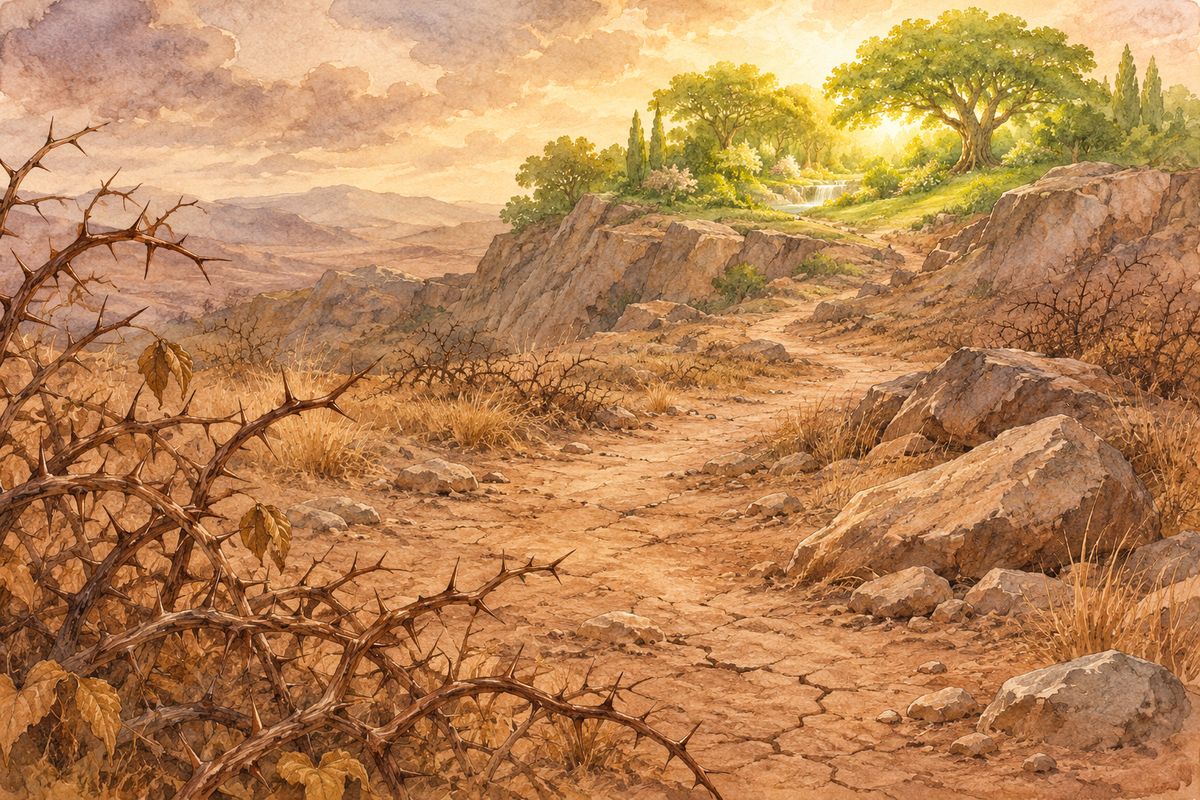
Thorns and a garden beyond recall the loss described in Genesis 3. No particular kind of forbidden fruit is identified.
3The fall
Read: Genesis 3 BLB
The serpent questioned God’s word. The woman and the man ate the fruit God had forbidden. Shame, fear, and blame followed (3:1–13).
God pronounced judgment. Pain, toil, and death entered the human story, and the man and woman were sent out of the garden. Yet God also clothed them, and His words about the woman’s offspring gave hope beyond the serpent’s deception (3:14–24).
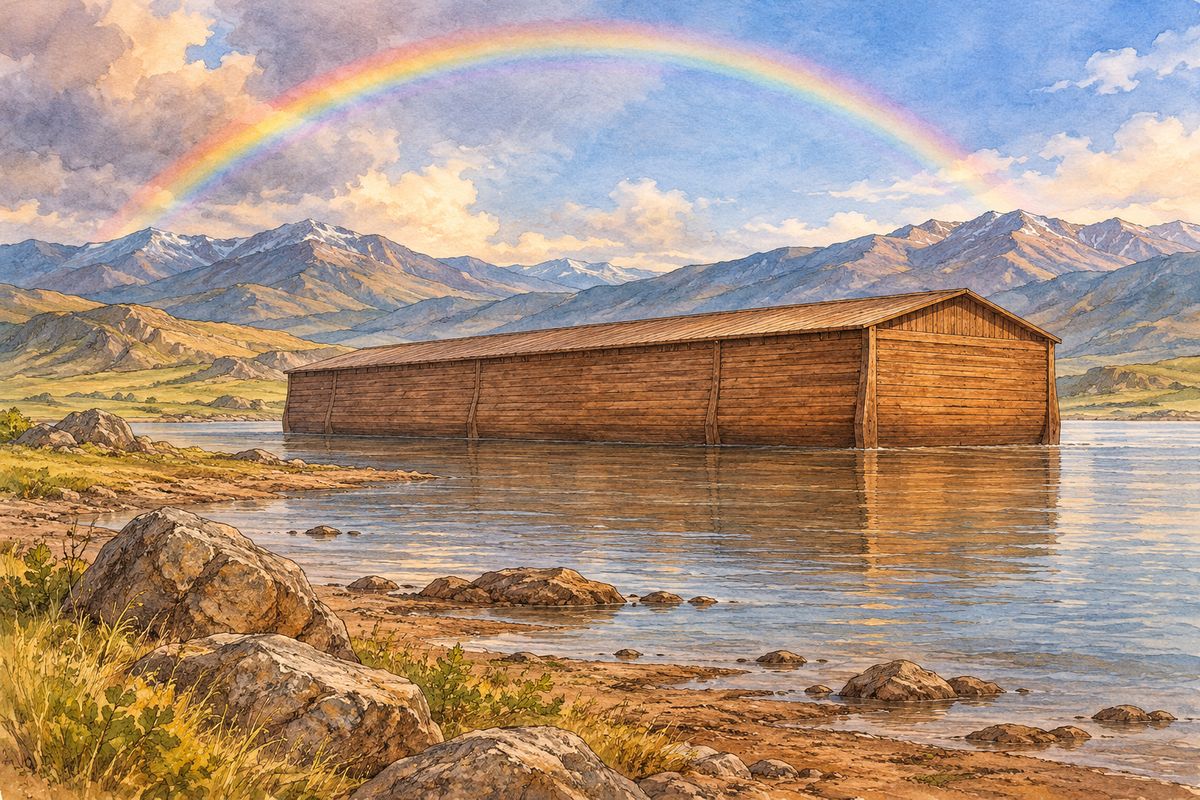
The ark and rainbow summarize different moments in the account. This is a symbolic reconstruction, not an exact scene.
4The flood and the covenant
Read: Genesis 6:5–9:17 BLB
The earth was filled with wickedness and violence. Noah found favor with God and obeyed His command to build an ark (6:5–22).
God judged the earth through the flood and preserved Noah, his family, and living creatures in the ark. Afterward, God made a covenant with Noah, his descendants, and every living creature. The rainbow was its sign: never again would a flood destroy all flesh (9:8–17).
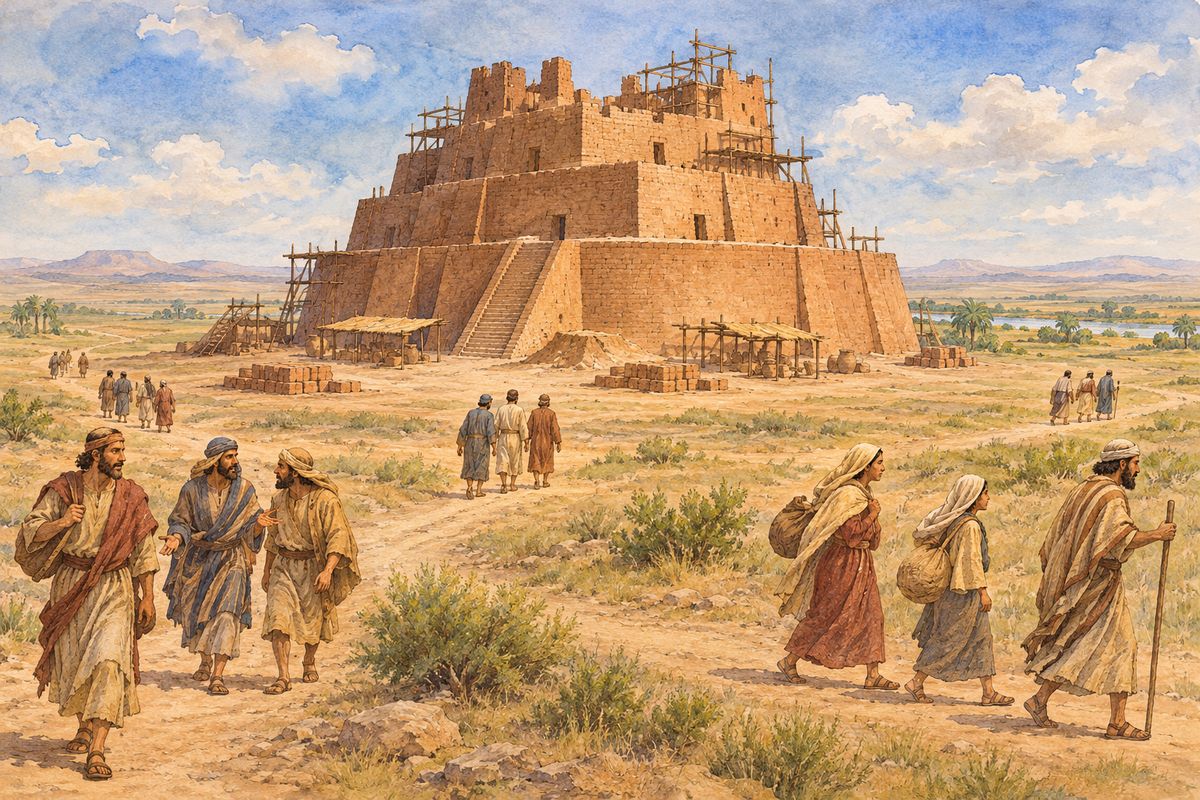
A brick tower and separating groups recall the account. Scripture does not give the tower’s exact shape or height.
5Babel
Read: Genesis 11:1–9 BLB
The people shared one language. On the plain of Shinar, they planned a city and a tower. They wanted to make a name for themselves and avoid being scattered (11:1–4).
The Lord confused their language so that they could not understand one another. He scattered them over the earth, and they stopped building the city (11:5–9). Human ambition could not overrule God.
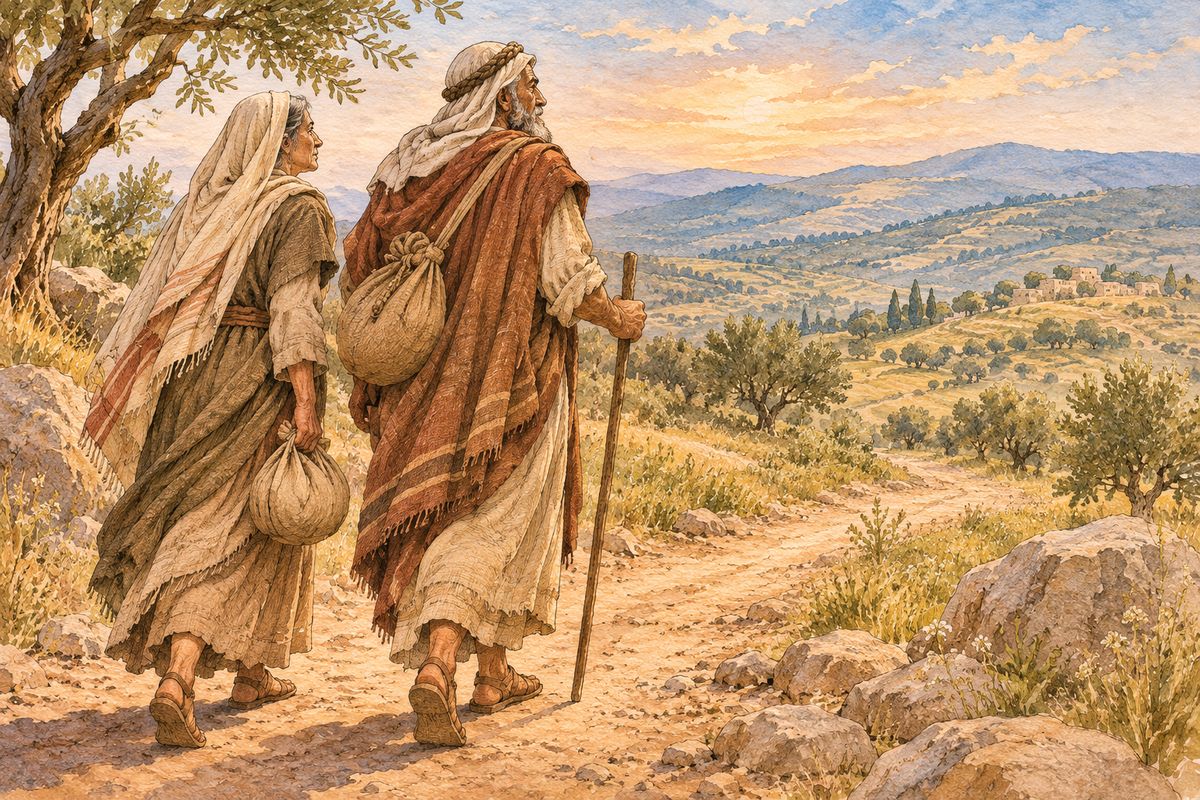
The travelers symbolize Abram and Sarai setting out. Faces, clothing, and the route are artistic reconstructions.
6Abram and Sarai set out
Read: Genesis 11:27–12:9 BLB
The Lord told Abram to leave his country and go to the land He would show him. God promised to make him a great nation and to bless all the families of the earth through him (12:1–3).
Abram went as the Lord told him. Sarai his wife, Lot his nephew, and their household went with him to Canaan (12:4–5). They had no child at this point (11:30). Later, God would name them Abraham and Sarah (17:5, 15).
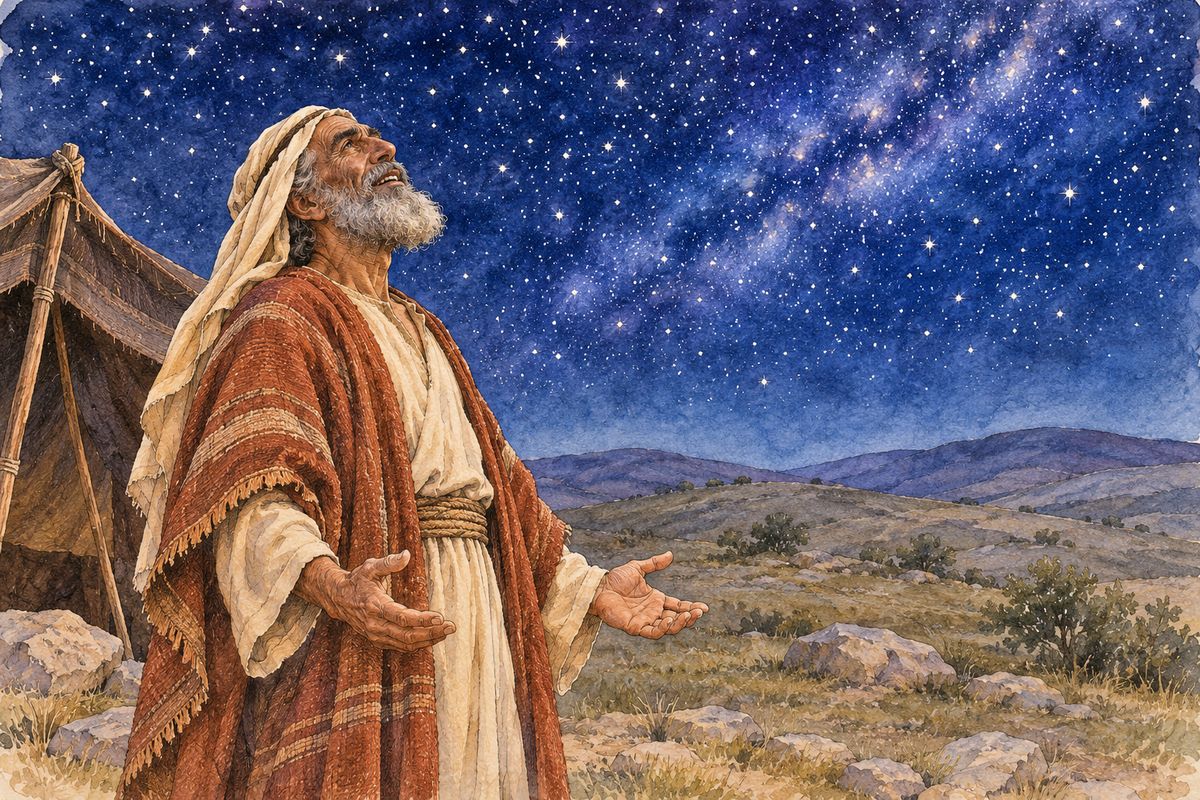
Artistic reconstruction of Abram looking at the stars. Faces, clothing, and landscapes are imagined.
7The promise under the stars
Read: Genesis 15:1–6 BLB
Abram still had no child. He asked how the promise could be fulfilled when a member of his household seemed likely to become his heir (15:2–3).
The Lord said Abram’s own son would be his heir. He directed Abram to look at the stars and spoke of descendants too numerous to count (15:4–5).
Abram believed the Lord, and the Lord counted it to him as righteousness (15:6). Abram was still waiting, but he trusted the One who had spoken.
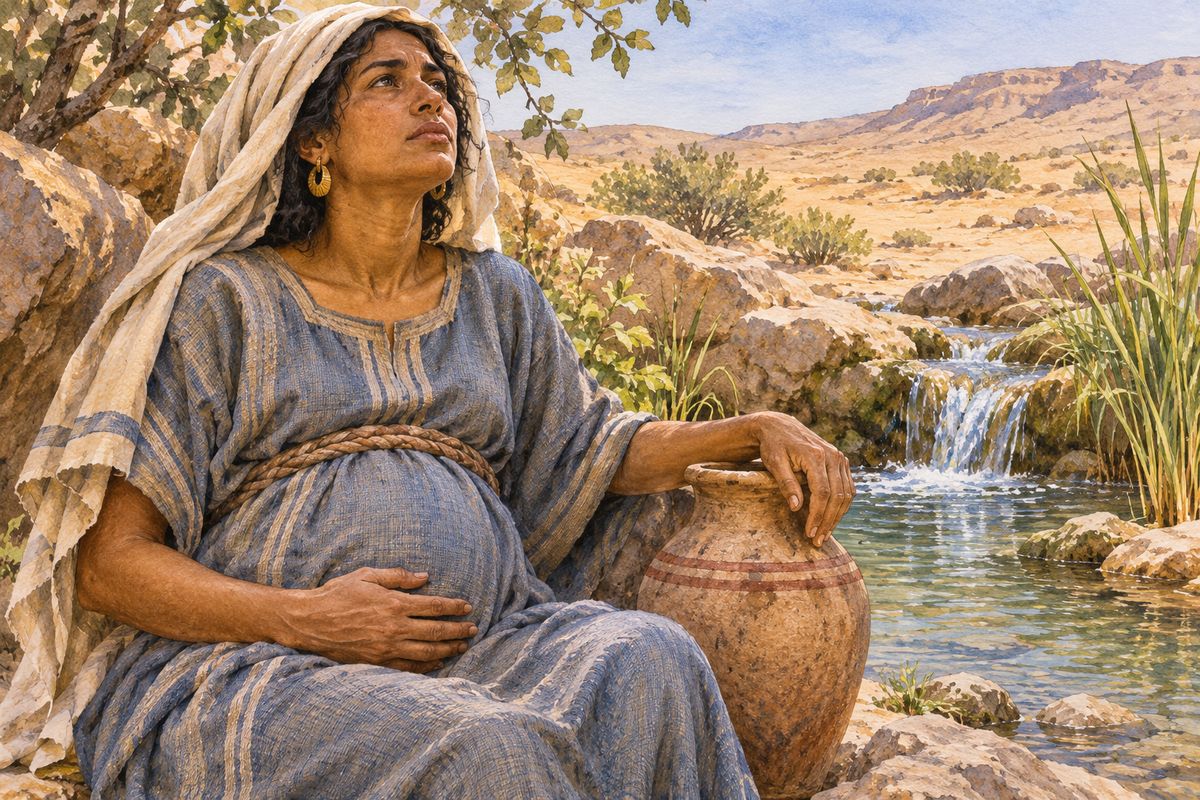
Hagar beside the spring. Ishmael is still unborn. Artistic reconstruction of Genesis 16, not Genesis 21.
8Hagar and Ishmael
Read: Genesis 16 BLB
Sarai gave Hagar, her Egyptian slave, to Abram as a wife, hoping to have a family through her. Hagar conceived. Tension grew, Sarai treated her harshly, and Hagar fled (16:1–6).
The angel of the Lord found her beside a spring. He told her to return and promised her many descendants. Her son was to be named Ishmael, because the Lord had heard her affliction (16:7–12).
Hagar spoke of the God who saw her. She later bore Ishmael when Abram was eighty-six (16:13–16). Her suffering had not gone unnoticed.
The instruction to Hagar belongs to this particular account. It does not give anyone permission to mistreat another person.
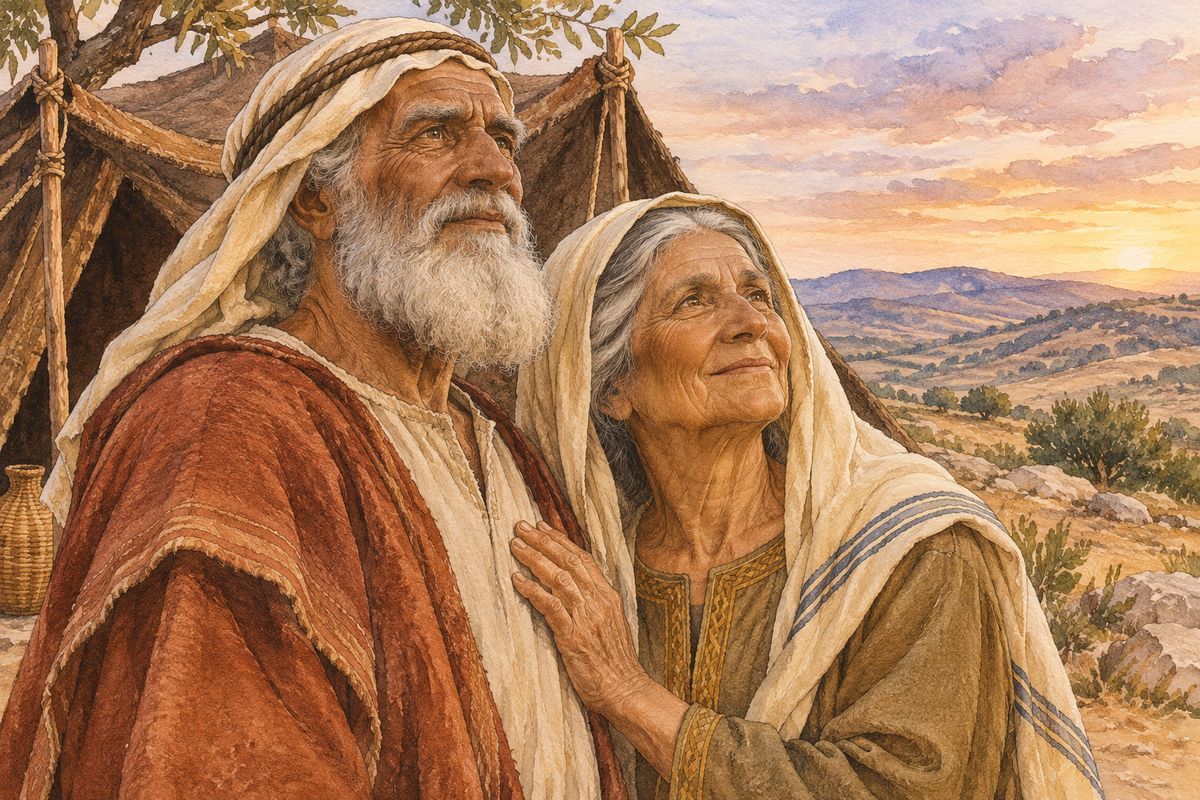
Artistic reconstruction symbolizing the promise concerning the couple. Genesis 17 records God speaking to Abraham.
9New names and a promised son
Read: Genesis 17:1–8 BLB and Genesis 17:15–22 BLB
Abram was ninety-nine when the Lord spoke of His covenant with him. He would become the father of many nations. God named him Abraham and promised Canaan to his descendants (17:1–8).
Sarai would now be called Sarah, and God promised she would bear a son. Abraham laughed and appealed to God on Ishmael’s behalf. God said the promised son would be named Isaac and that He would establish His covenant with him. He also promised to bless Ishmael (17:15–21).
The birth still lay ahead. God said Sarah would bear Isaac at the appointed time in the next year (17:21).
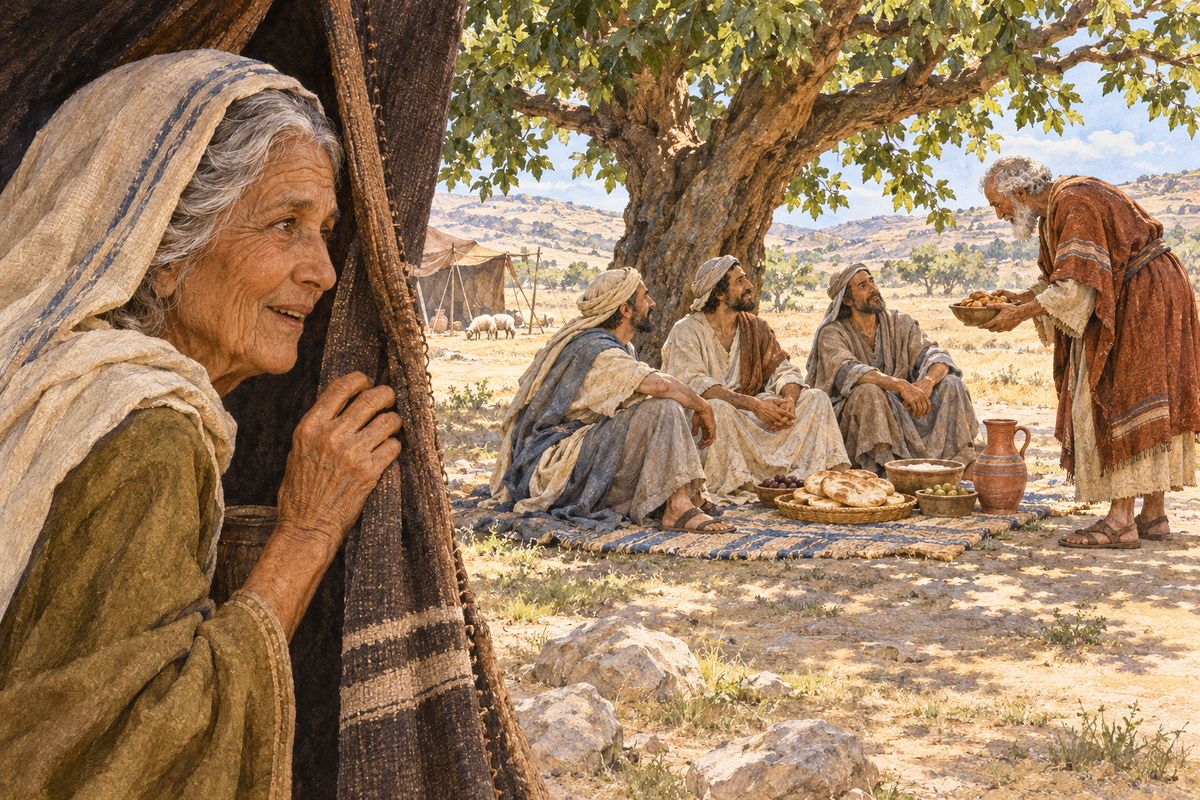
Artistic reconstruction: Sarah listens near the tent while Abraham serves three visitors. Their faces are imagined.
10Sarah hears the promise
Read: Genesis 18:1–15 BLB
At Mamre, Abraham welcomed three visitors and served them a meal. Sarah was in the tent when the promise was spoken: she would have a son (18:1–10).
Abraham and Sarah were old. Sarah laughed to herself as she thought about their age. The Lord asked why she had laughed and whether anything was beyond His power. He repeated the promise of a son at the appointed time (18:11–14).
Sarah denied laughing because she was afraid. The Lord answered that she had laughed (18:15).
Isaac’s birth follows in Genesis 21. These summaries use our own words; Scripture links open the ESV.
These scenes pause before Isaac’s birth in Genesis 21. Genesis continues through Isaac, Jacob, and Joseph. Read the chapters in between in your Bible to keep the full account in view.
The Story of the Old Testament →The Timeline →Who’s Who →The 39 Books →
The explanations are summaries in our own words, not quotations from a Bible translation. Scripture quotations and pop-ups are from the ESV® Bible (The Holy Bible, English Standard Version®), © 2001 by Crossway. Used by permission. All rights reserved.