Hebrews brings weary believers back to Jesus Christ. He is not one spiritual helper among many. He is God’s Son, our faithful High Priest, and the One whose sacrifice opens the way to God. The book joins careful teaching to urgent appeals: because of who Jesus is and what He has done, listen to Him, draw near to God, and encourage one another to persevere.
The book does not name its author. Paul, Barnabas, Apollos, and others have been proposed, but no proposal settles the question. Hebrews 2:3 places the writer among those to whom the Lord’s message was confirmed by its first hearers; Hebrews 13:23 shows a connection with Timothy. Neither clue identifies the writer. We can receive the book’s testimony without pretending to know more about its human author than the evidence permits.
Who first heard it?
The readers knew Israel’s Scriptures and worship practices well. They had endured public mistreatment, stood alongside prisoners, and suffered loss of property (Hebrews 10:32–34). They needed renewed endurance, not merely new information. The traditional title points to a Jewish-Christian setting, but the book never names the congregation or explicitly states every reader’s ethnicity. Its geographical destination remains uncertain.
When was it written?
A date in the first century is secure; a narrower date is debated. Many place it before Jerusalem’s temple was destroyed in AD 70, partly because its sacrificial descriptions use present-tense language and do not mention that destruction. Others caution that the author is explaining scriptural worship patterns and that this does not prove an operating temple. A date in the AD 60s is a common proposal, not a fact stated in Hebrews.
Where were the writer and readers?
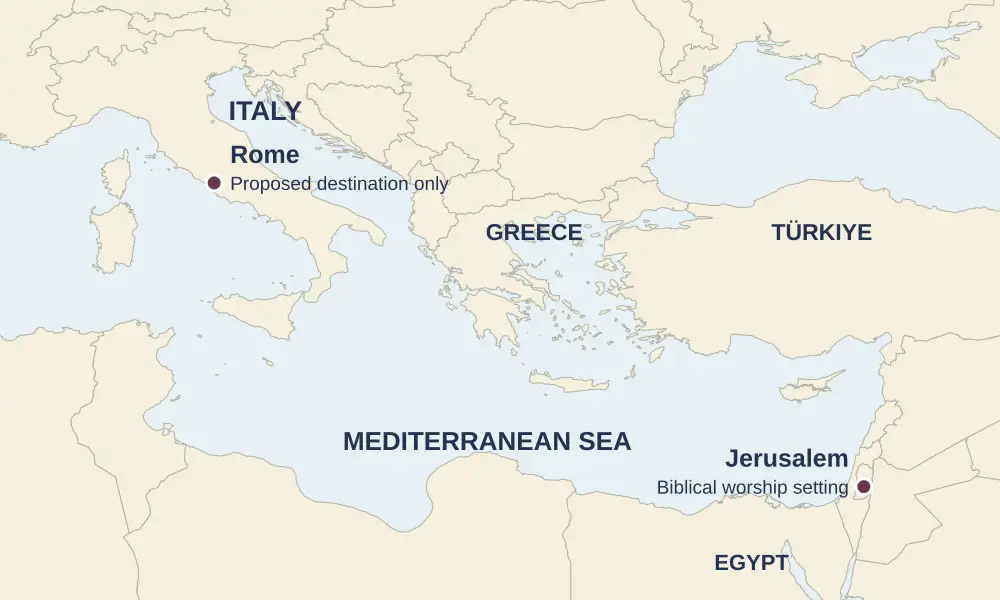
We do not know their exact locations. Hebrews 13:24 conveys greetings from people associated with Italy, but this could fit more than one arrangement. Rome is a suggested destination, not a verified address. Unlike the Corinthian letters, Hebrews does not allow us to draw a dependable writer-to-church route. The location guide below keeps the known settings separate from proposed ones.
What kind of writing is this?
Hebrews calls itself a word of exhortation (Hebrews 13:22). Much of it sounds like a carefully developed sermon, followed by personal requests and greetings. Explanation and application belong together: the greatness of Christ is the reason to resist unbelief, help one another, worship reverently, and live faithfully.
Read Israel’s story with respect
Hebrews depends on Israel’s Scriptures, promises, and worship. It presents Jesus as the fulfillment and goal of God’s provision, not as a reason to despise Jewish people. Comparisons between covenants, priesthoods, and sacrifices must not be turned into claims about the worth of ethnic groups. The God who spoke through the prophets is the God who speaks in His Son (Hebrews 1:1–2).
Hebrews in the New Testament
Usual order of the 27 New Testament books, not the order in which they were written. Hebrews is book 19, following Philemon and preceding James.
Matthew · Mark · Luke · John · Acts · Romans · 1 Corinthians · 2 Corinthians · Galatians · Ephesians · Philippians · Colossians · 1 Thessalonians · 2 Thessalonians · 1 Timothy · 2 Timothy · Titus · Philemon · Hebrews · James · 1 Peter · 2 Peter · 1 John · 2 John · 3 John · Jude · Revelation
Places and what we know
A setting guide, not a travel itinerary. Modern outlines are for orientation. Hebrews does not identify the writer’s city or the readers’ address.
Italy: named in the greeting of Hebrews 13:24. The wording does not settle whether the writer or readers were in Italy.
Rome, Italy: a proposed destination, not a known one.
Jerusalem: a familiar biblical center of worship. Hebrews explains the scriptural sanctuary and heavenly access; this marker does not identify the letter’s destination.
Jesus reveals God, sustains creation, makes purification for sins, and sits at God’s right hand. We do not move beyond Him to find a fuller Savior. Listening to the Son is the starting point of the whole book.
Jesus entered human life, suffering, and death to bring His people to glory. His solidarity with us is real, yet He remains without sin. The One exalted above angels is also the merciful High Priest who helps tempted people.
The wilderness generation shows the danger of hearing God’s promise without trusting Him. The repeated call to respond today is urgent. God’s rest is more than occupying a piece of land; His promised rest calls us to persevering faith.
Our confidence is not that we have no weakness. It is that Jesus understands weakness and gives access to mercy and grace. His suffering obedience qualifies Him fully for His saving priestly work; it does not mean He was previously sinful.
Spiritual dullness is dangerous, and mature discernment develops through practiced obedience. The stern warning is followed by encouragement, God’s trustworthy promise, and hope anchored in Jesus. The answer to fear is not to look for another refuge but to come to Him.
Psalm 110 and the account of Melchizedek help explain Jesus’ priesthood. Unlike mortal priests, Jesus lives forever and intercedes for those who approach God through Him. His appointment rests on God’s oath and His indestructible life.
The new covenant: better promises and changed hearts
Jesus mediates a better covenant founded on better promises. Quoting Jeremiah, Hebrews emphasizes what God promises to do: write His laws on His people’s minds and hearts, bring them into a relationship in which they know Him, and forgive their sins. This is more than a change in outward religious arrangements. God renews His people from within. His grace transforms our response to His will; it does not give us permission to disregard it.
Hebrews 10:15–17 identifies the Holy Spirit as the witness to this covenant promise. The broader biblical picture also explains the Spirit’s enabling work: Ezekiel 36:26–27 promises a new heart and God’s Spirit within His people, and Romans 8:13 calls believers to put sinful deeds to death by the Spirit. These passages illuminate the promise without treating every detail of that broader teaching as an explicit statement in Hebrews 8.
This does not mean the former covenant lacked grace or that faithful people then had no heartfelt obedience. Nor does renewal make obedience effortless or unnecessary. Hebrews calls us to persevering faith and practiced obedience, while its closing prayer looks to God to equip us to do His will (Hebrews 13:20–21).
The old sanctuary and repeated offerings pointed beyond themselves. Christ offered Himself once for all, cleanses the conscience, and opens access to God. His finished offering is the ground of forgiveness; it is not something believers must supplement with another atoning sacrifice.
Because Christ has opened the way, believers are called to worship, confidence, love, good works, and mutual encouragement. The warning against rejecting Him must be heard seriously. Ordinary struggles brought to Christ in repentance must not be confused with the settled repudiation the passage describes.
Faith perseveres through both victory and suffering
Faith trusts God and acts on His promises. Some witnesses experienced remarkable deliverance; others suffered and died without receiving an earthly rescue. The chapter does not promise comfort or success to everyone who believes. All depend on the better fulfillment God brings in Christ.
Jesus endured the cross and now reigns. His example and God’s fatherly care strengthen weary believers. Pursue peace and holiness, reject bitterness, and worship with reverence: God’s unshakable kingdom is received as a gift, not manufactured by human strength.
Brotherly love, hospitality, care for prisoners, sexual faithfulness, contentment, generosity, and responsible church life belong together. Praise is joined to doing good and sharing. The closing prayer asks God to equip His people to do His will through Jesus Christ.
A prayer shaped by Hebrews
Father, thank You for speaking to us through Your Son. Thank You that Jesus knows our weakness, has offered Himself for our sins, and lives to intercede for us. Keep us from drifting, hardening our hearts, or treating Your grace lightly. Teach us to draw near with honest repentance and confident trust. Help us grow in discernment, encourage one another, and hold fast when obedience is costly. Give us compassion for those who suffer and patience with those who are weary. Fix our eyes on Jesus rather than on our own strength. Make our worship visible in love, faithfulness, generosity, and hospitality. Equip us to do Your will through Jesus Christ, to whom be glory forever. Amen.
Who Jesus is and what He has accomplished lead to the call to draw near, hold fast, and endure. The warnings are woven into the teaching, not detached threats. The finished sacrifice and the continuing call to faith belong together.
Hebrews 1:1–4 — The opening foundation: God’s final revelation and saving work in the Son
Hebrews 1:5–2:18 — Greater than angels, yet made truly human to save and help us
Hebrews 3:1–4:13 — Greater than Moses: hear God today and enter His promised rest
Hebrews 5:11–6:20 — Grow toward maturity; receive the warning and cling to God’s promise
Hebrews 7:1–28 — An enduring priesthood, explained through Melchizedek and God’s oath
Hebrews 8:1–13 — A better ministry and the promised new covenant
Hebrews 9:1–10:18 — The true sanctuary and Christ’s once-for-all offering
Hebrews 10:19–39 — Therefore draw near, hold fast, gather, and persevere
Hebrews 11:1–40 — Faith lived out across Israel’s story, through triumph and suffering
Hebrews 12:1–29 — Look to Jesus, accept God’s training, and worship with reverence
Hebrews 13:1–25 — A life of love and faithful worship; prayer and final greetings
Reading the warnings with the promises
Hebrews speaks seriously about drifting, unbelief, hardened hearts, falling away, and rejecting the Son. Do not weaken these appeals merely because they are difficult. At the same time, read them beside the invitations to mercy and the writer’s encouragement about his readers (Hebrews 4:14–16; 6:9–12; 10:39).
Christians who affirm Scripture differ about how these warnings relate to final salvation. Some understand them as God’s means of keeping His people persevering, distinguishing lasting faith from a merely outward profession. Others understand them as warnings of a real possibility of apostasy for believers. This review identifies the interpretive question rather than pretending Hebrews settles every later theological debate in a single phrase.
The shared practical appeal is clear: do not abandon Jesus. Hear God today, keep coming to Christ, and encourage fellow believers. A frightened person who desires repentance should not be told that the desire to return proves they have been rejected. Hebrews directs weak people to the merciful High Priest, not away from Him.
Study every verse
Read the verse and its surrounding paragraph before the note. For example, the invitation to approach God in Hebrews 4:16 rests on the High Priest described in 4:14–15. The note should help you hear that connection.
Each entry includes Greek words behind selected English wording and two related passages. Greek meanings are contextual explanations, not claims that a word means everything in its dictionary entry at once.
Living the Word:James 1:22 calls us to be doers, not hearers only. Selected passages ask what we should obey, turn from, or trust. The response is to God’s grace, not a way to purchase it.
Hebrews begins with God speaking, not with a named human author. Israel’s prophets truly communicated God’s revelation, although it arrived through many people, occasions, and forms. The contrast with the Son in the next verse does not dismiss the Old Testament as false or useless. It prepares us to see its fulfillment and goal. Read the whole opening sentence before deciding what the contrast means.
English wording → Greek word → meaning
“prophets” → prophētēs → a person who communicates a message from God
Read alongside
Numbers 12:6–8BLB — God describes differing ways He made Himself known.
God’s revelation reaches its decisive fullness in His Son. The Son is not simply the next prophet in a long line: He is heir of everything and the One through whom God created. The final days are therefore identified by Christ’s coming, not by a modern prediction about a particular year. The same Son who explains God’s purpose also stands at creation’s beginning and its promised completion.
English wording → Greek word → meaning
“heir” → klēronomos → the one appointed to receive the inheritance
Read alongside
John 1:1–3BLB — The Word already existed and creation came through Him.
Colossians 1:16BLB — All things were created through Christ and for Him.
The Son makes God’s glory and nature known perfectly. He is not a rough likeness or a lesser divine being. His powerful word sustains creation, and His work addresses our deepest problem: sin. His taking the place of honor beside the Father announces His completed cleansing work and royal dignity. Hebrews will unfold how His once-for-all sacrifice gives believers access to God through their living High Priest.
English wording → Greek word → meaning
“exact imprint” → charaktēr → an exact representation or impress, here of God’s nature
Teacher’s comment — John Piper (paraphrase, source) Christ’s majesty and the practical response He requires belong together. Hebrews presents the greatness of Jesus as the reason to listen, trust, and persevere.
The Son’s superiority to angels follows His exaltation after making purification for sins. This does not mean He began to exist at that point or was previously an angel. The opening has already identified Him as the Creator and perfect revelation of God. The inherited name, explained in the following quotations, expresses His unique Sonship and authority. Created messengers must never displace the divine Son whom they serve.
English wording → Greek word → meaning
“superior” → kreittōn → better or greater in status
Two Old Testament promises establish the royal Son’s unique relationship to God. Psalm 2 speaks of God’s king, and the promise to David supplies a father-and-son pattern fulfilled supremely in Jesus. The begetting language here should not be treated as a description of God creating the Son. The point is His royal identity and appointment, a status never bestowed on an angel in this way.
English wording → Greek word → meaning
“Son” → huios → son; here the unique royal Son addressed by the Father
Read alongside
Psalm 2:7BLB — God publicly identifies His anointed king as Son.
2 Samuel 7:12–14BLB — God promises David a royal descendant and fatherly relationship.
The firstborn receives the worship of God’s angels. Firstborn can express the preeminent heir’s rank, not merely the first creature produced; the surrounding argument has already placed the Son on the Creator’s side of the Creator-creature distinction. Readers differ on whether the bringing into the world emphasizes His first coming or His future appearing. The certain point is the command that angels worship Him rather than rival Him.
English wording → Greek word → meaning
“firstborn” → prōtotokos → firstborn, here expressing the Son’s preeminent rank
Read alongside
Psalm 89:27BLB — Firstborn language describes the highest royal rank.
The angels are described as servants whom God directs. The quotation from Psalm 104 pictures wind and flame carrying out His purposes. However the imagery is understood, angels belong among those commissioned and governed by God. This prepares the contrast: the Son is addressed as the enthroned ruler in the next verse. Respect for God’s messengers must remain subordinate to worship of the One they obey.
English wording → Greek word → meaning
“ministers” → leitourgos → servants carrying out an assigned service
Read alongside
Psalm 104:4BLB — The psalm pictures God’s messengers and servants.
The words addressed to the Son affirm an enduring throne and a righteous reign. Hebrews applies the royal language of Psalm 45 to Jesus in a way that highlights His divine dignity. His rule is not maintained by corruption or manipulation. A believer’s confidence rests in a King whose authority and character agree. The following verse continues the quotation and shows that His delight in righteousness belongs to His reign.
English wording → Greek word → meaning
“throne” → thronos → the seat of royal rule
Read alongside
Psalm 45:6BLB — The royal psalm speaks of an everlasting throne.
The Messiah’s rule is inseparable from His love for what is right and hatred of evil. His anointing expresses God’s glad approval and His place above His companions. The passage does not resolve the identity of every companion mentioned in the psalm; it clearly establishes the Son’s distinction. We cannot honor this King while treating wrongdoing as harmless. His righteousness gives both assurance and a searching pattern for our conduct.
English wording → Greek word → meaning
“righteousness” → dikaiosynē → what is right before God
Read alongside
Psalm 45:7BLB — God anoints the righteous king with gladness.
Isaiah 11:1–5BLB — The promised ruler judges with righteousness.
The author now applies words about the Lord as Creator to the Son. Earth’s foundations and the heavens belong to His handiwork. This is stronger than saying Jesus assists a greater creator from outside the divine identity. Read with verses 2–3, the quotation presents His eternal significance and power. Believers may suffer in a changing world, but the One to whom they hold fast is its Maker.
English wording → Greek word → meaning
“laid the foundation” → themelioō → to establish a foundation
Read alongside
Psalm 102:25BLB — The psalm credits the Lord with making heaven and earth.
John 1:3BLB — Nothing created came into being apart from the Word.
Creation can wear out, but the Lord remains. The clothing image makes the contrast vivid: what seems vast and permanent to us is not permanent in itself. The author is not saying that material creation is evil. He is contrasting its dependence and change with the Son’s enduring life. Our security cannot rest finally on earthly structures, possessions, or institutions, however familiar and dependable they presently appear.
English wording → Greek word → meaning
“remain” → diamenō → to continue or endure
Read alongside
Psalm 102:26BLB — Created things wear out while the Lord endures.
Isaiah 51:6BLB — God’s saving righteousness outlasts the present creation.
God’s creation is pictured as clothing that can be folded and changed. The Son, however, is not exhausted by time or altered by its passing. His enduring identity stands behind the believer’s enduring hope. This does not make Him indifferent to human suffering; chapter 2 will stress His genuine participation in it. The unchanging Lord is also the compassionate Savior who entered our mortal condition to rescue us.
English wording → Greek word → meaning
“the same” → autos → the same one; here emphasizing unchanged identity
The opening argument reaches the invitation to sit at God’s right hand. No angel receives this royal position or the promise that every enemy will be subjected to Him. Psalm 110 will continue to shape Hebrews, especially its account of Christ’s priesthood. The waiting implied here does not undermine His authority. His victory is decisive, while the full public subjection of every enemy still lies ahead.
English wording → Greek word → meaning
“enemies” → echthros → those opposed to someone
Read alongside
Psalm 110:1BLB — The Lord invites David’s Lord to His right hand.
Angels serve under God’s direction for the benefit of those who will inherit salvation. Their ministry displays God’s care, but the text does not invite us to command angels or construct elaborate systems about their assignments. The Son saves and reigns; angels serve. The future inheritance encourages believers who face difficulty now. Their circumstances do not measure either Christ’s authority or the reality of God’s unseen provision.
English wording → Greek word → meaning
“ministering” → leitourgikos → serving in an appointed ministry
Read alongside
Psalm 91:11BLB — God commissions His angels to guard His people.
Luke 16:22BLB — Jesus portrays angels serving at a believer’s death.
Because the Son is so great, the hearers must respond attentively to His message. Drift can occur without a dramatic public renunciation: neglect gradually carries a person away from what once received attention. The warning includes the writer with the congregation and calls for active listening and faithful response. The remedy is not constant novelty but renewed attention to the salvation God has announced in His Son.
English wording → Greek word → meaning
“drift away” → pararreō → to slip or drift away
Read alongside
Proverbs 4:20–23BLB — Attend carefully to God’s instruction and guard the heart.
The law’s authority and its penalties establish the seriousness of rejecting God’s speech. Jewish tradition associated angels with the giving of the law, and the New Testament repeats that association. Hebrews is not criticizing God for giving the law or treating Israel as uniquely blameworthy. It reasons from a recognized truth: if earlier revelation carried accountability, the climactic message delivered by the Son deserves even more careful response.
English wording → Greek word → meaning
“disobedience” → parakoē → a refusal to heed or obey
Read alongside
Acts 7:53BLB — Stephen refers to the law received through angels.
Galatians 3:19BLB — Paul also associates angels with the law’s mediation.
Neglecting salvation is treated as a serious response, not a neutral alternative to accepting or opposing it. The message originated with the Lord and was confirmed to this community through those who heard Him. This observation helps explain why the author should not be confidently identified as an eyewitness apostle. The verse calls us to receive Christ’s rescue gratefully and seriously, rather than leave it as unused religious information.
English wording → Greek word → meaning
“neglect” → ameleō → to disregard or fail to give due attention
Teacher’s comment — John Piper (paraphrase, source) Salvation should not be filed away as an unused possession. Its greatness calls for sustained attention, gratitude, and a life shaped by what Christ has accomplished.
Read alongside
Luke 19:10BLB — Jesus describes His mission as seeking and saving the lost.
Hebrews 10:28–29BLB — Later warning similarly argues from lesser to greater accountability.
God supplied confirming testimony alongside the human witnesses. Signs, wonders, powerful works, and distributions of the Spirit pointed to the truth of the salvation proclaimed. Their purpose was not to turn attention away from Christ or make spiritual power a personal possession. The final phrase locates their distribution in God’s will. The verse records God’s authentication without by itself settling every question about the continuation of particular gifts today.
English wording → Greek word → meaning
“gifts” → merismos → distributions or apportionments; here the Spirit’s gifts
Read alongside
Acts 2:22BLB — Jesus’ works were God’s attestation.
The coming world is not entrusted to angelic rule. This develops the first chapter’s contrast while preparing an important shift toward humanity’s calling. The Son’s supremacy does not mean that human life is discarded. Rather, Jesus fulfills the destiny humanity has failed to realize. The rest of this paragraph reads Psalm 8 in light of His humiliation and exaltation, showing why His suffering belongs within God’s saving purpose.
English wording → Greek word → meaning
“world to come” → oikoumenē → the inhabited world; the following Greek phrase specifies the coming world
Psalm 8 marvels that the Creator attends to frail human beings. The ordinary human meaning of its parallel phrases should not be erased when Hebrews applies the psalm to Jesus. He truly shares our humanity and realizes its intended destiny. The question is worshipful amazement, not contempt for human life. Our worth rests in God’s gracious attention and purpose, not in our ability to make ourselves central to the universe.
English wording → Greek word → meaning
“mindful” → mimnēskomai → to remember or attend to
Read alongside
Psalm 8:4BLB — The psalm wonders at God’s care for humanity.
Genesis 1:26–28BLB — Human beings receive dignity and responsibility from their Creator.
Humanity’s humble position and bestowed honor appear together. Hebrews will especially connect the temporary lowliness with Jesus’ earthly humiliation and His subsequent glory. Neither His suffering nor ours should lead us to deny the purpose God has for His creatures. Glory is a gift from God, not an entitlement achieved by self-exaltation. Read this verse with verse 9, where the author explicitly identifies the One now crowned.
English wording → Greek word → meaning
“crowned” → stephanoō → to crown or confer honor
Read alongside
Psalm 8:5BLB — God crowns human beings with glory and honor.
The psalm’s sweeping claim is set beside the evident disorder of present experience. We do not yet see everything brought into proper subjection. Hebrews does not ask readers to pretend that suffering and evil have disappeared. It asks them to interpret the unfinished present in light of Jesus. His exaltation in the next verse guarantees a destiny that remains greater than what our immediate circumstances allow us to observe.
English wording → Greek word → meaning
“subjection” → hypotassō → to place under authority
Read alongside
Psalm 8:6BLB — God grants humanity dominion over His works.
Romans 8:19–23BLB — Creation still waits for its promised liberation.
What we cannot yet see fully in creation, we begin to see in Jesus. He truly entered human lowliness and suffered death, and He is now crowned with glory. His death is attributed to God’s grace rather than to a failure of God’s plan. The words about tasting death stress a real experience of death on behalf of others, not a superficial encounter with danger. Keep their breadth intact rather than silently narrowing the text.
English wording → Greek word → meaning
“taste” → geuomai → to taste or experience; here genuinely to undergo death
The Savior’s suffering fits God’s purpose of bringing many children to glory. Being made perfect does not imply that Jesus had moral defects needing repair. In Hebrews, the language concerns His being brought through suffering to the completion of His saving mission and priestly qualification. He leads His people along a path He has actually traveled. God’s glory and our suffering are not opposites when His saving purpose joins them in Christ.
English wording → Greek word → meaning
“founder” → archēgos → pioneer, leader, or originator; here the One who leads into salvation
Read alongside
Hebrews 5:8–9BLB — Suffering and completed obedience belong to His saving mission.
Romans 8:29–30BLB — God’s purpose for His family culminates in glory.
Jesus makes His people holy and openly owns them as His family. The shared origin language stresses real solidarity under God, while the surrounding argument maintains the Son’s unique identity. His willingness to call believers brothers is an astonishing act of grace, not evidence that we become divine in the same way He is. The following scriptural quotations show the Messiah standing among the people whom He represents and saves.
English wording → Greek word → meaning
“sanctifies” → hagiazō → to set apart as holy
Read alongside
John 20:17BLB — The risen Jesus calls His disciples His brothers.
Hebrews 10:10BLB — His offering is the ground of His people’s sanctification.
Words from Psalm 22 are placed on the lips of the Son, who announces God to His brothers and praises Him among the gathered people. The psalm moves through suffering into testimony and worship. Hebrews draws attention to the Messiah’s solidarity with His family rather than treating salvation as a detached transaction. Jesus brings those He has rescued into the acknowledgment and praise of the Father.
English wording → Greek word → meaning
“congregation” → ekklēsia → an assembly or gathered community
Read alongside
Psalm 22:22BLB — The rescued sufferer declares God’s name in the assembly.
John 17:26BLB — Jesus makes the Father’s name known to His people.
The quotations from Isaiah present trust in God and identification with God-given children. Hebrews hears these words fittingly on the Son’s lips. His genuine human dependence is consistent with His divine identity; the incarnation is not a performance in which He only appears to share our condition. Those God gives Him are not strangers to Him. His own faithful reliance on the Father accompanies His saving care for them.
English wording → Greek word → meaning
“trust” → peithō → to trust or be confidently persuaded; here expressed in a construction of reliance
Read alongside
Isaiah 8:17–18BLB — Isaiah trusts the Lord and stands with the children given him.
John 17:6BLB — Jesus speaks of those the Father has given Him.
The children share mortal human nature, and the Son truly participated in it. His death defeats the devil’s destructive power rather than confirming Satan as an equal rival to God. The verse does not mean the devil has unrestricted authority to decide every death. It shows Christ breaking the enemy’s hold through the very experience that terrifies fallen humanity. His incarnation and cross belong together in the work of rescue.
English wording → Greek word → meaning
“destroy” → katargeō → to render ineffective or break the power of
Read alongside
1 John 3:8BLB — The Son appeared to undo the devil’s works.
Fear of death can enslave a person’s entire way of living. Christ’s victory opens a different future: death is no longer the final master of those who belong to Him. This does not promise that believers never feel anxiety or grieve. It provides a solid reason to bring such fears to Jesus. Freedom rests in His accomplished rescue, not in our ability to manufacture fearless emotions on demand.
The Son’s saving help is directed toward Abraham’s offspring rather than angels. The verb emphasizes taking hold to help, and the next verse explains why full human solidarity was necessary. Hebrews is describing the historical people of God’s promise; the wider New Testament also identifies those who belong to Christ as Abraham’s heirs. The point is Christ’s committed rescue of His people, not contempt for other human beings.
English wording → Greek word → meaning
“helps” → epilambanomai → to take hold of, here in order to help
Read alongside
Isaiah 41:8–10BLB — God takes hold of Abraham’s offspring and promises help.
Galatians 3:29BLB — Those who belong to Christ are Abraham’s offspring and heirs.
Jesus’ real humanity qualifies Him to represent His people as their merciful and faithful High Priest. Mercy describes His care for us, and faithfulness His complete discharge of the work entrusted to Him. Making propitiation addresses the guilt of sin before God’s holy judgment, not merely our feelings about wrongdoing. His priestly work does not persuade an unwilling Father to love us; it carries out God’s own gracious saving purpose.
English wording → Greek word → meaning
“propitiation” → hilaskomai → to make atonement dealing with sin before God
Read alongside
Leviticus 16:15–19BLB — The Day of Atonement supplies important priestly background.
Romans 3:25–26BLB — Christ’s blood displays God’s righteousness in dealing with sin.
Jesus can help the tempted because His own testing involved genuine suffering. His sinlessness did not make temptation imaginary or painless. He remained obedient under pressures we often escape by giving in. The encouragement is practical: believers need not hide their struggles from their Savior or imagine He is distant from them. His tested faithfulness is a reason to seek His assistance in the moment of need.
English wording → Greek word → meaning
“tempted” → peirazō → to test or tempt; here testing that brought suffering
The command is to give sustained attention to Jesus. He is both God’s sent representative and the High Priest who represents His people before God. The readers are addressed as a holy family sharing a heavenly calling, so the exhortation is pastoral rather than remote. A mature Christian life begins again and again with seeing who Jesus is, instead of allowing pressure, novelty, or self-preoccupation to occupy the center.
English wording → Greek word → meaning
“consider” → katanoeō → to observe carefully and give thoughtful attention
Read alongside
John 20:21BLB — Jesus speaks of being sent by the Father.
Hebrews 12:2–3BLB — Believers are called to look to and consider Jesus.
Jesus is faithful to the One who appointed Him, and Moses also receives explicit honor for faithfulness. The argument is not built by discrediting Moses. Hebrews acknowledges the great servant before distinguishing the Son’s greater place. God’s household language refers to His people, not primarily a physical building. Moses’ service prepares readers to appreciate the faithfulness of Christ within God’s unfolding purpose.
English wording → Greek word → meaning
“faithful” → pistos → trustworthy and dependable in fulfilling a charge
Read alongside
Numbers 12:7BLB — God calls Moses faithful in His household.
John 5:46BLB — Jesus explains that Moses wrote about Him.
The Son receives greater honor than Moses because the builder’s relation to the house exceeds that of someone within it. The comparison elevates Christ without denying the importance of faithful human leadership. God’s people should appreciate those who serve them while refusing to make any servant their ultimate foundation. Read the next verse with this one: the argument links the Son’s work with God’s authorship of the household.
English wording → Greek word → meaning
“builder” → kataskeuazō → to construct or prepare
Read alongside
Matthew 16:18BLB — Jesus declares that He will build His church.
The ordinary observation that a house has a builder leads to a theological conclusion: God is the ultimate builder of all things. Within the comparison, this reinforces the Son’s dignity and God’s initiative in forming His people. The household does not create itself or exist for its own prestige. We belong to a work whose origin and purpose are God’s, and faithful servants remain accountable to Him.
English wording → Greek word → meaning
“built” → kataskeuazō → to construct or prepare
Read alongside
Psalm 127:1BLB — A house depends ultimately on the Lord’s building.
Moses’ service was faithful and prophetic: it bore witness to what God would later make known. Hebrews treats that service as meaningful rather than obsolete in the sense of worthless. The law, priesthood, and sanctuary furnish categories through which Christ’s work is explained. Their fulfillment in Him is the reason to read them carefully. A servant’s greatness is found in serving God’s purpose, not in replacing its promised goal.
English wording → Greek word → meaning
“servant” → therapōn → an attendant or servant entrusted with service
Read alongside
Numbers 12:7BLB — Moses is honored as faithful within God’s household.
Luke 24:27BLB — Jesus explains how Moses and the Prophets point to Him.
Christ is not merely a servant within the house but the Son over it. The confidence and hope of His people are therefore anchored in Him. The conditional language makes perseverance essential to the exhortation. Christians differ over how such conditions relate to assurance, but none should turn the verse into permission for abandoning Christ. Holding fast is the response of trust, not a fee paid to purchase a place in God’s family.
English wording → Greek word → meaning
“hold fast” → katechō → to retain firmly or keep hold of
Read alongside
Hebrews 10:23BLB — Believers hold their confession because God is faithful.
Colossians 1:22–23BLB — Paul also joins reconciliation with continuing in the faith.
The quotation is introduced as the Holy Spirit speaking in the present. Scripture is not merely a record of what God once said to other people; His written Word addresses this congregation now. The word today emphasizes the opportunity and urgency of response. Hebrews will repeat that emphasis because postponing obedience is one way a heart becomes resistant to the voice it claims to respect.
English wording → Greek word → meaning
“Today” → sēmeron → today, the present time for responding
Read alongside
Psalm 95:7–11BLB — The Spirit’s warning comes through this psalm.
Hebrews 4:7BLB — The invitation to respond today is repeated.
The wilderness generation supplies a warning against resisting God after experiencing His care. Hardening is not limited to outspoken atheism; it can occur among people who possess a history of deliverance and religious privilege. The instruction directs each hearer toward personal responsiveness rather than superiority over the people in the story. God’s past kindness should deepen trust, not become an excuse to demand further proof before obeying Him.
English wording → Greek word → meaning
“harden” → sklērynō → to make hard or resistant
Read alongside
Exodus 17:1–7BLB — Israel tests God’s presence at Massah and Meribah.
Psalm 95:8BLB — The psalm warns against repeating that resistance.
The people tested God despite prolonged exposure to His works. The problem was not a complete absence of evidence but a refusal to respond faithfully to what they had seen. Hebrews applies the wilderness story to its own hearers, who also have received abundant testimony. We should not assume that more religious experiences automatically produce obedience. God’s works need to be received with faith rather than consumed as repeated demands for reassurance.
English wording → Greek word → meaning
“put me to the test” → peirazō → to test or try; here putting God to the test
God identifies the root of the rebellion as the heart’s continual wandering. Not knowing His ways means more than lacking facts about Him; their conduct showed a refusal to receive and follow His character and purposes. The judgment is morally serious because God’s care had been plain. The passage challenges a kind of religious familiarity that can speak about God while remaining unwilling to walk in His ways.
English wording → Greek word → meaning
“go astray” → planaō → to wander or be led away from the right way
God’s oath announces exclusion from the rest He had promised the rebellious generation. The historical reference includes failure to enter the land, while Hebrews will show that the promise of God’s rest extends beyond that event. Divine patience must not be confused with endless permission to reject Him without consequence. This severe word is given to awaken the present hearers while the invitation to respond remains open.
English wording → Greek word → meaning
“rest” → katapausis → a place or state of rest; here God’s promised rest
Read alongside
Numbers 14:28–30BLB — The rebellious generation is excluded from entering the land.
The writer turns directly from Israel’s history to the congregation. An unbelieving heart is dangerous because it turns a person from the living God. This is not a command to treat honest questions as rebellion or to conceal struggles from others. It calls believers to take the direction of their hearts seriously and to help one another remain responsive to God. The next verse gives a practical, shared response to this danger.
English wording → Greek word → meaning
“unbelieving” → apistia → unbelief or lack of trust; the Greek noun describes the heart’s condition
Read alongside
Jeremiah 17:5–8BLB — Trust in the Lord is contrasted with turning the heart from Him.
Hebrews 10:38–39BLB — The community is urged to live by faith rather than shrink back.
Daily encouragement is God’s appointed answer to sin’s deceptive hardening. Sin often offers plausible reasons to postpone obedience, minimize wrongdoing, or isolate ourselves. Believers therefore need more than occasional instruction from a platform; they need truthful, loving involvement in one another’s lives. Exhortation is not domination or suspicion. It seeks another person’s good by helping that person hear God’s promises and warnings while there is still opportunity to respond.
English wording → Greek word → meaning
“exhort” → parakaleō → to encourage, urge, or appeal to
Teacher’s comment — John Piper (paraphrase, source) God uses intentional Christian relationships to strengthen faith. Encouraging one another is part of resisting the subtle growth of unbelief, not merely an optional social benefit.
Read alongside
Hebrews 10:24–25BLB — Gathering helps believers encourage love and good works.
Galatians 6:1–2BLB — Restoration should be gentle and attentive to one’s own weakness.
Sharing in Christ is linked with holding the beginning of confidence firmly to the end. The author addresses perseverance as a vital matter, not an optional advanced stage of Christian living. The verse has an important place in debates about assurance, but its immediate pastoral purpose is clear: keep trusting Christ. Confidence should not become confidence in a past religious event detached from present reliance on the Savior.
English wording → Greek word → meaning
“share in” → metochos → a participant or sharer; here sharing in Christ
Read alongside
John 15:4–6BLB — Jesus calls His disciples to remain in Him.
Hebrews 6:11–12BLB — The writer desires enduring hope, faith, and patience.
The repeated appeal from Psalm 95 refuses to let the warning remain a distant historical lesson. Hearing God’s voice creates an occasion for response now. Repetition is deliberate because the danger is serious and the hearers may have become slow to listen. A soft heart is not one that never struggles; it is one that remains willing to return, confess, trust, and obey rather than settle into resistance.
English wording → Greek word → meaning
“rebellion” → parapikrasmos → provocation or rebellion
Read alongside
Psalm 95:7–8BLB — Today’s hearing must not be met with hardening.
The question exposes the difference between experiencing deliverance and continuing in trust. The rebellion occurred among those brought out of Egypt under Moses, not among strangers who knew nothing of God’s rescue. The rhetorical generalization concerns the rebellious generation; it should not erase the named exceptions such as Joshua and Caleb. Spiritual privilege is a reason for gratitude and faithfulness, never a reason to ignore God’s warning.
English wording → Greek word → meaning
“rebelled” → parapikrainō → to provoke by rebellious resistance
The loss in the wilderness is tied to actual sin rather than random misfortune. The author asks the congregation to remember the cost of sustained rebellion. This does not permit us to identify every death or hardship as punishment for a particular sin. The narrative supplies an explicitly revealed instance of judgment, and Hebrews uses that instance to call present hearers away from unbelieving disobedience.
Those excluded from rest were the disobedient. The following verse calls the root of their disobedience unbelief. Together the verses show why Hebrews does not separate trusting God from responding to His word. Obedience is not an alternative way to earn salvation; it expresses whether God’s promise and command are being received as trustworthy. A claim to faith that continually refuses His voice needs serious examination.
English wording → Greek word → meaning
“disobedient” → apeitheō → to refuse persuasion and therefore disobey
The conclusion names unbelief as the barrier to entry. God’s promise had not failed, and the people had not lacked exposure to His saving works. Their refusal to trust Him expressed itself in disobedience. This prepares chapter 4's invitation and warning to the present congregation. The lesson is neither self-salvation nor despair: receive God’s promise in faith instead of repeating a refusal that shuts itself against His gift.
English wording → Greek word → meaning
“unbelief” → apistia → lack of faith or trust
Read alongside
Numbers 14:11BLB — God identifies the people’s refusal to believe Him.
Hebrews 4:2–3BLB — Hearing benefits those who receive the promise in faith.
The promise of entering God’s rest still stands, so the warning is paired with genuine opportunity. The reverent fear called for is serious attentiveness, not a conclusion that God is unwilling to receive those who trust Him. The plural language encourages concern for one another as well as oneself. We should not treat the wilderness story as merely ancient failure when its lesson concerns our own response to God’s promise.
English wording → Greek word → meaning
“promise” → epangelia → a promised assurance or gift
Read alongside
Hebrews 3:12–13BLB — The community is called to watch and encourage one another.
2 Peter 1:10–11BLB — Believers are urged toward diligent, fruitful confidence.
Both the wilderness generation and the present congregation received good news, though at different points in God’s unfolding revelation. Hearing alone did not benefit those who refused faith. The verse’s wording has a textual and grammatical complexity, but its central force is plain: the received message must meet a believing response. Religious exposure, familiar vocabulary, and attendance are not substitutes for entrusting ourselves to the God who speaks.
Believers enter God’s rest, yet the discussion continues to urge faithful perseverance toward its fullness. Hebrews holds present participation and future completion together. God’s rest is older and larger than Israel’s occupation of Canaan, for His creative work was complete from the world’s foundation. We should not reduce the rest to either a weekly pause or a feeling of relaxation; it is participation in God’s fulfilled purpose through trusting Him.
English wording → Greek word → meaning
“believed” → pisteuō → to believe or trust
Read alongside
Genesis 2:2–3BLB — God rests when His creative work is complete.
Matthew 11:28–30BLB — Jesus welcomes the burdened into rest under His gracious rule.
The creation account establishes God’s rest as the pattern behind the promise. God did not rest because His strength was exhausted. His rest marked the completion of His creative work. By bringing this text into the argument, Hebrews shows that the rest offered to God’s people cannot be exhausted by one generation’s history. It belongs to God’s own purpose, which His later promises invite people to share.
English wording → Greek word → meaning
“rested” → katapauō → to cease or rest
Read alongside
Genesis 2:2BLB — God ceases from His completed creative work.
Exodus 20:11BLB — The Sabbath command recalls God’s creation rest.
The author sets the exclusion announced in Psalm 95 beside the creation-rest passage. The two texts together establish that God’s rest exists while warning that people can fail to enter it through unbelief. The repeated quotation is part of a careful argument, not filler. God’s provision must be received on His terms. The reality of His promised rest does not make our response to Him irrelevant.
English wording → Greek word → meaning
“enter” → eiserchomai → to go into or enter
Read alongside
Psalm 95:11BLB — The rebellious are excluded from God’s rest.
The promise has not disappeared because an earlier generation rejected it. Some are still to enter, and the author therefore urges present hearers not to repeat the earlier disobedience. This reasoning protects both God’s faithfulness and the seriousness of His warning. We must not infer that one community’s failure defeats God’s purpose, or that God’s purpose allows individuals to dismiss the call to trust and obey.
English wording → Greek word → meaning
“disobedience” → apeitheia → refusal to be persuaded, expressed in disobedience
Read alongside
Numbers 14:30–31BLB — The next generation enters although the rebellious generation does not.
Romans 11:20–22BLB — Paul similarly urges humility and continuing faith rather than presumption.
The later wording of Psalm 95 opens a fresh today for response long after Israel’s wilderness experience. Hebrews therefore hears the scriptural invitation as still relevant rather than closed by the past. The appeal is personal and immediate: hear without hardening. God’s patience should encourage repentance, not give us a reason to postpone it. The verse does not require us to settle every historical question about the psalm’s composition to receive its message.
English wording → Greek word → meaning
“harden” → sklērynō → to make resistant or unresponsive
Read alongside
Psalm 95:7–8BLB — The later psalm renews the call to hear today.
Isaiah 55:6–7BLB — Seek the Lord and turn to Him while He may be found.
Joshua did bring Israel into the land, but that achievement was not the final rest intended in God’s promise. Otherwise, a later scriptural invitation would be unnecessary. Hebrews does not call Joshua’s work a failure; it distinguishes a real historical gift from its greater fulfillment. This guards us from treating any earthly settlement, institution, or season of peace as the complete realization of God’s saving purpose.
English wording → Greek word → meaning
“Joshua” → Iēsous → the Greek form used for Joshua; context identifies the leader of Israel here
Read alongside
Joshua 21:43–45BLB — God faithfully gives Israel land and rest under Joshua.
Psalm 95:7–11BLB — The later invitation shows that a fuller rest remains.
A rest patterned on God’s Sabbath remains for His people. The distinctive word carries Sabbath associations, while the surrounding argument reaches beyond the weekly observance to sharing God’s completed rest. Christians differ about the verse’s implications for a particular day of worship. Its unmistakable encouragement is that the promise has not been exhausted or withdrawn. The people of God can pursue the rest that He Himself provides.
English wording → Greek word → meaning
“Sabbath rest” → sabbatismos → Sabbath-like rest or celebration
Read alongside
Genesis 2:2–3BLB — God’s completed creation supplies the rest pattern.
Entering God’s rest involves cessation from one’s own work in a way patterned on God’s rest from creation. Many read this as the rest enjoyed by the believer; some understand a particular reference to Christ’s completed work. The context emphasizes God’s rest as the promised destination. We should not use the verse to excuse idleness or deny the next verse’s call to diligence. Rest is God’s gift, not self-earned achievement.
English wording → Greek word → meaning
“rested” → katapauō → to cease from work or enter rest
The command to strive for rest is not a contradiction. The effort concerns persevering faith and a refusal to repeat disobedience, not labor that earns salvation. A traveler can diligently follow the way to a place of rest without creating the destination. Hebrews urges the congregation to take God’s promise seriously, encourage one another, and reject the unbelief that prevented the wilderness generation from entering.
English wording → Greek word → meaning
“strive” → spoudazō → to be diligent or make every effort
God’s word is not passive information that we control from a safe distance. It penetrates, exposes, and judges the inner life. The vivid division of soul and spirit, joints and marrow, describes its searching reach; it need not be made into a technical chart of human composition. In context, the promise and warning we have heard uncover whether our response is trusting or resistant. Scripture must be allowed to examine us.
English wording → Greek word → meaning
“discerning” → kritikos → able to judge or evaluate
The living God behind His word sees every creature completely. Nothing in our conduct or inner life can be concealed from Him, and we must answer to Him. The verse removes the illusion that religious language can cover persistent resistance. Yet the paragraph does not leave us with exposure alone. The next verses announce our great High Priest and invite needy people to approach God’s throne for mercy.
English wording → Greek word → meaning
“exposed” → trachēlizō → laid open or exposed; the precise original image is debated
Read alongside
Psalm 139:1–12BLB — God’s knowledge reaches every place and every part of life.
Jesus the Son of God is the great High Priest who has passed through the heavens. His exaltation grounds the command to hold firmly to the confession of faith. Hebrews joins His divine identity with His priestly representation of human beings. He is not limited to an earthly sanctuary or a temporary appointment. Believers facing pressure have a reason to persevere that rests in His present position, not their own strength.
Our exalted High Priest is not distant from human weakness. Jesus experienced genuine testing while remaining without sin. The text does not require that He faced every conceivable modern circumstance; it affirms a comprehensive solidarity in the pressures of human life, with sin excluded. His innocence makes Him able to save, not unable to sympathize. We may therefore bring temptation and weakness to Him without pretending they are absent.
English wording → Greek word → meaning
“sympathize” → sympatheō → to share feeling with or have fellow-feeling for
Because Jesus represents us, we are invited to approach God’s throne confidently. Confidence is not casual disrespect or a demand that God follow our agenda. It is the freedom of those who depend on Christ rather than their own worthiness. Mercy meets our guilt and misery; grace supplies timely help. The passage moves from searching exposure to gracious invitation, teaching us to come to God instead of hiding from Him.
English wording → Greek word → meaning
“confidence” → parrēsia → boldness or freedom of approach
Teacher’s comment — Charles Spurgeon (paraphrase, source) Approaching the throne joins reverence for God’s majesty with confidence in His grace. Prayer depends on the Spirit’s help and the High Priest’s mediation, not polished speech.
Read alongside
Ephesians 3:12BLB — Believers have confident access through faith in Christ.
The writer begins with the familiar high priest under the law. He represents people before God and brings offerings concerning their sins. His ministry is not simply public speaking or moral advice: sin has damaged the relationship with God and calls for atonement. This description prepares us to understand both the similarity and the great difference between Israel's priests and Jesus. God provides the representative His people need.
English wording → Greek word → meaning
“high priest” → archiereus → the priest who represents the people before God
Read alongside
Leviticus 16:15–17BLB — The high priest makes atonement for the people and the sanctuary.
Hebrews 2:17BLB — Jesus became a merciful and faithful high priest to deal with His people’s sins.
An earthly high priest should respond to wandering people with measured compassion because he too knows human weakness. Gentleness does not mean treating sin as harmless. It means helping sinners without proud harshness. The comparison with Jesus is not identical at every point: Jesus shares our human experience and sympathizes with us, but, unlike these priests, He has no sin of His own. His compassion is therefore pure rather than compromised.
English wording → Greek word → meaning
“deal gently” → metriopatheō → respond with measured understanding rather than uncontrolled severity
Read alongside
Galatians 6:1BLB — Restoring someone who has sinned requires gentleness and self-watchfulness.
Hebrews 4:15BLB — Jesus sympathizes with human weakness while remaining without sin.
The earthly priest's own sin prevents him from standing outside the problem he addresses. He must receive God's provision before ministering it to others. Leviticus describes the high priest making atonement for himself and his household as well as for the people. Hebrews will contrast this repeated need with Jesus, who offers Himself for others without first needing forgiveness. Our confidence finally rests on that sinless priest, not on human religious officials.
English wording → Greek word → meaning
“obligated” → opheilō → to owe or be under an obligation
Read alongside
Leviticus 16:6BLB — Aaron brings the bull for atonement for himself and his household.
Hebrews 7:27BLB — Jesus does not need a sacrifice for His own sins.
The priestly office was God's appointment, not a position someone could rightfully seize through ambition. Aaron illustrates that principle. The writer is preparing to show that Jesus' priesthood also rests on God's initiative, even though Jesus does not belong to Aaron's family. This is about authorization for the high-priestly office; it is not a formula by which every modern claim of a special calling becomes beyond examination.
English wording → Greek word → meaning
“called” → kaleō → summoned or appointed; here, by God
Read alongside
Exodus 28:1BLB — God appoints Aaron and his sons to serve as priests.
Numbers 16:5BLB — God, rather than a self-appointed rival, identifies those who may approach Him.
Christ did not acquire His priestly dignity by promoting Himself. The Father who identifies Him as Son appoints Him to His saving office. The quotation from Psalm 2 concerns the royal Son and works together with the priestly promise in the following verse. It does not mean that the eternal Son began to exist on that day. Hebrews has already described the Son as the One through whom God made the world.
English wording → Greek word → meaning
“exalt” → doxazō → to glorify or honor; here, Christ does not confer the office on Himself
Read alongside
Psalm 2:7BLB — The royal declaration identifies God’s appointed Son.
Hebrews 1:2–3BLB — The Son is Creator, sustainer, and the exalted purifier of sins.
Psalm 110 supplies the crucial promise: the Messiah is a priest whose appointment does not end. Melchizedek appears before Aaron in the biblical story and combines royal and priestly roles. Hebrews will develop that pattern in chapter 7. For now the emphasis is God's stated intention. Jesus' priesthood is neither an unauthorized addition to Scripture nor a temporary substitute. God's earlier promise prepares the way for His lasting ministry.
English wording → Greek word → meaning
“order” → taxis → an arrangement or kind; here, priesthood patterned after Melchizedek
Read alongside
Psalm 110:4BLB — God declares the enduring priesthood that Hebrews applies to Jesus.
Genesis 14:18–20BLB — Melchizedek appears as king and priest, blessing Abraham.
Jesus' earthly life included real prayer, anguish, and reverent trust. His tears do not contradict His Sonship. Being heard did not mean avoiding the cross: the Father carried His saving purpose through Jesus' suffering and resurrection. The verse recalls His costly submission without reducing it to one recorded prayer. It encourages distressed believers to approach God honestly, while refusing to equate answered prayer with receiving the easiest possible outcome.
English wording → Greek word → meaning
“reverence” → eulabeia → reverent submission and devotion toward God
Read alongside
Luke 22:41–44BLB — Jesus prays in anguish while submitting to His Father’s will.
Acts 2:24BLB — God raised Jesus, freeing Him from the power of death.
Jesus did not learn obedience by leaving disobedience behind. As the sinless Son living a genuinely human life, He experienced obedience in the increasing cost of suffering. What was always His holy purpose was carried out through real trials. Sonship did not exempt Him from pain. His path helps us understand that faithful obedience may be costly, while His unique saving obedience remains the foundation of our hope.
English wording → Greek word → meaning
“obedience” → hypakoē → responsive submission; here, the Son’s lived obedience to the Father
Being made perfect means being brought to the completed fitness of His saving mission, not being cleansed of moral defects. Through His suffering and exaltation Jesus becomes the effective source of lasting salvation. Those who obey Him are people whose faith responds to His authority. Their obedience does not purchase salvation; salvation comes from Him. Hebrews refuses both self-salvation by works and a profession that deliberately rejects the Savior's voice.
English wording → Greek word → meaning
“source” → aitios → the responsible cause or source
“made perfect” → teleioō → brought to the intended completion; not corrected from prior sin
Read alongside
Hebrews 2:10BLB — God brings the founder of salvation to completion through suffering.
Ephesians 2:8–10BLB — Salvation is God’s gift, producing a life of good works.
The Father publicly designates the Son as the promised high priest. The mention of Melchizedek gathers together the argument about divine appointment, obedience, and completed saving work. Jesus' position does not depend on descent from Aaron. It rests on God's word and His fulfilled mission. The writer is ready to explain more, but first addresses the hearers' unwillingness to grow. Deep truth calls for attentive disciples rather than merely interested spectators.
English wording → Greek word → meaning
“designated” → prosagoreuō → formally named or addressed in a particular role
Read alongside
Psalm 110:4BLB — God’s oath establishes the priestly pattern.
Hebrews 7:15–17BLB — The later argument explains Christ’s priesthood in that pattern.
The difficulty is not simply that Melchizedek is an unfamiliar subject. The hearers have become slow to receive instruction. This is a spiritual responsiveness problem, not a criticism of age, hearing loss, or limited schooling. Hebrews asks them to wake up and listen so that they can grasp why Jesus is sufficient. A familiar Bible vocabulary can coexist with a heart that is no longer eager to be taught.
English wording → Greek word → meaning
“dull” → nōthros → sluggish or slow to respond; here, in listening
Read alongside
Hebrews 6:12BLB — The same description returns in a warning against sluggishness.
James 1:21–22BLB — Receiving the Word humbly must lead to doing it.
Time in the Christian community should have brought enough understanding to help others, but these hearers need the foundations taught again. Milk is good food for a beginning learner; it becomes a problem when someone refuses to move beyond it. The writer is not dismissing basic gospel truth or saying that every believer must hold a public teaching office. He expects growth that makes a believer increasingly useful to others.
English wording → Greek word → meaning
“basic principles” → stoicheion → elementary components or first lessons
Spiritual infancy shows itself in an inability to handle the message of righteousness with practiced understanding. Merely repeating words is not the same as learning to apply God's truth. The description continues the food illustration, not a contempt for new believers. Mature Christians should patiently help beginners grow, while long-standing believers should examine whether they are avoiding the learning and obedience that growth requires in ordinary life.
English wording → Greek word → meaning
“unskilled” → apeiros → inexperienced or unpracticed
Read alongside
Ephesians 4:14–15BLB — Growth in Christ moves believers beyond instability and toward truth in love.
2 Timothy 3:16–17BLB — Scripture trains God’s people for righteous living and good work.
Maturity includes trained discernment. Repeatedly receiving and applying God's Word develops the ability to recognize good and evil. It is not simply the accumulation of difficult facts or an impressive religious vocabulary. Like a skill strengthened through use, discernment grows through obedient practice. The writer therefore connects deeper teaching about Christ with everyday faithfulness. Knowledge and conduct belong together, and neither should become an excuse for neglecting the other.
English wording → Greek word → meaning
“trained” → gymnazō → exercised or disciplined through practice
“powers of discernment” → aisthētērion → a faculty of perception, here used for moral discernment
Moving beyond the foundation does not mean abandoning Christ, repentance, or faith. A builder keeps the foundation while adding the house. The hearers must move from repeatedly beginning to a fuller understanding of the Savior and a steadier obedience. Dead works cannot give life; repentance turns from them toward God. Maturity is dependence on Christ becoming better understood and more deeply practiced, not graduation from the gospel.
English wording → Greek word → meaning
“maturity” → teleiotēs → fullness or mature development
Read alongside
Hebrews 5:12–14BLB — The preceding paragraph explains why growth is needed.
Colossians 2:6–7BLB — Believers continue walking in the Christ they received, rooted and built up in Him.
The list continues with foundational instruction about washings, laying on of hands, resurrection, and judgment. These subjects have connections with Jewish teaching and early Christian practice; interpreters differ about the exact instructional setting intended. The plural word for washings should not be reduced without explanation to one baptismal event. Whatever the setting, the writer expects these believers to move toward a fuller grasp of Jesus' priesthood and saving work.
English wording → Greek word → meaning
“washings” → baptismos → ceremonial washing or baptism; the plural here needs contextual care
Read alongside
Hebrews 9:10BLB — The same word family describes the old covenant’s various washings.
Acts 24:15BLB — Resurrection of the righteous and unrighteous belongs to foundational Christian hope.
The resolve to grow is confident but dependent. The writer includes himself with the hearers and recognizes that progress requires God's enabling. This is not fatalism or permission to remain passive. It joins active teaching and learning with humble reliance on the Lord. We can plan, study, and encourage one another, but we cannot manufacture spiritual life by effort alone. God opens the way for genuine growth.
English wording → Greek word → meaning
“permits” → epitrepō → allows or grants opportunity
The warning begins by describing people who have received remarkable spiritual privileges. Enlightenment, the heavenly gift, and participation in the Spirit must not be dismissed as trivial exposure. Christians differ over whether these descriptions necessarily indicate regeneration or profound participation in the believing community. The sentence continues through verse 6, so its meaning must be read as a whole. Its immediate purpose is to warn against abandoning Christ, not to encourage careless speculation about other people's hearts.
English wording → Greek word → meaning
“enlightened” → phōtizō → given light or understanding
“shared” → metochos → a participant or sharer; the precise nature is determined by context
Read alongside
Hebrews 10:32BLB — The readers’ earlier enlightenment is linked with enduring suffering.
Hebrews 3:12–14BLB — The community is warned against unbelief and urged to hold fast to Christ.
These people have experienced the goodness of God's message and manifestations of the coming age. The description intensifies the seriousness of turning away after receiving light. Tasting should not automatically be explained as merely pretending: Hebrews uses tasting for Jesus' real experience of death. Yet spiritual experience by itself is not the whole question. The paragraph presses readers toward persevering faith and the fruitful response illustrated in the following verses.
English wording → Greek word → meaning
“tasted” → geuomai → experienced or tasted
“powers” → dynamis → works displaying power; here associated with the coming age
Read alongside
Hebrews 2:9BLB — Jesus truly experiences death, described with the same tasting verb.
Hebrews 2:4BLB — God bears witness through signs, wonders, and gifts of the Spirit.
This is deliberate repudiation of the Son, portrayed as joining the public rejection of Him. Christians interpret the warning differently: some see loss of genuine faith, others the exposure of a profession that never endured, and others a warning God uses to preserve believers. None should weaken its gravity. It is not a statement that every failure, doubt, or returning sinner is unforgivable. The person seeking Christ should come to Him rather than treat this verse as an order to stay away.
English wording → Greek word → meaning
“fallen away” → parapiptō → fall away or turn aside; here, grave rejection in the described setting
Read alongside
Hebrews 10:26–29BLB — A related warning concerns deliberate rejection of the Son and His sacrifice.
John 6:37BLB — Jesus promises not to cast out the person who comes to Him.
The field picture makes the warning concrete. Rain is received as a gift, but the expected response is a useful crop. Blessing is not earned by pretending that the field produced the rain; rather, fruit shows the purpose for which the rain was given. The hearers are urged to respond to God's generosity with faith that bears good fruit. The next verse shows why receiving benefits must never become an excuse for presumption.
English wording → Greek word → meaning
“crop” → botanē → vegetation or produce growing from the soil
Read alongside
Isaiah 55:10–11BLB — Rain and fruitful earth illustrate the effectiveness of God’s word.
John 15:5BLB — Fruitfulness depends on abiding in Christ.
Thorns instead of a useful crop reveal a tragic response to generous provision. The language of curse and burning makes the warning unmistakably serious. This is not a horticultural detail that cancels the spiritual danger. It contrasts fruitful reception with persistent resistance. Yet the writer immediately follows with hopeful words to his hearers, showing that a sharp warning can serve a loving purpose: awakening people so that they do not continue toward ruin.
English wording → Greek word → meaning
“worthless” → adokimos → failing the test or rejected as unfit
Read alongside
Isaiah 5:1–7BLB — God’s vineyard produces wrong fruit despite His care.
Matthew 7:19–20BLB — Jesus connects a tree’s fruit with the seriousness of judgment.
The writer does not want his severe language mistaken for a verdict that every hearer has abandoned God. He addresses them lovingly and expresses confidence in things connected with salvation. The warning and reassurance belong together. His confidence is not blind flattery; the next verse points to their ongoing love and service. Good pastoral care can speak honestly about danger while also recognizing evidence of God's work in people.
English wording → Greek word → meaning
“beloved” → agapētos → dearly loved
“salvation” → sōtēria → God’s saving deliverance
Read alongside
Philippians 1:6BLB — Paul expresses confidence in God’s continuing work among believers.
Hebrews 10:39BLB — The writer again expresses hope that his hearers belong among those who persevere.
God does not overlook the love shown in serving His people. Their continuing ministry matters to Him even when it is quiet or costly. The verse does not make God a debtor who must exchange salvation for services rendered. It reassures believers that His faithful character includes remembering the fruit of grace in their lives. Serving people for His name is not wasted, even when recognition from others is absent.
English wording → Greek word → meaning
“serving” → diakoneō → to minister to or attend to others’ needs
Read alongside
Matthew 25:40BLB — Jesus identifies loving service to His brothers with service to Him.
The writer desires the same active care from every person until the end. Assurance is connected with persevering hope, not merely a strong feeling at one moment. The call is individual within the shared life of the church: no one should assume that other people's faithfulness removes the need for his or her own response. Hope looks ahead to what God has promised and gives shape to patient faithfulness now.
English wording → Greek word → meaning
“earnestness” → spoudē → diligence or serious, willing effort
Read alongside
Hebrews 3:6BLB — Holding fast confidence and hope marks God’s household.
Romans 15:13BLB — God fills believers with hope through the Holy Spirit.
The alternative to sluggishness is not frantic activity but faithful imitation. Believers learn from those who keep trusting God through delay. Faith receives His promise, and patience refuses to abandon it when fulfillment is not immediate. Abraham becomes the example in the next paragraph. We should choose models for their trust in God, not merely for visible success, and remember that the promises remain gifts rather than rewards we can force from God.
English wording → Greek word → meaning
“patience” → makrothymia → steadfast patience through delay
“imitators” → mimētēs → those who follow a worthy example
Read alongside
Hebrews 11:8–16BLB — Abraham and others continue trusting beyond what they can yet see.
James 5:10–11BLB — The prophets and Job illustrate endurance under trial.
God's promise to Abraham rests on the highest possible authority: God Himself. There is no greater being by whom He could swear. His oath does not repair dishonesty in an earlier promise; it gives additional reassurance to weak human hearers. The argument moves the foundation of hope outside changing feelings and circumstances. The God who promised is the One who guarantees that His saving purpose will stand.
English wording → Greek word → meaning
“promise” → epangellomai → to make a pledge or commitment
Read alongside
Genesis 22:16–18BLB — God swears by Himself concerning blessing through Abraham’s offspring.
Numbers 23:19BLB — God is unlike a human liar or an unreliable promiser.
The blessing and multiplication belong first to God's promise to Abraham, not to a general guarantee that every believer will become wealthy or have many children. Hebrews uses the promise to demonstrate God's reliability. The larger biblical story carries Abraham's blessing toward the nations through Christ. We honor the promise by tracing its actual purpose rather than transferring every detail of Abraham's life directly onto our circumstances.
English wording → Greek word → meaning
“bless” → eulogeō → speak or grant blessing; here, God’s pledged favor
Read alongside
Genesis 22:17–18BLB — The original promise concerns Abraham’s descendants and blessing for the nations.
Abraham's experience joins waiting with receiving. God's promise did not eliminate years of uncertainty and testing. Hebrews can speak of his receiving the promise while elsewhere noting that the patriarchs died awaiting its fullest fulfillment. These are different stages of the same faithful purpose. The lesson is not that patience controls God's timetable, but that delay does not make His word unreliable or make trust pointless.
English wording → Greek word → meaning
“patiently waited” → makrothymeō → to remain patient through delay
The writer appeals to a familiar human practice: an oath invokes a greater authority to confirm disputed testimony. This explains why God's oath provides such strong reassurance in the next verses. It is an illustration of confirmation, not a command that Christians must use oaths in ordinary conversation. The argument rises from a recognizable human custom to the unmatched certainty of God's truthful character.
English wording → Greek word → meaning
“confirmation” → bebaiōsis → establishing or guaranteeing the reliability of something
God wants the heirs of His promise to know that His purpose will not change. The oath is an act of generous reassurance, not a sign that His ordinary word is insufficiently honest. Notice the emphasis on His desire to make this known. Assurance is not built by ignoring God and trying harder to feel certain. It grows as we attend to His trustworthy promise and the saving work that confirms it.
English wording → Greek word → meaning
“unchangeable” → ametathetos → not subject to alteration or reversal
Read alongside
Malachi 3:6BLB — God’s constancy undergirds His covenant faithfulness.
Romans 4:16BLB — The promise is grounded in grace so that it rests securely on God.
The promise and confirming oath together encourage people who have sought refuge in God. His inability to lie expresses His perfect truthfulness, not a weakness. The response is to hold firmly to the hope He sets before us. This does not make our grip stronger than His faithfulness. It calls us to rely actively on that faithfulness rather than seek safety in a substitute that cannot deliver.
English wording → Greek word → meaning
“refuge” → katapheugō → to flee for safety
“encouragement” → paraklēsis → strengthening encouragement or consolation
Read alongside
Titus 1:2BLB — Eternal life rests on the promise of the God who never lies.
Psalm 46:1BLB — God is the refuge and strength of His people.
Hope is pictured as an anchor secured in God's own presence. The image combines a ship's stability with the sanctuary curtain: our security reaches beyond what we can see. Hope here is more than a cheerful temperament. It rests on God's promise and Jesus' entry into His presence. Trials may shake our emotions without removing the ground of that hope. The next verse identifies the living Savior who has gone before us.
English wording → Greek word → meaning
“anchor” → ankyra → an anchor, here an image of secure hope
“curtain” → katapetasma → the veil associated with access to the inner sanctuary
Teacher’s comment — John Piper (paraphrase, source) Piper emphasizes that the anchor is not the changing strength of our emotions but the secure future God has promised and Jesus has secured.
Read alongside
Leviticus 16:2BLB — The inner sanctuary’s curtain marked restricted access under the old covenant.
Jesus enters God's presence on behalf of His people as their forerunner. He does not merely visit a place they can never reach; His priestly work makes their approach possible. His enduring priesthood explains why this hope remains secure. The return to Melchizedek also brings the reader back to the subject interrupted in chapter 5. The warning has served the goal of renewed confidence in Christ rather than confidence in ourselves.
English wording → Greek word → meaning
“forerunner” → prodromos → one who goes ahead, preparing the way for others
Teacher’s comment — Chuck Swindoll (paraphrase, source) Swindoll uses the anchor picture to direct troubled believers toward the Savior who has gone ahead of them into God’s presence and invites them to find security in Him.
Read alongside
John 14:2–3BLB — Jesus promises His people a place with Him.
Hebrews 7:24–25BLB — His permanent priesthood supports lasting salvation and intercession.
The writer returns to Melchizedek, whose brief appearance in Genesis supplies the pattern for a priesthood greater than Levi’s. He is both king and priest, and he blesses Abraham after Abraham’s victory. These details matter because Abraham is the honored ancestor of Israel and of its Levitical priests. The argument does not rest on an elaborate secret biography. It unfolds the significance of what Scripture actually records about this remarkable encounter.
English wording → Greek word → meaning
“priest” → hiereus → one who serves in priestly ministry before God
Read alongside
Genesis 14:18–20BLB — The original account presents Melchizedek as king and priest who blesses Abraham.
Psalm 110:4BLB — The royal psalm promises a permanent priesthood patterned after Melchizedek.
Abraham honors Melchizedek by giving him a tenth of the recovered goods. The writer also draws attention to the meaning of his name and royal title: righteousness and peace. These features prepare us to recognize a fitting pattern for Christ, not a second savior alongside Him. Jesus fulfills in reality what the ancient king-priest helps illustrate. The gift is evidence of Melchizedek’s significance in this argument, not by itself a complete rule for Christian giving.
English wording → Greek word → meaning
“peace” → eirēnē → peace, here in the explanation of the title king of Salem
Read alongside
Genesis 14:20BLB — Abraham gives Melchizedek a tenth after receiving his blessing.
Isaiah 9:6–7BLB — The promised royal Son establishes a kingdom marked by peace and righteousness.
Genesis introduces Melchizedek without reporting his ancestry, birth, or death. Hebrews reads that unusual scriptural presentation as a likeness to the Son’s enduring priesthood. The verse need not mean that this human king literally had no parents or that he was necessarily a preincarnate appearance of Christ. Notice the direction of the comparison: Melchizedek resembles the Son. Jesus, whose life truly continues forever, is the reality toward which the biblical pattern points.
English wording → Greek word → meaning
“resembling” → aphomoioō → being made like, here in the scriptural portrayal of the Son’s priesthood
Read alongside
Genesis 14:18–20BLB — The narrative supplies no genealogy or death notice for Melchizedek.
Hebrews 7:23–24BLB — Jesus possesses an enduring priesthood because He continues forever.
The reader is invited to consider Melchizedek’s greatness by remembering who honored him. Abraham was not an insignificant traveler but the patriarch who received God’s promises. Yet Abraham gave this priest a tenth of the spoils. Hebrews is building a carefully ordered comparison so that we will appreciate Christ’s greater priesthood. Respect for Abraham is assumed rather than undermined: the greater Abraham’s recognized place, the more striking his acknowledgment of Melchizedek becomes.
English wording → Greek word → meaning
“patriarch” → patriarchēs → ancestral father, here Abraham as the honored father of the people
Read alongside
Genesis 12:1–3BLB — God calls Abraham and promises blessing through him.
Genesis 14:20BLB — Abraham’s gift recognizes the priest who has blessed him.
Under the law, Levitical priests had authorization to receive tithes from their fellow Israelites. Priests and people shared descent from Abraham, yet God assigned a particular responsibility and support to Levi. The next verse will contrast that arrangement with Melchizedek, whose authority did not depend on belonging to Levi. Hebrews recognizes the genuine divine institution of the earlier system while showing that it cannot explain or limit the priesthood fulfilled in Christ.
English wording → Greek word → meaning
“commandment” → entolē → an authoritative requirement, here the law’s provision for receiving tithes
Read alongside
Numbers 18:21–24BLB — God assigns Israel’s tithes to the Levites for their service.
Hebrews 7:11BLB — The writer asks why Scripture promises a priest outside the Levitical order.
Melchizedek was outside Levi’s family line, yet he received Abraham’s tenth and pronounced blessing on the man who held God’s promises. His significance therefore precedes and exceeds the later Levitical arrangement. The writer is not questioning the promises given to Abraham. Rather, the promised blessing and the priestly blessing meet in a way that prepares for Jesus, whose saving ministry cannot be confined to genealogical qualification under the Mosaic law.
English wording → Greek word → meaning
“promises” → epangelia → God’s pledged blessings, here the promises entrusted to Abraham
Read alongside
Genesis 14:19–20BLB — Melchizedek blesses Abraham in the name of God Most High.
In this priestly encounter, the one who pronounces the blessing occupies the greater position relative to the one receiving it. The writer uses that recognized relationship to explain Melchizedek’s standing above Abraham. This is not a claim that anyone who says a kind blessing automatically outranks another person in every respect. It concerns the authoritative priestly blessing in Genesis and advances the comparison that will establish the superiority of Christ’s priesthood.
English wording → Greek word → meaning
“inferior” → elattōn → the lesser in the particular comparison being made
Read alongside
Genesis 14:19BLB — Melchizedek’s priestly blessing is pronounced over Abraham.
Hebrews 7:4BLB — Abraham’s honored status makes his recognition of Melchizedek especially significant.
The Levitical priests receive tithes as mortal men whose service ends in death. In the scriptural portrayal of Melchizedek, however, no death concludes his priestly role. That literary contrast prepares for the genuinely deathless ministry of the risen Jesus. We should distinguish the portrayal used in the argument from speculation about Melchizedek’s earthly biography. The decisive pastoral point is that our final priest does not need a successor: Jesus lives and continues to represent His people.
English wording → Greek word → meaning
“mortal” → apothnēskō → dying or subject to death, describing the human recipients of tithes
Read alongside
Hebrews 7:3BLB — Melchizedek’s scriptural presentation supplies the continuing-priest pattern.
Romans 6:9BLB — The risen Christ will never die again; death no longer rules Him.
The writer makes a representative argument: Levi, who would later receive tithes, can be spoken of as paying a tithe through his ancestor Abraham. The careful qualification signals a way of reasoning about family solidarity, not a claim that Levi was personally present at the meeting. If Abraham acknowledged Melchizedek, the priestly line descending from Abraham cannot simply claim superiority over him. Scripture itself points beyond Levi to the priesthood God establishes in Christ.
English wording → Greek word → meaning
“paid tithes” → dekatoō → to pay or give a tenth, here representatively through Abraham
Read alongside
Genesis 14:20BLB — Abraham gives the tenth on which the representative argument rests.
Hebrews 7:5BLB — Levi’s descendants later receive tithes under the law.
Levi’s future descent from Abraham explains the representative language of the preceding verse. The patriarch stands at the head of a family whose priestly ministry would come much later. This ancient way of speaking about ancestry serves a limited argument about the relative standing of priesthoods. It should not be turned into a theory that descendants personally perform every act of their ancestors. The larger purpose remains to show why a priest in Melchizedek’s pattern is needed.
English wording → Greek word → meaning
“ancestor” → patēr → father or forefather, here Abraham as Levi’s ancestor
Read alongside
Genesis 29:34BLB — Levi is born in a later generation of Abraham’s family.
Hebrews 7:11BLB — The argument proceeds from ancestry to the inadequacy of the Levitical priesthood.
If the Levitical priesthood could bring God’s people to the intended goal of full access to Him, why would Psalm 110 announce another kind of priest? The question shows that the old arrangement was not God’s final provision. Perfection here concerns the effective completion of the priestly task, not the claim that Israel’s Scriptures were bad or useless. Their own promise directs us to Jesus, who accomplishes what repeated sacrifices and mortal priests could not.
English wording → Greek word → meaning
“perfection” → teleiōsis → bringing to the intended goal, especially effective access to God
Read alongside
Psalm 110:4BLB — God promises a priest according to Melchizedek rather than Aaron.
Hebrews 10:1–4BLB — Repeated sacrifices cannot bring worshipers to the final cleansing they need.
Priesthood and covenant law belonged together in Israel’s worship. A new priestly order therefore entails a change in the legal arrangement governing that ministry. Jesus is not an unauthorized adjustment within the old system; God has established a better covenant through Him. This verse should not be stretched into permission to disregard every moral command in Scripture. Hebrews itself calls believers to holiness, love, fidelity, and obedience while explaining the fulfillment of the former priestly order.
English wording → Greek word → meaning
“change” → metathesis → a change or transfer in the governing arrangement
Jesus belongs to a tribe that did not provide priests for the altar under Moses. His priesthood must therefore rest on a different divine authorization. The writer is not overlooking a problem in Jesus’ ancestry; he makes that very distinction part of the argument. God’s later promise in the royal psalm identifies a priesthood beyond Levi. Christ’s qualification is established by God’s word and His enduring life, not by fitting Him into Aaron’s family.
English wording → Greek word → meaning
“tribe” → phylē → a people-group or tribal lineage, here one outside Levi
Read alongside
Numbers 3:10BLB — Aaron and his sons are appointed to the priestly office under the law.
Psalm 110:4BLB — God establishes the alternative priestly pattern fulfilled in the Messiah.
Jesus’ descent from Judah is openly acknowledged. Judah is the royal line associated with the Messiah, not the priestly tribe designated in the Mosaic legislation. Hebrews therefore joins kingship and priesthood in Jesus without pretending that Moses appointed Judah’s descendants to serve at the altar. The point reinforces the need for God’s distinct promise of a Melchizedek-like priest. In Christ, God provides the promised King whose saving ministry also brings His people near to Him.
English wording → Greek word → meaning
“descended” → anatellō → to arise or spring up, here describing the Lord’s origin from Judah
The emergence of another priest like Melchizedek makes the change clearer still. His likeness concerns the priestly pattern developed from Scripture, not a requirement that every detail of their lives match. Jesus fulfills a ministry grounded in God’s appointment and enduring life rather than Levitical descent. The comparison is meant to strengthen confidence that the gospel is God’s promised fulfillment, not an abandonment of His purposes or an improvised response to a failed plan.
English wording → Greek word → meaning
“likeness” → homoiotēs → similarity or resemblance in the relevant priestly pattern
Read alongside
Hebrews 7:3BLB — Melchizedek’s portrayal resembles the Son’s continuing priesthood.
Psalm 110:4BLB — The promised priest is appointed in Melchizedek’s order.
Jesus’ priesthood does not depend on the bodily ancestry required under the old law. Its decisive foundation is the power of His indestructible life. Having passed through death and risen, He cannot be removed from His ministry by death as earlier priests were. Bodily descent is not called evil; it is insufficient to establish this final priesthood. Believers therefore depend on a living Savior whose ability to represent them will never expire.
English wording → Greek word → meaning
“indestructible” → akatalytos → not subject to dissolution or destruction, describing Christ’s enduring life
Read alongside
Romans 6:9BLB — Christ’s resurrection means that He will never die again.
Revelation 1:17–18BLB — Jesus identifies Himself as the living One who died and lives forever.
God’s testimony in Psalm 110 supplies the warrant for this permanent priesthood. The word forever matters: the Messiah’s ministry is not a temporary term of service. The writer repeatedly returns to Scripture because confidence in Jesus rests on God’s declared purpose rather than religious novelty. Read alongside the resurrection, the promise explains why believers need no replacement priest who will accomplish what Jesus left unfinished. His living ministry continues on the basis of His completed sacrifice.
English wording → Greek word → meaning
“forever” → eis ton aiōna → for the age, an expression of enduring permanence
Read alongside
Psalm 110:4BLB — God’s sworn declaration establishes a priest forever.
Hebrews 7:24BLB — Jesus retains His priesthood because He continues forever.
The former command governing this priestly arrangement is set aside because it cannot accomplish the final saving task. Its weakness is not that God made a mistake or that the law had no useful purpose. Mortal priests and repeated sacrifices could point to cleansing without completing it. The next verse explains the limitation in terms of perfection and access to God. Christ supplies the effective provision toward which the earlier arrangement directed worshipers.
English wording → Greek word → meaning
“set aside” → athetēsis → annulment or setting aside of the former requirement
Read alongside
Hebrews 7:19BLB — The explanation focuses on the law’s inability to perfect and the better hope.
Hebrews 10:1BLB — The law’s sacrificial pattern is a shadow rather than the final reality.
The law could not bring worshipers to the completed cleansing and unrestricted access that Christ provides. Yet the sentence does not end with failure: God introduces a better hope through which we draw near. Christian hope is therefore more than expecting a pleasant outcome. It is confidence in God’s effective provision through His Son. We approach Him on that basis, not because we have made ourselves acceptable through a flawless record of religious performance.
English wording → Greek word → meaning
“hope” → elpis → confident expectation grounded in God’s provision
Read alongside
Hebrews 4:16BLB — Believers are invited to approach God’s throne through their great High Priest.
Hebrews 10:19–22BLB — Jesus’ blood opens the way for sincere, confident approach.
The appointment of Jesus includes something not attached to the ordinary installation of Levitical priests: God’s oath. The writer is preparing to contrast the legal institution of the former priests with the sworn declaration addressed to the Messiah. This does not make God’s earlier words unreliable. Rather, the oath gives emphatic assurance of the permanent priesthood now established in His Son. God has deliberately supplied strong grounds for the confidence of His people.
English wording → Greek word → meaning
“oath” → horkōmosia → a sworn declaration confirming an appointment or promise
Read alongside
Psalm 110:4BLB — God swears the enduring priestly appointment.
Hebrews 6:17–18BLB — God’s oath reinforces the certainty of His unchanging purpose.
The Lord’s oath establishes Jesus as priest forever and declares that this purpose will not be reversed. Our assurance rests on God’s settled commitment, not on the changing lifespan or faithfulness of a succession of human priests. The quotation does not suggest that God was previously uncertain about His plan. It communicates the firmness of His promise in language we can grasp. Christ’s continuing priesthood is the provision God has pledged for His people.
English wording → Greek word → meaning
“sworn” → omnyō → to confirm by an oath, here God’s solemn declaration
Read alongside
Psalm 110:4BLB — The oath joins permanent priesthood with God’s unwavering purpose.
Numbers 23:19BLB — God is not unreliable or changeable like fallen human beings.
Because His priesthood is established by God’s oath, Jesus is the guarantor of a better covenant. The covenant’s security rests in Him rather than in our ability to maintain an independent claim on God. Hebrews will explain its better promises in the next chapter: inward renewal, relationship with God, and forgiveness. This assurance does not make obedience optional. It establishes the foundation from which believers trust, draw near, and persevere in faithful response.
English wording → Greek word → meaning
“guarantor” → engyos → one who guarantees or secures an undertaking
Read alongside
Hebrews 8:6BLB — Jesus mediates the better covenant with better promises.
Hebrews 8:10–12BLB — The promised covenant includes transformed hearts, knowledge of God, and forgiveness.
The former priesthood required many priests because death repeatedly interrupted the service of each one. No individual priest could remain indefinitely to represent the people. This limitation belongs to human mortality, even where a priest served faithfully. Hebrews uses that unavoidable succession to highlight the difference Jesus makes. The Savior who has conquered death does not hand His saving office to another. His people’s confidence rests in the continuity of His own living ministry.
English wording → Greek word → meaning
“death” → thanatos → physical death, which terminates the service of mortal priests
Read alongside
Numbers 20:25–28BLB — Aaron’s death requires the transfer of his priestly garments to Eleazar.
Hebrews 7:24BLB — Jesus’ enduring life means that His priesthood remains permanent.
Jesus remains forever, so His priesthood is permanent. What death repeatedly disrupted in the former order cannot be disrupted in Him. This verse points away from dependence on an endless series of replacement mediators and toward personal confidence in the risen Son. He is not simply the founder of a religious system now running without Him. He continues as the living High Priest whose completed sacrifice and present ministry secure our approach to God.
English wording → Greek word → meaning
“permanently” → aparabatos → lasting or unchangeable, describing the priesthood that remains His
Read alongside
Romans 6:9BLB — The risen Jesus is no longer subject to death.
Hebrews 13:8BLB — Jesus Christ remains the same yesterday, today, and forever.
Jesus can save completely those who come to God through Him because He always lives to intercede for them. His intercession is not a repeated sacrifice or an attempt to persuade an unwilling Father to become loving. The Father sent the Son, and the Son’s living presence secures the benefits of His finished work. The promise invites us to approach God through Christ and to rest in a salvation whose sufficiency outlasts our weakness.
English wording → Greek word → meaning
“intercession” → entynchanō → to appeal or intercede on behalf of another
Teacher’s comment — Charles H. Spurgeon (paraphrase, source) Spurgeon directs this promise to those who come to God through Jesus, not to a favored denomination or social class. Their confidence rests in the Savior and His living intercession.
Read alongside
Romans 8:34BLB — The risen Christ intercedes at God’s right hand.
1 John 2:1–2BLB — Jesus is the righteous advocate whose sacrifice addresses our sins.
The High Priest we need is morally holy, innocent, and unstained, and He is exalted above the heavens. His separation from sinners does not mean He refused to associate with needy people or cannot sympathize with us. Hebrews has already emphasized His genuine participation in human suffering. He differs from sinners in His purity and exalted position. Unlike priests who must seek cleansing for themselves, Jesus is fully qualified to bring others into God’s presence.
English wording → Greek word → meaning
“holy” → hosios → devout and morally pure before God
Read alongside
Hebrews 4:15BLB — Jesus sympathizes with human weakness while remaining without sin.
1 Peter 2:22BLB — Jesus committed no sin and practiced no deceit.
Jesus does not need to offer for sins of His own, and His offering for the people is not repeated. He offered Himself once for all. The contrast gathers up the recurring sacrifices of the former system and the high priest’s need for personal cleansing. Jesus is both the sinless priest and the sufficient sacrifice. His continuing intercession therefore rests on a completed offering, not on an unfinished atonement that must be performed again.
English wording → Greek word → meaning
“once for all” → ephapax → once decisively, without the need for repetition
Read alongside
Leviticus 16:6, 15 — The high priest offers for himself and then for the people.
Hebrews 10:10–14BLB — Christ’s single offering is contrasted with the repeated sacrifices of other priests.
The law appointed human priests who shared the weakness of those they served. God’s later oath appoints the Son, whose priestly qualification has reached its complete and lasting goal. Being made perfect does not mean Jesus was once morally defective. Through His obedient suffering and accomplished saving work, He is fully fitted for the office Hebrews describes. The chapter closes with the contrast that matters for faith: our final priest is the perfected Son forever.
English wording → Greek word → meaning
“made perfect” → teleioō → brought to the intended completion, here in the Son’s enduring priestly qualification
Read alongside
Hebrews 2:10BLB — Jesus is perfected as the pioneer of salvation through suffering.
Hebrews 5:8–9BLB — His obedient suffering leads to completed saving qualification, not correction of moral sin.
The argument now comes into focus: believers actually have this kind of High Priest. Jesus is seated at the right hand of the heavenly Majesty, the place of supreme honor and authority. The point is not merely to admire a theological possibility but to recognize the Savior who represents us now. His seated position also anticipates Hebrews’ emphasis on His completed offering. We look to the reigning Son, not to an earthly substitute who must finish His work.
English wording → Greek word → meaning
“point” → kephalaion → the chief point or main substance of what is being said
Read alongside
Psalm 110:1BLB — The Lord’s anointed is invited to sit at God’s right hand.
Hebrews 10:12BLB — Jesus sits down after offering a single sacrifice for sins.
Jesus ministers in the true heavenly sanctuary established by the Lord rather than by human builders. The earthly tabernacle was genuinely commanded by God, but it pointed beyond itself. True here means the ultimate reality to which the earlier tent corresponded, not that Moses’ sanctuary was fraudulent. Hebrews directs our attention to God’s own presence and Christ’s effective ministry there. Confidence in Him is not limited by the absence of an impressive religious building on earth.
English wording → Greek word → meaning
“minister” → leitourgos → one who performs a sacred service
“true” → alēthinos → real or ultimate, in contrast with the earthly representation
Read alongside
Exodus 25:8–9BLB — God commands the earthly sanctuary according to His revealed pattern.
Hebrews 9:24BLB — Christ enters heaven itself to appear before God on our behalf.
Priestly service includes presenting gifts and sacrifices, so the claim that Jesus is High Priest raises the question of His offering. Hebrews has already answered that He offered Himself, and will unfold its significance more fully. This verse does not suggest that He repeatedly sacrifices Himself in heaven. It connects His ministry with the essential priestly task while preparing the contrast between His decisive offering and the repeated offerings under the earlier covenant.
English wording → Greek word → meaning
“offer” → prospherō → to present or bring an offering before God
Under the earthly priestly arrangement prescribed by the law, Jesus would not qualify for altar service because He is from Judah, not Levi. This does not deny that His saving sacrifice occurred through His real earthly death. It distinguishes His priestly order and heavenly ministry from the institutional duties assigned to the Levitical priests. The point is the difference between the two arrangements, not a claim that His earthly life was spiritually insignificant.
English wording → Greek word → meaning
“law” → nomos → the Mosaic law governing the earthly priestly service
Read alongside
Hebrews 7:13–14BLB — Jesus belongs to Judah, a tribe not assigned priestly altar service.
Hebrews 9:24–26BLB — His heavenly appearance rests on His once-for-all sacrifice in history.
The earthly priests serve in a sanctuary that functions as a copy and shadow of heavenly realities. Moses therefore had to follow the pattern God showed him rather than invent worship on his own terms. A shadow is not worthless, but it is not the substance itself. Hebrews honors the tabernacle’s God-given role while directing believers to its fulfillment. We should not mistake the beauty of the earlier sign for something superior to the reality found in Christ.
English wording → Greek word → meaning
“copy” → hypodeigma → a representation or model pointing beyond itself
“shadow” → skia → an outline cast by a greater reality
Read alongside
Exodus 25:40BLB — Moses is instructed to make the sanctuary according to the revealed pattern.
Colossians 2:16–17BLB — Earlier religious observances are described as shadows whose substance belongs to Christ.
Jesus’ ministry is better because He mediates a better covenant founded on better promises. The superiority does not arise from human religious progress or a later culture’s wisdom. God Himself promised a renewed relationship marked by inner transformation and forgiveness. The following quotation from Jeremiah supplies the explanation. Christ stands at the center of this covenant as its mediator, bringing into effect the reconciliation and access that the former system anticipated but could not finally accomplish.
English wording → Greek word → meaning
“promises” → epangelia → pledged benefits, here the divine commitments of the new covenant
Read alongside
Jeremiah 31:31–34BLB — God promises the new covenant whose benefits Hebrews now explains.
Luke 22:20BLB — Jesus identifies His sacrificial death with the establishment of the new covenant.
The promise of a second covenant shows that the first was not the final arrangement capable of accomplishing God’s saving purpose. The next verse locates fault in the people’s covenant failure; the law itself should not be dismissed as morally evil. Hebrews addresses both the people’s disobedience and the earlier system’s inability to bring lasting perfection. God’s remedy is not simply more external instruction. He provides the better covenant that Jeremiah announced and Jesus mediates.
English wording → Greek word → meaning
“faultless” → amemptos → free from fault or defect in relation to the intended goal
Read alongside
Romans 7:12BLB — Paul affirms that God’s law is holy, righteous, and good.
Hebrews 8:8–12BLB — The new covenant addresses covenant failure through God’s renewing and forgiving work.
God’s promise of a new covenant begins with His finding fault with the people. Yet judgment is not His final word: He promises to act for the house of Israel and the house of Judah. Christians receive this passage as fulfilled through Jesus, but its wording must not be erased or used to cultivate contempt for Jewish people. The covenant is God’s gracious answer to human unfaithfulness, not evidence that any group can boast of natural superiority.
English wording → Greek word → meaning
“new” → kainos → new in character or quality
“covenant” → diathēkē → a binding covenantal arrangement established by God
Read alongside
Jeremiah 31:31BLB — The promise explicitly names the houses of Israel and Judah.
Romans 11:17–20BLB — Gentile believers are warned against arrogant boasting over Jewish branches.
The new covenant differs from the covenant associated with the exodus, when God graciously led His people out of Egypt. Their failure was not lack of rescue or absence of revelation: they did not remain faithful to the covenant. Hebrews follows the Greek scriptural wording of Jeremiah in describing God’s response. This history is a warning against presumption, not permission for hostility toward Israel. The church also must hear God’s word with humility and persevering trust.
English wording → Greek word → meaning
“continue” → emmenō → to remain or persist in a commitment
Read alongside
Jeremiah 31:32BLB — The promised covenant is contrasted with the covenant broken after the exodus.
Hebrews 3:7–19BLB — The wilderness generation’s unbelief becomes a warning to Christian hearers.
God promises to put His laws into the minds and hearts of His people and to renew their covenant relationship with Him. The problem is not solved merely by moving written rules to a different location. God acts within His people so that knowing and obeying Him become matters of inward allegiance. This does not eliminate the need for teaching or effort; it grounds faithful response in His gracious work. The goal is belonging to God, not self-sufficient moral improvement.
English wording → Greek word → meaning
“hearts” → kardia → the inner center of thought, desire, and commitment
Teacher’s comment — John Piper (paraphrase, source) Piper emphasizes that the new covenant does more than alter outward arrangements: God works within His people, producing the heart response that external rules alone cannot create.
Read alongside
Jeremiah 31:33BLB — God promises internalized law and renewed covenant relationship.
Ezekiel 36:26–27BLB — God promises a new heart and His Spirit, enabling obedient life.
Knowing the Lord will characterize the whole covenant people, from the least to the greatest. The promise breaks down spiritual elitism: relationship with God is not reserved for an impressive few. It does not make Christian teachers unnecessary, since Hebrews itself teaches its readers and urges maturity. Rather, the foundational knowledge of God belongs to His people through the covenant He establishes. Read the promise as an expression of God’s comprehensive saving purpose, not as permission to ignore instruction.
English wording → Greek word → meaning
“Know” → ginōskō → to know or recognize personally, here the exhortation to know the Lord
Read alongside
Jeremiah 31:34BLB — The covenant promise extends knowledge of God to least and greatest.
Ephesians 4:11–13BLB — Christ still gives teachers to help His people grow toward maturity.
Forgiveness is central to the promised covenant: God deals mercifully with iniquity and no longer remembers sins against His people. This does not mean God loses awareness of history. It means He does not hold forgiven sins against them as an unpaid covenant charge. Hebrews will explain how Christ’s sacrifice establishes this forgiveness. Assurance therefore rests neither in denying wrongdoing nor in minimizing its seriousness, but in receiving the mercy God has provided through His Son.
English wording → Greek word → meaning
“merciful” → hileōs → graciously favorable, here in forgiving the people’s iniquities
Read alongside
Jeremiah 31:34BLB — God promises forgiveness and no further remembering of sins against His people.
Hebrews 10:14–18BLB — Christ’s sufficient offering is connected directly with this promise of forgiveness.
By promising a new covenant, God identified the former covenant as no longer the final arrangement for His people. Its aging and disappearance belong to the change in covenant administration fulfilled in Christ. The verse does not declare the Old Testament useless, and Hebrews repeatedly depends on its authority. Nor does it call Jewish people obsolete. The contrast concerns covenants and their priestly arrangements, directing every reader to the enduring salvation God provides through Jesus.
English wording → Greek word → meaning
“obsolete” → palaioō → to make old or outdated, here concerning the former covenant arrangement
The first covenant's worship was not a human invention. God gave Israel an ordered way to approach Him, with a sanctuary located within this created world. Hebrews respects that divine provision while explaining its limitations. The coming contrast is between an earthly arrangement that pointed forward and Christ's effective access to God, not between a foolish people and a superior ethnic group. Read the furnishings as part of that developing argument.
English wording → Greek word → meaning
“regulations” → dikaioma → an appointed requirement governing worship
Read alongside
Exodus 25:8–9BLB — God directs Israel to make the sanctuary according to His instruction.
Hebrews 8:5BLB — The earthly sanctuary serves as a copy and shadow of heavenly realities.
The author first describes the outer room of the tabernacle. Its lampstand, table, and bread belonged to the worship God commanded. These details establish the distinction between the first room and the inner sanctuary, which becomes important in verses 6–8. Hebrews does not assign a separate secret meaning to every object here. We should follow the explanation the author actually gives rather than build elaborate symbolism from the furniture alone.
English wording → Greek word → meaning
“tent” → skene → a tent or tabernacle used as the sanctuary
Read alongside
Exodus 25:23–30BLB — The table and bread are prescribed in Israel's worship.
A second curtain separated the outer room from the Most Holy Place. This physical barrier taught Israel that God's presence could not be approached casually. The structure prepares us for the great contrast with the access Christ provides. It does not mean that God was unwilling to show mercy under the old covenant. Rather, the restricted entrance displayed both His holiness and the need for an appointed mediator and sacrifice.
English wording → Greek word → meaning
“curtain” → katapetasma → the veil separating the inner sanctuary
Read alongside
Exodus 26:31–33BLB — The veil divides the Holy Place from the Most Holy Place.
Hebrews 10:19–20BLB — Jesus opens the way into God's presence through His death.
The ark and its associated covenant reminders recall God's provision, priestly appointment, and commands. The reference to the incense altar has generated discussion because Exodus locates it before the veil. The wording can describe its close association with the inner sanctuary; some understand the Greek term as a censer. The author's central point does not depend on settling that question: Israel's worship revolved around God's covenant presence and His appointed approach.
English wording → Greek word → meaning
“ark” → kibotos → the covenant chest associated with God's presence
Read alongside
Exodus 30:1–6BLB — The incense altar stands before the veil near the ark.
Numbers 17:8–10BLB — Aaron's budding staff is kept as a testimony of God's priestly choice.
The cherubim stood above the ark's cover, the place associated with the atoning blood and God's meeting with His people. The writer deliberately declines to explain every detail. That restraint is instructive: his purpose is to show how the sanctuary arrangement points toward Christ, not to satisfy every curiosity about sacred furniture. The mercy of God and the seriousness of sin belong together in the scene he has described.
English wording → Greek word → meaning
“mercy seat” → hilasterion → the ark's atonement cover, where sacrificial blood was applied
Read alongside
Exodus 25:17–22BLB — God appoints the mercy seat and the cherubim above the ark.
The priests regularly carried out their duties in the first room. Their repeated service showed the continuing needs of worshipers and the ongoing responsibilities of the old covenant priesthood. Hebrews is preparing a contrast with the decisive, once-for-all work of Christ. Repetition itself is not always wrong: Christians continually pray and worship. What cannot be repeated or supplemented is the saving sacrifice Jesus has already accomplished for His people.
English wording → Greek word → meaning
“duties” → latreia → appointed service or worship offered to God
Read alongside
Exodus 27:20–21BLB — The priests tend the lamp continually as part of sanctuary service.
Hebrews 10:11–12BLB — Standing priests repeatedly offer sacrifices, whereas Christ sits after His single offering.
The high priest's yearly entrance on the Day of Atonement required blood, including an offering for his own sins. Even Israel's appointed representative needed cleansing. The reference to unintentional sins reflects the law's distinction between sins addressed through sacrifice and defiant repudiation of God. It does not make careless disobedience harmless. The whole arrangement demonstrates that sinful human beings require an effective mediator who does not share their guilt.
English wording → Greek word → meaning
“high priest” → archiereus → the chief priest who represented the people before God
Read alongside
Leviticus 16:11–17BLB — The high priest makes atonement for himself and for the people.
Hebrews 7:26–27BLB — Jesus is sinless and does not need to sacrifice for His own sins.
The Holy Spirit teaches through the sanctuary's restricted access. While that arrangement retained its standing, it did not openly provide the full approach to God now available through Christ. The point is theological, not merely architectural: the old order displayed a barrier it could not finally remove. Hebrews therefore reads Israel's worship as divinely directed preparation for the Son, rather than treating the tabernacle as an irrelevant historical curiosity.
English wording → Greek word → meaning
“indicates” → deloo → to make something clear or show its significance
Read alongside
Hebrews 3:7–8BLB — The Holy Spirit speaks through the words of Scripture.
The sanctuary serves as an illustration of an order whose offerings could not bring the worshiper's conscience to its intended completeness. This does not deny that believers under the old covenant could trust God and receive mercy. It denies that repeated animal offerings themselves provided the final remedy for guilt. Hebrews directs our attention beyond religious activity to the actual cleansing and access that Jesus secures by His own sacrifice.
English wording → Greek word → meaning
“conscience” → syneidesis → the inward awareness of one's moral condition before God
Food regulations, drink, and ritual washings addressed bodily and ceremonial matters within the first covenant. Their temporary role was established by God; they were not a final cure for the conscience. The promised reformation here is the setting right brought by Christ, not a reference to a later movement in church history. We should not replace trust in His finished work with outward observances that cannot cleanse the heart.
English wording → Greek word → meaning
“reformation” → diorthosis → the setting right or new arrangement brought by Christ
Read alongside
Mark 7:18–23BLB — Jesus distinguishes outward food from the evil that comes from the heart.
Hebrews 8:6BLB — Christ mediates a better covenant founded on better promises.
Christ arrives as the High Priest who brings the good things the earlier order anticipated. His ministry belongs to the greater sanctuary, not a tent constructed within this creation. Hebrews is directing us toward God's own presence, clarified in verse 24, rather than asking us to imagine another earthly shrine. The decisive change is the person and work of our Priest: Jesus accomplishes what the previous sanctuary could only portray.
English wording → Greek word → meaning
“high priest” → archiereus → the priestly representative who brings His people to God
Read alongside
Hebrews 8:1–2BLB — Jesus ministers in the true tent established by the Lord.
Hebrews 9:24BLB — Christ enters heaven itself to appear before God for us.
Jesus' entrance rests on His own sacrificial death rather than on the blood of animals. His work obtains an enduring redemption and requires no repetition. The verse should not be turned into speculation about the physical transport of blood into heaven. Its emphasis is the saving effectiveness of His self-offering. Believers do not need a better sacrifice or another Savior; they need to depend upon the redemption Christ has accomplished.
English wording → Greek word → meaning
“redemption” → lytrosis → release secured at a cost, here by Christ's sacrificial death
Read alongside
Ephesians 1:7BLB — Redemption and forgiveness come through Christ's blood.
Hebrews 10:10BLB — Believers are sanctified through Jesus' once-for-all bodily offering.
The old covenant rituals had a real, God-appointed function: they restored ceremonial cleanness so people could participate in Israel's worship. The ashes of the red heifer especially addressed defilement associated with death. Hebrews does not pretend those provisions did nothing. Its reasoning moves from their limited effectiveness to the far greater effectiveness of Christ. Cleanness of the body points beyond itself to the deeper cleansing that sinners actually need.
English wording → Greek word → meaning
“purification” → katharotes → cleanness, here in the ceremonial sphere
Read alongside
Numbers 19:9–19BLB — The red heifer's ashes are used in purification from uncleanness.
Hebrews 9:14BLB — Christ's offering cleanses the conscience for service to the living God.
The sinless Christ offers Himself to God through the eternal Spirit. His sacrifice reaches the conscience and releases worshipers from dead works into service of the living God. Forgiveness is therefore neither cosmetic nor permission to remain unchanged. God cleanses us so that we can draw near and serve Him. When guilt exposes real sin, the answer is not denial or endless self-punishment, but repentance and reliance on Christ's sufficient offering.
English wording → Greek word → meaning
“purify” → katharizo → to cleanse or make clean, here the conscience
Teacher’s comment — John Piper (paraphrase, source) Piper explains that the ancient sanctuary still matters because it exposes our need for a cleansed conscience, a need that Christ answers through His self-offering.
Read alongside
1 John 1:7–9BLB — Christ's blood cleanses as believers walk in the light and confess sin.
Titus 2:14BLB — Jesus redeems and purifies a people eager for good works.
Jesus mediates the new covenant through a death that deals with transgressions committed under the first covenant. His saving work is not limited to people born after the cross; it provides the foundation for the promised inheritance God gives His called people. The old sacrifices pointed toward this redemption without accomplishing it themselves. The inheritance rests on God's promise fulfilled in Christ, not on our ability to erase the record of our failures.
English wording → Greek word → meaning
“mediator” → mesites → one who establishes and secures the covenant relationship
Read alongside
Hebrews 8:6BLB — Jesus is mediator of the better covenant.
Romans 3:24–26BLB — Christ's redemption demonstrates God's righteousness in forgiving sin.
The Greek word can mean either covenant or will, and translations differ in how they understand this illustration. The ESV presents the familiar case of a will whose maker's death must be established before its benefits take effect. Other interpreters relate the language more directly to covenant ratification. Either way, the surrounding argument is clear: the promised inheritance is secured through death, and Christ's death is indispensable to the new covenant.
English wording → Greek word → meaning
“will” → diatheke → a testament or covenant; its sense here is discussed in context
Read alongside
Galatians 3:15–18BLB — Paul uses a human covenant illustration when explaining God's promised inheritance.
Hebrews 9:15BLB — Christ's death redeems and secures the promised inheritance.
Continuing the will illustration, death is the event that brings the arrangement into operation. The author is explaining why the death of Christ belongs to the fulfillment of God's promise rather than contradicting it. This is not a complete account of all ancient inheritance law, and we should not press every legal detail. The next verses return to the covenant established through Moses and the blood that marked its inauguration.
English wording → Greek word → meaning
“takes effect” → bebaios → established or effective
Read alongside
Luke 22:20BLB — Jesus connects His blood with the new covenant.
Hebrews 9:18–20BLB — The first covenant was also inaugurated with blood.
The first covenant also began with blood. That fact prepares readers to understand why the new covenant is established through Christ's death. The comparison does not make animal blood equal to His offering; the contrast between them is the point of the chapter. God's dealings with Israel provide the pattern through which Christ's saving work is explained. We must understand fulfillment without dismissing the earlier covenant as accidental or meaningless.
English wording → Greek word → meaning
“inaugurated” → enkainizo → to dedicate or put into effect
Read alongside
Exodus 24:3–8BLB — Moses ratifies the covenant with sacrificial blood.
Matthew 26:27–28BLB — Jesus identifies His blood with the covenant and forgiveness of sins.
Moses announces God's commands and sprinkles blood in connection with the covenant. Hebrews brings together elements familiar from Israel's broader purification practices; not every listed detail appears in Exodus 24 itself. The central emphasis is that covenant relationship involves God's spoken requirements and His appointed provision for sinful people. Neither hearing commands without obedience nor performing ceremonies without trust fulfills the purpose toward which these actions point.
English wording → Greek word → meaning
“sprinkled” → rhantizo → to apply by sprinkling, especially in purification rites
Read alongside
Exodus 24:6–8BLB — Blood is applied to altar and people in the covenant ceremony.
Leviticus 14:4–7BLB — Water, scarlet material, and hyssop occur in cleansing practices.
The blood confirms the covenant God commanded, joining His people to the relationship He established. When Jesus later speaks of covenant blood, He deliberately stands within and fulfills this biblical pattern. The new covenant is not a vague feeling of acceptance detached from His death. Its assurance is costly and concrete. We approach God because the true Mediator has given Himself, and that mercy calls for covenant faithfulness rather than indifference.
English wording → Greek word → meaning
“covenant” → diatheke → God's established covenant arrangement
Read alongside
Exodus 24:8BLB — Moses declares the blood of the covenant.
Mark 14:24BLB — Jesus identifies His own blood as covenant blood poured out for many.
The tabernacle and its vessels also undergo blood purification. This extends the point from the people to the whole setting of worship. Sacred furniture is not morally guilty like a human being, but it belongs to an order requiring consecration and cleansing. Hebrews uses that pattern to prepare for Christ's greater work. The emphasis is not magical power in a substance, but God's appointed means of dealing with sin and access to His presence.
English wording → Greek word → meaning
“vessels” → skeuos → implements or articles used in sanctuary service
Read alongside
Exodus 29:12–21BLB — Blood consecrates the altar and those serving at it.
Leviticus 16:16–19BLB — Atonement cleanses the sanctuary and altar from Israel's uncleannesses.
The author says almost everything, acknowledging that the law contained exceptions and differing purification procedures. His central claim concerns forgiveness: sin requires the God-appointed sacrificial remedy fulfilled by Christ. Blood represents life given in death, not an impersonal cleansing ingredient. We should read this statement with the argument about Jesus' offering, not turn it into a reason to multiply sacrifices or imagine that our suffering could purchase our own pardon.
English wording → Greek word → meaning
“forgiveness” → aphesis → release or remission of sins
Read alongside
Leviticus 17:11BLB — God gives sacrificial blood for atonement because life is in the blood.
Ephesians 1:7BLB — Forgiveness comes through the redemption accomplished by Christ's blood.
The earthly copies were purified by the earlier sacrifices; the heavenly reality requires the greater sacrifice fulfilled in Christ. This difficult expression does not imply moral corruption in God or in His heavenly dwelling. It describes the effective cleansing and inauguration associated with sinners' access to His presence. The plural wording must not override the chapter's repeated insistence that Jesus offered Himself once. His single offering achieves what the earthly ceremonies could not.
English wording → Greek word → meaning
“copies” → hypodeigma → representations or patterns that point beyond themselves
Read alongside
Hebrews 8:5BLB — The earthly sanctuary is a copy and shadow of heavenly things.
Hebrews 10:19–22BLB — Christ's blood grants cleansed worshipers access to God.
Christ appears before God Himself on behalf of His people. His priestly ministry is not confined to a humanly constructed sanctuary that represents something greater. This gives believers a living foundation for confidence: the crucified and risen Savior is in God's presence for us. The verse emphasizes representation and access, not a fresh sacrifice being offered repeatedly in heaven. His present ministry rests on the sufficiency of His completed death.
English wording → Greek word → meaning
“appear” → emphanizo → to appear or make oneself present before someone
Read alongside
Romans 8:34BLB — The risen Christ intercedes at God's right hand.
Hebrews 7:25BLB — Jesus lives to intercede for those who draw near through Him.
Jesus' heavenly entrance does not resemble the high priest's yearly return with another sacrifice. The old pattern required repetition because it could not provide final cleansing. Christ is both the sinless Priest and the effective sacrifice, so repeating His self-offering would contradict its completeness. Christian prayer, remembrance, and worship continue, but they do not add another atoning death to the one by which He has secured redemption.
English wording → Greek word → meaning
“repeatedly” → pollakis → many times, in contrast with Christ's single offering
If Christ's offering needed repetition, His suffering would have to recur throughout history. Instead, He appears decisively at the culmination of the ages to deal with sin through His own sacrifice. The phrase places Jesus at the fulfillment of God's saving purpose; it does not give us a date for the world's end. The cross is sufficient and unrepeatable. Our confidence rests on what He has done, not on an unfinished installment plan.
English wording → Greek word → meaning
“put away” → athetesis → removal or setting aside, here the decisive dealing with sin
Read alongside
John 1:29BLB — Jesus is identified as the Lamb who takes away the world's sin.
1 Peter 3:18BLB — Christ suffers once for sins to bring us to God.
The ordinary human pattern is death followed by judgment, and the writer uses it to illuminate Christ's single death and future appearing. This is a sober reminder that life is accountable to God, not an endless cycle of chances. It is not meant to settle every exceptional biblical case, such as people raised temporarily from death. The comparison calls us to take both our mortality and God's promised salvation seriously now.
English wording → Greek word → meaning
“judgment” → krisis → God's just assessment and decision
Christ's first appearing deals with sin through His self-offering; His future appearing brings the full enjoyment of salvation to those awaiting Him. The contrast does not suggest that Jesus was personally sinful at His first coming. He bore the sins of others. Christian hope therefore joins the completed cross to the coming Savior: redemption has been accomplished, and believers await its final fulfillment in His presence and their resurrection.
English wording → Greek word → meaning
“eagerly waiting” → apekdechomai → to await expectantly
Read alongside
Isaiah 53:12BLB — The suffering servant bears the sin of many.
The law's sacrifices were a God-given shadow of the good things fulfilled in Christ, not the final reality itself. Their constant repetition showed that they could not bring worshipers to complete access and cleansing. The contrast concerns the sacrificial system's purpose and limits, not the worth of Jewish people or the goodness of God's Word. A shadow can direct us toward the person it represents, but it cannot take that person's place.
English wording → Greek word → meaning
“shadow” → skia → an outline or foreshadowing rather than the full reality
The writer argues from repetition: if the sacrifices had completed their cleansing work, the worshipers would not need to return for the same remedy. Freedom from consciousness of sins does not mean losing moral awareness or forgetting every past failure. It means the guilt that requires further atonement has been dealt with. Believers still confess sin, but they do not need another death of Christ to make forgiveness possible.
English wording → Greek word → meaning
“cleansed” → katharizo → to make clean; here with the finality the old offerings could not supply
Read alongside
Hebrews 9:14BLB — Christ's blood cleanses the conscience for service.
1 John 2:1–2BLB — Believers who sin have an advocate in Jesus Christ.
The annual sacrifices kept the reality of sin before the people. Their repetition testified that the ultimate solution was still awaited. Remembering sin can expose our need, but repeatedly remembering it is not itself a cure. Hebrews leads us from recurring reminders toward Christ's decisive accomplishment. Christians remember the cross in gratitude, not because another sacrifice must be performed each time their conscience recalls what they have done.
English wording → Greek word → meaning
“reminder” → anamnesis → a bringing to remembrance
Read alongside
Leviticus 16:29–34BLB — Israel's yearly atonement observance continually addressed sin.
Luke 22:19BLB — Jesus establishes remembrance of His completed self-giving.
Animal blood could not itself remove human guilt. God had appointed those offerings as part of Israel's covenant life, but their effectiveness depended on the saving reality to which they pointed. The problem was not insufficient quantity or insufficient effort by the worshipers. A different and sufficient sacrifice was required. Jesus does not merely improve the old cycle; His obedient self-offering accomplishes the removal of sin that the cycle could never achieve.
English wording → Greek word → meaning
“take away” → aphaireo → to remove or carry away
Read alongside
Hebrews 9:12BLB — Christ obtains eternal redemption through His own blood.
John 1:29BLB — Jesus is the Lamb who takes away sin.
The author places the words of Psalm 40 on Christ's lips, showing His willing entrance into the world to fulfill God's purpose. The Greek form of the psalm speaks of a prepared body, while the Hebrew wording in Psalm 40:6 speaks of opened ears. Both connect obedient availability with God's desire. Hebrews uses the bodily wording to emphasize the real human life through which the Son offers Himself for sinners.
English wording → Greek word → meaning
“body” → soma → the real human body prepared for Christ's obedient self-offering
Read alongside
Psalm 40:6–8BLB — The psalm connects God's desire with willing obedience.
John 1:14BLB — The eternal Word becomes flesh and dwells among us.
God did not find His final satisfaction in the repeated animal offerings considered by themselves. He had commanded them, but they were never substitutes for obedient hearts or the fulfillment of His saving purpose. This verse must not be read as though God had contradicted Himself by instituting sacrifice. The problem is treating a preparatory provision as the completed answer, while failing to recognize the obedient Son to whom it points.
English wording → Greek word → meaning
“pleasure” → eudokeo → to take delight or find satisfaction
Read alongside
1 Samuel 15:22BLB — Obedience matters more than sacrifice used to excuse disobedience.
Psalm 51:16–17BLB — God desires a broken and contrite heart rather than merely external offerings.
The Son's response is willing obedience to the Father. His coming fulfills the scriptural purpose represented in the psalm and throughout God's promises. Jesus' saving death is not an accidental tragedy detached from His life; it is the culmination of His obedient mission. We should distinguish His unique work from our response. His obedience saves; our obedience follows in gratitude and dependence upon the grace His offering provides.
English wording → Greek word → meaning
“will” → thelema → God's purpose or desire to be carried out
Read alongside
John 6:38BLB — Jesus comes to accomplish the will of the One who sent Him.
The writer repeats the psalm's language to make the contrast unmistakable. The sacrifices under discussion were indeed offered according to God's law. Their limitation therefore was not simply that they were unauthorized. They belonged to a temporary arrangement awaiting fulfillment. Hebrews argues from Scripture itself that God's purpose reaches beyond those offerings. We must not defend a religious practice in a way that prevents us from recognizing the fulfillment God has supplied in Christ.
English wording → Greek word → meaning
“offered” → prosphero → to bring or present an offering
Read alongside
Hebrews 8:5BLB — Moses was instructed to follow God's pattern for the sanctuary.
Hebrews 10:1BLB — The sacrifices belong to the shadow rather than the final reality.
The first arrangement is set aside as Christ establishes the reality of obedient self-offering. This is not the abolition of God's moral will or permission to disregard the Old Testament. The contrast follows the quotation: repeated sacrificial offerings give way to the Son's fulfillment of God's purpose. His work brings the earlier system to its intended goal. Reading the verse within its paragraph keeps us from using it to dismiss Scripture indiscriminately.
English wording → Greek word → meaning
“establish” → histemi → to set up or cause to stand
Read alongside
Hebrews 7:18–19BLB — A former command gives way to a better hope through which we approach God.
Matthew 5:17BLB — Jesus describes His mission in terms of fulfilling the Law and Prophets.
God's saving will is accomplished through the bodily offering of Jesus Christ. Believers are set apart for God on that basis, not by adding their own sacrifice to His. The once-for-all language protects the completeness of His work. It does not mean that Christians have finished growing in holiness or never need correction. Their secure foundation in Christ is precisely what makes ongoing obedience and transformation possible.
English wording → Greek word → meaning
“sanctified” → hagiazo → set apart for God through Christ's offering
The standing priest and repeated sacrifices form a vivid picture of work that cannot bring final removal of sins. This is not an attack on the sincerity of the priests. It is an explanation of the limits of their God-appointed role. The next verse contrasts their repeated activity with Christ's seated position after His one sacrifice. The point is the completion of atonement, not a rule that standing or repeated worship is inherently wrong.
English wording → Greek word → meaning
“take away” → periaireo → to take away or remove completely
Read alongside
Hebrews 7:27BLB — Jesus' offering differs from the recurring sacrifices of earlier priests.
Hebrews 9:25–26BLB — His self-offering does not require repeated suffering.
Jesus sits at God's right hand after offering the sufficient sacrifice for sins. His seated position expresses honor, authority, and the completion of His atoning offering. He has not ceased caring for His people; Hebrews also describes His continuing intercession. The distinction matters: His priestly ministry continues, but His sacrificial death is not repeated. Our assurance rests on the finished work of the living and exalted Savior.
English wording → Greek word → meaning
“sat down” → kathizo → to take a seated position, here at God's right hand
Read alongside
Psalm 110:1BLB — God invites the appointed Lord to sit at His right hand.
Hebrews 7:25BLB — The exalted Jesus continues to intercede for His people.
Christ's victory is certain even while its full public manifestation is awaited. The image of enemies beneath His feet comes from Psalm 110 and portrays royal triumph. It does not authorize believers to treat personal opponents with hatred or to seize Christ's final judgment for themselves. The church lives faithfully under His present lordship while waiting for every rival power to be brought under the rule God has established.
English wording → Greek word → meaning
“waiting” → ekdechomai → to await an expected outcome
Read alongside
Psalm 110:1BLB — The enthroned Lord awaits the subjection of His enemies.
One offering has achieved a lasting completeness for those being sanctified. Hebrews holds together the accomplished effectiveness of Christ's sacrifice and the ongoing life of His people. Perfected here concerns their access and standing through His priestly work, not a claim that every believer already behaves without sin. We should neither weaken the cross by making it provisional nor use its sufficiency as an excuse to resist the holiness it produces.
English wording → Greek word → meaning
“perfected” → teleioo → brought to the intended completeness through Christ's priestly work
Read alongside
Hebrews 7:19BLB — The law could not perfect, but a better hope brings access to God.
Philippians 1:6BLB — God continues the good work He has begun in believers.
The Holy Spirit bears witness through the scriptural promise that follows. Hebrews treats the words spoken through Jeremiah as God's present testimony to the readers, not merely as a relic from an earlier age. The author does not ask them to trust his argument without evidence. He returns to Scripture to show that the new covenant's inward transformation and forgiveness were part of God's announced purpose all along.
English wording → Greek word → meaning
“bears witness” → martyreo → to testify or provide confirming testimony
The new covenant includes God's instruction within the hearts and minds of His people. Forgiveness is not separated from inward renewal. The quotation comes from a promise originally addressed to Israel and Judah, so its biblical setting should not be erased. Hebrews applies its fulfillment through Christ to the believing community. We receive mercy not merely to appear religious outwardly, but to learn willing obedience from within.
English wording → Greek word → meaning
“hearts” → kardia → the inner center of thought, desire, and allegiance
Read alongside
Jeremiah 31:33BLB — God promises to write His law on His people's hearts.
Ezekiel 36:26–27BLB — God promises a renewed heart and His Spirit's enabling presence.
God's promise not to remember sins means that He will not hold forgiven sins against His people in judgment. It does not imply a defect in divine knowledge. The point is covenant mercy grounded in the effective sacrifice already explained. We need not pretend our sins were insignificant to receive this assurance. Their seriousness is displayed at the cross, and their forgiveness is secured by the Savior who bore them.
English wording → Greek word → meaning
“remember” → mimneskomai → to call to mind; here denied in the sense of holding sins against His people
Read alongside
Jeremiah 31:34BLB — The new covenant promises forgiveness and no further remembrance of sin.
Romans 8:1BLB — Those in Christ Jesus are not under condemnation.
The argument reaches its conclusion: genuine remission removes the need for another sin offering. Christ has supplied what the repeated sacrifices could never complete. This does not end prayer, repentance, worship, or the remembrance of His death. It ends the search for an additional atoning sacrifice. Christian assurance and obedience begin here, with forgiveness received through the Savior, rather than with attempts to make ourselves acceptable by adding to His work.
English wording → Greek word → meaning
“forgiveness” → aphesis → remission or release from sins
Read alongside
Hebrews 9:26BLB — Christ deals with sin through His own decisive sacrifice.
Romans 5:1–2BLB — Justification through faith brings peace and access to grace.
The teaching about Christ's sacrifice now becomes an invitation to live differently. Believers can approach God's holy presence with confidence because of Jesus' blood. This confidence is neither self-confidence nor casual familiarity with God. It rests on the cost and effectiveness of the Savior's death. The following commands to draw near, hold fast, and encourage one another flow from the access already granted, rather than earning that access.
English wording → Greek word → meaning
“confidence” → parresia → freedom and boldness to approach because of Christ
Read alongside
Hebrews 4:16BLB — Believers are invited to approach the throne of grace confidently.
Ephesians 3:12BLB — Faith in Christ gives boldness and confident access.
Jesus opens the living way to God through His embodied self-offering. The curtain image connects the earlier barrier with the access made possible by His flesh given for us. The language should not be pressed into a physical map of heaven or a claim that Christ's humanity obstructed salvation. His real human death is the means by which the barrier is overcome, and the risen Savior remains the living way.
English wording → Greek word → meaning
“opened” → enkainizo → inaugurated or dedicated for use
Our access depends not only on an accomplished sacrifice but also on the great Priest who represents God's household. Jesus is not one religious helper among many equally effective alternatives. He is the appointed Priest whose work secures the community's approach to God. The reference to the household also prepares for the communal commands that follow: drawing near to God involves belonging to and caring for His people, not isolated spirituality.
English wording → Greek word → meaning
“house” → oikos → a house or household, here God's people
Read alongside
Hebrews 3:6BLB — Christ is faithful over God's house as Son.
1 Peter 2:5BLB — Believers are built together as a spiritual house.
Because Christ has opened the way, believers are urged to approach God sincerely and confidently. The cleansing language recalls priestly purification and God's promise to cleanse His people; many readers also hear an allusion to baptism. Water is not presented as an independent replacement for Christ's blood. The command addresses the whole person, inviting inward trust and a life made clean rather than outward religious performance without a truthful heart.
English wording → Greek word → meaning
“draw near” → proserchomai → to approach God in faith through Christ
Teacher’s comment — John Piper (paraphrase, source) Piper emphasizes that drawing near is an act of trusting approach to God, not a physical journey or an achievement that earns access. Christ died to bring His people into fellowship with God.
The church is called to maintain its confession of hope because the One who made the promise is faithful. Perseverance does not depend on confidence in our own stability. It depends on God's trustworthiness, expressed in continued allegiance to Christ. This verse neither dismisses the seriousness of wavering nor leaves struggling believers without help. The next verses show that God strengthens steadfastness through the mutual care and encouragement of His people.
English wording → Greek word → meaning
“hold fast” → katecho → to retain firmly rather than release
Read alongside
Hebrews 6:17–19BLB — God's trustworthy promise gives a secure anchor of hope.
Faithfulness includes deliberate attention to other believers. We are to think about how to encourage love and useful obedience, not merely how to win arguments or expose faults. The strong word for stirring up is directed toward constructive action. It might mean a timely visit, practical help, or an honest question that moves someone toward love. The command turns our attention outward while keeping our shared life grounded in Christ's grace.
English wording → Greek word → meaning
“stir up” → paroxysmos → a strong prompting or provocation, here toward love and good works
Read alongside
Galatians 6:1–2BLB — Believers restore gently and bear one another's burdens.
Titus 3:8BLB — Those who believe God are to devote themselves to good works.
Gathering and encouragement are concrete means of perseverance. The warning addresses abandoning the community, not every absence caused by illness, disability, caregiving, or unavoidable circumstances. Those unable to attend still need and deserve the church's care. As Christ's coming draws nearer, believers should increase mutual encouragement rather than retreat into isolation. The command is not satisfied merely by occupying a seat while refusing to love the people beside us.
English wording → Greek word → meaning
“encouraging” → parakaleo → to encourage, exhort, or strengthen another
Read alongside
Acts 2:42–47BLB — The early believers share worship, teaching, fellowship, and practical care.
Hebrews 3:12–13BLB — Daily encouragement guards against the hardening deceit of sin.
This warning concerns continuing deliberately in sin after receiving the truth, described in verse 29 as contempt for the Son and His covenant blood. It is not a declaration that every knowingly committed sin places a repentant believer beyond forgiveness. Yet it must not be softened into permission to persist in rebellion. Rejecting Christ leaves no alternative sacrifice. The proper response is to turn toward Him, not to search for another saving remedy.
English wording → Greek word → meaning
“deliberately” → hekousios → willingly or intentionally, here in the sustained rejection described by the context
Teacher’s comment — John Piper (paraphrase, source) Piper argues that Hebrews joins its promises of grace with serious warnings. Rejecting the Son’s sacrifice leaves a person facing judgment rather than another means of atonement.
Read alongside
Numbers 15:30–31BLB — Defiant sin is distinguished from sins addressed through sacrifice.
1 John 1:8–2:2BLB — Those who confess sin are directed to Christ's cleansing and advocacy.
The alternative to the sacrifice of Christ is not harmless independence but judgment. The imagery of consuming fire communicates the terrifying seriousness of opposing God. The verse is not a tool for declaring a particular sufferer's illness or tragedy to be divine punishment. It addresses the outcome of rejecting the saving provision just explained. Love for people therefore includes an honest warning and an urgent invitation to seek refuge in Christ.
English wording → Greek word → meaning
“judgment” → krisis → God's judicial assessment and verdict
Read alongside
Isaiah 26:11BLB — The prophet speaks of divine fire consuming adversaries.
Hebrews 12:28–29BLB — God's people are called to reverent worship before the consuming fire.
The author recalls the gravity of rejecting the Mosaic law, including its requirement for corroborating witnesses. He is arguing from the lesser covenantal accountability to the greater seriousness of repudiating Christ. This is not an instruction for churches to carry out Israel's civil death penalties. Christian discipline and civil punishment must not be confused. The example establishes that God's gracious covenant has never made willful defiance morally insignificant.
English wording → Greek word → meaning
“witnesses” → martys → people who provide testimony establishing a charge
Read alongside
Deuteronomy 17:2–7BLB — The law requires multiple witnesses in a capital covenant offense.
1 Corinthians 5:12–13BLB — Church discipline is distinguished from judgment of those outside the church.
The warning describes contempt for Christ, His covenant blood, and the Spirit of grace. Christians differ over whether the sanctified person is a truly regenerate apostate, someone outwardly set apart within the covenant community. The text should not be flattened to settle that debate casually. Its practical force is clear: privileged association with God's people cannot make rejection of the Son safe. The Spirit's gracious work calls for reverent response.
English wording → Greek word → meaning
“outraged” → enybrizo → to insult or treat with contempt
Read alongside
Hebrews 6:4–6BLB — An earlier warning describes the seriousness of apostasy after great spiritual privileges.
John 3:18BLB — The decisive issue is one's response to God's Son.
Judgment belongs to God, whose character and covenant warnings the readers know from Scripture. These quotations from Deuteronomy remove any idea that religious identification exempts people from accountability. They also remove judgment from our private revenge. We are not authorized to punish others in God's place. The appropriate response is humble fear of the Lord, trust in His justice, and a refusal to treat His grace with contempt.
English wording → Greek word → meaning
“vengeance” → ekdikesis → just retribution belonging to God, not private revenge
The living God is not an impersonal force that can be manipulated through religious habits. To face His judgment without refuge in Christ is fearful. In the same letter, however, His throne is also the place where believers receive mercy through their High Priest. We must retain both truths rather than reducing God to either indulgence or hostility. The warning is meant to awaken perseverance and repentance, not to discourage anyone from coming to Jesus.
English wording → Greek word → meaning
“fearful” → phoberos → terrifying or causing fear
Read alongside
Hebrews 4:14–16BLB — The same holy God welcomes those who approach through Jesus for mercy.
Luke 12:4–7BLB — Jesus joins fear of God's judgment with assurance of His fatherly care.
After the severe warning, the writer reminds the readers of their earlier faithfulness. They had endured hardship after receiving the light of the gospel. Remembering that history can strengthen them for present endurance, but it is not a substitute for continuing faith. The pastoral movement matters: Hebrews does not merely frighten its hearers. It recalls God's work among them and encourages them to remain the people whose costly allegiance they have already displayed.
English wording → Greek word → meaning
“endured” → hypomeno → to remain steadfast under pressure
Read alongside
Hebrews 6:9–12BLB — The author expresses confidence while urging continuing diligence.
Their suffering included public insult and affliction, as well as willing solidarity with others being mistreated. Christian fellowship is more than enjoying agreeable company. It can involve sharing the social cost of another believer's faithfulness. The verse does not commend suffering caused by our own cruelty or foolishness. It remembers hardship endured because of identification with Christ and His people, and calls the readers not to abandon that costly fellowship now.
English wording → Greek word → meaning
“partners” → koinonos → sharers or companions in another's circumstances
The readers had cared for prisoners and accepted the loss of property because they knew a lasting possession awaited them. Their joy did not make theft or persecution right, nor does it require victims to ignore lawful protection. It revealed a deeper security that their oppressors could not confiscate. The verse challenges us to examine where our hope rests and to remember believers whose faithfulness brings material and social loss.
English wording → Greek word → meaning
“compassion” → sympatheo → to share another's suffering or feel with them
Read alongside
Matthew 6:19–21BLB — Jesus directs His followers toward treasure that endures.
Hebrews 13:3BLB — Believers are instructed to remember prisoners as if alongside them.
The confidence created by Christ's saving work must not be thrown away under pressure. The promised reward encourages perseverance, but it does not turn salvation into wages earned by endurance. Hebrews consistently locates access to God in Jesus' sacrifice and priesthood. The readers are urged to continue trusting the Savior whose promise is worth more than the temporary relief that abandoning Him might appear to offer.
English wording → Greek word → meaning
“confidence” → parresia → bold assurance grounded in Christ
Read alongside
Hebrews 10:19–23BLB — Confidence to approach God leads to holding fast the confession of hope.
Hebrews 11:6BLB — Those who approach God trust His reality and His rewarding faithfulness.
Endurance is necessary because doing God's will does not always bring immediate visible fulfillment. Faith must continue through the interval between God's promise and its full reception. The verse does not offer a formula guaranteeing that every personal desire will be granted after enough patience. It calls believers to remain obedient and trusting until they receive what God has actually promised through Christ, especially the salvation and inheritance described throughout Hebrews.
English wording → Greek word → meaning
“endurance” → hypomone → steadfastness that remains faithful under difficulty
Read alongside
James 1:2–4BLB — Testing can produce steadfastness and maturity.
Hebrews 6:12BLB — Faith and patience characterize those inheriting God's promises.
The writer uses prophetic language to assure the readers that the Coming One will arrive according to God's purpose. The encouragement is not a date-setting chart. From the perspective of God's promise, the wait is limited and the outcome certain, even when suffering makes time feel long. Christian endurance therefore looks beyond present appearances toward the faithfulness of the One who has promised to come and complete His saving work.
English wording → Greek word → meaning
“coming one” → erchomai → the verb 'to come'; its participle here identifies the One who is coming
Read alongside
Habakkuk 2:3BLB — The prophetic vision awaits its appointed fulfillment and will not fail.
Hebrews 9:28BLB — Christ will appear again to bring salvation to those awaiting Him.
The righteous person lives by faith rather than retreating from God when obedience becomes costly. Hebrews applies Habakkuk's words to the need for persevering trust. Faith is not merely an initial statement that leaves subsequent allegiance irrelevant; nor is it self-generated heroism. It is continuing reliance on God's promise. The warning about shrinking back prepares the contrast in the next verse and the many examples of enduring faith in chapter 11.
English wording → Greek word → meaning
“faith” → pistis → trust and reliance upon God and His promise
Read alongside
Habakkuk 2:4BLB — The righteous live by faith while awaiting God's action.
Romans 1:17BLB — Paul also cites Habakkuk to describe righteousness by faith.
The author finishes with pastoral confidence, identifying himself with those who continue in faith rather than retreat into destruction. He does not withdraw the preceding warning. He uses it, together with encouragement, to call the community forward. The preservation of life is bound to trust in Christ, not to confidence in mere membership or past experiences. Chapter 11 will explain that such faith can endure suffering precisely because it looks to God's promised future.
English wording → Greek word → meaning
“shrink back” → hypostole → withdrawal or retreat from the path of faith
Read alongside
Hebrews 6:9BLB — The writer expects better things associated with salvation for his hearers.
1 Peter 1:5–9BLB — God guards His people through faith toward the salvation to be revealed.
Faith is not a technique for making wishes come true. In the preceding passage, believers endure loss because they trust God’s better and lasting promise. Here that trust gives present assurance concerning what they cannot yet see. The chapter will show faith obeying, waiting, and sometimes suffering. Its strength rests on God’s reliability, not on the intensity of our feelings or our ability to picture a preferred outcome.
English wording → Greek word → meaning
“assurance” → hypostasis → confident reliance on what God has promised
The people of earlier generations received God’s approval through faith. Their stories are not a collection of flawless heroes who earned their way into His favor. Scripture openly records failures in many of their lives. Hebrews selects moments in which they trusted God’s word. What matters is not impressive reputation but the testimony God gives. The same emphasis will return at the end of the chapter.
English wording → Greek word → meaning
“commendation” → martyreo → to bear witness or testify; here God commends the faithful
Faith recognizes God as the source of the world rather than treating the visible universe as self-explanatory. The author’s point concerns God’s effective word: created reality depends on Him. This verse is not offering a scientific account of physical processes. It locates creation’s ultimate origin and order in the Creator. Trusting that testimony gives us reason to depend on the same God for promises whose fulfillment remains unseen.
English wording → Greek word → meaning
“word” → rhema → a spoken utterance; here God’s effective command
Read alongside
Genesis 1:1–3BLB — Creation begins with God’s action and speech.
Abel’s offering expresses faith, and God bears witness to him as righteous. The verse does not reduce acceptable worship to an external formula or explain every reason Cain’s offering was rejected. It directs attention to the person trusting God. Abel was murdered, yet his testimony continues through Scripture. Approval by God did not protect him from violence; his enduring witness shows that death cannot erase a faithful life.
English wording → Greek word → meaning
“righteous” → dikaios → right before God; approved by Him
Read alongside
Genesis 4:3–10BLB — Abel’s offering and murder supply the narrative background.
1 John 3:12BLB — Cain’s evil deeds are contrasted with Abel’s righteous deeds.
Enoch’s unusual departure from earthly life is attributed to God’s action. Hebrews connects it with his pleasing God through faith. Enoch is not presented as a promise that faithful people normally avoid death; Abel has just supplied the opposite example. Together they show that God’s approval is more fundamental than the form our earthly ending takes. His dealings differ, but fellowship with Him remains the heart of faith.
English wording → Greek word → meaning
“taken up” → metatithemi → to transfer or remove; here God takes Enoch
Drawing near to God requires more than performing religious actions. We must trust that He is real and that seeking Him is not futile. His reward is not a contract for wealth or an escape from every hardship; the chapter includes believers who suffer terribly. Faith approaches the living God as trustworthy and good. Such confidence changes prayer from empty ceremony into dependence on the One who receives His people.
English wording → Greek word → meaning
“seek” → ekzeteo → to seek earnestly; here to draw near to God in trust
Teacher’s comment — John Piper (paraphrase, source) Piper connects the examples of faith with the preceding call to endure loss because God offers a better, lasting possession. Their stories encourage us to imitate trust and patience, not simply admire heroic people.
Read alongside
Jeremiah 29:12–14BLB — God invites His exiled people to seek Him wholeheartedly.
Hebrews 10:22BLB — Believers draw near with sincere hearts and assurance.
Noah acted on God’s warning before the announced disaster was visible. Building the ark made faith concrete in costly, sustained obedience. His response exposed the unbelief of the surrounding world, but the verse does not invite believers to pronounce themselves superior to everyone else. Noah became an heir of righteousness according to faith. The emphasis is reliance on God’s word that produces action, not construction work earning salvation.
English wording → Greek word → meaning
“reverent fear” → eulabeomai → to respond with reverent concern and careful obedience
Abraham obeyed God’s call without possessing a complete itinerary. Faith did not mean that he invented a destination and expected God to endorse it; God initiated the call. The uncertainty concerned details of the journey, not the identity of the One speaking. His example encourages obedience to what God has actually revealed. It does not authorize treating every strong feeling or unexplained impulse as a divine command.
English wording → Greek word → meaning
“obeyed” → hypakouo → to heed a call and act upon it
Even after arriving in the promised land, Abraham lived in tents. Isaac and Jacob shared both the promise and the unsettled condition. Receiving God’s word did not immediately provide possession of everything it announced. Their temporary homes illustrate a life shaped by a future God guarantees. Believers likewise may obey faithfully without seeing a quick resolution. Waiting is not evidence that God’s promise has become unreliable.
English wording → Greek word → meaning
“went to live” → paroikeo → to live as a resident alien rather than a settled owner
Read alongside
Genesis 17:7–8BLB — God promises the land to Abraham and his descendants.
Genesis 23:4BLB — Abraham describes himself as a sojourner among the land’s inhabitants.
Abraham’s hope reached beyond temporary tents to a city established by God. Hebrews interprets his journey in the light of God’s larger purpose, not merely a search for improved earthly circumstances. The contrast is between what can be unsettled and what God permanently establishes. This hope does not make ordinary responsibilities meaningless. It keeps possessions, security, and achievements from becoming the final measure of a successful life.
English wording → Greek word → meaning
“foundations” → themelios → a stable foundation; here the permanence of God’s city
Sarah’s childbearing is connected with trust in the faithfulness of the Promiser. Genesis also records her laughter and struggle, reminding us that the biblical story includes growth and weakness rather than effortless certainty. The outcome was God’s particular covenant promise, not a universal guarantee of pregnancy to every believer. The enduring principle is that God’s reliability, rather than human capacity, sustains the faith He calls forth.
English wording → Greek word → meaning
“faithful” → pistos → reliable and worthy of trust
A vast family came from a man whose natural ability seemed exhausted. The stars and sand recall God’s covenant promises and emphasize their fulfillment beyond human expectation. The description of Abraham as virtually dead concerns his advanced age, not a literal resurrection at that moment. Faith sees the difference between the weakness of the human instrument and the power of God. The result displays God’s faithfulness, not Abraham’s self-sufficiency.
English wording → Greek word → meaning
“born” → gennao → to beget or give rise to offspring
Read alongside
Genesis 15:5–6BLB — God compares Abraham’s descendants to the stars.
Genesis 22:17BLB — The promise also uses the image of sand on the shore.
These patriarchs died trusting God without receiving the full completion of His promises. They recognized fulfillment from a distance and welcomed it. Their confession of being strangers is not contempt for the earth God made, but recognition that their final home and security lay with Him. This verse directly challenges the claim that sufficient faith always produces visible success before death. Faith can die waiting and still be genuine.
English wording → Greek word → meaning
“strangers” → xenos → foreigners or outsiders without settled belonging
Read alongside
Genesis 23:4BLB — Abraham acknowledges his sojourner status.
1 Peter 2:11BLB — Christians are addressed as sojourners and exiles.
Calling themselves strangers reveals that these believers were seeking a true homeland. Their outward journeys express a deeper orientation toward God’s promised future. Hebrews is not asking us to neglect family or neighbors while dreaming about another place. It is teaching us where ultimate belonging rests. When acceptance or comfort here becomes uncertain, God’s people need not surrender their faith in order to secure a permanent home.
The patriarchs could have returned to the country they left. Their continued journey therefore cannot be explained simply by lack of an alternative. Faith gave their future with God greater weight than the familiarity of their past. The point is not that all geographical return is sinful. It is that God’s people should not abandon His promise merely because the old life offers a more familiar form of security.
English wording → Greek word → meaning
“opportunity” → kairos → an occasion or suitable opportunity
Read alongside
Genesis 24:5–8BLB — Abraham refuses to send Isaac back to the former homeland.
Luke 9:62BLB — Jesus warns against turning back from following Him.
Their desire was for a better homeland, one God provides. God openly identifies Himself with those who trust Him and prepares their lasting home. Their hope does not purchase His acceptance; it recognizes the worth of His promise. The contrast between temporary and lasting belonging strengthens discouraged Christians. We can live generously and faithfully here without making this world’s approval the condition of our confidence in Him.
English wording → Greek word → meaning
“better” → kreitton → superior in worth; here the heavenly homeland
Read alongside
Exodus 3:6BLB — God identifies Himself with Abraham, Isaac, and Jacob.
John 14:2–3BLB — Jesus prepares a place and promises fellowship with His people.
Abraham’s testing brought the promised son and obedience to God into an agonizing tension. Isaac is called his unique son in relation to the covenant promise, not because Abraham had no other offspring. Genesis makes clear that God stopped the sacrifice and provided a substitute. This exceptional command must never be used to justify harming a child or obeying a supposed revelation that contradicts God’s moral commands.
English wording → Greek word → meaning
“tested” → peirazo → to put to the test; here the testing of trust
The quotation explains why the test was so severe: God had specifically located the promised family in Isaac. Abraham was not weighing an expendable possession against religious duty. The future God had announced appeared inseparable from this son’s life. Hebrews asks us to see Abraham’s faith in God’s consistency. The One who gave the promise could not become unfaithful even when Abraham could not see how obedience and fulfillment would meet.
English wording → Greek word → meaning
“offspring” → sperma → seed or descendants; here the promised line through Isaac
Read alongside
Genesis 21:12BLB — God identifies Isaac as the line of the promise.
Romans 9:7–9BLB — Paul distinguishes the promise through Isaac from mere physical descent.
Abraham reasoned that God could raise the dead. Faith here is not the absence of thought; it thinks from the premise of God’s power and fidelity. Isaac was not actually killed and resurrected. The author calls his return figurative, because Abraham had surrendered him and received him back. The experience points toward God’s ability to preserve His promise even when the circumstances look as final as death itself.
English wording → Greek word → meaning
“considered” → logizomai → to reckon or reason on the basis of what is known
Isaac’s blessings concerned realities still ahead. Genesis records deception and painful family conflict around them, so Hebrews is not approving every action in that story. It highlights trust that God’s purpose would continue beyond Isaac’s own lifetime. Faith can speak about the future without pretending to control it. The confidence belongs to God’s covenant word, not to a parent’s power to guarantee prosperity through a spoken formula.
English wording → Greek word → meaning
“blessings” → eulogeo → to speak blessing; here in relation to God’s promised future
Read alongside
Genesis 27:27–29BLB — Isaac blesses Jacob with future provision and prominence.
Jacob’s final years combine weakness, worship, and confidence in God’s continuing promise. The blessing of Joseph’s sons looks beyond his approaching death to generations he will not see. The staff detail follows the Greek wording of Genesis used by Hebrews; it should not become a distraction from the main point. His declining strength did not make faith or worship useless. God remained worthy of trust at the end.
English wording → Greek word → meaning
“worshiped” → proskyneo → to bow in reverence or worship
Joseph died in Egypt, but his instructions about his bones looked toward God’s promised deliverance. His faith was not limited to the blessings he had personally enjoyed in a position of power. He identified with God’s people and trusted a future he would not witness during life. Even burial arrangements could bear witness to that hope. The promise outlived Joseph, and later generations remembered his confidence in God.
English wording → Greek word → meaning
“exodus” → exodos → departure or going out; here Israel’s departure from Egypt
Read alongside
Genesis 50:24–25BLB — Joseph instructs Israel to carry his bones out of Egypt.
Moses’ parents protected him despite the king’s murderous order. His beauty is mentioned in the narrative, but it does not imply that less attractive children are less valuable. Their faith resisted a command to destroy life. Human authority has real limits under God. This verse honors costly protection of the vulnerable, not reckless disregard for every law or a promise that every dangerous act will have the same outcome.
English wording → Greek word → meaning
“afraid” → phobeomai → to fear; here the parents refuse fear-driven surrender
Read alongside
Exodus 1:22BLB — Pharaoh commands the killing of Hebrew boys.
Exodus 2:1–3BLB — Moses’ mother hides him and then places him in a basket.
Moses refused to make royal privilege his defining identity. Hebrews interprets his choice as an act of faith that joined him to God’s afflicted people. This does not make education, influence, or wealth inherently evil. The issue is whether advantages become reasons to abandon allegiance to God. Moses’ decision shows that faith can relinquish status when preserving it would require distancing oneself from the people and purposes of God.
English wording → Greek word → meaning
“refused” → arneomai → to deny or refuse an identity or claim
Read alongside
Exodus 2:10–12BLB — Moses grows up in Pharaoh’s household yet identifies with the Hebrews.
Acts 7:22–25BLB — Stephen recounts Moses’ privileged upbringing and concern for his people.
Moses preferred sharing the hardship of God’s people to enjoying sin’s temporary pleasures. The verse admits that sin can be pleasurable; its attraction is part of the danger. Faith evaluates that pleasure in relation to its duration and cost. Choosing God may hurt now without being foolish. The author encourages believers under pressure to consider the lasting future rather than allowing immediate relief to become their highest good.
English wording → Greek word → meaning
“fleeting” → proskairos → lasting only for a time
Read alongside
Psalm 73:17–26BLB — The apparent prosperity of the wicked is weighed against lasting fellowship with God.
The author connects Moses’ suffering with the reproach of Christ. Moses belonged to the people through whom God’s saving purpose would unfold, although Hebrews does not say he possessed a full understanding of Jesus’ earthly ministry. What looked like disgrace was more valuable than Egypt’s wealth. His attention to God’s reward helped him choose faithfully. The comparison calls us to value Christ above respectability, not to seek suffering for its own sake.
English wording → Greek word → meaning
“reproach” → oneidismos → disgrace or insult borne because of allegiance
Read alongside
Hebrews 13:13BLB — Believers are called to bear Christ’s reproach.
Moses’ departure from Egypt is described in terms of faith and endurance before the unseen God. Interpreters differ over whether the reference is to his earlier flight or the later exodus, especially because Exodus records fear during the earlier episode. The central emphasis is clear: the visible king did not have final authority over Moses’ course. Confidence in God sustained him when earthly power threatened him and his people.
English wording → Greek word → meaning
“endured” → kartereo → to remain steadfast or persist
Keeping the Passover meant trusting God’s appointed provision rather than personal innocence or national identity as a shield from judgment. The blood marked the households in accordance with His command. The event belongs to Israel’s deliverance, and the New Testament connects its saving pattern with Christ. Christians do not repeat the Egyptian doorway ritual to secure safety. We trust the Savior to whom the Passover story points.
English wording → Greek word → meaning
“Passover” → pascha → the Passover observance recalling God’s deliverance
Read alongside
Exodus 12:21–28BLB — Israel follows the instructions concerning the Passover blood.
Israel crossed the sea by faith, while the pursuing Egyptians were overwhelmed. The same waters did not give both groups the same outcome. Faith was a response to God’s saving direction, not a general confidence that any bold attempt would succeed. Hebrews remembers the deliverance as God’s action. His people could not manufacture a path through the sea; they could receive and follow the way He opened.
English wording → Greek word → meaning
“drowned” → katapino → to swallow up; here the sea overwhelms the pursuing Egyptians
Read alongside
Exodus 14:21–31BLB — Israel crosses while the pursuing army is overwhelmed.
Jericho’s walls fell after Israel obeyed God’s unusual instructions. The victory was not produced by marching as a magical technique. Faith rested on a specific divine promise in Israel’s historical mission. We should not turn this account into a guarantee that circling a building or repeating a prayer will make every obstacle disappear. It teaches dependence and obedience while leaving the form and timing of deliverance to God.
English wording → Greek word → meaning
“walls” → teichos → a city wall or fortification
Read alongside
Joshua 6:2–20BLB — Jericho falls after Israel follows God’s instructions.
2 Corinthians 10:3–5BLB — God’s power, rather than merely human resources, underlies spiritual warfare.
Rahab’s faith brought her into the story of God’s people despite her former life and outsider status. She welcomed the spies because she had come to recognize the Lord’s power. Hebrews highlights that response, not every detail of her conduct as a universal model. Her rescue shows that God’s mercy is not limited by ancestry or reputation. A past marked by sin does not place someone beyond His welcome.
English wording → Greek word → meaning
“disobedient” → apeitheo → to refuse belief or obedience
Read alongside
Joshua 2:8–13BLB — Rahab confesses the Lord’s power and asks for mercy.
James 2:25BLB — Rahab’s welcome of the messengers demonstrates her faith.
The list becomes too long for full retelling. Judges, a king, and prophets represent varied lives and roles. Their inclusion does not approve every decision they made; Scripture records serious failures among them. Hebrews draws attention to faith at work through imperfect people. The range also prevents us from assuming there is only one personality or vocation through which God acts. The unifying feature is trust in Him.
English wording → Greek word → meaning
“prophets” → prophetes → one who speaks God’s message
Read alongside
Judges 6:11–16BLB — God calls Gideon despite his weakness and uncertainty.
Some acts of faith brought striking public victories: kingdoms were overcome, justice was practiced, and lions were restrained. These examples show that trusting God is active and can transform situations. Yet the list is not a promise that every faithful person will achieve the same victories. The next verses include equally faithful sufferers. God’s approval is not measured simply by whether an obstacle falls or a public success follows.
English wording → Greek word → meaning
“justice” → dikaiosyne → righteousness or justice practiced in action
Faith has seen fire restrained, danger escaped, and weakness turned into strength. God is able to act beyond ordinary resources, and believers should not limit His power to what they can accomplish alone. At the same time, these remembered deliverances must be read with the suffering that follows. They encourage prayer and courage, not a formula that guarantees physical rescue whenever someone believes strongly enough.
English wording → Greek word → meaning
“weakness” → astheneia → weakness or lack of strength
The verse turns from miraculous restoration to costly endurance. Some women received loved ones back from death; others refused release on terms that would betray their faith. Their hope was a better resurrection, not merely a temporary return to mortal life. Both rescue and martyrdom belong within the chapter’s testimony to faith. This is decisive evidence against treating suffering or death as proof that a believer lacked enough faith.
English wording → Greek word → meaning
“resurrection” → anastasis → rising again; here life beyond death
Teacher’s comment — John Piper (paraphrase, source) Piper points out the chapter’s striking movement from deliverance to suffering. Faith must be prepared both for God’s remarkable rescues and for costly obedience without immediate relief; a trouble-free earthly life is not its promise.
Faithful people endured humiliation, physical punishment, chains, and prison. The author does not describe these as minor inconveniences or disguise the cruelty involved. Readers who have known public disgrace can recognize their experience in the history of God’s people. Their suffering does not mean God has abandoned them. The examples call for solidarity with persecuted believers and for endurance without making abuse admirable or its perpetrators innocent.
The list becomes graphic: violent deaths, poverty, exposure, and mistreatment. Some details may recall Jewish martyr traditions as well as biblical narratives; the verse does not identify every individual. Its message does not depend on reconstructing every name. Faith can remain steadfast where comfort and recognition disappear. We should not romanticize these conditions or blame sufferers for them. Hebrews honors their trust while exposing the world’s failure to value them.
English wording → Greek word → meaning
“afflicted” → thlibo → to press or oppress; here severe distress
The world judged these displaced believers as disposable, but the author reverses that verdict: the world was unworthy of them. Deserts, mountains, and caves became their shelters. Their dignity came from belonging to God, not from social acceptance or stable housing. This assessment should change how Christians regard people who endure exclusion for faith. It also directs compassion toward the vulnerable rather than admiration only for the successful.
English wording → Greek word → meaning
“worthy” → axios → of fitting worth or value
Read alongside
1 Kings 18:4BLB — Obadiah shelters endangered prophets in caves.
All these witnesses were commended through faith, yet they did not receive the promise in its full, final realization during their lives. Earlier verses mention particular promises fulfilled, so there is no contradiction. The author distinguishes those real gifts from the complete salvation to which the story points. Their unfinished waiting prepares for the shared fulfillment described next. God’s timeline embraces generations rather than merely one person’s lifespan.
English wording → Greek word → meaning
“what was promised” → epangelia → a promise; here its climactic fulfillment
Read alongside
Hebrews 10:36BLB — Endurance is needed while awaiting what God has promised.
1 Peter 1:10–12BLB — Earlier prophets looked ahead to grace revealed in Christ.
God’s plan unites earlier believers and those who now know Christ’s accomplished work. They are not completed apart from us, as though God maintained unrelated saving projects with different final goals. The better provision centers on Christ and the new covenant. This does not imply that earlier saints earned acceptance through works while Christians receive grace. All the examples have been commended through faith, and their hope reaches completion in Him.
English wording → Greek word → meaning
“perfect” → teleioo → to bring to the intended completion
Read alongside
Hebrews 10:14BLB — Christ’s offering provides the decisive basis of His people’s completion.
Hebrews 12:22–24BLB — The heavenly assembly gathers around the mediator of the new covenant.
The witnesses of chapter 11 surround us through their testimony to faith. The picture need not mean that they are watching every event of our lives from heaven. Their lives urge us onward. Sin must be put aside, and so must other burdens that hinder obedience even when they are not wrong in themselves. The Christian life is a long race requiring endurance, not a brief display of enthusiasm.
English wording → Greek word → meaning
“endurance” → hypomone → steadfast perseverance under difficulty
Read alongside
Hebrews 10:36BLB — The readers need endurance to receive the promise.
The decisive focus is Jesus, not our own determination or the achievements of earlier believers. He leads faith to its goal and has Himself endured the cross. The promised joy did not make the suffering unreal; it sustained His obedience through shame. His seat at God’s right hand confirms the victorious outcome. We run by attending to this Savior rather than allowing pain, fear, or self-measurement to become our controlling vision.
English wording → Greek word → meaning
“looking” → aphorao → to turn one’s attention toward a particular object
Read alongside
Hebrews 2:10BLB — Jesus is the founder of salvation brought to completion through suffering.
Considering Jesus means deliberately weighing what He endured and how He remained faithful. The readers face hostility that threatens exhaustion and discouragement. They are not told to deny their pain or to pretend that fatigue is sinful in itself. They are given a sufficient Savior to contemplate. His endurance provides both a pattern and encouragement, while the whole letter reminds them that He also supplies help in their need.
English wording → Greek word → meaning
“consider” → analogizomai → to consider carefully or reckon with something
The readers have suffered, but their resistance has not yet reached martyrdom. This comparison is meant to strengthen resolve, not belittle hardship. The struggle concerns sin and the pressures that could turn them away from Christ. It does not command self-injury or seeking persecution. The surrounding examples show that fidelity may carry a high cost, while Jesus’ own endurance establishes the deepest reason not to surrender.
English wording → Greek word → meaning
“resisted” → antikathistemi → to stand against in opposition
Read alongside
Hebrews 10:32–34BLB — The readers have already endured public suffering and loss.
Hebrews 11:35–37BLB — Earlier witnesses remained faithful even through violent death.
The author recalls Scripture as a present word of encouragement to God’s children. Discipline includes training and correction, not merely punishment after a particular misdeed. Two wrong responses are named: dismissing it lightly and collapsing under it. The passage should not be used to diagnose every illness as punishment for a specific sin. It teaches believers to receive God’s fatherly shaping while continuing to seek wise help amid real suffering.
English wording → Greek word → meaning
“discipline” → paideia → training or correction directed toward maturity
Read alongside
Proverbs 3:11–12BLB — The quoted wisdom connects the Lord’s correction with His love.
God’s correction belongs to His love rather than contradicting it. The severe language acknowledges that His training can be painful. It does not authorize human cruelty, imply that abusive parents reflect God faithfully, or forbid protection from harm. Hebrews describes the heavenly Father’s purpose to mature His children. We must read His discipline through the character revealed in Christ rather than use painful circumstances to invent a harsh and unpredictable god.
English wording → Greek word → meaning
“loves” → agapao → to love; here the Father’s committed care for His children
Read alongside
Deuteronomy 8:5BLB — Israel is taught to understand the Lord’s discipline as fatherly.
Psalm 103:13–14BLB — The Lord’s fatherly compassion takes account of human frailty.
Endurance is framed by family belonging. God is dealing with His people as children He trains, not enemies He has cast away. The ordinary experience of parental discipline illustrates the relationship, although human parents can fail badly. The passage encourages patient trust while God forms maturity. It is not permission to remain in an abusive situation or to refuse medical care, legal protection, or the help of other believers.
English wording → Greek word → meaning
“sons” → huios → children in a family relationship; here God’s sons and daughters
Read alongside
Romans 8:15–17BLB — Believers receive adoption and share Christ’s suffering and inheritance.
James 1:2–4BLB — Testing can produce endurance and maturity.
The family illustration stresses that God’s children are not exempt from His training. A life imagined as entirely free from God’s correction would not fit the relationship Hebrews describes. The verse is not a method for measuring someone else’s salvation by counting their hardships. Neither is it a judgment on a person’s birth circumstances. Its concern is spiritual belonging: the Father does not abandon the task of forming those who are His.
English wording → Greek word → meaning
“illegitimate” → nothos → outside the acknowledged status of legitimate children in the illustration
Read alongside
John 15:2BLB — The Father prunes fruitful branches so they bear more fruit.
Respect shown to earthly parents becomes an argument for deeper submission to the Father who gives life. The comparison depends on God’s greater goodness, not on the assumption that every human authority is trustworthy. To submit to Him is to receive His truth and training rather than insist that our immediate comfort must govern His work. The promised life belongs with His care, not with stubborn resistance to it.
English wording → Greek word → meaning
“subject” → hypotasso → to place oneself under rightful authority
Read alongside
James 4:7BLB — Believers are called to submit to God.
Numbers 16:22BLB — God is addressed as the God of the spirits of all flesh.
Human parents discipline for a limited time and according to their imperfect judgment. God’s purpose is deeper and reliable: that His children share His holiness. This is a gracious work of formation, not an attempt to make them divine in essence. The comparison also acknowledges the limitations of human parenting. God’s goodness should correct our understanding of earthly discipline rather than earthly failures defining what we expect from Him.
English wording → Greek word → meaning
“holiness” → hagiotes → holiness or consecrated moral character
Discipline is painful while it is happening. Hebrews does not ask sufferers to rename grief as pleasure. Its encouragement concerns the fruit God brings through training: righteousness and peace. That fruit is not always visible immediately, and it is not produced by pain automatically. The call is to remain responsive to God within the hardship. Other believers should offer patient support, not demand that someone quickly explain the lesson of their suffering.
English wording → Greek word → meaning
“trained” → gymnazo → to train through repeated exercise
Teacher’s comment — John Piper (paraphrase, source) Piper emphasizes that the passage acknowledges real pain while presenting God’s fatherly purpose: training His children in holiness, righteousness, and peace. Endurance rests on Christ’s accomplished victory rather than on an attempt to make suffering pleasant.
Read alongside
James 3:17–18BLB — Godly wisdom bears a harvest of righteousness in peace.
The writer moves from explaining discipline to encouraging practical renewal. Drooping hands and weak knees picture exhaustion in the race. Strengthening them involves renewed dependence on God and mutual care, not merely ordering tired people to try harder. The plural address makes this a shared responsibility. A church shaped by grace helps weary members continue, remembering that everyone depends on the same faithful Savior.
English wording → Greek word → meaning
“strengthen” → anorthoo → to make straight or restore strength
A straight path helps the weak continue rather than become more seriously injured. The image joins personal discipline with concern for others who are struggling. Our choices can either remove obstacles or place new ones before them. Healing, not the removal of inconvenient people, is the goal. This does not mean avoiding truth; it means applying truth in a way that supports restoration and faithful progress.
Peace and holiness are to be pursued, not treated as optional interests. Peace does not require agreeing with evil, and holiness does not excuse needless harshness. Seeing the Lord is inseparable from the transforming grace by which He makes a people His own. The verse is not saying that we earn access to God by reaching sinless perfection. It refuses the idea that faith can be permanently indifferent to a holy life.
English wording → Greek word → meaning
“strive” → dioko → to pursue earnestly
Read alongside
Romans 12:18BLB — As far as it depends on us, we should live peaceably with others.
The church must care that no one turns away from God’s grace. The bitter-root image echoes Deuteronomy’s warning about covenant unfaithfulness that spreads harm through the community. Personal resentment can indeed damage others, but the background is wider than an unpleasant mood. Mutual oversight means attentive encouragement and correction, not suspicion or intrusive control. We help one another remain responsive to grace rather than confidently drifting into rejection of it.
English wording → Greek word → meaning
“bitterness” → pikria → bitterness; here within the image of a corrupting root
Read alongside
Deuteronomy 29:18–19BLB — The root image warns against turning from the Lord while presuming on safety.
Hebrews 3:12–13BLB — Believers must watch against unbelief and encourage one another.
Esau illustrates the danger of treating a sacred inheritance as disposable for immediate appetite. The verse places sexual immorality and profane disregard together as dangers to resist. It does not require assuming that Genesis explicitly describes Esau committing the sexual sin mentioned here. The clear recorded example is his sale of the birthright. God’s people are warned not to trade lasting spiritual good for a passing demand of desire.
English wording → Greek word → meaning
“unholy” → bebelos → profane; treating sacred things as common or worthless
Read alongside
Genesis 25:29–34BLB — Esau trades his birthright for immediate satisfaction.
Ephesians 5:3–5BLB — Sexual immorality and covetousness contradict the life of God’s people.
Esau’s tears did not reverse the loss he had treated lightly. Interpreters differ over whether the change sought concerns Esau’s own repentance or his father’s decision about the blessing. The narrative emphasizes that some consequences cannot simply be undone. The warning is serious, but it must not be turned into a declaration that a sinner sincerely returning to Christ will be refused. Jesus welcomes those who come to Him.
English wording → Greek word → meaning
“repent” → metanoia → a change of mind; the precise referent in this sentence is debated
Read alongside
Genesis 27:34–38BLB — Esau weeps when the blessing cannot be recovered as he wishes.
2 Corinthians 7:10BLB — Godly grief leads to repentance rather than merely sorrow over consequences.
The readers have not approached God under the terrifying conditions that surrounded Sinai. Fire, darkness, and storm introduce a contrast with the heavenly assembly that follows. The author is not describing Israel’s God as different from the God of Christians. The same holy God has opened a new way of approach through Jesus. The difference concerns covenant access, not a change from a cruel deity to a loving one.
English wording → Greek word → meaning
“blazing” → kaio → to burn; here the fire of the Sinai manifestation
Read alongside
Exodus 19:16–19BLB — Sinai is marked by fire, darkness, and overwhelming divine presence.
The sound and spoken words at Sinai exposed the seriousness of drawing near to the holy God. Israel asked for a mediator because the encounter was overwhelming. Hebrews uses that memory to prepare for the better mediator named later. God’s word remains authoritative under the new covenant; grace has not made listening unnecessary. The privilege of approaching through Jesus increases, rather than removes, the importance of receiving what God says.
The boundary at Sinai extended even to an animal touching the mountain. It displayed the holiness of God and the danger of approaching on human terms. Hebrews recalls that command as part of the former covenant setting, not as a rule for modern sacred buildings. The contrast will show the access Jesus provides. We approach with gratitude and reverence, neither recreating Sinai’s boundary nor treating God’s holiness lightly.
English wording → Greek word → meaning
“endure” → phero → to bear or carry; here to withstand the command
Read alongside
Exodus 19:12–13BLB — Boundaries protect the mountain from unauthorized approach.
Even Moses is described as fearful before the overwhelming display. The author draws on the wider scriptural memory of Sinai rather than presenting human courage as the way to overcome divine holiness. The mediator of the old covenant was himself a frail person before God. This prepares for the confidence believers receive through Jesus, whose priesthood and sacrifice provide something greater than the strongest human representative could achieve.
Through Christ, believers have come to Mount Zion and the heavenly Jerusalem. The language describes a real spiritual privilege already enjoyed, while the final visible fulfillment remains ahead. Countless angels are pictured in joyful assembly. This is not a command to travel to a particular earthly shrine. The focus is access to God’s heavenly dwelling through the mediator, a privilege that gives enduring worship its joy and confidence.
English wording → Greek word → meaning
“festal gathering” → panegyris → a festive gathering or celebratory assembly
The heavenly gathering includes God’s people registered in heaven and the righteous brought to completion. God remains the Judge of all even in this joyful description. The firstborn language conveys shared inheritance and privileged belonging, not a small spiritual elite within the church. Believers on earth worship as members of a much larger people. Their hope rests in God’s acceptance and Christ’s work, not in social importance or visible success.
English wording → Greek word → meaning
“enrolled” → apographo → to register or record in a list
Read alongside
Luke 10:20BLB — Jesus directs His disciples to rejoice that their names are written in heaven.
Hebrews 11:40BLB — God’s people share the promised completion together.
Jesus stands at the center of this access to God. His covenant blood speaks more effectively than Abel’s, whose murder testified to violence and guilt. Hebrews has already shown Christ’s blood securing cleansing and forgiveness. The comparison is not a competition in personal virtue between Jesus and Abel. It contrasts the testimony of wrongful death with the saving effect of the mediator’s offered life, which enables guilty people to approach God.
English wording → Greek word → meaning
“mediator” → mesites → one who establishes or brings about relationship between parties
Read alongside
Hebrews 9:15BLB — Jesus mediates the new covenant through His death.
The welcome of the new covenant does not make refusal harmless. The warning argues from the lesser to the greater: if rejecting God’s former address brought consequences, turning away from His climactic word is more serious still. It is not aimed at frightening tender consciences away from Jesus. It summons the whole community to listen to Him rather than abandon the only mediator who brings them safely to God.
English wording → Greek word → meaning
“refuse” → paraiteomai → to decline or reject what is addressed to someone
Read alongside
Hebrews 2:1–3BLB — Neglecting the great salvation brings a grave warning.
God’s voice once shook the earth, and His promise announces a more comprehensive shaking. Hebrews quotes Haggai to direct attention beyond temporary structures to God’s final action. The language should not be used as a timetable for predicting a particular modern earthquake or political event. Its purpose is to expose the insecurity of created things and prepare believers to value the kingdom God establishes permanently.
English wording → Greek word → meaning
“shake” → seio → to shake; here God’s decisive action affecting creation
Read alongside
Haggai 2:6–9BLB — God promises a future shaking of heaven and earth.
2 Peter 3:10–13BLB — The present order gives way to God’s promised new creation.
The repeated shaking means that what is temporary will not have the final word. God’s purpose is that the unshakable reality He establishes should remain. This does not justify contempt for creation or neglect of earthly responsibilities. It puts them in their proper place. We should not build ultimate hope on institutions, possessions, or circumstances that cannot endure God’s final judgment and renewal.
Receiving the unshakable kingdom calls forth gratitude and acceptable worship. Reverence and awe belong with joy; familiarity with Christian language must not make us careless before God. The kingdom is received, not manufactured by our effort or secured by cultural dominance. Because the gift is firm, believers can worship steadily amid change. Their gratitude should be visible both in gathered praise and in the conduct described in the next chapter.
English wording → Greek word → meaning
“grateful” → charis → grace or gratitude; here the response of thankfulness
Read alongside
Colossians 3:15–17BLB — Thanksgiving accompanies the life and worship of Christ’s people.
The closing description draws directly on Israel’s Scriptures. The God who receives believers through Jesus is still holy and will not coexist with evil as though it were harmless. This sentence guards against treating grace as permission for indifference. It also confirms continuity between the old and new covenant’s God. Our confidence rests not in His becoming less holy, but in the sufficient mediator He has provided.
English wording → Greek word → meaning
“consuming” → katanalisko → to consume completely
Read alongside
Deuteronomy 4:24BLB — The Lord’s consuming fire is connected with His covenant holiness.
The final chapter begins with a simple continuing obligation: love within God’s family must endure. The readers have already shown costly care, but past faithfulness does not make present love automatic. The command connects heavenly worship with ordinary relationships. Spiritual maturity is not demonstrated only by knowing difficult doctrine. It also appears in patient, practical commitment to fellow believers, including those whose needs or personalities make love costly.
English wording → Greek word → meaning
“brotherly love” → philadelphia → family affection among fellow believers
Read alongside
John 13:34–35BLB — Jesus makes mutual love a mark of His disciples.
Romans 12:10BLB — Believers are called to affectionate devotion and honor.
Hospitality widens love beyond familiar friends. The reminder about angels recalls biblical occasions when hosts did not initially understand whom they were welcoming. It is not a promise that every visitor is an angel or a demand to ignore sensible safeguards. The central obligation is generous welcome. God’s people should resist a closed, self-protective way of life that leaves no room for strangers or believers in need.
English wording → Greek word → meaning
“hospitality” → philoxenia → welcoming and caring for strangers
Read alongside
Genesis 18:1–8BLB — Abraham welcomes visitors whose identity unfolds during the encounter.
Romans 12:13BLB — Sharing with the saints and pursuing hospitality belong together.
Remembering prisoners means more than occasionally thinking about them. The readers are asked to identify with their confinement and with the vulnerability of those being mistreated. Their own bodily life makes such suffering understandable, not remote. The verse especially fits believers imprisoned under persecution, while its compassion challenges broader indifference. Practical help, prayer, visits, advocacy, and support for families can express the solidarity that faith requires.
English wording → Greek word → meaning
“remember” → mimneskomai → to keep someone in mind with responsive concern
Read alongside
Hebrews 10:34BLB — The readers previously showed compassion to prisoners.
Matthew 25:36BLB — Jesus identifies care for prisoners with service rendered to Him.
Marriage is to be honored, and sexual faithfulness is not an optional private preference. God’s judgment gives moral seriousness to the command. The verse does not imply that marriage is required for every Christian or that single people are less complete. It calls the whole community to respect the covenant and guard conduct. Where there has been failure, repentance and Christ’s forgiveness lead toward changed living rather than casual excuses.
English wording → Greek word → meaning
“honor” → timios → precious or held in high regard
Read alongside
1 Corinthians 6:18–20BLB — The body belongs to the Lord and must not be given to sexual immorality.
Freedom from the love of money rests on God’s faithful presence. Contentment is not passivity about hunger, unpaid responsibilities, or injustice; Christians may work, plan, and seek needed help. It rejects the belief that enough money can replace dependence on God or guarantee lasting safety. The promise of His presence gives a deeper security. We can hold possessions gratefully without asking them to provide what only He can give.
English wording → Greek word → meaning
“content” → arkeo → to be satisfied with what is sufficient
God’s promise enables a confident response drawn from the Psalms. The question about what people can do is not a denial that persecution can wound or kill; Hebrews has described those realities plainly. It declares that human hostility cannot overturn God’s ultimate purpose for His people. Courage grows from His help, not from pretending to be invulnerable. This confidence supports faithful action even when circumstances remain dangerous.
English wording → Greek word → meaning
“helper” → boethos → one who comes to another’s aid
Read alongside
Psalm 118:6–7BLB — The psalmist confesses confidence in the Lord despite human opposition.
Romans 8:31–39BLB — No hostile power can sever God’s people from His love in Christ.
The readers should remember leaders who taught God’s word and consider the outcome of their lives. The object of imitation is their faith, not their every personality trait or decision. Scripture remains the standard by which examples are assessed. Remembering faithful teachers can steady a congregation, especially through change or loss. This is gratitude and discernment, not personality worship or a demand to excuse a leader’s wrongdoing.
English wording → Greek word → meaning
“imitate” → mimeomai → to follow an example
Read alongside
1 Corinthians 11:1BLB — Paul’s example is to be followed insofar as he follows Christ.
Hebrews 6:12BLB — Believers imitate those who inherit the promises through faith and patience.
Human leaders come and go, but Jesus Christ remains the same. In the surrounding verses, His constancy supports faithful imitation and resistance to strange teaching. The statement does not mean that every event in redemptive history repeats identically or that every believer receives the same earthly circumstances. It assures us that the Savior’s identity, faithfulness, and sufficiency do not expire. The Christ trusted by earlier believers is worthy of our trust today.
English wording → Greek word → meaning
“same” → autos → the same; here Christ’s enduring identity and faithfulness
Teacher’s comment — Charles Spurgeon (paraphrase, source) Spurgeon reads this verse with the instruction to remember faithful teachers. We can learn from earlier believers because the Christ they trusted has not become a different Savior; His enduring faithfulness gives their examples continuing value.
The heart is established by grace rather than by unusual teachings and food practices. The precise teaching troubling these readers is not fully described, so we should avoid inventing its details. The contrast is clear enough: outward observances cannot replace Christ’s gracious work. This does not make all dietary choices sinful. It warns against treating them as a source of spiritual security or superiority that belongs only to God’s grace.
English wording → Greek word → meaning
“strengthened” → bebaioo → to establish or make firm
Read alongside
Colossians 2:16–23BLB — Food regulations cannot provide the inward transformation found in Christ.
Romans 14:17BLB — God’s kingdom is not defined by eating and drinking.
The altar language identifies a privilege belonging to those who receive Christ’s sacrifice. Interpreters differ over whether a particular sacramental reference is intended; the surrounding argument centers on His once-for-all offering. Service at the old sanctuary does not itself grant participation in that saving benefit. The contrast concerns the covenantal basis of access, not ethnic contempt. Christ, rather than ritual status or ancestry, is the sufficient source of fellowship with God.
English wording → Greek word → meaning
“altar” → thysiasterion → a place of sacrifice; here pointing to the benefits of Christ’s offering
Read alongside
Hebrews 9:11–14BLB — Christ’s own blood secures the cleansing earlier rites could not accomplish.
1 Corinthians 10:16–18BLB — Sharing in sacrificial food signifies participation in what the altar represents.
The author recalls a specific feature of the sin offerings: blood was brought into the sanctuary, while bodies were taken outside the camp. This detail prepares for the comparison with Jesus’ suffering outside the city gate. It is not a claim that every sacrifice followed exactly the same procedure. Reading the Levitical instructions alongside the verse helps us see how carefully Hebrews builds its account of Christ’s saving work.
English wording → Greek word → meaning
“outside” → exo → outside a boundary or enclosure
Read alongside
Leviticus 16:27BLB — The Day of Atonement animals are burned outside the camp.
Leviticus 6:30BLB — Certain sin offerings are not eaten when their blood is brought into the sanctuary.
Jesus’ suffering outside the gate fulfills the pattern just recalled. His own blood makes His people holy, so the outward location of disgrace becomes associated with the deepest cleansing. The verse does not make a particular geographical site the continuing source of salvation. Its focus is the sacrifice of Jesus Himself. Those who belong to Him are set apart through His work, not through their ability to escape shame or secure public approval.
English wording → Greek word → meaning
“sanctify” → hagiazo → to make holy or set apart for God
Read alongside
John 19:17–20BLB — Jesus is crucified outside the city near a traveled place.
Hebrews 10:10BLB — God’s people are sanctified through Christ’s offered body.
The response is to go to Jesus and bear the disgrace associated with Him. The author calls for allegiance that may cost acceptance within familiar religious and social structures. He does not command isolation from neighbors, hostility toward Jewish people, or needless provocation. Nor is every criticism proof of faithful discipleship. The question is whether we will identify with the crucified Savior when obedience to Him brings genuine rejection.
English wording → Greek word → meaning
“reproach” → oneidismos → insult, disgrace, or public shame
No earthly city provides the lasting home God’s people seek. This does not make civic responsibility or love of one’s community unimportant. It places both within a larger hope that cannot be destroyed by displacement or political change. The approaching city belongs to God’s promise. Because our ultimate home is secure in Him, we can serve generously in present places without demanding that they fulfill every longing for permanence.
English wording → Greek word → meaning
“lasting” → meno → to remain or endure
Read alongside
Hebrews 11:10BLB — Abraham looks for the city whose builder is God.
Through Jesus, believers continually offer praise to God. The sacrifice is not another payment for sin; Christ’s offering is sufficient. It is the grateful response of people who confess His name. Continual praise includes worship beyond a meeting, though it does not demand nonstop speech or denial of lament. Honest sorrow and thanksgiving can coexist when both are brought through the mediator to the faithful God.
English wording → Greek word → meaning
“praise” → ainesis → praise offered to God
Read alongside
Hosea 14:2BLB — God’s people return with words of worship and repentance.
1 Peter 2:5BLB — Spiritual sacrifices are acceptable to God through Jesus Christ.
Praise with the lips must be joined to doing good and sharing resources. These sacrifices please God because they express the life His grace produces, not because they supplement Christ’s atonement. The instruction is deliberately practical. A church may sing beautifully and still neglect the needy. Worship that honors Jesus will make room for generosity, service, and ordinary acts of kindness toward people whose needs are easily overlooked.
English wording → Greek word → meaning
“share” → koinonia → sharing or participation expressed in generosity
Read alongside
Philippians 4:18BLB — Material generosity is described as a pleasing sacrifice to God.
James 2:15–17BLB — Faith’s response to need must become practical help.
Believers should respond cooperatively to leaders who watch over them and must answer to God. Their accountability makes leadership serious, not unlimited. This verse cannot authorize abuse, concealment, coercion, or obedience to instructions that contradict Scripture. Healthy submission and faithful shepherding belong together. The aim is the congregation’s spiritual good and the joy of service, not protecting a leader’s reputation at the expense of truth or vulnerable people.
English wording → Greek word → meaning
“obey” → peitho → to be persuaded or heed; here responsive obedience to faithful leadership
Read alongside
1 Peter 5:2–3BLB — Shepherds must care willingly and must not domineer over the flock.
Acts 5:29BLB — Obedience to God takes priority over conflicting human demands.
The writer asks for prayer and expresses a desire to act honorably in everything. This personal appeal reminds readers that their teacher also depends on God’s help and the prayers of others. A claim to a clear conscience is not a claim to sinless perfection or immunity from correction. It expresses sincerity and a commitment to integrity. Faithful ministry requires both truthful teaching and conduct that can withstand honest examination.
English wording → Greek word → meaning
“conscience” → syneidesis → moral awareness of one’s conduct before God
Read alongside
Acts 24:16BLB — Paul seeks a clear conscience before God and people.
The writer’s request becomes more urgent because he hopes to return to the readers. The exact obstacle is not explained, so imprisonment or a particular travel route should not be stated as certain. Prayer is understood as meaningful within God’s providence, not as a way to control Him. The personal longing also shows that this weighty theological exhortation arose within a real relationship of concern, affection, and mutual responsibility.
English wording → Greek word → meaning
“restored” → apokathistemi → to restore or return to a previous relationship or place
Read alongside
Philemon 22 — Paul asks for prayer concerning a hoped-for visit.
Romans 15:30–32BLB — Prayer is requested for ministry and reunion with believers.
The closing blessing centers on the God of peace who raised Jesus from the dead. Jesus is the great Shepherd whose covenant blood secures His people’s relationship with God. Resurrection, sacrifice, and pastoral care belong together: the crucified Savior lives to lead His flock. The covenant is everlasting because its foundation is His sufficient work, not the unstable performance of those who depend on Him.
English wording → Greek word → meaning
“shepherd” → poimen → one who tends and protects a flock
Read alongside
John 10:11–18BLB — Jesus is the good Shepherd who lays down His life and takes it up again.
Ezekiel 37:24–26BLB — God promises a shepherd and an everlasting covenant of peace.
The blessing asks God to equip His people to do His will and to work in them what pleases Him through Jesus. Divine action and human obedience are not competitors. Grace supplies what the exhortations require, while believers actively respond. The aim is God’s glory, not self-congratulation. This prayer gathers the letter’s practical burden into dependence: the Shepherd who saves is also able to form a faithful people.
English wording → Greek word → meaning
“equip” → katartizo → to make ready or furnish for a task
The author asks the readers to receive the exhortation patiently. Hebrews combines rich exposition with urgent appeal; it is not merely information to admire. Calling it brief is relative to the depth of its subject and the pastoral concern behind it. The request also models humility. A teacher should seek a hearing for God’s truth without pretending that every listener’s question is rebellion or that forceful speech makes examination unnecessary.
English wording → Greek word → meaning
“exhortation” → paraklesis → encouragement, appeal, or exhortation
Read alongside
Acts 13:15BLB — The same expression describes a word of exhortation in a synagogue setting.
Hebrews 3:13BLB — The community is to encourage one another against the hardening of sin.
Timothy is known to both the writer and the readers, and his changed circumstances may make a shared visit possible. The word can indicate release, but the verse does not provide enough detail to reconstruct the occasion confidently. Knowing Timothy does not identify the author as Paul. This small personal notice places Hebrews within a network of Christian relationships while leaving important historical questions open.
English wording → Greek word → meaning
“released” → apoluo → to release or send away; the circumstances are not specified
Read alongside
Acts 16:1–3BLB — Timothy is introduced as a coworker in the apostolic mission.
Greetings extend to the leaders and all God’s people, then come from those associated with Italy. That phrase has been understood as people in Italy or people from Italy elsewhere, so it does not securely establish either the letter’s origin or destination. The sure point is shared Christian fellowship across communities. These ordinary greetings fit the call to love, hospitality, and mutual encouragement that has filled the closing chapter.
English wording → Greek word → meaning
“saints” → hagios → holy ones; people set apart for God
Read alongside
Romans 1:7BLB — Believers are addressed as those called to belong to God’s holy people.
Hebrews 10:24–25BLB — Mutual encouragement belongs to life in the gathered community.
The letter closes with grace for the whole community. After strong warnings and demanding commands, the final word is not confidence in human resolve but God’s generous provision. The readers are to endure, obey, worship, and love as people who depend on Him. Grace does not cancel those responses; it makes them possible and directs their glory to God. The same gracious welcome underlies the entire invitation to draw near through Jesus.
English wording → Greek word → meaning
“grace” → charis → God’s undeserved favor and enabling generosity
Read alongside
Hebrews 4:16BLB — Believers approach the throne of grace for mercy and timely help.
2 Corinthians 13:14BLB — A Christian benediction joins grace with fellowship in the triune God.
Teacher comments are short, clearly labeled paraphrases. Inclusion is not an endorsement of every statement in a linked resource. The main study notes are original explanations prepared for this review, not quotations from these teachers.
Hollis’s existing Hebrews — Overview informed the “Jesus is better” framing and the balanced treatment of warnings. This expanded review does not replace that original file.
Verses to memorize
Choose one passage at a time. Read its setting, learn its wording, and ask what faithful response it calls for.
Commentary offered not as authoritative but as a view of the verse drawn from the scriptures presented, other scriptures, and various commentaries. If these thoughts do not line up with the Word then they must be rejected. It is my belief and prayer they are consistent with the Word and are offered as a simple teaching on the Word and as every teaching on the Word each must be carefully compared with the one true and living Word of God. — Hollis McGehee
Scripture is opened through Aiming for Jesus’s existing ESV reading window. This page does not reproduce the full text of Hebrews. ESV® is a registered trademark of Crossway.