Revelation is the revelation of Jesus Christ, given to show His servants what must take place. It begins with a blessing on those who read, hear, and keep its message, not a reward for solving a secret timetable. John writes to real churches facing suffering, temptation, and compromise. Through vivid visions we see the risen Lord among His people, the throne above every earthly power, the Lamb who was slain and lives, evil brought to judgment, and God dwelling with His redeemed people. Read with hope, reverence, and a willingness to obey. This complete review builds on Hollis McGehee’s Bible Prophecy book while taking a closer look at each verse.
The writer names himself John and calls himself a fellow participant in the suffering, kingdom, and patient endurance that belong to Jesus (Revelation 1:1; Revelation 1:4; Revelation 1:9). Christian tradition identifies him with the apostle John. The book itself does not add “son of Zebedee,” and Christians have discussed the identification since early centuries. We distinguish the traditional identification from what the book explicitly says.
When and where?
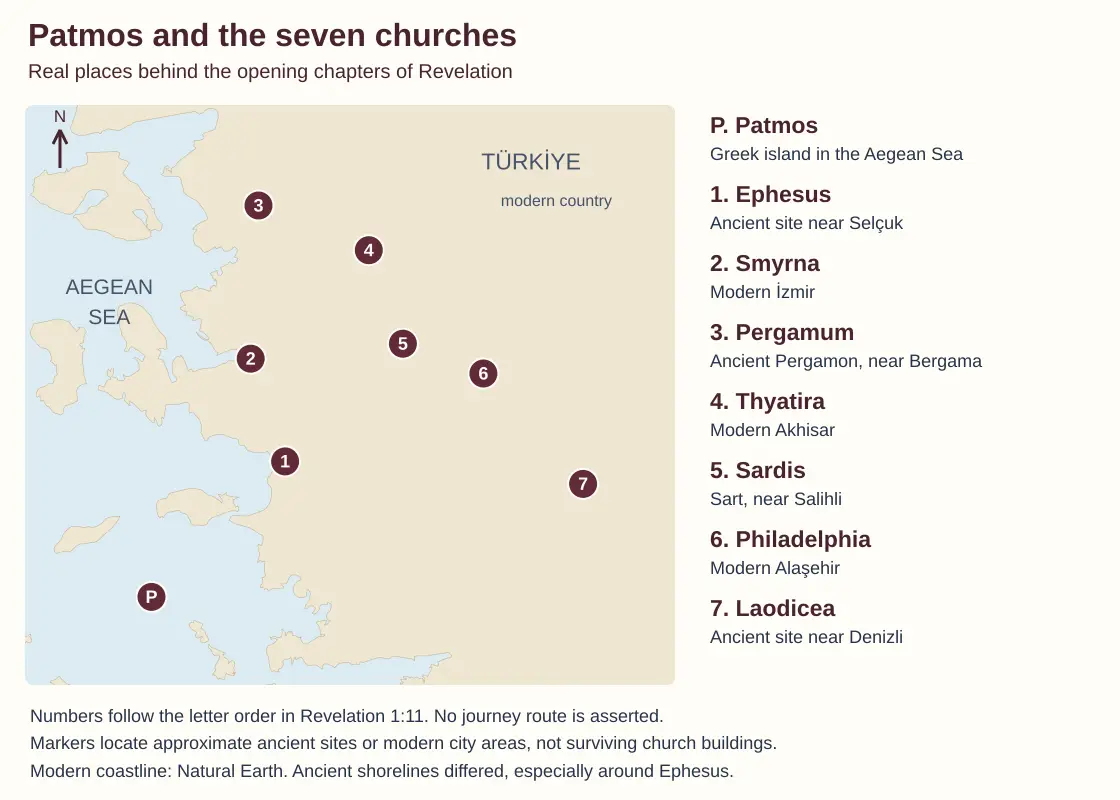
John says he was on Patmos because of the word of God and the testimony of Jesus (Revelation 1:9). This is commonly understood as exile, although the verse does not describe his sentence or conditions. A date near AD 95, during Domitian’s reign, is widely accepted; an earlier date in the AD 60s is also defended. Revelation does not name the emperor or give a year. The map locates the island and the seven receiving churches, not the location of every vision.
Who first received it?
The seven churches were communities of believers in the Roman province of Asia, in what is now western Türkiye: Ephesus, Smyrna, Pergamum, Thyatira, Sardis, Philadelphia, and Laodicea (Revelation 1:4; Revelation 1:11). They were not seven church buildings. Their difficulties were not identical: some suffered persecution, some tolerated false teaching, and some were spiritually complacent. Christ’s repeated call to hear what the Spirit says to the churches reaches beyond any one congregation.
What kind of book is this?
Revelation calls itself a revelation, a prophecy, and a message addressed to churches (Revelation 1:1–4). Its visions use the language and pictures of earlier Scripture, especially Daniel, Ezekiel, Isaiah, Zechariah, and Exodus. A symbol can communicate real truth without functioning like a photograph. Begin with what the text identifies, compare its Old Testament background, and distinguish an explanation from a guess.
The understanding followed in the companion book
Hollis explains his own understanding plainly: Jesus gathers His people before a coming period of great trouble, understood as about seven years; people come to faith during that time; Jesus returns, defeats His enemies, and reigns for a thousand years before the final judgment and new creation. This brings together passages such as Daniel 9:24–27, 1 Thessalonians 4:13–18, and Revelation 19:11–21; Revelation 20:1–15. The complete sequence is a reading of several passages together, not a timetable explicitly stated in one verse of Revelation. Each conclusion must remain open to examination by Scripture.
Where faithful Christians understand the details differently
Some expect Jesus to gather believers after the trouble has begun; others connect that gathering with His public return after the trouble. Some understand the thousand years as a future earthly reign, others as a picture of His present reign, and others expect a long period of widespread gospel fruitfulness before His return. Christians also differ over how much of Revelation describes the first century, later history, recurring spiritual conflict, or events still ahead. Those questions overlap, but one answer does not automatically settle all the others. We can explain differences without making labels the main lesson.
What must not get lost in the discussion?
Jesus Christ is Lord. His saving victory is not in doubt. He will return, evil will not have the final word, and His people are called to worship God and remain faithful. Do not turn a disputed identification into a test of someone’s love for Jesus. Do not soften a clear command because the surrounding vision is difficult. Ask what God has actually made known and what He calls us to do now (Revelation 1:3; Revelation 14:12; Revelation 22:7).
Revelation in the New Testament
Usual order of the 27 New Testament books, not the order in which they were written. Revelation is book 27, following Jude and concluding the New Testament.
Matthew · Mark · Luke · John · Acts · Romans · 1 Corinthians · 2 Corinthians · Galatians · Ephesians · Philippians · Colossians · 1 Thessalonians · 2 Thessalonians · 1 Timothy · 2 Timothy · Titus · Philemon · Hebrews · James · 1 Peter · 2 Peter · 1 John · 2 John · 3 John · Jude · Revelation
Places in Revelation
Patmos and the seven churches. Open the image for a larger view. John was on Patmos; the churches were communities of believers in the Roman province of Asia, not the whole modern continent of Asia. Their cities lie in western Türkiye today.
Reading the map: P marks Patmos, a Greek island. Numbers 1–7 follow the list in Revelation 1:11. The markers indicate approximate ancient sites or modern city areas, not locations of surviving first-century church buildings. No route of John’s travels is shown. Modern coastlines are used; the ancient coast around Ephesus was different.
Ancient name → modern location: Ephesus → ruins near Selçuk; Smyrna → İzmir; Pergamum → Pergamon near Bergama; Thyatira → Akhisar; Sardis → Sart near Salihli; Philadelphia → Alaşehir; Laodicea → ruins near Denizli.
Visions of heaven, the dragon, the beasts, and the New Jerusalem are not plotted as ordinary map locations. Their meaning must be learned from the passages themselves, not from an invented geographic reconstruction.
The opening blessing joins hearing to keeping. Revelation is meant to form faithful servants, not merely curious readers. Its announcement that Jesus is coming calls us to worship, repentance, and readiness. Ask not only what a vision means, but what obedience its message requires.
The glorious Lord stands among the lampstands, which the text identifies as the churches. He knows their service, suffering, love, and failures. Reputation and prosperity do not guarantee spiritual health. He commends faithfulness, exposes compromise, commands repentance, and gives promises to those who conquer. We must let Him examine us rather than applying every warning only to someone else.
The throne is occupied. Worship belongs to the Creator, and the slain yet living Lamb is worthy to open the scroll. Jesus conquers through His sacrificial death and redeems people from every tribe, language, people, and nation. His victory gives the entire book its center: the future rests with God and the Lamb, not with the strongest earthly ruler.
The seals expose conquest, conflict, scarcity, death, and the cry of those killed for their testimony. The martyrs’ question is heard, even while they are told to wait. The vision does not invite us to enjoy disaster or retaliate against opponents. It assures us that injustice is seen and that God, not we, will judge righteously.
The sealed servants and the great multitude declare that salvation belongs to God and the Lamb. Christians differ over the relationship between the 144,000 and the multitude, and over how these scenes fit the timetable. The shared comfort is plain: God knows His servants, and the Lamb brings His people into His care. Their robes are made white through His blood, not their own merit. Their promised relief does not mean believers never suffer or die.
Warnings call for repentance, not speculation alone
The trumpet judgments echo earlier biblical judgments and uncover the destructive character of evil. The continued refusal to repent in Revelation 9:20–21 is a central moral warning. We should not become so absorbed in identifying the pictures that we fail to turn from idolatry, violence, immorality, theft, and deception ourselves.
John must receive the little scroll before speaking again. God’s witnesses face opposition, yet their enemies cannot overturn His final vindication. Some understand the two witnesses as two future individuals; others understand them as portraying the church’s faithful testimony. The passage calls for witness and endurance. The sealed words of the seven thunders remind us that God has not disclosed everything we might wish to know.
The dragon is defeated, but his opposition is real
The text identifies the dragon as the devil and Satan. The vision presents the Messiah, His people, and the enemy’s furious opposition. God’s victory and care do not remove the call to costly faithfulness. The saints overcome through the blood of the Lamb and their testimony, even when faithfulness costs their lives. Satan’s accusations do not have the final authority over those who belong to Christ.
The beasts display authority, deception, and pressure to worship falsely, including economic coercion. The mark is presented together with allegiance to the beast, not as an unexplained danger detached from worship. Proposed historical and future identifications must be tested, not announced as certain merely because they resemble a headline. The clear demand is loyalty to Jesus rather than surrender to evil’s promises or threats.
The Lamb’s people stand in contrast to those who worship the beast. The chapter joins a call to worship the Creator, warnings of judgment, patient endurance, and a blessing on those who die in the Lord. The harvest scenes show that the world is moving toward God’s appointed reckoning. Christian hope does not excuse compromise; it strengthens faithful obedience.
The song of Moses and the Lamb honors God’s just and true ways. The bowls portray the completion of His wrath, while repeated refusal to repent exposes stubborn rebellion. Scripture’s warning is sobering, not entertainment. The call to remain awake in Revelation 16:15 turns the reader from fascination with disaster toward personal readiness before Christ.
Babylon combines seductive wealth, corrupt power, idolatry, and persecution. Its first readers could recognize features of imperial Rome; Christians differ over further historical or future fulfillment. Its warning reaches every age: prosperity built on exploitation and rebellion cannot last. Coming out means refusing participation in its sins, not assuming that changing an address alone makes a person faithful.
Heaven rejoices in God’s justice and the marriage supper of the Lamb. The rider called Faithful and True judges righteously and overcomes the forces opposing Him. His victory is not a commission for Christians to wage private holy war. The bride’s readiness is a gift expressed in faithful living; the church waits for the King rather than attempting to replace Him.
Christians differ over whether the thousand years describes a future earthly kingdom or Christ’s present reign, and over the first resurrection. The companion book explains Hollis’s expectation of a future thousand-year reign while hearing other readings fairly. The final outcome is not uncertain: Satan is defeated, the dead stand before God, death and Hades are ended, and the book of life matters eternally. Judgment according to deeds exposes the truth of lives; it does not make salvation a purchase earned by good works.
God will dwell with His people in a renewed creation
The goal is more than escape from hardship. God dwells with His people; death, mourning, and pain are gone. The city’s glory, the river of life, and the tree of life bring earlier biblical promises to their fulfillment. The servants of God see His face and serve Him. The vision gives real hope without requiring us to turn every architectural image into an engineering drawing.
The closing invitation offers the water of life freely. The warnings forbid manipulating this prophecy, and the repeated promise of Jesus’ coming calls for watchfulness. We are not given permission to set a date or to neglect ordinary obedience while waiting. The fitting response is to come to Christ, keep His Word, and pray for His return.
A prayer shaped by Revelation
Lord God Almighty, You alone are worthy of our worship. Thank You for Jesus Christ, the faithful witness, who loves us and has freed us from our sins by His blood. Search our hearts as You searched the seven churches. Restore our first love, expose our compromise, awaken us from complacency, and give us courage to obey. Teach us to receive Your Word humbly, holding firmly to what You have made clear and refusing to pretend we know what You have not revealed. Keep us from the worship of power, money, comfort, or ourselves. Strengthen those who suffer for the name of Jesus, and make us faithful witnesses with them. Help us hear Your warnings, repent sincerely, and live in the hope of Your promises. Fix our eyes on the Lamb and on the day when You will dwell with Your people and wipe away every tear. Until then, make us watchful, loving, and faithful. Come, Lord Jesus. Amen.
Jesus Christ is Lord. The Lamb conquers, His people are called to faithful endurance, and God will dwell with His redeemed creation. The outline follows the order in which John reports the visions; it does not assume that every scene is a separate event following the previous one in time.
Revelation 1:1–8 — The revelation, its blessing, and its greeting
Revelation 22:6–21 — Keep the prophecy; come to the water of life; await Jesus
Reading Revelation carefully
Read the whole paragraph and vision before isolating a verse. Ask who is speaking, what John sees or hears, and whether the text itself explains a symbol.
Let earlier Scripture illuminate the pictures. Daniel, Ezekiel, Isaiah, Zechariah, and Exodus are important companions; a similar image is a clue to examine, not permission to ignore differences.
Distinguish what the text states from a conclusion reached by bringing passages together. Explain uncertain identifications as possibilities, not facts.
The order in which John describes visions does not by itself settle the order of all the events they portray. Some Christians read more of the sequences as successive events; others see overlapping views of the same period.
Read the time expressions honestly. The book speaks of things near and soon, and also of Christ’s return, resurrection, judgment, and new creation. Do not erase either the first readers or the final hope to make a scheme work.
Do not assign today’s people, technologies, or news events to the beasts, mark, or judgments as though Scripture named them. Do not set dates.
When the passage commands, prohibits, warns, or promises, ask: What response does this call for? What needs to change in me? A promise should strengthen trust; a warning should produce repentance, not just curiosity.
Building on Bible Prophecy
This review builds on Hollis McGehee’s Bible Prophecy: Understanding the promises of God and learning to live in light of them, including the November 6, 2026 plain-language introduction and chapter-by-chapter walkthrough. The companion remains a separate book; this review does not replace or rewrite it.
The companion explains unfamiliar terms, the reasons Christians understand prophecy differently, Revelation’s words and pictures, and the prophetic books that prepare us to read it. Its study questions and illustrations can support this closer verse-by-verse work. Illustrations are artists’ interpretations, not photographs of the visions or new facts added to the text.
Begin with Scripture, then use the companion to compare explanations. Hollis’s stated understanding is that Jesus gathers His people before about seven years of great trouble. The book also presents other Christian readings in plain language and asks us to test our conclusions by God’s Word.
BibleProject’s two overview videos offer another way to see the book’s literary movement. They are optional teaching aids, not the final authority on disputed timing or a claim that every interpretation matches this review.
Read the verse and its surrounding passage before the note. For example, Revelation 3:20 belongs to Christ’s call for the complacent Laodicean church to repent; do not detach the invitation from that setting. The notes draw connections without making every image an exact match for a modern event.
Each entry includes two related passages and a Greek word behind selected English wording. Meanings are contextual explanations, not claims that a word means everything in its dictionary entry at once.
Living the Word:James 1:22 calls us to be doers, not hearers only. Selected passages ask what we should obey, turn from, or trust. The response is to God’s grace, not a way to purchase it.
Revelation begins as God's disclosure through Jesus Christ for His servants, not as a puzzle reserved for specialists. John receives and passes on what he is shown. The urgency of what must happen soon mattered to the original churches; it must neither be erased nor converted into a date-setting formula.
English wording → Greek word → meaning
“revelation” → apokalypsis → an unveiling or disclosure
Read alongside
Daniel 2:28–29BLB — God discloses what human wisdom cannot discover.
Revelation 22:6BLB — The conclusion repeats the message’s divine origin and urgency.
John identifies his task as bearing witness to God's word and Jesus' testimony. He does not present private invention as divine revelation. What he saw must be read within this claim to faithful testimony, while the reader distinguishes the vision itself from later interpretations of its images.
English wording → Greek word → meaning
“testimony” → martyria → witness or attestation
Read alongside
John 21:24BLB — The Gospel likewise identifies a witness behind its testimony.
Revelation 22:8BLB — John again identifies himself as the hearer and observer.
The blessing includes public reading, attentive hearing, and keeping the message. Revelation aims at obedient faithfulness, not merely curiosity about future events. Its nearness calls the churches to respond now. Understanding every disputed detail is not a prerequisite for receiving its warnings, worshiping God, and holding fast to Jesus.
English wording → Greek word → meaning
“keep” → tēreō → heed and observe what has been entrusted
Read alongside
Luke 11:28BLB — Jesus blesses hearing God’s word and keeping it.
Seven actual churches in Roman Asia receive grace and peace from the eternal God. The seven spirits are commonly understood as the fullness of the Holy Spirit, especially alongside 4:5 and 5:6; some read them as heavenly spirits. The text does not teach seven separate Holy Spirits.
English wording → Greek word → meaning
“peace” → eirēnē → peace granted by God
Read alongside
Exodus 3:14BLB — God’s self-identification forms part of the background to His enduring presence.
Revelation 4:5BLB — The seven spirits appear again as seven burning lamps.
Jesus is the reliable witness, the risen One with supremacy over death, and the ruler above earthly kings. Firstborn emphasizes His preeminence, not that He was created. Before describing judgment, John praises Christ's present love and His costly liberation of His people from sin through His blood.
English wording → Greek word → meaning
“firstborn” → prōtotokos → firstborn, here expressing resurrection priority and supremacy
Those freed by Christ belong to His kingdom and serve His God and Father as priests. Their identity is a gift of redemption, not a badge of superiority over others. Worship answers what Christ has done. The persecuted churches possess a calling that imperial authorities cannot grant or cancel.
English wording → Greek word → meaning
“priests” → hiereus → those set apart for priestly service
Read alongside
Exodus 19:6BLB — Israel is called to be a kingdom of priests.
1 Peter 2:9BLB — Believers’ priestly calling includes declaring God’s excellencies.
The announcement joins Daniel's coming figure with Zechariah's pierced one and mourning. Christ's appearing will not remain a private rumor: His authority confronts the peoples of the earth. Interpreters debate the mourning's precise scope and character, but the passage plainly calls readers to reckon with the returning Jesus.
English wording → Greek word → meaning
“clouds” → nephelē → clouds, here associated with divine appearing
Read alongside
Daniel 7:13–14BLB — The humanlike figure comes with heaven’s clouds and receives dominion.
God declares His comprehensive sovereignty through the first and last letters of the Greek alphabet. He is not confined by the churches' present crisis or by the empires around them. The title Almighty assures believers that history has a Lord; it does not excuse careless claims about His unrevealed timetable.
English wording → Greek word → meaning
“Almighty” → pantokratōr → the all-ruling One
Read alongside
Isaiah 44:6BLB — God identifies Himself as the first and the last.
Revelation 21:6BLB — Alpha and Omega accompanies the completion of God’s purposes.
John stands beside his readers as their brother and fellow participant in suffering, kingdom, and endurance in Jesus. Patmos is the setting of his witness-related hardship. He does not claim distance from the church's affliction. Kingdom belonging and present tribulation coexist rather than canceling one another.
English wording → Greek word → meaning
“patient endurance” → hypomonē → steadfast endurance under pressure
Read alongside
Acts 14:22BLB — Entry into God’s kingdom is spoken of alongside tribulation.
2 Timothy 2:12BLB — Endurance and sharing Christ’s reign are joined.
John describes being in the Spirit when a commanding voice interrupts him. The Lord's Day is commonly understood as the day of Christian worship, though the wording has prompted debate. The trumpet comparison conveys the voice's strength and authority; it is not by itself a rapture chronology.
English wording → Greek word → meaning
“voice” → phōnē → a voice or sound
Read alongside
Ezekiel 3:12BLB — The Spirit and a mighty sound accompany a prophetic experience.
John must write what he sees and send it to seven named congregations. The whole vision, not merely chapters 2–3, belongs to these churches. Their cities locate Revelation within real communities in Asia. Assigning each congregation a later era of church history goes beyond this command.
English wording → Greek word → meaning
“write” → graphō → record in writing
Read alongside
Habakkuk 2:2BLB — A prophetic vision is to be written for others to read.
John turns toward the voice and sees seven golden lampstands. Their meaning will be explained in verse 20, so no speculative code is needed. The scene presents the churches in relation to the glorious One among them. Their calling to bear light depends on His presence rather than their prominence.
The figure among the lampstands evokes Daniel's humanlike heavenly figure. His long robe and golden sash convey dignity and authority, with priestly associations often noted. Later self-identification makes clear that He is the risen Jesus. The churches are not abandoned: their Lord stands in their midst.
English wording → Greek word → meaning
“son” → huios → son; part of the phrase “son of man”
The white hair recalls the Ancient of Days, while fiery eyes express the penetrating holiness of Christ's gaze. The image is not a photograph of ordinary human aging. It places Jesus within divine glory and prepares for His searching assessment of churches whose outward appearance may hide their true condition.
English wording → Greek word → meaning
“eyes” → ophthalmos → eyes; here within the vision of searching sight
Read alongside
Daniel 7:9BLB — The Ancient of Days is pictured with hair like pure wool.
Burnished metal and rushing waters intensify the portrayal of Christ's strength and majesty. The language echoes earlier biblical visions rather than supplying secret correspondences to modern machinery. His voice is not one competing opinion among many. The churches must listen to the Lord whose presence overwhelms ordinary categories.
English wording → Greek word → meaning
“waters” → hydōr → water; the plural supplies the rushing-water comparison
Read alongside
Ezekiel 43:2BLB — God’s glorious approach is accompanied by a sound like many waters.
Daniel 10:6BLB — The heavenly figure has limbs like polished bronze and a mighty voice.
The stars are held in Christ's right hand, and the sword proceeds from His mouth. Verse 20 interprets the stars; other Scriptures illuminate the judicial power of His word. The blazing face displays glory. No detail requires inventing a physical weapon wielded by believers against their opponents.
English wording → Greek word → meaning
“sword” → rhomphaia → a large sword; here portraying Christ’s effective judging word
Read alongside
Isaiah 11:4BLB — The Messiah strikes with the word of His mouth.
Revelation 19:15BLB — The sword from Christ’s mouth appears again in judgment.
John falls before the glorious Christ, but Christ's touch and words answer his fear. The first-and-last title recalls God's own self-description in Isaiah. Reverence and reassurance belong together: Jesus does not cease to be holy when He comforts His servant, nor does His holiness make compassion impossible.
English wording → Greek word → meaning
“fear” → phobeomai → be afraid; here in the command not to fear
Read alongside
Isaiah 44:6BLB — The Lord calls Himself the first and the last.
Daniel 10:9–12BLB — A terrified servant is touched and told not to fear.
Jesus identifies Himself as the One who died and now lives forever. His keys signify authority over death and Hades, not a claim that Satan governs hell. The churches facing martyrdom hear this before the visions of judgment: the final power over their destiny belongs to their risen Savior.
English wording → Greek word → meaning
“keys” → kleis → keys, representing authority to open and close
Read alongside
Romans 6:9BLB — The risen Christ will never die again.
John is commanded to record the vision and the matters it discloses. Many readers use this verse as a broad outline of past sight, present conditions, and coming events. That can aid organization, but the wording alone does not establish a pretribulation rapture or a completely uninterrupted timeline.
English wording → Greek word → meaning
“after” → meta → after; part of “after this” in the temporal expression
Read alongside
Revelation 4:1BLB — The next major vision concerns what must take place afterward.
Revelation 22:10BLB — The book’s message is to remain available to its hearers.
Jesus explains the symbols: lampstands are churches, and stars are their angels. Whether these angels are heavenly representatives or human messengers remains debated; the term can denote a messenger, but Revelation usually uses it for heavenly beings. The secure point is that Christ holds and addresses His churches.
English wording → Greek word → meaning
“angels” → angelos → messengers; heavenly or human identity here is debated
Ephesus hears from the One who holds the stars and walks among the lampstands. Christ's presence makes both His encouragement and His correction authoritative. The message addresses a real congregation, yet its closing summons reaches every church willing to hear. Leadership and activity remain accountable to the Lord who knows them.
Jesus commends costly service, endurance, and testing people who falsely claim apostolic authority. Christian love does not require gullibility. Nevertheless, the praise must be read with the coming rebuke: accurate discernment and hard work cannot replace love. The church needs truth and devotion together rather than a choice between them.
English wording → Greek word → meaning
“tested” → peirazō → put to the test or examine
Read alongside
1 John 4:1BLB — Believers must test claims to spiritual authority.
Christ recognizes perseverance borne for His name. Faithfulness can be demanding without being publicly celebrated, yet the Lord sees it. This commendation should not be canceled by the rebuke that follows. His assessment is exact enough to acknowledge real obedience while exposing the serious failure that still needs repentance.
English wording → Greek word → meaning
“bearing up” → bastazō → carry or endure a burden
Read alongside
Galatians 6:9BLB — Believers are encouraged not to grow weary in doing good.
Hebrews 12:3BLB — Christ’s endurance helps His people resist weariness.
The church has abandoned the love it once showed. The wording should not be restricted so tightly to love for Christ that love for people disappears, or vice versa. Their earlier devotion has cooled despite impressive service. Christ does not regard loveless orthodoxy as a harmless variation of healthy discipleship.
English wording → Greek word → meaning
“love” → agapē → love expressed in devoted concern
Jesus commands remembrance, repentance, and renewed action. Recovery is not merely nostalgia or a fresh feeling; it includes doing the earlier works. The threatened removal of the lampstand is a serious warning to a congregation about its standing as His church. Busy activity must not become an excuse for refusing correction.
English wording → Greek word → meaning
“repent” → metanoeō → turn in repentance from the course being exposed
Read alongside
Luke 3:8BLB — Repentance is to bear fitting fruit.
Ephesus rightly rejects the practices of the Nicolaitans, which Christ also rejects. Revelation supplies too little history to identify their founder confidently or explain their entire system. The explicit target is their works. Opposition to corruption should remain joined to the love Christ commands, not become contempt for people.
English wording → Greek word → meaning
“works” → ergon → deeds or practices
Read alongside
Revelation 2:14–15BLB — The Nicolaitans appear alongside teaching that encourages compromise.
Romans 12:9BLB — Genuine love rejects evil and holds to good.
Every church must hear the Spirit's message. The conqueror is promised life with God, pictured through the tree once barred after human rebellion. Victory in Revelation is grounded in belonging to Christ and persevering in His testimony, not gaining salvation by superior performance. The promise reaches toward the restored creation.
Smyrna is addressed by the Lord who entered death and lives again. His title as first and last grounds their hope in divine sovereignty rather than the goodwill of persecutors. The church will face costly faithfulness, but its Lord knows death from within and has already overcome it.
English wording → Greek word → meaning
“came to life” → zaō → live; here live again after death
Christ sees suffering and material poverty yet declares Smyrna spiritually rich. His severe description of hostile slanderers concerns particular opponents, not all Jewish people. It must not be used to justify antisemitism. The letter reverses worldly measures: a deprived church can possess the riches of belonging to the risen Lord.
English wording → Greek word → meaning
“poverty” → ptōcheia → material destitution or poverty
Read alongside
James 2:5BLB — God’s poor people can be rich in faith.
Romans 11:17–20BLB — Gentile believers are warned against arrogance toward Jewish people.
Jesus does not promise escape from prison or death. He commands courage and faithfulness, promising the crown of life beyond the ordeal. Ten days marks a limited trial; the text does not identify ten later imperial persecutions. The devil's hostility is real, but it cannot overturn Christ's final promise.
English wording → Greek word → meaning
“faithful” → pistos → loyal or trustworthy
Read alongside
James 1:12BLB — The steadfast believer receives the crown of life.
Matthew 10:28BLB — Fear of God is set above fear of those who kill the body.
The promise does not deny that believers may suffer physical death; the preceding verse explicitly allows it. Christ assures His conquerors that the second death cannot finally harm them. Revelation later identifies this as the lake of fire. The distinction gives suffering Christians hope beyond what persecutors can take.
Pergamum hears the One whose judging word is pictured as a sharp two-edged sword. The same Lord who comforts threatened believers also confronts compromise among them. His authority does not depend on the city's political or religious structures. The church must weigh all teaching against His word.
English wording → Greek word → meaning
“sharp” → oxys → sharp or keen
Read alongside
Revelation 1:16BLB — The sword proceeds from Christ’s mouth in the opening vision.
Hebrews 4:12BLB — God’s word penetrates and exposes what lies beneath appearances.
Jesus knows Pergamum's hostile setting and remembers Antipas by name as a faithful witness. Neither a particular monument behind Satan's throne nor Antipas's manner of death is identified here. The church's courage is real, but the next verses show that resisting outward persecution does not automatically prevent inward compromise.
Balaam's story exposes teaching that makes participation in idolatry and sexual sin acceptable. Numbers supplies the background to this stumbling block; Revelation applies it to current compromise. Courage in one area does not excuse disobedience in another. Christ challenges a church willing to tolerate what endangers its members.
English wording → Greek word → meaning
“stumbling block” → skandalon → a trap or inducement that leads into sin
Read alongside
Numbers 31:16BLB — Balaam’s counsel is connected with Israel’s unfaithfulness at Peor.
The Nicolaitan teaching is tolerated within Pergamum, unlike the rejection commended at Ephesus. Revelation links the problem with the preceding pattern of compromise without explaining every historical detail. The practical issue is whether a church treats seductive wrongdoing as acceptable instruction simply because some of its members defend it.
English wording → Greek word → meaning
“teaching” → didachē → instruction or doctrine
Read alongside
Revelation 2:6BLB — Ephesus is commended for rejecting Nicolaitan practices.
2 Peter 2:14–15BLB — Balaam’s way illustrates corrupt teachers leading others into sin.
The church must repent rather than protect corrupt teaching. Christ's threatened opposition is directed against the compromisers, but the congregation is responsible to respond. The sword of His mouth portrays His decisive word of judgment. This is not permission for believers to use physical violence in defense of doctrine.
Hidden manna, a white stone, and a new name promise Christ's provision and personal welcome. Ancient practices have been proposed to explain the stone, but Revelation does not choose one. The assurance should rest on Christ's gift and recognized belonging, not on a confidently asserted reconstruction of an unknown custom.
English wording → Greek word → meaning
“name” → onoma → name, here expressing personal identity and belonging
Read alongside
Exodus 16:32–34BLB — Manna was preserved as a witness to God’s provision.
Isaiah 62:2BLB — God’s people receive a new name from Him.
Thyatira hears the Son of God whose fiery eyes and burnished feet recall the opening vision. His searching perception and strength frame the assessment of a church with genuine virtues and dangerous tolerance. Loving service does not make the church exempt from the holy Lord's examination of teaching and conduct.
Christ names the church's love, faith, service, and endurance, and recognizes its growth in works. The coming rebuke does not mean that all its ministry was false. His assessment teaches careful discernment: acknowledge what is genuinely good without allowing good qualities to shield persistent corruption from correction.
English wording → Greek word → meaning
“service” → diakonia → service or ministry for others
Read alongside
Hebrews 6:10BLB — God does not overlook love shown in service.
The teacher called Jezebel claims prophetic authority but leads Christ's servants into idolatry and sexual immorality. The name recalls Ahab's queen; whether it is her actual name is unstated. The charge concerns her teaching and conduct, not every woman in leadership or an invented identification with a modern denomination.
English wording → Greek word → meaning
“prophetess” → prophētis → a woman claiming to speak prophetically
Christ has allowed time for repentance, exposing both His patience and the teacher's refusal. Delay in judgment must not be mistaken for approval of sin. The passage names unwillingness to turn, not a lack of warning. The gracious opportunity to repent makes persistent resistance more serious rather than harmless.
English wording → Greek word → meaning
“repent” → metanoeō → turn from wrongdoing in repentance
Read alongside
Romans 2:4–5BLB — God’s kindness calls for repentance rather than stubbornness.
2 Peter 3:9BLB — Divine patience is associated with repentance.
The bed and severe affliction turn the imagery of sinful indulgence into judgment. Those sharing the teacher's wrongdoing are warned that repentance is necessary. The judgment is Christ's action; churches are not authorized to inflict illness or violence. Particular suffering today should not automatically be explained by this specific warning.
English wording → Greek word → meaning
“tribulation” → thlipsis → affliction or severe distress
Read alongside
1 Corinthians 11:30–32BLB — Paul describes divine discipline within another particular church setting.
Hebrews 12:10–11BLB — God’s discipline aims at holiness, though it is painful.
Christ searches motives as well as deeds, and His judgment will make that known to the churches. The teacher's children most naturally include her followers, though the image should not be pressed beyond the text. No reputation hides the heart. The response is truthful repentance, not human attempts to enact His sentence.
English wording → Greek word → meaning
“heart” → kardia → the inward center of thought and desire
Christ distinguishes those resisting the corrupt teaching from those embracing it. Supposed depth is exposed as satanic deception, not spiritual maturity. He does not require the faithful remnant to master evil before recognizing it. His word relieves them of additional burdens while calling them to retain the truth they know.
English wording → Greek word → meaning
“burden” → baros → a weight or burden
Read alongside
Acts 15:28–29BLB — The apostolic letter avoids unnecessary burdens while rejecting idolatry and immorality.
Romans 16:19BLB — Believers should be wise in good and innocent concerning evil.
The command is simple: retain faithful allegiance until Christ comes. The church need not invent a new spiritual program to compete with seductive teaching. Holding fast is active perseverance in what Christ has given, sustained by hope in Him. It does not authorize calculating the date of His return.
English wording → Greek word → meaning
“hold fast” → krateō → keep a firm hold
Read alongside
Hebrews 10:23BLB — Believers hold their confession because God is faithful.
Revelation 3:11BLB — Philadelphia likewise receives a command to hold fast.
Christ promises His conqueror a share in authority over the nations. Keeping His works describes enduring allegiance, not purchasing salvation through merit. The promise is rooted in the Messiah's own royal authority. It gives suffering believers hope without authorizing them to coerce others into faith in the present.
English wording → Greek word → meaning
“authority” → exousia → authority or delegated right to rule
Read alongside
Psalm 2:8–9BLB — The Messiah receives the nations and royal authority.
2 Timothy 2:12BLB — Enduring with Christ is joined to reigning with Him.
The iron rod and shattered pottery echo Psalm 2's decisive messianic rule. Christ shares what He received from the Father with His faithful people. The image assures the defeat of resistance to God's reign. It should not be converted into a present mandate for Christians to impose their will through force.
English wording → Greek word → meaning
“rule” → poimainō → shepherd or govern; here royal rule
Read alongside
Psalm 2:9BLB — The iron rod and broken pottery belong to the messianic psalm.
The morning star adds a promise of Christ-centered hope to the promise of shared authority. Jesus later calls Himself the bright morning star, providing the strongest internal connection. The image points toward participation in His victorious life, not a secret astronomical prediction or a possession independent of Him.
English wording → Greek word → meaning
“star” → astēr → star; here the morning-star image
The Spirit's summons reaches beyond Thyatira to the churches collectively. Readers should not reduce the letters to historical curiosities or warnings only for other congregations. The One who knows each church speaks to all of them, calling for hearing that becomes discernment, repentance, and enduring trust in His promises.
English wording → Greek word → meaning
“hear” → akouō → hear with the summons to heed
Read alongside
Revelation 2:7BLB — The repeated invitation calls every church to listen.
James 1:22–25BLB — Attentive hearing must become obedient response.
Sardis's reputation for life conflicts with Christ's diagnosis of death. The One possessing the seven spirits and stars knows more than public appearances reveal. A church's activity, history, or popularity cannot establish spiritual health. This warning invites honest examination under Christ's word rather than confidence in a successful image.
English wording → Greek word → meaning
“dead” → nekros → dead; here a spiritual diagnosis
Christ commands wakefulness and strengthening of what remains. The situation is grave but the command still offers a way to respond. Incomplete works are judged before God rather than by reputation. Spiritual renewal therefore requires more than preserving an institution; the church must recover attentive, obedient life before its Lord.
English wording → Greek word → meaning
“strengthen” → stērizō → make firm or establish
Read alongside
Luke 22:32BLB — Peter is commissioned to strengthen his brothers.
Ephesians 5:14BLB — Wakefulness and Christ’s light answer spiritual sleep.
Sardis must remember what it received, keep it, and repent. The unexpected-thief warning emphasizes readiness, not a detailed prophetic timetable. Christ's coming in judgment upon an unwatchful congregation is a serious threat. Familiarity with earlier instruction becomes useful only when the church returns to actual obedience.
Christ recognizes faithful people within a compromised congregation. Unsoiled garments and walking in white portray purity and fellowship with Him, not a claim that they never sinned. Revelation grounds cleansing in the Lamb's blood. The Lord's judgment is discerning enough to see those overlooked by a general diagnosis.
English wording → Greek word → meaning
“garments” → himation → clothing or garments
Read alongside
Revelation 7:14BLB — The redeemed are cleansed through the Lamb’s blood.
Jude 23 — Defiled clothing pictures the danger of corruption.
The conqueror receives white clothing, secure acknowledgment, and Christ's pledge concerning the book of life. Christians differ about how this assurance relates to warnings against falling away. Its direct force should not be lost: Christ promises to own His faithful people before the Father rather than treating their endurance as invisible.
English wording → Greek word → meaning
“confess” → homologeō → acknowledge or openly declare
Read alongside
Matthew 10:32BLB — Jesus acknowledges His people before the Father.
Revelation 21:27BLB — Entry into the holy city is linked with the Lamb’s book of life.
Sardis's warning is addressed to all who will hear the Spirit. A reader may recognize another church's weakness while refusing self-examination. The repeated summons prevents that escape. Christ intends His word to awaken His people, with the hope of restored faithfulness rather than mere criticism of someone else's failures.
English wording → Greek word → meaning
“Spirit” → pneuma → Spirit; here God’s Spirit speaking to the churches
Read alongside
Revelation 3:22BLB — The same summons concludes the final church message.
Hebrews 3:7–8BLB — Hearing the Spirit’s word must not be met by hardened hearts.
Philadelphia hears from the holy and true One who holds David's key. Isaiah's royal-household image illuminates Christ's authority to admit and exclude. His decision cannot be overturned by hostile people. The reassurance concerns belonging under the Messiah's rule, not merely success in whatever opportunity an individual wishes to pursue.
English wording → Greek word → meaning
“key” → kleis → key, an image of authority over access
Read alongside
Isaiah 22:22BLB — The key signifies authority to open and shut.
The church's small strength does not prevent Christ from commending its faithfulness. The open door is often understood as access to His kingdom, while some see missionary opportunity. The surrounding key imagery favors His securing their place. Human weakness is not the same as spiritual failure when His word is kept.
English wording → Greek word → meaning
“denied” → arneomai → deny or disown
Read alongside
1 Corinthians 16:9BLB — An open door can elsewhere describe an opportunity for ministry.
Christ promises vindication before the particular opponents who deny His people's standing. Isaiah's language is applied to this local conflict, but it must not become hostility toward Jewish people generally. The decisive disclosure is that Jesus loves this weak church. Vindication belongs to Him rather than to the church's revenge.
English wording → Greek word → meaning
“loved” → agapaō → love or hold in devoted concern
Read alongside
Isaiah 60:14BLB — Former opponents recognize God’s favor toward His people.
Romans 12:19BLB — Believers entrust vengeance to God rather than taking it themselves.
Christ promises protection concerning a worldwide hour of testing. Some understand removal before that period; others understand preservation through it, comparing John 17:15. The phrase requires careful interpretation rather than an assumed timetable. Whatever timing one holds, the immediate assurance is Christ's faithful care for those who keep His word.
English wording → Greek word → meaning
“keep” → tēreō → guard or preserve; the sense of “keep from” is debated here
Read alongside
John 17:15BLB — Jesus asks the Father to keep His disciples from the evil one.
The promise of Christ's coming leads directly to the command to hold fast. His crown is not a prize to be secured through anxious date calculations but encouragement for continued allegiance. The church should not allow hostile pressure or seductive compromise to rob its witness of faithfulness to the Lord.
English wording → Greek word → meaning
“crown” → stephanos → a victor’s crown or wreath
Read alongside
James 1:12BLB — Steadfast faith is associated with the crown of life.
Hebrews 10:23–25BLB — Holding fast includes encouraging one another as the day approaches.
The pillar and the written names promise lasting belonging in God's presence. They should not be pressed into an architectural claim that conflicts with the city having no temple in 21:22. Christ's people bear God's identity and share His city. The repeated names emphasize relationship and security rather than independent status.
English wording → Greek word → meaning
“pillar” → stylos → pillar, here an image of stable belonging
Read alongside
Revelation 21:2–3BLB — New Jerusalem comes from God and expresses His dwelling with His people.
The Spirit's invitation gives every church a share in hearing Philadelphia's encouragement. Congregations with little outward strength need not measure their future by impressive resources alone. Yet the promise is not detached from the letter's call to keep Christ's word. Reassurance and faithful perseverance remain joined.
English wording → Greek word → meaning
“churches” → ekklēsia → assemblies or congregations
Laodicea hears the utterly reliable witness, the Amen, whose relation to creation must be read with His divine identity. Beginning here must not be taken to mean Jesus is a created being; John 1:3 excludes that. His trustworthy verdict will expose a church unable to assess its own condition accurately.
English wording → Greek word → meaning
“beginning” → archē → beginning or origin; here understood with Christ’s authority over creation
Read alongside
John 1:1–3BLB — The divine Word is distinguished from everything created.
Christ knows Laodicea's works and describes them through the contrast of hot and cold. Regional water conditions may help illustrate the language, but the text's warning is clear without uncertain plumbing reconstructions. Jesus is exposing a useless, complacent response, not recommending active hatred of God as a desirable spiritual state.
English wording → Greek word → meaning
“cold” → psychros → cold or cool
Read alongside
Romans 12:11BLB — Christian service is to be earnest rather than sluggish.
Revelation 3:17BLB — The following diagnosis identifies the church’s self-satisfied condition.
Lukewarmness provokes Christ's forceful rejection. The image should not be softened into a minor preference about enthusiasm. In context, the church's self-sufficiency hides its need of Him. His severe warning aims at repentance and restored fellowship, as the invitation in verses 19–20 will make clear.
English wording → Greek word → meaning
“lukewarm” → chliaros → lukewarm or tepid
Read alongside
Revelation 3:19BLB — Christ’s loving correction calls for zeal and repentance.
James 4:8–10BLB — Drawing near to God requires honest repentance rather than divided allegiance.
Financial self-sufficiency has become a false measure of spiritual health. Christ names poverty, blindness, and nakedness beneath the church's confident claim to need nothing. Wealth itself cannot supply discernment or righteousness. The danger is not merely owning possessions but allowing them to silence recognition of dependence on the Lord.
English wording → Greek word → meaning
“blind” → typhlos → unable to see; here spiritual blindness
Christ offers the riches, clothing, and sight the church lacks. Buying from Him is a striking appeal to people proud of their resources, not a literal price for grace. They must receive from the One they thought unnecessary. The images call for genuine dependence rather than cosmetic repair of their reputation.
English wording → Greek word → meaning
“see” → blepō → see or perceive
Read alongside
Isaiah 55:1–3BLB — God invites needy people to receive what money cannot buy.
Revelation 7:14BLB — White robes are associated with cleansing through the Lamb’s blood.
Jesus identifies His rebuke as an expression of love. Love does not leave the church comfortably deceived, and correction should not be mistaken for abandonment. The response He commands is earnest repentance. This does not authorize harshness in every human correction; it explains the purpose of this Lord's faithful warning.
English wording → Greek word → meaning
“discipline” → paideuō → train or correct through discipline
The familiar invitation first addresses a complacent church. Christ offers shared fellowship to the one who hears and opens, answering the alienation exposed in the preceding verses. The image can illustrate personal response, but its setting should not disappear. He is calling His people away from self-sufficiency into communion with Him.
English wording → Greek word → meaning
“eat” → deipneō → share the principal meal
Read alongside
John 14:23BLB — The Father and Son make their home with those who love Jesus.
Luke 12:37BLB — The faithful servants are pictured sharing their master’s welcome.
Christ promises the conqueror participation in His victory and rule, grounded in His own conquest and enthronement with the Father. This is astonishing grace to a church just exposed as needy. It does not give believers independent divine status; their future honor remains a gift received with and under Jesus.
English wording → Greek word → meaning
“throne” → thronos → royal seat, representing rule
Read alongside
Luke 22:28–30BLB — Jesus promises His faithful disciples a share in His kingdom.
2 Timothy 2:12BLB — Endurance with Christ is connected with reigning with Him.
The final appeal makes all seven messages the concern of every listening church. Their different diagnoses reveal that no single outward measure defines faithfulness. Churches must hear Christ's actual word, repent where corrected, and trust where encouraged. Revelation's later visions continue this same call to loyal worship and endurance.
English wording → Greek word → meaning
“hear” → akouō → listen and heed
Read alongside
Revelation 1:3BLB — The opening blessing includes hearing and keeping.
John is invited into a heavenly vision to see what must take place. This is explicitly an invitation to John, not an explicit statement that the whole church has been raptured. Readers may propose a representative connection, but this verse alone cannot establish its timing. The immediate focus is God's throne.
English wording → Greek word → meaning
“door” → thyra → door or entrance
Read alongside
Revelation 1:10BLB — The earlier trumpetlike voice identifies the continuity of the vision.
Ezekiel 1:1BLB — Opened heaven introduces a prophetic vision of God.
The Spirit brings John into the vision, where the first decisive reality is a throne occupied by its sovereign ruler. Earthly suffering does not mean heaven is vacant. Before the seals unfold, the churches are shown that God's authority stands above the threats that dominate their immediate experience.
English wording → Greek word → meaning
“throne” → thronos → a royal seat signifying sovereign rule
Read alongside
Isaiah 6:1BLB — Isaiah’s vision centers on the Lord enthroned.
Precious stones and an emeraldlike rainbow portray dazzling glory rather than a detailed human portrait of God. The rainbow naturally recalls covenant faithfulness, but Revelation does not decode each color separately. The comparisons invite awe. Their purpose is not satisfied by assigning a speculative doctrine to every visual feature.
English wording → Greek word → meaning
“rainbow” → iris → rainbow or radiant bow
Read alongside
Ezekiel 1:28BLB — Rainbowlike radiance surrounds the appearance of divine glory.
Twenty-four elders share the throne-room scene, clothed in white and wearing crowns. Many understand representatives of God's redeemed people; others understand a heavenly council. Priestly divisions offer another possible background to the number. Their exact identity is not explicitly given, but their subordinate authority and worship soon become unmistakable.
English wording → Greek word → meaning
“elders” → presbyteros → elders, here figures surrounding the throne
Read alongside
1 Chronicles 24:1–19BLB — Twenty-four priestly divisions provide one possible background to the number.
Revelation 4:10BLB — The elders acknowledge God as the source of their honor.
Lightning, sounds, and thunder evoke the awe of God's presence at Sinai. Seven lamps are explicitly identified as God's seven spirits, returning to the opening greeting's imagery. The scene establishes the holy authority behind the judgments to come. Its force does not depend on treating every sound as a separate prediction.
English wording → Greek word → meaning
“torches” → lampas → burning torches or lamps
Read alongside
Exodus 19:16–19BLB — Thunder and lightning accompany God’s revelation at Sinai.
Revelation 8:5BLB — Related throne imagery accompanies judgment after the saints’ prayers.
A glasslike, crystal-clear sea and four living creatures frame the throne. The creatures' many eyes convey alertness and perception in the vision, not independent divine omniscience. The sea may recall earlier throne visions and temple imagery, but it is not explicitly defined as a barrier preventing all approach to God.
English wording → Greek word → meaning
“living creatures” → zōon → living beings or creatures
Read alongside
Ezekiel 1:22–26BLB — A shining expanse appears beneath the heavenly throne.
Revelation 15:2BLB — The glasslike sea appears again beside victorious worshipers.
The lion, ox, humanlike face, and flying eagle draw on Ezekiel's vision while arranging its features differently. These are heavenly attendants portrayed through creaturely images. The passage does not assign them to four Gospel writers or name four historical kingdoms. Their clear action in the next verse is continual worship.
English wording → Greek word → meaning
“lion” → leōn → lion
Read alongside
Ezekiel 1:10BLB — Ezekiel’s living creatures display related faces.
Psalm 148:7–13BLB — The breadth of creation is summoned to praise the Lord.
The six-winged creatures combine features associated with Ezekiel's vision and Isaiah's seraphim. Their unceasing praise declares God's holiness, sovereign power, and everlasting life. Heaven's attention rests on who God is rather than on the creatures' own magnificence. The church is invited to share that God-centered perspective.
English wording → Greek word → meaning
“holy” → hagios → holy, set apart in divine purity and majesty
The living creatures give glory, honor, and thanks to the One enthroned. Worship recognizes both His worth and the creature's dependence. Their praise leads into the elders' response, drawing the whole heavenly court toward God. His eternal life stands in contrast to the fragile claims of earthly rulers.
English wording → Greek word → meaning
“thanks” → eucharistia → thanksgiving or grateful acknowledgment
Read alongside
Psalm 100:4–5BLB — Thanksgiving answers God’s goodness and enduring faithfulness.
Daniel 4:34–35BLB — God’s everlasting dominion humbles earthly royal power.
The elders fall before God and place their crowns before His throne. Whatever honor they possess is received, not autonomous. Their example corrects pride without denying that God genuinely dignifies His servants. Worship includes surrender of the desire to treat gifts, status, or success as possessions independent of their Giver.
God is worthy because all things exist through His creative will. Creation is not self-originating, and its Maker is not dependent on its approval. The confession prepares readers to hear how the Lamb carries God's purposes forward. Worship begins with reality: we belong to the One who gives us existence.
English wording → Greek word → meaning
“worthy” → axios → deserving or fitting to receive honor
Read alongside
Genesis 1:1BLB — The biblical story begins with God as Creator.
The sealed scroll rests with the enthroned God, written on both sides. Ezekiel provides a close prophetic parallel. Its unfolding concerns God's purposes in judgment and salvation; calling it a title deed to the earth is an interpretation, not the passage's stated description. The vision centers on who can open it.
English wording → Greek word → meaning
“scroll” → biblion → a written scroll or document
Read alongside
Ezekiel 2:9–10BLB — A prophetic scroll is written on front and back.
The angel's loud question concerns worthiness, not merely physical strength or curiosity. God's purposes require a worthy agent to open the scroll. The question creates the setting for the Lamb's unique role. No human program, ruler, or spiritual technique can claim the authority the vision reserves for Him.
English wording → Greek word → meaning
“worthy” → axios → qualified or deserving in worth
Read alongside
Revelation 5:9BLB — The new song explains the Lamb’s worthiness through His redeeming death.
The search spans heaven, earth, and under the earth, yet no creature can open or inspect the scroll. The comprehensive scene exposes creaturely inability rather than describing a defect in God's plan. Its tension directs attention away from every lesser hope toward the One whom the next verses will reveal.
John weeps because no worthy opener has been found. His grief shows that the scroll's purpose matters profoundly; this is not entertainment about hidden information. The vision allows despair to be felt before the elder directs him to Christ. The answer will come through the Messiah's accomplished victory.
English wording → Greek word → meaning
“weep” → klaiō → weep or mourn
Read alongside
Luke 24:17–26BLB — Distressed disciples receive hope through the Messiah’s suffering and glory.
Revelation 5:5BLB — The elder answers John’s weeping with news of victory.
The Lion of Judah and Root of David identify the promised royal Messiah. He has conquered and therefore can open the scroll. John will then see a slain yet living Lamb, showing how this victory was accomplished. Royal power and sacrificial redemption must be held together rather than opposed.
John sees a Lamb bearing slaughter's marks yet standing alive. Seven horns portray complete power; the seven eyes are explicitly connected with God's seven spirits sent into the earth. The image declares the crucified Savior's living victory. It does not reduce His death to appearance or His resurrection to memory.
English wording → Greek word → meaning
“Lamb” → arnion → lamb; here the victorious sacrificial Messiah
Read alongside
Isaiah 53:7BLB — The suffering servant is compared with a lamb led to slaughter.
The Lamb approaches and receives the scroll from the enthroned One. The scene distinguishes Them while preparing for the worship offered to both. His taking the scroll answers the earlier universal inability. History's final resolution belongs neither to accidental forces nor to a creature claiming authority apart from God.
English wording → Greek word → meaning
“took” → lambanō → take or receive
Read alongside
Daniel 7:13–14BLB — The heavenly figure receives dominion from the Ancient of Days.
John 5:26–27BLB — The Father grants the Son authority in life and judgment.
The living creatures and elders bow before the Lamb. Golden bowls of incense are explicitly identified as the saints' prayers, so their meaning does not need guessing. The vision dignifies the prayers of vulnerable believers. Their cries are present before God even when earthly events make them appear unanswered.
English wording → Greek word → meaning
“prayers” → proseuchē → prayers addressed to God
Read alongside
Psalm 141:2BLB — Prayer is compared with incense before God.
Revelation 8:3–4BLB — Incense and the saints’ prayers appear together again.
The new song locates the Lamb's worthiness in His sacrificial death and redemption of people across every human boundary. The vision celebrates a worldwide people purchased for God, not automatic salvation of every individual. His blood, rather than ancestry or worldly status, grounds their belonging and their hope.
English wording → Greek word → meaning
“ransomed” → agorazō → purchase or buy; here redeem people for God
Read alongside
1 Peter 1:18–19BLB — Redemption is accomplished through Christ’s precious blood.
The redeemed become a kingdom and priests and are promised a share in earthly rule under Christ. The ESV's wording speaks of them, so it should not be quoted as though the singers necessarily identify themselves as redeemed humans. Manuscript differences here make arguments about the elders' exact identity less decisive.
English wording → Greek word → meaning
“kingdom” → basileia → kingdom or royal realm
Read alongside
Exodus 19:6BLB — God’s people receive a kingdom-and-priesthood calling.
Revelation 1:6BLB — Christ has already made His redeemed people a kingdom and priests.
An innumerable angelic company surrounds the throne, living creatures, and elders. The multiplying numbers convey a vast assembly, not a formula for estimating heaven's population. The scene widens the praise of the Lamb beyond the first circle. The churches' worship participates in a reality far larger than their local weakness.
English wording → Greek word → meaning
“angels” → angelos → heavenly messengers
Read alongside
Daniel 7:10BLB — Countless heavenly servants stand before God.
Hebrews 12:22BLB — The heavenly Jerusalem includes innumerable angels in festal gathering.
Heaven declares the slain Lamb worthy of the fullest honor. The piling up of seven terms presents comprehensive praise rather than seven separate stages of His exaltation. The apparent defeat of the cross is revealed as victory. Believers must therefore learn to evaluate power through Christ rather than through mere domination.
English wording → Greek word → meaning
“power” → dynamis → power or ability
Read alongside
Philippians 2:8–11BLB — The crucified Jesus is exalted and universally acknowledged.
Every realm of creation joins the praise offered to the enthroned God and the Lamb together. Revelation includes Jesus in divine worship while later refusing worship to angels. The scene expresses their universal honor; it should not be used in isolation to erase the book's equally explicit warnings of final judgment.
English wording → Greek word → meaning
“honor” → timē → honor or acknowledged worth
Read alongside
John 5:23BLB — The Son is to be honored as the Father is honored.
The living creatures affirm the praise, and the elders fall down in worship. The throne-room sequence ends not with a speculative timetable but with adoration of God and the Lamb. Readers are prepared to face the seals by knowing who is worthy. Their confidence belongs to the Redeemer who governs their future.
English wording → Greek word → meaning
“Amen” → amēn → truly; an affirmation of agreement
The Lamb, not an independent evil power, opens the seals. A living creature summons the first rider with a thunderlike voice. The order of the visions is clear, but Christians differ over their relationship to successive or overlapping historical events. The scene keeps ultimate authority with the worthy Redeemer.
English wording → Greek word → meaning
“seals” → sphragis → seals that secure or authenticate
Read alongside
Revelation 5:5–7BLB — The Lamb alone has the worthiness to take and open the scroll.
Zechariah 6:1–8BLB — Horse visions provide an important prophetic background.
The white horse's rider bears a bow, receives a crown, and goes out conquering. His identification as Christ, the gospel, or a final deceiver is debated. Destructive conquest fits the following riders well. Color alone does not settle his identity, and unmentioned arrows do not prove a bloodless political takeover.
English wording → Greek word → meaning
“conquering” → nikaō → overcoming or gaining victory
The second seal is opened by the same Lamb, and the second living creature summons the next rider. Repeated structure links the four horse scenes as a sequence of permitted judgments. Their arrival is not a summons for Christians to produce catastrophe, but a disclosure calling the churches to faithful endurance.
English wording → Greek word → meaning
“opened” → anoigō → open
Read alongside
Revelation 6:1BLB — The first seal establishes the repeated pattern.
The red rider is permitted to remove peace so that people kill one another. A great sword underlines bloodshed. Both warfare and internal violence fit the description; no modern nation or weapon is named. God's sovereign judgment does not make human cruelty righteous or give believers permission to spread it.
English wording → Greek word → meaning
“peace” → eirēnē → peace or freedom from conflict
Read alongside
Matthew 24:6–7BLB — Jesus warns of wars while resisting premature conclusions about the end.
Ezekiel 14:21BLB — The sword belongs among the prophetic agents of judgment.
The black horse's rider holds scales, preparing for the announcement of costly food in the next verse. These are ordinary instruments of measured exchange now placed within a scene of distress. The imagery points toward scarcity and economic pressure, not a coded description of a particular modern currency or institution.
English wording → Greek word → meaning
“scales” → zygos → a balance or pair of scales in this context
Read alongside
Ezekiel 4:16BLB — Bread weighed out portrays scarcity under judgment.
Leviticus 26:26BLB — Rationed food forms part of covenant judgment imagery.
The price announcement portrays severe scarcity: a day's wage buys only a small wheat ration, or more of the cheaper barley. Oil and wine are spared, showing limitation or unevenness. Because both were ordinary ancient products as well as commercially valuable ones, the text does not simply say that only luxuries escape.
English wording → Greek word → meaning
“denarius” → dēnarion → a Roman coin, here illustrating a day’s wage
Read alongside
Matthew 20:2BLB — A denarius is the agreed wage for a day’s labor.
The fourth seal introduces the fourth living creature's summons, completing the horse sequence. The repeated pattern keeps the reader focused on the Lamb's authority rather than treating the riders as rival sovereigns. The next verse gathers the earlier threats into the personified power of Death, whose authority nevertheless has limits.
Death is explicitly named as rider, with Hades following; no speculation is needed about his identity. Authority is given over a fourth of the earth through four agents recalling Ezekiel. The verse does not supply a simple global death census. Death and Hades themselves will finally be judged rather than reign forever.
English wording → Greek word → meaning
“pale” → chlōros → greenish or pale, here the deathly horse’s color
Read alongside
Ezekiel 14:21BLB — Sword, famine, beasts, and pestilence form a fourfold judgment.
The fifth seal shifts attention to faithful sufferers before God. Their position beneath the altar evokes sacrificial blood, and their deaths are linked to God's word and testimony. They have not vanished from His care. The vision treats their witness as precious rather than as evidence that Christ has lost control.
English wording → Greek word → meaning
“souls” → psychē → souls or persons, here the slain witnesses before God
Read alongside
Leviticus 4:7BLB — Sacrificial blood is poured at the altar’s base.
Revelation 12:11BLB — Faithful testimony can endure even at the cost of life.
The martyrs ask the holy and true Lord to judge and vindicate their blood. Their cry entrusts justice to God rather than authorizing private revenge. Scripture gives faithful sufferers language for painful waiting. The question is not whether evil matters to God, but how long His people must await its public reckoning.
English wording → Greek word → meaning
“avenge” → ekdikeō → bring justice or vindication
Read alongside
Psalm 79:5–10BLB — The psalm brings the blood of God’s servants before Him.
Each martyr receives a white robe and is told to rest while further faithful witnesses complete their course. The delay is bounded but painful. God knows the cost borne by His servants; the promise does not eliminate suffering before the end. Their honor and rest contradict the world's verdict upon their deaths.
English wording → Greek word → meaning
“rest” → anapauō → rest or be refreshed
Read alongside
Hebrews 11:39–40BLB — Faithful sufferers await the completion of God’s shared purpose.
Revelation 14:13BLB — Those who die in the Lord receive rest from their labors.
The sixth seal brings earthquake and cosmic darkening in language familiar from prophetic judgment scenes. Readers differ about the precise physical form and whether this previews final judgment or begins its last phase. The imagery's central force is unmistakable: the established world cannot insulate rebellious humanity from God's holy intervention.
English wording → Greek word → meaning
“earthquake” → seismos → shaking or earthquake
Read alongside
Joel 2:30–31BLB — Darkened sun and bloodlike moon accompany the Lord’s day.
Isaiah 13:9–13BLB — Judgment is portrayed through cosmic darkening and shaking.
Falling stars are compared with unripe figs shaken loose by a fierce wind. The comparison emphasizes sweeping upheaval, drawing on prophetic imagery rather than providing a modern astronomy lesson. It should not be confidently assigned to a current meteor shower or military event. The vision prepares for the collapse of earthly hiding places.
English wording → Greek word → meaning
“stars” → astēr → stars within the vision’s cosmic imagery
Read alongside
Isaiah 34:4BLB — Heavenly hosts fall like fruit and leaves in judgment imagery.
Matthew 24:29BLB — Jesus uses related language concerning cosmic upheaval.
The sky recoils like a rolled scroll, and mountains and islands shift. What seems permanent in human experience gives way before God. The imagery continues Isaiah's language of judgment. Its theological claim is not weakened by admitting debate over its physical fulfillment; creation remains subject to the will of its Maker.
English wording → Greek word → meaning
“scroll” → biblion → scroll, used here in a comparison
Read alongside
Isaiah 34:4BLB — The sky is pictured rolling up like a scroll.
Revelation 16:20BLB — Islands and mountains also disappear in the bowl judgments.
Every social level seeks shelter: rulers, commanders, the wealthy, the powerful, enslaved people, and free people. Status does not provide immunity before divine judgment. The scene does not single out only public villains while excusing ordinary people. All human arrangements fail when they are treated as ultimate protection from God.
English wording → Greek word → meaning
“hid” → kryptō → hide or conceal
Read alongside
Isaiah 2:19–21BLB — People flee into caves before the Lord’s majesty.
James 5:1–6BLB — Wealth cannot shelter oppressive people from God’s judgment.
Those hiding would rather face falling rocks than the presence of God and the Lamb's wrath. The Lamb is not merely a gentle symbol detached from justice; the crucified Savior also judges evil. Their plea exposes the futility of refuge without reconciliation. It is not a model for believers to imitate.
English wording → Greek word → meaning
“wrath” → orgē → settled righteous anger against evil
Read alongside
Hosea 10:8BLB — People call upon mountains to cover them.
John 5:22–29BLB — The Son’s authority includes judgment as well as life.
The question of who can stand introduces chapter 7's answer: those belonging to God and redeemed by the Lamb. Wrath is explicitly named here, but this alone does not prove the earlier seals lacked judicial significance or fix the rapture's date. The passage calls for humble readiness, not confident modern predictions.
English wording → Greek word → meaning
“stand” → histēmi → stand or remain standing before judgment
Read alongside
Malachi 3:2BLB — The prophet asks who can endure the Lord’s appearing.
Four angels restrain destructive winds before God’s servants are marked. The four corners describe the whole earthly scene in ordinary directional language, not a lesson about the planet’s shape. The pause answers the question of who can stand before judgment: God knows His people before the devastation proceeds.
English wording → Greek word → meaning
“winds” → anemos → winds, here held back from causing harm
Read alongside
Jeremiah 49:36BLB — Four winds picture judgment reaching from every direction.
Revelation 6:17BLB — The preceding question asks who can stand before divine wrath.
Another angel brings the living God’s seal and orders restraint. The destructive angels possess authority that has been granted, not authority independent of God. The rising sun identifies the direction of the angel’s approach; it does not identify a modern country or establish a timetable for the vision.
English wording → Greek word → meaning
“seal” → sphragis → a mark indicating ownership or authorization
Read alongside
Ezekiel 9:4BLB — A mark distinguishes those who grieve over evil before judgment falls.
Revelation 14:1BLB — The Lamb’s people bear His name and His Father’s name.
The servants must be sealed before the commanded harm begins. Their foreheads publicly signify that they belong to God, contrasting with the beast’s mark later in the book. This protection is real, but Revelation’s faithful martyrs prevent us from treating it as a promise that believers never suffer or die.
English wording → Greek word → meaning
“servants” → doulos → servants who belong to and serve their master
Read alongside
Revelation 9:4BLB — The sealed are explicitly protected from the locust torment.
Ephesians 1:13–14BLB — The Spirit seals believers as God’s possession and guarantees their inheritance.
John hears the number of the sealed from Israel’s tribes. Some understand a particular company of Jewish believers; others understand the patterned number as a picture of God’s complete people. The explicit tribal language and the vision’s symbolism both deserve attention. The verse does not call these servants evangelists or limit all salvation to this number.
English wording → Greek word → meaning
“sealed” → sphragizō → marked as belonging to God
Read alongside
Numbers 1:2–3BLB — Israel’s tribal numbering supplies a background for this organized company.
Revelation 14:1–5BLB — The same number appears with the Lamb and is described as redeemed.
Judah heads the list, followed by Reuben and Gad, each represented equally. Judah’s prominence fits the book’s earlier identification of Christ with that tribe. The order differs from a simple birth-order list. Readers should notice the arrangement without inventing hidden predictions from the meaning or order of every tribal name.
English wording → Greek word → meaning
“tribe” → phylē → a tribe or people-group, here a division of Israel
Asher, Naphtali, and Manasseh each receive the same number. The repeated pattern emphasizes ordered inclusion, not competition for status. Manasseh’s presence alongside Joseph later helps show that this is a deliberately shaped tribal list. It should not be forced into an ordinary census without considering the vision’s theological purpose.
English wording → Greek word → meaning
“tribe” → phylē → a named division of Israel
Read alongside
Genesis 48:5BLB — Jacob receives Joseph’s sons Ephraim and Manasseh among his own sons.
Revelation 7:4BLB — The opening total explains the repeated tribal numbers.
Simeon, Levi, and Issachar are named without a difference in their allotted number. Levi’s inclusion is notable because some Old Testament land lists treat Levi differently. The vision gathers God’s servants around His claim upon them. Differences among biblical tribal lists warn us against deriving elaborate certainty from a single omission or inclusion.
English wording → Greek word → meaning
“tribe” → phylē → a named division of Israel
Read alongside
Numbers 1:47–49BLB — Levi is treated separately in the wilderness military census.
Deuteronomy 10:8–9BLB — Levi’s special service and inheritance distinguish the tribe in Israel’s story.
Zebulun, Joseph, and Benjamin complete the twelvefold list. Dan is absent and Ephraim is not separately named, but John gives no explanation for those choices. Nothing here authorizes declaring a tribe eternally excluded or assigning the future enemy to Dan. The clear claim is that God identifies and seals His servants.
English wording → Greek word → meaning
“tribe” → phylē → a named tribal division
Read alongside
Genesis 35:22–26BLB — Jacob’s sons provide the family background for the tribal names.
Ezekiel 48:1BLB — Dan appears in Ezekiel’s restored-land vision, cautioning against claims of permanent exclusion.
John now sees a crowd beyond counting, drawn from every people and language. Some understand another view of the sealed company; others distinguish the groups. In either case, salvation is not restricted to one ethnicity. Their white robes and palm branches present a victorious, cleansed people standing before God and the Lamb.
English wording → Greek word → meaning
“multitude” → ochlos → a large crowd
Read alongside
Genesis 22:18BLB — God’s promise to Abraham reaches the nations.
Revelation 5:9BLB — The Lamb purchases people from every tribe, language, people, and nation.
The multitude attributes salvation to God and the Lamb. They do not celebrate their own resilience as the source of their rescue. Their loud praise answers the terror of the previous judgment scene: the redeemed stand because God saves them through Christ, not because they have secured themselves by superior strength or ancestry.
English wording → Greek word → meaning
“Salvation” → sōtēria → deliverance or rescue, here credited to God and the Lamb
Read alongside
Jonah 2:9BLB — Jonah credits salvation to the Lord.
Revelation 19:1BLB — Heaven again praises God as the source of salvation.
The angels join the elders and living creatures in worship before the throne. The redeemed crowd’s song draws a heavenly response rather than rivalry. Falling on their faces expresses reverence before God. The entire scene directs attention away from the impressive creatures and toward the One worthy of their adoration.
English wording → Greek word → meaning
“worshiped” → proskyneō → bow down in reverence and worship
Read alongside
Revelation 4:9–11BLB — The elders respond to heavenly praise by worshiping the Creator.
Hebrews 1:6BLB — The angels are called to worship the Son.
The heavenly company affirms the praise and names God’s glory, wisdom, generosity, strength, and rightful honor. The repeated Amen frames their agreement with the truth being declared. Their worship is not vague enthusiasm; it recognizes who God is and what belongs to Him without limit or expiration.
English wording → Greek word → meaning
“thanksgiving” → eucharistia → gratitude expressed to God
An elder asks John about the white-robed multitude, inviting an explanation rather than exposing a failure. The question directs the reader to their identity and their origin. Visionary details should be interpreted through the explanations the text supplies, not merely through an interpreter’s imaginative associations with the robes or the crowd.
English wording → Greek word → meaning
“robes” → stolē → a long robe or garment
Read alongside
Zechariah 3:3–5BLB — Changed garments picture cleansing and restored standing before God.
Revelation 6:11BLB — White robes are also given to the slain witnesses awaiting vindication.
The multitude has come through great tribulation, but their cleansing comes from the Lamb’s blood, not from suffering itself. Christians differ over the precise time and scope of this tribulation. The verse establishes their affliction and Christ’s saving sacrifice; it does not independently date a rapture or make pain the price of salvation.
English wording → Greek word → meaning
“tribulation” → thlipsis → severe pressure, distress, or affliction
Teacher’s comment — Charles Spurgeon (paraphrase, source) Spurgeon emphasizes that the redeemed needed cleansing because their lives were stained by sin. Their welcome and fitness for service rest on the Lamb, not on an innocence they possessed by nature.
Because the Lamb has cleansed them, the redeemed enjoy God’s presence and serve Him continually. His shelter conveys more than removal from danger: He dwells with His people. Temple and day-and-night language portray unhindered worship here; later visions develop this presence without requiring every image to function as a literal architectural schedule.
English wording → Greek word → meaning
“shelter” → skēnoō → dwell or spread a shelter over them
Hunger, thirst, and scorching heat no longer threaten the redeemed. These are concrete images of needs and suffering that God will finally remove. They offer hope without denying the reality of present deprivation. The promise should move believers toward compassionate care now, not toward dismissing hungry or exhausted people as insufficiently faithful.
English wording → Greek word → meaning
“thirst” → dipsaō → experience thirst
Read alongside
Isaiah 49:10BLB — God promises shelter, nourishment, and guidance to His restored people.
John 6:35BLB — Jesus identifies Himself as the bread that satisfies those who come to Him.
The Lamb is also the Shepherd, guiding His people to life-giving water. God Himself attends to their tears. The tender conclusion answers the fear of judgment with the care of the Savior who was slain. Final consolation does not mean grief was imaginary; it means suffering will not have the last word.
English wording → Greek word → meaning
“shepherd” → poimainō → care for and guide as a shepherd
Read alongside
Psalm 23:1–3BLB — The Lord shepherds His people and leads them beside refreshing waters.
Revelation 21:4BLB — God finally removes death, mourning, crying, and pain.
The seventh seal opens into silence rather than immediate noise. Heaven’s pause creates solemn expectation before the trumpet judgments. John gives an approximate duration within the vision, not a key for converting minutes into years. The scene invites reverent attention to God’s action rather than speculation about an unexplained prophetic calendar.
English wording → Greek word → meaning
“silence” → sigē → silence or quiet
Read alongside
Habakkuk 2:20BLB — The earth is summoned to silence before the Lord in His temple.
Zephaniah 1:7BLB — Silence accompanies the announcement of the Lord’s day.
Seven angels stand before God and receive trumpets. The instruments announce acts of judgment under His authority. Scripture uses trumpets for gathering, warning, and royal proclamation, so their meaning is supplied by this context. The narrative connects trumpets with the seventh seal, while Christians differ about how the judgment cycles overlap or follow one another.
English wording → Greek word → meaning
“trumpets” → salpinx → a trumpet used for a public signal
Read alongside
Numbers 10:9BLB — Trumpets sound an alarm in a time of conflict.
Joel 2:1BLB — A trumpet warns of the coming day of the Lord.
An angel offers incense with the prayers of all the saints at the golden altar. Heavenly worship gives dignity to prayers that may have seemed weak or unnoticed on earth. John describes an angelic action within a vision; this is not an instruction for Christians to direct prayers to angels.
English wording → Greek word → meaning
“prayers” → proseuchē → prayers addressed to God
Read alongside
Psalm 141:2BLB — Prayer is compared with incense before God.
Revelation 5:8BLB — The golden bowls of incense are identified with the saints’ prayers.
The smoke and the saints’ prayers rise before God together. The emphasis is that their petitions reach His presence. The picture belongs with the martyrs’ earlier plea for justice. God is not indifferent to suffering, even when the waiting people cannot yet see how His answer will unfold.
Fire from the altar is thrown to earth, accompanied by thunder, lightning, and an earthquake. The movement joins prayer with divine response, recalling the fearful signs of God’s presence at Sinai. The passage does not authorize personal retaliation; judgment belongs to the God whose holiness and justice the vision displays.
English wording → Greek word → meaning
“fire” → pyr → fire, here taken from the altar
Read alongside
Ezekiel 10:2BLB — Burning coals are scattered over Jerusalem in a judgment vision.
Exodus 19:16–18BLB — Thunder, lightning, fire, and trembling accompany God’s presence at Sinai.
The seven angels prepare to sound their trumpets. This short transition confirms that the coming disasters are part of an ordered vision, not independent forces competing with God. The first four blasts strike the created environment, and the following announcements intensify the judgment. Read the sequence before trying to explain its timing.
English wording → Greek word → meaning
“prepared” → hetoimazō → make ready for an assigned action
Read alongside
Revelation 8:2BLB — The seven trumpets were first given to the angels before God.
Revelation 11:15BLB — The seventh trumpet culminates in proclamation of God’s and His Christ’s kingdom.
The first trumpet brings hail and fire mixed with blood, recalling Egypt’s plague. John distinguishes the burning of a third of the earth and trees from all green grass. The language portrays devastating judgment with stated limits. It should not be reduced to a confident identification of a particular modern weapon or disaster.
English wording → Greek word → meaning
“hail” → chalaza → hail falling in judgment
Read alongside
Exodus 9:23–26BLB — Hail and fire strike Egypt while God’s distinction is preserved.
Ezekiel 38:22BLB — Hail, fire, and blood appear together in prophetic judgment imagery.
At the second trumpet, something resembling a burning mountain falls into the sea, and a third of the sea becomes blood. John explicitly uses a comparison. Cosmic-event and symbolic-power interpretations exist, but the text itself does not name a volcano, asteroid, or nation. Its stated effect is catastrophic disruption of the sea.
English wording → Greek word → meaning
“mountain” → oros → a mountain, used here in a comparison
Read alongside
Jeremiah 51:25BLB — Babylon is portrayed as a destroying mountain brought down by God.
Exodus 7:20–21BLB — Water turned to blood recalls judgment against Egypt.
The sea judgment kills a third of its living creatures and destroys a third of the ships. Both natural life and human activity are affected. The verse completes the previous trumpet rather than introducing another one. Trade, travel, and material security remain dependent on the Creator whose world sustains them.
A burning star falls upon rivers and springs at the third trumpet. Fresh water, distinct from the sea, becomes the target of judgment. The lamp-like blaze describes what John sees, without explaining a physical mechanism. The vision reaches ordinary necessities, reminding readers how deeply human life depends on gifts people cannot create for themselves.
English wording → Greek word → meaning
“springs” → pēgē → sources or springs of water
Read alongside
Deuteronomy 8:7BLB — Springs and streams are described among God’s life-sustaining gifts.
Revelation 16:4BLB — The later bowl vision also includes judgment upon rivers and springs.
The star’s name, Wormwood, connects the waters with bitter judgment. Many die because the water becomes deadly. Biblical associations with bitterness help explain the scene better than attempts to identify a recent place or accident by its name. John tells us the effect and its seriousness without giving a modern scientific description.
English wording → Greek word → meaning
“Wormwood” → apsinthos → wormwood, associated here with bitter and deadly water
Read alongside
Jeremiah 9:15BLB — Wormwood and poisoned water portray judgment upon unfaithfulness.
Jeremiah 23:15BLB — The same imagery appears in judgment against corrupt prophets.
The fourth trumpet strikes the heavenly lights, darkening a third of their light. The result disrupts day and night, recalling Egypt’s darkness and prophetic pictures of judgment. The language conveys a serious disturbance of created order. It does not supply enough information to reconstruct an astronomical event or equate every repeated fraction across Revelation.
English wording → Greek word → meaning
“darkened” → skotizō → make dark or deprive of light
An eagle announces three woes corresponding to the remaining trumpet blasts. The ESV follows manuscripts that read eagle; other translations may read angel. The announcement warns that the next scenes intensify human suffering. The point is the urgency of the warning, not a hidden identity to be extracted from the messenger’s appearance.
English wording → Greek word → meaning
“woe” → ouai → an exclamation announcing distress or judgment
The fifth trumpet reveals a fallen star that receives a key and acts personally. An angelic figure is suggested, but John does not name it Satan or identify it with the previous star. The key is given, emphasizing permission and limitation. The abyss is a prison-like realm of destructive powers, not simply another name for final judgment.
English wording → Greek word → meaning
“key” → kleis → a key conveying authority to open or shut
Read alongside
Luke 8:31BLB — Demons fear being ordered into the abyss.
Revelation 20:1–3BLB — An angel with the abyss’s key later confines Satan there.
The shaft opens and furnace-like smoke darkens sun and air. The image announces an eruption of destructive spiritual evil rather than explaining an industrial process. The source of the smoke distinguishes this scene from ordinary locust activity. Read its darkness as part of the unfolding trumpet judgment before attaching it to current events.
English wording → Greek word → meaning
“smoke” → kapnos → smoke obscuring light and air
Read alongside
Exodus 19:18BLB — Furnace-like smoke accompanies an overwhelming manifestation of divine presence.
Joel 2:2BLB — Darkness is associated with the day of the Lord and its invading host.
Locustlike creatures emerge from the smoke with scorpion-like power. Their origin and the following restrictions distinguish them from an ordinary swarm. The comparisons describe a terrifying force within the vision. They do not authorize replacing John’s creatures with helicopters or another modern technology simply because some visual detail seems suggestive.
English wording → Greek word → meaning
“locusts” → akris → locusts, here part of an extraordinary visionary plague
Read alongside
Exodus 10:12–15BLB — Egypt’s locust plague provides an important background and contrast.
Joel 1:4–7BLB — A devastating locust invasion supplies prophetic judgment imagery.
Unlike ordinary locusts, these creatures must not harm vegetation. Their permitted targets are people without God’s seal. The contrast underlines the extraordinary character of the plague and God’s authority to distinguish His servants. This specific protection must not be expanded into a promise that every faithful person escapes every kind of suffering.
English wording → Greek word → meaning
“seal” → sphragis → God’s mark of ownership and protection
Read alongside
Revelation 7:3BLB — The servants are marked before the commanded harm begins.
Exodus 8:22–23BLB — God distinguishes His people in the midst of Egypt’s plagues.
The creatures may torment but not kill, and their activity is restricted to five months. The scorpion comparison emphasizes agonizing pain. These limits matter as much as the terrifying imagery: evil has no unlimited authority. The verse does not allow readers to assign the experience to named contemporary victims or diagnose why an individual suffers.
English wording → Greek word → meaning
“torment” → basanismos → severe torment or distress
Read alongside
Job 2:6BLB — Satan’s permitted harm is limited by God’s command.
Revelation 9:10BLB — The five-month limit is repeated in the description of the creatures.
The suffering becomes so severe that people long for death without finding it. John describes the horror of judgment; he does not commend that desire or offer instructions for people in distress. Read the verse within the plague, while responding to anyone suffering now with compassionate help rather than accusations about divine punishment.
English wording → Greek word → meaning
“death” → thanatos → death, here sought but not found
Read alongside
Job 3:20–22BLB — Job describes sufferers longing for relief through death.
Revelation 21:4BLB — God’s final restoration removes both death and pain.
The creatures resemble horses prepared for battle, wearing crown-like objects and humanlike faces. The repeated comparisons require careful reading: John says what they resemble rather than naming ordinary cavalry. Their terrifying composite appearance communicates destructive power. The text gives no warrant for turning the description into an identification of a modern military unit.
English wording → Greek word → meaning
“battle” → polemos → war or battle
Read alongside
Joel 2:4–5BLB — The invading host resembles horses and sounds like chariots.
Revelation 9:9BLB — The following comparison intensifies the same warlike description.
Women’s hair and lions’ teeth add to the creatures’ disturbing appearance. These comparisons should be retained rather than replaced with a proposed mechanical explanation. The lion imagery especially recalls devouring judgment in Joel. Nothing in the verse teaches that women themselves symbolize evil or that a particular hairstyle identifies a future enemy.
English wording → Greek word → meaning
“teeth” → odous → teeth, here compared with those of lions
Read alongside
Joel 1:6BLB — The invading force is described with a lion’s teeth.
Revelation 9:7BLB — The preceding features belong to the same composite visionary creatures.
Iron-like armor and the noise of charging chariots make the locusts formidable. Their sound is as important as their appearance, something a static illustration cannot fully convey. John supplies comparisons, not an engineering diagram. The military imagery portrays overwhelming threat while the earlier verses still establish strict limits upon their activity.
English wording → Greek word → meaning
“breastplates” → thōrax → protective breastplates or armor
Read alongside
Joel 2:5BLB — The invading host sounds like chariots rushing over mountains.
Revelation 9:5BLB — The terrifying force remains limited in what it can do.
The creatures have scorpion-like tails with stings, and the five-month period is repeated. Their power to harm is specific rather than limitless. The detailed picture reinforces the misery of this judgment. Its emphasis is not a secret technological prediction but the seriousness of rebellion and the fact that destructive powers operate within an assigned boundary.
English wording → Greek word → meaning
“power” → exousia → granted authority or power to act
Read alongside
Revelation 9:3BLB — Scorpion-like power was given when the creatures emerged.
Revelation 9:5BLB — Both the permitted torment and its duration were already defined.
Their king is named as the angel of the abyss, with Hebrew and Greek names expressing destruction. John provides his office and character, not a full biography. Some identify him with Satan, but the passage does not explicitly do so. Nor does it expressly say he is identical with the fallen star of verse one.
English wording → Greek word → meaning
“Apollyon” → Apollyōn → Destroyer, a name describing destructive action
Read alongside
Job 26:6BLB — Abaddon appears in Hebrew Scripture in connection with destruction and the realm of death.
Revelation 20:1–3BLB — Another abyss scene distinguishes the angel with its key from Satan.
The first woe ends, and two remain. This marker connects the locust judgment with the eagle’s threefold warning and helps readers follow the sequence. The passage does not encourage relief based merely on one crisis passing. Further judgment remains, while the concluding refusal to repent will expose the deeper human problem.
English wording → Greek word → meaning
“woe” → ouai → an announced calamity or distress
Read alongside
Revelation 8:13BLB — Three woes were announced for the final three trumpets.
Revelation 11:14BLB — A later transition announces the passing of the second woe.
The sixth trumpet is answered by a voice from the golden altar before God. The altar connects this judgment with the earlier prayers offered in heaven. John does not identify the voice’s speaker here. What matters is that the coming release occurs under heavenly authority, not because evil has escaped God’s notice or control.
English wording → Greek word → meaning
“altar” → thysiastērion → an altar, here the golden altar before God
Read alongside
Revelation 8:3–5BLB — Prayer and judgment were joined at the heavenly altar.
Exodus 30:1–3BLB — The golden incense altar in Israel’s worship provides the image’s background.
The command releases four angels bound at the Euphrates. The river carried memories of invading powers and marked an eastern frontier in the ancient world. These angels are not identified with the four who restrained winds earlier. The verse names a real river, but does not identify a present nation as the prophecy’s exclusive fulfillment.
English wording → Greek word → meaning
“bound” → deō → bind or restrain
Read alongside
Isaiah 8:7–8BLB — The Euphrates is associated with an invading power in prophetic imagery.
Revelation 16:12BLB — The Euphrates appears again in the later bowl judgments.
The four angels are released at an appointed time to kill a third of humanity. This is more severe than the preceding permission to torment without killing. The exactness of the appointment stresses divine control, but supplies no date readers can calculate. Its fraction must not be confused with the different limitation in the fourth seal.
English wording → Greek word → meaning
“prepared” → hetoimazō → made ready for the appointed action
Read alongside
Revelation 6:8BLB — The fourth seal gives a different stated scope of destructive authority.
Daniel 11:36BLB — Even an arrogant ruler’s activity remains within an appointed divine purpose.
John hears the number of the mounted forces, an immense total commonly expressed as two hundred million. Readers differ over whether the number is literal or conveys overwhelming magnitude. The text neither names a contemporary army nor identifies its nationality. The description that follows must govern interpretation more than modern population statistics.
English wording → Greek word → meaning
“number” → arithmos → a counted number or total
Read alongside
Psalm 68:17BLB — An immense heavenly host expresses the greatness of God’s power.
Revelation 9:17–19BLB — The following verses describe the extraordinary character of the horses and their harm.
John describes colored armor, lionlike heads, and horses breathing fire, smoke, and sulfur. These unusual features support reading the force as more than ordinary cavalry, though interpretations differ. The vision portrays terrifying destruction. It does not invite confident claims that John was merely struggling to describe tanks, guns, or a specific modern army.
English wording → Greek word → meaning
“sulfur” → theion → sulfur or brimstone, here associated with destructive judgment
Read alongside
Genesis 19:24BLB — Sulfur and fire appear in the judgment on Sodom.
Revelation 9:18BLB — The next verse identifies the three destructive plagues issuing from the horses.
Fire, smoke, and sulfur are explicitly called three plagues and kill a third of humanity. The repetition keeps the reader focused on the judgment’s devastating effect rather than on imaginative identifications of its instruments. The scene is fearful, but its moral conclusion will also ask why survivors continue to refuse repentance.
English wording → Greek word → meaning
“plagues” → plēgē → blows or afflictions, here deadly judgments
Read alongside
Exodus 9:14BLB — God speaks of plagues confronting Pharaoh’s resistance.
Revelation 9:20–21BLB — The survivors’ refusal to repent becomes the chapter’s closing concern.
The horses harm through both mouths and serpentlike tails. This extraordinary anatomy continues the composite visionary language rather than clarifying a human weapons system. The picture presses home the force’s destructive reach. Yet the reader should remember that its release and appointed time were commanded, so the terror does not mean God has lost control.
English wording → Greek word → meaning
“power” → exousia → power or authority, here the capacity to inflict harm
Survivors refuse to repent of worshiping demons and handmade idols. Suffering alone does not necessarily soften a heart; people can cling to what cannot see, hear, or help them. John’s focus turns from spectacular judgments to stubborn allegiance. The warning asks readers to examine their worship now rather than assume a future crisis will produce obedience.
English wording → Greek word → meaning
“repent” → metanoeō → turn from a wrong course in a changed response to God
Read alongside
Psalm 115:4–8BLB — Handmade idols are unable to see, hear, or act.
1 Corinthians 10:20BLB — Paul warns that idolatrous sacrifices involve fellowship with demons.
The refusal to repent extends to murder, sorcery, sexual immorality, and theft. The list joins false worship with destructive conduct rather than separating spirituality from everyday life. The term for sorcery concerns occult practices in this setting; its historical connection with drugs does not condemn ordinary medicine or legitimate treatment.
English wording → Greek word → meaning
“sorceries” → pharmakon → sorcery or occult practice, not ordinary medical care
Read alongside
Galatians 5:19–21BLB — Sorcery appears among practices opposed to life in the Spirit.
Revelation 22:14–15BLB — The closing vision contrasts access to life with persistent allegiance to evil.
A mighty angel descends with cloud, rainbow, and radiant features. Some see a portrayal of Christ, but John calls him another angel and does not explicitly identify him as Jesus. Shared glorious imagery is not sufficient to settle identity. The description prepares us to hear a message carrying great heavenly authority.
English wording → Greek word → meaning
“mighty” → ischyros → strong or mighty
Read alongside
Ezekiel 1:26–28BLB — Radiance and rainbow belong to Ezekiel’s vision of heavenly glory.
Revelation 5:2BLB — Another mighty angel appears earlier without being identified as Christ.
The angel holds an open little scroll and stands on sea and land. His stance gives the announcement a worldwide horizon. Readers debate the scroll’s precise relationship to the sealed scroll of chapter five. The text emphasizes that it is open and will be received by John, rather than explaining its complete history.
English wording → Greek word → meaning
“scroll” → biblaridion → a little scroll or small book
Read alongside
Ezekiel 2:9–10BLB — Ezekiel sees a scroll extended to him before his commission.
Revelation 5:1BLB — The earlier scroll provides a related image, though their exact relationship is debated.
The angel’s cry is compared with a lion’s roar, and seven thunders respond. Both images convey power and solemnity. John reports an intelligible utterance, as the next verse makes clear, but does not preserve its content. The scene heightens attention while preparing an important limit on what this revelation makes known.
English wording → Greek word → meaning
“roaring” → mykaomai → roar or bellow, here in the lion comparison
Read alongside
Amos 3:8BLB — The Lord’s speech is compared with a lion’s roar that calls for response.
Psalm 29:3–9BLB — The Lord’s powerful voice is repeatedly associated with thunder.
John prepares to record the thunders but is expressly told not to write their words. Even within revelation, God withholds some information. Faithfulness therefore includes restraint. No interpreter can recover this sealed content from the passage or turn its silence into permission to announce a hidden message on God’s behalf.
English wording → Greek word → meaning
“Seal up” → sphragizō → seal or keep undisclosed in this command
Read alongside
Deuteronomy 29:29BLB — Secret things belong to God, while revealed things guide obedience.
Daniel 12:4BLB — Daniel is also instructed to seal prophetic words.
The angel raises his right hand toward heaven before taking an oath. This solemn gesture recalls Daniel’s vision and stresses the certainty of the announcement. The messenger does not become the source of authority by his impressive appearance. His oath points beyond himself to the everlasting Creator named in the next verse.
English wording → Greek word → meaning
“hand” → cheir → a hand, here raised in a solemn oath
Read alongside
Daniel 12:7BLB — A heavenly figure raises his hands and swears by the everlasting One.
Deuteronomy 32:40BLB — A lifted hand accompanies a solemn declaration of enduring divine life.
The angel swears by the eternal Creator of heaven, earth, and sea that delay will end. Older wording about time being no more can mislead if isolated. The following verse concerns the fulfillment of God’s purpose, not the abolition of time itself. The Creator has authority over both the world and its appointed outcome.
English wording → Greek word → meaning
“delay” → chronos → time; in this context, further delay
Read alongside
Exodus 20:11BLB — God is identified as Creator of heaven, earth, and sea.
Revelation 6:10–11BLB — The martyrs’ waiting has already been described as a limited period.
With the seventh trumpet, God’s mystery reaches its announced fulfillment. The mystery concerns His purpose made known through the prophets, not an exclusive code available to modern specialists. Readers differ over the exact arrangement of the judgment visions, but the promise is clear: God’s saving and judging purpose will not remain forever unfinished.
English wording → Greek word → meaning
“mystery” → mystērion → God’s purpose formerly hidden and made known by His revelation
Read alongside
Amos 3:7BLB — God makes His purposes known through His prophetic servants.
The heavenly voice directs John to take the open scroll from the angel. Receiving precedes speaking: the prophet must accept the message entrusted to him before proclaiming it. The instruction belongs to John’s commission, not a command to readers to seek another secret book or reproduce the visionary action literally.
English wording → Greek word → meaning
“Take” → lambanō → take or receive
Read alongside
Ezekiel 2:8–9BLB — Ezekiel is told to receive what God places before him.
Jeremiah 1:9BLB — God entrusts His words to the prophet’s mouth.
John is told to eat the scroll, which will taste sweet but turn bitter within him. The action echoes Ezekiel’s reception of God’s message. Its sweetness fits the goodness of God’s word, while bitterness fits the painful burden of judgment. These are contextual meanings, not an explanation of every detail of the symbol.
English wording → Greek word → meaning
“bitter” → pikrainō → make bitter
Read alongside
Ezekiel 3:1–3BLB — Ezekiel eats the scroll and finds it sweet as honey.
Jeremiah 15:16–18BLB — Receiving God’s words brings joy alongside the pain of prophetic service.
John obeys and experiences both the promised sweetness and bitterness. God’s message is not merely material to inspect from a safe distance; it becomes personally costly to its messenger. The verse does not make sadness proof of special revelation. It shows John receiving the word he has been commanded to proclaim.
English wording → Greek word → meaning
“sweet” → glykys → sweet to the taste
Read alongside
Psalm 119:103BLB — The psalmist describes God’s words as sweeter than honey.
Ezekiel 3:14BLB — Ezekiel’s commission includes a painful and troubled experience.
John receives a renewed commission concerning many peoples, nations, languages, and kings. His message extends beyond a private experience or one locality. The call is to speak what God gives, including difficult truth. Neither its worldwide scope nor the command to speak again establishes every detail of the later visions’ chronology.
English wording → Greek word → meaning
“prophesy” → prophēteuō → speak the message entrusted by God
Read alongside
Jeremiah 1:5–10BLB — Jeremiah is appointed to a prophetic ministry concerning nations and kingdoms.
Revelation 1:1–3BLB — The book is given to make known God’s revelation and calls its readers to keep it.
John measures the temple, altar, and worshipers. Prophetic measuring can express God’s claim and care, and the inclusion of people prevents reducing this scene to architecture alone. Some understand an earthly sanctuary; others see God’s worshiping people represented through temple imagery. The verse does not explicitly announce that a temple has just been rebuilt.
English wording → Greek word → meaning
“measure” → metreō → measure or take the dimensions of
Read alongside
Ezekiel 40:3–5BLB — A measured temple is central to Ezekiel’s restoration vision.
Zechariah 2:1–5BLB — Measuring Jerusalem is associated with God’s protection and presence.
The outer court is left unmeasured, and the nations trample the holy city for forty-two months. The vision combines real oppression with a stated limit. Jerusalem supplies the natural background, though interpretations of the temple and city differ. The duration should be read alongside related periods without pretending the verse gives a modern starting date.
English wording → Greek word → meaning
“trample” → pateō → tread upon or trample
Read alongside
Luke 21:24BLB — Jesus speaks of Jerusalem being trampled by the nations.
Daniel 7:25BLB — The oppressive ruler’s activity is limited to an appointed period.
Two witnesses receive authority to prophesy for 1,260 days while wearing sackcloth. Mourning and repentance frame their testimony, not self-display. Some expect two individual prophets; others understand a representation of the church’s witness. The verse names neither Moses nor Elijah and does not explain every relationship between this period and the surrounding visions.
English wording → Greek word → meaning
“witnesses” → martys → witnesses who testify
Read alongside
Deuteronomy 19:15BLB — Two witnesses provide corroborated testimony in Israel’s legal practice.
Jonah 3:5–8BLB — Sackcloth is associated with mourning and repentance.
The two witnesses are described as olive trees and lampstands before the Lord of the earth. Zechariah supplies the principal background, linking God’s work with His Spirit rather than human strength. Revelation has also used lampstands for churches. These connections illuminate the witnesses’ role without proving one proposed personal identification beyond question.
English wording → Greek word → meaning
“lampstands” → lychnia → stands bearing lamps, here an image of witness
Read alongside
Zechariah 4:2–14BLB — Olive trees and a lampstand portray Spirit-enabled service before God.
Revelation 1:20BLB — Lampstands are earlier identified with the seven churches.
Fire from the witnesses’ mouths defeats those seeking to harm them. The picture recalls the destructive authority of prophetic speech and Elijah’s ministry. It should not be treated as permission for Christians to attack opponents. Within the vision, God protects His appointed testimony until its assigned work is completed.
English wording → Greek word → meaning
“harm” → adikeō → injure or wrong
Read alongside
Jeremiah 5:14BLB — God pictures His word in the prophet’s mouth as fire.
2 Kings 1:10–12BLB — Fire in Elijah’s ministry supplies another background to the scene.
The witnesses can withhold rain, turn water to blood, and strike with plagues. These powers strongly recall Elijah and Moses, but resemblance does not establish that the witnesses must personally be those men. Their authority comes from God. The vision stresses the seriousness of rejecting His testimony, not techniques believers can use to control nature.
The beast kills the witnesses only after their testimony is finished. Its apparent victory cannot cancel the completion of God’s assignment. Later chapters describe the beast more fully; this first appearance already establishes opposition to God’s witnesses. Faithfulness is therefore not measured simply by whether a servant survives or receives public approval.
English wording → Greek word → meaning
“testimony” → martyria → the witness or testimony they bear
Read alongside
Daniel 7:21–22BLB — The hostile horn makes war on the saints before God gives judgment.
Revelation 13:7BLB — The beast’s war against the saints is developed later.
The witnesses’ bodies lie in the great city, given the symbolic names Sodom and Egypt. The statement that their Lord was crucified there most directly points to Jerusalem. The other names expose moral corruption and oppression, rather than moving the crucifixion to another country. Some readers also see a wider portrayal of the rebellious world.
English wording → Greek word → meaning
“symbolically” → pneumatikōs → spiritually or figuratively, as the names characterize the city
Read alongside
Isaiah 1:9–10BLB — Jerusalem’s leaders are addressed through Sodom imagery because of their conduct.
Luke 13:33–34BLB — Jesus associates Jerusalem with rejection and killing of God’s messengers.
People from many nations view the unburied bodies for three and a half days. Denial of burial intensifies the public humiliation. The shorter period must not be confused with the witnesses’ longer ministry. Modern broadcasting might be imagined as a means, but the passage itself does not identify television, satellites, or the internet.
English wording → Greek word → meaning
“tomb” → mnēma → a tomb; the Greek expression concerns placing the bodies in a tomb
Read alongside
Psalm 79:2–3BLB — Unburied bodies express the humiliation of God’s people.
Revelation 11:3BLB — The duration of the witnesses’ ministry differs from this period of death.
The earth’s inhabitants celebrate and exchange gifts over the witnesses’ deaths. Truth that exposed their rebellion was experienced as torment. The scene reveals a moral inversion: people rejoice when unwelcome testimony is silenced. It calls readers to examine hostility toward correction, rather than assume every unpopular speaker is therefore a genuine prophet.
English wording → Greek word → meaning
“rejoice” → chairō → rejoice or take pleasure
Read alongside
John 3:19–20BLB — People may resist the light because it exposes their deeds.
John 16:20BLB — Jesus contrasts the world’s rejoicing with His disciples’ grief.
God’s life-giving breath enters the witnesses, and they stand before their terrified observers. Their vindication overturns the public disgrace of their deaths. The language recalls Ezekiel’s restoration vision, but here belongs to the witnesses’ narrative. The central assurance is God’s power over death, not a promise that every faithful believer will be publicly vindicated immediately.
English wording → Greek word → meaning
“breath” → pneuma → breath or spirit, here the life-giving breath from God
Read alongside
Ezekiel 37:5–10BLB — God’s breath gives life to the dead in Ezekiel’s vision.
Romans 8:11BLB — God’s Spirit assures believers of resurrection life.
A heavenly voice summons the witnesses, and their enemies watch them ascend in a cloud. The people who celebrated their defeat must face God’s vindication. The scene echoes heavenly exaltation elsewhere in Scripture. It does not by itself identify the timing of the church’s gathering relative to every tribulation event.
English wording → Greek word → meaning
“Come up” → anabainō → go up or ascend
Read alongside
Acts 1:9BLB — Jesus ascends and is received by a cloud.
2 Kings 2:11BLB — Elijah’s departure provides another biblical account of a servant taken upward.
An earthquake destroys a tenth of the city and kills seven thousand. The survivors respond with fear and glory to God, contrasting with earlier refusals to repent. Whether this language describes full conversion or compelled acknowledgment is debated. It clearly shows that divine intervention exposes the inadequacy of the crowd’s earlier celebration.
English wording → Greek word → meaning
“glory” → doxa → glory or honor acknowledged as belonging to God
The second woe ends, and the third approaches. This brief transition reconnects the witnesses’ story with the trumpet sequence. It prevents treating the intervening visions as unrelated episodes. The following heavenly proclamation is full of worship, yet it also announces judgment, so the seventh trumpet must not be omitted merely because its tone changes.
English wording → Greek word → meaning
“soon” → tachy → soon or swiftly in the announcement
Read alongside
Revelation 8:13BLB — The last three trumpet blasts were announced as three woes.
Revelation 11:15–18BLB — The next trumpet includes both kingdom celebration and judgment.
The seventh trumpet announces the world’s kingdom as belonging to God and His Christ. His reign has no expiration. Some read this as the end presented in advance; others see it opening the final sequence of judgments. Either way, competing earthly powers do not determine history’s final outcome or deserve the allegiance belonging to God.
English wording → Greek word → meaning
“kingdom” → basileia → kingdom or royal rule
Read alongside
Daniel 7:14BLB — The Son of Man receives an everlasting dominion.
Psalm 2:7–9BLB — God’s anointed King is promised the nations.
The twenty-four elders fall before God in worship. Their thrones do not make them rivals to His kingship. The announcement of His reign calls forth submission rather than speculation. Revelation repeatedly places worship around its most fearful scenes, training readers to see history from the throne’s perspective rather than through terror alone.
English wording → Greek word → meaning
“worshiped” → proskyneō → bow in reverence and worship
The elders thank the Lord Almighty for exercising His great power and reign. God has never lacked sovereignty; the vision celebrates its decisive manifestation against opposition. The praise identifies Him as the everlasting One. It does not suggest that rulers previously acted outside His ultimate authority or that He has only now become divine.
English wording → Greek word → meaning
“reign” → basileuō → exercise kingship or royal rule
Read alongside
Psalm 93:1–2BLB — The Lord reigns from an established, everlasting throne.
Revelation 19:6BLB — Heaven again celebrates the reign of the Lord Almighty.
The nations’ rage meets God’s judgment, while His servants receive reward. Great and small are included among those who fear Him. Destroying the destroyers affirms justice against ruinous evil, not permission for private vengeance. The verse gathers judgment and vindication together, without specifying every chronological relationship later visions will develop.
English wording → Greek word → meaning
“rewarding” → misthos → reward; the phrase concerns giving reward to God’s servants
Read alongside
Psalm 2:1–6BLB — Raging nations cannot overthrow God’s appointed rule.
God’s heavenly temple opens, revealing the ark of His covenant amid storm and earthquake. The ark recalls His committed presence and faithfulness, while the surrounding signs express holy power. John describes a heavenly vision, not a clue to the present archaeological location of Israel’s earthly ark. God’s promises remain secure through judgment.
English wording → Greek word → meaning
“covenant” → diathēkē → a covenant expressing God’s committed relationship and promise
Read alongside
Exodus 25:21–22BLB — The ark is associated with God’s meeting and speaking with His people.
Revelation 15:5BLB — The heavenly sanctuary opens again before the bowl judgments.
A woman clothed with heavenly lights appears as a great sign. The imagery recalls Joseph’s dream and Israel’s family story. Because she bears the Messiah and later has other offspring, many understand God’s covenant people, especially Israel. Mary is involved in the Messiah’s historical birth, but the vision’s scope exceeds a portrait of Mary alone.
English wording → Greek word → meaning
“sign” → sēmeion → a sign pointing beyond itself to a larger reality
Read alongside
Genesis 37:9–11BLB — Sun, moon, and stars portray Israel’s family in Joseph’s dream.
Revelation 12:17BLB — The woman’s other offspring help show the vision’s broader scope.
The woman’s labor pains portray the agony surrounding the Messiah’s arrival. Prophetic writings often picture Zion as a woman in childbirth. The scene should therefore be read within Israel’s hope and struggle rather than reduced to a detailed obstetric account. God’s promised deliverance comes through opposition and distress, not through an absence of conflict.
English wording → Greek word → meaning
“birth pains” → ōdinō → suffer the pains of childbirth
Read alongside
Micah 4:9–10BLB — Zion’s distress is compared with labor pains before deliverance.
A great red dragon appears with multiple heads, horns, and royal crowns. Verse nine explicitly identifies him as Satan, so his identity need not be guessed. The imagery portrays formidable power and pretended dominion. Its frightening appearance must not imply equality with God: the dragon remains a defeated creature, not an independent divine rival.
English wording → Greek word → meaning
“dragon” → drakōn → a dragon or great serpent, here representing Satan
Read alongside
Daniel 7:7–8BLB — Horns and beastly power form part of the background for oppressive rule.
Revelation 12:9BLB — The text explicitly identifies the dragon as the devil and Satan.
The dragon sweeps down a third of the stars and waits to destroy the child. Many connect the stars with his angels, but the verse does not explicitly date their fall or give a census of all angels. The immediate emphasis is his destructive reach and his attempt to defeat God’s messianic purpose.
English wording → Greek word → meaning
“devour” → katesthiō → consume or devour
Read alongside
Matthew 2:13–16BLB — Herod’s attempt to kill Jesus illustrates hostility surrounding His birth.
Revelation 12:7–9BLB — The later conflict explicitly mentions the dragon’s angels.
The male child is destined to rule the nations and is caught up to God’s throne. The language of Psalm two and the exaltation strongly identify Him as Jesus the Messiah. The vision compresses His story rather than recounting every event. Satan’s intention cannot prevent the Son from receiving His victorious place of rule.
English wording → Greek word → meaning
“rule” → poimainō → shepherd or rule; here messianic rule with an iron rod
Read alongside
Psalm 2:7–9BLB — The anointed Son is promised the nations and iron-rod authority.
Acts 2:32–36BLB — Jesus is raised and exalted to God’s right hand.
The woman flees to a wilderness place prepared by God, where she is nourished for a limited period. Some connect this with a future preservation of Israel; others see God’s care for His people throughout persecution. The text names no modern refuge or route. Wilderness danger and divine provision belong together in the picture.
English wording → Greek word → meaning
“prepared” → hetoimazō → made ready, here by God for the woman’s care
Read alongside
Exodus 16:4BLB — God feeds His people in the wilderness.
Revelation 12:14BLB — The woman’s nourishment and limited period are described again.
War in heaven sets Michael and his angels against the dragon and his angels. Daniel presents Michael as a heavenly protector connected with God’s people. Revelation distinguishes this angelic conflict from the Lamb’s saving work; it does not identify Michael as Jesus. The vision reveals a spiritual dimension behind the hostility experienced by the churches.
English wording → Greek word → meaning
“war” → polemos → war or conflict
Read alongside
Daniel 12:1BLB — Michael is associated with God’s people in a time of distress.
Jude 9 — Michael is called an archangel and distinguished from the Lord he invokes.
The dragon cannot prevail, and his company loses its place in heaven. Their impressive power is not ultimate. Readers differ over how this event relates chronologically to Christ’s victory and the final crisis. The text’s clear burden is the enemy’s defeat and exclusion, not an invitation to treat him as an equal contender with God.
English wording → Greek word → meaning
“defeated” → ischyō → have strength or prevail; the negative construction means they did not prevail
Read alongside
John 12:31BLB — Jesus speaks of the ruler of this world being cast out.
Luke 10:18BLB — Jesus describes Satan’s fall in connection with the disciples’ mission.
John identifies the dragon as the ancient serpent, the devil, Satan, and the world’s deceiver. His angels share his expulsion. The passage removes doubt about the enemy’s identity but does not make every symbolic detail a separate biography. His work involves deception, so faithfulness requires truth and allegiance to Christ, not fascination with evil.
English wording → Greek word → meaning
“deceiver” → planaō → lead astray or deceive; here describes Satan’s activity
Read alongside
Genesis 3:1–6BLB — The serpent deceives humanity into disobedience.
2 Corinthians 11:3BLB — Paul warns believers against deception resembling the serpent’s corruption of Eve.
Heaven celebrates God’s salvation and Christ’s authority because the accuser has been cast down. The verse explains the spiritual significance of the conflict rather than merely adding another spectacle. Satan’s accusations do not have the final word over those belonging to Christ. Their confidence must rest in God’s saving action, not denial that their sins were real.
Believers conquer through the Lamb’s blood and faithful testimony, even when obedience costs their lives. Victory is therefore not defined as escaping death. Christ’s sacrifice is the ground of their triumph; their witness expresses allegiance to Him. The verse calls for endurance in faith, not seeking danger or treating human life as worthless.
English wording → Greek word → meaning
“conquered” → nikaō → overcome or prevail
Teacher’s comment — John Piper (paraphrase, source) Piper stresses the contrast between the enemy killing believers and believers nevertheless overcoming him. The Lamb secures their lasting life, so fidelity to Christ can be genuine victory even when the world calls it defeat.
Read alongside
Revelation 2:10BLB — Christ calls His people to faithfulness even through death.
Romans 8:35–39BLB — Suffering and death cannot separate believers from God’s love in Christ.
Heaven rejoices, but earth and sea receive a warning because the devil’s fury continues for a short time. His defeat does not mean all present hostility has ended. The contrast helps suffering believers understand why victory and conflict coexist. The announced limit gives assurance without providing a date by which readers can calculate the end.
English wording → Greek word → meaning
“wrath” → thymos → intense anger or fury
Read alongside
1 Peter 5:8–10BLB — Believers must resist the devil while trusting God’s final restoration.
Cast down to earth, the dragon pursues the woman who bore the child. His failed assault on the Messiah turns toward the people connected with Him. The verse continues the same story rather than identifying a new enemy. The persecution is real, but the following scene shows that hostility cannot erase God’s preserving purpose.
English wording → Greek word → meaning
“pursued” → diōkō → pursue or persecute
Read alongside
Genesis 3:15BLB — Conflict between the serpent and the woman’s offspring supplies the larger biblical background.
John 15:20BLB — Jesus warns that opposition to Him will also reach His disciples.
Eagle’s wings carry the woman to wilderness nourishment beyond the serpent’s reach for an appointed period. The imagery recalls God’s rescue of Israel. It does not identify an airplane or a modern nation’s emblem. The time expression corresponds with the earlier 1,260 days, while readers differ over whether it describes a calendar period or symbolic duration.
English wording → Greek word → meaning
“nourished” → trephō → feed, sustain, or care for
Read alongside
Exodus 19:4BLB — God describes His rescue of Israel as carrying them on eagles’ wings.
Daniel 7:25BLB — A time, times, and half a time limits the period of oppression.
The serpent sends a river-like flood to sweep away the woman. John describes the assault but does not interpret the water as a particular army, ideology, or disaster. Biblical floods often portray overwhelming danger. The scene’s clear purpose is to show the enemy’s destructive intention and prepare for God’s frustration of that intention.
English wording → Greek word → meaning
“water” → hydōr → water, here compared with a river sent against the woman
The earth swallows the river and helps the woman. The striking reversal shows that God can frustrate the serpent’s attack through means the enemy does not control. The text does not specify a present location or natural mechanism. It assures readers of preserving care without requiring an invented map for the escape.
English wording → Greek word → meaning
“help” → boētheō → come to someone’s aid
Read alongside
Exodus 15:12BLB — The earth swallowing Israel’s enemies forms part of the exodus song.
Numbers 16:30–33BLB — The opened earth is another biblical image of decisive divine intervention.
The enraged dragon makes war on the woman’s remaining offspring, identified by obedience to God and testimony to Jesus. Their identity is spiritual allegiance, not a coded modern nationality. The next chapter develops this hostility through earthly agents. God’s preservation and the cost of faithfulness must be held together: the Lamb’s victory includes martyrs.
English wording → Greek word → meaning
“testimony” → martyria → witness or testimony concerning Jesus
Read alongside
Revelation 13:7BLB — The dragon’s opposition continues through the beast’s war against the saints.
Revelation 14:12BLB — The saints are again marked by obedience and faith in Jesus.
The beast combines royal strength with hostility toward God. Its heads, horns, and crowns recall Daniel’s beast visions, directing us toward arrogant kingdoms rather than a zoological prediction. John portrays power that demands religious allegiance. Identifying every feature with a modern ruler requires arguments the verse itself does not supply.
English wording → Greek word → meaning
“beast” → thērion → a wild beast, portraying hostile power
The beast joins features of Daniel’s leopard, bear, and lion. Behind its earthly appearance stands the dragon, supplying its authority. Revelation uncovers the spiritual character of power that opposes God. This does not make every government identical to this beast, but warns against treating political greatness as proof of divine approval.
English wording → Greek word → meaning
“authority” → exousia → power or delegated right to act
An apparently mortal wound is healed, producing worldwide astonishment. The scene presents a counterfeit to the Lamb who was slain yet lives. Readers differ over the wound’s historical or future embodiment. The text emphasizes its effect: people become captivated by the beast instead of discerning the evil behind its apparent recovery.
English wording → Greek word → meaning
“wound” → plēgē → a blow or wound
Read alongside
Revelation 5:6BLB — The living Lamb bears the marks of having been slain.
Admiration becomes worship, reaching through the beast to the dragon. The questions about unmatched strength parody praise that belongs to God. Military invincibility becomes a reason to surrender conscience. John exposes the mistake: impressive power cannot establish moral goodness or make any creature worthy of the worship owed to the Creator.
English wording → Greek word → meaning
“worshiped” → proskyneō → bow before or render worship
The beast is permitted to speak arrogantly for a limited period. Its blasphemy is real, but its authority is neither ultimate nor endless. Forty-two months connects this scene with the book’s other bounded periods of oppression. Proposed timetables differ; the clear encouragement is that evil cannot extend its rule beyond God’s limit.
English wording → Greek word → meaning
“haughty” → megas → great; here describing arrogant claims
Read alongside
Daniel 7:25BLB — Arrogant persecution is bounded in duration.
Revelation 11:2BLB — The same period describes trampling of the holy city.
The beast’s mouth attacks God’s name, His dwelling, and those dwelling in heaven. Its hostility is not merely disagreement over earthly policy; it denies God’s rightful honor. The heavenly community remains identified with Him despite the beast’s accusations. Believers need not accept a powerful opponent’s description of God or His people.
English wording → Greek word → meaning
“blasphemies” → blasphēmia → speech that insults or dishonors
The beast is allowed to wage war against the saints and overcome them outwardly. This must be read beside their deeper victory through the Lamb. Revelation does not promise that faithfulness prevents imprisonment or death. Neither does suffering prove abandonment: earthly defeat cannot overturn Christ’s final vindication of those who belong to Him.
English wording → Greek word → meaning
“conquer” → nikaō → overcome or defeat
Read alongside
Daniel 7:21–22BLB — The saints suffer until judgment is given in their favor.
Revelation 12:11BLB — Faithful witnesses conquer even when their testimony costs their lives.
Beast worship is contrasted with belonging to the Lamb. The book of life places the saints’ security in God’s saving purpose, not their ability to resist by personal strength alone. The Lamb’s death remains central. Differences in how translations attach the final time phrase should not obscure the contrast between false worship and redemption.
English wording → Greek word → meaning
“book” → biblion → a written document or book
Read alongside
Revelation 17:8BLB — The book of life distinguishes those who marvel at the beast.
Revelation 21:27BLB — Entry into the holy city belongs to those written in the Lamb’s book.
The brief appeal interrupts the frightening description to address the hearer directly. Revelation is meant to be obeyed, not merely decoded. What follows is a summons to faithful endurance under danger. A person can become fascinated by the beast while overlooking the instruction God gives His people about their own response.
Captivity and death are possibilities the saints must face without surrendering faith. The difficult wording has textual and interpretive questions, but the concluding call is explicit: endurance and faithfulness. Revelation does not commission believers to establish Christ’s kingdom through retaliatory violence. Their hope rests in God’s judgment rather than escape from every earthly cost.
English wording → Greek word → meaning
“endurance” → hypomonē → steadfast perseverance under pressure
Read alongside
Jeremiah 15:2BLB — Captivity and death language echoes prophetic judgment.
Revelation 14:12BLB — Faithful endurance reappears as the saints’ required response.
The second beast looks lamblike yet speaks with the dragon’s voice. Appearance and message point in opposite directions. Later Revelation calls this deceiving partner the false prophet. The image warns that apparently gentle or religious leadership can serve destructive allegiance. Test its teaching and demanded worship rather than trusting reassuring presentation alone.
English wording → Greek word → meaning
“lamb” → arnion → a lamb
Read alongside
Matthew 7:15BLB — False prophets may conceal danger beneath harmless appearances.
Revelation 19:20BLB — The false prophet performs signs that deceive beast worshipers.
The second beast uses the first beast’s authority to direct worship toward it. The healed wound becomes a persuasive story supporting that demand. Religious deception and coercive rule cooperate. The issue is not simply believing that something extraordinary occurred; it is allowing an extraordinary claim to transfer devotion away from God.
Spectacular signs, even fire from heaven, make the deceiver appear credible. The imagery recalls genuine prophetic demonstrations but serves an opposite purpose. Scripture never makes supernatural appearance the only test of truth. Readers should compare the message and the allegiance demanded with God’s revealed Word, rather than surrender discernment to impressive experiences.
The signs persuade people to honor the first beast with an image. John explicitly calls their effect deception. Permission to perform signs does not mean God’s moral approval of their use. The chapter traces how admiration, a compelling story, and public pressure can combine until people willingly support worship that denies their Creator.
The beast’s image appears to speak, and refusal to worship brings a death sentence. The scene resembles the pressure faced by Daniel’s companions, now intensified. John does not explain the mechanism behind the image’s animation. The revealed issue is coercion: worship is demanded under threat, exposing the murderous nature of this supposed religion.
English wording → Greek word → meaning
“image” → eikōn → a likeness or representation
Read alongside
Daniel 3:13–18BLB — Faithful servants refuse an image despite threatened death.
Revelation 20:4BLB — Those refusing beast worship are finally vindicated.
The mark is imposed across every social and economic class. Hand and forehead imagery contrasts with God’s ownership of His servants. In context it is tied to the beast’s identity and worship, not an unexplained everyday transaction. The passage gives no warrant for confidently identifying an ordinary medicine or device as this mark.
English wording → Greek word → meaning
“mark” → charagma → an impressed or identifying mark
Economic exclusion enforces religious loyalty. Ordinary buying and selling become instruments of pressure against those who refuse the beast. Christians should recognize the moral danger of trading fidelity for security, while avoiding guesses that every financial innovation fulfills this verse. Faithful communities can prepare by supporting neighbors whose obedience costs them livelihood.
English wording → Greek word → meaning
“buy” → agorazō → purchase in a market
Read alongside
Revelation 2:9BLB — Christ knows a faithful church’s material poverty.
Hebrews 10:34BLB — Believers endured loss of property because of a greater hope.
The number invites wisdom, not endless speculative arithmetic. Ancient readers used letters as numbers, and proposed identifications include Nero; an early variant reads 616. Neither observation settles every question about the beast’s full significance. Keep the plain warning central: human and satanic power can demand worship, but the Lamb alone deserves our allegiance.
English wording → Greek word → meaning
“wisdom” → sophia → wisdom or discerning understanding
The scene shifts from the beast’s mark to the Lamb’s people bearing divine names. Mount Zion signifies God’s royal presence and promised victory. Readers differ about whether this is heavenly or earthly Zion and how to identify the numbered company. The central contrast is clear: these people belong to the Lamb, not the beast.
English wording → Greek word → meaning
“name” → onoma → a name expressing identity and belonging
Read alongside
Revelation 7:4BLB — The same numbered company is introduced as sealed.
Psalm 2:6BLB — Zion is associated with God’s appointed King.
John describes the heavenly sound with several comparisons: powerful waters, thunder, and beautiful music. These images communicate majesty rather than providing instructions for reconstructing a physical instrument. After earthly intimidation, the vision lets God’s people hear a greater reality. Heaven’s worship is neither silenced nor diminished by the beast’s threats.
English wording → Greek word → meaning
“voice” → phōnē → a voice or sound
Read alongside
Ezekiel 1:24BLB — Mighty waters describe an overwhelming heavenly sound.
Revelation 19:6BLB — Waters and thunder accompany praise of God’s reign.
The new song belongs particularly to the redeemed company before the throne. Their worship arises from an experience of God’s deliverance. The verse does not authorize ranking ordinary Christians by musical knowledge. It connects the Lamb’s saving work with a distinct testimony of praise that the world’s allegiance to the beast cannot share.
English wording → Greek word → meaning
“redeemed” → agorazō → purchase; here rescue as God’s possession
The company is portrayed as faithful, consecrated, and willing to follow the Lamb. Readers debate whether virginity is literal celibacy, symbolic refusal of idolatry, or both. Scripture elsewhere honors marriage, so this cannot make marriage inherently defiling. Firstfruits language stresses dedication to God and the Lamb, not superiority earned by a marital status.
English wording → Greek word → meaning
“follow” → akoloutheō → follow as a disciple or attendant
Read alongside
2 Corinthians 11:2BLB — Paul uses virginity imagery for faithful devotion to Christ.
Hebrews 13:4BLB — Marriage is honored rather than treated as unclean.
Truthfulness distinguishes the Lamb’s people from the deception surrounding the beasts. Their blamelessness describes consecrated fidelity, not an independent claim that they never needed redemption. Read this beside their purchase by the Lamb. Belonging to Him transforms speech as well as worship; deceit cannot remain a harmless tool for those who follow the Truth.
English wording → Greek word → meaning
“lie” → pseudos → falsehood or a lie
Read alongside
Zephaniah 3:13BLB — God’s restored people are described as truthful.
The angel’s announcement reaches every nation and language, showing the worldwide significance of God’s claim. Its immediate summons is to honor the Creator before judgment. This does not replace the Lamb’s saving work elsewhere in Revelation. The vision joins good news with urgency: God’s world must answer to Him, not to its counterfeit rulers.
English wording → Greek word → meaning
“gospel” → euangelion → good news or a good announcement
Read alongside
Matthew 24:14BLB — The kingdom’s good news is proclaimed among all nations.
Acts 14:15BLB — Gentiles are called from idols to the living Creator.
The command names the proper object of worship: the One who made everything. The beast’s worldwide demands cannot cancel the Creator’s rightful claim. Fear here includes serious reverence and accountability, not merely frightened curiosity. The arriving hour of judgment makes the call urgent and exposes the folly of glorifying created power instead of God.
English wording → Greek word → meaning
“worship” → proskyneō → render worship or reverent homage
Babylon’s fall is announced before chapters 17–18 explain its character and collapse. The city has intoxicated nations with corrupting unfaithfulness. The image joins seduction with judgment, portraying a civilization that draws others into opposition to God. Its wealth and reach cannot make it secure. What looks permanent on earth already stands under heaven’s verdict.
English wording → Greek word → meaning
“fallen” → piptō → fall; here suffer decisive overthrow
Read alongside
Isaiah 21:9BLB — The prophetic announcement of Babylon’s fall supplies the language.
Revelation 18:2–3BLB — Babylon’s corrupting influence and overthrow are developed further.
The warning addresses an allegiance expressed in worship and the beast’s mark. These belong together in the passage. John does not describe a faithful Christian accidentally condemned by unknowingly encountering a modern object. The solemn danger is choosing the beast’s worship over God’s claim, even when fear, social acceptance, or survival makes compromise attractive.
The cup conveys judgment without dilution, not a small corrective inconvenience. Fire and sulfur intensify the warning’s severity. The Lamb, often dismissed as weak, is present as Judge. We must not turn this vision into permission for human cruelty. It calls for repentance and urgent witness, while final judgment belongs to God alone.
English wording → Greek word → meaning
“wrath” → thymos → fury or intense anger; here divine judgment
The language of ascending smoke and unceasing unrest portrays the dreadful finality of judgment for beast worship. Christian debates about the nature of final punishment must reckon honestly with this severe wording, not dismiss it. The immediate contrast is decisive: worshiping the beast promises safety but ends in the opposite of the saints’ promised rest.
The saints’ endurance includes obedience and faith in Jesus. These are not alternatives, as though trust excused disobedience or commandments could purchase salvation. The warning surrounding this verse calls believers to hold fast under pressure. Their continuing loyalty displays the Lamb’s claim upon them even when the world rewards a different allegiance.
English wording → Greek word → meaning
“keep” → tēreō → guard or observe faithfully
Teacher’s comment — John Piper (paraphrase, source) Paraphrase: Piper connects Revelation’s call for endurance with hope in God. Continuing obedience depends not on applause or self-sufficiency but on the grace and power of the Lord in whom believers place their confidence.
Read alongside
Revelation 12:17BLB — God’s people are identified by obedience and testimony to Jesus.
Heaven calls those who die in the Lord blessed, answering the fear that martyrdom means the beast has finally won. The Spirit promises rest, while their works follow them. Their deeds do not buy union with Christ; they testify to faithfulness that God remembers. Death cannot erase the value of service offered to Him.
English wording → Greek word → meaning
“labors” → kopos → toil that brings weariness
Teacher’s comment — Charles Spurgeon (paraphrase, source) Paraphrase: Spurgeon emphasizes that this promise embraces believers whose deaths appear painful or dishonorable to the world. Their blessedness rests in belonging to the Lord, not in peaceful circumstances or public recognition.
Read alongside
Hebrews 6:10BLB — God remembers loving service done in His name.
The crowned figure on the cloud recalls Daniel’s son of man and strongly points to Christ. The sickle announces that the earth’s harvest is ready. Whether this grain harvest signifies gathering the redeemed or judgment is disputed. The following grape harvest clearly concerns wrath; avoid treating every interpretive detail of the two scenes as settled.
The command from the temple marks the divinely appointed harvest time. An angel’s delivery of the announcement does not establish that Christ is inferior in nature to angels. The vision presents heaven’s unified purpose. The earth cannot indefinitely postpone God’s action, and human speculation cannot move the harvest ahead of its appointed hour.
English wording → Greek word → meaning
“ripe” → xērainō → dry out; grain is ready for harvest
Read alongside
Mark 4:29BLB — Ripeness signals the arrival of harvest.
Joel 3:13BLB — The sickle is summoned when the harvest is ready.
The figure on the cloud acts, and the earth is reaped. The brevity emphasizes effective authority rather than an extended contest. Whatever view one takes of the grain harvest’s identity, the vision will not permit the conclusion that history escapes God’s rule. The promised intervention occurs at His time and by His power.
English wording → Greek word → meaning
“reaped” → therizō → gather a harvest
Read alongside
Matthew 24:30–31BLB — The Son of Man’s coming includes a decisive gathering.
Another heavenly messenger emerges from the temple carrying a sharp sickle. The sanctuary origin identifies this action with God’s judicial purpose rather than human revenge. John distinguishes this messenger from the cloud-borne figure in the preceding harvest. Following the sequence carefully prevents us from merging every character into one symbolic identity without textual grounds.
English wording → Greek word → meaning
“temple” → naos → the sanctuary
Read alongside
Revelation 15:5–6BLB — Judgment messengers also emerge from the heavenly sanctuary.
Joel 3:13BLB — Prophetic harvest imagery leads directly into the winepress.
The command to gather ripe grapes comes from an angel associated with the altar and fire. Earlier altar scenes included the saints’ prayers and their appeal for justice. The connection gives judgment a moral setting: God has heard suffering that earthly powers ignored. The harvest imagery declares that rebellion’s time of ripening has reached its limit.
English wording → Greek word → meaning
“altar” → thysiastērion → an altar
Read alongside
Revelation 6:9–11BLB — Martyrs appeal to God for justice from beneath the altar.
Revelation 8:3–5BLB — The altar connects prayer with God’s response in judgment.
The grapes are cast into the great winepress of God’s wrath. Unlike the debated grain harvest, this scene explicitly signifies judgment. The agricultural picture should not reduce people to objects of contempt; it conveys the gravity of resisting God. The One who offers mercy also brings evil to an end through righteous judgment.
English wording → Greek word → meaning
“winepress” → lēnos → a vat or press for grapes
Read alongside
Isaiah 63:1–6BLB — The divine warrior’s winepress portrays judgment.
Revelation 19:15BLB — The returning King is associated with the winepress of wrath.
Blood flowing an immense distance outside the city communicates terrifying judgment. Readers differ over the measurement’s literal and symbolic dimensions; the verse does not provide a modern battlefield map. Its purpose is not to entertain violent imagination. It warns that widespread rebellion will encounter a judgment no earthly alliance can successfully contain.
English wording → Greek word → meaning
“blood” → haima → blood; here a vivid judgment image
Read alongside
Joel 3:12–13BLB — The nations face judgment in harvest imagery.
The seven final plagues bring God’s wrath to completion within the vision. Their severity is framed by a heavenly sign rather than random catastrophe. Readers differ over how the bowls relate chronologically to the seals and trumpets. The unmistakable claim is that God’s judgment has a goal and will not remain forever unfinished.
Those who resisted the beast stand with instruments supplied by God. Their victory need not mean they escaped death; Revelation repeatedly portrays faithful martyrs as conquerors. The glasslike sea mingled with fire belongs to this heavenly scene. Its exact symbolism is less certain than the declared outcome: the beast has not destroyed the Lamb’s people.
The song of Moses and the Lamb joins the exodus pattern of deliverance with Christ’s victory. Its praise centers on God’s deeds and righteous rule, not the singers’ superiority. The Lamb’s people recognize that rescue and judgment reveal one faithful Lord. Their worship helps readers approach the coming bowls without attributing human injustice to God.
English wording → Greek word → meaning
“ways” → hodos → a way or course of action
Read alongside
Exodus 15:1–18BLB — Moses’ song celebrates rescue through judgment on an oppressor.
Deuteronomy 32:4BLB — God’s ways are characterized by justice and faithfulness.
The song asks who could finally deny God’s holiness when His righteous acts are revealed. Its vision of nations worshiping Him echoes the Psalms. It should not be used to erase Revelation’s warnings about judgment or claim that every individual is saved. The emphasis is God’s incomparable worth and the worldwide recognition of His justice.
English wording → Greek word → meaning
“holy” → hosios → holy or wholly faithful and righteous
Read alongside
Psalm 86:9–10BLB — The nations come to worship the incomparable God.
Jeremiah 10:7BLB — The King of the nations rightly receives reverence.
The heavenly sanctuary is described with language recalling Israel’s tabernacle of testimony. God’s presence and covenant faithfulness form the setting for the final plagues. The vision does not place judgment outside His holy character. What follows belongs to the Lord who has made Himself known and whose promises and warnings are trustworthy.
English wording → Greek word → meaning
“witness” → martyrion → testimony or witness
Read alongside
Exodus 38:21BLB — The tabernacle is associated with the testimony.
The angels emerge clothed in purity and dignity, carrying the final plagues. Their appearance contrasts with the moral corruption being judged. They act as commissioned servants, not independent agents enjoying destruction. The scene asks readers to assess judgment through God’s holiness rather than equating His actions with the arbitrary violence of the beast.
English wording → Greek word → meaning
“bright” → lampros → shining or splendid
Read alongside
Daniel 10:5BLB — Linen and gold accompany a heavenly figure’s appearance.
Revelation 19:8BLB — Bright clothing elsewhere signifies the holiness of God’s people.
The golden bowls contain God’s wrath, and their giver stands among the living creatures near His throne. Worship imagery and judgment imagery meet. The eternal God is not reacting helplessly to evil’s success. He commissions a complete response, and the coming events must be read in relation to His enduring sovereignty and righteousness.
English wording → Greek word → meaning
“bowls” → phialē → a shallow bowl
Read alongside
Revelation 5:8BLB — Golden bowls earlier hold the prayers of the saints.
Revelation 16:1BLB — The angels receive the command to pour these bowls.
Smoke fills the sanctuary, recalling the overwhelming divine presence at the tabernacle and temple. Entry is barred until the plagues finish, emphasizing the solemn inevitability of this appointed judgment. The scene does not invite speculation about heavenly architecture. It confronts us with God’s holiness and the fact that His purposes cannot be casually interrupted.
English wording → Greek word → meaning
“glory” → doxa → glory or manifested majesty
Read alongside
Exodus 40:34–35BLB — God’s glory fills the tabernacle and prevents entry.
The command comes from the temple and sends all seven angels to their task. The bowls therefore represent directed judgment, not uncontrolled chaos. As the sequence unfolds, the narrative repeatedly explains the moral responsibility of those judged. Readers should attend to those explanations instead of seeking a speculative mechanism behind every extraordinary event.
English wording → Greek word → meaning
“pour out” → ekcheō → pour or spill out
Read alongside
Psalm 79:6BLB — The pouring of wrath is established biblical judgment language.
The first bowl strikes those marked by and worshiping the beast. Their apparent source of security cannot protect them. The sores recall an Egyptian plague, connecting this judgment with liberation from an oppressive power. John identifies the affected allegiance, but does not give us authority to diagnose ordinary illness as evidence of beast worship.
The sea becomes like the blood of a dead person, and its living creatures die. Compared with the earlier trumpet, the description is comprehensive rather than limited to a third. The bowl exposes creation’s vulnerability under judgment. We are not given a scientific explanation, but a vision of life-supporting waters becoming a scene of death.
Fresh water is struck as well as the sea, extending judgment to the sources on which ordinary life depends. The explanation in the following verses links bloodied waters with bloodshed against God’s servants. Reading these verses together keeps us from treating the plagues as disconnected spectacles rather than expressions of accountable justice.
English wording → Greek word → meaning
“springs” → pēgē → a spring or source of water
Read alongside
Exodus 7:19BLB — Egypt’s waterways and stored waters are affected.
The angel responsible for the waters declares God’s judgment righteous. The Lord’s enduring identity and holiness are the basis of that verdict. This heavenly explanation challenges both the claim that evil is overlooked and the idea that God acts capriciously. The next verse specifies the crime, placing judgment in direct relation to persecuting violence.
Those who shed the blood of saints and prophets receive blood to drink. The correspondence exposes the justice of the sentence. The passage vindicates victims whom earthly powers treated as expendable. It does not authorize believers to imitate the punishment themselves; the judgment is God’s answer to wrong, not a command for private retaliation.
English wording → Greek word → meaning
“shed” → ekcheō → pour out; here shed blood
Read alongside
Psalm 79:3–10BLB — Spilled blood leads to an appeal for God’s justice.
The altar’s agreement reinforces the verdict that God’s judgments are true and just. Earlier the altar was associated with martyrs crying for justice, so their appeal has not been forgotten. Heavenly worship does not call evil good. It honors the One who answers suffering with a verdict that is neither mistaken nor corrupt.
English wording → Greek word → meaning
“judgments” → krisis → a judgment or judicial decision
The sun becomes an instrument of burning judgment rather than ordinary provision. The text emphasizes permitted action, maintaining the pattern of bounded heavenly authority. It offers no timetable based on present weather or climate events. Its theological force is that even the created powers humans depend upon remain subject to their Creator.
English wording → Greek word → meaning
“scorch” → kaumatizō → burn with intense heat
Read alongside
Revelation 7:16BLB — God’s redeemed people are promised relief from scorching heat.
Luke 21:25–28BLB — Cosmic disturbance is linked with divine intervention.
Intense suffering does not automatically produce a repentant heart. The people recognize divine authority over the plagues yet curse God and refuse to glorify Him. Revelation therefore exposes rebellion as more than lack of information. The warning calls readers to respond humbly now, rather than assuming severe consequences will eventually make obedience easy.
The fifth bowl strikes the beast’s throne and darkens its kingdom. Its promised dominion is revealed as helpless before God. The anguish of its subjects contrasts sharply with their earlier amazement at its power. This is a judgment on the realm claiming ultimate authority, not proof that ordinary darkness or pain always signals this event.
English wording → Greek word → meaning
“kingdom” → basileia → a kingdom or reign
Read alongside
Exodus 10:21–23BLB — Darkness exposes Egypt’s inability to resist the Lord.
Revelation 13:2–4BLB — The dragon’s throne and authority were given to the beast.
The response remains defiant: people curse God because of their pain and do not repent of their deeds. John connects judgment with conduct, not merely unfortunate circumstances. Persistent accusation against God can conceal refusal to face one’s own wrongdoing. The passage invites self-examination, while giving no permission to judge every sufferer’s spiritual condition.
English wording → Greek word → meaning
“deeds” → ergon → a deed or action
Read alongside
Revelation 16:9BLB — Blasphemy rather than repentance answers the previous plague.
Proverbs 19:3BLB — Human folly can be followed by anger against the Lord.
The river dries to prepare a route for eastern kings. The Euphrates had important historical and prophetic associations as a boundary and avenue of invasion. The rulers are not named. Assigning them to a present nation goes beyond the verse. Read this preparation within the larger gathering of the world’s powers against God.
English wording → Greek word → meaning
“Euphrates” → Euphratēs → the Euphrates River
Read alongside
Isaiah 11:15–16BLB — Drying waters can prepare a way through God’s action.
Revelation 9:14BLB — The Euphrates also appears in the trumpet judgments.
Three unclean spirits emerge from the dragon, beast, and false prophet, appearing like frogs. Their source and character are explained in the next verse, so we need not invent modern technologies to decode them. The trio’s deceptive speech draws rulers toward disaster, revealing the spiritual evil beneath apparently coordinated political purpose.
English wording → Greek word → meaning
“spirits” → pneuma → a spirit; here an evil spirit
The spirits perform signs to assemble earthly rulers for battle on God’s great day. Extraordinary power is again no guarantee of truth. The nations imagine pursuing their own victory, yet move toward divine judgment. Revelation directs us to test the allegiance promoted by signs rather than admire the force or popularity behind them.
English wording → Greek word → meaning
“demonic” → daimonion → a demon or evil spirit
Read alongside
1 Kings 22:19–23BLB — Deceptive spirits and rulers appear within a judgment scene.
Jesus interrupts the battle preparations with a personal call to readiness. The thief comparison emphasizes unexpected arrival, not dishonesty in His character. Keeping one’s garments pictures faithful preparedness rather than exposure and shame. Prophetic interest is misdirected when it increases speculation while leaving conduct unchanged. The blessing belongs to those who remain attentive to Him.
English wording → Greek word → meaning
“awake” → grēgoreō → stay alert or watchful
Read alongside
Revelation 3:3–5BLB — Watchfulness and garments appear in Christ’s message to Sardis.
The gathering place is named in Hebrew as Armageddon. A connection with Megiddo and its history of battles is widely proposed, though the derivation and geography are debated. John does not supply a modern military map. The central point is that rebellious rulers are assembled for the decisive conflict whose outcome God, not they, determines.
English wording → Greek word → meaning
“Armageddon” → Harmagedōn → Hebrew place-name preserved in Greek as Harmagedōn; its derivation is debated
Read alongside
Judges 5:19BLB — Megiddo is associated with a significant battle.
The seventh bowl is poured into the air, and a voice from the throne announces completion. This is the climax of the bowl sequence, not a signal that every subsequent vision follows in simple chronological succession. Revelation continues by explaining Babylon’s fall and Christ’s victory. God’s appointed judgment will accomplish what He declares.
English wording → Greek word → meaning
“done” → ginomai → come to pass; here reach completion
Read alongside
Revelation 15:1BLB — The final plagues complete God’s wrath in this sequence.
Revelation 21:6BLB — An announcement of completion also accompanies the new creation.
Lightning, thunder, and unprecedented shaking accompany the final bowl. Similar signs throughout Revelation mark God’s overwhelming presence and action. The scene describes an upheaval beyond ordinary human control. It is not an invitation to attach prophetic certainty to each present earthquake; the vision’s own scale and context must govern its interpretation.
English wording → Greek word → meaning
“earthquake” → seismos → a shaking or earthquake
Read alongside
Exodus 19:16–18BLB — Thunder and shaking accompany God’s descent at Sinai.
Revelation 11:19BLB — The heavenly temple scene also includes thunder and earthquake.
Babylon receives the cup of divine judgment, and the nations’ cities collapse. God’s remembering does not mean He had forgotten her wrongdoing; it means He now acts upon it. The following chapters unfold the city’s corruption and downfall. Wealth, centrality, and international influence cannot remove responsibility for what was built through injustice.
English wording → Greek word → meaning
“remembered” → mimnēskomai → remember; here act upon what is remembered
Islands and mountains disappear from their established places, portraying the removal of what seemed most secure. The image recalls earlier cosmic upheaval and anticipates the old order giving way. We should not flatten it into a precise geological forecast. Revelation’s message is that no created refuge can resist the judgment of its Maker.
Enormous hail completes the scene, yet people continue to curse God. The repeated response exposes stubborn rebellion rather than lack of warning. The imagery recalls Egypt’s plague while greatly intensifying it. The chapter closes by confronting readers with the need for repentance, not by providing material for fascination with catastrophic spectacle alone.
One of the bowl angels introduces Babylon’s judgment through the picture of a prostitute seated on many waters. The following verses explain the symbolic features. We should follow those explanations before attaching our own identities. The portrait exposes seductive power that enriches itself through unfaithfulness, dominates peoples, and persecutes God’s witnesses.
English wording → Greek word → meaning
“judgment” → krima → a judicial verdict or sentence
Read alongside
Jeremiah 51:13BLB — Ancient Babylon is described beside many waters.
Revelation 17:15BLB — The waters are explicitly interpreted as peoples and nations.
Earthly kings cooperate with Babylon, and the inhabitants are intoxicated by her influence. Prophetic sexual imagery often describes idolatry and unfaithful alliances, not merely private misconduct. The vision exposes a relationship between political power and moral corruption. Shared advantage can make wrongdoing seem normal, desirable, or too costly to challenge.
English wording → Greek word → meaning
“immorality” → porneia → sexual immorality; here an image of corrupt unfaithfulness
Read alongside
Isaiah 23:17BLB — Tyre’s trade with kingdoms is portrayed through prostitution imagery.
Revelation 18:3BLB — Kings and merchants share Babylon’s corrupt prosperity.
The Spirit carries John into a wilderness to see the woman on a blasphemous scarlet beast. Her partnership with the beast connects wealth and seduction with coercive power. The vision’s setting differs from her outward splendor. John is being shown what this influential civilization truly is, not invited to admire the position it has gained.
English wording → Greek word → meaning
“wilderness” → erēmos → a deserted or wilderness place
Read alongside
Revelation 13:1BLB — The earlier beast bears similar heads, horns, and blasphemy.
Revelation 21:10BLB — Another Spirit-led vision later shows the holy bride-city.
Expensive clothing, jewels, and a golden cup make Babylon attractive. The cup’s contents contradict its beauty: corruption and unfaithfulness lie beneath the surface. The verse does not condemn every use of beautiful materials, which also appear in the holy city. It warns against mistaking luxury or religious appearance for moral purity.
English wording → Greek word → meaning
“abominations” → bdelygma → something detestable, especially connected with idolatry
Read alongside
Jeremiah 51:7BLB — Babylon is pictured as a cup intoxicating the nations.
The woman’s name identifies her as Babylon and a source of corrupting practices. Mystery here signals a reality being revealed through the vision, not a license for secret-code speculation. The original city becomes a powerful biblical image of rebellion. Its later application must attend to the chapter’s own explanations of rule, seduction, and persecution.
English wording → Greek word → meaning
“mystery” → mystērion → a hidden reality now disclosed
Read alongside
Genesis 11:1–9BLB — Babel supplies an early pattern of proud human self-exaltation.
Revelation 17:18BLB — The woman is explained as the city ruling earthly kings.
Babylon’s intoxication is not simply with wealth but with the blood of God’s people. Her beauty conceals murderous persecution. John’s astonishment leads to the angel’s explanation rather than approval of her splendor. This verse keeps the victims in view and prevents the study from becoming merely a puzzle about impressive symbols and political identities.
English wording → Greek word → meaning
“martyrs” → martys → a witness, here one faithful to Jesus unto suffering
The angel responds to John’s wonder by promising an explanation of the woman and her beast. This is an important interpretive guide: where Revelation explains a symbol, its explanation should control ours. We need not invent a separate meaning for every detail. The vision will disclose both the alliance’s apparent strength and its destined collapse.
English wording → Greek word → meaning
“tell” → legō → say or explain
Read alongside
Daniel 7:15–17BLB — An angel interprets troubling beast imagery for Daniel.
The beast’s apparent disappearance and return amaze those outside the book of life. Its pattern mimics divine permanence while leading to destruction, not eternal reign. Readers debate its specific historical and future embodiments. The verse makes its ultimate destination clearer than its intermediate career: the power that captivates the world is already doomed.
Many interpreters understand the seven mountains as pointing early readers toward Rome, while the angel also interprets the heads as kings. These connected meanings should be kept together. They provide historical context without settling every proposed fulfillment. Readers should distinguish the recognizable imperial setting from later claims identifying particular institutions or future rulers with absolute certainty.
English wording → Greek word → meaning
“mountains” → oros → mountains or hills
Read alongside
Revelation 17:10BLB — The heads are interpreted as kings as well as mountains.
Five rulers have fallen, one exists, and another will remain briefly. Proposals differ over where an emperor list begins and whether rulers or kingdoms are primarily in view. The verse offers no uncontested list of names. Its clear contribution is that apparently mighty political authority is temporary and remains within the limits God allows.
The beast is described as an eighth while belonging to the seven, expressing continuity with the power already portrayed and a renewed manifestation of it. Exact historical identifications remain disputed. The sentence does not leave its final outcome uncertain: it goes to destruction. Readers should give that explicit verdict more weight than speculative lists.
English wording → Greek word → meaning
“eighth” → ogdoos → eighth in a sequence
Read alongside
Revelation 17:8BLB — The beast’s strange career also ends in destruction.
Daniel 7:11BLB — Arrogant beastly rule is ended by divine judgment.
The angel identifies the ten horns as rulers who receive brief authority with the beast. The text does not name a modern international organization. Their short tenure contrasts with God’s lasting kingdom. Whether interpreted in a future or historically patterned way, their union serves opposition to the Lamb rather than an independent power beyond God’s control.
English wording → Greek word → meaning
“horns” → keras → a horn, here explained as a ruler
The rulers share a common intention and surrender their authority to the beast. Agreement itself is not proof of righteousness; a coalition can unite around evil. The vision exposes the spiritual direction of their cooperation. Believers should not confuse widespread support, efficiency, or political unity with the goodness of what a group proposes to accomplish.
English wording → Greek word → meaning
“mind” → gnōmē → a purpose, intention, or resolve
Read alongside
Psalm 2:1–3BLB — Rulers unite in opposition to the Lord and His Anointed.
Revelation 17:17BLB — Even this united purpose cannot escape God’s larger judgment.
The Lamb defeats the rulers because He is supreme over every lord and king. His companions are called, chosen, and faithful, joining divine initiative with persevering allegiance. The verse does not give believers permission to wage religious violence. Their confidence rests in the Lamb’s victory and their calling is to remain faithful to Him.
The waters supporting the woman represent many peoples, nations, and languages. This is an explicit interpretation, not a guess. Babylon’s influence is international, extending beyond one small community. The description warns against both reducing the image to a private vice and turning it into hostility toward an ethnicity: the problem is corrupting allegiance across peoples.
The alliance turns upon Babylon and destroys her. Those who supported her splendor strip it away, exposing the instability of a partnership built on shared evil. Graphic prophetic language describes her downfall, not conduct believers are commanded to imitate. Worldly power may promise protection, but it cannot guarantee loyalty or prevent God’s appointed judgment.
English wording → Greek word → meaning
“hate” → miseō → hate or reject with hostility
Read alongside
Ezekiel 16:37–41BLB — Former allies become instruments of humiliating judgment.
Revelation 18:8BLB — Babylon’s destruction is portrayed as burning under judgment.
God brings His purpose to completion even through rulers who willingly give themselves to the beast. His sovereignty does not turn their wicked intention into virtue. The verse declares that evil cannot frustrate His word. We should neither excuse the rulers nor imagine their conspiracy creates a rival power capable of defeating the Lord.
English wording → Greek word → meaning
“purpose” → gnōmē → an intention or resolve
Read alongside
Acts 4:27–28BLB — Wicked actions against Jesus occur within God’s saving purpose.
Proverbs 21:1BLB — The king’s heart remains under the Lord’s authority.
The woman is identified as the great city ruling over earthly kings. Many interpreters see Rome as an immediate first-century point of reference, while Christians differ over wider recurring or final embodiments of Babylon. The text does not explicitly name a modern denomination. Its moral portrait remains unmistakable: seductive, wealthy, persecuting power stands under God’s judgment.
English wording → Greek word → meaning
“city” → polis → a city
Read alongside
Revelation 18:9–19BLB — Kings and merchants lament the city’s commercial and political collapse.
1 Peter 5:13BLB — Babylon also functions as a significant place-name in early Christian writing.
Another angel comes with authority and radiance that originate in heaven. Babylon's apparent greatness is now confronted by a glory she cannot manufacture. The vision continues God's disclosure of the city's judgment; the angel is His commissioned messenger, not an independent ruler or a figure whom readers should worship.
English wording → Greek word → meaning
“authority” → exousia → authorized power
Read alongside
Revelation 17:1BLB — The preceding vision announces judgment on the prostitute.
Ezekiel 43:2BLB — Divine glory illuminates the earth in another prophetic vision.
Babylon's downfall leaves a place of desolation rather than thriving prosperity. The language recalls prophetic judgments against ancient cities and exposes the spiritual corruption behind her attractiveness. Readers differ over the final city's precise identity, but the announcement unmistakably declares that opposition to God cannot secure a permanent home.
Babylon has drawn nations, rulers, and merchants into shared wrongdoing. Her wealth is not portrayed as morally neutral success: luxury flourishes through unfaithfulness and corrupt partnerships. The verse examines what binds the powerful together, warning that widespread participation and financial gain do not make an arrangement acceptable to God.
God calls His people to separate from Babylon's sins before sharing her judgment. This requires refusing complicity, not merely identifying evil elsewhere. Some readers also understand a literal departure from a final city. The command does not mean abandoning every neighbor or ordinary responsibility; its stated concern is participation in wrongdoing.
Babylon's accumulated wrongdoing has reached the point of judgment. God's remembering does not imply that He previously lacked information; it announces action concerning what He has fully known. Long-delayed accountability is not permission to continue sinning, and no impressive public reputation conceals a city's injustice from Him.
English wording → Greek word → meaning
“remembered” → mnēmoneuō → remember; here, bring wrongdoing into judgment
The voice calls for fitting repayment of Babylon's deeds. The doubled cup belongs to prophetic judgment language and emphasizes the seriousness of her offenses. This is not a personal revenge formula for believers. God measures judgment rightly; His people are elsewhere instructed to leave vengeance to Him rather than seize it.
English wording → Greek word → meaning
“repay” → apodidōmi → give back or render what is due
Read alongside
Jeremiah 50:29BLB — Babylon receives judgment corresponding to her actions.
Romans 12:19BLB — Believers are forbidden to take private vengeance.
Babylon treats luxury as proof that loss cannot touch her. Her inward boast exposes pride and false security, not merely possession of expensive things. The judgment answers the self-exaltation she cultivated. Prosperity may look permanent, but neither wealth nor status can place anyone beyond dependence on God and accountability to Him.
English wording → Greek word → meaning
“glorified” → doxazō → honor or exalt
Read alongside
Isaiah 47:7–8BLB — Babylon imagines her privileged position cannot end.
Luke 12:19–21BLB — The prosperous fool mistakes possessions for lasting security.
Babylon's assumed immunity collapses under swift, comprehensive judgment. Death, grief, hunger, and fire overturn her previous boasting. The decisive explanation is the strength of the Lord who judges her, not the superior strategy of another empire. Prophetic urgency should produce humility, not confident predictions about a particular modern economic crisis.
English wording → Greek word → meaning
“mighty” → ischyros → strong or powerful
Read alongside
Isaiah 47:9BLB — Loss comes suddenly to the self-confident city.
Revelation 18:7BLB — Her earlier boast is reversed by the coming judgment.
Rulers who enjoyed Babylon's immorality and luxury now mourn her burning. Their lament reveals the loss of a cherished partner, yet the text records no repentance for their participation. Powerful allies who benefited from corruption cannot preserve it when God's judgment arrives; shared pleasure proves unable to provide lasting security.
The kings stand away from Babylon because they fear sharing her suffering. Their cry emphasizes how quickly the supposedly invincible city loses her power. They can lament but cannot rescue her. The scene exposes the weakness of alliances built on self-interest: partners in prosperity become distant spectators when judgment falls.
English wording → Greek word → meaning
“fear” → phobos → fear or dread
Read alongside
Jeremiah 50:46BLB — Babylon’s capture causes trembling among the nations.
Revelation 18:17BLB — The merchants likewise describe the city’s sudden ruin.
The merchants grieve because their goods have no buyers. Their stated concern is commercial loss, revealing a system that measures catastrophe primarily by lost income. Revelation does not condemn all buying and selling. It condemns prosperity that makes people insensitive to righteousness, worship, and the suffering hidden beneath profitable business.
The cargo list begins with materials associated with wealth, clothing, and impressive homes. These objects are not individually declared evil; together they portray the reach of Babylon's luxury. The list prepares for its morally piercing conclusion in the next verse, where human beings appear among the items bought and sold.
English wording → Greek word → meaning
“gold” → chrysos → gold
Read alongside
Ezekiel 27:12–24BLB — Tyre’s extensive trade supplies an important prophetic background.
Revelation 18:13BLB — The cargo list culminates in human beings treated as merchandise.
Ordinary provisions and costly goods lead to the trade in enslaved human beings. The list exposes the human cost of a civilization proud of its abundance. God's judgment sees persons where merchants see cargo. The passage challenges any economy or personal habit that treats another person's life as merely a means of gain.
English wording → Greek word → meaning
“slaves” → sōma → body; here, an enslaved person in commerce
Read alongside
Amos 2:6BLB — People are sold for material advantage.
1 Timothy 1:10BLB — Slave trading is included among acts contrary to sound teaching.
Babylon loses the luxuries she passionately desired. What promised satisfaction disappears beyond recovery, exposing the fragility of a life organized around acquisition. This is a judgment on the city described in the vision, not a claim that every earthly enjoyment is sinful. Its warning concerns desires that become a person's ruling treasure.
English wording → Greek word → meaning
“longed” → epithymia → desire or longing; the Greek noun is expressed as “longed” in this English sentence
Read alongside
Luke 12:15BLB — Life does not consist in abundant possessions.
The merchants who prospered through Babylon now keep their distance. Their grief cannot reverse the judgment, and their wealth supplies no refuge from it. Like the rulers, they mourn what they have lost without confessing the wrongdoing that enriched them. The repeated scene invites readers to examine the foundation of their security.
English wording → Greek word → meaning
“gained wealth” → plouteō → become wealthy
Read alongside
Ezekiel 27:31–32BLB — Traders mourn the destruction of their commercial center.
The merchants remember Babylon's splendid dress and ornaments, linking the city with the richly adorned woman of chapter 17. Their attention remains fixed on external magnificence. The vision strips that beauty of its power to conceal evil: gold and fine clothing cannot make a corrupt way of life righteous or enduring.
English wording → Greek word → meaning
“clothed” → periballō → clothe or dress
Read alongside
Revelation 17:4BLB — The prostitute is adorned with these same signs of luxury.
The loss reaches beyond rulers and merchants to everyone dependent on maritime trade. The repeated brevity of Babylon's collapse contrasts with the long accumulation of her wealth. The vision portrays a connected commercial world suddenly exposed as insecure; it should not be reduced to a coded forecast of a modern market event.
English wording → Greek word → meaning
“wealth” → ploutos → riches or abundance
Read alongside
Ezekiel 27:27–29BLB — Tyre’s ruin brings its mariners and trading system down.
Revelation 18:11BLB — Commercial loss is the merchants’ stated reason for mourning.
The seafarers recognize Babylon's greatness only as they watch its destruction. Their question expresses astonishment that such a city could fall. Revelation challenges the assumption that an impressive civilization must be morally sound or permanently secure. Human admiration cannot overturn the judgment of the God whose authority the city resisted.
English wording → Greek word → meaning
“city” → polis → city
Read alongside
Ezekiel 27:32BLB — Tyre’s mourners ask who was like their great city.
Revelation 13:4BLB — A similar admiring question is asked about the beast’s power.
Dust on the head and repeated cries express profound mourning. The sailors identify Babylon as the source of their wealth, yet cannot save her from desolation. Their sorrow differs from repentance: the text emphasizes what they gained and lost. Readers should ask whether loss draws them toward God or only toward recovering comfort.
English wording → Greek word → meaning
“laid waste” → erēmoō → lay waste or make desolate
Read alongside
Ezekiel 27:30BLB — Sailors use dust and bitter mourning to lament Tyre.
2 Corinthians 7:10BLB — Godly grief and merely worldly grief have different outcomes.
Heaven rejoices because God has vindicated His servants against their persecutor. The joy concerns righteous judgment and the end of oppression, not delight in cruelty. Earthly laments and heavenly praise evaluate the same downfall differently because they value different things. Justice for the harmed matters more than preserving oppressive prosperity.
English wording → Greek word → meaning
“rejoice” → euphrainō → be glad or rejoice
Read alongside
Revelation 6:10BLB — The martyrs ask God to judge and vindicate their blood.
Revelation 19:2BLB — Heaven praises the truth and justice of God’s answer.
The angel's thrown stone portrays Babylon's violent and irreversible downfall. Jeremiah used a related symbolic action against historical Babylon. John applies that prophetic pattern to the enemy before him. The image communicates finality, not a technical explanation of the physical mechanism by which a particular present-day city must be destroyed.
English wording → Greek word → meaning
“violence” → hormēma → a forceful rush or violent impetus
Music, craftsmanship, and milling cease in the judged city. These are recognizable features of ordinary communal life, not activities condemned simply because they exist. Their silence measures the totality of Babylon's loss. A society cannot use culture, productivity, or artistic beauty to excuse the injustice that has become part of its foundation.
English wording → Greek word → meaning
“craftsman” → technitēs → artisan or skilled worker
Read alongside
Jeremiah 25:10BLB — Judgment silences everyday sounds and extinguishes ordinary life.
Lamplight and wedding voices vanish along with Babylon's celebrated commerce. The stated charges include deceptive sorcery and powerful merchants; material success hid spiritual seduction. The image does not identify ordinary medicine as sorcery merely because related Greek roots occur in modern words. Context concerns practices that deceive nations away from God.
English wording → Greek word → meaning
“sorcery” → pharmakeia → sorcery or magical practice
Read alongside
Nahum 3:4BLB — A seductive city uses sorcery to enslave nations.
Revelation 9:21BLB — Sorcery appears among sins people refuse to abandon.
The chapter ends with the blood Babylon's prosperity concealed. Her guilt encompasses prophets, saints, and others killed within the violent order she represents. This sweeping language portrays concentrated responsibility for oppression rather than supplying a simple identification test for one modern nation. God sees victims whom the powerful reduce to forgettable costs.
English wording → Greek word → meaning
“blood” → haima → blood; here, lives violently taken
Read alongside
Jeremiah 51:49BLB — Babylon is held responsible for widespread bloodshed.
Revelation 17:6BLB — The woman is already pictured as drunk with the saints’ blood.
Heaven answers Babylon's fall with praise rather than the merchants' grief. Salvation, glory, and power belong to God, whose victory delivers His people from evil. The scene teaches readers to evaluate history from His throne instead of measuring every event by economic gain, political success, or the applause of influential people.
English wording → Greek word → meaning
“Hallelujah” → hallēlouia → praise the Lord; a Hebrew acclamation carried into Greek
Read alongside
Revelation 7:10BLB — The redeemed attribute salvation to God and the Lamb.
Psalm 106:1BLB — Israel’s worship summons the people to praise the Lord.
God's judgment is praised because it is truthful and just. Babylon corrupted the earth and shed His servants' blood; her downfall answers their suffering. The passage does not invite believers to label every personal enemy Babylon. It directs confidence toward the Judge who understands every offense and never confuses vindication with vindictiveness.
Heaven repeats its praise as the smoke of Babylon's judgment rises. The image underscores an irreversible defeat rather than a temporary setback followed by renewed dominance. Its prophetic background is important: the vision uses enduring smoke to proclaim that the city opposing God will not recover her former power and corruption.
English wording → Greek word → meaning
“smoke” → kapnos → smoke
Read alongside
Isaiah 34:9–10BLB — Rising smoke portrays the enduring result of judgment on Edom.
Revelation 18:21BLB — Babylon’s fall is pictured as final and unrecoverable.
The elders and living creatures fall before God and affirm heaven's praise. Revelation repeatedly centers worship on the One enthroned above the world. Their response is neither admiration for destruction nor praise of human force: it acknowledges that the Lord alone rightly saves, judges, and brings His purposes to completion.
A voice from the throne calls every servant who fears God to praise Him. Small and great stand together in this summons; worldly rank supplies no greater claim to worship or belonging. Reverence for God draws His people into a shared response, especially when His justice has exposed the pretensions of earthly power.
English wording → Greek word → meaning
“servants” → doulos → servant or slave
Read alongside
Psalm 115:13BLB — Those who fear the Lord include both small and great.
Revelation 11:18BLB — God remembers His servants across worldly distinctions.
The immense sound of worship announces the reign of the Almighty. God has not suddenly become sovereign after previously lacking control; the vision celebrates His victorious rule as openly displayed. Babylon's collapse and the coming wedding show that the future belongs to Him rather than to the powers that intimidated His people.
English wording → Greek word → meaning
“reigns” → basileuō → rule as king
Read alongside
Psalm 97:1BLB — The Lord’s reign calls the earth to rejoice.
Revelation 11:15BLB — The kingdom of the world belongs to the Lord and His Christ.
The wedding of the Lamb portrays joyful covenant union with His people. The bride's readiness includes a real response of faithfulness, explained by the next verse as clothing granted to her. Christian hope is personal communion with Christ, not merely surviving future events or securing an advantageous place in a prophetic timetable.
English wording → Greek word → meaning
“marriage” → gamos → wedding or marriage celebration
The bride receives fine linen, and the vision identifies it with the saints' righteous deeds. Gift and faithful action are held together: grace produces conduct appropriate to belonging to the Lamb. The passage neither makes salvation a wage earned by good works nor treats obedience as irrelevant to the life of the redeemed.
English wording → Greek word → meaning
“righteous deeds” → dikaiōma → righteous act or deed in this context
Read alongside
Ephesians 2:8–10BLB — Salvation is God’s gift and leads to the good works He prepares.
Those invited to the Lamb's wedding feast are pronounced blessed, and the message is confirmed as God's truthful word. Bride and guest imagery need not establish separate classes of redeemed people; different pictures can describe shared salvation. The central assurance is joyful welcome into fellowship secured by the Lamb Himself.
English wording → Greek word → meaning
“invited” → kaleō → call or invite
Read alongside
Matthew 22:1–14BLB — Jesus pictures the kingdom through a royal wedding invitation.
Isaiah 25:6–9BLB — God promises a feast joined with salvation and the defeat of death.
John's response to the glorious messenger crosses the boundary of proper worship, and the angel immediately corrects him. Both are fellow servants. Prophecy belongs under Jesus' testimony and points toward Him, not toward the exaltation of its messenger. No religious experience or extraordinary ministry makes a created being worthy of divine worship.
The opened heaven reveals Christ as the faithful and truthful Judge. Unlike predatory rulers, His warfare is righteous rather than self-serving. This vision gives no authorization for Christians to imitate His final judgment through religious violence. The returning Lord brings justice with authority that belongs uniquely to Him.
The rider's fiery eyes and many crowns display searching knowledge and unrivaled authority. His undisclosed name also reminds readers that Christ exceeds what they can master or categorize. The vision reveals enough to identify Him and summon trust, while resisting the desire to make every detail a code humans can exhaustively solve.
The rider's title identifies Him as God's Word. His blood-marked robe has been understood in relation to His sacrifice or His judgment of enemies, especially the imagery of Isaiah 63. The verse does not explicitly identify the blood's source. Both His redeeming death and His righteous victory belong to Revelation's portrait of Christ.
English wording → Greek word → meaning
“Word” → logos → word; here, Christ’s personal title
Read alongside
John 1:1–14BLB — Jesus is the eternal Word who became flesh.
Isaiah 63:1–6BLB — Bloodstained garments portray the Lord’s judgment.
Heavenly armies follow the rider in clean linen. The clothing recalls the saints, while other passages describe angels accompanying Christ; this verse does not enumerate every member. Their presence cannot by itself establish the timing of a prior gathering. The following verses place the decisive power of victory in Christ, not in His followers.
English wording → Greek word → meaning
“armies” → strateuma → army or military force
Read alongside
Revelation 19:8BLB — Clean linen has just pictured the saints’ righteous deeds.
The sword proceeding from Christ's mouth portrays the effective authority of His judgment. The iron rod and winepress draw together royal and prophetic pictures of God defeating rebellion. These are not descriptions of weapons believers should wield. The One rejected by earthly powers executes God's righteous judgment over the nations.
English wording → Greek word → meaning
“rule” → poimainō → shepherd or rule
Read alongside
Psalm 2:9BLB — The Lord’s anointed rules with an iron rod.
Isaiah 11:4BLB — The righteous ruler judges through the authoritative word of His mouth.
The rider's supreme royal title leaves His identity and authority unmistakable. Whatever power kings claim, none stands above Jesus or beyond His judgment. Revelation directs persecuted believers to the true Sovereign without inviting them to attach His title to an earthly ruler, party, or state that demands their ultimate allegiance.
English wording → Greek word → meaning
“King” → basileus → king
Read alongside
1 Timothy 6:15BLB — God’s supreme sovereignty is expressed in the same royal language.
An angel calls the birds to a grim banquet. Set beside the Lamb's wedding feast, this summons reveals the consequence of persisting in opposition to Christ. Ezekiel's prophetic imagery supplies the background. The vision is a warning about God's judgment, not an invitation for believers to savor violence or identify personal enemies for destruction.
English wording → Greek word → meaning
“supper” → deipnon → main meal or banquet
Read alongside
Ezekiel 39:17–20BLB — Birds are summoned to feast after God defeats His enemies.
Revelation 19:9BLB — The joyful wedding supper provides a striking contrast.
The list of those defeated ranges from commanders to ordinary people, including the socially powerless and powerful alike. Earthly position supplies no exemption from accountability. This vision concerns those gathered against Christ in the surrounding passage; it should not be expanded into a claim that every member of humanity is destroyed here.
English wording → Greek word → meaning
“free” → eleutheros → free rather than enslaved
Read alongside
Revelation 19:19BLB — The context identifies an army gathered against Christ.
The beast and allied rulers gather against the rider and His army. Their impressive concentration of power leads to no extended contest between equals. Revelation exposes the futility of opposition to Christ: the powers that looked overwhelming to His servants are unable to overturn His authority or prevent their own judgment.
English wording → Greek word → meaning
“war” → polemos → war or battle
Read alongside
Psalm 2:1–6BLB — Earthly rulers gather in vain against the Lord and His anointed.
The beast and false prophet are captured and cast into the lake of fire. The false prophet's deceptive signs connect him with chapter 13's second beast. Their dramatic displays never made their claims true. The vision announces the end of their coercion and deception, not a struggle in which evil nearly defeats Christ.
English wording → Greek word → meaning
“deceived” → planaō → lead astray or deceive
Read alongside
Revelation 13:13–15BLB — The second beast deceives through signs and enforces false worship.
Revelation 20:10BLB — The devil later joins the beast and false prophet in final judgment.
The rider's authoritative judgment defeats the remaining opposition, and the birds complete the grim supper. The scene emphasizes the certainty of Christ's victory rather than military tactics. Its severity must not be softened into a harmless metaphor, but neither does it authorize the church to execute divine judgment in His name.
English wording → Greek word → meaning
“sword” → rhomphaia → large sword; here, an image of Christ’s judging word
Read alongside
Isaiah 11:4BLB — The Messiah strikes wickedness by His authoritative speech.
An angel descends with authority to confine Satan. The key and chain communicate that the deceiver is subject to God's restraint, not a rival sovereign. The abyss must be distinguished from the lake of fire introduced earlier: one is the place of temporary confinement in this scene, the other final judgment.
English wording → Greek word → meaning
“key” → kleis → key, signifying authority to open or shut
Read alongside
Revelation 9:1BLB — The abyss is opened only under permitted authority.
Revelation 20:10BLB — Satan’s final destination differs from this temporary confinement.
The dragon is explicitly identified as the ancient serpent, devil, and Satan. He is bound for the thousand years; readers disagree about when this period occurs and whether its number is literal or symbolic. The passage's clear assurance is that the enemy is restrained under God's authority, not operating beyond divine control.
English wording → Greek word → meaning
“bound” → deō → bind or tie
Read alongside
Revelation 12:9BLB — The same names identify the deceiver earlier in the book.
Mark 3:27BLB — Jesus describes binding the strong man before plundering his house.
The stated purpose of confinement is to prevent Satan from deceiving the nations until the period ends. Some understand a future restraint after Christ's return; others connect it with Christ's present victory and the gospel's advance. Both must account for this specified restriction and the later release rather than ignore difficult details.
John sees faithful witnesses vindicated after suffering rather than worshiping the beast. They come to life and reign with Christ. Some understand bodily resurrection followed by a future earthly reign; others understand the heavenly reign of departed believers. The debate must not obscure the promise that faithfulness to Jesus is not defeated by death.
English wording → Greek word → meaning
“reigned” → basileuō → rule as king
Read alongside
Daniel 7:22BLB — Judgment is given in favor of the saints, who receive the kingdom.
Revelation 6:9BLB — Slain witnesses had earlier been seen awaiting vindication.
The contrast between the faithful witnesses and the rest of the dead is central to interpreting the thousand years. A future bodily reading stresses the repeated coming-to-life language; other readings distinguish heavenly or spiritual life from final bodily resurrection. The verse itself names a first resurrection without explaining every proposed stage in a larger timetable.
English wording → Greek word → meaning
“resurrection” → anastasis → resurrection or rising
Read alongside
John 5:28–29BLB — Jesus teaches a coming resurrection to life and judgment.
1 Corinthians 15:20–23BLB — Paul connects the resurrection of believers with Christ’s own resurrection.
Those sharing the first resurrection are blessed, holy, and safe from the second death. Their future is priestly service and reigning with Christ, not merely escaping punishment. Whatever disagreements remain over the sequence, this assurance belongs at the center: the Lamb's faithful people share His victory and need not surrender their allegiance out of fear.
English wording → Greek word → meaning
“priests” → hiereus → priest
Read alongside
Revelation 1:6BLB — Christ has made His people a kingdom and priests.
Revelation 2:11BLB — Those who conquer are promised safety from the second death.
The release occurs when the thousand years end, exactly as the earlier vision announced. Satan's return to activity remains limited within God's purposes. This verse supplies a sequence inside the vision; it does not authorize a date calculation or tell readers to identify every present outbreak of evil as this final release.
English wording → Greek word → meaning
“released” → lyō → loose or release
Read alongside
Revelation 20:3BLB — The earlier announcement explicitly anticipates a short release.
The final rebellion gathers deceived nations under the names Gog and Magog. Ezekiel supplies the imagery, but Revelation places this assault after the thousand years. The passage does not name modern states or leaders. Its worldwide scope exposes the enduring folly of resisting God even when the enemy assembles overwhelming numbers.
English wording → Greek word → meaning
“nations” → ethnos → nation or people group
Read alongside
Ezekiel 38:2–9BLB — Gog’s attack supplies prophetic background for the final opposition.
The hostile gathering surrounds God's people but is consumed by fire from heaven. No prolonged contest threatens God's final purpose. The language of camp and beloved city identifies the community under attack; readers differ about its geographic realization. The central event is divine rescue from the last attempted destruction of His people.
English wording → Greek word → meaning
“saints” → hagios → holy ones; people belonging to God
Read alongside
Ezekiel 38:22BLB — God confronts the attacking coalition with judgment including fire.
Psalm 46:5–7BLB — God’s presence protects His city against raging nations.
The deceiver reaches final judgment in the lake of fire, where the beast and false prophet already are. The vision describes their torment as unending. Satan does not become the ruler of this place; he is judged there. Revelation promises the end of his power to deceive and destroy, not an everlasting rivalry with God.
English wording → Greek word → meaning
“tormented” → basanizō → subject to torment
Read alongside
Revelation 19:20BLB — The beast and false prophet were already cast into the lake of fire.
Matthew 25:41BLB — Jesus speaks of judgment prepared for the devil and his angels.
The great white throne introduces the final judgment scene. Earth and heaven flee before the enthroned Judge, portraying an authority before which the present order cannot provide shelter. Readers differ about how this scene relates to earlier resurrection events, but its force is clear: no created refuge can remove anyone from God's accountability.
English wording → Greek word → meaning
“throne” → thronos → royal seat or seat of judgment
Read alongside
Daniel 7:9–10BLB — A heavenly throne and opened books introduce judgment.
2 Peter 3:10–13BLB — The passing present order gives way to God’s promised new creation.
The dead stand before the throne, and the opened books expose their deeds. The book of life stands alongside that record, so judgment must not be reduced to earning salvation through a favorable score. Revelation joins real accountability with redemption through the Lamb. No person's social importance determines whether God sees the truth.
English wording → Greek word → meaning
“books” → biblion → book or written record
Read alongside
Daniel 7:10BLB — Opened books accompany the heavenly court.
Ephesians 2:8–10BLB — Grace saves and produces good works, rather than being purchased by them.
Sea, Death, and Hades surrender their dead, and every person is judged according to deeds. Neither burial circumstances nor the seeming disappearance of a life prevents God's judgment. The comprehensive image assures victims that evil is not forgotten and warns every hearer that no place or condition provides an escape from His knowledge.
English wording → Greek word → meaning
“dead” → nekros → dead person
Read alongside
John 5:28–29BLB — Those in the tombs hear Christ’s voice and rise.
Romans 2:6BLB — God renders judgment according to deeds.
Death and Hades themselves are thrown into the lake of fire. The powers associated with mortality and the realm of the dead do not survive as permanent rivals to God. The vision identifies the lake of fire with the second death, preparing the next chapter's promise that ordinary death and grief will no longer exist.
The book of life marks the dividing line between life with the Lamb and the second death. The warning is serious and should awaken repentance, not curiosity about another person's hidden status. Revelation has repeatedly located redemption in Christ's blood; a list of respectable deeds cannot replace belonging to Him.
John sees the old suffering order replaced by a new heaven and earth. The absence of the sea also answers Revelation's associations of chaos, danger, and the beast's emergence. The text does not explain every ecological feature of the future. Its promise concerns a genuinely renewed creation in which God brings His purposes to completion.
English wording → Greek word → meaning
“new” → kainos → new in character or condition
Teacher’s comment — John Piper (paraphrase, source) Piper emphasizes that the final Christian hope includes renewed creation and bodily life with God, not merely an escape from the material world. God’s dwelling comes among His people in the new earth.
The holy city comes from God rather than being constructed as humanity's achievement. Its bridal preparation portrays beauty and covenant belonging, contrasting with Babylon's seductive display. Christian hope moves toward God's dwelling with humanity; it is not exhausted by an escape from physical existence or the prospect of isolated, disembodied happiness.
The heart of the new creation is God's presence with His people. The covenant promise of belonging reaches fulfillment, not merely an improvement in circumstances. God makes His dwelling with humanity, and His people live with Him. All the city's beauty serves this greater joy: unbroken fellowship with the One who redeemed them.
God personally removes His people's tears, and the causes of their sorrow disappear with the former order. This promise does not deny present grief or require believers to call death good. It gives sorrow a final boundary. The Lord's completed redemption includes the removal of death, mourning, crying, and pain.
English wording → Greek word → meaning
“wipe away” → exaleiphō → wipe away or remove
Read alongside
Isaiah 25:8BLB — God removes death and wipes away tears.
The enthroned Lord declares His renewal of everything and commands John to record the promise. Its certainty rests in the trustworthiness of the Speaker, not in human ability to picture every detail. Revelation's hope is therefore neither optimistic speculation nor a wish for things to improve; it is confidence in God's pledged action.
English wording → Greek word → meaning
“trustworthy” → pistos → faithful or reliable
Read alongside
Isaiah 43:19BLB — God announces a new work beyond former expectations.
Revelation 22:6BLB — The prophecy’s words are again affirmed as trustworthy and true.
The One who governs beginning and end promises life's water without payment. The thirsty come as receivers, not purchasers. The completion announced here answers the long story of God's promises, while the freely given water keeps grace central. No measure of moral achievement can turn this gift into something owed to us.
English wording → Greek word → meaning
“without payment” → dōrean → freely or as a gift
Read alongside
Isaiah 55:1BLB — The thirsty are invited to receive without money.
John 4:14BLB — Jesus gives water that becomes a spring of eternal life.
The conqueror inherits God's promised future and belongs to Him as a child. In Revelation, conquering means faithful allegiance to Christ, including endurance through suffering, not worldly domination. The inheritance is received within this relationship. The promise should encourage steadfast faith rather than a competitive attempt to earn divine acceptance through impressive accomplishments.
English wording → Greek word → meaning
“will have this heritage” → klēronomeō → inherit or receive as an inheritance
Read alongside
Revelation 12:11BLB — The saints conquer through the Lamb and faithful testimony.
Romans 8:17BLB — God’s children are heirs with Christ through suffering and glory.
The warning contrasts the holy city's life with persistent unbelief and rebellion. Cowardice in this setting concerns abandoning faithful allegiance, not condemning a person simply for feeling fear or suffering anxiety. The sins named are serious, yet the wider gospel offers cleansing to repentant sinners. Judgment is not permission to treat anyone as beyond Christ's invitation.
English wording → Greek word → meaning
“faithless” → apistos → unbelieving or unfaithful
Read alongside
Revelation 2:10BLB — The church is called to faithfulness despite fear and suffering.
1 Corinthians 6:9–11BLB — A severe warning is followed by testimony to cleansing and change.
One of the bowl angels now offers to show the Lamb's bride. The transition links God's judgment on evil with His loving purpose for His people. The bride-city vision should be read alongside chapter 19's wedding and in deliberate contrast to Babylon, the corrupt woman whose attractiveness concealed exploitation and violence.
English wording → Greek word → meaning
“Bride” → nymphē → bride
Read alongside
Revelation 17:1BLB — An angel earlier offered to show the corrupt woman’s judgment.
Revelation 19:7BLB — The Lamb’s wedding anticipates the bride now shown.
From a high mountain John sees the holy city descending from God. Ezekiel's temple vision supplies a significant background, but Revelation develops the picture around the Lamb and God's direct presence. The vision offers a divine perspective on the redeemed community and its home, not a building project the church can construct by political power.
English wording → Greek word → meaning
“holy” → hagios → holy or set apart for God
Read alongside
Ezekiel 40:2BLB — A high mountain introduces the prophet’s vision of the restored sanctuary.
Hebrews 12:22BLB — Believers are connected with the heavenly Jerusalem through God’s saving work.
The city's radiance comes from God's glory, compared with a precious, crystal-clear stone. Its brilliance contrasts with Babylon's borrowed splendor and cannot be explained merely as expensive decoration. The vision uses familiar beauty to point beyond ordinary experience, teaching readers to desire a community illuminated by God's presence rather than human prestige.
The city's wall and guarded gates portray security and ordered welcome. The names of Israel's tribes locate the redeemed community within God's long covenant story. These details resist the idea that His final work discards everything earlier promised. They do not, by themselves, resolve every disputed question about Israel and the church.
Gates on all four sides present the city's completeness and accessibility. The arrangement echoes Ezekiel's vision while preparing for the nations' entrance later in this chapter. John is not supplying a modern urban plan. The geographic pattern serves a theological picture of God's secure dwelling, where His people are gathered into ordered fellowship.
The apostles' names appear on the foundations, just as Israel's tribes appear on the gates. The vision joins the biblical story rather than setting two unrelated peoples against one another. The Lamb stands at its center. Apostolic witness is foundational because it bears testimony to Him, not because the apostles replace Him as the church's Lord.
English wording → Greek word → meaning
“foundations” → themelios → foundation
Read alongside
Ephesians 2:19–22BLB — God’s household is built on apostolic and prophetic foundations with Christ as cornerstone.
Matthew 19:28BLB — Jesus connects the apostles with the renewal and Israel’s tribes.
The angel measures the city, its gates, and its wall with a golden rod. Measuring recalls earlier prophetic visions of God's claim and ordered purpose. The precious instrument suits the glory of what is shown. The act gives assurance of divine intention rather than permission to manufacture architectural details the following verses never state.
English wording → Greek word → meaning
“measure” → metreō → measure
Read alongside
Ezekiel 40:3–5BLB — The restored sanctuary is carefully measured in vision.
Zechariah 2:1–5BLB — Measuring Jerusalem introduces promises of God’s protection and presence.
The city has equal length, width, and height, recalling the cubic Most Holy Place. The immense dimensions convey fullness and divine presence. Many readers also expect a real city; recognizing symbolic meaning does not make the promised future unreal. The vision should not be forced into a choice between physical reality and theological significance.
The wall's measurement continues the vision's repeated pattern of twelve and its multiples. The text specifies a recognized measure but does not state whether the number describes height or thickness. A careful reader preserves that distinction. The city is secure and intentionally ordered without requiring us to invent an architectural specification for every feature.
Jasper and transparent gold portray a city of extraordinary purity and beauty. The description exceeds the ordinary properties of familiar materials, reminding readers that this is visionary language about God's glorious future. It invites wonder and hope rather than a calculation of market value or the assumption that earthly luxury is the measure of holiness.
English wording → Greek word → meaning
“pure” → katharos → clean or pure
Read alongside
Revelation 21:11BLB — The city shines with God’s glory like a precious stone.
Exodus 25:10–11BLB — Pure gold is associated with the dwelling place of God.
The foundations are adorned with precious stones, beginning a list completed in the next verse. Their beauty recalls prophetic descriptions of restoration and priestly ornaments. Ancient gemstone names do not always match modern mineral categories exactly. The emphasis is the splendor of God's dwelling and people, not a hidden code assigning destinies to individual stones.
The remaining stones complete the twelve foundations' rich variety. The vision portrays a unified city with abundant beauty, not monotonous uniformity. We should appreciate the pattern without inventing symbolic meanings for each gem. John does not explain such a code, and the passage's own center remains God's glory and the Lamb's people.
English wording → Greek word → meaning
“amethyst” → amethystos → amethyst, a precious stone
Pearl gates and transparent gold bring the city's description to a dazzling conclusion. These details communicate purity, magnificence, and welcome rather than encouraging present-day material ambition. Babylon displayed costly beauty while exploiting others; the holy city receives its beauty from God, and nothing corrupt can use its wealth to purchase entry.
English wording → Greek word → meaning
“pearls” → margaritēs → pearl
Read alongside
Revelation 17:4BLB — Babylon’s expensive adornment provides a moral contrast.
Revelation 21:27BLB — Entry depends on belonging to the Lamb, not possessing riches.
No temple building is needed because God and the Lamb are directly present as the city's temple. The city fulfills rather than diminishes the purpose of sanctuary: living in fellowship with the holy God. The Lamb's place alongside the Almighty is central to Revelation's worship and to the redeemed people's unmediated joy in Him.
The city requires no sun or moon for illumination because God's glory and the Lamb supply its light. The verse describes the absence of need, not every astronomical feature of the new creation. The Lamb is not an optional ornament within God's future; His presence gives light to the whole life of the redeemed.
The nations walk in the city's light and their rulers bring their glory into it. This fulfills Isaiah's vision of the peoples drawn toward God's radiance. The passage pictures redeemed humanity's life ordered around Him, not autonomous kingdoms competing with Him. Its worldwide horizon stands against narrow assumptions that salvation belongs to one earthly culture.
The gates remain open because there is no night or threat requiring defensive closure. Their openness expresses safety, not indifference to holiness; verse 27 still excludes evil. The vision combines welcome and security without tension because God's completed victory has removed the dangers that make human cities fearful and guarded.
The nations' honor enters the city as part of life submitted to God's glory. Human variety is not depicted as meaningless in the renewed world, but its gifts no longer serve rivalry or idolatry. The verse gives a broad promise of consecrated fullness, not enough detail to specify every future cultural institution or activity.
English wording → Greek word → meaning
“honor” → timē → honor or esteem
Read alongside
Isaiah 60:5BLB — The wealth of the nations comes to the restored city.
Haggai 2:7–9BLB — God promises glory beyond the former sanctuary’s splendor.
The city's welcome never becomes permission for corruption. Only those in the Lamb's book of life enter; uncleanness, falsehood, and detestable practice have no place there. The promise protects God's people from evil's return and calls them toward holiness now. Admission rests in the Lamb's saving work, not in successfully hiding one's sin.
English wording → Greek word → meaning
“unclean” → koinos → defiled or ceremonially common in contrast to holy
Read alongside
Revelation 20:15BLB — The book of life distinguishes belonging from final judgment.
1 John 1:7–9BLB — Christ cleanses those who walk in the light and confess their sins.
Life flows from the throne of God and the Lamb, pictured as a clear river. The source is personal and divine, not an independent natural force. Eden's river and Ezekiel's life-giving water provide background. The vision promises abundant life sustained by God's presence without explaining every physical property of the future landscape.
The tree of life bears fruit continually and supplies healing for the nations. Genesis's lost access and Ezekiel's fruitful trees stand behind the picture. Healing here expresses complete well-being, not necessarily continuing disease after the promise of no more pain. The wording does not require an invented explanation of precisely how the tree spans the river.
The curse is removed, and God's servants worship in His presence. Redemption reaches the damage introduced by sin rather than merely making life under it more tolerable. Service does not disappear in the new creation; it becomes fellowship with God free from the rebellion, futility, and estrangement that distort human work now.
God's servants see His face and bear His name. The promise describes intimate fellowship and secure belonging, answering the contrast with the beast's mark. It is not a claim that believers already possess unrestricted vision of God in this life. The final hope is direct communion with the One whose grace has made them His own.
English wording → Greek word → meaning
“face” → prosōpon → face or presence
Read alongside
Matthew 5:8BLB — The pure in heart are promised sight of God.
God's light replaces the need for lamps and sunlight, and His servants reign without end. This is more than rescue from misery: redeemed people participate in meaningful life under God's authority. The verse does not explain every future responsibility, but it assures believers that their service and fellowship will never again be defeated by darkness.
English wording → Greek word → meaning
“reign” → basileuō → rule as king
Read alongside
Daniel 7:27BLB — The saints share an everlasting kingdom under God.
The angel confirms the message's reliability and its origin in the God who speaks through His prophets. The near fulfillment language must be taken seriously, not erased by claiming the Greek simply means sudden. Christians differ about its relation to first-century events and final consummation; all are summoned to trust and respond to God's word.
English wording → Greek word → meaning
“trustworthy” → pistos → faithful or reliable
Read alongside
Revelation 1:1BLB — The book opens with the same purpose and urgency.
Daniel 2:28BLB — God reveals what human wisdom cannot discover about coming events.
Jesus' promise of coming is joined to a blessing on those who keep the prophecy. Keeping involves faithful response, not merely memorizing a sequence of events. The urgency calls believers to readiness and obedience without calculating a date. Revelation's promised blessing is received by listening to Christ and living in allegiance to Him.
English wording → Greek word → meaning
“keeps” → tēreō → keep, observe, or hold faithfully
Read alongside
Revelation 1:3BLB — The opening blessing also joins hearing with keeping.
John identifies himself as the witness who heard and saw the revelation, yet again misdirects worship toward the angel. Even a privileged recipient of God's message needs correction. The mistake reinforces a central lesson of the book: extraordinary spiritual experience does not remove the obligation to worship God alone and test one's response.
The angel places himself alongside John, the prophets, and all who keep God's words as a fellow servant. He refuses honor that belongs to God. Genuine spiritual ministry directs attention away from self-exaltation and toward the Lord. Neither impressive knowledge nor supernatural appearance can justify treating a messenger as the object of devotion.
English wording → Greek word → meaning
“fellow servant” → syndoulos → fellow servant
Read alongside
Matthew 4:10BLB — Jesus affirms worship and service belong to God alone.
The prophecy is to remain open because its message is urgent for its hearers. This contrasts with Daniel's instruction to seal his vision. Revelation was not given solely for distant specialists; churches must hear its comfort and warnings now. Interpretive humility is compatible with acting on what the book clearly teaches.
English wording → Greek word → meaning
“seal” → sphragizō → seal or close from access
Read alongside
Daniel 12:4BLB — Daniel is told to seal the book until the appointed time.
Revelation 1:4BLB — The revelation is addressed to real churches in Asia.
The contrasting paths of wrongdoing and holiness are stated with solemn finality. This is not permission to continue sinning: the surrounding verses announce recompense and extend an invitation to life. The warning exposes the direction a person is choosing and the seriousness of approaching judgment. Hearers should respond rather than postpone repentance indefinitely.
English wording → Greek word → meaning
“holy” → hagios → holy or devoted to God
Read alongside
Daniel 12:10BLB — Purification and continued wickedness are contrasted.
Revelation 22:17BLB — The closing invitation still summons the thirsty to receive life.
Jesus comes with recompense corresponding to each person's deeds. Conduct therefore matters, but this does not replace the Lamb's redeeming grace with salvation earned by performance. The One who knows every life will judge and reward rightly. His promised coming calls believers to faithful action rather than anxious attempts to secure a date.
Jesus identifies Himself with titles expressing sovereign completeness over the whole story. He is not simply one participant within history; its beginning, purpose, and final resolution belong under His authority. The titles connect with the Lord's own declarations elsewhere, sustaining worship and confidence in the One whose coming the churches await.
English wording → Greek word → meaning
“beginning” → archē → beginning or origin
Read alongside
Isaiah 44:6BLB — The Lord identifies Himself as first and last.
Revelation 1:17–18BLB — The risen Jesus claims these titles and authority over death.
Those who wash their robes receive access to life's tree and the city. The ESV follows the reading about cleansing; some other translations follow a manuscript reading about doing commandments. These must not be silently blended. Revelation connects cleansing with the Lamb's blood and also calls the cleansed to faithful obedience.
Those devoted to evil remain outside the city's holy life. The list identifies moral practices, not a license to contemptuously label neighbors or assume repentant sinners cannot be forgiven. The contrast follows final judgment; it does not describe a permanently tolerated district of corruption immediately beyond the city's gates.
English wording → Greek word → meaning
“falsehood” → pseudos → falsehood or lie
Read alongside
Revelation 21:8BLB — The warning lists persistent rebellion associated with the second death.
Jesus personally confirms that the testimony is for the churches. His titles as David's root and descendant unite royal fulfillment with a greatness beyond ordinary ancestry. The morning star expresses the bright hope He brings. These promises belong to the life of the church, not merely to speculative discussions detached from discipleship.
English wording → Greek word → meaning
“descendant” → genos → offspring or family line
Read alongside
Isaiah 11:1–10BLB — The promised Davidic ruler brings hope to the nations.
The Spirit and bride call for Christ's coming, and the invitation also reaches every thirsty hearer. Longing for the Lord does not cancel evangelism; it encourages sharing His free gift. The water of life is received, not purchased. The church waiting for Jesus continues to say come to those who need Him.
English wording → Greek word → meaning
“without price” → dōrean → freely or as a gift
Teacher’s comment — Charles Spurgeon (paraphrase, source) Spurgeon connects the church’s longing for Jesus to return with its invitation for thirsty people to come to Him. Waiting for Christ should deepen, rather than silence, the gospel invitation.
Read alongside
Isaiah 55:1BLB — The thirsty receive God’s provision without payment.
John 7:37–39BLB — Jesus invites the thirsty and speaks of the Spirit’s gift.
The warning directly concerns the words of this prophecy and forbids adding to its message. Its severity should produce careful teaching rather than fear of honest questions or translation work. Readers must not embellish the vision with invented revelations and then demand that others receive their additions as though God Himself had spoken them.
English wording → Greek word → meaning
“adds” → epitithēmi → put upon or add
Read alongside
Deuteronomy 4:2BLB — God forbids adding to or subtracting from His command.
Proverbs 30:5–6BLB — God’s reliable words must not be enlarged by human invention.
Removing words from the prophecy is as serious as adding to them. The warning calls for receiving uncomfortable truths as well as comforting promises. Its immediate object is Revelation, not a complete explanation of every question about the biblical canon. Careful interpretation must preserve the message rather than reshape it to suit preferred conclusions.
Jesus' final promise draws a prayerful answer from His people. The proper end of studying Revelation is love for the returning Lord, not pride in decoding a chart. His coming is certain even where Christians differ over its sequence. Readiness takes shape in present faithfulness, hope, and longing for Christ Himself.
The book closes with the grace of the Lord Jesus, not with a timetable or a demand for self-sufficient endurance. The churches need His favor and sustaining help to live what they have heard. Revelation's warnings and promises lead back to the Savior whose grace enables His people to remain faithful until He comes.
Teacher comments are short, clearly labeled paraphrases. Inclusion is not an endorsement of every statement in a linked resource. The main study notes are original explanations prepared for this review, not quotations from these teachers.
Commentary offered not as authoritative but as a view of the verse drawn from the scriptures presented, other scriptures, and various commentaries. If these thoughts do not line up with the Word then they must be rejected. It is my belief and prayer they are consistent with the Word and are offered as a simple teaching on the Word and as every teaching on the Word each must be carefully compared with the one true and living Word of God. — Hollis McGehee
Scripture is opened through Aiming for Jesus’s existing ESV reading window. This page does not reproduce the full text of the Book of Revelation. ESV® is a registered trademark of Crossway.