Titus — A Complete Review
Saved by Mercy, Trained by Grace, Ready to Do Good
Prepared for Hollis McGehee · Verse by verse
Select a Scripture reference to open the ESV reading window. BLB opens Blue Letter Bible.
Before you begin: BibleProject’s Titus guide

Just want to read Titus?
Choose a chapter to read the Scripture without leaving this page.
Meet the book
Titus is a short letter with a question that reaches right into our lives: does the way we live fit the Savior we say we know? Paul sends Titus instructions for churches on Crete, but the center is not a program for making ourselves respectable. Jesus gave Himself for us. God saved us by mercy. The Holy Spirit makes us new. Now that grace teaches us how to live. We will follow all three chapters, paying attention to leaders, households, neighbors, and the good we can do for one another.
Find your way
Background and setting
Author and date
The letter names Paul as its author and Titus as its recipient. The traditional understanding places it in the mid-60s AD, after the imprisonment described at the end of Acts. Some scholars dispute Pauline authorship or propose a different setting. The letter itself does not give a date, and Acts does not record the ministry assignment on Crete described here. We do not need to pretend those details are settled in order to hear the message clearly.
Who was Titus?
Titus was a Greek believer and a trusted partner of Paul. Galatians 2:1–3 tells us he accompanied Paul to Jerusalem. In 2 Corinthians 7:6–16 and 8:16–24 he helps with the difficult work of reconciliation and the collection for believers in need. In this letter Paul has left him on Crete to complete unfinished work and appoint qualified elders.
The problem and the purpose
False teachers are unsettling households, mixing religious claims with dishonest motives. Titus must establish trustworthy leadership and teach a way of life consistent with the gospel. The letter is not simply about church organization. It connects what we confess about God with how we treat people.
Titus in the New Testament
Titus is book 17 in the usual order of the 27 New Testament books, between 2 Timothy and Philemon. This is canonical order, not the order in which the books were written. Titus, 1 Timothy, and 2 Timothy are commonly called the Pastoral Letters because they address coworkers caring for churches.
Titus in the New Testament
Usual order of the 27 New Testament books, not the order in which they were written. Titus is book 17.
Places and what we know
Crete is the island in modern Greece where Paul left Titus to help set the churches in order (Titus 1:5). The letter does not name the town where Titus lived, and it does not say where Paul was when he wrote.
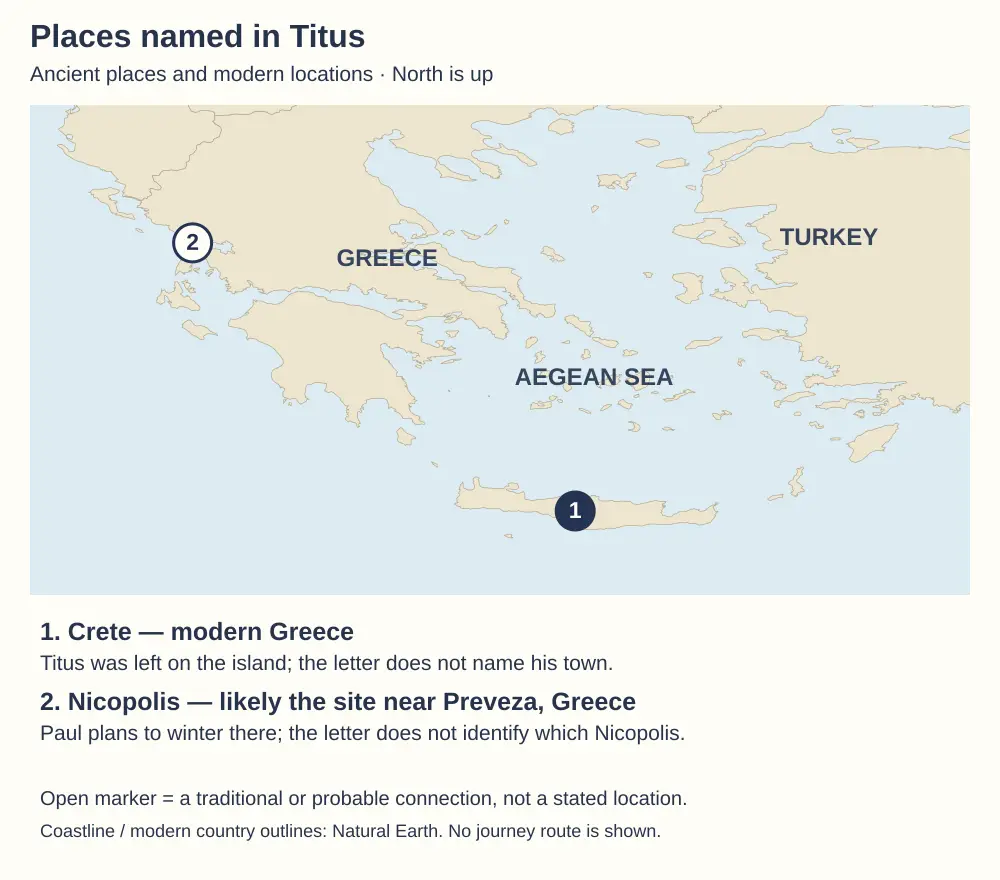
Nicopolis appears in Paul’s travel plan in Titus 3:12. The usual identification is the ancient city near modern Preveza, Greece, in Epirus. More than one ancient city bore that name, so we should not present the identification as something the verse explicitly settles. Paul says he intends to spend the winter there; that does not establish that he is already there as he writes.
Geography: UNESCO: Archaeological site of Nikopolis. Identification discussion: NET Bible: Nicopolis. Letter setting: ESV introduction to Titus. Base geography: Natural Earth, public domain. Modern borders help us locate places; they are not first-century borders.
Main teachings
God tells the truth, and His people should live truthfully
Our hope begins with the character of God. He does not lie, and His promise of eternal life is dependable. Knowing His truth should produce reverence and obedience, not merely religious vocabulary. The contrast with dishonest teachers runs throughout the letter. Paul’s opening ties together faith, truth, godliness, and the hope of eternal life. The instructions that follow grow out of that foundation; they are not a separate plan for earning God’s acceptance.
Church leadership is a trust, not a possession
Elders care for what belongs to God. Their households, character, and handling of Scripture matter. Talent cannot excuse greed, violence, or arrogance. A healthy church needs leaders who hold firmly to the apostolic message, encourage believers, and correct harmful teaching.
What we profess must not be contradicted by what we practice
False teachers can speak about God while denying Him by their actions. Paul calls for correction because people and households are being harmed. The goal is health in the faith, not the pleasure of condemning others. We should examine our own conduct as readily as we examine someone else’s words.
Healthy teaching reaches ordinary relationships
Paul speaks into the age groups, relationships, and household responsibilities his readers already knew in the Greco-Roman world. He addresses older men, older women, younger women, younger men, Titus himself, and enslaved people. These are not identical instructions to interchangeable groups. He calls each to conduct that fits the gospel, with concern for how others hear God’s word and see His people (Titus 2:5; Titus 2:8; Titus 2:10). We must distinguish the enduring call to faithful, self-controlled, loving conduct from the ancient social arrangements within which it was taught. The passage does not require us to recreate those arrangements or treat slavery and abuse as good. Verses 11–14 give the reason for this changed life: the saving and training grace of God.
Grace saves us and teaches us
Jesus did not give Himself so we could continue unchanged under sin’s rule. He redeems and cleanses a people who belong to Him and are eager to do good. Grace is neither a wage earned by obedience nor an excuse to refuse obedience. We depend on the Savior as we learn to turn from sin and live for Him.
Our blessed hope is Jesus Himself
In Titus 2:13, our blessed hope is the glorious appearing of Jesus Christ, our great God and Savior. We wait for the Lord Himself, not for the satisfaction of getting a timetable right. The wider New Testament shows why this hope is secure: 1 Peter 1:3 connects our living hope with His resurrection, and 1 Corinthians 15:20–23 connects Christ’s resurrection with the resurrection of His people at His coming. Titus does not spell out that resurrection argument in this verse, but these passages help us see the solid ground beneath its hope. The Savior who died for us is alive, and He will return. That future calls us to faithful living now.
Mercy, not our record, explains our salvation
We were not rescued because we had performed enough righteous deeds. God acted in kindness and mercy, bringing new life and renewal by the Holy Spirit through Jesus Christ. Justified by grace, we become heirs of eternal life. Remembering our own rescue should make us humble and compassionate toward others.
Believers are to become useful neighbors
Good works do not purchase salvation, but they are a fitting and necessary expression of faith. Paul wants believers ready to meet real needs, support fellow workers, and act courteously in their communities. Fruitless arguments and persistent division pull us away from that calling. Grace should make us more helpful, not merely more argumentative. Read Titus 3:4–11 together: mercy and renewal lead to useful service, while empty controversy and persistent division damage the fellowship. Paul does not reverse his teaching about grace when he calls believers to do good.
A prayer shaped by Titus
Father, thank You for saving us by Your mercy, not because we had earned Your favor. Thank You for Jesus, who gave Himself to make us His own, and for Your Holy Spirit, who gives new life. Forgive the places where our conduct contradicts our confession. Give our churches faithful leaders and teach all of us to speak truthfully, live gently, and care for others. Train us by Your grace to turn from sin and do the good You place before us. Keep our hope fixed on Jesus and His return. Make us doers of Your Word, not hearers only. In Jesus’ name, amen.
Find a topic
God’s truthfulness and eternal life
Titus 1:1–3; Titus 3:7
Elders and trustworthy leadership
Titus 1:5–9
False teaching and religious hypocrisy
Titus 1:10–16
Older and younger believers
Titus 2:1–8
Slavery, integrity, and careful application
Titus 2:9–10
Saving and training grace
Titus 2:11–14
Jesus’ identity and glorious return
Titus 2:13
Mercy, new birth, and the Holy Spirit
Titus 3:3–7
Good works and urgent needs
Titus 3:8; Titus 3:14
Avoiding quarrels and dealing with division
Titus 3:9–11
Follow the argument
God’s truth leads to godliness: the Savior’s grace creates a people whose lives show His goodness.
Titus 1:1–4 — God’s truthful promise and a shared faith
Titus 1:5–9 — Appoint trustworthy shepherds
Titus 1:10–16 — Confront teaching that damages households
Titus 2:1–10 — Live the truth in ordinary relationships
Titus 2:11–15 — The grace that redeems us also trains us
Titus 3:1–2 — Be respectful, gentle, and ready to do good
Titus 3:3–7 — Remember the mercy that made us new
Titus 3:8–11 — Choose fruitful service over destructive controversy
Titus 3:12–15 — Support fellow workers and meet pressing needs
Reading Titus carefully
Read each instruction within its paragraph and the letter’s whole message. For example, Titus 3:5 excludes our works as the basis of salvation, while Titus 3:8 calls those who believe to devote themselves to good works. Neither verse cancels the other.
Titus 1:6 raises real questions about the marriage qualification and whether the children are described as believing or faithful. The following words clearly concern a household not characterized by reckless rebellion. Church traditions differ over some applications, and this review does not pretend that one English gloss settles them all.
The severe Cretan saying in Titus 1:12–13 addresses a particular setting of deceitful teaching. It does not authorize ethnic contempt or a stereotype about modern Cretans. Paul’s stated aim is health in the faith, and Titus 3:3 includes Paul himself in the human need for mercy.
Titus 2:9–10 addresses enslaved people, not simply modern employees. Instructions for faithful living within that system are not a moral endorsement of slavery. Submission passages never authorize abuse or require obedience to sin. Church and civil authorities remain accountable to God.
Christians understand the baptismal implications of Titus 3:5 differently. The clear emphasis is God’s mercy and the Holy Spirit’s renewing work, not salvation earned by our actions. Explain disputed implications honestly rather than presenting an inference as the verse’s only possible reading.
Titus 3:9–11 does not forbid honest questions or every doctrinal discussion. It addresses fruitless disputes and persistent faction-making after warning. Correction should be fair and restorative, not a tool for shielding leaders from accountability.
Read each instruction inside its paragraph and the letter as a whole. Who is speaking, to whom, and why? Let Scripture correct our assumptions rather than making a verse say what we want.
Study every verse
Read the verse and its paragraph before the note. These original study notes help you follow the message; they do not replace Scripture.
Each entry includes two related passages and selected Greek word helps. English wording → Greek lemma and transliteration → meaning in this setting. A word does not carry every dictionary meaning into every verse.
Living the Word: James 1:22 calls us to be doers, not hearers only. Selected passages ask what we should obey, turn from, or trust. Our response is to God’s grace, not a way to purchase it.
Chapter 1 — Truthful Teaching and Trustworthy Leaders
Titus 1:1–16 · Greek interlinear
Titus 1:1
Study notes
Paul serves God and speaks as Christ’s commissioned apostle. His work aims at faith and a knowledge of truth that produces godliness. Right belief and a changed life belong together from the first sentence. God’s choosing does not turn the church inward; Paul’s calling sends him out to proclaim the truth. This opening sets the direction for the whole letter: faith, truth, and godliness belong with the promised eternal life of verses 2–3. Later commands describe the life shaped by that gospel, not another way to be saved.
English wording → Greek word → meaning
- “godliness” → εὐσέβεια (eusebeia) → reverent devotion to God expressed in life
Read alongside
Romans 1:1–5 BLB — Paul likewise joins his apostolic calling to faith that results in obedience.
1 Timothy 6:3 BLB — Healthy teaching is teaching consistent with godliness.
Titus 1:2
Study notes
Christian hope rests on God’s character, not our ability to keep ourselves impressive. The God who cannot lie promised eternal life before our story began. Hope here is confidence in His promise, not wishful thinking. Paul will later expose teachers whose profession does not match their conduct.
English wording → Greek word → meaning
- “hope” → ἐλπίς (elpis) → confident expectation grounded in God’s promise
Read alongside
Numbers 23:19 BLB — God does not lie or break His word as people do.
2 Timothy 1:9 BLB — God’s saving purpose precedes our works and the ages.
Titus 1:3
Study notes
God’s eternal purpose becomes known in history through the announced gospel. Paul did not invent this message or appoint himself its owner. He received a trust from God our Savior. Teachers are responsible to deliver that message faithfully rather than replace it with what attracts attention.
English wording → Greek word → meaning
- “entrusted” → πιστεύω (pisteuō) → here, to be entrusted with a responsibility
Read alongside
1 Timothy 1:11 BLB — Paul describes the gospel as a trust committed to him.
Romans 16:25–26 BLB — God’s long-hidden purpose is now made known through the gospel.
Titus 1:4
Study notes
Titus is Paul’s true child in their shared faith, a spiritual relationship rather than a claim about physical parentage. A Greek believer and a Jewish apostle stand together through the same Savior. The greeting names both God the Father and Christ Jesus as the source of grace and peace.
English wording → Greek word → meaning
- “common” → κοινός (koinos) → shared by them, not second-rate or ordinary in value
Read alongside
Galatians 2:1–3 BLB — Titus is identified as a Greek coworker whose faith did not require circumcision.
2 Corinthians 8:23 BLB — Paul calls Titus his partner and fellow worker.
Titus 1:5
Study notes
Paul left Titus on Crete to finish necessary work and appoint elders in the towns. A church needs more than enthusiastic beginnings. It needs responsible shepherds who teach and care for people. The letter does not name the towns, and Acts does not narrate this particular assignment.
English wording → Greek word → meaning
- “elders” → πρεσβύτερος (presbyteros) → recognized mature leaders of the local church
Read alongside
Acts 14:23 BLB — Paul and Barnabas appoint elders in newly established churches.
1 Peter 5:1–3 BLB — Elders are to shepherd willingly and by example, not by domination.
Titus 1:6
Study notes
An elder’s household matters because public leadership cannot be separated from private faithfulness. Being above reproach does not mean sinless perfection; it means a life not rightly chargeable with the disqualifying conduct described here. The marriage wording emphasizes sexual and marital faithfulness. Christians differ over its application to remarriage and whether the children must be believers or faithful and well-ordered; the following phrase clearly excludes reckless rebellion. These questions require careful church judgment, not a quick slogan.
English wording → Greek word → meaning
- “above reproach” → ἀνέγκλητος (anenklētos) → not open to a substantiated charge of the disqualifying wrongdoing in view
Read alongside
1 Timothy 3:2–5 BLB — The parallel qualifications connect household care with care of the church.
1 Samuel 16:7 BLB — God’s concern with the heart challenges selection by impressive appearances.
Titus 1:7
Study notes
The overseer in this verse explains the elder just described, rather than introducing a separate list of deacons. He is God’s steward, not the church’s owner. Arrogance, uncontrolled anger, drunkenness, violence, and greed contradict that trust. Gifted speaking does not cancel destructive character.
English wording → Greek word → meaning
- “steward” → οἰκονόμος (oikonomos) → one entrusted to manage another’s household or affairs
Read alongside
Acts 20:17–28 BLB — The same leaders are called elders and overseers, charged to shepherd God’s church.
1 Corinthians 4:1–2 BLB — A steward must be faithful to the One who entrusted the work.
Titus 1:8
Study notes
The positive qualities matter as much as the forbidden ones. Hospitality opens life to others. Love of good, clear judgment, justice, devotion, and discipline make leadership trustworthy. An elder must not merely avoid scandal; he must actively seek the good of those under his care.
English wording → Greek word → meaning
- “hospitable” → φιλόξενος (philoxenos) → welcoming and generous toward guests, including strangers
Read alongside
Romans 12:13 BLB — Hospitality belongs to the ordinary shared life of believers.
Hebrews 13:2 BLB — The church is urged not to neglect welcoming strangers.
Titus 1:9
Study notes
A leader must cling to the trustworthy message already taught. He needs both the ability to encourage believers with healthy teaching and the courage to expose contradiction. Authority comes from the message, not personal charisma. Correction should serve truth and the people harmed by error.
English wording → Greek word → meaning
- “sound” → ὑγιαίνω (hygiainō) → to be healthy; here, teaching free from corrupting error
Read alongside
2 Timothy 1:13–14 BLB — Timothy must preserve the pattern of sound words through the Spirit.
2 Timothy 2:24–26 BLB — Correction is to be patient and gentle, seeking repentance rather than winning a fight.
Titus 1:10
Read the verse: Titus 1:10 BLB
Study notes
Titus faces people who resist truth and mislead others with empty talk. Some are associated with demands connected to circumcision. Paul is identifying a particular teaching problem, not condemning Jewish people as an ethnic group. Paul himself is Jewish, and the gospel’s roots are in Israel’s Scriptures.
English wording → Greek word → meaning
- “deceivers” → φρεναπάτης (phrenapatēs) → people who mislead the understanding of others
Read alongside
Galatians 5:2–6 BLB — Paul rejects making circumcision a condition of justification.
Acts 15:1–11 BLB — The Jerusalem discussion shows the issue was salvation by grace, not ethnic superiority.
Titus 1:11
Read the verse: Titus 1:11 BLB
Study notes
The false teaching damages entire households and is driven by dishonest gain. Silencing it means preventing its spread through responsible teaching and church discipline; it is not permission for violence or coercion. Protecting a congregation requires confronting harmful instruction rather than treating every claim as equally harmless.
English wording → Greek word → meaning
- “gain” → κέρδος (kerdos) → profit or advantage, here pursued shamefully
Read alongside
1 Timothy 6:5–10 BLB — The desire to profit from religion is exposed as a dangerous corruption.
Acts 20:29–31 BLB — Paul warns elders to guard the flock against destructive teachers.
Titus 1:12
Read the verse: Titus 1:12 BLB
Study notes
Paul cites a harsh saying from a Cretan voice to expose dishonesty and self-indulgence among the people influencing these churches. The line is traditionally associated with Epimenides. Its presence does not authorize us to stereotype modern Cretans or any other people. Read it with the purpose that follows: people are to become healthy in the faith, not be written off as beyond God’s grace.
English wording → Greek word → meaning
- “liars” → ψεύστης (pseustēs) → people characterized here by falsehood
Read alongside
Titus 1:2 BLB — The truthfulness of God contrasts with the dishonesty being confronted.
Titus 3:3–4 BLB — Paul includes himself in humanity’s former sin and points to God’s saving kindness.
Titus 1:13
Read the verse: Titus 1:13 BLB
Study notes
Paul regards the cited description as fitting the problem Titus faces and calls for forceful correction. The purpose is recovery in the faith, not humiliation for its own sake. Sharpness of correction must be governed by the seriousness of the harm and by the desire to restore people to truth.
English wording → Greek word → meaning
- “rebuke” → ἐλέγχω (elenchō) → expose wrongdoing and correct it
Read alongside
Galatians 6:1 BLB — Restoration is to be attempted with gentleness and self-watchfulness.
2 Corinthians 13:10 BLB — Paul’s authority is for building people up rather than destroying them.
Titus 1:14
Read the verse: Titus 1:14 BLB
Study notes
The congregation must stop giving itself to speculative stories and human requirements that turn people away from truth. Paul is not dismissing the Old Testament. He is rejecting the replacement of God’s word with claims and rules that distort it. Religious language cannot make an invented requirement binding on a conscience.
English wording → Greek word → meaning
- “truth” → ἀλήθεια (alētheia) → the reality and truth of God’s message rather than misleading teaching
Read alongside
Mark 7:6–13 BLB — Jesus distinguishes God’s command from traditions that undermine it.
1 Timothy 1:3–4 BLB — Myths and speculative genealogies distract from faithful stewardship.
Titus 1:15
Read the verse: Titus 1:15 BLB
Study notes
In the setting of corrupt teaching about purity, Paul locates the deeper problem in the person, not merely in external objects. A defiled mind and conscience cannot be cleansed by manufactured religious restrictions. This does not make every behavior morally acceptable. The next verse condemns disobedient conduct, and the whole letter calls for holiness.
English wording → Greek word → meaning
- “consciences” → συνείδησις (syneidēsis) → the moral awareness by which people evaluate their conduct
Read alongside
Mark 7:18–23 BLB — Jesus identifies the heart as the source of moral defilement.
1 Timothy 4:3–5 BLB — Created gifts are received with thanksgiving rather than rejected through false religious prohibitions.
Titus 1:16
Read the verse: Titus 1:16 BLB
Study notes
A claim to know God can be contradicted by the way we live. Paul’s severe words address teachers whose conduct makes them unsuitable for the very good works the gospel produces. This is not a demand for flawless performance; it is a warning against settled religious hypocrisy. Confession and conduct must not be deliberately divorced.
English wording → Greek word → meaning
- “deny” → ἀρνέομαι (arneomai) → disown or contradict, here through actions
Read alongside
Matthew 7:16–20 BLB — Jesus teaches that the fruit of a life exposes false prophets.
1 John 2:3–6 BLB — Knowing God is inseparable from taking His commands seriously.
Chapter 2 — The Grace That Teaches Us to Live
Titus 2:1–15 · Greek interlinear
Titus 2:1
Study notes
Titus must teach a different kind of message from the deceivers. Healthy doctrine has fitting consequences for everyday life. The instructions that follow are not a departure from theology; they show what the gospel looks like in relationships, and verses 11–14 explain the grace that makes such living possible. Paul speaks into familiar Greco-Roman patterns of household and community life, but applies the gospel to distinct groups rather than giving every instruction to everyone. Watch whom he addresses and why before deciding how an instruction applies to us.
English wording → Greek word → meaning
- “doctrine” → διδασκαλία (didaskalia) → instruction or teaching, here the healthy apostolic message
Read alongside
1 Timothy 4:16 BLB — Attention to teaching and life belongs together.
Titus 2:11–14 BLB — God’s saving grace grounds the life this chapter describes.
Titus 2:2
Study notes
Older men are called to sober judgment, dignity, self-control, and healthy faith, love, and endurance. Age alone does not produce maturity. Their experience should become a steady example rather than an excuse for bitterness or indifference. Faithfulness includes the way they trust, love, and persevere.
English wording → Greek word → meaning
- “steadfastness” → ὑπομονή (hypomonē) → patient endurance under pressure
Read alongside
1 Thessalonians 1:3 BLB — Faith, love, and hope express themselves in work, labor, and endurance.
Psalm 92:12–15 BLB — The image of fruitfulness in old age encourages continuing usefulness.
Titus 2:3
Study notes
Older women likewise have an honored teaching responsibility. Their conduct should show reverence, not destructive speech or enslavement to drink. They pass on what is good through both words and example. Paul treats their influence as essential to the congregation’s health, not peripheral.
English wording → Greek word → meaning
- “teach what is good” → καλοδιδάσκαλος (kalodidaskalos) → a teacher of what is good
Read alongside
Proverbs 31:26 BLB — Wisdom and kindness shape the speech of the woman praised there.
Ephesians 4:29 BLB — Speech should build up rather than damage those who hear.
Titus 2:4
Study notes
Older women are to help younger women grow in loving their husbands and children. Such love is not reduced to spontaneous feeling; it can be nurtured through wise example and patient counsel. Paul addresses a particular household setting, not a rule that every woman must marry or become a mother to serve God.
English wording → Greek word → meaning
- “train” → σωφρονίζω (sōphronizō) → guide or train toward wise, sound judgment
Read alongside
Deuteronomy 6:6–7 BLB — Faith is handed on within the ordinary rhythms of household life.
1 Corinthians 7:32–35 BLB — Paul also recognizes the value of unmarried devotion to the Lord.
Titus 2:5
Study notes
These qualities bring Christian faith into household life: wise judgment, purity, diligence, kindness, and an ordered marriage relationship. Care for home must not be turned into a ban on all work outside it. Submission is not permission for abuse, sin, or silencing someone seeking safety. The concern is that conduct should not discredit God’s word; Scripture also demands a husband’s sacrificial love. In context, older women are to train younger women in these qualities (verses 3–5). The reason given is concern for how God’s word is regarded, not a declaration that every social custom of that age is God’s permanent design.
English wording → Greek word → meaning
- “kind” → ἀγαθός (agathos) → good or benevolent in character and action
Read alongside
Ephesians 5:25–29 BLB — Husbands are commanded to love sacrificially and care for their wives.
Proverbs 31:16–24 BLB — The praised woman cares for her household while engaging in productive enterprise.
Titus 2:6
Study notes
The instruction to younger men concentrates on self-control. Desire, pride, anger, and appetite must not be allowed to rule. This is not confidence in willpower alone: the chapter soon identifies grace as our trainer. A short instruction can reach every part of a young man’s life.
English wording → Greek word → meaning
- “self-controlled” → σωφρονέω (sōphroneō) → exercise sound judgment and sensible restraint
Read alongside
Proverbs 25:28 BLB — A person without self-control is compared to a defenseless city.
Galatians 5:22–23 BLB — Self-control is part of the fruit produced by the Holy Spirit.
Titus 2:7
Study notes
Titus is not merely to describe faithfulness but to model it. Good works and honest, serious teaching belong together. A teacher’s conduct can support the message or undermine it. Dignity need not mean coldness; it means treating God’s word and people with the seriousness they deserve.
English wording → Greek word → meaning
- “model” → τύπος (typos) → an example or pattern for others to follow
Read alongside
1 Timothy 4:12 BLB — Timothy is likewise to become an example in speech, conduct, love, faith, and purity.
Philippians 3:17 BLB — Believers learn from lives that follow the apostolic pattern.
Titus 2:8
Study notes
Titus’s speech should be sound enough that opponents cannot establish a legitimate accusation. Paul does not promise that faithful people will never be slandered. He calls for conduct and words that provide no rightful support for the criticism. Truthfulness matters more than defeating an opponent with cleverness.
English wording → Greek word → meaning
- “sound” → ὑγιής (hygiēs) → healthy or wholesome; here, speech free of corrupting fault
Read alongside
1 Peter 2:12 BLB — Good conduct can expose the falsity of accusations against believers.
Colossians 4:5–6 BLB — Grace and wisdom should shape speech toward outsiders.
Titus 2:9
Study notes
Paul addresses enslaved people within the Roman household system. The word is stronger than modern employee, even though the ESV uses bondservants. He gives people living under that system a way to honor Christ; he does not here announce abolition or declare slavery morally ideal. This passage must never be used to authorize owning people, exploitation, or obedience to sinful demands. These instructions concern people already living under slavery; they are not instructions to the church to establish or preserve that institution. Applying the call to integrity today must not erase the unequal power and restricted freedom of the original hearers.
English wording → Greek word → meaning
- “Bondservants” → δοῦλος (doulos) → enslaved persons under a master’s authority, not simply hired employees
Read alongside
1 Corinthians 7:21–23 BLB — Paul values freedom and reminds believers that they belong to Christ.
Philemon 1:15–16 BLB — Paul appeals for Onesimus to be received in the new relationship of a beloved brother.
Titus 2:10
Read the verse: Titus 2:10 BLB
Study notes
Integrity and trustworthiness matter even in circumstances a believer did not choose. Paul forbids theft and calls for faithfulness that makes the Savior’s teaching visible in a life. This dignifies enslaved believers as moral agents and witnesses, but it does not excuse their masters’ injustice. Adorning the teaching means displaying its beauty, not improving a deficient gospel.
English wording → Greek word → meaning
- “adorn” → κοσμέω (kosmeō) → make attractive or display fittingly, here through faithful conduct
Read alongside
Colossians 3:22–4:1 BLB — The household instructions also command masters to act justly and fairly.
Matthew 5:16 BLB — Good works should lead observers to glorify the Father, not the worker.
Titus 2:11
Read the verse: Titus 2:11 BLB
Study notes
The reason for this changed life is God’s grace made visible in Jesus. Salvation is not reserved for one age, sex, social position, or nation. The range of people addressed in the chapter helps us hear the breadth of the invitation. This verse does not by itself teach that every individual is finally saved regardless of faith; the saving grace announced here also forms a people who belong to Christ.
English wording → Greek word → meaning
- “grace” → χάρις (charis) → God’s undeserved favor shown in His saving action
Read alongside
John 1:14–17 BLB — God’s grace is revealed through Jesus Christ.
1 Timothy 2:3–6 BLB — God’s saving concern reaches all kinds of people through the one Mediator.
Titus 2:12
Read the verse: Titus 2:12 BLB
Study notes
Grace not only pardons us; it teaches us how to live. We are to say no to godlessness and desires that rule apart from God, and yes to a disciplined, upright, God-honoring life now. The alternatives are not legalism or careless living. Grace creates a willing learner who depends on the Savior while practicing obedience.
English wording → Greek word → meaning
- “training” → παιδεύω (paideuō) → educate, discipline, and form a person toward mature conduct
Read alongside
Romans 6:1–14 BLB — Freedom under grace is freedom from sin’s rule, not permission to continue in it.
Ephesians 4:22–24 BLB — Putting off the old life and putting on the new describes practical renewal.
Titus 2:13
Read the verse: Titus 2:13 BLB
Study notes
Paul directs our hope to the glorious appearing of Jesus Christ, our great God and Savior. We wait for a living Lord, not for a successful prediction of dates. Titus names His appearing here; it does not give a separate argument for His resurrection. That foundation is explicit elsewhere: 1 Peter 1:3 connects living hope with Jesus’ resurrection, and 1 Corinthians 15:20–23 connects His resurrection with that of His people at His coming. Read together, these passages show why our hope is more than wishful thinking. In this paragraph, waiting belongs with the grace-trained life of verse 12 and the good works of verse 14. Hope in His return should make us faithful in today’s responsibilities.
English wording → Greek word → meaning
- “appearing” → ἐπιφάνεια (epiphaneia) → a visible manifestation; here, Christ’s glorious return
Teacher’s comment — John Piper (paraphrase, source)
Piper links the two appearings: Christ came in saving grace and will return in glory. Gratitude for His first coming and hope for His return both encourage a faithful life now.
Read alongside
1 Peter 1:3–5 BLB — Peter explicitly grounds the believer’s living hope in Jesus’ resurrection and points to the inheritance God preserves. This supplies a resurrection foundation that Titus 2:13 does not develop.
1 Corinthians 15:20–23 BLB — Christ has been raised first, and those who belong to Him will be raised at His coming. Paul connects resurrection and return here, strengthening our understanding of the hope named in Titus.
Titus 2:14
Read the verse: Titus 2:14 BLB
Study notes
Jesus gave Himself to rescue us from lawlessness and make us His own people. His death is not merely an inspiring example; it accomplishes redemption. The purpose includes cleansing and eagerness for good works. We do not perform good works to purchase belonging to Him. Because He has made us His, we learn to love what pleases Him.
English wording → Greek word → meaning
- “redeem” → λυτρόω (lytroō) → release or rescue by paying a ransom; here, liberation through Christ’s self-giving
Read alongside
Exodus 19:5–6 BLB — The language of a people belonging to God recalls His covenant purpose for Israel.
1 Peter 1:18–19 BLB — Christ’s costly blood, not material wealth, accomplishes redemption.
Titus 2:15
Read the verse: Titus 2:15 BLB
Study notes
Titus must communicate these truths with encouragement and correction. His authority is the authority of the entrusted message, not a license to dominate. The charge not to let others disregard him calls him to carry out the ministry faithfully, rather than to demand unquestioning loyalty to his personality.
English wording → Greek word → meaning
- “exhort” → παρακαλέω (parakaleō) → urge, encourage, or appeal to someone toward faithful response
Read alongside
2 Timothy 4:2 BLB — Preaching includes patient correction, rebuke, and encouragement.
1 Peter 5:3 BLB — Church authority must not become domination of the flock.
Chapter 3 — Saved by Mercy and Ready to Do Good
Titus 3:1–15 · Greek interlinear
Titus 3:1
Study notes
Believers should be responsible members of the wider community: respectful toward authorities, obedient, and ready to do good. Following Jesus does not make us careless neighbors. This instruction is not unlimited approval of every ruler or command. Where human demands conflict with God, Scripture requires allegiance to God.
English wording → Greek word → meaning
- “ready” → ἕτοιμος (hetoimos) → prepared and willing to act
Read alongside
Romans 13:1–7 BLB — Paul explains the ordinary responsibilities of believers toward governing authorities.
Acts 5:29 BLB — The apostles identify obedience to God as the limit of compliance with human orders.
Titus 3:2
Study notes
Paul rules out slander, habitual quarrelling, and harshness. Courtesy is to extend to everyone, not only people who agree with us. Gentle speech is not surrender of truth; it is a way of honoring the people before us. The next verse explains why Christians have no ground for self-righteous contempt.
English wording → Greek word → meaning
- “gentle” → ἐπιεικής (epieikēs) → considerate and forbearing rather than insisting harshly on one’s own way
Read alongside
James 3:17 BLB — Wisdom from above is peaceable, gentle, and open to reason.
2 Timothy 2:24–25 BLB — The Lord’s servant corrects opponents without becoming quarrelsome.
Titus 3:3
Study notes
Paul includes himself with the believers in remembering life apart from Christ. Sin involved not only wrong actions but deception, enslaving desires, envy, and broken relationships. Remembering mercy should keep us from looking down on others. We are not superior people who rescued ourselves; we are people who needed rescue.
English wording → Greek word → meaning
- “led astray” → πλανάω (planaō) → be deceived or wander from the right way
Read alongside
Ephesians 2:1–3 BLB — Paul likewise includes believers in the condition from which God rescued them.
1 Corinthians 6:9–11 BLB — The remembrance of former sin leads to gratitude for cleansing, not superiority.
Titus 3:4
Study notes
The turning point is not our sudden moral success but the appearance of God’s kindness and love. Against the dark account of our former life, God acts as Savior. His goodness is not reluctance overcome by our persuasion. He takes the initiative in showing mercy to undeserving people.
English wording → Greek word → meaning
- “loving kindness” → φιλανθρωπία (philanthrōpia) → benevolent love toward human beings
Read alongside
Romans 5:8 BLB — God demonstrates His love through Christ’s death for sinners.
Ephesians 2:4–5 BLB — God’s mercy and love explain why He brings the spiritually dead to life.
Titus 3:5
Study notes
Our rescue rests on God’s mercy, not a record of righteous deeds. The Spirit brings new birth and renewal, not merely a polished version of our old life. Christians differ over how directly the washing language refers to baptism and how baptism relates to this saving work. Whatever that question, the sentence names God as Savior, excludes our deeds as its basis, and attributes the life-giving renewal to the Holy Spirit.
English wording → Greek word → meaning
- “regeneration” → παλιγγενεσία (palingenesia) → new birth or a new beginning; here, the new life God gives
Read alongside
John 3:5–8 BLB — Jesus teaches that entrance into God’s kingdom requires birth by the Spirit.
Ephesians 2:8–10 BLB — Salvation is God’s gift apart from our works, with good works as its intended fruit.
Titus 3:6
Study notes
God does not give the Spirit grudgingly. He pours out the Spirit richly through Jesus Christ our Savior. The saving work is fully God’s work: His mercy, the Spirit’s renewal, and Christ’s mediation. This abundance is not a guarantee of wealth or an identical spiritual experience for every believer.
English wording → Greek word → meaning
- “poured out” → ἐκχέω (ekcheō) → pour out generously; here, God’s giving of the Holy Spirit
Read alongside
Acts 2:32–33 BLB — The exalted Jesus pours out the promised Holy Spirit.
Romans 5:5 BLB — God’s love is poured into believers’ hearts through the Spirit.
Titus 3:7
Study notes
Justification means being put right before God by His grace, not earning a favorable verdict. Those He saves become heirs with the hope of eternal life. The letter’s opening hope returns here: our future rests on God’s promise. Being an heir is a gift of belonging, not a wage for religious achievement.
English wording → Greek word → meaning
- “justified” → δικαιόω (dikaioō) → declare or count righteous before God
Read alongside
Romans 3:23–26 BLB — God justifies sinners by grace through Christ’s redemption.
Romans 8:15–17 BLB — The Spirit bears witness to adoption and the inheritance of God’s children.
Titus 3:8
Study notes
Titus must insist on these truths so that believers give serious attention to good works. Paul does not retreat from grace after announcing it. He shows its result: lives that benefit other people. The same paragraph excludes works as the cause of salvation and requires them as the proper response of those who believe. Keep verses 4–11 together: God’s kindness and the Spirit’s renewal produce useful service; fruitless disputes and persistent faction-making work against that purpose. Good works are the fruit of salvation, not its purchase price.
English wording → Greek word → meaning
- “devote themselves” → προΐστημι (proistēmi) → here, take care to engage in or give serious attention to
Teacher’s comment — Charles H. Spurgeon (paraphrase, source)
Spurgeon distinguishes the basis of salvation from its fruit: our works do not save us, but those saved through faith should abound in works that benefit others. Remembering our own need for mercy also guards us against bitter contempt for sinners.
Read alongside
Ephesians 2:10 BLB — Those saved by grace are created in Christ for good works.
James 2:14–17 BLB — An inactive profession that refuses practical help exposes a failure of living faith.
Titus 3:9
Study notes
Avoid arguments that consume attention without strengthening faith or benefiting people. Paul names speculative genealogies and fights over the law, not every careful question about Scripture. The contrast with verse 8 is usefulness: healthy teaching leads to good; empty controversy produces nothing of lasting value.
English wording → Greek word → meaning
- “unprofitable” → ἀνωφελής (anōphelēs) → not beneficial or useful
Read alongside
1 Timothy 1:4–5 BLB — Speculation is contrasted with faith and love from a sincere heart.
2 Timothy 2:23 BLB — Foolish controversies generate quarrels rather than fruitful instruction.
Titus 3:10
Read the verse: Titus 3:10 BLB
Study notes
A person who persistently creates factions is to be warned, then warned again. If the conduct continues, Titus must stop allowing that person to disrupt the fellowship. This is not permission to dismiss everyone who asks a difficult question or disagrees on a secondary matter. There is a process of admonition before separation, with the protection of the church in view.
English wording → Greek word → meaning
- “stirs up division” → αἱρετικός (hairetikos) → faction-making or divisive; the context emphasizes destructive division
Read alongside
Matthew 18:15–17 BLB — Jesus describes a measured process of confronting persistent sin.
Romans 16:17–18 BLB — Paul warns against people who create divisions contrary to the teaching received.
Titus 3:11
Read the verse: Titus 3:11 BLB
Study notes
The repeated warnings make persistent rebellion especially serious. Such a person’s own conduct exposes the wrong, rather than requiring endless argument to establish it. Paul is describing someone who refuses correction, not someone struggling honestly with uncertainty. Church discipline needs fair evidence, patience, and accountability, not a leader’s wounded pride.
English wording → Greek word → meaning
- “self-condemned” → αὐτοκατάκριτος (autokatakritos) → condemned by one’s own conduct or acknowledged course
Read alongside
Matthew 7:3–5 BLB — Self-examination must precede correcting someone else.
2 Thessalonians 3:14–15 BLB — Even separation for disobedience is not license to treat a person as an enemy.
Titus 3:12
Read the verse: Titus 3:12 BLB
Study notes
Paul plans to send Artemas or Tychicus so Titus can join him for the winter at Nicopolis. Ministry involves travel, rest, replacement workers, and changing assignments. Nicopolis is usually identified with the city near modern Preveza in northwestern Greece. The plan does not tell us exactly where Paul was when he wrote, and a map should not invent that starting point.
English wording → Greek word → meaning
- “decided” → κρίνω (krinō) → here, decide or determine a course of action
Read alongside
Ephesians 6:21–22 BLB — Tychicus is a trusted messenger who encourages churches.
James 4:13–15 BLB — Travel plans remain subject to the Lord’s will.
Titus 3:13
Read the verse: Titus 3:13 BLB
Study notes
Zenas and Apollos need practical support for their journey. Zenas’s description as a lawyer does not settle whether his expertise concerned Jewish law or civil law. Paul gives no itinerary here. The clear responsibility is hospitality and provision so fellow workers can continue without avoidable need.
English wording → Greek word → meaning
- “speed” → προπέμπω (propempō) → send someone onward with assistance or supplies
Read alongside
Acts 18:24–28 BLB — Apollos is introduced as a gifted teacher who also receives instruction.
3 John 1:5–8 BLB — Supporting traveling gospel workers makes believers partners in the truth.
Titus 3:14
Read the verse: Titus 3:14 BLB
Study notes
The final practical instruction returns to the letter’s repeated theme: believers must learn to do good. Urgent needs are not a distraction from Christian growth; responding to them is part of a fruitful life. In this setting that includes helping travelers, but the principle extends to real needs around us. Grace should make us useful neighbors.
English wording → Greek word → meaning
- “unfruitful” → ἄκαρπος (akarpos) → without fruit or useful result
Read alongside
Galatians 6:9–10 BLB — Believers are to persevere in doing good as opportunities arise.
James 2:15–16 BLB — Kind words without needed practical help leave the need unanswered.
Titus 3:15
Read the verse: Titus 3:15 BLB
Study notes
Paul closes with mutual greetings and grace for the whole community. Although addressed to Titus, the letter serves the churches and their shared life. Affection, faith, practical service, and grace belong together. The final word is not confidence in human performance but God’s gracious provision for His people.
English wording → Greek word → meaning
- “Grace” → χάρις (charis) → God’s undeserved favor and sustaining kindness
Read alongside
2 Corinthians 13:14 BLB — Paul’s blessing likewise locates Christian fellowship in God’s grace, love, and Spirit.
Philippians 4:21–23 BLB — Personal greetings and grace conclude another letter addressed to a community.
Teacher comments and sources
Teacher comments are short, clearly labeled paraphrases. Inclusion is not an endorsement of every statement in a linked resource. The main study notes are original explanations prepared for this review, not quotations from these teachers.
Charles H. Spurgeon
Overview and language resources
Verses to memorize
Choose one passage at a time. Read its setting, learn its wording, and ask what faithful response it calls for.
About these study notes
Commentary offered not as authoritative but as a view of the verse drawn from the scriptures presented, other scriptures, and various commentaries. If these thoughts do not line up with the Word then they must be rejected. It is my belief and prayer they are consistent with the Word and are offered as a simple teaching on the Word and as every teaching on the Word each must be carefully compared with the one true and living Word of God. — Hollis McGehee
Scripture is opened through Aiming for Jesus’s existing ESV reading window. This page does not reproduce the full text of this letter. ESV® is a registered trademark of Crossway.