Esther — A Complete Review
For Such a Time as This — God’s Hidden Hand Watching Over His People · Bible study by Hollis McGehee · verse by verse
Click or tap any Scripture reference to read it in the ESV right here. Select BLB to open it in Blue Letter Bible.
Study notes are complete for all 10 chapters of Esther. Watch for God’s hidden hand in every scene, even where His name is never written.
Just want to read Esther?
Skip the study notes and go straight to the Scripture. Click or tap a chapter to read it right here on this page.
Esther 1:1–22 Esther 2:1–23 Esther 3:1–15 Esther 4:1–17 Esther 5:1–14 Esther 6:1–14 Esther 7:1–10 Esther 8:1–17 Esther 9:1–32 Esther 10:1–3
Who wrote it
The book does not tell us who wrote it. The writer knew the Persian court very well, wrote like someone who had been there, and cared deeply about the Jewish people. Jewish tradition named Mordecai, but the book seems to speak of Mordecai as someone other than the writer (9:20, 23). Whoever held the pen, the Holy Spirit gave us this book as part of God’s Word.
Where it takes place
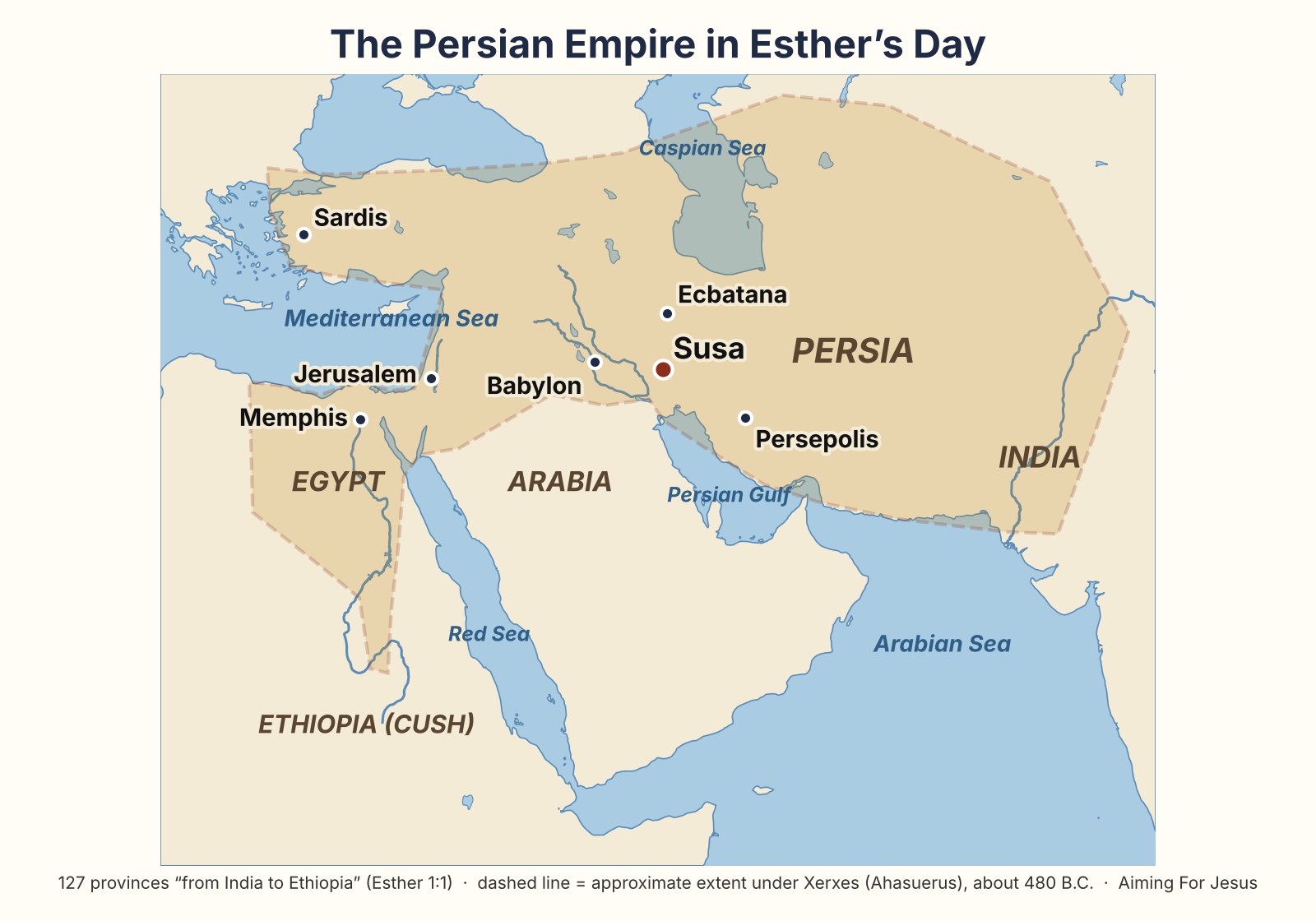
The story happens in Susa, one of the capital cities of the Persian Empire, in what is now southwest Iran. Most of it takes place in and around the king’s palace: the royal gardens, the women’s quarters, the king’s gate where officials sat, and the throne room. The Persian Empire stretched “from India to Ethiopia,” 127 provinces in all (1:1), and Jews lived scattered across all of it.
Esther among the Old Testament books
Genesis · Exodus · Leviticus · Numbers · Deuteronomy · Joshua · Judges · Ruth · 1 Samuel · 2 Samuel · 1 Kings · 2 Kings · 1 Chronicles · 2 Chronicles · Ezra · Nehemiah · Esther · Job · Psalms · Proverbs · Ecclesiastes · Song of Solomon · Isaiah · Jeremiah · Lamentations · Ezekiel · Daniel · Hosea · Joel · Amos · Obadiah · Jonah · Micah · Nahum · Habakkuk · Zephaniah · Haggai · Zechariah · Malachi
Esther is the 17th of the 39 books of the Old Testament and the last of the history books. Its events fit between Ezra chapters 6 and 7: after the first group of Jews went home to Jerusalem under Zerubbabel (about 538 B.C.) and before Ezra led the second group (458 B.C.). Ezra and Nehemiah tell about the Jews who went back to the land. Esther tells about the many who stayed in Persia, and shows that God had not forgotten them.
When it was written
The king in the story is Ahasuerus, better known by his Greek name Xerxes. He ruled Persia from 486 to 465 B.C. The events of the book run from about 483 to 473 B.C. The book was written some time after the first Feast of Purim (9:27–28), probably within a generation or two of the events.
Meet the book
Esther is the story of how God saved His people from being wiped out, without His name ever being mentioned. A powerful man named Haman plots to kill every Jew in the Persian Empire. A young Jewish woman named Esther has become queen, and her older cousin Mordecai urges her to risk her life to speak to the king. Through a chain of “coincidences” — a sleepless king, a book read at just the right page, a gallows built for the wrong man — the whole plan is turned upside down.
God is never named in Esther. There is no mention of prayer, the temple or the Law. Yet His hand is everywhere. The book teaches us to see what faith sees: that God is at work even when He seems silent, even through ordinary people who are far from perfect. Esther and Mordecai hid that they were Jews for years and lived much like the Persians around them. Even so, God was faithful to His promises to Abraham (Genesis 12:3) and used them to save His people.
The book also explains the Feast of Purim, which the Jewish people still keep every year. It is named for the “pur,” the lot Haman cast to choose the day to destroy the Jews (3:7). Haman trusted chance. But “the lot is cast into the lap, but its every decision is from the LORD” (Proverbs 16:33).
The central message God is always at work for His people, even when He is hidden and unnamed. He keeps His promises, turns evil plans upside down, and places His people where they are “for such a time as this.”
A verse to carry through the study Esther 4:14 BLB
Find your way
Main teachings
God’s hidden hand
Esther 6:1–11; Proverbs 21:1; Romans 8:28 God’s name never appears, yet nothing happens by accident. A king who cannot sleep, a record read at the right place, a man arriving at the right moment: God works through ordinary events to keep His promises. “The king’s heart is a stream of water in the hand of the LORD” (Proverbs 21:1).
God keeps His covenant
Esther 4:14; 6:13; Genesis 12:3 God promised Abraham that He would bless those who bless his family and curse those who curse it. Even Haman’s wife and friends saw it: if Mordecai is a Jew, “you will not overcome him” (6:13). God stayed faithful to His people even when they were not fully faithful to Him.
For such a time as this
Esther 4:12–16 Mordecai told Esther she may have been placed where she was for this very moment. God puts each of His children in a place, a family and a time for His purposes. Esther had to choose whether to speak up or stay quiet.
Courage and risk
Esther 4:16; 5:1–2; Joshua 1:9 “If I perish, I perish.” Esther fasted, asked others to fast with her, and walked into the throne room uninvited. Real courage is not the absence of fear but obedience in spite of it.
Pride goes before a fall
Esther 3:5–6; 5:9–14; 6:6–12; 7:10; Proverbs 16:18 Haman had wealth, sons, honor and the king’s favor, yet one man who would not bow made it all worth nothing to him. His pride built the gallows he would hang on. Esther is a living picture of Proverbs 16:18.
The great reversal
Esther 9:1; 9:22; Luke 1:52 On the very day the enemies of the Jews hoped to rule over them, “the reverse occurred” (9:1). Sorrow turned to gladness, mourning to a holiday. God loves to turn things around, and the greatest reversal of all is the cross and the empty tomb.
Living faithfully in a foreign land
Esther 2:10, 20; Jeremiah 29:7; 1 Peter 2:11–12 The Jews in Persia were exiles far from home, as believers today are strangers in this world. Esther shows both the danger of blending in so much that no one knows whom we belong to, and the call to stand up and be known as God’s people when it matters.
Remembering God’s deliverance
Esther 9:20–32 Purim was set up so God’s people would never forget how He saved them. Remembering together, with feasting, gifts to one another and gifts to the poor, builds faith. For Christians, the Lord’s Supper is our great remembering of a far greater deliverance.
Pointing to Christ
Esther 4:16; 8:3–6; Hebrews 7:25 Esther risked her life to stand before the king and plead for her people. Jesus did far more: He gave His life, and now stands before the Father and always lives to make intercession for us. Esther’s plea could not undo the king’s first law; Christ’s death fully satisfied God’s law for all who trust Him.
Praying through Esther
No prayer is written down in Esther. But when the news of Haman’s decree came, the Jews mourned with fasting, weeping and wailing (4:3), and Esther asked all the Jews in Susa to fast with her for three days before she went to the king (4:16). For God’s people, fasting was always joined with prayer. The silence of the book invites us to fill in what faith already knows: they were crying out to the God who hears.
A good way to pray through Esther is to bring to God the places where He seems hidden, and to ask Him for courage to speak up where He has placed you.
The prayers in this book
Esther 4:14 — A prayer to know your place. Ask God to show you why He has put you where you are, and to give you the faith to act when your moment comes.
Esther 4:16 — A prayer for courage. Bring your fears to God as Esther did, and ask for the courage to do what is right even when it is costly.
Esther 6:1–3 — A prayer of trust in His providence. Thank God that He works through ordinary things, even a sleepless night, and ask Him to help you trust Him when you cannot see His hand.
Esther 9:22 — A prayer of thanksgiving. Thank God for the times He has turned your sorrow into gladness and your mourning into a holiday.
For such a time as this (Esther 4:14–16)
Pray it with Esther 4:14–16 BLB
Read Esther
Select a chapter to read it in the ESV in a reading window, right here on this page.
Esther 1:1–22 Esther 2:1–23 Esther 3:1–15 Esther 4:1–17 Esther 5:1–14 Esther 6:1–14 Esther 7:1–10 Esther 8:1–17 Esther 9:1–32 Esther 10:1–3
A brief outline
1:1–1:9 The King’s Great Feast
1:10–1:22 Queen Vashti Says No
2:1–2:4 The Search for a New Queen
2:12–2:20 Esther Becomes Queen
2:21–2:23 Mordecai Saves the King’s Life
4:1–4:3 Mourning Across the Empire
4:4–4:17 For Such a Time as This
5:1–5:8 Esther Goes In to the King
5:9–5:14 Haman’s Pride and the Gallows
6:1–6:14 The King Cannot Sleep
8:1–8:8 Esther Pleads for Her People
8:9–8:17 A New Decree and Great Joy
Study every verse
Begin with the Scripture, then read the study notes and the passages to read alongside. After each section, pause over the question. Watch for God’s hand in each scene, even where His name is not written.
Commentary offered not as authoritative but as a view of the verse drawn from the scriptures presented, other scriptures, and various commentaries. If these thoughts do not line up with the Word then they must be rejected. It is my belief and prayer they are consistent with the Word and are offered as a simple teaching on the Word and as every teaching on the Word each must be carefully compared with the one true and living Word of God.
Chapter 1 1:1 1:2 1:3 1:4 1:5 1:6 1:7 1:8 1:9 1:10 1:11 1:12 1:13 1:14 1:15 1:16 1:17 1:18 1:19 1:20 1:21 1:22
Chapter 2 2:1 2:2 2:3 2:4 2:5 2:6 2:7 2:8 2:9 2:10 2:11 2:12 2:13 2:14 2:15 2:16 2:17 2:18 2:19 2:20 2:21 2:22 2:23
Chapter 3 3:1 3:2 3:3 3:4 3:5 3:6 3:7 3:8 3:9 3:10 3:11 3:12 3:13 3:14 3:15
Chapter 4 4:1 4:2 4:3 4:4 4:5 4:6 4:7 4:8 4:9 4:10 4:11 4:12 4:13 4:14 4:15 4:16 4:17
Chapter 5 5:1 5:2 5:3 5:4 5:5 5:6 5:7 5:8 5:9 5:10 5:11 5:12 5:13 5:14
Chapter 6 6:1 6:2 6:3 6:4 6:5 6:6 6:7 6:8 6:9 6:10 6:11 6:12 6:13 6:14
Chapter 7 7:1 7:2 7:3 7:4 7:5 7:6 7:7 7:8 7:9 7:10
Chapter 8 8:1 8:2 8:3 8:4 8:5 8:6 8:7 8:8 8:9 8:10 8:11 8:12 8:13 8:14 8:15 8:16 8:17
Chapter 9 9:1 9:2 9:3 9:4 9:5 9:6 9:7 9:8 9:9 9:10 9:11 9:12 9:13 9:14 9:15 9:16 9:17 9:18 9:19 9:20 9:21 9:22 9:23 9:24 9:25 9:26 9:27 9:28 9:29 9:30 9:31 9:32
Chapter 1
The King’s Great Feast
Esther 1:1
Read the verse: Esther 1:1 BLB
Study Notes
This story happened when Ahasuerus (Xerxes) was king over 127 provinces, from India to Ethiopia.
Ahasuerus is the Hebrew name for the Persian king the Greeks called Xerxes (ruled 486–465 B.C.). He ruled the largest empire the world had yet seen.
Read alongside Ezra 4:6 BLB; Daniel 9:1 BLB; Daniel 6:1 BLB
Esther 1:2
Read the verse: Esther 1:2 BLB
Study Notes
He ruled from his throne in the fortress city of Susa.
Susa was one of Persia’s capital cities. Nehemiah and Daniel also spent time there.
Read alongside Nehemiah 1:1 BLB; Daniel 8:2 BLB; Esther 2:5 BLB
Esther 1:3
Read the verse: Esther 1:3 BLB
Study Notes
In his third year he threw a big feast for all his officials, army leaders and nobles.
The third year was about 483 B.C. Many think this gathering was also a planning meeting for Xerxes’ war against Greece.
Read alongside Daniel 5:1 BLB; Mark 6:21 BLB; Proverbs 23:1–3 BLB
Esther 1:4
Read the verse: Esther 1:4 BLB
Study Notes
For six months he showed off his wealth and greatness.
Six months of showing off. Esther is full of feasts, at least nine in all, and the story turns at the banquet table.
Read alongside Proverbs 27:1–2 BLB; Jeremiah 9:23–24 BLB; Luke 12:16–21 BLB
Esther 1:5
Read the verse: Esther 1:5 BLB
Study Notes
Then he held a seven-day party in the palace garden for everyone in Susa, from the greatest to the least.
A week-long party for the whole city.
Read alongside 1 Kings 8:65 BLB; Ecclesiastes 2:10–11 BLB; Luke 14:16 BLB
Esther 1:6
Read the verse: Esther 1:6 BLB
Study Notes
The garden was decorated with fine curtains, silver rods, marble pillars and couches of gold and silver.
The writer describes it like someone who had seen it. Archaeologists have uncovered the palace at Susa.
Read alongside Esther 8:15 BLB; Amos 6:4 BLB; 1 Kings 10:18–21 BLB
Esther 1:7
Read the verse: Esther 1:7 BLB
Study Notes
Wine flowed freely, served in gold cups, each one different.
Lavish and wasteful.
Read alongside Daniel 5:2–4 BLB; Isaiah 5:11–12 BLB; Ephesians 5:18 BLB
Esther 1:8
Read the verse: Esther 1:8 BLB
Study Notes
No one had to drink; each guest could drink as much or as little as he wanted.
Each guest could drink as much or as little as he wanted.
Read alongside Proverbs 20:1 BLB; Proverbs 23:29–35 BLB; Romans 14:21 BLB
Esther 1:9
Read the verse: Esther 1:9 BLB
Study Notes
Queen Vashti gave her own feast for the women.
A separate feast for the women.
Read alongside Esther 5:4 BLB; Daniel 5:10 BLB; 1 Kings 10:1 BLB
Put it into practice The book of Esther opens with a king showing off “the riches of his kingdom” (verse 4). Where are you tempted to find your worth in what you have or what others see, rather than in God?
Queen Vashti Says No
Esther 1:10
Read the verse: Esther 1:10 BLB
Study Notes
On the seventh day, when the king was merry with wine, he sent seven servants
Wine clouds judgment. The trouble starts here.
Read alongside Proverbs 31:4–5 BLB; Ecclesiastes 10:17 BLB; Hosea 4:11 BLB
Esther 1:11
Read the verse: Esther 1:11 BLB
Study Notes
to bring Queen Vashti, wearing her crown, so he could show off her beauty to everyone.
He wanted to show her off like one more of his treasures.
Read alongside Proverbs 31:30 BLB; 1 Peter 3:3–4 BLB; Ephesians 5:28–29 BLB
Esther 1:12
Read the verse: Esther 1:12 BLB
Study Notes
But Vashti refused to come. The king was furious.
We are not told why she refused. The most powerful man in the world could not control his own temper or his own wife.
Read alongside Proverbs 16:32 BLB; Proverbs 19:11 BLB; James 1:19–20 BLB
Esther 1:13
Read the verse: Esther 1:13 BLB
Study Notes
He asked his wise men, the experts in law, what to do.
He calls in his advisers.
Read alongside Daniel 2:2 BLB; 1 Chronicles 12:32 BLB; Proverbs 11:14 BLB
Esther 1:14
Read the verse: Esther 1:14 BLB
Study Notes
His closest advisers were seven princes of Persia and Media.
The seven highest officials. Ezra 7:14 also mentions the king’s seven counselors.
Read alongside Ezra 7:14 BLB; Daniel 6:1–2 BLB
Esther 1:15
Read the verse: Esther 1:15 BLB
Study Notes
He asked, “What does the law say we should do to Queen Vashti for disobeying me?”
A personal hurt turned into a legal case.
Read alongside Daniel 6:8, 12 BLB; Proverbs 29:12 BLB
Esther 1:16
Read the verse: Esther 1:16 BLB
Study Notes
Memucan said, “Vashti has wronged not just the king but every man in the empire.
Memucan makes it everyone’s problem.
Read alongside Proverbs 18:17 BLB; Proverbs 26:21 BLB; James 3:5 BLB
Esther 1:17
Read the verse: Esther 1:17 BLB
Study Notes
When women hear of it, they will look down on their husbands.
He fears it will spread to every home.
Read alongside Proverbs 12:4 BLB; Ephesians 5:22–33 BLB; 1 Peter 3:1–7 BLB
Esther 1:18
Read the verse: Esther 1:18 BLB
Study Notes
The noble wives will start talking back to their husbands right away.
The advisers are worried about their own homes too. The writer gently pokes fun at a court in a panic.
Read alongside Proverbs 21:9 BLB; Proverbs 27:15–16 BLB
Esther 1:19
Read the verse: Esther 1:19 BLB
Study Notes
Let the king make a law that can’t be changed: Vashti may never come before the king again, and someone better will be queen.
A law of the Medes and Persians could not be changed (Daniel 6:8). This rule will matter later in the story.
Read alongside Daniel 6:8, 15 BLB; Esther 8:8 BLB; Esther 2:1 BLB
Esther 1:20
Read the verse: Esther 1:20 BLB
Study Notes
Then every wife in the kingdom will respect her husband.”
As if respect at home could be ordered by law.
Read alongside Colossians 3:18–19 BLB; 1 Peter 3:7 BLB; Proverbs 31:11–12 BLB
Esther 1:21
Read the verse: Esther 1:21 BLB
Study Notes
The king and princes liked the idea, and the king did it.
Advice given in a hurry, taken in a hurry.
Read alongside Proverbs 19:2 BLB; Proverbs 15:22 BLB; Esther 2:4 BLB
Esther 1:22
Read the verse: Esther 1:22 BLB
Study Notes
He sent letters to every province in its own language saying every man should rule his own home.
The Persians had a fast royal mail system. Without knowing it, the king had made room for Esther.
Read alongside Esther 3:12 BLB; Esther 8:9 BLB; Proverbs 16:9 BLB
Put it into practice God is never named in chapter 1, yet a quick-tempered king and his advisers are already opening the door for Esther. Looking back on your life, where can you see God at work in events that seemed to have nothing to do with Him at the time?
Chapter 2
The Search for a New Queen
Esther 2:1
Read the verse: Esther 2:1 BLB
Study Notes
Later, after the king calmed down, he thought about Vashti and what had been decided.
About four years have passed (compare 1:3 and 2:16). In that time Xerxes fought a costly, failed war against Greece. Now he misses his queen, but the law cannot be undone.
Read alongside Esther 1:19 BLB; Daniel 6:14 BLB; Proverbs 14:29 BLB
Esther 2:2
Read the verse: Esther 2:2 BLB
Study Notes
His servants said, “Let’s search for beautiful young women for the king.
The servants suggest a search.
Read alongside 1 Kings 1:2–4 BLB; Genesis 12:15 BLB
Esther 2:3
Read the verse: Esther 2:3 BLB
Study Notes
Let officers in every province bring them to the palace in Susa, to Hegai who is in charge of the women, and let them be given beauty treatments.
Young women were taken into the king’s harem. They had little or no choice.
Read alongside 1 Samuel 8:11–13 BLB; Genesis 41:34–35 BLB
Esther 2:4
Read the verse: Esther 2:4 BLB
Study Notes
The one who pleases the king can be queen instead of Vashti.” The king liked that.
The king follows advice again.
Read alongside Esther 1:21 BLB; Proverbs 16:9 BLB
Put it into practice The king made big decisions on the advice of others, without seeking God. Who do you go to for advice, and how can you make sure God’s Word has the first and last word?
Mordecai and Esther
Esther 2:5
Read the verse: Esther 2:5 BLB
Study Notes
In Susa there was a Jew named Mordecai, from the tribe of Benjamin.
Mordecai is introduced as a Jew. Kish was also the name of King Saul’s father (1 Samuel 9:1). That family line will matter in chapter 3.
Read alongside 1 Samuel 9:1–2 BLB; 2 Samuel 16:5 BLB; Esther 3:1 BLB
Esther 2:6
Read the verse: Esther 2:6 BLB
Study Notes
His family had been taken from Jerusalem with King Jeconiah by Nebuchadnezzar.
His family was taken to Babylon in 597 B.C., along with Ezekiel and the young king Jehoiachin (Jeconiah).
Read alongside 2 Kings 24:10–16 BLB; Jeremiah 24:1 BLB; Ezekiel 1:2 BLB
Esther 2:7
Read the verse: Esther 2:7 BLB
Study Notes
He was raising his cousin Hadassah, also called Esther, since her parents had died. She was beautiful.
Esther was an orphan, and Mordecai was her older cousin. Hadassah means “myrtle”; Esther may come from the Persian word for “star.”
Read alongside Psalm 68:5 BLB; James 1:27 BLB; Ruth 2:20 BLB
Esther 2:8
Read the verse: Esther 2:8 BLB
Study Notes
When the order went out, Esther was among the young women taken to the palace and put under Hegai’s care.
Esther was “taken.” She likely had no real choice.
Read alongside Genesis 12:15 BLB; Daniel 1:3–6 BLB
Esther 2:9
Read the verse: Esther 2:9 BLB
Study Notes
Hegai liked her and was kind to her. He gave her beauty treatments, food, seven servant girls and the best place to stay.
God gave Esther favor, as He did Joseph and Daniel. Notice the difference too: Daniel refused the king’s food (Daniel 1:8); Esther did not.
Read alongside Genesis 39:21 BLB; Daniel 1:8–9 BLB; Proverbs 3:3–4 BLB
Esther 2:10
Read the verse: Esther 2:10 BLB
Study Notes
Esther didn’t tell anyone she was Jewish, because Mordecai told her not to.
She hid that she was Jewish. It may have kept her safe, but it also meant living like the Persians around her.
Read alongside Esther 2:20 BLB; Daniel 6:10 BLB; Matthew 10:32–33 BLB
Esther 2:11
Read the verse: Esther 2:11 BLB
Study Notes
Every day Mordecai walked by the women’s courtyard to see how Esther was doing.
Mordecai kept caring for her like a father.
Read alongside Genesis 37:14 BLB; 1 Samuel 17:18 BLB
Put it into practice Mordecai faithfully looked after Esther, an orphan in his family (verse 7). Who in your life needs that kind of steady care from you?
Esther Becomes Queen
Esther 2:12
Read the verse: Esther 2:12 BLB
Study Notes
Each young woman had twelve months of beauty treatments before her turn with the king.
A full year of preparation.
Read alongside Song of Solomon 1:3 BLB; Proverbs 7:17 BLB
Esther 2:13
Read the verse: Esther 2:13 BLB
Study Notes
When she went to the king, she could take whatever she wanted with her.
Each could take whatever she thought would please him.
Read alongside Esther 2:15 BLB
Esther 2:14
Read the verse: Esther 2:14 BLB
Study Notes
She went in the evening and came back in the morning to another house. She didn’t see the king again unless he called her by name.
A sad picture: a woman spent one night with the king and then often lived the rest of her life in the harem, never called again.
Read alongside Genesis 2:24 BLB; Malachi 2:15 BLB; Hebrews 13:4 BLB
Esther 2:15
Read the verse: Esther 2:15 BLB
Study Notes
When Esther’s turn came, she asked only for what Hegai advised. Everyone who saw her liked her.
Esther was humble and took good advice. She didn’t try to win with extras.
Read alongside 1 Peter 3:3–4 BLB; Proverbs 12:15 BLB; Proverbs 22:4 BLB
Esther 2:16
Read the verse: Esther 2:16 BLB
Study Notes
Esther was taken to the king in the tenth month of his seventh year.
About 479 B.C., four years after Vashti was removed.
Read alongside Esther 1:3 BLB; Esther 3:7 BLB
Esther 2:17
Read the verse: Esther 2:17 BLB
Study Notes
The king loved Esther more than all the others, put the crown on her head and made her queen.
An orphan girl from a captive family becomes queen of Persia. God was putting her in place.
Read alongside 1 Samuel 2:8 BLB; Psalm 113:7–8 BLB; Esther 4:14 BLB
Esther 2:18
Read the verse: Esther 2:18 BLB
Study Notes
He gave a great feast in Esther’s honor, gave the provinces a holiday and handed out gifts.
A celebration for the new queen.
Read alongside Esther 1:3 BLB; Esther 9:22 BLB
Esther 2:19
Read the verse: Esther 2:19 BLB
Study Notes
When the young women were gathered a second time, Mordecai was sitting at the king’s gate.
Sitting at the king’s gate likely means Mordecai held a government post there.
Read alongside Esther 2:21 BLB; Esther 3:2 BLB; Daniel 2:49 BLB
Esther 2:20
Read the verse: Esther 2:20 BLB
Study Notes
Esther still kept her family and people secret, as Mordecai told her, just as she had obeyed him growing up.
Even as queen she respected Mordecai. Her secret stays hidden for now.
Read alongside Esther 2:10 BLB; Ephesians 6:1–3 BLB; Esther 4:13–14 BLB
Put it into practice Esther kept quiet about being one of God’s people (verses 10 and 20). Are there places where you have blended in so well that no one knows whom you belong to?
Mordecai Saves the King’s Life
Esther 2:21
Read the verse: Esther 2:21 BLB
Study Notes
While Mordecai sat at the gate, two of the king’s guards, Bigthan and Teresh, got angry and plotted to kill the king.
A plot against the king. History records that Xerxes was in fact murdered in his bedroom years later (465 B.C.).
Read alongside 2 Samuel 4:5–7 BLB; 2 Kings 12:20 BLB; Esther 6:2 BLB
Esther 2:22
Read the verse: Esther 2:22 BLB
Study Notes
Mordecai found out and told Esther, and she told the king, giving Mordecai the credit.
Mordecai was loyal to the king who ruled over him.
Read alongside Jeremiah 29:7 BLB; Romans 13:1 BLB; 1 Peter 2:17 BLB
Esther 2:23
Read the verse: Esther 2:23 BLB
Study Notes
It was checked and found true, and both men were hanged. It was written in the king’s record book.
Mordecai got no reward at the time. It was only written down. But God does not forget, and this record will be read on exactly the right night (6:1–2).
Read alongside Esther 6:1–3 BLB; Malachi 3:16 BLB; Hebrews 6:10 BLB
Put it into practice Mordecai did the right thing and got no reward, only a note in a book (verse 23). How does it help you to know that God remembers every faithful act, even when no one else does?
Chapter 3
Haman’s Rage
Esther 3:1
Read the verse: Esther 3:1 BLB
Study Notes
After this the king promoted Haman, an Agagite, above all the other officials.
Agag was the king of the Amalekites whom Saul spared (1 Samuel 15). Mordecai came from Saul’s family line; Haman from Agag’s. An old enmity comes back to life.
Read alongside 1 Samuel 15:8–9, 32–33 BLB; Exodus 17:14–16 BLB; Deuteronomy 25:17–19 BLB
Esther 3:2
Read the verse: Esther 3:2 BLB
Study Notes
Everyone at the king’s gate bowed to Haman as the king commanded, but Mordecai would not bow.
We are not told exactly why. It was not wrong for a Jew to bow to a king (Genesis 23:7; 1 Samuel 24:8). Mordecai may have refused to honor an Amalekite, God’s declared enemy, or Haman may have claimed honor that belongs to God.
Read alongside Daniel 3:12, 18 BLB; Acts 5:29 BLB; 1 Samuel 24:8 BLB
Esther 3:3
Read the verse: Esther 3:3 BLB
Study Notes
The other officials asked Mordecai, “Why are you disobeying the king?”
Others notice.
Read alongside Daniel 3:14 BLB; Daniel 6:13 BLB
Esther 3:4
Read the verse: Esther 3:4 BLB
Study Notes
They kept at him every day, but he wouldn’t listen. So they told Haman, since Mordecai had said he was a Jew.
Mordecai’s reason was tied to being a Jew. For the first time, he lets it be known.
Read alongside Daniel 6:5 BLB; Esther 2:10 BLB
Esther 3:5
Read the verse: Esther 3:5 BLB
Study Notes
When Haman saw Mordecai wouldn’t bow, he was furious.
Pride cannot stand one person who won’t bow.
Read alongside Proverbs 16:18 BLB; Proverbs 21:24 BLB; Esther 5:13 BLB
Esther 3:6
Read the verse: Esther 3:6 BLB
Study Notes
Killing only Mordecai wasn’t enough for him. He decided to wipe out all the Jews in the empire.
One man’s wounded pride grows into a plan to kill a whole people.
Read alongside Exodus 1:15–22 BLB; Psalm 83:3–4 BLB; Proverbs 6:16–19 BLB
Put it into practice Haman’s wounded pride turned into hatred of a whole people (verses 5–6). What small offense have you let grow into bitterness, and what would it look like to hand it to God?
The Lot Is Cast
Esther 3:7
Read the verse: Esther 3:7 BLB
Study Notes
In the first month of the king’s twelfth year, they threw the lot (called Pur) to pick a day, and it fell on the twelfth month, Adar.
Pur means “lot,” like casting dice. Haman trusted chance and omens. But the lot gave the Jews almost a whole year to prepare. Nisan was the month of Passover, when God had saved His people from Egypt.
Read alongside Proverbs 16:33 BLB; Exodus 12:1–2 BLB; Esther 9:24–26 BLB
Esther 3:8
Read the verse: Esther 3:8 BLB
Study Notes
Haman told the king, “There is a people scattered in your kingdom who keep different laws and don’t obey yours. It isn’t good to let them live.
Haman mixes truth and lies. He never names the people. Half-truths are a favorite tool of the enemy.
Read alongside Daniel 6:13 BLB; Acts 16:20–21 BLB; John 8:44 BLB
Esther 3:9
Read the verse: Esther 3:9 BLB
Study Notes
If you approve, let an order be written to destroy them, and I will pay a huge sum of silver into the royal treasury.”
Ten thousand talents was a staggering sum, perhaps two-thirds of the empire’s yearly income. Haman probably meant to pay it from the plunder.
Read alongside Matthew 26:15 BLB; 1 Timothy 6:10 BLB
Esther 3:10
Read the verse: Esther 3:10 BLB
Study Notes
The king took off his signet ring and gave it to Haman, the enemy of the Jews.
The signet ring gave Haman the king’s full authority. Notice the title: “the enemy of the Jews.”
Read alongside Genesis 41:42 BLB; Esther 8:2 BLB
Esther 3:11
Read the verse: Esther 3:11 BLB
Study Notes
He said, “Keep the money, and do what you like with the people.”
The king doesn’t even ask which people. A careless ruler signs away thousands of lives.
Read alongside Proverbs 29:12 BLB; Proverbs 20:8 BLB; Proverbs 31:8–9 BLB
Esther 3:12
Read the verse: Esther 3:12 BLB
Study Notes
The king’s scribes wrote Haman’s orders in every language and sealed them with the king’s ring.
The thirteenth of Nisan was the day before Passover. As Jews were preparing to remember how God saved them, their death sentence went out.
Read alongside Exodus 12:6 BLB; Esther 1:22 BLB; Esther 8:9 BLB
Esther 3:13
Read the verse: Esther 3:13 BLB
Study Notes
Letters went out by runners: on one day, the 13th of Adar, kill every Jew, young and old, women and children, and take their goods.
Total destruction was ordered. Satan has always tried to destroy God’s people, and with them the promised line of the Messiah.
Read alongside Revelation 12:13–17 BLB; Psalm 83:3–5 BLB; Genesis 3:15 BLB
Esther 3:14
Read the verse: Esther 3:14 BLB
Study Notes
A copy was made law in every province so people would be ready for that day.
Everyone would know the date.
Read alongside Esther 8:13 BLB
Esther 3:15
Read the verse: Esther 3:15 BLB
Study Notes
The runners hurried out. The king and Haman sat down to drink, but the city of Susa was confused and upset.
A chilling scene: the two men drink while a city reels. Even the ordinary people of Susa are shaken.
Read alongside Amos 6:4–6 BLB; Proverbs 28:12 BLB; Esther 8:15 BLB
Put it into practice Haman cast lots to pick his day, but Proverbs 16:33 says every decision of the lot is from the LORD. How does knowing that God rules even over “chance” help you face what you cannot control?
Chapter 4
Mourning Across the Empire
Esther 4:1
Read the verse: Esther 4:1 BLB
Study Notes
When Mordecai learned what had happened, he tore his clothes, put on sackcloth and ashes, and walked through the city crying loudly.
Torn clothes, sackcloth and ashes were signs of deep grief and humbling before God.
Read alongside Genesis 37:34 BLB; Jonah 3:6 BLB; Daniel 9:3 BLB
Esther 4:2
Read the verse: Esther 4:2 BLB
Study Notes
He went as far as the king’s gate, since no one in sackcloth could go in.
Sorrow was not allowed in the king’s presence.
Read alongside Nehemiah 2:2 BLB
Esther 4:3
Read the verse: Esther 4:3 BLB
Study Notes
In every province Jews mourned, fasted, wept and wailed. Many lay in sackcloth and ashes.
Fasting among God’s people went together with crying out to God, even though prayer is not named here.
Read alongside Joel 2:12–13 BLB; Jonah 3:5–9 BLB; Ezra 8:21–23 BLB
Put it into practice When the terrible decree came, God’s people mourned, fasted and wept together (verse 3). When bad news comes, where do you turn first?
For Such a Time as This
Esther 4:4
Read the verse: Esther 4:4 BLB
Study Notes
When Esther heard, she was very upset. She sent clothes for Mordecai, but he wouldn’t take them.
Esther wanted to fix the outside problem. Mordecai wanted her to face the real one.
Read alongside 2 Samuel 12:16–20 BLB; Isaiah 58:5 BLB
Esther 4:5
Read the verse: Esther 4:5 BLB
Study Notes
Esther sent Hathach, one of her servants, to find out what was wrong.
Esther, shut away in the palace, did not know about the decree.
Read alongside Esther 4:10 BLB
Esther 4:6
Read the verse: Esther 4:6 BLB
Study Notes
Hathach went out to Mordecai in the city square.
A messenger between them.
Read alongside Esther 4:9 BLB
Esther 4:7
Read the verse: Esther 4:7 BLB
Study Notes
Mordecai told him everything, even the amount of money Haman promised to pay to destroy the Jews.
Mordecai knew every detail.
Read alongside Esther 3:9 BLB
Esther 4:8
Read the verse: Esther 4:8 BLB
Study Notes
He gave him a copy of the order to show Esther and told him to urge her to go to the king and beg for her people.
“Her people.” Esther could no longer hide who she was.
Read alongside Nehemiah 1:4–11 BLB; Esther 7:3–4 BLB
Esther 4:9
Read the verse: Esther 4:9 BLB
Study Notes
Hathach told Esther what Mordecai said.
The message is delivered.
Read alongside Proverbs 25:13 BLB
Esther 4:10
Read the verse: Esther 4:10 BLB
Study Notes
Esther sent back word to Mordecai:
Esther answers.
Read alongside Esther 4:5 BLB
Esther 4:11
Read the verse: Esther 4:11 BLB
Study Notes
“Everyone knows that anyone who goes to the king without being called will be put to death, unless he holds out his gold scepter. And he hasn’t called me in thirty days.”
Esther’s fear was real. Coming in uncalled could mean death, and the king had not asked for her in a month.
Read alongside Esther 5:1–2 BLB; Hebrews 4:16 BLB; Ephesians 3:12 BLB
Esther 4:12
Read the verse: Esther 4:12 BLB
Study Notes
They told Mordecai what Esther said.
Mordecai hears her answer.
Read alongside Esther 4:9 BLB
Esther 4:13
Read the verse: Esther 4:13 BLB
Study Notes
Mordecai answered, “Don’t think that because you are in the palace you will escape when the other Jews don’t.
The palace would not protect her.
Read alongside Matthew 16:25 BLB; Philippians 2:4 BLB
Esther 4:14
Read the verse: Esther 4:14 BLB
Study Notes
If you stay silent now, help will come for the Jews from somewhere else, but you and your family will die. And who knows? Maybe you became queen for a time just like this.”
The key verse of the book. Mordecai is sure God will save His people somehow, because of His promises. The only question is whether Esther will be part of it. God puts each of His people in a place and a time for His purposes.
Read alongside Genesis 12:3 BLB; Genesis 50:20 BLB; Ephesians 2:10 BLB
Esther 4:15
Read the verse: Esther 4:15 BLB
Study Notes
Esther sent this answer back to Mordecai:
Esther decides.
Read alongside Joshua 24:15 BLB
Esther 4:16
Read the verse: Esther 4:16 BLB
Study Notes
“Gather all the Jews in Susa and fast for me. Don’t eat or drink for three days. My servants and I will fast too. Then I will go to the king, even though it’s against the law. If I die, I die.”
A turning point. Esther asks God’s people to stand with her, prepares herself, and commits to obey even if it costs her life.
Read alongside Daniel 3:17–18 BLB; Acts 20:24 BLB; Joel 2:15–17 BLB
Esther 4:17
Read the verse: Esther 4:17 BLB
Study Notes
Mordecai went and did everything Esther told him.
Now Mordecai follows Esther’s lead. The orphan has become the leader.
Read alongside Esther 2:20 BLB; 1 Timothy 4:12 BLB
Put it into practice Mordecai told Esther, “Who knows whether you have not come to the kingdom for such a time as this?” (verse 14). Where has God placed you right now, and what might He be calling you to do there?
Chapter 5
Esther Goes In to the King
Esther 5:1
Read the verse: Esther 5:1 BLB
Study Notes
On the third day Esther put on her royal robes and stood in the inner court facing the king’s throne room.
After three days of fasting, she goes. She dressed as queen and stood where the king could see her.
Read alongside Esther 4:16 BLB; Hosea 6:2 BLB; Hebrews 4:16 BLB
Esther 5:2
Read the verse: Esther 5:2 BLB
Study Notes
When the king saw her, he was pleased and held out his gold scepter. Esther came near and touched its tip.
Her life was spared. Proverbs 21:1 says the king’s heart is in the LORD’s hand.
Read alongside Proverbs 21:1 BLB; Nehemiah 2:4–8 BLB; Ezra 7:27 BLB
Esther 5:3
Read the verse: Esther 5:3 BLB
Study Notes
The king asked, “What is it, Queen Esther? What do you want? Even half my kingdom will be yours.”
“Half my kingdom” was a royal way of saying “I’ll be very generous.” Herod said the same thing (Mark 6:23).
Read alongside Mark 6:23 BLB; Esther 7:2 BLB
Esther 5:4
Read the verse: Esther 5:4 BLB
Study Notes
Esther said, “If it pleases the king, let the king and Haman come today to a dinner I have prepared.”
She does not rush. She invites the king and Haman to dinner, a wise and patient move.
Read alongside Proverbs 25:15 BLB; Ecclesiastes 3:1, 7 BLB; Proverbs 15:28 BLB
Esther 5:5
Read the verse: Esther 5:5 BLB
Study Notes
The king said, “Get Haman quickly,” and they came to Esther’s dinner.
Haman has no idea.
Read alongside Esther 6:14 BLB
Esther 5:6
Read the verse: Esther 5:6 BLB
Study Notes
While they drank wine, the king asked again, “What do you want? Even half my kingdom is yours.”
The king asks again.
Read alongside Esther 5:3 BLB; Esther 7:2 BLB
Esther 5:7
Read the verse: Esther 5:7 BLB
Study Notes
Esther said, “Here is my request:
She starts to answer…
Read alongside Esther 7:3 BLB
Esther 5:8
Read the verse: Esther 5:8 BLB
Study Notes
if the king is pleased with me, let him and Haman come tomorrow to another dinner, and then I will tell you.”
…and waits one more day. We are not told why. But that one day of delay gives God time to work in the night (chapter 6).
Read alongside Psalm 27:14 BLB; Isaiah 40:31 BLB; Esther 6:1 BLB
Put it into practice Esther waited for the right moment instead of rushing (verses 4–8). Where do you need to trust God’s timing rather than forcing things?
Haman’s Pride and the Gallows
Esther 5:9
Read the verse: Esther 5:9 BLB
Study Notes
Haman left happy and proud. But when he saw Mordecai at the gate refusing to stand or show fear, he was filled with anger.
Glad one moment, furious the next. Pride is never satisfied.
Read alongside Proverbs 27:4 BLB; Ecclesiastes 5:10 BLB; Esther 3:5 BLB
Esther 5:10
Read the verse: Esther 5:10 BLB
Study Notes
Still, he controlled himself and went home. He called his friends and his wife Zeresh.
He goes home to brag.
Read alongside Proverbs 12:16 BLB
Esther 5:11
Read the verse: Esther 5:11 BLB
Study Notes
He bragged about his riches, his many sons and how the king had honored him above everyone.
Boasting about what he has.
Read alongside Proverbs 27:2 BLB; Jeremiah 9:23–24 BLB; Luke 12:19–20 BLB
Esther 5:12
Read the verse: Esther 5:12 BLB
Study Notes
He said, “Queen Esther invited only me with the king to her dinner, and she invited me again tomorrow.
He thinks the invitation is an honor. It is the trap closing.
Read alongside Proverbs 16:18 BLB; Proverbs 29:5 BLB
Esther 5:13
Read the verse: Esther 5:13 BLB
Study Notes
But none of it means anything to me as long as I see Mordecai the Jew sitting at the king’s gate.”
He has everything, and it means nothing to him, because of one man. Bitterness steals all joy.
Read alongside Hebrews 12:15 BLB; Proverbs 14:30 BLB; 1 John 2:15–17 BLB
Esther 5:14
Read the verse: Esther 5:14 BLB
Study Notes
His wife and friends said, “Build a gallows 75 feet high and ask the king in the morning to hang Mordecai on it. Then go enjoy the dinner.” Haman liked the idea and had it built.
Fifty cubits is about 75 feet, perhaps a pole set up on a high place so all could see. Haman builds the very thing he will die on.
Read alongside Psalm 7:15–16 BLB; Proverbs 26:27 BLB; Esther 7:9–10 BLB
Put it into practice Haman had riches, sons and honor, yet said, “All this is worth nothing to me” because of one man (verse 13). What is robbing you of joy, and how can you hand it over to God?
Chapter 6
The King Cannot Sleep
Esther 6:1
Read the verse: Esther 6:1 BLB
Study Notes
That night the king couldn’t sleep, so he had the record book of the kingdom read to him.
The turning point of the whole book. God never appears by name, but who kept the king awake on that night of all nights?
Read alongside Daniel 6:18 BLB; Proverbs 21:1 BLB; Psalm 121:4 BLB
Esther 6:2
Read the verse: Esther 6:2 BLB
Study Notes
It told how Mordecai had reported Bigthana and Teresh, who plotted to kill the king.
Of all the pages in the record, they read this one.
Read alongside Esther 2:21–23 BLB; Malachi 3:16 BLB
Esther 6:3
Read the verse: Esther 6:3 BLB
Study Notes
The king asked, “What honor did Mordecai get for this?” His servants said, “Nothing.”
Five years late, the reward comes due at the perfect moment.
Read alongside Genesis 40:23 BLB; Genesis 41:9–14 BLB; Hebrews 6:10 BLB
Esther 6:4
Read the verse: Esther 6:4 BLB
Study Notes
The king asked, “Who is in the court?” Haman had just come in to ask the king to hang Mordecai on the gallows he built.
Haman arrives early to ask for Mordecai’s death, at the exact moment the king is thinking of honoring him.
Read alongside Proverbs 16:9 BLB; Psalm 37:12–13 BLB
Esther 6:5
Read the verse: Esther 6:5 BLB
Study Notes
The servants said, “Haman is in the court.” The king said, “Let him come in.”
In walks Haman.
Read alongside Esther 5:14 BLB
Esther 6:6
Read the verse: Esther 6:6 BLB
Study Notes
The king asked Haman, “What should be done for a man the king wants to honor?” Haman thought, “Who would the king want to honor more than me?”
Pride assumes everything is about itself.
Read alongside Proverbs 16:18 BLB; Luke 14:11 BLB; Romans 12:3 BLB
Esther 6:7
Read the verse: Esther 6:7 BLB
Study Notes
Haman said, “For the man the king wants to honor,
Haman plans his own parade.
Read alongside Proverbs 25:6–7 BLB; Luke 14:8–10 BLB
Esther 6:8
Read the verse: Esther 6:8 BLB
Study Notes
bring a royal robe the king has worn and a horse the king has ridden, with a royal crown on its head.
He asks to be treated like the king himself.
Read alongside 1 Kings 1:33 BLB; Genesis 41:42–43 BLB
Esther 6:9
Read the verse: Esther 6:9 BLB
Study Notes
Let one of the king’s top officials dress him, lead him on the horse through the city square and shout, ‘This is what is done for the man the king wants to honor!’”
Like Joseph in Egypt (Genesis 41:43).
Read alongside Genesis 41:43 BLB; 1 Samuel 18:6–7 BLB
Esther 6:10
Read the verse: Esther 6:10 BLB
Study Notes
The king said to Haman, “Hurry, get the robe and horse and do exactly that for Mordecai the Jew who sits at the king’s gate. Leave out nothing.”
The great reversal begins. Haman must honor the very man he came to kill.
Read alongside Proverbs 26:27 BLB; Luke 1:52 BLB; 1 Samuel 2:7–8 BLB
Esther 6:11
Read the verse: Esther 6:11 BLB
Study Notes
So Haman dressed Mordecai, led him through the city on horseback, and shouted, “This is what is done for the man the king wants to honor!”
Haman leads Mordecai’s horse and shouts his praises.
Read alongside Proverbs 29:23 BLB; James 4:6, 10 BLB
Esther 6:12
Read the verse: Esther 6:12 BLB
Study Notes
Mordecai went back to the king’s gate, but Haman hurried home, ashamed, with his head covered.
Mordecai goes humbly back to work. Haman goes home in shame.
Read alongside 2 Samuel 15:30 BLB; Jeremiah 14:3–4 BLB; Proverbs 11:2 BLB
Esther 6:13
Read the verse: Esther 6:13 BLB
Study Notes
He told his wife and friends everything. They said, “If Mordecai is a Jew, you can’t win against him. You will surely fall.”
Even pagans could see it: you cannot win against God’s people. God’s promise to Abraham was still standing (Genesis 12:3).
Read alongside Genesis 12:3 BLB; Zechariah 2:8 BLB; Numbers 24:9 BLB
Esther 6:14
Read the verse: Esther 6:14 BLB
Study Notes
While they were still talking, the king’s servants came to rush Haman to Esther’s dinner.
No time to plan. He is rushed to the banquet that will be his end.
Read alongside Proverbs 29:1 BLB; 1 Thessalonians 5:3 BLB
Put it into practice A sleepless night, the right page in a book, a man arriving at just the wrong time for him — chapter 6 is full of God’s hidden hand. Where have you seen God arrange the “small” details of your life?
Chapter 7
Haman Exposed
Esther 7:1
Read the verse: Esther 7:1 BLB
Study Notes
So the king and Haman went to dinner with Queen Esther.
The second banquet.
Read alongside Esther 5:8 BLB
Esther 7:2
Read the verse: Esther 7:2 BLB
Study Notes
On the second day, as they drank wine, the king asked again, “What is your request, Queen Esther? Even half my kingdom is yours.”
Third time the king asks.
Read alongside Esther 5:3, 6 BLB
Esther 7:3
Read the verse: Esther 7:3 BLB
Study Notes
Esther said, “If the king is pleased with me, spare my life and the lives of my people. That is my request.
Now she says it: “my people.” She stands with God’s people in the open.
Read alongside Ruth 1:16 BLB; Hebrews 11:24–25 BLB; Romans 1:16 BLB
Esther 7:4
Read the verse: Esther 7:4 BLB
Study Notes
We have been sold to be destroyed, killed and wiped out. If we had only been sold as slaves, I would have kept quiet.”
She quotes the words of the decree (3:13). She speaks humbly and wisely to the king.
Read alongside Esther 3:9, 13 BLB; Proverbs 25:11 BLB
Esther 7:5
Read the verse: Esther 7:5 BLB
Study Notes
The king asked, “Who is he, and where is he, who would dare to do this?”
The king doesn’t realize he signed it himself.
Read alongside 2 Samuel 12:5–7 BLB
Esther 7:6
Read the verse: Esther 7:6 BLB
Study Notes
Esther said, “The enemy is this wicked Haman!” Haman was terrified before the king and queen.
The secret is out. The hunter is caught.
Read alongside Proverbs 28:1 BLB; Psalm 73:18–19 BLB; Numbers 32:23 BLB
Esther 7:7
Read the verse: Esther 7:7 BLB
Study Notes
The king got up in a rage and went into the garden. Haman stayed to beg Esther for his life, seeing the king had decided his fate.
The king steps out to think. Haman, who would not show mercy, now begs for it.
Read alongside James 2:13 BLB; Matthew 7:2 BLB; Proverbs 21:13 BLB
Esther 7:8
Read the verse: Esther 7:8 BLB
Study Notes
When the king came back, Haman had fallen onto Esther’s couch. The king said, “Will he even attack the queen in my own house?” They covered Haman’s face.
People reclined on couches to eat. Haman threw himself down to plead, and the king took it the worst possible way. Covering the face meant he was condemned.
Read alongside Proverbs 26:27 BLB; Job 9:24 BLB
Esther 7:9
Read the verse: Esther 7:9 BLB
Study Notes
Harbona, a servant, said, “Haman built a gallows 75 feet high for Mordecai, who saved the king.” The king said, “Hang him on it.”
Harbona reminds the king that Mordecai saved his life.
Read alongside Esther 5:14 BLB; Esther 6:2 BLB
Esther 7:10
Read the verse: Esther 7:10 BLB
Study Notes
So they hanged Haman on the gallows he had built for Mordecai, and the king’s anger cooled.
The pit he dug, he fell into. God turned Haman’s plan back on his own head.
Read alongside Psalm 7:15–16 BLB; Psalm 9:15–16 BLB; Proverbs 11:8 BLB
Put it into practice Haman was hanged on the gallows he built for Mordecai (verse 10). How does this encourage you to leave justice in God’s hands instead of taking revenge (Romans 12:19)?
Chapter 8
Esther Pleads for Her People
Esther 8:1
Read the verse: Esther 8:1 BLB
Study Notes
That same day the king gave Esther Haman’s house. Mordecai came before the king, because Esther told how he was related to her.
Haman’s estate goes to Esther. Now the king learns Mordecai is family.
Read alongside Proverbs 13:22 BLB; Job 27:16–17 BLB
Esther 8:2
Read the verse: Esther 8:2 BLB
Study Notes
The king gave Mordecai his signet ring, which he had taken back from Haman, and Esther put Mordecai over Haman’s house.
The ring that sealed the death decree is now on Mordecai’s hand.
Read alongside Esther 3:10 BLB; Genesis 41:42 BLB; Daniel 2:48 BLB
Esther 8:3
Read the verse: Esther 8:3 BLB
Study Notes
Esther fell at the king’s feet, weeping and begging him to stop Haman’s evil plan against the Jews.
Haman is dead, but his law is still in force. Esther risks the king’s presence a second time and pleads with tears.
Read alongside Romans 9:1–3 BLB; Luke 19:41 BLB; Hebrews 5:7 BLB
Esther 8:4
Read the verse: Esther 8:4 BLB
Study Notes
The king held out his gold scepter, and Esther stood up before him.
Favor again.
Read alongside Esther 5:2 BLB
Esther 8:5
Read the verse: Esther 8:5 BLB
Study Notes
She said, “If it pleases the king, let an order be written to cancel Haman’s letters to destroy the Jews.
She asks that Haman’s letters be canceled, and carefully blames Haman, not the king.
Read alongside Proverbs 15:1 BLB; Proverbs 25:15 BLB
Esther 8:6
Read the verse: Esther 8:6 BLB
Study Notes
How can I stand to see disaster come on my people and my family?”
Her heart for her people.
Read alongside Nehemiah 2:3 BLB; Jeremiah 9:1 BLB
Esther 8:7
Read the verse: Esther 8:7 BLB
Study Notes
The king told Esther and Mordecai, “I gave Haman’s house to Esther, and he was hanged for attacking the Jews.
The king points to what he has done already.
Read alongside Esther 7:10 BLB; Esther 8:1 BLB
Esther 8:8
Read the verse: Esther 8:8 BLB
Study Notes
Now write whatever you want about the Jews in my name and seal it with my ring. An order sealed with my ring can’t be canceled.”
The problem: a Persian law cannot be undone. The answer will be a second law that lets the Jews defend themselves. God’s law against sin is not set aside either; it was satisfied by Christ.
Read alongside Esther 1:19 BLB; Daniel 6:8, 15 BLB; Romans 3:25–26 BLB
Put it into practice Esther pleaded again with tears for her people even after Haman was gone (verse 3). Whom do you need to keep pleading for in prayer, even when the battle seems half won?
A New Decree and Great Joy
Esther 8:9
Read the verse: Esther 8:9 BLB
Study Notes
The king’s scribes were called, and an order was written as Mordecai said, to every province in its own language, including to the Jews.
About two months after Haman’s decree. This time the Jews get a copy in their own language too.
Read alongside Esther 3:12 BLB; Esther 1:22 BLB
Esther 8:10
Read the verse: Esther 8:10 BLB
Study Notes
It was sealed with the king’s ring and sent by fast riders on royal horses.
The fastest horses carry the good news.
Read alongside Esther 3:13, 15 BLB; Isaiah 52:7 BLB
Esther 8:11
Read the verse: Esther 8:11 BLB
Study Notes
The king allowed the Jews in every city to gather and defend themselves, and to destroy any army that attacked them,
The new law let the Jews defend themselves against anyone who attacked them. It used the same words as Haman’s decree, but turned them around.
Read alongside Esther 3:13 BLB; Esther 9:2, 10, 16 BLB; Nehemiah 4:14 BLB
Esther 8:12
Read the verse: Esther 8:12 BLB
Study Notes
on one day, the 13th of Adar.
The very same day Haman had chosen.
Read alongside Esther 3:13 BLB; Esther 9:1 BLB
Esther 8:13
Read the verse: Esther 8:13 BLB
Study Notes
A copy was made law in every province so the Jews would be ready to fight back on that day.
Now the Jews had time to prepare.
Read alongside Esther 3:14 BLB
Esther 8:14
Read the verse: Esther 8:14 BLB
Study Notes
The riders rushed out, and the order was given in Susa.
Good news travels fast.
Read alongside Esther 3:15 BLB; Romans 10:15 BLB
Esther 8:15
Read the verse: Esther 8:15 BLB
Study Notes
Mordecai went out from the king in royal robes and a great gold crown, and the city of Susa shouted for joy.
Compare 3:15, when the city was confused. Now it celebrates.
Read alongside Proverbs 11:10 BLB; Proverbs 29:2 BLB; Genesis 41:42 BLB
Esther 8:16
Read the verse: Esther 8:16 BLB
Study Notes
For the Jews there was light, gladness, joy and honor.
Four words of joy. This line is still read aloud in Jewish homes.
Read alongside Psalm 97:11 BLB; Psalm 30:11 BLB; Isaiah 61:3 BLB
Esther 8:17
Read the verse: Esther 8:17 BLB
Study Notes
In every province where the order came, the Jews celebrated with feasting. Many people of other nations became Jews, because they feared them.
Many outsiders joined God’s people, as at the Exodus (Exodus 12:38). The fear of God’s people points to the power of their God.
Read alongside Exodus 12:38 BLB; Zechariah 8:23 BLB; Ruth 1:16 BLB
Put it into practice The news of the new decree brought “light and gladness and joy and honor” (verse 16). How does the good news of Jesus bring that kind of joy into your life, and who needs to hear it from you?
Chapter 9
The Day the Tables Turned
Esther 9:1
Read the verse: Esther 9:1 BLB
Study Notes
On the 13th of Adar, the day their enemies hoped to overpower them, the tables were turned and the Jews overpowered those who hated them.
The great reversal. The day meant for their destruction became the day of their deliverance.
Read alongside Psalm 30:11 BLB; Genesis 50:20 BLB; Luke 1:51–53 BLB
Esther 9:2
Read the verse: Esther 9:2 BLB
Study Notes
The Jews gathered in their cities to defend themselves. No one could stand against them, because everyone feared them.
They defended themselves against those who came to harm them.
Read alongside Joshua 2:9–11 BLB; Deuteronomy 11:25 BLB
Esther 9:3
Read the verse: Esther 9:3 BLB
Study Notes
The officials helped the Jews, because they feared Mordecai.
Even the officials took the Jews’ side.
Read alongside Proverbs 16:7 BLB; Genesis 39:2–5 BLB
Esther 9:4
Read the verse: Esther 9:4 BLB
Study Notes
Mordecai was powerful in the palace, and his fame spread through the provinces.
Mordecai’s rise.
Read alongside 1 Samuel 2:30 BLB; 2 Samuel 3:1 BLB; 1 Chronicles 11:9 BLB
Esther 9:5
Read the verse: Esther 9:5 BLB
Study Notes
The Jews struck down their enemies with the sword.
Those who planned to kill them were defeated.
Read alongside Psalm 18:37–40 BLB; Proverbs 11:8 BLB
Esther 9:6
Read the verse: Esther 9:6 BLB
Study Notes
In Susa they killed 500 men.
Even in the capital, where Haman’s friends were strongest.
Read alongside Esther 3:15 BLB
Esther 9:7
Read the verse: Esther 9:7 BLB
Study Notes
They also killed Haman’s ten sons:
Haman’s ten sons are named one by one…
Read alongside Esther 5:11 BLB
Esther 9:8
Read the verse: Esther 9:8 BLB
Study Notes
Poratha, Adalia, Aridatha,
…sons he had boasted about (5:11)…
Read alongside Esther 5:11 BLB; Psalm 37:28 BLB
Esther 9:9
Read the verse: Esther 9:9 BLB
Study Notes
Parmashta, Arisai, Aridai and Vaizatha,
…all of them…
Read alongside Exodus 17:14 BLB
Esther 9:10
Read the verse: Esther 9:10 BLB
Study Notes
the sons of Haman, enemy of the Jews. But they did not take any plunder.
Notice: they took no plunder, though the decree allowed it (8:11). Long before, King Saul had disobeyed God by keeping the Amalekites’ plunder (1 Samuel 15:9, 19). These Jews would not repeat his sin. They fought to live, not to get rich.
Read alongside 1 Samuel 15:9, 19 BLB; Genesis 14:22–23 BLB; Esther 8:11 BLB
Esther 9:11
Read the verse: Esther 9:11 BLB
Study Notes
That day the number killed in Susa was reported to the king.
The king hears the report.
Read alongside Esther 9:6 BLB
Esther 9:12
Read the verse: Esther 9:12 BLB
Study Notes
The king told Esther, “The Jews have killed 500 men and Haman’s sons in Susa. What else do you want?”
The king offers Esther more.
Read alongside Esther 5:6 BLB; Esther 7:2 BLB
Esther 9:13
Read the verse: Esther 9:13 BLB
Study Notes
Esther said, “Let the Jews in Susa defend themselves tomorrow too, and let Haman’s ten sons be hanged.”
The text does not tell us why she asked for a second day. It may be that enemies remained in Susa. Haman’s sons were already dead; hanging their bodies publicly was a warning to others. We are not told whether God approved of this request, and we should be careful not to read more into it than the text says.
Read alongside Esther 9:2 BLB; Deuteronomy 21:22–23 BLB; 1 Samuel 31:10 BLB
Esther 9:14
Read the verse: Esther 9:14 BLB
Study Notes
The king ordered it, and Haman’s ten sons were hanged.
The order is given.
Read alongside Esther 9:13 BLB
Esther 9:15
Read the verse: Esther 9:15 BLB
Study Notes
The Jews in Susa gathered on the 14th and killed 300 more, but took no plunder.
Again, no plunder.
Read alongside Esther 9:10, 16 BLB
Esther 9:16
Read the verse: Esther 9:16 BLB
Study Notes
The Jews in the provinces defended themselves and had rest from their enemies. They killed 75,000 but took no plunder.
They defended their lives and gained rest from their enemies. A third time: no plunder.
Read alongside Esther 8:11 BLB; Joshua 21:44 BLB; Esther 9:10 BLB
Esther 9:17
Read the verse: Esther 9:17 BLB
Study Notes
That was on the 13th of Adar. On the 14th they rested and made it a day of feasting and joy.
Rest and celebration in the provinces.
Read alongside Esther 9:21–22 BLB
Esther 9:18
Read the verse: Esther 9:18 BLB
Study Notes
The Jews in Susa fought on the 13th and 14th and rested on the 15th, making it their day of feasting.
Susa celebrated one day later.
Read alongside Esther 9:21 BLB
Esther 9:19
Read the verse: Esther 9:19 BLB
Study Notes
So Jews in the villages celebrate on the 14th of Adar with feasting and sending gifts of food to one another.
This explains why Purim came to be kept on two different days. To this day Jews in walled cities like Jerusalem keep Purim on the 15th.
Read alongside Nehemiah 8:10–12 BLB; Esther 9:22 BLB
Put it into practice On the day meant for their destruction, “the reverse occurred” (verse 1). What hard situation in your life might God be able to turn around, and how will you trust Him while you wait?
The Feast of Purim
Esther 9:20
Read the verse: Esther 9:20 BLB
Study Notes
Mordecai wrote all this down and sent letters to Jews in every province, near and far,
Mordecai writes it down so it will not be forgotten.
Read alongside Exodus 17:14 BLB; Psalm 102:18 BLB
Esther 9:21
Read the verse: Esther 9:21 BLB
Study Notes
telling them to celebrate the 14th and 15th of Adar every year,
Two days every year.
Read alongside Exodus 12:14 BLB; Leviticus 23:41 BLB
Esther 9:22
Read the verse: Esther 9:22 BLB
Study Notes
as the days the Jews got rest from their enemies, when sorrow turned to joy and mourning to celebration, with feasting, gifts of food and gifts to the poor.
Sorrow turned to gladness. True thankfulness overflows in sharing with others and caring for the poor.
Read alongside Psalm 30:11 BLB; Jeremiah 31:13 BLB; Galatians 2:10 BLB
Esther 9:23
Read the verse: Esther 9:23 BLB
Study Notes
So the Jews agreed to keep doing what they had started and what Mordecai wrote.
The people take it up.
Read alongside Esther 9:27 BLB
Esther 9:24
Read the verse: Esther 9:24 BLB
Study Notes
Haman, the enemy of the Jews, had plotted to destroy them and cast Pur, the lot, to crush them.
The story is retold in short.
Read alongside Esther 3:6–7 BLB
Esther 9:25
Read the verse: Esther 9:25 BLB
Study Notes
But when Esther went to the king, he ordered that Haman’s evil plan fall back on his own head, and he and his sons were hanged.
Evil came back on the evildoer.
Read alongside Psalm 7:16 BLB; Esther 7:10 BLB
Esther 9:26
Read the verse: Esther 9:26 BLB
Study Notes
That is why these days are called Purim, from the word Pur.
Purim means “lots.” The feast is named after the very lots Haman trusted, a reminder that God, not chance, rules.
Read alongside Proverbs 16:33 BLB; Esther 3:7 BLB
Esther 9:27
Read the verse: Esther 9:27 BLB
Study Notes
The Jews made it a rule for themselves, their children and anyone who joined them, to keep these two days every year without fail.
For all generations, including those who joined them.
Read alongside Isaiah 56:6–7 BLB; Exodus 12:48–49 BLB
Esther 9:28
Read the verse: Esther 9:28 BLB
Study Notes
These days are to be remembered and kept in every generation, family, province and city, never to be forgotten.
Remembering is a guard against forgetting God.
Read alongside Deuteronomy 6:12 BLB; Joshua 4:6–7 BLB; Luke 22:19 BLB
Esther 9:29
Read the verse: Esther 9:29 BLB
Study Notes
Queen Esther and Mordecai wrote with full authority to confirm this second letter about Purim.
Esther adds her royal weight to it.
Read alongside Esther 9:20 BLB
Esther 9:30
Read the verse: Esther 9:30 BLB
Study Notes
Letters went to all the Jews in the 127 provinces with words of peace and truth,
“Peace and truth” — a good summary of what God gave them.
Read alongside Zechariah 8:19 BLB; Psalm 85:10 BLB
Esther 9:31
Read the verse: Esther 9:31 BLB
Study Notes
to set the days of Purim, as Mordecai and Esther had ordered, along with their fasting and mourning.
The feast also remembers the fasting and crying out that came before the joy.
Read alongside Esther 4:3, 16 BLB; Psalm 126:5–6 BLB
Esther 9:32
Read the verse: Esther 9:32 BLB
Study Notes
Esther’s command confirmed the rules of Purim, and it was written in the record.
Written down for all to come.
Read alongside Psalm 102:18 BLB; Romans 15:4 BLB
Put it into practice Purim was set up so God’s people would never forget His deliverance, with feasting, gifts to one another and gifts to the poor (verse 22). How do you remember and celebrate what God has done for you, and how could you share that joy with someone in need?
Chapter 10
Mordecai the Great
Esther 10:1
Read the verse: Esther 10:1 BLB
Study Notes
King Ahasuerus put a tax on the land and the coastlands.
The empire goes on, and so does the king’s need for money.
Read alongside 1 Kings 9:15 BLB; Nehemiah 5:4 BLB
Esther 10:2
Read the verse: Esther 10:2 BLB
Study Notes
All his great deeds and the story of Mordecai’s greatness are written in the records of the kings of Media and Persia.
Mordecai’s greatness was recorded in Persia’s own official records.
Read alongside 1 Kings 14:19 BLB; Esther 2:23 BLB; Esther 6:1 BLB
Esther 10:3
Read the verse: Esther 10:3 BLB
Study Notes
Mordecai the Jew was second only to the king. He was great among the Jews and loved by his people, because he worked for their good and spoke up for their welfare.
The book ends with a godly picture of leadership: Mordecai used his power for the good of his people. Like Joseph and Daniel, a Jew in a foreign land rose to serve. The greater Son of David rules over all, seeking the good of His people and speaking peace (Ephesians 2:17).
Read alongside Genesis 41:40–44 BLB; Daniel 6:3 BLB; Ephesians 2:17 BLB
Put it into practice Mordecai “sought the welfare of his people and spoke peace to all” (verse 3). With whatever influence God has given you, how can you seek the good of others this week?
Source notes
Prepared for Aiming For Jesus by Hollis McGehee. The background, outline and much of the understanding in this study are based on the teaching of Dr. Thomas L. Constable, Notes on Esther (2026 edition, © 2026 Thomas L. Constable), available free at www.soniclight.com. The study notes are written in plain words and are not his text; for his full teaching and sources, please read his notes.
Scripture is distinguished from commentary throughout.
Scripture quotations are from the ESV® Bible (The Holy Bible, English Standard Version®), copyright © 2001 by Crossway, a publishing ministry of Good News Publishers. Used by permission. All rights reserved.
Verses to memorize
Begin with one selection. Read its surrounding passage, say the words aloud, and return to them during the day. For a longer selection, learn one verse at a time and then join the verses together.
For such a time as this
Esther 4:14 BLB
If I perish, I perish
Esther 4:16 BLB
The night the king could not sleep
Esther 6:1 BLB
The reverse occurred
Esther 9:1 BLB
Sorrow into gladness
Esther 9:22 BLB
The lot is from the LORD
Proverbs 16:33 The lot is cast into the lap, but its every decision is from the LORD.