Haggai — A Complete Review
Consider Your Ways — Rebuilding God’s House · Aiming For Jesus Study Bible · verse by verse
Click or tap any Scripture reference to read it in the ESV right here. Select BLB to open it in Blue Letter Bible.
These notes are offered only as a help. Not every verse has a note. The study notes must always be tested against the biblical text and never do it the other way around. Where there is any doubt or question, the plain language of Scripture controls.
Haggai Study Bible
Scripture with study notes, verse by verse. Choose a chapter to begin.
Other helps
Who, where and whenMain teachingsPraying through HaggaiA brief outlineVerses to rememberOld Testament Reference
▶ Watch the BibleProject video on HaggaiJust want to read Haggai, without notes?
Haggai 1:1–15 Haggai 2:1–23
Haggai — Author, Setting, Purpose, People, Places, Prophecy
A post-exile call to put God first, rebuild His house, trust His presence, and look toward greater future glory.
Brief overview
Author Haggai the prophet.
Setting The people back from exile in Jerusalem, 520 B.C., in the reign of Darius I.
Purpose To awaken God’s people from misplaced priorities and renew the rebuilding of the temple.
Major people Haggai, Zerubbabel, Joshua the high priest.
Major places Jerusalem and the unfinished temple.
Christ, prophecy and redemption
Introductions to read or watch
Bible Prophecy — where this book fits (Hollis’s study)ESV Global Study Bible — IntroductionESV Global Study Bible — Global MessageBibleProject — Haggai
More on Haggai at Aiming for Jesus
Who wrote it
The prophet Haggai. We know almost nothing about him except his messages. His name probably means “festive” or “my feast.” Ezra names him alongside Zechariah as the two prophets who stirred the people to rebuild the temple (Ezra 5:1; 6:14). Some think Haggai was an old man who had seen Solomon’s temple before it was destroyed (2:3), but the Bible doesn’t say.
Where it takes place
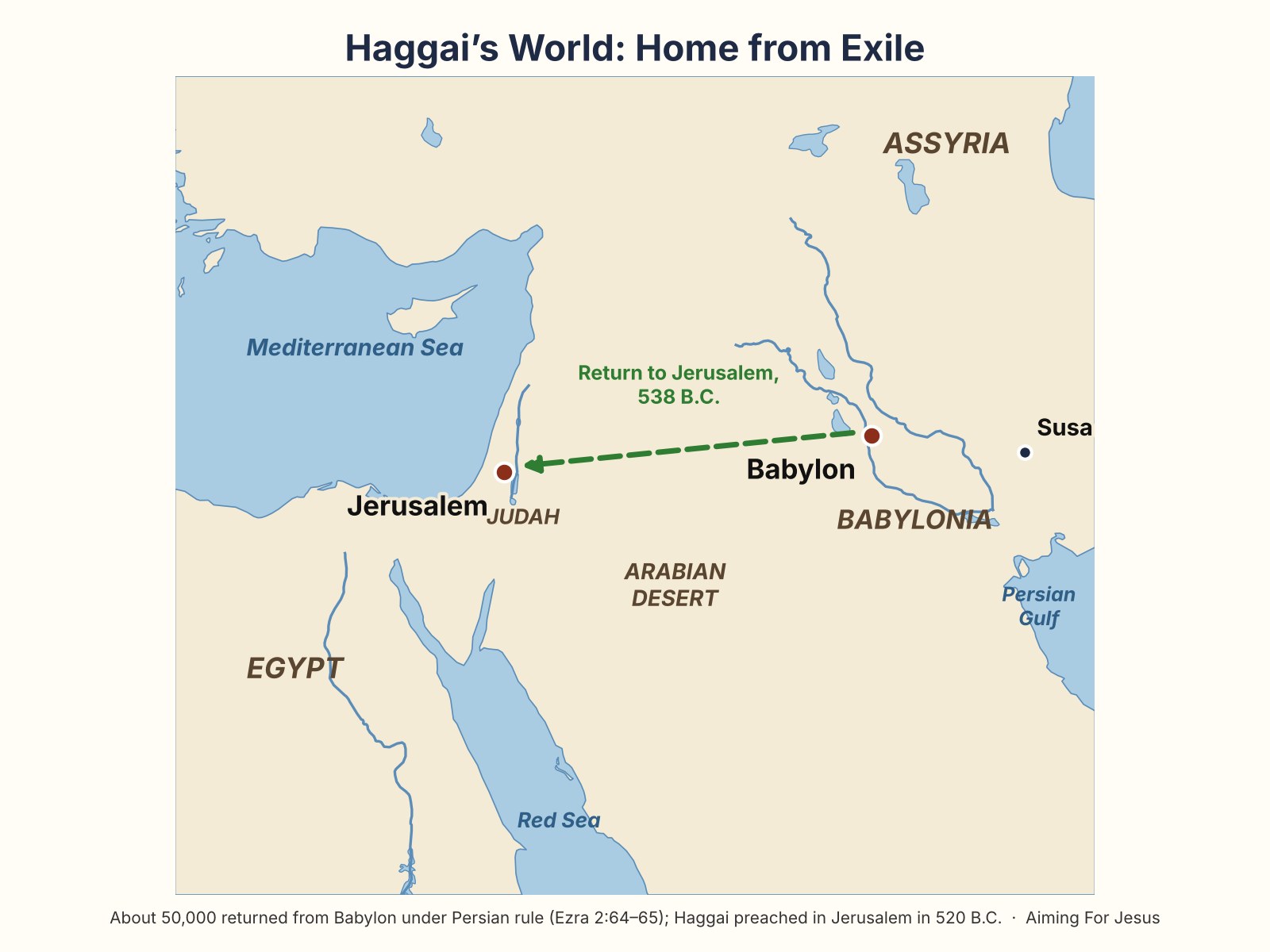
Jerusalem, about eighteen years after the first Jews came home from exile in Babylon. In 538 B.C. the Persian king Cyrus let them return and rebuild the temple (Ezra 1:1–4). They laid the foundation, but opposition and discouragement stopped the work. Now the temple site sat in ruins while the people built their own houses.
Haggai among the Old Testament books
Genesis · Exodus · Leviticus · Numbers · Deuteronomy · Joshua · Judges · Ruth · 1 Samuel · 2 Samuel · 1 Kings · 2 Kings · 1 Chronicles · 2 Chronicles · Ezra · Nehemiah · Esther · Job · Psalms · Proverbs · Ecclesiastes · Song of Solomon · Isaiah · Jeremiah · Lamentations · Ezekiel · Daniel · Hosea · Joel · Amos · Obadiah · Jonah · Micah · Nahum · Habakkuk · Zephaniah · Haggai · Zechariah · Malachi
Haggai is the 37th of the 39 books of the Old Testament and the tenth of the twelve Minor Prophets. It is the second-shortest book in the Old Testament (only Obadiah is shorter). Haggai, Zechariah and Malachi are the three prophets who spoke after the exile. Read it alongside Ezra 1–6, which tells the same story, and Zechariah 1–8, given in the same months.
When it was written
Haggai dates each of his four messages to the day. All of them came in 520 B.C., the second year of the Persian king Darius, between late August and mid-December. The people responded, and the temple was finished in 515 B.C. (Ezra 6:15).
Meet the book
- A sharp question: Why is God’s house in ruins while you live in fine houses?
- “Not yet”: The people home from Babylon started well, but opposition came. They said “the time has not yet come” to rebuild (1:2), and sixteen years went by.
- A bag with holes: Meanwhile their crops failed and their money leaked away “into a bag with holes” (1:6).
- “Consider your ways”: God sent Haggai. The people listened, and within three weeks they were back at work.
- “I am with you”: When some wept that the new temple looked like nothing beside Solomon’s, God said, “Be strong… work, for I am with you” (2:4), and promised its glory would be greater than the former.
- For us today: Haggai speaks to every believer who has let God’s work slide while life gets busy.
- Pointing to Jesus: The Lord of glory Himself came to that very temple. Zerubbabel, whom God called His signet ring (2:23), is in the family line of Jesus (Matthew 1:12–13).
The central message Put God first: when His people stop making excuses, consider their ways and get back to His work, He promises, “I am with you,” and He will fill His house with a glory greater than any before.
A verse to carry through the study Haggai 2:4 BLB
Find your way
Main teachings
Consider your ways
Haggai 1:5, 7; Lamentations 3:40; 2 Corinthians 13:5 Twice God says, “Consider your ways.” Take an honest look at your life. What do your time, money and attention say about your priorities?
Seek first His kingdom
Haggai 1:4, 9; Matthew 6:33 The people put their own houses ahead of God’s house. Jesus said to seek first God’s kingdom, and the rest will be added. This is not a promise of riches, but a call to put God first.
Obedience follows God’s word
Haggai 1:12–14; James 1:22 The leaders and people obeyed and feared the LORD. God stirred up their spirits, and they went to work. When God speaks, the right response is to act.
“I am with you”
Haggai 1:13; 2:4–5; Matthew 28:20 God’s presence is the reason to keep going. His Spirit remained among them. Jesus makes the same promise to us: “I am with you always.”
Don’t despise small beginnings
Haggai 2:3–5; Zechariah 4:10 The new temple looked small. Comparing it with the past discouraged them. God measures faithfulness, not size.
A greater glory to come
Haggai 2:6–9; Hebrews 12:26–28; John 1:14 God promised to shake heaven and earth and fill His house with glory. Jesus Himself walked in that temple, and He is building a kingdom that can’t be shaken.
Holiness isn’t contagious, but sin is
Haggai 2:10–14; Titus 1:15 Touching something holy doesn’t make you holy, but touching something unclean makes you unclean. Religious activity can’t cover a disobedient heart. Only God can make us clean.
God’s signet ring
Haggai 2:23; Matthew 1:12–13 God chose Zerubbabel, a descendant of David, as His signet ring, His sign of royal authority. The promise points ahead to Jesus, the Son of David, who will reign forever.
Praying through Haggai
Haggai has no written prayer, but its messages invite honest prayer about our priorities.
A good way to pray through Haggai is to ask God to show you where you have put His work off, to thank Him that He is with you, and to ask for strength to do what He has given you to do.
The prayers in this book
Haggai 1:5 — A prayer of honest review. Ask the Lord to show you how your time, money and energy line up with His priorities.
Haggai 2:4 — A prayer for strength. Thank God that He is with you, and ask for courage to keep working when you feel small or discouraged.
Haggai 2:9 — A prayer of hope. Praise God for the glory of Jesus, and ask Him to fill His church with His presence and peace.
Be strong and work (Haggai 2:4)
Pray it with Haggai 2:4 BLB
Read Haggai
Select a chapter to read it in the ESV in a reading window, right here on this page.
Haggai 1:1–15 Haggai 2:1–23
A brief outline
1:12–1:15 The People Obey, and God Is with Them
2:1–2:9 The Latter Glory Will Be Greater
Study every verse
Begin with the Scripture, then read the study notes and the passages to read alongside. After each section, pause over the question. Keep 2:4 in mind the whole way: be strong, and work, for the LORD is with you.
Commentary offered not as authoritative but as a view of the verse drawn from the scriptures presented, other scriptures, and various commentaries. If these thoughts do not line up with the Word then they must be rejected. It is my belief and prayer they are consistent with the Word and are offered as a simple teaching on the Word and as every teaching on the Word each must be carefully compared with the one true and living Word of God.
Chapter 1 1:1 1:2 1:3 1:4 1:5 1:6 1:7 1:8 1:9 1:10 1:11 1:12 1:13 1:14 1:15
Chapter 2 2:1 2:2 2:3 2:4 2:5 2:6 2:7 2:8 2:9 2:10 2:11 2:12 2:13 2:14 2:15 2:16 2:17 2:18 2:19 2:20 2:21 2:22 2:23
Chapter 1
Consider Your Ways
Haggai 1:1
Read the verse: Haggai 1:1 BLB
Study Notes
This Joshua is the high priest, the son of Jehozadak. He is not Joshua son of Nun, who led Israel into the land.
In the second year of King Darius, on the first day of the sixth month, the LORD’s word came through the prophet Haggai to Zerubbabel the governor of Judah and to Joshua the high priest.
Late August, 520 B.C. Haggai dates his message to the day. He speaks to the two leaders: Zerubbabel, a grandson of King Jehoiachin from David’s line, and Joshua the high priest. God starts with the leaders.
Read alongside Ezra 5:1–2 BLB; Ezra 3:2, 8 BLB; Zechariah 4:9 BLB
Haggai 1:2
Read the verse: Haggai 1:2 BLB
Study Notes
The LORD of hosts says: These people are saying the time hasn’t come yet to rebuild the LORD’s house.
“Not yet.” That was their excuse. Opposition had stopped the work years before (Ezra 4:4–5, 24). Now waiting had become a habit. How often do we say “not yet” to what God has plainly told us to do?
Read alongside Ezra 4:4–5, 24 BLB; Proverbs 27:1 BLB; 2 Corinthians 6:2 BLB
Haggai 1:3
Read the verse: Haggai 1:3 BLB
Study Notes
Then the LORD’s word came through Haggai the prophet:
God answers their excuse.
Read alongside Haggai 1:1 BLB; Zechariah 1:1 BLB; Ezra 6:14 BLB
Haggai 1:4
Read the verse: Haggai 1:4 BLB
Study Notes
Is it time for you to live in your finished, paneled houses while this house lies in ruins?
Paneled houses were fine homes. The people had found time and money for their own comfort. God’s house sat in rubble. The problem wasn’t that they had nice homes. It was what came first.
Read alongside 2 Samuel 7:2 BLB; Matthew 6:33 BLB; Philippians 2:21 BLB
Haggai 1:5
Read the verse: Haggai 1:5 BLB
Study Notes
So now the LORD of hosts says: Think carefully about your ways.
“Consider your ways.” Literally, “set your heart on your ways.” Stop and take an honest look. Where has your life been heading?
English wording → Hebrew word → meaning
“Consider” → sum → to set, to place; to set one’s heart on BLB
“ways” → derek → a way, a road; a way of life BLB
Teacher’s comment — Chuck Swindoll (paraphrase; overview of Haggai, Insight for Living; source)
Swindoll names 1:5 and 1:7, “consider your ways,” as key verses. He notes that the returned exiles had put their own houses ahead of God’s house, and that unlike many prophets’ hearers, they listened and went back to work. He teaches that the real obstacle was inside them, their own self-interest, and asks whether our lives, built on Christ, will leave a lasting legacy.
Read alongside Lamentations 3:40 BLB; Psalm 119:59 BLB; 2 Corinthians 13:5 BLB
Haggai 1:6
Read the verse: Haggai 1:6 BLB
Study Notes
You have planted much but harvested little. You eat and drink but are never satisfied. You put on clothes but are never warm. Whoever earns wages puts them into a bag full of holes.
A picture we all understand: money in, money out, and nothing to show for it. Under God’s covenant with Israel, poor harvests were a warning sign (Deuteronomy 28:38–40). Not every money problem today means that. But a life that leaves God out will always feel like a bag with holes.
Read alongside Deuteronomy 28:38–40 BLB; Hosea 4:10 BLB; Isaiah 55:2 BLB
Aiming for Jesus
Examine your heart
God said, “Consider your ways” (1:5). If you looked honestly at how you spend your time and money, what would it say about your priorities? Is there anything God has told you to do that you have been putting off with “not yet”?
Walk with Him today
Name one thing you know would honor God that you keep putting off. Ask Him for help, then take the first small step before this day ends.
Go Up and Build
Haggai 1:7
Read the verse: Haggai 1:7 BLB
Study Notes
The LORD of hosts says: Think carefully about your ways.
A second time. God wants them to really think about it.
Read alongside Haggai 1:5 BLB; Haggai 2:15, 18 BLB; Psalm 4:4 BLB
Haggai 1:8
Read the verse: Haggai 1:8 BLB
Study Notes
Go up into the hills, bring wood, and build the house, so that I may take pleasure in it and be honored, says the LORD.
A simple, clear command: go get wood and build. God takes pleasure in His people’s obedience. The goal is His glory, not a building for its own sake.
Read alongside 1 Chronicles 22:19 BLB; Ezra 3:7 BLB; 1 Corinthians 10:31 BLB
Haggai 1:9
Read the verse: Haggai 1:9 BLB
Study Notes
You looked for much, and it came to little. When you brought it home, I blew it away. Why? says the LORD of hosts. Because My house lies in ruins while each of you hurries off to his own house.
They expected plenty and got little. Why? God tells them plainly: you run to your own house and leave Mine in ruins. We can be busy, busy, busy, and still be busy with the wrong things.
Read alongside Matthew 6:33 BLB; Luke 12:16–21 BLB; Philippians 2:21 BLB
Haggai 1:10
Read the verse: Haggai 1:10 BLB
Study Notes
That is why the sky has held back its dew and the ground its crops.
In that dry land, dew mattered for the crops. God was using the weather to get their attention.
Read alongside Deuteronomy 11:16–17 BLB; 1 Kings 17:1 BLB; Amos 4:7 BLB
Haggai 1:11
Read the verse: Haggai 1:11 BLB
Study Notes
I called for drought on the land and hills, on the grain, the new wine, the oil, on all the ground produces, on people and animals, and on all your work.
Grain, wine and oil were the three basic crops. God controls them all. Trouble can be a loving call to come back to Him.
Read alongside Deuteronomy 28:22–24 BLB; Joel 1:10–12 BLB; Hebrews 12:5–6 BLB
Aiming for Jesus
Know Him
God loves His people too much to leave them comfortable in the wrong place. The hard times He sent were a call to come home, not a door slammed shut (Hebrews 12:5–6).
Remember whose you are
We belong to Him, and so do our time, money and strength. Life feels empty when we spend what is His only on ourselves.
The People Obey, and God Is with Them
Haggai 1:12
Read the verse: Haggai 1:12 BLB
Study Notes
Then Zerubbabel, Joshua the high priest, and all the rest of the people obeyed the voice of the LORD their God and the words of Haggai, because the LORD had sent him. And the people feared the LORD.
They obeyed! Leaders and people together. And they feared the LORD, meaning they took Him seriously with reverence. Few prophets saw such a quick response. When God’s word is heard with a ready heart, things change.
Read alongside Ezra 5:2 BLB; 1 Samuel 15:22 BLB; Proverbs 1:7 BLB
Haggai 1:13
Read the verse: Haggai 1:13 BLB
Study Notes
Then Haggai, the LORD’s messenger, gave the LORD’s message to the people: “I am with you, declares the LORD.”
Four words of grace: “I am with you.” God didn’t scold them more. Once they turned, He reassured them. That is the heart of God. He is with those who turn to Him.
Read alongside Matthew 28:20 BLB; Isaiah 41:10 BLB; Hebrews 13:5 BLB
Haggai 1:14
Read the verse: Haggai 1:14 BLB
Study Notes
And the LORD stirred up the spirit of Zerubbabel the governor, of Joshua the high priest, and of all the remaining people. They came and began working on the house of the LORD of hosts, their God,
God stirred their spirits. Even the desire to obey came from Him. He gives us both the willingness and the strength to do His work (Philippians 2:13).
Read alongside Philippians 2:12–13 BLB; Ezra 1:5 BLB; Hebrews 13:20–21 BLB
Haggai 1:15
Read the verse: Haggai 1:15 BLB
Study Notes
on the twenty-fourth day of the sixth month, in the second year of King Darius.
Twenty-three days after Haggai’s first message, the work began. They didn’t wait for another “someday.”
Read alongside Haggai 1:1 BLB; Psalm 119:60 BLB; Ecclesiastes 9:10 BLB
Aiming for Jesus
Seeing Jesus
“I am with you” comes to its fullest in Jesus, Immanuel, “God with us” (Matthew 1:23), who promised, “I am with you always” (Matthew 28:20).
Pray
Lord, thank You that You do not wait for us to be strong before You come near. Stir my heart as You stirred theirs, and give me both the desire and the strength to obey You (Philippians 2:13). In Jesus’ name, amen.
Chapter 2
The Latter Glory Will Be Greater
Haggai 2:1
Read the verse: Haggai 2:1 BLB
Study Notes
In the seventh month, on the twenty-first day, the LORD’s word came through Haggai the prophet:
Mid-October 520 B.C., the last day of the Feast of Booths. About seven weeks into the work. That is often when discouragement sets in.
Read alongside Leviticus 23:34–36 BLB; Ezra 3:4 BLB; 1 Kings 8:2 BLB
Haggai 2:2
Read the verse: Haggai 2:2 BLB
Study Notes
Speak now to Zerubbabel the governor, to Joshua the high priest, and to the rest of the people, and say:
A message for everyone.
Read alongside Haggai 1:12 BLB; Haggai 1:14 BLB; Ezra 5:2 BLB
Haggai 2:3
Read the verse: Haggai 2:3 BLB
Study Notes
Who among you is left who saw this house in its first glory? How does it look to you now? Doesn’t it seem like nothing to you?
Some of the older people had seen Solomon’s temple 66 years earlier. When the foundation was laid, they wept (Ezra 3:12). The new one looked so plain. Comparing with the past can steal our joy and strength.
Read alongside Ezra 3:12–13 BLB; Zechariah 4:10 BLB; Ecclesiastes 7:10 BLB
Haggai 2:4
Read the verse: Haggai 2:4 BLB
Study Notes
But now be strong, Zerubbabel, declares the LORD. Be strong, Joshua the high priest. Be strong, all you people of the land, declares the LORD. Work, for I am with you, declares the LORD of hosts,
“Be strong” three times. Then: “Work, for I am with you.” God’s answer to discouragement is not a bigger building. It is His presence. The same words were spoken to Joshua (Joshua 1:6–9) and by David to Solomon about the first temple (1 Chronicles 28:20).
English wording → Hebrew word → meaning
“strong” → chazaq → to be strong, to take courage BLB
Read alongside Joshua 1:6–9 BLB; 1 Chronicles 28:20 BLB; 1 Corinthians 15:58 BLB
Haggai 2:5
Read the verse: Haggai 2:5 BLB
Study Notes
as I promised you when you came out of Egypt. My Spirit remains among you. Do not be afraid.
God’s covenant from the exodus still stood. His Spirit was still with them. “Fear not.” The same promise holds for believers today; the Holy Spirit lives in us.
Read alongside Exodus 29:45–46 BLB; Isaiah 63:11–14 BLB; John 14:16–17 BLB
Haggai 2:6
Read the verse: Haggai 2:6 BLB
Study Notes
For the LORD of hosts says: In a little while I will once more shake the heavens and the earth, the sea and the dry land.
God shook Mount Sinai once. He will shake everything again. Hebrews 12:26–28 quotes this: everything that can be shaken will be removed, so that what cannot be shaken will remain. We belong to that unshakable kingdom.
Read alongside Hebrews 12:26–28 BLB; Exodus 19:18 BLB; Isaiah 2:19 BLB
Haggai 2:7
Read the verse: Haggai 2:7 BLB
Study Notes
And I will shake all nations, and the treasures of all nations will come in, and I will fill this house with glory, says the LORD of hosts.
Older Bibles read “the Desire of all nations shall come,” and many have seen Christ here. Most newer translations read “the treasures of all nations,” which fits verse 8. Either way, God promised to fill His house with glory, and Jesus, the Lord of glory, came to this very temple (Malachi 3:1).
English wording → Hebrew word → meaning
“treasures” → chemdah → something desired, a treasure BLB
“glory” → kabod → weight, honor, glory BLB
Read alongside Malachi 3:1 BLB; Isaiah 60:5–7 BLB; John 2:19–21 BLB
Haggai 2:8
Read the verse: Haggai 2:8 BLB
Study Notes
The silver is Mine, and the gold is Mine, declares the LORD of hosts.
Don’t worry about how plain it looks. All the wealth in the world belongs to God. He can supply whatever is needed.
Read alongside Psalm 24:1 BLB; Psalm 50:10–12 BLB; 1 Chronicles 29:14 BLB
Haggai 2:9
Read the verse: Haggai 2:9 BLB
Study Notes
The glory of this latter house will be greater than the former, says the LORD of hosts. And in this place I will give peace, declares the LORD of hosts.
How could this plain temple have greater glory than Solomon’s? Because Jesus Himself walked in its courts (Herod later enlarged this same temple). God’s Son brought a glory no gold could match, and through Him God gives peace.
English wording → Hebrew word → meaning
“peace” → shalom → peace, wholeness, well-being BLB
Read alongside John 1:14 BLB; Luke 2:27–32 BLB; Ephesians 2:14 BLB
Aiming for Jesus
Know Him
God’s answer to discouragement was not a bigger building. It was Himself: “Work, for I am with you… My Spirit remains in your midst. Fear not” (Haggai 2:4–5). The silver and the gold are His, and so is the work.
Examine your heart
The older people wept because the new temple looked like nothing compared to the old one (2:3; Ezra 3:12). Has comparing your life or your church with the past ever discouraged you? What does God’s promise “Work, for I am with you” (2:4) say to you today?
Clean and Unclean: From This Day I Will Bless You
Haggai 2:10
Read the verse: Haggai 2:10 BLB
Study Notes
On the twenty-fourth day of the ninth month, in the second year of Darius, the LORD’s word came through Haggai the prophet:
Mid-December 520 B.C., three months after the work began.
Read alongside Haggai 1:15 BLB; Zechariah 1:1 BLB; Ezra 4:24 BLB
Haggai 2:11
Read the verse: Haggai 2:11 BLB
Study Notes
The LORD of hosts says: Ask the priests about the law:
A question for the priests, the experts in what was clean and unclean.
Read alongside Leviticus 10:10–11 BLB; Deuteronomy 17:8–11 BLB; Malachi 2:7 BLB
Haggai 2:12
Read the verse: Haggai 2:12 BLB
Study Notes
If someone carries holy meat in the fold of his garment and his garment touches bread, stew, wine, oil or any food, does that food become holy? The priests answered, “No.”
Question one: does holiness pass along by touch? No.
Read alongside Leviticus 6:27 BLB; Ezekiel 44:19 BLB; Matthew 23:17–19 BLB
Haggai 2:13
Read the verse: Haggai 2:13 BLB
Study Notes
Then Haggai asked, If someone who is unclean from touching a dead body touches any of these, does it become unclean? The priests answered, “It does become unclean.”
Question two: does uncleanness pass along by touch? Yes. Sin spreads easily. Goodness doesn’t rub off the same way.
Read alongside Numbers 19:11–13, 22 BLB; Leviticus 22:4–6 BLB; 1 Corinthians 15:33 BLB
Haggai 2:14
Read the verse: Haggai 2:14 BLB
Study Notes
Then Haggai said, So it is with this people and this nation before Me, declares the LORD, and with every work of their hands. What they offer there is unclean.
Here is the point. Working on the temple didn’t make them clean. Their years of neglect had made everything they offered unclean. Religious activity can’t cover a disobedient heart. Only God can cleanse us, through the sacrifice of Christ.
Read alongside Titus 1:15–16 BLB; Isaiah 1:11–17 BLB; 1 John 1:7–9 BLB
Haggai 2:15
Read the verse: Haggai 2:15 BLB
Study Notes
Now think carefully from this day forward. Before one stone was placed on another in the LORD’s temple,
“Consider” again. Think back.
Read alongside Haggai 1:5, 7 BLB; Haggai 2:18 BLB; Ezra 3:10 BLB
Haggai 2:16
Read the verse: Haggai 2:16 BLB
Study Notes
how did things go for you? When someone came to a heap expecting twenty measures, there were only ten. When someone came to the winepress to draw fifty measures, there were only twenty.
Half the grain, less than half the wine. Remember how it was.
Read alongside Haggai 1:6, 9 BLB; Deuteronomy 28:38–39 BLB; Isaiah 5:10 BLB
Haggai 2:17
Read the verse: Haggai 2:17 BLB
Study Notes
I struck you and all the work of your hands with blight, mildew and hail, yet you did not turn to Me, declares the LORD.
Hardship hadn’t brought them back. Amos 4:9 says almost the same words about an earlier generation. God’s discipline is meant to turn us to Him.
Read alongside Amos 4:9 BLB; Deuteronomy 28:22 BLB; Hebrews 12:11 BLB
Haggai 2:18
Read the verse: Haggai 2:18 BLB
Study Notes
Think carefully from this day forward, from the twenty-fourth day of the ninth month. Since the day the foundation of the LORD’s temple was laid, think about it:
From this day, things change. A turning point.
Read alongside Haggai 2:10 BLB; Zechariah 8:9–12 BLB; Ezra 5:16 BLB
Haggai 2:19
Read the verse: Haggai 2:19 BLB
Study Notes
Is there still seed in the barn? The vine, the fig tree, the pomegranate and the olive tree have not yet produced. But from this day on I will bless you.
The seed was planted, but nothing had grown yet. They couldn’t see any results. Still God promised, “From this day on I will bless you.” Faith trusts God’s promise before the harvest comes. What a word of grace to people who had just been told they were unclean.
Read alongside Malachi 3:10 BLB; Zechariah 8:12 BLB; Hebrews 11:1 BLB
Aiming for Jesus
Seeing Jesus
Uncleanness spreads by touch, but holiness does not. Yet when Jesus touched a man with leprosy, the man was made clean (Mark 1:40–42). His holiness reaches us. We are made clean by His blood, not by our work (1 John 1:7).
Remember whose you are
Our work for God is not how we become His. We are His by grace through faith, and then we work because we belong to Him (Ephesians 2:8–10).
Zerubbabel, God’s Signet Ring
Haggai 2:20
Read the verse: Haggai 2:20 BLB
Study Notes
The LORD’s word came a second time to Haggai on the twenty-fourth day of the month:
The same day, a second message, just for Zerubbabel.
Read alongside Haggai 2:10 BLB; Haggai 1:1 BLB; Zechariah 4:6–9 BLB
Haggai 2:21
Read the verse: Haggai 2:21 BLB
Study Notes
Speak to Zerubbabel, governor of Judah: I am about to shake the heavens and the earth,
The shaking of verse 6 again.
Read alongside Haggai 2:6–7 BLB; Hebrews 12:26 BLB; Isaiah 13:13 BLB
Haggai 2:22
Read the verse: Haggai 2:22 BLB
Study Notes
and overturn the thrones of kingdoms and destroy the strength of the nations. I will overturn chariots and their riders; horses and riders will fall, each by his brother’s sword.
God will overturn every proud kingdom, just as He threw Pharaoh’s horses and riders into the sea. Empires like Persia looked permanent. They weren’t.
Read alongside Exodus 15:1, 4 BLB; Daniel 2:44 BLB; Psalm 46:6–9 BLB
Haggai 2:23
Read the verse: Haggai 2:23 BLB
Study Notes
On that day, declares the LORD of hosts, I will take you, Zerubbabel son of Shealtiel, My servant, declares the LORD, and make you like a signet ring, for I have chosen you, declares the LORD of hosts.
A signet ring was a king’s seal of authority. Generations earlier God had said that even if King Jehoiachin were His signet ring, He would pull him off (Jeremiah 22:24). Now He puts the ring back on David’s line through Zerubbabel, Jehoiachin’s grandson. Zerubbabel never became king, but his line led to Jesus (Matthew 1:12–16), the King of kings. God keeps His promises.
English wording → Hebrew word → meaning
“signet ring” → chotham → a seal, a signet ring BLB
“chosen” → bachar → to choose BLB
Read alongside Jeremiah 22:24 BLB; Matthew 1:12–16 BLB; Luke 1:32–33 BLB
Aiming for Jesus
Pray
Father, kingdoms rise and fall, but You keep every promise. Thank You for keeping Your word through ruins and exile to bring Jesus into the world. Help me trust You today with what I cannot yet see. In Jesus’ name, amen.
Walk with Him today
Write down one promise of God you need right now. Read it aloud morning and evening this week, and thank Him that He keeps His word.
Source notes
Prepared for Aiming For Jesus by Hollis McGehee. The background, outline and much of the understanding in this study are based on the teaching of Dr. Thomas L. Constable, Notes on Haggai (2026 edition, © Thomas L. Constable), available free at www.soniclight.com. The study notes are written in plain words and are not his text; for his full teaching and sources, please read his notes.
Scripture is distinguished from commentary throughout.
Hebrew word notes give the common meaning of the word as found in standard Hebrew dictionaries; each has a BLB button that opens the word in Blue Letter Bible so the reader can check it. Teacher’s comments are paraphrases, not quotations, of Chuck Swindoll, each with a link to its source, so the reader can read the teacher’s own words.
Scripture quotations are from the ESV® Bible (The Holy Bible, English Standard Version®), copyright © 2001 by Crossway, a publishing ministry of Good News Publishers. Used by permission. All rights reserved.
Verses to memorize
Begin with one selection. Read its surrounding passage, say the words aloud, and return to them during the day. For a longer selection, learn one verse at a time and then join the verses together.
Consider your ways
Haggai 1:5 BLB
Be strong and work
Haggai 2:4 BLB
My Spirit remains
Haggai 2:5 BLB
The latter glory
Haggai 2:9 BLB