Ephesians — A Complete Review
Every Spiritual Blessing in Christ — what God has done for us in Christ, and how to walk worthy of our calling · Bible study by Hollis McGehee · verse by verse
Click or tap any Scripture reference to read it in the ESV right here. Select BLB to open it in Blue Letter Bible.
Large Print edition (PDF) — easy to read and print
Before you begin: BibleProject’s Ephesians guide and overview video (outside site)
Just want to read Ephesians?
Skip the study notes and go straight to the Scripture. Click or tap a chapter to read it right here on this page.
Ephesians 1:1–23 Ephesians 2:1–22 Ephesians 3:1–21 Ephesians 4:1–32 Ephesians 5:1–33 Ephesians 6:1–24
Who wrote it
The apostle Paul wrote Ephesians. He names himself at the start (Ephesians 1:1), calls himself “a prisoner of Christ Jesus” (Ephesians 3:1) and “an ambassador in chains” (Ephesians 6:20). Unlike Colossians and Philippians, Ephesians names no co-sender; it comes from Paul alone.
Paul was once Saul of Tarsus, a Pharisee who sincerely believed he served God by persecuting the followers of Jesus. On the road to Damascus the risen Jesus met him, and the persecutor became a follower of Christ (Acts 9:1–22). Jesus called him as an apostle, especially to the Gentiles, and that calling is at the heart of this letter: Paul calls himself “the very least of all the saints,” given grace “to preach to the Gentiles the unsearchable riches of Christ” (Ephesians 3:8).
Where is Ephesus
Ephesus was a leading city of the Roman province of Asia, in what is now western Turkey. It was a busy port and center of trade, famous for its great temple of the goddess Artemis, one of the wonders of the ancient world.
Paul knew this church well. He spent about three years in Ephesus on his third missionary journey (Acts 19; 20:31), and the gospel spread so widely that “all the residents of Asia heard the word of the Lord” (Acts 19:10). So many turned from idols that the silversmiths who made shrines of Artemis started a riot (Acts 19:23–41). On his way to Jerusalem, Paul said a tearful farewell to the Ephesian elders (Acts 20:17–38).
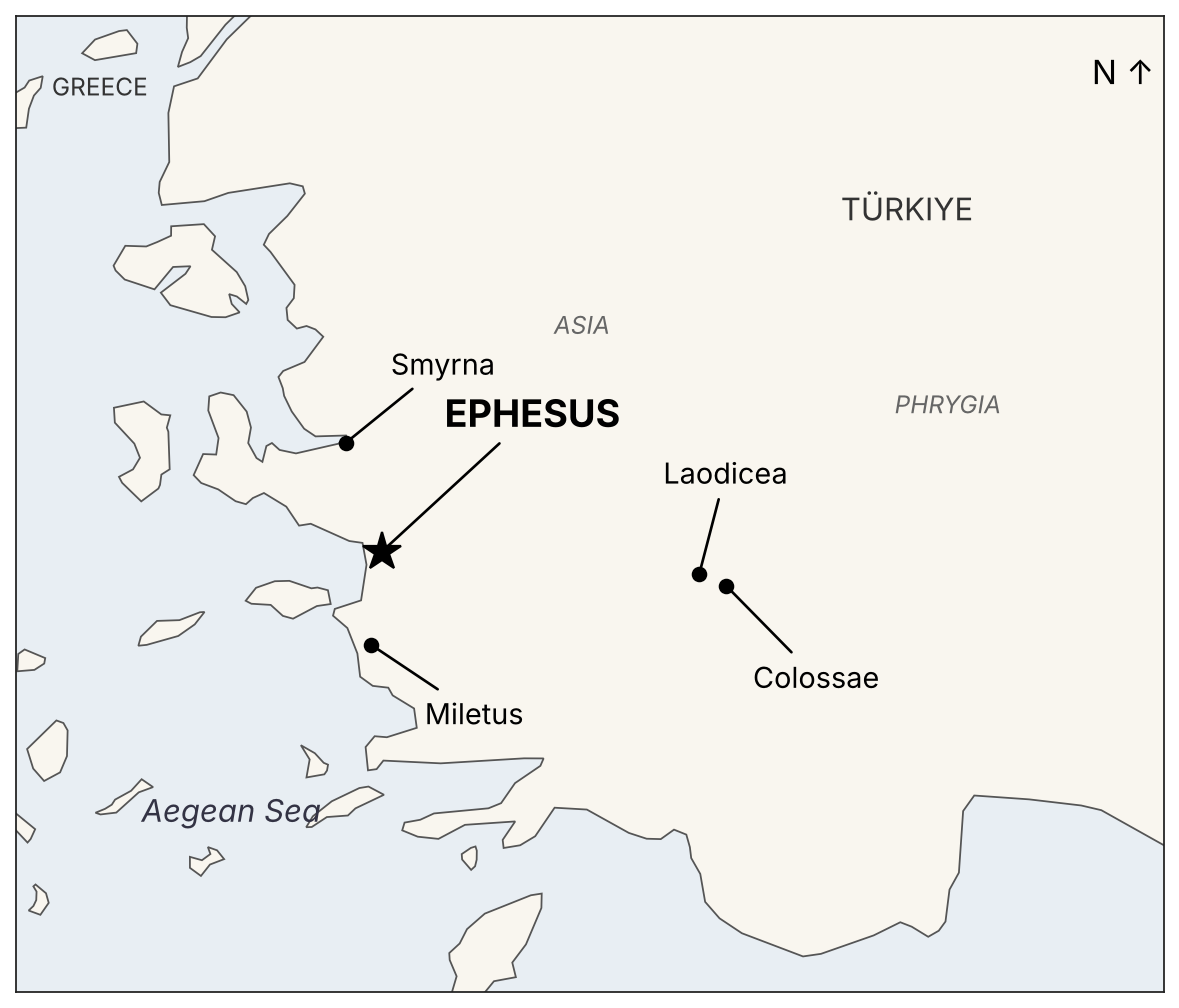
Modern locator map. Ephesus is marked by a star, on the coast of the Roman province of Asia, with Colossae and Laodicea inland to the east. Rome, where Paul most likely wrote, lies nearly 800 miles to the west.
Ephesians among the New Testament books
Matthew · Mark · Luke · John · Acts · Romans · 1 Corinthians · 2 Corinthians · Galatians · Ephesians · Philippians · Colossians · 1 Thessalonians · 2 Thessalonians · 1 Timothy · 2 Timothy · Titus · Philemon · Hebrews · James · 1 Peter · 2 Peter · 1 John · 2 John · 3 John · Jude · Revelation
Ephesians is the tenth of the 27 books in the New Testament. It comes after Galatians and before Philippians.
When and where it was written
Paul wrote Ephesians as a prisoner (Ephesians 3:1; 4:1; 6:20), most likely during his first imprisonment in Rome, about AD 60–62, when he lived under guard in his own rented house and freely welcomed visitors (Acts 28:16, 30–31). Tychicus carried it, the same man who carried Colossians (Ephesians 6:21–22; Colossians 4:7–9), so the two letters were written at about the same time and traveled together. Some of the oldest Greek manuscripts do not have the words “in Ephesus” in 1:1, and the letter has no personal greetings even though Paul knew the church well. For these reasons many believe it was meant to be read in several churches of the region, with Ephesus as the leading one. Either way, its message is for every church.
That places Ephesians in the middle years of Paul’s letter writing. By then he had already written Galatians, 1 and 2 Thessalonians, 1 and 2 Corinthians and Romans. Ephesians, Philippians, Colossians and Philemon are often called the “Prison Letters.” Paul’s letters to Timothy and Titus (1 Timothy, Titus and 2 Timothy) came later, near the end of his life.
Meet the letter
Ephesians is one of Paul’s richest letters. In six chapters it moves from the heights of God’s eternal plan, to the church made up of Jews and Gentiles as one body, to ordinary life at home and at work, and finally to the spiritual battle every believer faces. Paul wrote it as a prisoner (Ephesians 3:1; 4:1; 6:20), and Tychicus carried it to the churches along with Colossians (Ephesians 6:21–22; Colossians 4:7–9). The two are twin letters, and reading them side by side helps us understand both.
The letter has two halves of three chapters each. Chapters 1–3 tell us what God has done, with almost no commands at all. Paul praises God for every spiritual blessing in Christ, shows how grace saves sinners and makes Jews and Gentiles one, and twice stops to pray that the church would grasp it (Ephesians 1:15–23; 3:14–21). Chapters 4–6 tell us how we are to live. The turning point is 4:1, “I therefore … urge you to walk in a manner worthy of the calling to which you have been called,” and the word “walk” keeps coming back (Ephesians 4:1, 17; 5:2, 8, 15).
The order matters. Paul does not begin with what we must do but with what God has already done. Our walk grows out of our standing in Christ. Christian living is not our effort to earn God’s blessing; it is our response to blessings already given. That is why the letter that says “by grace you have been saved” (Ephesians 2:8) also says “walk in love” (Ephesians 5:2).
The central message God has blessed us with every spiritual blessing in Christ and made Jews and Gentiles one body in Him, so we must walk worthy of that calling, in unity, holiness and love, strong in the Lord.
A verse to carry through the study Ephesians 1:3 BLB
Find your way
Main teachings
Every spiritual blessing in Christ
Ephesians 1:3–14 In one long burst of praise Paul blesses God, who chose us, adopted us, redeemed us through Christ’s blood, made known His plan to unite all things in Christ, and sealed us with the Holy Spirit as the guarantee of our inheritance.
Eyes of the heart enlightened
Ephesians 1:15–23 Paul prays that believers would know God better and grasp the hope of His calling, the riches of His inheritance in the saints, and the immeasurable power that raised Christ and seated Him above every power.
Made alive by grace
Ephesians 2:1–10 Once dead in sin, we were made alive with Christ by God’s mercy and love, saved by grace through faith and not by works, and created in Christ Jesus for the good works God prepared for us.
One new people
Ephesians 2:11–22 Gentiles once far off have been brought near by the blood of Christ, who is our peace; He broke down the dividing wall and made Jews and Gentiles one household and one holy temple where God dwells by His Spirit.
The mystery revealed
Ephesians 3:1–13 The secret hidden for ages is now made known: the Gentiles are fellow heirs and members of the same body, and through the church God’s manifold wisdom is put on display.
To know the love of Christ
Ephesians 3:14–21 Paul kneels and prays that believers be strengthened by the Spirit, that Christ would dwell in their hearts through faith, and that they would know the love of Christ that surpasses knowledge, and he praises Him who is able to do far more than we ask or think.
Walk worthy, keep the unity
Ephesians 4:1–16 Walk worthy of your calling, keep the unity of the Spirit, and use the gifts Christ gave, so that the church grows up into Christ, speaking the truth in love.
Put off the old, put on the new
Ephesians 4:17–32 Put off the old self and put on the new: speak truth, deal with anger, work honestly, let no corrupting talk come out of your mouth, and be kind and forgiving as God in Christ forgave you.
Walk in love, in light and in wisdom
Ephesians 5:1–21 Imitate God as beloved children, walk in love as Christ loved us, live as children of light, make the best use of the time, and be filled with the Spirit.
Christ’s love, the pattern for marriage
Ephesians 5:22–33 Wives and husbands live out their marriage as to the Lord, with Christ’s self-giving love for the church as the pattern.
As to the Lord at home and at work
Ephesians 6:1–9 Children and parents, servants and masters each serve “as to the Lord,” remembering that everyone has the same Master in heaven.
Stand firm in the armor of God
Ephesians 6:10–20 Our real enemy is not people but spiritual forces of evil, so we are strong in the Lord, put on the whole armor God supplies, stand firm, and pray at all times in the Spirit.
Praying through Ephesians
Ephesians is a letter full of prayer. It opens with a great burst of praise to God for every spiritual blessing in Christ (Ephesians 1:3–14). Then Paul turns that praise into prayer, thanking God for the believers and asking that the eyes of their hearts be enlightened (Ephesians 1:15–23). In chapter 3 he kneels before the Father and prays that they would know the love of Christ that surpasses knowledge, and ends with praise to Him who is able to do far more than we ask or think (Ephesians 3:14–21). And he closes by calling believers to pray at all times in the Spirit, for all the saints and for him (Ephesians 6:18–20). Notice the pattern: thanksgiving first, then requests. Even strong believers need someone praying for them.
One of the best ways to study this letter is to pray it. Read a passage slowly, then say it back to God as your own prayer, for yourself and for people you name. Pray Paul’s two prayers (Ephesians 1:15–23 and 3:14–21) for yourself and for someone you love. The prayer below is my own morning prayer, prayed by saying Ephesians 2:1–10 back to God. Pray it as it is, then pray it again in your own words.
The prayers in this letter
Ephesians 1:3–14 — Blessed be God. Paul opens with praise: blessed be the God and Father of our Lord Jesus Christ, who chose us, adopted us, redeemed us, made known His plan and sealed us with the Holy Spirit, all to the praise of His glory.
Ephesians 1:15–23 — Paul’s first prayer: eyes of the heart enlightened. Paul thanks God for their faith in the Lord Jesus and love for all the saints, and asks for the Spirit of wisdom and revelation in knowing Him, that they may know the hope of His calling, the riches of His inheritance in the saints and the immeasurable greatness of His power toward those who believe.
Ephesians 3:14–21 — Paul’s second prayer: to know the love of Christ. Paul bows his knees before the Father and asks that believers be strengthened by His Spirit in the inner being, that Christ may dwell in their hearts through faith, and that, rooted and grounded in love, they may know the love of Christ that surpasses knowledge and be filled with all the fullness of God. He closes with glory to Him who is able to do far more abundantly than all we ask or think.
Ephesians 6:18–20 — Pray at all times in the Spirit. Paul urges believers to pray at all times in the Spirit, staying alert and making supplication for all the saints, and to pray for him, an ambassador in chains, that he may proclaim the mystery of the gospel boldly.
Ephesians 6:23–24 — A closing blessing. Paul ends by asking peace, love with faith, and grace for all who love our Lord Jesus Christ with love incorruptible.
A prayer from Ephesians 2
Pray it with Ephesians 2:1–10 BLB
Lord, we were once dead in the trespasses and sins in which we once walked, following the course of this world, following the prince of the power of the air, the spirit that is now at work in the sons of disobedience. Among them we all once lived in the passions of our flesh, carrying out the desires of the body and the mind, and were by nature children of wrath, like the rest of mankind.
But God, being rich in mercy, because of the great love with which You loved us, even when we were dead in our trespasses, made us alive together with Christ. By grace we have been saved! And You, O Lord, have raised us up with You and seated us with You in the heavenly places in Christ Jesus, so that in the coming ages You, O Lord, might show the immeasurable riches of Your grace in kindness toward us in Christ Jesus.
For by grace we have been saved through faith. And this is not our own doing; it is the gift of God, not a result of works, so that no one may boast. For we are Your workmanship, Lord, created in Christ Jesus for good works, which You, God, prepared beforehand, that we should walk in them. In Jesus’ name, amen.
Read Ephesians
Select a chapter to read it in the ESV in a reading window, right here on this page.
Ephesians 1:1–23 Ephesians 2:1–22 Ephesians 3:1–21 Ephesians 4:1–32 Ephesians 5:1–33 Ephesians 6:1–24
A brief outline
1:3–1:14 Spiritual Blessings in Christ
1:15–1:23 Thanksgiving and Prayer
2:1–2:10 By Grace Through Faith
3:1–3:13 The Mystery of the Gospel Revealed
3:14–3:21 Prayer for Spiritual Strength
4:1–4:16 Unity in the Body of Christ
6:1–6:9 Children and Parents; Bondservants and Masters
Study every verse
Begin with the Scripture, then read the study notes and the passages to read alongside. After each section, pause over the question. The aim is to understand Paul’s meaning and put it into practice in dependence on Christ.
Chapter 1 1:1 1:2 1:3 1:4 1:5 1:6 1:7 1:8 1:9 1:10 1:11 1:12 1:13 1:14 1:15 1:16 1:17 1:18 1:19 1:20 1:21 1:22 1:23
Chapter 2 2:1 2:2 2:3 2:4 2:5 2:6 2:7 2:8 2:9 2:10 2:11 2:12 2:13 2:14 2:15 2:16 2:17 2:18 2:19 2:20 2:21 2:22
Chapter 3 3:1 3:2 3:3 3:4 3:5 3:6 3:7 3:8 3:9 3:10 3:11 3:12 3:13 3:14 3:15 3:16 3:17 3:18 3:19 3:20 3:21
Chapter 4 4:1 4:2 4:3 4:4 4:5 4:6 4:7 4:8 4:9 4:10 4:11 4:12 4:13 4:14 4:15 4:16 4:17 4:18 4:19 4:20 4:21 4:22 4:23 4:24 4:25 4:26 4:27 4:28 4:29 4:30 4:31 4:32
Chapter 5 5:1 5:2 5:3 5:4 5:5 5:6 5:7 5:8 5:9 5:10 5:11 5:12 5:13 5:14 5:15 5:16 5:17 5:18 5:19 5:20 5:21 5:22 5:23 5:24 5:25 5:26 5:27 5:28 5:29 5:30 5:31 5:32 5:33
Chapter 6 6:1 6:2 6:3 6:4 6:5 6:6 6:7 6:8 6:9 6:10 6:11 6:12 6:13 6:14 6:15 6:16 6:17 6:18 6:19 6:20 6:21 6:22 6:23 6:24
Chapter 1
Greeting
Ephesians 1:1
Read the verse: Ephesians 1:1 BLB
Study Notes
Paul names himself at the very start. He is an apostle, one sent by Christ Jesus, and he holds that office not by his own choosing but “by the will of God.” He wrote this letter as a prisoner (Ephesians 3:1; 4:1; 6:20), most likely during his first imprisonment in Rome, about AD 60–62. He knew these believers well: he had spent about three years in Ephesus, a busy port city famous for its great temple of Artemis, and from there the gospel spread through the whole region (Acts 19:10; 20:31). Matthew Henry wrote of this letter: “It is an epistle that bears date out of a prison: and some have observed that what this apostle wrote when he was a prisoner had the greatest relish and savour in it of the things of God.”
Paul writes “to the saints … faithful in Christ Jesus.” Saints are not a special class of Christians; the word means “holy ones,” and it describes every believer, set apart for God. Some of the oldest Greek manuscripts do not have the words “in Ephesus,” and the letter carries no personal greetings, so many believe it was meant to be read in several churches of the region, with Ephesus as the leading one. Either way, its message is for every church, and for you and me.
Read alongside Acts 19:8–10 BLB; Acts 20:31 BLB; Ephesians 3:1 BLB; Colossians 1:1–2 BLB
Ephesians 1:2
Read the verse: Ephesians 1:2 BLB
Study Notes
Paul’s greeting of grace and peace from God our Father and the Lord Jesus Christ is a warm, encouraging greeting to the recipients of the letter. The grace spoken of here is related to, but not exactly the same as, the grace by which we are saved or born again. Both are God giving us what we don’t deserve, but this grace is about our life in Christ Jesus. It is the grace of God that gives us breath and the beat of our heart and everything that’s important, even the grace to stand, to lie down, to do all of the things we do. We have peace with God: when we are born again, we are reconciled to God. But the peace spoken of here is more about the peace of God alive in us as we receive and walk in His grace and trust Him more and more, looking to God—Father, Son and Holy Spirit—as our source for all things. God’s peace given to us is the wholeness and rest that God’s amazing grace brings: peace with God, the peace of God, and peace with one another. Notice the order: grace always comes first, and peace flows from it. Both come “from God our Father and the Lord Jesus Christ,” and Paul places the Son right beside the Father as the source of every blessing. These two words also preview the letter: “by grace you have been saved” (Ephesians 2:8), and Christ “himself is our peace” (Ephesians 2:14).
Read alongside Ephesians 2:8 BLB; Ephesians 2:14 BLB; Romans 5:1 BLB; Ephesians 6:23–24 BLB
Put it into practice Paul calls ordinary believers “saints” and “faithful in Christ Jesus.” Before you read further, thank God for the grace and peace He has given you, and ask Him to help you live this week as one set apart for Him.
Spiritual Blessings in Christ
Ephesians 1:3
Read the verse: Ephesians 1:3 BLB
Study Notes
Verses 3–14 are one long burst of praise. Paul does not begin with what we must do but with what God has already done: He “has blessed us” — past tense — “with every spiritual blessing.” This is the order of the whole letter. Our walk (chapters 4–6) grows out of our standing in Christ (chapters 1–3). Christian living is not our effort to earn God’s blessing; it is our response to blessings already given.
Every one of these blessings is “in Christ.” They belong to “the heavenly places,” where Christ now reigns at the Father’s right hand (Ephesians 1:20), and there they are safe. We do not wait until heaven to enjoy them; by faith they are ours today.
Read alongside Ephesians 1:20 BLB; Ephesians 2:6 BLB; 2 Peter 1:3 BLB; 1 Peter 1:3–4 BLB
Ephesians 1:4
Read the verse: Ephesians 1:4 BLB
Study Notes
The first blessing Paul names is that God “chose us in him before the foundation of the world.” Our salvation did not begin with our decision; it began in the heart of God before anything was made. And He chose us for a purpose: “that we should be holy and blameless before him.” We were not chosen because we were holy, but so that we would become holy, and one day Christ will present His church to Himself “without blemish” (Ephesians 5:27).
Here again the order matters. God’s choosing comes first; our holy walk follows. The same letter that says “by grace you have been saved” (Ephesians 2:8) also says “walk in love” (Ephesians 5:2).
Read alongside John 15:16 BLB; 2 Thessalonians 2:13 BLB; Colossians 1:22 BLB; Ephesians 5:27 BLB
Ephesians 1:5
Read the verse: Ephesians 1:5 BLB
Study Notes
“In love he predestined us for adoption.” To predestine is to decide beforehand, and what God lovingly decided was to make all born again Christians His own children. In the ancient world an adopted son received the full name, rights and inheritance of the family. That is what God gives us “through Jesus Christ.” And He did it “according to the purpose of his will”: not because we earned it, but because it pleased Him. We are not servants hoping to be noticed; we are sons and daughters who can call Him Father.
Read alongside Romans 8:15–17 BLB; Galatians 4:4–7 BLB; John 1:12 BLB; 1 John 3:1 BLB
Ephesians 1:6
Read the verse: Ephesians 1:6 BLB
Study Notes
Why did God do all this? “To the praise of his glorious grace.” This is the first of three times Paul says it (verses 6, 12 and 14). The goal of our salvation is God’s glory. God has blessed us “in the Beloved,” that is, in Jesus, the Son the Father loves (Matthew 3:17). We are accepted not because of who we are, but because of whom we are in.
Read alongside Matthew 3:17 BLB; Colossians 1:13 BLB; Ephesians 1:12 BLB; Ephesians 1:14 BLB
Ephesians 1:7
Read the verse: Ephesians 1:7 BLB
Study Notes
This is one of the key verses of the whole letter. Notice again the words “in him.” The phrase “in Christ” (or “in him”) runs all through this chapter, because everything God gives, He gives in union with His Son. Redemption is not something we have apart from Him; we have it only in Him.
To redeem is to set free by paying a price, and the price of our freedom was Christ’s own blood. What we receive is “the forgiveness of our trespasses.” And God forgives “according to the riches of his grace,” not in a small measure, but out of a fullness that is greater than all our sin.
Read alongside Colossians 1:13–14 BLB; 1 Peter 1:18–19 BLB; Romans 3:23–24 BLB; Hebrews 9:22 BLB
Ephesians 1:8
Read the verse: Ephesians 1:8 BLB
Study Notes
God did not give His grace sparingly; He “lavished” it upon us, poured it out more than enough. And that grace came “in all wisdom and insight.” God did not only forgive us; He opened our understanding so that we could begin to grasp what He is doing in the world. Grace gives us a new standing and a new way of seeing.
Read alongside Romans 5:20 BLB; 1 Timothy 1:14 BLB; Colossians 1:9 BLB; 1 Corinthians 2:9–10 BLB
Ephesians 1:9
Read the verse: Ephesians 1:9 BLB
Study Notes
In the Bible a “mystery” is not a puzzle but a secret God kept until the right time and has now made known. Later in this letter Paul shows part of that secret: God had plans for the Gentiles and the Jews to all come together in Christ, all one body (Ephesians 3:6). God did not have to tell us His plan; He chose to make it known, “according to his purpose, which he set forth in Christ.”
Read alongside Ephesians 3:3–6 BLB; Colossians 1:26–27 BLB; Romans 16:25–26 BLB
Ephesians 1:10
Read the verse: Ephesians 1:10 BLB
Study Notes
Here is God’s eternal plan: “to unite all things in him, things in heaven and things on earth.” History is not random. God is working toward “the fullness of time,” when everything will be brought together under Christ as Head. The church, made of every kind of person, Jew and Gentile together, is a living preview of that plan; through it God’s many-sided wisdom is put on display (Ephesians 3:10).
Read alongside Colossians 1:19–20 BLB; Galatians 4:4 BLB; Philippians 2:9–11 BLB; Ephesians 3:10 BLB
Ephesians 1:11
Read the verse: Ephesians 1:11 BLB
Study Notes
“In him we have obtained an inheritance.” Because we are in Christ, we share in what belongs to Him. And this was no accident; we were “predestined according to the purpose of him who works all things according to the counsel of his will.” That is a great comfort. Nothing in our lives falls outside God’s purpose, and He is working all of it toward His good plan. In verse 18 Paul will pray that we come to see how rich this inheritance really is.
Read alongside Romans 8:28 BLB; Colossians 1:12 BLB; 1 Peter 1:3–4 BLB; Ephesians 1:18 BLB
Ephesians 1:12
Read the verse: Ephesians 1:12 BLB
Study Notes
“We who were the first to hope in Christ” most likely means Paul and his fellow Jewish believers, who first received Jesus as the promised Messiah. In the next verse Paul turns to “you also,” the Gentile believers. Both groups have the same purpose: to live “to the praise of his glory.” The purpose of our lives is to bring glory and honor to God in all that we are and all that we do and have.
Read alongside Romans 1:16 BLB; Ephesians 2:11–13 BLB; 1 Peter 2:9 BLB
Ephesians 1:13
Read the verse: Ephesians 1:13 BLB
Study Notes
Paul traces how these blessings reached the Gentile believers. They heard “the word of truth, the gospel of your salvation”; they believed in Christ; and they were “sealed with the promised Holy Spirit.” In the ancient world a seal marked something as belonging to its owner, showed it was genuine, and protected it. Every believer receives the Holy Spirit as God’s mark of ownership. We are His, and He keeps what is His.
Read alongside Romans 10:17 BLB; John 14:16–17 BLB; 2 Corinthians 1:21–22 BLB; Ephesians 4:30 BLB
Ephesians 1:14
Read the verse: Ephesians 1:14 BLB
Study Notes
The Holy Spirit is “the guarantee of our inheritance,” like a down payment that promises the rest is surely coming. We have a real taste of God’s blessings now, and the full possession will be ours when Christ returns and our redemption is complete. And for the third time Paul says it: all of this is “to the praise of his glory.”
This is the sure and blessed hope that is ours in Christ Jesus. God gives us these spiritual blessings so that we may live as the people He called us to be, and share them with others.
Read alongside 2 Corinthians 5:5 BLB; Romans 8:23 BLB; Ephesians 4:30 BLB; 1 Peter 1:4–5 BLB
Put it into practice God has already blessed you “with every spiritual blessing” in Christ. Read verses 3–14 slowly and list each blessing you find: chosen, adopted, redeemed, forgiven, sealed. Which one means the most to you today, and why? Thank God for it by name.
Thanksgiving and Prayer
Ephesians 1:15
Read the verse: Ephesians 1:15 BLB
Study Notes
“For this reason” points back to verses 3–14, where Paul praised God for every spiritual blessing in Christ. Now he turns that praise into prayer. He names two marks of genuine Christians: faith directed toward the Lord Jesus, and love directed toward all the saints, not just some. Faith and love belong together; faith in Christ always shows itself in love for His people.
So ask yourself two simple questions: Do you have faith in the Lord Jesus? Do you have love toward all other Christians? If so, Paul’s prayer in the verses that follow is God’s promise for you. As Matthew Henry put it, “One inducement to pray for them was the good account he had of them, of their faith in the Lord Jesus and love to all the saints.”
Read alongside Colossians 1:3–4 BLB; 1 Thessalonians 1:2–3 BLB; Galatians 5:6 BLB; John 13:35 BLB
Ephesians 1:16
Read the verse: Ephesians 1:16 BLB
Study Notes
Paul was in prison, yet he never stopped thanking God for these believers and naming them in prayer. Thanksgiving comes first; then requests. That is a good model for our own praying: begin by thanking God for what He is already doing in the lives of others, and then ask Him for more. Even strong believers need someone praying for them. Matthew Henry wrote, “Even the best of Christians need to be prayed for: and, while we hear well of our Christian friends, we should think ourselves obliged to intercede with God for them.”
Read alongside Philippians 1:3–4 BLB; Romans 1:9 BLB; Colossians 1:3 BLB; 1 Samuel 12:23 BLB
Ephesians 1:17
Read the verse: Ephesians 1:17 BLB
Study Notes
If the answer to those two questions is “yes and yes,” then Almighty God may give you the Spirit of wisdom and the Spirit of revelation in knowing Jesus. And as Jesus Himself says, knowing Jesus is knowing the Father (John 14:7).
Notice what Paul asks for first. Not health, comfort or success, but the knowledge of God. The word Paul uses means a full, personal knowledge: not just knowing facts about God, but knowing Him, more deeply all the time (John 17:3). Only the Holy Spirit can give that kind of insight. Matthew Henry said it well: “Christians should not think it enough to have warm affections, but they should labour to have clear understandings; they should be ambitious of being knowing Christians, and judicious Christians.”
Read alongside John 17:3 BLB; John 14:7 BLB; Colossians 1:9 BLB; 2 Corinthians 4:6 BLB
Ephesians 1:18
Read the verse: Ephesians 1:18 BLB
Study Notes
God makes us to see. We cannot open the eyes of our own hearts to these things. And what He makes us to see is the sure and blessed hope that is ours in Christ Jesus, and how great our rich inheritance is: spiritual blessings that are ours so that we may live as the people God called us to be, and share them with others.
The “eyes of your hearts” are the eyes of the inner person, where we think, choose and love. Paul prays that God would flood them with light so that we grasp three things. First, the hope of His calling: a confident expectation, not a wish. Second, the riches of “his glorious inheritance in the saints”: God counts His people as His own treasured possession. The third comes in verse 19.
Read alongside 2 Corinthians 4:6 BLB; 1 Peter 1:3–4 BLB; Psalm 119:18 BLB; Ephesians 1:11 BLB
Ephesians 1:19
Read the verse: Ephesians 1:19 BLB
Study Notes
The third thing Paul wants us to grasp is “the immeasurable greatness of his power toward us who believe.” He piles up word after word for power (working, great might), as if ordinary language cannot hold it. This power is not only for heaven someday. “His power toward us who believe” is what God has given us: His power in us, because God lives in us.
So we have to get out of the way and let the life of Christ have full right of way in our lives. The only part of Christ’s power that is limited in us is where we do not have faith. Then we do not walk in the power and blessings God has provided for us through Jesus. As Matthew Henry wrote, “It is a desirable thing to know experimentally the mighty power of that grace beginning and carrying on the work of faith in our souls.”
Read alongside Philippians 3:10 BLB; Colossians 1:11 BLB; Ephesians 3:16 BLB; Ephesians 3:20 BLB
Ephesians 1:20
Read the verse: Ephesians 1:20 BLB
Study Notes
Oh, and that power is the very same power God the Father worked in God the Son, Jesus, when He raised Him from the dead and seated Him at His right hand. The resurrection is the measure of the power available to believers. The same Spirit who raised Jesus lives in those who belong to Him (Romans 8:11).
Read alongside Romans 8:11 BLB; Acts 2:32–33 BLB; Ephesians 2:6 BLB; Hebrews 1:3 BLB
Ephesians 1:21
Read the verse: Ephesians 1:21 BLB
Study Notes
Christ is not just one power among many. He is seated far above every ruler and authority, human or spiritual, and above every name or title anyone could ever be given, now and forever. For believers who live in a world of pressures and unseen spiritual forces (Ephesians 6:12), this is great comfort. Nothing that frightens us is above Him; everything is beneath Him. Matthew Henry wrote, “Jesus Christ is advanced above all, and he is set in authority over all, they being made subject to him.”
Read alongside Philippians 2:9–10 BLB; Colossians 1:16 BLB; Colossians 2:15 BLB; Ephesians 6:12 BLB
Ephesians 1:22
Read the verse: Ephesians 1:22 BLB
Study Notes
Paul echoes Psalm 8:6: God has put all things under Christ’s feet. Then he adds something remarkable: God gave this supreme Christ “as head over all things to the church.” The One who rules the universe is the Head of His people.
As Christians, Christ is our Head. And Christ as our Head means we have, or can have as we trust in Him, the very mind of Christ in our own little heads, because of Christ in us (1 Corinthians 2:16).
Read alongside Psalm 8:6 BLB; Colossians 1:18 BLB; 1 Corinthians 2:16 BLB; 1 Corinthians 15:27 BLB
Ephesians 1:23
Read the verse: Ephesians 1:23 BLB
Study Notes
The church is Christ’s body, the living expression of Him in the world. He fills all things, and the church is “the fullness of him,” the place where His presence dwells and is displayed. Matthew Henry wrote, “The church is his fulness, because Christ as Mediator would not be complete if he had not a church.”
We are not empty vessels trying to fill ourselves. We are full, filled with Christ (Galatians 2:20; Colossians 2:10), living a life of faith. As the saying goes, “Faith can take us where reason cannot stand,” for “we walk by faith, not by sight” (2 Corinthians 5:7).
Read alongside Colossians 2:9–10 BLB; Galatians 2:20 BLB; 2 Corinthians 5:7 BLB; Ephesians 3:19 BLB
Put it into practice Answer honestly: Do you have faith in the Lord Jesus? Do you have love toward all other Christians? Then pray verses 17–19 this week, by name, for yourself and for one believer you know, and name one place in your life where you need to get out of the way and trust the power that raised Jesus from the dead.
Chapter 2
By Grace Through Faith
Ephesians 2:1
Read the verse: Ephesians 2:1 BLB
Study Notes
At the end of chapter 1 Paul prayed that we would know the immeasurable greatness of God’s power toward us who believe. Oh, and that power is the very same power God worked in Jesus when He raised Him from the dead (Ephesians 1:19–20). Now Paul shows us where that power found us: dead in our trespasses and sins. These verses move from death to life, and they begin by telling us honestly what we were.
“Dead” does not mean sick or weak. A dead man cannot help himself, improve himself or raise himself. Apart from Christ we had no spiritual life toward God at all, and that is why salvation had to come from outside of us.
Read alongside Colossians 2:13 BLB; Ephesians 1:19–20 BLB; Romans 6:23 BLB; John 5:24 BLB
Ephesians 2:2
Read the verse: Ephesians 2:2 BLB
Study Notes
Our old walk had three masters. We followed the course of this world, its way of thinking and living without God. We followed the prince of the power of the air, the devil, the spirit still at work in those who disobey. And, as the next verse says, we followed our own desires. We were not free; we were being led, and led the wrong way.
Notice the word “walked.” Our ‘walking’ is our very lives. Our thoughts, words, and actions make up our ‘walk’. Paul will use it again in verse 10: once we walked in sin, now we are to walk in the good works God prepared for us. The whole Christian life is a change of walk.
Read alongside 1 John 5:19 BLB; 2 Corinthians 4:4 BLB; Colossians 1:13 BLB; John 12:31 BLB
Ephesians 2:3
Read the verse: Ephesians 2:3 BLB
Study Notes
Paul does not leave himself out: “among whom we all once lived.” Jew or Gentile, apostle or new believer, every one of us lived in the passions of the flesh and was by nature a child of wrath, under God’s just judgment. When I pray this passage I begin, “Lord, we were once dead,” because it is my story too. We cannot understand grace until we are honest about what we were without it.
Read alongside Romans 3:23 BLB; Titus 3:3 BLB; Romans 5:8–10 BLB; Galatians 5:16–17 BLB
Ephesians 2:4
Read the verse: Ephesians 2:4 BLB
Study Notes
Then come two of the greatest words in the Bible: “But God.” Everything turns here. We could not change our condition, but God, being rich in mercy, stepped in. And notice why He did it: “because of the great love with which he loved us.” Not because we earned it or deserved it, but because of who He is.
Read alongside Romans 5:8 BLB; Titus 3:4–5 BLB; 1 John 4:9–10 BLB; Lamentations 3:22–23 BLB
Ephesians 2:5
Read the verse: Ephesians 2:5 BLB
Study Notes
God did not wait for us to get better. He made us alive “even when we were dead in our trespasses.” He made us alive together with Christ, by the same power that raised Jesus from the dead. Paul is so full of this truth that he cannot wait until verse 8 to say it: “by grace you have been saved.”
Read alongside Colossians 2:13–14 BLB; Romans 6:4 BLB; Ephesians 1:19–20 BLB; Romans 8:11 BLB
Ephesians 2:6
Read the verse: Ephesians 2:6 BLB
Study Notes
In chapter 1 God raised Christ and seated Him at His right hand, far above every rule and authority (Ephesians 1:20–21). Now Paul says God has raised us up with Him and seated us with Him in the heavenly places. What God did for Christ, He has done for those who are in Christ. This is not only a future hope; it is where we stand now. Nothing that frightens us is above Him, and we are seated with Him.
Read alongside Ephesians 1:20–21 BLB; Colossians 3:1–3 BLB; Romans 6:5 BLB; Philippians 3:20 BLB
Ephesians 2:7
Read the verse: Ephesians 2:7 BLB
Study Notes
Why did God do all this? So that “in the coming ages” He might show the immeasurable riches of His grace in kindness toward us. Our salvation is not only for our good; it is a display of God’s goodness that will be on show forever. Saved sinners will be the everlasting proof of how kind and gracious God is.
Read alongside Ephesians 1:6–7 BLB; Ephesians 3:10 BLB; Titus 3:4–7 BLB; 1 Peter 1:3–5 BLB
Ephesians 2:8
Read the verse: Ephesians 2:8 BLB
Study Notes
We are saved only by grace through faith in Christ. There is nothing whatsoever we could do, or ever can do, to save ourselves or to keep our salvation. Salvation is in Christ, and God is keeping our salvation.
Grace is the source; faith is the hand that receives it. And even that is His gift: “this is not your own doing; it is the gift of God.” From beginning to end, it is all grace.
Read alongside Romans 3:23–24 BLB; Titus 3:5 BLB; Romans 4:4–5 BLB; Galatians 2:16 BLB
Ephesians 2:9
Read the verse: Ephesians 2:9 BLB
Study Notes
Salvation is “not a result of works, so that no one may boast.” No one in heaven will say, “I earned this.” Our works never earn salvation or add to what Christ has done. They are the fruit and evidence of a salvation already given. James says faith without works is dead (James 2:17), not that works produce faith.
Read alongside Romans 3:27–28 BLB; 1 Corinthians 1:29–31 BLB; Galatians 6:14 BLB; James 2:17 BLB
Ephesians 2:10
Read the verse: Ephesians 2:10 BLB
Study Notes
“We” means born-again, saved people: Christians. The word “workmanship” is the Greek poiēma, from which we get our word “poem.” It means something made, a work of art, and many Bible teachers translate it “masterpiece.” We are not saved by our works, but we are God’s work. He is the Maker, and a new creation in Christ is His handiwork. God’s workmanship is not achieved by good works, but it is to result in good works. As the Pulpit Commentary puts it, “It is not good works first, and grace after; but grace first, and good works after.”
Even the good works are not our idea; God “prepared” them “beforehand.” Our part is to walk in them. So are they our works, or the works God prepared for us? What is the key? Abiding in Christ. Jesus said, “Apart from me you can do nothing” (John 15:5). Walking with Jesus daily is different from “working,” which comes from us. When we are connected to Him, God does amazing things, and we become the people in whom and through whom He performs His good works. Matthew Henry: “Wherever God by his grace implants good principles, they are intended to be for good works.”
Read alongside Titus 2:14 BLB; John 15:5 BLB; Philippians 2:13 BLB; Colossians 1:10 BLB; 2 Corinthians 5:17 BLB
Put it into practice Pray Ephesians 2:1–10 back to God aloud and slowly, putting it in your own words: “Lord, we were once dead… but God…” Then ask Him to show you one good work He has already prepared for you this week, and walk in it, abiding in Christ rather than striving in your own strength.
One in Christ
Ephesians 2:11
Read the verse: Ephesians 2:11 BLB
Study Notes
“Therefore remember.” Paul turns from what God did for each believer to what God is doing with His people together. The Gentile readers had once been looked down on as “the uncircumcision,” outsiders to God’s people. But Paul quietly notes that circumcision was something “made in the flesh by hands.” An outward mark could never make anyone right with God; only Christ can do that.
Read alongside Romans 2:28–29 BLB; Colossians 2:11 BLB; Galatians 6:15 BLB; 1 Corinthians 6:11 BLB
Ephesians 2:12
Read the verse: Ephesians 2:12 BLB
Study Notes
Paul asks Gentile believers to remember how far off they once were: separated from Christ, outside the people of Israel, strangers to God’s covenant promises, without hope and without God in the world. It is a sad list. Remembering where we came from is not meant to shame us but to make us grateful for where grace has brought us.
Read alongside Romans 9:4–5 BLB; Colossians 1:21 BLB; Galatians 4:8 BLB; 1 Thessalonians 4:13 BLB
Ephesians 2:13
Read the verse: Ephesians 2:13 BLB
Study Notes
“But now.” Just as “But God” turned everything in verse 4, “But now” turns everything here. Gentiles who were once far off have been brought near, and not by their own effort, but “by the blood of Christ.” The cross not only reconciles us to God; it also reconciles us to one another.
Read alongside Isaiah 57:19 BLB; Colossians 1:20 BLB; Hebrews 10:19–22 BLB; Ephesians 1:7 BLB
Ephesians 2:14
Read the verse: Ephesians 2:14 BLB
Study Notes
Christ does not only bring peace; “he himself is our peace.” He has made Jew and Gentile one and has broken down the dividing wall of hostility that stood between them. If Christ tore that wall down at the cost of His own flesh, we must not build new walls between believers. Ask yourself where you see walls today, and what you could do to help tear one down.
In Paul’s day the temple in Jerusalem had a barrier that Gentiles could not pass on pain of death. Whether or not Paul had that wall in mind, the picture fits: in Christ there is no longer an inner court for some and an outer court for others.
Read alongside Galatians 3:28 BLB; Colossians 3:11 BLB; Isaiah 9:6 BLB; John 14:27 BLB
Ephesians 2:15
Read the verse: Ephesians 2:15 BLB
Study Notes
Christ removed what kept Jew and Gentile apart: “the law of commandments expressed in ordinances,” the many rules that marked Israel off from the nations. He did this not by setting God’s law aside but by fulfilling it (Matthew 5:17). His purpose was to “create in himself one new man in place of the two.” He did not make Gentiles into Jews or Jews into Gentiles; He made something new, a new people in Him.
Read alongside Colossians 2:14 BLB; Matthew 5:17 BLB; 2 Corinthians 5:17 BLB; Galatians 6:15 BLB
Ephesians 2:16
Read the verse: Ephesians 2:16 BLB
Study Notes
This was God’s plan all along: the Gentiles and the Jews were all to come together in Christ, all one body. At the cross Christ reconciled both to God “in one body” and so put to death the hostility between them. We cannot be at peace with God and at war with His people. The same cross that brings us to the Father brings us to each other.
Read alongside Colossians 1:20–22 BLB; 2 Corinthians 5:18–19 BLB; Romans 5:10 BLB; 1 Corinthians 12:13 BLB
Ephesians 2:17
Read the verse: Ephesians 2:17 BLB
Study Notes
Christ came and preached peace to those far off (the Gentiles) and to those near (the Jews). The words echo Isaiah 57:19. Through His apostles and His church, Jesus is still preaching that same gospel of peace today, and everyone, near or far, needs to hear it.
Read alongside Isaiah 57:19 BLB; Isaiah 52:7 BLB; Acts 10:36 BLB; Romans 10:14–15 BLB
Ephesians 2:18
Read the verse: Ephesians 2:18 BLB
Study Notes
Here is the goal of peace: access to God Himself. “Through him” (the Son) “we both” (Jew and Gentile) have access “in one Spirit” to “the Father.” All three Persons of the Trinity are in this one verse. No believer has a better door to God than another; we all come the same way, through Jesus, by the Spirit, to our Father.
Read alongside Romans 5:1–2 BLB; Hebrews 4:16 BLB; Ephesians 3:12 BLB; John 14:6 BLB
Ephesians 2:19
Read the verse: Ephesians 2:19 BLB
Study Notes
“So then”: here is what all this means. Gentile believers are no longer strangers and aliens. They are fellow citizens with the saints and members of the household of God. The church is God’s new family. In His household no one is a guest or an outsider; every believer belongs.
Read alongside Philippians 3:20 BLB; Galatians 6:10 BLB; Hebrews 12:22–23 BLB; 1 Peter 2:9–10 BLB
Ephesians 2:20
Read the verse: Ephesians 2:20 BLB
Study Notes
Paul now changes the picture from a family to a building. God’s house is built on the foundation of the apostles and prophets, the teaching God gave through them (compare 3:5), and Christ Jesus Himself is the cornerstone, the stone that holds the whole building true. A church stands only as long as it stays on that foundation and is lined up with Christ.
Read alongside Psalm 118:22 BLB; Isaiah 28:16 BLB; 1 Peter 2:4–7 BLB; 1 Corinthians 3:11 BLB
Ephesians 2:21
Read the verse: Ephesians 2:21 BLB
Study Notes
In Christ the whole structure, being joined together, grows into a holy temple in the Lord. Jewish and Gentile believers are not two buildings but one, and the building is alive and growing. The church is God’s household and His temple, the place where He dwells by His Spirit.
Read alongside 1 Corinthians 3:16–17 BLB; 1 Peter 2:5 BLB; Ephesians 4:15–16 BLB
Ephesians 2:22
Read the verse: Ephesians 2:22 BLB
Study Notes
“In him you also are being built together into a dwelling place for God by the Spirit.” Notice “being built”: the work is still going on. God does not live in a building made with hands; He lives in His people, built together.
This verse leads straight into chapter 3. When Paul says, “For this reason I, Paul…” (Ephesians 3:1), what reason? I believe it is this very verse: we are being built together into a dwelling place for God by the Spirit. Paul begins to pray because of it, breaks off to explain the mystery of Jew and Gentile made one, and then takes up the prayer again (Ephesians 3:14).
Read alongside 2 Corinthians 6:16 BLB; John 14:23 BLB; Ephesians 3:1 BLB; Ephesians 3:14–17 BLB
Put it into practice Think of one wall between you and other believers: a different church, background, race, generation or an old hurt. This week take one concrete step to help tear it down: pray by name for someone on the other side of it, then reach out with a call, a visit or a shared meal, remembering that Christ Himself is our peace.
Chapter 3
The Mystery of the Gospel Revealed
Ephesians 3:1
Read the verse: Ephesians 3:1 BLB
Study Notes
“For this reason…” What reason? My first thought was the verse just before: we “are being built together into a dwelling place for God by the Spirit” (Ephesians 2:22). That is where it points. Gentiles who were once “far off” have been brought near and are being built, together with Jewish believers, into one holy temple (Ephesians 2:13–22). Paul begins to pray here, then stops to explain his own part in God’s plan (verses 2–13), and picks the prayer up again at verse 14 with the very same words, “For this reason.”
“A prisoner of Christ Jesus on behalf of you”? Paul really was in chains, held by Rome, and his arrest came about because of his mission to the Gentiles (Acts 21:27–36; 22:21–22). Yet he does not call himself Rome’s prisoner. He belongs to Christ, and he sees even his chains as part of Christ’s purpose and as service for the very people he is writing to.
Read alongside Ephesians 2:21–22 BLB; Ephesians 4:1 BLB; Acts 22:21–22 BLB; Philippians 1:12–14 BLB
Ephesians 3:2
Read the verse: Ephesians 3:2 BLB
Study Notes
A “stewardship” is a trust given to a servant to manage for his master. Paul did not invent his ministry or earn it; God’s grace was given to him “for you,” for the good of others. Every gift of grace we receive is a trust like that: given to us, but meant to be passed on.
Read alongside Colossians 1:25 BLB; 1 Corinthians 4:1–2 BLB; 1 Peter 4:10 BLB; Galatians 1:15–16 BLB
Ephesians 3:3
Read the verse: Ephesians 3:3 BLB
Study Notes
Notice how Paul received it: “by revelation,” as he has “written briefly” already (see 1:9–10 and 2:11–22). Paul did not reason his way to this truth or learn it from men; God showed it to him (Galatians 1:11–12). In the Bible a “mystery” is not a puzzle to be solved but a secret God kept until the right time and has now made known.
Read alongside Galatians 1:11–12 BLB; Ephesians 1:9–10 BLB; Romans 16:25–26 BLB
Ephesians 3:4
Read the verse: Ephesians 3:4 BLB
Study Notes
Paul expects his readers to understand as they read. God’s plan is not hidden from ordinary believers; it is written down so that we can “perceive” it. This is a good reason to read the Scriptures slowly and carefully, asking the Lord for insight as we go, trusting the Holy Spirit to guide us into all truth.
Read alongside Colossians 1:26–27 BLB; Ephesians 1:17–18 BLB; 2 Timothy 2:7 BLB
Ephesians 3:5
Read the verse: Ephesians 3:5 BLB
Study Notes
This secret was not made known to earlier generations the way it has now been revealed. The prophets of old spoke of blessing for the nations, but they did not see the full picture. Now God has opened it up by His Spirit to His “holy apostles and prophets,” the same foundation on which the church is built (Ephesians 2:20).
Read alongside Ephesians 2:20 BLB; 1 Peter 1:10–12 BLB; Colossians 1:26 BLB; Romans 16:25–26 BLB
Ephesians 3:6
Read the verse: Ephesians 3:6 BLB
Study Notes
Here is the mystery itself: God had plans all along for the Gentiles and the Jews to come together in Christ, all one body. Gentiles are “fellow heirs” with Israel, “members of the same body,” and “partakers of the promise.” No one in Christ is a second-class member of God’s family.
This is the heart of chapters 2 and 3. The cross not only reconciles us to God; it reconciles us to one another. Where believers of different backgrounds worship together as one, the mystery is on display.
Read alongside Ephesians 2:13–16 BLB; Galatians 3:28–29 BLB; Colossians 1:27 BLB; Romans 15:8–12 BLB
Ephesians 3:7
Read the verse: Ephesians 3:7 BLB
Study Notes
Paul was made a “minister,” a servant, of this gospel. He did not make himself one. It came by “the gift of God’s grace” and “by the working of his power.” The same God who calls us to serve also supplies the power to do it.
Read alongside Colossians 1:23–25 BLB; 1 Corinthians 15:10 BLB; Ephesians 1:19 BLB
Ephesians 3:8
Read the verse: Ephesians 3:8 BLB
Study Notes
Paul calls himself “the very least of all the saints.” He never forgot that he once persecuted the church (1 Timothy 1:13–15). The man who knew grace best thought least of himself.
And what was he given to preach? “The unsearchable riches of Christ.” Unsearchable means we can never reach the bottom of them. However long we walk with Jesus, there is always more of Him to know, more grace, more mercy, more treasure. We will be searching these riches for all eternity and never come to the end.
Read alongside 1 Timothy 1:15–16 BLB; 1 Corinthians 15:9–10 BLB; Colossians 2:2–3 BLB; Romans 11:33 BLB
Ephesians 3:9
Read the verse: Ephesians 3:9 BLB
Study Notes
Paul’s task was to “bring to light for everyone” a plan that was “hidden for ages in God.” It was not a new idea or a change of plans. The God “who created all things” had this in mind from the beginning, and now He has turned on the light so everyone can see it.
Read alongside Ephesians 1:9–10 BLB; Colossians 1:26 BLB; Romans 16:25–26 BLB
Ephesians 3:10
Read the verse: Ephesians 3:10 BLB
Study Notes
Through the church, God’s “manifold,” many-sided wisdom is made known “to the rulers and authorities in the heavenly places.” That is, God is revealing to the angels, good and evil, what His wisdom is in making His people one. The church, made of every kind of person, is God’s showcase.
Think of that the next time you are in church with people very different from you. The unseen world is watching, and our unity in Christ is a living display of God’s wisdom.
Read alongside Ephesians 6:12 BLB; 1 Peter 1:12 BLB; Ephesians 1:20–21 BLB; Colossians 2:15 BLB
Ephesians 3:11
Read the verse: Ephesians 3:11 BLB
Study Notes
None of this was an afterthought. It was “according to the eternal purpose” of God, and that purpose has been carried out “in Christ Jesus our Lord.” What God planned before the world began, He has accomplished in His Son.
Read alongside Ephesians 1:4 BLB; Ephesians 1:11 BLB; 2 Timothy 1:9 BLB
Ephesians 3:12
Read the verse: Ephesians 3:12 BLB
Study Notes
Because of Christ we have “boldness and access with confidence.” Not fear, not hesitation, but the freedom to come straight to God. This access is not earned by our goodness; it comes “through our faith in him.” Jew and Gentile alike come in by the same door (Ephesians 2:18).
Read alongside Ephesians 2:18 BLB; Hebrews 4:16 BLB; Hebrews 10:19–22 BLB; Romans 5:1–2 BLB
Ephesians 3:13
Read the verse: Ephesians 3:13 BLB
Study Notes
Paul did not want his friends to be discouraged by his imprisonment. His sufferings were “for you,” and he calls them “your glory,” because they were the cost of bringing the gospel to the Gentiles. When we see faithful servants of God suffer, we need not lose heart; God is at work in it.
Matthew Henry: “It is an epistle that bears date out of a prison: and some have observed that what this apostle wrote when he was a prisoner had the greatest relish and savour in it of the things of God.” (Commentary on the Whole Bible, Introduction to Ephesians)
Read alongside Colossians 1:24 BLB; 2 Timothy 2:8–10 BLB; Philippians 1:12–14 BLB; 2 Corinthians 4:16–17 BLB
Put it into practice Think of a believer whose background, race or story is very different from yours. This week, reach out to that person, pray for them by name, and thank God that in Christ you are “members of the same body” (Ephesians 3:6).
Prayer for Spiritual Strength
Ephesians 3:14
Read the verse: Ephesians 3:14 BLB
Study Notes
For which reason? The same reason as in verse 1. Because God has brought Jew and Gentile together into one household (Ephesians 2:19) and revealed His plan through the gospel (Ephesians 3:1–13), Paul now kneels before the Father and prays that believers would experience all of it. Kneeling was not the usual posture for prayer in Paul’s day (standing was common), so it shows how earnest he was.
Read alongside Ephesians 3:1 BLB; Ephesians 2:19 BLB; Philippians 2:10–11 BLB; Acts 20:36 BLB
Ephesians 3:15
Read the verse: Ephesians 3:15 BLB
Study Notes
Every “family” in heaven and on earth owes its name, and its very existence, to this Father. He is the source of all true fatherhood and family. And in Christ He has made one family out of people who were once strangers to each other.
Read alongside Ephesians 4:6 BLB; Ephesians 2:19 BLB; Galatians 4:4–7 BLB
Ephesians 3:16
Read the verse: Ephesians 3:16 BLB
Study Notes
Look at the request one phrase at a time. That He may “grant you,” it is His gift. To be “strengthened,” we need it. “With power,” His power, not ours. “Through his Spirit,” the Holy Spirit does the work. “In your inner being,” where no one else sees, in the heart and soul. And all of it is “according to the riches of his glory,” so the supply never runs short.
We often pray for outward things: health, circumstances, open doors. Paul prays first for inner strength. When the inner person is strong in the Spirit, we can face whatever comes on the outside.
Read alongside Colossians 1:11 BLB; 2 Corinthians 4:16 BLB; Ephesians 1:18–19 BLB; Philippians 4:13 BLB
Ephesians 3:17
Read the verse: Ephesians 3:17 BLB
Study Notes
“So that” tells us the purpose. Christ may dwell in your hearts. When I first read this I asked, “I thought He was already there?” Yes, He is (Romans 8:9–10), but this is “more and more.” The word Paul uses means to settle down and be at home. Paul prays that Christ would be more and more at home in every room of our hearts, welcomed, trusted and in charge. And it comes “through faith”: has that already happened? Yes, but it is still happening, day by day.
“Rooted and grounded in love” calls us to dig deeper. “Rooted” is a farming word, a tree with deep roots; “grounded” is a building word, a house on a firm foundation. In Greek both describe something already done with lasting results. So this too is something that already is, and is also in process: we have been planted and founded in God’s love, and from that settled place we keep growing. Matthew Henry: “Christ is said to dwell in his people, as he is always present with them by his gracious influences and operations.” (Commentary on the Whole Bible, Ephesians 3:17)
Read alongside Romans 8:9–10 BLB; John 14:23 BLB; Colossians 2:6–7 BLB; Galatians 2:20 BLB
Ephesians 3:18
Read the verse: Ephesians 3:18 BLB
Study Notes
Here is a unique approach: Paul prays that we would have “strength to comprehend.” It takes God-given strength even to take in what follows. Breadth, length, height and depth: of what? Paul does not say, but the next words answer the question. Most Bible teachers take them as the dimensions of Christ’s love.
Are these repeated superlatives, or does each have an important meaning? Some, especially older writers, have given each a meaning: wide enough for all people, long enough for all time, high enough to lift us to heaven, deep enough to reach the lowest sinner. Others see the shape of the cross. Many think Paul simply piles up measurements to say Christ’s love is bigger than any measure. Either way, the point is its vastness. And notice we comprehend it “with all the saints”: we grasp more of Christ’s love together than alone.
Read alongside Romans 8:38–39 BLB; Psalm 103:11–12 BLB; Ephesians 1:18 BLB; Job 11:7–9 BLB
Ephesians 3:19
Read the verse: Ephesians 3:19 BLB
Study Notes
And, something additional, Paul prays that we would “know the love of Christ that surpasses knowledge.” Isn’t this a great example of the spiritual truth that there are things in God’s Word we can take in to a point, but not all the way? It is an example of the perfect tension I think of when I meet what appear to be contradictory statements in the Word of God. We can truly know this love, and grow in knowing it, yet never come to the end of it. Our part is to receive both sides humbly.
The goal is that we “may be filled with all the fullness of God.” Not that we become God, but that every part of our lives is filled with His presence, His love and His character. Matthew Henry: “We must pray and endeavour to know something, and should still covet and strive to know more and more of it, though, after the best endeavours, none can fully comprehend it: in its full extent it surpasses knowledge.” (Commentary on the Whole Bible, Ephesians 3:19)
Read alongside 1 Corinthians 13:12 BLB; Colossians 2:9–10 BLB; Ephesians 1:23 BLB; John 15:9 BLB
Ephesians 3:20
Read the verse: Ephesians 3:20 BLB
Study Notes
“Now to Him”: Jesus, right? In context, “him” is the Father to whom Paul has been praying (verse 14), and glory is given to Him “in the church and in Christ Jesus.” Since the Son shares fully in the Father’s glory, that instinct is not wrong, but Paul’s words here are directed to the Father, through the Son.
“Who is able to do far more abundantly than all that we ask or think.” When I read this, all I could write beside it was a row of question marks. Paul stacks the words up: God is able to do, to do all that we ask, all that we ask or think, far more abundantly than all of that. And the power that does it is not far away. It is “at work within us,” the very same power that raised Christ from the dead (Ephesians 1:19–20). The only place that power is limited in us is where we do not trust Him. Matthew Henry: “Open thy mouth ever so wide, still he hath wherewithal to fill it.” (Commentary on the Whole Bible, Ephesians 3:20)
Read alongside Ephesians 1:19–20 BLB; 2 Corinthians 9:8 BLB; Philippians 4:19 BLB; Jeremiah 32:17 BLB
Ephesians 3:21
Read the verse: Ephesians 3:21 BLB
Study Notes
All of it ends in glory to God, “in the church and in Christ Jesus throughout all generations, forever and ever.” The church that God made one in Christ exists to bring Him glory, now and forever. The chapter that began with a prisoner in chains ends with praise that has no limits. Amen: so be it.
Read alongside Romans 11:36 BLB; Romans 16:25–27 BLB; Jude 1:24–25 BLB; 1 Peter 4:11 BLB
Put it into practice Pray Paul’s prayer (Ephesians 3:14–21) for yourself and for someone you love, putting their name in it. Then ask: in what room of my life does Christ need to be more at home? And what have I stopped asking God for? Ask again this week, and thank Him in advance.
Chapter 4
Unity in the Body of Christ
Ephesians 4:1
Read the verse: Ephesians 4:1 BLB
Study Notes
With the word “therefore,” Paul turns the corner of the whole letter. Chapters 1–3 tell us what God has done for us in Christ; chapters 4–6 tell us how we are to live. Notice the order. Paul does not begin with what we must do but with what God has already done. Our walk grows out of our standing in Christ. Christian living is not our effort to earn God’s blessing; it is our response to blessings already given.
Paul urges us as “a prisoner for the Lord” (see 3:1; 6:20), most likely writing from his first imprisonment in Rome. Matthew Henry observed that “what this apostle wrote when he was a prisoner had the greatest relish and savour in it of the things of God.” Watch for the word “walk”: it keeps coming back in these chapters (Ephesians 4:1, 17; 5:2, 8, 15). A worthy walk is not one big step but the daily direction of a life that matches the calling God has given us.
Read alongside Colossians 1:10 BLB; Philippians 1:27 BLB; Ephesians 2:10 BLB; Ephesians 3:1 BLB; 1 Thessalonians 2:12 BLB
Ephesians 4:2
Read the verse: Ephesians 4:2 BLB
Study Notes
What does a worthy walk look like? Paul names four marks: humility, gentleness, patience, and bearing with one another in love. Gentleness is not weakness; it is strength held under control. Bearing with one another means putting up with the faults and rough edges of other believers, just as the Lord puts up with ours. None of this comes naturally. It is the character of Jesus Himself, who called Himself “gentle and lowly in heart,” being formed in us.
Read alongside Colossians 3:12–13 BLB; Philippians 2:3–4 BLB; Matthew 11:29 BLB; Galatians 5:22–23 BLB
Ephesians 4:3
Read the verse: Ephesians 4:3 BLB
Study Notes
Paul does not tell us to create unity but to maintain it. The unity already exists, because it is the Spirit’s work. Christ has broken down the dividing wall of hostility and made Jews and Gentiles one (Ephesians 2:14). The cross not only reconciles us to God but also to one another. Our part is to be “eager” to keep what Christ has won, guarding it with the bond of peace. Unity in a church does not keep itself; it takes effort, humility and love from every member.
Read alongside Ephesians 2:14–16 BLB; Colossians 3:14–15 BLB; John 17:20–23 BLB; Psalm 133:1 BLB
Ephesians 4:4
Read the verse: Ephesians 4:4 BLB
Study Notes
Back in chapter 3 Paul revealed the mystery: God had plans for the Gentiles and the Jews to all come together in Christ, all one body (Ephesians 3:6). Now he spells out the foundation of that oneness. There is one body, the church; one Spirit, who lives in every believer; and one hope, the sure future to which God has called us. That hope is not a wish but a certainty, the same “hope of his calling” Paul prayed we would grasp (Ephesians 1:18).
Read alongside Ephesians 3:6 BLB; 1 Corinthians 12:12–13 BLB; Ephesians 1:18 BLB; Romans 12:4–5 BLB
Ephesians 4:5
Read the verse: Ephesians 4:5 BLB
Study Notes
The list continues: one Lord, the Lord Jesus Christ, whom every believer confesses; one faith, the gospel truth we all believe and trust; and one baptism, the outward sign that we have been joined to Christ. Whatever our background, every true believer bows to the same Lord, trusts the same Savior and bears the same mark of belonging to Him. What we share in Christ is far greater than anything that divides us.
Read alongside 1 Corinthians 8:6 BLB; Galatians 3:26–28 BLB; Romans 6:3–4 BLB; Jude 3 BLB
Ephesians 4:6
Read the verse: Ephesians 4:6 BLB
Study Notes
The seven “ones” rise to their summit: one God and Father of all. He is over all in His sovereign rule, through all in His working, and in all who belong to Him. Our unity finally rests not on our agreement with one another but on the one God who made us His children. Brothers and sisters who share one Father have every reason to live at peace.
Read alongside Deuteronomy 6:4 BLB; Malachi 2:10 BLB; Romans 11:36 BLB; 1 Corinthians 8:6 BLB
Ephesians 4:7
Read the verse: Ephesians 4:7 BLB
Study Notes
“But” marks a turn from what we all share to what each of us is given. Unity does not mean sameness. Christ, the giver, has measured out grace to each believer, not one left out, for the good of the whole body. No one can say, “I have nothing to offer.” Every member has received something from Christ to use for others.
Read alongside Romans 12:6 BLB; 1 Corinthians 12:4–7 BLB; 1 Corinthians 12:11 BLB; 1 Peter 4:10–11 BLB
Ephesians 4:8
Read the verse: Ephesians 4:8 BLB
Study Notes
Paul supports this from Psalm 68:18, a picture of a victorious king going up in triumph, leading his captives and sharing the spoils. Christ is that King. By His death and resurrection He triumphed over sin, death and the powers of darkness, and having ascended to the Father, He pours out gifts on His people. The gifts we have are the fruit of His victory.
Read alongside Psalm 68:18 BLB; Colossians 2:15 BLB; Acts 2:32–33 BLB; John 16:7 BLB
Ephesians 4:9
Read the verse: Ephesians 4:9 BLB
Study Notes
In a short aside, Paul reminds us that Christ could not ascend unless He had first come down. The One who rose to the highest place first descended to the lowest, coming to earth as a man, humbling Himself to the point of death on a cross. The way up for Jesus went through the way down, and that is the pattern of humility He calls us to follow (Ephesians 4:2).
Read alongside John 3:13 BLB; Philippians 2:5–8 BLB; John 6:38 BLB
Ephesians 4:10
Read the verse: Ephesians 4:10 BLB
Study Notes
The One who came down is the same One who has now ascended “far above all the heavens.” He reigns there not to be far away but “that he might fill all things.” Paul has already said that the church is “the fullness of him who fills all in all” (Ephesians 1:23). Believers are not empty vessels trying to fill ourselves; we have been filled in Him (Colossians 2:10), and He fills His church with all it needs to grow.
Read alongside Ephesians 1:20–23 BLB; Colossians 2:9–10 BLB; Acts 1:9–11 BLB; Hebrews 4:14 BLB
Ephesians 4:11
Read the verse: Ephesians 4:11 BLB
Study Notes
Here are some of the gifts the risen Christ gave to His church: gifted people. The apostles and prophets laid the foundation (Ephesians 2:20); evangelists carry the gospel to those who have not heard it; shepherds and teachers care for and feed the flock with God’s Word. Every faithful pastor and teacher is a gift from Christ to His people, and should be received, prayed for and honored that way.
Read alongside Ephesians 2:20 BLB; 1 Corinthians 12:28 BLB; Acts 20:28 BLB; 1 Peter 5:2–4 BLB
Ephesians 4:12
Read the verse: Ephesians 4:12 BLB
Study Notes
Why did Christ give these leaders? Not to do all the ministry themselves, but “to equip the saints for the work of ministry.” The word “equip” carries the idea of making something ready and fit for use, like mending a net or setting a bone. Leaders train; the whole church serves. Every believer is a minister, called to the good works God prepared beforehand for us to walk in (Ephesians 2:10), and the result is a body that is built up.
Read alongside Ephesians 2:10 BLB; 2 Timothy 3:16–17 BLB; 1 Peter 4:10 BLB; 1 Corinthians 14:12 BLB
Ephesians 4:13
Read the verse: Ephesians 4:13 BLB
Study Notes
The goal is that we all grow up together into unity of faith and “the knowledge of the Son of God.” This is the same longing Paul prayed for in 1:17 and 3:19. The goal of the Christian life is not only knowing facts about God but knowing God Himself, personally and more deeply (John 17:3). Maturity is measured by nothing less than Christ: we are growing toward “the measure of the stature of the fullness of Christ.”
Read alongside John 17:3 BLB; Ephesians 1:17 BLB; Philippians 3:10 BLB; Colossians 1:28 BLB; 2 Peter 3:18 BLB
Ephesians 4:14
Read the verse: Ephesians 4:14 BLB
Study Notes
Spiritual children are easily pushed around. Paul pictures a small boat tossed by waves and spun by every shifting wind of teaching, at the mercy of clever and deceitful people. He had warned the Ephesian elders that “fierce wolves” would come in among them (Acts 20:29–30). The protection God provides is not isolation but maturity: believers grounded in His Word and growing together are not easily fooled.
Read alongside Acts 20:29–31 BLB; Hebrews 13:9 BLB; James 1:6 BLB; 1 John 4:1 BLB
Ephesians 4:15
Read the verse: Ephesians 4:15 BLB
Study Notes
“Rather” gives the alternative to being tossed about: speaking the truth in love. Both are needed. Truth without love becomes harsh; love without truth becomes soft and unhelpful. As we hold to the truth and speak it with genuine love, we grow up “in every way” into Christ, who is the head of the body. He is not only our goal; He is the source of all our growth.
Read alongside Ephesians 4:25 BLB; Colossians 1:18 BLB; 1 Corinthians 13:6 BLB; 1 Peter 2:2 BLB
Ephesians 4:16
Read the verse: Ephesians 4:16 BLB
Study Notes
Paul closes with the picture of a healthy body. All growth comes from Christ the head, and the whole body is joined and held together by every supporting part. When “each part is working properly,” the body grows and builds itself up in love. A church grows best not when a few do everything, but when every member does his or her part, and love is the atmosphere in which it all happens.
Read alongside Colossians 2:19 BLB; 1 Corinthians 12:14–26 BLB; Romans 12:4–8 BLB
Put it into practice Paul says Christ has broken down “the dividing wall of hostility” (Ephesians 2:14), and he calls us to be eager to maintain the unity of the Spirit. Where do you see walls between believers today, in your church, your family or your community? Name one, and take one humble, gentle step this week to help tear it down.
The New Life
Ephesians 4:17
Read the verse: Ephesians 4:17 BLB
Study Notes
Paul returns to the word “walk.” Once we “walked” following the course of this world (Ephesians 2:1–2); now, Paul solemnly testifies, we must no longer walk that way. The new life in Christ calls for a new walk.
The first mark of the old way is “the futility of their minds”: lives spent chasing things that cannot satisfy and lead nowhere. Paul is not saying unbelievers cannot think; he is saying that thinking apart from God ends in emptiness.
Read alongside Ephesians 2:1–3 BLB; Romans 1:21 BLB; 1 Peter 1:18 BLB; Ephesians 4:1 BLB
Ephesians 4:18
Read the verse: Ephesians 4:18 BLB
Study Notes
Paul traces the problem to its root. The mind is darkened, the person is cut off from “the life of God,” and the ignorance behind it all comes from “hardness of heart.” The deepest problem is not lack of information but a heart turned away from God. That is why only God, who gives new life, can bring the light (Ephesians 2:4–5).
Read alongside Romans 1:21–22 BLB; Ephesians 2:12 BLB; 2 Corinthians 4:4 BLB; Hebrews 3:12–13 BLB
Ephesians 4:19
Read the verse: Ephesians 4:19 BLB
Study Notes
Hardened hearts lead to deadened consciences. “Callous” describes someone who has stopped feeling the sting of sin. Having lost that sense, they give themselves over to sensuality, “greedy to practice every kind of impurity.” Sin never satisfies; it only demands more. This is a sober warning about where any path away from God finally leads.
Read alongside Romans 1:24 BLB; 1 Timothy 4:2 BLB; 1 Peter 4:3 BLB
Ephesians 4:20
Read the verse: Ephesians 4:20 BLB
Study Notes
Paul’s answer is short and strong: “But that is not the way you learned Christ!” Notice that we did not merely learn a set of rules; we learned a Person. To come to know Christ is to be taught a completely different way of living from the one just described.
Read alongside Colossians 2:6–7 BLB; Matthew 11:29 BLB; Philippians 3:8 BLB
Ephesians 4:21
Read the verse: Ephesians 4:21 BLB
Study Notes
The Ephesians had heard about Christ and been taught in Him, and Paul reminds them that “the truth is in Jesus.” Truth is not only a set of correct ideas; it is found in a Person. Jesus is the truth (John 14:6), and the more we know Him, the more clearly we see how to live.
Read alongside John 14:6 BLB; John 1:14 BLB; John 8:31–32 BLB
Ephesians 4:22
Read the verse: Ephesians 4:22 BLB
Study Notes
Here is a real put-off and put-on. Paul pictures the Christian life as a change of clothes: we take off the old self like a worn-out, soiled garment, and (v. 24) we put on the new. Romans 13:14 says it most simply: “put on the Lord Jesus Christ.”
The old self belongs to our former way of life and is “corrupt through deceitful desires.” Sin is a liar. It promises happiness and freedom but delivers decay. Putting off the old self is not a one-time event only; it is a daily choice to lay aside what belongs to the life we left behind.
Read alongside Romans 13:14 BLB; Colossians 3:9–10 BLB; Romans 6:6 BLB; Galatians 5:24 BLB
Ephesians 4:23
Read the verse: Ephesians 4:23 BLB
Study Notes
Between putting off and putting on comes renewal: “to be renewed in the spirit of your minds.” Real change begins on the inside, in the way we think. This is the Spirit’s work, but we cooperate with it by filling our minds with God’s Word and setting our thoughts on what is true and good.
Read alongside Romans 12:2 BLB; 2 Corinthians 4:16 BLB; Titus 3:5 BLB; Philippians 4:8 BLB
Ephesians 4:24
Read the verse: Ephesians 4:24 BLB
Study Notes
The new self is not something we sew together ourselves. It is “created after the likeness of God.” Back in 2:10 Paul called us God’s workmanship, created in Christ Jesus. The Greek word there, poiēma, means something made, a work of art. A new creation in Christ is His handiwork. Our part is to put on, day by day, what God has made, so that our lives show His true righteousness and holiness.
Read alongside Ephesians 2:10 BLB; 2 Corinthians 5:17 BLB; Colossians 3:10 BLB; Genesis 1:27 BLB
Ephesians 4:25
Read the verse: Ephesians 4:25 BLB
Study Notes
Now Paul gets practical, and the first item is truthfulness. Having put away falsehood, we are to speak the truth with our neighbors. His reason is striking: “we are members one of another.” A lie inside the body of Christ is like one part of the body deceiving another. Honesty builds trust, and trust holds a church together.
Read alongside Zechariah 8:16 BLB; Colossians 3:9 BLB; Ephesians 4:15 BLB; Proverbs 12:22 BLB
Ephesians 4:26
Read the verse: Ephesians 4:26 BLB
Study Notes
“Be angry and do not sin” echoes Psalm 4:4. Not all anger is sin; there is a right anger against evil and injustice. But anger is dangerous, and it easily slides into sin. So Paul sets a limit: “do not let the sun go down on your anger.” Deal with it quickly. Do not carry it to bed and let it settle into resentment.
Read alongside Psalm 4:4 BLB; James 1:19–20 BLB; Matthew 5:23–24 BLB; Proverbs 15:1 BLB
Ephesians 4:27
Read the verse: Ephesians 4:27 BLB
Study Notes
Unresolved anger gives the devil an “opportunity,” a foothold or open door. Paul will later warn about “the schemes of the devil” (Ephesians 6:11), and nursing a grudge is one of his favorite openings. When we settle accounts quickly and forgive freely, we shut the door he is looking for.
Read alongside Ephesians 6:11 BLB; 2 Corinthians 2:10–11 BLB; James 4:7 BLB; 1 Peter 5:8 BLB
Ephesians 4:28
Read the verse: Ephesians 4:28 BLB
Study Notes
The gospel does more than stop a thief from stealing; it turns a taker into a giver. The one who stole is now to do honest work with his own hands, so that he has something to share with anyone in need. Paul lived this himself and reminded the Ephesian elders of Jesus’ words, “It is more blessed to give than to receive.”
Read alongside Exodus 20:15 BLB; Acts 20:33–35 BLB; 1 Thessalonians 4:11–12 BLB; 2 Thessalonians 3:10–12 BLB
Ephesians 4:29
Read the verse: Ephesians 4:29 BLB
Study Notes
This verse is a filter for the mouth. Words carry real power to build up or tear down, so how we speak is never a small matter. Paul forbids “corrupting talk,” a word used of something rotten, words that spoil and spread decay. In its place he sets a three-part test: Is it good for building up? Does it fit the occasion? Will it give grace to those who hear?
I have found this verse so important that I wrote a whole book on it, EP-429. Before words leave our mouths, they should pass through this filter. If they cannot pass, they are better left unspoken.
Read alongside Colossians 4:6 BLB; Proverbs 18:21 BLB; James 3:5–10 BLB; Psalm 141:3 BLB
Ephesians 4:30
Read the verse: Ephesians 4:30 BLB
Study Notes
Paul has told us that believers were “sealed with the promised Holy Spirit,” the guarantee of our inheritance (Ephesians 1:13–14). Here he reminds us that the Spirit is a Person, not a force, and He can be grieved. Our careless words, bitterness and sin bring sorrow to the One who lives in us. Yet notice the comfort in the same verse: we are sealed “for the day of redemption.” He grieves over us, but He does not leave us.
Read alongside Ephesians 1:13–14 BLB; Isaiah 63:10 BLB; 1 Thessalonians 5:19 BLB; 2 Corinthians 1:21–22 BLB
Ephesians 4:31
Read the verse: Ephesians 4:31 BLB
Study Notes
Paul lists six things to put away completely: bitterness (a lingering, sour resentment), wrath and anger (outbursts and settled rage), clamor (loud quarreling), slander (speaking evil of others), and malice (the desire to hurt). They often grow in that order, from a hidden root of bitterness to open harm. The word “all” leaves no room for keeping a little of any of them.
Read alongside Colossians 3:8 BLB; Hebrews 12:15 BLB; Psalm 37:8 BLB; James 4:1 BLB
Ephesians 4:32
Read the verse: Ephesians 4:32 BLB
Study Notes
This is one of the key verses of the whole letter. Unity, humility, truth, purity, kindness and forgiveness mark the believer’s new life, and here Paul gathers it up: be kind, be tenderhearted, forgive. The pattern and the power for forgiving others is how God forgave us. “In him we have redemption through his blood, the forgiveness of our trespasses, according to the riches of his grace” (Ephesians 1:7).
When forgiving someone feels impossible, we remember how much we have been forgiven. Paul carries the thought straight into the next chapter: “Therefore be imitators of God, as beloved children. And walk in love, as Christ loved us” (Ephesians 5:1–2).
Read alongside Ephesians 1:7 BLB; Colossians 3:12–13 BLB; Ephesians 5:1–2 BLB; Matthew 6:14–15 BLB; Matthew 18:21–35 BLB
Put it into practice This week, run your words through the 4:29 filter before you speak, at home, at work and online. Is it good for building up? Does it fit the occasion? Will it give grace to the one who hears? If not, hold it back, and ask God to put a guard over your mouth.
Chapter 5
Walk in Love
Ephesians 5:1
Read the verse: Ephesians 5:1 BLB
Study Notes
“Therefore” ties this chapter to everything before it, especially the end of chapter 4, where we are told to be kind and forgiving “as God in Christ forgave you” (Ephesians 4:32). The order matters. Paul does not begin with what we must do but with what God has already done. Our walk grows out of our standing in Christ; Christian living is not our effort to earn God’s blessing but our response to blessings already given.
We are to imitate God “as beloved children.” Children copy the father they love and who loves them. We do not imitate God to become His children; we imitate Him because we already are His children, adopted in love (Ephesians 1:5).
Read alongside Ephesians 4:32 BLB; Ephesians 1:5 BLB; Matthew 5:44–45 BLB; Matthew 5:48 BLB; 1 John 4:19 BLB
Ephesians 5:2
Read the verse: Ephesians 5:2 BLB
Study Notes
Here is one of the key verses of the whole letter. The letter that says “by grace you have been saved” (Ephesians 2:8) also says “walk in love.” Grace is never an excuse for a careless walk; it is the reason for a loving one. The word “walk” keeps coming back in these chapters (Ephesians 4:1, 17; 5:2, 8, 15), because the Christian life is lived one step at a time, every day.
The measure of our love is Christ’s love: He “gave himself up for us.” His death on the cross was an offering that pleased the Father, like the sweet smell of the sacrifices in the Old Testament. When we love others in a self-giving way, our lives too become an offering to God (Romans 12:1).
Read alongside Ephesians 2:8–10 BLB; Galatians 2:20 BLB; John 15:12–13 BLB; Romans 12:1 BLB
Ephesians 5:3
Read the verse: Ephesians 5:3 BLB
Study Notes
Love that is real is also holy. Paul names sins that were common and accepted in Ephesus: sexual immorality, every kind of impurity, and covetousness, the greedy wanting of what is not ours. Among God’s people these things must “not even be named,” meaning they should have no place in our lives at all. We are “saints,” set apart for God, and our conduct should fit our new name.
Read alongside 1 Thessalonians 4:3–7 BLB; Colossians 3:5 BLB; 1 Corinthians 6:18–20 BLB; Ephesians 4:19–20 BLB
Ephesians 5:4
Read the verse: Ephesians 5:4 BLB
Study Notes
Words carry real power to build up or tear down, so how we speak is never a small matter. Just as 4:29 puts a filter on our mouths, Paul now rules out filthy talk, foolish talk and crude joking. They are “out of place” for a child of God.
Notice what Paul puts in their place: “thanksgiving.” He does not only tell us what to stop saying; he tells us what to start saying. A thankful heart crowds out the coarse and careless word.
Read alongside Ephesians 4:29 BLB; Colossians 3:8 BLB; Colossians 4:6 BLB; James 3:9–10 BLB
Ephesians 5:5
Read the verse: Ephesians 5:5 BLB
Study Notes
Paul says we can be “sure” of this: a life given over to immorality, impurity or greed has no share in the kingdom of Christ and God. He calls the covetous person an idolater, because whatever we crave more than God has become our god. This is not about a believer who stumbles and repents, but about a settled way of life that shows a heart that has never truly turned to Christ.
Read alongside 1 Corinthians 6:9–11 BLB; Galatians 5:19–21 BLB; Colossians 3:5–6 BLB; 1 John 3:9–10 BLB
Ephesians 5:6
Read the verse: Ephesians 5:6 BLB
Study Notes
There will always be “empty words” that make light of sin: “It doesn’t matter,” or “Everyone does it.” Paul warns us not to be fooled. These are the very things that bring God’s wrath on “the sons of disobedience,” the same phrase he used in 2:2 for the life we were rescued from. God’s grace does not make sin less serious; it shows how serious sin is.
Read alongside Ephesians 2:1–3 BLB; Colossians 3:6 BLB; Colossians 2:8 BLB; Galatians 6:7 BLB
Ephesians 5:7
Read the verse: Ephesians 5:7 BLB
Study Notes
“Partners” means sharing in something together. Paul is not telling us to avoid unbelievers (we are sent to them with the gospel), but not to join in their sinful ways. We can love people without sharing in their darkness.
Read alongside 2 Corinthians 6:14–16 BLB; 1 Corinthians 5:9–10 BLB; Ephesians 5:11 BLB; Psalm 1:1 BLB
Ephesians 5:8
Read the verse: Ephesians 5:8 BLB
Study Notes
Paul does not say we were once in the darkness; he says we “were darkness.” And now we are not just in the light; we “are light in the Lord.” Salvation changes who we are, not only where we stand. So the command follows the fact: since you are light, walk as children of light.
Here is the word “walk” again. Our walk always grows out of what God has already made us in Christ.
Read alongside 1 Peter 2:9 BLB; John 8:12 BLB; Matthew 5:14–16 BLB; Colossians 1:12–13 BLB
Ephesians 5:9
Read the verse: Ephesians 5:9 BLB
Study Notes
Light produces fruit, and Paul names it: all that is good and right and true. Fruit is not something we manufacture by striving; it grows as we stay connected to Jesus. As He said, “Whoever abides in me and I in him, he it is that bears much fruit” (John 15:5). When we are connected, God does amazing things.
Read alongside John 15:5 BLB; Galatians 5:22–23 BLB; Philippians 1:11 BLB; Ephesians 2:10 BLB
Ephesians 5:10
Read the verse: Ephesians 5:10 BLB
Study Notes
Children of light are always asking, “What would please the Lord here?” The word “discern” means to test and prove, like testing metal to see if it is genuine. We learn what pleases Him as we stay in His Word and walk with Him day by day.
God has created us and saved us to honor Him, and we best honor God by trusting and obeying God.
Read alongside Romans 12:2 BLB; Colossians 1:10 BLB; 2 Corinthians 5:9 BLB; Hebrews 13:21 BLB
Ephesians 5:11
Read the verse: Ephesians 5:11 BLB
Study Notes
The deeds of darkness are “unfruitful”: they promise much but produce nothing good. We are to take no part in them, and more than that, to “expose” them. Usually the clearest way to expose darkness is simply to live in the light, so that the contrast is plain, and to speak the truth in love when the Lord gives the opportunity (Ephesians 4:15).
Read alongside John 3:19–21 BLB; Romans 13:12 BLB; Ephesians 4:15 BLB; Galatians 6:1 BLB
Ephesians 5:12
Read the verse: Ephesians 5:12 BLB
Study Notes
Some sins are so shameful that even talking about them in detail does harm. Paul is not telling us to pretend evil does not exist, but to refuse to dwell on it, entertain ourselves with it, or treat it lightly. Exposing sin is different from gossiping about it.
Read alongside Philippians 4:8 BLB; Ephesians 5:3–4 BLB; Romans 16:19 BLB; Psalm 101:3 BLB
Ephesians 5:13
Read the verse: Ephesians 5:13 BLB
Study Notes
Light shows things as they really are. When sin is brought into the light of God’s truth, it can be seen for what it is, and what is seen can be confessed, forgiven and cleansed. Hidden sin keeps its power; sin brought into the light loses it.
Read alongside John 3:20–21 BLB; 1 John 1:5–9 BLB; Psalm 139:11–12 BLB; Hebrews 4:13 BLB
Ephesians 5:14
Read the verse: Ephesians 5:14 BLB
Study Notes
Light does more than expose; it transforms. What the light shines on can itself become light, just as we who were darkness are now light in the Lord (Ephesians 5:8). Paul then quotes words that may have been an early Christian hymn, echoing Isaiah 60:1: “Awake, O sleeper.”
This is the gospel call. We were once dead in our trespasses, “But God, being rich in mercy,” made us alive together with Christ (Ephesians 2:4–5). And the call still comes to sleepy believers: wake up, rise, and let Christ shine on you.
Read alongside Isaiah 60:1–2 BLB; Ephesians 2:4–5 BLB; Romans 13:11–12 BLB; 1 Thessalonians 5:5–6 BLB
Ephesians 5:15
Read the verse: Ephesians 5:15 BLB
Study Notes
“Look carefully then how you walk.” Here is the word “walk” one more time in this chapter. Walking worthy of our calling (Ephesians 4:1) means paying attention to each step.
The wise person is not the one who knows the most, but the one who lives with God in view. The fool goes through life without thinking about God or about where the road is going.
Read alongside Ephesians 4:1 BLB; Colossians 4:5 BLB; Proverbs 4:26 BLB; Psalm 90:12 BLB
Ephesians 5:16
Read the verse: Ephesians 5:16 BLB
Study Notes
“Making the best use of the time” is literally “buying up the time,” as a merchant snaps up a bargain before it is gone. The days are evil, and opportunities to do good, to speak for Christ and to love others will not wait. Whatever your hand finds to do, do it with your might (Ecclesiastes 9:10).
Read alongside Colossians 4:5 BLB; Ecclesiastes 9:10 BLB; Psalm 90:12 BLB; Galatians 6:10 BLB
Ephesians 5:17
Read the verse: Ephesians 5:17 BLB
Study Notes
We are not to be foolish, but to understand what the will of the Lord is. God’s will is not a hidden secret He keeps from us; much of it is plainly written in His Word, and this very chapter is full of it. Whoever does the will of God abides forever (1 John 2:17).
Read alongside Romans 12:2 BLB; 1 Thessalonians 4:3 BLB; 1 Thessalonians 5:16–18 BLB; 1 John 2:17 BLB
Ephesians 5:18
Read the verse: Ephesians 5:18 BLB
Study Notes
Paul sets two kinds of control side by side. Wine taken to excess takes control and leads to “debauchery,” a wasted, out-of-control life. Instead, we are to be filled with the Spirit, letting Him control and direct us. The command is in the present tense: keep on being filled, day by day.
Being filled with the Spirit is not about getting more of God; it is about God getting more of us. We have to get out of the way and let the life of Christ have full right of way in our lives. We are full, filled with Christ (Galatians 2:20), living a life of faith.
Read alongside Galatians 5:16 BLB; Galatians 5:22–25 BLB; Acts 4:31 BLB; Ephesians 3:16–19 BLB; Galatians 2:20 BLB
Ephesians 5:19
Read the verse: Ephesians 5:19 BLB
Study Notes
What does a Spirit-filled life look like? The first sign Paul gives is singing. Spirit-filled believers speak to one another in psalms, hymns and spiritual songs, encouraging each other, and they sing to the Lord “with your heart.” Worship is not only what we do on Sunday; it is the overflow of a heart filled with the Spirit.
Read alongside Colossians 3:16 BLB; Psalm 95:1–2 BLB; Acts 16:25 BLB; Hebrews 13:15 BLB
Ephesians 5:20
Read the verse: Ephesians 5:20 BLB
Study Notes
The second sign is thanksgiving, “always and for everything.” This does not mean thanking God for evil, but thanking Him in every situation, trusting that He is at work in all of it. Through Jesus we continually offer up a sacrifice of praise to God (Hebrews 13:15), and we give thanks “in the name of our Lord Jesus Christ,” since every good gift comes to us through Him.
Read alongside 1 Thessalonians 5:18 BLB; Colossians 3:17 BLB; Philippians 4:6 BLB; Hebrews 13:15 BLB
Ephesians 5:21
Read the verse: Ephesians 5:21 BLB
Study Notes
The third sign is humility: “submitting to one another out of reverence for Christ.” The Spirit-filled believer does not insist on his own way but gladly puts others first. This verse is the hinge into the next section: before Paul speaks to wives, husbands, children and servants, he reminds all of us that we live under Christ and serve one another.
Read alongside Philippians 2:3–5 BLB; 1 Peter 5:5 BLB; Galatians 5:13 BLB; John 13:14–15 BLB
Put it into practice Paul says to keep on being filled with the Spirit. Where do you most need to get out of the way this week and let the life of Christ have full right of way? Name it, ask the Spirit to fill and lead you there, and then look for one way to show it: a song of praise, a word of thanks, or a choice to put someone else first.
Wives and Husbands
Ephesians 5:22
Read the verse: Ephesians 5:22 BLB
Study Notes
Paul now shows what the Spirit-filled life looks like at home and at work. Each relationship is lived “as to the Lord.” A wife’s submission to her husband is first of all an act of devotion to Christ.
Notice the words “your own husbands.” Paul is not saying that women are to submit to men in general, nor that wives are less valuable; in Christ husband and wife are equal heirs of the grace of life (1 Peter 3:7). Submission here means willingly placing oneself under the loving leadership of one’s own husband. It never means following him into sin, for we must obey God rather than men (Acts 5:29).
Read alongside Ephesians 5:21 BLB; Colossians 3:18 BLB; 1 Peter 3:1–7 BLB; Galatians 3:28 BLB
Ephesians 5:23
Read the verse: Ephesians 5:23 BLB
Study Notes
The husband is the head of the wife “even as Christ is the head of the church.” Everything depends on that word “as.” Christ is our Head; He leads, protects, provides for and lives in His people. And Paul adds at once that Christ is “himself its Savior.” His headship is the headship of the One who died for His people. That is the only kind of headship a Christian husband is given.
As Christians, Christ is our Head, and as we trust Him we can have the very mind of Christ (1 Corinthians 2:16). A husband who leads well is first a man who is himself led by Christ.
Read alongside Ephesians 1:22–23 BLB; 1 Corinthians 11:3 BLB; Colossians 1:18 BLB; Mark 10:42–45 BLB
Ephesians 5:24
Read the verse: Ephesians 5:24 BLB
Study Notes
The church gladly follows Christ because she trusts His love and wisdom. Paul asks wives to follow their husbands in the same spirit, “in everything,” in every area of family life. The phrase is controlled by verse 22, “as to the Lord”; a wife’s first loyalty is always to Christ Himself, and no husband may ask her to do what Christ forbids.
Read alongside Ephesians 5:22 BLB; Colossians 3:18 BLB; Titus 2:3–5 BLB; Acts 5:29 BLB
Ephesians 5:25
Read the verse: Ephesians 5:25 BLB
Study Notes
Now Paul turns to husbands, and the standard is breathtaking: “love your wives, as Christ loved the church and gave himself up for her.” Christ’s love for the church is the pattern for marriage. It is the same self-giving love of 5:2, now brought home.
A husband’s calling is not to be served but to serve; not to demand, but to give, even to give his life. Wives are told to submit; husbands are told to die to self. Neither calling is easy, and both are possible only by the Spirit.
Read alongside Ephesians 5:2 BLB; John 15:12–13 BLB; Colossians 3:19 BLB; 1 Peter 3:7 BLB
Ephesians 5:26
Read the verse: Ephesians 5:26 BLB
Study Notes
Why did Christ give Himself for the church? To “sanctify her,” to make her holy and set apart for Himself. He cleanses her “by the washing of water with the word,” the cleansing that comes through the gospel and God’s Word applied to our lives. A Christian husband shares that aim: he wants his wife to grow in Christ, and he helps her, never hinders her, in that growth.
Read alongside John 17:17 BLB; Titus 3:5 BLB; John 15:3 BLB; 1 Corinthians 6:11 BLB
Ephesians 5:27
Read the verse: Ephesians 5:27 BLB
Study Notes
Christ’s goal is to present the church to Himself “in splendor,” like a bride on her wedding day, with no spot, no wrinkle and no blemish. This is His work, not ours; He will finish what He has begun. One day the church, His bride, will stand before Him holy and blameless, just as God chose us to be before the foundation of the world (Ephesians 1:4).
Read alongside Ephesians 1:4 BLB; Colossians 1:22 BLB; Revelation 19:7–8 BLB; Jude 1:24–25 BLB
Ephesians 5:28
Read the verse: Ephesians 5:28 BLB
Study Notes
“In the same way” points back to Christ. Husbands are to love their wives as their own bodies, because in marriage the two have become one flesh. A husband who loves his wife is not losing anything; “he who loves his wife loves himself.” Their lives are joined, and what blesses her blesses him.
Read alongside Genesis 2:24 BLB; Ephesians 5:31 BLB; 1 Peter 3:7 BLB; Colossians 3:19 BLB
Ephesians 5:29
Read the verse: Ephesians 5:29 BLB
Study Notes
No one hates his own body; he feeds it and takes care of it. That is how Christ treats His church: He “nourishes and cherishes” her. “Cherish” carries the idea of keeping warm, of tender care. So a husband is to feed his wife’s soul and spirit, not only provide for her body, and to treat her with warmth and tenderness.
Read alongside John 10:11 BLB; Isaiah 40:11 BLB; 1 Thessalonians 2:7 BLB; Ephesians 5:25 BLB
Ephesians 5:30
Read the verse: Ephesians 5:30 BLB
Study Notes
Christ cares for the church this way “because we are members of his body.” The church is His body, the fullness of Him who fills all in all (Ephesians 1:23). He does not look at His people as strangers or employees, but as part of Himself. In Christ we are all one body, and that should shape how we treat one another, in marriage and in the church.
Read alongside Ephesians 1:22–23 BLB; 1 Corinthians 12:27 BLB; Romans 12:4–5 BLB; Ephesians 3:6 BLB
Ephesians 5:31
Read the verse: Ephesians 5:31 BLB
Study Notes
Paul quotes Genesis 2:24, God’s words at the very first wedding. Marriage is God’s design before it is anyone’s tradition: a covenant meant to picture the love of Christ for His church. A man leaves his father and mother, holds fast to his wife, and the two become one flesh.
Jesus quoted this same verse and added, “What therefore God has joined together, let not man separate” (Matthew 19:6). Leaving, cleaving and becoming one are God’s plan for every marriage.
Read alongside Genesis 2:24 BLB; Matthew 19:4–6 BLB; Mark 10:6–9 BLB; Malachi 2:14–15 BLB
Ephesians 5:32
Read the verse: Ephesians 5:32 BLB
Study Notes
In the Bible a “mystery” is not a puzzle but a secret God kept until the right time and has now made known. Earlier the mystery was that Jews and Gentiles are one body in Christ (Ephesians 3:6). Here Paul shows that marriage itself was designed from the beginning to point to something greater: Christ and His church.
This lifts every Christian marriage. Each one, with all its imperfections, is meant to be a living picture to the world of how Christ loves His people and how His people respond to Him.
Read alongside Ephesians 3:3–6 BLB; Revelation 19:7–9 BLB; 2 Corinthians 11:2 BLB; Isaiah 54:5 BLB
Ephesians 5:33
Read the verse: Ephesians 5:33 BLB
Study Notes
Paul brings it back home: “However,” whatever else is true about the great mystery, here is what it means for you. Each husband, without exception, is to love his wife as himself, and the wife is to respect her husband. Love and respect are what each most needs to give, and they are given not because the other person always deserves it, but out of reverence for Christ (Ephesians 5:21).
Read alongside Ephesians 5:21 BLB; Ephesians 5:25 BLB; 1 Peter 3:1–2 BLB; 1 Peter 3:7 BLB; Colossians 3:18–19 BLB
Put it into practice If you are married, ask your spouse this week, “What is one way I can show you more love (or more respect) in the coming days?” Then do it, as to the Lord. If you are not married, pray for one marriage you know by name, asking God to make it a clearer picture of Christ’s love for His church.
Chapter 6
Children and Parents; Bondservants and Masters
Ephesians 6:1
Read the verse: Ephesians 6:1 BLB
Study Notes
Paul has been showing what life in Christ looks like at home and at work: wives and husbands, children and parents, servants and masters. Each relationship is to be lived “as to the Lord,” with Christ at the center. Remember the order of the whole letter: our walk grows out of our standing in Christ. We do not obey to earn God’s blessing; we obey because we have already been blessed.
Now Paul speaks directly to the children, which tells us they were sitting in the church when the letter was read. They are to obey their parents “in the Lord,” as part of their own walk with Jesus. Paul gives the simplest reason of all: “this is right.” It is God’s good design for the home.
Read alongside Colossians 3:20 BLB; Ephesians 5:21 BLB; Luke 2:51 BLB; Proverbs 1:8 BLB
Ephesians 6:2
Read the verse: Ephesians 6:2 BLB
Study Notes
Paul reaches back to the Ten Commandments: “Honor your father and mother.” Obedience is what children do; honor is an attitude of the heart that lasts a lifetime. Even when we are grown and our parents are old, we still owe them respect, gratitude and care. Paul notes that this is the first commandment that comes with a promise attached.
Read alongside Exodus 20:12 BLB; Deuteronomy 5:16 BLB; Matthew 15:4 BLB; 1 Timothy 5:4 BLB
Ephesians 6:3
Read the verse: Ephesians 6:3 BLB
Study Notes
The promise is that it may go well with the one who honors his parents, and that he may live long in the land. Paul applies to believers a promise first given to Israel. It is not a guarantee of a long life in every case, but a general truth: a home where parents are honored is a home where life goes well, and God delights to bless that kind of obedience.
Read alongside Deuteronomy 5:16 BLB; Exodus 20:12 BLB; Proverbs 3:1–2 BLB
Ephesians 6:4
Read the verse: Ephesians 6:4 BLB
Study Notes
Paul turns to fathers, and he begins with a warning: do not provoke your children to anger. Harshness, unfairness, constant criticism and broken promises can wound a child’s spirit. Instead, fathers are to bring their children up “in the discipline and instruction of the Lord.” Parents are the first teachers of the faith, by word and by example, and the goal is not simply good behavior but children who know and love the Lord.
Read alongside Colossians 3:21 BLB; Deuteronomy 6:6–7 BLB; Proverbs 22:6 BLB; 2 Timothy 3:14–15 BLB
Ephesians 6:5
Read the verse: Ephesians 6:5 BLB
Study Notes
Many believers in the early church were bondservants, and Paul speaks to them as full members of the body of Christ. He does not approve of slavery; elsewhere he tells a slave who can gain his freedom to take it (1 Corinthians 7:21). But he tells these believers how to live faithfully where they are: with respect, sincerity and a whole heart, serving “as you would Christ.” For us today, the principle carries over to our daily work: whoever we work for, we are really serving the Lord.
Read alongside Colossians 3:22 BLB; Titus 2:9–10 BLB; 1 Peter 2:18 BLB; 1 Corinthians 7:21–22 BLB
Ephesians 6:6
Read the verse: Ephesians 6:6 BLB
Study Notes
“Eye-service” is working hard only when the boss is watching. A people-pleaser does what will be seen and praised. Paul calls believers to something higher: we are “bondservants of Christ,” doing the will of God from the heart. The Lord sees what no one else sees, and that makes even the unnoticed task holy.
Read alongside Colossians 3:22–23 BLB; Galatians 1:10 BLB; 1 Corinthians 7:22–23 BLB
Ephesians 6:7
Read the verse: Ephesians 6:7 BLB
Study Notes
Here again is the key phrase for this whole part of the letter: “as to the Lord and not to man.” Every relationship, at home or at work, is lived before Christ. When we serve with good will as unto Him, ordinary work becomes worship.
Read alongside Colossians 3:23–24 BLB; Romans 12:11 BLB; Ephesians 5:21 BLB
Ephesians 6:8
Read the verse: Ephesians 6:8 BLB
Study Notes
God sees every good thing we do, and He will reward it, whether we are slave or free, unknown or well known. Remember, our good works never earn salvation; we are saved by grace through faith. But we were created in Christ Jesus for good works that God prepared beforehand for us to walk in (Ephesians 2:10). Good works done by the grace of God and in obedience to Him, led by the Holy Spirit, to God’s glory, are never wasted.
Read alongside Colossians 3:24–25 BLB; Ephesians 2:10 BLB; 2 Corinthians 5:10 BLB; Galatians 6:9 BLB
Ephesians 6:9
Read the verse: Ephesians 6:9 BLB
Study Notes
Paul does not leave masters out. They are to “do the same,” treating those under them with the same sincerity and good will, and to stop threatening. The reason is humbling: masters have a Master too, and He is in heaven. God shows no partiality; the one in charge and the one who serves will stand before the same Lord. Anyone in authority today, at work or at home, should remember who their own Master is.
Read alongside Colossians 4:1 BLB; Philemon 1:15–16 BLB; Romans 2:11 BLB; Acts 10:34 BLB
Put it into practice Choose one relationship at home or at work this week where you will act “as to the Lord.” Write down one specific thing you will do, whether honoring a parent, encouraging a child, or doing a task well when no one is watching, and do it as service to Christ.
The Whole Armor of God
Ephesians 6:10
Read the verse: Ephesians 6:10 BLB
Study Notes
“Finally” brings Paul to the last great theme of the letter: the spiritual battle every believer faces. Notice that he does not say, “Be strong.” He says, “Be strong in the Lord and in the strength of his might.” Paul uses the same words for God’s might that he used back in 1:19, where he prayed that we would know the immeasurable greatness of God’s power toward us who believe.
That power is the very same power God worked in Christ when He raised Him from the dead (Ephesians 1:20). We do not fight in our own strength. The key is abiding, not striving: we get out of the way and give the life of Christ full right of way, trusting Him and walking in what God has already provided.
Read alongside Ephesians 1:19–20 BLB; Ephesians 3:16 BLB; John 15:5 BLB; 2 Timothy 2:1 BLB; Philippians 4:13 BLB
Ephesians 6:11
Read the verse: Ephesians 6:11 BLB
Study Notes
God supplies the armor; our part is to put it on and stand. It is “the whole armor of God,” His provision, not something we make for ourselves, and we need every piece of it. The enemy is real and he has “schemes”: cunning plans to deceive, discourage and divide us. Believers clothed in God’s armor can stand firm against all of them.
Read alongside Romans 13:12 BLB; 2 Corinthians 2:11 BLB; James 4:7 BLB; 1 Peter 5:8–9 BLB
Ephesians 6:12
Read the verse: Ephesians 6:12 BLB
Study Notes
Our real enemy is not people but spiritual forces of evil. The person who hurts us, the coworker who opposes us, even the one who persecutes us, is not the true enemy. Behind the struggles we see are unseen “rulers” and “authorities” in the heavenly places. Remembering this changes how we treat people: we fight the battle in prayer and truth, not with anger toward flesh and blood.
But do not be afraid. Paul has already told us that Christ is seated “far above all rule and authority and power and dominion” (Ephesians 1:21). For believers who live in a world of pressures and unseen spiritual forces, this is great comfort. Nothing that frightens us is above Him; everything is beneath Him.
Read alongside Ephesians 1:20–21 BLB; Ephesians 2:2 BLB; 2 Corinthians 10:3–4 BLB; Colossians 2:15 BLB
Ephesians 6:13
Read the verse: Ephesians 6:13 BLB
Study Notes
Because the enemy is real, Paul repeats the call: take up the whole armor of God. “The evil day” is any time of special testing or attack, and such days will come to every believer. Paul’s goal is simple: that having done all, we would still be standing. In this battle, victory often looks like not giving ground, holding firm in Christ when the pressure is on.
Read alongside James 4:7 BLB; 1 Corinthians 16:13 BLB; 1 Peter 5:9 BLB; Ephesians 5:16 BLB
Ephesians 6:14
Read the verse: Ephesians 6:14 BLB
Study Notes
Now Paul names the pieces of armor, drawing on the picture of a soldier dressed for battle. The belt of truth holds everything else in place: the truth of God’s Word, and a life of honesty before Him. The breastplate of righteousness guards the heart. We stand first in Christ’s righteousness given to us by faith, and then we live out that righteousness day by day.
Read alongside Isaiah 59:17 BLB; Isaiah 11:5 BLB; Philippians 3:9 BLB; Ephesians 4:24–25 BLB
Ephesians 6:15
Read the verse: Ephesians 6:15 BLB
Study Notes
A soldier needs sure footing. Our shoes are “the readiness given by the gospel of peace.” The gospel has given us peace with God, and it makes us ready to stand firm and to carry that good news to others. Christ Himself is our peace (Ephesians 2:14), and a believer at peace with God can stand steady when the battle comes.
Read alongside Isaiah 52:7 BLB; Romans 10:15 BLB; Romans 5:1 BLB; Ephesians 2:14–17 BLB
Ephesians 6:16
Read the verse: Ephesians 6:16 BLB
Study Notes
A soldier’s large shield could cover his whole body. The enemy shoots “flaming darts”: lies, accusations, doubts, temptations and fears. Faith, trusting God and taking Him at His word, puts them out. “In all circumstances” means we never lay this shield down.
Read alongside 1 John 5:4 BLB; 1 Peter 1:5 BLB; Romans 10:17 BLB; Hebrews 11:6 BLB
Ephesians 6:17
Read the verse: Ephesians 6:17 BLB
Study Notes
The helmet of salvation guards the mind. Knowing that we belong to Christ, saved by grace, sealed by the Spirit, and kept for an inheritance, protects our thinking against despair and doubt. The sword of the Spirit is the word of God, the only weapon in the list made for attack as well as defense. Jesus Himself answered the devil’s temptations with “It is written,” and we can do the same when we know and trust the Word.
Read alongside Isaiah 59:17 BLB; 1 Thessalonians 5:8 BLB; Hebrews 4:12 BLB; Matthew 4:4 BLB; Psalm 119:11 BLB
Ephesians 6:18
Read the verse: Ephesians 6:18 BLB
Study Notes
The armor is put on and used through prayer. God supplies the armor; we are to stand firm and pray: “at all times,” “in the Spirit,” “with all prayer and supplication,” keeping alert and persevering. And we pray not only for ourselves but “for all the saints.” No believer fights alone.
One of the best ways to pray is to pray Scripture back to God. Paul’s own two prayers in this letter (Ephesians 1:15–23 and 3:14–21) are models for our praying, and we can pray them for ourselves and for others, word for word.
Read alongside Colossians 4:2 BLB; 1 Thessalonians 5:17 BLB; Luke 18:1 BLB; Romans 8:26 BLB; Jude 20 BLB
Ephesians 6:19
Read the verse: Ephesians 6:19 BLB
Study Notes
The great apostle asks for prayer for himself. He does not ask to be released from prison, but that God would give him the right words and boldness to make known “the mystery of the gospel,” the good news that in Christ, Jews and Gentiles are made one (Ephesians 3:6). Every Christian who shares Christ needs that same courage, and we can ask our brothers and sisters to pray for it.
Read alongside Colossians 4:3–4 BLB; Acts 4:29 BLB; 2 Thessalonians 3:1 BLB; Ephesians 3:3–6 BLB
Ephesians 6:20
Read the verse: Ephesians 6:20 BLB
Study Notes
Paul calls himself “an ambassador in chains.” He wrote this letter as a prisoner, most likely during his first imprisonment in Rome, when he lived under guard in his own rented house and freely welcomed visitors (Acts 28:16, 30–31). An ambassador represents his king in a foreign land; Paul represented King Jesus even in chains, and his chains did not stop the message.
Matthew Henry: “It is an epistle that bears date out of a prison: and some have observed that what this apostle wrote when he was a prisoner had the greatest relish and savour in it of the things of God.” (Commentary on the Whole Bible, Introduction to Ephesians)
Read alongside Acts 28:30–31 BLB; 2 Corinthians 5:20 BLB; Philippians 1:12–14 BLB; Ephesians 3:1 BLB
Put it into practice Of the pieces of the armor of God (verses 14–17), which do you most need to “put on” this week? Name it, find one Scripture that goes with it, and pray it each morning, remembering that our real enemy is not people.
Final Greetings
Ephesians 6:21
Read the verse: Ephesians 6:21 BLB
Study Notes
Tychicus carried this letter to its readers. He also carried Colossians, and Paul says almost the same words about him there (Colossians 4:7–9). Paul calls him “the beloved brother and faithful minister in the Lord.” What a description to have written about you: beloved and faithful. God’s work moves forward through faithful messengers whose names we hardly know.
Read alongside Colossians 4:7–9 BLB; Acts 20:4 BLB; 2 Timothy 4:12 BLB; Titus 3:12 BLB
Ephesians 6:22
Read the verse: Ephesians 6:22 BLB
Study Notes
Paul sends Tychicus for two reasons: so the believers would know how Paul was doing, and so that he might “encourage your hearts.” Paul was the one in prison, yet his concern was to comfort them. Christian fellowship includes sharing news, caring for one another, and lifting one another’s hearts.
Read alongside Colossians 4:8 BLB; Philippians 2:19 BLB; 1 Thessalonians 3:2 BLB
Ephesians 6:23
Read the verse: Ephesians 6:23 BLB
Study Notes
Paul closes with a blessing of peace, love and faith, all coming “from God the Father and the Lord Jesus Christ,” just as the letter began with grace and peace from the same source (Ephesians 1:2). Notice that, unlike most of Paul’s letters, this one ends with no list of personal greetings, even though Paul knew the church at Ephesus well. For this reason many believe the letter was meant to be read in several churches of the region. Either way, its message is for every church, and for us.
Read alongside Ephesians 1:2 BLB; Ephesians 1:15 BLB; 2 Thessalonians 3:16 BLB; Galatians 6:16 BLB
Ephesians 6:24
Read the verse: Ephesians 6:24 BLB
Study Notes
The final word is grace, for all who love our Lord Jesus Christ “with love incorruptible,” a love that does not fade or decay. The letter that began with every spiritual blessing in Christ ends with grace for those who love Him.
Here, at the end, it is worth asking the two questions Paul’s first prayer raises (Ephesians 1:15): Do you have faith in the Lord Jesus? Do you have love toward all other Christians? Faith and love toward Him and toward His people are the marks of those on whom this grace rests.
Read alongside 1 Peter 1:8 BLB; John 14:21 BLB; Ephesians 1:15 BLB; Ephesians 1:6 BLB
Put it into practice Pray Paul’s two prayers in Ephesians (Ephesians 1:15–23 and 3:14–21) for yourself and for one other believer by name this week, and then send that person a word of encouragement, as Tychicus did.
Related teaching and source notes
These are the Ephesians teachings, prayers and class notes this study was drawn from.
Ephesians — Overview: Every Spiritual Blessing in Christ — Front door to the collection: who wrote it and why, how the letter is built, a walk through all six chapters, the great themes and key verses.
Ephesians 1:15–23 — God’s Great Promises — Verse-by-verse study of Paul’s first prayer: the hope of His calling, the riches of His inheritance and the greatness of His power.
Ephesians 2:1–10 — Praying Ephesians 2 and Created for Good Works — My morning prayer from Ephesians 2, with sermon notes on “Christ in Action” and abiding in Christ.
Ephesians 3 — Knowing God — Class lesson from the Knowing God Better class: my questions on the mystery revealed and Paul’s second prayer, with answers from Scripture.
Ephesians 1–6 — Entire Letter Study — The whole letter set out with its section headings, with my margin questions and notes on chapter 3.
Knowing God Lesson — Ephesians 3 — Class handout of the chapter 3 text for the Knowing God Better class.
Praying Ephesians 2:1–10 — Morning Prayer — The original text of my morning prayer, praying Ephesians 2:1–10 back to God.
A Comprehensive Study of Ephesians — Reference summary of the book, kept for background: author, date, setting, key passages by chapter and major themes.
Ephesians 1:15–23 — God’s Great Promises (Class Handout) — The passage with my class notes and questions written into the text, verse by verse.
Ephesians 1:7–14 — Slides for a Video Teaching — Slide presentation prepared for a recorded video on Ephesians 1:7–14.
Source acknowledgments
Prepared for Aiming For Jesus from Hollis McGehee’s Ephesians studies, prayers, class handouts and teaching notes. Teaching explanations have been edited for clarity. Scripture is distinguished from commentary.
Scripture quotations are from the ESV® Bible (The Holy Bible, English Standard Version®), copyright © 2001 by Crossway, a publishing ministry of Good News Publishers. Used by permission. All rights reserved.
Verses to memorize
Begin with one selection. Read its surrounding passage, say the words aloud, and return to them during the day. For a longer selection, learn one verse at a time and then join the verses together.
Every spiritual blessing
Ephesians 1:3 BLB
Redeemed through His blood
Ephesians 1:7 BLB
Saved by grace, created for good works
Ephesians 2:8–10 BLB
Far more than we ask or think
Ephesians 3:20–21 BLB
Walk worthy of your calling
Ephesians 4:1–3 BLB
A filter for your mouth
Ephesians 4:29 BLB
Kind and forgiving
Ephesians 4:32 BLB
Walk in love
Ephesians 5:1–2 BLB
Strong in the Lord
Ephesians 6:10–12 BLB