Habakkuk — A Complete Review
The Righteous Shall Live by His Faith — From “How Long?” to “Yet I Will Rejoice” · Aiming For Jesus Study Bible · verse by verse
Click or tap any Scripture reference to read it in the ESV right here. Select BLB to open it in Blue Letter Bible.
These notes are offered only as a help. Not every verse has a note. The study notes must always be tested against the biblical text and never do it the other way around. Where there is any doubt or question, the plain language of Scripture controls.
Habakkuk Study Bible
Scripture with study notes, verse by verse. Choose a chapter to begin.
Other helps
Who, where and whenMain teachingsPraying through HabakkukA brief outlineVerses to rememberOld Testament Reference
▶ Watch the BibleProject video on HabakkukJust want to read Habakkuk, without notes?
Habakkuk 1:1–17 Habakkuk 2:1–20 Habakkuk 3:1–19
Habakkuk — Author, Setting, Purpose, People, Places, Prophecy
A faithful struggle with God over evil and injustice that moves from perplexity to trust and worship.
Brief overview
Author Habakkuk the prophet.
Setting Judah shortly before the Babylonian invasion.
Purpose To teach God’s people to live by faith when His ways are difficult to understand.
Major people Habakkuk, the Chaldeans (Babylonians).
Major places Judah, Babylon.
Christ, prophecy and redemption
Introductions to read or watch
Bible Prophecy — where this book fits (Hollis’s study)ESV Global Study Bible — IntroductionESV Global Study Bible — Global MessageBibleProject — Habakkuk
More on Habakkuk at Aiming for Jesus
Who wrote it
The prophet Habakkuk wrote it (1:1; 3:1). We know almost nothing else about him. His name may come from a word meaning “to embrace,” and Martin Luther liked to say Habakkuk embraced his people and held them close to God. The prayer-song in chapter 3 has musical notes, so some think he may have served with the temple singers, but we can’t be sure.
Where it takes place
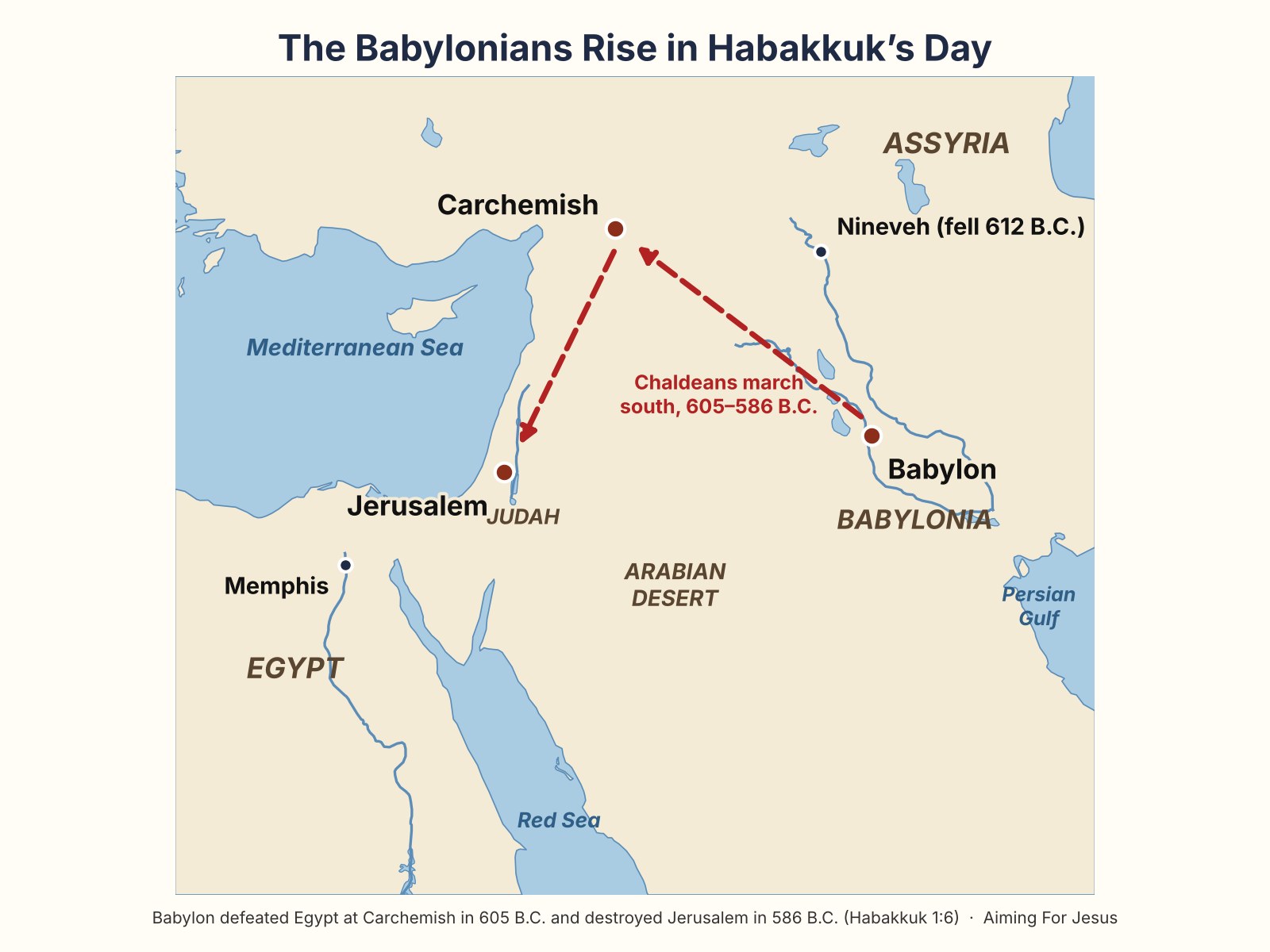
Habakkuk lived in Judah, probably in Jerusalem. The danger came from the Chaldeans, the people who ruled the new Babylonian Empire from the city of Babylon on the Euphrates River. In 612 B.C. they had destroyed Nineveh, and in 605 B.C. they crushed Egypt at the battle of Carchemish. They were coming south, and Judah lay in their path.
Habakkuk among the Old Testament books
Genesis · Exodus · Leviticus · Numbers · Deuteronomy · Joshua · Judges · Ruth · 1 Samuel · 2 Samuel · 1 Kings · 2 Kings · 1 Chronicles · 2 Chronicles · Ezra · Nehemiah · Esther · Job · Psalms · Proverbs · Ecclesiastes · Song of Solomon · Isaiah · Jeremiah · Lamentations · Ezekiel · Daniel · Hosea · Joel · Amos · Obadiah · Jonah · Micah · Nahum · Habakkuk · Zephaniah · Haggai · Zechariah · Malachi
Habakkuk is the 35th of the 39 books of the Old Testament and the eighth of the twelve Minor Prophets. Most prophets speak for God to the people. Habakkuk is different: he speaks to God for himself and for the people, asking hard questions. He lived at the same time as Jeremiah and Zephaniah. Nahum foretold the fall of Assyria; Habakkuk tells of Babylon, the empire that came next.
When it was written
Habakkuk most likely wrote between 609 and 605 B.C., in the early years of wicked King Jehoiakim, after good King Josiah died. God said He was raising up the Chaldeans (1:6), and they were just rising to power. Babylon first attacked Jerusalem in 605 B.C. and destroyed it in 586 B.C. Dr. Constable notes that the exact date can’t be known for sure.
Meet the book
Habakkuk is a conversation between a troubled believer and God. Habakkuk looks at his own people and sees violence, injustice and a broken legal system, and God seems to do nothing. “How long, O LORD, will I cry for help, and You will not hear?” (1:2). God answers, and the answer is worse than the question: He is sending the cruel Babylonians to judge Judah. So Habakkuk asks again: how can a holy God use people more wicked than we are?
Then Habakkuk does something wise. He climbs his watchtower and waits for God’s answer (2:1). God tells him the proud will fall, but “the righteous shall live by his faith” (2:4). Paul quotes that verse in Romans 1:17 and Galatians 3:11, and Hebrews 10:38 does too. Those words lit the fire of the Reformation in Martin Luther’s heart: we are made right with God by faith in Christ alone, and we live each day by trusting Him.
The book ends with a song. Habakkuk remembers God’s mighty works, trembles, and then makes one of the great statements of faith in the Bible: even if the fig tree doesn’t blossom, the crops fail and the stalls are empty, “yet I will rejoice in the LORD; I will take joy in the God of my salvation” (3:17–18). The book moves from “How long?” to “Yet I will rejoice.” It shows us how to bring our questions to God and come out trusting Him.
The central message When God’s ways are hard to understand, His people bring their questions to Him, wait for His answer, and live by faith; for He will judge the proud, fill the earth with His glory, and be our joy and strength even when everything else fails.
A verse to carry through the study Habakkuk 3:17–18 BLB
Find your way
Main teachings
Bring your questions to God
Habakkuk 1:2–4, 12–13; Psalm 13:1–2 Habakkuk asks “How long?” and “Why?” right to God’s face. Faith isn’t pretending we understand everything. It is taking our questions to God instead of away from Him.
God is working even when it doesn’t look like it
Habakkuk 1:5; Acts 13:41; Romans 8:28 “I am doing a work in your days that you would not believe if told.” God was not idle. He was doing something Habakkuk never imagined. Paul quoted this verse to warn people not to miss what God was doing in Jesus.
Wait and watch
Habakkuk 2:1–3; Psalm 5:3; Isaiah 40:31 Habakkuk climbed his tower to watch for God’s answer. God told him to write it plainly and wait: “If it seems slow, wait for it; it will surely come.”
The righteous shall live by faith
Habakkuk 2:4; Romans 1:17; Galatians 3:11 The proud trust in themselves; the righteous trust God. We are made right with God by faith in Christ alone, not by our works, and we live each day by that same trust.
God judges the proud
Habakkuk 2:6–20; Proverbs 16:18 Five woes fall on Babylon: for greed, for building on stolen goods, for building with blood, for shaming others, and for worshiping idols. God sees every sin of every empire.
The earth will be filled with His glory
Habakkuk 2:14; Isaiah 11:9; Revelation 21:23 Empires rise and fall, but the knowledge of the glory of the LORD will one day fill the earth as the waters cover the sea.
The LORD is in His holy temple
Habakkuk 2:20; Psalm 11:4; Zephaniah 1:7 Idols are dumb and dead. But the living God is on His throne. Let all the earth be silent before Him.
In wrath remember mercy
Habakkuk 3:2; Lamentations 3:22–23; Ephesians 2:4–5 Habakkuk accepts that judgment is coming and asks God to revive His work and, in wrath, remember mercy. God answered that prayer most fully at the cross.
Yet I will rejoice
Habakkuk 3:17–19; Philippians 4:11–13; 2 Corinthians 4:8–9 Even when everything fails, the LORD is still our salvation and strength. He makes our feet like the deer’s, sure-footed on the high and hard places.
Praying through Habakkuk
Habakkuk is a book of prayer from start to finish. Chapters 1 and 2 are honest prayers of complaint and God’s answers. Chapter 3 is “a prayer of Habakkuk the prophet,” set to music for the temple choir (3:1, 19).
A good way to pray through Habakkuk is to tell God honestly what troubles you, wait quietly for Him in His Word, and then choose, by His grace, to rejoice in Him whatever happens.
The prayers in this book
Habakkuk 1:2 — An honest prayer. Tell God plainly what you have been crying out about and how long it has been.
Habakkuk 2:1 — A prayer of waiting. Ask God to help you be still, watch, and listen for what He says through His Word.
Habakkuk 3:2 — A prayer for revival. Ask the LORD to revive His work in your day, and in wrath to remember mercy.
Habakkuk 3:17–19 — A prayer of joy in hard times. Name what is failing in your life, and tell the LORD you will rejoice in Him anyway, because He is your strength.
Yet I will rejoice (Habakkuk 3:17–19)
Pray it with Habakkuk 3:17–19 BLB
Read Habakkuk
Select a chapter to read it in the ESV in a reading window, right here on this page.
Habakkuk 1:1–17 Habakkuk 2:1–20 Habakkuk 3:1–19
A brief outline
1:5–1:11 God’s Surprising Answer: the Babylonians
1:12–1:17 “Why Use People More Wicked Than We Are?”
2:1–2:5 Watch, Wait and Live by Faith
2:6–2:14 Woes on the Proud, Part One
2:15–2:20 Woes on the Proud, Part Two: the LORD Is in His Holy Temple
Study every verse
Begin with the Scripture, then read the study notes and the passages to read alongside. After each section, pause over the question. Watch how Habakkuk moves from “How long?” to “Yet I will rejoice.”
Commentary offered not as authoritative but as a view of the verse drawn from the scriptures presented, other scriptures, and various commentaries. If these thoughts do not line up with the Word then they must be rejected. It is my belief and prayer they are consistent with the Word and are offered as a simple teaching on the Word and as every teaching on the Word each must be carefully compared with the one true and living Word of God.
Chapter 1 1:1 1:2 1:3 1:4 1:5 1:6 1:7 1:8 1:9 1:10 1:11 1:12 1:13 1:14 1:15 1:16 1:17
Chapter 2 2:1 2:2 2:3 2:4 2:5 2:6 2:7 2:8 2:9 2:10 2:11 2:12 2:13 2:14 2:15 2:16 2:17 2:18 2:19 2:20
Chapter 3 3:1 3:2 3:3 3:4 3:5 3:6 3:7 3:8 3:9 3:10 3:11 3:12 3:13 3:14 3:15 3:16 3:17 3:18 3:19
Chapter 1
“How Long, O LORD?”
Habakkuk 1:1
Read the verse: Habakkuk 1:1 BLB
Study Notes
The heavy message that Habakkuk the prophet saw.
Like Nahum, Habakkuk carried a “burden,” a heavy message. But this book starts differently. Before God speaks, Habakkuk speaks to God.
Read alongside Nahum 1:1 BLB; Malachi 1:1 BLB; Jeremiah 23:33 BLB
Habakkuk 1:2
Read the verse: Habakkuk 1:2 BLB
Study Notes
How long, LORD, must I call for help and You don’t listen? I cry out to You, “Violence!” and You don’t save.
Habakkuk is honest. He has been praying a long time, and it feels like God isn’t listening. This is how real believers sometimes feel. God doesn’t rebuke him for asking. He answers.
English wording → Hebrew word → meaning
“cry” → shava‘ → to cry out for help BLB
Read alongside Psalm 13:1–2 BLB; Psalm 22:1–2 BLB; Revelation 6:10 BLB
Habakkuk 1:3
Read the verse: Habakkuk 1:3 BLB
Study Notes
Why do You make me look at wrongdoing? Why do You put up with evil? Destruction and violence are in front of me; there is fighting and arguing everywhere.
Habakkuk isn’t complaining about pagans far away. He is looking at God’s own people in Judah. Violence, strife and wrong were everywhere, and God seemed to just watch.
Read alongside Jeremiah 20:8 BLB; Psalm 55:9–11 BLB; Micah 7:2–3 BLB
Habakkuk 1:4
Read the verse: Habakkuk 1:4 BLB
Study Notes
So the law is paralyzed and justice never comes out. The wicked surround the righteous, so justice comes out twisted.
The courts didn’t work anymore. God’s law was ignored, and the wicked had the upper hand. When justice is bent, the innocent suffer. Habakkuk felt it deeply, and he took it to the right place: to God.
Read alongside Isaiah 59:14–15 BLB; Amos 5:7 BLB; Psalm 82:2–5 BLB
Aiming for Jesus
Know Him
God is not offended by honest questions. He invites His people to bring Him their “how long?”
Examine your heart
Habakkuk took his frustration straight to God: “How long?” What have you been asking God “How long?” about? Have you told Him honestly?
God’s Surprising Answer: the Babylonians
Habakkuk 1:5
Read the verse: Habakkuk 1:5 BLB
Study Notes
Look among the nations, and see! Be astonished and amazed! For I am doing something in your days that you wouldn’t believe if you were told.
God answers! He hadn’t been idle; He was working on something Habakkuk would never have guessed. Paul quoted this verse in Acts 13:41 to warn people not to miss what God was doing in Jesus. God is always at work, even when we can’t see it.
Read alongside Acts 13:41 BLB; Isaiah 29:14 BLB; Isaiah 55:8–9 BLB
Habakkuk 1:6
Read the verse: Habakkuk 1:6 BLB
Study Notes
Look, I am raising up the Chaldeans, that bitter and hasty nation, who march across the whole earth to take homes that aren’t theirs.
Here is the shock: God would use the Babylonians (the Chaldeans) to judge Judah. They were fierce, fast and greedy. God is sovereign even over pagan empires. He raises them up and brings them down.
Read alongside Jeremiah 25:8–11 BLB; Isaiah 10:5–6 BLB; Daniel 2:21 BLB
Habakkuk 1:7
Read the verse: Habakkuk 1:7 BLB
Study Notes
They are fearsome and dreadful. They make their own rules and decide for themselves what is right.
The Babylonians answered to no one but themselves. Their own power was their law. That is the heart of pride: “I decide what is right.”
Read alongside Isaiah 47:8–10 BLB; Judges 21:25 BLB; Proverbs 16:5 BLB
Habakkuk 1:8
Read the verse: Habakkuk 1:8 BLB
Study Notes
Their horses are faster than leopards, fiercer than wolves at evening. Their horsemen charge ahead; they come from far away. They fly like an eagle swooping to eat.
Babylon’s army moved with frightening speed. Leopards, wolves, eagles: all hunters.
Read alongside Jeremiah 4:13 BLB; Deuteronomy 28:49–50 BLB; Lamentations 4:19 BLB
Habakkuk 1:9
Read the verse: Habakkuk 1:9 BLB
Study Notes
They all come for violence. Their faces press forward like the east wind, and they gather captives like sand.
Habakkuk complained about violence in Judah (1:2). Now God says violence is coming to Judah from outside. Sin is often judged by more of what it loves.
Read alongside Ezekiel 7:23–24 BLB; Jeremiah 4:11–12 BLB; Hosea 13:15 BLB
Habakkuk 1:10
Read the verse: Habakkuk 1:10 BLB
Study Notes
They laugh at kings and scoff at rulers. They laugh at every fortress, because they pile up dirt ramps and capture it.
No king or fort could stand against them. They simply built a ramp of earth up to the walls and walked in.
Read alongside 2 Kings 25:1 BLB; Jeremiah 32:24 BLB; Ezekiel 21:22 BLB
Habakkuk 1:11
Read the verse: Habakkuk 1:11 BLB
Study Notes
Then they sweep by like the wind and go on, guilty men, whose own strength is their god.
Here is Babylon’s real sin: they worshiped their own strength. And God says that makes them guilty. He would use them for a time, but He would hold them accountable.
Read alongside Daniel 4:30 BLB; Isaiah 10:12–15 BLB; Daniel 5:20–23 BLB
Aiming for Jesus
Know Him
God is always at work, even when we cannot see it. “I am doing a work in your days that you would not believe if told” (1:5).
Walk with Him today
God answered in a way Habakkuk never expected. Can you look back on a time when God was at work in a way you couldn’t see then?
“Why Use People More Wicked Than We Are?”
Habakkuk 1:12
Read the verse: Habakkuk 1:12 BLB
Study Notes
Aren’t You from everlasting, LORD my God, my Holy One? We will not die. LORD, You have appointed them to judge; O Rock, You have set them up to correct us.
Habakkuk is shaken, but he steadies himself by remembering who God is: eternal, holy, his God, his Rock. He trusts God won’t wipe out His people completely. The Babylonians are God’s tool for correcting Judah, not destroying it. When you don’t understand God’s ways, start with what you know about God Himself.
Read alongside Psalm 90:2 BLB; Deuteronomy 32:4 BLB; Lamentations 3:22 BLB
Habakkuk 1:13
Read the verse: Habakkuk 1:13 BLB
Study Notes
Your eyes are too pure to look at evil, and You can’t stand to see wrong. So why do You put up with traitors and stay silent while the wicked swallow up those more righteous than they?
Here is Habakkuk’s second question, and it is a hard one. God is holy. How can He use people who are worse than Judah? Habakkuk brings his honest confusion to God rather than turning away from Him.
Read alongside Psalm 5:4–5 BLB; Jeremiah 12:1 BLB; Psalm 73:2–3 BLB
Habakkuk 1:14
Read the verse: Habakkuk 1:14 BLB
Study Notes
You make people like fish in the sea, like crawling things that have no ruler.
Habakkuk feels like God has left people helpless as fish, with no one to protect them.
Read alongside Ecclesiastes 9:12 BLB; Jeremiah 16:16 BLB; Amos 4:2 BLB
Habakkuk 1:15
Read the verse: Habakkuk 1:15 BLB
Study Notes
He pulls them all up with a hook; he drags them out with his net and gathers them in his dragnet. So he rejoices and is glad.
Babylon is pictured as a fisherman hauling in nations like fish. Ancient carvings actually show conquerors holding captives in nets.
Read alongside Ezekiel 29:4–5 BLB; Jeremiah 16:16 BLB; Amos 4:2 BLB
Habakkuk 1:16
Read the verse: Habakkuk 1:16 BLB
Study Notes
So he sacrifices to his net and burns incense to his dragnet, because by them he lives in luxury and eats the best food.
This is the height of foolishness: worshiping your own tools. Babylon gave credit to its weapons and its army, not to God. We can do the same thing when we trust our job, our money or our skill as if they were the source of our blessings.
Read alongside Deuteronomy 8:17–18 BLB; Daniel 4:30 BLB; Isaiah 10:13 BLB
Habakkuk 1:17
Read the verse: Habakkuk 1:17 BLB
Study Notes
Will he keep on emptying his net and killing nations without mercy forever?
Habakkuk ends his question with a cry: is there no end to this? He has asked. Now he will wait for God’s answer.
Read alongside Psalm 74:10 BLB; Revelation 6:10 BLB; Isaiah 14:6 BLB
Aiming for Jesus
Remember whose you are
The everlasting, holy God is your Rock (1:12). You belong to Him even when you do not understand what He is doing.
Examine your heart
When Habakkuk didn’t understand, he reminded himself who God is: everlasting, holy, his Rock (1:12). What truths about God help you hold on when you don’t understand what He is doing?
Chapter 2
Watch, Wait and Live by Faith
Habakkuk 2:1
Read the verse: Habakkuk 2:1 BLB
Study Notes
I will stand at my watch post and station myself on the tower. I will watch to see what He will say to me and what I will answer when I am corrected.
This is what to do with hard questions: take them to God and then wait. Habakkuk climbs up like a watchman on the city wall to watch for God’s answer. He is even ready to be corrected. That is the posture of a humble heart.
Read alongside Psalm 5:3 BLB; Isaiah 21:8 BLB; Micah 7:7 BLB
Habakkuk 2:2
Read the verse: Habakkuk 2:2 BLB
Study Notes
The LORD answered me: Write down the vision. Make it plain on tablets so that a herald can run with it.
God tells Habakkuk to write the answer plainly and in large letters, so a messenger can read it at a glance and run to spread it. God’s Word is meant to be clear and to be carried to others.
Read alongside Isaiah 30:8 BLB; Deuteronomy 27:8 BLB; Revelation 1:19 BLB
Habakkuk 2:3
Read the verse: Habakkuk 2:3 BLB
Study Notes
For the vision is still waiting for its appointed time. It hurries toward the end, and it won’t lie. If it seems slow, wait for it; it will certainly come and won’t be late.
God has a timetable. What He promises may seem slow to us, but it isn’t late by His clock. Hebrews 10:37 uses this verse about the return of Jesus. Wait for it. It will surely come.
English wording → Hebrew word → meaning
“vision” → chazon → a vision, a revelation from God BLB
“wait” → chakah → to wait, to wait for BLB
Read alongside Hebrews 10:36–37 BLB; 2 Peter 3:9 BLB; Lamentations 3:25–26 BLB
Habakkuk 2:4
Read the verse: Habakkuk 2:4 BLB
Study Notes
Look at the proud one: his soul is puffed up and not upright. But the righteous person will live by his faith.
Here is the heart of the book, and one of the most important verses in the Bible. There are only two ways to live. The proud trust in themselves. The righteous trust God. Paul quotes this verse to show that we are made right with God by faith, not by works (Romans 1:17; Galatians 3:11), and Hebrews quotes it to call us to keep trusting (Hebrews 10:38). Reading Romans 1:17 opened Martin Luther’s eyes to the gospel of grace. We are saved by faith in Christ, and we live every day by that same faith.
English wording → Hebrew word → meaning
“righteous” → tsaddiq → righteous, just BLB
“faith” → ’emunah → firmness, faithfulness BLB
Teacher’s comment — Chuck Swindoll (paraphrase; overview of Habakkuk, Insight for Living; source)
Swindoll names this as the key verse. He teaches that God may seem silent, but He works justice in His time; the proud are brought low and the righteous live by faith. Habakkuk moved from frustration to prayer and praise instead of running from God, and Swindoll encourages us to wait on the Lord, since no situation is beyond the reach of His grace.
Read alongside Romans 1:17 BLB; Galatians 3:11 BLB; Hebrews 10:38–39 BLB
Habakkuk 2:5
Read the verse: Habakkuk 2:5 BLB
Study Notes
Moreover, wine betrays the arrogant man; he never rests. His appetite is as wide as the grave; like death, he is never satisfied. He gathers all nations and collects all peoples for himself.
Pride is never satisfied. Babylon swallowed nation after nation, like the grave that always has room for more. Greed is a hunger that more can’t fill.
Read alongside Proverbs 27:20 BLB; Proverbs 30:15–16 BLB; Isaiah 5:14 BLB
Aiming for Jesus
Seeing Jesus
“The righteous shall live by his faith” (2:4). Paul shows this is fulfilled in Jesus: we are made right with God through faith in Him (Romans 1:17).
Walk with Him today
“The righteous shall live by his faith.” What does it look like for you to live by faith in Christ this week, rather than by what you can see or control?
Woes on the Proud, Part One
Habakkuk 2:6
Read the verse: Habakkuk 2:6 BLB
Study Notes
Won’t all of them taunt him and mock him with sayings? They will say, “Woe to the one who piles up what isn’t his, how long will this go on? and who loads himself with debts!”
Now come five “woes” against Babylon. The first: woe to the one who gets rich by taking what isn’t his. The very nations Babylon conquered would one day sing this song over it.
Read alongside Isaiah 14:4 BLB; Micah 2:4 BLB; Jeremiah 50:13 BLB
Habakkuk 2:7
Read the verse: Habakkuk 2:7 BLB
Study Notes
Won’t your creditors suddenly rise up? Won’t those who make you tremble wake up? Then you will be their plunder.
Those Babylon robbed would rise up and rob it. Babylon fell to the Medes and Persians in 539 B.C.
Read alongside Isaiah 33:1 BLB; Daniel 5:28–31 BLB; Jeremiah 51:48 BLB
Habakkuk 2:8
Read the verse: Habakkuk 2:8 BLB
Study Notes
Because you have plundered many nations, all the rest of the peoples will plunder you, because of the blood of people and the violence done to the land, to cities and all who live in them.
You reap what you sow. God’s justice often works this way: the evil we do comes back on our own heads.
Read alongside Galatians 6:7 BLB; Obadiah 15 BLB; Isaiah 33:1 BLB
Habakkuk 2:9
Read the verse: Habakkuk 2:9 BLB
Study Notes
Woe to the one who gets evil gain for his house, to set his nest up high, to be safe from the reach of harm!
The second woe: against those who build their security on dishonest gain. Babylon wanted to build its nest so high nothing could touch it.
Read alongside Jeremiah 22:13 BLB; Obadiah 4 BLB; Proverbs 15:27 BLB
Habakkuk 2:10
Read the verse: Habakkuk 2:10 BLB
Study Notes
You have planned shame for your house by cutting off many peoples; you have sinned against your own life.
When we hurt others to get ahead, we are really hurting ourselves.
Read alongside Proverbs 1:18–19 BLB; Proverbs 8:36 BLB; Jeremiah 26:19 BLB
Habakkuk 2:11
Read the verse: Habakkuk 2:11 BLB
Study Notes
For the stone will cry out from the wall, and the beam from the woodwork will answer it.
The very stones and beams of houses built with stolen money will testify against the builder. Jesus said something similar: if people kept silent, the stones would cry out (Luke 19:40).
Read alongside Luke 19:40 BLB; Joshua 24:27 BLB; James 5:4 BLB
Habakkuk 2:12
Read the verse: Habakkuk 2:12 BLB
Study Notes
Woe to the one who builds a town with blood and founds a city on wrongdoing!
The third woe: against building cities on bloodshed and forced labor. Micah said the same about Jerusalem’s leaders (Micah 3:10).
Read alongside Micah 3:10 BLB; Jeremiah 22:13 BLB; Ezekiel 24:9 BLB
Habakkuk 2:13
Read the verse: Habakkuk 2:13 BLB
Study Notes
Isn’t it from the LORD of hosts that people labor only for the fire and nations wear themselves out for nothing?
Everything built without God will end up as fuel for the fire. All that work, for nothing.
Read alongside Jeremiah 51:58 BLB; Psalm 127:1 BLB; 1 Corinthians 3:12–15 BLB
Habakkuk 2:14
Read the verse: Habakkuk 2:14 BLB
Study Notes
For the earth will be filled with the knowledge of the LORD’s glory as the waters cover the sea.
Right in the middle of the woes comes this bright promise. Empires like Babylon rise and fall, but one day the whole earth will know the glory of the LORD, as completely as water fills the sea. That is where history is heading. Isaiah gives the same promise (Isaiah 11:9).
Read alongside Isaiah 11:9 BLB; Numbers 14:21 BLB; Revelation 21:23 BLB
Aiming for Jesus
Know Him
Empires rise and fall, but “the earth will be filled with the knowledge of the glory of the LORD” (2:14). History is heading toward His glory.
Examine your heart
Empires rise and fall, but “the earth will be filled with the knowledge of the glory of the LORD.” How does knowing where history is heading help you face today’s news?
Woes on the Proud, Part Two: the LORD Is in His Holy Temple
Habakkuk 2:15
Read the verse: Habakkuk 2:15 BLB
Study Notes
Woe to the one who makes his neighbor drink, pouring out your wrath and making them drunk, so that you can look at their nakedness!
The fourth woe: against shaming others for your own pleasure. Babylon humiliated the nations it conquered.
Read alongside Genesis 9:21–22 BLB; Lamentations 4:21 BLB; Obadiah 16 BLB
Habakkuk 2:16
Read the verse: Habakkuk 2:16 BLB
Study Notes
You will be filled with shame instead of glory. Drink, you too, and show yourself uncircumcised! The cup in the LORD’s right hand will come around to you, and utter shame will cover your glory.
Now Babylon would drink from the cup of God’s judgment. In Scripture the “cup” is a picture of God’s wrath. Jesus drank that cup for us in Gethsemane and on the cross, so that all who trust Him will never have to.
Read alongside Jeremiah 25:15–17 BLB; Matthew 26:39 BLB; Revelation 14:10 BLB
Habakkuk 2:17
Read the verse: Habakkuk 2:17 BLB
Study Notes
The violence done to Lebanon will overwhelm you, and the destruction of the animals will terrify you, because of the blood of people and the violence to the land, to cities and all who live in them.
Babylon even stripped the cedar forests of Lebanon and slaughtered its animals. God cares for His creation, and He holds people accountable for wrecking it.
Read alongside Isaiah 14:8 BLB; Isaiah 37:24 BLB; Jeremiah 22:23 BLB
Habakkuk 2:18
Read the verse: Habakkuk 2:18 BLB
Study Notes
What good is an idol, since its maker has carved it, a metal image, a teacher of lies? For its maker trusts in his own creation when he makes speechless idols.
The fifth woe begins with a question: what good is an idol? It is just something a man made, and it teaches lies.
Read alongside Isaiah 44:9–20 BLB; Jeremiah 10:14–15 BLB; 1 Corinthians 8:4 BLB
Habakkuk 2:19
Read the verse: Habakkuk 2:19 BLB
Study Notes
Woe to the one who says to a piece of wood, “Wake up!” or to a silent stone, “Get up!” Can it teach? Look, it is covered with gold and silver, but there is no breath at all in it.
Gold and silver on the outside, but no breath inside. That is every idol, ancient and modern.
Read alongside 1 Kings 18:26–29 BLB; Psalm 115:4–8 BLB; Jeremiah 10:3–5 BLB
Habakkuk 2:20
Read the verse: Habakkuk 2:20 BLB
Study Notes
But the LORD is in His holy temple. Let all the earth be silent before Him.
What a contrast! Idols are silent because they are dead. The LORD is alive and reigning on His throne, so all the earth should be silent before Him. After all of Habakkuk’s questions, here is where he lands: hushed in awe before the living God.
English wording → Hebrew word → meaning
“silence” → has → to hush, to keep silent BLB
Read alongside Psalm 11:4 BLB; Zephaniah 1:7 BLB; Psalm 46:10 BLB
Aiming for Jesus
Walk with Him today
Habakkuk ends chapter 2 in silence before God. When was the last time you were simply quiet before the Lord? Could you take five minutes today to do that?
Pray
Lord, You are in Your holy temple. Quiet my heart before You today. Let me listen before I speak. In Jesus’ name, amen.
Chapter 3
“In Wrath Remember Mercy”
Habakkuk 3:1
Read the verse: Habakkuk 3:1 BLB
Study Notes
A prayer of Habakkuk the prophet, set to Shigionoth.
Chapter 3 is a prayer written as a song. “Shigionoth” is a musical term; its exact meaning is uncertain, but it may point to a stirring, emotional kind of music. After talking with God, Habakkuk now sings to Him.
Read alongside Psalm 7:1 BLB; Psalm 90:1 BLB; Psalm 142:1 BLB
Habakkuk 3:2
Read the verse: Habakkuk 3:2 BLB
Study Notes
LORD, I have heard the report about You, and I stand in awe of Your work, LORD. Revive it in our days; make it known in our days. In wrath, remember mercy.
Habakkuk has heard what God will do, and he is filled with awe. He doesn’t argue anymore. He prays three things: revive Your work, make it known, and in wrath remember mercy. That last prayer is answered most fully at the cross, where God’s wrath against sin and His mercy toward sinners met in Jesus.
English wording → Hebrew word → meaning
“revive” → chayah → to live; to bring to life again BLB
“mercy” → racham → to have compassion, to love tenderly BLB
Read alongside Psalm 85:6 BLB; Lamentations 3:22–23 BLB; Ephesians 2:4–5 BLB
Aiming for Jesus
Seeing Jesus
At the cross, God remembered mercy in wrath. Jesus took the wrath sin deserves so that mercy could reach us.
Examine your heart
Habakkuk prayed, “In wrath remember mercy.” How does the cross of Jesus show God’s wrath against sin and His mercy toward sinners at the same time?
God Comes in Power
Habakkuk 3:3
Read the verse: Habakkuk 3:3 BLB
Study Notes
God came from Teman, the Holy One from Mount Paran. Selah. His splendor covered the heavens, and the earth was full of His praise.
Habakkuk remembers how God came to His people long ago at Mount Sinai, marching from the south (Teman and Paran were in the wilderness south of Judah). The word “Selah” likely means pause and think.
Read alongside Deuteronomy 33:2 BLB; Judges 5:4 BLB; Psalm 68:7–8 BLB
Habakkuk 3:4
Read the verse: Habakkuk 3:4 BLB
Study Notes
His brightness was like the sunlight; rays came out of His hand, and there His power was hidden.
God’s glory blazed like the sun, and that was only a glimpse; His full power was still hidden.
Read alongside Exodus 34:29–30 BLB; Psalm 104:2 BLB; Revelation 1:16 BLB
Habakkuk 3:5
Read the verse: Habakkuk 3:5 BLB
Study Notes
Plague went before Him, and pestilence followed at His feet.
Habakkuk remembers the plagues on Egypt. God’s judgments march before and behind Him like servants.
Read alongside Exodus 9:3 BLB; Exodus 12:29 BLB; Psalm 78:50 BLB
Habakkuk 3:6
Read the verse: Habakkuk 3:6 BLB
Study Notes
He stood and measured the earth; He looked and made the nations tremble. The ancient mountains were shattered, the age-old hills bowed down. His ways are eternal.
God simply stands and looks, and nations shake. Even the oldest mountains bow. But God’s ways are older than the mountains; they last forever.
Read alongside Psalm 90:2 BLB; Nahum 1:5 BLB; Micah 1:4 BLB
Habakkuk 3:7
Read the verse: Habakkuk 3:7 BLB
Study Notes
I saw the tents of Cushan in distress; the curtains of the land of Midian trembled.
Cushan and Midian were desert peoples near Israel’s path in the wilderness. They trembled when they heard what God had done for Israel.
Read alongside Exodus 15:14–16 BLB; Judges 7:22–25 BLB; Joshua 2:9–11 BLB
Habakkuk 3:8
Read the verse: Habakkuk 3:8 BLB
Study Notes
Was Your anger against the rivers, LORD? Was Your wrath against the rivers or Your fury against the sea, when You rode on Your horses, Your chariots of salvation?
When God split the Red Sea and stopped the Jordan, was He angry at the water? No. He was riding out to save His people. His chariots are “chariots of salvation.”
Read alongside Exodus 14:21–22 BLB; Joshua 3:14–17 BLB; Psalm 114:3–5 BLB
Habakkuk 3:9
Read the verse: Habakkuk 3:9 BLB
Study Notes
You took out Your bow and put arrows on the string. Selah. You split the earth with rivers.
God is pictured as a warrior getting His weapons ready for His people’s sake.
Read alongside Psalm 7:12–13 BLB; Deuteronomy 32:23 BLB; Psalm 78:15–16 BLB
Habakkuk 3:10
Read the verse: Habakkuk 3:10 BLB
Study Notes
The mountains saw You and writhed; the floodwaters swept by. The deep roared and lifted its waves on high.
All creation responds to its Maker: mountains shake, the deep roars.
Read alongside Psalm 77:16–18 BLB; Psalm 93:3–4 BLB; Exodus 19:18 BLB
Habakkuk 3:11
Read the verse: Habakkuk 3:11 BLB
Study Notes
The sun and moon stood still in their places at the light of Your arrows as they flew, at the flash of Your gleaming spear.
This recalls the day in Joshua 10 when the sun and moon stood still while Israel fought. God controls even the lights of heaven for His people.
Read alongside Joshua 10:12–14 BLB; Isaiah 38:8 BLB; Psalm 19:4–6 BLB
Habakkuk 3:12
Read the verse: Habakkuk 3:12 BLB
Study Notes
In fury You marched across the earth; in anger You trampled the nations.
God marched through the land of Canaan, judging the nations that had filled up their sin (Genesis 15:16).
Read alongside Genesis 15:16 BLB; Psalm 44:2–3 BLB; Joshua 21:43–45 BLB
Habakkuk 3:13
Read the verse: Habakkuk 3:13 BLB
Study Notes
You went out to save Your people, to save Your anointed. You crushed the head of the house of the wicked, laying him bare from neck to foot. Selah.
Here is the reason for it all: God went out to save His people. Notice the words “Your anointed,” in Hebrew messiah. God’s great purpose has always been salvation. The picture of crushing the head of the wicked reminds us of the first promise in Genesis 3:15, fulfilled when Jesus defeated Satan at the cross.
Read alongside Genesis 3:15 BLB; Psalm 68:21 BLB; Romans 16:20 BLB
Habakkuk 3:14
Read the verse: Habakkuk 3:14 BLB
Study Notes
You pierced the heads of his warriors with their own arrows when they came like a whirlwind to scatter us, gloating as if to devour the poor in secret.
The enemy’s own weapons were turned against them. God turns evil back on itself.
Read alongside Judges 7:22 BLB; Psalm 7:15–16 BLB; Esther 7:10 BLB
Habakkuk 3:15
Read the verse: Habakkuk 3:15 BLB
Study Notes
You trampled the sea with Your horses, churning the mighty waters.
Habakkuk ends his memories back at the Red Sea, where God made a path through the water for His people.
Read alongside Exodus 15:8–10 BLB; Psalm 77:19 BLB; Isaiah 43:16 BLB
Aiming for Jesus
Know Him
The God who split the sea and shook the mountains is the same God today. Remembering His past works strengthens faith.
Walk with Him today
Habakkuk strengthened his faith by remembering what God had done in the past. What has God done in your life that you need to remember right now?
“Yet I Will Rejoice in the LORD”
Habakkuk 3:16
Read the verse: Habakkuk 3:16 BLB
Study Notes
I heard, and my body trembled; my lips quivered at the sound. Rottenness entered my bones, and my legs shook. Yet I will wait quietly for the day of trouble to come on the people who invade us.
Habakkuk is honest: the thought of what is coming makes him shake to his bones. But he decides to wait quietly. Faith isn’t the absence of fear. It is choosing to trust God while you are afraid.
Read alongside Psalm 119:120 BLB; Daniel 10:8 BLB; Psalm 37:7 BLB
Habakkuk 3:17
Read the verse: Habakkuk 3:17 BLB
Study Notes
Though the fig tree doesn’t blossom and there is no fruit on the vines, though the olive crop fails and the fields produce no food, though the flock is cut off from the fold and there are no cattle in the stalls,
Habakkuk lists everything a farmer depends on: figs, grapes, olives, grain, sheep, cattle. Everything his world rested on might be gone. When the Babylonians came, that is exactly what happened.
English wording → Hebrew word → meaning
“blossom” → parach → to bud, to blossom BLB
Read alongside Joel 1:10–12 BLB; Haggai 2:17 BLB; Philippians 4:11–12 BLB
Habakkuk 3:18
Read the verse: Habakkuk 3:18 BLB
Study Notes
yet I will rejoice in the LORD; I will be joyful in the God of my salvation.
Here is one of the great “yet” verses in the Bible. Everything else may fail, yet I will rejoice in the LORD. Not in my circumstances, but in Him. He is the God of my salvation, and no army, no loss, no grief can take Him away. The book that began with “How long?” ends with “Yet I will rejoice.” That is what faith does.
English wording → Hebrew word → meaning
“rejoice” → ‘alaz → to rejoice, to exult BLB
“joy” → gil → to rejoice, to be glad BLB
Read alongside Philippians 4:4 BLB; Psalm 43:4–5 BLB; Romans 5:2–3 BLB
Habakkuk 3:19
Read the verse: Habakkuk 3:19 BLB
Study Notes
GOD, the Lord, is my strength. He makes my feet like the feet of a deer and lets me walk on my high places. To the choir director: with stringed instruments.
A deer can run sure-footed on steep, rocky mountains without falling. God doesn’t always take us off the hard and high places, but He gives us feet to stand there. He is our strength. And the closing note tells us this prayer was meant to be sung by God’s people together. Let it be our song too.
English wording → Hebrew word → meaning
“strength” → chayil → strength, ability BLB
Read alongside Psalm 18:32–33 BLB; 2 Samuel 22:34 BLB; Isaiah 40:29–31 BLB
Aiming for Jesus
Seeing Jesus
Even with empty stalls and fields, Habakkuk rejoiced in “the God of my salvation” (3:18). In Jesus we have a joy no loss can take away.
Walk with Him today
Make your own “though… yet” statement: “Though ______, yet I will rejoice in the LORD.” What would you put in the blank today?
Source notes
Prepared for Aiming For Jesus by Hollis McGehee. The background, outline and much of the understanding in this study are based on the teaching of Dr. Thomas L. Constable, Notes on Habakkuk (2026 edition, © Thomas L. Constable), available free at www.soniclight.com. The study notes are written in plain words and are not his text; for his full teaching and sources, please read his notes.
Scripture is distinguished from commentary throughout.
Hebrew word notes give the common meaning of the word as found in standard Hebrew dictionaries; each has a BLB button that opens the word in Blue Letter Bible so the reader can check it. Teacher’s comments are paraphrases, not quotations, of Chuck Swindoll, each with a link to its source, so the reader can read the teacher’s own words.
Scripture quotations are from the ESV® Bible (The Holy Bible, English Standard Version®), copyright © 2001 by Crossway, a publishing ministry of Good News Publishers. Used by permission. All rights reserved.
Verses to memorize
Begin with one selection. Read its surrounding passage, say the words aloud, and return to them during the day. For a longer selection, learn one verse at a time and then join the verses together.
The righteous shall live by faith
Habakkuk 2:4 BLB
Wait for it
Habakkuk 2:3 BLB
The earth filled with His glory
Habakkuk 2:14 BLB
The LORD is in His holy temple
Habakkuk 2:20 BLB
In wrath remember mercy
Habakkuk 3:2 BLB
Yet I will rejoice
Habakkuk 3:17–18 BLB
Feet like the deer’s
Habakkuk 3:19 BLB