John introduces Jesus as the eternal Word who became truly human. Through His signs, conversations, teaching, death, and resurrection, we are invited to see who He is and trust Him. John states his purpose plainly in John 20:30–31: these selected signs bear witness to Jesus as the Christ, the Son of God, so that believing readers have life in His name. This is not merely a book about religious ideas. It calls us to come to the living Savior and follow Him.
Christian tradition identifies the author as John the son of Zebedee, one of Jesus’ twelve apostles. The Gospel itself does not put that name in a signature. It associates its testimony with the disciple Jesus loved (John 21:20–24), who is presented as an eyewitness. This review follows the traditional identification while distinguishing it from an explicit naming of the author in the text. John the Baptist is another person, the witness who points people to Jesus.
When and where was it written?
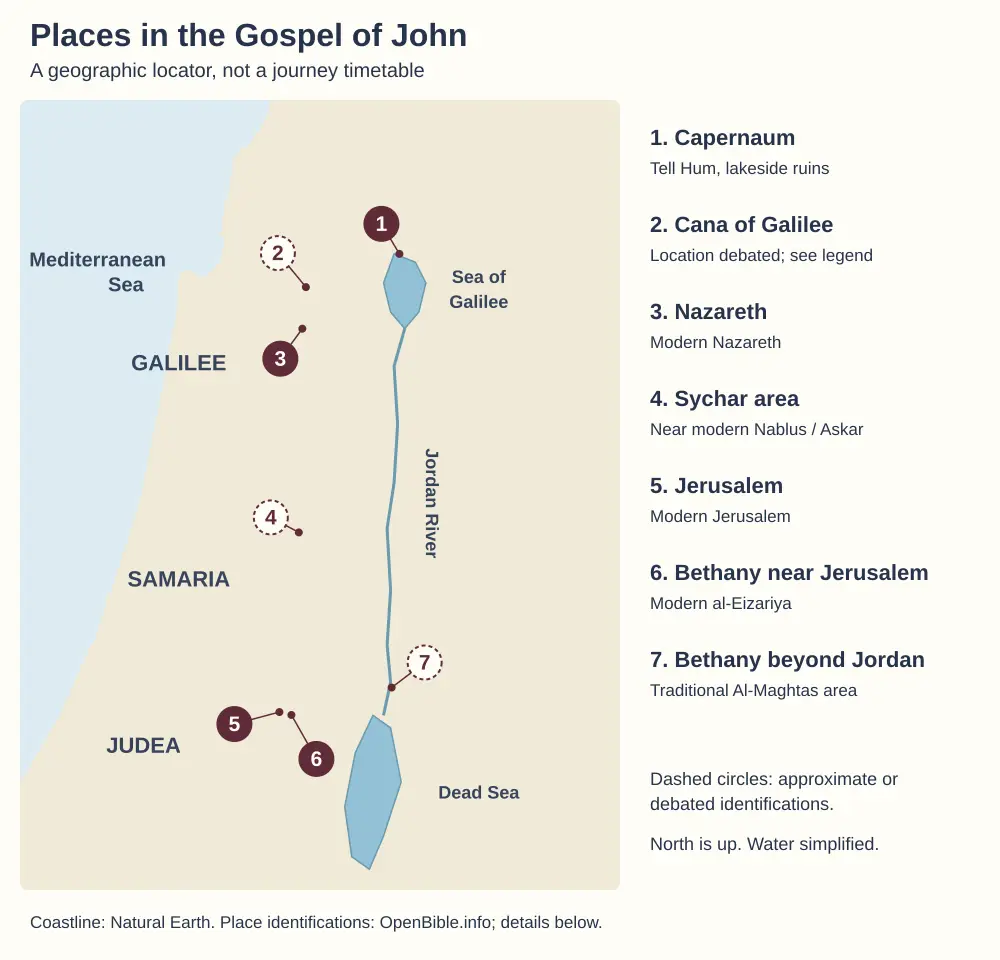
A late-first-century date, often around AD 80–95, and a connection with Ephesus are common conclusions in Christian scholarship and tradition. The Gospel does not state a writing date or address, and earlier dates have also been proposed. Its eyewitness claims and purpose do not depend on our assigning an exact year. The map below shows places in Jesus’ ministry, not a proven route from the author to his readers.
Who was meant to read it?
John explains some Jewish customs and translates certain names and expressions, making the story accessible to readers beyond its original setting. Its declared aim addresses people who need to believe in Jesus and have life in Him. Scholars debate whether the wording in John 20:31 primarily emphasizes coming to faith or continuing in faith; the whole Gospel serves both evangelism and the strengthening of disciples.
How does John fit with the other Gospels?
Matthew, Mark, Luke, and John all bear witness to Jesus’ earthly life, crucifixion, and resurrection. John selects and arranges his material distinctively. He gives extended conversations, visits to Jerusalem, signs and their explanations, and Jesus’ farewell teaching. Do not force every Gospel into an identical outline, or assume that different selection means contradiction. Read each account attentively before comparing it with the others.
Read signs together with the teaching
John calls Jesus’ mighty works signs because they reveal His identity and point beyond the immediate benefit. A crowd may enjoy food or be impressed by a miracle without surrendering to Jesus. Ask what the sign reveals, what Jesus says about it, and how the people respond (John 2:11; 6:26–35; 20:30–31).
Read the Jewish setting carefully
Jesus, His mother, His apostles, and many who believe in Him are Jewish. John frequently reports disputes within that setting. The expression “the Jews” must be read in context; it can refer to particular opponents or authorities rather than every Jewish person. Neither the crucifixion account nor any other passage authorizes hostility toward Jewish people. Roman authority also participates in Jesus’ death, and the Gospel presents His willing self-giving for sinners.
A note about manuscript differences
Modern Bibles flag John 5:4 and John 7:53–8:11 because their manuscript evidence differs from the surrounding text. John 5:4 is absent from the main text of the ESV. The account in John 7:53–8:11 is printed with a note that the earliest manuscripts do not include it. These are genuine textual questions, not reasons to hide information from readers. The verse notes explain the issue and avoid basing a distinctive doctrine on a disputed passage.
John in the New Testament
Usual order of the 27 New Testament books, not the order in which they were written. John is book 4, following Luke and preceding Acts.
Matthew · Mark · Luke · John · Acts · Romans · 1 Corinthians · 2 Corinthians · Galatians · Ephesians · Philippians · Colossians · 1 Thessalonians · 2 Thessalonians · 1 Timothy · 2 Timothy · Titus · Philemon · Hebrews · James · 1 Peter · 2 Peter · 1 John · 2 John · 3 John · Jude · Revelation
Places in John
From Galilee to Jerusalem: John moves repeatedly between northern Galilee, Samaria, Jerusalem and its surroundings, and the Jordan region. This locator helps us follow the settings; it does not trace a single journey.
Ancient names and modern equivalents. Open the map for a larger view. North is up; coastlines follow Natural Earth, while lakes and the Jordan River are simplified.
Capernaum: the archaeological site at Tell Hum on the northern shore of the Sea of Galilee, also called Lake Kinneret. John 2:12; 6:17, 24, 59.
Cana of Galilee: its precise location is disputed. Khirbet Qana and Kafr Kanna are leading proposed identifications; the marker indicates the wider area, not a settled site. John 2:1–11; 4:46–54; 21:2.
Nazareth: modern Nazareth. John identifies Jesus with this town but does not narrate a ministry visit there. John 1:45–46.
Sychar: in the region of modern Nablus, near Jacob’s well and ancient Shechem. Proposed identifications differ, including Askar and Shechem; the marker is approximate. John 4:5–6.
Jerusalem: modern Jerusalem, the setting of several festival visits and Jesus’ death and resurrection. John 2; 5; 7–10; 12–20.
Bethany near Jerusalem: associated with modern al-Eizariya, east of Jerusalem, the home of Lazarus, Martha, and Mary. This is not the Bethany of John 1:28. John 11:1, 18; 12:1.
Bethany beyond the Jordan: the map marks the traditional Al-Maghtas baptism site in modern Jordan. UNESCO recognizes its historic Christian tradition; the precise identification of the Gospel’s place remains debated. John 1:28; compare 10:40.
Reading the map: Solid numbered circles mark well-established general locations; dashed circles mark an approximate area or a debated identification. No modern political boundaries or travel routes are implied.
Jesus did not begin to exist at Bethlehem. The Word eternally existed with God and was God; all created things came into being through Him. John distinguishes the Word from the Father without making Him a lesser or created being. This eternal Word became truly human in Jesus Christ (John 1:14). His glory, grace, and truth make the unseen Father known. Neither His deity nor His humanity may be reduced to an appearance.
John the Baptist is not the Christ. He identifies Jesus and directs disciples toward Him. The pattern of testimony continues through Scripture, the Father’s works, the Spirit, eyewitnesses, and ordinary people who tell what they have encountered. Faithful ministry makes much of Jesus rather than building the messenger’s importance.
Water becomes wine, the sick are healed, hungry people are fed, sight is given, and Lazarus is raised. These signs are not disconnected displays of power. They reveal Jesus’ glory and call for trust. Their benefits are real, but treating Jesus merely as a supplier of earthly advantages misses the life He gives.
We need new birth, not merely religious improvement
Nicodemus has knowledge and status, yet he needs birth from above. The Spirit gives life that human effort cannot produce. God’s love is displayed in giving His Son, and the response is believing in Him rather than hiding from His light. Salvation is received through Christ, not achieved by religious credentials.
Jesus crosses entrenched social divisions to speak with a Samaritan woman. He offers lasting life, exposes sin without deception, and reveals the Father’s desire for true worship. Worship is not secured by owning the correct holy site. The woman’s testimony brings others to hear Jesus for themselves.
The Father has granted the Son to have life in Himself and has entrusted judgment to Him. Jesus exercises this authority in perfect unity with the Father: He does what the Father does, gives life, and is to receive the same honor as the Father. This is not the activity of an independent rival deity. Hearing Jesus and believing the Father who sent Him bring present passage from death to life. Jesus also announces a future bodily resurrection to life or judgment. Eternal life is already possessed through Him and awaits its full bodily consummation.
The crowd seeks more bread; Jesus gives Himself as the true source of life. His language of coming, believing, eating, and drinking directs hearers to wholehearted dependence on Him and His life-giving death. Christians differ about the passage’s relationship to the Lord’s Supper, but its central demand is not satisfied by an outward act without faith.
Jesus reveals God and exposes false confidence, deception, and slavery to sin. Freedom is not simply the ability to do whatever we want. It is the liberation the Son gives, expressed in continuing in His word. Chapter 9 makes the contrast vivid: a healed man grows in confession while confident opponents resist the light before them.
Jesus knows His sheep, calls them, gives them eternal life, and willingly dies for them. His care is personal and secure, unlike the self-interest of thieves or hired hands. His sheep hear His voice and follow Him. His promise of keeping encourages trust, not indifference to discipleship.
In this setting Jesus declares His oneness with the Father (John 10:30): neither His hand nor the Father’s hand can be overcome. Read this together with John 1:1 and John 1:14, His explanation of mutual indwelling in John 10:38, and John 14:9–11. John’s wider witness affirms the Son’s deity and unique unity with the Father while distinguishing the Son from the Father. John 10:30 should neither be reduced to a merely human agreement of purpose nor treated in isolation as a complete answer to every Trinitarian question.
Jesus meets Martha’s grief with a claim centered on Himself. He weeps, then calls Lazarus from the tomb. His compassion and authority belong together. The sign anticipates His own victory while showing that believers’ hope is not merely an event on a timetable but the living Lord who conquers death.
This hope belongs within the wider scriptural witness. Isaiah 26:19 speaks of the dead living again, and Daniel 12:2 describes an awakening to everlasting life or shame. These passages provide Old Testament background for reading John 5:28–29 and John 11:24–26. Their relevance does not require claiming that John is directly quoting them or that a specific literary dependence has been proved.
Jesus’ death is not the collapse of His mission. John 3:14–15 connects the Son of Man’s being lifted up with life for those who believe. In John 12:23–33, the hour of His glorification includes His approaching death: John explicitly explains that being lifted up points to how He will die. Like a grain that dies to bear fruit, His willing self-giving brings life, and He draws people to Himself.
Glory does not make the suffering unreal: Jesus speaks of His troubled soul, and John later narrates His scourging and crucifixion. Nor is the connection between suffering and glory absent from the other Gospels; compare Luke 24:26. His followers must also renounce self-centered living. Their costly service responds to His saving work rather than replacing it.
The Lord washes His disciples’ feet and commands them to love one another as He has loved them. This love is not a vague feeling. It takes visible form in humble service, loyalty to the truth, and costly concern for another’s good. Peter’s coming failure also reminds disciples not to confuse strong promises with spiritual strength.
Jesus comforts troubled disciples by directing them to Himself. He alone is the way to the Father. The Father and Son send the Holy Spirit to remain with them, teach them, and bring Jesus’ words to remembrance. These promises first address the apostles in their coming witness; their testimony continues to serve the church. Love for Jesus bears fruit in obedience.
A branch cannot produce life apart from the vine. Disciples must remain in Jesus, receive His words, and live in His love. The Father tends His people, and fruit includes obedience and love rather than mere religious activity. Christians differ about aspects of the removed-branch warning; no reading should empty the call to abide or treat Christ as unnecessary.
Jesus prepares disciples for rejection without inviting retaliation or despair. The Spirit bears witness to Him and confronts the world’s mistaken judgments about sin, righteousness, and judgment. Sorrow will give way to joy through Jesus’ victory. His promise of peace stands alongside His warning of trouble, not a guarantee of an easy life.
The Son prays to the Father for His own, asking that they be kept, sanctified in truth, united, and brought to share His glory. Their unity is grounded in the Father and Son and accompanies a mission to the world. It does not require abandoning truth, and holiness does not mean withdrawing from everyone who needs the gospel.
Jesus is arrested, tried, mocked, and crucified, yet John repeatedly shows that He is not helpless before events. His kingdom is not established by worldly violence. He bears witness to truth and completes the work entrusted to Him. His real death and burial are essential to the testimony, not merely a symbol of devotion.
The risen Jesus brings peace and calls us to follow
The tomb is empty, and the risen Lord meets His followers. Thomas confesses Him as Lord and God. Jesus commissions His disciples and restores Peter to shepherding service. The Gospel ends by directing attention to trustworthy testimony and the personal call to follow Jesus, rather than comparison with another disciple’s path.
A prayer shaped by John
Father, thank You for giving Your Son so that we may have life in His name. Lord Jesus, You are the eternal Word, the good Shepherd, and the resurrection and the life. Forgive our preference for darkness, our self-reliance, and our desire for Your gifts without surrender to You. Open our eyes to Your glory. Teach us to trust Your word, remain in Your love, and obey You from the heart. By Your Spirit, help us serve one another humbly and speak of You faithfully. Comfort those who grieve, strengthen those who face rejection, and draw those who do not yet believe. Keep us from empty profession and from comparing our calling with another person’s path. Make us faithful witnesses to Your death and resurrection. Lead us to follow You today, for Your glory. Amen.
John tells who Jesus is so that we may believe and have life in His name. His signs and words, His death and resurrection, and His commission to the disciples belong to one testimony.
John 1:1–18 — The eternal Word becomes flesh and makes the Father known
John 1:19–51 — Witnesses identify the Lamb and the first disciples follow
John 2:1–4:54 — Early signs and conversations: new birth, living water, and belief
John 5:1–47 — The Son’s authority to give life and judge; witnesses to His identity
John 6:1–71 — Bread given, the bread of life proclaimed, and disciples tested
John 7:1–10:42 — Festival debates: living water, light, true freedom, and the good Shepherd
John 11:1–12:50 — Lazarus raised; the approaching hour of the King’s death
John 13:1–14:31 — Humble love, a troubled departure, and the promise of the Helper
John 15:1–16:33 — Abiding, love, opposition, the Spirit’s witness, and promised joy
John 17:1–26 — The Son’s prayer for His disciples and those who will believe
John 18:1–19:42 — Arrest, trials, crucifixion, death, and burial
John 20:1–31 — The risen Lord appears; the purpose of the written testimony
John 21:1–25 — Breakfast by the sea, Peter’s restoration, and the call to follow
Reading John carefully
John 20:30–31 states the Gospel’s purpose: that its readers believe Jesus is the Christ, the Son of God, and have life in His name. Read each saying in its conversation and the Gospel’s larger account. The signs reveal Jesus; they are not a guarantee that every present-day request will be answered with the same miracle.
Jesus, His disciples, and the first believers were Jewish. John’s references to “the Jews” have to be read in their particular setting, sometimes pointing to authorities or opponents rather than every Jewish person. Nothing here licenses hostility toward Jewish people.
John 5:4 and John 7:53–8:11 require a textual note. The earliest and strongest manuscript evidence does not support including them in the original text at their traditional locations. Many Bibles omit John 5:4 from the main text and bracket the account of the woman accused of adultery. This review preserves familiar verse numbering, explains the issue, and does not build a distinctive doctrine on these disputed passages.
Study every verse
Read the verse and its surrounding paragraph before the note. For example, John 15:5 pictures Jesus as the vine and His disciples as branches; the surrounding verses explain abiding and fruitful discipleship. The note should help you hear that connection.
Each entry includes two related passages and, where present in the ESV main text, Greek words behind selected English wording. The omitted verse number John 5:4 is explained separately. Greek meanings are contextual explanations, not claims that a word means everything in its dictionary entry at once.
Living the Word:James 1:22 calls us to be doers, not hearers only. Selected passages ask what we should obey, turn from, or trust. The response is to God’s grace, not a way to purchase it.
Chapter 1 — The Word, the witness, and the first disciples
John begins before creation, when the Word already existed. The Word is distinguished from God the Father while sharing the divine identity. Jesus is neither a created messenger nor simply an impersonal message. Read the rest of this Gospel with this opening claim in mind: the One who becomes human is truly God.
English wording → Greek word → meaning
“Word” → logos → the personal Word who reveals God
Teacher’s comment — John Piper (paraphrase, source) Piper urges readers to interpret the entire Gospel in light of its opening: the Jesus who serves and dies is the eternal Creator. His words and actions disclose God, because His person is God’s decisive revelation.
Read alongside
Genesis 1:1BLB — John deliberately recalls creation's beginning.
John 17:5BLB — Jesus speaks of glory with the Father before the world existed.
John repeats the Word's relationship with God to prevent a misunderstanding of the first verse. The Word did not become divine after an achievement or promotion. Before anything made existed, He was with God. His later earthly ministry reveals an eternal relationship rather than beginning it.
English wording → Greek word → meaning
“beginning” → archē → the beginning of creation in this context
Everything in the category of created things came into being through the Word. John excludes the Word Himself from that category. The material world is not a mistake outside God's care. The One who saves sinners is also their Creator, possessing an authority no merely human teacher could claim.
English wording → Greek word → meaning
“made” → ginomai → come into existence; here, be created
Life belongs to the Word and becomes light for humanity. John will develop both themes through Jesus' words and signs. Human beings need more than information: they need the life only God gives. The light reveals God's character and exposes the darkness from which people must be rescued.
English wording → Greek word → meaning
“life” → zōē → life originating in the Word
Read alongside
John 5:26BLB — The Father and Son possess life in themselves.
John 8:12BLB — Jesus identifies Himself as the light of the world.
The light continues shining amid real opposition. The Greek verb translated overcome can also carry the sense of grasp or comprehend; John's wider story includes both rejection and the failure of darkness to defeat Jesus. Darkness is powerful enough to deceive, but never powerful enough to extinguish the divine light.
English wording → Greek word → meaning
“darkness” → skotia → darkness opposed to God's light
Read alongside
John 3:19–21BLB — People's response to light exposes their moral condition.
The narrative introduces John the Baptist as a man commissioned by God. His importance comes from his assignment, not from sharing the Word's divine identity. God uses human witnesses to point beyond themselves. The distinction between the eternal Word and the sent witness is essential to the passage.
English wording → Greek word → meaning
“sent” → apostellō → send with a commission
Read alongside
Malachi 3:1BLB — God promises a messenger who prepares the way.
Luke 1:76–77BLB — John's calling prepares people for the Lord and salvation.
John's testimony aims at faith in the light, not admiration of the witness. God chooses to work through truthful human testimony. The purpose is expansive: people should believe through John's witness. This does not say that everyone automatically believes or receives life regardless of their response.
English wording → Greek word → meaning
“witness” → martyria → testimony that directs others to truth
Read alongside
John 20:31BLB — The written signs are intended to lead to believing and life.
John the Baptist was not the light. The clarification protects Jesus' unique identity while honoring His servant's mission. A faithful witness can be significant without becoming the center. The distinction also warns readers not to attach to a gifted messenger the trust and devotion that belong to Christ.
English wording → Greek word → meaning
“light” → phōs → the divine light to whom John bears witness
Read alongside
John 3:28–30BLB — The Baptist gladly distinguishes his role from Christ's.
John 5:35BLB — Jesus calls John a burning lamp rather than the ultimate light.
The genuine light is entering the world in the person of Jesus. His light reaches humanity, exposing and revealing; this is not a declaration that every person is already saved. John immediately describes both rejection and reception. Christ's coming confronts everyone with God's decisive self-disclosure.
English wording → Greek word → meaning
“true” → alēthinos → genuine and ultimate, not merely symbolic
Read alongside
Isaiah 49:6BLB — God's salvation reaches beyond Israel to the nations.
John 12:46BLB — Jesus comes as light so believers need not remain in darkness.
The tragedy is that the world failed to recognize the One through whom it existed. Creation's dependence does not automatically produce grateful recognition. John's language makes unbelief more than an innocent lack of facts. The Maker came among those who owed Him their very existence, and they did not know Him.
English wording → Greek word → meaning
“world” → kosmos → the human world, here alienated from its Maker
Jesus came to His own place and people, yet many did not welcome Him. This describes rejection within Israel, not a condemnation of every Jewish person; Jesus and His first disciples were Jewish. Covenant privilege made the rejection especially grievous but did not eliminate the possibility of receiving Him.
English wording → Greek word → meaning
“receive” → paralambanō → welcome or accept someone
Read alongside
Matthew 23:37BLB — Jesus laments Jerusalem's resistance to His gathering care.
Romans 9:4–5BLB — Israel received extraordinary privileges, including the Messiah's human descent.
Receiving Jesus is explained as believing in His name, trusting who He truly is. Those who receive Him are given the standing of God's children. This is a gracious gift rather than an inherited human achievement. John does not equate all created humanity with this saving family relationship.
English wording → Greek word → meaning
“right” → exousia → authorized standing or privilege
Read alongside
Galatians 3:26BLB — Believers are God's children through faith in Christ.
1 John 3:1BLB — God's love gives believers the identity of His children.
God's children owe their new birth to God, not ancestry, sexual desire, or human determination. Spiritual life cannot be transmitted merely through a family line or produced by someone's effort. Christians debate details of salvation's order, but John's central emphasis is unmistakable: this new life has a divine source.
English wording → Greek word → meaning
“born” → gennaō → beget or give birth; here God's new-birth work
Read alongside
John 3:3–8BLB — Jesus explains birth from above by the Spirit.
James 1:18BLB — God brings His people forth through the word of truth.
The eternal Word became truly human without ceasing to be divine. His dwelling among us recalls God's presence with Israel in the tabernacle. The disciples encountered glory in a real human life full of grace and truth. The incarnation is neither divine disguise nor the promotion of an ordinary man.
English wording → Greek word → meaning
“dwelt” → skēnoō → dwell or pitch a tent among people
John the Baptist recognizes that Jesus, though appearing later in public ministry, outranks him because He existed before him. Ordinary birth order does not explain this claim. Within the prologue it points toward the Word's preexistence and establishes why the Baptist directs his followers away from himself toward Jesus.
English wording → Greek word → meaning
“before” → prōtos → prior; here expressing Christ's precedence
Read alongside
John 8:58BLB — Jesus asserts existence before Abraham.
Luke 1:36BLB — John's human conception precedes Jesus' birth.
Believers receive from Christ's abundance rather than from an independent supply of spiritual resources. The phrase about grace is interpreted as grace upon grace or grace replacing grace. Either way, Jesus is not a scarce provision for a privileged few; God's generosity is concentrated and disclosed in Him.
English wording → Greek word → meaning
“fullness” → plērōma → full abundance or completeness
Moses mediated God's law; Jesus brings grace and truth to their climactic expression. John is not saying the Old Testament contained no grace or that God's law was false. The contrast concerns fulfillment and fullness in the Son. The following verse explains why Jesus reveals God in this unique way.
English wording → Greek word → meaning
“grace” → charis → God's generous favor
Read alongside
Exodus 34:6BLB — God already reveals gracious faithfulness in the Old Testament.
Hebrews 3:5–6BLB — Moses' faithful service is distinguished from the Son's greater place.
No human observer has mastered or fully seen God's invisible being. The unique Son, intimately related to the Father, makes Him known. Manuscripts differ in wording about the unique Son or unique God, but the paragraph consistently presents Jesus as divine and as the Father's decisive revelation.
Religious authorities investigate John's identity and authority. Their inquiry provides a setting for his clear testimony, not merely background information. John does not respond by cultivating mystery around his importance. The narrative invites readers to hear his answer and then consider the greater One to whom he points.
English wording → Greek word → meaning
“testimony” → martyria → a witness's account
Read alongside
Luke 3:15–16BLB — People wonder whether John might be the Christ.
Acts 13:24–25BLB — Paul recalls John's refusal to claim the Messiah's identity.
John plainly denies being the Messiah. His repeated confession prevents the attention surrounding his ministry from becoming a false claim. Spiritual usefulness does not excuse exaggerating one's role. His honesty makes the positive testimony that follows more credible: he knows whom he is not and whom he serves.
English wording → Greek word → meaning
“confessed” → homologeō → acknowledge or declare openly
Read alongside
John 3:28BLB — John again insists he is not the Christ.
Acts 4:12BLB — Saving significance belongs uniquely to Jesus.
The questioners test several expected end-time identities. John's denial of being Elijah need not contradict his fulfilling Elijah's preparatory role; he is not Elijah personally returned in the way their question may imply. The expected Prophet recalls Moses' promise, a hope John ultimately directs toward Jesus.
English wording → Greek word → meaning
“Prophet” → prophētēs → a spokesman for God; here the expected prophet
The delegation presses for an answer it can carry back to those who sent it. John must explain his positive identity, not only reject mistaken labels. The scene reminds readers that testimony concerns a definite message. What he says next places his ministry under Scripture rather than under personal ambition.
English wording → Greek word → meaning
“answer” → apokrisis → a reply given to an inquiry
Read alongside
1 Peter 3:15BLB — Believers should be ready to explain their hope.
John 1:23BLB — John answers by identifying his scriptural assignment.
John identifies himself as the voice preparing the Lord's way. His significance lies in the message and the approaching Lord, not in building his own following. Isaiah's promise of God's return to His people supplies the context. John's call prepares people to meet Jesus rather than merely improve their religious appearance.
English wording → Greek word → meaning
“voice” → phōnē → a voice announcing a message
Read alongside
Isaiah 40:3BLB — The wilderness voice announces preparation for the Lord.
Mark 1:2–4BLB — The Gospel identifies John's ministry with prophetic preparation.
The delegation includes people associated with the Pharisees, a recognizable religious group. Their presence helps explain the scrutiny of John's baptism. This label should not become a shortcut for condemning all Jewish people or every Pharisee. The Gospel later portrays Nicodemus, a Pharisee, engaging Jesus with growing seriousness.
English wording → Greek word → meaning
“Pharisees” → Pharisaios → members of a Jewish religious movement
Read alongside
Matthew 3:7–10BLB — John challenges religious confidence that avoids repentance.
Acts 23:6–8BLB — Pharisees had distinct beliefs within first-century Judaism.
The question is not simply about washing but about authority to conduct a public preparatory rite. If John is none of the figures proposed, why does he baptize? His answer will redirect the discussion toward the unrecognized Messiah. The rite matters because of the One for whom it prepares people.
English wording → Greek word → meaning
“baptizing” → baptizō → immerse or wash; here administer baptism
Read alongside
Mark 1:4BLB — John's baptism is connected with repentance.
Acts 19:3–5BLB — John's baptism points beyond itself to Jesus.
John contrasts his water baptism with the presence of Someone his questioners do not recognize. Religious investigation does not guarantee spiritual recognition. The decisive issue is not John's prominence but Jesus' identity. God can be acting among people while their attention remains fixed on lesser questions.
English wording → Greek word → meaning
“know” → oida → know or recognize
Read alongside
John 7:28–29BLB — Jesus distinguishes surface familiarity from knowing His origin.
John 1:33BLB — John's recognition depends on God's given sign.
John places himself below even the lowly service of loosening Jesus' sandal. This is not theatrical self-hatred but an acknowledgment of the Messiah's surpassing greatness. The comparison dismantles any rivalry between the Baptist and Christ. The servant is honored precisely by speaking truthfully about his Master.
English wording → Greek word → meaning
“worthy” → axios → fit or deserving
Read alongside
Mark 1:7BLB — John describes himself as unworthy of the coming One's humblest service.
The testimony is located at Bethany beyond the Jordan, distinct from the Bethany near Jerusalem associated with Lazarus. Its exact modern identification is debated. John anchors the account in real geography without supplying enough detail to settle every modern map question. The location also returns later in the Gospel.
English wording → Greek word → meaning
“across” → peran → on the other side of
Read alongside
John 10:40BLB — Jesus later returns across the Jordan to John's earlier location.
Joshua 3:14–17BLB — The Jordan recalls an important boundary in Israel's history.
John identifies Jesus as God's provision for removing sin. The image gathers sacrificial and servant themes without reducing Jesus to a single Old Testament ritual. The scope reaches the world, not one ethnic group alone. This announcement directs readers toward the cross, where the Gospel's account of Jesus' mission will culminate.
English wording → Greek word → meaning
“Lamb” → amnos → a lamb; here Jesus as God's sin-bearing provision
Read alongside
Isaiah 53:7BLB — The suffering servant is compared with a lamb.
1 Peter 1:18–19BLB — Christ's blood is described as that of an unblemished lamb.
John repeats the explanation of Jesus' superiority, connecting the visible man approaching him with the preexistent One already described. Jesus is not greater merely because He gains more followers. His identity precedes His public ministry. John's role is to recognize and announce that identity faithfully.
English wording → Greek word → meaning
“ranks before” → emprosthen → ahead of; here expressing superior rank
Read alongside
John 1:15BLB — The prologue records the same testimony about Christ's precedence.
John's baptism serves the unveiling of Jesus to Israel. His statement that he did not know Him concerns recognition of His messianic identity and mission, not necessarily absence of any family acquaintance. God supplied the evidence that made this testimony possible. John's ministry is preparatory rather than self-contained.
English wording → Greek word → meaning
“revealed” → phaneroō → make manifest or known
Read alongside
Luke 1:76BLB — John is appointed to prepare the Lord's way.
John 1:33–34BLB — God's identifying sign enables John's testimony.
The Spirit's descent and remaining upon Jesus identify Him as the promised Spirit-endowed Messiah. The comparison with a dove describes what John saw; it does not teach that the Spirit is a bird. The lasting presence matters as Jesus becomes the One who gives the Spirit to others.
English wording → Greek word → meaning
“remain” → menō → stay or abide
Read alongside
Isaiah 11:2BLB — The Spirit rests on the promised Davidic ruler.
Luke 3:21–22BLB — The Spirit descends when Jesus is baptized.
God gave John an identifying sign: the One upon whom the Spirit remains will baptize in the Holy Spirit. Water marks John's preparatory work, but Jesus supplies the divine gift itself. The passage points to Christ's authority to impart spiritual life rather than to human ability to manufacture it.
English wording → Greek word → meaning
“baptizes” → baptizō → immerse; here the Messiah's giving of the Holy Spirit
Read alongside
Acts 1:5BLB — Jesus contrasts water baptism with baptism in the Holy Spirit.
Titus 3:5–6BLB — God richly pours out the Spirit through Jesus Christ.
John bears witness on the basis of what he has seen. The reading Son of God is supported by many manuscripts, while others have Chosen One of God. Both identify Jesus as God's appointed Messiah; the Gospel as a whole develops His unique divine Sonship far beyond an ordinary royal title.
English wording → Greek word → meaning
“Son” → huios → son; here Jesus' unique relationship to God
Read alongside
Matthew 3:17BLB — The Father identifies Jesus as His beloved Son.
John 20:31BLB — The Gospel seeks faith in Jesus as Christ and Son of God.
The Baptist stands with two of his own disciples as Jesus passes. Their presence prepares for a transfer of attention from the preparatory witness to the Messiah. John's ministry does not succeed by keeping every follower dependent on him. It succeeds when those who hear him begin following Jesus.
English wording → Greek word → meaning
“disciples” → mathētēs → learners or followers
Read alongside
John 3:25–30BLB — John explains why his followers should rejoice at Jesus' prominence.
Acts 19:1–4BLB — Later disciples associated with John need clearer knowledge of Jesus.
John's repeated identification is brief but decisive. He looks at Jesus and directs others to God's Lamb. The scene models testimony centered on Christ's person and saving work rather than on elaborate self-presentation. The disciples' response in the next verse shows that this simple witness has a concrete result.
English wording → Greek word → meaning
“looked” → emblepō → look intently at someone
Read alongside
John 1:29BLB — John has already announced Jesus as God's Lamb.
The two disciples move from hearing John's testimony to following Jesus. At this stage the verb describes a physical action that opens into discipleship. Their response does not require complete understanding beforehand. They begin drawing near to the One John has identified and will learn who He is through encounter.
English wording → Greek word → meaning
“followed” → akoloutheō → go after someone; also become a disciple
Jesus asks what the followers are seeking, bringing their purpose into the open. Their question about His lodging expresses a desire to stay with Him and learn, not merely collect a fact. Discipleship concerns relationship and attention to Jesus. The title Rabbi recognizes Him as a teacher they want to hear.
English wording → Greek word → meaning
“seeking” → zēteō → seek or look for
Read alongside
John 6:26–27BLB — Jesus later questions the motives of those seeking Him.
Jeremiah 29:13BLB — God calls His people to seek Him wholeheartedly.
Jesus invites the seekers to come and see. They spend the day with Him, and the remembered hour adds the concreteness of personal encounter. John does not tell us all they discussed. He emphasizes that direct contact with Jesus strengthens the testimony they will carry to others.
English wording → Greek word → meaning
“see” → horaō → see or perceive
Read alongside
Psalm 34:8BLB — The invitation to experience God's goodness accompanies trust.
John 1:46BLB — Philip uses the same invitation when addressing Nathanael's doubts.
Andrew is named as one of the two who heard John and followed Jesus. The other is unnamed; identifying him as the Gospel's author is a traditional inference, not an explicit statement here. Andrew's importance in this scene lies in hearing, following, and then bringing someone else to Christ.
English wording → Greek word → meaning
“heard” → akouō → hear and attend to a message
Read alongside
Romans 10:17BLB — Faith is connected with hearing the message about Christ.
John 6:8–9BLB — Andrew later brings another person and a need to Jesus.
Andrew first finds Simon and announces that they have found the Messiah. John explains the title for readers who know Greek better than Hebrew or Aramaic. Their understanding will deepen, but the recognition is already significant. Personal testimony often begins with bringing a family member to meet Jesus.
English wording → Greek word → meaning
“Messiah” → Messias → transliteration of the Hebrew/Aramaic title Anointed One
Read alongside
Daniel 9:25BLB — The anointed figure belongs to Israel's expectation.
John 4:25–26BLB — Jesus identifies Himself to the woman who expects the Messiah.
Andrew brings Simon to Jesus, who addresses both his present identity and his future name. Cephas is Aramaic; Peter gives its Greek equivalent. The naming signals Jesus' authority and purpose for Simon without implying that Simon is already mature. The Gospel will show both his failures and Christ's restoring grace.
English wording → Greek word → meaning
“Cephas” → Kēphas → Greek rendering of an Aramaic name meaning rock
Read alongside
Matthew 16:16–18BLB — Peter's name is associated with his confession of Jesus.
Luke 22:31–32BLB — Jesus knows Peter's weakness and future strengthening role.
Jesus takes the initiative in calling Philip. Discipleship is not merely admiration from a safe distance; it is a summons to go with Jesus and learn His way. The command belongs first to Philip's encounter, while the Gospel extends the call to trust and follow Christ to its readers.
English wording → Greek word → meaning
“Follow” → akoloutheō → come after; become a disciple
Read alongside
John 12:26BLB — Serving Jesus involves following Him.
Matthew 9:9BLB — Jesus also calls Matthew with a direct summons to follow.
Philip comes from Bethsaida, also associated with Andrew and Peter. This geographical connection helps explain the social networks through which testimony spreads. It does not mean that shared hometowns create saving faith. Jesus meets real people with ordinary relationships and redirects those connections toward His own mission.
English wording → Greek word → meaning
“city” → polis → town or city
Read alongside
John 12:21BLB — Philip's association with Bethsaida appears again.
Luke 9:10BLB — Bethsaida is another setting in Jesus' ministry.
Philip connects Jesus with Moses and the Prophets, grounding his discovery in Scripture. His description as Joseph's son reflects ordinary public identification, not a denial of the Gospel's opening claims. A new believer's testimony can be genuine while still needing fuller understanding of the One being announced.
English wording → Greek word → meaning
“wrote” → graphō → write; here the scriptural witness
Read alongside
Luke 24:27BLB — Jesus explains Moses and the Prophets as pointing toward Himself.
Nathanael questions whether Nazareth could produce anything good. Philip does not answer every objection in advance; he invites an encounter with Jesus. This is not permission to avoid serious questions, but a reminder that prejudice can be challenged by truthful firsthand engagement rather than by argument alone.
English wording → Greek word → meaning
“Come” → erchomai → come or approach
Read alongside
John 7:41–42BLB — Questions about Jesus' geographical origin later fuel dispute.
John 4:29BLB — The Samaritan woman also invites others to meet Jesus.
Jesus recognizes Nathanael as an Israelite without deceit. The description may recall Jacob's story, especially with the ladder imagery that follows. It does not pronounce Nathanael sinless. Jesus commends his openness and sincerity while displaying knowledge that will move him beyond his initial skepticism.
English wording → Greek word → meaning
“deceit” → dolos → guile or deliberate dishonesty
Read alongside
Psalm 32:2BLB — Blessedness includes a spirit without deceit.
Genesis 27:35BLB — Jacob's story includes deception, contrasting with Jesus' description here.
Nathanael asks how Jesus knows him, and Jesus refers to seeing him before Philip's invitation. John gives no detail about what occurred beneath the fig tree, so elaborate reconstructions are unwarranted. The disclosed knowledge is enough for Nathanael to recognize that Jesus is more than an ordinary stranger.
English wording → Greek word → meaning
“know” → ginōskō → know or recognize
Read alongside
Psalm 139:1–4BLB — God knows people before their words are spoken.
Nathanael answers with an extraordinary confession: Jesus is God's Son and Israel's King. In this setting the titles carry messianic significance that the Gospel will deepen. Nathanael has moved from contempt for Nazareth to recognition of Jesus. His confession is a beginning of understanding, not the end of discipleship.
English wording → Greek word → meaning
“King” → basileus → king or ruler
Read alongside
Psalm 2:6–7BLB — The royal Son belongs to God's messianic promise.
John 12:13BLB — The crowd later welcomes Jesus as Israel's King.
Jesus promises that Nathanael will see more than the remarkable knowledge just displayed. A genuine initial response should grow as Jesus reveals His glory. Faith is not asked to remain attached to one impressive experience. The signs, cross, and resurrection will disclose a far greater identity and mission.
English wording → Greek word → meaning
“greater” → megas → great; the comparative denotes greater things
Read alongside
John 14:12BLB — Jesus speaks of greater works in the unfolding mission.
John 20:29BLB — Jesus blesses those who believe without having seen.
Jesus places Himself where Jacob's vision joined heaven and earth. He is the meeting point of God's presence and human need, not merely another observer of heavenly things. The plural address extends the promise beyond Nathanael. The Gospel's signs and climactic exaltation will unfold what this extraordinary claim means.
English wording → Greek word → meaning
“Son of Man” → huios tou anthrōpou → Jesus' self-designation, drawing on human and heavenly associations
Read alongside
Genesis 28:12–17BLB — Jacob sees heaven opened and angels ascending and descending.
Daniel 7:13–14BLB — The human-like heavenly figure receives enduring dominion.
Jesus' first sign takes place at an ordinary wedding in Cana. John's time marker connects the scene with the preceding encounters, though elaborate symbolic calendars remain interpretive. The setting shows Jesus entering human celebration and need. His mother's presence introduces the shortage that becomes the occasion for revealing His glory.
English wording → Greek word → meaning
“wedding” → gamos → a marriage celebration
Read alongside
Genesis 2:24BLB — Marriage belongs to God's creation purpose.
Jesus and His disciples share in the wedding celebration rather than withdrawing from ordinary communal life. The invitation places them within a household's real circumstances. John does not portray holiness as hostility toward marriage or joy. The scene will disclose Christ's power without making the celebration itself the center of faith.
English wording → Greek word → meaning
“invited” → kaleō → call or invite
Read alongside
Luke 5:29–32BLB — Jesus accepts hospitality among people who need Him.
John 1:39BLB — Jesus' first followers begin spending time with Him.
Mary notices the shortage and brings it to Jesus. Her words state a need without specifying how He must respond. The family would face embarrassment, but John does not explain every social custom involved. The account begins with an ordinary lack and moves toward recognition of Jesus' extraordinary identity.
English wording → Greek word → meaning
“wine” → oinos → wine, the normal drink named in the account
Jesus addresses His mother respectfully but establishes that His mission follows the Father's timing, not family pressure. Woman is not necessarily insulting in this setting. His hour will become a major theme leading toward death and glorification. The sign that follows anticipates that glory without exhausting His mission.
English wording → Greek word → meaning
“hour” → hōra → an appointed time; in John often Jesus' climactic mission
Read alongside
John 7:30BLB — Jesus' opponents cannot seize Him before His hour.
John 12:23BLB — Jesus later declares that His hour has come.
Mary directs the servants to follow Jesus' instructions. Her response leaves the decision and action with Him rather than insisting on control. The narrative honors her trust while keeping Jesus central. For readers, obedient attention to Christ matters more than speculation about what Mary expected Him to do.
English wording → Greek word → meaning
“servants” → diakonos → a servant or attendant
Read alongside
Luke 5:5BLB — Peter acts on Jesus' word despite uncertainty.
John 14:15BLB — Love for Jesus is expressed through keeping His commands.
The stone jars belong to Jewish purification practices and hold a substantial amount. Their presence links the sign with Israel's religious life, though John does not decode every object allegorically. The abundance prepares readers to see the generosity of Jesus' provision. The jars are instruments of His action, not magical vessels.
English wording → Greek word → meaning
“purification” → katharismos → ritual cleansing
Read alongside
Mark 7:3–4BLB — Jewish washing practices form part of the Gospel's cultural setting.
Jesus gives an uncomplicated instruction, and the servants fill the jars completely. Their obedience does not create the miracle; His power does. Filling to the brim also leaves little room for explaining the result as adding a small quantity of wine. John directs attention to an actual transformation rather than a trick.
English wording → Greek word → meaning
“Fill” → gemizō → fill something completely
Read alongside
2 Kings 4:1–7BLB — God's provision through Elisha involves ordinary vessels and obedience.
The servants carry out Jesus' next instruction and take a sample to the steward. They move from filling jars to presenting what has been drawn, without the narrative explaining the precise moment of transformation. The lack of spectacle keeps the focus on Jesus' effective word and the result it produces.
English wording → Greek word → meaning
“draw” → antleō → draw out liquid
Read alongside
John 4:7BLB — Drawing water belongs to ordinary daily work.
Luke 17:14BLB — People act on Jesus' word before seeing the full result.
The steward tastes real wine without knowing its source, while the servants know what they have done. These differing perspectives make the discovery concrete. John does not require everyone at the feast to understand the sign immediately. The event's meaning becomes clearest in the disciples' response recorded shortly afterward.
English wording → Greek word → meaning
“knew” → oida → know or recognize
Read alongside
John 9:25BLB — A recipient of Jesus' work can testify to a result without explaining everything.
John 20:30–31BLB — Jesus' signs function as evidence leading to faith.
The steward remarks that the best wine has been kept until now. His conventional observation is not a command to become drunk or approval of excess. The narrative emphasizes the quality of Jesus' provision. Biblical banquet imagery may enrich the sign, but the steward himself does not explain its theological significance.
John names this event the beginning of Jesus' signs and states its purpose: His glory is revealed and His disciples believe. The wonder points beyond an improved wedding feast to the person of Christ. Its significance is not exhausted by debating the beverage. The sign calls for recognition and trust.
English wording → Greek word → meaning
“signs” → sēmeion → an act that points beyond itself to identity or significance
Read alongside
John 20:30–31BLB — The selected signs are written to encourage faith in Jesus.
Exodus 33:18–19BLB — The desire to see God's glory is answered by His self-disclosure.
Jesus travels to Capernaum with His family and disciples for a brief stay. The everyday movement bridges the wedding and the coming temple visit. John distinguishes family membership from discipleship, which matters when relatives later misunderstand Jesus. Kinship brings proximity but does not automatically amount to faith in Him.
English wording → Greek word → meaning
“brothers” → adelphos → brother; the plural can include family members
Read alongside
Mark 6:3BLB — Jesus is publicly known within a real family.
John 7:5BLB — His brothers do not yet share the disciples' faith later in the narrative.
Passover brings Jesus to Jerusalem and places His action within Israel's remembrance of redemption. John marks several Passovers in Jesus' ministry, helping readers follow its movement. Going up reflects Jerusalem's elevation and religious importance. The coming confrontation concerns worship of the God who delivered His people, not contempt for that history.
English wording → Greek word → meaning
“Passover” → pascha → Israel's festival recalling deliverance from Egypt
Jesus finds commerce within the temple precincts. Animals and currency exchange had practical roles in pilgrimage worship, but their presence here provokes His response. John emphasizes what God's house has become. The passage should not be used to condemn Jewish worship generally; Jesus acts as Israel's Messiah within Israel's sacred place.
English wording → Greek word → meaning
“temple” → hieron → the temple precincts or complex
Read alongside
Isaiah 56:7BLB — God's house is associated with prayer for the nations.
Malachi 3:1–3BLB — The Lord's coming to His temple includes purification.
Jesus decisively disrupts the trading, driving out animals and overturning money tables. The wording does not require picturing Him indiscriminately whipping people. His action is purposeful, not a model for uncontrolled anger. As the Son He claims authority over His Father's house, an authority the questioners immediately challenge.
English wording → Greek word → meaning
“drove” → ekballō → drive or cast out
Read alongside
Psalm 69:9BLB — Zeal for God's house characterizes the suffering righteous person.
Mark 11:15–17BLB — A later Gospel account also presents Jesus confronting temple commerce.
Jesus objects to turning His Father's house into a marketplace. His words identify the deeper problem and reveal His personal relationship to God. The issue is not that material things are inherently unholy, but that commerce has displaced the house's purpose. Readers should examine whether worship serves God or personal gain.
English wording → Greek word → meaning
“Father's” → patēr → father; here Jesus' distinctive relation to God
Read alongside
Luke 2:49BLB — Jesus speaks of His Father's concerns in the temple.
John 4:23–24BLB — True worship is directed to the Father in spirit and truth.
The disciples interpret Jesus' action through Scripture, recalling the zeal of the righteous sufferer. The word consume also points readers toward the cost His devotion will carry. Jesus is not merely a reformer seeking a cleaner institution. His mission will bring Him into conflict that culminates in His death.
English wording → Greek word → meaning
“Zeal” → zēlos → ardent concern or devotion
Read alongside
Psalm 69:9BLB — The disciples connect Jesus' action with this scriptural line.
Romans 15:3BLB — Paul also applies Psalm 69 to Christ's costly self-giving.
The authorities ask Jesus to substantiate His right to act. In this context the Jews refers to those confronting Him, not every Jewish person. Their demand raises a legitimate question of authority, but Jesus' answer exceeds their expectations. The decisive sign will be His resurrection, not an immediate performance on demand.
English wording → Greek word → meaning
“sign” → sēmeion → a validating sign
Read alongside
Matthew 12:38–40BLB — Jesus answers another sign demand by pointing toward His death and resurrection.
John 6:30BLB — People again ask what sign establishes Jesus' authority.
Jesus answers with a statement that His hearers take as architectural. The next verses explain that He means His body and resurrection. His words are not a command to destroy a building. The final vindication of His authority will come through death overcome, revealing where God's presence is now decisively encountered.
English wording → Greek word → meaning
“raise” → egeirō → raise up; here resurrection imagery
Read alongside
John 10:17–18BLB — Jesus speaks of laying down His life and taking it up again.
The questioners compare decades of temple work with Jesus' promise of three days. Their misunderstanding is understandable at the surface level, but it also illustrates how His identity must guide interpretation of His words. John supplies the explanation rather than leaving readers to invent it. The issue is resurrection, not construction speed.
English wording → Greek word → meaning
“years” → etos → a year
Read alongside
Mark 14:58BLB — Accusations at Jesus' trial distort His temple saying.
John 3:4BLB — Nicodemus similarly takes Jesus' language at an inadequate literal level.
John explicitly identifies the temple Jesus meant as His body. This controls the interpretation of the preceding exchange. God's presence is disclosed in the incarnate Son, and His resurrection establishes His authority. The verse does not make physical existence unimportant; it emphasizes the real body that will die and rise.
The disciples understand more fully after Jesus rises. Remembering His words and trusting Scripture belong together. Their earlier partial understanding does not make the testimony worthless; the Gospel openly describes its development. The resurrection becomes the interpretive event through which Jesus' temple saying is recognized as a promise fulfilled.
English wording → Greek word → meaning
“remembered” → mimnēskomai → remember or call to mind
Read alongside
Luke 24:6–8BLB — The resurrection leads disciples to remember Jesus' words.
John 14:26BLB — Jesus promises that the Spirit will bring His teaching to remembrance.
Many respond positively to Jesus after seeing signs. Yet the following verses caution that such belief can remain superficial or unstable. John neither denies the value of signs nor equates every impressed response with mature trust. Jesus knows whether attraction to His power has become genuine reception of His person.
English wording → Greek word → meaning
“believed” → pisteuō → believe or trust
Read alongside
John 6:14–15BLB — A sign can produce enthusiasm that misunderstands Jesus' mission.
John 8:30–31BLB — Jesus tests apparent belief by the call to abide in His word.
John uses the same Greek verb for the crowd's believing and Jesus' refusal to entrust Himself to them. The wordplay highlights an asymmetry: people may claim confidence in Jesus while He knows their hearts more accurately than they do. He is not manipulated by popularity or impressive professions of loyalty.
English wording → Greek word → meaning
“entrust” → pisteuō → trust or entrust; the same verb as believe
Jesus needs no outside report to discover humanity's inner condition. His insight prepares for the conversations with Nicodemus and the Samaritan woman, where He addresses needs beneath their opening questions. The Gospel's claim is more than psychological shrewdness. The divine Son knows His creatures and speaks to their deepest problem.
English wording → Greek word → meaning
“needed” → chreia → need; used with a negative and the verb have to express that Jesus needed no testimony
Read alongside
1 Samuel 16:7BLB — God sees the heart beyond outward appearance.
John 4:17–19BLB — Jesus displays penetrating knowledge of the Samaritan woman's life.
Nicodemus is introduced as a religious leader, not an obvious outsider to God's people. His learning and status make Jesus' diagnosis especially striking. Respectability does not remove the need for new birth. The Gospel will return to him, allowing readers to see a developing response rather than reducing him to a stereotype.
English wording → Greek word → meaning
“Pharisees” → Pharisaios → a member of the Pharisaic religious movement
Read alongside
John 7:50–51BLB — Nicodemus later urges a fair hearing for Jesus.
John 19:39BLB — Nicodemus participates in honoring Jesus' body.
Nicodemus comes at night and acknowledges God's presence in Jesus' works. John does not explicitly state whether fear, privacy, convenience, or symbolic darkness explains the hour. His respectful opening recognizes a teacher from God but does not yet grasp the full identity presented in the prologue. Jesus addresses the deeper need.
English wording → Greek word → meaning
“signs” → sēmeion → acts pointing to divine authority
Read alongside
John 2:23–25BLB — Signs produce interest, but Jesus knows the heart.
John 9:33BLB — A healed man reasons that Jesus' works disclose God's activity.
Jesus says entrance into God's kingdom requires a birth that comes from above. The Greek word also means again, which explains Nicodemus's misunderstanding. Religious pedigree or education cannot substitute for God's life-giving work. The requirement is not an optional deeper experience for advanced believers; it concerns seeing God's kingdom at all.
English wording → Greek word → meaning
“again” → anōthen → from above or again; both senses shape the exchange
Teacher’s comment — John Piper (paraphrase, source) Piper emphasizes that new birth is not an optional improvement for already adequate people. It is God’s life-giving work through the gospel, and recognizing its necessity should deepen humility, gratitude, and concern for others.
Nicodemus takes the language as a second physical birth and asks how it could happen. His question exposes the gap between Jesus' meaning and his own assumptions. The scene does not ridicule honest inquiry. It shows why even an educated teacher must receive revelation rather than force Jesus' words into familiar categories.
English wording → Greek word → meaning
“born” → gennaō → be born or begotten
Read alongside
John 4:11BLB — The Samaritan woman also initially understands spiritual speech physically.
1 Corinthians 2:14BLB — Spiritual truth is not mastered by unaided natural understanding.
Water and Spirit likely recall Ezekiel's promise of cleansing and renewal, especially since Jesus expects Israel's teacher to understand. Christians also discuss baptismal connections. The verse does not present a ritual as independently producing spiritual life. Its emphasis is the cleansing, life-giving work God must accomplish for entry into His kingdom.
English wording → Greek word → meaning
“Spirit” → pneuma → Spirit; here God's life-giving Spirit
Read alongside
Ezekiel 36:25–27BLB — Cleansing water and the Spirit belong to God's renewal promise.
Titus 3:5BLB — Salvation includes washing and renewal by the Holy Spirit.
Natural birth produces natural human life; the Spirit produces spiritual life. Jesus does not say human bodies are evil or that salvation removes bodily existence. He distinguishes what human nature can generate from what only God gives. Nicodemus needs more than improvement within his present resources; he needs divine renewal.
English wording → Greek word → meaning
“flesh” → sarx → human nature in its natural limitations
Read alongside
John 1:13BLB — New birth originates in God rather than human descent or will.
Romans 8:9BLB — Life in the Spirit differs from existence governed by the flesh.
Jesus tells Nicodemus not to be astonished at the necessity of new birth. The pronoun you is plural, extending the diagnosis beyond one religious leader. No class of people is exempt because of training, heritage, or outward morality. The answer to that universal need is God's action, not self-recreation.
English wording → Greek word → meaning
“must” → dei → it is necessary
Read alongside
John 3:14BLB — The necessity of new birth is followed by the necessity of the Son's lifting up.
Wind is invisible but its effects can be heard and seen. Jesus uses the shared Greek word for wind and spirit to describe God's sovereign, life-giving work. The comparison does not make conversion irrational or free of evidence. It denies human control while affirming that the Spirit's presence produces recognizable effects.
English wording → Greek word → meaning
“wind” → pneuma → wind or spirit; the shared word enables the comparison
Read alongside
Ecclesiastes 11:5BLB — Human understanding cannot encompass God's mysterious work.
Ezekiel 37:9–14BLB — God's breath or Spirit brings life where human strength cannot.
Nicodemus still struggles to understand how such renewal can occur. His question keeps the conversation focused on God's initiative rather than a technique he can master. Jesus responds by confronting the inadequacy of his understanding of Scripture. Honest questions are welcome, but the answer may overturn long-standing religious assumptions.
English wording → Greek word → meaning
“things” → houtos → these; referring to the realities Jesus has described
Read alongside
Luke 1:34–35BLB — A question about possibility receives an answer centered on divine action.
John 6:60–63BLB — Difficult teaching is answered by the life-giving Spirit.
As Israel's teacher, Nicodemus should recognize promises of cleansing and a new heart. Jesus' challenge suggests continuity with the Old Testament rather than an unrelated new idea. Knowing biblical language does not guarantee understanding its saving message. Teachers especially need humility to receive the truths they are responsible to explain.
Jesus speaks with firsthand knowledge, yet His testimony is not received. The plural language has been interpreted in several ways, including association with His witnesses; the passage does not identify every speaker in the we. Its clear contrast is between authoritative revelation and resistance, not between competing human opinions.
English wording → Greek word → meaning
“testimony” → martyria → witness or attestation
Read alongside
John 1:18BLB — The Son makes the unseen God known.
1 John 1:1–3BLB — Apostolic testimony rests on what was heard and seen.
If Nicodemus resists teaching illustrated by familiar earthly realities, greater heavenly disclosure will not become easier. Jesus is not contrasting false earthly teaching with true heavenly teaching. He exposes the hearer's unreadiness. Understanding God's mysteries begins with receiving what the Son has already made known, rather than demanding more impressive information.
English wording → Greek word → meaning
“believe” → pisteuō → trust or accept as true
Read alongside
John 6:62–63BLB — Heavenly identity and the Spirit deepen the challenge of Jesus' teaching.
Jesus alone speaks of heaven with the authority of the One who came from there. The verse is not a casual denial of biblical accounts of Elijah or Enoch; it concerns the unique access and authority of the heavenly Son. His self-designation connects His human presence with His divine origin.
English wording → Greek word → meaning
“descended” → katabainō → come down
Read alongside
John 6:38BLB — Jesus identifies His mission as coming from heaven to do the Father's will.
Proverbs 30:4BLB — The question about ascending and descending highlights divine knowledge.
Jesus compares His coming death with the bronze serpent raised in the wilderness. The comparison concerns God's appointed provision received in trust, not a claim that Jesus is sinful or serpentine. As dying Israelites depended on God's remedy, sinners need the crucified Son. The cross is necessary to His saving mission.
English wording → Greek word → meaning
“lifted up” → hypsoō → lift high; in John associated with crucifixion and exaltation
Read alongside
Numbers 21:8–9BLB — God appoints looking at the lifted serpent as the means of rescue.
John 12:32–33BLB — Jesus explicitly connects being lifted up with His death.
The purpose of the Son's lifting up is life for those who believe in Him. Eternal life is more than endless survival; the Gospel connects it with knowing God through Christ. The promise directs trust toward Jesus, not toward a saving object or human work independent of Him.
English wording → Greek word → meaning
“eternal” → aiōnios → belonging to the age to come and enduring
Read alongside
John 17:3BLB — Eternal life includes knowing the Father and the Son.
God's love is displayed in giving His unique Son so that believers receive life instead of perishing. The world is the undeserving human world, not merely an attractive or morally ready group. Ancient manuscripts lack quotation marks, so interpreters differ on where Jesus' speech ends and John's reflection begins; the truth remains the Gospel's witness.
English wording → Greek word → meaning
“loved” → agapaō → love expressed in purposeful giving
Read alongside
Romans 5:8BLB — God demonstrates love through Christ's death for sinners.
The Son's coming expresses God's saving purpose toward a world already in need. This does not erase the judgment discussed immediately afterward. Jesus does not arrive merely to expose an unavoidable fate without offering rescue. God's initiative opens the way of salvation through the Son, whom people are called to receive.
English wording → Greek word → meaning
“saved” → sōzō → rescue or save
Read alongside
Luke 19:10BLB — The Son of Man comes to seek and save the lost.
John 12:47BLB — Jesus describes His mission as saving rather than merely condemning.
Faith in the Son brings freedom from condemnation; rejecting Him leaves the person in an already-condemned condition. The verse does not portray unbelief as harmless neutrality. The decisive question is response to God's unique Son. It offers assurance to believers without saying that their future behavior or spiritual growth is irrelevant.
English wording → Greek word → meaning
“condemned” → krinō → judge; here render an adverse judgment
Read alongside
Romans 8:1BLB — There is no condemnation for those in Christ.
John 5:24BLB — The believer passes from death to life.
The moral dimension of unbelief is exposed: people prefer darkness because their deeds are evil. This is not a claim that every intellectual question is dishonest. It identifies a deeper resistance to God's revealing light. Jesus' coming uncovers what people love and whether they are willing to have their lives exposed.
English wording → Greek word → meaning
“judgment” → krisis → judgment or decisive evaluation
Read alongside
John 1:9–11BLB — The light enters a world that does not receive Him.
Wrongdoing seeks concealment because light threatens its protection. The verse describes a pattern of resistance, not a rule that anyone who feels shame cannot be saved. The invitation is to come into Christ's light rather than defend darkness. Exposure can become the doorway to confession, mercy, and a transformed life.
English wording → Greek word → meaning
“exposed” → elenchō → bring to light, convict, or reprove
Read alongside
Proverbs 28:13BLB — Concealing sin contrasts with confessing and forsaking it.
Coming to the light reveals that faithful conduct has its source in God's work. This is not salvation earned by superior moral performance. The contrast is between hiding evil and openly yielding to God's truth. A person shaped by grace need not pretend to be self-made or conceal dependence on God.
English wording → Greek word → meaning
“true” → alētheia → truth; doing truth means living honestly before God
Read alongside
1 John 1:6–9BLB — Walking in the light includes truthful confession.
Jesus spends time with His disciples in the Judean countryside, where His ministry includes baptism through them. John later clarifies that Jesus did not personally administer the rite. Shared time forms the disciples while the mission grows. The overlap with John's ministry sets up the concern about competing followings.
English wording → Greek word → meaning
“remained” → diatribō → spend time or stay
Read alongside
John 4:2BLB — The narrator clarifies that Jesus' disciples administered the baptisms.
Mark 3:14BLB — Jesus appoints disciples to be with Him as well as to be sent.
John continues baptizing where water is plentiful. The geographical detail reflects practical needs rather than providing a complete doctrine of baptism from one word. People are still responding to his preparatory call. Jesus' growing ministry does not instantly erase every activity of His forerunner.
English wording → Greek word → meaning
“water” → hydōr → water
Read alongside
Mark 1:5BLB — John's baptism is associated with confession and repentance.
Acts 19:4BLB — John's baptism directs people toward faith in the coming Jesus.
The narrator specifies that John has not yet been imprisoned. This timing helps readers place the overlapping ministries and avoids flattening all Gospel accounts into the same sequence. The detail also reminds readers of the cost awaiting the faithful witness. John's current freedom is real but temporary.
English wording → Greek word → meaning
“prison” → phylakē → a place of confinement
Read alongside
Mark 6:17–20BLB — Mark explains John's imprisonment under Herod.
Luke 3:19–20BLB — John's rebuke of Herod leads to imprisonment.
A dispute about purification arises between John's disciples and a Jewish interlocutor. The exact issue is not supplied, so detailed reconstructions remain speculative. The argument leads the disciples to worry about Jesus' expanding ministry. Religious questions can become tangled with group loyalty and concern over who is attracting the crowd.
English wording → Greek word → meaning
“purification” → katharismos → cleansing or purification
Read alongside
John 2:6BLB — The Cana jars belonged to purification practices.
Hebrews 9:13–14BLB — Christ's cleansing reaches deeper than ceremonial purification.
John's disciples report that people are going to Jesus, treating this as a possible loss. Their sweeping language conveys anxiety rather than a precise attendance count. They remember John's testimony but have not fully embraced its implication. If Jesus is the promised One, His growing prominence fulfills John's mission rather than threatening it.
English wording → Greek word → meaning
“all” → pas → all; here the disciples' sweeping description of the crowds
Read alongside
Numbers 11:27–29BLB — Joshua's concern about others prophesying is answered without jealousy.
John 12:19BLB — Another group later exaggerates that the whole world follows Jesus.
John answers that a person can receive only what heaven gives. Ministry is a gift and assignment, not a possession to defend through rivalry. This statement does not justify every person's claim of divine approval. In context it explains why John accepts his limited role and rejoices in Jesus' greater mission.
John reminds his disciples of his consistent testimony: he is not the Messiah but the one sent ahead. Their present concern should be measured against that earlier declaration. Faithfulness includes staying within one's assignment even when another receives greater attention. John's identity has not changed simply because the crowds are shifting.
English wording → Greek word → meaning
“sent” → apostellō → send with a commission
Read alongside
John 1:20–23BLB — John has already identified himself as the preparatory witness.
John compares himself to the bridegroom's friend, whose joy is fulfilled when the groom arrives. The bride belongs to the bridegroom, not to the attendant. This illustration turns apparent loss into celebration. John's gladness rests in Christ's rightful place, freeing him from needing to remain the center of attention.
English wording → Greek word → meaning
“joy” → chara → gladness or delight
Read alongside
Isaiah 62:5BLB — God's delight in His people is pictured through a bridegroom.
Matthew 9:15BLB — Jesus speaks of Himself in bridegroom imagery.
John accepts the necessary increase of Jesus' prominence and the decrease of his own. In context this concerns their distinct roles in redemptive history. It also exposes the pride that resents Christ's honor when personal recognition declines. Christian service is fulfilled when people become more attached to Jesus than to His servants.
The One from above surpasses earthly witnesses because His origin and authority are heavenly. Interpreters differ on whether these concluding lines continue John's speech or represent the evangelist's reflection. Either way, Jesus' superiority is grounded in who He is, not merely in the size of His audience.
English wording → Greek word → meaning
“above” → anōthen → from above
Read alongside
John 8:23BLB — Jesus contrasts His heavenly origin with earthly unbelief.
Jesus bears witness to heavenly realities He knows firsthand, yet people resist. The sweeping statement about rejection is immediately qualified by those who do receive His testimony. John often uses stark contrasts to reveal the world's condition. The point is the tragedy of rejecting the uniquely qualified revealer of God.
English wording → Greek word → meaning
“testimony” → martyria → witness or attestation
Read alongside
John 3:11BLB — Jesus speaks from knowledge but encounters rejection.
John 8:26BLB — Jesus speaks what He has heard from the Father.
Receiving Jesus' testimony affirms God's truthfulness. The image of sealing describes acknowledgment, not a human act that makes God truthful for the first time. Faith honors the Father by trusting the Son He sent. The relationship between divine testimony and human reception is central to John's account of belief.
English wording → Greek word → meaning
“seal” → sphragizō → authenticate or confirm, as with a seal
Read alongside
1 John 5:10BLB — Rejecting God's testimony concerning His Son treats God as false.
Romans 3:4BLB — God remains true despite human falsehood.
The One God sent speaks God's words and receives the Spirit without limitation. In this context the statement focuses on Jesus' unique fullness and commission, rather than guaranteeing every believer unrestricted spiritual ability. His teaching can be trusted because it is inseparable from the Father who sent Him.
English wording → Greek word → meaning
“measure” → metron → a measured amount or limit
Read alongside
Isaiah 11:2BLB — The promised ruler is endowed with God's Spirit.
John 1:32–33BLB — The Spirit remains upon Jesus, who gives the Spirit.
The Father loves the Son and entrusts everything to Him. Jesus' authority is not a rival claim against the Father but expresses their unique relationship. This prepares for the choice in the next verse: responding to the Son is responding to the One entrusted with God's saving authority.
The believer has eternal life, while persistent refusal of the Son leaves a person under God's wrath. The contrast joins unbelief and disobedience without teaching that salvation is purchased by works. Trust receives the Son's authority; rejection resists it. The warning is serious because the promised life is genuinely offered in Him.
English wording → Greek word → meaning
“obey” → apeitheō → refuse to believe or obey; resist in unbelief
Read alongside
John 5:24BLB — The believer already has eternal life.
Romans 1:18BLB — God's wrath is His righteous response to ungodliness.
Jesus learns that the Pharisees have heard reports about His growing ministry. His departure in the following verses shows purposeful judgment rather than fearfulness. Public attention can create misunderstanding and conflict before the appointed time. John connects this movement with the earlier concern over the relationship between John's ministry and Jesus'.
English wording → Greek word → meaning
“disciples” → mathētēs → learners or followers
Read alongside
John 3:26BLB — John's disciples already noticed Jesus' growing following.
Matthew 10:16BLB — Jesus instructs His servants to combine wisdom with integrity.
The narrator clarifies that Jesus' disciples, not Jesus personally, performed the baptisms. An activity can be attributed to the leader under whose authority it occurs. This careful distinction prevents a false contradiction with the preceding chapter. The rite remains connected with Jesus' ministry even though He did not administer it Himself.
Jesus leaves Judea for Galilee. The Gospel presents His movements as purposeful, not as a random escape from responsibility. The journey opens an encounter with people outside the expected center of religious influence. What might appear only a change of location becomes an important expression of His saving mission.
English wording → Greek word → meaning
“left” → aphiēmi → leave or depart from
Read alongside
John 7:1BLB — Jesus later avoids premature confrontation in Judea.
Mark 1:38BLB — Jesus moves to other places in fulfillment of His mission.
The route through Samaria is geographically natural, yet John's language also fits the divine purpose revealed in the encounter. It is unnecessary to claim that every Jew always avoided this route. The narrative's significance is that Jesus deliberately meets Samaritans and welcomes them into the reach of His mission.
English wording → Greek word → meaning
“had to” → dei → it is necessary
Read alongside
Luke 19:5BLB — Jesus describes another unexpected encounter as necessary.
Acts 1:8BLB — Samaria later appears within the widening apostolic mission.
Sychar lies near land associated with Jacob and Joseph, placing the encounter within a shared ancestral story. The region matters to both Jews and Samaritans despite their deep religious divisions. John does not reduce the woman to an ethnic label. She stands within a history that Jesus will both acknowledge and fulfill.
Jesus is genuinely tired from travel and sits by the well. His humanity is not a costume concealing unlimited physical stamina. The sixth hour is commonly understood as about noon, though timekeeping questions are discussed. The narrative gives no explicit reason for the woman's arrival then, so social assumptions should remain qualified.
English wording → Greek word → meaning
“wearied” → kopiaō → become tired through exertion
Read alongside
Hebrews 4:15BLB — Jesus truly shares human weakness without sin.
John 19:28BLB — Jesus' thirst also appears at the cross.
Jesus asks a Samaritan woman for water, beginning with a real human need. He approaches her as a person capable of responding, not merely as a problem to solve. The request crosses social boundaries and becomes the opening for divine generosity. His willingness to receive leads into what He can give.
English wording → Greek word → meaning
“drink” → pinō → drink
Read alongside
John 19:28BLB — The incarnate Son experiences bodily thirst.
Matthew 10:42BLB — Even a cup of water can become an act of service.
The disciples have gone into town to buy food, explaining why Jesus is alone at the well. Their ordinary errand becomes part of the providential setting for an extraordinary conversation. The detail also prepares for their later misunderstanding about food. Spiritual ministry takes place within real bodily needs and daily routines.
English wording → Greek word → meaning
“food” → trophē → nourishment or provisions
Read alongside
John 4:31–34BLB — The disciples' concern for food leads to teaching about Jesus' mission.
Luke 8:1–3BLB — Jesus' earthly ministry involved ordinary material provision.
The woman is surprised that a Jewish man requests water from her. John's explanation describes entrenched social and religious separation; it should not be pressed into a claim that no contact ever occurred. The disciples are buying food in the town. Jesus crosses the barrier without pretending the disagreement is unimportant.
English wording → Greek word → meaning
“dealings” → synchraomai → associate with or use things in common
Read alongside
Luke 9:52–56BLB — Hostility between Jews and Samaritans appears elsewhere in Jesus' ministry.
Luke 10:33–37BLB — Jesus challenges ethnic contempt through a Samaritan's mercy.
Jesus redirects the conversation from what He needs to what He gives. Living water can mean fresh flowing water, creating the misunderstanding that follows, but His promise concerns life from God. Recognizing His identity would lead the woman to ask. The gift is not earned by religious status or moral achievement.
English wording → Greek word → meaning
“gift” → dōrea → a freely given gift
Read alongside
Isaiah 55:1BLB — God invites the thirsty to receive without payment.
John 7:37–39BLB — Jesus later connects living water with the Spirit.
The woman points to the practical obstacles: a deep well and no drawing equipment. Her question is reasonable if Jesus means ordinary water. John uses such misunderstandings to unfold His deeper claims. Jesus does not scorn her; He continues leading her from the visible resource toward the life He supplies.
English wording → Greek word → meaning
“well” → phrear → a well or shaft holding water
Read alongside
John 3:4BLB — Nicodemus also interprets spiritual language only at a physical level.
John 6:34BLB — A later crowd asks for heavenly bread without fully understanding.
The woman asks whether Jesus is greater than Jacob, who gave the well. The reader already knows the answer from the prologue, while she is still discovering it. Jesus' gift will not merely improve an ancestral water supply. The encounter moves toward recognizing Someone who surpasses the revered fathers without despising their history.
English wording → Greek word → meaning
“greater” → megas → great; the comparative means greater
Read alongside
John 8:53BLB — Jesus' greatness relative to Abraham becomes another disputed question.
Hebrews 3:3BLB — Jesus is counted worthy of greater glory than Moses.
Ordinary water is necessary but temporary: the drinker becomes thirsty again. Jesus does not dismiss bodily need or suggest that spiritual life eliminates it. He uses the recurring need to explain a deeper kind of provision. Created resources cannot by themselves give the lasting life that comes from God.
English wording → Greek word → meaning
“thirsty” → dipsaō → be thirsty
Read alongside
Isaiah 55:2BLB — God questions seeking satisfaction in what cannot nourish.
Jeremiah 2:13BLB — God contrasts living water with broken cisterns.
Jesus promises a lasting inner source leading to eternal life. This does not mean believers never experience longing, weakness, or the need to keep trusting Him. The gift does not run out like a water jar. Its continuing source is Christ's provision, which will be further associated with the Spirit.
English wording → Greek word → meaning
“spring” → pēgē → a fountain or source of flowing water
Read alongside
John 7:38–39BLB — Living water is linked with the Spirit given to believers.
Revelation 22:17BLB — The thirsty are invited to receive life's water freely.
The woman asks for the water but still describes relief from physical thirst and repeated trips to the well. Her request shows interest while exposing incomplete understanding. Jesus responds by addressing her actual life. He does not provide spiritual language merely to make practical inconvenience disappear without confronting deeper need.
English wording → Greek word → meaning
“give” → didōmi → give or grant
Read alongside
John 6:35BLB — Jesus explains satisfaction in terms of coming and believing.
Isaiah 44:3BLB — God promises water for the thirsty land and His Spirit for descendants.
Jesus asks the woman to call her husband, bringing the conversation into the truth of her life. He is not changing the subject arbitrarily. The promise of living water meets a real person, not an abstract seeker. His next words reveal knowledge that she could not have inferred from this brief encounter.
English wording → Greek word → meaning
“husband” → anēr → man; in this relationship, husband
The woman's answer is brief but true, and Jesus acknowledges its accuracy. He neither shames her for speaking honestly nor accepts a partial answer as the whole story. His knowledge brings hidden realities into the open. Grace and truth work together as the conversation moves beyond outward thirst.
English wording → Greek word → meaning
“right” → kalōs → rightly or well
Read alongside
Proverbs 28:13BLB — Honest acknowledgment of sin contrasts with concealment.
John 3:21BLB — Coming to the light involves truth rather than evasion.
Jesus knows the woman's five marriages and her present nonmarital relationship. The text does not explain how the marriages ended, so it is unfair to invent a history of repeated adultery. It does identify the present situation honestly. His searching knowledge becomes evidence of prophetic authority, not permission for readers to speculate cruelly.
English wording → Greek word → meaning
“husbands” → anēr → husbands in this plural relational context
Read alongside
Luke 7:47–50BLB — Jesus offers forgiveness and peace rather than reducing a woman to her past.
The woman recognizes that Jesus possesses knowledge beyond ordinary observation and calls Him a prophet. This is a significant step, though not the Gospel's final account of His identity. Her next question concerns a major religious dispute. Whether defensive or sincere, it receives a substantial answer rather than dismissal.
English wording → Greek word → meaning
“prophet” → prophētēs → one who speaks with God-given insight
Read alongside
Luke 7:39–40BLB — Jesus' knowledge challenges assumptions about a prophet's response to sinners.
John 9:17BLB — A healed man also recognizes Jesus as a prophet.
The woman raises the dispute between worship at Mount Gerizim and Jerusalem. This was a real theological disagreement, not merely a preference in building style. Jesus neither validates every religious claim equally nor leaves worship tied forever to competing sacred sites. His answer will center on the Father and His unfolding saving work.
English wording → Greek word → meaning
“worshiped” → proskyneō → bow in reverence or worship
Jesus announces a coming change in access to the Father that surpasses the rivalry of sacred locations. He does not make gathered worship or physical places worthless. He locates the decisive change in His mission. God's people will not depend on possessing one mountain or city in order to approach Him.
English wording → Greek word → meaning
“hour” → hōra → appointed time
Read alongside
John 2:19–21BLB — Jesus identifies His own body as the temple.
Ephesians 2:18BLB — Through Christ believers have access to the Father in one Spirit.
Jesus affirms that God's saving revelation comes through Israel, correcting Samaritan religious limitation without humiliating the woman. The statement rejects the idea that all beliefs are interchangeable. Yet salvation from the Jews is for the world. The Jewish Messiah is speaking to a Samaritan precisely because God's promise reaches beyond one people.
English wording → Greek word → meaning
“salvation” → sōtēria → rescue or deliverance by God
Read alongside
Romans 9:4–5BLB — Israel's privileges include the Messiah's human descent.
Isaiah 49:6BLB — Israel's servant brings salvation to the nations.
The arrival of Jesus makes the coming hour already present. True worship involves spirit and truth rather than mere possession of a sacred location. Interpreters discuss the precise relation of human spirit and the Holy Spirit here; neither empty ritual nor truthless enthusiasm meets the point. The Father actively seeks genuine worshipers.
English wording → Greek word → meaning
“truth” → alētheia → truth as disclosed by God
Teacher’s comment — John Piper (paraphrase, source) Piper connects genuine worship with both inward response and a true understanding of God. Neither external correctness without living affection nor enthusiasm detached from truth fulfills the worship Jesus describes.
Read alongside
John 14:6BLB — Jesus identifies Himself as the truth and the way to the Father.
Philippians 3:3BLB — God's people worship by the Spirit and glory in Christ.
Because God is spirit, worship must correspond to who He is and to His truth. Sincerity alone does not make every conception of God correct, and correct location alone does not make worship genuine. The verse summons inward, truthful response to the Father as He is revealed through the Son.
English wording → Greek word → meaning
“spirit” → pneuma → spirit; here God's nonmaterial nature
Read alongside
Isaiah 66:1–2BLB — God exceeds any building yet attends to humble hearts.
The woman expresses hope that the coming Messiah will clarify these matters. John explains the title for his readers. Her expectation is genuine but still future-oriented. The next verse turns that hope into a present encounter: the One she expects is already speaking with her beside the well.
English wording → Greek word → meaning
“Messiah” → Messias → the Anointed One, rendered Christ in Greek
Jesus plainly identifies Himself as the Messiah to the Samaritan woman. The words belong first to the immediate question about the expected One, while John's wider use of I am language adds resonance. Her social position does not prevent this disclosure. Jesus gives her the truth that religious boundaries might have seemed to exclude.
English wording → Greek word → meaning
“am he” → egō eimi → I am; here identifying Jesus as the expected Messiah
Read alongside
John 9:35–38BLB — Jesus also identifies Himself to a person brought toward faith.
Isaiah 52:6BLB — God's people are promised recognition of the One speaking.
The returning disciples are surprised that Jesus is speaking with a woman, yet they do not voice their questions. Their unspoken reaction reveals assumptions His mission challenges. John does not say they understand the encounter. Their learning must include whom Jesus welcomes, not only the content of His teaching.
English wording → Greek word → meaning
“marveled” → thaumazō → be amazed or surprised
Read alongside
Luke 7:37–39BLB — Others are surprised by Jesus' reception of a woman with a difficult reputation.
Galatians 3:28BLB — Belonging to Christ crosses status distinctions.
The woman leaves her water jar and returns to the town. The action conveys urgency, though the text does not explicitly assign a symbolic meaning to the jar. What began as a trip for water has become a reason to speak about Jesus. Her attention has shifted toward sharing the encounter.
English wording → Greek word → meaning
“left” → aphiēmi → leave behind
Read alongside
Mark 1:18BLB — An encounter with Jesus reorders immediate priorities.
John 1:41–42BLB — A new follower quickly brings another person toward Jesus.
The woman's invitation reports Jesus' remarkable knowledge and raises the possibility that He is the Christ. Her wording is exploratory rather than a fully developed theological statement. Genuine witness can begin with what one has encountered. She directs the townspeople toward Jesus Himself, where their understanding can deepen beyond her report.
English wording → Greek word → meaning
“see” → horaō → see or encounter
Read alongside
John 1:46BLB — Philip invites Nathanael to come and see.
Psalm 66:16BLB — A worshiper invites others to hear what God has done.
The townspeople respond by going toward Jesus. Their movement is an important narrative answer to the woman's testimony, not yet the final description of their faith. The scene shows that the person the disciples might have overlooked becomes a witness to her community. Christ's mission expands through an unexpected voice.
English wording → Greek word → meaning
“coming” → erchomai → come or approach
Read alongside
Isaiah 55:3BLB — God invites people to come and hear for life.
John 6:37BLB — Jesus welcomes those who come to Him.
The disciples urge Jesus to eat, responding to a genuine physical need. Their concern is not wrong, but it becomes the setting for a deeper lesson. They have returned with provisions while a spiritual harvest is approaching. Jesus uses the moment to reveal what most deeply sustains and directs His mission.
English wording → Greek word → meaning
“eat” → esthiō → eat
Read alongside
Matthew 4:4BLB — Life depends on God's word as well as bread.
John 6:27BLB — Jesus later directs people beyond food that perishes.
Jesus speaks of nourishment the disciples do not yet understand. He is not denying His humanity or teaching that believers should neglect food. He reveals the satisfaction and sustaining purpose of obedience to the Father. As with living water, an ordinary need becomes the doorway to a spiritual truth.
English wording → Greek word → meaning
“food” → brōsis → food or eating
Read alongside
Job 23:12BLB — God's words are treasured above necessary food.
Deuteronomy 8:3BLB — God teaches that life is not sustained by bread alone.
The disciples wonder whether someone has supplied a meal. Their misunderstanding parallels the woman's earlier difficulty with living water. Being physically close to Jesus does not mean instantly grasping His words. He patiently explains the meaning, showing that discipleship involves repeated movement from surface impressions toward His purpose.
English wording → Greek word → meaning
“brought” → pherō → bring or carry
Read alongside
John 4:11BLB — The woman initially interprets living water in an ordinary physical sense.
John 6:52BLB — Jesus' listeners again misunderstand language about nourishment.
Jesus identifies His nourishment as doing the Father's will and completing His work. Obedience is not an unpleasant distraction from His mission; it is central to it. This is first a statement about Jesus' unique commission. It also challenges disciples to find purpose in God's work rather than only immediate comfort.
English wording → Greek word → meaning
“will” → thelēma → purpose or desire
Read alongside
John 6:38BLB — Jesus comes to do the will of the One who sent Him.
John 17:4BLB — Jesus speaks of completing the work the Father gave Him.
Jesus tells the disciples to look beyond the normal agricultural timetable and recognize a present spiritual harvest. The approaching Samaritans likely supply the immediate illustration, though the text does not specify their clothing. Mission requires attention to people God is drawing now, not indefinite postponement while waiting for ideal circumstances.
English wording → Greek word → meaning
“harvest” → therismos → gathering a crop; here people ready to respond
Read alongside
Matthew 9:37–38BLB — Jesus calls for workers in God's plentiful harvest.
Acts 8:5–8BLB — The gospel later produces joy among Samaritans.
The reaper participates in gathering people for eternal life, and both sower and reaper rejoice. Jesus shifts attention away from competing ownership of results. Different servants may work at different stages, but the life given is God's gift. Shared joy is more appropriate than claiming exclusive credit for another person's faith.
English wording → Greek word → meaning
“fruit” → karpos → produce or result; here people gathered for eternal life
Jesus applies a familiar saying about different people sowing and reaping. Gospel work often unfolds across time and through multiple servants. Someone may receive a visible response after others have labored unseen. The principle frees disciples from measuring faithfulness solely by immediate results or treating another worker's fruit as a threat.
The disciples enter work others have already begun. Jesus does not identify all the earlier laborers, so the list should not be made overly precise. The prophets, John's witness, and Jesus' own ministry supply the wider context. Their privilege is to participate humbly in God's work, not imagine they created it.
Many Samaritans believe because of the woman's testimony. Her statement about Jesus knowing her life is summarized broadly rather than presented as an exhaustive transcript. God uses her honest report to draw others toward Christ. Personal witness has real value, while the following verses show that faith must grow beyond dependence on the witness.
English wording → Greek word → meaning
“testimony” → martyreō → to bear witness; the participle describes the woman as testifying, expressed in English as her testimony
Read alongside
John 1:7BLB — Witness is intended to lead others to belief.
Romans 10:14–15BLB — Hearing the message is part of the way people come to faith.
The Samaritans ask Jesus to remain, and He stays two days. The hospitality contrasts with earlier expectations of separation. His mission is not satisfied with a brief display from a safe distance. He spends time teaching people often treated as outsiders, allowing their understanding to deepen through His own words.
English wording → Greek word → meaning
“stay” → menō → remain or abide
Read alongside
Luke 19:5–7BLB — Jesus' willingness to stay with an unexpected host provokes reaction.
Revelation 3:20BLB — Fellowship with Christ is pictured through welcomed presence.
More Samaritans believe because of Jesus' own message. This scene does not depend on a spectacular physical miracle in the town. The authority of His word is sufficient to deepen faith. Their response prepares an important contrast with those who demand signs before believing, described later in the chapter.
English wording → Greek word → meaning
“word” → logos → message or spoken teaching
Read alongside
John 6:68BLB — Peter recognizes Jesus' words as life-giving.
John 20:29BLB — Faith can rest on testimony without personally seeing a sign.
The Samaritans confess Jesus as the world's Savior after hearing Him themselves. Their confession broadens the woman's initial recognition beyond one local community. World does not mean that everyone is saved irrespective of faith; it declares the reach and significance of His mission. The witness has successfully directed hearers to Jesus Himself.
English wording → Greek word → meaning
“Savior” → sōtēr → one who rescues or delivers
Read alongside
1 John 4:14BLB — The Father sends the Son as Savior of the world.
Isaiah 49:6BLB — God's salvation reaches the ends of the earth.
After two days Jesus resumes His journey to Galilee. The brief stay has produced significant belief without becoming a permanent halt. His movement reflects the wider mission, not abandonment of those who welcomed Him. John transitions from Samaritan reception to a Galilean encounter that further explores the nature of faith.
English wording → Greek word → meaning
“departed” → exerchomai → go out or depart
Read alongside
Luke 4:43BLB — Jesus' mission leads Him onward to other towns.
John 4:3BLB — The narrative resumes the journey toward Galilee.
John recalls Jesus' saying about a prophet lacking honor at home. Readers debate how homeland is being used and how the saying relates to the following welcome. The wider context warns that enthusiastic reception of signs is not necessarily genuine honor. Familiarity can coexist with failure to recognize Jesus' true identity.
English wording → Greek word → meaning
“honor” → timē → respect or recognition
Read alongside
Mark 6:4BLB — Jesus states the proverb about a prophet lacking hometown honor.
John 1:11BLB — The prologue already describes rejection among His own.
The Galileans welcome Jesus because they saw His works at the Jerusalem feast. This reception is real but needs interpretation alongside His warning about signs. Interest can begin with what Jesus does and still fail to receive who He is. The official's story will show faith moving toward trust in His word.
English wording → Greek word → meaning
“welcomed” → dechomai → receive or welcome
Read alongside
John 2:23–25BLB — Festival signs produce belief Jesus knows may be shallow.
John 6:26BLB — A crowd later seeks Jesus because of material benefits.
Back in Cana, Jesus encounters a royal official whose son is ill in Capernaum. The man's status does not protect his household from suffering. John does not identify his ethnicity, so calling him certainly Gentile goes beyond the text. Desperation brings him to the One whose earlier sign revealed divine glory.
English wording → Greek word → meaning
“official” → basilikos → one connected with royal service
Read alongside
Luke 7:2–3BLB — Another official seeks Jesus' help for someone near death.
John 2:1–11BLB — Cana is already the site of Jesus' first sign.
The official seeks Jesus and asks Him to come before his son dies. His request shows genuine need and some confidence in Jesus' power, though he assumes physical presence is required. Jesus will lead him toward a stronger trust. The story is not a formula guaranteeing every parent's requested outcome.
English wording → Greek word → meaning
“heal” → iaomai → cure or restore health
Read alongside
Mark 5:22–23BLB — A father pleads with Jesus for a dying child.
Psalm 46:1BLB — God is presented as help in trouble.
Jesus' rebuke uses plural language, addressing a wider sign-dependent response rather than merely insulting a distressed father. Signs can point to Him, but demanding them as the condition of trust reverses their purpose. The official is invited to rely on Jesus' word before he sees the healing himself.
English wording → Greek word → meaning
“signs” → sēmeion → acts pointing to divine authority
Read alongside
John 20:29BLB — Jesus blesses belief that does not require personal sight.
The father repeats his urgent request, focusing on his child's danger. His words reveal neither polished theology nor complete understanding of Jesus' authority. He persists in seeking help. Jesus responds with a promise that meets the need while also challenging the assumption that He must travel to the bedside.
English wording → Greek word → meaning
“child” → paidion → a child or young dependent
Read alongside
Mark 9:24BLB — Another desperate father asks for help with his imperfect faith.
Hebrews 4:16BLB — The needy are invited to seek mercy and timely help.
Jesus tells the official to return because his son lives. The man trusts the word and begins the journey without visible proof. His obedience expresses confidence in Jesus rather than causing the healing. The narrative highlights a movement from requiring Jesus' presence to relying on His authority at a distance.
English wording → Greek word → meaning
“believed” → pisteuō → trust or believe
Read alongside
Matthew 8:8–10BLB — A centurion trusts the authority of Jesus' spoken word.
Servants meet the father with news that his son lives. Their report confirms the promise he has already trusted. John presents converging testimony rather than only the father's inward impression. The life restored is concrete, and the timing examined in the following verse ties it to Jesus' word.
English wording → Greek word → meaning
“recovering” → zaō → live; rendered was recovering here to describe the son’s restored condition
Read alongside
Luke 7:10BLB — Messengers find the sick servant restored.
The father asks when the improvement occurred and learns that the fever left at a definite hour. This is not unnecessary curiosity: the timing connects the healing to Jesus' declaration. The narrative gives an evidential detail, while not turning every illness into a test requiring the same sequence of events.
English wording → Greek word → meaning
“fever” → pyretos → fever
Read alongside
Luke 4:38–39BLB — Jesus also heals a fever in Simon's household.
John 11:4BLB — Another illness becomes an occasion for displaying God's glory.
The father recognizes the correspondence between Jesus' word and his son's recovery. His trust deepens and extends through the household. John does not describe the individual ages or responses, so the verse should not settle questions it does not address. The sign has led beyond relief into a shared recognition of Jesus.
English wording → Greek word → meaning
“household” → oikia → household or family unit
Read alongside
Acts 16:32–34BLB — A household hears the word and rejoices in believing.
John 20:31BLB — Signs serve the purpose of faith in Jesus.
John identifies this as the second sign associated with Jesus' return to Galilee. It does not deny the other Jerusalem signs already mentioned. The two Cana accounts frame a developing revelation of Christ's glory and authority. The reader is invited to respond as the official did: trust Jesus rather than merely admire the miracle.
English wording → Greek word → meaning
“second” → deuteros → second in sequence
Read alongside
John 2:11BLB — The first Cana sign revealed Jesus' glory.
John 20:30–31BLB — The chosen signs are written for faith and life.
Jesus returns to Jerusalem for an unnamed Jewish feast. Identifying it confidently as a particular festival goes beyond the information John supplies. The setting places the coming sign within Israel's religious life. The dispute that follows concerns the meaning of faithful Sabbath observance and, more deeply, Jesus' relationship with the Father.
English wording → Greek word → meaning
“feast” → heortē → a festival or celebration
Read alongside
Deuteronomy 16:16BLB — Israel's pilgrimage festivals bring worshipers before the Lord.
John 2:13BLB — An earlier Passover brought Jesus to Jerusalem.
John describes a recognizable Jerusalem location near the Sheep Gate with five covered colonnades. Manuscripts vary in the pool's name, commonly rendered Bethesda. The geographical specificity grounds the account in a real setting. It does not by itself prove a precise date for the Gospel's composition or resolve every archaeological question.
English wording → Greek word → meaning
“pool” → kolymbēthra → a pool for bathing
Read alongside
Nehemiah 3:1BLB — The Sheep Gate belongs to Jerusalem's remembered geography.
John 9:7BLB — Another Jerusalem pool becomes the setting for Jesus' healing work.
Many disabled and ill people gather in the colonnades, creating a setting of prolonged suffering and hope. John focuses on one man without explaining why every person present is not healed. The crowd's need should not be reduced to scenery. It emphasizes the difference between human helplessness and Jesus' effective authority.
English wording → Greek word → meaning
“blind” → typhlos → unable to see
Read alongside
Isaiah 35:5–6BLB — Restoration is pictured through opened eyes and strengthened limbs.
Matthew 11:4–5BLB — Jesus' works of healing testify to His identity.
Most modern translations, including the ESV, omit verse 4 from the main text because the earliest and strongest manuscript evidence does not support the explanation about an angel stirring the water. It appears in a footnote or later textual tradition. No Greek word is assigned here as though it belonged to the ESV verse.
English wording → Greek word → meaning
This verse number has no corresponding main-text wording in the ESV; no Greek word is assigned as though it did.
Read alongside
John 5:7BLB — The man's account mentions the stirring of the water.
John 20:30–31BLB — The Gospel's selected signs direct faith toward Jesus Himself.
One man has endured his condition for thirty-eight years. John gives the duration but no medical diagnosis and no detailed account of his earlier life. The long history makes the immediate restoration striking. Chronic suffering has not placed the man beyond Jesus' knowledge or power, even though his own options appear exhausted.
English wording → Greek word → meaning
“invalid” → astheneia → weakness or illness; expressed here in the phrase describing the man as an invalid
Read alongside
Luke 13:11–13BLB — Jesus also frees a woman after years of disabling illness.
Jesus notices the man, knows the length of his suffering, and asks whether he wants to become well. The question should not be used to blame disabled people for lacking sufficient desire. It opens a personal encounter. Jesus addresses someone whose long waiting has not solved his need.
English wording → Greek word → meaning
“healed” → hygiēs → healthy or well; part of the phrase become well
The man explains his lack of help and inability to reach the pool in time. His answer reveals the limits of the remedy he expects. John records his belief about the water without requiring readers to endorse every assumption behind it. Jesus' power will not depend on winning that race.
English wording → Greek word → meaning
“no one” → anthrōpos → a person; used with the negative here in the expression I have no one
Read alongside
Psalm 72:12BLB — The righteous king delivers those who have no helper.
John 4:11BLB — Jesus' hearers often measure His offer by familiar physical resources.
Jesus gives a direct command that includes rising, carrying the bed, and walking. His word supplies what the man's condition has prevented. This is a particular act of healing, not a universal instruction to demand movement from disabled people. The command also creates the Sabbath controversy developed in the following verses.
English wording → Greek word → meaning
“walk” → peripateō → walk or move about
Read alongside
Mark 2:11–12BLB — Jesus similarly commands a paralyzed man to rise and carry his bed.
Isaiah 35:6BLB — The promise of restoration includes movement for the lame.
The restoration is immediate, and the man acts on Jesus' command. John then reveals that it is the Sabbath, preparing the reader for conflict. The fact does not diminish the healing's goodness. It exposes a controversy over whether Jesus' action and instruction fit God's purpose for His day of rest.
English wording → Greek word → meaning
“at once” → eutheōs → immediately
Read alongside
Luke 5:25BLB — Another healing results in immediate rising and departure.
John 9:14BLB — A Sabbath healing later leads to another dispute.
The authorities challenge the healed man's carrying of his bed. Their objection draws on Sabbath restrictions but fails to reckon with the extraordinary restoration and Jesus' authority. John is not condemning all Jews; Jesus and the man are Jewish too. The scene concerns particular opponents' response to what Jesus has done.
English wording → Greek word → meaning
“lawful” → exesti → it is permitted
Read alongside
Jeremiah 17:21–22BLB — Israel is warned against ordinary burden-carrying on the Sabbath.
Mark 2:27–28BLB — Jesus teaches that the Sabbath serves humanity and that He is its Lord.
The man answers by appealing to the One who made him well. He sees the healing as grounds for obeying the accompanying instruction. His reply is not yet a complete confession of Jesus' identity. It does, however, redirect the inquiry toward the authority of the person who restored him.
English wording → Greek word → meaning
“healed” → poieō → make or do; together with well, it expresses making the man healthy
Read alongside
John 9:15BLB — Another healed man recounts what Jesus did.
Mark 2:10–12BLB — Healing displays the authority behind Jesus' command.
The questioners focus on who told the man to carry the bed rather than on the remarkable restoration. Their chosen question exposes the direction of their concern. Law matters, but a reading that cannot recognize God's merciful work needs correction. The dispute now moves toward identifying and confronting Jesus.
English wording → Greek word → meaning
“Who” → tis → who; an interrogative asking identity
Read alongside
John 9:16BLB — A healing prompts competing judgments about Jesus' identity.
Matthew 12:10–13BLB — Jesus confronts opposition to doing good on the Sabbath.
The healed man cannot identify Jesus because He has withdrawn into the crowd. John does not report a prior profession of faith as the condition for this healing. The sign originates in Jesus' initiative. The man's incomplete knowledge will soon be addressed by another encounter, this time in the temple.
English wording → Greek word → meaning
“withdrawn” → ekneuō → withdraw or slip away
Read alongside
Mark 1:35–38BLB — Jesus does not allow crowds to dictate His mission.
John 6:15BLB — Jesus withdraws when people attempt to make Him king.
Jesus finds the man and calls him away from sin, warning of something worse than his earlier suffering. The passage does not identify the sin or authorize treating every illness as punishment for a particular act. Physical restoration is not the whole of salvation. The man must respond to God's mercy with a changed life.
English wording → Greek word → meaning
“sin” → hamartanō → commit sin or act against God
Read alongside
John 9:2–3BLB — Jesus rejects a simplistic link between an individual's disability and personal sin.
Luke 13:2–5BLB — Jesus warns against reading tragedy as proof of exceptional guilt.
The man reports Jesus' identity to the authorities. John states what he does without explicitly explaining his motive; calling it either wholehearted witness or deliberate betrayal goes beyond the verse. The result is clear: opposition now concentrates on Jesus. The narrative shifts from the healed man toward the Son's authority.
English wording → Greek word → meaning
“told” → anangellō → report or announce
Read alongside
John 9:11BLB — Another healed man names Jesus as the one responsible.
John 5:16BLB — The identification leads directly to hostility against Jesus.
Jesus faces persecution because His works occur on the Sabbath. The conflict is not merely about a portable bed but about His pattern of merciful action and authority. Religious seriousness can become opposition to God when it refuses His revelation. John prepares readers to hear Jesus explain His relationship to the Father's work.
English wording → Greek word → meaning
“persecuting” → diōkō → pursue with hostility
Read alongside
Matthew 12:14BLB — Opponents plot against Jesus after a Sabbath healing.
John 15:20BLB — Jesus later prepares His disciples for persecution.
Jesus grounds His action in the Father's continuing work. God does not cease preserving and governing creation on the Sabbath. Jesus places His own work within that divine activity, making a claim far greater than an ordinary exception to a rule. The following verse explains why His opponents find the statement so provocative.
The opponents hear Jesus' reference to His own Father as a claim to equality with God. John reports their intensified hostility and their judgment concerning Sabbath breaking. Jesus' ensuing explanation does not retract His divine authority. Instead, He describes how the Son's work is inseparably united with the Father's.
English wording → Greek word → meaning
“equal” → isos → equal in status or measure
Read alongside
John 10:30–33BLB — Jesus' unity with the Father prompts another accusation of blasphemy.
The Son does nothing independently of the Father, yet He does whatever the Father does. Dependence here does not mean that Jesus is merely a weak creature copying God. It describes the perfect unity of divine action and relationship. The coming examples, giving life and judging, belong to God's own authority.
English wording → Greek word → meaning
“accord” → heautou → himself; part of the phrase from Himself
Read alongside
John 14:10BLB — Jesus' words and works reveal the Father dwelling in Him.
John 10:30BLB — Jesus speaks of unity with the Father.
The Father's love for the Son grounds their shared work and revelation. Greater works than the healing will make the hearers marvel. The next verses identify these as life-giving and judgment. Jesus' ministry is not a series of isolated wonders but the expression of His unique relationship with the Father.
English wording → Greek word → meaning
“loves” → phileō → love or cherish
Read alongside
John 3:35BLB — The Father loves the Son and entrusts all things to Him.
John 17:24BLB — Jesus speaks of the Father's love before the world's foundation.
The Son shares the Father's authority to raise the dead and give life. Jesus is not merely asking God to act while remaining outside the divine work. He gives life according to His will, united with the Father. The claim prepares for both present spiritual life and the future bodily resurrection.
The Father entrusts judgment to the Son. This does not mean the Father is morally indifferent; the judgment expresses His will through Jesus. The One rejected by human courts possesses ultimate judicial authority. The next verse explains the purpose: the Son must receive the honor appropriate to His relationship with the Father.
English wording → Greek word → meaning
“judgment” → krisis → judgment or judicial decision
Read alongside
Acts 17:31BLB — God appoints the risen Jesus to judge the world.
The Son is to be honored as the Father is honored. A person cannot dismiss Jesus while claiming to honor the God who sent Him. This is one of the Gospel's strongest statements of Jesus' divine dignity. Faithful worship does not place the Father and Son in competition.
English wording → Greek word → meaning
“honor” → timaō → honor or value
Read alongside
1 John 2:23BLB — Rejecting the Son cannot coexist with possessing the Father.
Hearing Jesus and believing the Father who sent Him brings present possession of eternal life. The believer has crossed from death into life and is not awaiting condemnation. This assurance rests in Christ's word, not personal perfection. The verse describes saving reception of His message, not mere exposure to religious sound.
English wording → Greek word → meaning
“passed” → metabainō → pass or move from one state to another
Jesus announces a life-giving hour already present, when the dead hear the Son's voice and live. The emphasis here includes present spiritual renewal; verses 28–29 explicitly turn to those in tombs. The distinction keeps present salvation and future resurrection connected without collapsing them into the same moment.
English wording → Greek word → meaning
“voice” → phōnē → voice or spoken summons
Read alongside
Ephesians 2:4–5BLB — God makes spiritually dead people alive with Christ.
The Father's self-existent life is shared with the Son in their unique relationship. Granted should not be used to deny the Son's eternal deity established in the prologue. Christians have explained the relationship's language in different ways. The clear point here is the Son's authority to impart life, not dependence on created resources.
Judgment belongs to Jesus as the Son of Man. The title recalls Daniel's vision of the human-like heavenly ruler while also locating judgment in the One who entered human life. God's final assessment is not delegated to an arbitrary stranger. Jesus' authority belongs to His divine commission and identity.
Jesus now explicitly describes a future hour when all in the tombs hear His voice. His authority extends beyond inward spiritual renewal to bodily resurrection. Death cannot place a person outside His summons. The universality of the rising leads to the sober distinction in the next verse between life and judgment.
English wording → Greek word → meaning
“tombs” → mnēmeion → a tomb or burial place
Teacher’s comment — John Piper (paraphrase, source) Piper links Jesus’ power to raise the dead with His divine authority as Creator. The resurrection summons is not merely encouragement to the living: the Son’s voice has authority over the grave itself.
Read alongside
Daniel 12:2BLB — The dead awaken to differing destinies.
The resurrection leads to differing destinies, described in relation to deeds. Read this alongside Jesus' promise of life through faith in verse 24, not as a competing way of earning salvation. Conduct reveals one's response to God's light. Grace does not make evil morally irrelevant or eliminate final judgment.
Jesus' judgment is righteous because He seeks the Father's will, not a private agenda. His inability to act independently is the consistency of perfect unity, not ignorance or injustice. Human judges can distort judgment through self-interest. The Son's unbroken fellowship with the Father guarantees that His judgment is trustworthy.
Jesus turns to the witnesses supporting His claim. The statement about His own testimony concerns validation in the dispute, not an admission that He tells falsehoods. Within the legal framework His hearers recognize, corroboration matters. The following verses present John, the works, the Father, and Scripture as converging witnesses.
Jesus knows the truth of the testimony given about Him. The immediate referent of another is discussed, but the paragraph ultimately centers on the Father's witness, expressed through works and Scripture as well as John's testimony. His claim does not rest on self-promotion. God has supplied grounds for receiving Him.
English wording → Greek word → meaning
“another” → allos → another person
Read alongside
John 5:37BLB — The Father is explicitly identified as a witness.
1 John 5:9BLB — God's testimony exceeds human testimony.
The authorities themselves had sent to John, and he testified to the truth. Jesus recalls evidence already available to His opponents rather than demanding blind acceptance without witnesses. John's testimony is not the highest authority, but it is a witness they had taken seriously enough to investigate. They must reckon with it.
English wording → Greek word → meaning
“truth” → alētheia → truth
Read alongside
John 1:19–34BLB — John's public testimony identifies Jesus as God's appointed One.
John 10:41–42BLB — People later recognize the truth of John's testimony about Jesus.
Jesus does not depend on human approval to establish His identity, yet He refers to John for His hearers' sake. His purpose is their salvation, not merely winning a debate. Even stern confrontation serves a gracious aim. He presents evidence that could lead opponents away from resistance into life.
English wording → Greek word → meaning
“saved” → sōzō → rescue or save
Read alongside
John 3:17BLB — God sends the Son for the world's salvation.
1 Timothy 2:4–6BLB — God's saving purpose is centered in the one Mediator.
John was a burning and shining lamp, and people enjoyed his ministry for a time. Temporary enthusiasm for a messenger can stop short of receiving the message. The lamp image honors John while distinguishing him from Jesus, the true light. His hearers must follow the testimony beyond fascination with the prophet.
English wording → Greek word → meaning
“lamp” → lychnos → a lamp that gives light
Read alongside
Psalm 132:17BLB — A lamp can symbolize God's provision for His anointed.
John 1:8BLB — John is a witness to the light, not the light itself.
The works assigned by the Father provide testimony greater than John's. They are not independent spectacles performed to gain status. They reveal the mission and identity of the One sent by God. Rejecting Jesus requires explaining away deeds that consistently display the Father's life-giving authority and mercy.
The Father has borne witness, yet Jesus' opponents have not truly encountered Him as they claim. The language exposes their failure of reception rather than denying every Old Testament revelation. They cannot appeal to God against His Son while refusing the very means by which the Father makes Himself known.
English wording → Greek word → meaning
“voice” → phōnē → voice or spoken communication
Read alongside
John 1:18BLB — The Son makes the unseen God known.
Their rejection of the One God sent exposes the absence of God's word abiding within them. Memorization and religious familiarity do not necessarily equal inward reception. Scripture is meant to bring hearers into obedient trust. The test in this encounter is whether they receive the Son to whom God's testimony points.
English wording → Greek word → meaning
“abiding” → menō → remain or dwell
Read alongside
1 John 2:14BLB — God's word abiding in believers strengthens them.
John 8:31BLB — Genuine disciples abide in Jesus' word.
Jesus acknowledges their searching of Scripture but challenges the failure to recognize its witness to Him. The Greek can be read as a statement or command; the context makes the central criticism clear either way. Bible study is not an end in itself. Its saving purpose is fulfilled in coming to Christ.
English wording → Greek word → meaning
“search” → eraunaō → examine or investigate carefully
Read alongside
Luke 24:27BLB — Jesus explains Scripture's witness concerning Himself.
2 Timothy 3:15BLB — The sacred writings lead toward salvation through faith in Christ.
The obstacle is unwillingness to come to Jesus for life, not simply lack of access to religious information. The verse directs the reader from examining texts toward receiving the Savior they reveal. It does not make careful study worthless. It exposes the tragedy of using Scripture while resisting its central testimony.
English wording → Greek word → meaning
“refuse” → thelō → will or desire; with the negative, it expresses refusal or unwillingness
Jesus does not seek His identity or validation from human applause. This claim contrasts with the motive He exposes in His opponents shortly afterward. He is not indifferent to their salvation; He is free from dependence on their praise. That freedom allows Him to speak truth even when it increases opposition.
English wording → Greek word → meaning
“glory” → doxa → honor or acclaim
Read alongside
Galatians 1:10BLB — Serving Christ cannot be governed by seeking human approval.
John 12:43BLB — Some love human praise more than God's praise.
Jesus knows that His opponents do not have love for God within them. The expression can concern their love for God or God's love received inwardly; either way, their rejection reveals a deep spiritual lack. He addresses these hearers, not an ethnic group as a whole. Religious zeal can conceal resistance to God.
Jesus comes in the Father's name but is rejected, while a self-authorized claimant may be welcomed. The contrast exposes a distorted standard of recognition. It need not identify one specific later figure to make its point. Those governed by human prestige can prefer an impressive pretender to God's authentic messenger.
English wording → Greek word → meaning
“name” → onoma → name; here representing authority and identity
Read alongside
John 7:18BLB — The one seeking the sender's glory differs from the self-promoter.
Seeking approval from one another can make faith in Jesus seem too costly. The problem is not appreciation of others but making their praise the controlling standard. Jesus calls His hearers toward the honor that comes from God. Belief requires freedom to receive God's truth even when one's social circle disapproves.
English wording → Greek word → meaning
“glory” → doxa → honor or praise
Read alongside
Romans 2:29BLB — True praise comes from God rather than people.
The very Moses in whom Jesus' opponents place confidence becomes their accuser. This is not Jesus rejecting Moses or the law; it is exposing a misuse of them. Scripture's witness cannot be recruited against the One it anticipates. Confidence in possession of the law is not the same as faithful reception of its message.
Jesus insists that genuine belief in Moses would lead toward belief in Him. Moses' writings prepare for Christ through promise, pattern, and the story of God's saving purpose. The verse does not specify only one prediction. It calls readers to recognize continuity between the Old Testament witness and Jesus' identity.
Jesus closes by asking how those who refuse Moses' writings will receive His own words. More revelation does not automatically overcome entrenched resistance. The hearers must respond faithfully to the testimony already given. The chapter ends with a searching challenge about how Scripture is heard, not merely how much of it is known.
English wording → Greek word → meaning
“writings” → gramma → written words or documents
Read alongside
Luke 16:31BLB — Refusing Moses and the Prophets cannot be cured merely by more spectacular evidence.
John 12:48BLB — Jesus' word will stand in the final judgment.
John locates this sign beside the Sea of Galilee, also known as the Sea of Tiberias. The alternate name identifies the same body of water, not a second journey. This geographical transition introduces a public sign whose meaning Jesus will explain rather than leave to the crowd’s imagination.
English wording → Greek word → meaning
“Sea” → thalassa → a sea or large lake
Read alongside
Matthew 14:13BLB — Matthew also places the feeding after a withdrawal by boat.
John 21:1BLB — The resurrection appearance uses the same alternate lake name.
The crowd follows because of the healings it has witnessed. John calls these signs: their purpose is to reveal Jesus, not merely attract an audience. Interest in miraculous help can begin a conversation about faith, but the rest of this chapter distinguishes fascination with benefits from trusting the One who gives them.
English wording → Greek word → meaning
“signs” → sēmeion → an action pointing beyond itself to Jesus’ identity
Read alongside
John 2:23–25BLB — Early enthusiasm for signs does not always amount to mature trust.
John 20:30–31BLB — John states the believing purpose of his selected signs.
Jesus goes up the hillside and sits with His disciples. The setting allows them to observe His care for the approaching crowd and their own inability to provide. They are being taught through participation, not simply listening to an abstract lesson about divine power and human need.
English wording → Greek word → meaning
“disciples” → mathētēs → learners who follow a teacher
Read alongside
Mark 6:30–34BLB — Mark describes the disciples’ intended rest and Jesus’ compassion.
Luke 9:10–11BLB — Luke likewise joins withdrawal, crowds, and Jesus’ welcome.
The approaching Passover supplies important background for the bread discourse. Israel remembered deliverance from Egypt, and the crowd will soon discuss wilderness manna. John does not equate every detail with an Exodus event, but the feast helps us hear Jesus’ claim that God’s decisive provision is now present in Him.
English wording → Greek word → meaning
“Passover” → pascha → Israel’s feast remembering deliverance from Egypt
Read alongside
Exodus 12:14BLB — Passover remembers the Lord’s saving deliverance.
John 6:31–35BLB — The ensuing discussion explicitly compares manna and true bread.
Jesus sees the hungry people and asks Philip where food can be obtained. His question draws the disciple into the problem without implying that Jesus lacks a plan. Christian compassion notices concrete need, while this particular sign will also direct attention beyond food to the life only Jesus can give.
English wording → Greek word → meaning
“bread” → artos → bread, a basic food staple
Read alongside
Mark 6:37BLB — The other feeding account also challenges the disciples to provide.
John 6:27BLB — Jesus later contrasts perishing food with enduring life.
John explicitly explains Jesus’ purpose: He is testing Philip, not seeking information He does not possess. The test exposes the limits of ordinary calculation and prepares Philip to recognize Jesus’ provision. This scene does not authorize us to invent explanations for every hardship someone else experiences.
English wording → Greek word → meaning
“test” → peirazō → to test or prove, here revealing Philip’s response
Philip calculates the expense and concludes that even a large sum would provide only a little for each person. His arithmetic is realistic, but it cannot measure what Jesus will do. The narrative recognizes genuine scarcity before displaying divine provision, rather than pretending that the need was small.
English wording → Greek word → meaning
“enough” → arkeō → to suffice or be adequate
Read alongside
Numbers 11:21–23BLB — Moses also struggled to imagine provision for a large crowd.
2 Kings 4:43BLB — Elisha’s servant questioned how little food could feed many.
Andrew enters the conversation as another disciple who notices what is available. John identifies him through his relationship with Simon Peter, but his contribution is his own. The account prepares us to see limited resources placed before Jesus without turning Andrew or the boy into the source of the miracle.
English wording → Greek word → meaning
“brother” → adelphos → a brother, here Andrew’s family relation to Peter
Read alongside
John 1:40–42BLB — Andrew previously brought his brother to Jesus.
John 12:21–22BLB — Andrew again helps bring people’s request to Jesus.
Andrew identifies a boy with a modest meal, then acknowledges its inadequacy for so many people. The barley bread and fish are real resources, but no rearrangement of them explains the abundance that follows. The text celebrates Jesus’ action without supplying an invented story about the boy’s motives.
English wording → Greek word → meaning
“boy” → paidarion → a boy or young servant
Read alongside
2 Kings 4:42–44BLB — The earlier barley-bread provision provides a relevant biblical parallel.
John 6:11–13BLB — Jesus’ distribution and the leftovers reveal the sign’s abundance.
Jesus organizes the people for a meal before the provision becomes visible. The grassy setting and the count of men place the event in ordinary physical circumstances. The disciples’ task is simple obedience to His direction; the power that feeds the gathering does not come from their organization.
English wording → Greek word → meaning
“sit down” → anapiptō → to recline or take a place for a meal
Read alongside
Mark 6:39–40BLB — Mark describes the ordered groups on green grass.
Psalm 23:1–2BLB — The shepherd psalm pictures provision and restful pasture.
Jesus gives thanks and distributes food until the people have what they want. John places gratitude and generous provision together, but does not explain the physical mechanism of multiplication. The sign points to Jesus’ sufficiency; it is not a promise that every believer will always possess material abundance.
English wording → Greek word → meaning
“given thanks” → eucharisteō → to give thanks
Read alongside
Matthew 14:19–20BLB — Matthew likewise describes blessing, distribution, and satisfaction.
1 Timothy 4:4–5BLB — Receiving God’s food with thanksgiving is a continuing Christian practice.
Abundant provision is followed by careful gathering. Jesus does not treat leftovers as worthless because the meal was miraculous. The action shows responsible care for what has been given, while the collected fragments also provide visible evidence that the crowd’s satisfaction was not imagined or merely symbolic.
English wording → Greek word → meaning
“Gather” → synagō → to collect or bring together
Read alongside
John 6:13BLB — The next verse records the concrete abundance collected.
Luke 16:10BLB — Faithfulness in small matters supports responsible stewardship.
Twelve baskets remain after everyone has eaten. The surplus confirms that Jesus supplied more than the original meal could contain. Scripture does not explain a separate symbolic meaning for each basket here, so the sure emphasis is abundant provision rather than speculative codes imposed on the number.
English wording → Greek word → meaning
“baskets” → kophinos → a basket used for carrying provisions
Read alongside
Mark 6:43BLB — Mark independently records the twelve baskets.
2 Kings 4:44BLB — Elisha’s feeding also ended with food left over.
The people connect the sign with the expected prophet like Moses. Their recognition contains genuine biblical insight, but their next action will reveal a distorted expectation of His mission. Correct religious vocabulary does not by itself mean someone has accepted the kind of Messiah Jesus actually is.
English wording → Greek word → meaning
“Prophet” → prophētēs → a prophet who speaks God’s message
Jesus withdraws when the crowd intends to impose kingship on Him by force. He is truly King, but His mission is not controlled by popular enthusiasm or material expectations. He refuses a crown that bypasses the Father’s purpose, which will lead Him through suffering rather than immediate political triumph.
English wording → Greek word → meaning
“king” → basileus → a king or ruler
Read alongside
John 18:36–37BLB — Jesus distinguishes His kingdom from worldly coercion.
Matthew 4:8–10BLB — He refuses dominion offered apart from obedient worship of God.
The disciples leave the feeding scene as evening comes. This brief transition prepares another encounter with Jesus’ authority, now in danger on the water. The narrative should be followed patiently: ordinary travel details establish the circumstances in which the disciples will come to recognize their Lord more clearly.
English wording → Greek word → meaning
“evening” → opsios → the evening part of the day
Read alongside
Mark 6:45–47BLB — Mark describes the departure and the boat at sea.
Matthew 14:22–24BLB — Matthew supplies the parallel transition into the storm.
The disciples travel toward Capernaum in darkness while Jesus is absent from the boat. Darkness is an important image elsewhere in John, but here it is also a real condition of travel. We need not turn every geographical detail into an allegory to appreciate their vulnerability.
English wording → Greek word → meaning
“dark” → skotia → darkness, here the absence of daylight
Read alongside
Mark 6:47–48BLB — Mark describes their struggle while Jesus remains ashore.
John 1:5BLB — John’s prologue establishes the broader light-and-darkness theme.
A strong wind makes the lake rough. The danger is physical and immediate, not merely a picture of discouragement. John’s account places Jesus’ coming against circumstances the disciples cannot control, preparing us to see His authority rather than admire their ability to overcome the weather.
English wording → Greek word → meaning
“wind” → anemos → wind
Read alongside
Psalm 107:25–30BLB — The psalm depicts the Lord rescuing sailors in a storm.
Mark 4:37–41BLB — Another storm account displays Jesus’ authority over wind and water.
After considerable rowing the disciples see Jesus approaching on the water and become frightened. His presence is initially interpreted as another threat. The scene reveals the limits of perception under fear: what will bring rescue is not yet recognized until Jesus identifies Himself to them.
English wording → Greek word → meaning
“frightened” → phobeomai → to be afraid
Read alongside
Job 9:8BLB — Job describes God’s sovereignty over the sea.
Matthew 14:25–27BLB — Matthew also records fear at Jesus’ approach and His reassuring speech.
Jesus identifies Himself and tells the disciples not to fear. The phrase naturally means that it is He, while John’s wider presentation gives His self-identification theological depth. We should neither erase the reassurance nor insist that the wording alone proves every later discussion of the divine name.
English wording → Greek word → meaning
“It is I” → egō eimi → I am, here identifying the speaker as Jesus
Read alongside
Isaiah 43:1–3BLB — God’s saving presence is the ground of reassurance.
John 8:58BLB — Elsewhere Jesus’ use of this expression carries an unmistakable claim to preexistence.
The disciples welcome Jesus into the boat, and they reach the shore. John emphasizes the resolution rather than describing every detail of the crossing. Receiving Jesus is the turning point in their fear, but this narrative is not a formula guaranteeing that faith will instantly remove every difficult circumstance.
English wording → Greek word → meaning
“glad” → thelō → to wish or be willing, here willingly receiving Jesus
The crowd observes that the disciples departed without Jesus and tries to account for His whereabouts. These details establish that they did not witness the lake crossing. Their pursuit will soon expose the difference between locating Jesus physically and understanding the meaning of His sign.
English wording → Greek word → meaning
“crowd” → ochlos → a crowd or multitude
Read alongside
John 6:24–26BLB — Their search leads to Jesus’ correction of their motives.
John 6:19–21BLB — The disciples witnessed an event the crowd did not see.
John again identifies the feeding place by Jesus’ thanksgiving. Boats arriving nearby explain how people could follow the disciples across the lake. This practical detail keeps the narrative grounded while recalling that the food they seek came through Jesus’ gracious provision, not through the crowd’s initiative.
English wording → Greek word → meaning
“given thanks” → eucharisteō → to give thanks
Read alongside
John 6:11BLB — The original distribution began with thanksgiving.
Acts 27:35BLB — Paul likewise thanks God publicly before taking food.
The people actively search for Jesus and travel to Capernaum. Their effort appears commendable until Jesus exposes what they primarily want. The passage invites us to examine motives without assuming that every determined religious search already amounts to faith in Christ’s identity and saving mission.
English wording → Greek word → meaning
“seeking” → zēteō → to seek or look for
Read alongside
John 6:26BLB — Jesus explains the crowd’s material focus.
John 4:23BLB — Jesus describes the Father seeking worshipers in spirit and truth.
The crowd respectfully addresses Jesus as teacher and asks about His arrival. He does not answer their curiosity about travel, but addresses their deeper spiritual need. We can ask sincere questions while missing the central issue; Jesus’ response redirects attention toward what receiving Him actually involves.
English wording → Greek word → meaning
“Rabbi” → rhabbi → a respectful address meaning teacher
Read alongside
John 3:2–3BLB — Jesus also redirects Nicodemus from signs toward new birth.
John 6:26–27BLB — His next words reveal the more important question beneath this inquiry.
Jesus distinguishes eating the bread from seeing its significance. The crowd enjoyed His provision but failed to respond to what the sign revealed about Him. The problem is not hunger or receiving help; it is reducing Jesus to a supplier while refusing the life to which the gift points.
English wording → Greek word → meaning
“ate your fill” → chortazō → to satisfy or fill with food
Read alongside
John 2:11BLB — A sign is meant to reveal Jesus’ glory and awaken faith.
John 20:31BLB — John explains that signs serve belief and life in Jesus’ name.
Jesus calls the crowd to seek enduring life rather than make temporary satisfaction its highest aim. He speaks of the Son giving this food, so the command is not salvation purchased by effort. The Father’s seal identifies Jesus as the authorized giver whom they must trust.
English wording → Greek word → meaning
“seal” → sphragizō → to seal or authenticate
Read alongside
Isaiah 55:1–3BLB — God invites people to receive freely what truly satisfies.
Matthew 6:31–33BLB — Jesus teaches priority for God’s kingdom over anxious pursuit of necessities.
The crowd responds by asking what deeds God requires. Their question moves toward obedience but can still imagine a manageable program of achievements. Jesus’ answer will focus the issue on believing the One sent by the Father, not assembling enough religious accomplishments to earn eternal life.
English wording → Greek word → meaning
“works” → ergon → deeds or actions
Read alongside
Micah 6:6–8BLB — Micah challenges mistaken attempts to secure God through escalating offerings.
Romans 3:28BLB — Paul distinguishes justification by faith from works of the law.
Jesus identifies the decisive response as trust in the Father’s sent Son. Faith receives God’s gift rather than supplying an achievement that obligates Him to save. Obedience matters throughout John, but it flows from receiving Christ; it cannot replace the need to believe in Him.
Despite having received the bread, the crowd demands another sign as the condition of faith. Their request shows that evidence can be resisted when expectations remain in control. Jesus is not obliged to keep satisfying demands for spectacle while His hearers avoid the meaning of what He has already done.
English wording → Greek word → meaning
“sign” → sēmeion → a revealing sign
Read alongside
John 6:14BLB — The crowd had already recognized the feeding as a sign.
Matthew 12:38–40BLB — Jesus elsewhere challenges demands for additional signs.
The crowd appeals to the manna tradition as a standard against which to measure Jesus. The quotation recalls genuine divine provision, but the discussion must ask who gave it and what it ultimately signified. Biblical memories can become obstacles when they are used to resist God’s present fulfillment.
English wording → Greek word → meaning
“manna” → manna → the wilderness food God gave Israel
Read alongside
Exodus 16:4BLB — God promises bread from heaven in the wilderness.
Psalm 78:24BLB — The psalm recalls the manna as God’s gift.
Jesus corrects both the source and the significance of the bread. Moses was not its ultimate giver, and past manna was not God’s final provision. The Father now gives the true heavenly bread, directing attention from a revered servant to the Son who brings lasting life.
English wording → Greek word → meaning
“true” → alēthinos → genuine or ultimate, fulfilling what the sign anticipated
Read alongside
Deuteronomy 8:3BLB — Manna taught dependence on God beyond physical food.
John 1:17BLB — Grace and truth reach their fulfillment through Jesus Christ.
The bread of God is identified personally with the One who comes from heaven and gives life. Jesus’ mission reaches beyond one hungry crowd or one ethnic community. The universal scope of the gift does not mean automatic salvation without the believing response that He immediately calls for.
English wording → Greek word → meaning
“life” → zōē → life, here the saving life given through Christ
The crowd asks for a continuing supply of this bread. Like the Samaritan woman’s request for water, the response may still focus on relief from physical need. Jesus answers by identifying Himself as the gift, moving the conversation from possessing a resource to trusting a Person.
English wording → Greek word → meaning
“always” → pantote → at all times
Read alongside
John 4:15BLB — The Samaritan woman initially asks for water in practical terms.
John 6:35BLB — Jesus directly identifies Himself as the bread sought.
Jesus identifies Himself as the bread of life and explains receiving Him through coming and believing. The promised satisfaction concerns life with God, not freedom from every physical appetite or emotional struggle. The imagery centers on personal dependence upon Christ rather than mere admiration of His miracles.
English wording → Greek word → meaning
“bread” → artos → bread, used here as an image of Jesus giving life
Teacher’s comment — John Piper (paraphrase, source) Piper draws attention to the parallel between coming to Jesus and believing in Him: the bread image directs our deepest dependence and desire toward Christ Himself rather than toward His temporary gifts.
Read alongside
Isaiah 55:2–3BLB — God invites hearers to receive the provision that satisfies.
John 4:14BLB — Jesus uses living water to describe enduring life.
The crowd has seen Jesus and His sign, yet still refuses belief. Physical exposure to religious events cannot substitute for trusting the Son. This rebuke follows a generous invitation, reminding us that the promise of life and the seriousness of unbelief must be heard together.
English wording → Greek word → meaning
“believe” → pisteuō → to trust
Read alongside
John 12:37BLB — Many signs did not prevent continued unbelief.
Hebrews 3:12BLB — Hebrews warns against an unbelieving heart turning away from God.
Jesus joins the Father’s gracious initiative with His own unfailing welcome of everyone who comes. Christians differ about how divine giving and human response relate, but the stated assurance is unmistakable: coming sinners are not turned away by Christ. His promise is stronger than their fear of rejection.
English wording → Greek word → meaning
“cast out” → ekballō → to drive out or reject
Teacher’s comment — John Piper (paraphrase, source) Piper reads the crowd’s responsibility to receive Jesus alongside the Father’s effective saving purpose. He emphasizes that rejection by many people does not mean God’s purpose to give eternal life has failed.
Read alongside
John 10:27–29BLB — Jesus promises the security of those who belong to Him.
Jesus grounds His saving welcome in the Father’s purpose, not an independent agenda. His descent from heaven and obedience display unity of mission between Father and Son. We should not imagine an unwilling Father whom a kinder Son must persuade to love the people He saves.
English wording → Greek word → meaning
“will” → thelēma → purpose or desire
Read alongside
John 4:34BLB — Jesus identifies obedience to the Father as His sustaining purpose.
The Father’s purpose includes the preservation and final resurrection of those entrusted to the Son. Salvation is not merely a temporary improvement within this life. Jesus connects His present keeping with the last day, directing hope toward bodily resurrection rather than reducing redemption to inward consolation.
English wording → Greek word → meaning
“lose” → apollymi → to lose or destroy
Read alongside
John 17:12BLB — Jesus speaks of guarding those entrusted to Him.
John 10:28BLB — His sheep will not perish or be snatched from His hand.
Jesus again places believing in the Son and resurrection hope together. Eternal life is received now, yet its consummation includes being raised at the last day. The promise concerns those who look to the Son in faith, not merely those who know facts about His earthly appearance.
English wording → Greek word → meaning
“raise” → anistēmi → to raise up, here at the final resurrection
Read alongside
John 5:24–29BLB — Present life and future resurrection are both described.
1 Corinthians 15:20–23BLB — Christ’s resurrection guarantees the resurrection of those belonging to Him.
Some hearers object to Jesus’ claim to be heavenly bread. Their grumbling recalls Israel’s wilderness complaints, fitting the manna discussion. John describes particular opponents in this scene, not an inherent fault of all Jewish people; Jesus, His disciples, and many who believe are themselves Jewish.
English wording → Greek word → meaning
“grumbled” → gongyzō → to murmur or complain
Read alongside
Exodus 16:2BLB — Israel grumbled in the wilderness despite God’s provision.
The objectors think knowledge of Jesus’ family disproves His heavenly origin. Familiarity with earthly circumstances becomes a barrier to receiving what He says about His identity. John does not deny His genuine humanity; he insists that the incarnate Son’s identity cannot be exhausted by ordinary assumptions about His upbringing.
English wording → Greek word → meaning
“father” → patēr → father
Read alongside
John 1:14BLB — The Word truly became flesh without ceasing to reveal divine glory.
Mark 6:3BLB — Jesus’ hometown similarly resisted Him through assumed familiarity.
Jesus directly confronts the murmuring among His hearers. Their shared skepticism is not corrected by repeating it to one another. The following teaching points them toward the Father’s gracious action and instruction, shifting attention away from their confidence that they already understand everything about Jesus.
Coming to Jesus depends on the Father’s action, not unaided human self-sufficiency. Jesus also promises resurrection to the one drawn. Christians debate the precise relation between this drawing and resistance, but the verse plainly humbles human pride and grounds salvation in divine grace rather than personal superiority.
English wording → Greek word → meaning
“draws” → helkō → to draw or bring toward
Read alongside
John 6:65BLB — Jesus repeats that coming is granted by the Father.
John 12:32BLB — He later speaks of drawing people through His being lifted up.
Jesus supports His teaching with the prophetic promise that God will instruct His people. Hearing and learning from the Father lead to the Son rather than around Him. This is not a claim that private spiritual impressions can replace Scripture or contradict the identity and message of Jesus.
Jesus distinguishes God’s teaching of His people from direct vision of the Father. The One who comes from God uniquely knows and reveals Him. Human spiritual experience must therefore be measured by the Son’s revelation, not elevated into a rival authority equal to His knowledge of the Father.
English wording → Greek word → meaning
“seen” → horaō → to see
Read alongside
John 1:18BLB — The Son makes the unseen God known.
Matthew 11:27BLB — Jesus describes the unique mutual knowledge of Father and Son.
Jesus states the promise simply: the believer has eternal life. The present tense emphasizes a real gift already received, while the surrounding passage also promises future resurrection. Faith is directed to Jesus Himself, not to the intensity of one’s faith or confidence in personal worthiness.
English wording → Greek word → meaning
“believes” → pisteuō → trusts or relies upon
Read alongside
John 3:36BLB — Belief in the Son is joined with possession of life.
1 John 5:11–13BLB — Assurance rests in God’s testimony concerning His Son.
Jesus repeats His identification as the bread of life. Repetition keeps the discussion centered on Him rather than on manna, miracles, or techniques for obtaining blessings. The sign of bread has served its purpose only when the hearer recognizes and receives the living Person to whom it points.
English wording → Greek word → meaning
“life” → zōē → life that comes from God
Read alongside
John 6:35BLB — The earlier statement connects coming and believing with this bread.
John 14:6BLB — Jesus likewise identifies Himself as the life.
The wilderness generation truly received God’s manna, yet its members still died. Jesus does not deny that earlier gift; He distinguishes temporary nourishment from the eternal life He supplies. Physical survival, even through remarkable providence, is not the same thing as deliverance from death’s final power.
English wording → Greek word → meaning
“died” → apothnēskō → to die
Read alongside
Exodus 16:35BLB — Manna sustained Israel during its wilderness years.
Hebrews 3:16–19BLB — Hebrews recalls the generation’s unbelief and failure to enter rest.
Jesus contrasts the limits of manna with heavenly bread that gives enduring life. The promise does not deny believers’ bodily deaths, since resurrection remains part of His explanation. Rather, those who receive Him will not be finally overcome by the death from which He saves.
English wording → Greek word → meaning
“eat” → esthiō → to eat, here within the bread-of-life image
Read alongside
John 11:25–26BLB — Jesus explains life that continues despite bodily death.
John 6:40BLB — The resurrection promise clarifies the final outcome.
The bread imagery now points explicitly toward Jesus giving His life for the world. His humanity and sacrificial death are essential, not embarrassing details to move past. The passage’s language has eucharistic resonance for many Christians, but it first calls hearers to receive the crucified Son by faith.
English wording → Greek word → meaning
“flesh” → sarx → flesh, here Jesus’ embodied life given in sacrifice
Read alongside
John 1:14BLB — The Word’s incarnation makes His embodied self-giving real.
Hebrews 10:10BLB — Christ’s bodily offering sanctifies His people.
The hearers argue because they take Jesus’ language as a problem of physical consumption. Their question exposes how difficult His claim has become, especially as He speaks of giving His flesh. John records the misunderstanding so that readers will seek His intended meaning rather than repeat a merely literal objection.
English wording → Greek word → meaning
“disputed” → machomai → to quarrel or dispute
Read alongside
John 3:4BLB — Nicodemus similarly misunderstood new birth in physical terms.
John 4:11BLB — The Samaritan woman initially understood living water as ordinary water.
Jesus makes receiving His self-giving life indispensable. Eating and drinking describe participation in Him, not detached interest in His teaching. Christians differ about the sacramental implications, but the chapter’s repeated explanation in terms of coming and believing prevents treating an outward rite as a substitute for faith.
English wording → Greek word → meaning
“blood” → haima → blood, here connected with Jesus’ sacrificial death
Read alongside
John 6:35BLB — Coming and believing explain the reception of the bread.
John 6:63BLB — The Spirit and Jesus’ words are essential to understanding this difficult language.
Jesus joins participation in His sacrifice with present eternal life and future resurrection. The promise concerns a living relationship with Him, not a mechanical power in physical eating. Whatever one’s view of the Lord’s Supper, His words exclude a salvation detached from the Son’s death and life.
English wording → Greek word → meaning
“eternal” → aiōnios → belonging to the age to come and enduring
Jesus’ flesh and blood provide the reality to which ordinary food and drink can only point. His sacrifice meets the deepest human need for life with God. The emphatic language should not be reduced to vague inspiration, but neither does it license a crude material understanding of His words.
English wording → Greek word → meaning
“true” → alēthēs → true or real
Read alongside
Isaiah 55:2BLB — God distinguishes truly satisfying provision from empty expenditure.
John 6:63BLB — Jesus directs attention to Spirit-given life and His words.
Receiving Jesus is described as mutual abiding: the believer remains in Him and He in the believer. The emphasis moves beyond a momentary benefit toward continuing communion. This relationship is sustained by Christ’s life and expressed in persevering faith, not by treating Him as a temporary remedy.
English wording → Greek word → meaning
“abides” → menō → to remain or continue in relationship
Read alongside
John 15:4–5BLB — The vine image develops the necessity of abiding in Jesus.
1 John 3:24BLB — John connects abiding with obedience and the Spirit’s presence.
Jesus explains His life-giving relationship through His mission from the living Father. Those who receive Him live because of Him, not from an independent spiritual resource within themselves. The comparison does not make believers divine; it describes their dependent participation in the life the Son gives.
English wording → Greek word → meaning
“living” → zaō → to live
Read alongside
John 5:26BLB — The Father and Son possess and communicate life.
Galatians 2:20BLB — Paul describes living by faith in the Son who gave Himself.
Jesus summarizes the contrast between manna and the true heavenly bread. Both come within God’s saving story, but only the Son grants life that death cannot finally destroy. This conclusion gathers the discourse around His identity and gift rather than leaving the crowd focused on yesterday’s meal.
English wording → Greek word → meaning
“forever” → aiōn → an age; in this expression, enduring life
Read alongside
John 6:49–51BLB — The earlier contrast clarifies the summary.
John locates this teaching in the synagogue at Capernaum. The discourse is a public engagement with Scripture and Israel’s hopes, not an isolated philosophical speech. The setting also reminds us that the dispute takes place within Jewish life, not between Jesus and an undifferentiated foreign people.
English wording → Greek word → meaning
“synagogue” → synagōgē → a gathering place for Jewish worship and instruction
Read alongside
Luke 4:16–21BLB — Jesus habitually taught in synagogues from Scripture.
John 18:20BLB — He later describes the public character of His teaching.
Many disciples find Jesus’ teaching offensive or unacceptable, not simply hard to decode. These are people who have followed Him, showing that proximity and enthusiasm do not guarantee continuing faith. The crisis asks whether they will allow Jesus to define life even when His words challenge their expectations.
English wording → Greek word → meaning
“hard” → sklēros → hard, harsh, or difficult to accept
Read alongside
John 6:66BLB — Some followers abandon Him after this teaching.
Matthew 13:20–21BLB — Jesus describes a shallow reception that fails under difficulty.
Jesus knows the disciples’ murmuring and names their stumbling. He does not avoid the challenge merely to retain a crowd. His question invites honest recognition of their resistance, preparing them to consider His heavenly identity and the Spirit’s work rather than judge His message by immediate comfort.
English wording → Greek word → meaning
“offense” → skandalizō → to cause stumbling or offense
Read alongside
Matthew 11:6BLB — Jesus blesses those who do not stumble over Him.
1 Corinthians 1:23BLB — The crucified Messiah can become a stumbling block to hearers.
Jesus points beyond the offensive discourse to the Son of Man’s return to His former place. The question challenges hearers to reckon with His heavenly origin and exaltation. His departure will come through the cross and resurrection, not by abandoning the sacrificial mission He has just described.
English wording → Greek word → meaning
“ascending” → anabainō → to go up or ascend
Read alongside
John 3:13BLB — Jesus connects heavenly authority with the Son of Man.
Acts 1:9–11BLB — Acts records His ascension and promised return.
Jesus directs His hearers to the Spirit’s life-giving work and to His words. His statement about flesh does not cancel the value of His incarnation or sacrifice; it rejects merely human or material understanding as a source of spiritual life. The difficult discourse must be received on His terms.
English wording → Greek word → meaning
“Spirit” → pneuma → the Spirit who gives life
Read alongside
John 3:6–8BLB — New birth comes through the Spirit rather than natural descent.
2 Corinthians 3:6BLB — Paul contrasts lifeless externalism with the Spirit who gives life.
Jesus identifies unbelief within the circle of followers and already knows the coming betrayal. John does not present rejection as an unforeseen failure of Jesus’ mission. At the same time, the people’s unbelief remains serious and personal; being counted among disciples is not identical with trusting Him.
Jesus returns to the Father’s gracious enabling as the explanation of coming to Him. Spiritual life is not generated by unaided intelligence or religious status. This teaching should foster humility and dependence rather than speculation about whether a willing seeker will be refused, which His promise in 6:37 excludes.
English wording → Greek word → meaning
“granted” → didōmi → to give or grant
Read alongside
John 6:37BLB — Everyone who comes is assured of welcome.
Ephesians 2:8–9BLB — Salvation is God’s gift rather than a ground for boasting.
Many disciples withdraw after the teaching. John lets the loss of popularity stand without softening Jesus’ claims. The question is not whether a message retains the largest crowd, but whether it faithfully presents the life found in Christ, even when hearers reject His authority over their expectations.
English wording → Greek word → meaning
“turned back” → aperchomai → to go away or depart
Read alongside
Luke 9:62BLB — Jesus warns against turning back from discipleship.
Hebrews 10:39BLB — Hebrews contrasts shrinking back with persevering faith.
Jesus asks the Twelve whether they also wish to leave. He does not treat their membership in the group as proof that the question is settled. The moment calls for personal trust, not merely solidarity with a crowd or loyalty to an admired religious movement.
English wording → Greek word → meaning
“go away” → hypagō → to depart or go away
Read alongside
Joshua 24:15BLB — Joshua calls Israel to a definite response to the Lord.
Matthew 16:15BLB — Jesus asks His disciples personally who they say He is.
Peter recognizes that Jesus’ words convey eternal life, even though he may not fully understand the preceding discourse. His answer is not that every difficulty has vanished, but that no alternative teacher can provide what Jesus gives. Genuine faith can cling to the known Savior while continuing to learn.
English wording → Greek word → meaning
“words” → rhēma → spoken words or sayings
Read alongside
Acts 4:12BLB — Salvation is found in no other name.
Psalm 73:25–26BLB — The psalmist recognizes God as his enduring portion.
Peter confesses Jesus as God’s Holy One. The statement joins believing and knowing without implying that Peter has reached complete understanding or moral perfection. The following warning about Judas keeps the confession from becoming complacency about everyone within the visible apostolic circle.
English wording → Greek word → meaning
“Holy One” → hagios → holy, set apart and belonging to God
Read alongside
Mark 1:24BLB — Even hostile spiritual powers recognize Jesus’ holy identity.
Matthew 16:16BLB — Peter elsewhere confesses Jesus as Messiah and Son of God.
Jesus tempers Peter’s plural confession by revealing betrayal within the Twelve. His choice of the group did not mean that every member was faithful. The severe description identifies Judas’s alignment with evil; it should not become permission to demonize people merely because they disagree with us.
English wording → Greek word → meaning
“devil” → diabolos → a slanderer; here a severe description of Judas’s alignment
Read alongside
John 13:2BLB — The betrayal is associated with the devil’s influence.
Luke 22:3–4BLB — Luke connects Judas’s action with Satan’s activity.
John names Judas so readers understand Jesus’ warning. The betrayal will come from someone close to Him, not merely from outside opposition. This closing note makes the chapter’s contrast between true reception and unbelief painfully concrete while anticipating the suffering through which Jesus gives life.
English wording → Greek word → meaning
“betray” → paradidōmi → to hand over or deliver up
Read alongside
John 13:18–21BLB — Jesus later announces betrayal within the fellowship.
Psalm 41:9BLB — The psalm portrays the wound of a trusted companion turning against the sufferer.
Jesus continues His ministry in Galilee because opponents in Judea intend to kill Him. John’s reference to Jewish opponents must be read in context, not as collective blame against Jewish people. His avoidance is purposeful, not cowardice: He will go to Jerusalem in obedience to the Father’s timing.
English wording → Greek word → meaning
“kill” → apokteinō → to put to death
Read alongside
John 5:18BLB — The earlier conflict explains the threat.
John 7:30BLB — His opponents cannot seize Him before His appointed hour.
The Feast of Booths remembers Israel’s wilderness life and celebrates God’s provision. This setting illuminates Jesus’ later invitation concerning thirst and living water. The feast belongs to the biblical story He fulfills, rather than being a disposable background with no bearing on His words.
English wording → Greek word → meaning
“Booths” → skēnopēgia → the festival of temporary shelters or tabernacles
Jesus’ brothers urge Him to move into public view in Judea. Their advice assumes that increased exposure will establish His importance. The following explanation warns readers not to confuse family proximity with faith: they have not yet understood the character or timing of His mission.
English wording → Greek word → meaning
“brothers” → adelphos → brothers, here Jesus’ family members
Read alongside
Mark 3:21BLB — Jesus’ family earlier struggled to understand His activity.
Acts 1:14BLB — His brothers later appear among the praying believers.
The brothers frame success in terms of visibility and publicity. Their reasoning sounds plausible for an ambitious public figure but misunderstands Jesus’ obedience to His Father. The passage challenges the assumption that the largest platform or immediate recognition is always the faithful path.
English wording → Greek word → meaning
“world” → kosmos → the public world, here the arena of widespread recognition
Read alongside
John 5:41–44BLB — Jesus contrasts human acclaim with glory from God.
Matthew 6:1BLB — Jesus warns against religious conduct performed for recognition.
John explicitly identifies the brothers’ unbelief, preventing us from reading their advice as mature discipleship. Knowing Jesus’ earthly family did not remove the need to receive Him by faith. Their later presence among believers also reminds us not to treat this stage of their story as its final outcome.
English wording → Greek word → meaning
“believed” → pisteuō → trusted or believed
Read alongside
John 1:11–13BLB — Receiving Jesus is distinguished from natural family descent.
Acts 1:14BLB — His brothers later join the believing community in prayer.
Jesus distinguishes His appointed timing from the brothers’ ordinary freedom of movement. His mission cannot be organized around publicity or their schedule. The statement does not invite Christians to claim divine timing for every personal preference; it reveals the unique obedience directing His journey toward the cross.
English wording → Greek word → meaning
“time” → kairos → an appropriate or appointed time
Read alongside
John 2:4BLB — Jesus earlier speaks of an hour not yet arrived.
John 12:23BLB — Later He announces the arrival of His glorification through death.
The world’s hostility arises because Jesus exposes evil rather than flattering it. His brothers do not yet provoke the same conflict because they have not embraced His mission. This does not mean every criticism of a Christian proves faithfulness; the issue is opposition specifically to Jesus’ truthful witness.
English wording → Greek word → meaning
“hates” → miseō → to hate or oppose
Read alongside
John 3:19–20BLB — People resist the light because it exposes their deeds.
John 15:18–20BLB — Jesus prepares His disciples for hostility associated with Him.
Jesus declines the proposed journey on His brothers’ terms and timing. Some manuscripts include “yet” in His refusal; either way, the ensuing private journey shows that He is not promising never to attend. Read His words with the contrast between public display and the Father-directed mission.
English wording → Greek word → meaning
“fully come” → plēroō → to fulfill or bring to completion
Read alongside
John 7:10BLB — Jesus later goes without the public display His brothers urged.
John 8:20BLB — His arrest remains governed by the arrival of His hour.
Jesus stays in Galilee after speaking to His brothers. This brief action confirms that their pressure does not dictate His movements. John lets a simple delay display obedience, reminding us that faithfulness cannot always be measured by immediate action, visible activity, or satisfying other people’s expectations.
English wording → Greek word → meaning
“remained” → menō → to stay or remain
Read alongside
John 11:6BLB — Jesus also delays before responding to Lazarus’s illness.
Psalm 27:14BLB — The psalm encourages patient trust in the Lord.
Jesus eventually attends the feast without the public demonstration His brothers wanted. The apparent tension with His earlier refusal is resolved by His different manner and timing. He is neither seeking safety at any cost nor courting danger for display, but carrying out the mission entrusted to Him.
English wording → Greek word → meaning
“private” → kryptos → hidden or private
Read alongside
John 7:14BLB — He teaches openly when the appointed moment arrives.
Matthew 12:15–19BLB — Matthew presents His quiet ministry rather than self-promoting spectacle.
Opponents search for Jesus at the feast. The question about His location belongs to the atmosphere of mounting conflict, not merely innocent curiosity. John is preparing readers to hear His teaching in a setting where religious expectation, public interest, and institutional hostility are all present.
English wording → Greek word → meaning
“looking” → zēteō → seeking or searching for
Read alongside
John 11:56–57BLB — A later feast likewise includes a search linked to arrest.
John 7:32BLB — The authorities eventually send officers to seize Him.
The crowd divides over Jesus, with some recognizing goodness and others accusing deception. Public disagreement does not establish the truth of either verdict. John invites readers to evaluate Jesus through His words, works, and relation to the Father rather than simply follow the majority’s changing judgment.
English wording → Greek word → meaning
“leading the people astray” → planaō → to mislead or deceive
Read alongside
John 9:16BLB — The healing of the blind man also divides His hearers.
John 10:19–21BLB — His shepherd discourse produces conflicting responses.
Fear of the authorities prevents open discussion of Jesus. The people described are themselves Jewish, showing why John’s terminology cannot be reduced to an ethnic opposition between Jesus and all Jews. Social pressure can silence honest inquiry even when interest in Him is widespread.
English wording → Greek word → meaning
“fear” → phobos → fear or apprehension
Read alongside
John 9:22BLB — Fear of exclusion affects testimony about Jesus.
John 12:42–43BLB — Some leaders conceal belief because they prize human approval.
Jesus enters the temple and teaches when the feast is underway. His earlier private arrival does not mean His message is secret or inaccessible. He now speaks in the central public setting of worship, confronting questions about His authority through teaching rather than the promotional display His brothers proposed.
English wording → Greek word → meaning
“teaching” → didaskō → to teach or instruct
Read alongside
Luke 19:47BLB — Jesus later teaches daily in the temple.
John 18:20BLB — At His trial He points to the public nature of His teaching.
The leaders are astonished by Jesus’ scriptural learning without the recognized training they expect. Their surprise raises the issue of authority, which Jesus answers by pointing to the Father. The passage neither despises education nor makes formal credentials the final test of truthful teaching.
English wording → Greek word → meaning
“learning” → gramma → letters or learning, here knowledge of sacred texts
Read alongside
Luke 2:46–47BLB — Jesus’ understanding astonished teachers even in His youth.
Acts 4:13BLB — The apostles’ boldness later surprises educated authorities.
Jesus identifies the Father as the source of His message. He is not offering an independently invented religious program or seeking authority through personal originality. His teaching reveals the One who sent Him, so responding to Jesus cannot be separated from responding to God.
A willingness to obey God is connected with recognizing Jesus’ teaching. This is not permission to replace careful reading with private certainty; it challenges resistance that refuses truth before hearing it. Moral responsiveness and understanding belong together, while the teaching itself remains centered on the Father’s sent Son.
Jesus contrasts self-promoting speech with seeking the sender’s honor. His reliability rests in His complete devotion to the Father, not manipulation for personal acclaim. The contrast offers a searching test for ministry motives without suggesting that a modest speaking style alone guarantees doctrinal truth.
English wording → Greek word → meaning
“glory” → doxa → honor or recognition
Read alongside
John 5:30BLB — Jesus seeks the Father’s will rather than an independent agenda.
2 Corinthians 4:5BLB — Apostolic proclamation centers on Jesus as Lord rather than self.
Jesus challenges opponents who claim Moses while plotting His death. Possessing the law does not mean practicing it, and selective zeal can conceal serious disobedience. This charge addresses the conduct of His hearers; it is not a dismissal of the Old Testament or a claim of ethnic moral inferiority.
Some in the crowd answer Jesus’ accusation with an insult, apparently unaware of the leaders’ murderous intention. John distinguishes the crowd’s knowledge from that of the authorities. Their denial shows how public appearances can obscure real danger and how personal attacks can replace attention to the issue.
English wording → Greek word → meaning
“demon” → daimonion → an evil spirit
Read alongside
John 7:25BLB — Others in Jerusalem know about the plot to kill Him.
John 8:48–49BLB — A later dispute repeats the accusation, which Jesus denies.
Jesus returns to the healing that provoked Sabbath controversy. The hearers’ amazement has not led them to recognize God’s restoring work. His argument will expose inconsistency in their application of the law, rather than simply dismiss the Sabbath as irrelevant or deny the need for discernment.
English wording → Greek word → meaning
“work” → ergon → a deed or work
Read alongside
John 5:8–16BLB — The healing at Bethesda explains the controversy.
John 7:23BLB — Jesus contrasts accepted circumcision with anger at complete healing.
Jesus notes that circumcision may be performed on the Sabbath to keep the covenant requirement. He accurately locates its origin before Moses, with the patriarchs. The point is not ridicule of the practice but a scriptural example showing that the law must be understood coherently rather than selectively.
English wording → Greek word → meaning
“circumcision” → peritomē → the covenant sign of circumcision
Jesus compares an accepted covenant act affecting one part of the body with restoring an entire person. His opponents’ anger reveals inconsistent judgment. The healing is presented as fitting God’s restorative purpose, not as a careless violation of divine holiness or an excuse to ignore Scripture.
English wording → Greek word → meaning
“well” → hygiēs → healthy or sound
Read alongside
Matthew 12:11–12BLB — Jesus argues that doing good accords with the Sabbath.
Luke 13:15–16BLB — He exposes inconsistency in permitting animal care while opposing human release.
Jesus commands right judgment rather than judgment based only on appearances. The command does not abolish moral discernment; it requires fair, truthful evaluation in light of God’s purposes. Its immediate target is the distorted assessment of His healing, but the principle challenges superficial judgment in ordinary relationships too.
Some Jerusalem residents know of the plot and wonder why Jesus is speaking unhindered. Their knowledge contrasts with the earlier crowd’s denial. John’s careful distinctions keep us from treating every group in the narrative as identical in motive, information, or response to Jesus.
English wording → Greek word → meaning
“kill” → apokteinō → to put to death
Read alongside
John 7:19–20BLB — Earlier hearers deny the existence of the murderous intention.
John 11:53BLB — The later council openly plans His death.
The residents speculate that official silence might signal recognition of Jesus as Messiah. They are trying to interpret Him through the authorities’ behavior rather than His own testimony. Institutional approval can matter socially, but it does not determine whether the Father has truly sent Jesus.
English wording → Greek word → meaning
“authorities” → archōn → rulers or leaders
Read alongside
John 7:48BLB — The leaders later appeal to their own alleged unanimity.
John 12:42BLB — Some authorities nevertheless believe in Him secretly.
The people think Jesus’ known earthly background rules Him out as Messiah. Their expectation about a hidden origin is not the whole scriptural picture, as the later Bethlehem discussion shows. John uses their confidence ironically: they know some facts while missing His deepest origin from the Father.
English wording → Greek word → meaning
“know” → oida → to know or suppose one knows
Read alongside
John 7:41–42BLB — Others cite Bethlehem as the expected messianic birthplace.
John 6:42BLB — Earlier opponents similarly reduced Jesus to His familiar family background.
Jesus challenges the crowd’s confident knowledge by directing attention to the Father who sent Him. Whatever they know of His earthly circumstances, they do not rightly know His divine source. The claim exposes the insufficiency of biographical familiarity without recognition of His mission and identity.
English wording → Greek word → meaning
“true” → alēthinos → genuine or true
Read alongside
John 8:19BLB — Knowing Jesus and knowing the Father cannot be separated.
John 17:3BLB — Eternal life is described through knowing the Father and the sent Son.
Jesus claims a unique relationship with the Father as the One who comes from Him and is sent by Him. His knowledge is not speculation or borrowed religious tradition. This testimony intensifies the conflict because accepting it requires more than ranking Him among ordinary teachers.
The attempt to seize Jesus fails because His hour has not arrived. John does not deny the opponents’ responsibility, but places their action within God’s sovereign purpose. Jesus’ eventual arrest will not mean that the Father lost control; it will belong to the fulfillment of His mission.
English wording → Greek word → meaning
“hour” → hōra → an hour or appointed moment
Read alongside
John 8:20BLB — Another attempted arrest fails for the same reason.
John 12:23–24BLB — The coming hour leads through death to fruitfulness and glory.
Many in the crowd respond positively to Jesus’ signs, reasoning that the Messiah could hardly do more. John records this movement without declaring every response equally deep or enduring. The signs point toward faith, but the Gospel continually calls people from impressed observation to personal reception of Jesus.
English wording → Greek word → meaning
“believed” → pisteuō → believed or trusted
Read alongside
John 2:23–25BLB — Belief prompted by signs may still need testing.
John 20:30–31BLB — John’s signs are written to encourage faith and life in Jesus.
The chief priests and Pharisees act against Jesus as His influence spreads. Their alliance and use of officers show that the controversy is becoming institutional and dangerous. The narrative describes particular leaders and decisions, not a timeless judgment against an entire religious or ethnic community.
English wording → Greek word → meaning
“officers” → hypēretēs → attendants or officers serving authorities
Read alongside
John 7:45–46BLB — The officers will return without arresting Jesus.
John 11:47–48BLB — The council later fears the consequences of His growing influence.
Jesus announces that His remaining public presence is brief and that He will return to the Father. His departure includes the cross, resurrection, and exaltation, although the hearers do not yet understand it. The statement adds urgency to responding while He speaks among them.
English wording → Greek word → meaning
“going” → hypagō → to go or depart
Read alongside
John 13:1BLB — Jesus’ coming hour is described as returning to the Father.
John 16:28BLB — He summarizes His mission as coming from and returning to the Father.
Jesus warns that a time will come when His opponents cannot find or follow Him. The warning concerns their refusal to receive Him, not a denial of His promise to welcome repentant seekers. Read it alongside His invitations rather than turning it into a reason for despair.
English wording → Greek word → meaning
“seek” → zēteō → to seek or search for
Read alongside
John 8:21BLB — Jesus connects inability to follow with dying in unbelief.
John 6:37BLB — He promises never to reject anyone who comes to Him.
The hearers interpret Jesus’ departure as possible travel among Jews abroad and teaching Greeks. Their speculation stays at a geographical level while He speaks about returning to the Father. The misunderstanding also anticipates the Gospel’s wider reach, though this verse itself is not a travel itinerary.
English wording → Greek word → meaning
“Dispersion” → diaspora → Jewish communities dispersed outside the homeland
Read alongside
John 12:20–23BLB — Greeks later seek Jesus as His hour approaches.
Acts 1:8BLB — The risen Christ commissions witness beyond Jerusalem.
The hearers repeat Jesus’ difficult words without grasping their meaning. Repetition alone does not produce understanding when His identity remains unrecognized. John preserves their question so readers can connect the promised departure with the cross and resurrection that the full Gospel will disclose.
English wording → Greek word → meaning
“saying” → logos → a statement or message
Read alongside
John 13:33–36BLB — The disciples also struggle to understand where He is going.
John 16:16–18BLB — Later questions about His departure show the same need for fuller revelation.
At the feast’s climax Jesus openly invites the thirsty to come and drink. The invitation presents Him as God’s provision for spiritual need, not merely a commentator on the celebration. Coming to Him is the response required; the next verses explain this drinking in terms of faith and the Spirit.
English wording → Greek word → meaning
“thirsts” → dipsaō → to be thirsty
Read alongside
Isaiah 55:1BLB — God invites the thirsty to receive freely.
Revelation 22:17BLB — Scripture closes with a similar invitation to the water of life.
Jesus promises abundant living water associated with believing in Him. The imagery draws on scriptural hopes of God’s renewing water rather than one necessarily exact quotation. Interpreters differ about the precise grammatical reference, but John’s own explanation centers on the Spirit received through the glorified Christ.
English wording → Greek word → meaning
“rivers” → potamos → rivers or flowing streams
Read alongside
Isaiah 44:3BLB — God joins water for the thirsty with the outpouring of His Spirit.
Ezekiel 47:1–12BLB — Ezekiel pictures life spreading through water from God’s sanctuary.
John explains the living water as the Spirit believers would receive. The Spirit was already active before Jesus’ glorification; the verse concerns the new outpouring tied to His death, resurrection, and exaltation. It should not be read as though the Holy Spirit did not previously exist or work.
English wording → Greek word → meaning
“Spirit” → pneuma → the Holy Spirit
Read alongside
John 14:16–17BLB — Jesus promises the Spirit’s continuing presence with His disciples.
Acts 2:32–33BLB — Peter connects the outpouring with the exalted Jesus.
Some hearers identify Jesus with the expected prophet like Moses. Their response recognizes the weight of His words but does not yet express the Gospel’s full testimony about Him. John lets the competing answers stand so readers will attend to the evidence rather than assume every favorable label is sufficient.
English wording → Greek word → meaning
“Prophet” → prophētēs → a prophet speaking for God
Others identify Jesus as Messiah, while objectors appeal to His Galilean association. Their objection illustrates how partial knowledge can harden into confident rejection. John’s purpose is not to deny the importance of Scripture, but to expose the failure to understand Jesus’ identity through incomplete assumptions.
English wording → Greek word → meaning
“Christ” → Christos → Messiah, the anointed king
Read alongside
John 1:45–46BLB — Nathanael initially questions Jesus because of Nazareth.
Matthew 2:1BLB — Matthew records Jesus’ birth in Bethlehem.
The crowd correctly recalls the Messiah’s Davidic connection and Bethlehem expectation. Correct scriptural facts can nevertheless be applied wrongly when the relevant history is not investigated. John records the objection without supplying a birth narrative, so readers should not infer that he denies the Bethlehem tradition.
English wording → Greek word → meaning
“offspring” → sperma → seed or descendants
Read alongside
Micah 5:2BLB — Micah identifies Bethlehem with the promised ruler.
Romans 1:3BLB — Paul identifies Jesus as David’s descendant according to the flesh.
Jesus becomes the occasion of division because people respond differently to His claims. The division is not praised for its own sake, nor does it prove that truth is unknowable. John asks readers to decide in light of Jesus’ testimony rather than use disagreement as an excuse to remain indifferent.
English wording → Greek word → meaning
“division” → schisma → a division or split
Read alongside
Luke 12:51–53BLB — Jesus warns that allegiance to Him may divide households.
John 9:16BLB — The later healing again produces division among observers.
Some want to arrest Jesus, but no one succeeds. The hostile intention is real, yet it does not determine the timing of His mission. This repeated pattern prepares readers to recognize His later surrender as deliberate obedience rather than the sudden collapse of divine protection.
English wording → Greek word → meaning
“arrest” → piazō → to seize or arrest
Read alongside
John 7:30BLB — The earlier attempt likewise fails before His hour.
John 18:4–8BLB — At His arrest Jesus knowingly steps forward and protects His disciples.
The officers return without Jesus and face questioning from the leaders who sent them. The scene shifts from public debate to the authorities’ frustration. Their inability to complete the arrest becomes another opportunity for testimony about Jesus rather than merely a procedural failure in the plot.
English wording → Greek word → meaning
“officers” → hypēretēs → attendants or officers
Read alongside
John 7:32BLB — The leaders had commissioned these officers to arrest Him.
John 18:3BLB — A later arrest party comes with weapons and officers.
The officers explain that Jesus’ speech is unlike anything they have heard. John does not say they have become mature disciples, but their response interrupts the machinery of opposition. His words deserve attention on their own terms, not dismissal simply because powerful people have already condemned Him.
The Pharisees answer the officers by accusing them of deception. Rather than examine what Jesus said, they attack the credibility of those impressed by Him. This is a warning against using institutional confidence or contempt to avoid testing a message honestly against truth.
English wording → Greek word → meaning
“deceived” → planaō → to mislead or lead astray
Read alongside
John 9:24BLB — The healed man is pressured to accept an imposed verdict.
Acts 17:11BLB — The Bereans examine Scripture rather than rely on assertion alone.
The leaders appeal to the supposed absence of official believers as evidence against Jesus. Their argument substitutes elite approval for truth and is undercut by Nicodemus’s presence in the next scene. Authority can assist discernment, but consensus among leaders is not infallible.
English wording → Greek word → meaning
“believed” → pisteuō → to believe or trust
Read alongside
John 3:1–2BLB — Nicodemus had already approached Jesus respectfully.
John 12:42BLB — John later reports belief among some authorities.
The leaders dismiss the crowd as ignorant and cursed. Their contempt contrasts with the law’s demands for justice and care. John records this insult rather than endorsing it, and the passage should challenge spiritual arrogance among all readers rather than become an excuse to despise Jewish people.
English wording → Greek word → meaning
“accursed” → eparatos → under a curse, here the leaders’ contemptuous judgment
Nicodemus, himself a Pharisee and ruler, interrupts the claim of unanimous opposition. John recalls his earlier visit to Jesus, linking the scenes without claiming that all questions about his faith are resolved here. His intervention begins with a straightforward concern for lawful and fair procedure.
English wording → Greek word → meaning
“Nicodemus” → Nikodēmos → the personal name Nicodemus
Read alongside
John 3:1–2BLB — His earlier meeting introduced serious inquiry about Jesus.
Nicodemus asks whether the law condemns a person without first hearing him and examining his actions. His point is procedural but morally important. A willingness to judge Jesus fairly exposes the injustice of conclusions already fixed by hostility, and it gives readers a concrete example of right judgment.
The leaders answer Nicodemus with ridicule and an overconfident geographical claim. Their assertion should not be treated as the narrator’s teaching: Jonah came from Gath-hepher in Galilee. The exchange shows how hostility can distort both the reading of Scripture and the treatment of a fair question.
English wording → Greek word → meaning
“Galilee” → Galilaia → the region of Galilee
Read alongside
2 Kings 14:25BLB — Jonah’s hometown challenges their sweeping assertion.
John 7:24BLB — Jesus has already commanded judgment deeper than appearances.
This verse begins the passage traditionally associated with the woman accused of adultery, extending through 8:11. The earliest surviving manuscripts do not include it here, and other manuscripts place it elsewhere. We retain a study entry while distinguishing this important textual question from certainty about its original place in John.
English wording → Greek word → meaning
“house” → oikos → a house or home
Read alongside
John 20:30–31BLB — John explains the purpose of his selected testimony.
2 Timothy 3:16–17BLB — Scripture remains the authority for teaching while textual evidence is examined honestly.
The scene places Jesus on the Mount of Olives while others return home. This verse belongs to 7:53–8:11, whose absence from the earliest manuscripts requires an explicit textual caution. The location is consistent with other Gospel scenes, but consistency alone does not establish the passage’s original placement in John.
English wording → Greek word → meaning
“Mount” → oros → a mountain or hill
Read alongside
Luke 21:37BLB — Luke describes Jesus lodging on the Mount of Olives.
John 7:53BLB — The preceding verse marks the beginning of the textually disputed unit.
Jesus returns to the temple and teaches the gathering people. The scene presents Him as accessible and authoritative, not withdrawn from ordinary hearers. Because this belongs to the textually disputed passage, its details should not be used as the sole foundation of a doctrine unavailable elsewhere in Scripture.
English wording → Greek word → meaning
“taught” → didaskō → to teach
Read alongside
Luke 19:47BLB — Luke independently records Jesus’ temple teaching.
John 18:20BLB — Jesus describes His public teaching ministry.
The accusers bring a woman into the public teaching scene and identify her sin. The narrative does not minimize adultery, but the confrontation will expose the accusers’ motives as well. The woman must not be reduced to a prop in a religious argument or treated as beyond mercy.
English wording → Greek word → meaning
“adultery” → moicheia → sexual unfaithfulness to a marriage covenant
Read alongside
Leviticus 20:10BLB — The law takes adultery seriously and addresses both participants.
The accusers insist that the evidence is decisive. Yet the account does not identify the man involved or explain why only the woman is presented. We should notice the selective presentation without inventing missing events. Their appeal to evidence will be tested by the deeper question of justice and integrity.
The accusation appeals to Moses and demands Jesus’ verdict. The legal issues are more specific than the accusers’ compressed statement suggests, and the story soon identifies a trap. The passage does not authorize Christians to administer ancient Israel’s penalties; its focus is Jesus confronting sin and manipulative prosecution.
The narrator reveals that the question aims to produce a charge against Jesus. His writing on the ground delays their demand, but the text never tells us what He wrote. Speculation about a list of their sins may be memorable, yet it must not be presented as biblical fact.
English wording → Greek word → meaning
“test” → peirazō → to test or tempt
Read alongside
Matthew 22:15–18BLB — Jesus elsewhere recognizes a question designed to trap Him.
Jeremiah 17:13BLB — Jeremiah’s writing-in-earth imagery is sometimes suggested, but does not identify what Jesus wrote.
Jesus turns the demand for condemnation back upon the accusers’ integrity. The law required witnesses to take responsibility for an execution, so His challenge is not a general abolition of courts or all moral judgment. It exposes sinful prosecution while refusing to let the woman become an instrument of their trap.
English wording → Greek word → meaning
“without sin” → anamartētos → without sin or guilt
Jesus bends down and writes again, leaving His challenge with the accusers. The repeated action is narrated without revealing its content. Faithful exposition should preserve that silence instead of supplying dramatic details, allowing the story’s stated words and actions to bear their own weight.
The accusers leave individually, beginning with the older men. The account records their departure but does not explain each person’s inner reasoning. The collapse of the prosecution leaves Jesus with the woman, moving the story from a public trap toward His direct address to her.
English wording → Greek word → meaning
“one by one” → heis → one, here describing individual departures
Read alongside
John 8:7BLB — Jesus’ challenge precedes their withdrawal.
Romans 3:23BLB — The universal reality of sin excludes self-righteous superiority.
Jesus asks about the absence of the accusers and their condemnation. He addresses the woman as a person rather than continuing the argument over her as an object. The question prepares His own response, in which mercy and the command to turn from sin appear together.
English wording → Greek word → meaning
“condemned” → katakrinō → to condemn or pronounce judgment against
Read alongside
John 3:17BLB — The Son’s saving mission is distinguished from condemnation.
Luke 7:48–50BLB — Jesus elsewhere addresses a sinful woman with forgiveness and peace.
Jesus refuses condemnation and directs the woman away from sin. Mercy is not permission to continue destructive conduct, nor is repentance a payment that purchases compassion. Because the passage’s textual placement is uncertain, its message should be taught alongside clear, undisputed passages joining forgiveness and transformed life.
English wording → Greek word → meaning
“sin” → hamartanō → to sin
Read alongside
John 5:14BLB — Jesus elsewhere commands a healed person to leave sin.
Romans 6:1–4BLB — Paul rejects using grace as permission to continue in sin.
Jesus identifies Himself as the light of the world and promises life to those who follow Him. His claim is larger than offering helpful advice: He supplies the revelation and rescue darkness cannot provide. Following is a continuing response to Him, not merely admiring a comforting image.
English wording → Greek word → meaning
“light” → phōs → light, here Jesus’ life-giving revelation
Read alongside
John 1:4–9BLB — The prologue connects the Word with light and life.
Isaiah 49:6BLB — God’s servant is appointed as light for the nations.
The Pharisees challenge Jesus’ testimony because He speaks about Himself. The discussion concerns the basis on which His claim can be recognized, not an admission that His words are false. Jesus will answer through His unique knowledge and the Father’s confirming witness.
English wording → Greek word → meaning
“testimony” → martyria → witness or testimony
Read alongside
John 5:31–37BLB — Jesus previously explained the witnesses to His identity.
Jesus knows His origin and destination in a way His opponents do not. Their limited understanding cannot invalidate His testimony about Himself. The verse affirms His unique authority without discarding the importance of witness, since He immediately speaks of the Father who testifies with Him.
English wording → Greek word → meaning
“true” → alēthēs → true or reliable
Read alongside
John 7:28–29BLB — Jesus identifies His origin in the Father who sent Him.
John 13:3BLB — His knowledge of origin and return frames the final meal.
Jesus exposes judgment based on inadequate human perception. His statement that He judges no one must be read with the next verse and His wider teaching about judgment. He is not denying all authority to judge, but refusing the superficial manner and condemning posture His opponents employ.
English wording → Greek word → meaning
“flesh” → sarx → flesh, here merely human standards of evaluation
Read alongside
John 7:24BLB — Jesus calls for judgment deeper than appearance.
John 5:22–23BLB — The Father has entrusted judgment to the Son.
If Jesus judges, His judgment is true because He acts in unity with the Father. The Son is not an isolated religious claimant defending private opinions. His authority and mission are inseparable from the One who sent Him, making rejection of His testimony a serious response to God.
English wording → Greek word → meaning
“judgment” → krisis → judgment or evaluation
Read alongside
John 5:30BLB — His judgment is just because He seeks the Father’s will.
John 16:32BLB — Even when disciples scatter, the Father remains with Him.
Jesus appeals to the legal principle of corroborating witnesses. Calling it their law engages the standard His opponents invoke; it does not deny the law’s divine origin. He turns their own requirement toward recognition of His unity with the Father rather than allowing it to dismiss Him prematurely.
Jesus identifies Himself and His Father as the witnesses to His claim. This does not reduce the Father to another ordinary human observer. The argument rests on the Son’s unique relation to God and the divine confirmation displayed through His words and works.
English wording → Greek word → meaning
“bears witness” → martyreō → to testify or bear witness
Read alongside
John 5:32BLB — Jesus speaks of another witness whose testimony is true.
John 10:37–38BLB — His works reveal the Father’s presence in Him.
The question about Jesus’ Father reveals the hearers’ failure to recognize both Father and Son. Jesus does not offer access to God apart from Himself. Knowing Him involves receiving the revelation He brings, not simply collecting biographical information about His family or adopting religious language.
English wording → Greek word → meaning
“know” → oida → to know
Read alongside
John 14:7–9BLB — Knowing and seeing Jesus reveals the Father.
1 John 2:23BLB — Denial of the Son cannot be separated from denial of the Father.
John anchors the exchange in a specific public location and again notes that arrest fails before Jesus’ hour. The narrative combines ordinary geography with the Father’s sovereign purpose. His later suffering will occur openly and deliberately, not because the mission suddenly falls outside divine control.
English wording → Greek word → meaning
“treasury” → gazophylakion → the temple treasury area
Read alongside
Mark 12:41BLB — Mark identifies the temple treasury as a public setting.
John 7:30BLB — John earlier records the same limit on attempts to arrest Jesus.
Jesus warns that His departure will leave persistent unbelief exposed to death in sin. This is a sober summons to respond, not a denial of His welcome to repentant sinners. The inability to follow Him is explained by rejection of His identity, not by lack of religious ancestry or effort.
English wording → Greek word → meaning
“sin” → hamartia → sin, here the condition of refusing Jesus
Read alongside
John 7:33–34BLB — Jesus previously warned about seeking after His departure.
John 8:24BLB — He explicitly connects the warning with unbelief.
The hearers speculate about suicide because they misunderstand Jesus’ departure. Their question is not the narrator’s explanation of His death. Jesus will lay down His life under the Father’s command and rise again; the cross must be understood through that voluntary saving mission, not this hostile guess.
English wording → Greek word → meaning
“kill himself” → apokteinō → to kill, here in the hearers’ mistaken speculation
Read alongside
John 10:17–18BLB — Jesus explains His authority to lay down and take up His life.
John 13:36BLB — Peter also misunderstands the place to which Jesus is going.
Jesus contrasts His heavenly origin with His opponents’ earthly outlook. The contrast is spiritual and christological, not a claim that one ethnic group is inherently inferior. All hearers need the life that comes from above, which John has already described through new birth and reception of the Son.
English wording → Greek word → meaning
“above” → anō → from above
Read alongside
John 3:3BLB — New birth is necessary for seeing God’s kingdom.
John 3:31BLB — The One from above speaks with heavenly authority.
Jesus makes believing His identity decisive in the matter of dying in sin. The expression translated “I am he” must be heard within John’s presentation of the Father’s sent Son and the later declaration in 8:58. Religious sincerity cannot replace receiving the Jesus who reveals Himself.
English wording → Greek word → meaning
“believe” → pisteuō → to trust or believe
Read alongside
John 3:18BLB — Unbelief in the Son leaves condemnation unresolved.
John 8:58BLB — The later declaration makes His preexistence unmistakable.
The hearers ask Jesus to identify Himself, despite His repeated testimony. The Greek wording of His answer is difficult, and translations differ, but the main point is continuous with what He has already said. His identity is not a secret contradiction of His public teaching.
English wording → Greek word → meaning
“beginning” → archē → a beginning or starting point
Read alongside
John 8:12BLB — He has just identified Himself as the world’s light.
John 10:24–25BLB — Jesus later points questioners back to His previous words and works.
Jesus’ message to the world comes from the truthful Father. His authority is neither self-invented nor dependent on the opponents’ approval. Although He has much to expose and judge, the defining emphasis here is the reliability of the One who sends Him and the faithfulness of His speech.
John explains that the hearers fail to recognize Jesus’ reference to the Father. This lack of understanding is central to the conflict, not a minor vocabulary problem. Readers are invited to hear what the characters miss and to recognize the relation between Jesus’ words and God’s revelation.
English wording → Greek word → meaning
“understand” → ginōskō → to know or understand
Read alongside
John 8:19BLB — Failure to know Jesus also obscures knowledge of the Father.
2 Corinthians 4:4–6BLB — Paul describes the need for divine light to recognize Christ’s glory.
Jesus identifies His coming crucifixion as the event that will disclose His identity and obedience. John’s language joins shameful lifting on the cross with exaltation. The claim is not that every observer will thereby become a believer, but that His death will reveal what their present judgment fails to see.
English wording → Greek word → meaning
“lifted up” → hypsoō → to lift up or exalt, here pointing to crucifixion
Read alongside
John 3:14–15BLB — The bronze-serpent comparison anticipates His saving death.
John 12:32–33BLB — John explicitly explains lifting up as the manner of His death.
Jesus’ obedience is continual and complete, and the Father remains with Him in His mission. His unique sinlessness distinguishes Him from the hearers He calls to faith. The verse grounds confidence in the faithful Son rather than offering a technique by which we can guarantee freedom from hardship.
English wording → Greek word → meaning
“pleasing” → arestos → pleasing or acceptable
Read alongside
Hebrews 4:15BLB — Jesus is without sin despite real testing.
John 4:34BLB — Doing the Father’s will defines His mission.
Many respond positively as Jesus speaks, but the ensuing conversation tests what their response means. John often distinguishes initial assent from abiding faith. We should neither dismiss every beginning as false nor assume a favorable moment removes the need to continue listening and obeying His word.
English wording → Greek word → meaning
“believed” → pisteuō → believed or trusted
Read alongside
John 2:23–25BLB — Earlier sign-based belief did not escape Jesus’ discerning knowledge.
John 8:31BLB — Jesus immediately describes the evidence of genuine discipleship.
Jesus identifies continuing in His word as the mark of genuine discipleship. This is more than a one-time favorable reaction or a claim of religious affiliation. Remaining with His teaching does not purchase salvation, but demonstrates the reality of receiving the Savior whose truth gives freedom.
English wording → Greek word → meaning
“abide” → menō → to remain or continue
Read alongside
John 15:7–10BLB — Abiding in Jesus includes remaining in His words and love.
James 1:22BLB — James warns against hearing without doing.
The promised freedom belongs to knowing the truth through continuing in Jesus’ word. This saying is not merely a slogan about education or unrestricted choice. The next verses identify sin’s slavery as the bondage from which the Son releases people, making His revelation both personal and liberating.
English wording → Greek word → meaning
“truth” → alētheia → truth revealed through Jesus and His word
Read alongside
John 14:6BLB — Jesus identifies Himself as the truth.
Romans 6:17–18BLB — Obedience to the gospel is associated with release from sin’s mastery.
The hearers appeal to descent from Abraham and reject Jesus’ diagnosis of slavery. Their claim is striking against Israel’s history, but the immediate issue is spiritual dependence rather than a historical debate. An honored heritage cannot remove the need for the freedom that only the Son gives.
English wording → Greek word → meaning
“offspring” → sperma → descendants or seed
Read alongside
Galatians 3:7BLB — Faith, not mere lineage, identifies Abraham’s children.
John 8:39–40BLB — Jesus tests the claim by comparing their conduct with Abraham’s.
Jesus defines slavery in terms of practicing sin. People may consider themselves independent while their desires and actions reveal a master they cannot escape unaided. The statement confronts every hearer, not merely notorious offenders, and prepares the promise of liberation through the Son.
English wording → Greek word → meaning
“slave” → doulos → a slave or bondservant
Read alongside
Romans 6:16BLB — Obedience reveals the master one serves.
Titus 3:3–5BLB — Salvation rescues people formerly enslaved to disordered desires.
Jesus contrasts the insecure position of a slave with the enduring place of a son in the household. The image prepares His claim to grant genuine freedom. It should not be pressed into approval of human slavery; its force is the Son’s authority and the permanence of belonging through Him.
English wording → Greek word → meaning
“son” → huios → a son
Read alongside
Galatians 4:4–7BLB — Redemption brings adoption rather than continued slavery.
Freedom is the Son’s gift, not an achievement secured by ancestry or moral self-confidence. The context identifies its object as sin’s bondage. This freedom is therefore not permission to follow every desire; it is release to live in the truth and obedience for which God made us.
English wording → Greek word → meaning
“free” → eleutheros → free rather than enslaved
Read alongside
Romans 6:22BLB — Release from sin leads to holiness and life.
Galatians 5:1BLB — Christ’s freedom calls believers not to return to slavery.
Jesus acknowledges the hearers’ physical descent from Abraham while exposing their hostility to His word. Genealogy is not denied, but it cannot excuse murderous intent. The verse turns the question toward receptive obedience: God’s message must be welcomed rather than excluded by inherited confidence.
English wording → Greek word → meaning
“place” → chōreō → to make room or gain entrance
Read alongside
Matthew 3:9BLB — John the Baptist warns against relying on ancestry.
John 15:7BLB — Abiding disciples make room for Jesus’ words.
Jesus contrasts the source of His speech with the source reflected in His opponents’ actions. The father-language develops through the following exchange and must be interpreted morally, not racially. Conduct reveals allegiance; Jesus speaks from unique fellowship with the Father, while resistance reveals a different orientation.
English wording → Greek word → meaning
“Father” → patēr → father
Read alongside
John 5:19BLB — The Son acts in unity with the Father.
1 John 3:10BLB — Righteousness and love reveal spiritual family resemblance.
The hearers repeat their claim to Abraham, and Jesus asks whether their conduct resembles his. The argument does not make works a substitute for faith; Abraham’s trust and response to God provide the contrast. Family resemblance is measured by receiving God’s revelation, not merely possessing an ancestral name.
English wording → Greek word → meaning
“works” → ergon → deeds or actions
Read alongside
Genesis 15:6BLB — Abraham trusted God and was counted righteous.
Romans 4:11–12BLB — Paul describes sharing Abraham’s faith rather than merely his ancestry.
Jesus identifies the contradiction between claiming Abraham and seeking to kill the One who speaks God’s truth. Abraham’s story is not a model for such hostility. The accusation is directed at the present opponents’ intended action, not at Jewish identity as such or all later descendants of Abraham.
The dispute turns from Abrahamic ancestry to a claim that God is their Father. The hearers may use birth-language polemically, but its precise insinuation is uncertain. Jesus answers the central issue: a genuine relation to God cannot coexist comfortably with rejection of the Son sent by Him.
English wording → Greek word → meaning
“works” → ergon → works or actions
Read alongside
Malachi 1:6BLB — Claiming God as Father carries a demand for honor.
John 8:42BLB — Jesus tests their claim through love for the sent Son.
Jesus says that love for the Father would result in love for the Son who comes from Him. His mission is not self-appointed, so rejection cannot be excused as loyalty to God against an unauthorized rival. The verse exposes the incoherence of honoring God while refusing His revelation in Christ.
English wording → Greek word → meaning
“love” → agapaō → to love
Read alongside
1 John 5:1BLB — Love for the Father includes love for His children.
John 5:23BLB — Honoring the Son is inseparable from honoring the Father.
The opponents’ failure to understand is traced to unwilling or resistant hearing, not merely inadequate information. Jesus’ word challenges their allegiance and therefore meets rejection. This diagnosis should prompt self-examination rather than contempt for others: fluent religious speech can coexist with refusal to receive uncomfortable truth.
English wording → Greek word → meaning
“hear” → akouō → to hear with receptive attention
Read alongside
Jeremiah 6:10BLB — Jeremiah describes people whose ears resist God’s word.
2 Timothy 4:3–4BLB — Paul warns against choosing teachers who merely satisfy preferences.
Jesus describes His opponents’ murderous and false conduct as resembling the devil. This is a moral charge against particular hostile hearers, never a racial description of Jewish people. Jesus and His first disciples are Jewish; the warning confronts anyone who chooses lies and violence against God’s truth.
English wording → Greek word → meaning
“father” → patēr → father, here an image of moral allegiance
Read alongside
Genesis 3:1–5BLB — The serpent’s deception illuminates the father-of-lies image.
1 John 3:8–12BLB — John applies spiritual family language to conduct, including Cain’s murder.
Jesus’ truthfulness itself becomes the occasion for rejection because it exposes the hearers’ false loyalties. The problem is not a shortage of clever persuasion alone. Faithful witness must remain truthful even when truth is unwelcome, while believers must examine whether they too resist correction because it threatens cherished assumptions.
English wording → Greek word → meaning
“truth” → alētheia → truth
Read alongside
Galatians 4:16BLB — Paul asks whether truth-telling has made him an enemy.
John 3:20BLB — Those committed to evil avoid exposing light.
Jesus challenges His opponents to substantiate a charge of sin. His question displays moral integrity and presses the irrationality of refusing truthful testimony. It is not a general claim that Christians may never be questioned; His unique sinlessness stands at the center of the argument.
English wording → Greek word → meaning
“convicts” → elenchō → to expose or prove wrongdoing
Read alongside
Hebrews 4:15BLB — Jesus was tested yet remained without sin.
1 Peter 2:22BLB — Peter affirms the absence of sin and deceit in Him.
Receptive hearing of God’s words reveals belonging to God. The opponents’ refusal therefore exposes the emptiness of their claim to divine parentage. The verse should drive readers toward listening to Jesus, not toward confident speculation about hidden destinies or judging others without regard to their actual response.
English wording → Greek word → meaning
“hears” → akouō → to hear receptively
Read alongside
John 10:27BLB — Jesus’ sheep hear His voice and follow.
1 John 4:6BLB — Recognition of apostolic testimony distinguishes truth from error.
The opponents answer Jesus with insults rather than evidence, combining a disparaged identity with an accusation of demonic possession. The narrator does not endorse their contempt for Samaritans. John has already shown Samaritans receiving Jesus, exposing the inadequacy of prejudice as a measure of spiritual truth.
English wording → Greek word → meaning
“Samaritan” → Samaritēs → a Samaritan, used here as an ethnic-religious insult
Read alongside
John 4:39–42BLB — Samaritans believe in Jesus as Savior of the world.
Luke 10:33–37BLB — Jesus makes a Samaritan the example of neighborly mercy.
Jesus calmly denies demonic possession and identifies His purpose as honoring the Father. Their treatment of Him is therefore not an expression of reverence for God. His response models refusal to let abuse dictate the terms of truth, while His claim remains uniquely grounded in His relation to the Father.
English wording → Greek word → meaning
“honor” → timaō → to honor
Read alongside
John 5:23BLB — Honor toward the Son and Father belong together.
1 Peter 2:23BLB — Jesus entrusts Himself to righteous judgment rather than retaliating.
Jesus does not seek self-exaltation apart from the Father. He entrusts vindication and judgment to the One who seeks His glory. The verse keeps His claims from being confused with ordinary vanity: the Son’s honor belongs to the divine mission rather than competition for human applause.
English wording → Greek word → meaning
“glory” → doxa → honor or glory
Read alongside
John 17:1–5BLB — Jesus asks the Father to glorify the Son through His completed work.
Jesus promises victory over death to the person who keeps His word. The next exchange shows that He means more than avoiding physical death, since faithful believers do die. His promise concerns enduring life in fellowship with God and ultimately resurrection, not a technique for bodily immortality now.
English wording → Greek word → meaning
“keeps” → tēreō → to keep, guard, or observe
Read alongside
John 11:25–26BLB — Jesus promises life even when a believer dies.
John 5:24BLB — Those who believe pass from death to life.
The hearers take Jesus’ promise only in terms of ordinary bodily death and appeal to Abraham and the prophets. Their objection identifies the scale of His claim but misses its meaning. John lets the misunderstanding prepare the question of whether Jesus truly surpasses Israel’s greatest witnesses.
English wording → Greek word → meaning
“death” → thanatos → death
Read alongside
John 6:49–50BLB — Jesus earlier contrasted physical death with life through heavenly bread.
John 11:11–14BLB — The disciples likewise misunderstand His language about death.
The opponents ask whether Jesus is greater than Abraham and the prophets. Their question reaches the heart of the Gospel even though it is posed skeptically. Jesus will not answer by boasting independently; He points to the Father’s glorification and His existence before Abraham.
English wording → Greek word → meaning
“greater” → megas → great or greater
Read alongside
John 4:12–14BLB — The Samaritan woman similarly asks whether Jesus surpasses Jacob.
Hebrews 3:3BLB — Hebrews describes Jesus as worthy of greater glory than Moses.
Jesus identifies the Father as the One who honors Him, challenging the opponents’ claim to know that same God. His glory is not empty self-assertion. The argument calls for recognition of the Father’s witness rather than treating Jesus’ authority as a contest in personal status.
English wording → Greek word → meaning
“glorifies” → doxazō → to glorify or honor
Read alongside
John 5:41–44BLB — Jesus distinguishes divine honor from mutual human praise.
John 17:5BLB — He speaks of glory shared with the Father before the world existed.
Jesus contrasts His genuine knowledge of the Father with the opponents’ claims. Denying that knowledge would itself be false, so humility cannot mean concealing His identity. His keeping of the Father’s word shows that true knowledge and obedience are inseparable in His mission.
Jesus describes Abraham as rejoicing in anticipation of His day. The verse does not identify exactly how or when Abraham saw this fulfillment, so confident reconstructions exceed the text. The clear point is continuity: Abraham’s hope reaches toward Jesus rather than supporting hostility against Him.
English wording → Greek word → meaning
“rejoiced” → agalliaō → to rejoice greatly
Read alongside
Genesis 22:18BLB — The promise anticipates blessing through Abraham’s offspring.
Hebrews 11:13BLB — The faithful saw and welcomed promised realities from afar.
The opponents calculate Jesus’ earthly age and question His relation to Abraham. Their objection assumes that His existence began within the limits of ordinary human biography. John prepares the reader for a claim that cannot be reduced to Jesus’ chronological age during His public ministry.
English wording → Greek word → meaning
“years” → etos → years
Read alongside
John 1:1–2BLB — The prologue locates the Word before creation.
John 8:58BLB — Jesus’ next declaration directly answers the chronological objection.
Jesus does not merely claim to be older than Abraham; He speaks of His existence in a striking absolute form. Read with John’s prologue and the hostile response, this is a profound declaration of His preexistence and divine identity. It must not be reduced to ordinary spiritual insight available to everyone.
English wording → Greek word → meaning
“I am” → egō eimi → I am, here asserting existence before Abraham
Read alongside
Exodus 3:14BLB — God’s self-identification forms important biblical background.
John 17:5BLB — Jesus speaks of glory with the Father before the world existed.
The opponents take up stones in response to Jesus’ claim, showing the seriousness with which they understand it. Jesus escapes, and His appointed hour remains ahead. The scene ends in rejection but does not authorize hatred toward Jewish people; it records the actions of particular opponents against their Jewish Messiah.
English wording → Greek word → meaning
“stones” → lithos → stones
Read alongside
John 10:31–33BLB — Another attempted stoning explicitly concerns His divine claim.
John 7:30BLB — His mission is not terminated before its appointed hour.
Jesus notices a man whose blindness has been present from birth. The person is not introduced as a theological puzzle but as someone Jesus sees. The lifelong condition makes the healing unmistakable, while the ensuing conversation exposes how people can overlook a sufferer’s humanity in their search for explanations.
English wording → Greek word → meaning
“blind” → typhlos → blind
Read alongside
Exodus 4:11BLB — God’s sovereignty includes human sensory limitations without licensing simplistic blame.
John 9:32BLB — The man later emphasizes the extraordinary character of his healing.
The disciples assume that this disability must be traced to a particular person’s sin. Their question presents alternatives that Jesus will reject. Scripture recognizes that sin can have bodily consequences, but it does not authorize identifying an individual’s disability as proof of personal or parental wrongdoing.
English wording → Greek word → meaning
“sinned” → hamartanō → to sin
Read alongside
Job 4:7–8BLB — Eliphaz illustrates the dangerous assumption that suffering proves guilt.
Luke 13:1–5BLB — Jesus rejects ranking victims as worse sinners because of their suffering.
Jesus rejects the proposed blame and directs attention to God’s work in this man. He does not say the man or parents are sinless, but denies that their sin explains this blindness. The verse must not become a harsh claim that every disabled person exists merely as an object lesson.
English wording → Greek word → meaning
“works” → ergon → works or deeds
Teacher’s comment — John MacArthur (paraphrase, source) MacArthur places this healing within John’s larger purpose: Jesus’ works reveal who He is and summon people to trust Him. The restored sight is a sign of divine power, not simply an unusual improvement in health.
Read alongside
John 11:4BLB — Lazarus’s illness becomes an occasion for revealing divine glory.
Romans 8:28BLB — God works for good without making every painful event simple to explain.
Jesus emphasizes the urgency of accomplishing the Sender’s works while opportunity remains. Day and night frame His mission and approaching suffering. The statement invites faithful action rather than endless speculation about someone’s misfortune; it does not authorize frantic activity detached from the Father’s direction.
English wording → Greek word → meaning
“work” → ergazomai → to work or carry out a task
Read alongside
John 4:34BLB — Doing the Father’s work defines Jesus’ mission.
John 12:35BLB — Jesus later urges response while the light is present.
Jesus again identifies Himself as the world’s light, now immediately before giving sight. The healing will visibly illustrate His power to reveal and restore. Yet physical vision will not be the whole issue: the chapter ends by contrasting receptive faith with the darkness of confident spiritual resistance.
English wording → Greek word → meaning
“light” → phōs → light
Read alongside
John 8:12BLB — Jesus promises the light of life to His followers.
Isaiah 42:6–7BLB — God’s servant is associated with light and opening blind eyes.
Jesus uses saliva and earth to make mud and applies it to the man’s eyes. John reports the action without explaining a medicinal mechanism or commanding its repetition. The point is Jesus’ deliberate involvement in restoration, not a universal healing formula Christians should mechanically imitate.
English wording → Greek word → meaning
“mud” → pēlos → clay or mud
Read alongside
Mark 8:23–25BLB — Another healing uses a different physical action.
Genesis 2:7BLB — Creation from the ground offers background without proving an explicit symbolism here.
Jesus directs the man to wash at Siloam, and John explains the name as Sent. The man obeys and returns seeing. The naming resonates with Jesus as the Father’s sent One, but the healing rests in His authority rather than special independent power belonging to the pool.
English wording → Greek word → meaning
“Sent” → apostellō → to send; the perfect passive participle here means Sent
Read alongside
John 9:4BLB — Jesus has identified His work with the One who sent Him.
2 Kings 5:10–14BLB — Naaman’s restoration also involves responding to an unexpected washing instruction.
Neighbors recognize the man through his former dependence on begging. Their question reveals how thoroughly blindness had shaped his public identity. The healing confronts them with a real change in someone they knew, preventing the event from remaining an unverifiable claim about an unknown person.
English wording → Greek word → meaning
“beggar” → prosaitēs → a beggar; someone who asks others for material support
Read alongside
Acts 3:9–10BLB — A familiar beggar’s healing likewise creates public astonishment.
John 9:20BLB — His parents confirm both identity and congenital blindness.
The neighbors dispute whether this is the same man, and he insists on his identity. The ordinary use of this Greek expression cautions against assigning a divine-name meaning to every occurrence. Here it simply establishes that the formerly blind man himself stands before them with restored sight.
English wording → Greek word → meaning
“I am” → egō eimi → I am he, an ordinary self-identification here
Read alongside
John 9:20BLB — His parents independently confirm his identity.
Luke 24:39BLB — Jesus’ resurrection appearance likewise answers questions about personal identity.
The neighbors ask how the healing occurred. Their question invites concrete testimony rather than theoretical explanation. John’s emphasis on opened eyes will grow into a contrast with spiritual perception, but the physical reality matters first: an identifiable person can now see.
English wording → Greek word → meaning
“opened” → anoigō → to open
Read alongside
Isaiah 35:5BLB — Restored sight belongs to prophetic hopes of salvation.
John 9:11BLB — The man answers with the actions he personally experienced.
The man reports what Jesus did and what he himself was told to do. His account is straightforward and limited to what he knows. He does not yet possess a full understanding of Jesus’ identity, showing that truthful witness can begin with honest testimony rather than exhaustive explanation.
English wording → Greek word → meaning
“received my sight” → anablepō → to gain or recover sight
Read alongside
Mark 5:19BLB — Jesus elsewhere directs a restored person to report God’s mercy.
John 9:35–38BLB — The man’s understanding later develops into explicit faith and worship.
The man admits that he does not know where Jesus is. His willingness to state the limits of his knowledge strengthens rather than weakens his testimony. Faithful witness does not require inventing answers to every question; it can distinguish what is known from what remains to be learned.
English wording → Greek word → meaning
“know” → oida → to know
Read alongside
John 9:25BLB — He later again separates what he knows from what he does not.
1 Peter 3:15–16BLB — Christian testimony should be offered with gentleness and a good conscience.
The neighbors bring the healed man to the Pharisees, turning a neighborhood question into formal religious scrutiny. John does not explain everyone’s motive for doing so. The scene will test whether those entrusted with discernment can recognize God’s restoring work when it challenges their settled expectations.
English wording → Greek word → meaning
“Pharisees” → Pharisaios → members of the Pharisaic movement
Read alongside
John 5:10BLB — An earlier Sabbath healing also drew official scrutiny.
John 9:16BLB — The Pharisees themselves divide over the meaning of the sign.
John explains that Jesus made the mud and healed on the Sabbath. This detail accounts for the controversy that follows. The story does not present divine compassion as careless lawbreaking; it exposes the need to understand Sabbath faithfulness in relation to the God who restores human life.
English wording → Greek word → meaning
“Sabbath” → sabbaton → the Sabbath day
Read alongside
John 5:16–17BLB — Jesus’ Sabbath work is linked to the Father’s activity.
Mark 2:27–28BLB — Jesus explains the Sabbath’s purpose and His authority over it.
The Pharisees ask how the man received sight, and he gives a concise account of the healing. His testimony remains centered on what happened rather than speculation about the controversy. The repeated questioning will reveal whether the investigators want evidence or merely a statement supporting their prior conclusion.
English wording → Greek word → meaning
“see” → blepō → to see
Read alongside
John 9:11BLB — His earlier report agrees with this concise testimony.
Acts 4:14–16BLB — Another undeniable healing puts hostile authorities in difficulty.
Some Pharisees reject Jesus because of their Sabbath judgment, while others ask how a sinner could perform such signs. John records disagreement within the group, resisting a caricature of uniform opposition. The conflict concerns whether their interpretation of the law can account for the work before them.
English wording → Greek word → meaning
“division” → schisma → a division or split
Read alongside
John 7:23–24BLB — Jesus previously challenged superficial judgment of Sabbath healing.
John 10:21BLB — Other hearers also appeal to restored sight against accusations of demonic influence.
The man identifies Jesus as a prophet when asked for his own assessment. His understanding is growing, though the chapter will lead beyond this designation. The authorities have asked a question whose honest answer challenges their preferred conclusion, showing the risk of inquiry controlled by a predetermined verdict.
English wording → Greek word → meaning
“prophet” → prophētēs → a prophet who speaks and acts for God
Read alongside
John 4:19BLB — The Samaritan woman also first identifies Jesus as a prophet.
John 9:35–38BLB — The healed man later receives a fuller revelation and worships Him.
The authorities refuse to accept the healing until they question the parents. Seeking confirmation can be appropriate, but the surrounding narrative exposes resistance that repeatedly moves the evidentiary threshold. We should distinguish honest examination from refusing every answer that would require reconsidering our judgment.
English wording → Greek word → meaning
“believe” → pisteuō → to believe or accept testimony
The parents are asked both to identify their son and to explain his sight. The questions separate facts they can verify from a mechanism they did not observe. Their answer will confirm the central evidence, even though fear limits how openly they speak about Jesus.
English wording → Greek word → meaning
“son” → huios → a son
Read alongside
John 9:20–23BLB — Their response distinguishes knowledge from fear-driven restraint.
The parents affirm that this is their son and that he was born blind. These are the facts they can personally establish. Their testimony prevents the authorities from dismissing the event as mistaken identity, while leaving the healed man responsible for reporting the encounter itself.
The parents direct the questioners to their adult son for an account of the healing. Their statement contains a legitimate limit of firsthand knowledge, but John immediately reveals fear behind their caution. The scene reminds us that technically accurate speech can still be shaped by pressure to avoid costly truth.
English wording → Greek word → meaning
“age” → hēlikia → age or maturity
Read alongside
John 9:22BLB — Fear of exclusion explains their restrained answer.
Matthew 10:32–33BLB — Jesus speaks of the seriousness of acknowledging Him before others.
The parents fear exclusion for acknowledging Jesus as Messiah. The threat carries serious communal consequences, explaining why they distance themselves from the question. John records a specific coercive decision, not a justification for contempt toward Jewish worship or a claim about every synagogue in every period.
English wording → Greek word → meaning
“put out of the synagogue” → aposynagōgos → excluded from the synagogue community
Read alongside
John 12:42BLB — Some rulers conceal belief for the same reason.
John 16:2BLB — Jesus warns His disciples about coming exclusion and persecution.
John repeats the parents’ referral to their son and identifies its fearful context. The repetition is not wasted detail: it exposes how pressure can narrow public testimony. Their caution leaves the healed man to face the authorities, where his plain account will become increasingly bold.
English wording → Greek word → meaning
“Ask him” → eperōtaō → to question or ask
Read alongside
John 9:21–22BLB — The preceding verses explain both their words and motive.
2 Timothy 1:7–8BLB — Paul encourages unashamed testimony rather than fear.
The authorities invoke a solemn religious appeal while demanding agreement with their verdict that Jesus is a sinner. Giving glory to God should mean truthful testimony, not surrender to an imposed conclusion. The man must now choose between the evidence he knows and the judgment powerful people require.
English wording → Greek word → meaning
“glory” → doxa → honor or glory
Read alongside
Joshua 7:19BLB — The phrase recalls a solemn appeal to speak truthfully.
John 9:25BLB — The man answers by holding to the fact of his healing.
The healed man refuses to claim knowledge he lacks, but will not deny what he has experienced. His concise testimony does not establish that experience outranks Scripture; it confronts the authorities with a concrete fact their verdict cannot explain. Honesty includes both humility and firmness.
English wording → Greek word → meaning
“know” → oida → to know
Read alongside
Acts 4:20BLB — The apostles likewise insist on reporting what they witnessed.
John 9:11BLB — His earlier account supplies the factual content behind this statement.
The questioners return again to the manner of the healing. Repetition could clarify evidence, but here it increasingly reveals dissatisfaction with the answer. The reader is invited to notice when questioning has ceased to seek understanding and has become an effort to wear down a witness.
English wording → Greek word → meaning
“did” → poieō → to do or make
Read alongside
John 9:15BLB — The man has already answered this question.
Luke 22:67–68BLB — Jesus later identifies questioning that refuses to believe an answer.
The man challenges the repeated questioning with an ironic suggestion that they may want to follow Jesus. His boldness exposes their resistance rather than flattering their authority. The verse does not make sarcasm a universal method of witness; it records a particular response under hostile pressure.
English wording → Greek word → meaning
“disciples” → mathētēs → learners or followers
Read alongside
John 7:51–52BLB — A fair question earlier met hostility from authorities.
Acts 4:19BLB — The apostles distinguish obedience to God from compliance with coercive demands.
The authorities respond with insults and contrast their allegiance to Moses with the man’s association with Jesus. The contrast is false if Moses’ witness truly points toward Christ. Their speech shows how claiming a revered teacher can become a defense against the very fulfillment that teacher anticipated.
English wording → Greek word → meaning
“reviled” → loidoreō → to insult or abuse verbally
The leaders claim certainty about Moses while professing ignorance of Jesus’ origin. Their selective certainty ignores the sign before them and His repeated testimony. John does not ask readers to abandon Moses; he presents Jesus as the One whose identity should be recognized through God’s earlier revelation.
The man points out the inconsistency between the authorities’ claimed ignorance and the undeniable restoration of his sight. His argument does not depend on advanced training. The event itself demands an adequate explanation, and their refusal to consider its implication has become more remarkable than his lack of credentials.
English wording → Greek word → meaning
“amazing” → thaumastos → remarkable or astonishing
Read alongside
Acts 4:13–14BLB — An undeniable healing similarly confronts the council.
John 3:2BLB — Nicodemus had already recognized that such signs indicate divine presence.
The man reasons from the biblical principle that God does not endorse wickedness. His statement is not an exhaustive rule that God never hears a repentant sinner’s cry. In context he argues that Jesus’ restoring act is inconsistent with the authorities’ claim that He is simply an ungodly deceiver.
English wording → Greek word → meaning
“listens” → akouō → to hear, here responding favorably
Read alongside
Psalm 66:18–19BLB — The psalm connects cherished sin with hindered prayer.
Luke 18:13–14BLB — Jesus teaches that God receives the repentant tax collector.
The man emphasizes the unprecedented character of giving sight to someone born blind. His argument moves beyond an ordinary improvement in health to an extraordinary act of restoration. The narrative does not require him to possess exhaustive historical knowledge; it presents the sign’s remarkable force in his situation.
English wording → Greek word → meaning
“opened” → anoigō → to open
Read alongside
Isaiah 35:5BLB — The prophets associate opened blind eyes with God’s saving work.
John 9:1BLB — The opening verse establishes the lifelong nature of his blindness.
The man concludes that Jesus’ work depends on His relation to God. His reasoning is still growing toward the fuller confession that follows, but it already challenges the leaders’ verdict. The sign functions as testimony to Jesus rather than as a reason to celebrate human ability independently of Him.
English wording → Greek word → meaning
“God” → theos → God
Read alongside
John 3:2BLB — Nicodemus draws a similar conclusion from Jesus’ signs.
John 10:37–38BLB — Jesus invites attention to His works as witness to the Father.
The authorities answer the man’s argument by insulting his birth and expelling him. Their accusation repeats the blame Jesus rejected at the chapter’s beginning. The action exposes how spiritual authority becomes abusive when it protects a verdict by shaming and excluding the person whose testimony challenges it.
English wording → Greek word → meaning
“cast him out” → ekballō → to throw or drive out
Read alongside
John 9:3BLB — Jesus explicitly rejected the proposed explanation of his blindness.
Matthew 5:11–12BLB — Jesus blesses those mistreated because of allegiance to Him.
Jesus seeks the expelled man and asks about faith in the Son of Man. The encounter shows that institutional rejection does not mean abandonment by Christ. His question moves the man beyond gratitude for healing toward personal recognition of the One who has restored him.
English wording → Greek word → meaning
“believe” → pisteuō → to believe or trust
Read alongside
Luke 19:10BLB — The Son of Man seeks and saves the lost.
Daniel 7:13–14BLB — Daniel supplies background for the Son of Man’s authority.
The man asks who the Son of Man is so that he may believe. His willingness contrasts with the authorities’ refusal to reconsider their verdict. At this point the address may express respect rather than a completed confession, which the following revelation and response will make explicit.
English wording → Greek word → meaning
“sir” → kyrios → sir or lord, a respectful address whose depth develops here
Read alongside
John 4:25–26BLB — Jesus similarly reveals Himself to the Samaritan woman.
John 9:38BLB — The man’s next response joins faith and worship.
Jesus identifies Himself as the One the man now sees and hears. Restored physical sight becomes the setting for recognition of the Savior, but revelation still comes through Jesus’ words. The sign has reached its intended purpose when the recipient receives the Person who performed it.
English wording → Greek word → meaning
“seen” → horaō → to see
Read alongside
John 4:26BLB — Jesus directly identifies Himself to another responsive hearer.
John 20:30–31BLB — John explains that signs lead to faith and life in Jesus.
The man responds with faith and worship. His movement from identifying a healer to receiving the Son of Man illustrates the sign’s purpose. The scene contrasts sharply with the authorities’ hostility and directs attention to Jesus Himself, not merely to the extraordinary experience the man has received.
English wording → Greek word → meaning
“worshiped” → proskyneō → to bow in reverence or worship
Read alongside
Matthew 14:33BLB — The disciples worship Jesus after His authority over the sea is revealed.
John 20:28BLB — Thomas’s confession brings recognition of the risen Jesus to a climax.
Jesus describes the dividing effect of His coming: those who acknowledge need receive sight, while self-confident rejecters expose their blindness. This does not contradict His saving purpose; salvation’s arrival also reveals resistance. The warning concerns spiritual presumption, not the idea that physical disability indicates spiritual ignorance.
English wording → Greek word → meaning
“judgment” → krima → judgment or the resulting verdict
Read alongside
Luke 2:34BLB — Jesus is appointed for the falling and rising of many.
John 3:19–21BLB — The light’s coming exposes whether people welcome or avoid truth.
Some Pharisees recognize that Jesus’ words may apply to them and challenge the implication. Their question reveals the central issue: confidence in seeing can prevent acknowledgment of need. John does not condemn learning or religious office, but confronts refusal to receive the light despite claiming insight.
English wording → Greek word → meaning
“blind” → typhlos → blind, here used of spiritual perception
Jesus holds the opponents accountable because they claim knowledge while resisting the revelation before them. Their guilt remains not because ignorance is automatically innocent, but because their confident rejection refuses correction. The chapter ends by inviting readers to seek Christ’s light rather than defend an appearance of spiritual adequacy.
English wording → Greek word → meaning
“remains” → menō → to remain or continue
Read alongside
John 15:22–24BLB — Greater revelation brings greater accountability for rejection.
James 4:17BLB — Knowing the good carries responsibility to do it.
Jesus continues the confrontation following the healed man’s expulsion. The shepherd image contrasts legitimate care with people who gain access for harmful purposes. It is not an invitation to identify every detail with a modern institution; the central question is who truly leads God’s people in relation to Jesus.
English wording → Greek word → meaning
“sheepfold” → aulē → an enclosure or courtyard for sheep
Read alongside
Ezekiel 34:2–6BLB — Ezekiel condemns shepherds who exploit rather than care for the flock.
John 9:34–35BLB — Jesus seeks the man whom the authorities expelled.
The genuine shepherd enters properly rather than by deceitful intrusion. Jesus develops a familiar pastoral picture to expose the difference between authorized care and exploitation. The following verses emphasize the sheep’s recognition and the shepherd’s personal knowledge, not merely possession of an impressive title or position.
English wording → Greek word → meaning
“shepherd” → poimēn → a shepherd who tends a flock
Read alongside
Psalm 23:1–3BLB — The Lord’s shepherding brings guidance and restoration.
Jeremiah 23:3–4BLB — God promises shepherds who truly care for His gathered people.
The shepherd calls his sheep personally and leads them out. Their relationship is marked by recognition rather than coercion or anonymity. Jesus’ image communicates intimate knowledge and trustworthy guidance, but it should not be turned into a promise that every inward impression is an audible message from Him.
English wording → Greek word → meaning
“name” → onoma → a name identifying an individual
Read alongside
Isaiah 43:1BLB — God speaks of calling His people by name.
John 10:27BLB — Jesus later identifies hearing and following as marks of His sheep.
The shepherd goes ahead and the sheep follow because they recognize his voice. Leadership is pictured as trustworthy guidance, not driving people by intimidation. Applied to Jesus, following means responding to His revealed word and way rather than treating familiarity with religious language as a substitute for obedience.
English wording → Greek word → meaning
“follow” → akoloutheō → to follow
Read alongside
John 8:31–32BLB — Continuing in Jesus’ word identifies genuine discipleship.
1 Peter 2:21BLB — Christ leaves His people an example to follow.
The sheep do not follow an unfamiliar voice. The picture highlights recognition of the true shepherd, not automatic infallibility in every believer’s judgment. Scripture elsewhere commands testing and discernment, so confidence in belonging to Jesus must remain joined to careful attention to His words.
English wording → Greek word → meaning
“stranger” → allotrios → someone belonging to another, a stranger
Read alongside
1 John 4:1BLB — Believers must test spiritual claims.
Galatians 1:8–9BLB — A message contradicting the gospel must be rejected.
John explains that the hearers do not understand Jesus’ pastoral illustration. The difficulty calls for His further explanation, not arbitrary allegories supplied by the reader. Jesus will identify Himself first as the door and then as the good shepherd, allowing the image to develop in more than one direction.
English wording → Greek word → meaning
“figure of speech” → paroimia → a figurative or veiled saying
Read alongside
John 16:25BLB — Jesus later contrasts figurative speech with clearer explanation.
Mark 4:33–34BLB — The Gospel tradition records His use and explanation of parables.
Jesus identifies Himself as the entrance for the sheep. The image presents access to safety and life through Him, rather than through a self-appointed mediator. Because the metaphor changes, we should follow His explanation instead of demanding that every element retain one fixed meaning throughout the discourse.
English wording → Greek word → meaning
“door” → thyra → a door or entrance
Read alongside
John 14:6BLB — Jesus identifies Himself as the way to the Father.
Ephesians 2:18BLB — Access to the Father is through Christ in the Spirit.
Jesus condemns false claimants who exploit the flock. His words should not be read as condemning Moses and the prophets, whom John presents as witnesses to Him. The contrast is between illegitimate pretenders and the true giver of life, especially in the context of failed spiritual leadership.
English wording → Greek word → meaning
“thieves” → kleptēs → thieves who steal
Read alongside
John 5:46BLB — Jesus affirms that Moses wrote about Him.
Ezekiel 34:7–10BLB — God opposes shepherds who feed themselves at the flock’s expense.
Entering through Jesus brings salvation and the freedom of secure pasture. The pastoral language pictures care and belonging, not a promise of immunity from every danger. Jesus is the decisive entrance; spiritual leaders serve faithfully only when they direct people to Him rather than make themselves indispensable.
English wording → Greek word → meaning
“saved” → sōzō → to save, rescue, or bring to safety
Read alongside
Psalm 23:2BLB — The Lord provides pasture and rest for His people.
Acts 4:12BLB — Salvation is found in Jesus’ name alone.
Jesus contrasts destructive exploitation with the life He gives. Abundance here is not a guarantee of wealth, health, or uninterrupted ease; the next verse defines His care through self-sacrifice. True fullness is life under the good shepherd, whose gift reaches through suffering to eternal life.
English wording → Greek word → meaning
“abundantly” → perissos → abundant or beyond measure
Read alongside
John 10:11BLB — The shepherd gives life by laying down His own.
John 17:3BLB — Eternal life is knowing the Father and His sent Son.
Jesus identifies Himself as the good shepherd whose care reaches the point of giving His life. He is not merely an unusually courageous religious leader; His death is the saving action by which He secures the flock. The cross therefore stands at the center of His shepherding.
English wording → Greek word → meaning
“good” → kalos → good, noble, or excellent
Read alongside
Ezekiel 34:11–16BLB — God promises personally to seek and care for His sheep.
1 Peter 2:24–25BLB — Christ’s suffering brings straying people back to their Shepherd.
The hired worker abandons the sheep when danger threatens because the flock is not his own. The image exposes self-protective leadership rather than condemning all paid ministry. Jesus contrasts a lack of committed care with His own willingness to face the danger and bear its cost.
English wording → Greek word → meaning
“hired hand” → misthōtos → a worker employed for wages
Read alongside
Acts 20:28–30BLB — Church shepherds are charged to guard against destructive wolves.
1 Peter 5:2–3BLB — Elders must serve willingly rather than for selfish gain.
Jesus identifies the hired worker’s underlying failure as lack of concern for the sheep. The problem is not merely fear in one crisis but a relationship governed by self-interest. Faithful ministry takes people’s good seriously, while the saving standard remains Jesus’ unique care rather than human perfection.
The good shepherd knows His sheep and is known by them. This mutual recognition is relational, not simply mastery of information. It grounds belonging in Jesus’ personal commitment and calls for a response to His voice, while avoiding the idea that believers know Him with the exhaustive knowledge He possesses.
English wording → Greek word → meaning
“know” → ginōskō → to know personally
Teacher’s comment — Charles Spurgeon (paraphrase, source) Spurgeon draws together the Shepherd’s character, His knowledge of His people, and His sacrifice. These are connected expressions of His care, not separate benefits that can be detached from the Person who gives them.
Jesus relates His knowledge of the sheep to the intimate knowledge between Father and Son, then returns to His sacrificial death. The comparison expresses depth of relationship without erasing the Creator-creature distinction. His care is not sentimental distance; it is demonstrated through the giving of His life.
English wording → Greek word → meaning
“life” → psychē → life or self, here Jesus’ life laid down
Teacher’s comment — Charles Spurgeon (paraphrase, source) Spurgeon emphasizes the completeness of Christ’s self-giving: the Shepherd’s devotion reaches its fullest expression in laying down His life for His sheep. His care is proved by sacrifice rather than merely by comforting speech.
Read alongside
John 15:13BLB — Laying down life displays supreme love.
Romans 5:8BLB — God’s love is demonstrated in Christ’s death for sinners.
Jesus will gather sheep beyond the present fold into one flock under one shepherd. In John’s wider setting this anticipates the inclusion of Gentiles, not a second competing people with another savior. Unity rests in hearing Jesus and belonging to Him, rather than uniformity of ethnic origin.
English wording → Greek word → meaning
“other” → allos → other or additional
Read alongside
Isaiah 56:6–8BLB — God promises to gather others beyond Israel’s existing community.
Jesus’ death and resurrection belong together in the Father’s purpose. The Father’s love is not first created by the cross, but is expressed within the Son’s obedient mission. His self-giving is purposeful and victorious, not a tragedy that God later turns into an unrelated success.
English wording → Greek word → meaning
“take it up” → lambanō → to take or receive, here taking up life again
Jesus’ life is not taken from Him against His ultimate will. Human betrayal and violence remain guilty, but His saving death is voluntary obedience under the Father’s command. His authority also includes taking life up again, making resurrection intrinsic to the mission rather than an afterthought.
English wording → Greek word → meaning
“authority” → exousia → authority or rightful power
Read alongside
Acts 2:23–24BLB — Human wrongdoing and God’s saving purpose meet at the cross.
John 18:4–8BLB — Jesus knowingly steps forward at His arrest.
Jesus’ words again divide His hearers. The conflict shows that His claim demands a response and cannot be reduced to harmless inspiration. John records particular reactions within a Jewish audience, not an undifferentiated rejection by an entire people or a reason for later hostility against them.
English wording → Greek word → meaning
“division” → schisma → a division or split
Read alongside
John 7:43BLB — An earlier discourse also creates division.
Luke 2:34BLB — Simeon anticipates that Jesus will expose differing responses.
Some dismiss Jesus as demon-possessed and irrational, urging others not to listen. Their response avoids the substance of His claims through labeling. The verse warns against contempt that shuts down discernment, but it does not imply that every rejected or eccentric speaker is therefore a faithful messenger.
English wording → Greek word → meaning
“insane” → mainomai → to be out of one’s mind
Read alongside
John 8:48–49BLB — Jesus earlier faced and denied the demonic accusation.
Acts 26:24–25BLB — Paul answers an accusation of madness with sober truth.
Other hearers appeal to both Jesus’ words and the healing of the blind man. Their question refuses an explanation that fails to account for His restoring work. John links this discourse back to chapter nine, showing that the good shepherd’s teaching interprets His care for the expelled man.
English wording → Greek word → meaning
“open” → anoigō → to open
Read alongside
John 9:32–33BLB — The healed man likewise recognized divine power in the sign.
Matthew 12:25–28BLB — Jesus exposes the incoherence of attributing His liberating work to evil.
John places the next exchange at the Feast of Dedication in winter. The festival recalled the temple’s rededication after desecration. This setting gives resonance to the discussion of consecration and divine identity, though the passage does not explain every detail through the festival’s history.
English wording → Greek word → meaning
“Dedication” → enkainia → dedication or renewal, here the temple dedication festival
Read alongside
John 10:36BLB — Jesus will describe Himself as consecrated and sent by the Father.
John 2:19–21BLB — John elsewhere connects Jesus’ body with the true temple.
Jesus walks in Solomon’s colonnade within the temple complex. The physical setting makes the encounter public and locates His words at the heart of Israel’s worship. John does not require an allegorical meaning for the architecture; the important issue is the identity of the One speaking there.
English wording → Greek word → meaning
“colonnade” → stoa → a covered portico or colonnade
Read alongside
Acts 3:11BLB — Solomon’s portico later becomes a setting for apostolic witness.
Acts 5:12BLB — The early church also gathers there publicly.
The opponents demand an unambiguous statement that Jesus is Messiah. Their question can sound like honest inquiry, but Jesus points to testimony they have already received. Clarity is not always the missing ingredient; resistance may persist when a clear answer conflicts with the kind of Messiah people want.
English wording → Greek word → meaning
“plainly” → parrēsia → openly or plainly
Read alongside
John 8:25BLB — An earlier exchange also demanded His self-identification.
John 10:25BLB — Jesus answers by recalling His previous words and works.
Jesus says that both His speech and the works done in the Father’s name already testify to Him. The works are not detached spectacles; they reveal the Father’s action through the Son. The issue is the hearers’ refusal to receive the witness rather than the total absence of evidence.
English wording → Greek word → meaning
“witness” → martyreō → to testify or bear witness
Read alongside
John 5:36BLB — The Father-given works testify to Jesus’ mission.
John 14:11BLB — Jesus again invites attention to the works as evidence of His unity with the Father.
Jesus locates unbelief within the contrast between His sheep and those resisting Him. This humbles human pride and emphasizes divine initiative, but must be read with His open invitations elsewhere. It does not authorize us to tell a repentant seeker that they are excluded from Christ’s welcome.
English wording → Greek word → meaning
“sheep” → probaton → sheep, here those belonging to Jesus
Read alongside
John 6:37BLB — Jesus promises to welcome everyone who comes.
John 10:27BLB — His sheep are described by hearing, being known, and following.
Jesus describes His sheep as hearing His voice, being known by Him, and following Him. Security and discipleship belong together in the same sentence. Hearing should be grounded in His revealed teaching, not identified uncritically with whatever inner impression a person happens to experience.
English wording → Greek word → meaning
“hear” → akouō → to hear and heed
Read alongside
John 8:31BLB — Genuine disciples continue in Jesus’ word.
James 1:22BLB — Hearing God’s word calls for obedient action.
Jesus gives eternal life and promises that no one can tear His sheep from His hand. The assurance rests in His power and commitment, not the believer’s strength. Read with the preceding description of hearing and following, it comforts dependence on the Shepherd rather than encouraging indifference to Him.
English wording → Greek word → meaning
“snatch” → harpazō → to seize or carry away by force
Read alongside
John 6:39–40BLB — Jesus promises to preserve and raise those entrusted to Him.
Romans 8:38–39BLB — Nothing can separate believers from God’s love in Christ.
The Father’s keeping stands together with the Son’s promise. The flock is secure because divine care surpasses every hostile power. This is not a guarantee that believers escape persecution or bodily death, but assurance that enemies cannot overthrow the saving purpose of the Father and Son.
English wording → Greek word → meaning
“hand” → cheir → hand, here expressing protecting power
Read alongside
John 17:11–12BLB — Jesus prays for the Father’s keeping of His people.
1 Peter 1:5BLB — Believers are guarded by God’s power through faith.
Jesus declares unity with the Father in the context of preserving the flock. The wording does not identify Father and Son as one person, since the sentence distinguishes them. In John’s larger presentation, their unity of divine action and identity exceeds a merely shared human purpose.
English wording → Greek word → meaning
“one” → heis → one; the Greek neuter form emphasizes unity
The opponents take up stones in response to Jesus’ claim. Their action makes clear that they hear more than a harmless statement of cooperation with God. John records the conflict to clarify the gravity of Jesus’ identity, not to invite collective blame against people beyond this scene.
English wording → Greek word → meaning
“stones” → lithos → stones
Read alongside
John 8:59BLB — An earlier divine claim also provoked attempted stoning.
John 10:33BLB — The opponents explicitly state their reason in the next exchange.
Jesus asks which of the Father’s good works has provoked the stoning. His question exposes the contradiction between visible restoration and violent rejection. He does not retreat from His claims but places them beside the evidence of His ministry, requiring the opponents to explain their judgment.
English wording → Greek word → meaning
“works” → ergon → deeds or works
Read alongside
Acts 10:38BLB — Peter summarizes Jesus’ ministry in terms of doing good and healing.
John 5:36BLB — The works testify that the Father sent Him.
The opponents accuse Jesus of blasphemy because His claim places Him with God. Their description is their verdict, not John’s conclusion that Jesus is merely a man pretending divinity. The Gospel has already identified the eternal Word who truly became flesh, joining humanity and divine identity.
English wording → Greek word → meaning
“blasphemy” → blasphēmia → speech regarded as dishonoring God
Read alongside
John 1:1–14BLB — John presents both the Word’s deity and incarnation.
Mark 14:61–64BLB — Jesus’ identity also becomes the focus of the later blasphemy charge.
Jesus cites Scripture’s use of exalted language for those addressed in Psalm 82. Interpreters debate whether the psalm refers to human judges or heavenly beings, but His argument does not teach that all people are divine. It challenges a hasty accusation by requiring attention to Scripture’s actual wording.
English wording → Greek word → meaning
“gods” → theos → gods, quoting the language of Psalm 82
Read alongside
Psalm 82:6–7BLB — The cited psalm uses the language Jesus discusses.
Exodus 7:1BLB — Moses is described representatively in relation to Pharaoh without becoming the Creator.
Jesus affirms Scripture’s abiding authority while developing His argument from Psalm 82. The point is not to lower His identity to that of the psalm’s figures, but to expose inconsistency in the accusation. Their own scriptural standard demands a more careful response to the Father’s consecrated Son.
English wording → Greek word → meaning
“broken” → lyō → to loosen or set aside, here invalidate Scripture
Jesus distinguishes Himself as the One consecrated and sent into the world by the Father. His claim to be God’s Son cannot be dismissed simply because Scripture sometimes uses exalted titles elsewhere. He moves from the lesser example toward His unique mission, not away from His divine identity.
English wording → Greek word → meaning
“consecrated” → hagiazō → to set apart for a holy purpose
Read alongside
John 17:19BLB — Jesus sets Himself apart for His people’s sanctification.
Hebrews 1:1–3BLB — The Son uniquely reveals God and sustains creation.
Jesus invites evaluation of whether His works truly reveal the Father. This is not an endorsement of unbelief, but an appeal to evidence consistent with His claims. Faith in John is not blind acceptance of an unsupported title; the Son’s works and words together disclose who He is.
English wording → Greek word → meaning
“believe” → pisteuō → to believe or trust
Read alongside
John 5:19BLB — Jesus acts in unity with the Father.
John 14:10–11BLB — The works reveal the Father dwelling and working in Him.
Jesus urges attention to the works so that His mutual indwelling with the Father may be recognized. The appeal holds together evidence and the profound reality it reveals. He does not merely ask for admiration of healing; He directs hearers toward understanding His unique relation to God.
English wording → Greek word → meaning
“know” → ginōskō → to know or recognize
Read alongside
John 14:11BLB — Jesus again invites belief on account of the works.
John 17:21BLB — His prayer speaks of the Father in the Son and the Son in the Father.
The opponents again seek to seize Jesus, but He escapes their grasp. Their response shows that further explanation has not dissolved the hostility. The narrative continues to distinguish His appointed self-giving from an involuntary defeat, while leaving the attackers responsible for their rejection.
English wording → Greek word → meaning
“arrest” → piazō → to seize or arrest
Read alongside
John 7:30BLB — Earlier attempts fail before His hour.
John 18:4–8BLB — At the final arrest Jesus knowingly presents Himself.
Jesus withdraws beyond the Jordan to the region associated with John’s earlier baptismal witness. The exact location is debated, so a map should not pretend certainty. Returning to this setting recalls the testimony that first introduced Him and prepares a contrast with the rejection in Jerusalem.
English wording → Greek word → meaning
“remained” → menō → to remain or stay
Read alongside
John 1:28–34BLB — John first bears witness to Jesus in the Jordan region.
John 3:26BLB — Later discussion recalls that witness beyond the Jordan.
The people compare John’s testimony with what they now know of Jesus and find it trustworthy. John performed no sign, yet his witness mattered because it pointed accurately to the Son. Effective ministry is therefore not measured only by spectacular events, but by faithful testimony to Christ.
English wording → Greek word → meaning
“true” → alēthēs → true or reliable
Read alongside
John 1:29–34BLB — John identifies the Lamb of God and Son of God.
John 5:33–35BLB — Jesus affirms John’s truthful witness while pointing beyond him.
Many believe in Jesus in the place associated with John’s witness. The chapter closes with receptive faith beyond the hostile temple debate. Opposition does not exhaust the response to Christ, and patient, truthful testimony can bear fruit even when its first messenger is no longer present.
English wording → Greek word → meaning
“believed” → pisteuō → believed or trusted
Read alongside
John 1:7BLB — John’s witness aimed to bring people to belief.
Lazarus enters the account as a sick man within a family Jesus knows. Bethany is not an abstract setting: the coming sign happens amid ordinary relationships, illness, and grief. John will identify Jesus as the source of life without pretending that people loved by Him never become seriously ill.
English wording → Greek word → meaning
“ill” → astheneō → to be weak or sick; here physical illness
Read alongside
John 11:5BLB — Jesus loves the family facing this illness.
John 9:3BLB — Another affliction becomes an occasion for God's works to be displayed.
John identifies Mary by an act narrated in the following chapter. This forward reference helps readers recognize the family, not establish that the anointing has already occurred at this point in the story. Mary's later devotion belongs beside her present sorrow over her brother.
English wording → Greek word → meaning
“anointed” → aleiphō → to apply oil or ointment
Read alongside
John 12:3BLB — The following chapter narrates Mary's anointing of Jesus.
Luke 10:38–42BLB — Martha and Mary appear together in another account of receiving Jesus.
The sisters appeal to Jesus through His relationship with Lazarus. Their message reports the need without dictating exactly what He must do. The story invites honest prayer, but it does not turn a loved person's sickness into evidence that Christ's care has failed.
Jesus announces the final purpose of the illness, not a promise that Lazarus will never physically die. Death will occur, but it will not have the last word in this sign. The Father's glory and the Son's glory are joined as Jesus reveals His life-giving authority.
English wording → Greek word → meaning
“glory” → doxa → honor and the revealed excellence of God
Read alongside
John 9:3BLB — God's works are displayed through another person's affliction.
John 11:40BLB — Jesus returns to the theme of seeing God's glory at the tomb.
John explicitly affirms Jesus' love before describing His delay. Readers must interpret the delay in light of that stated love rather than conclude that silence means indifference. The narrative gives a particular divine purpose here; it does not authorize us to explain every sufferer's experience as though we knew God's hidden plan.
English wording → Greek word → meaning
“loved” → agapaō → to love and care for
Read alongside
Romans 8:35–39BLB — Suffering does not separate believers from Christ's love.
John 13:1BLB — Jesus' love remains steady as His own suffering approaches.
Jesus remains where He is instead of immediately traveling to Bethany. His timing serves the sign John is about to describe. This deliberate delay belongs to Jesus' unique mission; it is not a model for withholding available medical care or ignoring a neighbor who needs timely help.
English wording → Greek word → meaning
“stayed” → menō → to remain or stay in a place
Read alongside
John 7:6BLB — Jesus distinguishes His appointed timing from others' expectations.
John 11:15BLB — The delay will become an occasion for the disciples' faith.
After the delay, Jesus initiates the return toward Judea. The disciples know the danger there, but Jesus is not controlled by either their anxiety or the opponents' threats. His movement toward Lazarus also moves the story toward the opposition that will culminate in His own death.
English wording → Greek word → meaning
“disciples” → mathētēs → a learner or follower
Read alongside
John 10:39–40BLB — Jesus had withdrawn from an attempt to seize Him.
John 11:53BLB — The raising of Lazarus leads to a determined plot against Jesus.
The disciples remember a real attempt on Jesus' life. Their question shows concern but also their limited grasp of His mission. The opponents mentioned are those seeking His death in Judea, not every Jewish person; Jesus and His disciples themselves belong within Israel.
English wording → Greek word → meaning
“stone” → lithazō → to execute or attack by throwing stones
Read alongside
John 10:31BLB — Opponents had picked up stones against Jesus.
John 7:1BLB — Earlier hostility in Judea explains the disciples' concern.
Jesus answers danger with the picture of walking during daylight. The saying connects purposeful movement with the Father's appointed work rather than promising that faithful people never suffer accidents. In this setting Jesus proceeds with confidence that the threat does not cancel His mission.
English wording → Greek word → meaning
“light” → phōs → light that enables sight; used here within Jesus' illustration
Read alongside
John 9:4BLB — Jesus speaks of doing the Father's work while it is day.
John 12:35BLB — Walking in the light is contrasted with being overtaken by darkness.
The nighttime contrast completes Jesus' illustration. Without light, a person cannot reliably judge the path. In John's wider narrative, Jesus supplies the light people need. The disciples must therefore learn to follow His direction rather than assume that their own estimate of safety gives the final answer.
English wording → Greek word → meaning
“stumbles” → proskoptō → to strike against something or stumble
Read alongside
John 8:12BLB — Jesus identifies Himself as the light of the world.
1 John 2:10–11BLB — Light and darkness also describe the direction of a person's life.
Jesus describes Lazarus's death as sleep because He intends to awaken him. The disciples initially misunderstand the figure. It emphasizes Jesus' authority over death rather than defining every detail of the intermediate state or denying that Lazarus has truly died.
English wording → Greek word → meaning
“fallen asleep” → koimaō → to sleep; here a figurative description of death
Read alongside
Mark 5:39–42BLB — Jesus uses sleep language before raising a girl.
The disciples take Jesus' words as a reassuring report of ordinary sleep. Their response makes sense on that limited understanding, but they have missed His meaning. John often uses such misunderstandings to lead readers from familiar physical categories toward the deeper claim Jesus is making.
English wording → Greek word → meaning
“recover” → sōzō → to save or make well; here recover from illness
Read alongside
John 3:4BLB — Nicodemus initially hears Jesus' words in an overly literal way.
John 4:11BLB — The Samaritan woman initially thinks in terms of ordinary water.
John removes any uncertainty about Jesus' meaning: Lazarus is dead, not merely resting or recovering. The explanation prepares readers to recognize a genuine raising from death. It also reminds us to allow the narrative itself to explain a figure before building a doctrine upon an isolated word.
English wording → Greek word → meaning
“death” → thanatos → physical death
Read alongside
John 11:14BLB — Jesus states Lazarus's death directly.
John 11:39BLB — The time in the tomb underscores the reality of his death.
Jesus now states the situation without imagery. His clarity corrects misunderstanding without concealing the painful fact. Christian hope does not require euphemisms that deny death's reality; it rests on the One who can confront death truthfully and overcome its power.
English wording → Greek word → meaning
“plainly” → parrēsia → openly or without figurative concealment
Read alongside
John 16:25BLB — Jesus contrasts figurative speech with plain explanation.
Jesus is glad for what the coming sign will accomplish in His disciples, not delighted by the family's suffering for its own sake. Their faith will grow as they see His power. The story's particular purpose must not be turned into a claim that grief itself is always immediately understandable.
English wording → Greek word → meaning
“believe” → pisteuō → to trust or place faith in
Read alongside
John 2:11BLB — A sign reveals Jesus' glory and strengthens the disciples' faith.
John 20:30–31BLB — John states the faith-producing purpose of his selected signs.
Thomas expects death if they return with Jesus, yet he urges the others to go. His courage and limited understanding coexist. The verse prevents reducing him to a one-dimensional skeptic; discipleship can include real loyalty even while a follower has not yet understood what Jesus intends.
English wording → Greek word → meaning
“die” → apothnēskō → to die
Read alongside
John 14:5BLB — Thomas later honestly asks about what he does not understand.
John 20:24–29BLB — His later struggle and confession complete a fuller portrait.
The four days in the tomb establish that Jesus arrives after Lazarus's death and burial are beyond ordinary doubt. John is not describing resuscitation from a brief faint. The detail heightens both the family's grief and the astonishing authority that Jesus will demonstrate.
English wording → Greek word → meaning
“tomb” → mnēmeion → a burial place or tomb
Read alongside
John 11:39BLB — Martha expects decay after the elapsed time.
Luke 7:12–15BLB — Jesus also raises a dead man during a funeral procession.
Bethany's proximity to Jerusalem explains why many mourners can be present and why news of the sign will reach influential opponents. Geography serves the story's movement toward Jesus' death. This is Bethany near Jerusalem, distinct from the earlier location called Bethany across the Jordan.
English wording → Greek word → meaning
“near” → engys → close or nearby
Read alongside
John 1:28BLB — John names another Bethany associated with the Baptist.
John 11:46–47BLB — Reports from Bethany reach the Jerusalem leadership.
The mourners come to comfort the sisters. John portrays a Jewish community sharing a family's grief, not merely a hostile crowd. Their presence will also supply witnesses to what Jesus does, and their responses will differ rather than fall into one uniform ethnic judgment.
English wording → Greek word → meaning
“console” → paramytheomai → to comfort or encourage someone in sorrow
Read alongside
Romans 12:15BLB — Believers are called to share others' grief.
John 11:45BLB — Many of these mourners respond by believing in Jesus.
Martha actively goes to meet Jesus while Mary remains inside. The text records different immediate responses without ranking the sisters' faith or assigning fixed personality labels. Martha's encounter gives space for grief, questioning, and one of the Gospel's clearest confessions about Jesus.
English wording → Greek word → meaning
“met” → hypantaō → to go out to meet
Read alongside
Luke 10:38–42BLB — The sisters also respond differently during another visit.
John 11:27BLB — Martha's conversation leads to an explicit confession of faith.
Martha voices both sorrow and confidence in Jesus' healing power. Her words need not be treated as either perfect understanding or sheer unbelief. Jesus receives her honestly spoken grief and leads her beyond what she believes He could have prevented toward who He is even now.
English wording → Greek word → meaning
“died” → apothnēskō → to die
Read alongside
Psalm 13:1–6BLB — Biblical lament brings pain to God while seeking His help.
John 11:32BLB — Mary will express the same grief-filled conviction.
Martha remains convinced that God hears Jesus, though her later hesitation at the tomb shows she does not fully anticipate what will happen. Her statement recognizes His access to God without yet expressing the full claim Jesus is about to make concerning resurrection and life.
English wording → Greek word → meaning
“ask” → aiteō → to request or ask
Read alongside
John 11:39BLB — Martha still expects the ordinary effects of death.
John 11:41–42BLB — Jesus openly thanks the Father for hearing Him.
Jesus offers Martha a promise whose immediate scope she has not yet grasped. Her brother's coming restoration will point beyond itself to the final resurrection. Lazarus will return to mortal life; Jesus' own resurrection will inaugurate a life no longer subject to death.
English wording → Greek word → meaning
“rise again” → anistēmi → to stand up or rise; here rise from death
Read alongside
John 5:28–29BLB — Jesus has already spoken of the coming resurrection.
Romans 6:9BLB — The risen Christ will never die again.
Martha affirms a future resurrection on the last day. Her belief has biblical roots and is not dismissed by Jesus. He takes that true hope and centers it on His own person, showing that resurrection is not merely a future event disconnected from the Savior standing before her.
English wording → Greek word → meaning
“resurrection” → anastasis → a rising, here from the dead
Jesus identifies Himself as resurrection and life, not merely a teacher who knows about them. Physical death does not cancel the believer's future with Him. His claim joins present trust to future bodily hope, and Lazarus's raising will display the authority behind this extraordinary promise.
English wording → Greek word → meaning
“life” → zōē → life; here the enduring life supplied by Christ
Teacher’s comment — John Piper (paraphrase, source) Jesus gives more than relief from suffering: He gives Himself. The raising of Lazarus reveals His glory and calls the grieving sisters to trust the One who is their resurrection and life.
Read alongside
John 5:21BLB — The Son gives life as the Father gives life.
Jesus' promise does not deny that believers may physically die; the preceding verse explicitly allows for it. Death cannot finally extinguish the life He gives. He then addresses Martha personally, calling her to trust Him rather than merely agree with an abstract teaching about resurrection.
English wording → Greek word → meaning
“believes” → pisteuō → to trust or rely on
Read alongside
John 5:24BLB — The believer has passed from death to life.
John 10:28BLB — Jesus promises enduring life to His sheep.
Martha confesses Jesus as Messiah and Son of God. Her statement closely echoes the purpose John later gives for writing his Gospel. She does not yet understand every consequence, but genuine faith can rest on who Jesus is while learning more about what He will do.
English wording → Greek word → meaning
“Christ” → Christos → Messiah or Anointed One
Read alongside
John 20:31BLB — John writes so readers may believe this identity and have life.
Matthew 16:16BLB — Peter makes a comparable confession of Jesus' identity.
Martha quietly tells Mary that Jesus is calling for her. The encounter moves from Martha's theological conversation to Mary's immediate grief. Jesus deals personally with each sister rather than requiring both to express sorrow identically or treating the family's needs as a public performance.
English wording → Greek word → meaning
“Teacher” → didaskalos → one who teaches
Read alongside
John 13:13BLB — Jesus accepts the titles Teacher and Lord.
John 10:3BLB — The shepherd calls His sheep personally.
Mary responds promptly when told that Jesus calls for her. Her movement is toward Him, although she carries the same unresolved grief she had before. The narrative does not require emotional composure before approaching Jesus; sorrow and readiness to come to Him can exist together.
English wording → Greek word → meaning
“quickly” → tachy → without delay or promptly
Read alongside
Matthew 11:28BLB — Jesus invites burdened people to come to Him.
Hebrews 4:16BLB — Those in need are invited to approach God's grace.
Jesus remains outside the village where He met Martha. This simple location detail explains Mary's movement and the mourners' following her. John keeps the sign grounded in a recognizable sequence of events rather than presenting it as an isolated saying detached from witnesses and circumstances.
English wording → Greek word → meaning
“place” → topos → a location or place
Read alongside
John 11:20BLB — Martha first met Jesus outside the house.
John 11:31BLB — The mourners follow Mary from the house.
The mourners assume Mary is going to the tomb, a natural response in grief, and accompany her. Their compassionate intention brings them to Jesus and eventually to the sign. John does not tell us every person's motive, so this verse should not be treated as evidence of insincere ritual mourning.
English wording → Greek word → meaning
“weep” → klaiō → to weep or lament
Read alongside
John 11:19BLB — They had come to comfort the sisters.
Mary's posture expresses humble dependence as she repeats the painful thought Martha voiced. Jesus' response will emphasize compassion rather than repeat the earlier discussion word for word. The same Lord can address one person's questions and another person's tears without treating either as beneath His attention.
English wording → Greek word → meaning
“feet” → pous → a foot; here Jesus' feet
Read alongside
John 11:21BLB — Martha expressed the same confidence and sorrow.
Jesus responds intensely to the sorrow before Him. The word can convey indignation, but John does not expressly identify its precise object here. Grief, death, and the surrounding responses all belong to the scene. We should affirm His profound involvement without claiming certainty about every movement of His inner experience.
English wording → Greek word → meaning
“deeply moved” → embrimaomai → to be strongly moved, with a sense of indignation or stern emotion
Read alongside
Hebrews 4:15BLB — Jesus truly sympathizes with human weakness.
Mark 1:43BLB — The same verb can carry a forceful or stern quality.
Jesus asks where Lazarus has been laid and accepts the invitation to see. The question participates in the human encounter rather than providing a complete definition of His knowledge. John has already shown that Jesus knew Lazarus was dead before arriving; both details should remain in view.
English wording → Greek word → meaning
“laid” → tithēmi → to place or lay
Read alongside
John 11:14BLB — Jesus knew Lazarus's death before the journey.
Jesus sheds tears even though He knows He will raise Lazarus. Hope and grief are therefore not opposites. His tears reveal genuine participation in human sorrow, not inability to act. This brief verse gives no warrant to shame mourners for grieving while they continue to trust God.
The observers recognize affection in Jesus' tears. Their conclusion is true as far as it goes, though the coming sign will reveal more than affection alone. The One who loves Lazarus also possesses authority to call him from the tomb, joining compassion with divine life-giving power.
English wording → Greek word → meaning
“loved” → phileō → to love or hold dear
Read alongside
John 11:3BLB — The sisters had appealed to this same loving relationship.
John 11:43–44BLB — Jesus' compassion is followed by His authoritative action.
Some mourners wonder why Jesus' demonstrated power did not prevent Lazarus's death. They remember the healing of the blind man but cannot yet imagine the greater sign before them. Their question captures a common struggle: knowing that God can act while not understanding why He has not acted as expected.
English wording → Greek word → meaning
“opened” → anoigō → to open
Read alongside
John 9:6–7BLB — Jesus had restored the blind man's sight.
Psalm 77:7–14BLB — The psalmist wrestles with God's apparent absence while recalling His works.
Jesus arrives at a tomb that is physically closed by a stone. John again describes Him as strongly moved. The details give weight to death's reality and prepare for an unmistakably public act; the sign is not merely an inward feeling that the bereaved should move on.
Jesus directs the removal of the stone, while Martha states the obvious difficulty of a body long dead. Her protest shows that confidence in Jesus does not mean she has anticipated the sign. He does not deny the physical obstacle; His authority will overcome it.
English wording → Greek word → meaning
“Take away” → airō → to lift or remove
Read alongside
John 11:17BLB — Four days have passed since Lazarus was buried.
John 2:5–7BLB — Another sign involves ordinary obedience to Jesus' instruction.
Jesus recalls the promise of God's glory and directs Martha back to His word. In this narrative faith is trust in Him amid a specific sign He has announced. It is not a formula guaranteeing that sufficient confidence will produce any miracle a person requests.
English wording → Greek word → meaning
“believed” → pisteuō → to trust
Read alongside
John 11:4BLB — The illness was placed within God's glory-revealing purpose.
John 20:29BLB — Jesus blesses trust that does not demand personal sight of every sign.
Jesus thanks the Father before Lazarus emerges. His prayer reveals an existing relationship of communion rather than an attempt to persuade an unwilling God. The public setting helps witnesses recognize that the sign expresses the Father's work through the Son, not a display of independent magical power.
English wording → Greek word → meaning
“thank” → eucharisteō → to give thanks
Read alongside
John 5:19–20BLB — The Son acts in perfect relation to the Father.
John 6:11BLB — Jesus gives thanks before distributing the bread.
Jesus explains why He speaks aloud: those present should recognize that the Father sent Him. The sign's goal is faith in His identity and mission, not amazement alone. The Father's hearing is not uncertain, and the public prayer makes that relationship intelligible to the watching crowd.
English wording → Greek word → meaning
“sent” → apostellō → to send with a commission
Read alongside
John 17:8BLB — The disciples come to know that the Father sent Jesus.
John 20:31BLB — Signs are selected to lead readers toward faith and life.
Jesus calls Lazarus by name with an audible command. The narrative's simplicity emphasizes His authority rather than elaborate ritual. His word reaches a man who cannot rescue himself, providing a visible sign of the Son's power to summon the dead into life.
English wording → Greek word → meaning
“voice” → phōnē → a voice or audible sound
Read alongside
John 5:25BLB — The dead hear the Son's voice and live.
Mark 5:41–42BLB — Jesus also raises a child through His authoritative command.
Lazarus comes out still wearing burial wrappings, and Jesus directs others to release him. The man is restored to ordinary embodied life, not yet the immortal resurrection condition of Christ. The helpers cannot create life, but they can respond practically to the life Jesus has given.
English wording → Greek word → meaning
“Unbind” → lyō → to loosen or release
Read alongside
John 20:6–7BLB — Jesus' own grave cloths are later found left behind.
Romans 6:9BLB — Christ's resurrection differs in that death no longer rules Him.
Many of the Jewish mourners respond to the sign with faith. Their response is an essential part of John's account and prevents interpreting his references to Jewish opposition as a rejection of Jewish people generally. The same community contains both those who trust Jesus and those who oppose Him.
English wording → Greek word → meaning
“believed” → pisteuō → to trust or believe
Read alongside
John 12:11BLB — Lazarus's restoration continues to lead many toward faith.
John 20:30–31BLB — John explains the intended response to the recorded signs.
Other witnesses carry news to the Pharisees. John does not state all their motives, so we should not automatically supply hostility to every messenger. What becomes clear is the leadership's response to the report, which turns a life-giving sign into an occasion for a death plot.
English wording → Greek word → meaning
“told” → legō → to say or report
Read alongside
John 11:47BLB — The report prompts a council meeting.
John 9:13BLB — Another healing also reaches the Pharisees for investigation.
The council acknowledges that Jesus performs signs, yet asks how to contain Him rather than how to respond faithfully. Recognizing evidence is not the same as submitting to its meaning. John exposes the conflict between God's work and leaders determined to preserve their own control.
English wording → Greek word → meaning
“signs” → sēmeion → an act that points beyond itself to reveal identity or authority
Read alongside
John 3:2BLB — Nicodemus likewise recognizes signs as evidence of God's presence.
Acts 4:16–17BLB — Later leaders acknowledge a sign while trying to suppress its effects.
The leaders fear Roman intervention and loss of their place and nation. Their political anxiety may involve temple, office, and national stability; the term for place need not be narrowed with certainty. The fear becomes an excuse for rejecting Jesus rather than honestly weighing His claims.
English wording → Greek word → meaning
“nation” → ethnos → a people or nation
Read alongside
John 19:12BLB — Roman loyalty is later used to pressure Pilate.
Luke 19:41–44BLB — Jesus Himself grieves over Jerusalem's coming destruction.
Caiaphas speaks from a position of religious authority but with contempt for the others. John emphasizes his office because the next verses interpret his words beyond his own intention. Official position can coincide with grave moral failure, and God can overrule words spoken for a wicked purpose.
English wording → Greek word → meaning
“high priest” → archiereus → the chief priest
Read alongside
John 18:13–14BLB — John recalls Caiaphas and his counsel during Jesus' arrest.
Acts 4:6BLB — Caiaphas remains associated with the high-priestly leadership.
Caiaphas argues that one man's death is preferable to national catastrophe. He means political expediency, not trusting acceptance of Jesus' saving work. John will reveal a deeper significance in the statement: Christ does give His life for others, but the council's calculation does not become morally innocent.
John interprets Caiaphas's words as carrying a God-given significance beyond the speaker's intention. This does not endorse Caiaphas's hostility or make every high priest's statement infallible. In this particular instance, the narrator identifies a prophecy of Jesus' death on behalf of the nation.
English wording → Greek word → meaning
“prophesied” → prophēteuō → to speak a message with prophetic significance
Read alongside
Acts 2:23BLB — Divine purpose and human guilt coexist in Jesus' death.
Numbers 24:10–13BLB — God can overrule a speaker whose intentions do not serve Him faithfully.
The saving purpose reaches beyond one nation to God's scattered children. Jesus' death creates a gathered people rather than merely preserving an institution or political order. The statement must be read beside John's calls to faith, not treated as an assertion that every person is saved apart from Christ.
English wording → Greek word → meaning
“gather” → synagō → to bring together
Read alongside
John 10:16BLB — Jesus speaks of other sheep brought into one flock.
Ephesians 2:13–18BLB — Christ's blood brings divided peoples into one reconciled body.
The council's deliberation hardens into a plan to kill Jesus. The sign that restores Lazarus to life therefore accelerates the opposition to the giver of life. God's saving purpose does not remove the seriousness of their decision or excuse deliberate rejection of the truth they have encountered.
English wording → Greek word → meaning
“put him to death” → apokteinō → to kill
Read alongside
John 12:10BLB — The threat will extend to Lazarus as well.
Acts 4:27–28BLB — The early church sees human opposition within God's overruling purpose.
Jesus withdraws with His disciples rather than remaining publicly exposed. Courage is not identical with unnecessary exposure to danger. His withdrawal fits the Gospel's emphasis on His appointed hour; the text names Ephraim but does not require certainty about every modern proposed identification of that location.
English wording → Greek word → meaning
“openly” → parrēsia → publicly or without concealment
Read alongside
John 7:30BLB — Earlier opponents cannot seize Him before His hour.
Matthew 10:23BLB — Jesus allows His followers to leave one place of persecution for another.
The approaching Passover draws people to Jerusalem for purification. Against that background, the leaders plot against the One who truly cleanses from sin. The contrast concerns their moral response, not a claim that every act of Jewish ritual preparation was hypocritical or worthless.
English wording → Greek word → meaning
“purify” → hagnizō → to cleanse or prepare through purification
Read alongside
Numbers 9:6–12BLB — Passover observance includes concerns about ritual cleanness.
John 1:29BLB — Jesus is introduced as the Lamb who takes away sin.
People at the temple speculate about whether Jesus will attend the feast. Their uncertainty shows the tension created by public interest and official hostility. John moves readers toward Passover with a question that will be answered by Jesus' deliberate arrival, not by an accidental capture.
English wording → Greek word → meaning
“feast” → heortē → a festival or religious feast
Read alongside
John 7:11BLB — An earlier feast also prompted people to look for Jesus.
John 12:12BLB — The crowd soon hears that Jesus is coming to Jerusalem.
The authorities require information about Jesus' whereabouts so they can seize Him. This closes the chapter with organized opposition rather than a spontaneous misunderstanding. Yet the following chapters show Jesus acting knowingly and freely; His enemies' plans never erase His willing obedience to the Father.
English wording → Greek word → meaning
“arrest” → piazō → to seize or take into custody
Read alongside
John 10:18BLB — Jesus insists that He lays down His life willingly.
John 18:4–8BLB — At His arrest Jesus steps forward with full awareness.
The final approach to Jesus' death begins with His return to Bethany shortly before Passover. Lazarus's presence keeps the recent sign in view. The One who restored His friend will soon give His own life, and John's timing connects that death with the great festival of deliverance.
At the meal, Martha serves and Lazarus reclines with Jesus. John does not criticize Martha here; her service belongs to a grateful household welcoming its Lord. Lazarus's ordinary place at a table also demonstrates the reality of his restoration to embodied human life.
Mary gives costly ointment and humble personal attention to Jesus. The fragrance fills the house, making her act impossible to overlook. Her devotion should not be reduced to a financial calculation; within the narrative Jesus interprets it in relation to His approaching burial.
English wording → Greek word → meaning
“anointed” → aleiphō → to apply oil or ointment
Read alongside
Mark 14:3–9BLB — A parallel anointing account emphasizes the act's significance for burial.
John 19:39–40BLB — Spices and burial preparations later accompany Jesus' body.
John identifies Judas before recording his objection so readers understand that his concern is not transparent benevolence. His place among the disciples has not produced a faithful heart. Religious proximity and responsible office must never be mistaken for unquestioned evidence of integrity.
English wording → Greek word → meaning
“betray” → paradidōmi → to hand over; here to betray
Read alongside
John 6:70–71BLB — Jesus had already identified betrayal within the Twelve.
John 13:21–30BLB — The coming betrayal becomes explicit at the final meal.
Judas frames his objection as concern for poor people and names a large monetary value. The next verse exposes his dishonesty, not the worthlessness of helping the poor. We must distinguish a good cause from the self-serving way someone may use that cause to conceal a corrupt intention.
John explains Judas's motive by his misuse of the common funds. The narrator does not ask readers to infer dishonesty merely from disagreement; he supplies direct information about theft. The verse warns that stewardship can be corrupted when control of resources becomes an opportunity for personal gain.
English wording → Greek word → meaning
“thief” → kleptēs → one who steals
Read alongside
Ephesians 4:28BLB — The thief is called to honest work and generosity.
Jesus defends Mary and connects her act with His burial. The precise wording about keeping the ointment is interpreted in different ways, but the central point is clear: her devotion has an appropriate significance in view of His approaching death. Judas's objection must not silence it.
English wording → Greek word → meaning
“burial” → entaphiasmos → preparation for burial
Read alongside
Mark 14:8BLB — Jesus explicitly relates the anointing to burial.
John 19:40BLB — His body is later prepared according to burial custom.
Jesus contrasts continuing opportunities to aid the poor with the brief remaining time of His bodily presence. He is not canceling compassion or treating poverty as acceptable neglect. His words recall Scripture that commands openhanded giving precisely because poor people remain among God's people.
English wording → Greek word → meaning
“poor” → ptōchos → people who lack material resources
The crowd comes both to see Jesus and to see Lazarus. Curiosity is understandable, but seeing a remarkable person is not yet the same as trusting Christ. John keeps the source of the sign clear: Lazarus is a witness to Jesus' power, not a rival object of devotion.
English wording → Greek word → meaning
“dead” → nekros → dead or lifeless
Read alongside
John 11:45BLB — Many witnesses to the raising believed in Jesus.
John 20:31BLB — The signs are meant to direct faith toward Jesus Himself.
Some chief priests plan to eliminate Lazarus as well as Jesus because his restored life challenges their resistance. Opposition can become increasingly destructive when people protect their position rather than receive truth. The verse identifies particular leaders, not every priest or every Jewish person.
English wording → Greek word → meaning
“put Lazarus to death” → apokteinō → to kill
Read alongside
John 11:53BLB — The council had already planned Jesus' death.
Acts 4:16–18BLB — Later leaders try to suppress the testimony of an undeniable sign.
Lazarus's presence leads many Jewish people to believe in Jesus. Their response again prevents any sweeping ethnic division between faithful Christians and unbelieving Jews in this narrative. The conflict concerns responses to Jesus within Israel, while His saving mission is also reaching outward to the world.
English wording → Greek word → meaning
“believing” → pisteuō → to trust or believe
Read alongside
John 11:45BLB — Many mourners believed after seeing Lazarus raised.
John 12:20–21BLB — The following scene introduces Greeks seeking Jesus.
The festival crowd hears that Jesus is approaching Jerusalem. Their welcome must be read within Passover hopes and the recent news about Lazarus. Public enthusiasm does not necessarily mean they understand His kind of kingship; the following scenes reveal how different His path is from popular expectations.
English wording → Greek word → meaning
“feast” → heortē → a religious festival
Read alongside
John 12:17–18BLB — John explains the influence of the Lazarus sign on the crowd.
Luke 19:37–40BLB — Another account describes the disciples' joyful welcome.
The crowd welcomes Jesus with royal language and words from a pilgrimage psalm. Their acclaim recognizes genuine truths, yet Jesus will define His kingship through humility and the cross. The title belongs to Him, but He will not become a king shaped by the crowd's preferred political program.
Jesus' choice of a donkey gives the entrance scriptural meaning. John connects the action with the promised king rather than presenting it as accidental transportation. The scene displays a royal arrival that is neither a military charge nor a denial of Jesus' authority.
English wording → Greek word → meaning
“written” → graphō → to write; here Scripture's written witness
The scriptural announcement directs Zion's attention to the coming king. Jesus fulfills the hope through a humble arrival rather than through a display of armed dominance. The passage offers assurance centered on God's king, not a blanket promise that Jerusalem will face no further hardship.
English wording → Greek word → meaning
“Fear not” → phobeomai → to fear; here within a prohibition against fear
Read alongside
Zechariah 9:9–10BLB — The king's humility is connected with peace extending to the nations.
Isaiah 40:9BLB — Zion is called to proclaim God's coming without fear.
The disciples understand the scriptural significance more fully after Jesus is glorified. Their later insight does not mean the events were invented afterward; John distinguishes participation from comprehension. The cross, resurrection, and Spirit's ministry help them grasp what they had previously witnessed without fully understanding.
English wording → Greek word → meaning
“remembered” → mimnēskomai → to recall or remember
Read alongside
John 2:22BLB — The resurrection also clarifies an earlier saying of Jesus.
John 14:26BLB — Jesus promises the Spirit's help in remembering His teaching.
The witnesses continue reporting Lazarus's raising. Their testimony explains the public excitement, but the testimony points beyond Lazarus to Jesus. John repeatedly emphasizes witness because faith is invited through reported acts and words, not simply through a private feeling detached from evidence.
English wording → Greek word → meaning
“bear witness” → martyreō → to testify to what one has seen or knows
Read alongside
John 11:43–45BLB — The crowd had witnessed the raising directly.
John 19:35BLB — An eyewitness again testifies so others may believe.
News of the sign draws the crowd toward Jesus. The response illustrates the power of testimony while also leaving open how deeply each person understands Him. John's concern is not crowd size alone, but whether signs lead people to recognize the Son and receive life through faith.
English wording → Greek word → meaning
“sign” → sēmeion → an act revealing something about Jesus' identity and mission
Read alongside
John 2:23–25BLB — Jesus distinguishes impressive responses from fully known hearts.
John 20:30–31BLB — John explains the intended purpose of his signs narrative.
The Pharisees express frustration through exaggerated language about the world's response. John places that complaint beside the arrival of Greeks, creating an irony the speakers do not fully grasp. Their words do not prove universal faith, but they anticipate the reach of Jesus' mission beyond local boundaries.
English wording → Greek word → meaning
“world” → kosmos → the world; here the crowd's perceived widespread response
The Greeks' presence signals interest beyond Israel's ethnic boundaries. John does not specify their exact religious status, so calling them certainly converts or certainly only curious tourists goes beyond the text. Their approach prepares for Jesus' declaration that His death will bear fruit widely.
English wording → Greek word → meaning
“Greeks” → Hellēn → a Greek person; here Gentile worshipers
Read alongside
Isaiah 49:6BLB — God's salvation is announced for the nations.
John 12:32BLB — Jesus speaks of drawing people through His being lifted up.
The visitors ask Philip for access to Jesus. Their request is simple and personal, though John does not record a separate conversation with them. The answer comes through Jesus' teaching about His hour and death, directing attention to how He must be truly known.
English wording → Greek word → meaning
“see” → horaō → to see; here to obtain an encounter with Jesus
Read alongside
John 1:43–46BLB — Philip earlier helped another person come to Jesus.
John 12:23–24BLB — Jesus answers the arrival of these seekers by speaking of His death.
Philip involves Andrew, and together they bring the request to Jesus. The verse gives an ordinary picture of people helping others approach Him without claiming that a special human intermediary is always required. What matters next is Jesus' own response, not the status of the messengers.
English wording → Greek word → meaning
“told” → legō → to say or report
Read alongside
John 1:40–42BLB — Andrew previously brought his brother to Jesus.
John 6:8–9BLB — Andrew also appears bringing a practical concern before Jesus.
The earlier statements that Jesus' hour had not come now give way to its arrival. His glorification will include the cross, not bypass it. In response to the wider world's interest, He identifies the saving event through which His mission will accomplish its fruit.
English wording → Greek word → meaning
“hour” → hōra → an hour or appointed time
Read alongside
John 7:30BLB — Earlier attempts failed because His hour had not arrived.
John 17:1BLB — Jesus again links His hour with the Father's glorification of the Son.
The grain image explains how Jesus' death will bring life to many. It first describes His unique saving mission before shaping discipleship in the next verses. We should not turn it into a formula that romanticizes every loss or suggests that human suffering can replace Christ's atoning work.
English wording → Greek word → meaning
“fruit” → karpos → fruit or productive result
Read alongside
Isaiah 53:10–11BLB — The suffering servant sees the fruit of His sacrifice.
Jesus contrasts self-preservation as the highest aim with allegiance to Him. Hating life here is a forceful comparison, not a command to despise one's God-given worth or harm oneself. The following verse makes the positive direction clear: follow and serve Jesus even when obedience costs.
English wording → Greek word → meaning
“life” → psychē → one's life or self
Read alongside
Luke 14:26–27BLB — Jesus uses similarly strong comparative language about discipleship.
Mark 8:35BLB — He contrasts saving one's life with losing it for His sake.
Service to Jesus means following His path, not merely admiring Him from a safe distance. The promise of being with Him and receiving the Father's honor sustains costly obedience. It does not make service a purchase price for salvation; it describes the relationship and future of His followers.
English wording → Greek word → meaning
“follow” → akoloutheō → to follow as a disciple
Read alongside
John 14:3BLB — Jesus promises His followers a place with Him.
Mark 10:43–45BLB — Jesus defines greatness through service patterned after His own mission.
Jesus acknowledges real inner distress as His death approaches. His willing obedience is not emotional detachment or a denial of His humanity. The question about asking deliverance leads to His resolve to fulfill the purpose for which He came, even at immeasurable personal cost.
English wording → Greek word → meaning
“troubled” → tarassō → to disturb or deeply agitate
Read alongside
Hebrews 5:7–9BLB — Jesus' suffering and obedient prayer are described with seriousness.
Mark 14:33–36BLB — Gethsemane likewise shows anguish joined to obedience.
Jesus seeks the Father's honor, and the heavenly response confirms the saving purpose already at work. Glory will be revealed through the approaching death and resurrection, not only in public triumph. The Father's answer places that purpose above the crowd's immediate understanding of the event.
English wording → Greek word → meaning
“glorify” → doxazō → to honor or reveal glory
Read alongside
John 17:4–5BLB — Jesus speaks of glorifying the Father through His completed work.
Matthew 3:17BLB — Another heavenly voice identifies the Father's pleasure in the Son.
The crowd hears the event but interprets it differently, some as thunder and some as angelic speech. Encountering something extraordinary does not automatically produce understanding. Jesus will explain its purpose, reminding readers that signs and sounds must be interpreted in light of His word.
English wording → Greek word → meaning
“thundered” → brontē → thunder; the Greek says thunder had occurred
Read alongside
John 5:37–40BLB — Jesus connects the Father's witness with people's failure to receive Him.
Acts 22:9BLB — Another heavenly encounter distinguishes experience from understanding.
Jesus says the voice serves those listening rather than supplying information He lacked about His mission. The public confirmation summons them to recognize what God is doing. The scene parallels His prayer at Lazarus's tomb, where spoken words helped witnesses understand His relation to the Father.
English wording → Greek word → meaning
“sake” → dia → because of or for the sake of, in this construction
Read alongside
John 11:41–42BLB — Jesus speaks aloud for the sake of those around Him.
John 5:36BLB — His works bear witness that the Father has sent Him.
Jesus presents the cross as judgment upon the rebellious world and defeat of its ruler. This does not mean evil instantly disappears from history; the decisive victory will still be worked out amid conflict. The apparent defeat of Jesus becomes the means by which Satan's claim is broken.
Jesus connects His being lifted up with a worldwide drawing to Himself. The Greeks' arrival helps explain the expansive scope. Christians differ over how the drawing relates to individual response, but the verse should not be isolated to teach universal salvation while ignoring John's calls to believe.
English wording → Greek word → meaning
“draw” → helkō → to draw or attract toward oneself
Read alongside
John 3:14–16BLB — Being lifted up is linked with life for those who believe.
John 6:44BLB — John also speaks of the Father's drawing in coming to Jesus.
John explicitly identifies the lifting up with Jesus' manner of death. The phrase therefore cannot be reduced to giving Him public praise, although worship is appropriate. The crucifixion, with its humiliation and divine glory, is the event through which the promised drawing will occur.
English wording → Greek word → meaning
“death” → thanatos → death
Read alongside
John 18:31–32BLB — John again connects Jesus' words with the manner of His death.
John 3:14BLB — The raised serpent supplies an earlier image of the Son lifted up.
The crowd struggles to reconcile a lasting Messiah with Jesus' announcement of death. Their expectation grasps a genuine biblical hope but lacks the path by which it is fulfilled. Jesus' death does not cancel His everlasting reign; the resurrection reveals how suffering and kingship belong together.
English wording → Greek word → meaning
“forever” → aiōn → an age; in this expression, forever
Read alongside
Psalm 89:36–37BLB — The Davidic promise includes an enduring throne.
Luke 24:26BLB — The risen Jesus explains suffering as preceding the Messiah's glory.
Jesus urges response while the light is present. Rather than answering every speculative question first, He calls people to act on the revelation they have received. The urgency concerns trusting and following Him, not a license for manipulative pressure or manufactured predictions about someone's final opportunity.
English wording → Greek word → meaning
“Walk” → peripateō → to walk; figuratively to conduct one's life
Read alongside
John 8:12BLB — Following Jesus means not walking in darkness.
Ephesians 5:8–10BLB — Those who belong to the Lord are called to walk as children of light.
The call to believe in the light invites people to belong to the life Jesus reveals. His withdrawal then brings the public appeal to a solemn pause. Faith is more than fascination with signs; it is a response to the One whose presence exposes darkness and gives direction.
English wording → Greek word → meaning
“believe” → pisteuō → to trust or place faith in
Read alongside
John 1:12BLB — Receiving Christ is associated with becoming God's children.
John summarizes persistent unbelief despite abundant signs. The problem is not simply that Jesus supplied too little evidence. Yet the summary must be read with the following acknowledgement that many did believe; John is describing a dominant resistant response, not denying every individual exception.
English wording → Greek word → meaning
“believe” → pisteuō → to trust or believe
Read alongside
John 12:42BLB — John immediately acknowledges belief among some authorities.
John 5:39–40BLB — People may study testimony while refusing to come to Jesus.
Isaiah's lament helps John interpret the rejection of Jesus within the scriptural story. The revelation of God's saving power does not guarantee a willing human response. Fulfillment here deepens the tragic irony: the promised servant is present, yet many do not receive the testimony about Him.
English wording → Greek word → meaning
“fulfilled” → plēroō → to fulfill or bring to completion
Read alongside
Isaiah 53:1BLB — John quotes the prophet's question about unbelief.
Romans 10:16BLB — Paul uses the same text in discussing rejection of the gospel.
John moves from refusal to a sobering statement of inability and introduces Isaiah's language of hardening. Readers should hold divine judgment and human responsibility together rather than use the verse to dismiss sincere seeking. The preceding narrative has repeatedly shown resistance to revealed truth.
English wording → Greek word → meaning
“could” → dynamai → to be able
Read alongside
Isaiah 6:9–10BLB — The prophetic commission includes a judicial hardening theme.
John 5:40BLB — Jesus also identifies unwillingness to come to Him for life.
The quotation portrays judgment through blindness and hardened hearts. It is not a claim that every Jewish person is rejected, nor an invitation to pronounce particular living people beyond mercy. John's Gospel continues to summon belief, while warning that persistent resistance to God's light is deeply serious.
John says Isaiah saw His glory and spoke of Him, connecting the prophetic vision with Jesus. The statement supports the Gospel's high view of the Son rather than treating Him as merely another messenger. It also joins the glorious Lord and the suffering servant within John's reading of Scripture.
English wording → Greek word → meaning
“glory” → doxa → divine majesty or revealed excellence
Read alongside
Isaiah 6:1–3BLB — Isaiah sees the Lord enthroned in holiness.
John 1:14BLB — John speaks of beholding the incarnate Word's glory.
Some authorities believe but conceal their response because they fear exclusion. John records their conflict rather than giving us enough information to settle every individual's final standing. The passage challenges a faith muted by social cost and prepares the diagnosis of misplaced love in the next verse.
English wording → Greek word → meaning
“confess” → homologeō → to acknowledge openly
Read alongside
John 9:22BLB — Fear of exclusion had already silenced others.
Romans 10:9–10BLB — Faith and open confession are joined in Paul's description.
The issue beneath their silence is a preference for human approval over God's approval. This is more than ordinary social discomfort; it reveals a governing loyalty. Readers should examine their own choices rather than imagine that the temptation belongs only to ancient religious officials.
English wording → Greek word → meaning
“glory” → doxa → honor or approval
Read alongside
John 5:44BLB — Seeking one another's honor obstructs faith.
Galatians 1:10BLB — Paul contrasts pleasing people with serving Christ.
Jesus insists that faith in Him reaches the Father who sent Him. He is not setting Himself against God as a competing object of trust. The statement must be read with John's distinction between Father and Son: their unity in revelation does not erase their personal relationship.
English wording → Greek word → meaning
“sent” → pempō → to send
Read alongside
John 5:23–24BLB — Honoring and believing the Son is inseparable from the Father.
John 14:1BLB — Jesus calls for faith in God and in Himself.
Seeing Jesus in the revelatory sense means encountering the One who sent Him. The claim concerns His faithful disclosure of the Father, not the Father's physical embodiment as Jesus. John's Gospel maintains both the Son's unique revelation and His continuing relationship with the unseen Father.
English wording → Greek word → meaning
“sees” → theōreō → to behold or observe
Read alongside
John 1:18BLB — The Son makes the unseen God known.
Colossians 1:15BLB — Christ is described as the image of the invisible God.
Jesus explains His coming as light entering a dark world so believers need not remain in darkness. The promise is not merely intellectual improvement. It concerns a changed relationship to God through trust in the Son, with a corresponding change in direction and allegiance.
English wording → Greek word → meaning
“light” → phōs → light; here Christ's revelation and life
Read alongside
John 8:12BLB — Jesus identifies Himself as the light of the world.
Colossians 1:13BLB — God rescues His people from the domain of darkness.
Jesus emphasizes the saving purpose of His coming while the next verse makes clear that judgment remains real. Mercy is not indifference to rejection. The passage distinguishes the present mission of salvation from the final accountability that His word will bring into the open.
English wording → Greek word → meaning
“save” → sōzō → to rescue or save
Read alongside
John 3:17–18BLB — The saving mission and the seriousness of unbelief appear together.
John 5:22–27BLB — John elsewhere affirms the Son's authority to judge.
Rejecting Jesus does not make His word powerless. The revelation refused now will become the standard of judgment at the last day. This gives urgency to hearing, but it also directs teachers to Christ's actual word rather than allowing their personal opinions to assume divine authority.
English wording → Greek word → meaning
“judge” → krinō → to judge or render a verdict
Read alongside
Deuteronomy 18:18–19BLB — God holds people accountable for rejecting His appointed prophet's words.
Hebrews 2:1–3BLB — The hearers are warned not to neglect so great a salvation.
Jesus speaks in complete faithfulness to the Father's commission. His words are neither a private religious theory nor rebellion against God. The Father-Son relationship grounds the authority of the message, and its content must be received as revelation rather than judged by popular approval.
English wording → Greek word → meaning
“commandment” → entolē → an authoritative instruction
Read alongside
John 7:16–18BLB — Jesus explains that His teaching comes from the One who sent Him.
John 14:10BLB — His words and works reveal the Father's presence and action.
Jesus concludes by connecting the Father's command with eternal life. Obedience in His mission brings a life-giving message to the world. The verse does not teach that people earn eternal life by flawless law-keeping; throughout John, that life is received through believing in the Son.
English wording → Greek word → meaning
“eternal life” → zōē aiōnios → the enduring life of the coming age
Read alongside
John 3:36BLB — Life is found in believing the Son.
John 17:3BLB — Jesus describes eternal life in terms of knowing the Father and the Son.
Jesus faces His appointed departure with deliberate love for His own. The phrase can emphasize love through the end and love carried to its fullest expression. The washing of feet and the approaching cross show that His knowledge of suffering does not interrupt His commitment to His disciples.
English wording → Greek word → meaning
“end” → telos → end or completion; here the extent and culmination of love
Read alongside
John 10:17–18BLB — Jesus knowingly and willingly gives His life.
Romans 5:8BLB — God's love is displayed in Christ's death for sinners.
The meal unfolds under the shadow of Judas's betrayal. Satanic influence is real, yet John does not erase Judas's responsibility for the decisions already developing in his heart. Jesus' humble service will occur in the presence of that evil rather than only among people who deserve His kindness.
English wording → Greek word → meaning
“betray” → paradidōmi → to hand over; here to betray
Read alongside
John 12:4–6BLB — Judas's theft reveals prior moral corruption.
Luke 22:3–6BLB — Luke also describes Satan's involvement and Judas's agreement to betray Jesus.
Jesus knows His divine origin, His return to God, and the authority entrusted to Him. That knowledge frames the foot washing. His humility is not ignorance of His dignity; precisely because of who He is, His willing service overturns ordinary assumptions about how the powerful should act.
English wording → Greek word → meaning
“given” → didōmi → to give or entrust
Read alongside
John 3:35BLB — The Father has entrusted all things to the Son.
Jesus rises and takes the position associated with lowly service. John slows the scene through practical actions rather than merely announcing a lesson about humility. The Lord's example becomes concrete in clothing, water, and attention to others, showing how love can appear in ordinary bodily care.
Jesus washes and dries the disciples' feet in an act both practical and symbolic. He meets a need that could have been dismissed as beneath Him. The following conversation will connect the act with cleansing and participation in Him, so neither the spiritual meaning nor the humble service should be lost.
English wording → Greek word → meaning
“wash” → niptō → to wash a part of the body
Read alongside
John 13:8BLB — Jesus explains the necessity of His cleansing.
1 Timothy 5:10BLB — Foot washing later appears among examples of hospitable service.
Peter's question expresses astonishment at the reversal of status. He rightly recognizes Jesus as Lord but has difficulty receiving a Lord who serves him in this way. The scene exposes how our respect for Jesus can still carry mistaken expectations about the shape of His saving humility.
English wording → Greek word → meaning
“Lord” → kyrios → lord or master
Read alongside
Luke 5:8BLB — Peter previously responds to Jesus with a sense of unworthiness.
Mark 8:32–33BLB — Peter also resists Jesus' announcement of a suffering mission.
Jesus acknowledges Peter's present lack of understanding and promises a fuller grasp afterward. The verse does not praise blind acceptance of every religious claim; it concerns trust in Jesus while His specific action awaits explanation. The cross and resurrection will deepen what the disciples learn from this enacted lesson.
English wording → Greek word → meaning
“understand” → ginōskō → to know or understand
Read alongside
John 2:22BLB — The disciples later understand an earlier saying after the resurrection.
John 12:16BLB — They also understand the entrance into Jerusalem more fully afterward.
Peter refuses, but Jesus makes receiving His cleansing necessary for participation in Him. The action points beyond courtesy to the disciple's dependence on Jesus. We cannot establish fellowship with Him by maintaining proud self-sufficiency, even when that refusal is expressed in language that sounds reverent.
English wording → Greek word → meaning
“share” → meros → a portion or participation
Read alongside
Titus 3:5BLB — Salvation involves God's cleansing rather than our achievements.
1 Corinthians 6:11BLB — Believers are described as washed through Christ and the Spirit.
Peter swings from refusing the washing to requesting more of it. His zeal is genuine, but he still treats the matter as though a greater amount of physical washing would secure a stronger relationship. Jesus will clarify that the issue is His effective cleansing, not Peter's attempt to improve the symbol.
English wording → Greek word → meaning
“hands” → cheir → a hand
Read alongside
John 13:10BLB — Jesus distinguishes bathing from the washing of feet.
Romans 10:2BLB — Zeal must be joined with understanding.
Jesus distinguishes the one already bathed from the need to wash the feet, then identifies an exception among the disciples. Christians differ on how precisely to develop the imagery into a doctrine of ongoing cleansing. The immediate point is that Jesus knows who belongs to Him and who remains unclean.
English wording → Greek word → meaning
“clean” → katharos → clean or purified
Read alongside
John 15:3BLB — Jesus connects the disciples' cleanness with His word.
1 John 1:7–9BLB — Believers continue to depend on Christ's cleansing and confession of sin.
John identifies the reason for Jesus' qualification: He knows the coming betrayer. The distinction is spiritual and moral, not a claim about hygiene. Participation in the meal or outward association with the disciples does not by itself mean a person has received the cleansing Jesus describes.
English wording → Greek word → meaning
“knew” → oida → to know
Read alongside
John 6:64BLB — Jesus knew who did not believe and who would betray Him.
John 13:18BLB — He will distinguish Judas within the gathered group.
After the action, Jesus asks the disciples to consider its meaning. He does not leave them to invent any symbolic interpretation they prefer. His explanation will connect His identity as Lord with their obligation to serve one another, making the lesson both theological and practical.
English wording → Greek word → meaning
“understand” → ginōskō → to know or comprehend
Read alongside
John 13:14–15BLB — Jesus supplies His own explanation of the example.
Jesus accepts both Teacher and Lord as accurate titles. His humility does not cancel His authority or make Him merely one equal voice among the disciples. The force of the coming command depends on that authority: the One entitled to receive service has chosen to serve.
Jesus draws a direct obligation from His example: His followers must serve one another humbly. Some churches also practice foot washing as an ordinance; others emphasize the broader pattern of lowly service. Either way, the instruction cannot be satisfied by admiring humility while refusing to meet another person's need.
English wording → Greek word → meaning
“ought” → opheilō → to owe or be under obligation
Read alongside
Galatians 5:13BLB — Believers are to serve one another through love.
1 Peter 5:5BLB — Humility is to characterize relationships among believers.
The disciples are to act according to the pattern Jesus has given. His service challenges competition for status and the desire to be exempt from ordinary tasks. Following the example means more than copying a gesture once; it involves allowing His love to reshape how they treat one another.
English wording → Greek word → meaning
“example” → hypodeigma → a pattern or example to follow
Jesus reminds the disciples that servants and messengers do not outrank those who send them. If their Lord serves, they cannot appeal to dignity as a reason to avoid service. The same principle will also prepare them to endure opposition without imagining that suffering disproves His calling.
English wording → Greek word → meaning
“messenger” → apostolos → one sent as a representative
Read alongside
John 15:20BLB — Jesus repeats the principle in connection with persecution.
Matthew 10:24–25BLB — A disciple should expect treatment related to that of the teacher.
Jesus places blessing in practicing the truth, not merely recognizing it. Knowledge of His example is valuable, but it reaches its intended outcome in humble action. The verse challenges a form of study that collects insights while leaving habits, relationships, and willingness to serve unchanged.
English wording → Greek word → meaning
“do” → poieō → to do or put into practice
Read alongside
James 1:22–25BLB — The blessed hearer becomes a doer of the word.
Matthew 7:24–27BLB — Jesus contrasts hearing and doing with hearing alone.
Jesus distinguishes the coming betrayal from the faithful response He seeks in His disciples. The quotation from the psalm depicts treachery by someone sharing a meal. His choice and foreknowledge mean He is not surprised; they do not make Judas's betrayal good or remove the betrayer's responsibility.
English wording → Greek word → meaning
“chosen” → eklegomai → to choose or select
Read alongside
Psalm 41:9BLB — A trusted meal companion turns against the psalmist.
John 6:70–71BLB — Jesus earlier distinguishes Judas within the chosen Twelve.
Jesus predicts the betrayal so that its occurrence will strengthen rather than destroy the disciples' trust in Him. Forewarning reveals that the coming crisis is not evidence of His ignorance or defeat. The emphasis rests on His identity and reliability, not on satisfying curiosity about future details.
English wording → Greek word → meaning
“believe” → pisteuō → to trust or believe
Read alongside
John 14:29BLB — Jesus again explains that prediction is meant to strengthen faith.
Isaiah 43:10BLB — God's self-disclosure calls people to know and believe Him.
Jesus links receiving His commissioned witnesses with receiving Himself and the Father. This dignifies faithful apostolic testimony, but it is not a blank endorsement of anyone claiming to speak for God. The representative's authority depends on being truly sent and faithfully conveying the sender's message.
English wording → Greek word → meaning
“receives” → lambanō → to receive or welcome
Read alongside
Matthew 10:40BLB — Jesus gives the same principle to His messengers.
1 John 4:1–6BLB — Claims to speak for God must be tested against the apostolic witness.
Jesus openly expresses distress at betrayal from within the group. Divine knowledge does not make His experience emotionally unreal. John presents the Son as fully aware and genuinely affected, allowing readers to recognize that suffering caused by personal treachery is not beneath His understanding.
English wording → Greek word → meaning
“troubled” → tarassō → to be deeply disturbed
Read alongside
John 11:33BLB — Jesus also experiences deep disturbance in the face of grief.
Hebrews 4:15BLB — The High Priest truly sympathizes with human weakness.
The disciples do not immediately identify the betrayer. Outward association has concealed Judas's intention from them, even though Jesus knows. This uncertainty cautions readers against assuming that they can infallibly identify another person's heart from appearance, office, or closeness to religious activity.
English wording → Greek word → meaning
“uncertain” → aporeō → to be perplexed or at a loss
Read alongside
1 Samuel 16:7BLB — God sees the heart beyond outward appearance.
John 6:64BLB — Jesus possesses knowledge the disciples lack.
The beloved disciple is positioned close to Jesus at the meal. John does not name him here, and the traditional identification with John should be distinguished from the wording of this verse. The description emphasizes personal relationship and eyewitness proximity rather than a competition over which disciple mattered most.
English wording → Greek word → meaning
“loved” → agapaō → to love
Read alongside
John 19:26–27BLB — The beloved disciple appears again at the cross.
John 21:20–24BLB — The closing chapter connects this disciple with the Gospel's testimony.
Peter uses a gesture to ask the nearby disciple to inquire about Jesus' statement. The detail reflects the social arrangement of the meal and Peter's desire to know. It does not establish a permanent hierarchy of access to Jesus; the narrative is describing this particular conversation.
English wording → Greek word → meaning
“motioned” → neuō → to signal by a movement or gesture
Read alongside
John 13:23BLB — The beloved disciple's position explains Peter's gesture.
John 21:20BLB — The later narrative recalls the same meal scene.
The disciple closest to Jesus asks the question directly. The brief exchange lets Jesus identify the betrayer without providing the whole table with an immediately understood explanation. John often allows readers to know more than the characters do at a particular moment in the story.
English wording → Greek word → meaning
“said” → legō → to say or ask
Read alongside
John 13:28–29BLB — The others still misunderstand what is happening.
John 21:20BLB — This question is recalled when the beloved disciple appears later.
Jesus identifies Judas by giving him the dipped piece of food. A shared table and ordinary hospitality become the setting for profound betrayal. The action does not cause Judas's evil or make the food itself spiritually dangerous; it reveals the person whose intention Jesus already knows.
English wording → Greek word → meaning
“morsel” → psōmion → a small piece of food
Read alongside
Psalm 41:9BLB — The betrayal involves one who shares bread.
John 13:2BLB — The narrator has already identified Judas's intention before this act.
The narrative describes Satan's intensified involvement as Judas proceeds toward betrayal. Jesus' direction to act quickly shows His control of the unfolding hour, not moral approval of treachery. The text holds spiritual evil and human responsibility together rather than allowing one to excuse the other.
English wording → Greek word → meaning
“Satan” → Satanas → the adversary, Satan
Read alongside
Luke 22:3–6BLB — Luke also connects Satan's activity with Judas's chosen agreement.
John 10:18BLB — Jesus' life is not taken apart from His willing purpose.
The remaining disciples do not understand Jesus' instruction to Judas. John's explanation preserves the difference between the reader's informed perspective and the participants' confusion. We should not assume that every disciple grasped the betrayal simply because the narrator has already made it clear to us.
English wording → Greek word → meaning
“knew” → ginōskō → to know or understand
Read alongside
John 13:29BLB — Their alternative explanations show their misunderstanding.
John 12:16BLB — Earlier events were also understood only later.
The disciples assume Judas may be buying festival necessities or helping poor people. Their guesses reflect his responsibility for the moneybag and the ordinary place of generosity in the group's life. They do not know his hidden misuse of that responsibility or the purpose of his departure.
English wording → Greek word → meaning
“poor” → ptōchos → people in material need
Read alongside
John 12:6BLB — John has disclosed Judas's theft from the common funds.
Judas leaves immediately, and John notes the darkness outside. Night is an actual time marker that also fits the Gospel's moral imagery. The observation should not invite speculation about unrecorded details; its force comes from the contrast between departing into betrayal and remaining with the Light.
English wording → Greek word → meaning
“night” → nyx → night; here also fitting John's darkness imagery
Read alongside
John 3:19–21BLB — Darkness can describe resistance to God's light.
John 12:35–36BLB — Jesus had warned about darkness overtaking those who refuse the light.
With Judas gone, Jesus speaks of glory rather than merely impending defeat. The betrayal will lead into the cross, where the Son's obedience and the Father's saving purpose are revealed. John does not make cruelty admirable; he shows God bringing salvation through the evil done against Jesus.
English wording → Greek word → meaning
“glorified” → doxazō → to honor or reveal glory
Read alongside
John 12:23–24BLB — Jesus already connected His glorification with His death.
John 17:1–5BLB — His prayer joins the Father's and Son's glory with completed mission.
Jesus speaks of the Father's response to the Son's glorifying work. The cross, resurrection, and return to the Father belong together within the approaching culmination. The timing directs attention to what is now at hand, not to a calculation of every stage of future events.
Jesus addresses His disciples tenderly while preparing them for separation. They cannot accompany Him through His unique saving passage simply by following His physical footsteps. His departure will not mean abandonment, but they must learn a new way of living in relationship with Him.
English wording → Greek word → meaning
“Little children” → teknion → an affectionate address to children or dependents
Read alongside
John 14:18BLB — Jesus promises not to leave them as orphans.
John 14:3BLB — He promises that they will ultimately be with Him.
The command to love is rooted in earlier Scripture, but Jesus now supplies His own self-giving love as its decisive pattern. The cross will make that pattern unmistakable. Love among His followers is therefore neither sentiment alone nor agreement with everything others do; it actively seeks their good at personal cost.
English wording → Greek word → meaning
“commandment” → entolē → an authoritative instruction
Read alongside
Leviticus 19:18BLB — Love of neighbor was already commanded in Scripture.
1 John 3:16–18BLB — Jesus' sacrifice defines love that acts rather than merely speaks.
Mutual love publicly identifies Jesus' disciples. The verse does not replace truth or holiness with pleasant behavior; it gives their confession a visible expression. A church may possess accurate vocabulary yet obscure its Lord when members consistently treat one another with contempt, indifference, or selfish ambition.
English wording → Greek word → meaning
“disciples” → mathētēs → learners or followers
Teacher’s comment — John MacArthur (paraphrase, source) Love for fellow believers is a visible mark of the life God gives. A claim to know Him must be considered alongside the practical way a person treats others, rather than accepted as words alone.
Read alongside
1 John 4:20–21BLB — Love for God cannot be separated from love for fellow believers.
Peter returns to the question of Jesus' destination. Jesus distinguishes Peter's present inability from a future following. The statement points toward eventual participation with Christ and, in John's later account, Peter's costly death; it does not mean Peter can duplicate Jesus' unique work of atonement.
English wording → Greek word → meaning
“follow” → akoloutheō → to follow
Read alongside
John 21:18–19BLB — Jesus later speaks of Peter's death and calls him to follow.
John 14:2–3BLB — Jesus promises a future place with Him.
Peter sincerely offers his life but overestimates his present strength. His confidence contrasts with Jesus' settled knowledge of the coming failure. The lesson is not that loyalty is worthless; it is that declarations of courage cannot substitute for dependence on the Lord who knows and sustains His followers.
English wording → Greek word → meaning
“lay down” → tithēmi → to place or lay down; here surrender life
Read alongside
Luke 22:31–34BLB — Jesus warns Peter while also speaking of prayer and restoration.
Jesus predicts Peter's repeated denial before the night ends. He exposes weakness without implying that Peter's failure will be the last word. The subsequent Gospel records both the denial and Jesus' restoring commission, so this warning should lead to humility rather than hopelessness.
English wording → Greek word → meaning
“denied” → arneomai → to deny or disown
Read alongside
John 18:17–27BLB — The predicted denial occurs in the courtyard.
John 21:15–19BLB — The risen Jesus restores and commissions Peter.
Jesus comforts disciples facing His departure by directing them toward trust in God and in Himself. The wording can be rendered with the first clause as statement or command, but both readings center their confidence on Him. He does not deny their fear; He gives them a reliable object of faith.
English wording → Greek word → meaning
“Believe” → pisteuō → to trust or place faith in
Read alongside
Psalm 42:5BLB — The troubled soul is directed toward hope in God.
John 16:33BLB — Peace in Jesus can coexist with trouble in the world.
Jesus promises ample room in the Father's household and a place prepared for His people. The emphasis is belonging with Him, not detailed architecture or luxurious property. His departure through death, resurrection, and return to the Father secures their welcome rather than leaving them without a future.
English wording → Greek word → meaning
“rooms” → monē → a dwelling place or abiding place
Read alongside
John 14:23BLB — The same word for dwelling appears in the promise of God's presence.
Jesus promises to return and receive His followers into His presence. Christians discuss how this saying relates to the resurrection appearances, death, and the final coming, but its central assurance is clear: His purpose is lasting fellowship with His people. Detailed end-times systems should not obscure that personal hope.
English wording → Greek word → meaning
“take” → paralambanō → to receive or take someone with oneself
Jesus tells the disciples that they know the way, prompting Thomas's honest question. The answer will show that knowing Jesus is more decisive than possessing a travel itinerary. Their confusion becomes an occasion for Him to identify Himself as the only access to the Father.
English wording → Greek word → meaning
“way” → hodos → a road, path, or way of access
Read alongside
John 14:6BLB — Jesus explains what He means by the way.
Hebrews 10:20BLB — Access to God is described as a new and living way through Christ.
Thomas admits that he does not understand the destination or route. Jesus does not shame the question; He answers it with a revelation of His own identity. Honest confusion can become a doorway to clearer faith when it brings us to listen rather than to conceal what we do not grasp.
English wording → Greek word → meaning
“know” → oida → to know
Read alongside
John 11:16BLB — Thomas earlier showed loyalty alongside limited understanding.
John 20:27–29BLB — Jesus later addresses Thomas's doubts personally.
Jesus presents Himself as the way, truth, and life, not one religious option among interchangeable paths. The exclusiveness concerns His unique saving identity and work, not the superiority of a culture or ethnic group. The invitation is worldwide, but access to the Father is through the Son.
English wording → Greek word → meaning
“way” → hodos → the way of access; here access to the Father through Jesus
Read alongside
Acts 4:12BLB — The apostles proclaim salvation in Jesus alone.
1 Timothy 2:5–6BLB — Christ is the one mediator who gives Himself for others.
Knowing Jesus brings knowledge of the Father because the Son truly reveals Him. The verse addresses the disciples' growing understanding, not merely their ability to identify Jesus' face. The surrounding dialogue preserves the distinction between Father and Son while insisting that their revelation is inseparable.
English wording → Greek word → meaning
“known” → ginōskō → to know or recognize
Read alongside
John 1:18BLB — The Son makes the unseen Father known.
John 12:45BLB — Seeing Jesus is described as seeing the One who sent Him.
Philip asks for a sight of the Father that would satisfy them. His request resembles earlier biblical desires to see God's glory, but he has not yet understood the revelation already present in Jesus. The answer will redirect him from an additional spectacle to the Son standing before him.
Jesus' response does not identify the Father and Son as one person. Rather, the Son perfectly makes the Father known. Philip's long companionship makes the question poignant: familiarity with Jesus' activities has not yet produced a full recognition of who He is and whom He reveals.
English wording → Greek word → meaning
“seen” → horaō → to see; here recognize God's revelation in Jesus
Jesus explains His relation to the Father through mutual indwelling and unity of words and works. He is not an independent teacher competing with God. The claim reaches beyond a prophet merely receiving occasional messages; His entire mission discloses the Father's presence and action through Him.
English wording → Greek word → meaning
“dwells” → menō → to remain or abide
Read alongside
John 5:19–23BLB — The Son's works and honor are inseparable from the Father.
John 10:37–38BLB — Jesus appeals to His works as evidence of this mutual relation.
Jesus invites trust in His own testimony and points to His works as confirming evidence. The appeal does not demand credulity without reason. At the same time, the works must be understood through His words; amazement at a miracle alone is not the full faith John seeks.
English wording → Greek word → meaning
“works” → ergon → deeds or actions
Read alongside
John 20:30–31BLB — The recorded signs are intended to lead to faith.
John 10:25BLB — Jesus' works bear witness about Him.
Jesus promises the continuation and enlargement of His work because He goes to the Father. The worldwide spread of the gospel through the Spirit-given mission helps explain this greater scope. The verse need not mean that every believer will perform more spectacular miracles than Jesus or possess authority independent of Him.
English wording → Greek word → meaning
“greater” → megas → great; here comparative, greater
Read alongside
Acts 1:8BLB — The Spirit empowers witness outward to the ends of the earth.
Acts 2:32–41BLB — The risen and exalted Christ produces widespread response through apostolic preaching.
Asking in Jesus' name is prayer aligned with who He is and what He seeks, not a formula attached to any desire. The stated purpose is the Father's glory in the Son. The promise therefore encourages bold prayer within relationship and mission, not control over God.
English wording → Greek word → meaning
“name” → onoma → name; here Jesus' identity, authority, and mission
Jesus repeats the promise of answering prayer offered in His name. The context governs the breadth of the wording: His authority and the Father's glory remain central. Some manuscripts omit the explicit word addressing Him, but either reading places Jesus at the heart of the promised response.
English wording → Greek word → meaning
“ask” → aiteō → to request
Read alongside
John 14:13BLB — The preceding verse explains the purpose of this prayer.
James 4:3BLB — Prayer can be distorted by self-serving motives.
Love for Jesus expresses itself in obedience. This is not a demand to earn His love by flawless performance; it describes the fitting response of those who belong to Him. The following promise of the Spirit shows that Jesus does not command faithful living while leaving His followers without divine help.
English wording → Greek word → meaning
“keep” → tēreō → to observe, guard, or obey
Read alongside
1 John 5:3BLB — Love for God is connected with keeping His commands.
Ephesians 2:8–10BLB — Grace saves and also directs believers toward good works.
Jesus promises another Helper, the Holy Spirit, who will remain with His disciples. The Father gives the Spirit at the Son's request, revealing personal distinction and coordinated divine action. The Spirit is not an impersonal replacement energy but the abiding presence and help Jesus explains in the following verses.
English wording → Greek word → meaning
“Helper” → paraklētos → advocate, helper, or one called alongside
Read alongside
John 14:26BLB — Jesus explicitly identifies the Helper as the Holy Spirit.
Romans 8:9–16BLB — The Spirit's indwelling marks and helps God's people.
The Spirit of truth will dwell in the disciples, while the world that rejects God's revelation does not recognize Him. The contrast concerns relationship to God, not an ethnic division. Jesus prepares His followers for enduring divine presence rather than a life dependent solely on His physical proximity.
English wording → Greek word → meaning
“truth” → alētheia → truth or reality
Read alongside
John 16:13BLB — The Spirit will guide the apostles into truth.
Jesus promises that His departure will not leave the disciples abandoned. His coming to them includes the reassurance developed through resurrection and the Spirit's presence, while ultimate fellowship remains ahead. The verse offers personal care, not a guarantee that believers will never experience loneliness or seasons of grief.
English wording → Greek word → meaning
“orphans” → orphanos → those bereft of parental care or protection
Read alongside
Matthew 28:20BLB — The risen Jesus promises His continuing presence.
Romans 8:15–16BLB — The Spirit assures believers of their belonging to God's family.
Jesus' coming victory over death grounds the life of His followers. Their hope is not sustained merely by His memory or example but by His living person. The contrast with the world's sight points toward the disciples' recognition of the risen Lord and the life He shares with them.
English wording → Greek word → meaning
“live” → zaō → to live
Read alongside
John 11:25–26BLB — Jesus identifies Himself as resurrection and life.
Romans 6:8–9BLB — Believers' hope rests on the Christ who lives beyond death.
The disciples will come to recognize their union with Jesus and His relation to the Father. This is participation in His life, not absorption into God's identity or the loss of personal distinction. The coming events will make clear the relationship His words are preparing them to understand.
Jesus joins love, obedience, and His self-disclosure. The promise should not be reduced to a technique for obtaining visions or private messages. Those who receive His commands and live in loving response come to know Him within the fellowship of the Father and Son.
English wording → Greek word → meaning
“manifest” → emphanizō → to reveal or make known
Read alongside
John 15:9–10BLB — Abiding in Christ's love is connected with obedience.
1 John 2:3–6BLB — Knowing Christ is evidenced in walking according to His word.
Judas, distinguished from Iscariot, asks why Jesus' manifestation will not be public to the whole world. His question reflects expectations of a visible revelation that all would recognize. Jesus answers by emphasizing loving fellowship and obedience rather than a spectacle detached from receiving His word.
English wording → Greek word → meaning
“manifest” → emphanizō → to make known or reveal
Read alongside
Luke 6:16BLB — Luke lists Judas the son of James among the Twelve.
John 7:4BLB — Jesus' brothers had earlier urged a public display to the world.
Jesus promises the Father's and His own presence with the person who loves Him and keeps His word. The same dwelling language used of the Father's house now describes divine fellowship with believers. This is relational communion through grace, not the claim that a person becomes divine.
English wording → Greek word → meaning
“home” → monē → a dwelling or abiding place
Read alongside
John 14:2BLB — The same dwelling term occurs in the promise of the Father's house.
Ephesians 3:16–19BLB — Paul prays for Christ to dwell in believers through faith.
Refusal to keep Jesus' words reveals the absence of love for Him. The warning concerns settled rejection, not a declaration that every failure proves a believer has never loved Christ. His message carries the Father's authority, so selective admiration cannot replace receptive, obedient faith.
English wording → Greek word → meaning
“words” → logos → a word or message
Read alongside
Luke 6:46BLB — Calling Jesus Lord is inconsistent with disregarding His commands.
1 John 2:4–5BLB — John contrasts empty profession with keeping Christ's word.
Jesus distinguishes His present instruction from the Spirit's coming teaching and reminding work. The disciples are receiving words they do not yet fully grasp. This prepares readers to value both the historical teaching of Jesus and the Spirit-enabled apostolic witness that will faithfully communicate it.
English wording → Greek word → meaning
“spoken” → laleō → to speak
Read alongside
John 16:12–13BLB — Further understanding will come through the Spirit.
John 2:22BLB — Later events enable the disciples to remember and understand.
The Spirit will teach the disciples and bring Jesus' words to remembrance. The promise directly addresses those who heard His earthly teaching and supports the apostolic witness. Believers also depend on the Spirit's illumination, but this verse does not make every later impression infallible or authorize new teaching contrary to Jesus.
English wording → Greek word → meaning
“remembrance” → hypomimnēskō → to remind or bring to mind
Read alongside
John 15:26–27BLB — The Spirit's testimony accompanies the apostles' eyewitness witness.
2 Peter 1:20–21BLB — Scriptural testimony is connected with the Spirit's work.
Jesus gives peace that does not depend on the world's ability to make circumstances secure. He speaks on the eve of betrayal and death, so His promise is not trouble-free living. Trust in Him can steady fearful hearts even while suffering, uncertainty, and costly obedience remain real.
English wording → Greek word → meaning
“peace” → eirēnē → peace or wholeness
Read alongside
John 16:33BLB — Jesus promises peace in Himself amid tribulation.
Jesus speaks as the sent Son completing His humbled earthly mission and returning to the Father. This statement must be read alongside John's affirmation of the Son's divine identity and shared glory. It does not by itself establish that Jesus is a created or lesser kind of being.
English wording → Greek word → meaning
“greater” → megas → greater in the comparison being made
Read alongside
John 1:1–3BLB — The Word is divine and active in creation.
Philippians 2:6–11BLB — Christ's humility and exaltation explain His servant role without denying His divine status.
Jesus tells the disciples beforehand so that His departure will confirm rather than overturn their faith. They will still struggle, but the fulfillment will reveal that He was not overtaken by events He failed to foresee. Prediction serves trust in His person, not fascination with secret information.
English wording → Greek word → meaning
“believe” → pisteuō → to trust or believe
Read alongside
John 13:19BLB — Jesus gave the same purpose for predicting betrayal.
Luke 24:6–8BLB — Remembering Jesus' words helps interpret the resurrection.
The world's ruler is approaching through the coming conflict, but he has no rightful hold over Jesus. Satan's activity is real without being ultimate. Jesus' sinlessness and willing obedience distinguish His death from a defeat imposed because evil has uncovered some guilty allegiance within Him.
English wording → Greek word → meaning
“claim” → echō → to have or possess; the phrase denies any hold over Jesus
Jesus moves toward the cross as an act of love for the Father. His obedience provides the living pattern behind His teaching that love keeps God's word. The closing call to rise advances the farewell scene, though the Gospel does not require us to reconstruct each subsequent change of location with certainty.
English wording → Greek word → meaning
“commanded” → entellomai → to command or direct
Read alongside
John 10:17–18BLB — His willing death fulfills the Father's command.
Philippians 2:8BLB — Christ's obedience reaches even to death on a cross.
Jesus identifies Himself as the true vine and the Father as the cultivator. Israel had been pictured as God's vine, often failing to bear the expected fruit. Jesus fulfills that vocation, and His followers receive life through Him. The metaphor explains dependence and fruitfulness, not every possible detail of horticulture.
The Father distinguishes fruitless branches from fruitful ones and cultivates greater fruitfulness. Christians differ over how the removed branches relate to genuine and merely professed faith, but the warning must not be emptied of force. The pruning image also teaches that God's care can include painful correction that serves growth.
English wording → Greek word → meaning
“prunes” → kathairō → to clean or prune away what hinders growth
Read alongside
Hebrews 12:10–11BLB — God's discipline aims at holiness and fruitful righteousness.
John 15:6BLB — The following warning clarifies the seriousness of failing to abide.
Jesus reassures the disciples that His word has already cleansed them. The pruning and cleansing language is related, but the assurance should not be used to dismiss the coming command to abide. His prior work grounds their response; they are not asked to create spiritual life independently.
English wording → Greek word → meaning
“clean” → katharos → clean or purified
Read alongside
John 13:10–11BLB — Jesus had distinguished the clean disciples from the betrayer.
Ephesians 5:25–27BLB — Christ's cleansing work prepares His people for holiness.
Jesus commands continuing dependence on Him. A branch cannot generate fruit while disconnected from its source of life, and disciples cannot produce the life He seeks through self-sufficiency. Abiding is developed in this passage through His words, prayer, love, and obedience rather than through a vague feeling alone.
English wording → Greek word → meaning
“Abide” → menō → to remain or continue in a living relationship
Read alongside
John 15:7–10BLB — The following verses explain abiding through word, prayer, and obedience.
Colossians 2:6–7BLB — Believers are called to continue walking in the Christ they received.
Jesus repeats the relationship between vine and branches so the source of fruit is unmistakable. Dependence does not mean inactivity; branches truly bear fruit, but their life comes from the vine. The warning concerns spiritual fruitfulness in His mission, not a denial that unbelievers can perform ordinary human tasks.
English wording → Greek word → meaning
“nothing” → oudeis → nothing in the phrase describing inability apart from Christ
Teacher’s comment — John Piper (paraphrase, source) The vine picture directs attention to the life and fruitfulness received through union with Christ. The Father tends His people, and their fruitful living comes through dependence on the Son rather than independent spiritual strength.
The image of a withered branch and fire gives the call to abide its serious consequence. Christians differ about whether the branch represents false profession or departure from genuine participation, but both readings must face the warning. The proper response is continuing trust in Christ, not complacency or speculative labeling of others.
The promise about prayer is framed by abiding in Jesus and His words abiding in the disciples. Their desires are to be formed by His teaching, not left untouched and merely given divine backing. Bold asking therefore belongs with receptive obedience rather than becoming a technique for controlling outcomes.
English wording → Greek word → meaning
“words” → rhēma → spoken words or sayings
Read alongside
John 14:13BLB — Prayer in Jesus' name aims at the Father's glory.
1 John 5:14BLB — Prayer's confidence is connected with God's will.
The Father's glory is displayed when Jesus' disciples bear fruit. In the surrounding passage that fruit includes love, obedience, prayer, and witness, not merely outward numerical success. Fruit confirms discipleship; it does not purchase the life that comes from Christ.
English wording → Greek word → meaning
“fruit” → karpos → fruit or the result of living connection with Christ
Jesus grounds the disciples' relationship with Him in the Father's love for Him. The command to remain in His love follows that gift rather than manufacturing it. The next verse explains the obedient response, protecting the promise from both legalistic earning and careless presumption.
English wording → Greek word → meaning
“love” → agapē → self-giving love
Read alongside
John 17:23–26BLB — Jesus speaks of His people sharing in the Father's love.
1 John 4:19BLB — Believers love because God first loved them.
Obedience is the practical expression of remaining in Jesus' love, patterned after His own obedience to the Father. The comparison does not mean disciples achieve His sinless perfection or earn divine affection. It makes clear that love and disregard for His will cannot be treated as compatible life directions.
Jesus' teaching aims at shared and full joy, not merely restrictive duty. Because He speaks before suffering, this joy cannot mean permanent ease or cheerful emotions at every moment. It is rooted in relationship with Him and the life of love He gives His followers.
English wording → Greek word → meaning
“joy” → chara → joy or gladness
Read alongside
John 16:22BLB — Jesus promises a joy that opponents cannot finally take away.
1 Peter 1:8–9BLB — Believers can rejoice in Christ while awaiting full salvation.
Jesus gives mutual love as the central command within this passage. His own conduct supplies its measure, culminating in the self-giving death described next. The command is not satisfied by affectionate language alone; it requires concrete action that seeks a fellow believer's good rather than merely one's own comfort.
English wording → Greek word → meaning
“love” → agapaō → to love with active concern for another's good
Read alongside
John 13:34BLB — Jesus had already given His love as the pattern.
1 John 3:16–18BLB — Love shaped by Christ acts in material and practical ways.
Jesus identifies the supreme expression of love in giving one's life for friends. He is about to embody that love in a unique saving death. Disciples cannot repeat His atonement, but they are called to a corresponding willingness to sacrifice themselves for others' good.
English wording → Greek word → meaning
“lay down” → tithēmi → to lay down; here willingly surrender one's life
Read alongside
Romans 5:6–8BLB — Christ's love reaches even those who were sinners and enemies.
1 John 3:16BLB — His death becomes the pattern of costly love for fellow believers.
Jesus describes His friends as people who respond to His commands. Friendship does not remove His lordship or turn obedience into an optional extra. Nor does the verse say that people buy friendship by moral performance; the preceding and following verses emphasize His love, disclosure, and initiative.
English wording → Greek word → meaning
“friends” → philos → friends or those in a relationship of affection
Read alongside
John 15:15–16BLB — Jesus makes known the Father's message and chooses His followers.
James 2:23BLB — Abraham's faith is associated with being called God's friend.
Jesus contrasts a servant kept uninformed with friends admitted to the master's purposes. He is not abolishing every later use of servant language for believers. The point is the privilege of receiving what He has heard from the Father, a relationship of disclosure as well as obedience.
English wording → Greek word → meaning
“servants” → doulos → servants or slaves
Read alongside
Amos 3:7BLB — God makes His purpose known to His servants the prophets.
Romans 1:1BLB — Paul still gladly identifies himself as Christ's servant.
Jesus reminds the disciples of His initiative in choosing and appointing them for lasting fruit. The immediate setting includes their apostolic calling, while the verse also emphasizes dependence on grace. It should not be made to settle every later debate about election without attending to that mission-shaped context.
English wording → Greek word → meaning
“chose” → eklegomai → to choose or select
Read alongside
Mark 3:13–15BLB — Jesus chooses the Twelve to be with Him and to be sent.
Ephesians 2:10BLB — God's grace prepares His people for fruitful good works.
Jesus repeats mutual love as the purpose and demand of His teaching. The repetition prevents readers from separating the remarkable promises about prayer and chosen mission from ordinary relationships. A ministry that claims divine calling while habitually refusing love contradicts the direction of this passage.
English wording → Greek word → meaning
“command” → entellomai → to command or direct
Read alongside
John 15:12BLB — The command has already been stated directly.
Jesus prepares His followers for hostility by placing their experience in relation to His own. Rejection for belonging to Him should not be mistaken for His abandonment. The warning is not permission to label every criticism as persecution; conduct can also provoke deserved correction.
English wording → Greek word → meaning
“hates” → miseō → to hate or reject with hostility
Read alongside
Matthew 5:11–12BLB — Jesus speaks of suffering specifically on His account.
1 Peter 4:14–16BLB — Peter distinguishes suffering for Christ from suffering for wrongdoing.
The world's hostility arises because Jesus has called His disciples into a different allegiance. The term does not authorize hatred toward people, withdrawal from all human society, or contempt for God's creation. Jesus loves and sends His followers into the very world whose rebellious values they must not adopt.
English wording → Greek word → meaning
“world” → kosmos → the human order in its resistance to God
Read alongside
John 17:14–18BLB — Jesus distinguishes His disciples from the world while sending them into it.
Romans 12:2BLB — Believers are not to conform to the world's pattern.
Jesus repeats that servants do not outrank their master, now applying the principle to opposition and response. Some will reject His messengers, while others will receive their word. Faithfulness cannot be measured simply by universal approval or universal hostility; the decisive question is whether they represent Him truly.
English wording → Greek word → meaning
“persecuted” → diōkō → to pursue or persecute
Read alongside
John 13:16BLB — The earlier saying connected their status with humble service.
Matthew 10:24–25BLB — Jesus similarly prepares disciples to share their teacher's treatment.
Opposition directed at the disciples because of Jesus reveals failure to know the Father who sent Him. Religious language alone cannot overcome that rejection. The statement explains Christ-centered persecution without permitting disciples to despise their opponents or assume that all disagreement arises from spiritual ignorance.
English wording → Greek word → meaning
“name” → onoma → name; here Jesus' identity and the allegiance it represents
Read alongside
John 16:2–3BLB — Some persecutors will wrongly imagine they are serving God.
Luke 23:34BLB — Jesus' own response includes prayer for His enemies.
Jesus says His coming and speaking remove excuse for the specific rejection of God's revelation in Him. He is not teaching that people had never sinned before His ministry. The added light makes resistance more accountable, a point reinforced by the reference to His works in the following verses.
English wording → Greek word → meaning
“excuse” → prophasis → a pretext or covering excuse
Read alongside
John 9:39–41BLB — Claimed sight increases responsibility for rejecting Jesus.
Luke 12:47–48BLB — Greater knowledge brings greater accountability.
Hatred of Jesus is inseparable from rejection of the Father whom He reveals. The statement rests on their unity, not on an insecure teacher demanding personal admiration. It should be heard alongside Jesus' saving love for the world and His summons to believe, not used as an excuse for hostility toward unbelievers.
English wording → Greek word → meaning
“hates” → miseō → to hate or reject
Read alongside
John 5:23BLB — Honoring the Son is inseparable from honoring the Father.
John 12:44–45BLB — Jesus connects receiving Him with receiving the One who sent Him.
Jesus' unparalleled works add to the responsibility of those who reject Him. His point concerns the guilt of resisting that clear revelation, not the absence of all prior sin. The narrative keeps words and works together: signs reveal the Father and Son, but resistant hearts can still refuse their meaning.
Jesus interprets unjust hatred through the psalms. Calling the Scripture their Law exposes the contradiction between professed reverence for it and rejection of its fulfillment. The appeal must not be turned against Jewish people collectively; Jesus, the psalmists, and His earliest followers stand within Israel's story.
English wording → Greek word → meaning
“without a cause” → dōrean → without basis or deserving cause
Read alongside
Psalm 35:19BLB — The psalmist suffers hatred without cause.
Psalm 69:4BLB — Another psalm describes undeserved hostility.
The coming Helper will testify about Jesus. Father, Son, and Spirit are personally distinguished while acting together in the disciples' mission. The verse should first be allowed to make that promise clear; later debates about the Spirit's procession involve broader theological questions beyond a brief study note.
English wording → Greek word → meaning
“bear witness” → martyreō → to testify
Read alongside
John 14:26BLB — Jesus identifies the Helper as the Holy Spirit sent by the Father.
John 16:13–14BLB — The Spirit's ministry directs attention to Christ's truth and glory.
The disciples' testimony accompanies the Spirit's work because they have been with Jesus from the beginning. This gives the apostolic witness a distinctive historical role. Later believers truly bear witness to Christ, but their testimony depends on that received gospel rather than a claim to have witnessed His earthly ministry themselves.
English wording → Greek word → meaning
“bear witness” → martyreō → to testify or give witness
Read alongside
Acts 1:21–22BLB — The apostles emphasize the qualification of eyewitness companionship.
1 John 1:1–3BLB — The apostolic message is grounded in what was heard and seen.
Jesus prepares His disciples for hostility so that suffering will not destroy their confidence in Him. Warning is an act of care, not a prediction that faithful people will avoid trouble. Remembering His words will help them recognize persecution without mistaking it for His absence.
English wording → Greek word → meaning
“falling away” → skandalizō → to stumble or be led into abandoning allegiance
Read alongside
John 15:18–21BLB — Jesus has already explained the world's hostility.
Matthew 24:9–13BLB — Jesus connects persecution with the call to endure.
Exclusion and even death may be inflicted by people convinced they are serving God. Religious sincerity alone does not make an action righteous. Jesus describes particular persecutors, not every Jewish person or synagogue, and His Jewish disciples will themselves suffer this hostility.
English wording → Greek word → meaning
“service” → latreia → religious service or worship offered to God
Read alongside
Acts 8:1–3BLB — Saul persecuted believers while zealous for his religion.
Philippians 3:4–7BLB — Paul later reconsiders the religious credentials he once trusted.
The deepest problem behind this persecution is failure to know the Father and the Son. Jesus exposes the distance between religious claims and actual recognition of God. This diagnosis calls for truth and compassion, not permission for Christians to answer persecution with hatred.
English wording → Greek word → meaning
“known” → ginōskō → to know or recognize personally and truly
Read alongside
John 8:19BLB — Knowing Jesus and knowing His Father belong together.
1 John 2:23BLB — The apostolic witness connects receiving the Son with the Father.
Jesus gives advance warning so that His disciples can remember it when the predicted hostility comes. His physical presence has previously sheltered and guided them; His departure changes their situation. Remembered teaching will interpret their experience rather than experience overturning everything He taught.
English wording → Greek word → meaning
“remember” → mnēmoneuō → to recall and keep in mind
Read alongside
John 13:19BLB — Jesus predicts events so later fulfillment strengthens belief.
John 14:29BLB — Advance teaching prepares disciples to believe when events occur.
Earlier the disciples had asked about Jesus' destination, but grief now dominates their attention. Jesus is not necessarily denying that anyone ever voiced such a question. He challenges their present failure to consider what His return to the Father means for His mission and their future.
English wording → Greek word → meaning
“going” → hypagō → to go away or depart
Read alongside
John 13:36BLB — Peter previously asked where Jesus was going.
John 14:5BLB — Thomas also expressed uncertainty about Jesus' destination.
Jesus names the sorrow filling their hearts rather than dismissing it. The disciples hear separation before they understand resurrection and the coming Spirit. Their grief is real, but their limited view is not the whole story; Jesus will explain the good God brings through this painful departure.
English wording → Greek word → meaning
“sorrow” → lypē → grief or sadness
Read alongside
John 14:1BLB — Jesus speaks comfort to troubled disciples.
John 16:20BLB — He promises their sorrow will become joy.
Jesus' departure through death, resurrection, and exaltation is necessary for the promised sending of the Spirit. The disciples will not be left with a lesser substitute for Him. God's saving work moves forward as the exalted Son sends the Helper to equip and sustain His people.
English wording → Greek word → meaning
“Helper” → paraklētos → advocate or helper who comes alongside
Read alongside
John 14:16–17BLB — Jesus promises another Helper who remains with His disciples.
Acts 2:32–33BLB — Peter connects the Spirit's outpouring with Jesus' exaltation.
The Spirit exposes the world's mistaken verdict concerning sin, righteousness, and judgment. His work reaches people who do not yet believe, confronting their rejection of Christ. The following verses define these terms, so they should not be reduced to a general feeling of guilt detached from Jesus.
English wording → Greek word → meaning
“convict” → elenchō → to expose wrongdoing or demonstrate a fault
Read alongside
Acts 2:36–37BLB — The apostolic message concerning Christ pierces its hearers.
John 3:18–21BLB — Unbelief and resistance to the light expose the human problem.
Unbelief in Jesus stands at the center of the Spirit's exposure of sin. This does not mean other sins cease to matter. Rejecting God's Son reveals the deeper refusal of God's saving revelation, while receiving Him leads people into light, forgiveness, and a changed relationship with God.
English wording → Greek word → meaning
“believe” → pisteuō → to trust or place confidence in
Read alongside
John 8:24BLB — Jesus warns about remaining in sins through unbelief.
Acts 16:30–31BLB — The gospel calls people to trust the Lord Jesus.
Jesus' return to the Father overturns the world's condemnation of Him. His vindication reveals the righteousness of the One rejected as a criminal. With Jesus no longer physically present, the Spirit will continue to make the truth about His person and work known through the apostolic witness.
English wording → Greek word → meaning
“righteousness” → dikaiosynē → rightness or righteousness, here connected with Jesus' vindication
Read alongside
Acts 3:14–15BLB — Peter contrasts rejection of the Righteous One with God's raising Him.
1 Timothy 3:16BLB — Christ's vindication belongs to the church's confession.
The ruler of this world has already received judgment in the decisive victory Jesus is accomplishing. Satan's activity does not mean his authority is ultimate or his victory certain. The Spirit exposes the false verdict against Jesus by revealing God's verdict against the enemy who opposes Him.
English wording → Greek word → meaning
“judged” → krinō → to render judgment or a decisive verdict
Read alongside
John 12:31–32BLB — Jesus connects His lifting up with judgment on the world's ruler.
Colossians 2:15BLB — The cross displays Christ's triumph over hostile powers.
Jesus recognizes that the disciples cannot yet bear everything He could teach them. Their present limitation does not make His teaching defective. The cross, resurrection, and gift of the Spirit will enable a fuller understanding, showing why later apostolic instruction belongs with rather than against Jesus' ministry.
English wording → Greek word → meaning
“bear” → bastazō → to carry or endure a burden
Read alongside
John 2:22BLB — The resurrection later clarifies Jesus' earlier words.
John 12:16BLB — The disciples understand certain events after Jesus is glorified.
The Spirit will guide Jesus' appointed witnesses into the truth they need for their mission. This foundational promise supports confidence in apostolic teaching; it does not authorize every later believer to claim infallibility. The Spirit speaks in unity with the Father and Son rather than promoting an independent message.
English wording → Greek word → meaning
“guide” → hodēgeō → to lead along the way
Read alongside
John 14:26BLB — The Spirit teaches and reminds the disciples of Jesus' words.
The Spirit's work makes Jesus' glory known by declaring what belongs to Him. Claims of spiritual insight should therefore be tested by their fidelity to Christ rather than their novelty or emotional force. The Spirit does not compete with Jesus for attention but reveals Him truly.
English wording → Greek word → meaning
“glorify” → doxazō → to honor and disclose glory
Read alongside
John 15:26BLB — The Spirit bears witness about Jesus.
1 John 4:1–3BLB — Spiritual claims are tested by their confession of Christ.
Everything belonging to the Father belongs to the Son, which explains why the Spirit can declare what is Christ's without departing from the Father's revelation. This is a profound statement of unity and shared possession, not a suggestion that the three divine persons are interchangeable.
English wording → Greek word → meaning
“declare” → anangellō → to announce or make known
Read alongside
John 5:19–23BLB — The Son works in unity with the Father and receives honor.
John 17:10BLB — Jesus speaks of what He and the Father share.
Jesus announces a brief loss of sight followed by renewed sight. His approaching death and resurrection give this promise its immediate shape, though His later return to the Father also belongs to the wider discourse. The disciples' confusion will soon be answered by a concrete encounter with the risen Lord.
English wording → Greek word → meaning
“see” → horaō → to see or perceive; the promise concerns seeing Jesus again
Read alongside
John 20:19–20BLB — The disciples rejoice when the risen Jesus appears.
John 14:19BLB — Jesus promises His disciples life and renewed sight of Him.
The disciples discuss Jesus' words among themselves but cannot yet connect His departure with the promise of seeing Him again. John allows readers to hear their confusion rather than presenting them as people who understood everything immediately. Understanding will grow through events and Jesus' own explanation.
English wording → Greek word → meaning
“disciples” → mathētēs → a learner or follower
Read alongside
Luke 18:31–34BLB — The disciples struggle to understand Jesus' predictions.
John 20:9BLB — Their grasp of resurrection Scripture is initially incomplete.
Their repeated question shows that the timetable and meaning remain unclear. Jesus' teaching does not demand that readers pretend the first hearers understood more than they did. The narrative will resolve their bewilderment through the cross and resurrection, so the phrase should not become a speculative date calculation.
English wording → Greek word → meaning
“saying” → legō → to say or speak
Read alongside
John 16:16BLB — This is the saying the disciples are discussing.
Mark 9:31–32BLB — The disciples also struggle with Jesus' resurrection prediction.
Jesus knows the question the disciples want to ask and addresses it before they voice it directly to Him. His awareness serves their need for understanding rather than humiliating them. The explanation that follows moves their attention from solving a riddle to trusting His promised reversal of sorrow.
The disciples' grief and the world's apparent victory will coincide at Jesus' death, but resurrection will reverse that verdict. Their joy will arise from the very event that first caused anguish. Christian hope does not deny suffering; it rests on God's power to transform its outcome through Christ.
English wording → Greek word → meaning
“joy” → chara → gladness or rejoicing
Read alongside
John 20:20BLB — The risen Lord brings joy to His disciples.
Psalm 30:5BLB — The psalm describes mourning giving way to joy.
Childbirth illustrates anguish followed by joy, not because the pain was unreal but because the outcome changes its meaning. Jesus uses a familiar human experience to explain the disciples' approaching sorrow and reunion. The illustration should not be pressed into an exact account of every feature of salvation.
English wording → Greek word → meaning
“anguish” → thlipsis → distress or pressure
Read alongside
Romans 8:22–23BLB — Paul also uses birth pains to describe suffering directed toward hope.
Jesus promises to see His disciples again and give them joy that their enemies cannot finally take away. Resurrection grounds that confidence. The promise does not require constant cheerful feelings or the absence of grief, but it gives believers a lasting reason for joy beneath changing circumstances.
After the resurrection, their relation to Jesus and the Father will enter a new clarity. The verse moves from questioning Jesus toward asking the Father in His name. Such prayer depends on Christ's person and purposes, not on attaching a verbal formula to any desire whatever.
English wording → Greek word → meaning
“ask” → aiteō → to request or petition; used here of prayer to the Father
Read alongside
John 14:13–14BLB — Prayer in Jesus' name serves the Father's glory.
1 John 5:14–15BLB — Confidence in prayer is connected with God's will.
Jesus invites His disciples into prayer shaped by His name and completed mission. The promised fullness of joy concerns restored fellowship with God, not a guarantee that every personal preference will be fulfilled. Their access to the Father will be a gift of the Son's saving work.
Jesus contrasts the disciples' current difficulty with a coming clarity about the Father. His figurative language has conveyed truth, but events still to come will disclose its meaning more fully. This promise encourages patient attention to the whole gospel rather than forcing every image into an immediate explanation.
English wording → Greek word → meaning
“figures of speech” → paroimia → a veiled or figurative saying
Read alongside
John 10:6BLB — John earlier identifies a saying the hearers did not understand.
Luke 24:27BLB — The risen Jesus explains Scripture in light of His work.
Prayer in Jesus' name does not require persuading an unwilling Father to care for His people. Jesus is not denying His continuing intercession; the next verse emphasizes the Father's own love. Christ's mediation brings believers into genuine access and welcome, not into a reluctant audience with God.
English wording → Greek word → meaning
“behalf” → peri → concerning or on behalf of; part of the prayer expression
Read alongside
Romans 8:34BLB — Christ continues to intercede for His people.
Hebrews 7:25BLB — His living intercession supports their approach to God.
The Father Himself loves those who receive His Son. Their love and faith identify a real relationship, not a payment that forces God to be gracious. Throughout John, God's initiative precedes human response, while this verse reassures disciples that their faith meets the Father's personal welcome.
English wording → Greek word → meaning
“loves” → phileō → to love or hold dear; here describing the Father's love
Read alongside
John 3:16BLB — God's love initiates the giving of His Son.
1 John 4:19BLB — Believers love because God first loved them.
Jesus summarizes His mission in movement from the Father into the world and back to the Father. His coming is more than an ordinary birth and His departure more than an ordinary death. The verse gathers His incarnation, saving mission, and exaltation into one coherent account.
English wording → Greek word → meaning
“world” → kosmos → the human world into which the Son came
Read alongside
John 1:14BLB — The eternal Word truly becomes flesh.
The disciples now think they understand Jesus plainly. Their relief is genuine, but the next verses expose how much remains untested. John records their confidence without making it the final measure of their faith; Jesus will sustain them through a failure they have not yet imagined.
English wording → Greek word → meaning
“plainly” → parrēsia → openly or without concealment
The disciples confess that Jesus knows their needs before they ask and that He comes from God. This is true belief, yet it remains immature and vulnerable. Correct statements about Jesus do not automatically produce courage under pressure; His faithful care will exceed their present understanding.
English wording → Greek word → meaning
“know” → oida → to know or understand
Read alongside
John 2:24–25BLB — Jesus' knowledge extends to the human heart.
John 6:68–69BLB — The disciples previously confess Jesus' unique identity.
Jesus' searching response tests the disciples' confidence. He does not dismiss every element of their faith, but He exposes the gap between their words and the crisis approaching them. The following prediction calls readers to depend on His faithfulness rather than congratulate themselves on their certainty.
English wording → Greek word → meaning
“believe” → pisteuō → to believe or trust
Read alongside
Matthew 26:31–35BLB — Jesus predicts failure despite confident declarations.
Jesus foresees the disciples' scattering and His abandonment, yet He remains secure in the Father's presence. Their failure does not surprise Him or overthrow His mission. This assurance prepares for His arrest and also explains why restoration, rather than final rejection, will follow their collapse.
English wording → Greek word → meaning
“scattered” → skorpizō → to disperse or scatter
Read alongside
Zechariah 13:7BLB — The shepherd's striking is associated with scattered sheep.
John 8:29BLB — Jesus describes the Father's continuing presence with Him.
Jesus offers peace in Himself while openly promising trouble in the world. His victory, not favorable circumstances, supplies the reason for courage. The statement anticipates the cross and resurrection as a decisive triumph, calling disciples to endure without pretending that suffering or hostility has disappeared.
English wording → Greek word → meaning
“overcome” → nikaō → to conquer or gain victory over
Read alongside
Romans 8:35–39BLB — Suffering cannot finally separate believers from Christ's love.
1 John 5:4–5BLB — Faith in Jesus participates in victory over the world.
Jesus turns from addressing the disciples to addressing His Father as the appointed hour arrives. His request for glory is inseparable from glorifying the Father through His completed mission. In John, the cross is not merely the interruption of glory but the startling way divine love and obedience are displayed.
English wording → Greek word → meaning
“glorify” → doxazō → to display or acknowledge glory
Read alongside
John 12:23–28BLB — Jesus connects His hour and glory with His approaching death.
The Father has entrusted universal authority to the Son, whose purpose includes giving eternal life to those given Him. The verse joins Christ's sovereignty with His saving generosity. It should be read with John's invitations to believe, rather than used to silence either divine initiative or the gospel call.
English wording → Greek word → meaning
“authority” → exousia → right or power to act
Read alongside
John 5:21–27BLB — The Father entrusts life-giving authority and judgment to the Son.
Matthew 28:18–20BLB — Christ's universal authority grounds the disciples' mission.
Eternal life involves knowing the Father through the Son He sent, not merely continuing to exist forever. Jesus distinguishes Himself from the Father while placing knowledge of Himself within the definition of saving life. The wider gospel identifies Him as the eternal Word who shares divine glory.
English wording → Greek word → meaning
“know” → ginōskō → to know personally and relationally
Read alongside
John 1:1–3BLB — The Word's divine identity frames the gospel.
1 John 5:20BLB — The Son gives understanding and knowledge of the true God.
Jesus has revealed the Father's glory by faithfully accomplishing His assigned work. The cross still lies immediately ahead, but the prayer speaks with the certainty of obedient completion. His mission is not self-directed achievement; it is the fulfillment of the Father's saving purpose.
English wording → Greek word → meaning
“accomplished” → teleioō → to bring to completion or fulfill
Read alongside
John 4:34BLB — Jesus describes doing the Father's work as His food.
John 19:30BLB — His final declaration announces the completion of His work.
Jesus asks to share again the glory He had with the Father before creation. This language reaches beyond a prophet's honor or a creature's future reward. It supports His personal preexistence and divine majesty while preserving the distinction between the Son who asks and the Father addressed.
English wording → Greek word → meaning
“glory” → doxa → splendor, honor, or manifested divine majesty
Read alongside
John 1:1–2BLB — The Word was with God before creation.
Hebrews 1:3BLB — The Son is the radiance of God's glory.
Jesus has made the Father's name known through His life and teaching, not merely by pronouncing a title. The disciples belong to the Father and have been entrusted to the Son. Their reception of His word marks genuine response, even though their understanding and courage remain imperfect.
English wording → Greek word → meaning
“manifested” → phaneroō → to make visible or known
The disciples recognize that Jesus' words and works come from the Father. Their confession does not mean they understand every implication or will never fail. Jesus receives their developing faith as real while grounding their security in the Father's gift and the Son's faithful revelation.
English wording → Greek word → meaning
“given” → didōmi → to give or entrust
Read alongside
John 7:16–18BLB — Jesus identifies His teaching as coming from the One who sent Him.
John 16:30BLB — The disciples confess that Jesus comes from God.
Jesus' disciples have received the Father's words through Him and believed His divine mission. Faith is therefore a response to revealed truth, not simply admiration for a teacher. Their reception will become the basis of their own witness as others come to believe through their message.
English wording → Greek word → meaning
“received” → lambanō → to receive or welcome
Read alongside
John 1:12BLB — Receiving Christ and believing in His name belong together.
Jesus now prays specifically for those entrusted to Him. This focused intercession does not cancel His love for the world or the later prayer for future believers. The immediate concern is preserving and equipping the disciples who will carry His saving testimony into that world.
English wording → Greek word → meaning
“praying” → erōtaō → to ask or make request; here intercession
Read alongside
John 17:20–21BLB — The prayer widens to future believers and the world's response.
John 3:16–17BLB — God's saving love extends toward the world.
Jesus speaks of mutual possession between Himself and the Father and of His glory displayed in the disciples. Their significance comes from belonging to God, not from personal greatness. Their coming witness and unity will make visible the saving work of the Son whom they follow.
English wording → Greek word → meaning
“glorified” → doxazō → to honor or display glory
Read alongside
John 16:15BLB — Jesus speaks of all the Father has as His own.
As Jesus prepares to leave, He asks the holy Father to guard the disciples in His revealed name. Their unity is patterned after divine communion but does not erase their individuality or make them divine. Preservation and unity are gifts they must receive and express in shared faithfulness.
English wording → Greek word → meaning
“keep” → tēreō → to guard or preserve
Read alongside
John 10:27–30BLB — Jesus describes the Father's and Son's protection of the sheep.
Ephesians 4:1–6BLB — Believers are called to maintain their God-given unity.
Jesus has guarded His disciples, while Judas's loss fulfills Scripture rather than overturning God's purpose. The verse does not portray betrayal as morally innocent or mechanically compelled. Judas remains responsible, and Jesus' faithful care remains secure despite the tragic departure of one who shared the group.
English wording → Greek word → meaning
“lost” → apollymi → to perish or be lost
Read alongside
John 13:18–19BLB — Jesus connects betrayal with Scripture and His foreknowledge.
Acts 1:16–20BLB — The apostles interpret Judas's betrayal in light of Scripture.
Jesus prays within the disciples' hearing so that His joy may take root in them. Their joy is not ignorance of danger but confidence in His fellowship with the Father and care for them. The prayer itself becomes a gift of reassurance before the approaching darkness.
English wording → Greek word → meaning
“joy” → chara → gladness grounded here in fellowship with Christ
Read alongside
John 15:11BLB — Jesus intends His joy to fill His disciples.
John 16:22BLB — Their sorrow will give way to lasting joy.
Receiving God's word changes the disciples' allegiance and provokes opposition from the world. They still live among ordinary people but no longer take the world's rebellion as their standard. This distinction is moral and relational, not permission to despise neighbors or withdraw all compassion.
English wording → Greek word → meaning
“word” → logos → message or communication; here the Father's revelation
Read alongside
Romans 12:2BLB — Believers resist conformity to the age.
1 John 3:13BLB — The church should not be surprised by the world's hatred.
Jesus does not ask for immediate removal from the world but for protection from the evil one within their mission. Christian holiness therefore includes faithful presence rather than total escape from human society. God's protection does not promise freedom from every hardship, as the surrounding discourse makes clear.
English wording → Greek word → meaning
“evil one” → ponēros → the evil one; the phrase can also be rendered evil
Read alongside
Matthew 6:13BLB — Jesus teaches prayer for deliverance from evil.
Jesus repeats that His disciples do not derive their identity from the world's rebellion, just as He does not. Their distinction rests in union with Him rather than social superiority. The repetition prepares for sanctification and mission, showing that separation from evil serves rather than cancels their witness.
English wording → Greek word → meaning
“world” → kosmos → human society considered here in resistance to God
Read alongside
John 15:19BLB — Jesus explains why the world rejects those He has chosen.
Jesus asks the Father to set His disciples apart by truth, identifying God's word as truth. Holiness is not formed by sincerity detached from revelation. The request includes consecration for mission and moral transformation, directing believers to receive and obey the Father's trustworthy message.
English wording → Greek word → meaning
“Sanctify” → hagiazō → to set apart as holy or consecrate
Jesus sends His disciples into the world as the Father sent Him. The parallel gives their mission purpose and pattern, not equality with His unique saving identity. They are to represent Him through truthful witness and obedient love rather than pursue isolation or self-appointed power.
English wording → Greek word → meaning
“sent” → apostellō → to send with a commission
Read alongside
John 20:21BLB — The risen Jesus repeats this commission.
Jesus consecrates Himself to His saving mission so His disciples may be set apart in truth. He is not confessing a need for moral cleansing; the sinless Son willingly devotes Himself to the Father's work. Their sanctification depends on His self-giving, not merely on copying an inspiring example.
English wording → Greek word → meaning
“consecrate” → hagiazō → to set apart or dedicate; used of Jesus' devoted mission
Read alongside
Hebrews 10:10BLB — Believers are sanctified through Christ's offered body.
John 10:36BLB — The Father consecrated and sent the Son.
Jesus' prayer reaches beyond the first disciples to those who will believe through their testimony. Later Christians therefore stand within His expressed concern, although they did not see His earthly ministry. Their faith rests on the apostolic message rather than on replacing it with a private revelation.
English wording → Greek word → meaning
“word” → logos → message; here the disciples' testimony about Christ
Read alongside
Romans 10:14–17BLB — Faith comes through hearing the proclaimed message.
Ephesians 2:19–22BLB — The church is built on the apostolic foundation with Christ central.
Jesus prays for a unity rooted in the Father and Son that will bear witness to the world. Such unity is deeper than organizational convenience and cannot be separated from truth and holiness. The church's divided conduct can obscure its testimony, while shared life in Christ makes His mission visible.
English wording → Greek word → meaning
“one” → heis → one; expressing unity rather than identical personality
Read alongside
Ephesians 4:3–6BLB — One Spirit, Lord, faith, and Father ground Christian unity.
John 13:34–35BLB — Mutual love identifies Jesus' disciples before the world.
Jesus shares with His followers the glory entrusted to Him so that they may be united. The precise dimensions unfold through His revelation, self-giving love, and their future hope. This gift does not turn disciples into independent gods; it draws them into the shared life and mission He gives.
Christ's presence in His people and the Father's presence in Him bring their unity toward its intended fullness. The world is meant to see both Jesus' divine mission and God's love for His people. Unity is therefore a theological witness, not simply a technique for avoiding uncomfortable disagreements.
English wording → Greek word → meaning
“perfectly one” → teleioō → to bring to completion; here unity brought to its intended fullness
Jesus desires His people to be with Him and behold His glory, grounded in the Father's love before creation. Christian hope is therefore centered on personal communion with Christ, not merely on a pleasant place. The prayer points beyond the disciples' immediate danger to their final welcome into His presence.
English wording → Greek word → meaning
“see” → theōreō → to look upon or contemplate
Teacher’s comment — Charles Spurgeon (paraphrase, source) Spurgeon emphasizes the comfort of hearing Christ pray for His people to be with Him. Their future hope rests not only in their desire for heaven but in the Savior’s own loving intercession.
Read alongside
John 14:2–3BLB — Jesus promises to receive His disciples to Himself.
Jesus addresses the righteous Father while distinguishing the world's ignorance from His own knowledge and the disciples' faith. The prayer's confidence rests on God's character and the Son's true revelation. Human rejection does not alter who the Father is or invalidate the mission He entrusted to Jesus.
English wording → Greek word → meaning
“righteous” → dikaios → just or right in character and action
Read alongside
John 8:55BLB — Jesus contrasts His knowledge of the Father with opponents' claims.
Jesus has made the Father's name known and promises to continue doing so, so divine love may dwell in His people with Him. The prayer closes with communion rather than self-sufficient achievement. Knowledge of God is meant to become lived love through the indwelling presence of Christ.
English wording → Greek word → meaning
“love” → agapē → love; here the Father's love for the Son shared with believers
Read alongside
Romans 5:5BLB — God's love is poured into believers' hearts through the Spirit.
Ephesians 3:16–19BLB — Paul prays for Christ's indwelling and knowledge of His love.
Jesus crosses the Kidron with His disciples and enters a garden. John locates the arrest in a real landscape while emphasizing Jesus' willing movement toward it. The parallel accounts identify Gethsemane, but this verse itself does not name the garden or supply a precise modern location.
English wording → Greek word → meaning
“garden” → kēpos → an enclosed garden or cultivated place
Read alongside
Matthew 26:36BLB — Matthew names Gethsemane as the place of prayer.
2 Samuel 15:23BLB — David also crosses the Kidron during betrayal and rejection.
Judas knows the location because Jesus has often met there with the disciples. Familiarity with Jesus' habits becomes the means of betrayal. John does not imply that Jesus accidentally exposes Himself; the following verses show Him fully aware of what is coming and freely confronting it.
English wording → Greek word → meaning
“met” → synagō → to gather or come together
Read alongside
Luke 22:39BLB — Jesus regularly goes to the Mount of Olives.
John 13:21–30BLB — Jesus has already identified the approaching betrayal.
Judas arrives with an armed force and officers from the authorities. Their torches and weapons contrast with the One who will identify Himself openly. The Greek term for a military band need not establish that an entire unit at full strength attended, so exact numbers should not be invented.
English wording → Greek word → meaning
“band” → speira → a military cohort or detachment, without specifying the number present here
Read alongside
Matthew 26:47BLB — The parallel account describes an armed crowd accompanying Judas.
Jesus knows what will happen and steps forward to confront the arresting party. He is not a powerless victim surprised by events. His question begins an encounter in which He identifies Himself and protects His disciples while willingly accepting the suffering appointed by the Father.
The officers seek Jesus of Nazareth, and Jesus identifies Himself while Judas stands among them. His simple identification carries special resonance within John's gospel, but the phrase should not be detached from its immediate conversational use. The narrative emphasizes both His clear answer and the betrayer's chosen company.
English wording → Greek word → meaning
“I am” → egō eimi → I am; here identifying Himself, with wider resonance in John
Read alongside
John 8:58BLB — Jesus elsewhere uses an emphatic I-am declaration.
Matthew 26:48–50BLB — The parallel account describes Judas's identifying betrayal.
At Jesus' identification, the arresting party draws back and falls to the ground. John presents a striking reversal of apparent power without explaining every physical detail. The moment underscores that Jesus is not being seized because His captors possess ultimate authority over Him.
English wording → Greek word → meaning
“fell” → piptō → to fall down
Read alongside
John 10:18BLB — Jesus' surrender of His life is voluntary.
Psalm 27:2BLB — The psalm describes adversaries stumbling and falling before God.
Jesus repeats His question, and the officers repeat the name of the person they seek. The exchange narrows their purpose to Him and prepares His request that the disciples be released. Even in arrest, His attention remains on those entrusted to His care.
English wording → Greek word → meaning
“seek” → zēteō → to look for or seek
Read alongside
John 18:4–5BLB — The earlier exchange identifies the intended prisoner.
John 10:11BLB — The good shepherd gives Himself for the sheep.
Jesus identifies Himself again and directs the officers to let His disciples go. His protective action illustrates the shepherd's care under danger. The disciples will still face future suffering, so this particular rescue should not be turned into a promise that followers of Jesus can never be arrested.
English wording → Greek word → meaning
“let” → aphiēmi → to permit or let go
Read alongside
John 17:12BLB — Jesus describes His faithful guarding of the disciples.
John 15:20BLB — He also warns that His followers will face persecution.
John connects the disciples' release with Jesus' promise that He will lose none entrusted to Him. Immediate physical protection serves the larger picture of His saving faithfulness. The evangelist interprets the arrest through Jesus' earlier words, showing continuity rather than a mission unexpectedly falling apart.
English wording → Greek word → meaning
“lost” → apollymi → to lose or allow to perish
Read alongside
John 6:39BLB — Jesus states His purpose to lose none given by the Father.
John 17:12BLB — He speaks of keeping those entrusted to Him.
Peter strikes the high priest's servant and cuts off his right ear. Naming both Peter and Malchus gives the event personal concreteness, but Peter's zeal does not make his action obedient. Jesus will reject this attempt to prevent the mission the Father has given Him.
English wording → Greek word → meaning
“sword” → machaira → a sword or large knife
Read alongside
Luke 22:49–51BLB — Luke records Jesus' healing of the wounded servant.
Jesus commands Peter to put away his sword and accepts the cup the Father has given Him. The cup represents the suffering of His saving mission, not random misfortune. Obedience here means accepting the cross rather than allowing loyal but misguided violence to divert Him from it.
English wording → Greek word → meaning
“cup” → potērion → a drinking cup, figuratively the allotted suffering
Read alongside
Mark 14:36BLB — Jesus prays about the cup while submitting to the Father's will.
Matthew 20:22–23BLB — The cup imagery also concerns suffering in Jesus' mission.
The arresting party binds Jesus despite His voluntary surrender. Their apparent control does not overturn what He has just revealed about His authority. John moves directly into the hearings, where political and religious power will be exercised against the innocent One who gives Himself for sinners.
English wording → Greek word → meaning
“bound” → deō → to tie or bind
Read alongside
Mark 15:1BLB — Jesus is bound and delivered to Pilate.
Isaiah 53:7BLB — The servant submits to affliction without retaliatory resistance.
Jesus is taken first to Annas, whose family connection to Caiaphas explains his continuing influence. John distinguishes the influential former high priest from the serving high priest. This scene concerns identifiable leaders in a particular crisis, not an accusation against every member of the Jewish people.
English wording → Greek word → meaning
“high priest” → archiereus → chief priest or high priest
Read alongside
Luke 3:2BLB — Luke names Annas and Caiaphas in the period's leadership.
Acts 4:6BLB — Both men remain prominent in the later hearing of apostles.
John reminds readers that Caiaphas had argued for one man's death for the people. His political calculation unwittingly pointed toward a greater saving purpose. The reminder does not excuse the injustice; it shows God's redemptive work unfolding even through leaders whose motives are self-protective.
English wording → Greek word → meaning
“expedient” → sympherō → to be advantageous or beneficial
Read alongside
John 11:49–52BLB — The earlier counsel is interpreted beyond Caiaphas's intention.
Romans 5:8BLB — Christ's death displays God's saving love for sinners.
Peter follows Jesus with another disciple who has access to the high priest's courtyard. John does not name this disciple here, so identification should remain cautious. Peter's presence shows attachment to Jesus, but the courtyard will expose the weakness beneath his earlier confidence.
English wording → Greek word → meaning
“followed” → akoloutheō → to follow or accompany
Read alongside
John 13:37–38BLB — Peter's confident promise is met by Jesus' prediction.
Matthew 26:58BLB — Peter follows at a distance into the courtyard.
The unnamed disciple arranges Peter's admission through the servant girl at the door. An apparently ordinary act places Peter in the setting of his denial. John's close attention to people and movements allows the failure to unfold concretely rather than treating it as an abstract lesson about weakness.
English wording → Greek word → meaning
“door” → thyra → a door or entrance
Read alongside
John 18:15BLB — The other disciple's acquaintance explains his access.
Mark 14:54BLB — Peter enters the courtyard and sits with the guards.
Asked whether he is one of Jesus' disciples, Peter denies it. The question does not demand a lengthy confession; even this simple identification proves too costly to him. Jesus' prediction is beginning to unfold, reminding readers that sincere affection can coexist with fear and failure.
English wording → Greek word → meaning
“not” → ou → a negative particle; part of Peter's denial
Read alongside
John 13:38BLB — Jesus predicts Peter's three denials.
Luke 22:56–57BLB — The parallel account records the servant girl's recognition.
Peter warms himself with servants and officers beside a charcoal fire because it is cold. These physical details place his denial amid ordinary human discomfort and social pressure. A later charcoal fire will provide the setting of Jesus' restoring conversation, though John does not explicitly explain the connection.
English wording → Greek word → meaning
“charcoal fire” → anthrakia → a fire of charcoal or burning coals
Read alongside
John 21:9BLB — A charcoal fire appears at the resurrection breakfast.
Mark 14:54BLB — Peter sits among the guards warming himself.
The high priest questions Jesus about His disciples and teaching. The inquiry concerns both His movement and His message, but Jesus will direct attention to the public character of His ministry. He does not expose His followers to scrutiny by supplying details that His questioner seeks.
English wording → Greek word → meaning
“teaching” → didachē → instruction or doctrine
Read alongside
Luke 20:1–2BLB — Authorities earlier challenge Jesus while He teaches publicly.
John 7:14–16BLB — Jesus teaches openly and identifies the source of His doctrine.
Jesus points to His public teaching in synagogues and the temple. He has also taught His disciples privately, so His claim should not be read as denying private conversations. Rather, His message is not a secret conspiracy that must be uncovered through coercive questioning.
English wording → Greek word → meaning
“openly” → parrēsia → openly or publicly
Read alongside
John 7:26BLB — People observe Jesus speaking publicly.
Matthew 26:55BLB — Jesus contrasts public teaching with His armed arrest.
Jesus calls for testimony from those who heard Him rather than accepting the premise of a secretive teaching movement. His response appeals to accountable evidence. The verse does not establish a complete reconstruction of trial procedure, but it exposes the unfairness of demanding an incriminating account from Him.
English wording → Greek word → meaning
“heard” → akouō → to hear or listen
Read alongside
John 7:45–46BLB — Temple officers previously testify to Jesus' distinctive speech.
An officer strikes Jesus and treats His truthful answer as disrespect. The violence does not answer His challenge concerning evidence. John contrasts the dignity of Jesus' defense with abuse by those claiming to preserve authority, showing that official position does not guarantee a righteous judgment.
English wording → Greek word → meaning
“struck” → didōmi rhapisma → to give a blow or slap; a phrase rather than one verb
Read alongside
Isaiah 50:6BLB — The servant endures blows and humiliation.
Acts 23:2–3BLB — Paul later faces a comparable assault during questioning.
Jesus answers the blow by asking for evidence of wrongdoing. His response is neither retaliation nor passive agreement with falsehood. Patient suffering can include truthful protest against injustice, so the example should not be used to demand that victims call abuse right or remain silent about it.
English wording → Greek word → meaning
“wrong” → kakōs → badly or wrongly
Read alongside
1 Peter 2:22–23BLB — Jesus suffers without deceit or retaliatory threats.
Acts 16:37BLB — Paul challenges unlawful treatment by authorities.
Annas sends Jesus, still bound, to Caiaphas. The narrative moves between hearings and Peter's denials without recording every event described in the other gospels. John's selective arrangement focuses on Jesus' truthful witness and willing endurance rather than providing an exhaustive courtroom transcript.
English wording → Greek word → meaning
“sent” → apostellō → to send away or dispatch
Read alongside
Matthew 26:57BLB — Jesus is taken to Caiaphas and the assembled leaders.
John 18:13BLB — John has already distinguished Annas from Caiaphas.
The narrative returns to Peter warming himself, where another question brings another denial. Repetition shows his failure deepening rather than vanishing after one frightened answer. Jesus remains faithful under hostile questioning while Peter, nearby, cannot acknowledge that he belongs to Him.
A relative of Malchus recognizes Peter from the garden, making the challenge more specific. Peter's earlier violent display has left witnesses who can identify him. The verse exposes how one misguided act and later fear can become entangled, without excusing the denial that follows.
English wording → Greek word → meaning
“relative” → syngenēs → a kinsman or relative
Read alongside
John 18:10BLB — Peter's attack on Malchus explains this witness's connection.
Luke 22:59BLB — Another witness presses the identification of Peter.
Peter denies Jesus again, and the rooster crows as Jesus predicted. The event reveals both Peter's failure and Jesus' accurate knowledge. John later records Peter's restoration, so the denial is neither minimized nor presented as the final word on the life of this disciple.
English wording → Greek word → meaning
“crowed” → phōneō → to call or cry out; here a rooster's crow
Read alongside
John 13:38BLB — Jesus predicted the sequence before the arrest.
John 21:15–19BLB — The risen Jesus restores and recommissions Peter.
The leaders bring Jesus to Pilate but remain outside to avoid ritual defilement before eating the Passover. John's irony exposes concern for purity alongside participation in injustice. It does not condemn Jewish observance itself. The Passover chronology across the gospels is debated and should not be oversimplified.
English wording → Greek word → meaning
“defiled” → miainō → to defile or render impure
Read alongside
Matthew 23:23–24BLB — Jesus challenges scrupulous observance that neglects justice.
Mark 15:1BLB — The leaders deliver Jesus to Pilate.
Pilate comes out and asks for the charge against Jesus. The Roman governor now holds responsibility in the proceeding; he is not merely a passive observer. The question gives the accusers an opportunity to state evidence, but their first answer will substitute indignation for a clear accusation.
English wording → Greek word → meaning
“accusation” → katēgoria → a formal charge or accusation
Read alongside
Luke 23:1–2BLB — Luke records political accusations presented to Pilate.
Acts 25:16BLB — Roman procedure is described as allowing an accused person to answer charges.
The accusers insist that their decision to deliver Jesus should itself prove His guilt. This evasive answer asks Pilate to trust their authority rather than examine the case. John exposes the gap between confident denunciation and demonstrated wrongdoing, while leaving Pilate responsible for his own response.
English wording → Greek word → meaning
“doing evil” → kakon poieō → to do wrong; the phrase describes an alleged wrongdoer
Read alongside
John 7:51BLB — Nicodemus earlier asks whether judgment should precede a hearing.
Luke 23:4BLB — Pilate finds no basis for guilt in Jesus.
Pilate tells the leaders to judge Jesus themselves, but they press for a sentence requiring Roman authority. Their statement about execution concerns the circumstances and power at issue here, not a claim that no unlawful stoning ever occurred. The narrative is moving toward Roman crucifixion.
English wording → Greek word → meaning
“law” → nomos → law or governing instruction
Read alongside
Acts 7:57–60BLB — Stephen's later stoning shows that unlawful mob killing could occur.
John 19:6–7BLB — The leaders continue pressing their charge before Pilate.
John interprets the transfer to Roman authority in light of Jesus' prediction of His death. Crucifixion will fulfill His words about being lifted up. Fulfillment does not absolve the people making unjust decisions; God's purpose and human responsibility remain together in the narrative.
English wording → Greek word → meaning
“fulfill” → plēroō → to bring to fulfillment
Read alongside
John 12:32–33BLB — Jesus' lifting up indicates the kind of death He will die.
Pilate asks whether Jesus is the king of the Jews, bringing the political issue into focus. The title can sound like a rival claim against Rome, yet Jesus will explain a kingship unlike the world's military rule. The governor must reckon with the accused person's actual claims.
English wording → Greek word → meaning
“King” → basileus → a king or ruler
Read alongside
Luke 23:2–3BLB — The political accusation and royal question appear together.
John 1:49BLB — Nathanael earlier confesses Jesus as Israel's King.
Jesus asks whether Pilate's question arises from his own inquiry or from others' accusations. The distinction matters because the title king carries different expectations in Roman and Jewish settings. Jesus does not evade truth; He brings the assumptions behind the question into the open.
English wording → Greek word → meaning
“say” → legō → to say or state
Read alongside
John 18:36BLB — Jesus explains the character and source of His kingship.
Matthew 27:11BLB — The parallel royal question places Jesus before the governor.
Pilate distances himself from Jewish concerns and asks what Jesus has done. His answer reveals reliance on the accusation brought by particular leaders. The language should not be expanded into collective guilt for Jewish people, many of whom have followed Jesus and will soon proclaim His resurrection.
English wording → Greek word → meaning
“delivered” → paradidōmi → to hand over or deliver into another's power
Read alongside
John 19:11BLB — Jesus distinguishes degrees of responsibility without excusing Pilate.
Acts 2:23BLB — Peter names both divine purpose and responsible human action.
Jesus' kingdom does not originate from the world's power system, as His refusal of armed resistance demonstrates. He is not saying His reign has no consequences for life on earth. Its source, authority, and methods differ from kingdoms maintained by coercion and military force.
English wording → Greek word → meaning
“kingdom” → basileia → royal rule or reign
Read alongside
John 6:15BLB — Jesus refuses a crowd's attempt to make Him king by force.
Matthew 26:52–54BLB — He rejects the sword as a means of preventing His arrest.
Jesus acknowledges His royal mission and connects it with bearing witness to truth. Those responsive to truth listen to His voice. His kingdom cannot be understood apart from God's revelation, so Pilate's political category is inadequate unless he also faces the truth Jesus brings.
English wording → Greek word → meaning
“truth” → alētheia → truth or reality disclosed faithfully
Read alongside
John 14:6BLB — Jesus identifies Himself with the truth.
John 10:27BLB — His sheep hear His voice and follow Him.
Pilate asks about truth and then declares that he finds no guilt in Jesus. John does not tell us whether the question is cynical, weary, or genuinely probing. What is clear is the contradiction between Pilate's recognition of innocence and his later willingness to permit the execution.
English wording → Greek word → meaning
“guilt” → aitia → a ground of accusation or charge
Read alongside
Luke 23:13–16BLB — Pilate again declares that the charges do not warrant death.
1 Peter 2:22BLB — The apostolic witness affirms Christ's innocence.
Pilate offers to release Jesus under a Passover custom, using the royal title again. This is a political attempt to escape the case rather than a straightforward act of justice. Jesus' innocence should require release, not a contest in which an innocent person must win public approval.
English wording → Greek word → meaning
“release” → apolyō → to release or set free
Read alongside
Mark 15:6–10BLB — The parallel account describes the release custom.
The crowd chooses Barabbas instead of Jesus. John's term describes a robber or bandit; the other gospels add involvement in insurrection and killing. The contrast is between an innocent King and a violent prisoner, not a warrant to condemn an entire people for a particular crowd's choice.
English wording → Greek word → meaning
“robber” → lēstēs → a robber or bandit, often associated with violence
Read alongside
Luke 23:18–19BLB — Barabbas is associated with insurrection and murder.
Acts 3:14–15BLB — Peter contrasts release of a murderer with rejection of the Author of life.
Pilate orders Jesus flogged even after declaring no guilt worthy of punishment. Roman cruelty becomes part of the suffering of the innocent Son. John states the action briefly without dwelling on graphic detail, directing attention to the injustice and the willing endurance of Jesus rather than sensational description.
English wording → Greek word → meaning
“flogged” → mastigoō → to scourge or whip
Read alongside
Isaiah 53:5BLB — The servant suffers wounds through which others receive peace.
Matthew 27:26BLB — The parallel account records flogging before crucifixion.
The soldiers dress Jesus in a parody of royal honor, using thorns and a purple robe. Their mockery assumes that a humiliated prisoner cannot truly be king. John's readers know otherwise: the One they ridicule is the King whose self-giving love exposes the blindness of worldly power.
English wording → Greek word → meaning
“crown” → stephanos → a wreath or crown, here used in mockery
The soldiers repeatedly offer mock homage and strike Jesus. Their words accidentally name the truth they intend to ridicule, while their violence displays the corruption of power without reverence. Jesus' endurance must not be confused with approval of their actions or a command to excuse abuse.
English wording → Greek word → meaning
“Hail” → chairō → a greeting of salutation, used here sarcastically
Read alongside
Matthew 27:29–30BLB — The parallel account combines mock greeting and physical violence.
Isaiah 50:6BLB — The servant endures shame and mistreatment.
Pilate again announces that he finds no guilt in Jesus, this time while presenting the abused prisoner. His declaration makes his later decision more culpable, not less. Recognizing innocence without acting justly exposes the weakness of political calculation when public pressure becomes more important than truth.
English wording → Greek word → meaning
“guilt” → aitia → a basis for accusation or charge
Read alongside
Luke 23:22BLB — Pilate repeatedly finds no cause for death.
John 18:38BLB — He has already declared Jesus innocent.
Jesus appears wearing the instruments of mock royalty, and Pilate presents Him to the crowd. The governor may hope the humiliation will satisfy His accusers, but the scene reveals the innocent Son subjected to contempt. John gives no basis for turning the phrase into a complete hidden allegory.
The chief priests and officers demand crucifixion despite Pilate's repeated acknowledgment of innocence. John identifies particular participants rather than every Jewish person. Pilate's attempt to shift responsibility does not release him from duty; the execution will still proceed through the authority and soldiers of Rome.
English wording → Greek word → meaning
“Crucify” → stauroō → to execute by fastening to a cross
Read alongside
Luke 23:23–24BLB — Persistent demands influence Pilate's final decision.
Acts 4:27–28BLB — The church names multiple responsible parties in Jesus' death.
The accusers appeal to their law because Jesus has claimed divine Sonship. The dispute is not merely political; it concerns His identity and the truth of His revelation. John's gospel has already presented the evidence for that identity, so readers see the tragic reversal of condemning truth as blasphemy.
English wording → Greek word → meaning
“Son” → huios → a son; here the divine Sonship claimed by Jesus
Read alongside
John 5:18BLB — Conflict earlier arises over Jesus' relation to the Father.
John 10:33–38BLB — Jesus answers accusations of blasphemy with His works and identity.
Pilate becomes more afraid on hearing the claim concerning Jesus' divine origin. The text does not specify every source of his fear. His response nevertheless shows that he is not indifferent to the significance of the prisoner, yet fear alone will not lead him to act with justice.
English wording → Greek word → meaning
“afraid” → phobeomai → to fear or become afraid
Read alongside
Matthew 27:19BLB — Pilate also receives his wife's warning in Matthew's account.
John 19:12BLB — Political fear soon shapes his decision.
Pilate asks where Jesus is from, moving beyond birthplace toward the troubling question of His origin. Jesus does not answer. His silence is not ignorance or defeat; He has already borne witness, and Pilate's next words will reveal his mistaken understanding of the authority he possesses.
English wording → Greek word → meaning
“answer” → apokrisis → an answer or reply
Read alongside
Isaiah 53:7BLB — The servant remains silent before oppression.
Pilate treats his ability to release or crucify Jesus as the decisive fact. He misunderstands the source and limits of his authority. The governor does possess real responsibility, but Jesus will place that power beneath God's sovereignty rather than concede that political office has ultimate control over His life.
English wording → Greek word → meaning
“authority” → exousia → the right or power to act
Read alongside
Romans 13:1BLB — Governing authority is accountable to God.
John 10:18BLB — Jesus has authority to lay down His own life.
Jesus recognizes Pilate's authority as permitted from above while assigning greater guilt to the one who delivered Him. Divine sovereignty does not erase human sin, and differing guilt does not make Pilate innocent. The exact referent of the singular betrayer is debated, often understood as the responsible priestly authority.
English wording → Greek word → meaning
“greater” → megas → greater in degree; modifying the guilt described
Read alongside
Acts 2:23BLB — God's purpose and human responsibility coexist in the crucifixion.
Luke 12:47–48BLB — Jesus teaches that responsibility can differ with knowledge.
Pilate seeks release but yields to the threat that sparing Jesus could be represented as disloyalty to Caesar. Political self-preservation now competes with the innocence he has recognized. The scene warns that knowing the right action is not the same as having the courage to carry it out.
English wording → Greek word → meaning
“friend” → philos → a friend or loyal supporter; here political loyalty to Caesar
Pilate brings Jesus to the judgment seat at the place John names in Greek and the local language. The description anchors the verdict in a public judicial setting. Interpretations of whether Pilate seats Jesus there are debated; the ordinary reading has Pilate taking the seat to pronounce judgment.
English wording → Greek word → meaning
“judgment seat” → bēma → a raised platform used for official judgment
John places the scene within Passover preparation and gives an approximate hour before Pilate presents Jesus as king. Questions about festival terminology and comparison with Mark's timing require care. The theological point is plain even where chronology is debated: the rejected King is approaching His sacrificial death.
English wording → Greek word → meaning
“Preparation” → paraskeuē → preparation day, especially associated with preparation for Sabbath
Read alongside
Mark 15:25BLB — Mark supplies a time reference for the crucifixion.
John 1:29BLB — Jesus is introduced as God's Lamb who takes away sin.
The chief priests reject Jesus' kingship and profess allegiance to Caesar. John's irony exposes the cost of rejecting the true King, not a permanent verdict on all Jewish people. Their words arise from this particular confrontation, while Jesus' Jewish disciples will soon become His commissioned witnesses.
English wording → Greek word → meaning
“king” → basileus → a royal ruler
Read alongside
1 Samuel 8:7BLB — Israel's demand for a king can express rejection of God's rule.
Acts 5:29BLB — The apostles later place obedience to God above human rulers.
Pilate hands Jesus over for crucifixion. His attempts at avoidance end in an unjust exercise of the very authority he claimed. The verse links the decision to the execution without requiring the pronoun them to mean the accusers personally performed the crucifixion; Roman soldiers carry it out.
English wording → Greek word → meaning
“delivered” → paradidōmi → to hand over to another's power
Read alongside
Mark 15:15BLB — Pilate releases Barabbas and hands Jesus over.
John 19:23BLB — Roman soldiers are identified as the executioners.
Jesus goes out carrying His cross to the place called the Skull. The other gospels mention Simon's forced assistance, which need not negate John's description of the beginning of the journey. The narrative stresses Jesus' purposeful movement toward death without supplying a complete route through Jerusalem.
English wording → Greek word → meaning
“cross” → stauros → an execution cross
Read alongside
Luke 23:26BLB — Simon is compelled to carry the cross after Jesus.
Hebrews 13:12–13BLB — Believers are called to identify with Jesus outside the gate.
Jesus is crucified between two others. John does not linger on the mechanics or describe their crimes here; the placement underscores the shame He bears among condemned people. His innocence and royal identity remain central even as He undergoes an execution designed to humiliate and destroy.
English wording → Greek word → meaning
“crucified” → stauroō → to put to death on a cross
Read alongside
Isaiah 53:12BLB — The servant is numbered with transgressors.
Pilate orders an inscription naming Jesus and His royal claim. Intended as the public charge, it also declares a truth beyond the governor's intention. John's narrative repeatedly shows hostile actions and mocking words bearing witness, ironically, to the identity of the King being rejected.
English wording → Greek word → meaning
“inscription” → titlos → a written notice or title displayed publicly
Read alongside
Matthew 27:37BLB — The written charge identifies Jesus as King of the Jews.
John 18:37BLB — Jesus has acknowledged His kingship before Pilate.
The location near the city and the multilingual inscription make the execution publicly legible. John emphasizes witnesses who could read the charge in familiar languages. The verse does not require imagining that every person present understood all three; it highlights the broad public exposure of Jesus' royal title.
English wording → Greek word → meaning
“read” → anaginōskō → to read written words
Read alongside
Luke 23:38BLB — Luke also records the inscription over Jesus.
John 12:19–20BLB — The narrative has already widened beyond the immediate local audience.
The chief priests object to the inscription's direct declaration and ask that it be framed only as Jesus' claim. Their objection shows continued resistance to His kingship even at the cross. The conflict over wording serves John's larger contrast between human rejection and the truth being proclaimed.
English wording → Greek word → meaning
“write” → graphō → to write or record
Read alongside
John 19:15BLB — The leaders have explicitly rejected Jesus' kingship.
Psalm 2:1–6BLB — Human opposition cannot overturn God's appointed King.
Pilate refuses to alter the inscription. His firmness over wording contrasts with his earlier weakness over justice. John does not present this stubbornness as repentance or saving faith; rather, the unchanged title continues to witness to Jesus' kingship despite the intentions of those involved.
English wording → Greek word → meaning
“written” → graphō → to write; the completed action is emphasized in the statement
Read alongside
John 19:19BLB — Pilate has authorized the royal inscription.
John 11:51–52BLB — Another leader's words carry significance beyond his intention.
The soldiers divide Jesus' clothing but find His tunic woven in one piece. John records both the degrading stripping and the practical decision that follows. Claims that the garment proves a particular priestly symbolism go beyond what this verse explicitly explains; John's own stated focus is fulfillment of Scripture.
English wording → Greek word → meaning
“tunic” → chitōn → an inner garment or tunic
Read alongside
Psalm 22:18BLB — The psalm describes divided garments and casting lots.
Mark 15:24BLB — Mark also records the division of Jesus' clothes.
The soldiers choose lots rather than tearing the tunic, fulfilling the Scripture John cites. Their ordinary calculation becomes part of a larger pattern of fulfillment. This does not make them conscious interpreters of prophecy; the evangelist recognizes God's purpose within actions carried out for very different reasons.
English wording → Greek word → meaning
“lots” → klēros → a lot used to decide by chance
Read alongside
Psalm 22:18BLB — John directly applies this scriptural wording to the event.
Luke 24:44BLB — Jesus later explains fulfillment of the Scriptures concerning Him.
Women who love Jesus remain near the cross, including His mother and Mary Magdalene. The punctuation allows debate about whether three or four women are listed, so family relationships should not be invented. Their presence contrasts with many disciples' flight and prepares Jesus' care for His mother.
English wording → Greek word → meaning
“mother” → mētēr → a mother
Read alongside
Luke 2:34–35BLB — Simeon foretells sorrow that will pierce Mary's soul.
Mark 15:40–41BLB — Women who followed Jesus witness the crucifixion.
Jesus sees His mother and the disciple He loves and establishes a new responsibility between them. Even while suffering, He attends to a concrete human need. The form of address to His mother is not inherently disrespectful; the action that follows expresses care and provision.
English wording → Greek word → meaning
“son” → huios → a son; here used in entrusting family responsibility
Read alongside
John 2:4BLB — Jesus earlier uses the same form of address to His mother.
1 Timothy 5:4BLB — Care for one's family is treated as an expression of godliness.
Jesus entrusts His mother to the beloved disciple, who receives her into his household. John presents a practical act of care rather than explaining every reason other relatives are not named. The scene gives discipleship a tangible form: love accepts responsibility for the needs placed before it.
English wording → Greek word → meaning
“home” → ta idia → one's own things or household; the phrase implies receiving her into his care
Read alongside
John 13:34–35BLB — Jesus commands His disciples to love one another.
James 1:27BLB — True devotion includes practical care for vulnerable people.
Jesus knows His mission is reaching completion and expresses thirst in fulfillment of Scripture. His awareness does not make His physical suffering unreal. John holds together purposeful obedience and genuine human need, resisting any picture of a Savior who merely appears to experience the anguish of death.
English wording → Greek word → meaning
“thirst” → dipsaō → to be thirsty
Read alongside
Psalm 69:21BLB — The psalm describes sour wine offered in suffering.
Hebrews 2:14–18BLB — The Son shares genuine human experience to save His people.
A sponge soaked in sour wine is raised to Jesus on hyssop. The plant may evoke Passover associations for readers, but John does not explicitly explain that symbolism. The immediate action answers His thirst and prepares the final declaration that His appointed work has reached completion.
English wording → Greek word → meaning
“hyssop” → hyssōpos → hyssop, the plant or stalk named in the account
Read alongside
Exodus 12:22BLB — Hyssop is used in the Passover instructions.
Psalm 69:21BLB — Sour wine appears in the scriptural pattern of suffering.
Jesus announces completion and gives up His spirit. The declaration concerns the work the Father entrusted to Him, not the end of all God's future action. His death is real and voluntary; Christian confidence rests in the sufficiency of His saving obedience rather than adding a second atonement of our own.
English wording → Greek word → meaning
“finished” → teleō → to bring to completion or accomplish
Teacher’s comment — Charles Spurgeon (paraphrase, source) Spurgeon connects Jesus’ final declaration with fulfilled Scripture, completed obedience, and the sufficiency of His atoning sacrifice. The believer’s confidence rests on Christ’s accomplished work rather than a fresh sacrifice supplied by human effort.
Read alongside
John 17:4BLB — Jesus speaks of completing the Father's assigned work.
Hebrews 10:12–14BLB — Christ's one sacrifice has enduring saving sufficiency.
The authorities seek removal of the bodies before the Sabbath, which is especially significant in the festival setting. Their concern reflects the law regarding exposed corpses, but it stands beside the injustice already committed. John's account maintains this irony without treating reverence for the Sabbath itself as wrong.
The soldiers break the legs of the two men crucified with Jesus, a brutal action intended to hasten death. John records it because Jesus' treatment will be different. The contrast prepares his explanation of fulfilled Scripture, not a suggestion that the others' suffering is unimportant.
English wording → Greek word → meaning
“legs” → skelos → the leg or lower limb
Read alongside
John 19:31BLB — The request to hasten death explains the action.
John 19:36BLB — John identifies the scriptural significance of Jesus' unbroken bones.
The soldiers find Jesus already dead and therefore do not break His legs. His death is not presented as a temporary faint or a mistaken impression shared only by followers. The executioners themselves recognize the fact, which prepares both the piercing and the subsequent burial.
English wording → Greek word → meaning
“dead” → thnēskō → to die; here the state of having died
Read alongside
Mark 15:44–45BLB — Pilate verifies Jesus' death with the centurion.
A soldier pierces Jesus' side, and blood and water emerge. John emphasizes eyewitness evidence rather than offering a modern medical diagnosis. The event confirms the reality of His death and bodily suffering; symbolic reflections should remain secondary to the testimony the evangelist explicitly underlines.
English wording → Greek word → meaning
“pierced” → nyssō → to pierce or stab
Read alongside
Zechariah 12:10BLB — The next verses connect the piercing with this prophecy.
1 John 5:6–8BLB — John's letter also joins water and blood in witness to Jesus.
The eyewitness insists that his testimony is true so readers may believe. John invites trust in reported events rather than private speculation about hidden meanings. The claim concerns the reality of what was seen and its saving significance, preparing the gospel's later statement of its purpose.
English wording → Greek word → meaning
“testimony” → martyria → witness or attestation
Read alongside
John 21:24BLB — The closing chapter affirms the disciple's testimony.
John 20:30–31BLB — The written signs serve the purpose of believing and life.
John sees the unbroken bones as fulfillment of Scripture, drawing on language associated with the Passover lamb and God's care for the righteous sufferer. This interpretation identifies Jesus' death within God's saving purpose. It does not mean the executioners consciously intended to fulfill a biblical pattern.
English wording → Greek word → meaning
“bone” → osteon → a bone
Read alongside
Exodus 12:46BLB — The Passover lamb's bones are not to be broken.
Psalm 34:20BLB — God preserves the righteous sufferer's bones.
The piercing also fulfills Scripture about looking upon the one pierced. John brings the reader from a soldier's act to prophetic testimony. The quotation does not invite contempt toward a people; its original setting includes mourning and repentance, and Revelation extends the sight of the pierced One to the nations.
English wording → Greek word → meaning
“pierced” → ekkenteō → to pierce through
Read alongside
Zechariah 12:10BLB — The prophecy joins piercing with mourning and God's gracious work.
Revelation 1:7BLB — The coming Christ will be seen, including by those who pierced Him.
Joseph of Arimathea, previously a secret disciple through fear of the authorities, requests Jesus' body. His action makes his allegiance costly and visible at a moment of apparent defeat. John records fear honestly without denying the significance of this later act of care and courage.
English wording → Greek word → meaning
“secretly” → kryptō → to conceal or hide; describing his earlier discipleship
Read alongside
Mark 15:43BLB — Joseph boldly asks Pilate for Jesus' body.
John 12:42–43BLB — John describes believers whose fear restrains public confession.
Nicodemus joins Joseph with a substantial quantity of burial spices. The man first introduced visiting Jesus at night now participates in honoring His body. The amount suggests generous provision, but speculative claims about exact cost or a formal royal funeral exceed what John directly states.
English wording → Greek word → meaning
“mixture” → migma → a mixture or blended preparation
Read alongside
John 3:1–2BLB — Nicodemus first visits Jesus at night.
John 7:50–52BLB — He later challenges judgment without a hearing.
Joseph and Nicodemus wrap Jesus' body with spices according to Jewish burial custom. The care confirms His real death and burial while showing reverence from men previously associated with caution. John's Jewish setting should be respected here, not treated as a mere backdrop to be replaced by later customs.
English wording → Greek word → meaning
“linen cloths” → othonion → linen cloths used for wrapping
Read alongside
Luke 23:53BLB — Luke records the body's wrapping and placement in a tomb.
John 20:5–7BLB — The burial cloths become part of the resurrection evidence.
Near the place of execution is a garden containing a new tomb. John gives the practical setting of the burial and specifies that the tomb has not previously been used. The garden setting may invite reflection, but the narrative's explicit concern is the identifiable location where Jesus' body is placed.
The approaching Sabbath and the tomb's proximity explain the immediate burial location. The burial is neither a disappearance into an unknown place nor a denial of Jesus' death. John has carefully prepared the reader to recognize why the empty tomb and remaining cloths will matter in the next chapter.
Mary Magdalene arrives early and sees the stone removed. John focuses on her experience without denying the other women's presence reported elsewhere. The darkness is a time marker and may echo the gospel's light imagery, but Mary does not yet understand that the empty tomb means resurrection.
English wording → Greek word → meaning
“dark” → skotia → darkness, here describing the early morning
Read alongside
Mark 16:1–4BLB — Other women also come and find the stone moved.
Luke 24:1–3BLB — The women discover that Jesus' body is absent.
Mary runs to Peter and the beloved disciple, concluding that someone has removed Jesus' body. Her report records confusion, not an immediate readiness to believe a resurrection story. The plural we is compatible with other women being present, though John concentrates his narrative on Mary.
English wording → Greek word → meaning
“taken” → airō → to take away or remove
Read alongside
John 19:41–42BLB — The previous chapter establishes where the body was placed.
Luke 24:10–12BLB — The women's report prompts Peter to investigate.
Peter and the other disciple go to the tomb to investigate Mary's report. Their movement reflects a need to see what has happened rather than passive acceptance of rumor. John will distinguish what they observe from how fully they understand it, allowing faith to emerge through testimony and evidence.
English wording → Greek word → meaning
“tomb” → mnēmeion → a burial place
Read alongside
Luke 24:12BLB — Peter runs to the tomb and examines the cloths.
John 20:30–31BLB — John explains that selected evidence serves faith in Jesus.
Both disciples run, but the other reaches the tomb first. The detail has the texture of remembered experience without requiring an invented explanation of their ages or athletic ability. Their different arrivals prepare the sequence of looking, entering, and responding to what remains inside.
English wording → Greek word → meaning
“ran” → trechō → to run
Read alongside
John 20:2BLB — Mary has also run to report the discovery.
Luke 24:24BLB — Other disciples later describe investigation of the tomb.
The first disciple stoops and sees the linen cloths but does not enter. The visible cloths distinguish this scene from a simple report that the whole burial has vanished. John develops the evidence step by step; the verse itself does not yet say what conclusion the disciple reaches.
English wording → Greek word → meaning
“linen cloths” → othonion → linen burial cloths
Read alongside
John 19:40BLB — Jesus' body was wrapped in linen with spices.
John 11:44BLB — Lazarus emerged still bound in burial cloths, providing a contrast.
Peter arrives and enters, seeing the burial cloths lying there. His action brings the narrative from a view at the entrance into the tomb itself. The cloths are concrete evidence to consider, but John does not give enough detail to reconstruct every physical mechanism of Jesus' emergence.
English wording → Greek word → meaning
“saw” → theōreō → to observe or look at
Read alongside
Luke 24:12BLB — Luke also notes the linen cloths in Peter's investigation.
John 20:8BLB — The other disciple will enter and respond in belief.
The face cloth lies separately from the other linen. John highlights an orderly, distinctive scene rather than providing a coded cultural message about folded napkins. Claims that this arrangement was a universal ancient signal promising return lack support in the passage and should not be taught as its meaning.
English wording → Greek word → meaning
“face cloth” → soudarion → a cloth covering or wrapping the face
Read alongside
John 11:44BLB — A face cloth also appears in Lazarus's burial description.
John 19:40BLB — The burial account supplies the immediate context for these cloths.
The beloved disciple enters, sees, and believes. The most natural reading is an emerging conviction about Jesus' resurrection, though interpreters debate the precise extent of his understanding. The next verse acknowledges that understanding Scripture still lags behind the evidence; John does not portray instant mastery of everything.
English wording → Greek word → meaning
“believed” → pisteuō → to believe or trust
Read alongside
John 2:22BLB — Resurrection later clarifies Jesus' words and Scripture.
John 20:29BLB — The gospel connects seeing, testimony, and believing.
The disciples have not yet understood the scriptural necessity of Jesus' resurrection. This limitation distinguishes their initial encounter with evidence from the fuller apostolic explanation that follows. Their later proclamation is not based on a long-standing expectation that made them imagine an event they already anticipated.
English wording → Greek word → meaning
“Scripture” → graphē → the sacred writings
Read alongside
Luke 24:25–27BLB — Jesus explains the scriptural pattern of suffering and glory.
Acts 2:25–32BLB — Peter later expounds Scripture as witness to the resurrection.
The disciples return home after inspecting the tomb. John does not explain every conversation they have or the full state of their understanding. Their departure shifts attention back to Mary, whose continuing grief will be met not merely by an empty place but by the living Jesus.
English wording → Greek word → meaning
“homes” → ta idia → their own place or homes
Read alongside
John 20:11BLB — Mary remains outside the tomb in grief.
Luke 24:12BLB — Peter also leaves pondering what has happened.
Mary remains weeping and looks into the tomb. Her sorrow reflects love and the conviction that Jesus' body has been taken, not unbelief presented as indifference. The scene prepares a personal encounter in which Jesus will transform grief by revealing Himself alive.
English wording → Greek word → meaning
“weeping” → klaiō → to weep or mourn
Read alongside
John 16:20–22BLB — Jesus had promised sorrow transformed into joy.
Psalm 30:11BLB — The psalm celebrates God's turning mourning into gladness.
Mary sees two angels positioned where Jesus' body had lain. Their presence marks the tomb as a place of divine action rather than merely human removal. John gives their positions but does not explicitly identify them as a visual reconstruction of the ark's cherubim, so that suggestion should remain secondary.
English wording → Greek word → meaning
“angels” → angelos → messengers, here heavenly messengers
Read alongside
Luke 24:4–6BLB — Angelic messengers announce that Jesus is living.
Matthew 28:5–6BLB — The angel explains the empty tomb in light of resurrection.
The angels ask why Mary is crying, and she repeats her conviction that the Lord's body has been moved. Even an extraordinary sight has not yet corrected her explanation. John treats her grief patiently, preparing for the moment when recognition of Jesus Himself changes everything.
English wording → Greek word → meaning
“Lord” → kyrios → lord or master; Mary's reverent designation for Jesus
Read alongside
John 20:2BLB — Mary's earlier report expresses the same concern.
Luke 24:5BLB — The resurrection messengers challenge a search among the dead.
Mary turns and sees Jesus standing there but does not recognize Him. John states the fact without identifying the cause, so tears, changed appearance, or divine restraint should not be asserted as certain. Recognition will come through Jesus' personal address rather than Mary's independent deduction.
English wording → Greek word → meaning
“know” → oida → to know or recognize
Read alongside
Luke 24:15–16BLB — Other disciples also initially fail to recognize the risen Jesus.
John 21:4BLB — The disciples later do not immediately recognize Him on the shore.
Jesus asks about Mary's grief and whom she seeks, while she supposes He is the gardener. Her willingness to recover the body reveals devotion, but her assumption still belongs to death rather than resurrection. Jesus will redirect that love toward the living Lord and a mission of witness.
English wording → Greek word → meaning
“seeking” → zēteō → to look for or seek
Read alongside
John 1:38BLB — Jesus' opening question to disciples concerns what they seek.
John 10:3BLB — The shepherd personally calls His sheep by name.
Jesus speaks Mary's name, and she recognizes Him, responding with the familiar title Teacher. The personal address turns grief into recognition without making the relationship merely private sentiment. The risen Lord who knows her will immediately entrust her with news for His brothers.
English wording → Greek word → meaning
“Rabboni” → rabbouni → an Aramaic title meaning my teacher, preserved in the Greek text
Read alongside
John 10:3–4BLB — The sheep recognize the shepherd's voice.
Isaiah 43:1BLB — God speaks of calling His people by name.
Jesus redirects Mary from holding Him to announcing His coming ascent. The command does not mean His risen body cannot be touched, as later encounters show. His relation to the disciples is entering a new stage; He calls them brothers while distinguishing His Sonship from their adopted relationship with the Father.
English wording → Greek word → meaning
“cling” → haptomai → to hold or touch; here the negative command redirects Mary's action
Mary reports that she has seen the Lord and conveys His message. Her witness is rooted in an encounter, not simply a changed emotional outlook. John gives a woman a central role in announcing the resurrection to the disciples, reflecting God's initiative rather than conventional social prestige.
Jesus appears among disciples gathered behind locked doors and speaks peace. Their fear of particular authorities should not be expanded into hostility toward all Jewish people; they are Jewish themselves. The risen Lord enters their fear with assurance rather than beginning with condemnation for their earlier desertion.
English wording → Greek word → meaning
“Peace” → eirēnē → peace, well-being, and restored relationship
Read alongside
John 14:27BLB — Jesus promised His own peace before His death.
Luke 24:36–39BLB — The risen Jesus likewise appears and reassures His followers.
Jesus shows His hands and side, identifying Himself as the One who was crucified. Their joy rests on the continuity between the suffering Jesus and the risen Lord, not on an unrelated spiritual apparition. His wounds become evidence of victory without making the suffering unreal.
English wording → Greek word → meaning
“glad” → chairō → to rejoice or be glad
Read alongside
John 16:22BLB — Jesus promised renewed sight of Him and enduring joy.
Luke 24:39–40BLB — He also shows His hands and feet in Luke's account.
Jesus repeats His peace and sends His disciples as the Father sent Him. Their mission flows from His completed work and living authority, not from their recent record of courage. They are commissioned witnesses who must embody His truth and love without claiming His unique role as Redeemer.
English wording → Greek word → meaning
“sending” → pempō → to send or commission
Read alongside
John 17:18BLB — Jesus has already prayed concerning their mission.
Matthew 28:18–20BLB — The risen Christ commissions His followers to make disciples.
Jesus breathes on the disciples and commands them to receive the Holy Spirit. Christians differ on whether this is an immediate gift, a symbolic anticipation of Pentecost, or a distinctive commissioning act. The clear point is that their mission depends on divine life and empowerment rather than their own resources.
English wording → Greek word → meaning
“breathed” → emphysaō → to breathe upon, recalling life-giving imagery
Read alongside
Genesis 2:7BLB — God breathes life into the first human.
Acts 2:1–4BLB — Pentecost records the Spirit's empowering outpouring.
Jesus entrusts His commissioned community with a serious ministry concerning forgiveness and retained sins. Traditions differ over the precise ecclesial practice involved, but it is not permission for arbitrary personal pardons or grudges. The authority belongs under Christ and His gospel, announcing forgiveness and confronting unbelief faithfully.
English wording → Greek word → meaning
“forgive” → aphiēmi → to release or forgive
Read alongside
Luke 24:46–47BLB — Repentance and forgiveness are to be proclaimed in Christ's name.
Acts 10:43BLB — Forgiveness is announced to everyone who believes in Him.
Thomas is absent when Jesus first appears to the gathered disciples. John identifies him as one of the Twelve despite Judas's departure, using the established group designation. His absence sets up a personal struggle with testimony and evidence rather than making him a caricature of all unbelief.
English wording → Greek word → meaning
“Twelve” → dōdeka → twelve, the established designation of the apostolic group
Read alongside
John 11:16BLB — Thomas previously shows willingness to face danger with Jesus.
John 14:5BLB — He has also voiced honest confusion about Jesus' teaching.
Thomas refuses the other disciples' testimony unless he can inspect Jesus' wounds. His demand is more than a passing question, but Jesus will meet him with patient correction. The passage invites readers neither to mock honest inquiry nor to make personally dictated conditions the proper basis for trusting Christ.
English wording → Greek word → meaning
“believe” → pisteuō → to believe or trust
Read alongside
Luke 24:11BLB — The others also initially resist resurrection testimony.
John 20:29BLB — Jesus later blesses those who believe through testimony without sight.
A week later Jesus appears again while Thomas is present, despite the locked doors, and speaks peace. The repeated setting underscores continuity with the first appearance. Jesus deliberately addresses the absent disciple's need, showing that His restoring care is personal without making unbelief a virtue.
English wording → Greek word → meaning
“inside” → esō → within or inside
Read alongside
John 20:19BLB — The earlier appearance supplies the parallel setting.
Jesus invites Thomas to examine the wounds and calls him from unbelief to faith. John does not explicitly say Thomas then touches Him, so that action should not be added as a fact. The invitation reveals Jesus' knowledge of his demand and the gracious seriousness of the call to believe.
English wording → Greek word → meaning
“disbelieve” → apistos → unbelieving; contrasted with believing in Jesus' command
Read alongside
Mark 9:24BLB — A struggling father asks for help with unbelief.
John 20:25BLB — Jesus answers the precise condition Thomas had stated.
Thomas addresses Jesus as his Lord and God, bringing the gospel's opening claim about the Word into a personal confession. Jesus does not correct the title as misdirected. The response is more than an exclamation of surprise; it is addressed to the risen One before him.
English wording → Greek word → meaning
“God” → theos → God; Thomas directly addresses Jesus with this title
Teacher’s comment — John Piper (paraphrase, source) Piper observes that Thomas’s confession reaches the gospel’s central aim: recognizing the crucified and risen Jesus as Lord and God. The account is written to awaken and sustain faith through trustworthy testimony.
Read alongside
John 1:1BLB — The gospel begins by identifying the Word as God.
Titus 2:13BLB — Paul speaks of Jesus Christ in divine and saving terms.
Jesus acknowledges Thomas's sight-based belief and blesses those who will believe without seeing Him physically. This is not praise for believing without any evidence. John immediately explains the written testimony provided for later readers, whose faith rests on trustworthy witness rather than a repeated resurrection appearance.
English wording → Greek word → meaning
“Blessed” → makarios → blessed or favored
Read alongside
1 Peter 1:8–9BLB — Believers love and trust Christ without having seen Him.
John 20:30–31BLB — The written signs supply testimony for later faith.
John states that Jesus performed many other signs before the disciples that are not included in this book. The gospel is selective rather than exhaustive, and its selection has a stated purpose. Recognizing that purpose helps readers ask what the recorded signs reveal about Jesus rather than demand every possible detail.
English wording → Greek word → meaning
“signs” → sēmeion → an act that points beyond itself to reveal meaning
Read alongside
John 2:11BLB — The first sign reveals Jesus' glory and strengthens faith.
John 21:25BLB — The closing verse again emphasizes the abundance of Jesus' works.
John identifies the aim of his chosen testimony: belief in Jesus as Messiah and Son of God, with life through Him. A textual variation allows discussion of initial or continuing belief, but neither changes the central purpose. The gospel calls readers into living trust, not merely informed admiration.
English wording → Greek word → meaning
“life” → zōē → life, here the saving life received in Christ
Read alongside
John 3:16BLB — Believing in the Son is joined with eternal life.
1 John 5:11–13BLB — Life is found in God's Son and assured to believers.
Jesus reveals Himself again beside the Sea of Tiberias, another name for the Sea of Galilee. The resurrection appearances are not confined to Jerusalem or to one kind of setting. This final chapter combines recognizable daily work with Jesus' renewed provision and commission for His disciples.
English wording → Greek word → meaning
“revealed” → phaneroō → to make known or manifest
Read alongside
John 6:1BLB — John identifies the sea by both names.
Matthew 28:7BLB — The disciples are told they will see Jesus in Galilee.
John names several disciples present and leaves two unnamed. This is a particular gathering, not necessarily a census of every surviving disciple. The combination includes people previously introduced in different settings, showing the continuity of Jesus' followers across the ministry, failure, and resurrection narratives.
English wording → Greek word → meaning
“together” → homou → together in the same place
Read alongside
John 1:45–49BLB — Nathanael's earlier encounter provides background.
John 20:24–29BLB — Thomas's recent encounter confirms his restored participation.
Peter proposes fishing, and the others join him, but they catch nothing that night. John does not explicitly condemn the work as apostasy or disobedience. The empty result prepares a contrast with Jesus' provision, teaching dependence without requiring every unsuccessful day's labor to signify divine displeasure.
English wording → Greek word → meaning
“caught” → piazō → to catch or seize
Read alongside
Luke 5:4–6BLB — An earlier unsuccessful night is followed by Jesus' abundant provision.
John 15:5BLB — Jesus teaches His disciples dependence on Him.
At daybreak Jesus stands on the shore, but the disciples do not recognize Him. John does not explain whether distance, light, or another cause accounts for this. The scene echoes earlier delayed recognition and prepares for His identity to become clear through His word and provision.
English wording → Greek word → meaning
“know” → oida → to know or recognize
Read alongside
John 20:14BLB — Mary also initially fails to recognize Jesus.
Luke 24:16BLB — The Emmaus disciples experience delayed recognition.
Jesus addresses the disciples affectionately and asks whether they have food from their fishing. Their brief negative answer acknowledges the failure of the night. The question makes their need explicit before the provision, rather than requiring them to disguise disappointment or claim success they have not experienced.
English wording → Greek word → meaning
“Children” → paidion → children; used here as an affectionate form of address
Read alongside
John 13:33BLB — Jesus previously addresses the disciples tenderly.
Jesus directs the disciples to cast on the right side, and the catch is overwhelming. The narrative emphasizes obedience to His particular instruction and His abundant provision. It is not a universal technique promising material success whenever a believer follows an inward impression about where to work.
English wording → Greek word → meaning
“cast” → ballō → to throw or cast
Read alongside
Luke 5:5–7BLB — Jesus previously directs a miraculous catch.
John 2:7–11BLB — An obedient response accompanies another sign of His provision.
The beloved disciple recognizes Jesus, and Peter responds by moving eagerly toward Him. Their different actions should not be turned into a rigid ranking of contemplative and active personalities. The scene shows recognition and desire for the Lord after the disciples' recent failures and restoration.
English wording → Greek word → meaning
“Lord” → kyrios → lord or master; identifying the risen Jesus
Read alongside
John 20:8BLB — The beloved disciple earlier responds to evidence in faith.
The other disciples bring the boat and net to shore, a relatively short distance away. John includes the practical work alongside Peter's urgent response. Their task is not spiritually inferior merely because it is ordinary; the catch will become part of the shared meal Jesus provides.
English wording → Greek word → meaning
“net” → diktyon → a fishing net
Read alongside
Luke 5:6–7BLB — The earlier catch also requires coordinated work.
On shore the disciples find a charcoal fire with fish and bread already prepared. Jesus provides before asking them to bring part of their catch. The charcoal fire also recalls the setting of Peter's denial, preparing readers for a restoration that addresses failure without abandoning fellowship.
English wording → Greek word → meaning
“charcoal fire” → anthrakia → a charcoal fire or bed of coals
Read alongside
John 18:18BLB — Peter's denial occurred beside a charcoal fire.
John 6:11BLB — Jesus earlier provides bread and fish for a multitude.
Jesus asks the disciples to bring some of the fish they have just caught. His provision does not exclude their participation; their labor becomes part of the meal He initiates. The command belongs to this particular scene, while illustrating the gracious way He involves followers in what He supplies.
English wording → Greek word → meaning
“bring” → pherō → to bring or carry
Read alongside
John 6:9–11BLB — A small available provision is included in Jesus' feeding sign.
1 Corinthians 3:9BLB — Believers are described as fellow workers in God's service.
Peter brings the net ashore with a counted abundance of large fish, and the net remains intact. John gives the number but does not explain a symbolic code for it. Numerous proposed meanings for 153 should not displace the clear account of Jesus' generous provision and the disciples' concrete catch.
English wording → Greek word → meaning
“torn” → schizō → to split or tear
Read alongside
Luke 5:6BLB — The earlier miraculous catch contrasts with nets beginning to break.
John 21:6BLB — The abundance follows Jesus' instruction.
Jesus invites the disciples to breakfast, and they know it is the Lord without pressing Him with questions. The encounter combines familiarity with reverent recognition of His risen identity. Fellowship is restored around His provision, preparing for the serious conversation with Peter that follows the meal.
English wording → Greek word → meaning
“breakfast” → aristaō → to eat a morning meal
Read alongside
Luke 24:41–43BLB — The risen Jesus also shares food in another appearance.
Acts 10:40–41BLB — Peter later recalls eating and drinking with the risen Lord.
Jesus distributes bread and fish, recalling earlier acts of provision. John does not identify this meal as the institution of the Lord's Supper, so that claim should not be imposed. The simple actions show continuity of identity and care: the crucified and risen Lord still serves His followers.
English wording → Greek word → meaning
“gave” → didōmi → to give or distribute
Read alongside
John 6:11BLB — Jesus uses similar actions in feeding the multitude.
Luke 24:30–31BLB — Another meal becomes a setting of resurrection recognition.
John calls this the third revelation to the disciples after Jesus rose. The count refers to the group appearances narrated in this gospel, not a denial of His appearance to Mary or other encounters recorded elsewhere. The statement places the breakfast within John's selected resurrection testimony.
English wording → Greek word → meaning
“raised” → egeirō → to raise or awaken; here resurrection from death
Read alongside
John 20:19–23BLB — The first narrated group appearance occurs on resurrection evening.
After breakfast Jesus asks Peter about his love and charges him to feed His lambs. The comparison more than these may recall Peter's earlier claim of superior loyalty, though alternatives are discussed. Restoration centers on love expressed in care for Christ's people, not on recovering personal status.
English wording → Greek word → meaning
“Feed” → boskō → to feed or provide nourishment
Teacher’s comment — John Piper (paraphrase, source) Piper stresses that love for Jesus overflows in feeding His people with His word. Faithful leadership does not merely gather admirers; it helps the flock hear and follow the voice of Christ.
Read alongside
Luke 22:31–34BLB — Jesus anticipates Peter's failure and later service to others.
1 Peter 5:2–4BLB — Peter later exhorts elders to shepherd God's flock.
Jesus repeats the question and entrusts Peter with tending His sheep. The sheep remain Christ's, so pastoral responsibility is stewardship rather than ownership. The alternating Greek words for love and shepherding should not bear an elaborate hierarchy that John's broader usage does not consistently support.
English wording → Greek word → meaning
“Tend” → poimainō → to shepherd, guide, and care for a flock
Read alongside
Acts 20:28BLB — Church leaders are charged to shepherd God's people.
John 10:14–16BLB — Jesus remains the good shepherd who knows His sheep.
The third question grieves Peter, who appeals to Jesus' complete knowledge rather than boasts about his own strength. Three questions naturally recall the three denials, though the narrative does not explicitly turn them into a legal transaction. Jesus again entrusts His sheep to Peter's care.
English wording → Greek word → meaning
“love” → phileō → to love or hold dear; not necessarily an inferior grade of love
Read alongside
John 13:38BLB — Jesus had predicted Peter's threefold denial.
John 16:27BLB — The same love verb describes the Father's love.
Jesus contrasts Peter's former freedom of movement with the loss of control he will experience in death. The next verse explains the saying, so readers need not invent details from the metaphor alone. Peter's restored calling includes costly faithfulness rather than a promise of comfort or worldly honor.
English wording → Greek word → meaning
“stretch out” → ekteinō → to extend or stretch out
John explains that Jesus' words concern the death by which Peter will glorify God, then records the renewed command to follow. Details of Peter's later execution come from outside this verse. The central summons is clear: restored love is to become enduring discipleship, even when the path is costly.
English wording → Greek word → meaning
“Follow” → akoloutheō → to follow as a disciple
Read alongside
Matthew 16:24–25BLB — Following Jesus includes self-denial and costly obedience.
Philippians 1:20BLB — Paul desires Christ to be honored whether by life or death.
Peter turns and sees the beloved disciple following, identified by his closeness to Jesus at the supper. John links the final scene back to the betrayal night. The identification supports continuity of witness, but it does not invite competition over which disciple is more valued by the Lord.
English wording → Greek word → meaning
“following” → akoloutheō → to follow or accompany
Read alongside
John 13:23–25BLB — The earlier supper scene identifies this disciple's role.
John 21:24BLB — The chapter later identifies him as the witnessing disciple.
Peter asks about the other disciple's future. The question is understandable after hearing of his own costly path, but Jesus will redirect him from comparison. Another believer's calling or lifespan does not determine the faithfulness required of Peter, nor does it measure the Lord's love for either disciple.
English wording → Greek word → meaning
“what” → tis → what or who; part of Peter's question about the other disciple
Read alongside
Romans 14:4BLB — Each servant stands before the Lord rather than a fellow servant's judgment.
Galatians 6:4–5BLB — Believers examine their own work rather than boast by comparison.
Jesus responds with a conditional statement and repeats Peter's responsibility to follow Him. He does not promise that the other disciple will survive until His return. The point is that Jesus governs each servant's future, while Peter must obey the call already given instead of managing another's destiny.
English wording → Greek word → meaning
“remain” → menō → to remain or stay
Read alongside
Matthew 24:36BLB — The timing of the final day is not entrusted to speculative calculation.
John 21:19BLB — Peter's clear assignment is to follow Jesus.
John corrects a rumor that arose from misreading Jesus' conditional words as a prediction. The correction models careful attention to what Jesus actually said. Even a popular report circulating among believers must be tested against the original statement rather than preserved because it seems exciting or reassuring.
English wording → Greek word → meaning
“saying” → logos → a word, statement, or report
Read alongside
Acts 17:11BLB — Hearers examine teaching rather than accept it uncritically.
2 Timothy 2:15BLB — God's word requires careful and truthful handling.
The beloved disciple is identified as the witness behind the account, and his testimony is affirmed as true. The wording supports the gospel's connection with eyewitness memory, while the precise role of the affirming we is debated. John invites confidence in the witness, not speculation beyond the text.
English wording → Greek word → meaning
“testimony” → martyria → witness or attestation
Read alongside
John 19:35BLB — An eyewitness similarly affirms the truth of the crucifixion testimony.
1 John 1:1–3BLB — The apostolic message rests on what was heard and seen.
The gospel closes by emphasizing that Jesus did far more than this selected account records. The expansive language celebrates the abundance of His life and work rather than supplying a literal estimate of global library capacity. Readers already have sufficient testimony for the purpose stated in the preceding chapter.
English wording → Greek word → meaning
“written” → graphō → to write or record
Read alongside
John 20:30–31BLB — The selection of signs serves faith and life in Jesus.
Psalm 40:5BLB — The psalm celebrates God's works as too many to recount.
Teacher comments are short, clearly labeled paraphrases. Inclusion is not an endorsement of every statement in a linked resource. The main study notes are original explanations prepared for this review, not quotations from these teachers.
Commentary offered not as authoritative but as a view of the verse drawn from the scriptures presented, other scriptures, and various commentaries. If these thoughts do not line up with the Word then they must be rejected. It is my belief and prayer they are consistent with the Word and are offered as a simple teaching on the Word and as every teaching on the Word each must be carefully compared with the one true and living Word of God. — Hollis McGehee
Scripture is opened through Aiming for Jesus’s existing ESV reading window. This page does not reproduce the full text of the Gospel of John. ESV® is a registered trademark of Crossway.