Micah — A Complete Review
Who Is a God Like You? — Justice, Mercy and the Ruler from Bethlehem · Aiming For Jesus Study Bible · verse by verse
Click or tap any Scripture reference to read it in the ESV right here. Select BLB to open it in Blue Letter Bible.
These notes are offered only as a help. Not every verse has a note. The study notes must always be tested against the biblical text and never do it the other way around. Where there is any doubt or question, the plain language of Scripture controls.
Micah Study Bible
Scripture with study notes, verse by verse. Choose a chapter to begin.
Other helps
Who, where and whenMain teachingsPraying through MicahA brief outlineVerses to rememberOld Testament Reference
▶ Watch the BibleProject video on MicahJust want to read Micah, without notes?
Micah 1:1–16 Micah 2:1–13 Micah 3:1–12 Micah 4:1–13 Micah 5:1–15 Micah 6:1–16 Micah 7:1–20
Micah — Author, Setting, Purpose, People, Places, Prophecy
Judgment on corruption and false security, joined with hope in a coming Shepherd-King, forgiveness, and restored Zion.
Brief overview
Author Micah of Moresheth.
Setting Judah in the 700s B.C., in the days of Jotham, Ahaz and Hezekiah.
Purpose To confront injustice and idolatry while promising restoration through God’s Shepherd-King.
Major people Micah, the rulers and false prophets of Judah, the coming Ruler from Bethlehem.
Major places Samaria, Jerusalem, Bethlehem.
Christ, prophecy and redemption
Introductions to read or watch
Bible Prophecy — where this book fits (Hollis’s study)ESV Global Study Bible — IntroductionESV Global Study Bible — Global MessageBibleProject — Micah
More on Micah at Aiming for Jesus
The prophetic books and a chapter-by-chapter walk through Revelation.
Who wrote it
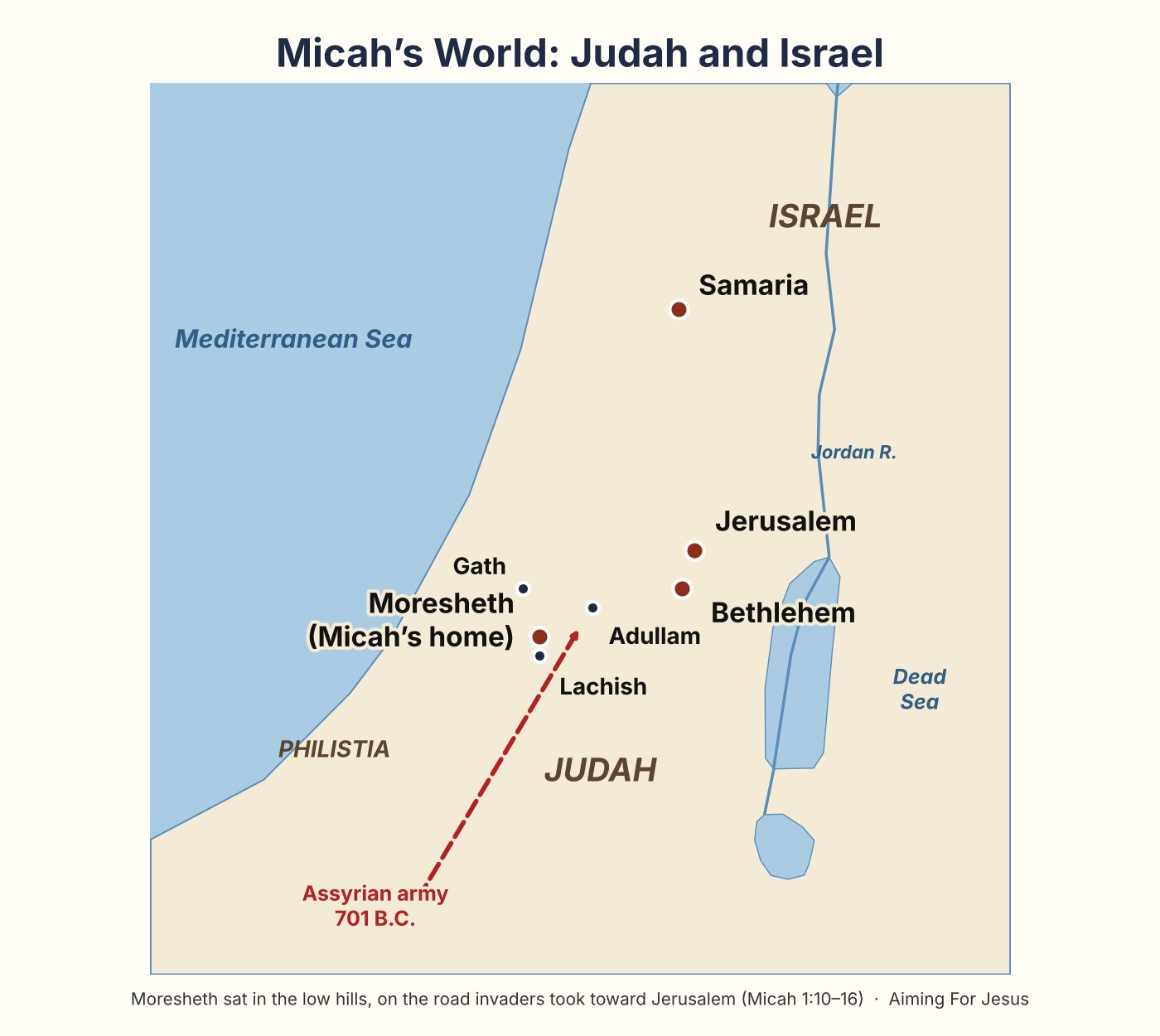
The prophet Micah wrote it (1:1). His name means “Who is like the LORD?” and the book ends by asking that very question: “Who is a God like You?” (7:18). He came from Moresheth, a small country town in the low hills about 25 miles southwest of Jerusalem. Micah was not a city man or a palace man. He spoke for ordinary country people who were being pushed around by the powerful.
About a hundred years later, when Jeremiah was on trial for his life, some elders stood up and quoted Micah 3:12 word for word. They reminded everyone that King Hezekiah listened to Micah and turned to the LORD (Jeremiah 26:17–19). Micah’s words changed a king’s heart.
Where it takes place
Micah speaks to both kingdoms of God’s divided people: Israel in the north, with its capital Samaria, and Judah in the south, with its capital Jerusalem (1:1, 5). Most of his message is for Judah. In chapter 1 he names a string of towns in the low hills near his home, the very road an invading army would take toward Jerusalem. The great power of the day was Assyria, with its capital at Nineveh. Micah also looks ahead to Babylon (4:10) and to a small town called Bethlehem (5:2).
Micah among the Old Testament books
Genesis · Exodus · Leviticus · Numbers · Deuteronomy · Joshua · Judges · Ruth · 1 Samuel · 2 Samuel · 1 Kings · 2 Kings · 1 Chronicles · 2 Chronicles · Ezra · Nehemiah · Esther · Job · Psalms · Proverbs · Ecclesiastes · Song of Solomon · Isaiah · Jeremiah · Lamentations · Ezekiel · Daniel · Hosea · Joel · Amos · Obadiah · Jonah · Micah · Nahum · Habakkuk · Zephaniah · Haggai · Zechariah · Malachi
Micah is the 33rd of the 39 books of the Old Testament and the sixth of the twelve “Minor Prophets.” They are called minor only because they are short. Micah preached at the same time as Isaiah in Jerusalem and Hosea in the north, and not long after Amos. Micah 4:1–3 and Isaiah 2:2–4 say almost the same thing about the mountain of the LORD in the last days.
When it was written
Micah preached during the reigns of three kings of Judah: Jotham, Ahaz and Hezekiah (1:1), roughly 750 to 686 B.C. He lived to see the Assyrians destroy Samaria in 722 B.C., just as he warned (1:6), and he saw the Assyrian army under Sennacherib sweep through Judah in 701 B.C. Jerusalem was spared that day because Hezekiah cried out to the LORD.
Meet the book
- A country preacher: God’s people had religion, but the rich stole from the poor, leaders took bribes, and idols stood beside the worship of the LORD.
- Judgment, then hope: Three times Micah calls, “Hear” (1:2; 3:1; 6:1), and each time hope follows judgment.
- Out of Bethlehem: A Ruler “whose coming forth is from of old” (5:2), the verse that pointed the wise men to Jesus (Matthew 2:5–6).
- Micah 6:8: Do justice, love kindness, walk humbly with your God. Not a ladder to heaven, but the life of people who know Him.
- Who is a God like You? He pardons iniquity, delights in mercy, and casts all our sins into the depths of the sea (7:18–19).
The central message The LORD sees the sin of His people and will judge it, but He delights in mercy; He will send a Shepherd-King from Bethlehem and cast all our sins into the depths of the sea.
A verse to carry through the study Micah 7:18 BLB
Find your way
Main teachings
God sees how we treat people
Micah 2:1–2; 3:1–3; 6:10–12 Micah names real sins: grabbing houses and fields, cheating with false scales, leaders who tear at the people like butchers. God cares about the widow, the farmer and the worker. How we use power over others matters to Him.
Religion is no cover for sin
Micah 3:11; 6:6–8; Isaiah 1:11–17 The leaders took bribes and then said, “Is not the LORD in our midst? No disaster shall come upon us.” God isn’t fooled by religious activity. He wants hearts and lives that belong to Him.
False prophets and true
Micah 2:6, 11; 3:5–8 The popular preachers said, “Don’t preach of these things.” They preached peace to anyone who fed them. Micah was different: “I am filled with power, with the Spirit of the LORD… to declare to Jacob his transgression.” True preaching tells the truth.
Justice, kindness and humility
Micah 6:8; Matthew 23:23; Ephesians 2:8–10 God has told us what is good: do justice, love kindness (steadfast, loyal love), and walk humbly with your God. We are saved by grace alone through faith in Christ, and this is the shape of the life He gives us.
The remnant and the Shepherd
Micah 2:12–13; 4:6–7; 5:4; 7:14 God promises to gather His scattered, lame and outcast sheep. A King will break open the way and go before them. God never loses His flock.
The Ruler from Bethlehem
Micah 5:2–5; Matthew 2:1–6; John 7:42 From a small, overlooked town comes a Ruler whose origins are from of old, from ancient days. He will shepherd in the strength of the LORD, and “He shall be their peace.” That is Jesus.
The mountain of the LORD and lasting peace
Micah 4:1–5; Isaiah 2:2–4 One day the nations will come to learn God’s ways. They will beat swords into plowshares, and everyone will sit under his own vine and fig tree with no one to make them afraid. Christians differ on the details of when and how, but the hope is sure.
Waiting on God in dark days
Micah 7:7–9 When friends and even family can’t be trusted, Micah says, “But as for me, I will look to the LORD; I will wait for the God of my salvation.” When I fall, I shall rise. When I sit in darkness, the LORD will be a light to me.
Who is a God like You?
Micah 7:18–20; Psalm 103:12; 1 John 1:9 The book ends in wonder at God’s forgiveness. He pardons, passes over, doesn’t stay angry, delights in mercy, has compassion, treads our sins underfoot and casts them into the depths of the sea. In Christ, every one of those promises is ours.
Praying through Micah
Micah 7 is a prayer. Micah looks around at a broken society, then turns his eyes to the LORD and waits for Him. He asks God to shepherd His people as in days of old (7:14), and he ends in praise for God’s forgiveness (7:18–20).
A good way to pray through Micah is to ask God to search your heart against 6:8, to confess what He shows you, and then to thank Him for the mercy of 7:18–19.
The prayers in this book
Micah 6:8 — A prayer for a life that pleases God. Ask Him to help you do what is right, love mercy, and walk humbly with Him today.
Micah 7:7 — A prayer of waiting. Tell the LORD you are looking to Him and waiting for Him, and that you trust Him to hear you.
Micah 7:8–9 — A prayer when you have fallen. Confess your sin, and thank God that He will lift you up and be your light.
Micah 7:18–19 — A prayer of thanksgiving. Praise God that there is no one like Him, who pardons sin and casts it into the depths of the sea.
Who is a God like You? (Micah 7:18–20)
Pray it with Micah 7:18–20 BLB
Read Micah
Select a chapter to read it in the ESV in a reading window, right here on this page.
Micah 1:1–16 Micah 2:1–13 Micah 3:1–12 Micah 4:1–13 Micah 5:1–15 Micah 6:1–16 Micah 7:1–20
A brief outline
1:8–1:16 Micah Weeps over the Towns of Judah
2:1–2:5 Woe to Those Who Steal Land
2:6–2:11 “Don’t Preach Like That!”
2:12–2:13 The Shepherd-King Gathers His Flock
3:1–3:4 Leaders Who Devour the People
3:5–3:8 False Prophets and a True One
3:9–3:12 Zion Will Be Plowed Like a Field
4:1–4:5 The Mountain of the LORD
4:6–4:8 The Lame and the Outcast Gathered
4:9–4:13 Labor Pains, Then Rescue
5:1–5:6 The Ruler from Bethlehem
5:7–5:15 The Remnant and a Purified People
6:1–6:5 The LORD Takes His People to Court
6:6–6:8 What Does the LORD Require?
6:9–6:16 Cheating Scales and Empty Plates
7:1–7:7 “But As for Me, I Will Look to the LORD”
Study every verse
Begin with the Scripture, then read the study notes and the passages to read alongside. After each section, pause over the question. Watch how often Micah moves from “judgment is coming” to “but the LORD will gather, save and forgive.”
Commentary offered not as authoritative but as a view of the verse drawn from the scriptures presented, other scriptures, and various commentaries. If these thoughts do not line up with the Word then they must be rejected. It is my belief and prayer they are consistent with the Word and are offered as a simple teaching on the Word and as every teaching on the Word each must be carefully compared with the one true and living Word of God.
Chapter 1 1:1 1:2 1:3 1:4 1:5 1:6 1:7 1:8 1:9 1:10 1:11 1:12 1:13 1:14 1:15 1:16
Chapter 2 2:1 2:2 2:3 2:4 2:5 2:6 2:7 2:8 2:9 2:10 2:11 2:12 2:13
Chapter 3 3:1 3:2 3:3 3:4 3:5 3:6 3:7 3:8 3:9 3:10 3:11 3:12
Chapter 4 4:1 4:2 4:3 4:4 4:5 4:6 4:7 4:8 4:9 4:10 4:11 4:12 4:13
Chapter 5 5:1 5:2 5:3 5:4 5:5 5:6 5:7 5:8 5:9 5:10 5:11 5:12 5:13 5:14 5:15
Chapter 6 6:1 6:2 6:3 6:4 6:5 6:6 6:7 6:8 6:9 6:10 6:11 6:12 6:13 6:14 6:15 6:16
Chapter 7 7:1 7:2 7:3 7:4 7:5 7:6 7:7 7:8 7:9 7:10 7:11 7:12 7:13 7:14 7:15 7:16 7:17 7:18 7:19 7:20
Chapter 1
The LORD Is Coming
Micah 1:1
Read the verse: Micah 1:1 BLB
Study Notes
This is the message the LORD gave Micah from Moresheth in the days of Jotham, Ahaz and Hezekiah, kings of Judah. He saw it concerning Samaria and Jerusalem.
Micah was a country preacher from a small town. God’s Word came to him in real history, under real kings. Samaria was the capital of the northern kingdom and Jerusalem of the southern. Both needed to hear.
Read alongside Isaiah 1:1 BLB; Jeremiah 26:18 BLB; 2 Peter 1:21 BLB
Micah 1:2
Read the verse: Micah 1:2 BLB
Study Notes
Listen, all you peoples! Pay attention, earth and everyone in it! The Lord GOD will testify against you from His holy temple.
Micah opens like a courtroom. The whole world is called in to hear God bring His case. God is not a local god. He is Lord of all the earth.
Read alongside Psalm 50:1–7 BLB; Isaiah 1:2 BLB; Habakkuk 2:20 BLB
Micah 1:3
Read the verse: Micah 1:3 BLB
Study Notes
Look! The LORD is coming out of His place. He will come down and walk on the high places of the earth.
The “high places” were where idols were worshiped. The LORD is coming to walk right over them. Nothing people set up against Him will stand.
Read alongside Isaiah 26:21 BLB; Amos 4:13 BLB; Psalm 18:9 BLB
Micah 1:4
Read the verse: Micah 1:4 BLB
Study Notes
Under Him the mountains melt and the valleys split apart, like wax near a fire, like water pouring down a steep slope.
What looks solid and permanent to us is like wax to God. We should never shrink God down to our size.
Read alongside Psalm 97:5 BLB; Nahum 1:5 BLB; Judges 5:5 BLB
Micah 1:5
Read the verse: Micah 1:5 BLB
Study Notes
All this is because of Jacob’s rebellion and Israel’s sins. What is Jacob’s rebellion? Isn’t it Samaria? What is Judah’s high place? Isn’t it Jerusalem?
The rot started at the top, in the capital cities where the leaders lived. Belonging to God’s people didn’t excuse their sin. It made it worse.
Read alongside Amos 6:1 BLB; 2 Kings 17:7–18 BLB; Romans 2:17–24 BLB
Micah 1:6
Read the verse: Micah 1:6 BLB
Study Notes
So I will make Samaria a heap of rubble in the open country, a place to plant vineyards. I will roll her stones down into the valley and lay bare her foundations.
This came true in 722 B.C. when the Assyrians destroyed Samaria. A proud capital became a field for planting grapes. God’s warnings are not empty words.
Read alongside 2 Kings 17:5–6 BLB; Amos 3:15 BLB; Hosea 13:16 BLB
Micah 1:7
Read the verse: Micah 1:7 BLB
Study Notes
Her carved idols will be smashed, everything she was paid will be burned, and her idols will be ruined. She gathered them with a prostitute’s wages, and they will go back to pay prostitutes.
Worshiping idols is pictured as spiritual adultery. Riches gained by unfaithfulness to God won’t last. The Assyrians would carry it all away to their own temples.
Read alongside Hosea 2:5–8 BLB; Exodus 20:3–5 BLB; 1 John 5:21 BLB
Aiming for Jesus
Know Him
The LORD sees what happens in high places and low. Nothing is hidden from Him.
Examine your heart
Micah says the LORD sees what happens in the capital cities, where the leaders live. Where might God want to bring His light into the “capital city” of your own life: the place where your decisions are made?
Micah Weeps over the Towns of Judah
Micah 1:8
Read the verse: Micah 1:8 BLB
Study Notes
Because of this I will mourn and wail. I will go barefoot and stripped; I will howl like the jackals and moan like the owls.
Micah doesn’t announce judgment with a smile. He weeps. A true messenger of God grieves over sin and its cost, even when he must warn.
Read alongside Isaiah 20:2–4 BLB; Jeremiah 9:1 BLB; Luke 19:41–44 BLB
Micah 1:9
Read the verse: Micah 1:9 BLB
Study Notes
Her wound can’t be healed. It has come to Judah; it has reached the very gate of my people, to Jerusalem.
The sickness of Samaria had spread south. The danger came right up to Jerusalem’s gate. In 701 B.C. the Assyrian army did exactly that.
Read alongside 2 Kings 18:13 BLB; Isaiah 1:5–6 BLB; Jeremiah 30:12 BLB
Micah 1:10
Read the verse: Micah 1:10 BLB
Study Notes
Don’t tell it in Gath; don’t weep at all. In Beth-le-aphrah, roll in the dust.
Micah begins a string of word plays on town names that are hard to bring into English. Beth-le-aphrah sounds like “house of dust,” so its people will roll in the dust. Gath was a Philistine city; don’t let the enemy gloat. David said nearly the same words over Saul.
Read alongside 2 Samuel 1:20 BLB; Jeremiah 6:26 BLB; Joshua 15:33–44 BLB
Micah 1:11
Read the verse: Micah 1:11 BLB
Study Notes
Pass on your way, people of Shaphir, naked and ashamed. The people of Zaanan don’t come out. Beth-ezel mourns, and its support is taken from you.
Shaphir sounds like “beautiful,” but its people will go out stripped and ashamed. Zaanan sounds like “going out,” but its people won’t dare to go out. Each town’s name becomes a picture of its fate.
Read alongside Isaiah 47:2–3 BLB; Lamentations 1:8 BLB; Jeremiah 13:26 BLB
Micah 1:12
Read the verse: Micah 1:12 BLB
Study Notes
The people of Maroth wait anxiously for good news, because disaster has come down from the LORD to the gate of Jerusalem.
Maroth sounds like “bitter.” They hoped for good, but bitterness came. Notice who sent it: the LORD. The Assyrians were only the tool in His hand.
Read alongside Isaiah 10:5–6 BLB; Jeremiah 8:15 BLB; Amos 3:6 BLB
Micah 1:13
Read the verse: Micah 1:13 BLB
Study Notes
Hitch the swift horses to the chariots, people of Lachish! You were where the sin of Daughter Zion began, for Israel’s rebellions were found in you.
Lachish was Judah’s great fortress city, and it sounds like the word for “team of horses.” They trusted in chariots instead of God. Sennacherib captured Lachish in 701 B.C. and carved the scene on his palace walls in Nineveh.
Read alongside 2 Kings 18:14 BLB; Isaiah 31:1 BLB; Psalm 20:7 BLB
Micah 1:14
Read the verse: Micah 1:14 BLB
Study Notes
So you will give parting gifts to Moresheth-gath. The houses of Achzib will prove deceptive to the kings of Israel.
Moresheth was Micah’s own hometown. Achzib sounds like “deceptive,” like a dry creek bed that promises water but has none. The people trusted in things that would let them down.
Read alongside Jeremiah 15:18 BLB; Job 6:15–20 BLB; Joshua 15:44 BLB
Micah 1:15
Read the verse: Micah 1:15 BLB
Study Notes
I will again bring a conqueror against you, people of Mareshah. The glory of Israel will flee to Adullam.
Mareshah sounds like “conqueror” or “possessor.” Adullam was the cave where David hid from Saul. Israel’s leaders would end up hiding in caves like hunted men.
Read alongside 1 Samuel 22:1 BLB; 2 Chronicles 11:8 BLB; Isaiah 2:19 BLB
Micah 1:16
Read the verse: Micah 1:16 BLB
Study Notes
Shave your heads in mourning for the children you love. Make yourselves as bald as the eagle, for they will go away from you into exile.
Shaving the head was a sign of deep grief. The worst part of judgment would be losing the children, carried away into exile. Sin always costs more than we expect, and it often costs the next generation.
Read alongside Isaiah 22:12 BLB; Amos 8:10 BLB; 2 Kings 17:6 BLB
Aiming for Jesus
Seeing Jesus
Jesus wept over Jerusalem (Luke 19:41). Grief over sin and its cost is a sign of a heart like His.
Walk with Him today
Micah wept over the towns that would suffer. When you see sin and its cost in the world, or in your own family, do you grieve and pray, or just shake your head?
Chapter 2
Woe to Those Who Steal Land
Micah 2:1
Read the verse: Micah 2:1 BLB
Study Notes
Woe to those who lie awake planning evil on their beds! When morning comes they carry it out, because they have the power to do it.
Sin often starts in the mind at night and shows up in the hands by morning. These people did wrong simply because they could. God sees what we plan in the dark.
Read alongside Psalm 36:4 BLB; Proverbs 4:16 BLB; Isaiah 32:7 BLB
Micah 2:2
Read the verse: Micah 2:2 BLB
Study Notes
They want fields and grab them; they want houses and take them. They cheat a man out of his home and a person out of his inheritance.
In Israel, land was a family’s inheritance from God, passed down through generations. The powerful were swallowing up the small farmers. Coveting leads to taking.
Read alongside Exodus 20:17 BLB; 1 Kings 21:1–16 BLB; Isaiah 5:8 BLB
Micah 2:3
Read the verse: Micah 2:3 BLB
Study Notes
So the LORD says: I am planning disaster against this family, and you won’t be able to pull your necks out of it. You won’t walk proudly anymore, for it will be an evil time.
They planned evil; now God plans their judgment. They put others under a yoke; now they will wear one. God has a way of turning our schemes back on us.
Read alongside Jeremiah 18:11 BLB; Isaiah 2:12 BLB; Galatians 6:7 BLB
Micah 2:4
Read the verse: Micah 2:4 BLB
Study Notes
In that day people will mock you with a sad song: ‘We are completely ruined! He has taken away my people’s land. He hands our fields to traitors.’
Those who stole fields would see their own fields taken by foreign invaders. Their own sad song would be turned into a taunt.
Read alongside Habakkuk 2:6 BLB; Amos 5:11 BLB; Jeremiah 6:12 BLB
Micah 2:5
Read the verse: Micah 2:5 BLB
Study Notes
So you will have no one in the LORD’s assembly to measure out a share of land by lot.
When Israel first entered the land, it was divided by lot as a gift from God (Joshua 14). These land-grabbers would have no part when God gave the land again.
Read alongside Joshua 14:1–2 BLB; Psalm 16:5–6 BLB; Deuteronomy 32:8–9 BLB
Aiming for Jesus
Know Him
God sees the plans made in the night (2:1). He is a God of justice who protects the vulnerable.
Examine your heart
The land-grabbers lay awake planning how to get more. Is there anything you want so badly that you are tempted to bend what is right to get it?
“Don’t Preach Like That!”
Micah 2:6
Read the verse: Micah 2:6 BLB
Study Notes
“Don’t preach,” they preach. “People shouldn’t preach about such things. Shame won’t catch up with us.”
The popular preachers told Micah to stop. They didn’t want to hear about sin and judgment. People have always preferred comfortable sermons.
Read alongside Amos 7:10–16 BLB; Isaiah 30:10 BLB; 2 Timothy 4:3–4 BLB
Micah 2:7
Read the verse: Micah 2:7 BLB
Study Notes
Should it be said, O house of Jacob, ‘Has the LORD run out of patience? Is this the kind of thing He does?’ Don’t My words do good to the one who walks uprightly?
God’s Word isn’t harsh to those who walk with Him. It is good. It only feels like an attack to those who don’t want to change.
Read alongside Psalm 19:7–11 BLB; Psalm 119:65 BLB; Hebrews 4:12 BLB
Micah 2:8
Read the verse: Micah 2:8 BLB
Study Notes
Lately My people have risen up like an enemy. You strip the fine robe off peaceful travelers, men who are coming home from war, trusting they are safe.
God’s own people were acting like enemy raiders, robbing their neighbors who thought they were safe. When we wrong others, we set ourselves against God.
Read alongside Exodus 22:26–27 BLB; Proverbs 3:29 BLB; Amos 2:8 BLB
Micah 2:9
Read the verse: Micah 2:9 BLB
Study Notes
You drive the women of My people out of their pleasant homes, and you take My glory away from their young children forever.
Widows and children, the very people God told Israel to protect, were being thrown out of their homes. God calls these children His own.
Read alongside Exodus 22:22–24 BLB; Isaiah 10:1–2 BLB; James 1:27 BLB
Micah 2:10
Read the verse: Micah 2:10 BLB
Study Notes
Get up and go! This is no place to rest, because it is defiled and will be destroyed with a terrible destruction.
They had thrown others out; now they would be thrown out of the land. Sin had made the land unclean.
Read alongside Leviticus 18:24–28 BLB; Deuteronomy 12:9 BLB; Hebrews 4:9 BLB
Micah 2:11
Read the verse: Micah 2:11 BLB
Study Notes
If a man came along spreading wind and lies, saying, ‘I will preach to you about wine and beer,’ he would be just the preacher for this people!
They wanted a preacher who would promise good times and full cups. It is a warning for us too: the most popular message isn’t always God’s message.
Read alongside Isaiah 28:7 BLB; Jeremiah 5:31 BLB; 2 Timothy 4:3 BLB
Aiming for Jesus
Know Him
God’s Word is good even when it is hard. “Do not my words do good to him who walks uprightly?” (2:7).
Walk with Him today
The people wanted preachers who would tell them only pleasant things. How do you respond when God’s Word puts its finger on something you would rather not change?
The Shepherd-King Gathers His Flock
Micah 2:12
Read the verse: Micah 2:12 BLB
Study Notes
I will surely gather all of you, Jacob; I will gather the remnant of Israel. I will bring them together like sheep in a fold, like a flock in its pasture; it will be noisy with people.
Suddenly, hope. After all the judgment, God promises to gather His people like a shepherd gathers sheep. God never loses His remnant.
Read alongside Isaiah 40:11 BLB; Ezekiel 34:11–16 BLB; John 10:16 BLB
Micah 2:13
Read the verse: Micah 2:13 BLB
Study Notes
The one who breaks open the way will go up before them. They will break through the gate and go out. Their King will pass on before them, the LORD at their head.
Picture sheep penned in, and a strong leader breaking open the gate and leading them out. The King goes first, and He is the LORD Himself. Jesus is the Shepherd-King who goes before His sheep.
Read alongside John 10:4 BLB; Hebrews 6:20 BLB; Isaiah 52:12 BLB
Aiming for Jesus
Seeing Jesus
Jesus is the Good Shepherd who goes before His sheep (John 10:4). He breaks open the way.
Pray
Micah pictures the LORD as a Shepherd-King who breaks open the way and goes ahead of His sheep. Where do you need Him to go before you right now?
Chapter 3
Leaders Who Devour the People
Micah 3:1
Read the verse: Micah 3:1 BLB
Study Notes
And I said: Listen, you heads of Jacob and rulers of Israel! Shouldn’t you, of all people, know what justice is?
This is Micah’s second “Hear!” Now he speaks straight to the leaders. Their whole job was to know and keep justice. They of all people had no excuse.
Read alongside Isaiah 1:10 BLB; Jeremiah 5:4–5 BLB; Deuteronomy 16:18–20 BLB
Micah 3:2
Read the verse: Micah 3:2 BLB
Study Notes
You hate what is good and love what is evil. You tear the skin off my people and the flesh off their bones.
Micah uses a shocking picture. The leaders were treating the people like animals to be butchered. They had turned everything upside down: hating good, loving evil.
Read alongside Amos 5:15 BLB; Isaiah 5:20 BLB; Ezekiel 34:2–4 BLB
Micah 3:3
Read the verse: Micah 3:3 BLB
Study Notes
You eat the flesh of my people, strip off their skin, break their bones, and chop them up like meat for the pot, like flesh in a cauldron.
The picture keeps going. Leaders who should have been shepherds were acting like butchers. Power used to feed yourself at the expense of others is evil in God’s eyes.
Read alongside Psalm 14:4 BLB; Proverbs 30:14 BLB; Ezekiel 22:27 BLB
Micah 3:4
Read the verse: Micah 3:4 BLB
Study Notes
Then they will cry out to the LORD, but He won’t answer them. He will hide His face from them at that time, because their deeds have been evil.
They ignored the cries of the poor, so their own cries would go unanswered. This is a sobering warning, not to those who come to God humbly, but to those who keep on in sin and only call when trouble comes.
Read alongside Proverbs 21:13 BLB; Isaiah 1:15 BLB; Psalm 66:18 BLB
Aiming for Jesus
Know Him
God hears the cries of the oppressed and will answer them.
Examine your heart
Micah says leaders will one day cry to God and not be answered. What does it mean to you that God hears the cries of those who are being treated unfairly?
False Prophets and a True One
Micah 3:5
Read the verse: Micah 3:5 BLB
Study Notes
This is what the LORD says about the prophets who lead my people astray: when they have something to eat, they cry ‘Peace!’ But if anyone doesn’t feed them, they declare war against him.
The false prophets’ message depended on who paid them. Feed them, and they preached peace. Don’t, and they preached against you. Their message was for sale.
Read alongside Jeremiah 6:13–14 BLB; Ezekiel 13:10 BLB; 2 Peter 2:1–3 BLB
Micah 3:6
Read the verse: Micah 3:6 BLB
Study Notes
So night will come over you, without visions, and darkness, without answers. The sun will set on the prophets, and the day will go dark over them.
Those who sold God’s Word would lose it altogether. When people refuse the truth, a day comes when they can’t find it.
Read alongside Amos 8:11–12 BLB; Isaiah 29:10 BLB; 1 Samuel 28:6 BLB
Micah 3:7
Read the verse: Micah 3:7 BLB
Study Notes
The seers will be ashamed and the fortune-tellers embarrassed. They will all cover their lips, because there is no answer from God.
Covering the lips was a sign of shame and mourning. These prophets would have nothing to say.
Read alongside Leviticus 13:45 BLB; Zechariah 13:4 BLB; Ezekiel 24:17 BLB
Micah 3:8
Read the verse: Micah 3:8 BLB
Study Notes
But as for me, I am filled with power, with the Spirit of the LORD, and with justice and courage, to tell Jacob his rebellion and Israel his sin.
Here is the difference between a false prophet and a true one. Micah wasn’t powered by money or popularity. He was filled with the Spirit of the LORD, and that gave him courage to tell the truth people didn’t want to hear.
Read alongside Acts 1:8 BLB; 2 Timothy 1:7 BLB; Isaiah 58:1 BLB
Aiming for Jesus
Know Him
God fills His messengers “with power, with the Spirit of the LORD” (3:8) to speak truth.
Walk with Him today
Micah was filled with the Spirit to speak the truth. Is there a truth God wants you to speak with love and courage, even if it isn’t welcome?
Zion Will Be Plowed Like a Field
Micah 3:9
Read the verse: Micah 3:9 BLB
Study Notes
Hear this, you heads of the house of Jacob and rulers of the house of Israel, who hate justice and twist everything that is straight,
Micah turns to the leaders again. They didn’t just neglect justice; they hated it, and they bent what was straight to suit themselves.
Read alongside Amos 5:7 BLB; Isaiah 59:14 BLB; Proverbs 17:23 BLB
Micah 3:10
Read the verse: Micah 3:10 BLB
Study Notes
who build Zion with bloodshed and Jerusalem with wrongdoing.
Their fine buildings in Jerusalem were paid for by crushing the poor. A city built on injustice is built on sand.
Read alongside Habakkuk 2:12 BLB; Jeremiah 22:13 BLB; Ezekiel 22:27 BLB
Micah 3:11
Read the verse: Micah 3:11 BLB
Study Notes
Her leaders judge for a bribe, her priests teach for a price, and her prophets tell fortunes for money. Yet they lean on the LORD and say, ‘Isn’t the LORD with us? No disaster will come on us.’
Judges, priests and prophets were all for sale. And still they said, “God is with us; nothing bad will happen.” That is false confidence: using God’s name as a lucky charm while living in sin.
Read alongside Jeremiah 7:4–11 BLB; Isaiah 1:23 BLB; 1 Timothy 6:5 BLB
Micah 3:12
Read the verse: Micah 3:12 BLB
Study Notes
So because of you, Zion will be plowed like a field, Jerusalem will become a heap of ruins, and the temple mountain will be overgrown like a forest hilltop.
This was unthinkable: God’s own city plowed under. A hundred years later, elders quoted this very verse at Jeremiah’s trial and said that King Hezekiah heard it and turned to the LORD, and God held back the disaster (Jeremiah 26:18–19). It finally came in 586 B.C.
Read alongside Jeremiah 26:18–19 BLB; 2 Kings 25:8–10 BLB; Lamentations 5:18 BLB
Aiming for Jesus
Know Him
God cannot be used as a good-luck charm. He is the Lord, to be trusted and obeyed.
Examine your heart
The leaders said, “Isn’t the LORD with us? Nothing bad will happen.” How can we tell the difference between real trust in God and using His name as a good-luck charm?
Chapter 4
The Mountain of the LORD
Micah 4:1
Read the verse: Micah 4:1 BLB
Study Notes
In the last days, the mountain of the LORD’s house will be set up as the highest of the mountains and lifted above the hills, and peoples will stream to it.
Right after Zion is plowed like a field (3:12), Micah sees it lifted higher than every mountain. Judgment is not God’s last word. Isaiah gives almost the same promise (Isaiah 2:2–4). Notice that the peoples stream uphill to it, drawn by God.
Read alongside Isaiah 2:2–4 BLB; Zechariah 8:20–23 BLB; Hebrews 12:22 BLB
Micah 4:2
Read the verse: Micah 4:2 BLB
Study Notes
Many nations will come and say, “Come, let us go up to the mountain of the LORD, to the house of the God of Jacob, so He can teach us His ways and we can walk in His paths.” For the law will go out from Zion, and the LORD’s word from Jerusalem.
The nations come wanting to be taught by God. That began when the gospel went out from Jerusalem to the ends of the earth (Acts 1:8), and it will be complete when Christ reigns.
Read alongside Isaiah 2:3 BLB; Luke 24:47 BLB; Acts 1:8 BLB
Micah 4:3
Read the verse: Micah 4:3 BLB
Study Notes
He will judge between many peoples and settle disputes for strong nations far away. They will hammer their swords into plowshares and their spears into pruning hooks. Nation won’t lift sword against nation, and they won’t train for war anymore.
When God Himself is Judge, wars come to an end. Weapons are turned into farm tools. This is a peace the world has never yet seen, and it comes from God, not from treaties. Christians differ on the details of when and how it fully comes, but the hope is sure.
English wording → Hebrew word → meaning
“plowshares” → ’eth → a plowshare BLB
“pruning hooks” → mazmerah → a pruning knife BLB
Read alongside Isaiah 2:4 BLB; Isaiah 11:6–9 BLB; Revelation 21:4 BLB
Micah 4:4
Read the verse: Micah 4:4 BLB
Study Notes
Everyone will sit under his own vine and his own fig tree, and no one will make them afraid, because the mouth of the LORD of hosts has spoken.
What a peaceful picture: a man resting under his own trees, on his own land, with no fear. Remember chapter 2, where the powerful were stealing land. God promises to set it right. And it is sure, because the LORD has said it.
Read alongside 1 Kings 4:25 BLB; Zechariah 3:10 BLB; Isaiah 65:21–22 BLB
Micah 4:5
Read the verse: Micah 4:5 BLB
Study Notes
All the peoples may walk, each in the name of its god, but we will walk in the name of the LORD our God forever and ever.
While we wait for that day, God’s people make a choice now. Others may follow their gods. We will walk with the LORD.
Read alongside Joshua 24:15 BLB; Psalm 20:7 BLB; Zechariah 10:12 BLB
Aiming for Jesus
Seeing Jesus
Jesus brings the peace Micah describes. He is our peace (Ephesians 2:14).
Walk with Him today
Micah pictures each person resting under his own vine and fig tree with no one to make him afraid. What fear would you love God to take away, and how does His promise help you today?
The Lame and the Outcast Gathered
Micah 4:6
Read the verse: Micah 4:6 BLB
Study Notes
In that day, declares the LORD, I will gather the lame and bring together those who were driven away and those I have afflicted.
God gathers the ones nobody else wants: the lame, the outcast, the hurting. He even gathers those He had to discipline. That is our God.
Read alongside Zephaniah 3:19 BLB; Ezekiel 34:16 BLB; Luke 14:21 BLB
Micah 4:7
Read the verse: Micah 4:7 BLB
Study Notes
I will make the lame a remnant and those driven away a strong nation. The LORD will reign over them in Mount Zion from that time on and forever.
The weak become the remnant; the scattered become strong. God loves to build His kingdom out of the weak so that the glory is His.
Read alongside 1 Corinthians 1:26–29 BLB; Isaiah 24:23 BLB; Luke 1:32–33 BLB
Micah 4:8
Read the verse: Micah 4:8 BLB
Study Notes
And you, watchtower of the flock, stronghold of Daughter Zion, to you the former rule will return, the kingdom will come to Daughter Jerusalem.
Jerusalem is pictured as a shepherd’s tower watching over the flock. The kingdom that seemed lost will come back. Hold on to this; we will meet the Shepherd-King from Bethlehem in chapter 5.
Read alongside Genesis 35:21 BLB; Amos 9:11 BLB; Acts 15:16–17 BLB
Aiming for Jesus
Seeing Jesus
Jesus welcomed the lame, the outcast and the overlooked. His kingdom is full of people others left out.
Walk with Him today
God gathers the lame and the outcast and makes them strong. Who in your life might God want you to welcome in?
Labor Pains, Then Rescue
Micah 4:9
Read the verse: Micah 4:9 BLB
Study Notes
Now why are you crying out so loudly? Is there no king among you? Has your counselor perished, that pain grips you like a woman in labor?
Micah jumps back to the hard present. The people are crying out like a woman in labor, because their king and their advisers can’t save them.
Read alongside Jeremiah 8:19 BLB; Isaiah 13:8 BLB; Jeremiah 4:31 BLB
Micah 4:10
Read the verse: Micah 4:10 BLB
Study Notes
Writhe and groan, Daughter Zion, like a woman giving birth, for now you will leave the city and live in the open country. You will go to Babylon. There you will be rescued. There the LORD will redeem you from the hand of your enemies.
An amazing prophecy. In Micah’s day Assyria was the great power, yet he names Babylon, more than a hundred years before the exile. The pain would be real, but like labor pains, it would end in new life. Even in Babylon, God would redeem them.
Read alongside 2 Kings 20:16–18 BLB; Isaiah 48:20 BLB; Ezra 1:1–4 BLB
Micah 4:11
Read the verse: Micah 4:11 BLB
Study Notes
Now many nations are gathered against you. They say, “Let her be defiled, and let our eyes gloat over Zion.”
The enemies thought they were about to enjoy Zion’s fall.
Read alongside Psalm 2:1–3 BLB; Zechariah 12:2–3 BLB; Obadiah 12 BLB
Micah 4:12
Read the verse: Micah 4:12 BLB
Study Notes
But they don’t know the thoughts of the LORD or understand His plan, that He has gathered them like sheaves to the threshing floor.
The nations thought they were the harvesters. In fact, God had gathered them like bundles of grain to be threshed. People make their plans, but God’s plan stands.
Read alongside Isaiah 55:8–9 BLB; Proverbs 19:21 BLB; Psalm 33:10–11 BLB
Micah 4:13
Read the verse: Micah 4:13 BLB
Study Notes
Get up and thresh, Daughter Zion, for I will make your horn iron and your hooves bronze. You will crush many peoples, and you will devote their gain to the LORD, their wealth to the Lord of the whole earth.
God gives His weak people strength like an ox with iron horns and bronze hooves. And notice the end of the verse: the riches go to the LORD. Every victory belongs to Him.
Read alongside Isaiah 41:15–16 BLB; Zechariah 14:14 BLB; Joshua 6:19 BLB
Aiming for Jesus
Know Him
God has a plan the nations do not understand (4:12). He is never caught off guard.
Examine your heart
The nations didn’t know the LORD’s plan (4:12). When it looks like the wrong side is winning, how does knowing God has a plan help you?
Chapter 5
The Ruler from Bethlehem
Micah 5:1
Read the verse: Micah 5:1 BLB
Study Notes
Now gather your troops, city of troops. A siege is set against us. They will strike the judge of Israel on the cheek with a rod.
Jerusalem is under siege, and Israel’s ruler is humiliated, struck on the face. Many see in this a picture of the true King, Jesus, who was struck on the face by His enemies before He triumphed.
Read alongside 1 Kings 22:24 BLB; Matthew 27:30 BLB; Lamentations 3:30 BLB
Micah 5:2
Read the verse: Micah 5:2 BLB
Study Notes
But you, Bethlehem Ephrathah, small among the clans of Judah, out of you will come for Me one who will be ruler over Israel, whose origins are from long ago, from the days of eternity.
Here is the great promise of Micah. Out of little Bethlehem, David’s hometown, God will bring a Ruler. And this Ruler’s beginnings reach back before Bethlehem, “from of old, from ancient days.” Seven hundred years later the scribes quoted this verse to show Herod where the Christ would be born (Matthew 2:5–6). Jesus was born in Bethlehem, and He is the eternal Son of God.
Read alongside Matthew 2:1–6 BLB; John 7:42 BLB; John 1:1–2 BLB
Micah 5:3
Read the verse: Micah 5:3 BLB
Study Notes
So He will give them up until the time when she who is in labor has given birth. Then the rest of His brothers will return to the people of Israel.
Before the Ruler comes, there will be a time of waiting and hardship. Then a woman gives birth, and the scattered family comes home. The birth of Jesus is the turning point of history.
Read alongside Isaiah 7:14 BLB; Galatians 4:4 BLB; Revelation 12:5 BLB
Micah 5:4
Read the verse: Micah 5:4 BLB
Study Notes
He will stand and shepherd His flock in the strength of the LORD, in the majesty of the name of the LORD His God. And they will live securely, for now He will be great to the ends of the earth.
The Ruler is a Shepherd. He doesn’t rule by force like earthly kings. He stands, feeds and guards His flock in the LORD’s own strength. Jesus said, “I am the good shepherd” (John 10:11). His greatness reaches to the ends of the earth.
Read alongside John 10:11, 14 BLB; Ezekiel 34:23 BLB; Psalm 23:1 BLB
Micah 5:5
Read the verse: Micah 5:5 BLB
Study Notes
And He will be their peace. When the Assyrian comes into our land and marches through our fortresses, we will raise against him seven shepherds and eight leaders of men.
“He shall be their peace.” Not just the bringer of peace; He Himself is our peace (Ephesians 2:14). When enemies come, God will raise up more than enough leaders. Seven and eight is a way of saying “plenty, and then some.”
Read alongside Ephesians 2:14 BLB; Isaiah 9:6 BLB; Ecclesiastes 11:2 BLB
Micah 5:6
Read the verse: Micah 5:6 BLB
Study Notes
They will rule the land of Assyria with the sword, the land of Nimrod at its gates. He will rescue us from the Assyrian when he comes into our land and treads within our borders.
Assyria, the land of Nimrod (Genesis 10:8–11), was the great enemy of the day. Micah uses it as the picture of every enemy of God’s people. The Shepherd-King will deliver His flock.
Read alongside Genesis 10:8–11 BLB; Isaiah 10:24–27 BLB; Isaiah 14:25 BLB
Aiming for Jesus
Seeing Jesus
Out of Bethlehem came the Ruler “whose coming forth is from of old” (5:2). Jesus Himself “shall be their peace” (5:5).
Pray
Micah promises a Ruler from tiny Bethlehem who “shall be their peace.” Where do you need Jesus to be your peace today?
The Remnant and a Purified People
Micah 5:7
Read the verse: Micah 5:7 BLB
Study Notes
Then the remnant of Jacob will be among many peoples like dew from the LORD, like showers on the grass, which don’t wait for man or depend on people.
God’s people will be a blessing among the nations, like dew that refreshes the ground. Dew doesn’t come from man; it comes from God. Our influence for good comes from Him.
Read alongside Hosea 14:5 BLB; Psalm 133:3 BLB; Genesis 12:2–3 BLB
Micah 5:8
Read the verse: Micah 5:8 BLB
Study Notes
And the remnant of Jacob will be among the nations, among many peoples, like a lion among the animals of the forest, like a young lion among flocks of sheep, which no one can rescue from once it attacks.
The same remnant is also like a lion. To those who receive God, His people are refreshing dew. To those who fight against Him, they are strong and cannot be stopped, because God is with them.
Read alongside Genesis 49:9 BLB; Numbers 24:9 BLB; 2 Corinthians 2:15–16 BLB
Micah 5:9
Read the verse: Micah 5:9 BLB
Study Notes
Your hand will be lifted up over your enemies, and all your foes will be cut off.
In the end, God’s people win, because God wins.
Read alongside Psalm 21:8 BLB; Isaiah 26:11 BLB; Romans 16:20 BLB
Micah 5:10
Read the verse: Micah 5:10 BLB
Study Notes
In that day, declares the LORD, I will cut off your horses from among you and destroy your chariots.
Now God turns to what His own people trusted in. Horses and chariots were their military strength. God will take away every false security so that they trust Him alone.
Read alongside Psalm 20:7 BLB; Isaiah 31:1 BLB; Zechariah 9:10 BLB
Micah 5:11
Read the verse: Micah 5:11 BLB
Study Notes
I will cut off the cities of your land and tear down all your fortresses.
Walls and forts can’t save. Only the LORD can.
Read alongside Hosea 8:14 BLB; Psalm 127:1 BLB; Proverbs 18:10 BLB
Micah 5:12
Read the verse: Micah 5:12 BLB
Study Notes
I will cut off sorcery from your hands, and you will have no more fortune-tellers.
Sorcery and fortune-telling were ways of trying to control the future without God. God will remove them. His people don’t need them; they have Him.
Read alongside Deuteronomy 18:10–12 BLB; Isaiah 2:6 BLB; Acts 19:18–19 BLB
Micah 5:13
Read the verse: Micah 5:13 BLB
Study Notes
I will cut off your carved idols and your sacred pillars from among you, and you will no longer bow down to the work of your hands.
What a foolish thing, to bow down to something you made yourself. God will tear it all out.
Read alongside Exodus 20:4–5 BLB; Isaiah 44:9–20 BLB; 1 John 5:21 BLB
Micah 5:14
Read the verse: Micah 5:14 BLB
Study Notes
I will root out your Asherah poles from among you and destroy your cities.
Asherah poles stood for a Canaanite goddess. God’s cleansing is thorough; He pulls sin up by the roots.
Read alongside Deuteronomy 16:21 BLB; 2 Kings 18:4 BLB; Isaiah 27:9 BLB
Micah 5:15
Read the verse: Micah 5:15 BLB
Study Notes
And in anger and wrath I will take vengeance on the nations that did not obey.
God will purify His people, and He will judge the nations that refuse Him. His mercy and His justice go together.
Read alongside Psalm 149:7 BLB; Isaiah 63:1–6 BLB; 2 Thessalonians 1:7–8 BLB
Aiming for Jesus
Know Him
God removes the things His people lean on, so that they will lean on Him alone.
Examine your heart
God promises to cut off horses, forts, fortune-tellers and idols, everything His people trusted instead of Him. What is one thing you lean on instead of God, and what would it look like to hand it over to Him?
Chapter 6
The LORD Takes His People to Court
Micah 6:1
Read the verse: Micah 6:1 BLB
Study Notes
Listen to what the LORD says: Get up, plead your case before the mountains, and let the hills hear your voice.
Micah’s third “Hear!” begins. It is a courtroom scene. The mountains and hills, which have watched Israel’s whole history, are called as the jury.
Read alongside Deuteronomy 32:1 BLB; Isaiah 1:2 BLB; Hosea 4:1 BLB
Micah 6:2
Read the verse: Micah 6:2 BLB
Study Notes
Hear, you mountains, the LORD’s case, and you enduring foundations of the earth. For the LORD has a case against His people, and He will argue it with Israel.
God brings charges against His own people. Notice the word “His.” This isn’t a stranger accusing strangers. It is a hurt Father speaking to His children.
Read alongside Jeremiah 2:9 BLB; Isaiah 3:13 BLB; Hosea 12:2 BLB
Micah 6:3
Read the verse: Micah 6:3 BLB
Study Notes
“My people, what have I done to you? How have I worn you out? Answer Me!
What a tender question. God doesn’t start with an accusation. He asks, “What have I done to you?” He invites them to name any wrong He has done. There is none.
Read alongside Jeremiah 2:5 BLB; Isaiah 5:4 BLB; Isaiah 43:22–24 BLB
Micah 6:4
Read the verse: Micah 6:4 BLB
Study Notes
I brought you up out of Egypt and redeemed you from the house of slavery. I sent Moses, Aaron and Miriam before you.
Instead of wearing them out, God had set them free. He gave them leaders to guide them. God reminds them of His grace before He speaks of their sin.
Read alongside Exodus 20:2 BLB; Deuteronomy 7:8 BLB; Exodus 15:20 BLB
Micah 6:5
Read the verse: Micah 6:5 BLB
Study Notes
My people, remember what King Balak of Moab planned and how Balaam son of Beor answered him, and what happened from Shittim to Gilgal, so that you may know the righteous acts of the LORD.”
Balak hired Balaam to curse Israel, but God turned every curse into a blessing (Numbers 22–24). Shittim was their last camp before crossing the Jordan; Gilgal was their first camp in the Promised Land. God brought them all the way. Remember!
Read alongside Numbers 22:1–6 BLB; Numbers 23:7–12 BLB; Joshua 3:1 BLB; Joshua 4:19 BLB
Aiming for Jesus
Know Him
God says, “Remember” (6:5). His faithfulness in the past gives us confidence today.
Walk with Him today
God says, “My people, what have I done to you?… Remember.” Take a few minutes to remember specific ways God has been faithful to you. How does remembering change the way you see your troubles today?
What Does the LORD Require?
Micah 6:6
Read the verse: Micah 6:6 BLB
Study Notes
With what should I come before the LORD and bow down before God on high? Should I come before Him with burnt offerings, with year-old calves?
Now the people answer. They ask what it will take to please God. Their first thought is: more sacrifices.
Read alongside Psalm 40:6 BLB; Hebrews 10:4 BLB; Isaiah 1:11 BLB
Micah 6:7
Read the verse: Micah 6:7 BLB
Study Notes
Will the LORD be pleased with thousands of rams or ten thousand rivers of oil? Should I give my firstborn for my rebellion, the child of my body for the sin of my soul?
The offers get bigger and bigger, all the way to the unthinkable: giving their own child. They thought they could buy God off. But no gift can pay for sin. Only God Himself could provide the sacrifice, and He did when He gave His own Son.
Read alongside 2 Kings 16:3 BLB; John 3:16 BLB; Romans 8:32 BLB
Micah 6:8
Read the verse: Micah 6:8 BLB
Study Notes
He has told you, O man, what is good. And what does the LORD require of you but to do justice, to love faithful kindness, and to walk humbly with your God?
Here is one of the best-loved verses in the Bible. God doesn’t want bribes; He wants our hearts and lives. Do what is right toward others. Love mercy, God’s loyal, steadfast kind of love. And walk humbly with God, every day. This isn’t how we earn salvation; we are saved by grace through faith in Jesus. This is the life that grows out of knowing Him.
English wording → Hebrew word → meaning
“justice” → mishpat → justice, a just decision BLB
“kindness” → chesed → steadfast love, loyal kindness BLB
“humbly” → tsana‘ → to be humble, to walk carefully BLB
Teacher’s comment — Chuck Swindoll (paraphrase; overview of Micah, Insight for Living; source)
Swindoll names this as a key verse. He notes that Micah spoke for the poor and powerless and foretold Christ’s birth in Bethlehem (5:2), and that the book ends by pointing God’s people to His mercy (7:7). He asks us to look for injustice or indifference in our own lives, to notice the vulnerable around us, and to respond with repentance, justice and kindness.
Read alongside Deuteronomy 10:12–13 BLB; Matthew 23:23 BLB; Ephesians 2:8–10 BLB
Aiming for Jesus
Remember whose you are
Micah 6:8 is the shape of a life already saved by grace, walking humbly with the God who saved us.
Walk with Him today
Micah 6:8 is not a ladder to heaven; it is the shape of a life saved by grace. Which part do you most need God’s help with today: doing justice, loving mercy, or walking humbly with Him?
Cheating Scales and Empty Plates
Micah 6:9
Read the verse: Micah 6:9 BLB
Study Notes
The voice of the LORD calls out to the city. It is wise to fear Your name. Listen to the rod and to the One who appointed it.
God now speaks to Jerusalem. When God disciplines, the wise person listens and asks what the Lord is teaching.
Read alongside Proverbs 9:10 BLB; Isaiah 10:5 BLB; Hebrews 12:5–11 BLB
Micah 6:10
Read the verse: Micah 6:10 BLB
Study Notes
Can I forget the treasures gained by wickedness in the house of the wicked, and the short measure that is cursed?
God doesn’t forget stolen money, even when it is hidden in a fine house. A “short measure” was a basket made smaller than it should be, so the buyer got less than he paid for.
Read alongside Amos 8:5 BLB; Proverbs 10:2 BLB; Deuteronomy 25:13–16 BLB
Micah 6:11
Read the verse: Micah 6:11 BLB
Study Notes
Can I count anyone innocent who uses dishonest scales and a bag of false weights?
Cheating in business is not a small thing to God. He cares about the scales at the market.
Read alongside Proverbs 11:1 BLB; Proverbs 20:23 BLB; Leviticus 19:35–36 BLB
Micah 6:12
Read the verse: Micah 6:12 BLB
Study Notes
Her rich men are full of violence, her people speak lies, and their tongues are deceitful in their mouths.
From the rich at the top to ordinary people, lying and violence had become normal.
Read alongside Jeremiah 9:3–8 BLB; Psalm 12:2 BLB; Hosea 4:2 BLB
Micah 6:13
Read the verse: Micah 6:13 BLB
Study Notes
So I have begun to strike you down, to make you desolate because of your sins.
God’s judgment had already started.
Read alongside Leviticus 26:16 BLB; Isaiah 1:5–7 BLB; Hosea 5:12–14 BLB
Micah 6:14
Read the verse: Micah 6:14 BLB
Study Notes
You will eat but not be satisfied; there will be hunger inside you. You will put things away but not keep them, and what you save I will hand over to the sword.
These were the curses God warned about long before (Leviticus 26). Life without God leaves us empty, even with food on the table.
Read alongside Leviticus 26:26 BLB; Haggai 1:6 BLB; Hosea 4:10 BLB
Micah 6:15
Read the verse: Micah 6:15 BLB
Study Notes
You will sow but not reap. You will press olives but not anoint yourselves with oil, and press grapes but not drink the wine.
All the work, and none of the harvest. What they took from others, they would lose themselves.
Read alongside Deuteronomy 28:38–40 BLB; Amos 5:11 BLB; Zephaniah 1:13 BLB
Micah 6:16
Read the verse: Micah 6:16 BLB
Study Notes
You have kept the laws of Omri and all the practices of Ahab’s house, and you have followed their advice. So I will make you a ruin and your people an object of scorn, and you will bear the shame of My people.
Omri and Ahab were wicked kings of the north who led Israel into Baal worship. Judah, which was supposed to be better, was following their example. We follow someone. The question is whom.
Read alongside 1 Kings 16:25–33 BLB; 2 Kings 21:3 BLB; Jeremiah 19:8 BLB
Aiming for Jesus
Know Him
God cares about honest scales and fair dealing (6:11). He sees the small things.
Examine your heart
God cares about honest scales and fair dealing. Is there any place in your work, money or dealings with others where you need to be more honest?
Chapter 7
“But As for Me, I Will Look to the LORD”
Micah 7:1
Read the verse: Micah 7:1 BLB
Study Notes
Woe is me! I am like someone gathering summer fruit after the harvest, picking grapes after the pickers are done. There isn’t a cluster to eat, not one early fig that my soul longs for.
Micah feels like a hungry man walking through a field that has already been picked clean. He looks for godly people and finds hardly any. It is a lonely feeling.
Read alongside Isaiah 24:13 BLB; Jeremiah 8:20 BLB; Psalm 12:1 BLB
Micah 7:2
Read the verse: Micah 7:2 BLB
Study Notes
The faithful have vanished from the land; there is no one upright left. They all lie in wait to shed blood; each hunts his brother with a net.
It seemed like everyone was out for himself, even hunting his own brother. Paul quotes a similar thought in Romans 3: “None is righteous, no, not one.” This is what sin does to a society.
Read alongside Psalm 12:1 BLB; Isaiah 57:1 BLB; Romans 3:10–18 BLB
Micah 7:3
Read the verse: Micah 7:3 BLB
Study Notes
Their hands are skilled at doing evil. The official and the judge ask for a bribe, and the powerful man speaks out the evil desire of his soul. They all weave it together.
Officials, judges and the powerful were all working together, skilled with both hands at doing wrong. When corruption becomes teamwork, the weak have no one to turn to.
Read alongside Isaiah 1:23 BLB; Amos 5:12 BLB; Proverbs 17:23 BLB
Micah 7:4
Read the verse: Micah 7:4 BLB
Study Notes
The best of them is like a briar; the most upright is worse than a thorn hedge. The day your watchmen warned about has come, the day of your punishment. Now their confusion has come.
Even the “best” were like thorns: they hurt anyone who came near. The day the prophets, the watchmen, had warned about had come.
Read alongside Ezekiel 2:6 BLB; Ezekiel 33:6 BLB; Isaiah 22:5 BLB
Micah 7:5
Read the verse: Micah 7:5 BLB
Study Notes
Don’t trust a neighbor; don’t rely on a friend. Guard what you say even from the woman who lies in your arms.
When sin takes over, trust breaks down everywhere, even in the closest relationships.
Read alongside Jeremiah 9:4 BLB; Proverbs 25:19 BLB; Psalm 41:9 BLB
Micah 7:6
Read the verse: Micah 7:6 BLB
Study Notes
For a son treats his father with contempt, a daughter rises up against her mother, a daughter-in-law against her mother-in-law. A man’s enemies are the people of his own household.
Jesus quoted this verse when He warned that following Him might divide families (Matthew 10:35–36). Sin turns homes upside down.
Read alongside Matthew 10:35–36 BLB; Luke 12:53 BLB; 2 Timothy 3:1–3 BLB
Micah 7:7
Read the verse: Micah 7:7 BLB
Study Notes
But as for me, I will look to the LORD. I will wait for the God of my salvation. My God will hear me.
Here is the turning point of the whole chapter, maybe the whole book. Everything around Micah is falling apart. People can’t be trusted. “But as for me…” He turns his eyes to the LORD. He waits for Him. And he is sure: “My God will hear me.” When we can’t trust anyone else, we can always trust Him.
English wording → Hebrew word → meaning
“look” → tsaphah → to watch, to keep watch BLB
“wait” → yachal → to wait, to hope BLB
Read alongside Psalm 130:5–6 BLB; Habakkuk 2:1 BLB; Lamentations 3:24–26 BLB
Aiming for Jesus
Know Him
“My God will hear me” (7:7). Even when people fail, the Lord is faithful.
Walk with Him today
When the people around him couldn’t be trusted, Micah said, “But as for me, I will look to the LORD.” What would it look like for you to say that about a hard situation you are facing now?
When I Fall, I Shall Rise
Micah 7:8
Read the verse: Micah 7:8 BLB
Study Notes
Don’t gloat over me, my enemy! When I fall, I will rise. When I sit in darkness, the LORD will be my light.
Micah now speaks for God’s people. Yes, we have fallen. Yes, it is dark. But the enemy shouldn’t celebrate, because falling isn’t the end and darkness isn’t the last word. The LORD will be our light.
Read alongside Proverbs 24:16 BLB; Psalm 27:1 BLB; Isaiah 9:2 BLB
Micah 7:9
Read the verse: Micah 7:9 BLB
Study Notes
I will bear the LORD’s anger, because I have sinned against Him, until He pleads my case and gives me justice. He will bring me out to the light, and I will see His righteousness.
This is real repentance. Micah doesn’t blame anyone else: “I have sinned.” He accepts God’s discipline. And then, amazing grace, the same God who disciplines will take up his case and bring him into the light. God is both Judge and Defender of His people.
Read alongside Lamentations 3:39–40 BLB; 1 John 2:1 BLB; Psalm 37:6 BLB
Micah 7:10
Read the verse: Micah 7:10 BLB
Study Notes
Then my enemy will see it, and shame will cover her who said to me, ‘Where is the LORD your God?’ My eyes will see her downfall; she will be trampled like mud in the streets.
The enemy mocked, “Where is your God?” One day that question will be answered for all to see.
Read alongside Psalm 42:3, 10 BLB; Psalm 79:10 BLB; Joel 2:17 BLB
Micah 7:11
Read the verse: Micah 7:11 BLB
Study Notes
A day for building your walls will come. In that day your boundary will be extended.
After the ruins, rebuilding. God promises a day when the broken walls go up again and His people’s borders grow.
Read alongside Amos 9:11 BLB; Isaiah 54:2–3 BLB; Nehemiah 6:15 BLB
Micah 7:12
Read the verse: Micah 7:12 BLB
Study Notes
In that day people will come to you from Assyria and the cities of Egypt, from Egypt to the Euphrates River, from sea to sea and mountain to mountain.
People will come from everywhere, even from Israel’s old enemies, Assyria and Egypt. God’s plan has always included the nations.
Read alongside Isaiah 19:23–25 BLB; Isaiah 11:11 BLB; Zechariah 10:10 BLB
Micah 7:13
Read the verse: Micah 7:13 BLB
Study Notes
But the earth will become desolate because of the people who live in it, as the fruit of their deeds.
The world that refuses God will reap what it has sown.
Read alongside Isaiah 24:5–6 BLB; Galatians 6:7–8 BLB; Jeremiah 17:10 BLB
Aiming for Jesus
Seeing Jesus
“When I fall, I shall rise.” Jesus is the light of the world, and He lifts those who fall (7:8).
Examine your heart
“When I fall, I shall rise; when I sit in darkness, the LORD will be a light to me.” How does this verse speak to a time you have fallen or felt in the dark?
Who Is a God Like You?
Micah 7:14
Read the verse: Micah 7:14 BLB
Study Notes
Shepherd Your people with Your staff, the flock that is Your inheritance, which lives alone in a forest in the middle of a fertile pasture. Let them graze in Bashan and Gilead as in days long ago.
Micah prays. He asks God to be the Shepherd of His people again, as in the good old days. Bashan and Gilead were rich grazing lands east of the Jordan. It is a prayer for God’s care and provision.
Read alongside Psalm 28:9 BLB; Psalm 80:1 BLB; John 10:11 BLB
Micah 7:15
Read the verse: Micah 7:15 BLB
Study Notes
“As in the days when you came out of Egypt, I will show them wonderful things.”
God answers! He will do wonders again, as He did at the exodus. The God who split the sea is still the same.
Read alongside Exodus 3:20 BLB; Psalm 78:12 BLB; Jeremiah 16:14–15 BLB
Micah 7:16
Read the verse: Micah 7:16 BLB
Study Notes
Nations will see and be ashamed of all their might. They will put their hands over their mouths; their ears will be deaf.
When God acts, the proud nations will be speechless. All their power will look like nothing.
Read alongside Isaiah 52:15 BLB; Job 40:4 BLB; Psalm 107:42 BLB
Micah 7:17
Read the verse: Micah 7:17 BLB
Study Notes
They will lick the dust like a snake, like creatures that crawl on the earth. They will come trembling out of their strongholds to the LORD our God. They will be afraid and will fear You.
Proud enemies will come down to the dust, trembling, and turn in fear to the LORD. Every knee will one day bow.
Read alongside Psalm 72:9 BLB; Isaiah 49:23 BLB; Philippians 2:10–11 BLB
Micah 7:18
Read the verse: Micah 7:18 BLB
Study Notes
Who is a God like You, who pardons iniquity and passes over the rebellion of the remnant of His inheritance? He doesn’t stay angry forever, because He delights in steadfast love.
Here is the high point of the whole book, and remember, Micah’s name means “Who is like the LORD?” No one is like our God. He pardons sin. He passes over our rebellion. He doesn’t hold onto His anger. And why? Because He delights in mercy. God isn’t reluctant to forgive. It gives Him joy.
English wording → Hebrew word → meaning
“pardoning” → nasa’ → to lift, to carry away; to forgive BLB
“steadfast love” → chesed → steadfast love, loyal kindness BLB
Read alongside Exodus 15:11 BLB; Exodus 34:6–7 BLB; Psalm 103:8–12 BLB
Micah 7:19
Read the verse: Micah 7:19 BLB
Study Notes
He will again have compassion on us. He will tread our sins underfoot. You will throw all our sins into the depths of the sea.
Picture it: God stomping our sins under His feet, then throwing them into the deepest part of the ocean, where no one can ever dig them up again. That is what Jesus did for us at the cross. As Corrie ten Boom is often remembered for saying, God then puts up a sign: “No fishing allowed.” (The saying is widely credited to her; the thought is fully true to this verse.)
English wording → Hebrew word → meaning
“tread” → kabash → to tread down, to subdue BLB
“cast” → shalak → to throw, to cast BLB
Read alongside Psalm 103:12 BLB; Isaiah 38:17 BLB; 1 John 1:9 BLB
Micah 7:20
Read the verse: Micah 7:20 BLB
Study Notes
You will show faithfulness to Jacob and steadfast love to Abraham, as You swore to our fathers from the days of old.
Micah ends where God’s story began: His promise to Abraham. God keeps His word. Everything He promised to Abraham, “in you all the families of the earth shall be blessed,” comes true in Jesus Christ.
Read alongside Genesis 22:16–18 BLB; Luke 1:72–73 BLB; Galatians 3:8, 29 BLB
Aiming for Jesus
Seeing Jesus
“Who is a God like you, pardoning iniquity?” (7:18). At the cross, Jesus carried our sins away for good.
Walk with Him today
Micah says God casts all our sins into the depths of the sea. Is there a sin you keep fishing back up, even though you have confessed it? What would it mean to leave it there?
Source notes
Prepared for Aiming For Jesus by Hollis McGehee. The background, outline and much of the understanding in this study are based on the teaching of Dr. Thomas L. Constable, Notes on Micah (2025 edition, © Thomas L. Constable), available free at www.soniclight.com. The study notes are written in plain words and are not his text; for his full teaching and sources, please read his notes.
Scripture is distinguished from commentary throughout.
Hebrew word notes give the common meaning of the word as found in standard Hebrew dictionaries; each has a BLB button that opens the word in Blue Letter Bible so the reader can check it. Teacher’s comments are paraphrases, not quotations, of Chuck Swindoll, each with a link to its source, so the reader can read the teacher’s own words.
Scripture quotations are from the ESV® Bible (The Holy Bible, English Standard Version®), copyright © 2001 by Crossway, a publishing ministry of Good News Publishers. Used by permission. All rights reserved.
Verses to memorize
Begin with one selection. Read its surrounding passage, say the words aloud, and return to them during the day. For a longer selection, learn one verse at a time and then join the verses together.
What the LORD requires
Micah 6:8 BLB
O Bethlehem
Micah 5:2 BLB
He shall be their peace
Micah 5:4–5 BLB
I will look to the LORD
Micah 7:7 BLB
When I fall, I shall rise
Micah 7:8 BLB
Who is a God like You?
Micah 7:18–19 BLB