Nahum — A Complete Review
The LORD Is Good, a Stronghold in the Day of Trouble — the Fall of Nineveh · Aiming For Jesus Study Bible · verse by verse
Click or tap any Scripture reference to read it in the ESV right here. Select BLB to open it in Blue Letter Bible.
These notes are offered only as a help. Not every verse has a note. The study notes must always be tested against the biblical text and never do it the other way around. Where there is any doubt or question, the plain language of Scripture controls.
Nahum Study Bible
Scripture with study notes, verse by verse. Choose a chapter to begin.
Other helps
Who, where and whenMain teachingsPraying through NahumA brief outlineVerses to rememberOld Testament Reference
▶ Watch the BibleProject video on NahumJust want to read Nahum, without notes?
Nahum 1:1–15 Nahum 2:1–13 Nahum 3:1–19
Nahum — Author, Setting, Purpose, People, Places, Prophecy
The fall of Nineveh: God is patient but just, a refuge for those who trust Him and a judge of violent oppression.
Brief overview
Author Nahum of Elkosh.
Setting Before the fall of Nineveh, the capital of the cruel Assyrian empire, in 612 B.C.
Purpose To comfort Judah by declaring that cruel imperial power will not escape the LORD’s justice.
Major people Nahum, the king of Assyria.
Major places Nineveh, Judah.
Christ, prophecy and redemption
Introductions to read or watch
Bible Prophecy — where this book fits (Hollis’s study)ESV Global Study Bible — IntroductionESV Global Study Bible — Global MessageBibleProject — Nahum
More on Nahum at Aiming for Jesus
Who wrote it
The prophet Nahum wrote it. He is called “Nahum of Elkosh” (1:1). His name means “comfort,” and his message was a comfort to God’s people: the cruel empire that had crushed them would fall. We don’t know where Elkosh was. Some think it was in Judah, some in Galilee (the town name Capernaum means “village of Nahum”), and some near Nineveh itself. That is all we know about the man. What matters is the message God gave him.
Where it takes place
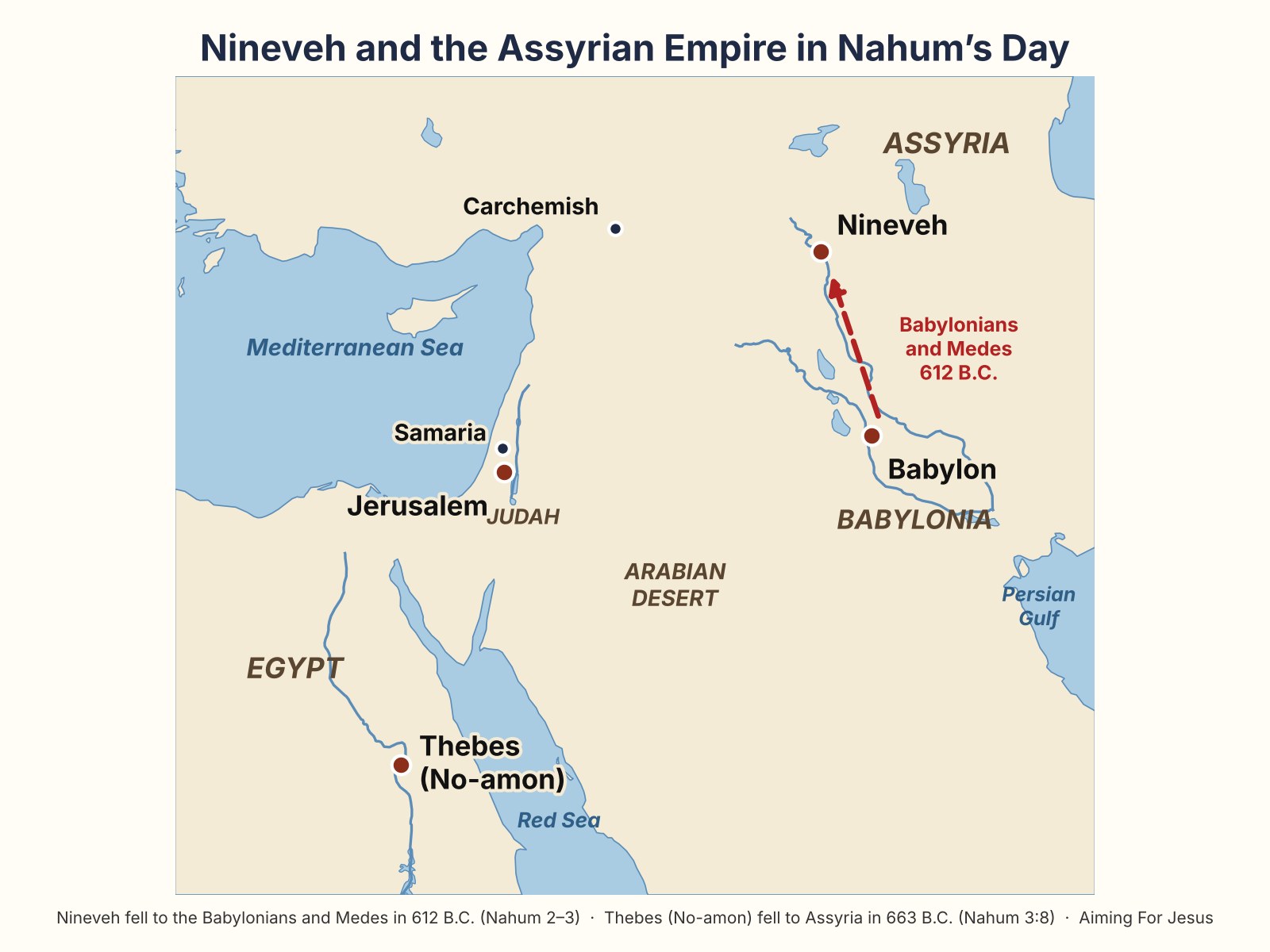
Nahum speaks about Nineveh, the great capital of the Assyrian Empire, on the Tigris River in what is now northern Iraq. Nineveh was huge, with walls about eight miles around, palaces, gardens, and a library of thousands of clay tablets. Assyria had destroyed the northern kingdom of Israel in 722 B.C. and had invaded Judah in 701 B.C. In 3:8 Nahum points to Thebes (No-amon), the great city of Egypt on the Nile, which Assyria itself had destroyed in 663 B.C.
Nahum among the Old Testament books
Genesis · Exodus · Leviticus · Numbers · Deuteronomy · Joshua · Judges · Ruth · 1 Samuel · 2 Samuel · 1 Kings · 2 Kings · 1 Chronicles · 2 Chronicles · Ezra · Nehemiah · Esther · Job · Psalms · Proverbs · Ecclesiastes · Song of Solomon · Isaiah · Jeremiah · Lamentations · Ezekiel · Daniel · Hosea · Joel · Amos · Obadiah · Jonah · Micah · Nahum · Habakkuk · Zephaniah · Haggai · Zechariah · Malachi
Nahum is the 34th of the 39 books of the Old Testament and the seventh of the twelve Minor Prophets. It is the other half of the story of Jonah. About a hundred years earlier, Jonah preached to Nineveh and the city repented, and God spared it. By Nahum’s day Nineveh had gone back to its cruelty. God’s patience had a limit. Zephaniah also foretold Nineveh’s fall (Zephaniah 2:13–15).
When it was written
Nahum speaks of the fall of Thebes as something already past (3:8), and that happened in 663 B.C. He speaks of Nineveh’s fall as still to come, and that happened in 612 B.C. So the book was written between those dates, likely during the reign of wicked King Manasseh in Judah. Dr. Constable places it most likely between 663 and 654 B.C., when Assyria still looked unbeatable. That makes the prophecy all the more remarkable.
Meet the book
- One city: Nineveh, capital of Assyria, the terror of the ancient world for more than a century.
- Slow to anger, great in power: “The LORD will by no means clear the guilty” (1:3). Nineveh’s time had run out.
- Fulfilled: In 612 B.C. Nineveh fell so completely that for centuries people didn’t know where it had been.
- Real comfort: “The LORD is good, a stronghold in the day of trouble; He knows those who take refuge in Him” (1:7).
- The safe place: Evil will not have the last word. The one safe place on the day of judgment is the refuge God gives us in Jesus Christ.
The central message The LORD is patient but He will not leave evil unpunished forever; He is good, a stronghold in the day of trouble for those who take refuge in Him, and He will bring down every proud and cruel power that sets itself against Him.
A verse to carry through the study Nahum 1:7 BLB
Find your way
Main teachings
Slow to anger, but He will judge
Nahum 1:2–3; Exodus 34:6–7; 2 Peter 3:9 God’s patience is real. He waited more than a century after Jonah. But His patience is not weakness, and it isn’t forever. He will by no means clear the guilty who refuse Him.
The LORD is good, a stronghold
Nahum 1:7; Psalm 46:1; Proverbs 18:10 In the middle of a book about judgment comes this verse. God is good, and He is a fortress for those who run to Him. He knows them personally.
Good news on the mountains
Nahum 1:15; Isaiah 52:7; Romans 10:15 A messenger runs over the mountains with good news: the enemy is defeated, peace has come. Paul uses the same picture for those who carry the gospel of Jesus.
God opposes the proud and cruel
Nahum 2:13; 3:1–5; James 4:6 “Behold, I am against you,” says the LORD to Nineveh. Assyria built its empire on bloodshed, lies and plunder. No nation or person is too big for God to bring down.
You reap what you sow
Nahum 3:8–10, 19; Galatians 6:7 Assyria destroyed Thebes; now the same would happen to Nineveh. Everyone who heard of Nineveh’s fall would clap their hands, “for upon whom has not come your unceasing evil?”
Comfort for the oppressed
Nahum 1:12–13, 15; Romans 12:19 Nahum means “comfort.” God promises to break the yoke off His people. We don’t have to take revenge; we can leave it to God, who judges rightly.
The other side of Jonah
Jonah 3:10; Jonah 4:2; Nahum 1:3 Jonah shows God’s mercy to a city that repents. Nahum shows God’s justice on the same city when it returns to evil. Both are true of God. Grace is offered; it must not be despised.
Refuge in Christ
Nahum 1:6–7; Romans 5:9; 1 Thessalonians 1:10 “Who can stand before His indignation?” No one, on our own. But Jesus took God’s judgment for all who take refuge in Him. He is our stronghold in the day of trouble.
Praying through Nahum
There is no written prayer in Nahum, but 1:7 has been a prayer for God’s people for ages: “The LORD is good, a stronghold in the day of trouble.”
A good way to pray through Nahum is to bring to God the cruelty and injustice you see in the world, to leave judgment in His hands, and to thank Him that in Christ you have a safe refuge.
The prayers in this book
Nahum 1:7 — A prayer of refuge. Tell the LORD you are running to Him as your stronghold today, and thank Him that He knows you.
Nahum 1:3 — A prayer of trust in God’s justice. Ask God to help you trust Him to set things right in His time, and to keep you from taking revenge.
Nahum 1:15 — A prayer for good news to spread. Pray for those who carry the gospel, and ask God to make your own feet beautiful with the good news of peace in Jesus.
The LORD is good (Nahum 1:7)
Pray it with Nahum 1:7 BLB
Read Nahum
Select a chapter to read it in the ESV in a reading window, right here on this page.
Nahum 1:1–15 Nahum 2:1–13 Nahum 3:1–19
A brief outline
1:1–1:1 The Burden Concerning Nineveh
1:2–1:8 The Jealous and Avenging God, Who Is Good
1:9–1:14 The Yoke Will Be Broken
1:15–2:2 Good News on the Mountains
2:8–2:13 The Lions’ Den Is Empty
Study every verse
Begin with the Scripture, then read the study notes and the passages to read alongside. After each section, pause over the question. Keep 1:7 in mind the whole way through: the LORD is good, a stronghold in the day of trouble.
Commentary offered not as authoritative but as a view of the verse drawn from the scriptures presented, other scriptures, and various commentaries. If these thoughts do not line up with the Word then they must be rejected. It is my belief and prayer they are consistent with the Word and are offered as a simple teaching on the Word and as every teaching on the Word each must be carefully compared with the one true and living Word of God.
Chapter 1 1:1 1:2 1:3 1:4 1:5 1:6 1:7 1:8 1:9 1:10 1:11 1:12 1:13 1:14 1:15
Chapter 2 2:1 2:2 2:3 2:4 2:5 2:6 2:7 2:8 2:9 2:10 2:11 2:12 2:13
Chapter 3 3:1 3:2 3:3 3:4 3:5 3:6 3:7 3:8 3:9 3:10 3:11 3:12 3:13 3:14 3:15 3:16 3:17 3:18 3:19
Chapter 1
The Burden Concerning Nineveh
Nahum 1:1
Read the verse: Nahum 1:1 BLB
Study Notes
A heavy message about Nineveh. The book of the vision of Nahum from Elkosh.
The word for “oracle” here means a burden, a heavy load. Nahum carried a weighty message. Nineveh was the capital of Assyria, the cruelest empire of its day. A hundred years earlier, Jonah had preached there and the city repented. Now God speaks again.
Read alongside Jonah 1:2 BLB; Jonah 3:4–10 BLB; Zephaniah 2:13 BLB
Aiming for Jesus
Know Him
God is patient. He spared Nineveh in Jonah’s day. But His patience is an invitation to turn, not permission to drift back.
Examine your heart
Nineveh once repented under Jonah and was spared, then went back to its old ways. Is there an area of your life where you once turned to God but have slowly drifted back?
The Jealous and Avenging God, Who Is Good
Nahum 1:2
Read the verse: Nahum 1:2 BLB
Study Notes
The LORD is a jealous God who avenges. The LORD takes vengeance and is full of wrath. He takes vengeance on His enemies and keeps His anger for those who oppose Him.
God’s jealousy isn’t petty. It is the right zeal of a husband for his wife, of a Father for His children. He won’t share His people with idols, and He won’t let evil go forever. Vengeance belongs to Him, not to us.
English wording → Hebrew word → meaning
“jealous” → qanno’ → jealous; zealous for what is rightly His BLB
“avenging” → naqam → to take vengeance BLB
Read alongside Exodus 20:5 BLB; Deuteronomy 32:35 BLB; Romans 12:19 BLB
Nahum 1:3
Read the verse: Nahum 1:3 BLB
Study Notes
The LORD is slow to anger and great in power, and He will never leave the guilty unpunished. His way is in the whirlwind and the storm, and the clouds are the dust of His feet.
Here are two truths side by side. God is slow to anger. He waited a long time for Nineveh. But He is also great in power, and He will not clear the guilty who refuse to turn. The storm clouds are just the dust kicked up by His feet.
English wording → Hebrew word → meaning
“slow to anger” → ’erek → long; with ’aph, “nose,” slow to become angry BLB
Read alongside Exodus 34:6–7 BLB; Jonah 4:2 BLB; 2 Peter 3:9 BLB
Nahum 1:4
Read the verse: Nahum 1:4 BLB
Study Notes
He rebukes the sea and dries it up; He makes all the rivers run dry. Bashan and Carmel wither, and the blossoms of Lebanon fade.
God speaks and the sea obeys, as at the Red Sea. Bashan, Carmel and Lebanon were the greenest, richest places in the land. Even they wither when He is angry.
Read alongside Exodus 14:21 BLB; Psalm 106:9 BLB; Matthew 8:26 BLB
Nahum 1:5
Read the verse: Nahum 1:5 BLB
Study Notes
The mountains shake before Him, and the hills melt. The earth heaves before Him, the world and all who live in it.
All creation trembles before its Creator. Nineveh thought it was mighty. Next to God, the mountains themselves are nothing.
Read alongside Micah 1:4 BLB; Psalm 97:5 BLB; Judges 5:4–5 BLB
Nahum 1:6
Read the verse: Nahum 1:6 BLB
Study Notes
Who can stand before His fury? Who can endure the heat of His anger? His wrath pours out like fire, and the rocks are shattered by Him.
The answer is: no one. Not on our own. If God dealt with us as our sins deserve, none of us could stand. That is why we need a Savior. Jesus took the heat of God’s anger in our place.
Read alongside Malachi 3:2 BLB; Revelation 6:17 BLB; Romans 5:9 BLB
Nahum 1:7
Read the verse: Nahum 1:7 BLB
Study Notes
The LORD is good, a safe place in the day of trouble. He knows those who take refuge in Him.
Right in the middle of all this thunder comes a gentle verse. The LORD is good. He is a stronghold, a fortress, when trouble comes. And He knows those who run to Him. He doesn’t just tolerate them; He knows them by name. The same God whose anger shakes mountains is the safest place in the universe for those who trust Him.
English wording → Hebrew word → meaning
“good” → tob → good BLB
“stronghold” → ma‘oz → a fortress, a place of safety BLB
“take refuge” → chasah → to take refuge, to flee for protection BLB
Teacher’s comment — Chuck Swindoll (paraphrase; overview of Nahum, Insight for Living; source)
Swindoll names 1:3 and 1:7 among the key verses. He notes that Nahum continues the story begun in Jonah: Nineveh repented then but later went back to its ways. He teaches that God’s mercy for a time does not cancel His justice, and that when sin and discouragement weigh on us, God is still at work, so we can trust Him when our resolve to do right grows weak.
Read alongside Psalm 46:1 BLB; Proverbs 18:10 BLB; John 10:14 BLB
Nahum 1:8
Read the verse: Nahum 1:8 BLB
Study Notes
But with an overwhelming flood He will make an end of Nineveh, and He will pursue His enemies into darkness.
Some ancient writers said a flood helped break down Nineveh’s walls in 612 B.C. Whether by water or by armies, God made a complete end of the city. For His enemies there is no escape, even into the dark.
Read alongside Nahum 2:6 BLB; Isaiah 8:7–8 BLB; Psalm 139:11–12 BLB
Aiming for Jesus
Seeing Jesus
Jesus is our refuge. In Him we find the stronghold Nahum describes (1:7), and the Lord knows each one who takes refuge in Him.
Pray
“The LORD is good, a stronghold in the day of trouble; He knows those who take refuge in Him.” What trouble do you need to bring into God’s stronghold today?
The Yoke Will Be Broken
Nahum 1:9
Read the verse: Nahum 1:9 BLB
Study Notes
What are you plotting against the LORD? He will make a complete end of it. Trouble will not rise up a second time.
Assyria had plotted against God’s people, and that is plotting against God Himself. God will finish it so completely that it won’t need doing twice.
Read alongside Psalm 2:1–4 BLB; Psalm 33:10 BLB; Isaiah 8:10 BLB
Nahum 1:10
Read the verse: Nahum 1:10 BLB
Study Notes
They are like tangled thorns and like drunkards soaked with drink; they will be burned up like dry stubble.
Thorns, drunkards, dry straw: all easy to burn. Nineveh looked strong, but before God it was kindling.
Read alongside Isaiah 10:17 BLB; Malachi 4:1 BLB; 2 Samuel 23:6–7 BLB
Nahum 1:11
Read the verse: Nahum 1:11 BLB
Study Notes
From you, Nineveh, came one who plotted evil against the LORD, a counselor of wickedness.
This likely points to Sennacherib, the Assyrian king who invaded Judah in 701 B.C., mocked the LORD, and boasted that God couldn’t save Jerusalem (2 Kings 18–19).
Read alongside 2 Kings 18:28–35 BLB; 2 Kings 19:22–23 BLB; Isaiah 10:7 BLB
Nahum 1:12
Read the verse: Nahum 1:12 BLB
Study Notes
This is what the LORD says: Though they are strong and many, they will be cut down and pass away. Though I have afflicted you, Judah, I will afflict you no more.
Now God turns to His own people with comfort. Yes, Assyria was strong and numerous. It didn’t matter. And God says to Judah: I used them to discipline you, but that is over now.
Read alongside Isaiah 10:5–12 BLB; Isaiah 54:7–8 BLB; Lamentations 3:31–33 BLB
Nahum 1:13
Read the verse: Nahum 1:13 BLB
Study Notes
Now I will break his yoke off you and tear your chains apart.
Judah had been paying tribute to Assyria, wearing its yoke like an ox. God promises to break it off. That is what our God does. He sets captives free.
Read alongside Isaiah 9:4 BLB; Isaiah 10:27 BLB; Galatians 5:1 BLB
Nahum 1:14
Read the verse: Nahum 1:14 BLB
Study Notes
The LORD has commanded about you, Nineveh: you will have no more descendants to carry your name. I will cut off the carved and cast idols from the house of your gods. I will make your grave, for you are worthless.
Assyria’s gods couldn’t save it. God would dig its grave. And it happened: within a few years after 612 B.C., Assyria disappeared from history.
Read alongside Isaiah 14:22 BLB; 2 Kings 19:37 BLB; Isaiah 37:38 BLB
Aiming for Jesus
Seeing Jesus
Jesus came to break the yoke of sin and death. “Come to me… and I will give you rest” (Matthew 11:28).
Pray
God promises to break the yoke off His people. What yoke or burden do you need to ask Him to break?
Good News on the Mountains
Nahum 1:15
Read the verse: Nahum 1:15 BLB
Study Notes
Look! On the mountains, the feet of the one who brings good news, who announces peace! Celebrate your festivals, Judah, keep your vows. The wicked will never again invade you; he is completely cut off.
Picture a runner coming over the hills with the news: the enemy is defeated! Isaiah used the same words (Isaiah 52:7), and Paul applies them to everyone who carries the gospel of Jesus (Romans 10:15). The greatest good news is that Jesus has defeated sin, death and the devil.
Read alongside Isaiah 52:7 BLB; Romans 10:15 BLB; Ephesians 6:15 BLB
Chapter 2
Nahum 2:1
Read the verse: Nahum 2:1 BLB
Study Notes
The one who scatters has come up against you, Nineveh. Guard the fortress! Watch the road! Brace yourself! Gather all your strength!
Nahum turns to Nineveh with a mocking call to arms. Get ready, because it won’t help. The “scatterer” is the army God would send: the Babylonians and Medes.
Read alongside Jeremiah 46:3–4 BLB; Joel 3:9–11 BLB; Isaiah 8:9–10 BLB
Nahum 2:2
Read the verse: Nahum 2:2 BLB
Study Notes
For the LORD is restoring the majesty of Jacob, like the majesty of Israel, though plunderers have stripped them and ruined their vines.
Here is why Nineveh must fall: God is restoring His own people. Assyria had stripped Israel bare like a vineyard. God will give back what was taken.
Read alongside Isaiah 60:15 BLB; Joel 2:25 BLB; Amos 9:14 BLB
Aiming for Jesus
Seeing Jesus
Nahum’s “good news” on the mountains (1:15) points ahead to the gospel of peace in Jesus (Romans 10:15).
Examine your heart
God was against Nineveh but for His people (2:2). Paul says, “If God is for us, who can be against us?” (Romans 8:31). How does that change the way you face what is against you?
The Attack on Nineveh
Nahum 2:3
Read the verse: Nahum 2:3 BLB
Study Notes
The shields of his warriors are red; his soldiers are dressed in scarlet. The chariots flash like fire on the day he prepares for battle, and the spears of cypress are brandished.
Nahum paints the attack as if he were standing on the wall watching it. Red shields, scarlet uniforms, flashing chariots. He saw it about fifty years before it happened.
Read alongside Ezekiel 23:14–15 BLB; Jeremiah 46:9 BLB; Isaiah 63:1–3 BLB
Nahum 2:4
Read the verse: Nahum 2:4 BLB
Study Notes
The chariots race madly through the streets; they rush back and forth in the squares. They look like flaming torches and dart about like lightning.
Chaos in the streets of the proud city. The chariots that had terrorized others now terrorize Nineveh.
Read alongside Joel 2:4–5 BLB; Jeremiah 4:13 BLB; Nahum 3:2 BLB
Nahum 2:5
Read the verse: Nahum 2:5 BLB
Study Notes
He calls his officers; they stumble as they go. They hurry to the wall, and the protective shield is put in place.
The defenders of Nineveh scramble, stumbling, to the walls. Too late.
Read alongside Jeremiah 46:6 BLB; Isaiah 5:27 BLB; Psalm 33:16–17 BLB
Nahum 2:6
Read the verse: Nahum 2:6 BLB
Study Notes
The river gates are thrown open, and the palace melts away.
Nineveh had rivers and canals running into the city. The gates that controlled them were opened, by flood or by the enemy, and the palace was overwhelmed. What looked like a strength became the weak spot.
Read alongside Nahum 1:8 BLB; Isaiah 45:1 BLB; Daniel 5:30 BLB
Nahum 2:7
Read the verse: Nahum 2:7 BLB
Study Notes
It is decreed: the city is stripped and carried away. Her servant girls moan like doves and beat on their breasts.
The city’s fate was settled by God. Those inside mourn as the city is stripped.
Read alongside Isaiah 38:14 BLB; Isaiah 47:1–3 BLB; Ezekiel 7:16 BLB
The Lions’ Den Is Empty
Nahum 2:8
Read the verse: Nahum 2:8 BLB
Study Notes
Nineveh is like a pool whose waters are draining away. “Stop! Stop!” they cry, but no one turns back.
A great reservoir springs a leak and everything rushes out. Nineveh’s people and soldiers run away, and no one can stop them.
Read alongside Jeremiah 46:5 BLB; Isaiah 31:3 BLB; Proverbs 28:1 BLB
Nahum 2:9
Read the verse: Nahum 2:9 BLB
Study Notes
Take the silver! Take the gold! There is no end of treasure, an abundance of every precious thing.
Assyria had filled its treasury by robbing other nations. Now it would be robbed. What we take from others doesn’t stay with us.
Read alongside Habakkuk 2:6–8 BLB; Isaiah 33:1 BLB; James 5:1–3 BLB
Nahum 2:10
Read the verse: Nahum 2:10 BLB
Study Notes
Empty! Emptied! Stripped! Hearts melt and knees knock, every body trembles, and every face turns pale.
In Hebrew, the first three words sound almost alike, like an echo of something hollow. The once-proud city is empty, and its people shake with fear.
Read alongside Isaiah 13:7–8 BLB; Joel 2:6 BLB; Daniel 5:6 BLB
Nahum 2:11
Read the verse: Nahum 2:11 BLB
Study Notes
Where is the lions’ den now, the feeding place of the young lions, where the lion and lioness went with their cubs and no one made them afraid?
The lion was a symbol of Assyria; its kings carved great lions on their palaces. Nineveh was the lions’ den where they brought their prey. Now God asks, “Where is it?” Gone.
Read alongside Ezekiel 19:2–9 BLB; Jeremiah 50:17 BLB; Psalm 34:10 BLB
Nahum 2:12
Read the verse: Nahum 2:12 BLB
Study Notes
The lion tore enough for his cubs and strangled prey for his lionesses. He filled his caves with prey and his dens with torn flesh.
Assyria fed on the nations it conquered, like a lion filling its den with kills. History records their cruelty in their own carvings.
Read alongside Isaiah 5:29 BLB; Jeremiah 4:7 BLB; 1 Peter 5:8 BLB
Nahum 2:13
Read the verse: Nahum 2:13 BLB
Study Notes
“Look, I am against you,” declares the LORD of hosts. I will burn up your chariots in smoke, and the sword will devour your young lions. I will cut off your prey from the earth, and the voice of your messengers will never be heard again.
Here is the most frightening sentence a nation can hear: “Behold, I am against you.” The LORD of hosts, the Commander of heaven’s armies, has spoken. Assyria’s messengers had once shouted threats at Jerusalem’s walls (2 Kings 18:17–35). Their voice would be silenced forever.
Read alongside 2 Kings 18:17–35 BLB; Ezekiel 5:8 BLB; Romans 8:31 BLB
Aiming for Jesus
Remember whose you are
We belong to the One who used His strength to serve, not to take. In Christ, power is for lifting others up.
Examine your heart
Assyria fed on others like a lion. Is there any way you use your strength, position or words to take from others instead of serving them?
Chapter 3
Woe to the City of Blood
Nahum 3:1
Read the verse: Nahum 3:1 BLB
Study Notes
Woe to the city of blood, full of lies and plunder, never letting go of its victims!
Nahum names Nineveh’s sins: bloodshed, deceit and robbery. Its own records bragged of piling up skulls and skinning enemies alive. God had seen it all.
Read alongside Ezekiel 22:2–3 BLB; Habakkuk 2:12 BLB; Ezekiel 24:6–9 BLB
Nahum 3:2
Read the verse: Nahum 3:2 BLB
Study Notes
The crack of the whip, the rumble of wheels, galloping horses and bouncing chariots!
Nahum writes in short bursts, like flashes of the battle. You can almost hear it.
Read alongside Jeremiah 47:3 BLB; Job 39:19–25 BLB; Judges 5:22 BLB
Nahum 3:3
Read the verse: Nahum 3:3 BLB
Study Notes
Horsemen charging, flashing swords, glittering spears, heaps of the dead, piles of bodies without end; they stumble over the corpses.
Nineveh had made heaps of dead in other lands. Now the heaps were in its own streets. This is a sobering picture of what sin finally brings.
Read alongside Isaiah 34:3 BLB; Ezekiel 39:11–12 BLB; Revelation 19:17–18 BLB
Nahum 3:4
Read the verse: Nahum 3:4 BLB
Study Notes
All because of the many sins of the prostitute, so charming, the mistress of sorceries, who sells nations with her seductions and peoples with her witchcraft.
Nineveh is pictured as a seductive woman who lured nations in with her charm and then enslaved them. Evil often looks attractive at first. Revelation uses a similar picture for Babylon the great.
Read alongside Isaiah 47:9–12 BLB; Revelation 17:1–5 BLB; Revelation 18:23 BLB
Nahum 3:5
Read the verse: Nahum 3:5 BLB
Study Notes
“Look, I am against you,” declares the LORD of hosts. I will lift your skirts over your face and show the nations your nakedness and the kingdoms your shame.
Again, the terrible words, “I am against you.” Nineveh would be publicly shamed in front of the nations it had humiliated.
Read alongside Isaiah 47:2–3 BLB; Jeremiah 13:22–26 BLB; Ezekiel 16:37 BLB
Nahum 3:6
Read the verse: Nahum 3:6 BLB
Study Notes
I will throw filth on you, treat you with contempt, and make you a spectacle.
The proud city would become a public disgrace.
Read alongside Malachi 2:9 BLB; 1 Corinthians 4:9 BLB; Jeremiah 51:37 BLB
Nahum 3:7
Read the verse: Nahum 3:7 BLB
Study Notes
Everyone who sees you will run from you and say, ‘Nineveh is ruined! Who will mourn for her?’ Where can I find anyone to comfort you?
No one would grieve for Nineveh. Remember, Nahum’s name means “comfort.” God’s people would receive comfort, but there would be no one to comfort Nineveh.
Read alongside Isaiah 51:19 BLB; Jeremiah 15:5 BLB; Lamentations 1:2 BLB
Aiming for Jesus
Know Him
No city, empire or problem is too big for God. Nineveh fell exactly as He said.
Examine your heart
Nineveh seemed too big to fall, but God brought it down. Is there any “Nineveh” in the world, or in your own life, that seems too big for God to handle? What does Nahum teach you about that?
No Better Than Thebes
Nahum 3:8
Read the verse: Nahum 3:8 BLB
Study Notes
Are you better than Thebes, which sat by the Nile, with water all around her, the river her rampart and the waters her wall?
Thebes (called No-amon) was the great city of Egypt, protected by the Nile. Assyria itself had destroyed it in 663 B.C. Nahum asks: if your army could destroy Thebes, why do you think you can’t be destroyed?
Read alongside Jeremiah 46:25 BLB; Ezekiel 30:14–16 BLB; Isaiah 19:5–8 BLB
Nahum 3:9
Read the verse: Nahum 3:9 BLB
Study Notes
Cush and Egypt were her endless strength; Put and the Libyans were her helpers.
Thebes had powerful allies all around it. It didn’t matter.
Read alongside Isaiah 20:5–6 BLB; Jeremiah 46:9 BLB; Ezekiel 30:5 BLB
Nahum 3:10
Read the verse: Nahum 3:10 BLB
Study Notes
Yet she went into exile; she was taken captive. Her infants were dashed to pieces at every street corner. Lots were cast for her nobles, and all her great men were bound in chains.
This is what Assyria did to Thebes. Now Nineveh would reap what it had sown. Galatians says it plainly: whatever one sows, that will he also reap.
Read alongside Galatians 6:7 BLB; Obadiah 15 BLB; Psalm 137:8–9 BLB
Nahum 3:11
Read the verse: Nahum 3:11 BLB
Study Notes
You too will become drunk; you will go into hiding. You too will look for a refuge from the enemy.
Nineveh would stagger like a drunk and look for somewhere to hide. There is only one true refuge, and Nineveh had rejected Him (1:7).
Read alongside Jeremiah 25:15–27 BLB; Isaiah 51:17 BLB; Nahum 1:7 BLB
Nahum 3:12
Read the verse: Nahum 3:12 BLB
Study Notes
All your fortresses are like fig trees with first-ripe figs. If they are shaken, they fall into the mouth of the eater.
Ripe figs drop at the slightest shake. Nineveh’s great forts would fall just as easily.
Read alongside Isaiah 28:4 BLB; Revelation 6:13 BLB; Amos 8:1–2 BLB
Nahum 3:13
Read the verse: Nahum 3:13 BLB
Study Notes
Look at your troops: they are like women in your midst. The gates of your land are wide open to your enemies; fire has consumed the bars of your gates.
The mighty Assyrian army would lose its nerve. The gates would stand wide open.
Read alongside Jeremiah 50:37 BLB; Jeremiah 51:30 BLB; Isaiah 45:1–2 BLB
Nahum 3:14
Read the verse: Nahum 3:14 BLB
Study Notes
Draw water for the siege! Strengthen your forts! Go into the clay and tread the mortar; take hold of the brick mold!
Again Nahum mocks: go ahead, prepare for the siege, make more bricks. It won’t matter.
Read alongside Isaiah 22:8–11 BLB; 2 Chronicles 32:3–5 BLB; Psalm 127:1 BLB
Nahum 3:15
Read the verse: Nahum 3:15 BLB
Study Notes
There the fire will devour you, the sword will cut you down. It will eat you up like the locust. Multiply like the locust! Multiply like the grasshopper!
Archaeologists found ash layers in Nineveh from the fire of 612 B.C. However many soldiers Nineveh could gather, like a swarm of locusts, it wouldn’t be enough.
Read alongside Joel 1:4 BLB; Joel 2:25 BLB; Jeremiah 51:14 BLB
Nahum 3:16
Read the verse: Nahum 3:16 BLB
Study Notes
You have increased your merchants more than the stars of the sky. The locust strips the land and flies away.
Nineveh was a great center of trade. But its merchants would scatter like locusts that eat and fly off.
Read alongside Ezekiel 27:12–25 BLB; Revelation 18:11–17 BLB; Proverbs 23:5 BLB
Nahum 3:17
Read the verse: Nahum 3:17 BLB
Study Notes
Your guards are like locusts, your officials like swarms of grasshoppers settling on the walls on a cold day. When the sun rises, they fly away, and no one knows where they are.
Locusts huddle on a wall when it is cold, then vanish when the sun warms them. Nineveh’s officials would disappear the same way when trouble came.
Read alongside Jeremiah 51:30 BLB; Isaiah 33:4 BLB; Psalm 37:10 BLB
Nahum 3:18
Read the verse: Nahum 3:18 BLB
Study Notes
Your shepherds are asleep, king of Assyria; your nobles lie down to rest. Your people are scattered on the mountains, with no one to gather them.
The “shepherds” are the rulers. They are asleep, perhaps in death. The people are scattered like sheep with no one to gather them. How different from our Shepherd, who gathers His scattered sheep (Micah 2:12).
Read alongside 1 Kings 22:17 BLB; Psalm 76:5–6 BLB; Ezekiel 34:5–6 BLB
Nahum 3:19
Read the verse: Nahum 3:19 BLB
Study Notes
Nothing can heal your wound; your injury is fatal. Everyone who hears the news about you claps their hands at your fall, for who has not felt your endless cruelty?
The book ends with a question. Who has not suffered from Nineveh’s cruelty? No one. So the whole world would clap at its fall. It is a sobering reminder that God sees every act of cruelty, and that evil, however big, will not last. Notice the book of Jonah also ends with a question, about God’s mercy to Nineveh (Jonah 4:11). Together the two books show God’s mercy and His justice.
Read alongside Jonah 4:11 BLB; Jeremiah 30:12–15 BLB; Lamentations 2:15 BLB
Aiming for Jesus
Seeing Jesus
At the cross, God’s justice and mercy meet. Jesus bore the judgment sin deserves so that we could receive mercy.
Walk with Him today
Nahum and Jonah are about the same city. One shows God’s mercy when Nineveh repented, the other God’s justice when it returned to evil. How does seeing both sides of God help you understand the cross of Jesus?
Source notes
Prepared for Aiming For Jesus by Hollis McGehee. The background, outline and much of the understanding in this study are based on the teaching of Dr. Thomas L. Constable, Notes on Nahum (2026 edition, © Thomas L. Constable), available free at www.soniclight.com. The study notes are written in plain words and are not his text; for his full teaching and sources, please read his notes.
Scripture is distinguished from commentary throughout.
Hebrew word notes give the common meaning of the word as found in standard Hebrew dictionaries; each has a BLB button that opens the word in Blue Letter Bible so the reader can check it. Teacher’s comments are paraphrases, not quotations, of Chuck Swindoll, each with a link to its source, so the reader can read the teacher’s own words.
Scripture quotations are from the ESV® Bible (The Holy Bible, English Standard Version®), copyright © 2001 by Crossway, a publishing ministry of Good News Publishers. Used by permission. All rights reserved.
Verses to memorize
Begin with one selection. Read its surrounding passage, say the words aloud, and return to them during the day. For a longer selection, learn one verse at a time and then join the verses together.
A stronghold in the day of trouble
Nahum 1:7 BLB
Slow to anger, great in power
Nahum 1:3 BLB
The feet of him who brings good news
Nahum 1:15 BLB
Who can stand?
Nahum 1:6 BLB