Philemon — A Complete Review
Grace That Changes the Way We Receive One Another
Prepared for Hollis McGehee · Verse by verse
Select a Scripture reference to open the ESV reading window. BLB opens Blue Letter Bible.
Before you begin: BibleProject’s Philemon guide
A helpful overview of partnership and transformed relationships. Its account of flight and wrongdoing reconstructs details the letter leaves unstated; its interpretation that Paul asks for emancipation is stronger than the explicit wording. Read with the distinctions noted in this review.

Just want to read Philemon?
Choose a chapter to read the Scripture without leaving this page.
Meet the book
Philemon is a short letter with a deeply personal question: what happens when the grace we believe must change the way we treat a particular person? Paul writes from prison about Onesimus, now his beloved child in the faith. He asks Philemon to receive him as a brother and to welcome him as he would welcome Paul. We will read all 25 verses, keeping the people, the appeal, and the gospel together. The question is not only what Philemon should do. It is what needs to change in us because we belong to Jesus.
Find your way
Background and setting
Author and date
The letter identifies Paul as its author and includes Timothy in the greeting. Paul writes as a prisoner for Christ. Rome around AD 60–62 is the traditional setting; imprisonment in Ephesus or Caesarea has also been proposed. The letter itself does not name the prison city or give a date.
The people and the place
Philemon is a Christian coworker whose home hosts a church. Apphia and Archippus are also addressed. The connection with Colossae is strong: Colossians 4:9 calls Onesimus one of the Colossians, and several other names appear in both letters. Colossae was in the Lycus Valley in what is now western Türkiye, near modern Honaz. The letter does not directly name Philemon’s town.
What happened before the letter?
Onesimus had been separated from Philemon, met Paul, and became a Christian through Paul’s ministry. He was enslaved, and Paul is sending him back with this appeal. The familiar account of a runaway who stole money is a possible reconstruction, not the complete story stated by Paul. Verse 18 refers conditionally to wrong or debt. We can understand the appeal without filling every gap.
A personal letter with a church-wide concern
Paul addresses one principal recipient, yet includes the household congregation. How a believer treats another believer is not detached from the church’s witness. This is a carefully reasoned appeal for a transformed relationship, not a general legal code about slavery.
Philemon in the New Testament
Usual order of the 27 New Testament books, not the order in which they were written. Philemon is book 18.
Places and what we know
Paul writes as a prisoner, but he does not name his prison city. Rome is the traditional setting. An imprisonment in Ephesus or Caesarea has also been proposed. The note should not become more certain than the letter.
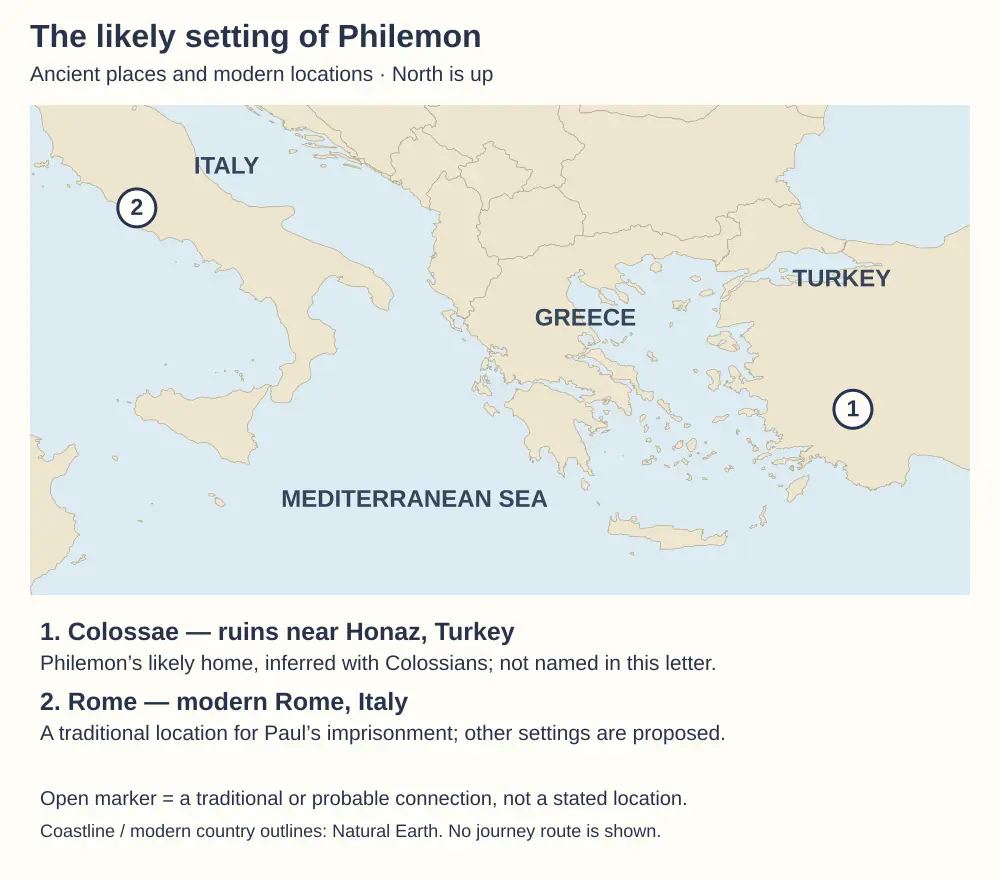
Colossae is the likely home of Philemon and his household church. The connection comes from comparing the people named here with Colossians 4:9, 12, and 17. Its ruins lie near modern Honaz, in the Denizli region of Turkey. Colossae is an ancient site near Honaz, not simply another name for the modern town.
Geography: Biblical Archaeology Society: Where Is Biblical Colossae?. Traditional letter setting: ESV introduction to Philemon. Base geography: Natural Earth, public domain. Modern borders are shown for orientation, not as first-century boundaries.
Main teachings
Grace makes people family
The letter begins with family and partnership language. Paul, Timothy, Philemon, Apphia, Archippus, and the congregation belong to the same Lord. Before a difficult appeal is made, they are reminded of the grace and peace they receive from God. Our treatment of other Christians must begin with who they are in Christ, not with their usefulness or social standing.
Faith becomes visible through love
Philemon is already known for refreshing other believers. Paul prays for shared faith to become effective in lived fellowship. This is more than agreeing with true statements. What we believe about Jesus must reach into the relationships in front of us. The person we would rather keep at a distance may be the very person who tests whether our profession is becoming practice.
Love seeks willing obedience
Paul says he could command what is fitting, but in Philemon 1:8–9 he chooses to appeal on the basis of love. Verse 14 makes his purpose clear: he wants a willing response, not one forced by his position. This does not mean Paul lacks authority or that doing right is optional. He wants Philemon’s heart and actions to agree. Christian leaders should seek willing obedience to Jesus rather than rely on pressure to get their way.
A brother is more than a social label
In Philemon 1:15–17, Paul asks Philemon to receive Onesimus as a beloved brother and welcome him as he would welcome Paul himself. This calls for a changed relationship in daily life as well as in the fellowship of believers. Scholars differ over whether Paul also expects legal emancipation, but the letter does not report either a completed reconciliation or Onesimus’s release. We must not supply an ending it does not give. Nor should we soften slavery into a harmless arrangement or suggest that kindness is a substitute for freedom. The letter cannot justify racial slavery or make ownership of a human being a Christian ideal. Compare the welcome Christ gives His people in Romans 15:7 and the accountability of masters to God in Colossians 4:1.
Reconciliation may cost something
Paul makes a concrete offer in Philemon 1:18–19: if Onesimus has caused a wrong or owes a debt, Paul will take responsibility and repay it. The conditional wording does not tell us exactly what happened, and the letter does not say that a payment was later made. Paul offers more than advice; he is willing to bear a cost to help bring these people together. This can illustrate costly grace without making Paul’s offer another saving sacrifice. Jesus’ work is unique. Seeking reconciliation must include truth, justice, and care for the person at risk, not a demand to overlook harm.
God can redeem a painful history
Paul says perhaps when he considers the purpose of the separation. We may recognize the good God brings without claiming to know everything He was doing. Providence does not turn wrongdoing into righteousness. It gives us reason to hope that failure and loss need not have the last word.
The church needs grace to live this way
Paul ends with confidence, prayer, plans for hospitality, and the grace of Jesus. This is not a lesson in trying harder on our own. The Lord who brings people into His family supplies what they need to honor one another within it. The letter leaves the outcome unreported, but it does not leave the appeal unclear. His confidence in verse 21 is an expectation, not evidence that reconciliation or emancipation later occurred.
A prayer shaped by Philemon
Father, thank You for receiving us through Jesus Christ. Forgive us when we gladly receive Your grace but hesitate to extend love to another person. Keep us from reducing anyone to a past failure, a social position, or what they can do for us. Give us honest hearts, willing obedience, and courage to make things right where we can. Help us protect the vulnerable and seek reconciliation without hiding wrong. Teach us to welcome our brothers and sisters as people You love. Let our homes and our church refresh those who are weary. We cannot do this in our own strength. May the grace of the Lord Jesus Christ be with us. Amen.
Find a topic
Prayer and thanksgiving
Philemon 1:4–7; Philemon 1:22
Partnership in Christ
Philemon 1:6; Philemon 1:17
Love and willing obedience
Philemon 1:8–14; Philemon 1:21
New life and changed relationships
Philemon 1:10–17
Slavery, dignity, and brotherhood
Philemon 1:15–17
Forgiveness and practical repair
Philemon 1:18–20
Hospitality and church life
Philemon 1:2; Philemon 1:22–25
Follow the argument
The grace of Jesus creates a family, and life in that family must reshape a damaged relationship.
Philemon 1:1–3 — A greeting rooted in shared life in Christ
Philemon 1:4–7 — Thanksgiving for love that already refreshes believers
Philemon 1:8–14 — An appeal for Onesimus and a willing response
Philemon 1:15–17 — Receive him as a beloved brother and partner
Philemon 1:18–20 — An offer to bear the cost and a call to refresh Paul’s heart
Philemon 1:21–25 — Confidence, a hoped-for visit, and sustaining grace
Reading Philemon carefully
Read the whole letter before drawing an application from a single sentence. Paul’s authority, tender appeal, offer of repayment, and demand for brotherly welcome all belong together.
The ESV uses bondservant in verse 16, but the situation involves slavery, not an ordinary modern employment arrangement. Roman slavery had different forms, yet those differences do not erase coercion or make ownership of people morally harmless.
Do not use Paul’s sending of Onesimus as a command that an abused person must return to danger. Forgiveness does not cancel accountability, lawful protection, or wise boundaries. The letter aims at reception as a beloved brother, not permission for further harm.
The letter does not say exactly why Onesimus left, how he met Paul, or how Philemon responded. It also does not give an explicit legal emancipation order. Distinguish what the text states from what a teacher infers.
Paul’s offer to bear a debt can illustrate costly reconciliation. It is not itself Christ’s atonement, and Philemon is not an allegory in which every person and detail has a hidden counterpart.
Read each instruction inside its paragraph and the letter as a whole. Who is speaking, to whom, and why? Let Scripture correct our assumptions rather than making a verse say what we want.
Study every verse
Read the verse and its paragraph before the note. These original study notes help you follow the message; they do not replace Scripture.
Each entry includes two related passages and selected Greek word helps. English wording → Greek lemma and transliteration → meaning in this setting. A word does not carry every dictionary meaning into every verse.
Living the Word: James 1:22 calls us to be doers, not hearers only. Selected passages ask what we should obey, turn from, or trust. Our response is to God’s grace, not a way to purchase it.
Chapter 1 — Receive him as a beloved brother
Philemon 1:1–25 · Greek interlinear
Philemon 1:1
Read the verse: Philemon 1:1 BLB
Study notes
Paul begins as a prisoner for Christ, not by emphasizing his rank as an apostle. He includes Timothy and calls Philemon a beloved coworker. This is an appeal within the family of faith, not a detached legal instruction. Paul's confinement has not stopped his care for other people.
English wording → Greek word → meaning
- “prisoner” → δέσμιος (desmios) → a person held in confinement; Paul understands his imprisonment in relation to Christ
Read alongside
Ephesians 3:1 BLB — Paul similarly describes his imprisonment in terms of belonging to Christ and serving others.
2 Timothy 2:8–9 BLB — The messenger may be chained, but God's word is not imprisoned.
Philemon 1:2
Read the verse: Philemon 1:2 BLB
Study notes
The letter also addresses Apphia, Archippus, and the congregation meeting in Philemon's home. A personal relationship has consequences for the church. Apphia may have been Philemon's wife, and Archippus may have belonged to his household, but the letter does not identify those family connections. We should not present a reasonable guess as a stated fact.
English wording → Greek word → meaning
- “church” → ἐκκλησία (ekklēsia) → the gathered community of believers, here meeting in a home
Teacher’s comment — Charles H. Spurgeon (paraphrase, source)
Spurgeon emphasizes that the church is the gathered people of God, not the building, and encourages believers to use their homes for prayer and worship.
Read alongside
Romans 16:3–5 BLB — Priscilla and Aquila also hosted a congregation in their home.
Colossians 4:17 BLB — Archippus is charged to fulfill his ministry; this helps connect the letter with the Colossian setting.
Philemon 1:3
Read the verse: Philemon 1:3 BLB
Study notes
Grace and peace come from God our Father and the Lord Jesus Christ. Paul does not begin with what Philemon must give up, but with what God gives. The grace that brought these believers into one family is also the help they need to live as that family.
English wording → Greek word → meaning
- “peace” → εἰρήνη (eirēnē) → peace or well-being; here the blessing Paul asks God to give the believers
Read alongside
Romans 5:1–2 BLB — Peace with God and access to grace come through Jesus Christ.
Ephesians 2:14–18 BLB — Christ creates peace and gives believers access to the Father together.
Philemon 1:4
Read the verse: Philemon 1:4 BLB
Study notes
Before making his difficult request, Paul thanks God for Philemon and remembers him in prayer. His gratitude is not empty flattery: the following verses identify love that has already helped people. Correction and appeals can begin by honestly recognizing God's work in someone.
English wording → Greek word → meaning
- “thank” → εὐχαριστέω (eucharisteō) → to express gratitude; here Paul thanks God for Philemon
Read alongside
Philippians 1:3–5 BLB — Paul thanks God for believers whose partnership in the gospel has encouraged him.
1 Thessalonians 1:2–3 BLB — Thanksgiving names the faith, love, and hope visible in other believers.
Philemon 1:5
Read the verse: Philemon 1:5 BLB
Study notes
Philemon's trust in the Lord Jesus shows itself in love toward God's people. The sentence links faith and love closely; Paul is not asking for a new religion but for a response consistent with the faith Philemon already professes. The coming appeal will test how wide that love really reaches.
English wording → Greek word → meaning
- “saints” → ἅγιος (hagios) → holy or set apart; the plural here names God's people, not a special class of exceptional Christians
Read alongside
Galatians 5:6 BLB — Faith expresses itself through love rather than remaining a merely verbal profession.
1 John 4:20–21 BLB — Love for God cannot be separated from love for one's brother.
Philemon 1:6
Read the verse: Philemon 1:6 BLB
Study notes
The sharing of faith here includes the fellowship and partnership believers have in Christ, not only telling someone how to be saved. Paul prays that this shared life will become effective as Philemon recognizes the good Christ has given His people. Verse 17 will make this practical: partnership with Paul must affect the way Onesimus is received.
English wording → Greek word → meaning
- “sharing” → κοινωνία (koinōnia) → participation or fellowship; here shared life and partnership arising from faith
Read alongside
Philippians 1:5 BLB — Partnership in the gospel involves people participating together in its work.
1 Corinthians 10:16–17 BLB — Participation in Christ binds believers together as one body.
Philemon 1:7
Read the verse: Philemon 1:7 BLB
Study notes
Philemon has brought relief and encouragement to other Christians, and Paul has taken joy in that love. The language about refreshed hearts returns in verse 20. Paul will ask him to extend to this particular brother the care he has already shown to many others.
English wording → Greek word → meaning
- “refreshed” → ἀναπαύω (anapauō) → to give rest or relief; here the encouragement believers have received through Philemon
Read alongside
1 Corinthians 16:17–18 BLB — Faithful believers can refresh the spirits of others through their presence and service.
2 Corinthians 7:13 BLB — Titus was refreshed by the Corinthians, showing the personal effect of a church's response.
Philemon 1:8
Read the verse: Philemon 1:8 BLB
Study notes
Paul has authority in Christ to tell Philemon what is fitting. His decision to appeal does not mean the moral issue is optional or unimportant. It shows how he wants the right response to arise: not from his rank alone, but from love shaped by Christ. Read verses 8–9 together: Paul contrasts what he could command with the loving appeal he chooses to make. We should not confuse his restraint with an absence of authority.
English wording → Greek word → meaning
- “command” → ἐπιτάσσω (epitassō) → to order or direct someone to act
Read alongside
2 Corinthians 10:8 BLB — The Lord gives apostolic authority for building people up, not destroying them.
1 Thessalonians 2:6–8 BLB — Paul describes ministry that refuses self-importance and treats believers with affection.
Philemon 1:9
Read the verse: Philemon 1:9 BLB
Study notes
Paul chooses an appeal for love's sake, identifying himself as an old man and a prisoner for Christ. These circumstances give the appeal personal weight without changing its substance. Christian leadership should seek willing obedience to the Lord, not merely compliance produced by intimidation. Verse 14 explains the aim: Philemon’s goodness should be willing rather than compelled. Paul is asking love to become action toward Onesimus, not merely a warm feeling about him.
English wording → Greek word → meaning
- “appeal” → παρακαλέω (parakaleō) → to urge or entreat; here Paul makes a personal request instead of issuing an order
Read alongside
2 Corinthians 8:8–9 BLB — Paul appeals to genuine love and to Christ's generosity rather than issuing a bare command.
1 Peter 5:2–3 BLB — Shepherds should lead willingly and by example rather than domineering over people.
Philemon 1:10
Read the verse: Philemon 1:10 BLB
Study notes
Onesimus is now introduced as Paul's child in the faith. Paul became his spiritual father during imprisonment, meaning that Onesimus came to faith through his ministry. The letter does not explain exactly how they met. Before Philemon hears what to do, he must see the person he is being asked to receive.
English wording → Greek word → meaning
- “child” → τέκνον (teknon) → a child; here a spiritual family relationship formed through the gospel
Read alongside
1 Corinthians 4:15 BLB — Paul describes becoming a spiritual father through preaching the gospel.
Colossians 4:9 BLB — Onesimus is identified as a faithful, beloved brother associated with the Colossians.
Philemon 1:11
Read the verse: Philemon 1:11 BLB
Study notes
Paul plays on the name Onesimus, which carries the sense of useful or beneficial. His former usefulness to Philemon is contrasted with his present service to both men. This is not a statement that an enslaved person's worth depends on productivity. The point is the change God has brought into Onesimus's life and relationships.
English wording → Greek word → meaning
- “useful” → εὔχρηστος (euchrēstos) → helpful or serviceable; describing Onesimus's present service, not the measure of his human worth
Read alongside
2 Corinthians 5:17 BLB — Belonging to Christ brings new creation, not merely a new label.
2 Timothy 2:21 BLB — God prepares His people for useful service and good work.
Philemon 1:12
Read the verse: Philemon 1:12 BLB
Study notes
Paul sends Onesimus back with an unusually tender description: receiving this man means receiving someone Paul deeply loves. The letter's aim is his welcome as a brother, not the preservation of a master's unchecked power. This historical action must not be turned into a rule that endangered people must return to abusive situations.
English wording → Greek word → meaning
- “heart” → σπλάγχνον (splanchnon; plural splanchna) → literally inward parts; the plural here expresses deep personal affection
Read alongside
Philippians 1:8 BLB — Paul uses the language of deep affection to describe his longing for believers.
Romans 12:10 BLB — Believers are to show family affection and honor to one another.
Philemon 1:13
Read the verse: Philemon 1:13 BLB
Study notes
Paul would welcome Onesimus's continuing help while he is confined because of the gospel. He sees that help as something Philemon himself could share in through Onesimus. Service is being reframed as participation in the gospel, yet Paul does not quietly settle the matter without addressing the broken relationship.
English wording → Greek word → meaning
- “serve” → διακονέω (diakoneō) → to minister or provide practical help; here caring for Paul during imprisonment
Read alongside
Philippians 2:25–30 BLB — Epaphroditus represents his church by serving Paul's needs at personal cost.
Hebrews 13:3 BLB — Christians are called to remember prisoners with compassionate solidarity.
Philemon 1:14
Read the verse: Philemon 1:14 BLB
Study notes
Paul refuses to secure a good outcome by bypassing Philemon's willing consent. He wants goodness that is freely offered, not extracted. The verse is addressed to this concrete request; it is not permission for a powerful person to withhold justice until he feels generous.
English wording → Greek word → meaning
- “compulsion” → ἀνάγκη (anankē) → constraint or necessity; here pressure that would make Philemon's action unwilling
Read alongside
2 Corinthians 9:7 BLB — Giving should be willing rather than reluctant or compelled.
1 Peter 5:2 BLB — Willing service is contrasted with service performed under compulsion.
Philemon 1:15
Read the verse: Philemon 1:15 BLB
Study notes
Paul cautiously considers God's providence in the separation: perhaps a temporary loss has become the occasion for an enduring brotherhood. He does not pretend to know every hidden purpose of God, and he does not call wrongdoing good. God's ability to redeem a painful history is not an excuse for the harm within it. Paul’s hope for an enduring relationship is not a report that reconciliation has already taken place.
English wording → Greek word → meaning
- “perhaps” → τάχα (tacha) → possibly or perhaps; a deliberate qualification rather than a claim of certainty
Read alongside
Genesis 50:20 BLB — God can bring good from what human beings intended for evil without declaring their evil good.
Romans 8:28 BLB — God works for the good of those who love Him; this does not make every event morally good.
Philemon 1:16
Read the verse: Philemon 1:16 BLB
Study notes
The central request is a changed relationship: Onesimus must be received as a beloved brother, not reduced to his enslaved status. Brotherhood matters in everyday life as well as in the Lord. Whether Paul also expects legal emancipation is debated; he gives no explicit manumission formula. What is unmistakable is that Onesimus cannot be treated as less worthy of love and honor. This letter is no warrant for racial slavery, trafficking, or treating people as property. Brotherhood must not be used to make slavery seem harmless or to suggest that a kind master makes freedom unnecessary. The letter does not tell us whether Onesimus was legally freed or how Philemon received him.
English wording → Greek word → meaning
- “brother” → ἀδελφός (adelphos) → a brother; here shared membership in God's family through Christ
Teacher’s comment — John Piper (paraphrase, source)
Piper argues that the letter undermines slavery by placing Onesimus within the family of God and requiring Philemon to receive him with the love and honor due a brother.
Read alongside
Galatians 3:26–29 BLB — Slave and free share the same standing as God's children and heirs through faith in Christ.
Colossians 4:1 BLB — Masters are accountable to a Master in heaven and are commanded to act justly and fairly.
Philemon 1:17
Read the verse: Philemon 1:17 BLB
Study notes
Paul now places his own relationship with Philemon behind Onesimus: the welcome given to this brother should match the welcome Paul himself would receive. Partnership becomes visible in hospitality and honor. The appeal presses beyond avoiding punishment to positively receiving the person. This is an appeal for welcome, not a narrative of a welcome already given. Romans 15:7 gives the wider Christian pattern: receive one another in light of Christ’s welcome.
English wording → Greek word → meaning
- “receive” → προσλαμβάνω (proslambanō) → to welcome or take to oneself; here accepting Onesimus as Philemon would accept Paul
Read alongside
Romans 15:7 BLB — Christ's welcome becomes the pattern for believers welcoming one another.
James 2:1–4 BLB — Favoritism based on social standing contradicts faith in the Lord Jesus.
Philemon 1:18
Read the verse: Philemon 1:18 BLB
Study notes
Paul offers to take responsibility for any wrong or debt. The conditional wording does not give us the details of what happened, and it does not prove that Onesimus stole money. Reconciliation is not pretending that losses do not exist. Paul is willing to help bear a real cost rather than simply tell the parties to get along. His offer is conditional upon any wrong or debt that exists; neither its amount nor a completed repayment is recorded.
English wording → Greek word → meaning
- “charge” → ἐλλογέω (ellogeō) → to enter something on an account; Paul offers to have any debt charged to him
Read alongside
2 Corinthians 5:19–21 BLB — God's reconciling work in Christ gives the larger gospel setting for costly reconciliation; Paul's offer is an illustration, not another atoning sacrifice.
Luke 19:8–10 BLB — Zacchaeus's response to salvation includes concrete concern for restitution.
Philemon 1:19
Read the verse: Philemon 1:19 BLB
Study notes
Paul signs his undertaking personally and promises repayment. He also reminds Philemon of his spiritual debt to Paul, apparently reflecting Paul's part in his conversion. This is a strong appeal, not an itemized price for salvation. We should not use another person's spiritual gratitude as a tool to control them. A personal promise to repay is stated; its later fulfillment is not narrated. We can teach the willingness to bear a cost without inventing a financial settlement or a reconciliation scene.
English wording → Greek word → meaning
- “repay” → ἀποτίνω (apotinō) → to pay back or make repayment; Paul's personal undertaking concerning any debt
Read alongside
Galatians 6:11 BLB — Paul also draws attention to writing with his own hand in another letter.
Romans 13:8 BLB — The continuing obligation of love reaches beyond settling financial accounts.
Philemon 1:20
Read the verse: Philemon 1:20 BLB
Study notes
Paul asks for the benefit of seeing this reconciliation take shape in Christ. His request to have his heart refreshed echoes the praise in verse 7 and his affection for Onesimus in verse 12. The spiritual encouragement Paul seeks is not separate from how Philemon treats another person.
English wording → Greek word → meaning
- “Refresh” → ἀναπαύω (anapauō) → to give rest or refreshment; here Paul asks for encouragement through a faithful response
Read alongside
Philemon 1:7 BLB — The earlier praise for refreshing believers' hearts becomes the pattern for Paul's present request.
3 John 1:3–4 BLB — Seeing believers walk in the truth brings deep joy to those who care for them.
Philemon 1:21
Read the verse: Philemon 1:21 BLB
Study notes
Paul expects obedience and believes Philemon will do more than he has stated. Some readers see here an implied hope for Onesimus's freedom or his return to assist Paul. Those are possibilities, not an explicit report. We are not told how Philemon answered, so the review should not manufacture a happy ending.
English wording → Greek word → meaning
- “obedience” → ὑπακοή (hypakoē) → responsive obedience; here the willing response Paul anticipates to his appeal
Read alongside
2 Corinthians 8:3–5 BLB — The Macedonian believers willingly go beyond what Paul expected.
James 1:22–25 BLB — God's word calls for action rather than hearing alone.
Philemon 1:22
Read the verse: Philemon 1:22 BLB
Study notes
Paul requests a guest room and hopes to visit through the help of their prayers. He plans concretely while recognizing that his release is a gift, not something he controls. His coming presence also reminds the church that the appeal concerns a relationship they will continue to share.
English wording → Greek word → meaning
- “guest room” → ξενία (xenia) → lodging or hospitality provided for a guest
Read alongside
Philippians 1:19 BLB — Paul connects his circumstances with believers' prayers and the Spirit's help.
James 4:13–15 BLB — Plans should acknowledge dependence on the Lord rather than assume control of tomorrow.
Philemon 1:23
Read the verse: Philemon 1:23 BLB
Study notes
Epaphras sends greetings as Paul's fellow prisoner in Christ. Colossians describes his work and prayer for the churches of the Lycus Valley. The brief greeting reminds us that this letter comes out of a network of costly, personal gospel service, not Paul's isolated effort.
English wording → Greek word → meaning
- “fellow prisoner” → συναιχμάλωτος (synaichmalōtos) → one imprisoned alongside another; a companion sharing captivity
Read alongside
Colossians 1:7–8 BLB — Epaphras is a beloved servant who taught the Colossians the gospel.
Colossians 4:12–13 BLB — Epaphras prays earnestly for believers in Colossae and nearby communities.
Philemon 1:24
Read the verse: Philemon 1:24 BLB
Study notes
Mark, Aristarchus, Demas, and Luke join the greetings as coworkers. Their names also appear in Colossians 4. Later Scripture tells more of some of their stories, including Mark's usefulness and Demas's departure, but here Paul names them as people laboring with him. Ordinary named people carry the work of the gospel.
English wording → Greek word → meaning
- “fellow workers” → συνεργός (synergos) → a coworker or fellow laborer; here partners in gospel ministry
Read alongside
Colossians 4:10–14 BLB — The overlapping names help locate Philemon within Paul's circle of coworkers.
2 Timothy 4:10–11 BLB — Later reports about Demas, Luke, and Mark remind us that these were real people with unfolding stories.
Philemon 1:25
Read the verse: Philemon 1:25 BLB
Study notes
The letter ends where it began: with the grace of Jesus Christ. The word translated your is plural, drawing the wider group into the blessing. A difficult act of love is not sustained by determination alone. The whole church needs the grace of the Lord whose family it has become.
English wording → Greek word → meaning
- “grace” → χάρις (charis) → gracious favor or gift; here Christ's sustaining blessing upon the believers
Read alongside
Galatians 6:18 BLB — Paul closes another letter by asking that Christ's grace be with the believers' spirit.
2 Corinthians 12:9 BLB — Christ's grace supplies strength where His servants are weak.
Teacher comments and sources
Teacher comments are short, clearly labeled paraphrases. Inclusion is not an endorsement of every statement in a linked resource. The main study notes are original explanations prepared for this review, not quotations from these teachers.
Charles H. Spurgeon
Overview and language resources
Verses to memorize
Choose one passage at a time. Read its setting, learn its wording, and ask what faithful response it calls for.
About these study notes
Commentary offered not as authoritative but as a view of the verse drawn from the scriptures presented, other scriptures, and various commentaries. If these thoughts do not line up with the Word then they must be rejected. It is my belief and prayer they are consistent with the Word and are offered as a simple teaching on the Word and as every teaching on the Word each must be carefully compared with the one true and living Word of God. — Hollis McGehee
Scripture is opened through Aiming for Jesus’s existing ESV reading window. This page does not reproduce the full text of this letter. ESV® is a registered trademark of Crossway.