Philippians — A Complete Review
A letter from the apostle Paul to the church at Philippi · Bible study by Hollis McGehee · verse by verse
Click or tap any Scripture reference to read it in the ESV right here. Select BLB to open it in Blue Letter Bible.
Large Print edition (PDF) — easy to read and print
Before you begin: BibleProject’s Philippians guide and overview video (outside site)
Just want to read Philippians?
Skip the study notes and go straight to the Scripture. Click or tap a chapter to read it right here on this page.
Philippians 1:1–30 Philippians 2:1–30 Philippians 3:1–21 Philippians 4:1–23
Who Is Paul (previously known as Saul)
Saul was a Jewish man from Tarsus, a Roman citizen, and a Pharisee trained in the Jewish law. He sincerely believed he was serving God when he opposed Jesus and persecuted His followers. He approved of Stephen’s death and sought to arrest believers. (Acts 7:58–8:3; 21:39; 22:3–5, 25–28; Philippians 3:5–6.)
Saul was on the road to Damascus to arrest and persecute followers of Jesus. Suddenly, the risen Jesus appeared to Saul in a blinding light and confronted him: he was persecuting the very Lord he needed to follow. Blinded by the encounter, he was led into the city. Jesus sent a disciple named Ananias to him; his sight was restored, he was baptized, and he began proclaiming Jesus as the Son of God. The persecutor had become a follower of Christ. (Acts 9:1–22.)
Saul did not receive the name Paul at his conversion. Acts 13:9 identifies him as “Saul, who was also called Paul.” Scripture does not describe a name change; it begins using Paul as the account follows his ministry among the nations. Jesus called him as an apostle, especially to the Gentiles—people who were not Jewish. He traveled, helped establish churches, and wrote letters such as Philippians to strengthen believers. Paul credited his transformed life to God’s grace. (Acts 9:15; Romans 11:13; 1 Corinthians 15:9–10.)
Where is Philippi
Philippi was a city in ancient Macedonia. Its ruins are in northeastern Greece today, near the modern city of Kavala. It is not in the modern country called North Macedonia. Acts 16 tells how Paul first brought the gospel to this community.
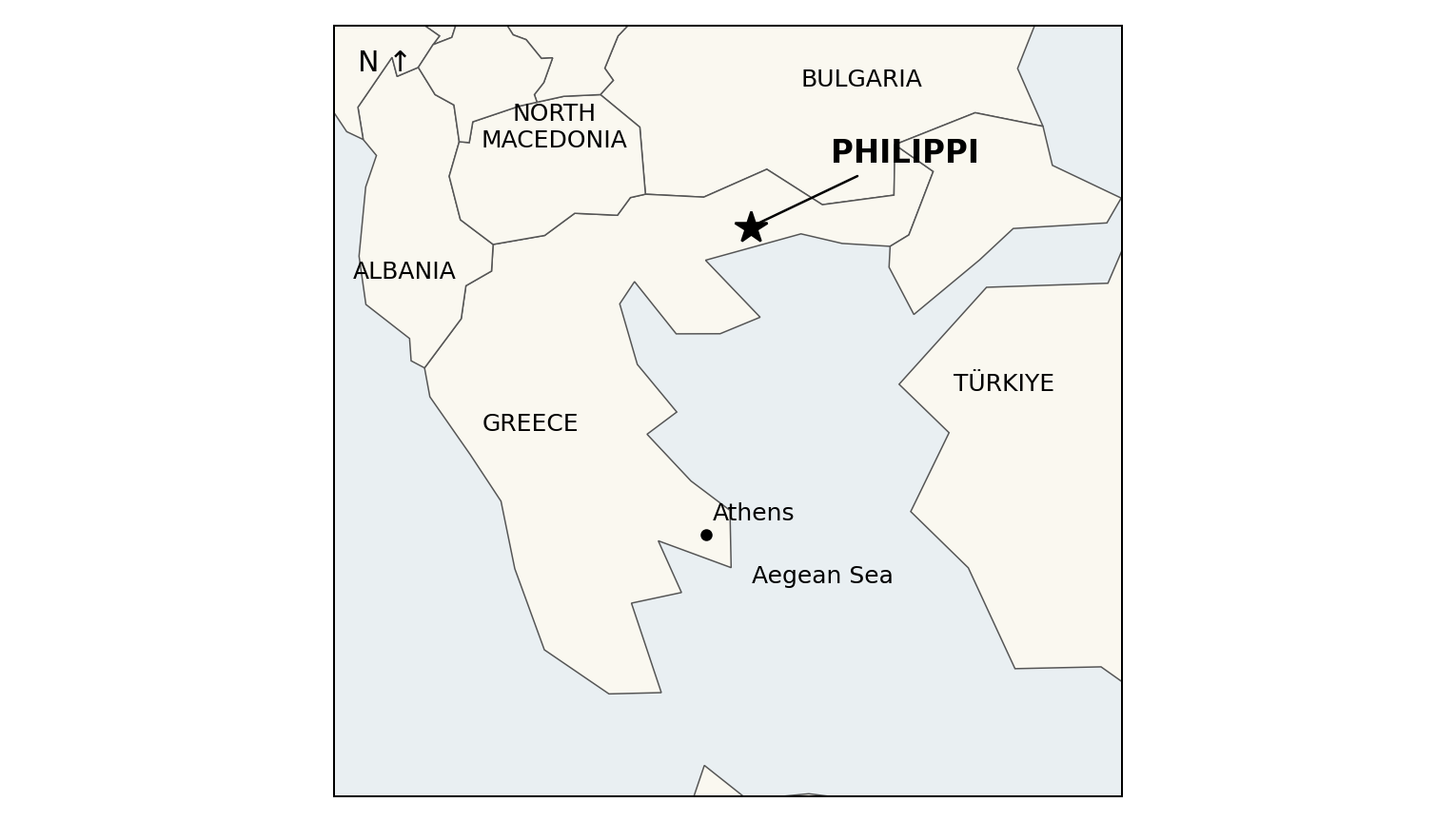
Modern locator map. Philippi marked by a star.
Philippians among the New Testament books
Matthew · Mark · Luke · John · Acts · Romans · 1 Corinthians · 2 Corinthians · Galatians · Ephesians · Philippians · Colossians · 1 Thessalonians · 2 Thessalonians · 1 Timothy · 2 Timothy · Titus · Philemon · Hebrews · James · 1 Peter · 2 Peter · 1 John · 2 John · 3 John · Jude · Revelation
There are 27 books in the New Testament. Philippians is the eleventh.
Meet the letter
Philippians is a joyful, encouraging letter from Paul to believers he deeply loved. He had helped establish the church during his second missionary journey. Acts 16 introduces Lydia, the jailer, and the beginnings of this Christian community. Their partnership with Paul continued through prayer, personal service, and financial help.
Paul wrote while imprisoned, most likely in Rome around AD 60–62. His imprisonment is certain from the letter; the precise location and date are debated. He thanks the church for its gift sent through Epaphroditus, reports how the gospel is advancing, and prepares them to welcome their messenger home. He also urges unity, warns against misplaced religious confidence, and teaches a life of joy, humility, prayer, and contentment in Christ.
The central message Knowing Jesus Christ is worth more than every competing gain. Because we belong to Him, we can serve humbly, stand together, and rejoice through changing circumstances.
A verse to carry through the study Philippians 1:21 — For to me to live is Christ, and to die is gain.
Find your way
Main teachings
God’s faithful work
Philippians 1:3–11 Our confidence rests in God, who begins and completes His work in His people.
The gospel in hardship
Philippians 1:12–18 God can use difficult circumstances to make Christ known.
To live is Christ
Philippians 1:19–26 Christ gives purpose to life and hope beyond death.
Unity and humility
Philippians 1:27–2:4 Stand together and give serious attention to the good of others.
The mind of Christ
Philippians 2:5–11 Follow the self-giving disposition of Jesus, who humbled Himself and is exalted as Lord.
God at work in our obedience
Philippians 2:12–18 Live out salvation reverently, depending on God for desire and strength.
Faithful servants
Philippians 2:19–30 Timothy and Epaphroditus show what genuine concern and costly service look like.
Knowing Christ above all
Philippians 3:1–11 Receive righteousness through faith in Christ rather than trusting your religious record.
Pressing forward
Philippians 3:12–16 Keep growing because Christ has made you His own.
Citizenship in heaven
Philippians 3:17–21 Live in allegiance to Christ while awaiting His return and the transformation of your body.
Reconciliation
Philippians 4:1–3 Help fellow believers resolve conflict in the Lord.
Joy prayer and peace
Philippians 4:4–7 Bring every concern to God with thanksgiving and trust His guarding peace.
Think on these things
Philippians 4:8–9 Attend to what is true and good, then practice what you have learned.
Contentment and generosity
Philippians 4:10–20 Depend on Christ in both plenty and need, and share in the burdens of others.
Read Philippians
Select a chapter to read it in the ESV in a reading window, right here on this page.
Philippians 1:1–30 Philippians 2:1–30 Philippians 3:1–21 Philippians 4:1–23
A brief outline
1:3–1:11 Thanksgiving and prayer
1:27–1:30 Stand together for the gospel
2:1–2:4 Unity through humility
2:5–2:11 The mind and humility of Christ
2:12–2:18 Obedience and witness
2:19–2:24 Timothy’s faithful care
2:25–2:30 Epaphroditus and costly service
3:1–3:11 Knowing Christ above all
3:12–3:16 Pressing toward the goal
4:1–4:3 Stand firm and seek reconciliation
4:10–4:13 Learning contentment
Study every verse
Begin with the Scripture, then read the explanation and related passages. After each section, pause over the application question. The aim is to understand Paul’s meaning and put it into practice in dependence on Christ.
Chapter 1 1:1 1:2 1:3 1:4 1:5 1:6 1:7 1:8 1:9 1:10 1:11 1:12 1:13 1:14 1:15 1:16 1:17 1:18 1:19 1:20 1:21 1:22 1:23 1:24 1:25 1:26 1:27 1:28 1:29 1:30
Chapter 2 2:1 2:2 2:3 2:4 2:5 2:6 2:7 2:8 2:9 2:10 2:11 2:12 2:13 2:14 2:15 2:16 2:17 2:18 2:19 2:20 2:21 2:22 2:23 2:24 2:25 2:26 2:27 2:28 2:29 2:30
Chapter 3 3:1 3:2 3:3 3:4 3:5 3:6 3:7 3:8 3:9 3:10 3:11 3:12 3:13 3:14 3:15 3:16 3:17 3:18 3:19 3:20 3:21
Chapter 4 4:1 4:2 4:3 4:4 4:5 4:6 4:7 4:8 4:9 4:10 4:11 4:12 4:13 4:14 4:15 4:16 4:17 4:18 4:19 4:20 4:21 4:22 4:23
Chapter 1
Greeting
Philippians 1:1
Read the verse: Philippians 1:1 BLB
Study Notes
Paul names Timothy alongside himself and identifies both as servants of Christ. Their authority belongs under His lordship. The saints are the believers who belong to Christ, not a special spiritual class. Overseers and deacons serve this whole congregation. Christian leadership is a responsibility exercised under Christ and for His people.
Read alongside Romans 1:1 BLB; 1 Timothy 3:1–13 BLB; Titus 1:5–9 BLB; 1 Corinthians 1:2 BLB
Philippians 1:2
Read the verse: Philippians 1:2 BLB
Study Notes
Paul greets the church with grace and peace from God the Father and the Lord Jesus Christ. Grace is God’s undeserved favor; peace flows from His reconciling work. This greeting directs our attention to the Father and Son as the source of the blessings the church needs.
Read alongside Romans 1:7 BLB; Galatians 1:3 BLB; Ephesians 1:2 BLB; John 14:27 BLB
Put it into practice Remember that you belong to Christ. How can your service reflect that today?
Thanksgiving and prayer
Philippians 1:3
Read the verse: Philippians 1:3 BLB
Study Notes
Every memory. Not the easy ones. All of them. Paul is in prison. Yet every time he thinks of the Philippians, his heart goes to God in thanksgiving.
This is a model for how we are to pray for one another. Not with complaints. Not with worry. With thanks.
Read alongside Romans 1:8 BLB; 1 Thessalonians 1:2 BLB; Ephesians 1:16 BLB
Philippians 1:4
Read the verse: Philippians 1:4 BLB
Study Notes
The word joy — chara — sounds like a bell throughout this entire letter. Paul is in chains. And he prays with joy.
Joy is not the absence of pain. Joy is the presence of God in the middle of pain. Paul proves it here.
Read alongside Philippians 4:4 BLB; 1 Thessalonians 5:16–18 BLB; Romans 5:3 BLB
Philippians 1:5
Read the verse: Philippians 1:5 BLB
Study Notes
Partnership — koinōnia. This word means more than a handshake. It means shared life. Shared cost. Shared mission.
The Philippians had been partners from the very first day Paul arrived in Philippi (Acts 16). They never stopped. That kind of faithfulness is rare. That kind of faithfulness is worth celebrating.
The gospel does not advance alone. It advances through people who partner together — giving, praying, going, sacrificing.
Read alongside Acts 16:12–15 BLB; Philippians 4:15–16 BLB; Romans 15:26 BLB; 2 Corinthians 8:4 BLB
Philippians 1:6
Read the verse: Philippians 1:6 BLB
Study Notes
Paul’s confidence rests in God, who began His good work among these believers and will bring it to completion at Christ’s return. Read this alongside their partnership in the gospel and the call to obedient living in 2:12–13. God’s faithfulness gives us reason to persevere, rather than an excuse to become careless.
Read alongside Romans 8:28–30 BLB; 1 Corinthians 1:8–9 BLB; 1 Thessalonians 5:23–24 BLB; John 10:28–29 BLB; Ephesians 2:10 BLB
Philippians 1:7
Read the verse: Philippians 1:7 BLB
Study Notes
Paul holds them in his heart. From prison. That is a pastor’s love — it does not stop at the cell door.
They are partakers of grace together. Not just recipients of the same doctrine. Partners in the same suffering. Partners in the same mission. Partners in the same grace.
Read alongside 2 Corinthians 7:3 BLB; Philemon 1:13 BLB; Acts 16:19–40 BLB
Philippians 1:8
Read the verse: Philippians 1:8 BLB
Study Notes
Paul calls God as witness to the depth of his affection. His love for the Philippians is shaped by Christ’s own love. Gospel partnership involves people we hold in our hearts, not merely tasks we complete. Distance and difficulty have not extinguished Paul’s concern for them.
Read alongside Romans 1:9 BLB; 2 Corinthians 11:11 BLB; 1 Thessalonians 2:8 BLB
Philippians 1:9
Read the verse: Philippians 1:9 BLB
Study Notes
Paul asks God to make their love grow in knowledge and discernment. Christian love seeks another person’s good in a way guided by truth. We need to understand God’s Word and learn to recognize what is right, so that sincere affection leads to wise choices.
Read alongside Romans 12:2 BLB; Ephesians 1:17 BLB; Colossians 1:9–10 BLB; Hebrews 5:14 BLB
Philippians 1:10
Read the verse: Philippians 1:10 BLB
Study Notes
Growing discernment helps believers recognize and approve what is excellent. Paul looks toward the day of Christ and prays for sincere, blameless lives. His concern is practical holiness: learning to choose what pleases God instead of drifting with whatever attracts us.
Read alongside Romans 2:18 BLB; Romans 12:2 BLB; Ephesians 5:10 BLB; 1 Thessalonians 3:13 BLB
Philippians 1:11
Read the verse: Philippians 1:11 BLB
Study Notes
The righteous fruit Paul seeks comes through Jesus Christ and brings glory to God. Dependence on Christ produces a changed life. John 15:1–8 helps explain this relationship: the branch bears fruit by abiding in the vine. We obey and serve as people who continually receive life and strength from Him.
Read alongside John 15:1–8 BLB; Galatians 5:22–23 BLB; Hebrews 12:11 BLB; Isaiah 61:3 BLB
Put it into practice Name someone you can thank God for, and pray for that person’s love and discernment.
The gospel advances
Philippians 1:12
Read the verse: Philippians 1:12 BLB
Study Notes
Paul’s imprisonment has unexpectedly served the spread of the gospel. What looked like a barrier became an opportunity for witness. This does not make the hardship pleasant, but it shows that God’s work is not confined to favorable circumstances. Acts 28:30–31 gives a related picture of Paul teaching while under restriction.
Read alongside Acts 28:30–31 BLB; 2 Timothy 2:9 BLB; Romans 8:28 BLB; Genesis 50:20 BLB
Philippians 1:13
Read the verse: Philippians 1:13 BLB
Study Notes
It has become widely known among the imperial guard and others that Paul is imprisoned because of Christ. The verse does not describe every conversation or say that every guard became a believer. Its emphasis is that Paul’s chains have made his allegiance to Jesus visible in an unexpected place.
Read alongside Acts 28:16 BLB; Ephesians 6:19–20 BLB; 2 Timothy 1:8 BLB; Acts 23:11 BLB
Philippians 1:14
Read the verse: Philippians 1:14 BLB
Study Notes
Paul’s imprisonment has encouraged many fellow believers to speak God’s Word more boldly. His faithfulness under pressure strengthens their courage. Our response to difficulty can help others trust Christ and take the next obedient step, even when we cannot see all the results.
Read alongside 2 Timothy 1:7–8 BLB; Acts 4:13 BLB; Acts 4:29–31 BLB; 1 Thessalonians 2:2 BLB
Philippians 1:15
Read the verse: Philippians 1:15 BLB
Study Notes
Paul does not pretend the church is perfect. Some men were preaching Christ to provoke Paul. Their motive was envy. Their method was rivalry.
This is a moment of radical honesty. Churches then — and churches now — contain people with mixed motives. Paul names it plainly.
Read alongside 1 Corinthians 3:3 BLB; Galatians 5:20 BLB; James 3:14–16 BLB; Romans 15:20 BLB
Philippians 1:16
Read the verse: Philippians 1:16 BLB
Study Notes
The ones with good motives preach out of love — agapē. They understand Paul is where God placed him. They come alongside his mission rather than competing with it.
Defense — apologia. The legal term for a defense in court. Paul’s whole life was a defense of the gospel.
Read alongside 1 Peter 3:15 BLB; 2 Timothy 4:16 BLB; Acts 22:1 BLB; Acts 26:2 BLB
Philippians 1:17
Read the verse: Philippians 1:17 BLB
Study Notes
Some preach Christ from selfish ambition, hoping to increase Paul’s distress. Their message and their motives must be distinguished. Paul will rejoice that Christ is proclaimed without approving envy or rivalry. We should examine our own motives rather than use ministry to compete for attention.
Read alongside Galatians 5:20 BLB; James 3:14 BLB; Romans 2:8 BLB; 1 Corinthians 4:5 BLB
Philippians 1:18
Read the verse: Philippians 1:18 BLB
Study Notes
Paul rejoices that Christ is truly proclaimed, even when some preachers have selfish motives. This is not approval of false teaching; compare his warning in 3:2–3. He values the advance of the gospel above his own reputation. Joy in Christ frees us to welcome good that does not center on us.
Read alongside Philippians 4:4 BLB; Romans 8:28 BLB; 1 Corinthians 1:17 BLB; Acts 5:41 BLB
Put it into practice What present limitation could become an opportunity to make Christ known?
To live is Christ
Philippians 1:19
Read the verse: Philippians 1:19 BLB
Study Notes
Paul relies on the church’s prayers and the help of the Spirit of Jesus Christ. In the following verses, his hope reaches beyond release from prison to honoring Christ whether he lives or dies. Prayer is one of God’s appointed means of helping His people; it does not make the Holy Spirit dependent on our permission.
Read alongside Romans 8:26–27 BLB; Ephesians 6:18–19 BLB; John 14:16–17 BLB; Acts 16:25 BLB
Prayer in practice Pause before God, confess known sin, and ask the Holy Spirit to guide your prayer through Scripture. Bring your requests with thanksgiving and submit your desires to God’s will. Persevere while you wait. Our access rests in Christ, not in a performance that earns God’s attention. Read Romans 8:26–27 and Ephesians 6:18–20.
Philippians 1:20
Read the verse: Philippians 1:20 BLB
Study Notes
Paul eagerly hopes to honor Christ in his body, whether through continued life or through death. He wants courage rather than shame when tested. His deepest concern is faithfulness to Jesus, not control over the outcome. This gives direction to our prayers when the future is uncertain.
Read alongside Romans 8:19 BLB; 2 Corinthians 5:9 BLB; 1 Peter 4:16 BLB; Romans 14:8 BLB
Philippians 1:21
Read the verse: Philippians 1:21 BLB
Study Notes
Christ is the center and purpose of Paul’s life. Continued life means serving Him; death means being with Him, as verse 23 explains. Paul is not dismissing the value of earthly life. His confidence in Christ enables both fruitful service now and hope beyond death.
Read alongside Galatians 2:20 BLB; Colossians 3:4 BLB; Romans 14:8 BLB; 2 Corinthians 5:8 BLB
Philippians 1:22
Read the verse: Philippians 1:22 BLB
Study Notes
If Paul lives, fruit happens. That is how he views continued existence. Not comfort. Not retirement. Fruitful labor.
He genuinely cannot decide which he prefers — life with continued service, or death with immediate glory. This is the dilemma of a man fully alive to Christ.
Read alongside John 15:5 BLB; Galatians 6:9 BLB; 1 Corinthians 15:58 BLB; 2 Timothy 4:7 BLB
Philippians 1:23
Read the verse: Philippians 1:23 BLB
Study Notes
Paul feels the pull of two good desires: continued service among believers and departure to be with Christ. Being with Christ is far better for him personally. His hope rests in the Person who receives him, not in an escape from meaningful responsibility.
Read alongside 2 Corinthians 5:6–8 BLB; Luke 23:43 BLB; 1 Thessalonians 4:17 BLB; Revelation 21:3 BLB
Philippians 1:24
Read the verse: Philippians 1:24 BLB
Study Notes
Paul recognizes that his continued presence would help the Philippians. He weighs their needs alongside his own desire to be with Christ. He is not claiming control over whether he lives or dies; he is showing the unselfish concern that he will urge on the church in chapter 2.
Read alongside 2 Corinthians 1:24 BLB; 1 Thessalonians 3:10 BLB; Philippians 2:3–4 BLB; Romans 15:1 BLB
Philippians 1:25
Read the verse: Philippians 1:25 BLB
Study Notes
Convinced — persuaded. Not wishful. Settled. Paul expects to be released and to return to them.
His purpose for returning: their progress and joy in the faith. Not to build his ministry. Not to increase his influence. Their progress. Their joy.
Read alongside Acts 28:30–31 BLB; Philippians 4:1 BLB; 1 Thessalonians 3:7–10 BLB; Colossians 2:5 BLB
Philippians 1:26
Read the verse: Philippians 1:26 BLB
Study Notes
The glory is never Paul’s. It is always Christ Jesus. Even his return to them will be a reason to boast in Christ — not in Paul.
Every gift God gives — every answer to prayer — is meant to increase glory in Christ Jesus.
Read alongside 2 Corinthians 1:14 BLB; Galatians 6:14 BLB; 1 Corinthians 1:31 BLB; Romans 5:11 BLB
Put it into practice What would honoring Christ look like in the outcome you most fear?
Stand together for the gospel
Philippians 1:27
Read the verse: Philippians 1:27 BLB
Study Notes
"Manner of life" — politeuesthe. The word means to live as a citizen. Philippi was a Roman colony. Paul says: live as citizens of the Kingdom of Heaven. Be worthy of your King.
Whether Paul is watching or not — live this way. The mark of a mature believer is consistency when no one is looking.
One spirit. One mind. Side by side. Unity is not uniformity. It is focused, coordinated effort toward the same goal.
Read alongside Ephesians 4:1 BLB; Colossians 1:10 BLB; 1 Thessalonians 2:12 BLB; Acts 2:46 BLB; Ephesians 4:3 BLB
Philippians 1:28
Read the verse: Philippians 1:28 BLB
Study Notes
Paul calls the church to stand firm rather than be driven away from the gospel by opposition. Their perseverance points toward God’s final judgment and salvation. Courage here is continued allegiance to Christ under pressure, sustained by the knowledge that salvation comes from God.
Read alongside 1 Peter 3:14–17 BLB; 2 Thessalonians 1:4–5 BLB; Luke 21:12–19 BLB; Romans 8:31 BLB
Philippians 1:29
Read the verse: Philippians 1:29 BLB
Study Notes
Granted — echarithe — from charis, grace. Suffering for Christ is a grace gift. Let that sink in.
Two gifts are wrapped together here: faith in Christ, and suffering for Christ. You cannot separate them and remain in the New Testament.
Read alongside Acts 5:41 BLB; Romans 5:3–5 BLB; 2 Timothy 3:12 BLB; 1 Peter 4:12–14 BLB; Matthew 5:10–12 BLB
Philippians 1:30
Read the verse: Philippians 1:30 BLB
Study Notes
Same conflict. Paul is not asking them to do something he has never done. He has been in this fight since his first day in Philippi — when he was beaten and thrown in prison (Acts 16).
The life of faith is a conflict. It is not a cruise. But you do not fight alone.
Read alongside Acts 16:19–40 BLB; 2 Corinthians 11:23–27 BLB; 2 Timothy 4:7 BLB; Jude 1:3 BLB
Put it into practice Where can you stand beside another believer instead of leaving that person to struggle alone?
Chapter 2
Unity through humility
Philippians 2:1
Read the verse: Philippians 2:1 BLB
Study Notes
Paul appeals to blessings the believers share in Christ: encouragement, love, fellowship in the Spirit, affection, and sympathy. He urges them to let these realities shape their relationships. Christian unity grows from the grace we have already received together.
Read alongside 2 Corinthians 1:3–4 BLB; Romans 5:5 BLB; Galatians 4:6 BLB; Romans 8:16 BLB
Philippians 2:2
Read the verse: Philippians 2:2 BLB
Study Notes
Paul longs for the church to share a common mind and love in Christ. This is unity around the gospel, expressed in how they treat one another. The following verses explain its practical shape: rejecting rivalry, valuing others, and attending to their needs.
Read alongside Romans 12:16 BLB; 1 Corinthians 1:10 BLB; Ephesians 4:3–6 BLB; John 17:21–23 BLB
Philippians 2:3
Read the verse: Philippians 2:3 BLB
Study Notes
Selfish ambition puts personal advancement ahead of others; conceit seeks empty glory. Paul commands humility instead. Counting others more significant means giving their good serious priority, not pretending that every person has greater abilities or that you have no value. Christ’s self-giving love supplies the pattern.
Read alongside Romans 12:10 BLB; Galatians 5:26 BLB; 1 Peter 5:5 BLB; James 4:10 BLB; Luke 9:46–48 BLB
Philippians 2:4
Read the verse: Philippians 2:4 BLB
Study Notes
Not only. Paul does not condemn self-care. He expands the vision. Your own interests matter — and so do theirs.
This is the practical shape of love. It looks. It pays attention. It notices what the other person needs.
Read alongside 1 Corinthians 10:24 BLB; 1 Corinthians 13:5 BLB; Romans 15:2 BLB; Galatians 6:2 BLB
Put it into practice Whose interests need your attention in the next decision you make?
The mind and humility of Christ
Philippians 2:5
Read the verse: Philippians 2:5 BLB
Study Notes
Paul commands believers to share Christ’s humble, self-giving disposition in their relationships. Their life in Christ is the foundation for this calling, but the command still requires a response. Having the mind of Christ means learning to think and act under His lordship, one decision and one encounter at a time.
Read alongside Romans 8:5–9 BLB; Romans 12:16 BLB; 1 Corinthians 2:16 BLB; Colossians 3:1–2 BLB
Philippians 2:6
Read the verse: Philippians 2:6 BLB
Study Notes
Christ already shares the divine nature; equality with God is not something He needs to acquire. Yet He does not use His status for selfish advantage. The passage presents His willing humility without suggesting that He surrendered His deity. His greatness is displayed in His self-giving love.
Read alongside John 1:1–2 BLB; John 10:30 BLB; John 17:5 BLB; Colossians 1:15–17 BLB; Hebrews 1:3 BLB
John 1:1–2 (ESV) In the beginning was the Word, and the Word was with God, and the Word was God. He was in the beginning with God.
Colossians 1:15–16 (ESV) He is the image of the invisible God, the firstborn of all creation. For by him all things were created, in heaven and on earth, visible and invisible, whether thrones or dominions or rulers or authorities—all things were created through him and for him.
A step of obedience Refuse to use position, rights, or ability for selfish advantage; follow Christ in humble service.
Philippians 2:7
Read the verse: Philippians 2:7 BLB
Study Notes
Paul explains Christ’s self-emptying by describing what He took: the form of a servant and true human life. The eternal Son became genuinely human without ceasing to be God. His humility was not a disguise. He entered our condition and served in costly obedience.
Read alongside John 1:14 BLB; Romans 8:3 BLB; Hebrews 2:14–17 BLB; Isaiah 52:13–53:3 BLB; Luke 22:27 BLB
John 1:14 (ESV) And the Word became flesh and dwelt among us, and we have seen his glory, glory as of the only Son from the Father, full of grace and truth.
2 Corinthians 8:9 (ESV) For you know the grace of our Lord Jesus Christ, that though he was rich, yet for your sake he became poor, so that you by his poverty might become rich.
A step of obedience Choose the servant’s place when love and obedience call for it.
Philippians 2:8
Read the verse: Philippians 2:8 BLB
Study Notes
Jesus humbled Himself in obedience all the way to death on a cross. His suffering was real, and His obedience was willing. Paul brings the church to the cross to show the depth of Christ’s love and the pattern for putting others before self. Our acts of humble service flow from His saving work.
Read alongside Isaiah 53:7–12 BLB; Hebrews 12:2 BLB; John 10:17–18 BLB; Galatians 3:13 BLB; 1 Peter 2:21–24 BLB
Hebrews 5:8 (ESV) Although he was a son, he learned obedience through what he suffered.
1 Peter 2:24 (ESV) He himself bore our sins in his body on the tree, that we might die to sin and live to righteousness. By his wounds you have been healed.
A step of obedience Let Christ’s obedience move you toward immediate, wholehearted obedience to God.
Philippians 2:9
Read the verse: Philippians 2:9 BLB
Study Notes
The Father highly exalts the obedient Son. Jesus’ humiliation is followed by supreme honor, expressed in the confession of His lordship in verse 11. This is not the promotion of a merely human Jesus into deity. It is the exaltation of the incarnate Son who already existed in the form of God.
Read alongside Acts 2:33 BLB; Ephesians 1:20–22 BLB; Matthew 28:18 BLB; Hebrews 1:4 BLB; Isaiah 52:13 BLB
Acts 2:32–33 (ESV) This Jesus God raised up, and of that we all are witnesses. Being therefore exalted at the right hand of God, and having received from the Father the promise of the Holy Spirit, he has poured out this that you yourselves are seeing and hearing.
Ephesians 1:20–21 (ESV) That he worked in Christ when he raised him from the dead and seated him at his right hand in the heavenly places, far above all rule and authority and power and dominion, and above every name that is named, not only in this age but also in the one to come.
A step of obedience Trust God with the outcome of humble obedience; exalt Christ rather than yourself.
Philippians 2:10
Read the verse: Philippians 2:10 BLB
Study Notes
Every realm of creation will acknowledge Jesus’ authority. The language echoes Isaiah 45:23, where every knee bows to the Lord. Paul’s words call us to worship Christ now. Universal acknowledgment of His lordship does not mean that every person will receive salvation.
Read alongside Isaiah 45:23 BLB; Romans 14:11 BLB; Revelation 5:13 BLB; Revelation 19:6 BLB; Ephesians 1:21 BLB
Isaiah 45:23 (ESV) By myself I have sworn; from my mouth has gone out in righteousness a word that shall not return: “To me every knee shall bow, every tongue shall swear allegiance.”
Romans 14:11 (ESV) For it is written, “As I live, says the Lord, every knee shall bow to me, and every tongue shall confess to God.”
A step of obedience Bow willingly to Jesus now, submitting every part of life to His lordship.
Philippians 2:11
Read the verse: Philippians 2:11 BLB
Study Notes
The confession is that Jesus Christ is Lord, to the glory of God the Father. The language echoes the divine lordship proclaimed in Isaiah 45. The Son’s glory does not compete with the Father’s glory. We respond by confessing Jesus with our mouths and submitting to Him in our conduct.
Read alongside Romans 10:9–10 BLB; Acts 2:36 BLB; 1 Corinthians 12:3 BLB; John 5:22–23 BLB; Isaiah 45:23 BLB
1 Corinthians 12:3 (ESV) Therefore I want you to understand that no one speaking in the Spirit of God ever says “Jesus is accursed!” and no one can say “Jesus is Lord” except in the Holy Spirit.
Revelation 5:13 (ESV) And I heard every creature in heaven and on earth and under the earth and in the sea, and all that is in them, saying, “To him who sits on the throne and to the Lamb be blessing and honor and glory and might forever and ever!”
A step of obedience Confess Jesus as Lord with both your words and the obedient direction of your life.
Put it into practice What right, preference, or recognition can you surrender in order to serve?
Obedience and witness
Philippians 2:12
Read the verse: Philippians 2:12 BLB
Study Notes
Paul addresses believers and calls them to carry their salvation into obedient expression. They do not earn acceptance with God through works. They take His saving work seriously, with reverence and dependence. This includes life together as a church, especially the humble unity described in the surrounding verses.
Read alongside Ephesians 2:8–10 BLB; James 2:17–18 BLB; 1 Corinthians 9:27 BLB; Romans 6:1–4 BLB; Galatians 5:6 BLB
James 2:17–18 (ESV) So also faith by itself, if it does not have works, is dead. But someone will say, “You have faith and I have works.” Show me your faith apart from your works, and I will show you my faith by my works.
2 Peter 1:10 (ESV) Therefore, brothers, be all the more diligent to confirm your calling and election, for if you practice these qualities you will never fall.
A step of obedience Take your growth in holiness seriously and obey God whether anyone is watching or not.
Philippians 2:13
Read the verse: Philippians 2:13 BLB
Study Notes
God is at work within His people, shaping both the desire and the ability to do what pleases Him. Verse 13 explains how the obedience of verse 12 is possible. His grace produces active dependence: we ask for His help and respond by obeying. Spiritual growth is His work expressed through our willing response.
Read alongside Ephesians 3:20 BLB; Hebrews 13:21 BLB; 1 Corinthians 12:6 BLB; Romans 8:28 BLB; John 15:5 BLB
John 15:5 (ESV) I am the vine; you are the branches. Whoever abides in me and I in him, he it is that bears much fruit, for apart from me you can do nothing.
Hebrews 13:20–21 (ESV) Now may the God of peace who brought again from the dead our Lord Jesus, the great shepherd of the sheep, by the blood of the eternal covenant, equip you with everything good that you may do his will, working in us that which is pleasing in his sight, through Jesus Christ, to whom be glory forever and ever. Amen.
A step of obedience Depend on God for both the desire and the strength to obey, then act on what He supplies.
In the small moments Ask for His help with the next thought, word, pause, and step. A quiet act of obedience matters. Maturity grows as God’s grace shapes our ordinary responses, not merely our public or dramatic moments.
Philippians 2:14
Read the verse: Philippians 2:14 BLB
Study Notes
Grumbling and argumentative resistance damage a congregation’s witness. Paul calls for obedience that reaches our speech and attitude, not merely our outward actions. The setting recalls Israel’s wilderness complaints. Bring concerns honestly to God and address problems truthfully, without cultivating resentment or needless conflict.
Read alongside 1 Corinthians 10:10 BLB; Numbers 14:2 BLB; James 5:9 BLB; 1 Peter 4:9 BLB; Jude 1:16 BLB
Exodus 16:8 (ESV) And Moses said, “When the LORD gives you in the evening meat to eat and in the morning bread to the full, because the LORD has heard your grumbling that you grumble against him—what are we? Your grumbling is not against us but against the LORD.”
1 Corinthians 10:10 (ESV) Nor grumble, as some of them did and were destroyed by the Destroyer.
A step of obedience Catch complaint before it becomes speech, and replace it with trust, prayer, and gratitude.
Philippians 2:15
Read the verse: Philippians 2:15 BLB
Study Notes
Crooked — skolias. Bent. Warped. The world around you is twisted. You know this.
And into that darkness, God places you as lights — phōstēres — shining stars. Not to hide. Not to blend in. To shine.
The power of the light is its contrast with the darkness. A candle commands a dark room.
Read alongside Matthew 5:14–16 BLB; Ephesians 5:8–11 BLB; Daniel 12:3 BLB; 1 Peter 2:9 BLB; Romans 12:2 BLB
Matthew 5:14–16 (ESV) You are the light of the world. A city set on a hill cannot be hidden. Nor do people light a lamp and put it under a basket, but on a stand, and it gives light to all in the house. In the same way, let your light shine before others, so that they may see your good works and give glory to your Father who is in heaven.
Deuteronomy 32:5 (ESV) They have dealt corruptly with him; they are no longer his children because they are blemished; they are a crooked and twisted generation.
A step of obedience Live with such integrity and kindness that the difference Christ makes can be clearly seen.
Philippians 2:16
Read the verse: Philippians 2:16 BLB
Study Notes
Believers shine by holding fast to the word of life. The expression is also understood by some as holding forth the message to others. In either case, the gospel belongs at the center of faithful witness. Paul longs to see lasting fruit from his labor when Christ returns.
Read alongside John 6:63 BLB; 1 John 1:1–2 BLB; Acts 20:24 BLB; 1 Thessalonians 2:19 BLB; Galatians 2:2 BLB
John 6:63 (ESV) It is the Spirit who gives life; the flesh is no help at all. The words that I have spoken to you are spirit and life.
1 Thessalonians 2:19–20 (ESV) For what is our hope or joy or crown of boasting before our Lord Jesus at his coming? Is it not you? For you are our glory and joy.
A step of obedience Hold firmly to Scripture and offer its life-giving truth to those around you.
Philippians 2:17
Read the verse: Philippians 2:17 BLB
Study Notes
Paul pictures his costly service, and possibly his death, as a drink offering accompanying the Philippians’ sacrificial service of faith. The image expresses a life gladly offered to God. He rejoices in their faith rather than treating his own sacrifice as the center of the story.
Read alongside 2 Timothy 4:6 BLB; Numbers 15:1–10 BLB; Romans 12:1 BLB; Isaiah 53:12 BLB; Colossians 1:24 BLB
Numbers 28:7 (ESV) Its drink offering shall be a quarter of a hin for each lamb. In the Holy Place you shall pour out a drink offering of strong drink to the LORD.
2 Timothy 4:6–7 (ESV) For I am already being poured out as a drink offering, and the time of my departure has come. I have fought the good fight, I have finished the race, I have kept the faith.
A step of obedience Offer your life gladly in service to Christ, even when faithful service is costly.
Philippians 2:18
Read the verse: Philippians 2:18 BLB
Study Notes
Joy is not Paul’s alone. He invites them into it. Even if he dies — rejoice with him.
This is what resurrection hope does to grief. It does not erase it. It transforms it.
Read alongside Philippians 4:4 BLB; 1 Thessalonians 5:16 BLB; Romans 5:3 BLB; Acts 5:41 BLB
Philippians 3:1 (ESV) Finally, my brothers, rejoice in the Lord. To write the same things to you is no trouble to me and is safe for you.
Philippians 4:4 (ESV) Rejoice in the Lord always; again I will say, rejoice.
A step of obedience Choose to rejoice with other believers in faithful service, even when the circumstances are hard.
Put it into practice Ask God for the desire and strength to obey, then take the next clear step.
Timothy’s faithful care
Philippians 2:19
Read the verse: Philippians 2:19 BLB
Study Notes
Paul hopes to send Timothy to learn how the Philippians are doing and to be encouraged by the report. He makes this plan in the Lord Jesus, recognizing that his plans remain under Christ’s authority. Care for a church includes listening for news and responding to actual needs.
Read alongside Acts 16:1–3 BLB; 1 Timothy 1:2 BLB; 1 Corinthians 4:17 BLB; Romans 16:21 BLB
Philippians 2:20
Read the verse: Philippians 2:20 BLB
Study Notes
Genuinely concerned — gnēsiōs merimnēsei. Authentically, not as a performance. Timothy’s care for people is real.
Paul says he has no one like him. High praise from an apostle. Timothy stands apart because he cares about people the way Christ cares about people.
Read alongside 1 Timothy 5:23 BLB; 2 Timothy 1:4–5 BLB; 1 Thessalonians 3:1–2 BLB; Philippians 4:6 BLB
Philippians 2:21
Read the verse: Philippians 2:21 BLB
Study Notes
Paul contrasts Timothy’s concern for Christ’s interests with the self-interest of others. This sharp statement belongs to the situation he is discussing; it is not a denial that all other Christians can be faithful. It asks each of us whose interests our choices actually serve.
Read alongside Philippians 1:15–17 BLB; 1 Corinthians 10:24 BLB; 2 Timothy 4:10 BLB; Romans 15:1 BLB
Philippians 2:22
Read the verse: Philippians 2:22 BLB
Study Notes
Timothy’s character has been proved through service. He has worked with Paul for the gospel in a relationship marked by the affection and loyalty of a son with a father. Trustworthy service is demonstrated over time through faithfulness, not established by a title alone.
Read alongside 1 Corinthians 4:17 BLB; 2 Timothy 3:10–11 BLB; Acts 16:1–3 BLB; 1 Thessalonians 3:6 BLB
Philippians 2:23
Read the verse: Philippians 2:23 BLB
Study Notes
Paul waits to know the outcome of his trial before sending Timothy. Even in planning, he holds things loosely.
James 4:13–15 is lived out here. If the Lord wills.
Read alongside James 4:13–15 BLB; Acts 23:11 BLB; Acts 28:30 BLB; Romans 1:10 BLB
Philippians 2:24
Read the verse: Philippians 2:24 BLB
Study Notes
Paul expresses confidence in the Lord that he will visit soon. This is his expectation at the time of writing; Philippians does not narrate its fulfillment. We can make hopeful plans while placing their outcome in the Lord’s hands.
Read alongside Philemon 1:22 BLB; Acts 28:30–31 BLB; Proverbs 3:5–6 BLB
Put it into practice How can you show genuine concern for someone’s spiritual welfare?
Epaphroditus and costly service
Philippians 2:25
Read the verse: Philippians 2:25 BLB
Study Notes
Paul calls Epaphroditus his brother, fellow worker, and fellow soldier, as well as the church’s messenger and minister to his need. These descriptions honor both relationship and service. He represents the congregation’s care in person. The military image points to shared commitment and endurance in Christ’s work.
Read alongside Philemon 1:2 BLB; 2 Corinthians 8:23 BLB; Romans 16:3 BLB; 2 Timothy 2:3 BLB
Philippians 2:26
Read the verse: Philippians 2:26 BLB
Study Notes
Epaphroditus longs for the church and is distressed that they heard about his illness. His concern shows the mutual affection between a congregation and its messenger. Paul gives us this concrete example of looking to the interests of others.
Read alongside Philippians 2:4 BLB; Philippians 2:3 BLB; 1 Thessalonians 3:7 BLB
Philippians 2:27
Read the verse: Philippians 2:27 BLB
Study Notes
Epaphroditus really was close to death. Paul describes his recovery as God’s mercy to him and to Paul, who would otherwise have faced added sorrow. Faith does not remove grief or make illness imaginary. This passage invites gratitude for mercy and compassionate concern for those who suffer.
Read alongside 2 Corinthians 1:9–10 BLB; Job 33:30 BLB; Psalm 103:3–4 BLB; James 5:15 BLB
Philippians 2:28
Read the verse: Philippians 2:28 BLB
Study Notes
Sending Epaphroditus back will bring joy to the Philippians and ease Paul’s concern. Paul speaks honestly about the emotional weight of caring for people. His practical response is to restore contact and reassure the church through their messenger’s return.
Read alongside Philippians 4:6–7 BLB; 1 Thessalonians 3:7 BLB; 2 Corinthians 7:6 BLB
Philippians 2:29
Read the verse: Philippians 2:29 BLB
Study Notes
Paul gives them an explicit instruction: when people like Epaphroditus come to you — worn down from serving — honor them.
The church is called to recognize and celebrate faithful sacrifice. Not just the famous. The faithful.
Read alongside 1 Thessalonians 5:12–13 BLB; 1 Corinthians 16:18 BLB; Romans 13:7 BLB; Hebrews 13:17 BLB
Philippians 2:30
Read the verse: Philippians 2:30 BLB
Study Notes
Epaphroditus risked his life in Christ’s work as the church’s representative. He supplied the personal service that the Philippians could not all provide from a distance. Paul honors this costly faithfulness; he is not rebuking the church as though its gift had been worthless.
Read alongside Romans 16:3–4 BLB; Acts 15:26 BLB; 2 Corinthians 8:5 BLB; 1 John 3:16 BLB
Put it into practice Who serves faithfully without much recognition, and how can you encourage that person?
Chapter 3
Knowing Christ above all
Philippians 3:1
Read the verse: Philippians 3:1 BLB
Study Notes
"Finally" — but the letter is far from over. Paul uses the word as a transition, not a conclusion.
Rejoice in the Lord. He has said it before. He will say it again. Repetition in Scripture is not redundancy — it is emphasis.
Safe for you. What Paul is about to address — the danger of false teaching — can destroy a believer who is not grounded in joy and truth.
Read alongside Philippians 4:4 BLB; 1 Thessalonians 5:16 BLB; Romans 5:11 BLB; 2 Peter 1:12–13 BLB
Philippians 3:2
Read the verse: Philippians 3:2 BLB
Study Notes
Paul sharply warns against teachers who place confidence in circumcision and the flesh. Their teaching threatens the sufficiency of Christ. His wordplay contrasts circumcision with mutilation. This warning targets a false basis of confidence before God, not Jewish people as an ethnic group.
Read alongside Galatians 1:6–9 BLB; Galatians 5:12 BLB; 2 Corinthians 11:13–15 BLB; Acts 15:1–2 BLB; Romans 16:17–18 BLB
Philippians 3:3
Read the verse: Philippians 3:3 BLB
Study Notes
We — the believers — are the true circumcision. Not the cutting of skin. The cutting of the heart (Romans 2:29, Deuteronomy 30:6).
Three marks of the true people of God: worship by the Spirit. Glory in Christ Jesus. No confidence in the flesh.
The Judaizers had it backward. Paul dismantles their entire system in one verse.
Read alongside Romans 2:28–29 BLB; Deuteronomy 30:6 BLB; Galatians 6:14–15 BLB; John 4:23–24 BLB; Colossians 2:11 BLB
Philippians 3:4
Read the verse: Philippians 3:4 BLB
Study Notes
Paul can speak from inside the world of religious credentials. He had grounds for confidence in the flesh that others would have admired. He lists them to show why even an impressive religious record cannot replace knowing Christ and receiving righteousness through faith.
Read alongside 2 Corinthians 11:18–22 BLB; Galatians 1:13–14 BLB; Acts 22:3 BLB; Acts 26:4–5 BLB
Philippians 3:5
Read the verse: Philippians 3:5 BLB
Study Notes
Paul describes his covenant upbringing, Israelite ancestry, tribe, Hebrew identity, and Pharisaic commitment. These were valued credentials. Being a Hebrew of Hebrews emphasizes his Jewish heritage and identity; it does not mean he could not speak Greek or that he was not born outside Judea. None of these advantages could make him righteous before God.
Read alongside Acts 22:3 BLB; Acts 26:5 BLB; Galatians 1:14 BLB; Romans 11:1 BLB; Genesis 17:12 BLB
Philippians 3:6
Read the verse: Philippians 3:6 BLB
Study Notes
Paul’s zeal once drove him to persecute the church. His outward observance of the law appeared blameless by the standards he had pursued. He is not claiming sinlessness. Religious intensity can be tragically misdirected when it resists Christ.
Read alongside Acts 8:3 BLB; Acts 9:1–2 BLB; Galatians 1:13 BLB; Acts 26:9–11 BLB; Romans 10:2–3 BLB
Philippians 3:7
Read the verse: Philippians 3:7 BLB
Study Notes
Counted — hēgēmai. Perfect tense. A completed action with continuing results. He made the calculation. He stands by it.
Gain became loss. The profit column became the loss column. Not because the credentials disappeared. Because Paul found something that made them all look worthless by comparison.
One encounter with Christ on the Damascus road rewrote the ledger forever.
Read alongside Luke 14:33 BLB; Matthew 13:44–46 BLB; Acts 9:1–9 BLB; Galatians 1:15–16 BLB; Isaiah 64:6 BLB
Philippians 3:8
Read the verse: Philippians 3:8 BLB
Study Notes
Everything as loss. Not just the religious credentials. Everything.
"The surpassing worth" — the excellence that surpasses all. Knowing Christ outweighs every other category combined.
Rubbish — skybala. Strong word. The Greek means refuse, dung, scraps thrown to dogs. Compared to Christ — everything else is garbage.
This is not bitterness. It is liberation. When you have found the treasure of all treasures, everything else is just noise.
Read alongside Matthew 13:44–46 BLB; Galatians 2:20 BLB; John 17:3 BLB; 1 Corinthians 2:2 BLB; Colossians 2:2–3 BLB
Philippians 3:9
Read the verse: Philippians 3:9 BLB
Study Notes
Found in him. On that final day, Paul wants one thing: to be found in Christ. Not standing on his own record. In Christ’s record.
Two kinds of righteousness: my own righteousness — produced by law-keeping. And God’s righteousness — given by grace through faith.
This is the heart of the gospel. You cannot produce righteousness sufficient to stand before God. It must be given. It must be received. Through faith in Christ alone.
Read alongside Romans 3:21–26 BLB; Romans 10:3–4 BLB; 2 Corinthians 5:21 BLB; Galatians 2:16 BLB; Ephesians 2:8–9 BLB
Philippians 3:10
Read the verse: Philippians 3:10 BLB
Study Notes
Paul wants to know Christ in the power of His resurrection and in fellowship with His sufferings. Knowing Him changes the way we live and endure hardship. Becoming like Him in His death involves a life shaped by the cross, including costly obedience and surrender of self-rule.
Read alongside John 17:3 BLB; Romans 6:3–5 BLB; 2 Corinthians 4:10–11 BLB; Galatians 6:14 BLB; Colossians 1:24 BLB
Philippians 3:11
Read the verse: Philippians 3:11 BLB
Study Notes
Paul looks toward the resurrection from the dead. His wording expresses humble, earnest pursuit of that goal; it does not teach that resurrection is earned by suffering enough. Keep this hope beside 3:9, where righteousness is received through faith, and 3:20–21, where Christ transforms His people’s bodies.
Read alongside 1 Corinthians 15:20–23 BLB; 1 Thessalonians 4:13–17 BLB; John 11:25–26 BLB; Luke 20:35–36 BLB
Put it into practice What achievement or possession competes with your confidence in Christ?
Pressing toward the goal
Philippians 3:12
Read the verse: Philippians 3:12 BLB
Study Notes
Paul corrects himself before anyone else can. He has not arrived. He is not perfect — fully complete.
But he presses on. Diōkō — pursues. The same word used for hunting or chasing. He is going after it with everything in him.
The foundation of his pursuit: Christ Jesus has made me his own. He does not press on to earn belonging. He presses on because he already belongs.
Read alongside 1 Corinthians 9:24–27 BLB; Hebrews 12:1–2 BLB; 1 Timothy 6:12 BLB; 2 Timothy 4:7 BLB; Galatians 4:9 BLB
Philippians 3:13
Read the verse: Philippians 3:13 BLB
Study Notes
Paul refuses to treat past achievements or failures as the finish line. Forgetting what lies behind means moving forward in the pursuit of Christ rather than being governed by the past. It does not require erasing memory, refusing repentance, or neglecting responsibilities created by past actions.
Read alongside Isaiah 43:18–19 BLB; Luke 9:62 BLB; Hebrews 12:1 BLB; 1 Kings 18:46 BLB
Philippians 3:14
Read the verse: Philippians 3:14 BLB
Study Notes
Paul presses toward the goal of God’s heavenly call in Christ Jesus. The athletic picture conveys purposeful perseverance. The prize belongs with the resurrection hope of this passage. He pursues Christ because Christ has made him His own, not to purchase salvation by effort.
Read alongside 1 Corinthians 9:24–25 BLB; Hebrews 12:2 BLB; Colossians 3:1–4 BLB; 2 Timothy 4:8 BLB; 1 Thessalonians 2:12 BLB
Philippians 3:15
Read the verse: Philippians 3:15 BLB
Study Notes
Mature — teleioi. Paul used the same root in verse 12 to say he was not perfect. Now he calls the mature to think this way.
Mature believers are not the ones who claim to have arrived. They are the ones who press on.
Where believers differ — God will reveal the truth in time. Paul trusts the Spirit to be the teacher.
Read alongside 1 Corinthians 2:6 BLB; Ephesians 4:13–15 BLB; Romans 12:16 BLB; James 1:5 BLB; John 16:13 BLB
Philippians 3:16
Read the verse: Philippians 3:16 BLB
Study Notes
Hold true to what you already know. Do not abandon the ground already won.
You may not be where you want to be. But you are not where you were. Hold the ground. Press forward.
Read alongside Galatians 5:1 BLB; 1 Corinthians 15:1–2 BLB; Revelation 3:11 BLB; 2 Peter 3:17 BLB
Put it into practice What faithful step can you take today without waiting to feel fully mature?
Citizens of heaven
Philippians 3:17
Read the verse: Philippians 3:17 BLB
Study Notes
Imitate me. Paul has earned the right to say this. He has laid out his credentials and counted them as dung. He has modeled pressing on. He has modeled suffering with joy.
This is not arrogance. This is discipleship. Find people who are running hard after Christ. Watch them closely. Follow their footsteps.
Who are you watching? And who is watching you?
Read alongside 1 Corinthians 4:16 BLB; 1 Corinthians 11:1 BLB; 1 Thessalonians 1:6 BLB; Hebrews 13:7 BLB; 2 Thessalonians 3:9 BLB
Philippians 3:18
Read the verse: Philippians 3:18 BLB
Study Notes
Paul warns with tears about people whose walk opposes the cross of Christ. He does not give enough information here to identify every person or reconstruct their history. His grief should shape our own warnings: truth must be spoken seriously and with concern for those in danger.
Read alongside 2 Timothy 4:10 BLB; 1 John 2:19 BLB; Galatians 1:6–9 BLB; Jude 1:4 BLB; 2 Peter 2:1–2 BLB
Philippians 3:19
Read the verse: Philippians 3:19 BLB
Study Notes
Four devastating phrases. End: destruction. God: their belly — their appetites rule them.
They glory in their shame — boasting about things that should make them blush.
Minds set on earthly things. Earthbound. Horizontal. Unable to see above the horizon of this present age.
This is the trajectory of every life lived for self. It ends in ruin.
Read alongside Romans 16:18 BLB; 2 Peter 2:13 BLB; Colossians 3:2 BLB; Matthew 6:24 BLB; Romans 8:5–8 BLB
Philippians 3:20
Read the verse: Philippians 3:20 BLB
Study Notes
Believers belong to heaven’s commonwealth and await the Savior from there. In a Roman colony, citizenship would have been a familiar and meaningful image. Our allegiance to Christ shapes our life here while our hope looks to His return. This does not mean we existed in heaven before birth.
Read alongside Ephesians 2:19 BLB; Hebrews 13:14 BLB; John 18:36 BLB; 1 Thessalonians 4:16–17 BLB; Titus 2:13 BLB
Philippians 3:21
Read the verse: Philippians 3:21 BLB
Study Notes
Transform — metaschēmatisei. He will change the form of our humble bodies.
Lowly body — the body of our humiliation. These bodies break down. They age. They suffer. They die.
But He will transform them to be like His glorious body. Real, physical, glorified — no longer subject to decay or death.
By the power that enables him even to subject all things to himself. He who holds the cosmos in His hand can certainly raise the dead.
Read alongside 1 Corinthians 15:42–54 BLB; Romans 8:17–23 BLB; 1 John 3:2 BLB; 2 Corinthians 5:1–4 BLB; Luke 24:36–43 BLB
Put it into practice Whose example helps you follow Christ, and what example are you giving?
Chapter 4
📖 Monday Night Bible Study on this chapter: Philippians 4:4–23 — Do Not Be Anxious About Anything (November 9, 2026)
Stand firm and seek reconciliation
Philippians 4:1
Read the verse: Philippians 4:1 BLB
Study Notes
Five terms of endearment in one verse. Brothers. Whom I love. Whom I long for. My joy. My crown.
Crown — stephanos. The victor’s wreath. These people are Paul’s prize. The proof that his race was not run in vain.
Stand firm. After everything in chapter 3 — the warnings, the weeping, the vision of heaven — here is the application. Plant your feet. In the Lord. Immovable.
Read alongside 1 Corinthians 15:58 BLB; 1 Thessalonians 2:19 BLB; Galatians 5:1 BLB; 1 Peter 5:9 BLB; Ephesians 6:11 BLB
Philippians 4:2
Read the verse: Philippians 4:2 BLB
Study Notes
Two women. Named publicly in a letter read to the whole church.
Paul does not take sides. He pleads with both — the same word, the same appeal, equal weight to both.
"Agree in the Lord" — not just agree on the issue. Be reconciled in Christ. The foundation of their unity is the Lord they both serve.
Read alongside Matthew 5:23–24 BLB; Romans 12:18 BLB; Ephesians 4:3 BLB; Colossians 3:13 BLB; Matthew 18:15 BLB
Philippians 4:3
Read the verse: Philippians 4:3 BLB
Study Notes
Paul asks a trusted companion to help Euodia and Syntyche be reconciled. He remembers their work for the gospel and speaks of the fellow workers whose names are in the book of life. Their conflict should be addressed in the light of their shared belonging to Christ, with help that seeks truth and peace.
Read alongside Exodus 32:32 BLB; Daniel 12:1 BLB; Luke 10:20 BLB; Revelation 3:5 BLB; Revelation 21:27 BLB
Put it into practice Is there a strained relationship where you can take an honest step toward peace?
Joy prayer and peace
Philippians 4:4
Read the verse: Philippians 4:4 BLB
Study Notes
Rejoice — chairete. A command. Imperative. Not a feeling to wait for. A choice to make.
Always. In prosperity and in pain. In answered prayer and in silence. In health and in suffering. Always.
He says it twice. In the Lord. The source of the joy is not your circumstances. It is the Lord. He does not change. Therefore the joy does not have to stop.
Paul wrote these words from prison. His joy was not theoretical. It was tested.
Read alongside 1 Thessalonians 5:16 BLB; Romans 5:2–3 BLB; James 1:2–4 BLB; Habakkuk 3:17–18 BLB; John 15:11 BLB
Philippians 4:5
Read the verse: Philippians 4:5 BLB
Study Notes
Paul calls for a gentleness and reasonableness visible to everyone. We need not insist on our advantage in every encounter. The Lord is at hand: His nearness and the expectation of His coming give weight to this appeal. Treat people as someone who lives before the Lord.
Read alongside James 3:17 BLB; Matthew 5:5 BLB; Titus 3:2 BLB; 1 Peter 2:18 BLB; Revelation 22:20 BLB
Philippians 4:6
Read the verse: Philippians 4:6 BLB
Study Notes
Paul directs believers to bring every concern to God through prayer, specific requests, and thanksgiving. Gratitude remembers God’s goodness even when the need remains unresolved. This is a continuing practice of dependence, not a technique for forcing a preferred outcome. We can bring our fears honestly to the Father and return to Him whenever they rise again.
Read alongside Matthew 6:25–34 BLB; 1 Peter 5:6–7 BLB; Luke 18:1 BLB; 1 Thessalonians 5:17–18 BLB; Psalm 55:22 BLB
Philippians 4:7
Read the verse: Philippians 4:7 BLB
Study Notes
God’s peace guards hearts and minds in Christ Jesus. The picture is of protection, not a promise that every difficulty disappears immediately. This peace exceeds what circumstances alone can explain. Read the promise with the prayer of verse 6 and the thought and practice of verses 8–9.
Read alongside Romans 5:1 BLB; Isaiah 26:3 BLB; John 14:27 BLB; Colossians 3:15 BLB; Isaiah 55:8–9 BLB
Put it into practice Turn one specific concern into a prayer, including thanksgiving.
Think and practice
Philippians 4:8
Read the verse: Philippians 4:8 BLB
Study Notes
Paul directs attention toward what is true, honorable, just, pure, lovely, commendable, excellent, and worthy of praise. This is disciplined attention to what is good, not pretending that evil or suffering does not exist. What we repeatedly dwell on shapes our responses. Bring your reading, viewing, conversations, and inner rehearsals under this instruction.
Read alongside Romans 12:2 BLB; Colossians 3:2 BLB; Psalm 119:15 BLB; Proverbs 23:7 BLB; 2 Corinthians 10:5 BLB
Philippians 4:9
Read the verse: Philippians 4:9 BLB
Study Notes
Learned. Received. Heard. Seen. Four ways they had received Paul’s teaching — through instruction, tradition, word, and watching his life.
Practice — prassete. Do them repeatedly. Not a one-time performance. A sustained practice.
And the promise: the God of peace will be with you. Not just the peace of God (v.7) — but God Himself. His presence is the peace.
Verse 7 gives you the peace that guards your heart. Verse 9 gives you the God who gives the peace.
Read alongside James 1:22–25 BLB; Luke 6:47–48 BLB; John 13:17 BLB; 1 John 2:6 BLB; 2 John 1:4 BLB
Put it into practice Which recurring thought needs to be tested against Paul’s list?
Learning contentment
Philippians 4:10
Read the verse: Philippians 4:10 BLB
Study Notes
Rejoiced in the Lord. Even gratitude is directed to God first.
Paul is gracious. He notes they were concerned all along — they simply lacked the opportunity to send help. He assumes the best.
This is a small portrait of charity: believing the best about others’ delays.
Read alongside Philippians 2:25 BLB; 2 Corinthians 9:2 BLB; Romans 15:27 BLB; Galatians 6:10 BLB
Philippians 4:11
Read the verse: Philippians 4:11 BLB
Study Notes
Paul has learned contentment through experience. His peace does not depend on having a particular amount, and his gratitude does not imply that Christ is insufficient. Verses 12–13 explain that this steadiness comes through the One who strengthens him. Contentment is learned dependence on Christ in changing conditions.
Read alongside 1 Timothy 6:6–8 BLB; Hebrews 13:5 BLB; Psalm 23:1 BLB; Luke 3:14 BLB; 2 Corinthians 12:10 BLB
Philippians 4:12
Read the verse: Philippians 4:12 BLB
Study Notes
Paul knows both shortage and abundance, hunger and plenty. Each situation brings its own temptations. He has learned to live faithfully in both. Read this verse before verse 13 so that the promise of strength remains connected to endurance and contentment in real circumstances.
Read alongside 2 Corinthians 11:27 BLB; 1 Timothy 6:17 BLB; Proverbs 30:8–9 BLB; Luke 16:10–12 BLB; Job 1:21 BLB
Philippians 4:13
Read the verse: Philippians 4:13 BLB
Study Notes
The all things here refers to the situations Paul has just named: plenty, hunger, abundance, and need. Christ strengthens him to remain faithful through them. The verse does not promise success in every ambition. It assures us that dependence on Christ reaches into circumstances we would not have chosen.
Read alongside 2 Corinthians 12:9–10 BLB; Ephesians 3:16 BLB; Isaiah 40:29–31 BLB; 1 Timothy 1:12 BLB; John 15:5 BLB
Put it into practice What would grateful dependence on Christ look like in your present circumstances?
Generosity and God’s provision
Philippians 4:14
Read the verse: Philippians 4:14 BLB
Study Notes
Paul wants them to know: the gift mattered.
Share my trouble — synkoinōnēsantes. Co-participation in suffering. They entered his trouble. They did not observe it from a safe distance.
This is what the body of Christ looks like. You enter one another’s trouble.
Read alongside Galatians 6:2 BLB; Romans 12:15 BLB; Hebrews 13:3 BLB; 1 Corinthians 12:26 BLB
Philippians 4:15
Read the verse: Philippians 4:15 BLB
Study Notes
Paul recalls the Philippians’ distinctive financial partnership when he left Macedonia. He honors their generosity without explaining why other churches did not share in it. The gift expresses sustained participation in the gospel, rather than a distant interest in someone else’s work.
Read alongside Acts 16:12–15 BLB; 2 Corinthians 11:8–9 BLB; 2 Corinthians 8:1–5 BLB; Acts 17:1 BLB
Philippians 4:16
Read the verse: Philippians 4:16 BLB
Study Notes
Their help was repeated, even while Paul was in Thessalonica. Love found a practical and continuing expression. Ministry partnership often grows through ordinary faithfulness: noticing needs and helping again, rather than assuming one past act has completed our concern.
Read alongside Acts 17:1 BLB; 2 Corinthians 8:1–4 BLB; 1 Thessalonians 2:9 BLB; 2 Thessalonians 3:8 BLB
Philippians 4:17
Read the verse: Philippians 4:17 BLB
Study Notes
Paul is especially interested in the spiritual fruit their generosity produces. Giving is valuable because it expresses faith and love before God. The accounting image does not promise a financial return larger than the gift. Paul seeks their good, not merely more money for himself.
Read alongside Matthew 6:20 BLB; Luke 6:38 BLB; 2 Corinthians 9:6–8 BLB; 1 Timothy 6:18–19 BLB; Hebrews 6:10 BLB
Philippians 4:18
Read the verse: Philippians 4:18 BLB
Study Notes
Full payment — apechō. The business term for a receipted payment. Paul signs off on the account: paid in full.
Fragrant offering — osmēn euōdias. Old Testament sacrificial language (Leviticus 1:9). Their financial gift to Paul is described as a temple offering. God received it. He was pleased.
This elevates generosity from a financial transaction to a worship act. When you give to kingdom work, you are presenting an offering to God.
Read alongside Leviticus 1:9 BLB; 2 Corinthians 9:12 BLB; Ephesians 5:2 BLB; Hebrews 13:16 BLB; Romans 15:16 BLB
Philippians 4:19
Read the verse: Philippians 4:19 BLB
Study Notes
Paul assures these generous believers that God will supply their needs from His riches in glory in Christ Jesus. Read this alongside Paul’s own hunger and need in verse 12. The promise invites trust in God’s faithful provision, not a bargain in which donations purchase wealth or exemption from hardship.
Read alongside Romans 8:32 BLB; 2 Corinthians 9:8 BLB; Ephesians 3:20 BLB; Matthew 6:33 BLB; Psalm 23:1 BLB
Philippians 4:20
Read the verse: Philippians 4:20 BLB
Study Notes
The natural response to everything Paul has written. When God supplies all your needs — what do you do?
You worship.
Forever and ever — eis tous aiōnas tōn aiōnōn. Into the ages of the ages. The doxology has no end.
Amen. So be it. Paul means it. And so should we.
Read alongside Romans 11:36 BLB; Galatians 1:5 BLB; Ephesians 3:21 BLB; 1 Timothy 1:17 BLB; Revelation 4:11 BLB
Put it into practice How can you share a real burden through practical generosity?
Greetings and grace
Philippians 4:21
Read the verse: Philippians 4:21 BLB
Study Notes
Paul sends greetings to every believer in Christ Jesus. The brothers with him also send their greetings. Christian fellowship reaches beyond a single congregation or location. Each person belongs within the care and affection of the body of Christ.
Read alongside Romans 16:5 BLB; 1 Corinthians 16:19–20 BLB; 2 Timothy 4:21 BLB; Philemon 1:23–24 BLB
Philippians 4:22
Read the verse: Philippians 4:22 BLB
Study Notes
Believers connected with Caesar’s household send greetings. This household included people serving the imperial establishment; the phrase does not identify them as the emperor’s relatives or tell us where each worked. Nor does Paul explain exactly how they were converted. The greeting shows the reach of Christian fellowship even into imperial circles.
Read alongside Philippians 1:13 BLB; Romans 16:10–11 BLB; Acts 28:30–31 BLB; Romans 1:8 BLB
Philippians 4:23
Read the verse: Philippians 4:23 BLB
Study Notes
The letter closes with the grace of the Lord Jesus Christ, returning to the blessing of its opening. Everything Paul calls the church to do depends on Christ’s gracious provision. We finish this letter looking to Him for the strength to live what we have learned.
Read alongside Galatians 6:18 BLB; 2 Corinthians 13:14 BLB; Romans 16:20 BLB; Philemon 1:25 BLB; 2 Timothy 4:22 BLB
Put it into practice Remember a believer beyond your usual circle and pray for that person.
Related teaching and source notes
These companion resources belong with the passages they teach. The original files remain preserved alongside this combined study.
Philippians 2:6–18 Bible Study — fuller passage study on Christ’s humility, exaltation, obedience, and witness.
Be Properly Dressed — Be a Put On — recorded teaching with Pastor Javed; Romans 13:14 and Philippians 2:5–8.
Christlikeness — Philippians 3:10–11 — 27-slide teaching on knowing Christ and becoming like Him.
Does Life Come with a Blueprint — Philippians 3:17–21 — 14-slide teaching on our pattern of life and heavenly citizenship.
Real Peace — Resting in Jesus — companion graphic for Philippians 4:4–7, with Romans 12:1–2; 7:15–25; 8:1.
Source acknowledgments
Prepared for Aiming For Jesus from the supplied Philippians Study Guide versions (4), (5), and (6), the focused Philippians 2:6–18 studies, and the supplied letter text. Teaching explanations have been edited for clarity and context. Scripture is distinguished from commentary. Original source files retain additional teaching notes and historical drafts.
Scripture quotations are from the ESV® Bible (The Holy Bible, English Standard Version®), copyright © 2001 by Crossway, a publishing ministry of Good News Publishers. ESV wording in the supplied letter has been preserved, including its capitalization.
Historical introduction — Crossway ESV Global Study Bible
Verses to memorize
Begin with one selection. Read its surrounding passage, say the words aloud, and return to them during the day. For a longer selection, learn one verse at a time and then join the verses together.
God completes His work
Philippians 1:6
To live is Christ
Philippians 1:21
Humility toward others
Philippians 2:3–2:4
The mind and humility of Christ
Philippians 2:5–2:11
Obedience through God’s work
Philippians 2:12–2:13
Pressing toward the goal
Philippians 3:13–3:14
Heavenly citizenship
Philippians 3:20–3:21
Joy prayer and peace
Philippians 4:4–4:7
Think and practice
Philippians 4:8–4:9
Contentment through Christ
Philippians 4:11–4:13