The Gospel of Matthew — A Complete Review
Jesus the Messiah, the Kingdom of Heaven, and the Life of a Disciple
Aiming for Jesus · Verse by verse
Select a Scripture reference to open the ESV reading window. BLB opens Blue Letter Bible.
Before you begin: BibleProject’s Matthew guide
Watch chapters 1–13 · Watch chapters 14–28
Just want to read Matthew?
Choose a chapter to read the Scripture without leaving this page.
Meet the book
Matthew introduces Jesus as the promised son of David and son of Abraham, then follows His birth, ministry, teaching, suffering, resurrection, and commission to the nations. The King who possesses all authority also serves and gives His life. This review follows all 28 chapters, keeping each verse within its paragraph and the Gospel’s larger story. As we read, we want to do more than learn about Jesus. We want to trust Him, obey His teaching, and help others become His disciples.
Find your way
Background and setting
Author and date
Matthew does not name the author. Early Christians called it the work of Matthew the Apostle who was a former tax collector. Bible experts disagree about when it was written in reference to Mark. We can go with what we do know: this is the Word of God for the people of God. Thanks be to God.
Readers and setting
Matthew assumes familiarity with Israel’s Scriptures and customs, yet looks unmistakably toward all nations. Its first readers likely included Jewish followers of Jesus, alongside a widening Gentile audience. Antioch is a proposed setting, not an identification supplied by the Gospel itself.
What kind of book is this?
This is a Gospel: an account of Jesus’ life and saving work, told to make known who He is and call readers to faithful response. Matthew arranges the teaching and events with a purpose. We should not assume that every event is presented in the order it happened. When we compare the Gospels, we can pay attention to what each one tells us without trying to make every detail read the same way.
Five major teaching blocks
Notice the Sermon on the Mount (chapters 5–7), the mission discourse (10), kingdom parables (13), community instruction (18), and the discourse on coming judgment and readiness (24–25). Narrative and teaching belong together. The authoritative Teacher is the same Lord who touches the unclean, welcomes the needy, and goes to the cross.
Matthew in the New Testament
Usual order of the 27 New Testament books, not the order in which they were written. Matthew is book 1, followed by Mark. It stands first among the four Gospels.
Places in Matthew
From Bethlehem and Galilee to Jerusalem: Matthew places the life and ministry of Jesus in real towns and regions. The map is a locator, not a reconstruction of every journey.
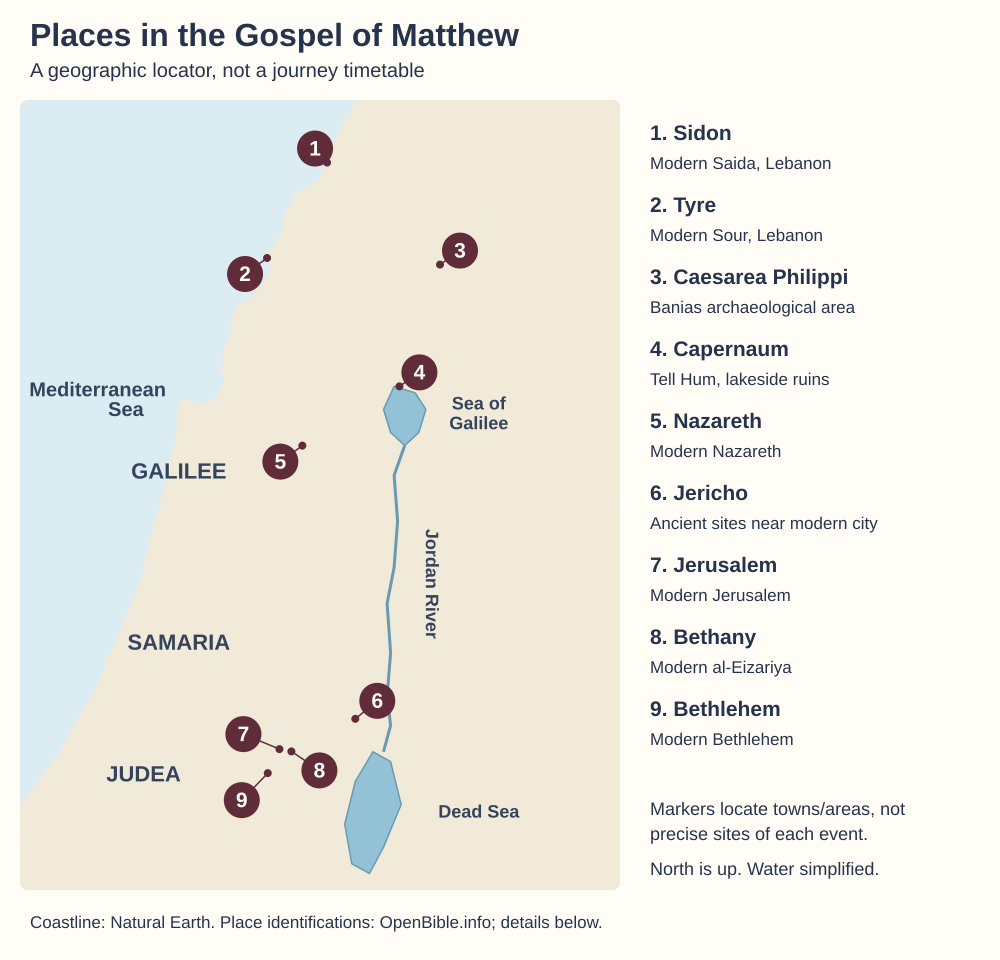
- Sidon and Tyre: modern Saida and Sour in Lebanon. Matthew 15:21 describes Jesus entering the district of these cities, not a detailed itinerary through both city centers.
- Caesarea Philippi: the Banias archaeological area. Jesus questions His disciples in the district (Matthew 16:13). The map does not claim an exact location for that conversation or the transfiguration.
- Capernaum: Tell Hum, on the northern shore of the Sea of Galilee, also called Lake Kinneret. Matthew 4:13 places Jesus here after leaving Nazareth.
- Nazareth: modern Nazareth, where Jesus grows up after the family’s return from Egypt (Matthew 2:19–23).
- Jericho: ancient settlement areas near the modern city. Different ancient sites and periods must not be collapsed into one precise point. Matthew 20:29 places the healing of two blind men as Jesus leaves Jericho.
- Jerusalem and Bethany: modern Jerusalem and nearby al-Eizariya, respectively. Bethany lies east of Jerusalem. These places frame the final days before Jesus’ death (Matthew 21:1–17; 26:6).
- Bethlehem: modern Bethlehem, south of Jerusalem, named as the place of Jesus’ birth (Matthew 2:1).
Beyond this map: Egypt lies to the southwest. Matthew 2:13–15 records the family taking refuge there but does not name their town or trace their route. The Magi come from the east (Matthew 2:1); their exact homeland is not identified. The wilderness temptation and several mountain settings likewise cannot be pinned to precise locations with certainty.
Reading the map: Numbered markers identify general locations, not exact event sites. No modern political boundaries, travel routes, or disputed territorial claims are implied.
Geographic outline: Natural Earth, public domain. Place identifications: OpenBible.info Bible Geocoding (CC BY); BiblePlaces: Caesarea Philippi; BiblePlaces: Jericho.
Companion resources
Explore these companion resources alongside this review:
Main teachings
Jesus fulfills God’s promises
Matthew places Jesus within the history of Abraham, David, exile, and promised restoration. Jesus is not a detached religious teacher. His coming carries forward God’s purposes for Israel and the nations. Fulfillment includes direct prediction and patterns that reach their goal in Him; each Old Testament passage deserves to be read in its own setting.
God is with us in Jesus
The opening identification of Jesus as Immanuel frames the whole Gospel. At the close the risen Lord promises His presence with His disciples (Matthew 28:20). His authority, compassion, forgiveness, and victory over death show why disciples can trust Him rather than merely admire Him.
The kingdom calls for repentance and faith
God’s reign draws near in the King. Jesus calls people to turn, follow, and live under His authority. The kingdom is present in His ministry and awaits its consummation. Neither political domination nor private self-improvement adequately describes it. Its blessings are received with the humility of those who need mercy.
Righteousness reaches the heart
Jesus fulfills rather than discards the Law and the Prophets. His teaching addresses anger, lust, truthfulness, enemies, prayer, possessions, and anxious hearts. Outward religious performance cannot substitute for love of God and neighbor. These demands expose our need and describe the life of those who belong to Him.
The King has authority and compassion
Jesus teaches, heals, forgives, confronts evil, and gathers the neglected. His signs reveal His identity and mercy; they are not a formula guaranteeing every requested healing now. His compassion also becomes a summons to pray for laborers and participate in the mission.
The kingdom is received with responsive hearing
The parables disclose the kingdom and expose resistance to it. The differing soils lead us to examine how we receive the word; later parables reveal its surpassing value and final separation. Not every narrative detail is a separate hidden code. Attend first to the point Jesus explains or the context makes clear.
Discipleship follows the crucified Messiah
Peter’s confession is followed by Jesus’ announcement of suffering and resurrection. A true confession of His identity must not reject His way. Taking up the cross means costly allegiance to Jesus, not simply enduring any inconvenience. His coming glory gives perspective to present sacrifice.
Greatness takes the form of humble service
Jesus teaches His people to receive the lowly, resist sin, seek the wandering, pursue reconciliation, and forgive. Discipline is not an excuse for humiliation, and forgiveness does not require concealing harm. The community of the King should reflect the mercy its members have received.
Love, truth, and watchfulness belong together
Love of God and neighbor sums up the Law and the Prophets. Jesus’ warnings against hypocrisy therefore expose religion that neglects justice, mercy, and faithfulness. His teaching about judgment calls for readiness, faithful service, and endurance, not confident date-setting or speculation that replaces obedience.
Jesus gives His life for sinners
The Last Supper interprets the coming death through covenant and forgiveness. Jesus willingly goes to the cross; His suffering is neither an accident nor approval of the injustice committed against Him. Matthew names particular actors, but supplies no warrant for blaming Jewish people collectively or persecuting any people.
The risen Lord sends disciples to all nations
The crucified Jesus has been raised. His commission rests on His authority and enduring presence. Disciple-making includes baptism and teaching obedience to all He commanded, not merely securing a momentary decision. Mission extends across nations without erasing the dignity of their peoples.
A prayer shaped by Matthew
Father, thank You for sending Jesus, Your promised Son and our Savior. Teach me to hear His words and do them. Forgive my pride, hidden hypocrisy, and reluctance to love those who are difficult to love. Make me humble, truthful, merciful, and ready to forgive. Help me seek Your kingdom rather than the approval and possessions of this world. Give me courage to follow Jesus when obedience is costly. Keep me watchful and faithful, trusting His death and resurrection rather than my own worthiness. Make my life useful in helping others know and follow Him. Thank You that He is with His people to the end of the age. In Jesus’ name, amen.
Find a topic
Jesus’ identity and fulfillment
Matthew 1:1–23; Matthew 2:1–23; Matthew 16:13–20
Prayer and daily trust
Matthew 6:5–34; Matthew 7:7–11
Hearing and doing
Matthew 7:15–27; Matthew 13:1–23
Mercy and forgiveness
Matthew 9:9–13; Matthew 18:15–35
Marriage and faithfulness
Matthew 5:27–32; Matthew 19:1–12
Wealth, service, and greatness
Matthew 6:19–24; Matthew 19:16–30; Matthew 20:20–28
Judgment and readiness
Matthew 24:1–51; Matthew 25:1–46
The cross, resurrection, and mission
Matthew 26:26–29; Matthew 27:32–66; Matthew 28:1–20
Follow the Gospel
The promised King brings God’s kingdom, gives His life, rises, and sends His disciples. The teaching, miracles, cross, and resurrection form one story, not disconnected lessons.
Matthew 1:1–2:23 — The promised King comes: ancestry, birth, worship, danger, and refuge
Matthew 3:1–4:25 — The King is revealed: baptism, temptation, proclamation, and calling
Matthew 5:1–7:29 — The King teaches the life of His kingdom
Matthew 8:1–10:42 — Authority, compassion, and the sending of the Twelve
Matthew 11:1–13:58 — Responses to Jesus and the mysteries of the kingdom
Matthew 14:1–17:27 — The Messiah revealed, opposed, and misunderstood
Matthew 18:1–20:34 — The humble and merciful life of the King’s people
Matthew 21:1–23:39 — The King enters Jerusalem and confronts unfaithfulness
Matthew 24:1–25:46 — Coming judgment, watchfulness, and faithful service
Matthew 26:1–27:66 — The King gives His life and is buried
Matthew 28:1–20 — The risen King commissions His disciples
Reading Matthew carefully
Read each instruction inside its paragraph and the Gospel as a whole. For example, Matthew 7:1 warns against condemning others hypocritically; Matthew 7:3–5 first calls for self-examination, while Matthew 7:15–20 still requires discernment about false prophets. Context prevents turning a saying into permission either to condemn carelessly or to ignore wrongdoing.
Matthew presents Jesus as Israel’s Messiah and the Savior whose mission reaches all nations. Jesus, His disciples, and the first believers were Jewish. The conflicts described here do not justify hostility toward Jewish people. Matthew 27:25 is not permission to assign inherited guilt to any ethnic or religious group.
Matthew 12:47, Matthew 17:21, Matthew 18:11, and Matthew 23:14 are familiar verse numbers omitted from the ESV main text used by this reader because of manuscript evidence. This review preserves the numbering and explains the issue. The longer doxology often prayed at Matthew 6:13 is not part of the ESV main text. A textual variant should be acknowledged rather than silently presented as undisputed Scripture.
Christians differ over aspects of Matthew 16:18, marriage and divorce in Matthew 19:3–12, and the relationship of Jerusalem’s destruction to Christ’s return in Matthew 24. The notes identify significant alternatives where needed without treating every question as settled. Matthew 24:36 rules out confident claims to know the day or hour.
Study every verse
Read the verse and its paragraph before the note. The commentary should help you understand the speaker, hearers, setting, and point, not replace your reading of Scripture.
Each entry includes two related passages and, where present in the ESV main text, Greek words behind selected English wording. Greek meanings are contextual explanations, not claims that a word means everything in its dictionary entry at once.
Living the Word: James 1:22 calls us to be doers, not hearers only. Selected passages ask what we should obey, turn from, or trust. Our response is to God’s grace, not a way to purchase it.
Chapter 1 — The promised Son and Immanuel
Matthew 1:1–25 · Greek interlinear
Matthew 1:1
Read the verse: Matthew 1:1 BLB
Study notes
Matthew introduces Jesus as Israel's promised Messiah, descended from David and Abraham. The genealogy places His coming within God’s covenant promises rather than presenting Him as an isolated religious teacher. The royal and Abrahamic titles prepare us for a King whose saving mission will ultimately extend to the nations.
English wording → Greek word → meaning
- “genealogy” → genesis → origin or family descent; here the account of Jesus' lineage
Read alongside
2 Samuel 7:12–16 BLB — God promises David an enduring royal house.
Genesis 12:1–3 BLB — God promises blessing through Abraham to the families of the earth.
Matthew 1:2
Read the verse: Matthew 1:2 BLB
Study notes
Abraham, Isaac, Jacob, and Judah trace the chosen family through which God’s promise advances. Mentioning Judah's brothers reminds us that Jesus' story belongs to Israel's wider story. This lineage is not a list of morally flawless people; the Genesis accounts show God’s faithfulness through troubled family relationships and human failures.
English wording → Greek word → meaning
- “the father of” → gennao → to beget; here to stand in the line of ancestry
Read alongside
Genesis 21:1–3 BLB — Isaac's birth fulfills God’s promise to Abraham and Sarah.
Genesis 49:8–10 BLB — Jacob's words associate Judah with royal leadership.
Matthew 1:3
Read the verse: Matthew 1:3 BLB
Study notes
Tamar's name recalls a painful episode involving Judah and his daughter-in-law. Matthew includes her rather than smoothing the family history into a tale of respectability. The genealogy displays God’s working through complicated circumstances, but inclusion in the Messiah's ancestry does not mean that every action in those circumstances was approved.
English wording → Greek word → meaning
- “Tamar” → Thamar → the Greek form of the name Tamar
Read alongside
Genesis 38:24–30 BLB — Tamar bears Perez and Zerah after Judah acknowledges his wrongdoing.
Ruth 4:12 BLB — Perez's family becomes an example of a household God established.
Matthew 1:4
Read the verse: Matthew 1:4 BLB
Study notes
These less familiar names connect the patriarchal family with the generation associated with Israel's wilderness journey. Matthew's repeated pattern stresses continuity across generations we know little about. God’s faithfulness does not depend on each person's prominence, and the ancestry should be read as purposeful historical lineage, not a hidden code for predicting events.
English wording → Greek word → meaning
- “the father of” → gennao → to beget or be an ancestor in the line
Read alongside
Numbers 1:7 BLB — Nahshon, son of Amminadab, represents Judah.
Ruth 4:19–20 BLB — The same ancestral sequence links Perez's family to David.
Matthew 1:5
Read the verse: Matthew 1:5 BLB
Study notes
Rahab and Ruth recall God’s welcome of people associated with nations outside Israel. Ruth's loyal commitment and God’s provision through Boaz become part of the royal line. Their presence anticipates Matthew's wider mission to the nations without reducing their individual histories to the same circumstances or claiming their inclusion erases Israel's covenant story.
English wording → Greek word → meaning
- “Ruth” → Rhouth → the Greek form of the name Ruth
Read alongside
Joshua 6:22–25 BLB — Rahab and her household are spared when Jericho falls.
Ruth 4:13–17 BLB — Ruth and Boaz become parents of Obed, David's grandfather.
Matthew 1:6
Read the verse: Matthew 1:6 BLB
Study notes
David is explicitly called king, marking the royal significance of this genealogy. Yet the reference to Uriah's wife also recalls David's grave sin. Matthew holds royal promise and moral failure together: the Messiah comes through David's house, but He is not merely another David whose position excuses abuse or concealment.
English wording → Greek word → meaning
- “king” → basileus → a ruler; here David as Israel's king
Read alongside
2 Samuel 11:26–27 BLB — David takes Uriah's wife, and his actions displease the Lord.
2 Samuel 7:12–13 BLB — God promises David a royal descendant and an enduring throne.
Matthew 1:7
Read the verse: Matthew 1:7 BLB
Study notes
The royal line proceeds through Rehoboam and Abijah into the divided kingdom. These names locate Jesus within Judah's history, including the consequences of failed leadership. Some Greek manuscripts preserve the spelling Asaph where the Old Testament king is Asa; this naming detail does not require identifying the king with the psalmist.
English wording → Greek word → meaning
- “the father of” → gennao → to beget; to continue a family line
Read alongside
1 Kings 12:16–20 BLB — The kingdom divides during Rehoboam's rule.
1 Chronicles 3:10 BLB — The royal genealogy identifies Rehoboam, Abijah, and Asa.
Matthew 1:8
Read the verse: Matthew 1:8 BLB
Study notes
Matthew's genealogy is selective. Between Joram and Uzziah, the Old Testament records additional kings not named here. Such compression serves the structured presentation in verse 17 rather than claiming every generation is listed. The line still connects Jesus with Judah's royal house through periods of both faithfulness and rebellion.
English wording → Greek word → meaning
- “the father of” → gennao → to beget or be an ancestor; genealogies may omit intermediate generations
Read alongside
1 Chronicles 3:11–12 BLB — The fuller royal list includes generations omitted in Matthew.
2 Chronicles 26:1–5 BLB — Uzziah's reign belongs to the continuing Davidic dynasty.
Matthew 1:9
Read the verse: Matthew 1:9 BLB
Study notes
Uzziah, Jotham, Ahaz, and Hezekiah span contrasting forms of kingship. The genealogy does not pause to judge each reign, but the Old Testament records both trust and unfaithfulness among them. The promised King will answer the need exposed by this mixed history, not merely inherit a record of uninterrupted righteousness.
English wording → Greek word → meaning
- “the father of” → gennao → to beget; here the royal succession in a family line
Read alongside
2 Kings 16:1–4 BLB — Ahaz's reign is marked by serious unfaithfulness.
2 Kings 18:1–7 BLB — Hezekiah is commended for trusting the Lord.
Matthew 1:10
Read the verse: Matthew 1:10 BLB
Study notes
The line includes Manasseh's notorious evil and Josiah's reforms. God’s promise continues through a family whose members differ sharply in their response to Him. Matthew's spelling Amos in the ESV reflects the Greek textual form; the royal ancestor corresponds to Amon in the Old Testament, not necessarily to the prophet Amos.
English wording → Greek word → meaning
- “Manasseh” → Manasses → the Greek form of the royal name Manasseh
Read alongside
2 Kings 21:1–9 BLB — Manasseh leads Judah into grave sin.
2 Kings 22:1–2 BLB — Josiah turns toward the Lord rather than following those failures.
Matthew 1:11
Read the verse: Matthew 1:11 BLB
Study notes
The exile interrupts the visible security of David's kingdom. Jechoniah and his contemporaries stand at the point where royal privilege cannot avert God’s judgment. Matthew's genealogy acknowledges that national catastrophe, preparing readers to see Jesus as the fulfillment of promises that survived the loss of land, throne, and independence.
English wording → Greek word → meaning
- “deportation” → metoikesia → forced relocation; here exile to Babylon
Read alongside
2 Kings 24:12–16 BLB — Jehoiachin and many Judeans are carried into Babylonian exile.
Jeremiah 29:10–14 BLB — God promises restoration after exile rather than final abandonment.
Matthew 1:12
Read the verse: Matthew 1:12 BLB
Study notes
After deportation, the ancestral line continues. Zerubbabel evokes return and rebuilding, though the restored community did not regain the former monarchy. God preserved His people through exile and partial restoration while they still awaited fuller fulfillment. Matthew connects that unfinished history with the arrival of Jesus the Messiah.
English wording → Greek word → meaning
- “after” → meta → following; here after the Babylonian deportation
Read alongside
Ezra 3:2 BLB — Zerubbabel participates in restoring worship after the return.
Haggai 2:20–23 BLB — God addresses Zerubbabel with hope concerning His sovereign purposes.
Matthew 1:13
Read the verse: Matthew 1:13 BLB
Study notes
These names move the genealogy beyond the widely known kings into less documented generations. Matthew does not supply biographies for them, and we should not invent character lessons from their names. Their place in the line continues the central claim: God’s covenant purpose reached Jesus through real generations, including people not prominent in Scripture's narratives.
English wording → Greek word → meaning
- “the father of” → gennao → to beget or be an ancestor in the genealogy
Read alongside
Matthew 1:17 BLB — Matthew explains the deliberate structure of the genealogy.
Luke 1:68–73 BLB — The coming salvation is celebrated as faithfulness to God’s ancient promises.
Matthew 1:14
Read the verse: Matthew 1:14 BLB
Study notes
The repeated family links carry the promise forward during generations without a ruling Davidic king. Matthew gives no separate deeds or sayings for these men. The point is therefore the continuity of the lineage, not speculative meanings drawn from each name or a claim that obscurity means their lives were unimportant to God.
English wording → Greek word → meaning
- “the father of” → gennao → to beget; the repeated expression connecting generations
Read alongside
2 Samuel 7:16 BLB — The Davidic promise provides the royal background of this line.
Matthew 1:1 BLB — The genealogy's opening identifies the Messiah as David's and Abraham's descendant.
Matthew 1:15
Read the verse: Matthew 1:15 BLB
Study notes
The genealogy draws near to Joseph, bringing its long sweep of history into the household where Jesus will be raised. Matthew's purpose remains focused on the Messiah rather than giving complete personal histories of every ancestor. The succession prepares for the deliberate change of wording when Jesus' birth is described in the next verse.
English wording → Greek word → meaning
- “the father of” → gennao → to beget; here the final generations before Joseph
Read alongside
Matthew 1:16 BLB — The wording changes when Matthew reaches Jesus' birth.
Luke 1:32–33 BLB — The promised child will receive David's throne and reign without end.
Matthew 1:16
Read the verse: Matthew 1:16 BLB
Study notes
Matthew calls Joseph Mary's husband but does not say Joseph fathered Jesus. The feminine singular expression behind 'of whom' points to Mary, preparing for the explanation of the virgin conception. Joseph's place in the royal genealogy and Jesus' extraordinary origin belong together without making Joseph His biological father.
English wording → Greek word → meaning
- “was born” → gennao → to be born; the passive form here describes Jesus' birth from Mary
Read alongside
Luke 1:34–35 BLB — Mary is told that her child will be conceived by the Holy Spirit.
Matthew 1:20–21 BLB — Joseph learns the child's divine origin and receives responsibility to name Him.
Matthew 1:17
Read the verse: Matthew 1:17 BLB
Study notes
Matthew arranges the genealogy in three groups of fourteen around Abraham, David, and the exile. This is a deliberate theological and literary structure, not proof that no ancestors were omitted. It highlights the promise, monarchy, exile, and arrival of the Messiah. Proposed symbolism should be distinguished from what Matthew explicitly explains.
English wording → Greek word → meaning
- “generations” → genea → successive generations in an ancestral line
Read alongside
1 Chronicles 3:10–16 BLB — The fuller royal genealogy helps readers recognize Matthew's selectivity.
Matthew 1:1 BLB — The genealogy's principal covenant landmarks are named at its beginning.
Matthew 1:18
Read the verse: Matthew 1:18 BLB
Study notes
Mary's pregnancy occurs before she and Joseph live together as husband and wife. Matthew attributes it to the Holy Spirit, not to an ordinary human father. This explains the genealogy's unusual wording and frames the coming child as God’s initiative for salvation. The narrative gives no support for treating conception as sexual activity between God and Mary.
English wording → Greek word → meaning
- “Holy Spirit” → pneuma hagion → God’s Spirit, named as the source of the conception
Read alongside
Luke 1:34–38 BLB — The angel explains the Spirit's work and Mary responds in trust.
Galatians 4:4–5 BLB — God sends His Son, born of woman, to redeem His people.
Matthew 1:19
Read the verse: Matthew 1:19 BLB
Study notes
Joseph intends a quiet divorce rather than public humiliation. Betrothal carried binding obligations, so separation required more than ending a casual engagement. The verse presents his righteousness alongside reluctance to expose Mary to disgrace. Before the angel speaks, Joseph does not yet understand the miraculous cause of the pregnancy.
English wording → Greek word → meaning
- “just” → dikaios → righteous; concerned to act rightly before God
Read alongside
Deuteronomy 24:1 BLB — Divorce language belongs to a binding marital relationship.
Matthew 1:24 BLB — Joseph's eventual action responds to God’s clarified instruction.
Matthew 1:20
Read the verse: Matthew 1:20 BLB
Study notes
God addresses Joseph's fear through an angelic message. Calling him son of David reconnects the immediate crisis with the royal genealogy. He is told not to reject Mary because the child's origin is the Holy Spirit. Divine reassurance directs a particular act of obedience; it is not a general rule that all dreams carry revelation.
English wording → Greek word → meaning
- “angel” → angelos → a messenger; here a messenger of the Lord
Read alongside
Luke 1:35 BLB — Gabriel likewise identifies the Holy Spirit's role in Jesus' conception.
Matthew 2:13 BLB — Another specific angelic warning directs Joseph to protect the child.
Matthew 1:21
Read the verse: Matthew 1:21 BLB
Study notes
The name Jesus is linked with His saving mission. Matthew identifies sin, not merely political oppression, as the bondage He comes to overcome. His people need rescue that reaches guilt and wrongdoing. The verse anticipates the cross and the new-covenant forgiveness later explained at the Last Supper.
English wording → Greek word → meaning
- “save” → sozo → to rescue; here deliverance from sins
Read alongside
Matthew 26:28 BLB — Jesus connects His poured-out blood with forgiveness of sins.
Psalm 130:7–8 BLB — The Lord promises redemption for Israel from its iniquities.
Matthew 1:22
Read the verse: Matthew 1:22 BLB
Study notes
Matthew interprets the birth within God’s word spoken through the prophet. Fulfillment is not an accidental resemblance discovered after the fact but a central way he presents Jesus' identity. The following quotation must be read both in Isaiah's original setting and in Matthew's claim that Jesus brings its deepest realization.
English wording → Greek word → meaning
- “fulfill” → pleroo → to bring to fulfillment; God’s earlier word reaches its intended realization
Read alongside
Isaiah 7:10–14 BLB — The sign of Immanuel is first given in Isaiah's historical setting.
Matthew 5:17 BLB — Jesus describes His mission as fulfilling the Law and Prophets.
Matthew 1:23
Read the verse: Matthew 1:23 BLB
Study notes
Matthew interprets Jesus' birth through the promise of Immanuel. The name's significance is God’s presence with His people, not a prediction that every person would normally address Jesus by that name. The virgin conception and the child's identity belong to the Gospel's opening declaration, echoed by Jesus' lasting presence at its close.
English wording → Greek word → meaning
- “Immanuel” → Emmanouel → a Hebrew name rendered in Greek and explained as God with us
Read alongside
Isaiah 7:14 BLB — The prophetic sign supplies the wording quoted here.
Matthew 28:20 BLB — The risen Jesus promises His presence with His disciples to the end.
Matthew 1:24
Read the verse: Matthew 1:24 BLB
Study notes
Joseph's response turns received guidance into action: he takes Mary as his wife. His obedience protects the family from the course he had previously considered. Matthew does not describe all the social cost, but Joseph acts on God’s word rather than requiring public vindication before doing what he has been told.
English wording → Greek word → meaning
- “commanded” → prostasso → to direct or give an instruction
Read alongside
Luke 1:38 BLB — Mary likewise receives God’s announced purpose with submission.
James 1:22 BLB — God’s word calls for doing, not hearing alone.
Matthew 1:25
Read the verse: Matthew 1:25 BLB
Study notes
Joseph does not have sexual relations with Mary before Jesus' birth, and he gives the child the commanded name. This reinforces the account of virginal conception. The word 'until' identifies the period in view; this sentence alone should not be made to settle every later question about Mary's marital life.
English wording → Greek word → meaning
- “knew” → ginosko → to know; here a customary expression for marital sexual relations
Read alongside
Luke 1:31 BLB — The announced name Jesus precedes His birth.
Matthew 1:21 BLB — Joseph follows the instruction to name the saving child Jesus.
Chapter 2 — Worship, danger, and the return from Egypt
Matthew 2:1–23 · Greek interlinear
Matthew 2:1
Read the verse: Matthew 2:1 BLB
Study notes
Jesus is born in Bethlehem during Herod's reign, and visitors from the east arrive seeking Him. Matthew neither names three visitors nor calls them kings; the familiar number comes from the three kinds of gifts. Their journey introduces Gentile recognition of Israel's King in contrast with the hostility that follows.
English wording → Greek word → meaning
- “wise men” → magos → Magi; eastern learned men associated with observing signs and the heavens
Read alongside
Micah 5:2 BLB — Bethlehem is identified with the promised ruler.
Matthew 28:19 BLB — The Gospel will end with a mission extending to all nations.
Matthew 2:2
Read the verse: Matthew 2:2 BLB
Study notes
The visitors seek the child born King of the Jews and explain that they saw His star. Their purpose is homage, not curiosity alone. Matthew does not identify the astronomical mechanism or authorize astrology as a guide to Christian life. The narrative directs attention to the King whom God brings them to seek.
English wording → Greek word → meaning
- “worship” → proskyneo → to bow before someone in homage or worship
Read alongside
Numbers 24:17 BLB — A star and scepter appear in a prophecy of Israel's ruler.
Matthew 27:37 BLB — The title King of the Jews reappears above Jesus' cross.
Matthew 2:3
Read the verse: Matthew 2:3 BLB
Study notes
Herod responds to news of another king with alarm rather than joy. Jerusalem shares the disturbance, perhaps anticipating political trouble, but Matthew does not explain every person's motive. The contrast with the visitors warns that proximity to biblical knowledge and religious institutions does not guarantee a welcoming response to God’s Messiah.
English wording → Greek word → meaning
- “troubled” → tarasso → to disturb or unsettle
Read alongside
Psalm 2:1–3 BLB — Earthly rulers resist the Lord and His Anointed.
Luke 2:34–35 BLB — Jesus' coming exposes opposition and the thoughts of hearts.
Matthew 2:4
Read the verse: Matthew 2:4 BLB
Study notes
Herod consults those able to identify the scriptural birthplace of the Messiah. His question connects the visitors' royal title with Israel's messianic expectation. Accurate religious information can be used for corrupt purposes, so possessing the right answer is not the same as submitting to the One about whom Scripture speaks.
English wording → Greek word → meaning
- “Christ” → Christos → Anointed One; the Messiah
Read alongside
John 5:39–40 BLB — Jesus distinguishes searching Scripture from coming to Him for life.
Micah 5:2 BLB — The prophetic text gives the promised ruler's birthplace.
Matthew 2:5
Read the verse: Matthew 2:5 BLB
Study notes
The religious leaders identify Bethlehem from the prophetic text. Their answer shows that the Messiah's arrival is not detached from Israel's Scriptures. Yet knowledge of the prophecy does not itself describe their response to the child. Matthew places fulfilled Scripture at the center of the story while exposing the inadequacy of information without faithful response.
English wording → Greek word → meaning
- “prophet” → prophetes → one who speaks God’s message
Read alongside
Micah 5:2 BLB — Micah connects Bethlehem with a ruler for Israel.
Luke 24:27 BLB — Jesus later explains the Scriptures concerning Himself.
Matthew 2:6
Read the verse: Matthew 2:6 BLB
Study notes
The quotation presents Bethlehem's ruler as a shepherd for God’s people, combining prophetic and Davidic language. His greatness will be measured differently from Herod's violent grasp on power. Matthew's wording draws attention to the humble town's significance because the promised ruler comes from it, not because it was politically impressive.
English wording → Greek word → meaning
- “shepherd” → poimaino → to tend or govern as a shepherd
Read alongside
Micah 5:2–4 BLB — The promised ruler stands and shepherds in the Lord's strength.
2 Samuel 5:2 BLB — David is called to shepherd Israel.
Matthew 2:7
Read the verse: Matthew 2:7 BLB
Study notes
Herod privately obtains information about when the star appeared. In isolation this could look like responsible inquiry, but the later command to kill the children exposes his purpose. Matthew lets the unfolding narrative interpret his careful questioning. Not every detailed interest in Jesus arises from a desire to honor Him.
English wording → Greek word → meaning
- “ascertained” → akriboo → to establish carefully or precisely
Read alongside
Matthew 2:16 BLB — Herod uses the timing information in his violent order.
Psalm 10:7–10 BLB — The wicked conceal destructive intentions while targeting the vulnerable.
Matthew 2:8
Read the verse: Matthew 2:8 BLB
Study notes
Herod's request borrows the language of worship to conceal murderous intent. The contrast warns against assuming that religious words prove a faithful heart. The visitors are asked to locate the child and report back, but God’s later warning prevents their becoming instruments of Herod's hostility.
English wording → Greek word → meaning
- “diligently” → akribos → carefully or accurately
Read alongside
Matthew 2:12 BLB — God warns the visitors not to return to Herod.
Proverbs 26:24–26 BLB — Hateful intentions can be disguised by outward speech.
Matthew 2:9
Read the verse: Matthew 2:9 BLB
Study notes
The visitors leave the king and receive further guidance toward Jesus. Matthew describes the star's movement and stopping without explaining its physical nature. The point is God’s successful direction of their search. Attempts to identify a precise astronomical event should be presented as proposals, not conclusions demanded by this account.
English wording → Greek word → meaning
- “star” → aster → a star or celestial light described as guiding the visitors
Read alongside
Matthew 2:2 BLB — The visitors initially associate the star with the King's birth.
Psalm 72:10–11 BLB — The royal psalm pictures distant rulers bringing homage.
Matthew 2:10
Read the verse: Matthew 2:10 BLB
Study notes
Their great joy contrasts with Herod's troubled response. Matthew emphasizes their delight at being guided toward the child rather than an entitlement based on nationality or status. The joy is tied to encountering the King; the narrative does not promise that every sincere search will be accompanied by a comparable visible sign.
English wording → Greek word → meaning
- “rejoiced” → chairo → to experience joy or gladness
Read alongside
Luke 2:10–11 BLB — The announcement of the Savior’s birth brings great joy.
Matthew 13:44 BLB — Finding the kingdom is compared with discovering a treasure that brings joy.
Matthew 2:11
Read the verse: Matthew 2:11 BLB
Study notes
The visitors enter a house, see the child with Mary, bow, and offer gifts. Matthew names gold, frankincense, and myrrh without assigning each an explicit symbolic meaning. The scene centers on costly homage to Jesus. It should not be flattened into details about a stable or the exact timing that Matthew does not give.
English wording → Greek word → meaning
- “treasures” → thesauros → stored valuables or precious possessions
Read alongside
Isaiah 60:6 BLB — The prophetic picture includes nations bringing gold and frankincense.
Psalm 72:15 BLB — Gifts and praise accompany honor to the king.
Matthew 2:12
Read the verse: Matthew 2:12 BLB
Study notes
The visitors obey God’s warning and return by another route. Their refusal to serve Herod's plan follows a specific revelation in this narrative, not an invitation to disregard ordinary responsibilities whenever a feeling arises. God preserves the child while exposing the limits of the ruler's power and deceit.
English wording → Greek word → meaning
- “warned” → chrematizo → to receive a divine warning or instruction
Read alongside
Matthew 2:8 BLB — Herod's earlier request provides the immediate danger behind the warning.
Acts 5:29 BLB — When commands conflict, obedience to God takes priority over human authority.
Matthew 2:13
Read the verse: Matthew 2:13 BLB
Study notes
Joseph receives a concrete instruction to take Jesus and Mary to Egypt because Herod intends to kill the child. Divine protection here includes urgent flight rather than immunity from danger. The Messiah's early life identifies Him with vulnerable people forced from home; the verse does not romanticize that danger or suffering.
English wording → Greek word → meaning
- “flee” → pheugo → to escape or seek safety from danger
Read alongside
Hosea 11:1 BLB — Israel's departure from Egypt provides the pattern Matthew soon invokes.
Matthew 10:23 BLB — Jesus later permits His disciples to flee persecution.
Matthew 2:14
Read the verse: Matthew 2:14 BLB
Study notes
Joseph acts promptly, taking the child and His mother away by night. Matthew gives the essentials without describing the route, companions, or length of travel. His action shows obedient care in a threatening situation. Trust in God’s promise is expressed through practical protection, not refusal to take the danger seriously.
English wording → Greek word → meaning
- “night” → nyx → nighttime; the time of Joseph's departure
Read alongside
Matthew 1:24 BLB — Joseph earlier responded obediently to God’s direction.
Proverbs 22:3 BLB — Prudence recognizes danger and seeks refuge.
Matthew 2:15
Read the verse: Matthew 2:15 BLB
Study notes
Hosea originally spoke of Israel's exodus. Matthew sees that history brought to its fullest meaning in Jesus, God’s Son, who comes out of Egypt. This is a pattern of fulfillment, not a claim that Hosea's original sentence had no reference to Israel. Jesus enters His people's story and fulfills their calling.
English wording → Greek word → meaning
- “son” → huios → a son; here Jesus as the true Son who fulfills Israel's pattern
Read alongside
Hosea 11:1 BLB — God recalls calling Israel, His son, out of Egypt.
Exodus 4:22–23 BLB — Israel is called God’s firstborn son in the exodus confrontation.
Matthew 2:16
Read the verse: Matthew 2:16 BLB
Study notes
Herod's anger becomes violence against Bethlehem's young boys. Matthew connects the chosen age range with the information obtained from the visitors, not with a precise statement of Jesus' age. The account exposes tyrannical evil; it never portrays the killing as justified by God’s saving purpose or as the mothers' fault.
English wording → Greek word → meaning
- “furious” → thymoo → to become enraged
Read alongside
Exodus 1:15–22 BLB — Pharaoh likewise directs violence against Hebrew male children.
Matthew 2:13 BLB — The earlier warning identifies Herod's purpose to destroy Jesus.
Matthew 2:17
Read the verse: Matthew 2:17 BLB
Study notes
Matthew connects this grief with Jeremiah's portrayal of Rachel mourning her children. Fulfillment here does not turn lament into approval of murder. Israel's history of loss is heard again in Bethlehem's suffering, while Jeremiah's surrounding promise of restoration reminds readers that lament need not be the final word.
English wording → Greek word → meaning
- “fulfilled” → pleroo → to bring an earlier scriptural pattern to realization
Read alongside
Jeremiah 31:15–17 BLB — Rachel's lament is followed by hope for restoration.
Romans 12:15 BLB — God’s people are called to weep with those who weep.
Matthew 2:18
Read the verse: Matthew 2:18 BLB
Study notes
Rachel represents Israel's mothers in a quotation filled with inconsolable loss. Matthew does not hurry past their grief to make the story comfortable. The innocent victims matter, even as God preserves Jesus. Christian hope does not require denying the reality of bereavement or rebuking those whose sorrow is profound.
English wording → Greek word → meaning
- “weeping” → klauthmos → mourning expressed in tears
Read alongside
Jeremiah 31:15 BLB — The original prophetic lament names Rachel's tears.
Revelation 21:4 BLB — God’s final restoration includes the removal of death and tears.
Matthew 2:19
Read the verse: Matthew 2:19 BLB
Study notes
Herod's death changes the circumstances, and God again directs Joseph through an angelic dream. The violent king's authority is temporary, whereas God’s purpose for Jesus continues. Matthew does not give a date in this verse; historical dating must be argued from additional evidence rather than treated as part of the wording.
English wording → Greek word → meaning
- “died” → teleutao → to come to the end of life
Read alongside
Psalm 146:3–4 BLB — Human rulers and their plans pass away.
Matthew 2:13 BLB — The original flight was to last until further divine direction.
Matthew 2:20
Read the verse: Matthew 2:20 BLB
Study notes
Joseph is told to return because those seeking the child's life are dead. The wording recalls Moses' return after his enemies had died. Matthew thus places Jesus within Israel's deliverance history while keeping the practical emphasis on protecting the child. The return is commanded, not merely Joseph's guess that conditions have improved.
English wording → Greek word → meaning
- “life” → psyche → life or living self; here the child's life threatened by enemies
Read alongside
Exodus 4:19 BLB — Moses is told that those seeking his life are dead.
Matthew 2:15 BLB — The return brings the out-of-Egypt pattern to completion.
Matthew 2:21
Read the verse: Matthew 2:21 BLB
Study notes
Joseph takes the child and His mother back to Israel in obedience to the message. The repeated description keeps Jesus and Mary's safety central. The family has returned to the covenant land, but the next verses show that danger has not simply vanished. Faithfulness still involves attention to changing local circumstances.
English wording → Greek word → meaning
- “land” → ge → land or territory; here Israel
Read alongside
Matthew 2:20 BLB — Joseph follows the specific instruction to return.
Luke 2:39 BLB — Luke also locates the family's eventual home in Nazareth of Galilee.
Matthew 2:22
Read the verse: Matthew 2:22 BLB
Study notes
Archelaus's rule makes Joseph afraid to settle in Judea, and a warning directs him toward Galilee. God uses both the family's awareness of danger and His particular guidance. This verse does not praise reckless exposure to threats. Joseph's care contributes to the setting in which Jesus' public identity will develop.
English wording → Greek word → meaning
- “withdrew” → anachoreo → to depart or withdraw to another place
Read alongside
Matthew 4:12–13 BLB — Jesus' later ministry is likewise centered initially in Galilee.
Proverbs 14:16 BLB — Wisdom includes turning away from danger rather than careless confidence.
Matthew 2:23
Read the verse: Matthew 2:23 BLB
Study notes
Jesus grows up in Nazareth and becomes known as a Nazarene. Matthew speaks of the prophets in the plural; no surviving Old Testament verse contains this exact sentence. The fulfillment may gather broader prophetic themes, including humble or despised origins. We should not invent a missing quotation or equate Nazarene automatically with a Nazirite vow.
English wording → Greek word → meaning
- “Nazarene” → Nazoraios → a designation identifying Jesus with Nazareth
Read alongside
John 1:45–46 BLB — Nazareth is associated with skepticism when Jesus is first announced.
Isaiah 53:2–3 BLB — The servant is described as lacking outward prestige and being despised.
Chapter 3 — Prepare the way of the Lord
Matthew 3:1–17 · Greek interlinear
Matthew 3:1
Read the verse: Matthew 3:1 BLB
Study notes
John appears in the wilderness rather than at a center of power. His preaching prepares Israel for the arrival of God’s kingdom and its King. The setting recalls Israel's earlier wilderness experiences, but the emphasis falls on God’s present summons. Ancestry and religious familiarity cannot replace the response John's message demands.
English wording → Greek word → meaning
- “preaching” → kerysso → publicly proclaim a message
Read alongside
Isaiah 40:3 BLB — The wilderness herald prepares the Lord's way.
Malachi 3:1 BLB — God promises a messenger who prepares His coming.
Matthew 3:2
Read the verse: Matthew 3:2 BLB
Study notes
The nearness of God’s kingdom calls for a changed response to God, not merely curiosity about future events. Repentance includes acknowledging sin and turning from it; it is more than regret at consequences. John announces the kingdom, while the following narrative identifies Jesus as the One whose arrival gives the announcement its urgency.
English wording → Greek word → meaning
- “Repent” → metanoeo → turn from sin toward God
Read alongside
Matthew 4:17 BLB — Jesus begins His public preaching with the same kingdom summons.
Acts 26:20 BLB — Repentance is expressed in turning to God and corresponding deeds.
Matthew 3:3
Read the verse: Matthew 3:3 BLB
Study notes
Matthew identifies John as Isaiah's wilderness voice. Preparing the Lord's way concerns the people's readiness to receive Him, not construction of a literal highway. Isaiah's promise of restoration gains fresh significance as John announces Jesus. Matthew places Jesus' arrival within the story of God’s promised coming to save and rule His people.
English wording → Greek word → meaning
- “Prepare” → hetoimazo → make ready
Read alongside
Isaiah 40:3–5 BLB — The original promise announces the Lord's coming and revealed glory.
Luke 1:76–77 BLB — John's calling is to prepare the Lord's ways and announce salvation.
Matthew 3:4
Read the verse: Matthew 3:4 BLB
Study notes
John's clothing and wilderness diet mark an austere prophetic ministry rather than fashionable religious prestige. His appearance particularly recalls Elijah. Matthew does not command every believer to adopt John's diet or wardrobe; the details identify the kind of messenger God has sent and contrast his ministry with the comforts of royal courts.
English wording → Greek word → meaning
- “garment” → endyma → clothing
Read alongside
2 Kings 1:8 BLB — Elijah is recognized by his distinctive clothing and leather belt.
Matthew 11:7–14 BLB — Jesus explains John's prophetic significance rather than praising luxury.
Matthew 3:5
Read the verse: Matthew 3:5 BLB
Study notes
People travel from Jerusalem and the surrounding region to hear John. The widespread response shows the force of his ministry, but geographical breadth does not mean every individual repented. Matthew next describes both confession and confrontation. Crowds around a preacher are not, by themselves, evidence that everyone understands or obeys the message.
English wording → Greek word → meaning
- “going out” → ekporeuomai → go out or depart
Read alongside
Mark 1:5 BLB — Mark likewise describes the broad response to John's wilderness ministry.
Matthew 3:7–10 BLB — John challenges hearers whose lives do not demonstrate repentance.
Matthew 3:6
Read the verse: Matthew 3:6 BLB
Study notes
Those receiving John's baptism acknowledge their sins. The washing is joined to repentance rather than treated as a religious performance that makes honesty unnecessary. John prepares people for the greater One who follows him. Christian readers should notice the importance of confession without collapsing every distinction between John's preparatory baptism and later baptism in Jesus' name.
English wording → Greek word → meaning
- “confessing” → exomologeo → openly acknowledge or confess
Read alongside
Acts 19:3–5 BLB — Paul distinguishes John's baptism from baptism connected with faith in Jesus.
1 John 1:9 BLB — Confession accompanies reliance on God’s forgiveness and cleansing.
Matthew 3:7
Read the verse: Matthew 3:7 BLB
Study notes
John's sharp warning confronts religious leaders approaching his baptism. The question exposes the danger of seeking safety from judgment without genuine repentance. His language is prophetic confrontation in a particular setting, not permission for believers to insult opponents indiscriminately. Religious office and group membership cannot shelter an unchanged heart from God’s righteous assessment.
English wording → Greek word → meaning
- “wrath” → orge → God’s righteous judgment against evil
Read alongside
Luke 3:7–9 BLB — Luke records the warning together with its call for fruitful repentance.
Romans 2:3–5 BLB — Presuming upon God’s kindness while refusing repentance stores up judgment.
Matthew 3:8
Read the verse: Matthew 3:8 BLB
Study notes
John calls for conduct consistent with repentance. Fruit does not purchase God’s mercy; it reveals that the turning being professed is real. In context, religious identity and participation in baptism cannot substitute for changed behavior. The demand invites honest examination of habits, relationships, and treatment of others rather than confident reliance on a spiritual label.
English wording → Greek word → meaning
- “fruit” → karpos → observable results of repentance
Read alongside
Luke 3:10–14 BLB — John illustrates repentance through generosity, honesty, and contentment.
James 2:17 BLB — A claim to faith without corresponding action is lifeless.
Matthew 3:9
Read the verse: Matthew 3:9 BLB
Study notes
Descent from Abraham is a privilege but cannot be used as a guarantee against judgment. John emphasizes God’s freedom and power to raise up Abraham's children. His warning opposes presumption, not the worth of Jewish people. The question is whether hearers respond to God faithfully rather than relying on inherited religious standing.
English wording → Greek word → meaning
- “children” → teknon → children or descendants
Read alongside
John 8:39–40 BLB — Jesus challenges conduct inconsistent with claiming Abraham as father.
Romans 9:6–8 BLB — Paul distinguishes physical descent from the children of God’s promise.
Matthew 3:10
Read the verse: Matthew 3:10 BLB
Study notes
The axe at the root pictures judgment as urgent and decisive. John's image challenges listeners to repent now rather than assume endless delay. The tree's fruit discloses its condition. This is a warning about God’s judgment, not an invitation for people to carry out violence against those they consider spiritually unfruitful.
English wording → Greek word → meaning
- “root” → rhiza → the root supporting a tree
Read alongside
Matthew 7:19–20 BLB — Jesus uses the fruit-bearing tree as an image of discernment and judgment.
Luke 13:6–9 BLB — The barren fig tree illustrates patience that must not be presumed upon.
Matthew 3:11
Read the verse: Matthew 3:11 BLB
Study notes
John contrasts his water baptism with the greater work of the coming Messiah. He is unworthy even of a servant's task beside Him. The nearby images of fire and chaff strongly associate fire with judgment, though interpreters discuss its relation to purification. We should not automatically equate every mention of fire with spiritual enthusiasm.
English wording → Greek word → meaning
- “mightier” → ischyros → stronger or more powerful
Read alongside
Acts 1:5 BLB — Jesus promises His followers baptism with the Holy Spirit.
Matthew 3:12 BLB — The following verse explicitly associates fire with the destruction of chaff.
Matthew 3:12
Read the verse: Matthew 3:12 BLB
Study notes
The threshing-floor image presents the Messiah as the One who separates and judges. Wheat is preserved; chaff is burned. John therefore announces more than a helpful teacher: the coming One holds ultimate authority over people's destiny. The warning belongs beside the promise of the Spirit and makes repentance a serious, urgent matter.
English wording → Greek word → meaning
- “gather” → synago → bring together
Read alongside
Psalm 1:4–6 BLB — Chaff pictures the instability and judgment of the wicked.
Matthew 13:40–43 BLB — Jesus describes final separation and judgment using an agricultural image.
Matthew 3:13
Read the verse: Matthew 3:13 BLB
Study notes
Jesus comes from Galilee to receive baptism from John. Because John's baptism accompanies confession of sin, this arrival creates the question voiced immediately by John. Matthew does not portray Jesus as confessing personal wrongdoing. His explanation in the following verses directs attention to obedience to God’s saving purpose rather than a need for His own cleansing.
English wording → Greek word → meaning
- “baptized” → baptizo → immerse or administer baptism
Read alongside
Mark 1:9–11 BLB — Mark records Jesus' baptism and the heavenly declaration.
Hebrews 4:15 BLB — Jesus shares human testing without sin.
Matthew 3:14
Read the verse: Matthew 3:14 BLB
Study notes
John recognizes that Jesus' greatness overturns the expected relationship between baptizer and recipient. His protest is understandable in light of his announcement that the coming One will baptize with the Spirit. Matthew allows the difficulty to stand before Jesus explains it. Genuine humility listens when God’s purpose challenges our first assumptions.
English wording → Greek word → meaning
- “prevented” → diakolyo → strongly try to hinder
Read alongside
Matthew 3:11 BLB — John has already declared the coming One's superiority.
John 1:29–34 BLB — John identifies Jesus as the Lamb of God and giver of the Spirit.
Matthew 3:15
Read the verse: Matthew 3:15 BLB
Study notes
Jesus explains His baptism as obedience to everything God’s righteous purpose requires. He identifies Himself with the people He has come to save without admitting sin of His own. The verse does not say baptism supplies a moral deficiency in Jesus. John yields because Jesus' mission, not John's initial objection, governs the encounter.
English wording → Greek word → meaning
- “righteousness” → dikaiosyne → what accords with God’s righteous will
Read alongside
Matthew 5:17 BLB — Jesus' mission fulfills rather than abolishes God’s revealed purpose.
Philippians 2:8 BLB — Jesus' obedience characterizes His saving mission.
Matthew 3:16
Read the verse: Matthew 3:16 BLB
Study notes
The Spirit descends upon Jesus as He emerges from the water. Matthew describes a dove-like descent, not a claim that the Spirit's essential nature is an animal. Together with the Father’s voice, the scene identifies and commissions Jesus for His public work. The Father, Son, and Spirit appear distinctly within one saving event.
English wording → Greek word → meaning
- “Spirit” → pneuma → the Holy Spirit
Read alongside
Isaiah 42:1 BLB — God places His Spirit upon His chosen servant.
John 1:32–34 BLB — John bears witness to the Spirit descending and remaining on Jesus.
Matthew 3:17
Read the verse: Matthew 3:17 BLB
Study notes
The heavenly voice identifies Jesus as the Father’s beloved Son and expresses His pleasure in Him. Royal sonship and the servant's calling converge in this declaration. Jesus enters His ministry with divine approval before the temptation begins. The statement concerns His unique identity and mission, not a generic affirmation detached from who He is.
English wording → Greek word → meaning
- “beloved” → agapetos → dearly loved
Read alongside
Psalm 2:7 BLB — The royal psalm speaks of God’s appointed Son.
Isaiah 42:1 BLB — God delights in His chosen servant.
Chapter 4 — Temptation, proclamation, and the first disciples
Matthew 4:1–25 · Greek interlinear
Matthew 4:1
Read the verse: Matthew 4:1 BLB
Study notes
The Spirit leads Jesus into the wilderness, while the devil is the one who tempts Him. God’s purpose in testing must not be confused with Satan's intention to draw Him into disobedience. Jesus meets the trial as God’s obedient Son, recalling Israel's wilderness experience while succeeding where God’s people repeatedly failed.
English wording → Greek word → meaning
- “tempted” → peirazo → put to the test or entice to sin
Read alongside
Deuteronomy 8:2 BLB — Israel's wilderness testing exposed the response of its heart.
James 1:13 BLB — God does not entice anyone to evil.
Matthew 4:2
Read the verse: Matthew 4:2 BLB
Study notes
Jesus' prolonged fast leaves Him genuinely hungry. Matthew presents real human weakness, not a theatrical temptation that cannot touch Him. The forty days recall Moses and Israel's wilderness story. The passage describes Jesus' particular preparation and testing; it does not establish a requirement that every disciple attempt the same length of fast.
English wording → Greek word → meaning
- “hungry” → peinao → experience hunger
Read alongside
Exodus 34:28 BLB — Moses fasts during a decisive encounter with God.
Hebrews 2:17–18 BLB — Jesus' real experience of suffering and temptation equips Him to help His people.
Matthew 4:3
Read the verse: Matthew 4:3 BLB
Study notes
The devil aims his first temptation at Jesus' hunger and identity as God’s Son. The issue is not whether bread is evil but whether Jesus will use His position on the tempter's terms rather than trust the Father. A genuine need can become the occasion for disobedience when satisfying it displaces God’s word.
English wording → Greek word → meaning
- “tempter” → peirazo → one who entices to sin
Read alongside
Genesis 3:1–6 BLB — The first temptation likewise challenges trust in God’s word.
Matthew 6:11 BLB — Disciples are taught to seek daily bread from their Father.
Matthew 4:4
Read the verse: Matthew 4:4 BLB
Study notes
Jesus answers from Deuteronomy, where Israel learned dependence upon God through hunger and manna. Material provision matters, but human life cannot be rightly sustained apart from God’s will and speech. Scripture is not a magic formula here: Jesus understands and obeys its meaning, refusing to make bodily need the highest authority.
English wording → Greek word → meaning
- “word” → rhema → a spoken utterance or declaration
Read alongside
Deuteronomy 8:3 BLB — God’s provision of manna taught Israel dependence on His word.
John 4:34 BLB — Jesus describes doing the Father’s will as His food.
Matthew 4:5
Read the verse: Matthew 4:5 BLB
Study notes
The devil takes Jesus to a high point of the temple in the holy city. Matthew does not identify the precise architectural location, and certainty about it is unnecessary. The setting prepares a temptation involving spectacular rescue at a religious landmark. Sacred surroundings do not make a suggestion faithful to God.
English wording → Greek word → meaning
- “pinnacle” → pterygion → an extremity or projecting edge
Read alongside
Matthew 4:6–7 BLB — The next exchange exposes the misuse of a promise of protection.
Luke 4:9–12 BLB — Luke also records this temple temptation and Jesus' reply.
Matthew 4:6
Read the verse: Matthew 4:6 BLB
Study notes
The devil quotes a psalm promising God’s protection but uses it to encourage a reckless demand for rescue. Accurate words can be misused when separated from their purpose and the rest of Scripture. Jesus will not force the Father to prove His care through a spectacle. Faith trusts God’s promise without dictating His performance.
English wording → Greek word → meaning
- “written” → grapho → recorded in writing
Read alongside
Psalm 91:11–12 BLB — The cited promise assures God’s guarding care.
Deuteronomy 6:16 BLB — Israel is forbidden to put the Lord to the test.
Matthew 4:7
Read the verse: Matthew 4:7 BLB
Study notes
Jesus answers Scripture with Scripture rightly understood. God’s protection does not authorize deliberately creating danger to make Him demonstrate His faithfulness. The command recalls Israel's demand for proof that God was among them. Jesus refuses to turn sonship into entitlement or trust into an experiment designed on the devil's terms.
English wording → Greek word → meaning
- “test” → ekpeirazo → put to a presumptuous test
Read alongside
Deuteronomy 6:16 BLB — The command refers to Israel's testing of God at Massah.
Exodus 17:1–7 BLB — The people question God’s presence despite His earlier provision.
Matthew 4:8
Read the verse: Matthew 4:8 BLB
Study notes
The devil displays the world's kingdoms and their splendor. Matthew focuses on the offered shortcut to authority, not on explaining how every kingdom could be viewed from one geographical point. Jesus is promised kingship by the Father, but Satan offers glory through disloyalty. The path to the kingdom cannot be separated from obedience.
English wording → Greek word → meaning
- “kingdoms” → basileia → realms of royal rule
Read alongside
Psalm 2:8 BLB — The Father promises the nations to His appointed King.
Matthew 28:18 BLB — The risen Jesus receives all authority without yielding to Satan.
Matthew 4:9
Read the verse: Matthew 4:9 BLB
Study notes
The price attached to Satan's offer is worship. What looks like an opportunity for influence is exposed as a demand for allegiance. Jesus will not acquire power by honoring God’s enemy. This verse searches every attempt to justify corrupt loyalties by appealing to the apparently beneficial results they might produce.
English wording → Greek word → meaning
- “worship” → proskyneo → bow in homage or worship
Read alongside
Deuteronomy 6:13–14 BLB — Israel must worship the Lord rather than other gods.
Revelation 13:4 BLB — Revelation portrays the satanic distortion of authority and worship.
Matthew 4:10
Read the verse: Matthew 4:10 BLB
Study notes
Jesus rejects Satan and declares that worship and service belong to God alone. The pairing shows that allegiance involves both reverence and obedience. No promised achievement can justify abandoning the Father. Jesus' decisive response also models the need to refuse temptation rather than keep bargaining over a proposal whose foundation is disloyalty.
English wording → Greek word → meaning
- “serve” → latreuo → render religious service or worship
Read alongside
Deuteronomy 6:13 BLB — Jesus grounds His refusal in God’s covenant command.
Matthew 6:24 BLB — Jesus later teaches that divided ultimate allegiance is impossible.
Matthew 4:11
Read the verse: Matthew 4:11 BLB
Study notes
After Jesus refuses the devil's proposals, angels attend to Him. The Father has not abandoned His obedient Son, even though Jesus declined to demand spectacular protection. God’s care arrives on God’s terms. This conclusion encourages trust without promising that every faithful person will immediately experience visible relief from hardship.
English wording → Greek word → meaning
- “ministering” → diakoneo → serve or attend to needs
Read alongside
Hebrews 1:14 BLB — Angels serve within God’s care for His people.
Hebrews 4:15–16 BLB — Jesus' victory in temptation encourages His followers to seek help.
Matthew 4:12
Read the verse: Matthew 4:12 BLB
Study notes
News of John's imprisonment marks a transition in the narrative, and Jesus moves into Galilee. The kingdom mission continues amid opposition rather than waiting for a politically safe environment. Withdrawal here is not described as abandoning His calling. Matthew now shows how the location of Jesus' ministry belongs within the prophetic story.
English wording → Greek word → meaning
- “withdrew” → anachoreo → depart or move away
Read alongside
Mark 1:14–15 BLB — Mark also connects John's arrest with Jesus' Galilean preaching.
Matthew 14:3–5 BLB — Matthew later explains the circumstances of John's imprisonment.
Matthew 4:13
Read the verse: Matthew 4:13 BLB
Study notes
Jesus makes Capernaum, beside the Sea of Galilee, a base for His ministry. Matthew identifies the region through Israel's tribal geography to prepare the quotation from Isaiah. The change of residence is therefore more than a travel detail: it locates the arrival of God’s light among people whose history included invasion and darkness.
English wording → Greek word → meaning
- “lived” → katoikeo → settle or reside
Read alongside
Isaiah 9:1–2 BLB — The northern region is promised a great light.
Matthew 9:1 BLB — Capernaum functions as Jesus' own city in the narrative.
Matthew 4:14
Read the verse: Matthew 4:14 BLB
Study notes
Matthew interprets Jesus' location through Isaiah's promise. Fulfillment is not an isolated name match but the arrival of divine light in the place the prophet identified. Jesus' preaching and works disclose the meaning of that light. Readers are invited to connect the geographical details with God’s long-standing purpose to bring deliverance.
English wording → Greek word → meaning
- “fulfilled” → pleroo → bring to fulfillment
Read alongside
Isaiah 9:1–7 BLB — The promise of light leads into the announcement of a royal child.
Luke 1:78–79 BLB — God’s saving visitation is described as light for those in darkness.
Matthew 4:15
Read the verse: Matthew 4:15 BLB
Study notes
Isaiah's description places Galilee near the world of the nations. Matthew's Gospel begins with a mission centered on Israel but increasingly discloses a horizon embracing all peoples. The phrase does not mean every Galilean was a Gentile. It highlights a borderland setting where Israel's promised light will become visible.
English wording → Greek word → meaning
- “Gentiles” → ethnos → nations or non-Jewish peoples
Read alongside
Isaiah 9:1 BLB — Isaiah names the same northern territories.
Matthew 28:19 BLB — The Gospel concludes with a commission reaching all nations.
Matthew 4:16
Read the verse: Matthew 4:16 BLB
Study notes
The arrival of Jesus answers the darkness and death-shadow described by Isaiah. Light here is not merely better information; His kingdom preaching, healing, and authority bring God’s saving presence into view. Matthew emphasizes divine initiative: people in darkness receive a light they did not create for themselves.
English wording → Greek word → meaning
- “light” → phos → light as an image of divine deliverance
Read alongside
Isaiah 9:2 BLB — The prophetic image announces light shining upon a darkened people.
John 8:12 BLB — Jesus identifies Himself as the light of the world.
Matthew 4:17
Read the verse: Matthew 4:17 BLB
Study notes
Jesus begins His public proclamation with the same summons heard from John, now intensified by the presence of the King Himself. The kingdom's nearness requires response, not detached observation. Repentance is not a preliminary formality to be forgotten; life under God’s rule involves continuing surrender to His authority and mercy.
English wording → Greek word → meaning
- “Repent” → metanoeo → turn from sin toward God
Read alongside
Matthew 3:2 BLB — John's preparatory preaching announces the approaching kingdom.
Mark 1:15 BLB — Jesus joins the kingdom announcement with repentance and faith.
Matthew 4:18
Read the verse: Matthew 4:18 BLB
Study notes
Jesus encounters Simon Peter and Andrew at ordinary work beside the sea. Their occupation prepares the metaphor He will use in calling them. Matthew's account emphasizes Jesus' initiative and authority rather than the men's qualifications. Their later failures also remind readers that being called by Jesus begins a process of learning discipleship.
English wording → Greek word → meaning
- “brothers” → adelphos → brothers or siblings
Read alongside
John 1:40–42 BLB — John supplies another encounter involving Andrew and Simon.
Luke 5:1–11 BLB — Luke narrates the fishing setting of Jesus' call in fuller detail.
Matthew 4:19
Read the verse: Matthew 4:19 BLB
Study notes
Jesus calls the brothers into personal allegiance and promises to form them for His mission. Fishing for people describes gathering people through the kingdom message, not manipulating or treating them as trophies. The order matters: their future service grows out of following Jesus and being shaped by Him, rather than self-appointed religious ambition.
English wording → Greek word → meaning
- “Follow me” → deute opiso mou → come after Me
Read alongside
Jeremiah 16:16 BLB — Fishing imagery appears in an earlier prophetic setting, though its immediate purpose differs.
Matthew 28:19–20 BLB — Jesus' mission eventually commissions disciples to make disciples of all nations.
Matthew 4:20
Read the verse: Matthew 4:20 BLB
Study notes
The brothers leave their nets and follow Jesus promptly. Matthew highlights the compelling authority of His call and their concrete response. The narrative does not say all believers must leave the same occupation. It does show that discipleship cannot remain a private admiration that never alters a person's priorities, relationships, or use of time.
English wording → Greek word → meaning
- “Immediately” → eutheos → at once
Read alongside
Matthew 19:27 BLB — Peter later recalls what the disciples left to follow Jesus.
Luke 14:33 BLB — Jesus teaches that discipleship requires surrender of competing claims.
Matthew 4:21
Read the verse: Matthew 4:21 BLB
Study notes
Jesus also calls James and John while they work with their father. Discipleship enters a network of family and livelihood, not an isolated spiritual compartment. Matthew gives no lengthy negotiation: the call of Jesus is central. The subsequent Gospel will reveal that receiving this call does not mean the disciples already understand His mission fully.
English wording → Greek word → meaning
- “called” → kaleo → summon or call
Read alongside
Mark 1:19–20 BLB — Mark records the same call within the family's fishing business.
Matthew 20:20–28 BLB — James and John's later misunderstanding requires Jesus' teaching about service.
Matthew 4:22
Read the verse: Matthew 4:22 BLB
Study notes
James and John leave boat and father to follow Jesus. Their response shows that even honorable responsibilities cannot outrank His unique claim. This particular calling should not be turned into permission to neglect dependent family members. Elsewhere Jesus condemns using religious language to evade the duty of honoring and caring for one's parents.
English wording → Greek word → meaning
- “followed” → akoloutheo → go after as a disciple
Read alongside
Matthew 10:37–39 BLB — Jesus explains the priority of allegiance to Him.
Matthew 15:3–6 BLB — Jesus rejects religious excuses for withholding care from parents.
Matthew 4:23
Read the verse: Matthew 4:23 BLB
Study notes
Jesus' ministry joins teaching, proclamation, and healing. The kingdom message explains His works, and His works display God’s compassionate authority over human misery. Healing is not presented as a substitute for the summons to repentance. Nor does this summary promise that every illness will be removed immediately from every believer's life.
English wording → Greek word → meaning
- “gospel” → euangelion → good news
Read alongside
Isaiah 35:5–6 BLB — God’s promised restoration includes healing and renewed life.
Matthew 9:35 BLB — Matthew repeats this summary as Jesus prepares the disciples for mission.
Matthew 4:24
Read the verse: Matthew 4:24 BLB
Study notes
News of Jesus spreads as people bring many kinds of suffering to Him. Matthew distinguishes various afflictions rather than equating all illness with demonic activity. Jesus' authority reaches the whole range of distress described. The scene displays mercy toward sufferers, not an invitation to blame them for their conditions or diagnose others carelessly.
English wording → Greek word → meaning
- “healed” → therapeuo → heal or restore health
Read alongside
Mark 1:32–34 BLB — Mark also distinguishes diseases from demonic oppression.
Matthew 8:16–17 BLB — Jesus' healings are interpreted in relation to Isaiah's servant.
Matthew 4:25
Read the verse: Matthew 4:25 BLB
Study notes
People gather from a broad region, demonstrating the widening reach of Jesus' ministry. Following in a crowd, however, is not yet the same as persevering discipleship. The next chapter turns from popularity to Jesus' demanding teaching about life in the kingdom. Readers must move from observing His works to hearing and obeying His words.
English wording → Greek word → meaning
- “crowds” → ochlos → a large gathering of people
Read alongside
Matthew 5:1–2 BLB — Jesus responds to the gathering by teaching His disciples.
Matthew 7:24–27 BLB — The sermon concludes by distinguishing hearing from obedient hearing.
Chapter 5 — The kingdom and righteousness of the heart
Matthew 5:1–48 · Greek interlinear
Matthew 5:1
Read the verse: Matthew 5:1 BLB
Study notes
Jesus goes up the mountain and His disciples gather near Him. The crowds remain part of the setting, but the teaching describes the life of those who belong to His kingdom. Sitting is a teacher's posture, not a sign of casualness. The mountain setting also invites comparison with Moses without reducing Jesus to another messenger.
English wording → Greek word → meaning
- “disciples” → mathetes → learners or followers
Read alongside
Exodus 19:3 BLB — Moses ascends a mountain to receive God’s covenant instruction.
Matthew 7:28–29 BLB — The crowds recognize Jesus' distinctive authority when the sermon ends.
Matthew 5:2
Read the verse: Matthew 5:2 BLB
Study notes
Jesus begins sustained instruction that will extend through chapter 7. The beatitudes, commands, warnings, and promises belong together as one account of kingdom life. Individual sayings should therefore be read within this larger argument. Jesus is not offering disconnected inspirational slogans but forming a people whose character and conduct reflect their Father.
English wording → Greek word → meaning
- “taught” → didasko → instruct or teach
Read alongside
Matthew 4:23 BLB — Teaching is central to Jesus' kingdom ministry.
Matthew 28:20 BLB — The risen Jesus commissions the teaching of obedience to His commands.
Matthew 5:3
Read the verse: Matthew 5:3 BLB
Study notes
Poverty of spirit means recognizing one's need before God rather than claiming spiritual self-sufficiency. Jesus does not bless pride disguised as humility or suggest material hardship automatically saves. The kingdom belongs to people who cannot establish a claim upon God by their own merit and instead receive His reign with dependent trust.
English wording → Greek word → meaning
- “poor” → ptochos → destitute or lacking resources
Teacher’s comment — John Piper (paraphrase, source)
Piper explains that receiving what Jesus gives begins with acknowledging our spiritual need rather than defending self-sufficiency. Dependence upon Him is not an embarrassing weakness to hide; it is the honest posture of those who know they need a Savior. (Paraphrase.)
Read alongside
Isaiah 66:2 BLB — God regards the humble person who trembles at His word.
Luke 18:9–14 BLB — The repentant tax collector is justified rather than the self-congratulating Pharisee.
Matthew 5:4
Read the verse: Matthew 5:4 BLB
Study notes
Jesus promises comfort to those who mourn. In the beatitudes, grief includes sorrow over sin and the brokenness of life under its effects, rather than treating every kind of disappointment as spiritually identical. God’s kingdom does not require pretending all is well. Its hope is that God Himself will answer grief with lasting consolation.
English wording → Greek word → meaning
- “mourn” → pentheo → grieve or lament
Read alongside
Isaiah 61:1–3 BLB — God’s anointed messenger brings comfort to those who mourn.
Revelation 21:4 BLB — God’s final restoration removes tears, death, and pain.
Matthew 5:5
Read the verse: Matthew 5:5 BLB
Study notes
Meekness is not inability to act but refusal to secure life through arrogant self-assertion. Jesus promises an inheritance to those who entrust themselves to God. The saying echoes a psalm contrasting patient trust with the apparent success of evildoers. Kingdom hope frees disciples from believing that domination is the only path to security.
English wording → Greek word → meaning
- “meek” → praus → gentle and humble rather than self-assertive
Read alongside
Psalm 37:9–11 BLB — The meek inherit the land while trusting the Lord.
Matthew 11:29 BLB — Jesus describes Himself as gentle and lowly in heart.
Matthew 5:6
Read the verse: Matthew 5:6 BLB
Study notes
Hunger and thirst describe an earnest longing for what is right before God. In this sermon righteousness concerns genuine obedience rather than religious display, and the promise directs the needy toward God’s provision. Disciples desire both their own conformity to His will and the setting right of a world distorted by sin.
English wording → Greek word → meaning
- “righteousness” → dikaiosyne → right relationship and conduct according to God’s will
Read alongside
Matthew 6:33 BLB — Jesus calls disciples to seek God’s kingdom and righteousness first.
Isaiah 55:1–3 BLB — God invites the needy to receive what truly satisfies.
Matthew 5:7
Read the verse: Matthew 5:7 BLB
Study notes
Mercy responds to another person's misery with compassion rather than cold superiority. Jesus links receiving mercy with becoming merciful, not with earning salvation through a tally of charitable acts. Those who depend upon God’s compassion cannot comfortably deny it to others. The promise and challenge belong together within the life of His kingdom.
English wording → Greek word → meaning
- “merciful” → eleemon → showing compassion to those in need
Read alongside
Matthew 18:21–35 BLB — The forgiven servant is condemned for withholding mercy.
James 2:13 BLB — James warns against merciless judgment and celebrates mercy.
Matthew 5:8
Read the verse: Matthew 5:8 BLB
Study notes
Purity of heart concerns the inner center of desire, intention, and loyalty, not merely an outwardly respectable appearance. Jesus promises the vision of God to those whose lives are being made whole before Him. The beatitude challenges divided allegiance and hidden corruption while directing hope toward communion with God rather than public admiration.
English wording → Greek word → meaning
- “pure” → katharos → clean or unmixed
Read alongside
Psalm 24:3–4 BLB — Clean hands and a pure heart characterize those who approach God.
1 John 3:2–3 BLB — Hope of seeing Christ is connected with present purification.
Matthew 5:9
Read the verse: Matthew 5:9 BLB
Study notes
Peacemakers do more than avoid disagreement. They seek reconciliation in ways consistent with truth and righteousness, reflecting the character of their Father. This does not require tolerating abuse or concealing wrongdoing to preserve appearances. Jesus blesses the work of restoring relationships, not the maintenance of a superficial calm at any moral cost.
English wording → Greek word → meaning
- “peacemakers” → eirenopoios → those who actively work for peace
Read alongside
Romans 12:18 BLB — Believers are to pursue peace insofar as it depends upon them.
James 3:17–18 BLB — Heavenly wisdom produces righteousness through peacemaking.
Matthew 5:10
Read the verse: Matthew 5:10 BLB
Study notes
The kingdom belongs to those who suffer because they pursue righteousness. Jesus does not pronounce every conflict evidence of faithfulness; people may also suffer from their own harshness or wrongdoing. The reason for opposition matters. This beatitude prepares disciples to value God’s verdict more than the acceptance they may lose through obedience.
English wording → Greek word → meaning
- “persecuted” → dioko → pursued or mistreated
Read alongside
1 Peter 3:14–17 BLB — Peter distinguishes suffering for doing good from suffering for evil.
2 Timothy 3:12 BLB — Godly allegiance to Christ can bring persecution.
Matthew 5:11
Read the verse: Matthew 5:11 BLB
Study notes
Jesus makes the preceding beatitude personal and ties suffering specifically to allegiance to Him. False accusations and insults can wound deeply even without physical violence. His blessing does not make lies harmless; it assures disciples that others' hostility cannot overturn His welcome. The qualification that accusations are false remains important when examining our own conduct.
English wording → Greek word → meaning
- “revile” → oneidizo → insult or reproach
Read alongside
1 Peter 4:14–16 BLB — Peter distinguishes suffering for Christ from suffering as a wrongdoer.
Luke 6:22–23 BLB — Jesus likewise promises blessing when rejection comes because of the Son of Man.
Matthew 5:12
Read the verse: Matthew 5:12 BLB
Study notes
Jesus places present persecution within the history of God’s prophets and the horizon of heaven. Rejoicing is grounded in God’s future faithfulness, not in enjoying abuse or denying pain. Disciples may grieve and seek safety while retaining this hope. Faithful suffering does not mean God has forgotten them or that their obedience is wasted.
English wording → Greek word → meaning
- “reward” → misthos → recompense or reward
Read alongside
Hebrews 11:35–40 BLB — Faithful witnesses suffered while awaiting God’s promised fulfillment.
Acts 5:40–42 BLB — The apostles rejoice in belonging to Jesus despite mistreatment.
Matthew 5:13
Read the verse: Matthew 5:13 BLB
Study notes
Jesus describes His disciples as salt before warning about salt that loses its usefulness. The image stresses the importance of their distinctive kingdom character, not cultural superiority. A profession of discipleship emptied of faithful conduct fails its purpose. The warning belongs after the beatitudes, which show what that distinctive life actually looks like.
English wording → Greek word → meaning
- “salt” → halas → salt used as a picture of distinctive influence
Read alongside
Mark 9:50 BLB — Jesus joins the image of salt with faithful life and peace.
Colossians 4:5–6 BLB — Paul uses salt imagery for gracious and wise speech toward outsiders.
Matthew 5:14
Read the verse: Matthew 5:14 BLB
Study notes
Disciples are to make God’s goodness visible in the world. Their light is received through allegiance to Jesus rather than generated by moral self-sufficiency. The city on a hill emphasizes visibility and shared witness. Faith cannot be reduced to a private identity that leaves no observable effect upon relationships, decisions, and public conduct.
English wording → Greek word → meaning
- “light” → phos → light that makes visible
Read alongside
Isaiah 60:1–3 BLB — God’s light upon His people draws the nations' attention.
Philippians 2:14–16 BLB — Believers shine by holding to the word of life.
Matthew 5:15
Read the verse: Matthew 5:15 BLB
Study notes
A lamp is placed where it can illuminate a household, not hidden under a measuring basket. The ordinary image clarifies the purpose of visible discipleship. Jesus is not encouraging constant self-advertisement; He is opposing concealment that prevents others from benefiting from the light. The following verse identifies the proper audience for the resulting praise.
English wording → Greek word → meaning
- “lamp” → lychnos → a household oil lamp
Read alongside
Mark 4:21 BLB — Jesus elsewhere uses the lamp image to emphasize disclosure.
Ephesians 5:8–10 BLB — Children of light are to display goodness, righteousness, and truth.
Matthew 5:16
Read the verse: Matthew 5:16 BLB
Study notes
Good works should direct attention to the Father rather than become a performance of personal virtue. This explains how public faithfulness differs from the self-display condemned in chapter 6. The issue is not simply whether anyone sees an action, but whose honor we seek. Kingdom obedience makes God’s character more credible to those who observe it.
English wording → Greek word → meaning
- “glory” → doxazo → honor or praise
Read alongside
1 Peter 2:12 BLB — Honorable conduct can lead observers to glorify God.
Matthew 6:1 BLB — Jesus warns against righteousness practiced for human applause.
Matthew 5:17
Read the verse: Matthew 5:17 BLB
Study notes
Jesus does not discard the Law and the Prophets. His life, teaching, and saving work bring their purpose to fulfillment. This statement governs the demanding interpretations that follow: He speaks with authority about what God’s revelation requires. Fulfillment must not be reduced either to mere repetition of every earlier regulation or to permission to disregard God’s holiness.
English wording → Greek word → meaning
- “fulfill” → pleroo → bring to fullness or intended realization
Read alongside
Luke 24:44 BLB — Jesus identifies the Scriptures as finding fulfillment in Him.
Romans 3:31 BLB — Paul rejects the claim that faith simply nullifies God’s law.
Matthew 5:18
Read the verse: Matthew 5:18 BLB
Study notes
Jesus affirms the reliability of God’s revelation down to its smallest written details. The enduring purpose of Scripture is not subject to human convenience. Christians differ over how particular laws apply after Christ's fulfillment, but that discussion must begin with reverence for God’s word rather than contempt for the Old Testament or casual dismissal of its authority.
English wording → Greek word → meaning
- “accomplished” → ginomai → come to pass or happen
Read alongside
Isaiah 40:8 BLB — God’s word endures when human strength fades.
Luke 16:17 BLB — Jesus similarly affirms the law's enduring seriousness.
Matthew 5:19
Read the verse: Matthew 5:19 BLB
Study notes
Jesus warns against treating God’s commands as disposable and teaching others to do the same. Doing and teaching belong together: accurate instruction without obedience is incomplete. This verse calls teachers especially to humility and care. It must be read with Jesus' fulfillment of the law, not used to bypass the rest of the New Testament's teaching.
English wording → Greek word → meaning
- “relaxes” → lyo → loosen or set aside
Read alongside
James 3:1 BLB — Teachers bear heightened responsibility.
Matthew 28:20 BLB — Jesus commissions instruction that leads to obedience.
Matthew 5:20
Read the verse: Matthew 5:20 BLB
Study notes
Jesus demands a righteousness exceeding that of the scribes and Pharisees. The following examples show that He means more than adding religious activities to an impressive record: God’s will reaches anger, desire, truthfulness, and love. Outward correctness that protects inward hostility is insufficient. The kingdom calls for the whole person to come under God’s rule.
English wording → Greek word → meaning
- “righteousness” → dikaiosyne → conduct aligned with God’s righteous will
Read alongside
Matthew 23:25–28 BLB — Jesus exposes the contrast between outward appearance and inward corruption.
Jeremiah 31:33 BLB — God promises His law written upon the heart.
Matthew 5:21
Read the verse: Matthew 5:21 BLB
Study notes
Jesus begins with the command against murder and its connection with judgment. He does not deny the seriousness of killing or equate all offenses in every respect. Instead, He will expose the destructive anger that can stand behind the outward act. The paragraph must be read as a deepening demand for reconciliation and reverence for another person's life.
English wording → Greek word → meaning
- “murder” → phoneuo → unlawfully kill
Read alongside
Exodus 20:13 BLB — The command against murder forms the starting point.
Genesis 9:6 BLB — Human life has special dignity because humanity bears God’s image.
Matthew 5:22
Read the verse: Matthew 5:22 BLB
Study notes
Jesus brings hostile anger, contempt, and degrading speech under God’s scrutiny. His examples expose the heart's willingness to diminish another person, not merely breaches of etiquette. The progression is not a usable sentencing chart for human courts. The warning presses disciples to take relational evil seriously before it develops into the outward violence everyone already condemns.
English wording → Greek word → meaning
- “angry” → orgizo → become angry
Read alongside
1 John 3:15 BLB — Hatred is connected with the murderous disposition.
Ephesians 4:26–32 BLB — Paul commands believers to put away destructive anger and speech.
Matthew 5:23
Read the verse: Matthew 5:23 BLB
Study notes
Jesus imagines a worshiper remembering a damaged relationship while bringing an offering. Worship does not excuse neglect of a wrong done to another person. The wording concerns a brother's grievance, prompting honest examination rather than automatic assumptions that every accusation is justified. The next verse gives priority to seeking reconciliation wherever a real breach needs attention.
English wording → Greek word → meaning
- “remember” → mimneskomai → recall or bring to mind
Read alongside
Isaiah 1:11–17 BLB — God rejects worship separated from justice and repentance.
Mark 11:25 BLB — Jesus connects prayer with the need to forgive.
Matthew 5:24
Read the verse: Matthew 5:24 BLB
Study notes
Jesus commands the worshiper to pursue reconciliation before continuing the offering. He gives no permission to manipulate another person into forgiving or to insist that unsafe contact is always necessary. The responsibility is to address one's own wrong honestly and seek peace. Religious activity must not become a shelter from confession, restitution, or a difficult apology.
English wording → Greek word → meaning
- “reconciled” → diallasso → be restored to a right relationship
Read alongside
Romans 12:18 BLB — Peace is to be pursued within the limits of one's responsibility.
Matthew 18:15 BLB — Jesus teaches direct attention to relational wrongdoing.
Matthew 5:25
Read the verse: Matthew 5:25 BLB
Study notes
The legal example urges prompt action before conflict hardens and consequences become unavoidable. Within the paragraph, Jesus presses the urgency of dealing with alienation rather than nursing it. The image should not be turned into a rule to accept every unjust demand. Its force is that delay and pride can make a damaged situation far worse.
English wording → Greek word → meaning
- “terms” → eunoeo → be well disposed or seek agreement
Read alongside
Proverbs 25:8–10 BLB — Wisdom warns against rushing into unresolved litigation.
Luke 12:58–59 BLB — Jesus uses a similar legal picture to stress timely response.
Matthew 5:26
Read the verse: Matthew 5:26 BLB
Study notes
The final payment image completes Jesus' warning about the cost of unresolved conflict. It emphasizes accountability and the seriousness of acting while there is opportunity. This brief illustration is not a full description of the afterlife, and details should not be pressed into a doctrine it does not explicitly teach. Reconciliation is the paragraph's practical concern.
English wording → Greek word → meaning
- “paid” → apodidomi → give back or pay what is due
Read alongside
Matthew 5:23–25 BLB — The surrounding instructions call for prompt relational repair.
Romans 13:7–8 BLB — Paul connects fulfilling obligations with the continuing duty of love.
Matthew 5:27
Read the verse: Matthew 5:27 BLB
Study notes
Jesus begins with the familiar prohibition of adultery before addressing the desire that fosters it. He does not weaken the command or imply that physical betrayal is unimportant. His concern is that obedience cannot be measured solely by whether a forbidden act has occurred while deliberate inward cultivation of unfaithfulness remains unchallenged.
English wording → Greek word → meaning
- “adultery” → moicheuo → violate marital faithfulness
Read alongside
Exodus 20:14 BLB — The seventh commandment prohibits adultery.
Hebrews 13:4 BLB — Marriage and sexual faithfulness are to be honored.
Matthew 5:28
Read the verse: Matthew 5:28 BLB
Study notes
Jesus addresses a look directed toward cultivating wrongful desire, not the mere recognition that someone is attractive. The heart is morally significant because it can embrace betrayal before action follows. His teaching calls for respect toward another person rather than reducing that person to an object of gratification. It also forbids self-congratulation based only on outward restraint.
English wording → Greek word → meaning
- “lustful intent” → epithymeo → desire; here deliberately covet another sexually
Read alongside
Exodus 20:17 BLB — The command against coveting reaches inward desire.
Job 31:1 BLB — Job describes a deliberate commitment concerning his gaze.
Matthew 5:29
Read the verse: Matthew 5:29 BLB
Study notes
Jesus uses severe bodily imagery to demand decisive resistance to sin. The point is not literal self-injury: removing an eye cannot cure a corrupt heart. Disciples must surrender cherished habits or access that repeatedly nurture wrongdoing. The contrast with judgment shows why such decisions matter, even when giving something up feels costly.
English wording → Greek word → meaning
- “causes you to sin” → skandalizo → cause to stumble into sin
Read alongside
Matthew 18:8–9 BLB — Jesus repeats this urgent imagery concerning stumbling into sin.
Colossians 3:5 BLB — Paul calls for putting sinful practices to death.
Matthew 5:30
Read the verse: Matthew 5:30 BLB
Study notes
The second bodily image reinforces the seriousness of removing occasions for sin. Jesus is not commanding amputation or suggesting the body alone is the source of evil. The heart must change, and practical boundaries can express that change. What seems indispensable must not be allowed to become an excuse for conduct that destroys faithfulness.
English wording → Greek word → meaning
- “hand” → cheir → hand, here representing a valued means of action
Read alongside
Mark 7:20–23 BLB — Jesus identifies the heart as the source of moral evil.
Romans 13:14 BLB — Believers are told not to provide opportunities for sinful desires.
Matthew 5:31
Read the verse: Matthew 5:31 BLB
Study notes
Jesus turns to the practice of divorce and the certificate associated with it. The original legal provision regulated a broken situation rather than celebrating marital rupture. The following verse challenges the assumption that correct paperwork makes every dismissal morally acceptable. We must read the certificate within the larger biblical concern for covenant faithfulness and protection of the vulnerable.
English wording → Greek word → meaning
- “divorce” → apolyo → release or dismiss; here divorce
Read alongside
Deuteronomy 24:1–4 BLB — The law regulates consequences of divorce and remarriage.
Matthew 19:3–9 BLB — Jesus later explains marriage in relation to creation and human hardness.
Matthew 5:32
Read the verse: Matthew 5:32 BLB
Study notes
Jesus exposes the moral harm of divorcing a wife and treating remarriage casually. Matthew includes an exception involving sexual immorality, whose precise application Christians interpret differently. This verse should not be isolated from Jesus' later teaching or Paul's pastoral counsel. It is no warrant to force someone to remain in immediate danger or to offer simplistic judgments about another's marriage.
English wording → Greek word → meaning
- “sexual immorality” → porneia → illicit sexual conduct; its scope here is debated
Read alongside
Matthew 19:3–9 BLB — Jesus discusses the creation purpose and divorce exception more fully.
1 Corinthians 7:10–16 BLB — Paul addresses separation and abandonment in pastoral situations.
Matthew 5:33
Read the verse: Matthew 5:33 BLB
Study notes
Jesus recalls commands requiring truthfulness in vows made before God. The concern is not only technically avoiding perjury but refusing a system in which carefully chosen formulas excuse deception. His teaching will require dependable speech without elaborate guarantees. Invoking religion cannot make dishonest intentions honorable or relieve a person of responsibility for promises.
English wording → Greek word → meaning
- “swear falsely” → epiorkeo → make a false oath or break an oath
Read alongside
Leviticus 19:12 BLB — God forbids false swearing by His name.
Numbers 30:2 BLB — A vow places a serious obligation upon the speaker.
Matthew 5:34
Read the verse: Matthew 5:34 BLB
Study notes
Jesus forbids the oath-making evasions described in this paragraph. Heaven is not a religiously neutral substitute for God’s name because it is His throne. Christians differ over whether this prohibition includes every formal judicial oath, but no reading permits manipulative distinctions that make ordinary speech less truthful. The command demands integrity before God.
English wording → Greek word → meaning
- “oath” → omnyo → swear or take an oath
Read alongside
Isaiah 66:1 BLB — Heaven is identified as God’s throne.
James 5:12 BLB — James repeats the demand for speech that does not depend on oath formulas.
Matthew 5:35
Read the verse: Matthew 5:35 BLB
Study notes
Earth and Jerusalem also belong to God, so swearing by them cannot remove Him from a promise. Jesus dismantles attempts to create binding and nonbinding grades of religious speech. The whole world stands under God’s authority. Truthfulness is therefore not limited to moments when we explicitly mention His name.
English wording → Greek word → meaning
- “footstool” → hypopodion → a place for the feet; image of royal dominion
Read alongside
Isaiah 66:1 BLB — Earth is God’s footstool.
Psalm 48:1–2 BLB — Jerusalem is celebrated as the city of the great King.
Matthew 5:36
Read the verse: Matthew 5:36 BLB
Study notes
Even an oath by one's own head assumes control a person does not possess. Jesus emphasizes human dependence rather than discussing cosmetic changes to hair. We cannot guarantee life by our own authority. The wise response is not a more ingenious oath but honest speech that acknowledges our limits and refuses to manipulate another person's trust.
English wording → Greek word → meaning
- “head” → kephale → head, here invoked in an oath
Read alongside
James 4:13–16 BLB — Human plans must acknowledge dependence upon God.
Matthew 6:27 BLB — Anxiety cannot secure mastery over the length of one's life.
Matthew 5:37
Read the verse: Matthew 5:37 BLB
Study notes
Jesus calls for plain, dependable truthfulness. A yes should mean yes and a no should mean no, without hidden qualifications designed to mislead. The verse does not forbid careful explanation where facts are complex. It condemns the dishonesty that makes extra verbal guarantees necessary and treats ordinary commitments as less than morally serious.
English wording → Greek word → meaning
- “Yes” → nai → an affirmation
Read alongside
James 5:12 BLB — James echoes Jesus' instruction about truthful speech.
Ephesians 4:25 BLB — Believers are commanded to put away falsehood and speak truth.
Matthew 5:38
Read the verse: Matthew 5:38 BLB
Study notes
The law of equivalent recompense limited punishment rather than licensing unlimited revenge. Jesus addresses how His disciples respond when personally wronged. His next examples challenge retaliation, but they should not be read as abolishing every public responsibility to protect victims or judge evil. The distinction between personal vengeance and lawful justice matters.
English wording → Greek word → meaning
- “eye” → ophthalmos → eye; part of the legal principle of proportionate justice
Read alongside
Exodus 21:23–25 BLB — The legal principle requires proportionate consequences.
Romans 12:19–13:4 BLB — Paul distinguishes personal vengeance from governing responsibility.
Matthew 5:39
Read the verse: Matthew 5:39 BLB
Study notes
Jesus commands a response to personal insult that refuses the cycle of retaliation. Turning the other cheek expresses a radical freedom from the demand to answer humiliation in kind. It is not permission for abusers to continue harming someone or a prohibition against seeking safety and lawful protection. The paragraph concerns rejecting vindictive self-assertion.
English wording → Greek word → meaning
- “resist” → anthistemi → oppose or stand against
Read alongside
Romans 12:17–21 BLB — Paul calls believers to overcome evil without personal revenge.
John 18:22–23 BLB — Jesus answers an unjust blow by naming the wrong rather than retaliating.
Matthew 5:40
Read the verse: Matthew 5:40 BLB
Study notes
The lawsuit example intensifies Jesus' challenge to a defensive fixation upon possessions and personal rights. His disciple can respond with startling generosity rather than determined retaliation. The saying should not be weaponized to help exploiters strip the poor of necessities. It addresses the disciple's freedom to relinquish claims, not an aggressor's entitlement to demand more.
English wording → Greek word → meaning
- “cloak” → himation → outer garment
Read alongside
Exodus 22:26–27 BLB — The law protects a poor person's cloak as a necessity.
1 Corinthians 6:7 BLB — Paul asks whether accepting loss may be preferable to destructive litigation.
Matthew 5:41
Read the verse: Matthew 5:41 BLB
Study notes
Compulsory service was a familiar burden under imperial rule. Jesus pictures a disciple going beyond the imposed mile rather than allowing resentment to dictate every response. The illustration challenges vengeance and grudgingness; it does not pronounce every coercive practice just. Voluntary generosity can reveal an allegiance deeper than the power of the person making the demand.
English wording → Greek word → meaning
- “forces” → angareuo → compel someone into service
Read alongside
Matthew 27:32 BLB — Simon is compelled to carry Jesus' cross using the same verb.
Romans 12:21 BLB — Believers are to overcome evil with good.
Matthew 5:42
Read the verse: Matthew 5:42 BLB
Study notes
Jesus calls for openhandedness toward people seeking help. The command challenges the instinct to protect every possession from another person's need. It does not require enabling fraud, addiction, or abuse; wisdom still considers what truly benefits a neighbor. Such discernment must not become a respectable excuse for habitual refusal or indifference.
English wording → Greek word → meaning
- “Give” → didomi → give or provide
Read alongside
Deuteronomy 15:7–11 BLB — God commands generosity toward the needy.
1 John 3:17–18 BLB — Love responds concretely when a brother or sister lacks necessities.
Matthew 5:43
Read the verse: Matthew 5:43 BLB
Study notes
Jesus recalls the command to love one's neighbor alongside the added assumption that enemies may be hated. The Old Testament commands neighbor-love but does not give this blanket instruction to hate enemies. The contrast exposes a narrowed understanding of responsibility. God’s people must not redefine neighbor so conveniently that difficult people fall outside love's demands.
English wording → Greek word → meaning
- “neighbor” → plesion → a fellow person or neighbor
Read alongside
Leviticus 19:18 BLB — The law commands love for one's neighbor.
Exodus 23:4–5 BLB — Even an enemy's animal is to receive practical assistance.
Matthew 5:44
Read the verse: Matthew 5:44 BLB
Study notes
Jesus commands love for enemies and prayer for persecutors. Love seeks their genuine good; it does not call evil good, dispense with justice, or require unsafe access. Prayer resists the desire to reduce another person to the wrong they have done. The command brings even hostile relationships under the Father’s character and purposes.
English wording → Greek word → meaning
- “pray” → proseuchomai → address God in prayer
Read alongside
Luke 6:27–28 BLB — Jesus explicitly connects enemy-love with doing good and praying.
Romans 12:14 BLB — Paul commands blessing rather than cursing persecutors.
Matthew 5:45
Read the verse: Matthew 5:45 BLB
Study notes
Loving enemies reflects the Father’s generosity, displayed in sunshine and rain given to both righteous and unrighteous people. Jesus is describing family resemblance, not teaching that a person earns adoption through weather-like impartiality. God’s common kindness does not imply indifference to evil. It shows that His goodness is not confined to those who already respond rightly.
English wording → Greek word → meaning
- “sons” → huios → children showing family likeness
Read alongside
Acts 14:16–17 BLB — God’s provision of rain and food witnesses to His goodness.
Ephesians 5:1–2 BLB — God’s beloved children are called to imitate His love.
Matthew 5:46
Read the verse: Matthew 5:46 BLB
Study notes
Loving those who already love us is natural and socially useful, but Jesus calls His disciples beyond that limit. His reference to tax collectors exposes how ordinary reciprocal affection is, not a denial that such people can repent or receive grace. Kingdom love cannot be measured merely by warmth within a friendly circle.
English wording → Greek word → meaning
- “reward” → misthos → recompense or reward
Read alongside
Luke 6:32–35 BLB — Jesus contrasts reciprocal kindness with love that expects no return.
Romans 5:8 BLB — God demonstrates love toward people who are still sinners.
Matthew 5:47
Read the verse: Matthew 5:47 BLB
Study notes
Selective greetings can reveal the same narrowness as selective love. Jesus asks whether His disciples' conduct differs from the ordinary practice of welcoming only one's own group. The example is modest but searching: even everyday acknowledgment can communicate exclusion. Love begins to take visible form in whom we notice, welcome, and treat with dignity.
English wording → Greek word → meaning
- “greet” → aspazomai → welcome or offer greeting
Read alongside
James 2:1–4 BLB — Favoritism in welcoming people contradicts faithful conduct.
Romans 15:7 BLB — Believers are to welcome others as Christ has welcomed them.
Matthew 5:48
Read the verse: Matthew 5:48 BLB
Study notes
The command concludes the paragraph on enemy-love by pointing to the Father’s undivided goodness. Jesus calls for wholehearted likeness to God, not a reduced standard satisfied with loving only friends. The verse neither teaches that disciples are already sinless nor permits complacency. It directs growth toward a completeness of love that depends upon God’s transforming grace.
English wording → Greek word → meaning
- “perfect” → teleios → complete or mature; here whole in love
Read alongside
Leviticus 19:2 BLB — God’s character sets the pattern for His people's holiness.
Luke 6:36 BLB — Luke's parallel emphasis calls disciples to imitate the Father’s mercy.
Chapter 6 — Prayer, treasure, and trust in the Father
Matthew 6:1–34 · Greek interlinear
Matthew 6:1
Read the verse: Matthew 6:1 BLB
Study notes
Jesus warns against practicing righteousness for the purpose of attracting admiration. The issue is motive, not a blanket ban on visible good works. Chapter 5 calls for conduct that glorifies the Father; this chapter condemns conduct designed to glorify ourselves. Giving, praying, and fasting can all become stages for self-promotion if the audience matters more than God.
English wording → Greek word → meaning
- “righteousness” → dikaiosyne → conduct that accords with God’s will
Read alongside
Matthew 5:16 BLB — Visible good works should direct glory to the Father.
John 12:43 BLB — Love of human praise can displace love of God’s approval.
Matthew 6:2
Read the verse: Matthew 6:2 BLB
Study notes
Jesus exposes giving that seeks publicity and social honor. Such donors receive the recognition they wanted, but that applause is the whole reward of the performance. The trumpet language sharply depicts self-advertisement; the moral point does not depend on reconstructing a particular custom. Generosity is corrupted when the needy become props for a donor's reputation.
English wording → Greek word → meaning
- “hypocrites” → hypokrites → people presenting a false religious appearance
Read alongside
Proverbs 19:17 BLB — Kindness to the poor is seen and valued by the Lord.
Acts 5:1–11 BLB — The story of Ananias and Sapphira exposes deceptive religious appearance.
Matthew 6:3
Read the verse: Matthew 6:3 BLB
Study notes
The image of one hand not knowing the other's action urges freedom from self-conscious display. Jesus does not demand careless accounting or secrecy that hides misuse of funds. He challenges the inward rehearsal of our generosity as an achievement. Giving can become a quiet expression of love rather than a story we continually tell about ourselves.
English wording → Greek word → meaning
- “know” → ginosko → know or be aware
Read alongside
Romans 12:8 BLB — Giving is to be marked by generosity and sincerity.
2 Corinthians 9:7 BLB — God loves giving that is willing rather than pressured.
Matthew 6:4
Read the verse: Matthew 6:4 BLB
Study notes
The Father sees generosity that receives no public recognition. His attention frees disciples from needing an audience to make their kindness worthwhile. Jesus promises God’s reward without defining it as financial return or increased status. The focus is relationship with the Father, whose approval is more enduring than the notice that public performance can win.
English wording → Greek word → meaning
- “secret” → kryptos → hidden from public view
Read alongside
Hebrews 6:10 BLB — God does not overlook loving service offered in His name.
Matthew 25:34–40 BLB — Jesus values practical care for those in need.
Matthew 6:5
Read the verse: Matthew 6:5 BLB
Study notes
Prayer can be distorted into a performance just as giving can. Jesus condemns those who choose conspicuous settings because they want to be seen, not every instance of public prayer. Standing was a normal prayer posture. The searching question is whether we are speaking to the Father or using religious words to impress the people nearby.
English wording → Greek word → meaning
- “pray” → proseuchomai → address God in prayer
Read alongside
Luke 18:9–14 BLB — Jesus contrasts self-displaying prayer with humble dependence.
Acts 4:24–31 BLB — The church prays together publicly and receives God’s help.
Matthew 6:6
Read the verse: Matthew 6:6 BLB
Study notes
Jesus directs the disciple toward private communion with the Father. A closed door removes the immediate opportunity to perform for others and helps expose the heart's actual purpose. The instruction does not require a particular room or forbid shared prayer. It establishes that prayer has value because the Father hears, even when no human witness knows it happened.
English wording → Greek word → meaning
- “room” → tameion → an inner or private room
Read alongside
Mark 1:35 BLB — Jesus withdraws to a solitary place to pray.
Psalm 139:1–4 BLB — God knows His people intimately, including their unspoken thoughts.
Matthew 6:7
Read the verse: Matthew 6:7 BLB
Study notes
Jesus rejects the idea that verbal quantity can compel divine attention. The target is empty or manipulative repetition, not every repeated request or long prayer. Elsewhere persistent prayer is commended, and Jesus Himself repeats a petition. Prayer is personal dependence upon God, not a technique whose success depends on accumulating the correct number of words.
English wording → Greek word → meaning
- “empty phrases” → battalogeo → babble or heap up thoughtless words
Read alongside
Matthew 26:44 BLB — Jesus repeats His prayer in Gethsemane.
Luke 18:1–8 BLB — Jesus encourages persistent prayer rather than giving up.
Matthew 6:8
Read the verse: Matthew 6:8 BLB
Study notes
The Father’s knowledge precedes our asking, so prayer does not inform an inattentive deity or persuade a reluctant stranger to notice us. Jesus nevertheless teaches His disciples to ask. God’s knowledge and our petitions are not rivals: prayer expresses dependence, trust, and fellowship with the One who already understands our needs more fully than we do.
English wording → Greek word → meaning
- “knows” → oida → know or understand
Read alongside
Psalm 103:13–14 BLB — The Father knows the weakness of those He loves.
Philippians 4:6–7 BLB — Believers are invited to bring requests to God with thanksgiving.
Matthew 6:9
Read the verse: Matthew 6:9 BLB
Study notes
Jesus begins the model prayer with shared address to the Father and reverence for His name. His fatherhood invites trust; His heavenly majesty forbids casual manipulation. Asking that His name be honored places God’s glory before our immediate concerns. The prayer teaches both what to ask and the order of loves that should shape our asking.
English wording → Greek word → meaning
- “hallowed” → hagiazo → regarded and honored as holy
Read alongside
Ezekiel 36:23 BLB — God acts to vindicate the holiness of His name.
Romans 8:15 BLB — The Spirit enables believers to address God as Father.
Matthew 6:10
Read the verse: Matthew 6:10 BLB
Study notes
The prayer asks for God’s reign to be manifested and His will obeyed on earth as in heaven. It reaches beyond private improvement to the fulfillment of His purposes in the world. Those who pray it also offer their own lives to His will. The request is inconsistent with seeking divine help while reserving areas where we refuse His authority.
English wording → Greek word → meaning
- “kingdom” → basileia → royal rule or reign
Read alongside
Matthew 26:39 BLB — Jesus submits His own will to the Father’s purpose.
Revelation 11:15 BLB — The final triumph of God’s kingdom fulfills this hope.
Matthew 6:11
Read the verse: Matthew 6:11 BLB
Study notes
Jesus teaches disciples to ask for necessary provision. The unusual Greek adjective has been understood as daily, necessary, or for the coming day, but the prayer clearly expresses dependence upon the Father for bread. The plural language also challenges indifference to other people's hunger. Ordinary bodily needs belong within prayer, not outside spiritual concern.
English wording → Greek word → meaning
- “daily” → epiousios → needed for the day; the rare word's nuance is debated
Read alongside
Exodus 16:4 BLB — Daily manna teaches dependence on God’s provision.
Proverbs 30:8–9 BLB — The prayer for necessary food resists both destitution and proud self-sufficiency.
Matthew 6:12
Read the verse: Matthew 6:12 BLB
Study notes
The petition asks God to forgive the wrongs we owe Him and joins that request to our treatment of others. Forgiving does not purchase grace, but refusing mercy contradicts the posture of a person asking for it. Forgiveness also does not remove every consequence, erase truthful memory, or require immediate restoration of trust where repentance and safety are absent.
English wording → Greek word → meaning
- “debts” → opheilema → what is owed; here the moral debt of sin
Read alongside
Matthew 18:21–35 BLB — The unmerciful servant exposes the contradiction of receiving mercy while denying it.
Ephesians 4:32 BLB — Believers forgive in response to God’s forgiveness in Christ.
Matthew 6:13
Read the verse: Matthew 6:13 BLB
Study notes
The prayer acknowledges our vulnerability and asks for protection through testing and rescue from evil, or the evil one. God does not entice people to sin, so the request is for His guarding guidance rather than accusation. The familiar concluding doxology appears in later manuscripts and Christian worship but is absent from the ESV main text here.
English wording → Greek word → meaning
- “deliver” → rhyomai → rescue from danger or evil
Read alongside
James 1:13–14 BLB — Temptation toward evil is not attributed to God’s corrupt intent.
Matthew 26:41 BLB — Jesus commands prayer against entering into temptation.
Matthew 6:14
Read the verse: Matthew 6:14 BLB
Study notes
Jesus underlines the connection between receiving the Father’s forgiveness and extending forgiveness to others. He is not supplying a technique for earning pardon. Rather, a merciful response belongs to the changed relationship with God that the prayer assumes. His emphasis prevents us from asking for grace while deliberately nurturing an unforgiving posture toward another person.
English wording → Greek word → meaning
- “forgive” → aphiemi → release or remit an offense
Read alongside
Mark 11:25 BLB — Prayer is joined to releasing offenses against others.
Colossians 3:13 BLB — The Lord's forgiveness becomes the pattern for forgiving one another.
Matthew 6:15
Read the verse: Matthew 6:15 BLB
Study notes
The warning makes refusal to forgive a serious spiritual matter, not a minor personality preference. It addresses settled withholding of mercy, while the process of releasing deep injury may require time, support, and repeated prayer. Forgiveness is compatible with truthful testimony, protective boundaries, and lawful accountability. None of those safeguards should become a disguise for cultivating revenge.
English wording → Greek word → meaning
- “trespasses” → paraptoma → wrongdoings or offenses
Read alongside
Matthew 18:32–35 BLB — Jesus warns against responding mercilessly after receiving great mercy.
Romans 12:19 BLB — Believers relinquish personal vengeance to God’s justice.
Matthew 6:16
Read the verse: Matthew 6:16 BLB
Study notes
Jesus assumes fasting can belong to discipleship but condemns using it to advertise devotion. An exaggerated appearance turns self-denial into a way of feeding pride. The issue is not whether fasting is valuable but whether it is directed toward God. No timetable or medical requirement is established here, and vulnerable people should not endanger their health.
English wording → Greek word → meaning
- “fast” → nesteuo → abstain from food for a religious purpose
Read alongside
Isaiah 58:3–7 BLB — God rejects fasting divorced from justice and mercy.
Matthew 9:14–15 BLB — Jesus explains fasting in relation to His presence and departure.
Matthew 6:17
Read the verse: Matthew 6:17 BLB
Study notes
Ordinary grooming prevents fasting from becoming an announcement of exceptional spirituality. Jesus is not prescribing an elaborate ritual; He tells disciples to look after themselves normally. The act of devotion need not be displayed to prove that it is real. Its significance lies in attention to God rather than in visible signs of personal hardship.
English wording → Greek word → meaning
- “anoint” → aleipho → apply oil
Read alongside
Ruth 3:3 BLB — Washing and anointing appear as ordinary preparations.
Matthew 6:3–4 BLB — The same principle of unadvertised devotion governs giving.
Matthew 6:18
Read the verse: Matthew 6:18 BLB
Study notes
Fasting is directed to the Father who sees what others do not. This repeated emphasis across giving, prayer, and fasting unifies the paragraph. Secret devotion is not a method for manipulating a larger reward; it expresses freedom from the need to be admired. The Father’s attentive presence makes hidden faithfulness meaningful.
English wording → Greek word → meaning
- “Father” → pater → father; here God as the disciple's Father
Read alongside
Hebrews 11:6 BLB — Those approaching God trust that He responds to those who seek Him.
Matthew 6:6 BLB — Private prayer rests on the same assurance of the Father’s attention.
Matthew 6:19
Read the verse: Matthew 6:19 BLB
Study notes
Jesus warns against making vulnerable earthly possessions the center of security. Clothes decay and stored wealth can be stolen; modern forms of savings remain fragile in other ways. The command challenges hoarding and ultimate attachment, not every prudent provision for dependents. The following verses ask what our possessions reveal about the location of our hearts.
English wording → Greek word → meaning
- “treasures” → thesauros → stored valuables or possessions
Read alongside
Luke 12:16–21 BLB — The rich fool stores goods while neglecting his relationship with God.
1 Timothy 6:17–19 BLB — The wealthy are warned against placing hope in uncertain riches.
Matthew 6:20
Read the verse: Matthew 6:20 BLB
Study notes
Heavenly treasure is secure because it rests with God rather than on perishable property. Jesus does not describe a commercial exchange in which good deeds purchase salvation. He calls disciples to invest their lives in what God values, including generosity and faithfulness. Such priorities endure beyond the losses that can overturn earthly confidence.
English wording → Greek word → meaning
- “heaven” → ouranos → heaven, God’s dwelling and sphere of lasting reward
Read alongside
Luke 12:32–34 BLB — Jesus connects heavenly treasure with trust and generous giving.
1 Peter 1:3–4 BLB — Believers have an imperishable inheritance kept by God.
Matthew 6:21
Read the verse: Matthew 6:21 BLB
Study notes
Our treasures and our hearts are closely connected. What we protect, pursue, and continually consider reveals and shapes our loyalties. Jesus invites examination of actual priorities, not merely stated beliefs. Decisions about money, attention, and ambition can either deepen attachment to passing things or express a growing trust in the Father’s enduring kingdom.
English wording → Greek word → meaning
- “heart” → kardia → the center of thought, desire, and allegiance
Read alongside
Colossians 3:1–4 BLB — Believers are directed toward the things above where Christ is.
Proverbs 4:23 BLB — The heart must be guarded because it shapes the course of life.
Matthew 6:22
Read the verse: Matthew 6:22 BLB
Study notes
The eye image concerns how a person's outlook directs the whole life. Within teaching about treasure and masters, a sound eye suggests clear, undivided orientation toward God, with generosity also relevant to the idiom. Jesus is not making a medical claim about vision. What we value determines how we perceive and respond to the world.
English wording → Greek word → meaning
- “healthy” → haplous → single or sound; in this setting associated with undivided outlook
Read alongside
Luke 11:34–36 BLB — Luke records the same image of the eye and inner light.
Proverbs 22:9 BLB — A generous eye is associated with sharing bread with the poor.
Matthew 6:23
Read the verse: Matthew 6:23 BLB
Study notes
A corrupted outlook fills life with darkness while potentially imagining itself enlightened. In context, attachment to wealth can distort moral judgment so deeply that selfishness appears sensible and generosity foolish. Jesus warns against trusting our own perspective without examination. The issue is the heart's orientation, not a physical disability or a person's literal eyesight.
English wording → Greek word → meaning
- “bad” → poneros → evil or unhealthy
Read alongside
Matthew 20:15 BLB — An evil eye expresses resentment toward generosity.
Ephesians 4:17–18 BLB — Paul describes the darkened understanding associated with alienation from God.
Matthew 6:24
Read the verse: Matthew 6:24 BLB
Study notes
Jesus declares that ultimate allegiance cannot be divided between God and wealth. Money can be used as a tool, but it becomes a rival master when it determines our obedience and security. The problem is not limited to having much; fear and craving can rule the poor as well. Every financial decision belongs beneath God’s authority.
English wording → Greek word → meaning
- “serve” → douleuo → serve as a slave or belong to a master
Read alongside
Luke 16:13 BLB — Luke repeats the impossibility of serving God and money.
1 Timothy 6:9–10 BLB — Love of money can draw people into destructive desires.
Matthew 6:25
Read the verse: Matthew 6:25 BLB
Study notes
Because the Father is a trustworthy master, Jesus challenges consuming anxiety about food and clothing. He does not shame people for involuntary distress or forbid responsible planning and treatment. His reasoning begins with God’s gift of life itself. Disciples are invited to bring their real needs under His care rather than let fear become the organizing power of life.
English wording → Greek word → meaning
- “anxious” → merimnao → be troubled or preoccupied with care
Read alongside
Philippians 4:6–7 BLB — Prayer brings anxious concerns before God.
1 Peter 5:7 BLB — Believers cast their anxieties upon the God who cares for them.
Matthew 6:26
Read the verse: Matthew 6:26 BLB
Study notes
Birds do not maintain human agricultural systems, yet the Father sustains them. Jesus reasons from God’s care for lesser creatures to His care for people. Birds still gather food, so the image does not praise inactivity. Nor does it promise a life untouched by hardship; it challenges the belief that anxious self-reliance is our only security.
English wording → Greek word → meaning
- “feeds” → trepho → nourish or provide food
Read alongside
Psalm 147:9 BLB — God provides food for animals and young ravens.
Matthew 10:29–31 BLB — Jesus again uses birds to affirm the Father’s attentive care.
Matthew 6:27
Read the verse: Matthew 6:27 BLB
Study notes
Anxiety cannot secure control over the measure of our lives. The Greek expression can refer to stature or lifespan; the ESV presents the latter sense here. Either way, Jesus exposes worry's inability to deliver the mastery it promises. Recognizing this limit invites trust and appropriate action rather than endless mental rehearsal of what we cannot control.
English wording → Greek word → meaning
- “add” → prostithemi → add or increase
Read alongside
Psalm 39:4–5 BLB — Human life is limited and dependent upon God.
Luke 12:25–26 BLB — The parallel passage emphasizes anxiety's inability to accomplish even a small extension.
Matthew 6:28
Read the verse: Matthew 6:28 BLB
Study notes
Jesus directs attention to the lilies as a lesson in the Father’s provision. Their beauty is not produced by the anxious labor that troubles human hearts. The image invites attentive learning from creation, not withdrawal from work or household responsibilities. God’s care is visible around us and can interrupt the assumption that everything depends upon our strain.
English wording → Greek word → meaning
- “Consider” → katamanthano → observe carefully and learn
Read alongside
Psalm 104:24 BLB — Creation displays the wisdom of God’s works.
Luke 12:27 BLB — Luke records the same invitation to consider the lilies.
Matthew 6:29
Read the verse: Matthew 6:29 BLB
Study notes
Even Solomon's celebrated wealth cannot match the beauty God gives an ordinary flower. Jesus contrasts human achievement with divine generosity, showing that value is not measured solely by costly possessions. The comparison challenges status-conscious concern about clothing as well as basic anxiety. Our Father’s creative care exceeds what royal resources can manufacture.
English wording → Greek word → meaning
- “glory” → doxa → splendor or magnificence
Read alongside
1 Kings 10:4–7 BLB — Solomon's magnificence astonishes the queen of Sheba.
Psalm 19:1 BLB — Creation witnesses to God’s glory.
Matthew 6:30
Read the verse: Matthew 6:30 BLB
Study notes
God clothes grass that quickly disappears; His care for His children is therefore not indifferent. Jesus' correction addresses faltering trust without denying the reality of need. The argument is about the Father’s character, not a guarantee that faithful people will never lack suitable clothing. He calls anxious disciples back to dependence upon the One who knows them.
English wording → Greek word → meaning
- “little faith” → oligopistos → having small or faltering trust
Read alongside
Matthew 8:25–26 BLB — Jesus similarly challenges frightened disciples whose trust falters.
James 2:15–16 BLB — Believers must respond practically when others lack clothing and food.
Matthew 6:31
Read the verse: Matthew 6:31 BLB
Study notes
Jesus names the recurring questions that can dominate daily thought. Food, drink, and clothing are legitimate needs, but fear can turn them into relentless demands for certainty. His command calls disciples away from that governing preoccupation. It should be offered compassionately, not used to accuse a struggling person of moral failure for experiencing anxiety.
English wording → Greek word → meaning
- “anxious” → merimnao → be consumed with worry
Read alongside
Psalm 55:22 BLB — The burdened person is invited to entrust cares to the Lord.
Philippians 4:6 BLB — Believers bring concrete needs to God rather than being ruled by anxiety.
Matthew 6:32
Read the verse: Matthew 6:32 BLB
Study notes
The Father knows His children's material needs. Jesus contrasts their relationship with Him against a way of life dominated by securing necessities without this trust. His reference to Gentiles is a description of an outlook, not a license for ethnic contempt. Knowledge of the Father should change the place these needs occupy in our thinking.
English wording → Greek word → meaning
- “knows” → oida → know or understand
Read alongside
Matthew 6:8 BLB — The Father knows what His children need before they ask.
Psalm 103:13–14 BLB — God’s fatherly compassion includes understanding human weakness.
Matthew 6:33
Read the verse: Matthew 6:33 BLB
Study notes
God’s kingdom and righteousness are to receive first place. The promise about necessities refers back to food and clothing, not to unlimited prosperity or every preferred outcome. Seeking first does not mean neglecting work; it means ordering work, possessions, and decisions beneath God’s reign. Trust becomes visible when obedience is not postponed until we feel completely secure.
English wording → Greek word → meaning
- “seek” → zeteo → pursue or make a priority
Teacher’s comment — John Piper (paraphrase, source)
Piper contrasts rulers who maintain control by keeping subjects afraid with God, whose reign aims to free His people from anxiety. Seeking the kingdom therefore rests on confidence in the Father rather than fear that He must be persuaded to care. (Paraphrase.)
Read alongside
1 Kings 3:9–13 BLB — Solomon's request illustrates prioritizing what serves God’s calling rather than riches.
Romans 14:17 BLB — God’s kingdom is characterized by righteousness, peace, and joy in the Spirit.
Matthew 6:34
Read the verse: Matthew 6:34 BLB
Study notes
Jesus concludes by refusing tomorrow the right to consume today's strength. Each day brings genuine trouble, so His counsel is realistic rather than sentimental. Planning can be wise; anxious attempts to live every future crisis in advance are not. Disciples meet today's responsibilities with the Father’s help and entrust what has not yet arrived to Him.
English wording → Greek word → meaning
- “tomorrow” → aurion → the next day
Read alongside
Lamentations 3:22–23 BLB — God’s mercies are renewed day by day.
James 4:13–15 BLB — Planning must acknowledge dependence upon the Lord.
Chapter 7 — Hear Jesus and do what He says
Matthew 7:1–29 · Greek interlinear
Matthew 7:1
Read the verse: Matthew 7:1 BLB
Study notes
Jesus forbids the condemning posture developed in the following verses: harsh assessment of others while excusing oneself. He does not abolish all moral discernment, since this chapter requires recognition of false prophets and bad fruit. The command calls for humility and self-examination rather than indifference to wrongdoing or silence when someone needs protection.
English wording → Greek word → meaning
- “Judge” → krino → evaluate or pronounce judgment
Read alongside
Romans 2:1 BLB — Condemning others while practicing the same wrong exposes hypocrisy.
John 7:24 BLB — Jesus calls for right judgment rather than judgment by appearances.
Matthew 7:2
Read the verse: Matthew 7:2 BLB
Study notes
The standard we apply to others exposes us to corresponding scrutiny. Jesus challenges a harshness that demands exacting judgment for a neighbor while seeking indulgence for oneself. This is not a promise that every person will treat us fairly if we are kind. It reminds us that our own judgments are made before the God who knows us.
English wording → Greek word → meaning
- “measure” → metron → a standard or measure
Read alongside
James 2:12–13 BLB — Those who judge must remember mercy and accountability.
Luke 6:37–38 BLB — The parallel teaching connects judgment, forgiveness, and the measure one uses.
Matthew 7:3
Read the verse: Matthew 7:3 BLB
Study notes
The exaggerated contrast between a speck and a beam exposes the absurdity of scrutinizing another person's minor fault while ignoring one's own serious wrong. Jesus does not imply the speck is imaginary. He insists that truthful moral attention must begin with ourselves. Humor serves a searching purpose here, uncovering the self-deception that often accompanies criticism.
English wording → Greek word → meaning
- “log” → dokos → a large beam of wood
Read alongside
Psalm 139:23–24 BLB — The psalmist invites God to examine his own heart and way.
Galatians 6:1 BLB — Restoring another person requires gentleness and watchfulness over oneself.
Matthew 7:4
Read the verse: Matthew 7:4 BLB
Study notes
The offer to help another person becomes presumptuous when our own vision is obstructed. Jesus exposes the contradiction between a corrective posture and neglected self-examination. Good intentions or accurate observations do not excuse hypocrisy. Before assuming the role of another person's moral surgeon, we must address the serious faults that distort our judgment and damage our credibility.
English wording → Greek word → meaning
- “take” → ekballo → remove or cast out
Read alongside
Romans 2:21–23 BLB — Paul challenges those who teach others but fail to obey themselves.
Matthew 23:3–4 BLB — Jesus condemns teachers whose practice contradicts their instruction.
Matthew 7:5
Read the verse: Matthew 7:5 BLB
Study notes
Jesus commands removal of one's own beam first, then allows genuinely helpful attention to another's speck. The goal is not permanent silence but clearer, humbler service. Confession and correction of our own wrongdoing prepare us to help without superiority. This order guards against using another person's fault as a distraction from the repentance we ourselves need.
English wording → Greek word → meaning
- “clearly” → diablepo → see distinctly or clearly
Read alongside
Galatians 6:1–2 BLB — Believers restore gently and bear burdens rather than boast.
James 5:19–20 BLB — Helping a person turn from error can be an act of saving care.
Matthew 7:6
Read the verse: Matthew 7:6 BLB
Study notes
Jesus adds discernment to the prohibition of judgmentalism. What is holy and precious should not be pressed upon people who are actively treating it with contempt and hostility. The animal imagery describes a destructive response, not an ethnic or permanent class of lesser humans. Wisdom may require stopping an argument while continuing to desire the person's good.
English wording → Greek word → meaning
- “pearls” → margarites → pearls; an image of something precious
Read alongside
Matthew 10:14 BLB — Disciples may leave when their message is persistently rejected.
Acts 13:45–46 BLB — Paul and Barnabas turn from hostile rejection toward receptive hearers.
Matthew 7:7
Read the verse: Matthew 7:7 BLB
Study notes
Jesus encourages confident prayer through three pictures: asking, seeking, and knocking. The following verses ground this confidence in the Father’s goodness, not in a technique that guarantees every desired outcome. Prayer involves active dependence upon Him. The invitation is especially fitting after demanding teaching that shows how much disciples need divine help to live faithfully.
English wording → Greek word → meaning
- “Ask” → aiteo → request or petition
Read alongside
Luke 11:9–13 BLB — The parallel passage connects asking with the Father’s gift of the Holy Spirit.
James 1:5 BLB — Those who lack wisdom are invited to ask the generous God.
Matthew 7:8
Read the verse: Matthew 7:8 BLB
Study notes
Jesus strengthens the invitation with assurance that seeking the Father is not futile. The statement belongs within His teaching about God’s will and good gifts, not outside it as an unconditional promise of whatever we demand. The Father’s response may correct our desires as well as meet our needs. Persistent trust rests upon His character.
English wording → Greek word → meaning
- “receives” → lambano → receive or obtain
Read alongside
1 John 5:14–15 BLB — Confidence in prayer is related to asking according to God’s will.
Matthew 7:9
Read the verse: Matthew 7:9 BLB
Study notes
The parental example makes the Father’s generosity intelligible through ordinary human care. A parent would not answer a child's request for food with a useless stone. Jesus reasons from a familiar relationship toward trust in God. The picture does not deny the tragic existence of harmful parents; it describes the care a parent ought naturally to show.
English wording → Greek word → meaning
- “bread” → artos → bread or food
Read alongside
Isaiah 49:15 BLB — God’s faithfulness exceeds even the strongest human parental bond.
Psalm 103:13 BLB — God’s compassion is compared with a father's compassion.
Matthew 7:10
Read the verse: Matthew 7:10 BLB
Study notes
The second example contrasts needed nourishment with something dangerous. Jesus assures His disciples that the Father does not maliciously substitute harm when they ask for help. This does not mean His answers always match their expectations. His wisdom about what is good exceeds theirs, which is why confidence in prayer must remain confidence in Him.
English wording → Greek word → meaning
- “fish” → ichthys → a fish used as food
Read alongside
Luke 11:11–12 BLB — Luke expands the parental comparison with an additional example.
James 1:17 BLB — Every genuinely good gift has its source in the Father.
Matthew 7:11
Read the verse: Matthew 7:11 BLB
Study notes
Imperfect human parents know how to give beneficial gifts; the heavenly Father is more trustworthy still. Jesus acknowledges human sinfulness without denying ordinary acts of kindness. The promise concerns good gifts, as the Father understands goodness. It therefore invites bold dependence without turning prayer into control over God or a guarantee of wealth, comfort, and uninterrupted health.
English wording → Greek word → meaning
- “good” → agathos → beneficial or morally good
Read alongside
Luke 11:13 BLB — The parallel identifies the Holy Spirit as the Father’s supreme gift.
Romans 8:32 BLB — God’s gift of His Son grounds confidence in His generous purpose.
Matthew 7:12
Read the verse: Matthew 7:12 BLB
Study notes
Jesus summarizes practical neighbor-love by calling disciples to treat others as they would rightly wish to be treated. The positive form requires initiative, not merely avoidance of harm. It must be governed by God’s goodness rather than selfish preferences. The reference to the Law and Prophets shows that this ethic fulfills their moral direction rather than replacing them with convenience.
English wording → Greek word → meaning
- “do” → poieo → act or carry out
Read alongside
Leviticus 19:18 BLB — Love of neighbor underlies the summary.
Romans 13:8–10 BLB — Paul likewise describes love as fulfilling the law's intent.
Matthew 7:13
Read the verse: Matthew 7:13 BLB
Study notes
The sermon now presses for a decision. The wide gate and easy road picture a popular course ending in destruction, while Jesus commands entry through the narrow gate. Popularity is therefore no reliable test of truth. The warning is not an invitation to pride about belonging to a small group, but a summons to respond personally to His teaching.
English wording → Greek word → meaning
- “Enter” → eiserchomai → go in or enter
Read alongside
Luke 13:24 BLB — Jesus urges entry through the narrow door.
Deuteronomy 30:15–20 BLB — God’s people are confronted with the choice between life and death.
Matthew 7:14
Read the verse: Matthew 7:14 BLB
Study notes
The road leading to life is constricted rather than effortless. Jesus has already described costly obedience, enemy-love, and possible persecution. The difficulty does not mean salvation is earned by accumulating hardship; it means following Him cannot be reshaped to fit every desire. The destination is life, which gives the costly journey its enduring worth.
English wording → Greek word → meaning
- “hard” → thlibo → pressed or constricted; here describing a difficult way
Read alongside
Acts 14:22 BLB — Believers are encouraged to persevere through tribulations.
Matthew 16:24–25 BLB — Following Jesus involves self-denial and the paradox of finding life through surrender.
Matthew 7:15
Read the verse: Matthew 7:15 BLB
Study notes
False prophets can appear harmless and religiously respectable while harming the flock. Jesus therefore commands discernment, not gullibility. Clothing and claims are insufficient evidence of faithfulness. The next verses identify fruit as a test. This warning should not become a license for careless accusations; serious judgments about teachers require truthful, patient attention to their teaching and conduct.
English wording → Greek word → meaning
- “Beware” → prosecho → pay careful attention or be on guard
Read alongside
Acts 20:28–30 BLB — Paul warns shepherds about destructive teachers arising among believers.
1 John 4:1 BLB — Believers are instructed to test claims of spiritual authority.
Matthew 7:16
Read the verse: Matthew 7:16 BLB
Study notes
A teacher's fruit reveals more than an attractive presentation. In context this includes the pattern of life and the effect of teaching, assessed by Jesus' words rather than popularity or apparent success. One isolated mistake does not establish every conclusion about a person, but persistent corruption cannot be excused merely because the ministry appears impressive.
English wording → Greek word → meaning
- “fruits” → karpos → observable results or produce
Read alongside
Galatians 5:22–23 BLB — The Spirit's fruit provides a positive picture of transformed character.
Matthew 12:33–37 BLB — Jesus connects fruit, the heart, and accountable speech.
Matthew 7:17
Read the verse: Matthew 7:17 BLB
Study notes
The tree illustration connects inward character with outward results. Jesus is teaching the relationship between a source and its characteristic fruit, not giving permission to claim sinless perfection for respected leaders. A sustained pattern matters. Discernment must examine what a ministry actually produces rather than assume that its labels, credentials, or growth prove its goodness.
English wording → Greek word → meaning
- “healthy” → agathos → good in quality
Read alongside
James 3:11–12 BLB — James uses natural images to expose inconsistent speech.
Luke 6:43–45 BLB — Jesus explains that words and actions flow from the heart.
Matthew 7:18
Read the verse: Matthew 7:18 BLB
Study notes
The repetition strengthens Jesus' insistence that character and fruit cannot finally be separated. Religious claims do not transform corrupt results into good ones. The illustration concerns the characteristic production of the tree, not a denial that believers can stumble and repent. Where wrongdoing is persistent and defended, flattering descriptions cannot make it trustworthy.
English wording → Greek word → meaning
- “bear” → poieo → produce or bring forth
Read alongside
Titus 1:16 BLB — Some profess to know God while denying Him through their works.
1 John 3:7–10 BLB — John warns against separating claims of righteousness from actual practice.
Matthew 7:19
Read the verse: Matthew 7:19 BLB
Study notes
Jesus warns that fruitlessness and corruption end in judgment. The image echoes John's earlier preaching and gives discernment eternal seriousness. It does not authorize disciples to punish or attack suspected false teachers themselves. Their responsibility is faithful evaluation and obedience, while final judgment belongs to God, whose knowledge is complete.
English wording → Greek word → meaning
- “fire” → pyr → fire as an image of judgment
Read alongside
Matthew 3:10 BLB — John uses the same image of an unfruitful tree facing judgment.
John 15:6 BLB — Jesus also uses discarded branches and fire as a solemn warning.
Matthew 7:20
Read the verse: Matthew 7:20 BLB
Study notes
Jesus concludes that false prophets are recognized by their fruit. The summary directs attention away from charisma and toward evidence. Faithful discernment asks whether a teacher's message and life accord with Jesus' teaching. It avoids both cynical suspicion of everyone and uncritical loyalty that refuses to acknowledge harm when clear evidence emerges.
English wording → Greek word → meaning
- “recognize” → epiginosko → know or identify by evidence
Read alongside
1 Thessalonians 5:20–22 BLB — Prophetic claims are to be tested and what is good retained.
2 Peter 2:1–3 BLB — False teachers may be recognized through destructive teaching and exploitation.
Matthew 7:21
Read the verse: Matthew 7:21 BLB
Study notes
Calling Jesus Lord is not a substitute for doing the Father’s will. He confronts empty profession, not genuine dependence upon grace. Obedience does not purchase entrance to the kingdom; it distinguishes real allegiance from religious language that leaves a life unchanged. The warning should lead to honest trust and repentance rather than confidence in impressive verbal confession.
English wording → Greek word → meaning
- “will” → thelema → purpose or desire; here God’s will
Read alongside
Luke 6:46 BLB — Jesus asks why people call Him Lord without doing what He says.
James 1:22 BLB — Hearing must lead to doing rather than self-deception.
Matthew 7:22
Read the verse: Matthew 7:22 BLB
Study notes
People may appeal to striking ministries and supernatural claims as evidence that they belong to Jesus. The verse warns that extraordinary activity, reputation, and repeated use of His name are not decisive proofs. Matthew does not explain every mechanism behind the claimed works. The central issue is whether Jesus knows them and whether their lives submit to Him.
English wording → Greek word → meaning
- “prophesy” → propheteuo → speak a message claimed as prophetic
Read alongside
1 Corinthians 13:1–3 BLB — Remarkable spiritual activity without love is empty.
Deuteronomy 13:1–4 BLB — Even a sign must not override faithfulness to God.
Matthew 7:23
Read the verse: Matthew 7:23 BLB
Study notes
Jesus rejects those whose religious claims coexist with lawlessness. His declaration concerns a lack of genuine relationship, not merely insufficient ministry achievement. The warning dismantles reliance on gifts, titles, or spectacular experiences as substitutes for knowing Him. It should direct readers to repentant allegiance rather than endless comparison with the apparent success of others.
English wording → Greek word → meaning
- “lawlessness” → anomia → disregard for God’s law and will
Read alongside
2 Timothy 2:19 BLB — The Lord knows His own, who are called to depart from unrighteousness.
Psalm 6:8 BLB — The language of departure from evildoers echoes the psalm.
Matthew 7:24
Read the verse: Matthew 7:24 BLB
Study notes
The wise builder hears Jesus' words and acts on them. The foundation is not general optimism, Bible familiarity, or admiration for a teacher; it is a life responding to Jesus' authority. The sermon ends where its demands lead: knowledge must become obedience. Such obedience grows from trusting Him, not from attempting to secure salvation through flawless performance.
English wording → Greek word → meaning
- “does” → poieo → puts into practice
Teacher’s comment — Charles Spurgeon (paraphrase, source)
Spurgeon emphasizes that Jesus ends the sermon by warning hearers against satisfaction with listening alone. Learning about the narrow way or discussing its demands cannot replace entering it; the wise response is practical obedience to the Savior. (Paraphrase.)
Read alongside
James 1:22–25 BLB — James contrasts mere hearing with active obedience.
Luke 6:47–48 BLB — The parallel account emphasizes digging deeply to establish a foundation.
Matthew 7:25
Read the verse: Matthew 7:25 BLB
Study notes
The storm tests the house rather than being prevented by its sound foundation. Jesus does not promise obedient disciples a trouble-free life. The picture includes the ultimate testing of judgment, while also illuminating the pressures encountered now. What endures is a life established upon His words, not confidence that circumstances will always remain favorable.
English wording → Greek word → meaning
- “founded” → themelioo → establish upon a foundation
Read alongside
1 Corinthians 3:11–15 BLB — A building image portrays the testing of work and its foundation.
Psalm 46:1–3 BLB — God’s people trust Him even when the world around them is shaken.
Matthew 7:26
Read the verse: Matthew 7:26 BLB
Study notes
The foolish builder also hears Jesus. The difference is not access to information but failure to put His teaching into practice. A person can participate in religious life, recognize the sermon, and still build on an unstable foundation. Jesus exposes the danger of treating understanding or agreement as though they were equivalent to submission.
English wording → Greek word → meaning
- “foolish” → moros → lacking sound judgment
Read alongside
Ezekiel 33:30–32 BLB — People enjoy hearing God’s messenger without acting on the words.
James 2:14–17 BLB — A claim without corresponding action cannot substitute for living faith.
Matthew 7:27
Read the verse: Matthew 7:27 BLB
Study notes
The same storm strikes the house built on sand, and its collapse is decisive. Jesus closes with warning rather than reassurance detached from response. The loss is not blamed on lack of opportunity to hear but on refusing to act upon what was heard. The severity is meant to awaken obedience while the invitation to build rightly remains.
English wording → Greek word → meaning
- “fall” → ptosis → collapse or downfall
Read alongside
Proverbs 10:25 BLB — The wicked do not endure the storm, while righteousness has lasting stability.
Matthew 7:13–14 BLB — The earlier contrast of roads likewise ends with opposing destinations.
Matthew 7:28
Read the verse: Matthew 7:28 BLB
Study notes
The crowds are astonished when Jesus finishes. His teaching has challenged conventional religious confidence and demanded allegiance reaching the heart. Amazement is an understandable response, but the concluding illustration has already shown that admiration is not enough. Matthew leaves readers to consider whether their own response will move beyond being impressed to hearing and doing.
English wording → Greek word → meaning
- “astonished” → ekplesso → be struck with amazement
Read alongside
Mark 1:22 BLB — Hearers likewise recognize the unusual authority of Jesus' teaching.
Matthew 7:24 BLB — Jesus identifies obedient hearing as the wise response.
Matthew 7:29
Read the verse: Matthew 7:29 BLB
Study notes
Jesus teaches with authority that differs from the scribes' customary manner. Throughout the sermon He has spoken directly about God’s will, judgment, and the foundation of life. Matthew is not dismissing all Jewish teaching as worthless; he highlights Jesus' unique claim. Readers must decide whether His words are merely interesting or genuinely authoritative over them.
English wording → Greek word → meaning
- “authority” → exousia → right or power to command
Read alongside
Matthew 28:18–20 BLB — The risen Jesus grounds His commission in universal authority.
John 7:46 BLB — Officers sent to arrest Jesus recognize the distinctiveness of His speech.
Chapter 8 — Authority over sickness, nature, and evil
Matthew 8:1–34 · Greek interlinear
Matthew 8:1
Read the verse: Matthew 8:1 BLB
Study notes
Matthew moves from Jesus' authoritative teaching to His authoritative deeds. The crowds follow Him down the mountain, but their enthusiasm is not yet the same as discipleship. The healings that follow display the kingdom's mercy and invite readers to consider the identity of the One who teaches.
English wording → Greek word → meaning
- “followed” → akoloutheō → went after or accompanied Him
Read alongside
Matthew 7:28–29 BLB — The teaching has already displayed unusual authority.
Matthew 4:23–25 BLB — Teaching and healing together attract the crowds.
Matthew 8:2
Read the verse: Matthew 8:2 BLB
Study notes
The man does not question Jesus' power; he appeals to His willingness. His humble approach acknowledges dependence rather than bargaining for healing. The condition traditionally translated leprosy brought social and ceremonial exclusion as well as physical suffering, so cleansing would restore more than bodily health.
English wording → Greek word → meaning
- “clean” → katharizō → cleanse or make clean
Read alongside
Leviticus 13:45–46 BLB — Skin disease could isolate the sufferer from the community.
Mark 1:40–42 BLB — The parallel account emphasizes Jesus' compassionate response.
Matthew 8:3
Read the verse: Matthew 8:3 BLB
Study notes
Jesus willingly touches the excluded man and cleanses him immediately. The touch expresses mercy, while the effective command reveals His authority. This is an actual restoration, not a lesson that every sick person can compel an immediate cure by repeating the man's words or measuring personal faith.
English wording → Greek word → meaning
- “touched” → haptomai → make contact with or touch
Read alongside
Luke 5:13 BLB — Jesus' touch brings immediate cleansing.
Matthew 9:35 BLB — His healing ministry accompanies proclamation of the kingdom.
Matthew 8:4
Read the verse: Matthew 8:4 BLB
Study notes
Jesus sends the cleansed man to the priest rather than encouraging public spectacle. The prescribed offering provides recognized testimony of his cleansing under the law. Mercy does not make obedience irrelevant, and Jesus' command also challenges those who would prefer excitement about miracles to hearing His message.
English wording → Greek word → meaning
- “proof” → martyrion → testimony or evidence
Read alongside
Leviticus 14:2–32 BLB — The law supplies the priestly procedure for restoration.
Matthew 5:17 BLB — Jesus explains His relationship to the Law and Prophets.
Matthew 8:5
Read the verse: Matthew 8:5 BLB
Study notes
A centurion approaches Jesus in Capernaum, introducing an unexpected example of faith from outside Israel. Military rank does not remove the man's need. Matthew focuses attention on his appeal and Jesus' response, preparing the larger theme of people from the nations sharing the kingdom's blessings.
English wording → Greek word → meaning
- “centurion” → hekatontarchos → an officer traditionally commanding about a hundred soldiers
Read alongside
Luke 7:1–10 BLB — Luke gives additional details of the centurion's appeal.
Acts 10:1–2 BLB — Another centurion seeks the God of Israel.
Matthew 8:6
Read the verse: Matthew 8:6 BLB
Study notes
The officer describes his servant's paralysis and severe suffering. His concern reaches beyond his own health or status to a dependent member of his household. Matthew does not supply a medical diagnosis beyond this description; the point is the need he confidently brings before Jesus.
English wording → Greek word → meaning
- “servant” → pais → servant or attendant in this setting
Read alongside
Matthew 4:24 BLB — Paralysis is among the conditions brought to Jesus.
Luke 7:2 BLB — The parallel account notes the servant's value to his master.
Matthew 8:7
Read the verse: Matthew 8:7 BLB
Study notes
Jesus responds with readiness to heal. Some interpreters hear His words as a question, but either way the ensuing exchange reveals the centurion's trust in His authority. Jesus is not presented as reluctant to show mercy to someone outside Israel's usual religious boundaries.
English wording → Greek word → meaning
- “heal” → therapeuō → restore to health
Read alongside
Matthew 8:3 BLB — Jesus has already shown His willingness to cleanse.
John 4:46–53 BLB — Jesus also heals at a distance in another account.
Matthew 8:8
Read the verse: Matthew 8:8 BLB
Study notes
The centurion combines humility about himself with confidence in Jesus' word. Distance is no obstacle to the authority he recognizes. His faith is directed toward Jesus, not toward a formula of positive speech; it is the Lord's command, rather than the officer's status, that can restore his servant.
English wording → Greek word → meaning
- “worthy” → hikanos → sufficient or fit for the honor described
Read alongside
Luke 7:6–7 BLB — The centurion's humility is emphasized in the parallel.
Psalm 107:20 BLB — God's effective word brings healing and deliverance.
Matthew 8:9
Read the verse: Matthew 8:9 BLB
Study notes
The officer reasons from his experience of delegated authority. Orders accomplish their purpose without the commander being physically present at every task. He recognizes that Jesus' authority over illness is greater than his own authority over soldiers, and therefore trusts that a word from Jesus is enough.
English wording → Greek word → meaning
- “authority” → exousia → right or power to command
Read alongside
Matthew 7:29 BLB — Jesus' teaching bears authority unlike ordinary instruction.
Matthew 9:6 BLB — His authority extends to forgiveness of sins.
Matthew 8:10
Read the verse: Matthew 8:10 BLB
Study notes
Jesus publicly commends a faith greater than He has found in Israel. This surprises expectations based on religious background and prepares His warning against presumed entitlement. The contrast concerns responses to Jesus, not a claim that Jewish people as an ethnic group are incapable of faith.
English wording → Greek word → meaning
- “faith” → pistis → trust in Jesus' authority
Read alongside
Matthew 15:28 BLB — Another Gentile's faith receives explicit praise.
Romans 4:16 BLB — The promise is received through faith rather than ethnic privilege alone.
Matthew 8:11
Read the verse: Matthew 8:11 BLB
Study notes
The kingdom banquet will include people from far beyond Israel, sharing fellowship with the patriarchs. Jesus does not replace God's promises with a different story; He reveals their reach to the nations. Entrance rests on responding to Him, not on assuming that physical ancestry secures a seat.
English wording → Greek word → meaning
- “kingdom” → basileia → God's royal rule and its blessings
Read alongside
Isaiah 25:6–9 BLB — God's saving feast embraces the nations.
Galatians 3:8–9 BLB — Abraham's blessing reaches the nations through faith.
Matthew 8:12
Read the verse: Matthew 8:12 BLB
Study notes
Those who presume membership may instead face exclusion and anguish. The warning exposes the danger of inherited privilege without faith. It is not permission for contempt toward Jewish people; Jesus addresses hearers who must decide whether to trust Him rather than rely on their expected position.
English wording → Greek word → meaning
- “darkness” → skotos → the darkness of exclusion in this judgment image
Read alongside
Luke 13:28–29 BLB — The banquet image similarly warns against presumption.
Matthew 22:11–14 BLB — Another banquet parable stresses accountable response.
Matthew 8:13
Read the verse: Matthew 8:13 BLB
Study notes
Jesus' word accomplishes the healing immediately and at a distance. The event confirms the authority the centurion trusted. It does not teach that faith is an independent force or that every request has this same promised outcome; the narrative directs praise toward the One whose command restores.
English wording → Greek word → meaning
- “believed” → pisteuō → trusted or placed confidence in
Read alongside
John 4:50–53 BLB — A father trusts Jesus' word and later confirms the healing.
Matthew 8:8 BLB — The centurion had asked for a word rather than a visit.
Matthew 8:14
Read the verse: Matthew 8:14 BLB
Study notes
Peter's mother-in-law lies ill inside an ordinary home. Jesus' attention to household suffering complements the public miracles. The reference also indicates that Peter was married, but Matthew's central concern is the compassionate authority of Jesus in the personal and familiar circumstances of His followers.
English wording → Greek word → meaning
- “fever” → pyressō → be ill with a fever
Read alongside
Mark 1:29–31 BLB — The parallel describes the same household healing.
1 Corinthians 9:5 BLB — Paul refers to Cephas traveling with a believing wife.
Matthew 8:15
Read the verse: Matthew 8:15 BLB
Study notes
The fever leaves when Jesus touches her, and she rises to serve. Her immediate activity demonstrates restoration rather than a prolonged recovery. Service follows received mercy; the verse is not a demand that sick people prove gratitude by working before they have recovered or by ignoring physical limitations.
English wording → Greek word → meaning
- “serve” → diakoneō → attend to or serve others
Read alongside
Luke 4:39 BLB — The parallel likewise connects restoration with service.
Matthew 20:28 BLB — Jesus Himself defines His mission in terms of serving.
Matthew 8:16
Read the verse: Matthew 8:16 BLB
Study notes
The evening brings many sufferers to Jesus, and His word expels evil spirits. Matthew distinguishes demonic oppression from other sickness while showing His authority over both. We should not label every illness demonic or turn the scene into a technique for controlling spiritual powers.
English wording → Greek word → meaning
- “word” → logos → an effective spoken command here
Read alongside
Mark 1:32–34 BLB — The parallel describes the gathering of sick and oppressed people.
Luke 4:40–41 BLB — Jesus' authority is shown over disease and demons.
Matthew 8:17
Read the verse: Matthew 8:17 BLB
Study notes
Matthew understands the healings in light of Isaiah's suffering servant. Jesus enters the misery of a fallen world as the One who ultimately bears sin and its consequences. The fulfillment here includes actual bodily healing, without promising that every believer escapes sickness before the final resurrection.
English wording → Greek word → meaning
- “bore” → bastazō → carried or bore a burden
Read alongside
Isaiah 53:4–5 BLB — The servant bears suffering and is wounded for transgressions.
Romans 8:23 BLB — Believers still await the full redemption of their bodies.
Matthew 8:18
Read the verse: Matthew 8:18 BLB
Study notes
Jesus directs a crossing to the other side rather than remaining where crowds gather. Popular demand does not determine His mission. The command opens a section on the cost and character of following Him, then leads the disciples into a storm that will reveal their need for trust.
English wording → Greek word → meaning
- “orders” → keleuō → command or direct
Read alongside
Mark 4:35 BLB — Jesus similarly initiates the crossing in Mark.
Luke 9:57–62 BLB — Luke groups parallel sayings about costly discipleship.
Matthew 8:19
Read the verse: Matthew 8:19 BLB
Study notes
The scribe offers apparently unlimited loyalty. Jesus takes the promise seriously enough to disclose its cost. Being impressed with a teacher is not identical with sharing His way of life; discipleship must face the actual person and mission of Jesus rather than an imagined path to comfort.
English wording → Greek word → meaning
- “Teacher” → didaskalos → teacher or instructor
Read alongside
Matthew 8:20 BLB — Jesus answers by describing His unsettled life.
Luke 14:28–33 BLB — Disciples are urged to consider the cost of following.
Matthew 8:20
Read the verse: Matthew 8:20 BLB
Study notes
Jesus' earthly ministry lacks the settled security even animals enjoy. His title Son of Man carries wider biblical significance, but here it emphasizes His humble circumstances. Following Him cannot be sold as guaranteed comfort, status, or wealth; the disciple shares allegiance to a rejected and serving King.
English wording → Greek word → meaning
- “Son of Man” → huios tou anthrōpou → Jesus' self-designation, here in His humble earthly condition
Read alongside
Daniel 7:13–14 BLB — The Son of Man image also carries royal authority.
2 Corinthians 8:9 BLB — Christ's generosity is described through His becoming poor.
Matthew 8:21
Read the verse: Matthew 8:21 BLB
Study notes
The would-be follower asks to put family burial before Jesus' summons. The precise family circumstances are not explained, so we should not pretend to know how long the requested delay would last. The exchange nevertheless presses the question of whether another claim will indefinitely postpone obedience.
English wording → Greek word → meaning
- “first” → prōton → before other things in priority or sequence
Read alongside
Luke 9:59–60 BLB — The parallel highlights the summons to proclaim the kingdom.
Matthew 10:37 BLB — Jesus places loyalty to Himself above even close family ties.
Matthew 8:22
Read the verse: Matthew 8:22 BLB
Study notes
Jesus' startling reply places His call above every rival priority. The distinction between the two uses of dead is commonly understood as spiritual and physical, though the saying is deliberately compressed. It does not abolish love for parents; it refuses an excuse that makes obedience perpetually secondary.
English wording → Greek word → meaning
- “Follow” → akoloutheō → come after as a disciple
Read alongside
Matthew 15:4–6 BLB — Jesus elsewhere upholds responsibility toward parents.
Luke 9:60 BLB — The parallel sets the urgency of kingdom proclamation beside the saying.
Matthew 8:23
Read the verse: Matthew 8:23 BLB
Study notes
The disciples enter the boat behind Jesus. Their obedience does not keep them from danger; it takes them into an encounter that exposes fear and reveals His authority. We should distinguish following His actual command from choosing reckless situations and then demanding that He rescue us.
English wording → Greek word → meaning
- “disciples” → mathētēs → learners or followers
Read alongside
Matthew 8:18 BLB — Jesus had directed the crossing.
Mark 4:36 BLB — The parallel places the disciples with Jesus in the boat.
Matthew 8:24
Read the verse: Matthew 8:24 BLB
Study notes
A violent storm threatens the boat while Jesus sleeps. His genuine human weariness is not evidence of indifference. Matthew places the disciples' visible danger alongside the Lord's rest, creating the tension that will be answered by His command over wind and water rather than by their strength.
English wording → Greek word → meaning
- “storm” → seismos → a violent shaking or disturbance, here on the sea
Read alongside
Psalm 107:23–30 BLB — Sailors cry to God amid dangerous waves.
Mark 4:38 BLB — The parallel explicitly locates Jesus asleep in the boat.
Matthew 8:25
Read the verse: Matthew 8:25 BLB
Study notes
The disciples correctly turn to Jesus but speak from fear of imminent death. Their plea is neither polished nor lengthy. The following rebuke shows that asking for help and struggling to trust can coexist; Jesus' response teaches them more about His identity than their panic could perceive.
English wording → Greek word → meaning
- “Save” → sōzō → rescue or deliver from danger here
Read alongside
Psalm 69:1–3 BLB — The psalmist cries for rescue with imagery of overwhelming waters.
Matthew 14:30 BLB — Peter later voices a similarly brief cry for rescue.
Matthew 8:26
Read the verse: Matthew 8:26 BLB
Study notes
Jesus challenges their small faith and then commands the storm. The calm reveals authority that belongs to the Lord of creation. This miracle is not a promise of a trouble-free life, but it gives disciples reason to trust Him even when circumstances seem larger than their resources.
English wording → Greek word → meaning
- “little faith” → oligopistos → having inadequate trust in this situation
Read alongside
Psalm 89:9 BLB — God rules the raging sea.
Mark 4:39–40 BLB — The parallel connects calm with Jesus' question about faith.
Matthew 8:27
Read the verse: Matthew 8:27 BLB
Study notes
The disciples' wonder becomes a question about Jesus Himself. They have seen more than unusual courage or weather prediction; creation responds to His command. Matthew invites readers to answer the same question in the light of the Gospel's full witness to Jesus' divine authority and saving mission.
English wording → Greek word → meaning
- “obey” → hypakouō → heed or submit to a command
Read alongside
Psalm 107:29 BLB — The Lord stills the storm.
Matthew 14:33 BLB — A later sea miracle leads the disciples to confess Jesus as God's Son.
Matthew 8:28
Read the verse: Matthew 8:28 BLB
Study notes
Two men under demonic oppression meet Jesus among the tombs. Their violence has made the place dangerous, but they do not prevent His approach. Matthew describes spiritual bondage without treating the sufferers as worthless; the narrative will show a power greater than that which has isolated them.
English wording → Greek word → meaning
- “fierce” → chalepos → dangerous or difficult to approach
Read alongside
Mark 5:2–5 BLB — The parallel describes the misery associated with such oppression.
Luke 8:27–29 BLB — Jesus confronts the bondage rather than retreating from it.
Matthew 8:29
Read the verse: Matthew 8:29 BLB
Study notes
The demons recognize Jesus as God's Son and anticipate judgment. Their accurate recognition is not obedient faith. Their question about the appointed time also shows that evil is not sovereign: it faces a judgment fixed by God, even when it appears frightening in the present.
English wording → Greek word → meaning
- “time” → kairos → an appointed or decisive time
Read alongside
James 2:19 BLB — Demons can recognize truth and still tremble in rebellion.
Matthew 25:41 BLB — Jesus speaks of final judgment prepared for the devil and his angels.
Matthew 8:30
Read the verse: Matthew 8:30 BLB
Study notes
The nearby herd provides the setting for what follows. Matthew does not identify its owners' ethnicity or explain the local economy, so accusations beyond the text are unwarranted. The focus remains the encounter between Jesus and the destructive spirits, not speculation about why the animals were present.
English wording → Greek word → meaning
- “herd” → agelē → a group of grazing animals
Read alongside
Mark 5:11 BLB — The parallel likewise identifies a herd on the hillside.
Leviticus 11:7 BLB — Pigs were ceremonially unclean under Israel's dietary law.
Matthew 8:31
Read the verse: Matthew 8:31 BLB
Study notes
The spirits must request permission rather than act independently of Jesus. Their bargaining underlines His superior authority. The scene is not a model for believers to negotiate with demons; it describes the unique authority of the Son who brings deliverance and determines the limits of evil's activity.
English wording → Greek word → meaning
- “begged” → parakaleō → appeal urgently or implore
Read alongside
Luke 8:31–32 BLB — The parallel emphasizes the demons' repeated requests.
Mark 1:27 BLB — Jesus commands unclean spirits and they obey Him.
Matthew 8:32
Read the verse: Matthew 8:32 BLB
Study notes
Jesus dismisses the spirits, and the herd's destruction makes the episode's violence visible. The text does not explain every question about the animals' loss. It does show that evil is destructive and subject to Jesus, whose arrival ends the men's bondage rather than leaving them abandoned.
English wording → Greek word → meaning
- “Go” → hypagō → depart or go away
Read alongside
Mark 5:13 BLB — The parallel records the herd's destruction.
John 10:10 BLB — Jesus contrasts destructive taking with the life He gives.
Matthew 8:33
Read the verse: Matthew 8:33 BLB
Study notes
The herdsmen report both the loss of the pigs and the deliverance of the men. The town must respond to evidence that something extraordinary has happened. Matthew's wording keeps the human restoration in view, even though material loss may have dominated the hearers' immediate concerns.
English wording → Greek word → meaning
- “told” → apangellō → report or announce what happened
Read alongside
Mark 5:14–15 BLB — The townspeople encounter the restored man in the parallel.
Luke 8:34–36 BLB — Witnesses describe how deliverance took place.
Matthew 8:34
Read the verse: Matthew 8:34 BLB
Study notes
The town responds by asking Jesus to leave. Fear and disturbance outweigh welcome, although Matthew does not disclose every person's motive. The episode warns that seeing remarkable evidence is not the same as receiving Jesus; people can prefer familiar arrangements even after His mercy becomes unmistakable.
English wording → Greek word → meaning
- “leave” → metabainō → move away or depart from one place to another
Read alongside
Luke 8:37 BLB — The parallel explicitly identifies great fear.
John 1:11–12 BLB — Rejection and reception of Jesus lead to sharply different responses.
Chapter 9 — Mercy, forgiveness, and the harvest
Matthew 9:1–38 · Greek interlinear
Matthew 9:1
Read the verse: Matthew 9:1 BLB
Study notes
Jesus crosses back to His own city, understood in Matthew's setting as Capernaum. The movement connects the rejected deliverer across the lake with the teacher whose authority will now provoke debate at home. Geography serves the unfolding account of mercy, forgiveness, opposition, and the call to follow.
English wording → Greek word → meaning
- “own” → idios → one's own or personally associated place
Read alongside
Matthew 4:13 BLB — Jesus had settled in Capernaum.
Matthew 9:2
Read the verse: Matthew 9:2 BLB
Study notes
Those bringing the paralyzed man express faith through their action. Jesus addresses the deeper need of forgiveness before bodily restoration, without saying that this man's paralysis resulted from a particular personal sin. His reassuring words prepare the central question: who has authority to forgive sins?
English wording → Greek word → meaning
- “forgiven” → aphiēmi → release or remit sins
Read alongside
Psalm 103:2–3 BLB — Forgiveness and healing belong to God's merciful benefits.
Mark 2:3–5 BLB — The parallel describes the friends' determined approach.
Matthew 9:3
Read the verse: Matthew 9:3 BLB
Study notes
Some scribes interpret Jesus' claim as blasphemy. Their objection would be understandable if He were merely claiming a divine prerogative without authority. Matthew will answer their inward accusation through both Jesus' knowledge of their thoughts and His public restoration of the paralyzed man.
English wording → Greek word → meaning
- “blaspheming” → blasphēmeō → speak irreverently against God or His honor
Read alongside
Mark 2:7 BLB — The parallel states that God alone can forgive sins.
Isaiah 43:25 BLB — The Lord declares His own authority to blot out transgressions.
Matthew 9:4
Read the verse: Matthew 9:4 BLB
Study notes
Jesus exposes the reasoning that has not been spoken aloud. He identifies not honest inquiry alone but an evil judgment against God's work. The scene invites readers to examine the assumptions by which they interpret Jesus, rather than measuring His authority solely by expectations they have already settled.
English wording → Greek word → meaning
- “thoughts” → enthymēsis → inward reasoning or consideration
Read alongside
John 2:24–25 BLB — Jesus knows what is within people.
Luke 5:22 BLB — The parallel likewise emphasizes His awareness of their reasoning.
Matthew 9:5
Read the verse: Matthew 9:5 BLB
Study notes
It is easy to pronounce forgiveness without visible proof, while a command to walk can immediately be tested. Jesus uses this contrast to make His invisible authority publicly evident. The question does not suggest that forgiveness is a trivial achievement; it asks how His claim can be demonstrated.
English wording → Greek word → meaning
- “easier” → eukopōteros → less difficult, here regarding the claim being tested
Read alongside
Mark 2:9 BLB — The parallel preserves the same contrast.
Matthew 9:6 BLB — Jesus explains the purpose of the ensuing healing.
Matthew 9:6
Read the verse: Matthew 9:6 BLB
Study notes
The healing is explicitly a sign of the Son of Man's authority to forgive. Jesus gives concrete instructions that will expose either power or emptiness. His command succeeds, joining bodily restoration with the announced forgiveness rather than presenting healing as a substitute for reconciliation with God.
English wording → Greek word → meaning
- “authority” → exousia → the right and power to act
Read alongside
Daniel 7:13–14 BLB — The Son of Man receives authority from God.
Acts 5:31 BLB — The risen Jesus grants repentance and forgiveness.
Matthew 9:7
Read the verse: Matthew 9:7 BLB
Study notes
The man rises and returns home, demonstrating that Jesus' command was effective. Matthew's brevity directs attention to the undeniable outcome rather than to a dramatic technique. The restoration answers the challenge raised by the scribes and gives the crowd reason to reconsider who stands before them.
English wording → Greek word → meaning
- “rose” → egeirō → rise or get up
Read alongside
Mark 2:12 BLB — The man visibly carries his bed away.
John 5:8–9 BLB — Another disabled man rises at Jesus' command.
Matthew 9:8
Read the verse: Matthew 9:8 BLB
Study notes
The crowd responds with reverent fear and praise to God. Their language recognizes extraordinary authority among human beings, though the Gospel will develop a fuller understanding of Jesus' identity. Their amazement is appropriate, but readers are invited to move beyond admiration to trusting the Son Himself.
English wording → Greek word → meaning
- “glorified” → doxazō → honor or praise
Read alongside
Luke 5:25–26 BLB — The restored man and crowd glorify God.
Matthew 16:16 BLB — Peter later expresses a fuller confession of Jesus' identity.
Matthew 9:9
Read the verse: Matthew 9:9 BLB
Study notes
Jesus calls Matthew from the tax booth, and Matthew follows. The call reaches a man associated with a despised occupation rather than an established reputation for religious respectability. Discipleship begins with Jesus' initiative and calls for a real change of allegiance, not merely favorable opinions about Him.
English wording → Greek word → meaning
- “Follow” → akoloutheō → come after as a disciple
Read alongside
Luke 5:27–28 BLB — The parallel describes Levi leaving his tax work.
Matthew 4:19–22 BLB — The first disciples likewise respond to Jesus' summons.
Matthew 9:10
Read the verse: Matthew 9:10 BLB
Study notes
Jesus shares a meal with tax collectors and people publicly labeled sinners. Fellowship here serves His mission of mercy, not approval of wrongdoing. The table becomes a visible challenge to the assumption that holiness requires refusing any meaningful contact with those who most obviously need repentance.
English wording → Greek word → meaning
- “sinners” → hamartōlos → people characterized as sinful in this setting
Read alongside
Luke 5:29 BLB — Levi hosts a gathering with many tax collectors.
Luke 19:5–10 BLB — Jesus' visit to Zacchaeus brings repentance and restoration.
Matthew 9:11
Read the verse: Matthew 9:11 BLB
Study notes
The Pharisees question the disciples about their teacher's companions. Their concern reveals a boundary around acceptable fellowship, but Jesus will expose a failure to understand mercy. The narrative challenges religious pride without making every Pharisee identical or dismissing the genuine importance of holiness.
English wording → Greek word → meaning
- “eat” → esthiō → eat or share a meal
Read alongside
Matthew 11:19 BLB — Jesus' table fellowship also attracts accusations elsewhere.
Luke 15:1–2 BLB — A similar complaint introduces Jesus' parables of mercy.
Matthew 9:12
Read the verse: Matthew 9:12 BLB
Study notes
Jesus compares His mission to a physician's care for the sick. The point is not that some people have no need of forgiveness, but that those aware of need are the fitting recipients of His care. A healer does not demonstrate purity by refusing the patients who need Him.
English wording → Greek word → meaning
- “physician” → iatros → doctor or healer
Read alongside
Luke 5:31–32 BLB — The parallel explicitly connects the call with repentance.
Romans 3:23 BLB — All people fall short of God's glory.
Matthew 9:13
Read the verse: Matthew 9:13 BLB
Study notes
Jesus directs His critics to Hosea's demand for mercy rather than empty ritual. Sacrifice detached from covenant love misses God's intention. His mission calls sinners, so the proper response is humble repentance and merciful welcome, not a claim that wrongdoing no longer matters.
English wording → Greek word → meaning
- “mercy” → eleos → compassion expressed toward those in need
Read alongside
Hosea 6:6 BLB — God desires steadfast love and knowledge of Him over hollow offerings.
Matthew 12:7 BLB — Jesus uses the same text in another controversy.
Matthew 9:14
Read the verse: Matthew 9:14 BLB
Study notes
John's disciples ask why Jesus' followers do not share their fasting practice. The question concerns the proper response to God's present work, not a simple contest between spiritual seriousness and indulgence. Jesus answers by explaining the significance of His presence and the coming change after His departure.
English wording → Greek word → meaning
- “fast” → nēsteuō → abstain from food as a religious practice
Read alongside
Matthew 6:16–18 BLB — Jesus teaches sincere fasting rather than display.
Luke 5:33–35 BLB — The parallel records the same question and answer.
Matthew 9:15
Read the verse: Matthew 9:15 BLB
Study notes
The bridegroom's presence makes this a time of celebration. Jesus also anticipates His removal, when fasting will be appropriate. Christian fasting therefore belongs within relationship to Him and longing for His purposes, rather than functioning as a badge of superiority over people with different practices.
English wording → Greek word → meaning
- “bridegroom” → nymphios → the man marrying, here Jesus in the wedding image
Read alongside
John 3:29 BLB — John the Baptist also uses the bridegroom image.
Acts 13:2–3 BLB — The church later fasts in worship and mission.
Matthew 9:16
Read the verse: Matthew 9:16 BLB
Study notes
An unshrunk patch pulls against an old garment and worsens the tear. Jesus' arrival cannot be treated as a small repair to unchanged religious expectations. The illustration does not declare the Old Testament evil; it explains the mismatch between His new situation and practices imposed without recognizing Him.
English wording → Greek word → meaning
- “patch” → epiblēma → a piece laid on to repair a garment
Read alongside
Mark 2:21 BLB — The parallel uses the same clothing illustration.
Hebrews 8:6 BLB — Christ mediates a covenant with better promises.
Matthew 9:17
Read the verse: Matthew 9:17 BLB
Study notes
New wine needs wineskins able to accommodate its fermentation. Jesus' work requires a fitting response rather than forcing everything into inherited patterns. The preservation of both wine and skins matters in the image; the saying is not permission to reject every tradition merely because it is old.
English wording → Greek word → meaning
- “wineskins” → askos → skin containers used for liquids
Read alongside
Luke 5:37–39 BLB — The parallel develops the wineskin illustration.
Matthew 13:52 BLB — Jesus later values both old and new treasures rightly understood.
Matthew 9:18
Read the verse: Matthew 9:18 BLB
Study notes
A ruler kneels and asks Jesus to restore his daughter even after death. Matthew compresses details found in the other accounts, focusing on the petitioner's extraordinary confidence. The story concerns Jesus' authority over death, not a guarantee that every bereaved parent will receive the same immediate miracle.
English wording → Greek word → meaning
- “live” → zaō → be alive or restored to life
Read alongside
Mark 5:22–23 BLB — The parallel identifies the ruler as Jairus.
John 11:25 BLB — Jesus declares Himself the resurrection and the life.
Matthew 9:19
Read the verse: Matthew 9:19 BLB
Study notes
Jesus goes with the ruler, accompanied by His disciples. The journey shows willing attention to personal grief, while the interruption that follows will reveal that another sufferer is not overlooked. Urgent requests do not exhaust His compassion or make less visible people unimportant.
English wording → Greek word → meaning
- “followed” → akoloutheō → went after or accompanied
Read alongside
Mark 5:24 BLB — Jesus accompanies Jairus toward his house.
Luke 8:42 BLB — The parallel describes the pressing crowd on the journey.
Matthew 9:20
Read the verse: Matthew 9:20 BLB
Study notes
A woman suffering chronic bleeding approaches from behind and touches Jesus' garment. Her condition would have affected social and ceremonial life as well as health. Matthew does not treat her as a nuisance interrupting an important man's request; her suffering receives the Lord's personal attention.
English wording → Greek word → meaning
- “fringe” → kraspedon → the edge or tassel of a garment
Read alongside
Leviticus 15:25–27 BLB — The law describes the ceremonial effects of prolonged bleeding.
Mark 5:25–27 BLB — The parallel supplies further details of her suffering.
Matthew 9:21
Read the verse: Matthew 9:21 BLB
Study notes
The woman's inward reasoning shows confidence that contact with Jesus will bring healing. Her understanding may be incomplete, but her hope is directed toward Him. The narrative should not be turned into a superstition about cloth or objects; Jesus' response identifies personal faith and His saving power.
English wording → Greek word → meaning
- “made well” → sōzō → be restored or healed in this context
Read alongside
Mark 5:28 BLB — The parallel records her expectation of healing.
Acts 3:16 BLB — Healing is attributed to Jesus rather than an object's independent power.
Matthew 9:22
Read the verse: Matthew 9:22 BLB
Study notes
Jesus turns an anonymous touch into a personal encounter, calling her daughter and reassuring her. Faith is not the source of power apart from Him; it receives the mercy He gives. The immediate restoration confirms His authority and honors someone whose long suffering had made her vulnerable.
English wording → Greek word → meaning
- “faith” → pistis → trust placed in Jesus
Read alongside
Luke 8:48 BLB — The parallel includes Jesus' assurance of peace.
Matthew 8:13 BLB — Jesus similarly acknowledges trust in the centurion's encounter.
Matthew 9:23
Read the verse: Matthew 9:23 BLB
Study notes
The mourning scene confirms that the household regards the girl as dead. Musicians and noise reflect communal grief rather than a private misunderstanding. Matthew prepares readers to see that Jesus confronts genuine death, even though He will describe it in terms of sleep before restoring her.
English wording → Greek word → meaning
- “flute players” → aulētēs → musicians playing pipes or flutes
Read alongside
Jeremiah 9:17–18 BLB — Professional mourning appears in Israel's grief customs.
Mark 5:38 BLB — The parallel describes weeping and loud lamentation.
Matthew 9:24
Read the verse: Matthew 9:24 BLB
Study notes
Jesus calls for the mourners to leave and describes the girl's death as sleep. Their laughter reveals that they do not expect restoration. In the light of the miracle, sleep expresses death's temporary hold before His authority, not a denial that her condition was real or grief understandable.
English wording → Greek word → meaning
- “sleeping” → katheudō → sleep, used here in view of imminent restoration
Read alongside
John 11:11–14 BLB — Jesus also describes Lazarus's death as sleep and then explains it.
1 Thessalonians 4:13–14 BLB — Sleep becomes a hopeful description of believers who have died.
Matthew 9:25
Read the verse: Matthew 9:25 BLB
Study notes
Jesus takes the girl by the hand, and she rises. His act reverses the situation that produced the mourners' certainty and ridicule. Matthew offers no technique to imitate; the focus is the life-giving authority of Jesus, whose presence makes death yield in this particular encounter.
English wording → Greek word → meaning
- “arose” → egeirō → rise or be raised
Read alongside
Mark 5:41–42 BLB — The parallel records His command and her immediate rising.
Luke 7:14–15 BLB — Jesus also raises a widow's son.
Matthew 9:26
Read the verse: Matthew 9:26 BLB
Study notes
News spreads throughout the district after the girl's restoration. Public awareness grows as Jesus' deeds become known, but reputation alone does not produce genuine understanding. The following episodes continue to distinguish those who trust His mercy from those who explain away the same evidence.
English wording → Greek word → meaning
- “report” → phēmē → news or report of an event
Read alongside
Matthew 4:24 BLB — Reports of Jesus' work spread widely earlier.
Luke 7:16–17 BLB — Another raising also leads to widespread reports.
Matthew 9:27
Read the verse: Matthew 9:27 BLB
Study notes
Two blind men call Jesus Son of David and plead for mercy. Their title recognizes messianic hope even while they lack physical sight. The request is not a demand based on merit; it asks the promised King's compassion and prepares Jesus' question about their trust in His ability.
English wording → Greek word → meaning
- “mercy” → eleeō → show compassion or mercy
Read alongside
Matthew 20:30–34 BLB — Other blind petitioners use the same messianic title.
Isaiah 35:5 BLB — Restored sight belongs to prophetic hope for God's salvation.
Matthew 9:28
Read the verse: Matthew 9:28 BLB
Study notes
Inside the house, Jesus asks whether they trust His ability to act. Their answer centers on Him as Lord. The question makes faith personal rather than merely repeating a popular title, but it does not establish a rule that every unhealed person has failed to believe enough.
English wording → Greek word → meaning
- “believe” → pisteuō → trust or place confidence in
Read alongside
Mark 10:51–52 BLB — Jesus engages a blind petitioner personally.
Hebrews 11:6 BLB — Faith approaches God in confidence in His reality and goodness.
Matthew 9:29
Read the verse: Matthew 9:29 BLB
Study notes
Jesus touches their eyes and acknowledges their faith. Their trust receives His gracious action; it does not compel Him as an impersonal force. Read this event as a sign of His messianic power rather than a universal promise that every bodily condition will immediately match a person's expectation.
English wording → Greek word → meaning
- “faith” → pistis → trust directed toward Jesus
Read alongside
Matthew 8:13 BLB — Jesus similarly acknowledges the centurion's belief.
John 9:6–7 BLB — Another healing of blindness uses a different action, showing no fixed technique.
Matthew 9:30
Read the verse: Matthew 9:30 BLB
Study notes
Their sight is restored, and Jesus sternly commands silence. His mission is not to be controlled by sensational publicity or mistaken expectations. Gratitude must listen to the actual Lord who heals, rather than assuming that excitement gives permission to disregard what He has plainly requested.
English wording → Greek word → meaning
- “warned” → embrimaomai → charge or warn sternly
Read alongside
Mark 1:43–44 BLB — Jesus likewise gives a firm instruction after cleansing a leper.
Matthew 12:16 BLB — He later orders healed people not to publicize Him.
Matthew 9:31
Read the verse: Matthew 9:31 BLB
Study notes
The men spread the news despite Jesus' warning. Matthew records the action without praising disobedience. Their enthusiasm is understandable, but the contrast between received mercy and ignored instruction challenges a form of devotion that celebrates Jesus while refusing to listen to His particular commands.
English wording → Greek word → meaning
- “spread” → diaphēmizō → make known widely
Read alongside
Mark 1:45 BLB — Publicity after a similar command complicates Jesus' movements.
John 14:15 BLB — Love for Jesus is connected with keeping His commands.
Matthew 9:32
Read the verse: Matthew 9:32 BLB
Study notes
A man unable to speak is brought to Jesus, and the narrative identifies demonic oppression in his case. This diagnosis belongs to the specific account, not to every person with a speech or hearing disability. The people bringing him recognize a need that he cannot express in the ordinary way.
English wording → Greek word → meaning
- “mute” → kōphos → unable to speak here; the term can also describe deafness
Read alongside
Luke 11:14 BLB — The parallel likewise connects this man's muteness with oppression.
Mark 7:32–35 BLB — A different speech-and-hearing healing is described without this diagnosis.
Matthew 9:33
Read the verse: Matthew 9:33 BLB
Study notes
When the demon is expelled, the man speaks and the crowd marvels. Jesus' authority brings release that the community had not expected. The wonder of the crowd contrasts sharply with the leaders' accusation in the next verse, showing that the same deed can meet opposite responses.
English wording → Greek word → meaning
- “marveled” → thaumazō → be amazed or astonished
Read alongside
Matthew 12:22–23 BLB — A later deliverance again prompts messianic questions.
Isaiah 35:6 BLB — The prophet pictures the mute singing in God's restoration.
Matthew 9:34
Read the verse: Matthew 9:34 BLB
Study notes
The Pharisees attribute Jesus' deliverance to demonic leadership. Their explanation reverses the moral meaning of His mercy rather than denying that something happened. Matthew develops this charge further in chapter 12; here it introduces the deepening resistance that accompanies the growing evidence of His authority.
English wording → Greek word → meaning
- “prince” → archōn → ruler or leader
Read alongside
Matthew 12:24–28 BLB — Jesus later answers this accusation explicitly.
Matthew 9:35
Read the verse: Matthew 9:35 BLB
Study notes
Jesus' ministry combines teaching, kingdom proclamation, and healing throughout towns and villages. Neither instruction nor compassion is treated as optional. Matthew's summary also prepares for the disciples' mission: they will be sent to participate under His authority, not to replace Him as the source of salvation.
English wording → Greek word → meaning
- “gospel” → euangelion → good news, here of the kingdom
Read alongside
Matthew 4:23 BLB — An earlier summary uses the same threefold description.
Luke 4:43 BLB — Jesus identifies proclamation of God's kingdom as His mission.
Matthew 9:36
Read the verse: Matthew 9:36 BLB
Study notes
Jesus sees the crowds as distressed sheep without a shepherd. His response is compassion rather than contempt for their confusion. The image recalls failed leadership in Israel and God's promise to care for His people, while preparing the disciples to serve people whose needs are not merely physical.
English wording → Greek word → meaning
- “compassion” → splanchnizomai → be deeply moved with pity or compassion
Read alongside
Ezekiel 34:5–16 BLB — God promises to seek sheep neglected by their shepherds.
Numbers 27:17 BLB — Moses asks for a leader so the people will not be shepherdless.
Matthew 9:37
Read the verse: Matthew 9:37 BLB
Study notes
The harvest is abundant while workers are few. Jesus turns the disciples' attention from the scale of need to the need for servants. The harvest belongs to God, so effective mission is not a competition for recognition but participation in work He initiates and sustains.
English wording → Greek word → meaning
- “harvest” → therismos → the gathering of a crop, here an image of mission
Read alongside
John 4:35–38 BLB — Jesus similarly speaks of a harvest and shared labor.
Luke 10:2 BLB — The saying accompanies another commissioning of workers.
Matthew 9:38
Read the verse: Matthew 9:38 BLB
Study notes
Jesus tells the disciples to ask the Lord of the harvest to send workers. Prayer comes before the commissioning that follows, and those praying may themselves be sent. The instruction invites dependence on God's initiative rather than treating the shortage of laborers as a problem solved by technique alone.
English wording → Greek word → meaning
- “send out” → ekballō → send or thrust out into the work
Read alongside
Matthew 10:1–7 BLB — Jesus soon sends these same disciples on mission.
Acts 13:2–4 BLB — Prayer and the Spirit's direction accompany missionary sending.
Chapter 10 — The Twelve sent into a costly mission
Matthew 10:1–42 · Greek interlinear
Matthew 10:1
Read the verse: Matthew 10:1 BLB
Study notes
Jesus authorizes the Twelve for the work He assigns rather than asking them to manufacture spiritual power. Their healing and deliverance continue the compassionate ministry described in the previous chapter. The mission displays His kingdom and depends on His authority, not the disciples' personal greatness.
English wording → Greek word → meaning
- “authority” → exousia → delegated right and power to act
Read alongside
Matthew 9:35–38 BLB — Jesus' compassion and call for workers prepare this commission.
Mark 3:14–15 BLB — The Twelve are appointed to preach and cast out demons.
Matthew 10:2
Read the verse: Matthew 10:2 BLB
Study notes
The list begins with Peter and Andrew, James and John, identifying actual people rather than an anonymous spiritual elite. The twelvefold number recalls Israel's tribes and signals restoration under the Messiah. These witnesses will learn obedience through weakness as well as participate in remarkable ministry.
English wording → Greek word → meaning
- “apostles” → apostolos → commissioned messengers or sent representatives
Read alongside
Matthew 19:28 BLB — Jesus connects the Twelve with the twelve tribes.
Luke 6:13–16 BLB — Luke also records the choosing and naming of the apostles.
Matthew 10:3
Read the verse: Matthew 10:3 BLB
Study notes
Matthew includes his own former occupation among the names, reminding readers that Jesus calls people with different histories. Tax collectors were socially suspect, yet Matthew belongs among Christ's commissioned witnesses. Inclusion rests on Jesus' call rather than a spotless social reputation or a uniform background.
English wording → Greek word → meaning
- “tax collector” → telōnēs → collector of taxes or tolls
Read alongside
Matthew 9:9–13 BLB — Jesus calls Matthew and explains His welcome to sinners.
1 Corinthians 1:26–29 BLB — God's calling overturns ordinary grounds for boasting.
Matthew 10:4
Read the verse: Matthew 10:4 BLB
Study notes
The list includes Simon the Zealot and Judas, who will betray Jesus. A place within the visible apostolic company does not make betrayal impossible. Matthew names Judas' later action without making the other disciples omniscient about it, preparing readers for the painful events of the passion narrative.
English wording → Greek word → meaning
- “betrayed” → paradidōmi → handed over into another's power
Read alongside
Matthew 26:14–16 BLB — Judas later arranges to hand Jesus over.
John 6:70–71 BLB — Jesus distinguishes Judas within the chosen Twelve.
Matthew 10:5
Read the verse: Matthew 10:5 BLB
Study notes
The restriction concerns this particular mission in Israel, not God's permanent exclusion of Gentiles or Samaritans. Matthew already includes Gentile faith and will end with a commission to all nations. Reading the command within the Gospel's unfolding story prevents an interim assignment from becoming a universal prohibition.
English wording → Greek word → meaning
- “Gentiles” → ethnos → nations or peoples other than Israel here
Read alongside
Matthew 8:10–12 BLB — A Gentile's faith anticipates wider kingdom inclusion.
Matthew 28:19 BLB — The risen Jesus explicitly commissions disciples among all nations.
Matthew 10:6
Read the verse: Matthew 10:6 BLB
Study notes
Jesus directs this mission toward Israel's lost sheep, echoing the neglected crowds He has just seen. Covenant priority is an act of mercy, not permission to despise other peoples. The Messiah gathers Israel while preparing the wider blessing promised through Abraham and completed in the worldwide commission.
English wording → Greek word → meaning
- “lost” → apollymi → lost or perishing, here describing wandering sheep
Read alongside
Ezekiel 34:11–16 BLB — God promises to seek His scattered sheep.
Romans 1:16 BLB — Paul preserves Israel's priority without restricting salvation to Israel.
Matthew 10:7
Read the verse: Matthew 10:7 BLB
Study notes
The messengers announce the kingdom's nearness because the King is present and acting. Their announcement demands a response rather than merely offering religious information. Healing serves this proclamation; the mission cannot be reduced either to miraculous spectacle or to teaching detached from compassionate concern for people.
English wording → Greek word → meaning
- “kingdom” → basileia → God's royal rule and reign
Read alongside
Matthew 4:17 BLB — Jesus announces the same kingdom message.
Luke 10:9 BLB — Healing and kingdom proclamation are likewise paired.
Matthew 10:8
Read the verse: Matthew 10:8 BLB
Study notes
Jesus commands generous ministry because the disciples have received their commission freely. The particular miraculous assignments belong to this authorized mission, not a guarantee that every Christian can reproduce each sign at will. The enduring principle opposes exploiting spiritual ministry for profit or treating grace as merchandise.
English wording → Greek word → meaning
- “without paying” → dōrean → without payment or cost
Read alongside
Acts 8:18–23 BLB — Peter rejects the attempt to buy spiritual authority.
1 Peter 4:10 BLB — Believers steward received gifts in service to others.
Matthew 10:9
Read the verse: Matthew 10:9 BLB
Study notes
The disciples are not to stockpile money for this journey. This practical instruction trains reliance on God's provision through receptive households and keeps the mission from becoming a commercial enterprise. Its immediate setting matters: later instructions show that Jesus does not forbid every missionary from carrying ordinary supplies.
English wording → Greek word → meaning
- “acquire” → ktaomai → obtain or procure for oneself
Read alongside
Luke 22:35–36 BLB — Later travel instructions differ from this earlier assignment.
1 Corinthians 9:14 BLB — Gospel workers may receive appropriate support.
Matthew 10:10
Read the verse: Matthew 10:10 BLB
Study notes
Jesus limits additional equipment while affirming that workers deserve support. Dependence does not mean their labor has no value, nor does hospitality purchase the gospel. The commission forms servants who travel simply and trust God through others, rather than demanding comfort before they will obey.
English wording → Greek word → meaning
- “laborer” → ergatēs → one who works or serves
Read alongside
Luke 10:7 BLB — Jesus similarly joins hospitality with the worker's support.
1 Timothy 5:18 BLB — Paul applies the principle of fair support to ministry.
Matthew 10:11
Read the verse: Matthew 10:11 BLB
Study notes
The disciples should find a receptive household and remain there rather than continually seeking better accommodation. Worthiness here concerns a fitting welcome to the mission, not sinless merit before God. Stable hospitality allows the messengers to focus on proclamation rather than personal advancement or social prestige.
English wording → Greek word → meaning
- “worthy” → axios → fitting or suitable to receive the messengers
Read alongside
Luke 10:5–7 BLB — The parallel instruction discourages moving from house to house.
Acts 16:14–15 BLB — Lydia offers a household base for gospel ministry.
Matthew 10:12
Read the verse: Matthew 10:12 BLB
Study notes
A household greeting is an offered blessing, not a demand for compliance. The messengers enter as guests carrying good news and peace. Their posture should reflect the Lord whose mission they represent, so the coming instructions about rejection must not be read as permission for arrogance or intimidation.
English wording → Greek word → meaning
- “greet” → aspazomai → welcome or address with a greeting
Read alongside
Luke 10:5 BLB — Jesus specifies a greeting of peace.
Romans 12:18 BLB — Believers seek peace as far as it depends on them.
Matthew 10:13
Read the verse: Matthew 10:13 BLB
Study notes
The blessing rests where the mission is received; rejection does not exhaust God's peace or give the household power over it. Jesus reassures His messengers that a refused welcome need not become personal defeat. They are responsible to offer the message faithfully, not to force receptive hearts.
English wording → Greek word → meaning
- “peace” → eirēnē → peace or well-being offered as blessing
Read alongside
Luke 10:6 BLB — The blessing of peace rests on a receptive hearer.
John 14:27 BLB — Jesus gives a peace not dependent on worldly acceptance.
Matthew 10:14
Read the verse: Matthew 10:14 BLB
Study notes
Shaking off dust marks solemn testimony that the message has been rejected. It is not an instruction to retaliate or humiliate opponents for personal satisfaction. The messengers depart rather than coerce belief, leaving judgment to God while making clear that refusing the kingdom is spiritually serious.
English wording → Greek word → meaning
- “listen” → akouō → hear with attention or receptivity
Read alongside
Acts 13:50–51 BLB — Paul and Barnabas enact this sign after rejection.
Acts 18:6 BLB — Paul similarly marks responsibility when his testimony is refused.
Matthew 10:15
Read the verse: Matthew 10:15 BLB
Study notes
Greater revelation brings greater accountability. Jesus compares rejection of His messengers with notoriously judged cities to expose the seriousness of refusing God's approaching kingdom. The comparison is about divine judgment, not an authorization for disciples to punish an unreceptive town or confidently rank individuals' final destinies.
English wording → Greek word → meaning
- “judgment” → krisis → God's decisive assessment and verdict
Read alongside
Genesis 19:24–25 BLB — Sodom and Gomorrah exemplify divine judgment.
Matthew 11:20–24 BLB — Jesus again relates accountability to received revelation.
Matthew 10:16
Read the verse: Matthew 10:16 BLB
Study notes
The mission requires both alertness and integrity because vulnerable messengers face real hostility. Wisdom must not become manipulation, and innocence must not become careless denial of danger. Jesus prepares His followers to discern circumstances while refusing the deceit and aggression that characterize the opposition they encounter.
English wording → Greek word → meaning
- “innocent” → akeraios → unmixed, guileless, or free from corrupt intent
Read alongside
Romans 16:19 BLB — Paul joins wisdom concerning good with innocence concerning evil.
Philippians 2:15 BLB — Believers are called to blameless integrity in a crooked generation.
Matthew 10:17
Read the verse: Matthew 10:17 BLB
Study notes
Jesus warns that religious institutions can become settings of persecution. The warning prepares the disciples for concrete suffering rather than promising universal approval of their ministry. It addresses particular opponents and circumstances, not a license to condemn all Jewish people or treat every disagreement as persecution.
English wording → Greek word → meaning
- “beware” → prosechō → pay close attention or be on guard
Read alongside
Acts 5:40–42 BLB — The apostles suffer flogging yet continue their witness.
2 Corinthians 11:24 BLB — Paul recalls beatings received in Jewish settings.
Matthew 10:18
Read the verse: Matthew 10:18 BLB
Study notes
Witness will extend to political authorities and Gentiles, anticipating a mission larger than the initial journey. Opposition can create opportunities to speak about Christ, though persecution itself remains evil. The disciples' calling is faithful testimony before powerful people, not the acquisition of political power as proof of success.
English wording → Greek word → meaning
- “witness” → martyrion → evidence or witness given before others
Read alongside
Acts 24:24–25 BLB — Paul speaks before Felix about faith and judgment.
Acts 26:1–23 BLB — Paul testifies before Agrippa about the risen Christ.
Matthew 10:19
Read the verse: Matthew 10:19 BLB
Study notes
Jesus addresses the anxiety of being handed over for prosecution, promising help for that crisis. He does not forbid preparation for ordinary teaching or careful study of Scripture. The point is confidence that faithful witness does not finally depend on a prisoner's ability to anticipate every hostile question.
English wording → Greek word → meaning
- “anxious” → merimnaō → be troubled with anxious concern
Read alongside
Luke 12:11–12 BLB — The Spirit's help is promised during questioning.
2 Timothy 2:15 BLB — Ordinary ministry still calls for diligent handling of truth.
Matthew 10:20
Read the verse: Matthew 10:20 BLB
Study notes
The Father's Spirit will sustain testimony when disciples stand under hostile examination. This promise does not make every spontaneous opinion inspired or remove responsibility for truthful speech. It assures persecuted witnesses that God remains present and active precisely when their social and legal power is weakest.
English wording → Greek word → meaning
- “Spirit” → pneuma → the Holy Spirit speaking through Christ's witnesses
Read alongside
Acts 4:8–12 BLB — Peter speaks before rulers while filled with the Spirit.
Acts 6:10 BLB — Stephen's opponents cannot withstand the wisdom of his testimony.
Matthew 10:21
Read the verse: Matthew 10:21 BLB
Study notes
Loyalty to Jesus can fracture even the closest family bonds. The warning describes the hostility disciples may endure; it does not command them to provoke conflict or abandon love for relatives. Following Christ requires sober readiness for costly rejection without turning that rejection into a badge of superiority.
English wording → Greek word → meaning
- “brother” → adelphos → a sibling, here within a divided household
Read alongside
Micah 7:6 BLB — The prophet describes painful conflict within families.
Matthew 10:35–37 BLB — Jesus further explains the cost of divided family loyalties.
Matthew 10:22
Read the verse: Matthew 10:22 BLB
Study notes
Endurance matters because discipleship is not a momentary enthusiasm that disappears under pressure. Jesus connects salvation with persevering allegiance to Him, not with earning grace through heroic stamina. The promise encourages faithful dependence amid hatred rather than a search for hostility to prove one's spiritual authenticity.
English wording → Greek word → meaning
- “endures” → hypomenō → remain steadfast or persevere under pressure
Read alongside
Matthew 24:13 BLB — Jesus repeats the call to endurance amid tribulation.
Hebrews 10:35–39 BLB — Believers are urged to persevere in faith rather than shrink back.
Matthew 10:23
Read the verse: Matthew 10:23 BLB
Study notes
Flight from persecution can be faithful rather than cowardly. The saying about the Son of Man's coming is interpreted in relation to different horizons of judgment and vindication, and should not be pressed into a confident date. The immediate command keeps witness moving without glorifying needless exposure to violence.
English wording → Greek word → meaning
- “flee” → pheugō → escape or move away from danger
Read alongside
Acts 8:1–4 BLB — Scattered believers carry the gospel into new places.
Matthew 24:15–22 BLB — Jesus elsewhere commands flight during approaching danger.
Matthew 10:24
Read the verse: Matthew 10:24 BLB
Study notes
A disciple should not expect treatment fundamentally unlike the Master's. Jesus establishes the relationship that explains suffering without making suffering valuable in itself. The goal of discipleship is likeness to Him, including faithful obedience when rejected, rather than a protected status unavailable to the Lord being followed.
English wording → Greek word → meaning
- “disciple” → mathētēs → a learner attached to a teacher
Read alongside
John 15:20 BLB — Jesus repeats that servants are not above their master.
Luke 6:40 BLB — A fully trained disciple becomes like the teacher.
Matthew 10:25
Read the verse: Matthew 10:25 BLB
Study notes
If Jesus is accused of demonic allegiance, His household should not be surprised by slander. The accusation is false, but its falsehood does not prevent opponents from repeating it. Disciples can therefore resist measuring their faithfulness solely by reputation while refusing to return malicious speech for malicious speech.
English wording → Greek word → meaning
- “master” → oikodespotēs → master or head of a household
Read alongside
Matthew 9:34 BLB — Opponents have already attributed Jesus' deliverance to demonic power.
1 Peter 2:21–23 BLB — Christ models patient trust under unjust accusation.
Matthew 10:26
Read the verse: Matthew 10:26 BLB
Study notes
Fear of opponents must not silence the message because hidden realities will ultimately be exposed. God's disclosure is more decisive than present slander or secrecy. Jesus encourages courage rooted in final truth, not recklessness based on an assumption that faithful servants will always be publicly vindicated immediately.
English wording → Greek word → meaning
- “fear” → phobeomai → be afraid of or intimidated by
Read alongside
Luke 12:2–3 BLB — Concealed realities will be made known.
1 Corinthians 4:5 BLB — The Lord will disclose hidden motives and purposes.
Matthew 10:27
Read the verse: Matthew 10:27 BLB
Study notes
What Jesus teaches privately must eventually be proclaimed openly. The imagery moves from quiet instruction to public witness, showing that the kingdom message is not reserved for an initiated elite. Disciples should communicate what they have actually received from Christ, rather than filling the public space with speculation.
English wording → Greek word → meaning
- “proclaim” → kēryssō → announce publicly as a herald
Read alongside
Acts 5:20 BLB — The apostles are directed to speak openly about this life.
Acts 20:20 BLB — Paul teaches publicly and from house to house.
Matthew 10:28
Read the verse: Matthew 10:28 BLB
Study notes
Human violence is terrible but limited; God's judgment concerns the whole person. Jesus redirects fear from persecutors to the One whose authority is ultimate. The verse must not be used to minimize bodily suffering, but it frees disciples from treating survival as a higher good than fidelity to God.
English wording → Greek word → meaning
- “soul” → psychē → the person's life or self beyond mere bodily existence
Read alongside
Luke 12:4–5 BLB — Jesus similarly distinguishes human power from divine judgment.
Revelation 2:10 BLB — Faithfulness may be costly, yet Christ promises life.
Matthew 10:29
Read the verse: Matthew 10:29 BLB
Study notes
The Father's care extends to creatures of little market value, so persecution does not mean His attention has failed. Jesus does not promise that no sparrow falls or that no disciple dies. He promises that suffering never places His people outside their Father's knowledge and sovereign care.
English wording → Greek word → meaning
- “sparrows” → strouthion → small birds of little commercial value
Read alongside
Psalm 104:27–30 BLB — Creatures depend on God's sustaining care.
Luke 12:6–7 BLB — God's remembrance of sparrows reassures His children.
Matthew 10:30
Read the verse: Matthew 10:30 BLB
Study notes
The numbered hairs portray intimate divine knowledge rather than offering a technique for calculating providence. God knows disciples in detail, not merely as a religious population. This assurance strengthens courage amid the dangers already named, without denying that those dangers may bring real pain and loss.
English wording → Greek word → meaning
- “numbered” → arithmeō → counted or reckoned individually
Read alongside
Psalm 139:1–6 BLB — God's knowledge of a person is intimate and comprehensive.
Isaiah 49:15–16 BLB — God assures His people that they are not forgotten.
Matthew 10:31
Read the verse: Matthew 10:31 BLB
Study notes
The conclusion is courage grounded in value to the Father. Jesus does not compare people and birds to excuse careless treatment of creation, but to assure endangered disciples of personal care. Fear may be felt, yet it need not rule decisions when belonging to God is the deeper reality.
English wording → Greek word → meaning
- “value” → diapherō → be of greater worth or significance
Read alongside
Matthew 6:26 BLB — The Father's care for birds supports trust in His provision.
1 Peter 5:7 BLB — Believers may entrust anxieties to God's care.
Matthew 10:32
Read the verse: Matthew 10:32 BLB
Study notes
Public acknowledgment of Jesus matters because discipleship involves allegiance, not merely private admiration. His promise of acknowledgment before the Father places present witness within an eternal relationship. It encourages courage without implying that salvation is earned by polished speeches or that every believer must express faith in identical ways.
English wording → Greek word → meaning
- “acknowledges” → homologeō → confess or openly acknowledge allegiance
Read alongside
Romans 10:9–10 BLB — Confession and heart-belief belong together.
Revelation 3:5 BLB — Christ promises to acknowledge the faithful before His Father.
Matthew 10:33
Read the verse: Matthew 10:33 BLB
Study notes
Denial of Jesus is a serious repudiation, not a harmless strategy for avoiding embarrassment. The warning should awaken faithfulness rather than suggest that a repentant failure is beyond mercy. Matthew will later describe Peter's denial, and the wider Gospel witness shows the risen Jesus restoring him to service.
English wording → Greek word → meaning
- “denies” → arneomai → disown or refuse acknowledgment
Read alongside
Matthew 26:69–75 BLB — Peter's denial ends in bitter repentance.
John 21:15–19 BLB — The risen Jesus restores Peter and renews his calling.
Matthew 10:34
Read the verse: Matthew 10:34 BLB
Study notes
The sword names the division generated by conflicting responses to Jesus, as the following family examples explain. It is not permission to spread the kingdom through violence. Christ's arrival exposes loyalties and can disturb superficial peace, even while His followers are commanded to love enemies and make peace.
English wording → Greek word → meaning
- “sword” → machaira → a sword, here an image of disruptive division
Read alongside
Luke 12:51–53 BLB — The parallel explicitly speaks of division.
Matthew 26:52 BLB — Jesus rejects defending His mission through the sword.
Matthew 10:35
Read the verse: Matthew 10:35 BLB
Study notes
Jesus echoes Micah's picture of household conflict to describe the cost of allegiance. The division arises because family members respond differently to Him, not because hostility is a Christian ideal. Love for relatives remains real, but it cannot become an authority that overrides the Lord's claim on disciples.
English wording → Greek word → meaning
- “against” → kata → against or in opposition to
Read alongside
Micah 7:6 BLB — The language draws on the prophet's divided household.
Luke 14:26 BLB — Jesus elsewhere expresses the priority of discipleship over family loyalty.
Matthew 10:36
Read the verse: Matthew 10:36 BLB
Study notes
The closest relationships can become sources of opposition when loyalty to Christ is contested. Jesus names the pain honestly so disciples are not blindsided by it. The verse does not authorize suspicion of every relative or excuse withholding ordinary kindness, provision, and patient witness within a difficult household.
English wording → Greek word → meaning
- “household” → oikiakos → members of one's own household
Read alongside
Micah 7:6 BLB — Household hostility forms the prophetic background.
1 Peter 3:1–2 BLB — Faithful conduct remains important within religiously divided homes.
Matthew 10:37
Read the verse: Matthew 10:37 BLB
Study notes
Jesus requires supreme allegiance, not emotional contempt toward parents or children. Family love is good, but it becomes disordered when it demands disobedience to Him. The searching comparison asks whether a disciple will obey Christ even when cherished relationships exert pressure in the opposite direction.
English wording → Greek word → meaning
- “worthy” → axios → fitting for the allegiance discipleship requires
Read alongside
Deuteronomy 6:5 BLB — Love for God claims the whole person.
Matthew 22:37–40 BLB — Supreme love for God stands alongside love for neighbor.
Matthew 10:38
Read the verse: Matthew 10:38 BLB
Study notes
Taking up the cross meant readiness for shame and death under Roman power, not merely tolerating everyday inconvenience. Jesus calls disciples to follow Him even when obedience is costly. His own cross will give this demand its deepest meaning, distinguishing self-giving faithfulness from suffering pursued for its own sake.
English wording → Greek word → meaning
- “cross” → stauros → an execution cross, here the cost of following Jesus
Read alongside
Matthew 16:24–25 BLB — Jesus repeats the cross-shaped call after predicting His death.
Galatians 2:20 BLB — Paul describes life shaped by union with the crucified Christ.
Matthew 10:39
Read the verse: Matthew 10:39 BLB
Study notes
Trying to secure life by abandoning Jesus ultimately loses what one seeks to preserve. Losing life for His sake leads instead to true life in Him. This paradox is not praise of self-destruction; it concerns the difference between self-preserving disloyalty and faithful dependence on the Lord of life.
English wording → Greek word → meaning
- “life” → psychē → one's life or self
Read alongside
John 12:25–26 BLB — Jesus connects surrendered life with faithful service.
Mark 8:35–37 BLB — The parallel asks what can compensate for losing one's life.
Matthew 10:40
Read the verse: Matthew 10:40 BLB
Study notes
Receiving Christ's commissioned messengers is linked to receiving Christ and the Father who sent Him. Their authority is representative rather than self-created. The promise honors hospitality to genuine gospel witness, but does not require uncritical acceptance of anyone who claims a religious title or demands allegiance.
English wording → Greek word → meaning
- “receives” → dechomai → welcome or receive as a guest or representative
Read alongside
John 13:20 BLB — Jesus connects receiving His messenger with receiving Him.
2 John 9–11 — Discernment is still necessary concerning a teacher's message.
Matthew 10:41
Read the verse: Matthew 10:41 BLB
Study notes
God recognizes those who support His servants because they belong to Him. Hospitality and material help are not secondary in His sight simply because they occur outside public ministry. The reward language affirms participation in faithful work, without making generosity a transaction that purchases divine favor.
English wording → Greek word → meaning
- “reward” → misthos → recompense or recognition for service
Read alongside
1 Kings 17:8–16 BLB — A widow's hospitality supports God's prophet.
Hebrews 6:10 BLB — God remembers loving service to His people.
Matthew 10:42
Read the verse: Matthew 10:42 BLB
Study notes
Even a small act of care matters when offered because someone belongs to Jesus. The cup of water makes discipleship concrete and accessible rather than glamorous. Christ notices service that others overlook, encouraging ordinary generosity without suggesting that a minimal gesture substitutes for the larger obedience He has taught.
English wording → Greek word → meaning
- “little ones” → mikros → those small or insignificant in others' estimation
Read alongside
Matthew 25:35–40 BLB — Jesus identifies with care shown to His people.
Mark 9:41 BLB — The parallel promises recognition for a simple cup of water.
Chapter 11 — Questions, warning, and rest for the weary
Matthew 11:1–30 · Greek interlinear
Matthew 11:1
Read the verse: Matthew 11:1 BLB
Study notes
After commissioning the Twelve, Jesus continues teaching and preaching Himself. Sending others does not mean withdrawing from the mission; their work participates in His ongoing ministry. Matthew now turns toward varied responses to Jesus, so the following doubts and opposition must be read alongside the kingdom activity already displayed.
English wording → Greek word → meaning
- “teach” → didaskō → instruct or explain truth
Read alongside
Matthew 9:35 BLB — Teaching and proclamation characterize Jesus' ministry.
Mark 6:12–13 BLB — The sent disciples also preach and minister.
Matthew 11:2
Read the verse: Matthew 11:2 BLB
Study notes
John hears about the Messiah's works from prison, where faithful service has not brought safety or visible triumph. His question arises within suffering and unmet expectations, not ignorance of Jesus' importance. Matthew allows readers to see that a genuine servant can seek clarification without being dismissed as worthless.
English wording → Greek word → meaning
- “Christ” → Christos → Messiah, God's anointed king
Read alongside
Matthew 3:11–12 BLB — John had announced powerful judgment by the coming One.
Matthew 14:3–5 BLB — Herod's imprisonment of John explains his circumstances.
Matthew 11:3
Read the verse: Matthew 11:3 BLB
Study notes
John asks whether Jesus is the expected One or whether another should be awaited. The question invites attention to how Jesus fulfills promise, especially when His merciful ministry differs from expectations of immediate judgment. Honest uncertainty is brought to Jesus rather than resolved by abandoning the evidence of His work.
English wording → Greek word → meaning
- “come” → erchomai → coming, here in the title of the expected deliverer
Read alongside
Psalm 118:26 BLB — The blessed coming One belongs to Israel's hope.
John 1:29–34 BLB — John had previously testified to Jesus' identity.
Matthew 11:4
Read the verse: Matthew 11:4 BLB
Study notes
Jesus directs John's messengers to report what they hear and see. His answer joins observable deeds with the scriptural pattern of restoration, rather than demanding trust detached from evidence. John is invited to interpret the mission through God's promises, not simply through the painful limitations of his prison experience.
English wording → Greek word → meaning
- “hear” → akouō → hear or receive testimony
Read alongside
Isaiah 35:4–6 BLB — God's saving arrival brings restoration to the afflicted.
Luke 7:21–22 BLB — The parallel describes healings alongside the reply.
Matthew 11:5
Read the verse: Matthew 11:5 BLB
Study notes
The list echoes Isaiah's promised restoration and includes good news for the poor. These works identify Jesus' messianic mission through mercy and renewal, not merely spectacular power. They are signs of the kingdom's arrival, while John's continued imprisonment warns against assuming every righteous sufferer receives immediate rescue.
English wording → Greek word → meaning
- “good news” → euangelizō → announce glad tidings or gospel
Read alongside
Isaiah 61:1 BLB — The anointed servant brings good news to the poor.
Isaiah 35:5–6 BLB — Sight, hearing, and mobility mark promised restoration.
Matthew 11:6
Read the verse: Matthew 11:6 BLB
Study notes
Blessing belongs to those who do not stumble over the actual Jesus when He differs from their expectations. The invitation is gentle but searching: faith must receive God's Messiah rather than demand a more convenient version. It addresses disappointed trust without treating sincere questions as identical to settled rejection.
English wording → Greek word → meaning
- “offended” → skandalizō → stumble or be drawn into rejection
Read alongside
Isaiah 8:14–15 BLB — God can become a stumbling stone to unbelief.
1 Peter 2:6–8 BLB — Responses to Christ divide belief from stumbling.
Matthew 11:7
Read the verse: Matthew 11:7 BLB
Study notes
Jesus defends John after the messengers depart, asking whether the crowds expected a wavering reed. John's questioning has not erased the courage of his earlier witness. The rhetorical question recalls a prophet whose public ministry was marked by conviction, not a performer adjusting his message to every popular breeze.
English wording → Greek word → meaning
- “reed” → kalamos → a reed, here an image of instability
Read alongside
Matthew 3:7–10 BLB — John speaks boldly rather than flattering his hearers.
Ephesians 4:14 BLB — Maturity contrasts with being carried by every changing teaching.
Matthew 11:8
Read the verse: Matthew 11:8 BLB
Study notes
John's austere life differs from royal luxury, and his imprisonment makes that contrast especially sharp. Jesus exposes the absurdity of expecting a courtly entertainer in the wilderness. Faithful prophetic ministry is judged by obedience to God, not by elegance, comfort, or proximity to influential patrons.
English wording → Greek word → meaning
- “soft” → malakos → soft or luxurious in the clothing comparison
Read alongside
Matthew 3:4 BLB — John's clothing and diet reflect wilderness austerity.
2 Kings 1:8 BLB — Elijah's appearance forms a prophetic parallel.
Matthew 11:9
Read the verse: Matthew 11:9 BLB
Study notes
John is indeed a prophet, but his role exceeds announcing a distant hope. He prepares the immediate way for the Messiah's arrival. Jesus honors the unique place of John's ministry without implying that John possesses all the understanding of those who later witness the cross and resurrection.
English wording → Greek word → meaning
- “prophet” → prophētēs → one who speaks God's message
Read alongside
Luke 1:76–77 BLB — John is appointed to prepare the Lord's way.
John 3:28–30 BLB — John distinguishes his preparatory role from Christ's supremacy.
Matthew 11:10
Read the verse: Matthew 11:10 BLB
Study notes
Jesus identifies John with the promised messenger who prepares the way. Applying the prophetic promise to Jesus' own arrival gives the passage weight beyond a general commendation of John. God's promised intervention is now unfolding, and John's importance lies in pointing away from himself toward the One who comes.
English wording → Greek word → meaning
- “messenger” → angelos → a messenger, here the human forerunner
Read alongside
Malachi 3:1 BLB — God promises a messenger to prepare His way.
Mark 1:2–4 BLB — Mark applies the preparatory promise to John's ministry.
Matthew 11:11
Read the verse: Matthew 11:11 BLB
Study notes
John's greatness belongs to his pivotal place in God's unfolding purpose. Yet participation in the kingdom brings a privilege surpassing even his preparatory position. The comparison concerns redemptive-historical privilege rather than declaring every later believer morally superior to John or dismissing the value of the earlier Scriptures.
English wording → Greek word → meaning
- “greater” → megas → greater in status or significance here
Read alongside
Luke 7:28 BLB — Luke preserves the same striking comparison.
1 Peter 1:10–12 BLB — Earlier prophets anticipated blessings now announced in the gospel.
Matthew 11:12
Read the verse: Matthew 11:12 BLB
Study notes
This difficult saying is translated and interpreted in different ways, either stressing violent opposition to the kingdom or forceful response to its arrival. John's imprisonment makes hostility especially relevant. The verse should not become permission for coercion or a slogan claiming that aggressive personalities can seize God's kingdom.
English wording → Greek word → meaning
- “violence” → biazō → a debated verb conveying force or violent treatment
Read alongside
Luke 16:16 BLB — A related saying also uses difficult language of force.
Matthew 14:10 BLB — John's death demonstrates real violence against God's messenger.
Matthew 11:13
Read the verse: Matthew 11:13 BLB
Study notes
The Law and Prophets reach toward the moment announced by John. Jesus describes a turning point in fulfillment, not the rejection of the Old Testament as false or useless. John's ministry stands at the threshold where long-promised hope is being realized in the Messiah's presence and work.
English wording → Greek word → meaning
- “prophesied” → prophēteuō → spoke beforehand as God's witnesses
Read alongside
Luke 24:27 BLB — Jesus explains the Scriptures as bearing witness to Him.
Matthew 5:17 BLB — He fulfills rather than abolishes the Law and Prophets.
Matthew 11:14
Read the verse: Matthew 11:14 BLB
Study notes
John fulfills the promised Elijah-like preparatory role for those willing to recognize God's work. This is not a claim that Elijah has been reincarnated. The connection concerns prophetic mission, calling Israel to repentance before the Lord's decisive arrival, and is clarified elsewhere as ministry in Elijah's spirit and power.
English wording → Greek word → meaning
- “Elijah” → Ēlias → the prophet whose preparatory role John fulfills
Read alongside
Malachi 4:5–6 BLB — Elijah is promised before the Lord's day.
Matthew 11:15
Read the verse: Matthew 11:15 BLB
Study notes
Jesus calls for attentive reception, not merely the physical ability to hear words. The summons asks listeners to grasp the significance of John and Jesus within God's promises. Understanding requires a responsive heart willing to be corrected, rather than detached curiosity about prophetic identities or religious novelty.
English wording → Greek word → meaning
- “hear” → akouō → listen attentively and respond
Read alongside
Matthew 13:9 BLB — Jesus repeats this summons after the sower parable.
Revelation 2:7 BLB — The churches are called to hear the Spirit's message.
Matthew 11:16
Read the verse: Matthew 11:16 BLB
Study notes
Jesus compares the generation's responses to children dissatisfied with every proposed game. The illustration exposes resistance that changes its complaint whenever circumstances change. It is not a condemnation of all people of a particular age or ethnicity, but of hearers who refuse God's message regardless of its messenger.
English wording → Greek word → meaning
- “generation” → genea → the contemporary people addressed collectively
Read alongside
Luke 7:31–35 BLB — The parallel preserves the same illustration.
Matthew 12:39 BLB — Jesus also confronts a generation demanding signs while resisting Him.
Matthew 11:17
Read the verse: Matthew 11:17 BLB
Study notes
Neither joyful music nor mourning produces an appropriate response in the children's complaint. The picture prepares the contrast between John's austerity and Jesus' table fellowship. Their critics refuse both, showing that the real obstacle is not style but unwillingness to receive God's call through either ministry.
English wording → Greek word → meaning
- “mourn” → thrēneō → lament or sing a funeral lament
Read alongside
Ecclesiastes 3:4 BLB — Different occasions properly call for mourning or dancing.
Luke 7:32 BLB — Luke records the same contrast in the children's saying.
Matthew 11:18
Read the verse: Matthew 11:18 BLB
Study notes
John's abstinent way of life is dismissed as demonic rather than received as a prophetic summons. The accusation reveals how resistance can reinterpret even disciplined devotion as evidence against a messenger. Jesus does not endorse asceticism as the only faithful pattern; He exposes critics who use it as an excuse.
English wording → Greek word → meaning
- “demon” → daimonion → an evil spirit, falsely alleged against John
Read alongside
Matthew 3:4–6 BLB — John's wilderness life accompanies a call to repentance.
John 8:48–49 BLB — Jesus also faces and rejects a demonic accusation.
Matthew 11:19
Read the verse: Matthew 11:19 BLB
Study notes
Jesus' ordinary eating and welcome to sinners are twisted into accusations of excess. The contrast with John's treatment exposes the inconsistency of unbelief. Divine wisdom is vindicated by its works, so the proper test is what God's mission actually produces, not caricatures created to avoid responding to it.
English wording → Greek word → meaning
- “wisdom” → sophia → God's wise purpose displayed in His works
Read alongside
Matthew 9:10–13 BLB — Jesus explains His fellowship with sinners through mercy.
Luke 7:35 BLB — The parallel speaks of wisdom being vindicated by her children.
Matthew 11:20
Read the verse: Matthew 11:20 BLB
Study notes
Jesus rebukes towns that received abundant evidence yet did not repent. Miracles are not entertainment detached from moral response; they call people toward God. The warning also challenges readers who assume that exposure to Christian teaching and spiritual privileges necessarily means they have personally turned to the Lord.
English wording → Greek word → meaning
- “repent” → metanoeō → turn in heart and direction toward God
Read alongside
Matthew 4:17 BLB — Repentance belongs to Jesus' kingdom proclamation.
Romans 2:4–5 BLB — God's kindness is intended to lead to repentance.
Matthew 11:21
Read the verse: Matthew 11:21 BLB
Study notes
Chorazin and Bethsaida are contrasted with notorious Gentile cities to expose complacency. Jesus knows how the latter would have responded to comparable works, but His purpose is warning, not speculative reconstruction of unrealized history. Privileged religious surroundings do not excuse refusal to repent when God's mercy is made plain.
English wording → Greek word → meaning
- “mighty works” → dynamis → deeds displaying divine power
Read alongside
Jonah 3:5–10 BLB — A foreign city responds to warning with repentance.
Isaiah 23:1–9 BLB — Tyre appears in prophetic judgment oracles.
Matthew 11:22
Read the verse: Matthew 11:22 BLB
Study notes
Judgment takes account of the light people received. Jesus' comparison overturns the assumption that covenant proximity automatically guarantees a better outcome than pagan cities. The warning calls privileged hearers to repentance now; it is not an invitation to calculate exact degrees of future punishment for particular neighbors.
English wording → Greek word → meaning
- “bearable” → anektos → bearable or less severe in comparison
Read alongside
Luke 12:47–48 BLB — Responsibility corresponds to knowledge received.
Romans 2:6–11 BLB — God judges impartially rather than by social privilege.
Matthew 11:23
Read the verse: Matthew 11:23 BLB
Study notes
Capernaum's privileged exposure to Jesus does not justify spiritual pride. The contrast between exaltation and descent recalls prophetic language against arrogant power, while Sodom intensifies the warning. Familiarity with sacred activity can harden into complacency when people admire the spectacle but refuse the repentance it requires.
English wording → Greek word → meaning
- “Hades” → hadēs → the realm of the dead, here expressing downfall
Read alongside
Isaiah 14:13–15 BLB — Arrogant ascent is answered with descent.
Genesis 19:24–25 BLB — Sodom's destruction supplies the warning's historical comparison.
Matthew 11:24
Read the verse: Matthew 11:24 BLB
Study notes
The repeated comparison with Sodom makes the urgency unmistakable: greater opportunity carries greater accountability. Jesus does not soften judgment into mere disappointment, yet He delivers the warning before the final reckoning. Its pastoral purpose is to awaken repentance rather than encourage fascination with the punishment of others.
English wording → Greek word → meaning
- “judgment” → krisis → divine assessment and verdict
Read alongside
Matthew 10:15 BLB — The same comparison warns towns rejecting the mission.
Hebrews 2:1–3 BLB — Those receiving great salvation must not neglect it.
Matthew 11:25
Read the verse: Matthew 11:25 BLB
Study notes
Jesus thanks the Father that revelation is received by the dependent rather than secured by self-confident expertise. The contrast does not condemn learning itself. It exposes pride that assumes God can be mastered intellectually, while honoring the childlike receptivity through which people welcome what the Father makes known.
English wording → Greek word → meaning
- “little children” → nēpios → infants, figuratively the dependent and unpretentious
Read alongside
1 Corinthians 1:26–31 BLB — God overturns ordinary grounds of intellectual and social boasting.
Matthew 18:3–4 BLB — Childlike humility characterizes kingdom reception.
Matthew 11:26
Read the verse: Matthew 11:26 BLB
Study notes
Jesus affirms the Father's gracious pleasure rather than treating revelation as a human achievement. The verse joins thanksgiving with submission to divine wisdom. It does not excuse indifference to truth or teaching, but keeps disciples from imagining that insight into Christ places them above others as self-made spiritual experts.
English wording → Greek word → meaning
- “gracious will” → eudokia → good pleasure or favorable purpose
Read alongside
Ephesians 1:5 BLB — God's gracious purpose governs adoption.
James 1:17–18 BLB — New life comes from the Father's generous initiative.
Matthew 11:27
Read the verse: Matthew 11:27 BLB
Study notes
The Son's unique knowledge of the Father grounds His authority to reveal Him. Jesus is not merely another religious guide exchanging partial impressions about God. The mutual Father-Son relationship stands behind the invitation that follows, so coming to Jesus is the way into true knowledge of the Father.
English wording → Greek word → meaning
- “reveal” → apokalyptō → make known what was hidden
Read alongside
John 1:18 BLB — The Son makes the unseen God known.
John 14:6–9 BLB — Knowing Jesus is inseparable from knowing the Father.
Matthew 11:28
Read the verse: Matthew 11:28 BLB
Study notes
Jesus invites the weary to come to Him personally, not merely adopt another program of self-improvement. His rest answers burdens that people cannot finally resolve by their own strength. The following call to take His yoke shows that rest is not escape from discipleship but life under a different Master.
English wording → Greek word → meaning
- “rest” → anapauō → give relief, refreshment, or rest
Read alongside
Jeremiah 6:16 BLB — God's good way is associated with rest for the soul.
Hebrews 4:9–11 BLB — God's people are invited into His promised rest.
Matthew 11:29
Read the verse: Matthew 11:29 BLB
Study notes
Jesus' yoke means learning His way under His authority. His gentleness and humility distinguish this relationship from crushing domination, while the promise of rest reaches the inner person. The invitation joins obedient discipleship with relief, resisting the false choice between exhausting self-reliance and an inactive faith without service.
English wording → Greek word → meaning
- “gentle” → praus → meek or considerate rather than harsh
Teacher’s comment — John Piper (paraphrase, source)
Piper observes that Jesus promises rest while also inviting disciples to take His yoke and learn. Rest in Christ therefore includes active obedience and service, sustained by the gracious Lord rather than anxious self-reliance.
Read alongside
Zechariah 9:9 BLB — The promised king comes humbly.
1 Peter 2:21–23 BLB — Jesus' conduct provides a pattern for His followers.
Matthew 11:30
Read the verse: Matthew 11:30 BLB
Study notes
The goodness of Jesus' yoke does not mean discipleship never costs anything; the same Gospel speaks of carrying a cross. His burden differs from oppressive religious loads because it is borne within His gracious rule and faithful presence. The invitation replaces self-saving striving with trusting, teachable obedience.
English wording → Greek word → meaning
- “easy” → chrēstos → kind, good, or well-fitting rather than harsh
Read alongside
Matthew 23:4 BLB — Jesus condemns leaders who impose burdens without helping.
1 John 5:3 BLB — Love for God expresses itself in commands that are not oppressive.
Chapter 12 — The Lord of the Sabbath and responses to His power
Matthew 12:1–50 · Greek interlinear
Matthew 12:1
Read the verse: Matthew 12:1 BLB
Study notes
The hungry disciples pluck grain while walking on the Sabbath. The dispute concerns Sabbath interpretation rather than theft, since the law permitted this kind of hand-plucking. Matthew places the controversy after Jesus' invitation to rest, preparing readers to consider how His authority relates to the purpose of God's commands.
English wording → Greek word → meaning
- “hungry” → peinaō → experience hunger or need food
Read alongside
Deuteronomy 23:25 BLB — Hand-plucking a neighbor's grain was permitted.
Mark 2:23–28 BLB — The parallel develops the Sabbath's purpose.
Matthew 12:2
Read the verse: Matthew 12:2 BLB
Study notes
The Pharisees identify the disciples' action as unlawful Sabbath work. Their objection raises a genuine interpretive question, but Jesus will challenge how they apply Scripture to human need. The scene should not be turned into a rejection of every Jewish practice or a claim that God's commands are unimportant.
English wording → Greek word → meaning
- “lawful” → exesti → permitted or allowed
Read alongside
Exodus 20:8–11 BLB — The Sabbath command supplies the dispute's background.
Luke 6:1–5 BLB — The parallel likewise centers on Jesus' Sabbath authority.
Matthew 12:3
Read the verse: Matthew 12:3 BLB
Study notes
Jesus answers from Scripture, recalling David's hunger and the provision he received. His question challenges interpreters who know a text but fail to consider its implications. The appeal is not a blanket claim that need cancels morality; it asks how God's provision and anointed servant illuminate this case.
English wording → Greek word → meaning
- “read” → anaginōskō → read or recognize the scriptural account
Read alongside
1 Samuel 21:1–6 BLB — David receives consecrated bread in a time of need.
Mark 2:25–26 BLB — Jesus' parallel reply emphasizes David's need and companions.
Matthew 12:4
Read the verse: Matthew 12:4 BLB
Study notes
David ate bread normally reserved for priests, exposing the inadequacy of an interpretation indifferent to human need. Jesus uses the episode as scriptural reasoning, not as permission to disregard every sacred boundary. The story prepares His larger claim that His own presence determines how the disciples' conduct should be understood.
English wording → Greek word → meaning
- “bread” → artos → bread, here the consecrated loaves
Read alongside
Leviticus 24:5–9 BLB — The bread was ordinarily assigned to Aaron and his sons.
1 Samuel 21:6 BLB — The priest gives David the consecrated bread.
Matthew 12:5
Read the verse: Matthew 12:5 BLB
Study notes
Priests perform temple duties on the Sabbath without guilt, so the law itself recognizes obligations that qualify a simplistic ban on all activity. Jesus asks His critics to reason from the whole scriptural pattern. Proper interpretation must consider worship, vocation, and divine purpose rather than isolating one rule from its setting.
English wording → Greek word → meaning
- “guiltless” → anaitios → without culpability in this circumstance
Read alongside
Numbers 28:9–10 BLB — Sabbath offerings require priestly activity.
John 7:22–23 BLB — Jesus similarly reasons from circumcision performed on the Sabbath.
Matthew 12:6
Read the verse: Matthew 12:6 BLB
Study notes
Jesus announces a reality greater than the temple in His own mission. The claim is striking because the temple stands at the center of Israel's worship. His presence is not merely another exception within an old debate; it brings the authority and fulfillment that the institution itself anticipated.
English wording → Greek word → meaning
- “greater” → megas → greater in significance or authority
Read alongside
John 2:19–21 BLB — Jesus identifies His body as the true temple.
Matthew 12:41–42 BLB — Further comparisons identify One greater than Jonah and Solomon.
Matthew 12:7
Read the verse: Matthew 12:7 BLB
Study notes
Mercy provides the scriptural principle their judgment has neglected. Jesus quotes Hosea to expose condemnation of the innocent, not to abolish every sacrifice or moral obligation. Faithful interpretation must reflect God's character, so zeal for religious correctness becomes distorted when it refuses compassion toward people in genuine need.
English wording → Greek word → meaning
- “mercy” → eleos → compassionate concern and covenant kindness
Read alongside
Hosea 6:6 BLB — God desires mercy and the knowledge of Him.
Matthew 9:13 BLB — Jesus has already used this text to explain His mission.
Matthew 12:8
Read the verse: Matthew 12:8 BLB
Study notes
Jesus claims lordship over the Sabbath as the Son of Man. The conclusion moves beyond defending the disciples to identifying the authority of their Master. Rest and worship find their proper interpretation under Him, rather than being used as tools by which religious leaders deny the mercy He embodies.
English wording → Greek word → meaning
- “lord” → kyrios → one possessing authority and rightful rule
Read alongside
Mark 2:27–28 BLB — The Sabbath serves humanity under the Son of Man's lordship.
Colossians 2:16–17 BLB — Sabbath observances are related to their fulfillment in Christ.
Matthew 12:9
Read the verse: Matthew 12:9 BLB
Study notes
Jesus enters the synagogue rather than withdrawing from the community's worship after controversy. The following healing makes the Sabbath question concrete in a person's suffering. Matthew's transition therefore joins teaching and action: Jesus will demonstrate the merciful purpose that His earlier scriptural argument has defended.
English wording → Greek word → meaning
- “synagogue” → synagōgē → the local Jewish gathering or meeting place
Read alongside
Luke 4:16 BLB — Synagogue participation is a customary part of Jesus' ministry.
Mark 3:1–6 BLB — The parallel develops the same healing controversy.
Matthew 12:10
Read the verse: Matthew 12:10 BLB
Study notes
The man's disabled hand becomes the occasion for an accusatory test. The questioners are less interested in his restoration than in grounds to charge Jesus. The scene exposes how religious argument can become morally distorted when a suffering person is treated primarily as evidence in a dispute.
English wording → Greek word → meaning
- “accuse” → katēgoreō → bring a charge or accusation against
Read alongside
Luke 6:6–7 BLB — The observers watch for a reason to accuse Jesus.
Matthew 23:23 BLB — Jesus later condemns neglect of justice and mercy.
Matthew 12:11
Read the verse: Matthew 12:11 BLB
Study notes
Jesus appeals to ordinary care for an animal in danger to expose inconsistency. If Sabbath observance allows rescue of a sheep, compassion toward a person cannot simply be dismissed. The illustration reasons from accepted practice toward God's priorities rather than treating people as less worthy of help than property.
English wording → Greek word → meaning
- “sheep” → probaton → a sheep, here illustrating practical rescue
Read alongside
Deuteronomy 22:4 BLB — The law requires assistance to an animal in distress.
Luke 14:5 BLB — Jesus uses a comparable rescue illustration.
Matthew 12:12
Read the verse: Matthew 12:12 BLB
Study notes
A person's greater worth makes doing good appropriate on the Sabbath. Jesus does not oppose God's holy day to human welfare; He rejects a reading that pits them against one another. The positive principle calls for active mercy, not merely avoiding technically prohibited behavior while leaving another person's need untouched.
English wording → Greek word → meaning
- “good” → kalōs → what is good or beneficial
Read alongside
Mark 3:4 BLB — The parallel contrasts doing good with doing harm.
Galatians 6:10 BLB — Believers are urged to do good as opportunity permits.
Matthew 12:13
Read the verse: Matthew 12:13 BLB
Study notes
Jesus commands the man to extend his hand, and restoration follows. The healing enacts the good He has declared lawful and demonstrates His authority without a complicated ritual. The man's response is obedience to Jesus' particular command, not a universal formula promising that every disability disappears when someone acts boldly.
English wording → Greek word → meaning
- “restored” → apokathistēmi → returned to a sound or proper condition
Read alongside
Luke 6:10 BLB — The parallel records the hand's restoration.
Acts 3:6–8 BLB — Another healing demonstrates Christ's authority through His apostle.
Matthew 12:14
Read the verse: Matthew 12:14 BLB
Study notes
The response to healing is a plan to destroy the healer, exposing the depth of the conflict. Those policing Sabbath behavior now contemplate killing. Matthew portrays particular opponents' hardened response; the verse must not become collective blame against Jewish people, among whom Jesus and His disciples themselves belong.
English wording → Greek word → meaning
- “destroy” → apollymi → kill or bring to ruin
Read alongside
Mark 3:6 BLB — The parallel names collaboration in the plot.
John 11:47–53 BLB — Later authorities likewise plot after a life-giving sign.
Matthew 12:15
Read the verse: Matthew 12:15 BLB
Study notes
Jesus withdraws from immediate danger while continuing to heal the crowds. Avoiding a confrontation at this moment is not abandonment of His mission but its wise continuation. His path toward the cross unfolds according to divine purpose, not the timetable of opponents or the demands of public spectacle.
English wording → Greek word → meaning
- “withdrew” → anachōreō → departed or moved away
Read alongside
Matthew 10:23 BLB — Disciples may likewise flee persecution.
John 7:30 BLB — Opponents cannot seize Jesus before His appointed hour.
Matthew 12:16
Read the verse: Matthew 12:16 BLB
Study notes
Jesus restricts publicity surrounding the healings, refusing to let popular excitement determine His messianic role. The secrecy serves the mission's character and timing, not shame about doing good. Matthew explains this quiet posture through Isaiah's servant, whose work advances without the self-advertisement expected of worldly power.
English wording → Greek word → meaning
- “ordered” → epitimaō → strictly charged or instructed
Read alongside
Mark 3:12 BLB — Jesus similarly forbids premature public identification.
Isaiah 42:1–4 BLB — The servant's restrained ministry supplies Matthew's interpretation.
Matthew 12:17
Read the verse: Matthew 12:17 BLB
Study notes
Matthew interprets Jesus' conduct as fulfillment of Isaiah's servant prophecy. The quotation shows that withdrawal and gentleness are not failures of messianic courage. They belong to God's promised way of bringing justice, correcting expectations that the Messiah must establish His authority through immediate public confrontation or coercive force.
English wording → Greek word → meaning
- “fulfill” → plēroō → bring to realization or intended fullness
Read alongside
Isaiah 42:1–4 BLB — The quoted servant passage describes God's chosen agent.
Matthew 8:17 BLB — Matthew elsewhere interprets healing through Isaiah's servant themes.
Matthew 12:18
Read the verse: Matthew 12:18 BLB
Study notes
God's chosen servant is beloved and empowered by the Spirit, and His mission reaches the nations. Justice here belongs to God's restorative rule, not merely private comfort. Matthew presents Jesus' quiet ministry within a worldwide purpose that will become explicit in the final command to make disciples everywhere.
English wording → Greek word → meaning
- “servant” → pais → servant or chosen attendant in the quotation
Read alongside
Isaiah 42:1 BLB — God's Spirit rests upon His chosen servant.
Matthew 3:16–17 BLB — Jesus' baptism identifies Him as beloved and Spirit-anointed.
Matthew 12:19
Read the verse: Matthew 12:19 BLB
Study notes
The servant does not advance through noisy self-promotion or quarrelsome dominance. This describes the character of His mission, not a denial that Jesus sometimes speaks forcefully against wrongdoing. His authority does not require the manipulative spectacle or aggressive competition through which human leaders often establish their status.
English wording → Greek word → meaning
- “quarrel” → erizō → engage in contentious strife
Read alongside
Isaiah 42:2 BLB — The servant does not raise a clamorous public voice.
2 Timothy 2:24–25 BLB — The Lord's servant is called to patient, gentle instruction.
Matthew 12:20
Read the verse: Matthew 12:20 BLB
Study notes
The damaged reed and dim wick portray fragile people whom the servant will not crush. His gentleness is not weakness, because He carries justice toward victory. The verse offers hope to the wounded while refusing the idea that true leadership must discard those who appear unproductive, damaged, or nearly exhausted.
English wording → Greek word → meaning
- “bruised” → syntribō → crushed or damaged without being fully destroyed
Read alongside
Isaiah 42:3 BLB — The servant preserves what is fragile while bringing justice.
Matthew 11:29 BLB — Jesus describes His own gentleness and humility.
Matthew 12:21
Read the verse: Matthew 12:21 BLB
Study notes
The servant's name becomes the hope of the nations. Matthew's citation places Gentile inclusion within Israel's Scriptures rather than presenting it as a later change of plan. Jesus' mission fulfills God's purpose for the world, inviting trust in Him rather than making ethnicity a barrier to divine mercy.
English wording → Greek word → meaning
- “hope” → elpizō → place expectation and confidence in
Read alongside
Isaiah 42:4 BLB — The distant coastlands await the servant's instruction.
Romans 15:12 BLB — Paul likewise connects Gentile hope with the promised ruler.
Matthew 12:22
Read the verse: Matthew 12:22 BLB
Study notes
Jesus restores a man whose blindness and inability to speak are connected in this account with demonic oppression. The healing reveals liberation rather than a contest for spectacle. This specific connection must not be generalized into a claim that all blindness, speech disability, or illness results directly from demons.
English wording → Greek word → meaning
- “healed” → therapeuō → restore from illness or affliction
Read alongside
Luke 11:14 BLB — The parallel records liberation and restored speech.
John 9:1–3 BLB — Jesus rejects simplistic explanations of a man's blindness.
Matthew 12:23
Read the verse: Matthew 12:23 BLB
Study notes
The crowd's question raises the possibility that Jesus is the promised Davidic Messiah. Astonishment begins an inquiry but is not yet the same as settled faith. Matthew contrasts this open question with the hostile explanation that follows, showing how the same merciful deed can provoke sharply different responses.
English wording → Greek word → meaning
- “Son of David” → huios Dauid → royal messianic title linking Jesus to David
Read alongside
2 Samuel 7:12–16 BLB — God promises an enduring Davidic kingdom.
Matthew 9:27 BLB — Blind men have already addressed Jesus with this title.
Matthew 12:24
Read the verse: Matthew 12:24 BLB
Study notes
The Pharisees attribute Jesus' deliverance to the ruler of demons. Their claim rejects the sign's meaning while conceding that extraordinary power has operated. Matthew identifies particular opponents' accusation, not an ethnic characteristic; the moral danger is knowingly recasting God's liberating work as evil in order to resist Jesus.
English wording → Greek word → meaning
- “prince” → archōn → ruler or chief
Read alongside
Matthew 9:34 BLB — The same accusation has already appeared.
Mark 3:22 BLB — The parallel explicitly attributes the accusation to scribes.
Matthew 12:25
Read the verse: Matthew 12:25 BLB
Study notes
Jesus exposes the accusation's internal incoherence through the image of a divided kingdom. A ruler who systematically destroys his own power cannot maintain it. The argument addresses the actual explanation offered by His critics, showing that responsible spiritual discernment must consider whether a claim makes sense of the evidence.
English wording → Greek word → meaning
- “divided” → merizō → split into opposing parts
Read alongside
Mark 3:24–25 BLB — The parallel uses kingdom and household comparisons.
Galatians 5:15 BLB — Destructive internal conflict threatens a community.
Matthew 12:26
Read the verse: Matthew 12:26 BLB
Study notes
If Satan expels Satan, his dominion undermines itself. Jesus presses the implication of their accusation rather than accepting a vague association between spiritual power and evil. The reasoning prepares a positive alternative: liberation from demonic bondage points to a stronger authority confronting Satan, not to Satan generously freeing his captives.
English wording → Greek word → meaning
- “kingdom” → basileia → a realm or sphere under a ruler
Read alongside
Luke 11:18 BLB — Jesus asks the same question about Satan's divided rule.
1 John 3:8 BLB — Christ's appearing is directed against the devil's works.
Matthew 12:27
Read the verse: Matthew 12:27 BLB
Study notes
Jesus challenges the inconsistent standard applied to Him compared with the critics' own exorcists. Their accepted practitioners become witnesses against an explanation used selectively. The verse exposes biased judgment rather than guaranteeing the authenticity of every claimed deliverance or equating all religious activity with the work of God's Spirit.
English wording → Greek word → meaning
- “judges” → kritēs → those whose evidence exposes an inconsistent verdict
Read alongside
Luke 11:19 BLB — The parallel makes the same comparison.
Romans 2:1 BLB — Judging others inconsistently exposes one's own accountability.
Matthew 12:28
Read the verse: Matthew 12:28 BLB
Study notes
Jesus identifies His deliverance as the Spirit's work and therefore evidence that God's kingdom has arrived among them. The sign is not merely a preview detached from present reality. God's reign is already confronting evil in Jesus, though the Gospel still looks forward to its final, complete manifestation.
English wording → Greek word → meaning
- “Spirit” → pneuma → God's Holy Spirit empowering the work
Read alongside
Luke 11:20 BLB — Luke expresses the same divine power as God's finger.
Acts 10:38 BLB — Jesus' Spirit-anointed ministry includes liberation from oppression.
Matthew 12:29
Read the verse: Matthew 12:29 BLB
Study notes
The strong man must first be bound before his possessions are plundered. Jesus portrays Himself as the stronger One who invades Satan's domain and frees captives. The illustration concerns His victorious authority; it should not be turned into a detailed technique for identifying and binding imagined spirits over every location.
English wording → Greek word → meaning
- “binds” → deō → restrain or tie up
Read alongside
Isaiah 49:24–25 BLB — God promises to rescue captives from the mighty.
Colossians 2:15 BLB — Christ triumphs over hostile powers.
Matthew 12:30
Read the verse: Matthew 12:30 BLB
Study notes
Neutrality is impossible in the decisive confrontation between Jesus and evil described here. Refusing His gathering work leaves a person aligned with scattering, whatever the appearance of detachment. The saying should be read with its context rather than used to declare every difference among Christians opposition to Christ.
English wording → Greek word → meaning
- “gather” → synagō → bring together into a united gathering
Read alongside
Luke 11:23 BLB — The parallel preserves the same challenge.
John 11:51–52 BLB — Jesus' death gathers God's scattered children.
Matthew 12:31
Read the verse: Matthew 12:31 BLB
Study notes
Jesus distinguishes the breadth of God's forgiveness from the grave resistance expressed in slandering the Spirit's work. The immediate setting is the deliberate attribution of Jesus' liberation to demonic power. The warning is not aimed at an unwanted intrusive thought or a repentant person anxiously seeking mercy from Christ.
English wording → Greek word → meaning
- “blasphemy” → blasphēmia → defamatory or irreverent speech against God
Read alongside
Mark 3:28–30 BLB — Mark explicitly connects the warning with calling Jesus' Spirit unclean.
1 John 1:9 BLB — Those who confess sin are assured of God's forgiveness.
Matthew 12:32
Read the verse: Matthew 12:32 BLB
Study notes
The contrast intensifies the seriousness of resisting the Spirit's clear testimony to Jesus. Interpretations differ on the exact formulation, but the context concerns hardened repudiation rather than ordinary ignorance or a passing doubt. The saying must not be used to forbid sincere repentance or imply that Jesus turns away those seeking Him.
English wording → Greek word → meaning
- “forgiven” → aphiēmi → release or remit guilt
Read alongside
Luke 12:10 BLB — The parallel repeats the warning about the Spirit.
John 6:37 BLB — Jesus promises not to cast out those who come to Him.
Matthew 12:33
Read the verse: Matthew 12:33 BLB
Study notes
Tree and fruit belong together: the character of the source is revealed in what it produces. Jesus turns from the opponents' explanation of His work to the moral quality of their own speech. Discernment requires attention to consistent fruit, not merely impressive religious claims or isolated outward appearances.
English wording → Greek word → meaning
- “fruit” → karpos → produce, figuratively the outcome revealing character
Read alongside
Matthew 7:16–20 BLB — Jesus earlier teaches recognition through fruit.
Luke 6:43–45 BLB — The parallel connects fruit with the heart's speech.
Matthew 12:34
Read the verse: Matthew 12:34 BLB
Study notes
Jesus' severe address exposes the gap between corrupt hearts and the expectation of good speech. Words are not detached accidents without moral significance; they often disclose what fills the inner person. The rebuke calls for inward repentance rather than mere vocabulary management or self-righteous policing of someone else's mistakes.
English wording → Greek word → meaning
- “heart” → kardia → the inner center of thought, desire, and intention
Read alongside
Proverbs 4:23 BLB — Life's direction flows from the heart.
Matthew 15:18–20 BLB — Jesus again traces harmful speech to the heart.
Matthew 12:35
Read the verse: Matthew 12:35 BLB
Study notes
The image of stored treasure explains how a person's speech draws from inward resources. Good or evil words reveal what has been welcomed and cultivated within. The passage therefore presses beyond surface politeness toward the formation of character, while its immediate focus remains the opponents' malicious interpretation of Jesus.
English wording → Greek word → meaning
- “treasure” → thēsauros → a store or reserve from which things are brought out
Read alongside
Luke 6:45 BLB — The parallel links stored goodness or evil with speech.
Psalm 119:11 BLB — Treasuring God's word shapes resistance to sin.
Matthew 12:36
Read the verse: Matthew 12:36 BLB
Study notes
Careless words are subject to God's judgment, so speech cannot be dismissed as morally weightless. Jesus' warning includes the irresponsible accusations just made against Him. It encourages truthful, thoughtful communication rather than anxious calculation over every verbal imperfection, especially when a person is humbly seeking correction and forgiveness.
English wording → Greek word → meaning
- “careless” → argos → idle, unproductive, or irresponsible
Read alongside
James 3:5–10 BLB — The tongue has serious moral power.
Ephesians 4:29 BLB — Speech should build up and give grace to hearers.
Matthew 12:37
Read the verse: Matthew 12:37 BLB
Study notes
Words function as evidence of the heart before God's judgment. Jesus is not teaching salvation through eloquence or flawless conversational performance. In this context, speech either acknowledges God's work or exposes resistance to it, making the contrast between confession and malicious rejection a matter of enduring spiritual significance.
English wording → Greek word → meaning
- “condemned” → katadikazō → found guilty or condemned
Read alongside
Romans 10:9–10 BLB — Confession expresses heart-belief in the Lord Jesus.
James 2:12 BLB — Believers should speak as those accountable to God.
Matthew 12:38
Read the verse: Matthew 12:38 BLB
Study notes
The request for a sign follows abundant works already performed and explained. Its problem is therefore not an honest desire for evidence but resistance that demands another proof on its own terms. Jesus distinguishes teachable inquiry from testing that continually raises the threshold to avoid acknowledging what God has done.
English wording → Greek word → meaning
- “sign” → sēmeion → a confirming sign or evidential wonder
Read alongside
Matthew 12:22–28 BLB — A recent deliverance already testified to the kingdom.
John 6:30 BLB — Another crowd demands a sign despite prior provision.
Matthew 12:39
Read the verse: Matthew 12:39 BLB
Study notes
Jesus calls the sign-seeking generation unfaithful and points instead to Jonah. The marital language draws on prophetic descriptions of covenant disloyalty, not an accusation against every individual hearer. The decisive sign will concern His death and vindication, rather than a spectacle produced to satisfy opponents' demands.
English wording → Greek word → meaning
- “adulterous” → moichalis → unfaithful, here in a covenantal metaphor
Read alongside
Hosea 3:1 BLB — Marital unfaithfulness pictures covenant betrayal.
Matthew 16:4 BLB — Jesus again identifies Jonah as the promised sign.
Matthew 12:40
Read the verse: Matthew 12:40 BLB
Study notes
Jonah's confinement provides a pattern for the Son of Man's burial and resurrection. The time expression should be read within ancient Jewish ways of reckoning days, alongside Matthew's repeated third-day predictions. The comparison identifies the decisive saving event, not a requirement to calculate an exact seventy-two-hour burial interval.
English wording → Greek word → meaning
- “heart” → kardia → the interior or depths in the burial image
Read alongside
Jonah 1:17 BLB — Jonah remains in the great fish three days and nights.
Matthew 16:21 BLB — Jesus predicts resurrection on the third day.
Matthew 12:41
Read the verse: Matthew 12:41 BLB
Study notes
Nineveh responded to Jonah's warning, exposing the guilt of those who reject One greater than Jonah. The contrast emphasizes response to received revelation, not ethnic superiority. Jesus' presence brings greater opportunity and accountability, so admiration of biblical stories is insufficient if their call to repentance is resisted now.
English wording → Greek word → meaning
- “repented” → metanoeō → turned from sin in response to God's warning
Read alongside
Jonah 3:5–10 BLB — Nineveh responds to prophetic preaching.
Luke 11:32 BLB — The parallel repeats the contrast with Jonah.
Matthew 12:42
Read the verse: Matthew 12:42 BLB
Study notes
The queen's journey to hear Solomon demonstrates earnest response to available wisdom. Jesus declares His own greater significance, confronting hearers who have far more revelation close at hand yet remain resistant. The comparison invites a receptive pursuit of God's truth rather than passive reliance on inherited religious privilege.
English wording → Greek word → meaning
- “wisdom” → sophia → insight and understanding, here associated with Solomon
Read alongside
1 Kings 10:1–9 BLB — The queen travels to hear Solomon's wisdom.
Colossians 2:3 BLB — The treasures of wisdom are found in Christ.
Matthew 12:43
Read the verse: Matthew 12:43 BLB
Study notes
The departing unclean spirit begins a warning about reform without lasting allegiance to God. Jesus uses a vivid spiritual picture, not a complete map of demonic geography. Its force emerges in the conclusion about this generation, where a temporarily improved condition proves inadequate without genuine response to His mission.
English wording → Greek word → meaning
- “rest” → anapausis → a settled place of repose in the illustration
Read alongside
Luke 11:24–26 BLB — The parallel preserves the same warning.
Matthew 12:30 BLB — The surrounding context rejects neutrality toward Jesus.
Matthew 12:44
Read the verse: Matthew 12:44 BLB
Study notes
The returning spirit finds the former dwelling orderly but empty. The image warns that external improvement alone does not establish a secure relationship with God. It should not be turned into a superstition that cleanliness or tidiness invites demons; emptiness signifies the lack of a decisive new allegiance.
English wording → Greek word → meaning
- “empty” → scholazō → unoccupied or vacant in the illustration
Read alongside
John 15:4–5 BLB — Lasting fruit depends on abiding in Christ.
Ephesians 3:16–17 BLB — Paul prays for Christ to dwell in believers' hearts.
Matthew 12:45
Read the verse: Matthew 12:45 BLB
Study notes
The final condition is worse because the apparent improvement did not produce lasting transformation. Jesus applies the picture to a generation encountering His ministry yet resisting Him. The warning concerns a deeper return to evil, not an instruction to diagnose every relapse, illness, or emotional struggle as multiple demon possession.
English wording → Greek word → meaning
- “worse” → cheirōn → more harmful or grievous than before
Read alongside
2 Peter 2:20–22 BLB — Returning to corruption after escape brings grave danger.
Luke 11:26 BLB — The parallel emphasizes the worsened final condition.
Matthew 12:46
Read the verse: Matthew 12:46 BLB
Study notes
Jesus' mother and brothers seek to speak with Him while He teaches. The scene introduces a redefinition of family around obedience to the Father without denying the reality of biological relationships. Matthew does not explain their motives here, so readers should avoid inventing either hostility or perfect understanding for them.
English wording → Greek word → meaning
- “brothers” → adelphos → brothers or close familial kin in the narrative
Read alongside
Mark 3:31–35 BLB — The parallel develops the same family scene.
John 19:26–27 BLB — Jesus still provides loving care for His mother.
Matthew 12:47
Read the verse: Matthew 12:46–48 BLB
Study notes
The ESV places verse 47 in a footnote because it is absent from some early manuscripts. The reported message about Jesus' mother and brothers repeats information already present in verse 46 and introduces His reply. This variation does not change the passage's teaching about belonging to Jesus' family.
English wording → Greek word → meaning
This verse number has no corresponding main-text wording in the ESV; no Greek word is assigned as though it did.
Read alongside
Matthew 12:46 BLB — The preceding verse already introduces the waiting relatives.
Mark 3:32 BLB — The parallel explicitly records the crowd's message.
Matthew 12:48
Read the verse: Matthew 12:48 BLB
Study notes
Jesus' question invites hearers to reconsider the basis of belonging to His family. It is not a denial that He has a mother or a command to neglect relatives. The point is that proximity through ancestry cannot replace responsive obedience to the Father revealed in Jesus' teaching and mission.
English wording → Greek word → meaning
- “brothers” → adelphos → family members, now used to introduce spiritual kinship
Read alongside
John 1:12–13 BLB — God's children are identified beyond natural descent.
Galatians 3:26 BLB — Belonging to God's family comes through faith in Christ.
Matthew 12:49
Read the verse: Matthew 12:49 BLB
Study notes
Jesus gestures toward His disciples to identify the family formed around Him. Their belonging is not based on flawless understanding, as their later failures make clear, but on their responsive attachment to His mission. The scene opens genuine kinship to those who receive Him rather than limiting it to bloodline.
English wording → Greek word → meaning
- “disciples” → mathētēs → learners and followers of Jesus
Read alongside
Matthew 28:19–20 BLB — The family of disciples extends to all nations.
Ephesians 2:19 BLB — Believers become members of God's household.
Matthew 12:50
Read the verse: Matthew 12:50 BLB
Study notes
Doing the Father's will identifies Jesus' family, joining relationship with obedient response. This is not salvation earned by accumulating merit; it challenges claims of closeness that refuse His word. The promise gives profound belonging to ordinary disciples while calling that belonging to become visible in the way they live.
English wording → Greek word → meaning
- “will” → thelēma → what the Father desires and purposes
Read alongside
Matthew 7:21 BLB — Doing the Father's will contrasts with empty profession.
John 14:23 BLB — Love for Jesus expresses itself through keeping His word.
Chapter 13 — The kingdom revealed in parables
Matthew 13:1–58 · Greek interlinear
Matthew 13:1
Read the verse: Matthew 13:1 BLB
Study notes
Jesus moves from the house to the lakeshore, where the setting accommodates the teaching that follows. Matthew gathers kingdom parables into a sustained discourse rather than presenting disconnected moral illustrations. The changing location also prepares a contrast between public teaching to crowds and later explanation given more privately to disciples.
English wording → Greek word → meaning
- “sea” → thalassa → the sea or lake, here Galilee
Read alongside
Mark 4:1 BLB — Mark describes the same lakeside teaching setting.
Matthew 13:36 BLB — Jesus later returns indoors to explain a parable.
Matthew 13:2
Read the verse: Matthew 13:2 BLB
Study notes
The large crowd leads Jesus to teach from a boat while listeners stand on shore. Popular interest creates opportunity, but the coming parable will distinguish hearing from fruitful reception. Matthew therefore does not equate the size of an audience with the depth of its response to the kingdom message.
English wording → Greek word → meaning
- “crowds” → ochlos → assembled groups of people
Read alongside
Luke 5:1–3 BLB — Jesus also uses a boat as a place for teaching.
Matthew 13:18–23 BLB — The explanation distinguishes several responses among hearers.
Matthew 13:3
Read the verse: Matthew 13:3 BLB
Study notes
Jesus begins with a familiar agricultural action: a sower scatters seed. The story will focus on how the word is received rather than on the sower's skill or the attractiveness of the seed. Parables invite sustained attention, allowing ordinary experience to uncover deeper realities about the kingdom.
English wording → Greek word → meaning
- “parables” → parabolē → illustrative comparisons that communicate and probe truth
Teacher’s comment — Charles Spurgeon (paraphrase, source)
Spurgeon distinguishes faithfully sowing the gospel from creating its growth. The messenger must speak of Christ clearly and persistently, while depending on God rather than assuming personal responsibility for producing conversion.
Read alongside
Mark 4:2–3 BLB — The parallel introduces the same teaching method.
Isaiah 55:10–11 BLB — God's word is compared with life-producing provision.
Matthew 13:4
Read the verse: Matthew 13:4 BLB
Study notes
Seed on the hardened path remains exposed and is quickly taken away by birds. The image introduces hearing that never penetrates to understanding. Jesus will explain the spiritual meaning, so readers need not invent symbolic details for every feature beyond the interpretation the passage itself supplies.
English wording → Greek word → meaning
- “path” → hodos → a trodden way or track
Read alongside
Matthew 13:19 BLB — Jesus explains this soil as hearing without understanding.
Luke 8:12 BLB — The parallel identifies the devil's removal of the word.
Matthew 13:5
Read the verse: Matthew 13:5 BLB
Study notes
Shallow soil over rock permits quick growth but little depth. The initial appearance is promising, showing why immediate enthusiasm cannot alone establish lasting spiritual fruit. Jesus' explanation will connect this condition with a response that has not developed the rooted endurance necessary when following Him becomes costly.
English wording → Greek word → meaning
- “rocky ground” → petrōdēs → stony ground with inadequate depth of soil
Read alongside
Matthew 13:20–21 BLB — Jesus interprets the shallow-rooted response.
Colossians 2:6–7 BLB — Believers are called to rooted growth in Christ.
Matthew 13:6
Read the verse: Matthew 13:6 BLB
Study notes
Sunlight exposes the weakness of plants without adequate roots. The problem is not the existence of ordinary heat but the absence of depth to withstand it. Within the parable, pressure reveals the quality of reception, cautioning against confusing a quick emotional response with persevering trust in Jesus.
English wording → Greek word → meaning
- “root” → rhiza → the plant's sustaining underground growth
Read alongside
James 1:2–4 BLB — Testing can develop steadfastness.
Matthew 13:21 BLB — Jesus connects the scorching pressure with persecution.
Matthew 13:7
Read the verse: Matthew 13:7 BLB
Study notes
Thorns grow alongside the seed and eventually choke it. The image introduces competing growth rather than outright refusal at the beginning. Jesus will identify pressures and desires that crowd out fruitful reception, reminding hearers that distraction can be spiritually destructive even when it looks less dramatic than open hostility.
English wording → Greek word → meaning
- “thorns” → akantha → thorny plants that crowd and choke growth
Read alongside
Matthew 13:22 BLB — Jesus identifies the cares and deceptive riches represented.
Jeremiah 4:3 BLB — The prophet warns against sowing among thorns.
Matthew 13:8
Read the verse: Matthew 13:8 BLB
Study notes
Good soil produces a harvest in differing measures. The point is genuine fruitfulness rather than identical output from every hearer. Jesus' image encourages careful attention to the word and its results, while resisting comparisons that rank believers solely by visible productivity or turn the numbers into a guaranteed prosperity formula.
English wording → Greek word → meaning
- “grain” → karpos → fruit or agricultural yield
Read alongside
John 15:5 BLB — Abiding in Christ produces fruit.
Galatians 5:22–23 BLB — The Spirit's fruit describes transformed character.
Matthew 13:9
Read the verse: Matthew 13:9 BLB
Study notes
The summons to hear calls for more than exposure to a memorable story. Jesus addresses the listener's willingness to receive and respond to the kingdom message. The parable itself tests that willingness, because a person can enjoy its imagery while overlooking its challenge to the condition of the heart.
English wording → Greek word → meaning
- “hear” → akouō → listen attentively and responsively
Read alongside
Matthew 11:15 BLB — Jesus earlier uses the same summons.
James 1:22–25 BLB — Hearing should lead to obedient practice.
Matthew 13:10
Read the verse: Matthew 13:10 BLB
Study notes
The disciples ask why Jesus teaches the crowds through parables. Their question shows that they need instruction too; discipleship does not mean instant comprehension. By drawing near for explanation, they model a receptive response distinct from hearing at a distance and assuming the surface story exhausts its meaning.
English wording → Greek word → meaning
- “parables” → parabolē → comparative stories requiring attentive interpretation
Read alongside
Mark 4:10 BLB — Those around Jesus ask about the parables.
Matthew 13:36 BLB — The disciples later request a specific explanation.
Matthew 13:11
Read the verse: Matthew 13:11 BLB
Study notes
Knowledge of the kingdom's mysteries is a gift, not an intellectual achievement that warrants pride. Mysteries here are divine purposes being disclosed, not secret techniques for a spiritual elite. The contrast concerns differing responses to Jesus and the grace of revelation, while the disciples remain responsible to listen and learn.
English wording → Greek word → meaning
- “secrets” → mystērion → divine realities now disclosed rather than guessed
Read alongside
Daniel 2:28 BLB — God reveals mysteries beyond human ingenuity.
Ephesians 3:4–6 BLB — A mystery is God's purpose made known in Christ.
Matthew 13:12
Read the verse: Matthew 13:12 BLB
Study notes
Receptive hearing leads to deeper understanding, while refusal results in further loss. The saying concerns response to revelation rather than a general endorsement of wealth accumulating to the rich. Spiritual privilege is not static: what a hearer does with the light already received affects the possibility of further insight.
English wording → Greek word → meaning
- “abundance” → perisseuō → have more than enough or increase richly
Read alongside
Matthew 25:29 BLB — A similar saying concerns faithful stewardship.
Luke 8:18 BLB — Jesus explicitly connects the principle with how people hear.
Matthew 13:13
Read the verse: Matthew 13:13 BLB
Study notes
Parables expose the difference between physical perception and spiritual understanding. People can see Jesus' works and hear His words while resisting their meaning. The teaching is not a puzzle designed merely to entertain; it reveals truth to attentive hearers while also uncovering and judging persistent refusal to receive it.
English wording → Greek word → meaning
- “understand” → syniēmi → grasp the significance or bring meaning together
Read alongside
Jeremiah 5:21 BLB — The prophet describes eyes and ears that fail to respond.
Mark 4:11–12 BLB — The parallel connects parables with Isaiah's warning.
Matthew 13:14
Read the verse: Matthew 13:14 BLB
Study notes
Jesus identifies Isaiah's warning as finding fulfillment in resistant hearing. The quotation places contemporary unbelief within a longstanding pattern, not a judgment against Jewish identity itself. The danger remains relevant whenever people receive repeated exposure to God's word but close themselves to the repentance and trust it demands.
English wording → Greek word → meaning
- “prophecy” → prophēteia → a prophetic utterance from God
Read alongside
Isaiah 6:9–10 BLB — Isaiah's commission contains the quoted warning.
Acts 28:25–27 BLB — Paul later applies the same passage to resistant hearers.
Matthew 13:15
Read the verse: Matthew 13:15 BLB
Study notes
The quotation describes dulled hearts, reluctant ears, and closed eyes. Its language connects resistance with the refusal of healing that turning to God would bring. The passage should provoke humble self-examination rather than smug diagnosis of others, especially among readers who have frequent access to biblical teaching.
English wording → Greek word → meaning
- “heart” → kardia → the center of understanding and response
Read alongside
Isaiah 6:10 BLB — The original passage joins perception, turning, and healing.
Hebrews 3:7–8 BLB — Those hearing God's voice are warned not to harden their hearts.
Matthew 13:16
Read the verse: Matthew 13:16 BLB
Study notes
The disciples are blessed because they see and hear the fulfillment unfolding before them. Their privilege is received rather than earned, and their continuing questions show that blessing does not eliminate the need to learn. Gratitude, not superiority toward outsiders, is the fitting response to what God has made known.
English wording → Greek word → meaning
- “blessed” → makarios → favored or fortunate under God's gracious provision
Read alongside
Luke 10:23–24 BLB — Jesus similarly blesses those witnessing His ministry.
1 Peter 1:12 BLB — The gospel's blessings were long anticipated.
Matthew 13:17
Read the verse: Matthew 13:17 BLB
Study notes
Earlier prophets and righteous people desired the fulfillment now present in Jesus. Their longing underscores continuity between the Testaments rather than rendering earlier faith meaningless. The disciples stand at a privileged moment in God's saving story, so they should cherish the revelation rather than treat it as ordinary religious background.
English wording → Greek word → meaning
- “righteous” → dikaios → those living in faithful relationship to God
Read alongside
Hebrews 11:39–40 BLB — Earlier believers awaited the fuller realization of God's promise.
John 8:56 BLB — Abraham rejoiced in anticipation of Christ's day.
Matthew 13:18
Read the verse: Matthew 13:18 BLB
Study notes
Jesus now provides the interpretation, guiding readers away from uncontrolled allegory. The following explanation identifies the seed with the kingdom word and the soils with different hearers. Understanding a parable requires attention to Jesus' stated connections and the narrative setting, not imaginative symbolism for every incidental feature.
English wording → Greek word → meaning
- “parable” → parabolē → the illustrative comparison now being explained
Read alongside
Mark 4:13–20 BLB — Mark supplies a parallel interpretation.
Luke 8:11 BLB — Luke explicitly identifies the seed as God's word.
Matthew 13:19
Read the verse: Matthew 13:19 BLB
Study notes
The path represents hearing without understanding, leaving the word vulnerable to the evil one's removal. The failure is deeper than forgetting a sentence; the message has not taken receptive root in the heart. The warning encourages attentive engagement with Jesus rather than assuming that mere exposure brings spiritual benefit.
English wording → Greek word → meaning
- “understand” → syniēmi → grasp and receive the message's significance
Read alongside
2 Corinthians 4:3–4 BLB — Unbelief is associated with blinded perception.
James 1:21 BLB — The implanted word is to be received with humility.
Matthew 13:20
Read the verse: Matthew 13:20 BLB
Study notes
The rocky hearer responds immediately with joy. Jesus does not condemn joy, but He distinguishes an initial welcome from durable rootedness. A promising beginning must become sustained trust and obedience, so teachers and hearers alike should avoid treating immediate excitement as a complete measure of genuine spiritual growth.
English wording → Greek word → meaning
- “joy” → chara → gladness at receiving the message
Read alongside
Acts 8:6–8 BLB — The gospel can rightly produce great joy.
Colossians 1:23 BLB — Believers are called to continue grounded and steadfast.
Matthew 13:21
Read the verse: Matthew 13:21 BLB
Study notes
Trouble or persecution because of the word reveals the rocky hearer's lack of root. The falling away is linked specifically to the cost of allegiance, not every struggle or sorrow. Jesus warns against a response that welcomes benefits but abandons Him when following requires endurance under pressure.
English wording → Greek word → meaning
- “falls away” → skandalizō → stumble into abandoning allegiance
Read alongside
1 Thessalonians 3:3–5 BLB — Paul is concerned that affliction not overturn faith.
Hebrews 10:36 BLB — Endurance is needed to receive what God promises.
Matthew 13:22
Read the verse: Matthew 13:22 BLB
Study notes
Worldly anxiety and wealth's deception choke the message until it becomes unfruitful. The danger includes ordinary preoccupation, not merely spectacular wrongdoing. Riches deceive when they promise security or significance that displaces trust in God, so fruitful hearing requires attention to the competing loves that occupy daily life.
English wording → Greek word → meaning
- “deceitfulness” → apatē → the misleading allure that presents false promise
Read alongside
Matthew 6:24–34 BLB — Jesus addresses money's mastery and anxious preoccupation.
1 Timothy 6:9–10 BLB — Desire for riches can draw people into destructive snares.
Matthew 13:23
Read the verse: Matthew 13:23 BLB
Study notes
Good-soil hearing involves understanding and produces actual fruit. The differing yields indicate that fruitfulness need not look identical in every disciple, but barrenness is not the ideal. Jesus directs attention toward lasting response to the word rather than outward excitement, social status, or comparison with another person's visible results.
English wording → Greek word → meaning
- “bears fruit” → karpophoreō → produce an effective harvest or result
Read alongside
Colossians 1:5–6 BLB — The gospel bears fruit as God's grace is understood.
John 15:8 BLB — Fruitfulness glorifies the Father and marks discipleship.
Matthew 13:24
Read the verse: Matthew 13:24 BLB
Study notes
Jesus introduces another kingdom comparison through a farmer sowing good seed. Unlike the earlier parable, this story will distinguish good seed from weeds and explain their coexistence until judgment. Readers should follow the interpretation Jesus later supplies rather than assuming that a repeated agricultural image always has identical meaning.
English wording → Greek word → meaning
- “good” → kalos → good or suitable in quality
Read alongside
Matthew 13:37–39 BLB — Jesus identifies the characters and elements of this parable.
Matthew 13:18–23 BLB — The previous seed parable uses the image differently.
Matthew 13:25
Read the verse: Matthew 13:25 BLB
Study notes
An enemy secretly introduces weeds among the wheat. The story locates destructive interference outside the farmer's good purpose, while acknowledging its real effects within the field. It does not explain every question about evil's origin; it prepares the problem of how the farmer will respond without damaging the crop.
English wording → Greek word → meaning
- “enemy” → echthros → one hostile to the farmer's work
Read alongside
Matthew 13:39 BLB — Jesus identifies the enemy in His explanation.
1 Peter 5:8 BLB — Believers are warned of a hostile spiritual adversary.
Matthew 13:26
Read the verse: Matthew 13:26 BLB
Study notes
The weeds become apparent as the crop grows and forms grain. The unfolding growth explains why immediate appearances may not reveal the whole condition of the field. Jesus' story encourages patience about final assessment, without suggesting that wrongdoing should be ignored or that discernment has no place in present discipleship.
English wording → Greek word → meaning
- “weeds” → zizanion → a harmful weed growing among cereal crops
Read alongside
Matthew 7:16–20 BLB — Fruit helps reveal a plant's character.
1 Corinthians 4:5 BLB — Final judgment awaits the Lord's disclosure.
Matthew 13:27
Read the verse: Matthew 13:27 BLB
Study notes
The servants recognize the mismatch between good sowing and the field's mixed growth. Their question gives voice to the apparent contradiction between God's good kingdom and the continuing presence of evil. The farmer's answer will distinguish the source of the trouble from the patient wisdom of his response.
English wording → Greek word → meaning
- “servants” → doulos → servants belonging to and working for the master
Read alongside
Matthew 13:24–25 BLB — The story has distinguished good sowing from hostile interference.
Habakkuk 1:2–4 BLB — The prophet likewise wrestles with evil's continuing presence.
Matthew 13:28
Read the verse: Matthew 13:28 BLB
Study notes
The farmer names enemy action, while the servants propose immediate removal. Their concern for the crop is understandable, but zeal alone does not guarantee wise action. The story prepares a distinction between recognizing evil and possessing the competence or authority to eliminate every evil person before God's appointed judgment.
English wording → Greek word → meaning
- “gather” → syllegō → collect or pull together for removal
Read alongside
Romans 12:19 BLB — Final vengeance belongs to God rather than private retaliation.
Luke 9:54–55 BLB — Jesus rebukes disciples eager to call down destructive judgment.
Matthew 13:29
Read the verse: Matthew 13:29 BLB
Study notes
The farmer refuses immediate uprooting because it would damage the wheat. The parable warns against destructive attempts to purify the world by forcibly removing those judged wicked. Jesus later identifies the field as the world, so the story does not simply abolish the church's separate responsibility for corrective discipline.
English wording → Greek word → meaning
- “root up” → ekrizoō → pull out by the roots
Read alongside
Matthew 13:38 BLB — Jesus identifies the field as the world.
1 Corinthians 5:12–13 BLB — Church discipline concerns a distinct responsibility within the community.
Matthew 13:30
Read the verse: Matthew 13:30 BLB
Study notes
Both crops remain until harvest, when separation becomes decisive. God's patience does not mean evil is approved or judgment has disappeared. The parable holds restraint and final accountability together, encouraging disciples to trust the appointed Judge rather than assume they must bring the final separation about themselves.
English wording → Greek word → meaning
- “harvest” → therismos → the gathering time, interpreted as the age's completion
Read alongside
Matthew 13:39–43 BLB — Jesus explains the harvest and separation.
Revelation 14:14–20 BLB — Harvest imagery also portrays final divine judgment.
Matthew 13:31
Read the verse: Matthew 13:31 BLB
Study notes
The mustard seed presents the kingdom through a small beginning. Jesus directs attention to the contrast between what is initially unimpressive and what it becomes. The image corrects expectations that God's reign must arrive in an immediately overwhelming public form in order to be real, effective, and worthy of trust.
English wording → Greek word → meaning
- “mustard seed” → sinapi → mustard, a small seed familiar in the illustration
Read alongside
Mark 4:30–32 BLB — The parallel emphasizes the same small-to-large contrast.
Zechariah 4:10 BLB — God's work should not be despised for small beginnings.
Matthew 13:32
Read the verse: Matthew 13:32 BLB
Study notes
The plant's surprising growth provides shelter for birds. Jesus uses familiar proverbial comparison rather than offering a technical botanical claim about every seed on earth. The language also recalls scriptural tree imagery for kingdoms, highlighting the expanding reach of God's reign from beginnings that observers might underestimate.
English wording → Greek word → meaning
- “branches” → klados → the spreading limbs of a plant or tree
Read alongside
Ezekiel 17:22–24 BLB — God plants a tree that shelters birds.
Daniel 4:12 BLB — A kingdom is pictured as a tree providing shelter.
Matthew 13:33
Read the verse: Matthew 13:33 BLB
Study notes
Leaven works through a large quantity of flour, portraying the kingdom's pervasive effect from an unobtrusive beginning. The symbol is positive within this comparison even though leaven represents corruption elsewhere. Images receive meaning from their context, so readers should not impose one fixed meaning on every biblical occurrence.
English wording → Greek word → meaning
- “leaven” → zymē → yeast or ferment working through dough
Read alongside
Luke 13:20–21 BLB — The parallel gives the same kingdom comparison.
1 Corinthians 5:6–8 BLB — A different context uses leaven negatively, illustrating contextual meaning.
Matthew 13:34
Read the verse: Matthew 13:34 BLB
Study notes
Matthew summarizes Jesus' public use of parables in this teaching setting. The statement concerns the discourse to these crowds, not a denial that Jesus ever taught openly in other forms. His stories reveal the kingdom while requiring attentive response, making the hearer's posture part of the encounter with truth.
English wording → Greek word → meaning
- “parables” → parabolē → illustrative comparisons used in teaching
Read alongside
Mark 4:33–34 BLB — Mark distinguishes public parables from private explanations.
Matthew 5:1–2 BLB — Other settings include direct instruction to disciples.
Matthew 13:35
Read the verse: Matthew 13:35 BLB
Study notes
Matthew connects Jesus' parabolic teaching with the scriptural pattern of revealing long-hidden things. The quotation gives theological significance to the method without turning the stories into arbitrary codes. God is making His kingdom purpose known through Jesus, and the hearers must attend to the revelation rather than only its entertaining surface.
English wording → Greek word → meaning
- “hidden” → kryptō → concealed or not previously disclosed
Read alongside
Psalm 78:2 BLB — The psalm introduces instruction through parable and ancient sayings.
Romans 16:25–26 BLB — God's long-hidden purpose is now made known.
Matthew 13:36
Read the verse: Matthew 13:36 BLB
Study notes
Jesus leaves the crowds and receives the disciples' request for explanation indoors. Their question models teachability rather than pretending that everything is obvious. The private setting supplies an authoritative interpretation of the weeds, protecting readers from treating their own imaginative applications as if Jesus had explicitly taught them.
English wording → Greek word → meaning
- “explain” → diasapheō → make clear or explain fully
Read alongside
Mark 4:34 BLB — Jesus explains matters privately to His disciples.
James 1:5 BLB — Those needing wisdom are encouraged to ask God.
Matthew 13:37
Read the verse: Matthew 13:37 BLB
Study notes
The sower of good seed is the Son of Man. Jesus places Himself at the center of the kingdom's establishment, so the story is more than general optimism about goodness eventually prevailing. Its outcome depends on His authority and purpose, which the following verses extend to judgment at the age's completion.
English wording → Greek word → meaning
- “Son of Man” → huios tou anthrōpou → Jesus' self-designation carrying messianic authority
Read alongside
Daniel 7:13–14 BLB — The humanlike figure receives dominion from God.
Matthew 13:41 BLB — The Son of Man directs the final gathering.
Matthew 13:38
Read the verse: Matthew 13:38 BLB
Study notes
The field is the world, and the two kinds of growth represent people with contrasting allegiances. This identification limits applications that treat the field solely as the institutional church. Jesus addresses the coexistence of kingdom people and evil in the present world while reserving final separation to God's appointed action.
English wording → Greek word → meaning
- “world” → kosmos → the world as the field of human life
Read alongside
John 17:15–18 BLB — Jesus' people remain in the world as those He sends.
1 John 3:10 BLB — Conduct reveals contrasting spiritual allegiances.
Matthew 13:39
Read the verse: Matthew 13:39 BLB
Study notes
Jesus identifies the enemy, harvest, and reapers, locating final separation at the close of the age. The clarity of these identifications cautions against speculative additions to the story. Angels carry out the appointed gathering under divine authority; disciples are not commissioned to imitate that final judgment by violence now.
English wording → Greek word → meaning
- “angels” → angelos → heavenly messengers serving God's judgment
Read alongside
Matthew 24:31 BLB — Angels participate in the final gathering.
2 Thessalonians 1:7–10 BLB — Christ's appearing brings decisive judgment and vindication.
Matthew 13:40
Read the verse: Matthew 13:40 BLB
Study notes
The burning of weeds illustrates final judgment rather than endless coexistence of good and evil. Jesus' patience toward the present mixture should not be mistaken for moral indifference. The image is severe because the consequences are serious, but it is not permission for human beings to enact punitive fire against opponents.
English wording → Greek word → meaning
- “end” → synteleia → completion or consummation of the age
Read alongside
Matthew 13:49–50 BLB — The net parable repeats the final separation.
2 Peter 3:9–10 BLB — Divine patience and coming judgment belong together.
Matthew 13:41
Read the verse: Matthew 13:41 BLB
Study notes
The Son of Man commands the removal of causes of sin and practitioners of lawlessness. His authority extends beyond teaching into final judgment, revealing the seriousness of His identity. The promise assures disciples that evil will not permanently corrupt God's reign, while warning against a profession of faith that embraces persistent disobedience.
English wording → Greek word → meaning
- “law-breakers” → anomia → conduct rejecting God's rightful rule
Read alongside
Matthew 7:21–23 BLB — Religious claims do not excuse lawlessness.
Zephaniah 1:3 BLB — Prophetic judgment includes the removal of stumbling blocks and wickedness.
Matthew 13:42
Read the verse: Matthew 13:42 BLB
Study notes
The furnace and anguish portray the terrible outcome of judgment. Jesus does not present final exclusion as trivial or invite delight in it. The warning should produce sober repentance and compassionate witness, not confident speculation about particular individuals or the use of fear to manipulate people for personal power.
English wording → Greek word → meaning
- “weeping” → klauthmos → crying or lamentation in anguish
Read alongside
Matthew 8:12 BLB — The same language describes exclusion from kingdom fellowship.
Matthew 25:46 BLB — Jesus contrasts final punishment with eternal life.
Matthew 13:43
Read the verse: Matthew 13:43 BLB
Study notes
The righteous will shine in the Father's kingdom, completing the contrast with judgment. Their vindication reflects God's promised renewal rather than self-generated spiritual brilliance. The concluding summons to hear makes the whole explanation an appeal for present response, not merely information about a distant future that leaves daily allegiance unchanged.
English wording → Greek word → meaning
- “shine” → eklampō → shine out brightly
Read alongside
Daniel 12:3 BLB — The wise shine in resurrection hope.
Philippians 3:20–21 BLB — Christ transforms His people in the final renewal.
Matthew 13:44
Read the verse: Matthew 13:44 BLB
Study notes
The hidden treasure portrays the incomparable value of the kingdom and the joy of recognizing it. The man's sale of everything emphasizes wholehearted response, not a method for purchasing salvation. Parables focus attention through a central comparison, so incidental business details should not become an independent ethical rule about concealed discoveries.
English wording → Greek word → meaning
- “joy” → chara → gladness at discovering great value
Read alongside
Philippians 3:7–9 BLB — Paul regards former gains as loss compared with knowing Christ.
Isaiah 55:1–3 BLB — God's life-giving invitation cannot be bought by ordinary wealth.
Matthew 13:45
Read the verse: Matthew 13:45 BLB
Study notes
The merchant actively seeks valuable pearls, offering a different path to the same recognition of supreme worth. Some encounter the kingdom unexpectedly, while others search before finding. The comparison honors the discovery's value rather than suggesting that spiritual truth is simply a consumer choice among equally adequate alternatives.
English wording → Greek word → meaning
- “search” → zēteō → searching or looking for what is valuable
Read alongside
Matthew 7:7–8 BLB — Jesus encourages seeking and finding.
Proverbs 2:3–5 BLB — Wisdom is pursued like hidden treasure.
Matthew 13:46
Read the verse: Matthew 13:46 BLB
Study notes
The uniquely valuable pearl leads the merchant to relinquish everything else to obtain it. Jesus portrays the kingdom's worth as sufficient for a decisive reordering of priorities. The emphasis is not earning God's favor through loss, but recognizing that no competing possession can equal the life found under His reign.
English wording → Greek word → meaning
- “value” → polytimos → of great price or worth
Read alongside
Luke 14:33 BLB — Discipleship challenges possessive claims over everything one owns.
Philippians 3:8 BLB — Knowing Christ surpasses all competing gains.
Matthew 13:47
Read the verse: Matthew 13:47 BLB
Study notes
The dragnet gathers fish of many kinds before sorting occurs. The kingdom comparison again distinguishes the present gathering from the final separation, complementing the weeds parable. An inclusive catch at this stage does not mean every response is finally equivalent, nor does it authorize disciples to preempt the judgment assigned to God.
English wording → Greek word → meaning
- “net” → sagēnē → a large dragnet gathering a broad catch
Read alongside
Matthew 13:24–30 BLB — The weeds parable likewise delays final separation.
Matthew 4:19 BLB — Jesus' calling uses fishing imagery for gathering people.
Matthew 13:48
Read the verse: Matthew 13:48 BLB
Study notes
Sorting follows the completed catch, separating what is kept from what is discarded. Jesus uses ordinary fishing practice to convey a serious distinction at the end. The illustration is not permission to classify people by social usefulness, attractiveness, or cultural background; its meaning comes from the judgment explanation that follows.
English wording → Greek word → meaning
- “good” → kalos → suitable or good in the fishing comparison
Read alongside
Matthew 13:49 BLB — Jesus identifies the moral distinction in the explanation.
Matthew 25:31–33 BLB — Another judgment scene uses imagery of separation.
Matthew 13:49
Read the verse: Matthew 13:49 BLB
Study notes
Jesus locates the separation at the age's completion and assigns it to angels. The present world therefore cannot be treated as if its visible boundaries perfectly match God's final verdict. Disciples should practice faithful discernment now while leaving ultimate judgment to the Lord who knows people fully.
English wording → Greek word → meaning
- “separate” → aphorizō → divide or set apart from others
Read alongside
Matthew 13:39–41 BLB — The earlier explanation gives angels the gathering role.
1 Corinthians 4:5 BLB — Final assessment waits for the Lord's disclosure.
Matthew 13:50
Read the verse: Matthew 13:50 BLB
Study notes
The repeated judgment language reinforces the gravity of responding to the kingdom. Jesus' stories offer both promise and warning; the joyful treasure does not cancel accountability. Readers should hear the warning personally and compassionately, resisting both indifference to judgment and a harsh delight in imagining the fate of others.
English wording → Greek word → meaning
- “furnace” → kaminos → a heated furnace used as an image of judgment
Read alongside
Matthew 13:42 BLB — The weeds explanation uses the same image.
Malachi 4:1 BLB — Prophetic language pictures the coming day as burning.
Matthew 13:51
Read the verse: Matthew 13:51 BLB
Study notes
Jesus asks whether the disciples understand the teachings, inviting them to take responsibility for what they have heard. Their affirmative reply should not be read as proof of perfect comprehension, since later events reveal continuing confusion. Genuine learning includes receiving present insight while remaining open to further correction.
English wording → Greek word → meaning
- “understood” → syniēmi → grasped the meaning or significance
Read alongside
Matthew 15:16 BLB — Jesus later challenges their incomplete understanding.
Luke 24:45 BLB — The risen Christ opens understanding of the Scriptures.
Matthew 13:52
Read the verse: Matthew 13:52 BLB
Study notes
The kingdom-trained teacher draws on both new revelation and the older scriptural treasury. Jesus does not require discarding Israel's Scriptures to understand Him; He brings their fulfillment into view. Faithful teaching joins continuity and fresh understanding under His authority rather than collecting novelties or merely repeating inherited formulas.
English wording → Greek word → meaning
- “trained” → mathēteuō → made a disciple or instructed in discipleship
Read alongside
Luke 24:27 BLB — Jesus explains the older Scriptures in relation to Himself.
2 Timothy 3:15–17 BLB — The Scriptures equip teaching and faithful life.
Matthew 13:53
Read the verse: Matthew 13:53 BLB
Study notes
Matthew marks the end of the parable discourse as Jesus moves on. Such transitions organize the Gospel's teaching blocks and return attention to His lived ministry. The next episode shows that understanding the kingdom's stories must be joined to responding rightly to the Teacher Himself when familiarity becomes an obstacle.
English wording → Greek word → meaning
- “finished” → teleō → completed or brought to an end
Read alongside
Matthew 7:28 BLB — A similar formula closes the Sermon on the Mount.
Matthew 19:1 BLB — Matthew uses the same pattern after another discourse.
Matthew 13:54
Read the verse: Matthew 13:54 BLB
Study notes
Jesus teaches in His hometown, where astonishment focuses on the source of His wisdom and mighty works. Familiarity with His upbringing makes the evidence puzzling rather than automatically persuasive. The question can lead toward recognition, but the following verses show how social assumptions can harden into resistance instead.
English wording → Greek word → meaning
- “wisdom” → sophia → insight evident in Jesus' teaching
Read alongside
Luke 4:16–22 BLB — Nazareth also marvels at Jesus' words.
Mark 6:1–2 BLB — The parallel records astonishment at His teaching and works.
Matthew 13:55
Read the verse: Matthew 13:55 BLB
Study notes
The townspeople identify Jesus through His family and ordinary occupation background. Their knowledge is real but incomplete: knowing where someone grew up does not settle who He is before God. Matthew records named brothers without using this scene to resolve every later Christian debate about the precise family relationships.
English wording → Greek word → meaning
- “carpenter” → tektōn → a craftsman or builder
Read alongside
Mark 6:3 BLB — The parallel identifies Jesus Himself as the craftsman.
John 6:42 BLB — Known parentage likewise becomes an obstacle to recognizing His identity.
Matthew 13:56
Read the verse: Matthew 13:56 BLB
Study notes
The mention of sisters reinforces the town's confidence that Jesus is fully accounted for by familiar family ties. Their question about the source of His abilities could invite investigation, yet it becomes resistance. The passage warns against allowing social familiarity to dismiss the evidence of God's work before one's eyes.
English wording → Greek word → meaning
- “sisters” → adelphē → female siblings or familial sisters in the narrative
Read alongside
Mark 6:3 BLB — The parallel also mentions Jesus' sisters.
John 7:15 BLB — Others question how Jesus possesses such learning.
Matthew 13:57
Read the verse: Matthew 13:57 BLB
Study notes
The people stumble over Jesus, and He names the familiar rejection of a prophet at home. Their offense arises not from insufficient proximity but from refusing to recognize significance beyond familiar categories. The saying describes a recurring pattern rather than a rule that every hometown must reject every faithful teacher.
English wording → Greek word → meaning
- “offense” → skandalizō → stumble into rejection because of Him
Read alongside
Luke 4:24 BLB — Jesus similarly speaks of prophetic rejection at home.
John 4:44 BLB — John records the saying about a prophet's honor.
Matthew 13:58
Read the verse: Matthew 13:58 BLB
Study notes
Their unbelief accompanies the absence of many mighty works, but Matthew does not say Jesus has lost divine power. The scene concerns His ministry among resistant hearers, not a formula blaming sick people for inadequate faith. Miracles are signs calling for trust, not performances detached from the response to their giver.
English wording → Greek word → meaning
- “unbelief” → apistia → lack of trust or refusal to believe
Read alongside
Mark 6:5–6 BLB — The parallel also connects the scene with unbelief.
Matthew 12:38–39 BLB — Jesus refuses demands for signs made from resistant hearts.
Chapter 14 — Grief, compassion, bread, and the storm
Matthew 14:1–36 · Greek interlinear
Matthew 14:1
Read the verse: Matthew 14:1 BLB
Study notes
Reports of Jesus reach Herod Antipas, the regional ruler. Matthew now places the kingdom's work beside political power troubled by what it hears. The transition also introduces the account of John's death, showing that faithful witness may encounter fear, manipulation, and violence rather than welcome from influential people.
English wording → Greek word → meaning
- “tetrarch” → tetraarchēs → a ruler over a region under imperial authority
Read alongside
Luke 3:1 BLB — Luke identifies Herod's rule in Galilee.
Mark 6:14–16 BLB — The parallel describes competing reports about Jesus.
Matthew 14:2
Read the verse: Matthew 14:2 BLB
Study notes
Herod explains Jesus' powers by imagining that John has returned from death. His conclusion reveals a troubled response to reports rather than reliable insight into Jesus' identity. Matthew's readers know the distinction between John and Jesus, so the ruler's fear illustrates how guilt and rumor can distort perception.
English wording → Greek word → meaning
- “raised” → egeirō → raised up, here imagined resurrection from death
Read alongside
Luke 9:7–9 BLB — Herod is perplexed by reports and seeks to see Jesus.
Matthew 11:2–6 BLB — John's own inquiry points to Jesus' distinct messianic identity.
Matthew 14:3
Read the verse: Matthew 14:3 BLB
Study notes
Matthew looks back to explain John's imprisonment, linking it with Herod's relationship with Herodias. Political authority is being used to silence a moral challenge. The account does not portray imprisonment as evidence that John's mission failed; it reveals the cost of speaking truth where powerful people resist correction.
English wording → Greek word → meaning
- “bound” → deō → restrained or placed in custody
Read alongside
Luke 3:19–20 BLB — Luke connects John's rebuke with his imprisonment.
Mark 6:17 BLB — The parallel gives the same reason for his arrest.
Matthew 14:4
Read the verse: Matthew 14:4 BLB
Study notes
John tells Herod that the marriage is unlawful, bringing God's moral standard to bear on a ruler's private conduct. His witness is neither flattery nor a campaign for personal influence. The scene shows prophetic courage, while its particular legal context should be understood before applying it loosely to every modern relationship.
English wording → Greek word → meaning
- “lawful” → exesti → permitted under the relevant moral law
Read alongside
Leviticus 18:16 BLB — The law forbids taking a brother's wife.
Leviticus 20:21 BLB — The same prohibited relationship is explicitly addressed.
Matthew 14:5
Read the verse: Matthew 14:5 BLB
Study notes
Herod's desire to kill John is checked by fear of the crowd, not by principled repentance. Public opinion restrains injustice temporarily but cannot transform the ruler's heart. The verse contrasts John's integrity with a leader whose decisions depend on competing fears and whose power does not produce genuine moral freedom.
English wording → Greek word → meaning
- “feared” → phobeomai → was afraid of the consequences from the crowd
Read alongside
Matthew 21:26 BLB — Leaders likewise fear public regard for John as a prophet.
Proverbs 29:25 BLB — Fear of people can become a snare.
Matthew 14:6
Read the verse: Matthew 14:6 BLB
Study notes
The birthday celebration creates the setting for a disastrous promise. Matthew reports the daughter's dance without describing it in sexualized detail, so readers should not supply sensational features absent from the text. The focus falls on Herod's response and the chain of decisions by which entertainment becomes an occasion for injustice.
English wording → Greek word → meaning
- “pleased” → areskō → gave pleasure or satisfaction
Read alongside
Mark 6:21–22 BLB — The parallel names the banquet's influential guests.
Esther 1:10–12 BLB — Another royal feast exposes impulsive demands within power.
Matthew 14:7
Read the verse: Matthew 14:7 BLB
Study notes
Herod binds himself with a sweeping oath, promising more than wisdom or justice can responsibly guarantee. The problem is not generosity itself but a public commitment detached from moral limits. The following request will reveal that keeping one's reputation for consistency cannot justify carrying out an evil promise.
English wording → Greek word → meaning
- “oath” → horkos → a solemn sworn pledge
Read alongside
Matthew 5:33–37 BLB — Jesus teaches truthful speech without manipulative oath-making.
Proverbs 20:25 BLB — Rash sacred commitments can become a trap.
Matthew 14:8
Read the verse: Matthew 14:8 BLB
Study notes
Prompted by her mother, the daughter asks for John's death. The request turns the ruler's careless promise into an instrument of vengeance. Matthew exposes deliberate manipulation without excusing Herod's responsibility: being pressured by another person does not remove accountability for a violent action one has the authority to refuse.
English wording → Greek word → meaning
- “prompted” → probibazō → instructed or urged beforehand
Read alongside
Mark 6:24–25 BLB — The parallel describes consultation with her mother.
James 1:14–15 BLB — Desire can develop into actions that bring death.
Matthew 14:9
Read the verse: Matthew 14:9 BLB
Study notes
Herod is grieved but prioritizes his oath and guests over justice. Regret is not the same as repentance when a person continues with the wrong. A sinful promise should be abandoned rather than fulfilled, and concern for public embarrassment cannot make an innocent person's execution morally acceptable.
English wording → Greek word → meaning
- “sorry” → lypeō → be distressed or grieved
Read alongside
Mark 6:26 BLB — The parallel emphasizes the king's distress and unwillingness to refuse.
Acts 5:29 BLB — Obedience to God takes precedence over human pressure.
Matthew 14:10
Read the verse: Matthew 14:10 BLB
Study notes
John is executed in prison at Herod's command. Matthew's brevity gives the event gravity without turning it into spectacle. The prophet's death exposes earthly power's injustice and anticipates the rejection Jesus Himself will face, reminding readers that faithful service is not a guarantee of protection from violent rulers.
English wording → Greek word → meaning
- “beheaded” → apokephalizō → put to death by removing the head
Read alongside
Matthew 17:12–13 BLB — Jesus connects John's treatment with His own coming suffering.
Hebrews 11:35–38 BLB — Faithful witnesses sometimes suffer rather than receive immediate rescue.
Matthew 14:11
Read the verse: Matthew 14:11 BLB
Study notes
John's head is delivered as requested, completing the cruel transaction. The sequence shows how rashness, manipulation, and concern for prestige can converge in irreversible harm. Scripture does not celebrate the scene; it forces readers to see the human cost when power is used to preserve pride rather than protect life.
English wording → Greek word → meaning
- “brought” → pherō → carried or conveyed to another
Read alongside
Mark 6:28 BLB — The parallel records the same transfer.
Proverbs 6:16–19 BLB — God condemns innocent bloodshed and schemes of evil.
Matthew 14:12
Read the verse: Matthew 14:12 BLB
Study notes
John's disciples honor his body with burial and bring the news to Jesus. Their act preserves dignity after the ruler's violence and directs grief toward the One John proclaimed. The account does not offer easy explanations for the loss, but it shows faithful care continuing even after a ministry is forcibly ended.
English wording → Greek word → meaning
- “buried” → thaptō → place a dead body in burial
Read alongside
Acts 8:2 BLB — Devout people similarly bury Stephen and mourn.
John 1:35–37 BLB — John's witness had directed disciples toward Jesus.
Matthew 14:13
Read the verse: Matthew 14:13 BLB
Study notes
Jesus withdraws by boat after hearing the news, and the crowds follow on foot. Matthew does not describe every motive or emotion behind the withdrawal, so readers should avoid excessive reconstruction. The scene moves from a ruler's deadly banquet toward Jesus' life-sustaining provision in a desolate place.
English wording → Greek word → meaning
- “withdrew” → anachōreō → departed or retired to another place
Read alongside
Mark 6:30–32 BLB — The parallel also mentions the disciples' need for rest.
Luke 9:10 BLB — Jesus withdraws with the returning apostles.
Matthew 14:14
Read the verse: Matthew 14:14 BLB
Study notes
Seeing the crowd, Jesus responds with compassion and heals the sick. Their interruption does not erase His concern for them, and His power is exercised for restoration rather than prestige. The contrast with Herod's banquet is striking: the true King attends to vulnerable people rather than sacrificing them to His reputation.
English wording → Greek word → meaning
- “compassion” → splanchnizomai → be deeply moved with merciful concern
Read alongside
Matthew 9:36 BLB — Jesus earlier sees the crowds with shepherd-like compassion.
Ezekiel 34:15–16 BLB — God promises to tend and strengthen His sheep.
Matthew 14:15
Read the verse: Matthew 14:15 BLB
Study notes
The disciples recognize the practical problem of feeding a large crowd in an isolated location late in the day. Their proposal is understandable, but it measures possibility by available arrangements. Jesus will involve them in provision beyond their resources, without making ordinary concern for logistics itself a failure of faith.
English wording → Greek word → meaning
- “desolate” → erēmos → isolated or uninhabited
Read alongside
Mark 6:35–36 BLB — The parallel gives the same practical concern.
Numbers 11:13 BLB — Moses also faces the question of feeding a multitude.
Matthew 14:16
Read the verse: Matthew 14:16 BLB
Study notes
Jesus tells the disciples to feed the people rather than send them away. The command draws them into His compassionate work and exposes their dependence on Him. It is not a general promise that every ministry plan will receive miraculous funding, but a particular invitation to obey the Lord in this moment.
English wording → Greek word → meaning
- “give” → didōmi → provide or bestow what is needed
Read alongside
2 Kings 4:42–44 BLB — Elisha orders provision for a crowd from inadequate supplies.
John 6:5–6 BLB — Jesus' question tests the disciples while He knows His purpose.
Matthew 14:17
Read the verse: Matthew 14:17 BLB
Study notes
The disciples name their limited supplies: five loaves and two fish. Honest recognition of insufficiency is not the same as unbelief, but the resources cannot be the final measure of Jesus' ability. The account prepares a sign of His provision rather than a lesson that scarcity is always imaginary.
English wording → Greek word → meaning
- “loaves” → artos → loaves of bread available for the meal
Read alongside
John 6:8–9 BLB — John identifies the small supply and asks what it can do.
2 Kings 4:43 BLB — Elisha's servant similarly questions inadequate provision.
Matthew 14:18
Read the verse: Matthew 14:18 BLB
Study notes
Jesus asks for the available food to be brought to Him. The disciples do not solve the shortage before obeying; they place what they have at His disposal. The action belongs to this sign and should not become a manipulative fundraising formula promising that every gift will be materially multiplied.
English wording → Greek word → meaning
- “bring” → pherō → carry or present to someone
Read alongside
John 2:7–9 BLB — Obedient practical action also accompanies the Cana sign.
Mark 6:38–41 BLB — The parallel moves from counting supplies to presenting them.
Matthew 14:19
Read the verse: Matthew 14:19 BLB
Study notes
Jesus orders the crowd to sit, blesses God, and distributes bread through the disciples. His thanksgiving acknowledges the Father while His provision reveals messianic care. The meal anticipates later patterns of blessing and breaking bread, though readers should not collapse this event entirely into the institution of the Lord's Supper.
English wording → Greek word → meaning
- “blessing” → eulogeō → speak blessing or praise to God
Read alongside
Psalm 23:1–2 BLB — The shepherd imagery includes restful provision.
Matthew 26:26 BLB — Jesus later blesses and breaks bread at the final supper.
Matthew 14:20
Read the verse: Matthew 14:20 BLB
Study notes
Everyone eats fully, and the leftovers exceed the original supply. Matthew presents abundant provision rather than barely sufficient symbolic portions. The twelve baskets show that the crowd's need has genuinely been met, but the narrative does not promise uninterrupted material abundance to every believer in every circumstance.
English wording → Greek word → meaning
- “satisfied” → chortazō → eat one's fill or be fully fed
Read alongside
Psalm 145:15–16 BLB — God opens His hand to satisfy living creatures.
John 6:12–13 BLB — John records the collection of abundant leftovers.
Matthew 14:21
Read the verse: Matthew 14:21 BLB
Study notes
The count names about five thousand men in addition to women and children. The total crowd was therefore larger, though the text does not supply a precise overall number. Careful reading respects both the scale of the sign and the limits of what can responsibly be calculated from the account.
English wording → Greek word → meaning
- “besides” → chōris → apart from or in addition to
Read alongside
Mark 6:44 BLB — Mark records the five thousand men.
Matthew 15:38 BLB — A later feeding likewise distinguishes women and children from the count.
Matthew 14:22
Read the verse: Matthew 14:22 BLB
Study notes
Jesus immediately sends the disciples ahead while He dismisses the crowd. He directs the mission's next step rather than allowing popular excitement to determine it. John's parallel notes a desire to make Him king, helping readers see why miraculous provision must not be mistaken for acceptance of a political agenda.
English wording → Greek word → meaning
- “made” → anankazō → compelled or strongly directed
Read alongside
John 6:14–15 BLB — Jesus withdraws from the crowd's attempt to make Him king.
Mark 6:45 BLB — The parallel records the immediate departure instruction.
Matthew 14:23
Read the verse: Matthew 14:23 BLB
Study notes
Jesus goes alone to the mountain to pray, and evening finds Him there. Solitude and dependence on the Father accompany public compassion and extraordinary works. The scene offers a pattern of prayerful communion without implying that faithful people must always be physically isolated or ignore urgent responsibilities to others.
English wording → Greek word → meaning
- “pray” → proseuchomai → address God in prayer
Read alongside
Luke 5:16 BLB — Jesus regularly withdraws to pray.
Mark 1:35 BLB — He seeks a solitary place for prayer after ministry.
Matthew 14:24
Read the verse: Matthew 14:24 BLB
Study notes
The boat struggles against wind and waves while Jesus is absent from it. The disciples are in difficulty while following His instruction, so hardship cannot simply be read as evidence of disobedience. The narrative prepares a revelation of His authority within danger rather than a promise that obedient journeys remain smooth.
English wording → Greek word → meaning
- “beaten” → basanizō → battered or severely distressed
Read alongside
Mark 6:48 BLB — Jesus sees the disciples straining at the oars.
Psalm 107:23–30 BLB — The psalm portrays distress at sea and God's deliverance.
Matthew 14:25
Read the verse: Matthew 14:25 BLB
Study notes
Jesus approaches during the night's final watch, walking on the sea. The action recalls scriptural descriptions of God's mastery over waters, contributing to the account's revelation of His identity. The timing underscores the disciples' prolonged struggle without authorizing a formula for when God must intervene in every crisis.
English wording → Greek word → meaning
- “walking” → peripateō → walk or move about on foot
Read alongside
Job 9:8 BLB — God is described as treading the sea's waves.
Psalm 77:19 BLB — God's way passes through the sea beyond ordinary perception.
Matthew 14:26
Read the verse: Matthew 14:26 BLB
Study notes
The disciples mistake Jesus for an apparition and cry out in fear. Their reaction is understandable within the extraordinary scene, but it shows how danger can distort recognition of the One who comes to help. Matthew reports their confusion honestly rather than portraying the future apostles as naturally fearless spiritual experts.
English wording → Greek word → meaning
- “ghost” → phantasma → an apparition or spectral appearance
Read alongside
Mark 6:49–50 BLB — The parallel records the same mistaken recognition.
Luke 24:37–39 BLB — The risen Jesus later addresses another fear of seeing a spirit.
Matthew 14:27
Read the verse: Matthew 14:27 BLB
Study notes
Jesus answers fear with His presence and a command to take courage. His self-identification reassures the disciples and, within the water-walking scene, contributes to the disclosure of divine authority. The familiar phrase should not be made to bear every theological claim by itself; the whole narrative supplies its significance.
English wording → Greek word → meaning
- “Take heart” → tharseō → be encouraged or take heart
Read alongside
Isaiah 43:1–2 BLB — God's presence grounds courage amid waters and danger.
John 6:20 BLB — The parallel records Jesus' reassuring self-identification.
Matthew 14:28
Read the verse: Matthew 14:28 BLB
Study notes
Peter asks to come only at Jesus' command, connecting his action with the Lord's authorization. The request is bold, but it is not a model for inventing dangerous tests of God's protection. Faith follows what Jesus actually says rather than demanding a miracle to authenticate every personal ambition.
English wording → Greek word → meaning
- “command” → keleuō → order or direct someone to act
Read alongside
Matthew 4:5–7 BLB — Jesus refuses to test God through needless danger.
Luke 5:5 BLB — Peter acts on Jesus' word despite contrary expectations.
Matthew 14:29
Read the verse: Matthew 14:29 BLB
Study notes
Jesus' invitation enables Peter to step from the boat and walk toward Him. The extraordinary action depends on this particular command, not on a general human capacity unlocked by confidence. The point is trust in Jesus' authority, so applying the scene should emphasize obedient dependence rather than reckless imitation.
English wording → Greek word → meaning
- “Come” → erchomai → come toward the speaker
Read alongside
Hebrews 12:2 BLB — Faith is directed toward Jesus.
John 15:5 BLB — Fruitful action depends on Christ rather than autonomous ability.
Matthew 14:30
Read the verse: Matthew 14:30 BLB
Study notes
Peter's attention shifts to the threatening wind, and fear overwhelms his trust. His cry for rescue is brief but directed to the right Person. The scene does not teach that every setback results from defective faith; it shows this disciple's need for Jesus when genuine trust becomes entangled with fear.
English wording → Greek word → meaning
- “save” → sōzō → rescue from danger
Read alongside
Psalm 69:1–2 BLB — The psalmist cries for rescue amid overwhelming waters.
Matthew 8:25 BLB — The disciples previously call on Jesus to save them at sea.
Matthew 14:31
Read the verse: Matthew 14:31 BLB
Study notes
Jesus immediately takes hold of Peter before addressing his little faith. Rescue and correction belong together: the Lord does not abandon a faltering disciple, yet He names the doubt that has unsettled him. The passage encourages trust in Jesus' grasp rather than treating flawless confidence as the prerequisite for receiving His help.
English wording → Greek word → meaning
- “doubt” → distazō → waver or hesitate between trust and fear
Teacher’s comment — John MacArthur (paraphrase, source)
Discussing Peter’s experience, MacArthur notes how trust falters when threatening circumstances eclipse confidence in Christ. Jesus nevertheless reaches out to rescue Peter, addressing his weakness rather than abandoning him in it.
Read alongside
Matthew 28:17 BLB — The same verb appears amid the disciples' response to the risen Jesus.
Psalm 94:18 BLB — God's steadfast love supports a slipping foot.
Matthew 14:32
Read the verse: Matthew 14:32 BLB
Study notes
When Jesus and Peter enter the boat, the wind ceases. The ending joins personal rescue with authority over the surrounding danger, drawing the disciples toward recognition of who Jesus is. It does not establish a rule that every storm in a believer's circumstances must end immediately after prayer.
English wording → Greek word → meaning
- “ceased” → kopazō → subside or stop raging
Read alongside
Matthew 8:26–27 BLB — Jesus previously stills wind and sea.
Psalm 107:29 BLB — God stills a storm and quiets the waves.
Matthew 14:33
Read the verse: Matthew 14:33 BLB
Study notes
The disciples worship Jesus and confess Him as God's Son. Their response marks growth beyond earlier astonishment, though later events will show that understanding is still developing. The account's center is therefore not Peter's brief achievement but the identity of Jesus, whose authority and mercy call forth worship.
English wording → Greek word → meaning
- “worshiped” → proskyneō → bow in reverence or worship
Read alongside
Matthew 16:16 BLB — Peter later confesses Jesus as the Christ and Son of God.
Matthew 28:9 BLB — The risen Jesus receives worship from His followers.
Matthew 14:34
Read the verse: Matthew 14:34 BLB
Study notes
The crossing ends in Gennesaret, returning the narrative from the dramatic lake scene to ordinary inhabited territory. Jesus' identity revealed to the disciples now accompanies renewed public ministry. Matthew's geographic note grounds the story in actual movement while preparing another display of His compassionate accessibility to suffering people.
English wording → Greek word → meaning
- “land” → gē → land or inhabited territory reached after the crossing
Read alongside
Mark 6:53 BLB — Mark names the same destination.
Matthew 4:23–25 BLB — Galilee is a sustained setting of teaching and healing.
Matthew 14:35
Read the verse: Matthew 14:35 BLB
Study notes
Recognition of Jesus prompts people to gather the sick from the surrounding region. Their response contrasts with the unbelief of His hometown, though seeking healing is not yet identical to mature discipleship. The scene highlights both His growing reputation and the practical care of those who bring others to Him.
English wording → Greek word → meaning
- “recognized” → epiginōskō → recognize or identify someone
Read alongside
Mark 6:54–55 BLB — The parallel describes the rapid gathering of sick people.
Matthew 9:2 BLB — Others similarly bring a suffering person into Jesus' presence.
Matthew 14:36
Read the verse: Matthew 14:36 BLB
Study notes
People appeal for even brief contact, and those who touch are restored. The fringe recalls an earlier healing, but power belongs to Jesus rather than to a magical garment. Matthew reports this particular abundance of healing without promising that every sick believer today will receive the same immediate bodily outcome.
English wording → Greek word → meaning
- “made well” → diasōzō → bring safely through or restore completely
Read alongside
Matthew 9:20–22 BLB — The woman with bleeding earlier touches Jesus' garment.
Mark 6:56 BLB — The parallel likewise records healing through contact with Him.
Chapter 15 — Hearts, mercy, and bread for the crowd
Matthew 15:1–39 · Greek interlinear
Matthew 15:1
Read the verse: Matthew 15:1 BLB
Study notes
Religious teachers come from Jerusalem to question Jesus. Their official standing gives the encounter weight, but authority is not the same as faithfulness. The controversy will expose how inherited practices can become a rival to God's command rather than a servant of it.
English wording → Greek word → meaning
- “scribes” → grammateus → teachers trained in interpreting the law
Read alongside
Mark 7:1 BLB — Mark describes the same delegation and controversy.
Matthew 23:2–4 BLB — Jesus later distinguishes the teachers' position from their conduct.
Matthew 15:2
Read the verse: Matthew 15:2 BLB
Study notes
The issue is ceremonial handwashing before eating, not ordinary hygiene. The elders' tradition extended ritual concerns into daily meals. Jesus will challenge the assumption that such a human tradition has divine authority, especially when those defending it neglect God's explicit commands.
English wording → Greek word → meaning
- “tradition” → paradosis → a teaching or practice handed down
Read alongside
Mark 7:3–5 BLB — Mark explains these washing customs for his readers.
Colossians 2:20–23 BLB — Human regulations cannot by themselves conquer sinful desire.
Matthew 15:3
Read the verse: Matthew 15:3 BLB
Study notes
Jesus answers the accusation with a deeper question: what happens when tradition causes disobedience to God? He is not rejecting all inherited wisdom. He is establishing the proper order of authority. A practice must be evaluated by God's Word, not protected merely because it is familiar.
English wording → Greek word → meaning
- “commandment” → entolē → an authoritative command, here from God
Read alongside
Isaiah 8:20 BLB — Claims must be measured against God's instruction.
Mark 7:8–9 BLB — The parallel explicitly contrasts God's command with human tradition.
Matthew 15:4
Read the verse: Matthew 15:4 BLB
Study notes
Jesus cites the command to honor parents alongside the law's severe sanction against reviling them. Honoring parents includes practical responsibility, not merely respectful vocabulary. The command provides a concrete test of religious faithfulness before Jesus describes a custom that was being used to evade it.
English wording → Greek word → meaning
- “Honor” → timaō → to value and treat with due respect
Read alongside
Exodus 20:12 BLB — The command to honor father and mother is foundational.
Exodus 21:17 BLB — The law also forbids reviling one's parents.
Matthew 15:5
Read the verse: Matthew 15:5 BLB
Study notes
A declaration that resources were dedicated to God could be used to withhold needed support from parents. Jesus exposes religious language functioning as an excuse for lovelessness. Calling something a gift to God does not make neglect of a clear duty an act of devotion.
English wording → Greek word → meaning
- “given to God” → dōron → a gift or offering designated for God
Read alongside
Mark 7:11–12 BLB — Mark names the practice Corban and describes its effect.
1 Timothy 5:4 BLB — Caring for one's family is a way of showing godliness.
Matthew 15:6
Read the verse: Matthew 15:6 BLB
Study notes
The practical result is that God's Word is rendered ineffective by human tradition. Jesus measures the custom by what it permits people to do, not by its religious sound. A rule that protects a selfish evasion of responsibility cannot be defended as faithfulness to God.
English wording → Greek word → meaning
- “made void” → akyroō → to invalidate or deprive of effective force
Read alongside
Mark 7:13 BLB — The parallel uses this same indictment of the tradition.
James 1:22 BLB — Hearing the Word without doing it becomes self-deception.
Matthew 15:7
Read the verse: Matthew 15:7 BLB
Study notes
Jesus identifies the discrepancy between appearance and reality as hypocrisy. Isaiah's words apply because the same heart problem continues: impressive religious speech can hide disobedience. The point is not that these people know nothing about worship, but that their worship is contradicted by their conduct.
English wording → Greek word → meaning
- “hypocrites” → hypokritēs → people whose outward religious appearance conceals contrary reality
Read alongside
Isaiah 29:13 BLB — Isaiah exposes worship with lips while the heart remains distant.
Matthew 23:27–28 BLB — Jesus later uses another vivid image of outward and inward contradiction.
Matthew 15:8
Read the verse: Matthew 15:8 BLB
Study notes
Nearness in language can coexist with distance in the heart. The quoted indictment is directed at people who use God's name and profess honor, not merely at open unbelievers. Genuine worship therefore requires more than correct statements; it involves the inward allegiance from which obedience grows.
English wording → Greek word → meaning
- “heart” → kardia → the inner person, including desire and allegiance
Read alongside
Deuteronomy 6:5 BLB — God calls for love involving the whole person.
Ezekiel 33:31 BLB — People may hear God's words while their hearts pursue selfish gain.
Matthew 15:9
Read the verse: Matthew 15:9 BLB
Study notes
Worship becomes empty when human requirements are taught as though they were God's commands. Jesus does not authorize each person to invent a private religion. He restores God's revealed will as the standard and exposes additions that displace it while claiming to defend it.
English wording → Greek word → meaning
- “in vain” → matēn → without the intended or acceptable result
Read alongside
Isaiah 29:13 BLB — The quotation places the problem in its prophetic setting.
Titus 1:14 BLB — Paul warns against human commands that turn people from truth.
Matthew 15:10
Read the verse: Matthew 15:10 BLB
Study notes
Jesus summons the crowd to hear and understand, moving the issue beyond a dispute among experts. The coming statement concerns everyone, because everyone has a heart and speaks from it. Listening to Jesus should lead to understanding rather than simply choosing sides in a controversy.
English wording → Greek word → meaning
- “understand” → syniēmi → to grasp the meaning of what is heard
Read alongside
Matthew 13:23 BLB — Fruitful hearing includes understanding the word.
Mark 7:14 BLB — The parallel gives the same public call to listen.
Matthew 15:11
Read the verse: Matthew 15:11 BLB
Study notes
The deepest source of moral defilement is not food entering the mouth but evil emerging from the person. Jesus is addressing the dispute over ritual washing and then explains the heart's role. This teaching redirects attention from external precautions to the need for inward cleansing.
English wording → Greek word → meaning
- “defiles” → koinoō → to make unclean, here morally rather than by unwashing
Read alongside
Mark 7:15–23 BLB — Mark expands the distinction between food and heart-born evil.
James 3:6 BLB — Speech can reveal and spread profound moral corruption.
Matthew 15:12
Read the verse: Matthew 15:12 BLB
Study notes
The disciples report that the Pharisees were offended. Their reaction shows how threatening Jesus' teaching is to an established religious system. Offense alone does not establish that a teaching is wrong. The disciples must learn to evaluate truth by Jesus' authority rather than influential people's approval.
English wording → Greek word → meaning
- “offended” → skandalizō → to take offense and stumble over a teaching
Read alongside
Matthew 13:57 BLB — People elsewhere also take offense at Jesus.
Galatians 1:10 BLB — Faithfulness cannot be governed by the desire to please people.
Matthew 15:13
Read the verse: Matthew 15:13 BLB
Study notes
The planting image warns that what the heavenly Father has not established will not endure. In context it addresses the leaders and their teaching, not every inconvenient human institution. Their apparent strength cannot protect them from God's judgment when they resist His Son and His Word.
English wording → Greek word → meaning
- “rooted up” → ekrizoō → to uproot and remove
Read alongside
Matthew 13:40–42 BLB — Jesus describes the final removal of evil from His kingdom.
Isaiah 60:21 BLB — God also speaks positively of the people He plants.
Matthew 15:14
Read the verse: Matthew 15:14 BLB
Study notes
Jesus warns against following spiritually blind guides. Leadership increases responsibility but does not guarantee understanding. If guides refuse the light, their followers share the danger. The disciples must neither surrender discernment to status nor assume that religious confidence is evidence of sight.
English wording → Greek word → meaning
- “blind” → typhlos → unable to see, used here for spiritual perception
Read alongside
Luke 6:39 BLB — Jesus repeats the image of a blind guide leading another.
Romans 2:19–23 BLB — Those claiming to guide others must themselves obey the truth.
Matthew 15:15
Read the verse: Matthew 15:15 BLB
Study notes
Peter asks for explanation rather than pretending to understand. His question shows that the disciples also need correction, not only the opponents. Jesus' teaching overturns deeply familiar assumptions, and discipleship includes bringing confusion to Him and allowing His explanation to reshape one's categories.
English wording → Greek word → meaning
- “Explain” → phrazō → to make the meaning clear
Read alongside
Mark 7:17 BLB — The disciples ask about the saying privately.
Matthew 13:36 BLB — They similarly ask Jesus to explain the weeds parable.
Matthew 15:16
Read the verse: Matthew 15:16 BLB
Study notes
Jesus expresses surprise that the disciples still lack understanding. Their closeness to Him has brought real privilege, but they must actively learn from what they hear and see. This rebuke is part of His patient instruction, exposing confusion so that it can be corrected.
English wording → Greek word → meaning
- “without understanding” → asynetos → failing to grasp the point
Read alongside
Matthew 16:9 BLB — Jesus again asks whether they still do not understand.
Hebrews 5:12–14 BLB — Spiritual growth requires moving beyond prolonged immaturity.
Matthew 15:17
Read the verse: Matthew 15:17 BLB
Study notes
Food follows the ordinary bodily process and is eliminated. Jesus uses a simple physical observation to explain why unwashed hands are not the root of moral corruption. The point is about the source of sin, not a denial that bodily actions can have moral consequences.
English wording → Greek word → meaning
- “stomach” → koilia → the bodily digestive region
Read alongside
Mark 7:18–19 BLB — The parallel makes the physical process explicit.
1 Corinthians 6:13 BLB — Paul distinguishes food and the body while still affirming bodily holiness.
Matthew 15:18
Read the verse: Matthew 15:18 BLB
Study notes
Words come from the heart and reveal its condition. Jesus will immediately include deeds as well as speech, so He is not reducing sin to vocabulary. The inward person produces outward life, and cleansing must reach deeper than rituals performed at a meal.
English wording → Greek word → meaning
- “comes out” → ekporeuomai → to proceed or come out
Read alongside
Matthew 12:34–35 BLB — Jesus teaches that speech reveals the heart's stored treasure.
Proverbs 4:23 BLB — The heart must be guarded because life flows from it.
Matthew 15:19
Read the verse: Matthew 15:19 BLB
Study notes
Jesus names thoughts and actions that arise from the heart, including violence, sexual wrongdoing, theft, lies, and slander. Evil is not explained merely by external contamination. Personal responsibility reaches inward, while the list also shows how inward rebellion harms neighbors in concrete ways.
English wording → Greek word → meaning
- “evil thoughts” → dialogismos → reasonings or thoughts, here qualified as evil
Read alongside
Genesis 6:5 BLB — The flood account identifies corruption in human thoughts and intentions.
Galatians 5:19–21 BLB — Paul similarly lists outward expressions of sinful desire.
Matthew 15:20
Read the verse: Matthew 15:20 BLB
Study notes
Jesus closes the argument by distinguishing genuine defilement from eating without the traditional washing. The sentence does not commend carelessness or reject practical cleanliness. It restores moral proportion: rituals cannot compensate for an unrepentant heart, and omission of this ritual is not the sin the critics claim.
English wording → Greek word → meaning
- “unwashed” → aniptos → not washed according to the practice in question
Read alongside
Mark 7:23 BLB — Mark concludes that the evils from within defile a person.
Psalm 51:10 BLB — David asks God for inward cleansing and renewal.
Matthew 15:21
Read the verse: Matthew 15:21 BLB
Study notes
Jesus withdraws toward the region of Tyre and Sidon, beyond the usual centers of His Galilean ministry. The encounter that follows contrasts the resistance of prominent religious teachers with the trust of a Gentile woman. Geography becomes part of Matthew's unfolding account of mercy reaching outsiders.
English wording → Greek word → meaning
- “withdrew” → anachōreō → to depart or withdraw to another area
Read alongside
Mark 7:24 BLB — Mark supplies the parallel setting near Tyre.
Matthew 11:21 BLB — Jesus had already mentioned Tyre and Sidon when warning unresponsive towns.
Matthew 15:22
Read the verse: Matthew 15:22 BLB
Study notes
The woman identifies Jesus with Israel's royal promise while pleading for mercy for her daughter. Her Canaanite identity emphasizes that she is an outsider to Israel's covenant history. Yet she recognizes help in David's Son and brings her helplessness to Him instead of claiming entitlement.
English wording → Greek word → meaning
- “Have mercy” → eleeō → to show compassion to someone in need
Read alongside
Matthew 9:27 BLB — Other needy people also appeal to the Son of David.
Psalm 72:12–14 BLB — The promised king rescues the needy and oppressed.
Matthew 15:23
Read the verse: Matthew 15:23 BLB
Study notes
Jesus' initial silence and the disciples' wish to dismiss the woman make the encounter difficult. Matthew lets the tension stand until Jesus' final commendation. We should not turn this moment into a general command to ignore suffering or assume that every delayed answer has the same purpose.
English wording → Greek word → meaning
- “send her away” → apolyō → to dismiss or release someone
Read alongside
Mark 7:25–26 BLB — The parallel emphasizes her plea for her daughter.
Luke 18:1–8 BLB — Jesus elsewhere encourages persistent prayer rather than losing heart.
Matthew 15:24
Read the verse: Matthew 15:24 BLB
Study notes
Jesus states the priority of His earthly mission to Israel. That priority fulfills God's promises; it is not the final boundary of His saving purpose. Matthew ends with a mission to all nations, and this very encounter will become an example of mercy to a Gentile.
English wording → Greek word → meaning
- “lost” → apollymi → lost or perishing, here describing Israel as sheep needing rescue
Read alongside
Matthew 10:5–6 BLB — The Twelve initially receive the same Israel-focused mission.
Matthew 28:19 BLB — The risen Jesus commissions discipleship among all nations.
Matthew 15:25
Read the verse: Matthew 15:25 BLB
Study notes
The woman kneels and asks for help in the simplest terms. She has no bargaining power and offers none. Her approach expresses dependence on Jesus Himself. The narrative invites attention to His eventual response rather than treating a particular posture or formula as a technique that forces mercy.
English wording → Greek word → meaning
- “knelt” → proskyneō → to bow down in reverence or entreaty
Read alongside
Matthew 8:2 BLB — A leper approaches Jesus with a similar posture.
Hebrews 4:16 BLB — Believers are invited to seek mercy at the throne of grace.
Matthew 15:26
Read the verse: Matthew 15:26 BLB
Study notes
The household picture gives priority to the children while placing the woman outside that first claim. Its language is difficult, but the story ends in welcome, not contempt. The diminutive word for dogs fits the domestic image; it should not be used to excuse ethnic humiliation by Jesus' followers.
English wording → Greek word → meaning
- “dogs” → kynarion → little dogs in the household picture
Read alongside
Mark 7:27 BLB — Mark includes the word first, making the priority explicit.
Romans 15:8–9 BLB — Christ confirms Israel's promises so Gentiles also glorify God for mercy.
Matthew 15:27
Read the verse: Matthew 15:27 BLB
Study notes
The woman accepts the image yet sees room in it for mercy. The children need not lose their bread for the household dogs to receive crumbs. She trusts that Jesus' provision is abundant enough to reach her daughter without overturning His mission to Israel.
English wording → Greek word → meaning
- “crumbs” → psichion → small pieces of food falling from the table
Read alongside
Mark 7:28 BLB — The parallel preserves the woman's discerning reply.
Ephesians 2:12–13 BLB — Those once outside Israel's covenant privileges are brought near in Christ.
Matthew 15:28
Read the verse: Matthew 15:28 BLB
Study notes
Jesus praises the woman's faith and grants the request. The whole encounter must be read toward this outcome: the outsider is neither dismissed nor despised. Her daughter's healing displays Jesus' authority at a distance and anticipates the gathering of people beyond Israel through faith in Him.
English wording → Greek word → meaning
- “faith” → pistis → trust in Jesus and His merciful power
Teacher’s comment — Charles Spurgeon (paraphrase, source)
Spurgeon notices that strong faith can appear where outward advantages are few. The woman’s trust warns believers not to assume that people outside familiar religious circles are beyond Christ’s mercy.
Read alongside
Matthew 8:10–13 BLB — Jesus similarly praises a Gentile centurion's faith and heals at a distance.
Romans 10:12–13 BLB — The Lord is generous to all who call on Him.
Matthew 15:29
Read the verse: Matthew 15:29 BLB
Study notes
Jesus returns beside the Sea of Galilee and sits on a mountain. Matthew again presents Him as the center around whom needy people gather. The location prepares for healing and feeding, showing that His teaching ministry and His compassionate acts belong together rather than competing with each other.
English wording → Greek word → meaning
- “mountain” → oros → a mountain or elevated place
Read alongside
Matthew 5:1 BLB — Jesus also sits on a mountain to teach.
Mark 7:31 BLB — Mark traces His return through the surrounding region.
Matthew 15:30
Read the verse: Matthew 15:30 BLB
Study notes
The crowds bring people with many disabilities and place them at Jesus' feet. Their need is diverse, but His authority is sufficient. The verse describes real acts of mercy in Jesus' ministry; it does not authorize treating disabled people today as deficient in faith when healing does not occur.
English wording → Greek word → meaning
- “healed” → therapeuō → to restore health in this account
Read alongside
Isaiah 35:5–6 BLB — The prophetic picture of restoration includes opened eyes and strengthened limbs.
Matthew 11:4–5 BLB — Jesus points to such works as evidence of His messianic mission.
Matthew 15:31
Read the verse: Matthew 15:31 BLB
Study notes
The people respond to the healings with wonder and glorify Israel's God. The gifts point beyond themselves to the Giver. In the wider setting this wording can suggest Gentile participation, though Matthew does not explicitly identify every person present. Praise, not spectacle alone, is the fitting response.
English wording → Greek word → meaning
- “glorified” → doxazō → to honor and praise
Read alongside
Isaiah 29:18–19 BLB — Restoration leads the needy to rejoice in Israel's Holy One.
Luke 5:25–26 BLB — Healing elsewhere also results in praise and awe before God.
Matthew 15:32
Read the verse: Matthew 15:32 BLB
Study notes
Jesus notices hunger as well as illness and refuses to send the crowd away exhausted. His compassion considers the practical consequences of their situation. This is not an abstract affection; it moves toward provision. The disciples are invited into that concern as He speaks to them.
English wording → Greek word → meaning
- “compassion” → splanchnizomai → to be deeply moved by another's need
Read alongside
Mark 8:1–3 BLB — The parallel describes the same compassionate concern.
James 2:15–16 BLB — Words alone do not meet a hungry person's bodily need.
Matthew 15:33
Read the verse: Matthew 15:33 BLB
Study notes
The disciples focus on the scarcity of bread in a desolate place. Their question is understandable yet striking after the previous feeding. Matthew shows that disciples can remember an event without applying what it reveals about Jesus. Their limitation becomes the setting for another demonstration of His sufficiency.
English wording → Greek word → meaning
- “desolate place” → erēmia → an uninhabited or remote area
Read alongside
Matthew 14:15–21 BLB — The earlier feeding should have informed their expectations.
Numbers 11:21–23 BLB — Moses also struggles to imagine provision for a large crowd.
Matthew 15:34
Read the verse: Matthew 15:34 BLB
Study notes
Jesus asks what food is available, and the disciples report seven loaves and a few fish. The small provision is neither ignored nor treated as enough by itself. In His hands it will serve far beyond ordinary calculation, without any suggestion that the disciples generated the miracle.
English wording → Greek word → meaning
- “loaves” → artos → bread loaves
Read alongside
Mark 8:5–7 BLB — Mark records the same inventory of bread and fish.
2 Kings 4:42–44 BLB — Elisha's feeding miracle also involves inadequate food made sufficient.
Matthew 15:35
Read the verse: Matthew 15:35 BLB
Study notes
Jesus directs the crowd to sit, creating an orderly setting for receiving food. The brief action prepares for His thanksgiving and distribution. Divine provision does not require confusion. People who have gathered around Him are now positioned to receive what they could not have supplied for themselves.
English wording → Greek word → meaning
- “sit down” → anapiptō → to recline or sit for a meal
Read alongside
Mark 8:6 BLB — The parallel connects the seating with the meal.
Luke 9:14–15 BLB — The earlier feeding also includes orderly seating.
Matthew 15:36
Read the verse: Matthew 15:36 BLB
Study notes
Jesus gives thanks, breaks the food, and supplies it through the disciples. Their role is genuine service, but He is the source of the provision. Thanksgiving acknowledges the Father rather than displaying self-sufficiency. The sequence also prepares readers for the language of later meals with Jesus.
English wording → Greek word → meaning
- “given thanks” → eucharisteō → to express gratitude to God
Read alongside
Matthew 26:26–27 BLB — Jesus later gives thanks and distributes bread and the cup.
John 6:11 BLB — The earlier feeding likewise includes thanksgiving before distribution.
Matthew 15:37
Read the verse: Matthew 15:37 BLB
Study notes
Everyone eats enough, and seven baskets remain. The leftovers make the sufficiency visible and show that the crowd did not merely share a token taste. Matthew reports this abundance without assigning a hidden symbolic meaning to every number, so interpretation should not outrun the account.
English wording → Greek word → meaning
- “satisfied” → chortazō → to be filled with enough food
Read alongside
Psalm 145:15–16 BLB — God is praised for satisfying His creatures' needs.
Matthew 16:9–10 BLB — Jesus later asks the disciples to remember the baskets from both feedings.
Matthew 15:38
Read the verse: Matthew 15:38 BLB
Study notes
Matthew counts four thousand men and notes women and children separately. The total gathering was therefore larger than that figure. The detail establishes a second feeding rather than merely retelling the first, as Jesus' later reference to both events confirms. His compassion reaches the whole assembled crowd.
English wording → Greek word → meaning
- “four thousand” → tetrakischilioi → the number four thousand
Read alongside
Mark 8:9 BLB — Mark independently reports the four-thousand figure.
Matthew 16:10 BLB — Jesus distinguishes this feeding from the five thousand.
Matthew 15:39
Read the verse: Matthew 15:39 BLB
Study notes
After feeding the crowd Jesus dismisses them and crosses by boat to another region. The scene closes with needs met rather than people abandoned hungry. The next controversy will again reveal that impressive signs do not automatically create faith in those determined to resist Him.
English wording → Greek word → meaning
- “sending away” → apolyō → to dismiss or release
Read alongside
Mark 8:9–10 BLB — The parallel closes the feeding with departure by boat.
Matthew 16:1 BLB — Religious opponents soon demand another sign despite His works.
Chapter 16 — The Christ and the way of the cross
Matthew 16:1–28 · Greek interlinear
Matthew 16:1
Read the verse: Matthew 16:1 BLB
Study notes
The Pharisees and Sadducees unite despite their differences to test Jesus. Their demand for a heavenly sign is not an innocent request for understanding. Matthew has already described many mighty works. The problem is resistance to the significance of what God has already placed before them.
English wording → Greek word → meaning
- “test” → peirazō → to put someone to the test with hostile intent
Read alongside
Matthew 12:38–40 BLB — An earlier demand for a sign receives a similar answer.
Mark 8:11–12 BLB — Mark emphasizes Jesus' grief over the demand.
Matthew 16:2
Read the verse: Matthew 16:2 BLB
Study notes
Jesus begins with an everyday observation about interpreting the sky. His hearers can draw practical conclusions from familiar evidence when their own plans depend on it. The comparison exposes a selective unwillingness to recognize spiritual evidence. Some early manuscripts omit the weather illustration in verses 2–3.
English wording → Greek word → meaning
- “evening” → opsia → the latter part of the day
Read alongside
Luke 12:54–56 BLB — Jesus similarly contrasts weather reading with spiritual discernment.
Matthew 11:4–6 BLB — His works provide meaningful evidence of His identity.
Matthew 16:3
Read the verse: Matthew 16:3 BLB
Study notes
The weather comparison sharpens into rebuke: skill in reading ordinary conditions does not guarantee recognition of God's decisive work. The signs of the times concern Jesus' ministry, not a license to construct speculative timetables from every current event. Spiritual discernment begins with attention to Him.
English wording → Greek word → meaning
- “times” → kairos → appointed or significant seasons
Read alongside
Luke 19:44 BLB — Jerusalem fails to recognize the time of its visitation.
Matthew 12:28 BLB — Jesus' works announce that God's kingdom has come upon them.
Matthew 16:4
Read the verse: Matthew 16:4 BLB
Study notes
The sign of Jonah points ahead to Jesus' death and resurrection, as Matthew has already explained. He will not submit to hostile demands for a performance on their terms. Calling the generation adulterous uses the prophets' language for covenant unfaithfulness rather than merely describing sexual misconduct.
English wording → Greek word → meaning
- “sign” → sēmeion → an event that points beyond itself
Read alongside
Jonah 1:17 BLB — Jonah's three days provide the earlier sign's pattern.
Matthew 12:39–41 BLB — Matthew explicitly explains the sign of Jonah.
Matthew 16:5
Read the verse: Matthew 16:5 BLB
Study notes
The disciples' forgotten bread provides the setting for their misunderstanding of Jesus' warning. Their immediate concern is food, although they have twice witnessed extraordinary provision. Matthew brings ordinary anxiety beside spiritual instruction, showing how a legitimate practical concern can make hearers miss a teacher's meaning.
English wording → Greek word → meaning
- “bread” → artos → bread or a loaf used for food
Read alongside
Matthew 15:34–38 BLB — The disciples recently witnessed provision for thousands.
Mark 8:14 BLB — Mark notes that they had only one loaf in the boat.
Matthew 16:6
Read the verse: Matthew 16:6 BLB
Study notes
Leaven is a small ingredient with a spreading effect. Here Jesus uses it negatively for dangerous religious influence, though elsewhere leaven illustrates the kingdom's growth. The image must therefore be interpreted in its paragraph. The disciples need vigilance against teaching that leads them away from Him.
English wording → Greek word → meaning
- “leaven” → zymē → yeast or fermented dough, here an image of influence
Read alongside
Matthew 13:33 BLB — The same image has a different point in another context.
Galatians 5:9 BLB — Paul also uses spreading leaven as a warning.
Matthew 16:7
Read the verse: Matthew 16:7 BLB
Study notes
The disciples interpret the warning as a comment about their shortage of bread. They discuss the issue among themselves without recognizing the spiritual danger Jesus names. Their mistake is not simply ignorance of a word; it reflects how quickly immediate material concerns can occupy the whole field of attention.
English wording → Greek word → meaning
- “discussing” → dialogizomai → to reason or discuss together
Read alongside
Mark 8:16 BLB — The parallel records the same misunderstanding.
John 4:31–34 BLB — Another conversation moves from literal food to a deeper concern.
Matthew 16:8
Read the verse: Matthew 16:8 BLB
Study notes
Jesus identifies little faith beneath their discussion. They need not fear that forgetting supplies has defeated His ability to care for them. His correction joins understanding and trust: remembering who He is should free them to hear His warning rather than reducing everything to a bread problem.
English wording → Greek word → meaning
- “little faith” → oligopistos → having inadequate or faltering trust
Read alongside
Matthew 6:30–33 BLB — Jesus addresses anxiety about provision as a matter of trust.
Matthew 14:31 BLB — Peter also receives this correction after faltering.
Matthew 16:9
Read the verse: Matthew 16:9 BLB
Study notes
Jesus directs their memory to the feeding of five thousand and the baskets remaining. He expects His deeds to shape their understanding, not merely become impressive memories. The question invites them to reason from demonstrated generosity toward present trust, while recognizing that His current warning concerns something other than food.
English wording → Greek word → meaning
- “remember” → mnēmoneuō → to call something to mind
Read alongside
Matthew 14:17–21 BLB — The earlier feeding supplies the event they should remember.
Psalm 77:11–12 BLB — Remembering God's works strengthens reflection and trust.
Matthew 16:10
Read the verse: Matthew 16:10 BLB
Study notes
The second feeding supplies further evidence that the shortage of bread is not the central issue. Jesus distinguishes the two events and their different basket totals. The repeated reminder exposes forgetfulness without making the disciples hopeless; He continues teaching them to interpret present needs in light of His works.
English wording → Greek word → meaning
- “baskets” → spyris → large baskets or hampers
Read alongside
Matthew 15:34–38 BLB — Seven baskets remained after the second feeding.
Mark 8:19–21 BLB — Mark preserves Jesus' extended questions about both feedings.
Matthew 16:11
Read the verse: Matthew 16:11 BLB
Study notes
Jesus explicitly removes the literal misunderstanding and repeats the warning. Understanding a biblical image requires following the speaker's explanation, not attaching a fixed meaning mechanically to every occurrence. The disciples must now attend to the religious influence represented by leaven rather than the food they failed to bring.
English wording → Greek word → meaning
- “beware” → prosechō → to attend carefully or be on guard
Read alongside
Matthew 7:15 BLB — Jesus warns against religious teachers whose appearance conceals danger.
Colossians 2:8 BLB — Paul urges vigilance against teaching that displaces Christ.
Matthew 16:12
Read the verse: Matthew 16:12 BLB
Study notes
Matthew explains the image directly: Jesus means the teaching of the Pharisees and Sadducees. Their differing positions share a resistance to Him. The verse models the value of reading through a paragraph until an image is explained, rather than isolating a memorable saying and guessing its application.
English wording → Greek word → meaning
- “teaching” → didachē → instruction or doctrine
Read alongside
Matthew 23:13 BLB — Jesus later exposes teaching that obstructs entry into the kingdom.
Acts 23:8 BLB — Luke identifies important differences between the two groups.
Matthew 16:13
Read the verse: Matthew 16:13 BLB
Study notes
In the region of Caesarea Philippi, Jesus asks how people identify the Son of Man. The setting is outside the usual center of Jewish religious authority. His question moves the disciples from public opinions toward their own confession, making His identity central rather than treating Him merely as an inspiring teacher.
English wording → Greek word → meaning
- “Son of Man” → huios tou anthrōpou → Jesus' characteristic self-designation
Read alongside
Daniel 7:13–14 BLB — The humanlike figure receives an everlasting kingdom.
Mark 8:27 BLB — Mark locates the same conversation near Caesarea Philippi.
Matthew 16:14
Read the verse: Matthew 16:14 BLB
Study notes
Public opinion places Jesus among great prophetic figures. Such judgments express respect but still fall short of His identity. Jeremiah and the other prophets prepared people to hear God's word; Jesus is more than another member of their company. Admiration alone does not answer the question He next puts to His disciples.
English wording → Greek word → meaning
- “prophets” → prophētēs → one who speaks God's message
Read alongside
Matthew 14:1–2 BLB — Herod identifies Jesus with John raised from death.
Luke 9:19 BLB — Luke records similar popular explanations of Jesus' identity.
Matthew 16:15
Read the verse: Matthew 16:15 BLB
Study notes
Jesus turns from what others say to what the disciples themselves confess. The question is plural, addressed to the group, though Peter answers. Faith cannot remain an inventory of public opinions. Those who have followed Him must reckon personally and together with the identity disclosed in His words and deeds.
English wording → Greek word → meaning
- “you” → hymeis → the plural you, here emphasizing the disciples
Read alongside
John 6:67–69 BLB — Jesus similarly asks His disciples where they stand.
Romans 10:9–10 BLB — Confession of Jesus belongs with heartfelt faith.
Matthew 16:16
Read the verse: Matthew 16:16 BLB
Study notes
Peter confesses Jesus as Messiah and Son of the living God. The confession gathers the significance of Jesus' ministry into a direct answer. Peter will soon misunderstand how this Messiah must suffer, so a true confession does not mean complete understanding. Jesus continues forming the disciple who has spoken rightly.
English wording → Greek word → meaning
- “Christ” → Christos → Messiah, God's anointed one
Read alongside
Matthew 14:33 BLB — The disciples had already confessed Jesus as God's Son.
John 11:27 BLB — Martha makes a closely related confession.
Matthew 16:17
Read the verse: Matthew 16:17 BLB
Study notes
Jesus calls Peter blessed because the confession arises from the Father's revelation, not merely human insight or social inheritance. This does not make thought unnecessary; it recognizes God's gracious initiative in opening understanding. Peter's coming failure also shows that receiving revelation does not render every subsequent judgment infallible.
English wording → Greek word → meaning
- “revealed” → apokalyptō → to uncover or make known
Read alongside
Matthew 11:25–27 BLB — Knowing the Son is grounded in divine revelation.
Galatians 1:15–16 BLB — Paul describes God revealing His Son to him.
Matthew 16:18
Read the verse: Matthew 16:18 BLB
Study notes
Jesus promises to build His church and links Peter's name with the rock image. Christians differ over whether the emphasis is Peter as confessing apostolic witness, his confession, or Christ confessed. The wordplay deserves respect, but grammatical gender alone cannot settle later claims about church authority or succession. The promise about Hades assures the church that the powers of death will not defeat what Christ builds.
English wording → Greek word → meaning
- “church” → ekklēsia → an assembly, here the community belonging to Jesus
Read alongside
Ephesians 2:19–22 BLB — The church is built on apostolic foundation with Christ as cornerstone.
1 Corinthians 3:11 BLB — Christ remains the church's indispensable foundation.
Matthew 16:19
Read the verse: Matthew 16:19 BLB
Study notes
The keys symbolize entrusted authority in the kingdom, and binding and loosing concern responsible judgment under heaven's rule. Peter receives a significant commission, while Matthew 18 extends related language to the gathered disciples. Authority here is accountable service to Jesus, not permission to make heaven endorse arbitrary human decisions.
English wording → Greek word → meaning
- “keys” → kleis → keys, symbolizing entrusted access and authority
Read alongside
Isaiah 22:22 BLB — A key represents delegated household authority.
Matthew 18:18 BLB — Binding and loosing also appear in instruction to the community.
Matthew 16:20
Read the verse: Matthew 16:20 BLB
Study notes
Jesus restricts public announcement of His messianic identity at this stage. The disciples must learn that His mission includes rejection and death before they can proclaim it rightly. The command is temporary, not a permanent ban on witness; after His resurrection He sends them to make disciples among all nations.
English wording → Greek word → meaning
- “tell” → legō → to say or tell
Read alongside
Matthew 17:9 BLB — Another temporary silence lasts until the resurrection.
Matthew 28:18–20 BLB — The risen Jesus commands worldwide disciple-making.
Matthew 16:21
Read the verse: Matthew 16:21 BLB
Study notes
Jesus now states plainly that His mission leads to Jerusalem, suffering, death, and resurrection. The word must expresses divine purpose rather than an unfortunate accident. The disciples' confession must be reshaped by the cross. Resurrection is included from the outset, although the suffering initially dominates what they hear.
English wording → Greek word → meaning
- “must” → dei → it is necessary within God's purpose
Read alongside
Luke 24:26–27 BLB — The risen Christ explains the necessity of His suffering.
1 Corinthians 15:3–4 BLB — Death and resurrection stand at the gospel's center.
Matthew 16:22
Read the verse: Matthew 16:22 BLB
Study notes
Peter's rebuke reveals how a sincere disciple can resist God's purpose while imagining he is protecting Jesus. His view of Messiahship has no room for the cross. The contrast with his earlier confession is deliberate: speaking truth about Jesus must be joined to receiving Jesus' own explanation of His mission.
English wording → Greek word → meaning
- “rebuke” → epitimaō → to censure or sharply correct
Read alongside
Matthew 26:51–54 BLB — Another attempt to protect Jesus resists the path He accepts.
John 13:6–8 BLB — Peter again misunderstands a humbling act of Jesus.
Matthew 16:23
Read the verse: Matthew 16:23 BLB
Study notes
Jesus treats Peter's proposal as an adversarial temptation because it would divert Him from the Father's saving purpose. The disciple who was associated with a rock now becomes a stumbling block. The sharp correction distinguishes God's priorities from human calculations and recalls the temptation to gain glory without obedient suffering.
English wording → Greek word → meaning
- “hindrance” → skandalon → a stumbling block or snare
Read alongside
Matthew 4:8–10 BLB — Jesus earlier rejects a route to glory apart from obedience.
Romans 8:5–8 BLB — Paul contrasts flesh-directed thinking with the mind of the Spirit.
Matthew 16:24
Read the verse: Matthew 16:24 BLB
Study notes
Following Jesus means denying self-rule, taking up the cross, and continuing behind Him. A cross was an instrument of execution, not simply a label for inconvenience. Discipleship may involve costly loss and public shame. The command does not authorize self-harm or another person's coercion; allegiance belongs to Christ.
English wording → Greek word → meaning
- “deny” → aparneomai → to disown or renounce, here self-rule
Read alongside
Luke 9:23 BLB — Luke emphasizes the daily character of following Jesus.
Galatians 2:20 BLB — Paul describes life shaped by union with the crucified Christ.
Matthew 16:25
Read the verse: Matthew 16:25 BLB
Study notes
Jesus contrasts protecting life at the cost of faithfulness with losing life for His sake. The paradox concerns ultimate life before God, not contempt for bodily existence. Self-preservation becomes destructive when it requires rejecting Him; costly allegiance is not wasted because the Lord holds the disciple's final future.
English wording → Greek word → meaning
- “life” → psychē → life or self, with meaning shaped by context
Read alongside
John 12:25–26 BLB — Jesus connects losing life with serving and following Him.
Revelation 12:11 BLB — Faithful witnesses value allegiance above preserving life at any price.
Matthew 16:26
Read the verse: Matthew 16:26 BLB
Study notes
The gain of the entire world cannot compensate for the loss of one's life before God. Jesus challenges the scale by which success is measured. Wealth, influence, or safety may look decisive now, but none can purchase the person back from final ruin or replace reconciled life with God.
English wording → Greek word → meaning
- “gain” → kerdainō → to acquire or gain as profit
Read alongside
Psalm 49:7–9 BLB — Human wealth cannot ransom a life from death.
Luke 12:16–21 BLB — The rich fool gains possessions but loses his life.
Matthew 16:27
Read the verse: Matthew 16:27 BLB
Study notes
The Son of Man will come in His Father's glory and judge human deeds. This future places present discipleship within a moral horizon larger than immediate outcomes. Deeds reveal the reality of allegiance; the verse should not be detached from Jesus' call to trust and follow Him as though salvation were a wage.
English wording → Greek word → meaning
- “repay” → apodidōmi → to render or give back what is due
Read alongside
Daniel 7:13–14 BLB — The Son of Man receives divine royal authority.
2 Corinthians 5:10 BLB — Believers are reminded of accountability before Christ.
Matthew 16:28
Read the verse: Matthew 16:28 BLB
Study notes
Jesus promises that some present will see the Son of Man coming in His kingdom before they die. The following transfiguration offers an immediate preview; interpreters also relate the saying to resurrection and subsequent vindication. It should not be flattened into a failed prediction that the final consummation had to occur within every hearer's lifetime.
English wording → Greek word → meaning
- “kingdom” → basileia → royal rule or reign
Read alongside
Matthew 17:1–8 BLB — The next scene reveals Jesus' glory to three disciples.
2 Peter 1:16–18 BLB — Peter recalls the mountain as eyewitness testimony to Christ's majesty.
Chapter 17 — The Son revealed in glory
Matthew 17:1–27 · Greek interlinear
Matthew 17:1
Read the verse: Matthew 17:1 BLB
Study notes
Six days after the confession and passion prediction, Jesus takes three disciples up a high mountain. The restricted group will witness His glory before sharing the darkness of Gethsemane. Matthew does not name the mountain, so identifying it confidently with a modern site goes beyond what this passage tells us.
English wording → Greek word → meaning
- “by themselves” → kat’ idian → privately or apart from others
Read alongside
Exodus 24:15–18 BLB — A mountain and six days recall Moses' encounter with God's glory.
Matthew 26:36–37 BLB — These three also accompany Jesus deeper into Gethsemane.
Matthew 17:2
Read the verse: Matthew 17:2 BLB
Study notes
Jesus is transformed before their eyes, with radiant face and clothing. The event discloses glory rather than changing Him into someone else. Coming immediately after His prediction of suffering, it teaches the disciples that the path to the cross belongs to the glorious Son, not to a defeated or mistaken claimant.
English wording → Greek word → meaning
- “transfigured” → metamorphoō → to change in outward form or appearance
Read alongside
Exodus 34:29–35 BLB — Moses' shining face provides an important biblical comparison.
2 Peter 1:16–18 BLB — Peter later appeals to this witnessed majesty.
Matthew 17:3
Read the verse: Matthew 17:3 BLB
Study notes
Moses and Elijah appear speaking with Jesus. Their presence brings the law and prophetic witness into the scene, though Matthew does not explain every symbolic detail. The focus remains Jesus, whom the heavenly voice will identify. Luke adds that their conversation concerns the departure He will accomplish at Jerusalem.
English wording → Greek word → meaning
- “appeared” → horaō → to be seen or appear
Read alongside
Luke 9:30–31 BLB — Luke names the subject of their conversation.
Malachi 4:4–6 BLB — Moses and Elijah appear together in the prophetic conclusion.
Matthew 17:4
Read the verse: Matthew 17:4 BLB
Study notes
Peter proposes three shelters, placing Jesus, Moses, and Elijah side by side in his suggestion. His words show enthusiasm without full comprehension. Before he can organize the moment, God speaks. The scene is not given so that the disciples may preserve an experience, but so that they may hear and obey the Son.
English wording → Greek word → meaning
- “tents” → skēnē → tents or temporary shelters
Read alongside
Mark 9:5–6 BLB — Mark connects Peter's proposal with fear and confusion.
Leviticus 23:42–43 BLB — Temporary shelters belong to Israel's remembered wilderness life.
Matthew 17:5
Read the verse: Matthew 17:5 BLB
Study notes
The bright cloud evokes God's presence, and the voice identifies Jesus as the beloved Son. The command to listen to Him governs the scene, including His difficult teaching about suffering. Moses and Elijah are honored witnesses, not competing authorities who reduce Jesus to one teacher among several equally ultimate voices.
English wording → Greek word → meaning
- “listen” → akouō → to hear attentively and heed
Read alongside
Deuteronomy 18:15 BLB — Israel is commanded to listen to the prophet God raises up.
Matthew 3:17 BLB — The baptismal voice likewise identifies the beloved Son.
Matthew 17:6
Read the verse: Matthew 17:6 BLB
Study notes
The disciples fall facedown in fear when they hear the heavenly voice. Their reaction reflects the overwhelming holiness of divine revelation rather than mere surprise at unusual scenery. Matthew allows the weight of the encounter to stand before showing Jesus' personal care, joining reverence and reassurance instead of treating them as opposites.
English wording → Greek word → meaning
- “terrified” → phobeō → to be afraid or filled with fear
Read alongside
Exodus 20:18–20 BLB — Israel trembles before God's manifestation at Sinai.
Revelation 1:17 BLB — John falls before the glorified Christ and receives reassurance.
Matthew 17:7
Read the verse: Matthew 17:7 BLB
Study notes
Jesus approaches, touches the frightened disciples, and tells them to rise without fear. The glorious Son is also the one who draws near in mercy. His touch does not dismiss the reality of God's holiness; it enables these overwhelmed witnesses to stand and continue with Him after the vision.
English wording → Greek word → meaning
- “touched” → haptomai → to touch or make contact
Read alongside
Matthew 8:3 BLB — Jesus' touch also expresses mercy toward a leper.
Daniel 10:10–12 BLB — A fearful recipient of revelation is touched and reassured.
Matthew 17:8
Read the verse: Matthew 17:8 BLB
Study notes
When the disciples look up, Jesus alone remains. The temporary appearance of Moses and Elijah has served its purpose, while the Son continues with them. The verse directs attention back to the one they must follow, not to fascination with departed figures or attempts to recover the extraordinary experience itself.
English wording → Greek word → meaning
- “only” → monos → only or alone
Read alongside
Hebrews 1:1–2 BLB — God's climactic speech is through His Son.
Luke 9:36 BLB — Luke also notes that Jesus is found alone after the voice.
Matthew 17:9
Read the verse: Matthew 17:9 BLB
Study notes
Jesus again orders temporary silence, this time explicitly until His resurrection. The vision cannot be understood rightly apart from the cross and empty tomb. Glory without suffering would reinforce the disciples' mistaken expectations. Later testimony will proclaim the whole story rather than using the mountain experience to avoid the road to Jerusalem.
English wording → Greek word → meaning
- “vision” → horama → something seen in a revelatory experience
Read alongside
Mark 9:9–10 BLB — The disciples puzzle over the reference to rising from death.
Matthew 28:19–20 BLB — After resurrection the restriction gives way to public mission.
Matthew 17:10
Read the verse: Matthew 17:10 BLB
Study notes
The disciples ask about the scribes' expectation that Elijah must come first. Their question arises naturally after seeing Elijah on the mountain and hearing about resurrection. They are trying to fit Jesus' revelation into prophetic promises. Jesus answers by connecting the expected preparation with a ministry they have already encountered.
English wording → Greek word → meaning
- “first” → prōton → before something else in sequence
Read alongside
Malachi 4:5–6 BLB — The promise of Elijah's coming underlies the question.
John 1:21 BLB — Questions about Elijah also surround John's ministry.
Matthew 17:11
Read the verse: Matthew 17:11 BLB
Study notes
Jesus affirms the scriptural expectation of Elijah's preparatory work. The promise is not brushed aside, but its fulfillment must be understood through what God has actually done. The following verse identifies the rejected forerunner, preventing readers from separating restoration language from the costly, resisted mission of God's messengers.
English wording → Greek word → meaning
- “restore” → apokathistēmi → to restore or set things right
Read alongside
Malachi 4:6 BLB — Elijah's promised work includes turning hearts.
Luke 1:16–17 BLB — John comes in Elijah's spirit and power to prepare a people.
Matthew 17:12
Read the verse: Matthew 17:12 BLB
Study notes
Jesus explains that Elijah has already come and suffered rejection. The treatment of the forerunner anticipates the suffering of the Son of Man. Fulfillment does not mean that God's messengers receive public acceptance or protection from violence. Opposition can coexist with the accomplishment of God's promised saving purpose.
English wording → Greek word → meaning
- “suffer” → paschō → to undergo suffering
Read alongside
Matthew 14:3–12 BLB — John's imprisonment and death display the rejection described.
Matthew 11:13–14 BLB — Jesus previously identifies John with the promised Elijah.
Matthew 17:13
Read the verse: Matthew 17:13 BLB
Study notes
The disciples understand that Jesus is speaking about John the Baptist. Matthew supplies the identification clearly, so readers need not speculate that the passage teaches reincarnation. John fulfills Elijah's preparatory role in spirit and power, while his rejection helps explain the opposition Jesus Himself is about to face.
English wording → Greek word → meaning
- “understood” → syniēmi → to comprehend or grasp the meaning
Read alongside
Luke 1:17 BLB — John's ministry is described in terms of Elijah's spirit and power.
Matthew 11:9–14 BLB — Jesus explains John's place in prophetic fulfillment.
Matthew 17:14
Read the verse: Matthew 17:14 BLB
Study notes
The descent from the mountain leads immediately into human distress. A father kneels before Jesus on behalf of his suffering son. Matthew places the glorious revelation beside a desperate appeal, showing that Jesus' majesty does not remove Him from ordinary misery. His disciples must learn faithfulness in both settings.
English wording → Greek word → meaning
- “kneeling” → gonypeteō → to fall on one's knees
Read alongside
Mark 9:14–18 BLB — Mark supplies more detail about the distressed crowd and father.
Matthew 15:25 BLB — Another parent kneels in appeal for a suffering child.
Matthew 17:15
Read the verse: Matthew 17:15 BLB
Study notes
The father describes severe seizures and repeated danger from fire and water. Matthew later identifies a demonic cause in this particular case, but the passage does not teach that every seizure disorder is demonic. The child's suffering calls for compassion, not stigma or dismissal of appropriate medical care today.
English wording → Greek word → meaning
- “mercy” → eleeō → to show compassion to someone in distress
Read alongside
Mark 9:20–22 BLB — Mark describes the child's distress and the father's plea.
Matthew 4:24 BLB — Matthew distinguishes several kinds of illness and oppression.
Matthew 17:16
Read the verse: Matthew 17:16 BLB
Study notes
The father has already sought help from the disciples, but they were unable to heal his son. Their earlier commission did not make power an automatic possession independent of trust in God. The failure becomes an occasion for Jesus to expose inadequate faith and instruct them without abandoning the suffering family.
English wording → Greek word → meaning
- “heal” → therapeuō → to heal or restore health
Read alongside
Matthew 10:1 BLB — Jesus had entrusted the disciples with authority over affliction.
Mark 9:28–29 BLB — The disciples later ask privately about their failure.
Matthew 17:17
Read the verse: Matthew 17:17 BLB
Study notes
Jesus laments an unbelieving and distorted generation, then commands that the child be brought to Him. The rebuke should not be weaponized against sufferers as though their illness proves personal spiritual failure. In the narrative the disciples' failed ministry receives specific attention, while Jesus moves toward the child with effective mercy.
English wording → Greek word → meaning
- “faithless” → apistos → unbelieving or lacking trust
Read alongside
Deuteronomy 32:5 BLB — The description recalls Israel's distorted response to God.
Matthew 17:19–20 BLB — Jesus later addresses the disciples' inadequate faith directly.
Matthew 17:18
Read the verse: Matthew 17:18 BLB
Study notes
Jesus rebukes the demon, which leaves, and the boy is healed immediately. The child's restoration demonstrates the authority that the disciples could not exercise successfully. Matthew keeps attention on Jesus' effective command rather than supplying a technique or formula that readers could treat as a substitute for dependence on Him.
English wording → Greek word → meaning
- “rebuked” → epitimaō → to command sternly or censure
Read alongside
Mark 9:25–27 BLB — Mark gives a fuller account of the deliverance.
Luke 9:42 BLB — Luke likewise joins deliverance with healing and return to the father.
Matthew 17:19
Read the verse: Matthew 17:19 BLB
Study notes
The disciples ask privately why they could not drive the demon out. Their willingness to bring failure to Jesus is important: ministry disappointment becomes a setting for instruction rather than concealment. The answer will direct them toward faith, not toward protecting their reputation or blaming the father and child.
English wording → Greek word → meaning
- “privately” → kat’ idian → apart from the crowd
Read alongside
Mark 9:28 BLB — Mark records the same private question.
John 15:5 BLB — Jesus teaches that fruitful ministry depends on abiding in Him.
Matthew 17:20
Read the verse: Matthew 17:20 BLB
Study notes
Jesus contrasts little faith with faith pictured by a tiny mustard seed. The point is not faith as a measurable force that controls God. Genuine reliance on Him can accomplish what human resources cannot. The mountain image expresses formidable impossibility, not a promise that every desired outcome is automatically guaranteed.
English wording → Greek word → meaning
- “faith” → pistis → trust or reliance, here upon God's power
Read alongside
Matthew 21:21–22 BLB — Jesus again uses a mountain image when teaching faith and prayer.
1 Corinthians 13:2 BLB — Paul echoes mountain-moving faith while insisting on love.
Matthew 17:21
Read the verse: Matthew 17:20–22 BLB
Study notes
The ESV main text moves from verse 20 to verse 22 because important early manuscripts do not include the traditionally numbered verse 21 here. Later witnesses include a saying about prayer and fasting, related to Mark 9:29, where fasting also has textual variation. Read the surrounding passage rather than supplying missing wording as undisputed text.
English wording → Greek word → meaning
This verse number has no corresponding main-text wording in the ESV; no Greek word is assigned as though it did.
Read alongside
Mark 9:29 BLB — The parallel contains Jesus' instruction about prayer, with a variation concerning fasting.
Matthew 17:19–20 BLB — The immediate context records the disciples' question and Jesus' answer.
Matthew 17:22
Read the verse: Matthew 17:22 BLB
Study notes
While the disciples gather in Galilee, Jesus again announces that the Son of Man will be handed over to human authorities. The prediction follows a display of power, preventing the disciples from imagining that His coming suffering results from inability. He knowingly walks toward the mission the Father has given Him.
English wording → Greek word → meaning
- “delivered” → paradidōmi → to hand over into another's power
Read alongside
Matthew 16:21 BLB — Jesus has already announced suffering, death, and resurrection.
Luke 9:44 BLB — Luke strongly emphasizes hearing this prediction.
Matthew 17:23
Read the verse: Matthew 17:23 BLB
Study notes
Jesus joins His coming death with resurrection on the third day, yet the disciples respond with deep grief. Their sorrow is understandable, but they have not yet grasped the whole promise. Matthew lets their limited understanding remain visible, showing the patience required as Jesus prepares them for events they cannot yet comprehend.
English wording → Greek word → meaning
- “raised” → egeirō → to raise up, here from death
Read alongside
Matthew 28:5–7 BLB — The resurrection fulfills the promise they struggled to hear.
John 16:20–22 BLB — Jesus promises that sorrow will be transformed into joy.
Matthew 17:24
Read the verse: Matthew 17:24 BLB
Study notes
At Capernaum collectors ask Peter whether Jesus pays the two-drachma temple tax. This concerns support for the temple, not the later question about tribute to Caesar. The encounter raises Jesus' relationship to His Father's house and allows Him to distinguish genuine freedom from an unnecessarily provocative use of that freedom.
English wording → Greek word → meaning
- “tax” → didrachmon → the two-drachma levy associated with the temple
Read alongside
Exodus 30:13–16 BLB — The sanctuary contribution forms part of the tax's biblical background.
Matthew 22:17–21 BLB — The later tax controversy concerns Caesar rather than this levy.
Matthew 17:25
Read the verse: Matthew 17:25 BLB
Study notes
Peter answers affirmatively, but Jesus addresses the matter before Peter raises it. His question about kings distinguishes sons from others in their realm. The analogy prepares a claim about His unique relation to the temple's God. It also teaches Peter to think through the reason for an action rather than merely following custom.
English wording → Greek word → meaning
- “sons” → huios → sons or children in a familial relationship
Read alongside
Luke 2:49 BLB — Jesus speaks of His Father's house in the temple setting.
John 2:16 BLB — He identifies the temple as His Father's house.
Matthew 17:26
Read the verse: Matthew 17:26 BLB
Study notes
Peter recognizes that kings collect from others rather than their sons, and Jesus concludes that the sons are free. The immediate claim concerns His relation to the temple and the Father. Freedom here does not lead to contempt for others; the next verse shows voluntary payment for the sake of avoiding needless offense.
English wording → Greek word → meaning
- “free” → eleutheros → free from the obligation in view
Read alongside
Galatians 4:6–7 BLB — Sonship changes the believer's relationship to God.
1 Corinthians 9:19 BLB — Paul voluntarily limits freedom in service to others.
Matthew 17:27
Read the verse: Matthew 17:27 BLB
Study notes
Jesus provides the tax for Himself and Peter while choosing not to create unnecessary offense. The unusual provision emphasizes His authority, but the instruction is specific rather than a general promise of miraculous finances. His freedom is exercised with restraint, showing that possessing a right does not require insisting on it.
English wording → Greek word → meaning
- “offense” → skandalizō → to cause stumbling or give an occasion for rejection
Read alongside
1 Corinthians 9:12 BLB — Paul relinquishes a right rather than hinder the gospel.
Romans 14:13 BLB — Believers should consider whether their conduct causes others to stumble.
Chapter 18 — Humility, restoration, and forgiveness
Matthew 18:1–35 · Greek interlinear
Matthew 18:1
Read the verse: Matthew 18:1 BLB
Study notes
The disciples ask about greatness in the kingdom, revealing that rivalry survives alongside their growing confession of Jesus. The chapter answers by emphasizing humility, care for vulnerable believers, restoration, and forgiveness. Kingdom greatness is not a religious version of social climbing; it changes how disciples regard themselves and treat one another.
English wording → Greek word → meaning
- “greatest” → megas → great in rank or importance
Read alongside
Mark 9:33–35 BLB — The parallel exposes an argument over personal rank.
Matthew 20:25–28 BLB — Jesus later defines greatness through humble service.
Matthew 18:2
Read the verse: Matthew 18:2 BLB
Study notes
Jesus calls a child into the group, turning an abstract question about status into a visible lesson. The child is not presented as morally sinless or intellectually superior. The surrounding explanation stresses lowliness and dependence, challenging adults who are measuring their place in the kingdom by comparative importance.
English wording → Greek word → meaning
- “child” → paidion → a young child
Read alongside
Mark 9:36–37 BLB — Mark describes Jesus taking the child in His arms.
Luke 9:46–48 BLB — Luke connects receiving the child with the question of greatness.
Matthew 18:3
Read the verse: Matthew 18:3 BLB
Study notes
Jesus says that a decisive turning is necessary even to enter the kingdom. Becoming like children means relinquishing the proud pursuit of status, as the following verse clarifies. The warning is directed to disciples, reminding them that outward closeness to Jesus does not make ambition and self-exaltation harmless.
English wording → Greek word → meaning
- “turn” → strephō → to turn around or change direction
Read alongside
Matthew 5:3 BLB — The kingdom belongs to the poor in spirit.
Mark 10:15 BLB — Receiving the kingdom like a child excludes self-sufficient entitlement.
Matthew 18:4
Read the verse: Matthew 18:4 BLB
Study notes
Jesus identifies greatness with humbling oneself like the child before them. This is not an invitation to cultivated helplessness or refusal of adult responsibility. It is the abandonment of claims to superiority before God. The disciple receives the kingdom as a gift and therefore has no ground for despising others.
English wording → Greek word → meaning
- “humbles” → tapeinoō → to lower oneself rather than seek exaltation
Read alongside
Matthew 23:12 BLB — Self-exaltation and humility receive opposite divine outcomes.
James 4:6 BLB — God gives grace to the humble and opposes the proud.
Matthew 18:5
Read the verse: Matthew 18:5 BLB
Study notes
Welcoming a child in Jesus' name welcomes Jesus Himself. The insignificant person becomes a test of allegiance to the Lord, overturning calculations about who can improve one's status. Receiving means more than polite recognition; it involves practical acceptance grounded in belonging to Jesus and honoring those He values.
English wording → Greek word → meaning
- “receives” → dechomai → to welcome or accept
Read alongside
Matthew 10:40–42 BLB — Receiving Jesus' messengers and little ones matters to Him.
Luke 9:48 BLB — The parallel links receiving the child, Jesus, and the Father.
Matthew 18:6
Read the verse: Matthew 18:6 BLB
Study notes
Jesus gives a severe warning against causing a little believer to stumble into sin. The image of a heavy millstone underscores the seriousness of corrupting or exploiting the vulnerable. It is a judgment warning, not permission for human violence. Spiritual leadership must protect trust rather than manipulate it.
English wording → Greek word → meaning
- “sin” → skandalizō → to cause to stumble or fall into sin
Read alongside
Romans 14:15 BLB — A believer must not destroy another through careless conduct.
1 Corinthians 8:11–13 BLB — Paul refuses to use freedom in a way that harms vulnerable faith.
Matthew 18:7
Read the verse: Matthew 18:7 BLB
Study notes
Stumbling blocks will occur in a fallen world, but their inevitability does not excuse the person who brings them. Jesus holds together sober realism and moral responsibility. Disciples must not normalize damaging conduct merely because it is common, nor treat the predictable presence of temptation as permission to become its agent.
English wording → Greek word → meaning
- “temptations” → skandalon → causes of stumbling into sin
Read alongside
Luke 17:1–2 BLB — Luke records a closely related warning.
James 1:13–15 BLB — Temptation and sin must not be attributed to God's moral wrongdoing.
Matthew 18:8
Read the verse: Matthew 18:8 BLB
Study notes
Jesus uses shocking bodily imagery to demand decisive action against sin. The command is not literal self-mutilation; removing a body part cannot cure the heart. The point is to abandon even something valued when it becomes an instrument of sin, recognizing that final life matters more than preserving every present advantage.
English wording → Greek word → meaning
- “life” → zōē → life, here in contrast with final judgment
Read alongside
Matthew 5:29–30 BLB — The Sermon on the Mount uses the same severe imagery.
Colossians 3:5 BLB — Paul calls for putting sinful practices to death.
Matthew 18:9
Read the verse: Matthew 18:9 BLB
Study notes
The repeated image of removing an eye reinforces the urgency of resisting sin. Jesus refuses to trivialize either temptation or judgment. Practical obedience may require changing habits, access, or relationships that foster wrongdoing, but bodily injury is not the remedy. His warning seeks wholehearted repentance rather than symbolic acts that leave desires untouched.
English wording → Greek word → meaning
- “hell” → geenna → Gehenna, an image of God's final judgment
Read alongside
Mark 9:47–48 BLB — Mark expands the warning with prophetic judgment imagery.
Psalm 101:3 BLB — The psalmist rejects setting corrupting things before the eyes.
Matthew 18:10
Read the verse: Matthew 18:10 BLB
Study notes
Disciples must not despise the little ones whom heaven regards with care. The reference to their angels expresses their importance before the Father, but does not supply a detailed system of individual guardian assignments. Jesus' practical command is clear even where angelic arrangements remain unexplained: no vulnerable believer is disposable.
English wording → Greek word → meaning
- “despise” → kataphroneō → to look down on or treat with contempt
Read alongside
Hebrews 1:14 BLB — Angels serve God's purposes for those who inherit salvation.
James 2:1–4 BLB — Favoritism dishonors people whom God calls believers to welcome.
Matthew 18:11
Read the verse: Matthew 18:10–12 BLB
Study notes
The ESV main text does not print the traditionally numbered verse 11 because significant early manuscripts lack it here. Later witnesses contain a saying about the Son of Man saving the lost, closely related to Luke 19:10. The surrounding paragraph already teaches the Father's concern for wandering little ones without depending on the disputed insertion.
English wording → Greek word → meaning
This verse number has no corresponding main-text wording in the ESV; no Greek word is assigned as though it did.
Read alongside
Luke 19:10 BLB — This undisputed passage states the Son of Man's saving mission.
Matthew 18:12–14 BLB — The shepherd illustration expresses God's concern for the wandering one.
Matthew 18:12
Read the verse: Matthew 18:12 BLB
Study notes
The shepherd leaves the ninety-nine to seek one wandering sheep. In this chapter the illustration concerns care for little ones in the community, not an excuse to neglect everyone else. Jesus confronts the tendency to calculate people by convenience: the one who wanders still matters and should be actively sought.
English wording → Greek word → meaning
- “astray” → planaō → to wander or be led away
Read alongside
Ezekiel 34:11–16 BLB — God promises to seek and restore scattered sheep.
Luke 15:4–7 BLB — Luke uses a similar illustration in the setting of repentance.
Matthew 18:13
Read the verse: Matthew 18:13 BLB
Study notes
The shepherd's joy over the recovered sheep reveals the desired outcome: restoration, not punishment enjoyed for its own sake. The comparison highlights delight in recovery rather than denying the worth of the ninety-nine. Disciples should measure success by people being brought back, not by proving their own superiority to those who wandered.
English wording → Greek word → meaning
- “rejoices” → chairō → to be glad or take joy
Read alongside
Luke 15:7 BLB — Heaven rejoices over a sinner's repentance.
Galatians 6:1 BLB — Restoration should be pursued with gentleness and self-watchfulness.
Matthew 18:14
Read the verse: Matthew 18:14 BLB
Study notes
Jesus applies the shepherd illustration to the Father's will concerning little ones. Their preservation matters to God, so the community must not treat loss casually. This pastoral assurance should not be turned into an isolated formula that erases every warning elsewhere in Matthew; here it grounds active, humble care for others.
English wording → Greek word → meaning
- “perish” → apollymi → to be lost or destroyed
Read alongside
John 10:27–29 BLB — Jesus speaks of protecting His sheep.
2 Peter 3:9 BLB — God's patience is connected with His desire for repentance.
Matthew 18:15
Read the verse: Matthew 18:15 BLB
Study notes
Jesus begins correction with a private conversation aimed at winning the brother, not humiliating him. Some manuscripts vary over the phrase against you, but the restorative aim is clear. This process does not require victims to confront dangerous abusers alone or prevent reporting crimes; safety and lawful accountability remain necessary.
English wording → Greek word → meaning
- “gained” → kerdainō → to gain or win back
Read alongside
Leviticus 19:17 BLB — Love includes honest correction rather than concealed hatred.
Galatians 6:1 BLB — Spiritual restoration requires gentleness and care.
Matthew 18:16
Read the verse: Matthew 18:16 BLB
Study notes
If private correction fails, one or two others join so the matter is established responsibly. The witnesses protect against both unsubstantiated accusations and unaccountable denial. Jesus draws on the law's concern for fair testimony. The process should pursue truth and restoration, not recruit allies for a predetermined campaign against someone.
English wording → Greek word → meaning
- “witnesses” → martys → people able to attest to the matter
Read alongside
Deuteronomy 19:15 BLB — Multiple witnesses safeguard the establishment of a charge.
1 Timothy 5:19 BLB — Paul applies a related safeguard to accusations against elders.
Matthew 18:17
Read the verse: Matthew 18:17 BLB
Study notes
Persistent refusal brings the matter to the church, and continued rejection changes how the person is recognized within the community. Gentile and tax collector language marks being outside its acknowledged fellowship, not permission for hatred or abuse. Jesus Himself seeks outsiders; discipline must retain a truthful, merciful desire for repentance.
English wording → Greek word → meaning
- “church” → ekklēsia → the gathered community of believers
Read alongside
1 Corinthians 5:11–13 BLB — Paul addresses serious unrepentant sin within the church.
2 Thessalonians 3:14–15 BLB — Correction must not turn the person into an enemy.
Matthew 18:18
Read the verse: Matthew 18:18 BLB
Study notes
Binding and loosing now address the disciples in the plural within the setting of community correction. Their judgments must reflect heaven's authority rather than personal control. This promise does not make every church decision infallible; the entire process requires truthful witness, humble obedience, and fidelity to the Lord whose church it is.
English wording → Greek word → meaning
- “bind” → deō → to bind, here in the exercise of accountable judgment
Read alongside
Matthew 16:19 BLB — Related authority is earlier entrusted to Peter.
John 20:22–23 BLB — The risen Jesus commissions His followers regarding forgiveness.
Matthew 18:19
Read the verse: Matthew 18:19 BLB
Study notes
Agreement in prayer belongs here to the difficult work of restoring and judging responsibly within the community. Jesus assures His disciples that the Father hears them. The verse is not a mechanical promise that any two people can force any desired result; prayer remains under the Father's will and Jesus' authority.
English wording → Greek word → meaning
- “agree” → symphōneō → to be in accord or agreement
Read alongside
1 John 5:14 BLB — Confidence in prayer is joined to asking according to God's will.
Matthew 18:20
Read the verse: Matthew 18:20 BLB
Study notes
Jesus promises His presence where even two or three gather in His name. The immediate context concerns accountable community life, including discipline and prayer. The saying also comforts small gatherings, but does not imply that a solitary believer lacks Christ's presence. His name means allegiance to Him, not a verbal formula.
English wording → Greek word → meaning
- “gathered” → synagō → to bring together or assemble
Read alongside
Matthew 28:20 BLB — Jesus promises enduring presence with His disciples.
1 Corinthians 5:4 BLB — Paul describes church action undertaken in Jesus' name and power.
Matthew 18:21
Read the verse: Matthew 18:21 BLB
Study notes
Peter asks how often forgiveness must be extended to a brother who sins against him. His proposed limit sounds generous but still treats mercy as a countable allowance. Jesus' answer and parable challenge the bookkeeping impulse by placing human forgiveness beneath the immeasurable mercy believers have received from God.
English wording → Greek word → meaning
- “forgive” → aphiēmi → to release or remit an offense
Read alongside
Luke 17:3–4 BLB — Jesus addresses repeated repentance and forgiveness.
Ephesians 4:32 BLB — Christian forgiveness is grounded in God's forgiveness in Christ.
Matthew 18:22
Read the verse: Matthew 18:22 BLB
Study notes
Jesus answers with a number that may be translated seventy-seven or seventy times seven. Either way the point is not a larger ceiling after which vengeance becomes acceptable. The response overturns calculated limits and prepares the parable's contrast between a debt beyond repayment and a comparatively small debt between fellow servants.
English wording → Greek word → meaning
- “seven” → hepta → seven, repeated here to overturn a calculated limit
Read alongside
Genesis 4:24 BLB — Lamech boasts of multiplied vengeance, providing a striking contrast.
Colossians 3:13 BLB — Believers forgive because the Lord has forgiven them.
Matthew 18:23
Read the verse: Matthew 18:23 BLB
Study notes
The kingdom comparison begins with a king settling accounts with his servants. The setting brings accountability and mercy together rather than treating forgiveness as denial that a debt exists. The enormous obligation soon revealed will expose the servant's helplessness and make the king's release the controlling fact of the story.
English wording → Greek word → meaning
- “accounts” → logos → an account or reckoning in this setting
Read alongside
Romans 14:12 BLB — Each person will give an account to God.
Matthew 25:19 BLB — Another kingdom parable includes a master settling accounts.
Matthew 18:24
Read the verse: Matthew 18:24 BLB
Study notes
The servant owes ten thousand talents, an intentionally overwhelming sum far beyond ordinary repayment. Exact modern currency conversions obscure the point because ancient wages and economies differ. The debt portrays radical helplessness before the king. The servant cannot solve his situation through a slightly better budget or a short extension.
English wording → Greek word → meaning
- “talents” → talanton → a very large unit of weight or money
Read alongside
Psalm 49:7–8 BLB — The cost of ransoming a life exceeds human resources.
Luke 7:41–43 BLB — Another debt illustration connects forgiveness and love.
Matthew 18:25
Read the verse: Matthew 18:25 BLB
Study notes
The king orders the debtor and his household sold, exposing the severity of the servant's situation. This narrative feature reflects ancient debt practices rather than instituting an ethical command to enslave families. The story's movement will focus on the king's unexpected mercy and the servant's failure to extend mercy in turn.
English wording → Greek word → meaning
- “pay” → apodidōmi → to repay or render what is owed
Read alongside
2 Kings 4:1 BLB — An ancient debt crisis threatens a widow's children.
Matthew 18:27 BLB — The king's compassion interrupts the threatened outcome.
Matthew 18:26
Read the verse: Matthew 18:26 BLB
Study notes
The servant falls down and promises complete repayment if given patience. His plea expresses desperation, but the promise is unrealistic given the immense amount. The king will grant more than the requested extension. The scene underscores how grace exceeds what the debtor can earn, negotiate, or credibly promise to accomplish.
English wording → Greek word → meaning
- “patience” → makrothymeō → to be patient or long-suffering
Read alongside
Romans 2:4 BLB — God's patience is meant to lead to repentance.
Luke 18:13 BLB — The tax collector appeals to mercy rather than personal sufficiency.
Matthew 18:27
Read the verse: Matthew 18:27 BLB
Study notes
Moved by compassion, the master releases the servant and cancels the debt. Nothing in the story suggests the debt was manageable or that the servant earned this decision. The cancellation is the parable's decisive gift. Everything that follows tests whether receiving extraordinary mercy has transformed the servant's treatment of others.
English wording → Greek word → meaning
- “pity” → splanchnizomai → deep compassion toward another in need
Read alongside
Ephesians 2:4–5 BLB — God's mercy brings life to people unable to rescue themselves.
Colossians 2:13–14 BLB — Paul describes forgiveness through cancellation of the record of debt.
Matthew 18:28
Read the verse: Matthew 18:28 BLB
Study notes
The forgiven servant immediately seizes a fellow servant who owes a much smaller amount. A hundred denarii is not nothing, but its size is tiny beside the canceled debt. His violence reveals the contradiction between receiving mercy and refusing it. The parable exposes a heart unchanged by what it has received.
English wording → Greek word → meaning
- “choke” → pnigō → to choke or seize by the throat
Read alongside
James 2:13 BLB — Mercilessness is incompatible with resting securely in mercy.
Matthew 7:3–5 BLB — Jesus exposes distorted judgment toward another's smaller fault.
Matthew 18:29
Read the verse: Matthew 18:29 BLB
Study notes
The fellow servant makes essentially the same plea for patience that the first servant made. The repetition is deliberate, giving the forgiven debtor an opportunity to recognize himself in another's vulnerability. Unlike the enormous original debt, this smaller obligation could realistically be repaid, which makes the refusal of patience especially stark.
English wording → Greek word → meaning
- “patience” → makrothymeō → to wait patiently rather than demand immediate satisfaction
Read alongside
Matthew 18:26 BLB — The same plea was just made by the forgiven servant.
Luke 6:36 BLB — Disciples are called to mercy like their Father's mercy.
Matthew 18:30
Read the verse: Matthew 18:30 BLB
Study notes
The servant refuses and imprisons his fellow servant until payment. Having received complete release, he will not grant even time. The contrast exposes forgiveness treated as a private benefit rather than a transforming gift. Jesus is not forbidding all lawful debt collection; He is confronting mercilessness in those who claim God's mercy.
English wording → Greek word → meaning
- “refused” → thelō → to will or be willing, here negated
Read alongside
Proverbs 21:13 BLB — Refusing compassion to the needy carries a solemn warning.
1 John 3:17 BLB — Claimed love is tested by practical response to another's need.
Matthew 18:31
Read the verse: Matthew 18:31 BLB
Study notes
Other servants are deeply distressed and report what happened to the master. Their response recognizes that the cruelty damages more than a private relationship. A healthy community should not admire ruthlessness or remain indifferent when the vulnerable are mistreated. The report brings the contradiction between the king's mercy and the servant's conduct into view.
English wording → Greek word → meaning
- “distressed” → lypeō → to grieve or be deeply saddened
Read alongside
Romans 12:15 BLB — Believers share the grief of those who suffer.
1 Corinthians 12:26 BLB — The suffering of one member concerns the whole body.
Matthew 18:32
Read the verse: Matthew 18:32 BLB
Study notes
The master confronts the servant with the full measure of what was forgiven. His wickedness lies not in failing to repay the canceled debt but in acting as though that mercy carried no claim on his treatment of others. The question makes gratitude and moral transformation inseparable from truly receiving the king's kindness.
English wording → Greek word → meaning
- “forgave” → aphiēmi → to release or cancel an obligation
Read alongside
Luke 7:47 BLB — Much forgiveness produces much love.
Ephesians 4:31–32 BLB — God's forgiveness calls believers away from malice toward kindness.
Matthew 18:33
Read the verse: Matthew 18:33 BLB
Study notes
The master states the moral logic directly: received mercy should produce mercy toward a fellow servant. Forgiveness is not an achievement that purchases God's grace; it is the fitting fruit of grace received. The question strips away excuses that treat God's generosity as compatible with a settled determination to withhold compassion from others.
English wording → Greek word → meaning
- “mercy” → eleeō → to show compassion or pity
Read alongside
Colossians 3:13 BLB — The Lord's forgiveness is the pattern for forgiving others.
Luke 6:35–36 BLB — The Father's mercy shapes the conduct of His children.
Matthew 18:34
Read the verse: Matthew 18:34 BLB
Study notes
The master's judgment reverses the servant's position and exposes the seriousness of mercilessness. Torture belongs to the parable's ancient judicial imagery, not a command authorizing Christian punishment. The unpayable debt makes the warning dreadful: one cannot appeal to grace while persistently repudiating the merciful character of the giver.
English wording → Greek word → meaning
- “anger” → orgizō → to become angry
Read alongside
James 2:13 BLB — Judgment without mercy confronts those who show none.
Hebrews 10:30–31 BLB — Divine judgment is treated with solemn seriousness.
Matthew 18:35
Read the verse: Matthew 18:35 BLB
Study notes
Jesus applies the warning to forgiveness from the heart. Empty words cannot substitute for relinquishing cherished vengeance. This does not require denying harm, abandoning protective boundaries, or preventing lawful justice. Reconciliation may require repentance and restored trust; nevertheless, those who live by the Father's mercy must not cultivate a merciless spirit.
English wording → Greek word → meaning
- “heart” → kardia → the inner center of intention and desire
Teacher’s comment — John Piper (paraphrase, source)
Piper explains that forgiving others does not earn God’s mercy; it grows from receiving that mercy. He also distinguishes forgiveness from denying the seriousness of sin or removing its appropriate consequences.
Read alongside
Matthew 6:14–15 BLB — Jesus connects forgiving others with the Father's forgiveness.
Romans 12:19–21 BLB — Believers relinquish personal vengeance while overcoming evil with good.
Chapter 19 — Marriage, children, and the cost of following
Matthew 19:1–30 · Greek interlinear
Matthew 19:1
Read the verse: Matthew 19:1 BLB
Study notes
Jesus leaves Galilee and enters the region associated with Judea beyond the Jordan. The journey moves the narrative toward Jerusalem and the events He has predicted. Matthew marks the completion of the preceding teaching before showing Jesus continue His public ministry, where mercy and controversy again appear together.
English wording → Greek word → meaning
- “finished” → teleō → to complete or bring to an end
Read alongside
Matthew 7:28 BLB — Matthew similarly marks the completion of a major teaching section.
Mark 10:1 BLB — Mark records the journey into the same region.
Matthew 19:2
Read the verse: Matthew 19:2 BLB
Study notes
Large crowds follow Jesus, and He heals them there. The brief notice keeps His compassionate ministry in view before the dispute over divorce. He is not merely winning arguments about interpretation; He is caring for suffering people. The theological discussions that follow must therefore be read within His larger mission of restorative mercy.
English wording → Greek word → meaning
- “healed” → therapeuō → to heal or restore health
Read alongside
Matthew 12:15 BLB — Crowds likewise receive healing during an earlier withdrawal.
Acts 10:38 BLB — Peter summarizes Jesus' ministry as doing good and healing.
Matthew 19:3
Read the verse: Matthew 19:3 BLB
Study notes
The Pharisees test Jesus with a question about divorce for any cause. The wording reflects a disputed interpretation of marriage law rather than a neutral request for pastoral care. Jesus will redirect them from arguments about permissible exits to God's creation intention, without pretending that the effects of human sin are insignificant.
English wording → Greek word → meaning
- “divorce” → apolyō → to release or dismiss, here end a marriage
Read alongside
Deuteronomy 24:1–4 BLB — The divorce legislation stands behind the dispute.
Mark 10:2 BLB — Mark also identifies the question as a test.
Matthew 19:4
Read the verse: Matthew 19:4 BLB
Study notes
Jesus begins with creation, citing God's making humanity male and female. His answer roots marriage in God's purpose rather than the convenience of the stronger partner. The appeal is to Scripture's account of a created relationship, preparing the next verse's emphasis on leaving, joining, and the shared life of one flesh.
English wording → Greek word → meaning
- “created” → ktizō → to create or bring into being
Read alongside
Genesis 1:27 BLB — The creation text identifies humanity as male and female.
Genesis 5:2 BLB — Genesis repeats this account of humanity's creation and blessing.
Matthew 19:5
Read the verse: Matthew 19:5 BLB
Study notes
Jesus joins the creation accounts by citing the leaving of parents and becoming one flesh with a spouse. Marriage forms a new primary household bond rather than merely a revocable arrangement of convenience. The language honors embodied union and enduring commitment, while requiring family loyalties to be reordered around the new relationship.
English wording → Greek word → meaning
- “hold fast” → kollaō → to join closely or cleave to
Read alongside
Genesis 2:24 BLB — The cited text establishes the one-flesh union.
Ephesians 5:31–33 BLB — Paul applies the same passage to marriage and Christ's love.
Matthew 19:6
Read the verse: Matthew 19:6 BLB
Study notes
Jesus draws the conclusion: the married pair are one flesh, joined by God rather than merely assembled by human agreement. His prohibition confronts casual dissolution and the treatment of a spouse as disposable. It must not be used to prevent escape from immediate danger or to excuse violence within a marriage.
English wording → Greek word → meaning
- “joined together” → syzeugnymi → to join or yoke together
Read alongside
Malachi 2:14–16 BLB — The prophet confronts faithlessness toward a covenant spouse.
1 Corinthians 7:10–11 BLB — Paul preserves the Lord's serious instruction concerning separation.
Matthew 19:7
Read the verse: Matthew 19:7 BLB
Study notes
The challengers appeal to Moses' provision for a divorce certificate, treating it as though divorce itself had been commanded. Their question reveals the interpretive issue: does regulation of a damaged situation define God's original ideal? Jesus will distinguish a concession addressing hard hearts from the creation purpose already cited.
English wording → Greek word → meaning
- “certificate” → biblion → a written document or certificate
Read alongside
Deuteronomy 24:1–4 BLB — The law regulates circumstances involving a divorce certificate.
Matthew 5:31–32 BLB — Jesus previously addressed the same legal provision.
Matthew 19:8
Read the verse: Matthew 19:8 BLB
Study notes
Jesus explains that Moses permitted divorce because of hard hearts, not because divorce expressed God's original design. The distinction prevents a concession from becoming an ideal. It also recognizes the reality of sin within human relationships. Faithful teaching must hold marriage's seriousness together with honest attention to betrayal, injustice, and hardened conduct.
English wording → Greek word → meaning
- “hardness of heart” → sklērokardia → stubborn resistance to God's will
Read alongside
Deuteronomy 10:16 BLB — Israel is called to abandon stubbornness of heart.
Ezekiel 36:26 BLB — God promises a new heart in place of a hardened one.
Matthew 19:9
Read the verse: Matthew 19:9 BLB
Study notes
Jesus strongly condemns divorce and remarriage that violate the marriage bond, while Matthew includes an exception concerning sexual immorality. Christians differ over the exception's precise scope and implications for remarriage. It should neither be erased nor stretched into permission for casual divorce; difficult cases require careful, truthful, compassionate pastoral judgment.
English wording → Greek word → meaning
- “sexual immorality” → porneia → illicit sexual conduct; its precise scope here is debated
Read alongside
Matthew 5:32 BLB — Matthew includes a related exception in the Sermon on the Mount.
1 Corinthians 7:12–16 BLB — Paul addresses additional circumstances involving an unbelieving spouse.
Matthew 19:10
Read the verse: Matthew 19:10 BLB
Study notes
The disciples respond that remaining unmarried may be preferable under such a demanding understanding of marriage. Their reaction shows how sharply Jesus challenges easy assumptions about a husband's freedom to dismiss his wife. He will answer without devaluing marriage, explaining that unmarried life can also be a genuine calling rather than a universal requirement.
English wording → Greek word → meaning
- “marry” → gameō → to enter marriage
Read alongside
1 Corinthians 7:7–9 BLB — Paul recognizes differing gifts concerning marriage and singleness.
Hebrews 13:4 BLB — Marriage is to be honored rather than dismissed as inferior.
Matthew 19:11
Read the verse: Matthew 19:11 BLB
Study notes
Jesus says that not everyone can receive this saying, but only those to whom it is given. In context He proceeds to discuss those who do not marry. The teaching resists making celibacy an imposed standard for every disciple. Capacity and calling differ, and both married and unmarried faithfulness belong within service to God.
English wording → Greek word → meaning
- “given” → didōmi → to give or grant
Read alongside
1 Corinthians 7:7 BLB — Paul describes differing gifts from God.
1 Corinthians 7:32–35 BLB — Undivided service is commended without imposing a restraint.
Matthew 19:12
Read the verse: Matthew 19:12 BLB
Study notes
Jesus distinguishes different reasons people do not marry and recognizes voluntary celibacy for the kingdom. His figurative language about making oneself a eunuch is not a command to bodily mutilation. The final invitation addresses those able to receive this calling, honoring unmarried disciples without making marriage spiritually second-rate.
English wording → Greek word → meaning
- “eunuchs” → eunouchos → men unable or choosing not to enter ordinary married life here
Read alongside
Isaiah 56:3–5 BLB — God promises belonging and honor to faithful eunuchs.
1 Corinthians 7:32–35 BLB — Paul discusses the opportunities of unmarried service.
Matthew 19:13
Read the verse: Matthew 19:13 BLB
Study notes
Children are brought to Jesus for prayer and the laying on of hands, but the disciples rebuke those bringing them. Their gatekeeping contradicts the humility and welcome He recently taught. The scene asks whether followers make access to Jesus easier for the apparently unimportant or protect Him according to their own calculations of significance.
English wording → Greek word → meaning
- “pray” → proseuchomai → to address God in prayer
Read alongside
Matthew 18:2–5 BLB — Jesus has already taught His disciples to welcome children.
Mark 10:13–16 BLB — Mark gives a fuller account of Jesus' welcome.
Matthew 19:14
Read the verse: Matthew 19:14 BLB
Study notes
Jesus corrects the disciples and welcomes the children, saying the kingdom belongs to such as these. The saying emphasizes receptive dependence rather than social importance or merit. Christians differ over some sacramental implications, but the immediate command is unmistakable: children must not be pushed aside as unworthy of His attention.
English wording → Greek word → meaning
- “hinder” → kōlyō → to prevent or obstruct
Read alongside
Luke 18:15–17 BLB — Luke connects the welcome with receiving the kingdom like a child.
Matthew 18:10 BLB — Jesus forbids despising little ones.
Matthew 19:15
Read the verse: Matthew 19:15 BLB
Study notes
Jesus lays His hands on the children before continuing His journey. The brief action completes His spoken welcome with personal attention. Matthew does not record a lengthy lesson or make the children prove comprehension first. The disciples see that those they had tried to exclude are people whom their Lord willingly blesses.
English wording → Greek word → meaning
- “hands” → cheir → hands, here used in an act of blessing
Read alongside
Mark 10:16 BLB — Mark explicitly describes Jesus blessing the children.
Genesis 48:14–16 BLB — Laying on hands accompanies blessing in Israel's story.
Matthew 19:16
Read the verse: Matthew 19:16 BLB
Study notes
A man approaches Jesus seeking eternal life through a good deed he might perform. His question is earnest, yet its framing invites examination of goodness, obedience, and the heart's allegiance. Jesus will not supply a manageable religious achievement that leaves the man's attachment to possessions and his relationship to God untouched.
English wording → Greek word → meaning
- “eternal” → aiōnios → belonging to the age to come and enduring
Read alongside
Mark 10:17 BLB — Mark describes the man's urgent approach and question.
Luke 10:25–28 BLB — Another question about eternal life leads to the law's demand for love.
Matthew 19:17
Read the verse: Matthew 19:17 BLB
Study notes
Jesus directs attention to the one who is truly good and tells the man to keep the commandments. This is not a denial of Jesus' identity, nor a claim that a checklist can purchase salvation. The unfolding conversation exposes whether the man's apparent obedience reaches the wholehearted allegiance God's commands require.
English wording → Greek word → meaning
- “commandments” → entolē → authoritative commands
Read alongside
Leviticus 18:5 BLB — The law connects God's commands with life.
Romans 3:20 BLB — The law also exposes sin rather than justifying sinners by achievement.
Matthew 19:18
Read the verse: Matthew 19:18 BLB
Study notes
Asked which commands, Jesus names prohibitions against murder, adultery, theft, and false witness. These concern concrete responsibilities toward other people, not merely religious observance. The list does not imply that omitted commandments are unimportant. It begins testing the man's claim to goodness in the relationships where obedience must become visible.
English wording → Greek word → meaning
- “false witness” → pseudomartyreō → to give false testimony
Read alongside
Exodus 20:13–16 BLB — These commands come from the Ten Commandments.
Romans 13:9 BLB — Paul gathers several of the same commands under love of neighbor.
Matthew 19:19
Read the verse: Matthew 19:19 BLB
Study notes
Jesus completes the list with honoring parents and loving one's neighbor as oneself. The demand for love makes a merely external checklist inadequate. The man's next answer will show confidence in his record, while Jesus' subsequent invitation will test whether concern for neighbor can overcome attachment to wealth and social security.
English wording → Greek word → meaning
- “love” → agapaō → to seek another's good in faithful action
Read alongside
Exodus 20:12 BLB — The command requires honoring father and mother.
Leviticus 19:18 BLB — Love of neighbor is explicitly commanded in the law.
Matthew 19:20
Read the verse: Matthew 19:20 BLB
Study notes
The young man claims to have kept these commands yet senses something lacking. Jesus does not settle for either flattering his record or dismissing his question. The next demand will reveal the rival loyalty underneath his respectable life. A good public reputation cannot by itself demonstrate an undivided heart before God.
English wording → Greek word → meaning
- “lack” → hystereō → to fall short or be deficient
Read alongside
Philippians 3:4–9 BLB — Paul reevaluates an impressive religious record in light of Christ.
Mark 10:20–21 BLB — Mark notes Jesus' love before the searching command.
Matthew 19:21
Read the verse: Matthew 19:21 BLB
Study notes
Jesus tells this man to sell his possessions, give to the poor, and follow Him. The command exposes his particular controlling attachment while embodying the call to wholehearted discipleship. It does not establish poverty as a purchase price for salvation, but no disciple may exempt treasured possessions from the Lord's authority.
English wording → Greek word → meaning
- “perfect” → teleios → complete or wholehearted in the response required
Read alongside
Matthew 6:19–24 BLB — Treasure and divided masters reveal the heart's allegiance.
Luke 14:33 BLB — Discipleship places possessions under Jesus' claim.
Matthew 19:22
Read the verse: Matthew 19:22 BLB
Study notes
The young man leaves sorrowful because his great possessions hold him back from following Jesus. The tragedy is not simply that he owns much, but that what he owns has become a rival allegiance. His response warns that an earnest spiritual question can coexist with resistance when Jesus names the costly change required.
English wording → Greek word → meaning
- “sorrowful” → lypeō → to grieve or become distressed
Read alongside
Matthew 6:21 BLB — The location of treasure reveals the heart.
1 Timothy 6:9–10 BLB — The desire for riches can trap and wound people.
Matthew 19:23
Read the verse: Matthew 19:23 BLB
Study notes
Jesus tells the disciples that wealth makes entering the kingdom difficult. Possessions can encourage self-sufficiency and make surrender seem unbearable. The statement is not a declaration that every rich person is excluded, as the following verses clarify, but it dismantles the assumption that prosperity automatically signals spiritual favor or readiness.
English wording → Greek word → meaning
- “rich” → plousios → possessing substantial wealth
Read alongside
Luke 6:24 BLB — Jesus warns those who find their consolation in riches.
James 2:5 BLB — God's choice overturns assumptions based on worldly wealth.
Matthew 19:24
Read the verse: Matthew 19:24 BLB
Study notes
The camel and needle image expresses impossibility in deliberately striking terms. There is no need to invent a special small Jerusalem gate to soften it. Jesus intensifies the warning about wealth, then directs the disciples toward God's power. Human resources cannot produce entrance into the kingdom, regardless of how impressive they appear.
English wording → Greek word → meaning
- “needle” → rhaphis → a sewing needle
Read alongside
Mark 10:25–27 BLB — Mark preserves the same image and divine possibility.
Jeremiah 32:17 BLB — God's power exceeds what human beings can accomplish.
Matthew 19:25
Read the verse: Matthew 19:25 BLB
Study notes
The astonished disciples ask who can be saved. If those commonly regarded as blessed by material abundance face such difficulty, their ordinary scale of spiritual security has collapsed. Jesus has brought them to the right question: salvation cannot finally rest on assets, status, or the apparent capacity to secure one's own future.
English wording → Greek word → meaning
- “saved” → sōzō → to rescue or save
Read alongside
Romans 3:22–24 BLB — All need God's freely given justification.
Ephesians 2:8–9 BLB — Salvation is God's gift rather than a ground for boasting.
Matthew 19:26
Read the verse: Matthew 19:26 BLB
Study notes
Jesus answers that salvation is impossible for human beings but possible with God. The statement addresses the rescue just discussed, not a blanket guarantee that every personal ambition will succeed. God can free a person from the loyalties that hold the heart captive and accomplish the salvation human effort cannot achieve.
English wording → Greek word → meaning
- “possible” → dynatos → within one's power or ability
Read alongside
Genesis 18:14 BLB — God's promise exceeds ordinary human possibility.
Titus 3:5 BLB — Salvation comes through God's mercy rather than righteous works performed.
Matthew 19:27
Read the verse: Matthew 19:27 BLB
Study notes
Peter points out that the disciples have left everything to follow Jesus and asks about their future. The question contrasts with the young man's refusal, but may also reveal concern about reward. Jesus acknowledges real sacrifice while the following teaching warns against turning discipleship into a calculation of superiority or entitlement.
English wording → Greek word → meaning
- “followed” → akoloutheō → to accompany as a committed disciple
Read alongside
Matthew 4:18–22 BLB — The first disciples leave their work to follow Jesus.
Matthew 20:1–16 BLB — The following parable corrects assumptions about earned precedence.
Matthew 19:28
Read the verse: Matthew 19:28 BLB
Study notes
Jesus promises a future renewal in which the Son of Man reigns and the apostles have a role concerning Israel. The imagery honors their calling while placing authority under His throne. It should not become speculation that obscures the main assurance: their costly following participates in God's restored order rather than ending in loss.
English wording → Greek word → meaning
- “new world” → palingenesia → renewal or regeneration, here of the coming order
Read alongside
Luke 22:28–30 BLB — Jesus likewise promises the apostles a place in His kingdom.
Revelation 21:1–5 BLB — The final vision describes God's renewal of creation.
Matthew 19:29
Read the verse: Matthew 19:29 BLB
Study notes
Jesus promises abundant recompense and eternal life to those who lose homes or family ties for His name. He is not commanding irresponsible abandonment of dependents or guaranteeing material prosperity. The assurance concerns the surpassing gain of belonging to Him, including His people, even when faithful allegiance brings costly separation.
English wording → Greek word → meaning
- “inherit” → klēronomeō → to receive as an inheritance
Read alongside
Mark 10:29–30 BLB — Mark includes a new community and present persecutions.
Romans 8:17–18 BLB — God's heirs share suffering now and glory to come.
Matthew 19:30
Read the verse: Matthew 19:30 BLB
Study notes
Jesus ends with a reversal: many first will be last and last first. The warning checks pride in sacrifice and confidence in visible rank. It also prepares the vineyard parable immediately following. Those who have followed longest or surrendered most visibly must not assume that grace gives them grounds to despise later recipients.
English wording → Greek word → meaning
- “last” → eschatos → last in order or rank
Read alongside
Matthew 20:16 BLB — The vineyard parable ends with the same reversal.
Luke 13:29–30 BLB — Jesus similarly overturns expectations about places in the kingdom.
Chapter 20 — Grace, service, and the ransom of the Son
Matthew 20:1–34 · Greek interlinear
Matthew 20:1
Read the verse: Matthew 20:1 BLB
Study notes
The vineyard parable continues Jesus' warning about first and last. A landowner goes out early to hire workers, establishing a scene of ordinary employment that will lead to an unexpected display of generosity. Its focus is the kingdom's grace, not a comprehensive policy for wages or a claim that work has no value.
English wording → Greek word → meaning
- “master” → oikodespotēs → the head or owner of a household
Read alongside
Matthew 19:30 BLB — The preceding reversal frames the parable.
Isaiah 55:8–9 BLB — God's ways challenge ordinary human calculations.
Matthew 20:2
Read the verse: Matthew 20:2 BLB
Study notes
The landowner and early workers agree on a denarius for the day. The agreement establishes that their eventual payment is fair by the terms they accepted. Their later grievance will arise not from receiving less than promised, but from seeing others receive more generously than they think comparative effort deserves.
English wording → Greek word → meaning
- “denarius” → dēnarion → a Roman coin used here as an agreed daily wage
Read alongside
Luke 10:7 BLB — Workers are entitled to their wages.
Deuteronomy 24:14–15 BLB — The law protects hired workers and requires prompt payment.
Matthew 20:3
Read the verse: Matthew 20:3 BLB
Study notes
At the third hour the owner finds more people standing in the marketplace. The text calls them idle in the sense of not yet working, without establishing that they are lazy or unwilling. The later explanation points to lack of hiring. The owner takes initiative to bring additional people into the vineyard.
English wording → Greek word → meaning
- “idle” → argos → not working or unemployed in this setting
Read alongside
Matthew 20:6–7 BLB — The later workers explain that no one hired them.
Ruth 2:7 BLB — Another biblical labor scene shows the importance of access to work.
Matthew 20:4
Read the verse: Matthew 20:4 BLB
Study notes
The owner promises the new workers whatever is right, and they go without a specified amount recorded. Their response introduces trust in the owner's fairness. The story does not celebrate exploitation through vague promises; its eventual surprise is generosity beyond expectation, while the original workers receive exactly what was agreed.
English wording → Greek word → meaning
- “right” → dikaios → just or fair
Read alongside
Psalm 145:17 BLB — The Lord is righteous in His ways.
Colossians 4:1 BLB — Masters are charged to treat workers justly and fairly.
Matthew 20:5
Read the verse: Matthew 20:5 BLB
Study notes
The owner repeats the hiring at the sixth and ninth hours, drawing still more workers into the vineyard. The repeated action keeps attention on his initiative rather than the workers' comparative claims. As the day advances, the difference in hours worked becomes increasingly important to the surprise that will follow at payment.
English wording → Greek word → meaning
- “Going out” → exerchomai → to go out
Read alongside
Matthew 9:37–38 BLB — Jesus speaks of workers needed for a harvest.
John 9:4 BLB — Daylight provides an image of the available time for work.
Matthew 20:6
Read the verse: Matthew 20:6 BLB
Study notes
Near the end of the working day the owner finds others still waiting and asks why they have stood idle. The question opens space for their explanation rather than proving moral blame. Only a short opportunity remains, yet the owner is still willing to bring them into the work rather than dismiss them as too late.
English wording → Greek word → meaning
- “eleventh” → hendekatos → eleventh in sequence, near the working day's end
Read alongside
Matthew 20:7 BLB — Their answer clarifies why they have not worked.
Luke 23:42–43 BLB — Jesus' mercy can reach someone very late in life.
Matthew 20:7
Read the verse: Matthew 20:7 BLB
Study notes
The workers answer that no one has hired them, and the owner sends them to his vineyard. Their exclusion was not presented as a deliberate refusal to work. The detail challenges easy contempt toward those with fewer opportunities, while the parable's main concern remains the owner's freedom to extend surprising generosity.
English wording → Greek word → meaning
- “hired” → misthoō → to engage someone for paid work
Read alongside
James 2:1–5 BLB — Believers must not assign worth according to social advantage.
Matthew 20:1 BLB — The owner's initiative begins and continues the hiring.
Matthew 20:8
Read the verse: Matthew 20:8 BLB
Study notes
At evening the owner directs payment from the last workers to the first. The order ensures that those who worked all day witness the generosity toward late arrivals. The surprise is therefore intentional within the story, exposing whether the early workers can rejoice in another's good without interpreting it as an injury to themselves.
English wording → Greek word → meaning
- “wages” → misthos → payment or reward for work
Read alongside
Leviticus 19:13 BLB — Wages must not be withheld overnight.
Matthew 20:16 BLB — The closing reversal interprets the unexpected order.
Matthew 20:9
Read the verse: Matthew 20:9 BLB
Study notes
Those hired at the eleventh hour receive a full denarius. Their payment exceeds what their short labor would ordinarily lead them to expect. The owner's generosity is the striking fact, not a hidden claim that they somehow worked equal hours. Grace cannot be understood simply as a carefully balanced exchange of equivalent services.
English wording → Greek word → meaning
- “received” → lambanō → to receive or take what is given
Read alongside
Romans 4:4–5 BLB — Paul distinguishes a wage owed from grace received.
Ephesians 2:8–9 BLB — Salvation is a gift rather than a basis for boasting.
Matthew 20:10
Read the verse: Matthew 20:10 BLB
Study notes
The early workers expect more after seeing the late workers' payment, but each receives the agreed denarius. Their expectation arises from comparison, not a new promise from the owner. The scene exposes how gratitude can turn into dissatisfaction when attention shifts from what has been faithfully given to what someone else has received.
English wording → Greek word → meaning
- “more” → pleiōn → a greater amount
Read alongside
Luke 15:28–30 BLB — The elder brother resents generosity toward his returning brother.
James 3:16 BLB — Jealousy produces disorder rather than gratitude.
Matthew 20:11
Read the verse: Matthew 20:11 BLB
Study notes
The workers grumble against the owner after receiving their payment. Their complaint shows that a fulfilled agreement can still seem unfair when envy becomes the measure. The parable invites disciples to examine resentment toward God's generosity rather than merely judging the workers from a comfortable distance as though comparison never shapes their own hearts.
English wording → Greek word → meaning
- “grumbled” → gongyzō → to complain or murmur resentfully
Read alongside
Exodus 16:2–3 BLB — Israel's murmuring reveals distrust amid God's provision.
Philippians 2:14 BLB — Believers are called away from grumbling and disputing.
Matthew 20:12
Read the verse: Matthew 20:12 BLB
Study notes
The early workers emphasize their long labor and the day's heat, objecting that the owner has made the latecomers equal to them. Their sacrifice is real, but they turn it into a claim against generosity. Jesus addresses a danger facing experienced disciples: service can become a demand for superior standing over those received later.
English wording → Greek word → meaning
- “equal” → isos → equal in the respect being compared
Read alongside
Luke 15:29–32 BLB — The elder brother measures his service against another's welcome.
1 Corinthians 4:7 BLB — Received gifts leave no room for self-exalting comparison.
Matthew 20:13
Read the verse: Matthew 20:13 BLB
Study notes
The owner answers one worker directly and denies wrongdoing because the agreed wage has been paid. He does not pretend the hours were identical. Rather, he distinguishes justice toward the first workers from generosity toward the last. Giving beyond obligation to one person does not automatically constitute injustice toward another.
English wording → Greek word → meaning
- “wrong” → adikeō → to treat unjustly or do harm
Read alongside
Matthew 20:2 BLB — The agreed wage establishes the basis of the owner's answer.
Romans 9:14–16 BLB — Paul likewise distinguishes divine mercy from an accusation of injustice.
Matthew 20:14
Read the verse: Matthew 20:14 BLB
Study notes
The owner tells the worker to take what belongs to him and explains his desire to give the latecomer the same amount. His generosity is deliberate, not an accounting mistake. The parable challenges the assumption that God's kindness must be rationed according to visible seniority or that another's welcome diminishes one's own gift.
English wording → Greek word → meaning
- “choose” → thelō → to will or desire
Read alongside
Romans 11:35–36 BLB — No one makes God a debtor through a prior gift.
Luke 12:32 BLB — The Father delights to give His people the kingdom.
Matthew 20:15
Read the verse: Matthew 20:15 BLB
Study notes
The owner asks whether his generosity has made the worker envious. The Greek image of an evil eye expresses resentful jealousy at another's good. The question exposes the real dispute: not withheld wages but resistance to kindness. Disciples must learn to celebrate grace extended to others instead of treating it as lost personal status.
English wording → Greek word → meaning
- “generosity” → agathos → good or generous in this setting
Read alongside
Proverbs 23:6 BLB — The evil-eye image can describe a grudging disposition.
Romans 12:15 BLB — Love rejoices with those who rejoice.
Matthew 20:16
Read the verse: Matthew 20:16 BLB
Study notes
The first-and-last reversal closes the parable and echoes the saying that introduced it. Jesus does not abolish faithful service; He abolishes entitlement that uses service to control grace. The final order belongs to God's judgment and generosity, so both early and late followers must receive the kingdom without boasting over one another.
English wording → Greek word → meaning
- “first” → prōtos → first in sequence or rank
Read alongside
Matthew 19:30 BLB — The same reversal introduces the parable.
1 Corinthians 15:10 BLB — Paul attributes his abundant labor to grace rather than independent merit.
Matthew 20:17
Read the verse: Matthew 20:17 BLB
Study notes
On the way to Jerusalem, Jesus takes the Twelve aside and again explains what awaits Him. The private instruction prepares those who will witness the crisis most closely. His journey is deliberate, not an accidental collision with authorities. The repeated prediction also exposes how slowly the disciples absorb a Messiah whose glory comes through suffering.
English wording → Greek word → meaning
- “twelve” → dōdeka → the Twelve, Jesus' appointed apostolic group
Read alongside
Mark 10:32 BLB — Mark describes the disciples' amazement and fear on the road.
Matthew 16:21 BLB — Jesus has already predicted Jerusalem's suffering and resurrection.
Matthew 20:18
Read the verse: Matthew 20:18 BLB
Study notes
Jesus names the chief priests and scribes as participants in condemning Him to death. The prediction identifies particular authorities in the coming events, not every Jewish person across history. Jesus and His disciples are themselves Jewish. Responsible reading must resist turning a narrative of specific opposition into collective ethnic blame.
English wording → Greek word → meaning
- “condemn” → katakrinō → to pronounce judgment against
Read alongside
Matthew 26:57–66 BLB — The council proceedings unfold the predicted condemnation.
Acts 4:27–28 BLB — The early church names multiple groups involved in Jesus' suffering.
Matthew 20:19
Read the verse: Matthew 20:19 BLB
Study notes
Jesus predicts being handed to Gentiles for mockery, flogging, and crucifixion, followed by resurrection on the third day. Both Jewish and Roman participants appear in the narrative, while the saving purpose belongs to God. The final word is not cruelty's victory but the promised raising that will transform the disciples' understanding.
English wording → Greek word → meaning
- “crucified” → stauroō → to execute by fastening to a cross
Read alongside
Matthew 27:26–31 BLB — Roman soldiers flog and mock Jesus before crucifixion.
Matthew 28:5–6 BLB — The resurrection fulfills the final part of the prediction.
Matthew 20:20
Read the verse: Matthew 20:20 BLB
Study notes
The mother of James and John approaches Jesus with her sons and kneels to make a request. Its placement immediately after the passion prediction is striking: the family seeks honor while Jesus describes suffering. Reverent posture does not guarantee a rightly ordered desire, and the request will reveal how ambition can accompany devotion.
English wording → Greek word → meaning
- “asked” → aiteō → to ask or request
Read alongside
Mark 10:35–37 BLB — Mark presents the sons themselves voicing the request.
Matthew 4:21 BLB — The sons of Zebedee were called to follow Jesus.
Matthew 20:21
Read the verse: Matthew 20:21 BLB
Study notes
She asks that her two sons occupy the places beside Jesus in His kingdom. Right and left signify exceptional honor. The request assumes that belonging near Jesus should yield rank over others. His answer redirects them from managing future status to the costly path of discipleship and the Father's freedom in assigning honor.
English wording → Greek word → meaning
- “kingdom” → basileia → royal reign or dominion
Read alongside
Matthew 19:28 BLB — Jesus has promised the apostles a role in the renewed order.
Luke 14:7–11 BLB — Jesus warns against choosing places of honor for oneself.
Matthew 20:22
Read the verse: Matthew 20:22 BLB
Study notes
Jesus says they do not understand their request and asks whether they can drink His cup. The cup represents the suffering appointed for Him, not a ceremonial privilege. Their confident answer exceeds their present understanding. Following Jesus may share His suffering, but it cannot turn His unique saving mission into a competition for prestige.
English wording → Greek word → meaning
- “cup” → potērion → a cup, here an image of appointed suffering
Read alongside
Matthew 26:39 BLB — Jesus prays concerning the cup in Gethsemane.
Psalm 75:8 BLB — The cup can portray the seriousness of divine judgment.
Matthew 20:23
Read the verse: Matthew 20:23 BLB
Study notes
Jesus affirms that they will share suffering, but places of honor belong to the Father's preparation. Their sacrifice cannot purchase privileged seating by negotiation. James will later be killed, and apostolic witness broadly bears suffering, yet the point here is trustful service rather than calculating which hardship earns the highest rank.
English wording → Greek word → meaning
- “prepared” → hetoimazō → to make ready or appoint beforehand
Read alongside
Acts 12:1–2 BLB — James later suffers martyrdom.
Romans 8:17 BLB — Sharing Christ's suffering is joined to hope of glory.
Matthew 20:24
Read the verse: Matthew 20:24 BLB
Study notes
The other ten become indignant with the two brothers. Their anger does not necessarily prove humility; the dispute itself shows that status rivalry affects the group. Jesus gathers them all for correction rather than treating ambition as only the brothers' problem. Kingdom leadership requires a different understanding of greatness across the whole community.
English wording → Greek word → meaning
- “indignant” → aganakteō → to be angry or resentfully displeased
Read alongside
Luke 22:24–27 BLB — A later dispute again concerns who is greatest.
James 4:1–3 BLB — Conflicting desires produce quarrels within a community.
Matthew 20:25
Read the verse: Matthew 20:25 BLB
Study notes
Jesus contrasts the disciples' calling with rulers who dominate and display power over others. He is not denying every legitimate exercise of authority, but rejecting a pattern that treats people as instruments of status. The contrast prepares His positive model: authority among His followers must take the shape of service rather than self-exaltation.
English wording → Greek word → meaning
- “lord it over” → katakyrieuō → to dominate or exercise mastery over
Read alongside
1 Peter 5:2–3 BLB — Elders are forbidden to domineer over those entrusted to them.
Ezekiel 34:4 BLB — God condemns shepherds who rule harshly instead of caring.
Matthew 20:26
Read the verse: Matthew 20:26 BLB
Study notes
Jesus declares that greatness among His followers is expressed through becoming a servant. The command challenges both formal leaders and anyone seeking importance. Service is not a clever technique for gaining admiration later; it is the actual form of kingdom greatness, measured by another person's good rather than the servant's prestige.
English wording → Greek word → meaning
- “servant” → diakonos → one who serves or attends to others
Teacher’s comment — John MacArthur (paraphrase, source)
MacArthur identifies humble, selfless service as the mark of kingdom greatness. Jesus reverses the search for prominence: the important question is not how high a person rises, but how faithfully that person serves.
Read alongside
Mark 9:35 BLB — Jesus connects being first with becoming servant of all.
Philippians 2:3–4 BLB — Believers put others' interests ahead of selfish ambition.
Matthew 20:27
Read the verse: Matthew 20:27 BLB
Study notes
Jesus intensifies the reversal by describing the one who would be first as a slave. The image emphasizes surrendered status and responsibility toward others, not endorsement of human trafficking or abusive control. No leader may use this saying to demand servility while exempting himself from the costly, self-giving service it commands.
English wording → Greek word → meaning
- “slave” → doulos → a bondservant or slave, here emphasizing lowly service
Read alongside
John 13:14–15 BLB — Jesus models lowly service in washing His disciples' feet.
1 Corinthians 9:19 BLB — Paul makes himself a servant for the sake of others.
Matthew 20:28
Read the verse: Matthew 20:28 BLB
Study notes
Jesus grounds the command in His own mission: the Son of Man serves and gives His life as a ransom for many. His death is more than an example of kindness; it accomplishes liberation at great cost. The language evokes the suffering servant and makes self-giving love the foundation of Christian leadership.
English wording → Greek word → meaning
- “ransom” → lytron → the price paid to secure release
Read alongside
Isaiah 53:10–12 BLB — The servant gives his life and bears the sins of many.
1 Timothy 2:5–6 BLB — Christ gives Himself as a ransom in His mediating work.
Matthew 20:29
Read the verse: Matthew 20:29 BLB
Study notes
As Jesus leaves Jericho, a large crowd follows. The journey toward Jerusalem continues, but the narrative pauses for people whose need could easily be lost within the movement of the crowd. The next scene puts the lesson about service into action: Jesus gives attention to those others are prepared to silence.
English wording → Greek word → meaning
- “crowd” → ochlos → a gathered multitude
Read alongside
Mark 10:46 BLB — Mark names Bartimaeus in the Jericho encounter.
Luke 18:35–43 BLB — Luke records a related healing near Jericho.
Matthew 20:30
Read the verse: Matthew 20:30 BLB
Study notes
Two blind men call to Jesus as Lord and Son of David when they hear He is passing. Their cry combines need with a significant messianic confession. Matthew names two recipients, while parallel accounts focus on one. The central point is their persistent appeal to the king whose mercy they trust.
English wording → Greek word → meaning
- “Son of David” → huios Dauid → a title identifying the promised Davidic king
Read alongside
Matthew 9:27 BLB — Earlier blind men appeal using the same title.
2 Samuel 7:12–16 BLB — God's promise to David grounds the royal expectation.
Matthew 20:31
Read the verse: Matthew 20:31 BLB
Study notes
The crowd rebukes the men and urges silence, but they cry out more loudly. Their persistence exposes the crowd's failure to reflect Jesus' concern for the overlooked. Following along physically is not the same as sharing His mercy. The men refuse to let social pressure extinguish their appeal to the Son of David.
English wording → Greek word → meaning
- “mercy” → eleeō → to show compassion toward need
Read alongside
Luke 18:1–8 BLB — Jesus teaches persistence in appeal to God.
Matthew 19:13–14 BLB — The disciples earlier tried to prevent children from approaching.
Matthew 20:32
Read the verse: Matthew 20:32 BLB
Study notes
Jesus stops and calls the men, asking what they want Him to do. His question does not display ignorance; it gives them a voice and draws their request into the open. On the way to His own suffering, He refuses to treat vulnerable people as inconvenient interruptions to a more important religious agenda.
English wording → Greek word → meaning
- “called” → phōneō → to call or summon
Read alongside
Mark 10:49–51 BLB — Mark records the call and the request in greater detail.
Psalm 34:6 BLB — The Lord hears the cry of the needy.
Matthew 20:33
Read the verse: Matthew 20:33 BLB
Study notes
The men ask that their eyes be opened. Their request is direct and concrete, without elaborate religious performance. The narrative concerns actual restoration of sight, though Matthew's surrounding stories also invite reflection on spiritual understanding. Readers should not replace the men's bodily need with symbolism that makes their lived suffering disappear.
English wording → Greek word → meaning
- “opened” → anoigō → to open what was closed
Read alongside
Isaiah 35:5 BLB — The prophetic hope includes opened eyes for the blind.
Matthew 11:5 BLB — Restored sight is among the signs Jesus names for John.
Matthew 20:34
Read the verse: Matthew 20:34 BLB
Study notes
Moved with compassion, Jesus touches their eyes; they immediately receive sight and follow Him. Healing leads into discipleship rather than ending with private benefit alone. The scene embodies the service Jesus has just taught and closes with formerly marginalized men joining the journey, while the powerful still struggle to recognize who He is.
English wording → Greek word → meaning
- “pity” → splanchnizomai → deep compassion toward suffering
Read alongside
Matthew 9:36 BLB — Jesus' compassion responds to the crowd's vulnerability.
Luke 18:43 BLB — The parallel includes following Jesus and glorifying God.
Chapter 21 — The King enters Jerusalem
Matthew 21:1–46 · Greek interlinear
Matthew 21:1
Read the verse: Matthew 21:1 BLB
Study notes
Near Jerusalem, Jesus reaches Bethphage at the Mount of Olives and sends two disciples ahead. The geographical detail places the coming entrance on the city's eastern approach. Matthew presents deliberate preparation rather than spontaneous pageantry: Jesus chooses how He will enter the city where He has repeatedly predicted suffering and death.
English wording → Greek word → meaning
- “Mount of Olives” → oros tōn elaiōn → the olive-covered ridge east of Jerusalem
Read alongside
Zechariah 14:4 BLB — The Mount of Olives appears in prophetic expectation.
Mark 11:1 BLB — Mark also locates the preparation near Bethphage and Bethany.
Matthew 21:2
Read the verse: Matthew 21:2 BLB
Study notes
Jesus directs the disciples to a donkey and her colt, telling them to bring both. Matthew's account includes the mother as well as the young animal, while other Gospels focus on the colt Jesus rides. The scene should not be pictured as Jesus straddling two animals; the emphasis is His intentional, humble royal entrance.
English wording → Greek word → meaning
- “colt” → pōlos → a young animal, here a donkey's colt
Read alongside
Mark 11:2 BLB — Mark specifies a colt on which no one has sat.
John 12:14–15 BLB — John identifies the young donkey with the prophetic promise.
Matthew 21:3
Read the verse: Matthew 21:3 BLB
Study notes
Jesus supplies the response if anyone questions the disciples: the Lord needs the animals and they will be sent. The instruction concerns this particular arrangement, not general permission to take another person's property under religious language. The narrative emphasizes Jesus' authority and provision for the entrance He is preparing.
English wording → Greek word → meaning
- “Lord” → kyrios → lord or master, here identifying Jesus' authority
Read alongside
Mark 11:3–6 BLB — Mark describes the explanation being given and accepted.
Luke 19:33–34 BLB — Luke records the owners' question and the disciples' answer.
Matthew 21:4
Read the verse: Matthew 21:4 BLB
Study notes
Matthew explicitly interprets the action as fulfillment of prophetic speech. The entrance is therefore more than an illustration invented after the event; Jesus' chosen manner of arrival corresponds to Scripture's portrait of the king. Fulfillment here directs readers to the character of His kingship, especially the humility that contrasts with military display.
English wording → Greek word → meaning
- “fulfill” → plēroō → to bring to fulfillment
Read alongside
Matthew 1:22–23 BLB — Matthew repeatedly reads Jesus' life in relation to prophetic promise.
Zechariah 9:9–10 BLB — The promised king's humble arrival leads into a vision of peace.
Matthew 21:5
Read the verse: Matthew 21:5 BLB
Study notes
The prophetic quotation announces Zion's king as humble and mounted on a donkey. Matthew combines wording associated with Isaiah and Zechariah. The king truly comes with authority, but not according to ordinary displays of coercive force. His gentleness must not be mistaken for weakness, nor His kingship reduced to military nationalism.
English wording → Greek word → meaning
- “humble” → praus → gentle or meek rather than self-assertive
Read alongside
Zechariah 9:9 BLB — The central quotation describes Zion's coming king.
Isaiah 62:11 BLB — The opening summons echoes the announcement to daughter Zion.
Matthew 21:6
Read the verse: Matthew 21:6 BLB
Study notes
The disciples go and carry out Jesus' instruction. Their obedience is briefly stated without drawing attention away from Him. In a narrative often marked by misunderstanding, this straightforward response matters: they serve the approaching king by doing the practical task given them rather than demanding complete knowledge of everything about to unfold.
English wording → Greek word → meaning
- “directed” → syntassō → to command or arrange
Read alongside
John 2:5 BLB — The servants at Cana are told to do what Jesus says.
Matthew 28:20 BLB — Discipleship includes learning obedience to Jesus' commands.
Matthew 21:7
Read the verse: Matthew 21:7 BLB
Study notes
The disciples bring the animals and place their cloaks on them, providing an improvised seat. Matthew's plural wording refers naturally to the cloaks or the prepared arrangement, not a requirement that Jesus ride both animals simultaneously. The humble furnishings match the prophetic picture of a king whose authority does not depend on lavish display.
English wording → Greek word → meaning
- “cloaks” → himation → outer garments or cloaks
Read alongside
Mark 11:7 BLB — Mark explicitly describes Jesus sitting on the colt.
2 Kings 9:13 BLB — Spreading garments also appears in recognition of a king.
Matthew 21:8
Read the verse: Matthew 21:8 BLB
Study notes
The crowd spreads cloaks and branches along the road in a gesture of welcome and honor. Their enthusiasm recognizes something royal about Jesus' arrival, though the coming narrative will reveal how incomplete public understanding remains. Visible celebration can be sincere without yet grasping the kind of salvation and kingship Jesus is bringing.
English wording → Greek word → meaning
- “branches” → klados → branches cut from trees
Read alongside
John 12:13 BLB — John specifies palm branches in the welcome.
Leviticus 23:40 BLB — Branches belong to Israel's language of festival rejoicing.
Matthew 21:9
Read the verse: Matthew 21:9 BLB
Study notes
The crowds acclaim Jesus as Son of David and use words from Psalm 118. Hosanna began as a plea for salvation and functions here as praise-laden appeal. The welcome has strong messianic significance, but the crowds still need to learn that the Davidic king saves through suffering rather than simply fulfilling their immediate political expectations.
English wording → Greek word → meaning
- “Hosanna” → hōsanna → a transliterated plea meaning save, now used in acclamation
Read alongside
Psalm 118:25–26 BLB — The crowd draws its words from this festival psalm.
Matthew 20:30–31 BLB — The blind men also recognize Jesus as Son of David.
Matthew 21:10
Read the verse: Matthew 21:10 BLB
Study notes
Jesus' arrival stirs the whole city, which asks who He is. Matthew distinguishes the city's question from the entering crowd's acclamation. The event forces attention to His identity, but disturbance is not the same as faith. Jerusalem must confront the king whose manner of coming both fulfills Scripture and overturns common expectations.
English wording → Greek word → meaning
- “stirred up” → seiō → to shake or agitate
Read alongside
Matthew 2:3 BLB — Jerusalem was troubled earlier by news of the newborn king.
John 12:19 BLB — The public response also unsettles Jesus' opponents.
Matthew 21:11
Read the verse: Matthew 21:11 BLB
Study notes
The crowds identify Jesus as the prophet from Nazareth in Galilee. The description recognizes His teaching authority and origin within the story, but remains less complete than the confession of Messiah and Son. Matthew allows different levels of understanding to stand together: public enthusiasm has not yet become full recognition of who He is.
English wording → Greek word → meaning
- “prophet” → prophētēs → one who speaks God's message
Read alongside
Deuteronomy 18:15 BLB — Israel expects a prophet raised up by God.
Matthew 16:13–16 BLB — Popular prophetic identifications fall short of Peter's confession.
Matthew 21:12
Read the verse: Matthew 21:12 BLB
Study notes
Jesus enters the temple and drives out those buying and selling, overturning tables and seats. His action is a prophetic judgment on the use of His Father's house, not a general warrant for believers to destroy property when angered. The temple's purpose and the integrity of worship stand at the center of His protest.
English wording → Greek word → meaning
- “temple” → hieron → the temple complex or precincts
Read alongside
Malachi 3:1–3 BLB — The Lord's coming to His temple includes purification.
John 2:14–17 BLB — John records a temple action with related concerns.
Matthew 21:13
Read the verse: Matthew 21:13 BLB
Study notes
Jesus joins Isaiah's vision of a house of prayer with Jeremiah's warning about a den of robbers. Jeremiah's language confronts people who use sacred space as security while practicing injustice, so the charge reaches beyond commercial inconvenience. Worship cannot shelter exploitation or become a substitute for obedience to the God being worshiped.
English wording → Greek word → meaning
- “prayer” → proseuchē → prayer or address to God
Read alongside
Isaiah 56:7 BLB — God's house is intended as a house of prayer.
Jeremiah 7:9–11 BLB — The prophet condemns injustice concealed behind temple confidence.
Matthew 21:14
Read the verse: Matthew 21:14 BLB
Study notes
Blind and lame people come to Jesus in the temple, and He heals them. The contrast is powerful: after confronting corrupt activity, He welcomes and restores those in need. His action is not merely destructive protest. It reveals what honor for God's house looks like when worship and mercy are held together.
English wording → Greek word → meaning
- “healed” → therapeuō → to heal or restore health
Read alongside
Isaiah 35:5–6 BLB — Restored sight and mobility belong to prophetic hope.
Matthew 12:7 BLB — Jesus insists that mercy cannot be displaced by distorted religion.
Matthew 21:15
Read the verse: Matthew 21:15 BLB
Study notes
The chief priests and scribes see the healings and hear children acclaiming the Son of David, but respond with indignation. Their anger contrasts with the restored people and the children's praise. Religious expertise and institutional responsibility do not guarantee openness to God's work when that work challenges one's control or established expectations.
English wording → Greek word → meaning
- “indignant” → aganakteō → to become angry or offended
Read alongside
Matthew 11:25 BLB — Jesus praises the Father for revealing truth to little children.
Luke 19:39–40 BLB — Other religious leaders object to the disciples' acclamation.
Matthew 21:16
Read the verse: Matthew 21:16 BLB
Study notes
Jesus answers the objection by quoting Psalm 8 about praise from children and infants. He receives the praise rather than silencing it, and uses Scripture to challenge those who reject it. The citation does not celebrate ignorance; it shows that God can establish fitting praise through voices dismissed by socially authoritative observers.
English wording → Greek word → meaning
- “praise” → ainos → praise or commendation
Read alongside
Psalm 8:2 BLB — The psalm identifies praise from the mouths of children.
Matthew 18:3–4 BLB — Jesus has already challenged adult pride through the example of a child.
Matthew 21:17
Read the verse: Matthew 21:17 BLB
Study notes
Jesus leaves the hostile exchange and spends the night at Bethany. The brief geographical note places Him outside Jerusalem while keeping Him close to the city for the next day's teaching. It also reminds readers that the climactic week unfolds through ordinary movements, lodging, and return, not only dramatic public events.
English wording → Greek word → meaning
- “lodged” → aulizomai → to spend the night or lodge
Read alongside
Mark 11:11 BLB — Mark likewise records the return to Bethany.
John 12:1–3 BLB — Bethany is associated with a household that welcomes Jesus.
Matthew 21:18
Read the verse: Matthew 21:18 BLB
Study notes
Returning to the city early the next morning, Jesus is hungry. Matthew's simple statement affirms His genuine humanity alongside the authority soon displayed. The following sign must be read in the larger setting of Jerusalem and fruitless religion, rather than reduced to a temperamental reaction to an unsatisfactory roadside breakfast.
English wording → Greek word → meaning
- “hungry” → peinaō → to experience hunger
Read alongside
Matthew 4:2 BLB — Jesus also experiences hunger during His wilderness testing.
Hebrews 4:15 BLB — His true humanity belongs to His sympathetic identification with us.
Matthew 21:19
Read the verse: Matthew 21:19 BLB
Study notes
Jesus finds leaves but no fruit on a fig tree and pronounces judgment, after which it withers. Within the temple-conflict setting the action functions as a prophetic sign against fruitlessness beneath outward appearance. It is not a declaration that all Jewish people are rejected, nor a model for venting irritation on creation.
English wording → Greek word → meaning
- “fruit” → karpos → fruit, also an image of the results of a life
Read alongside
Jeremiah 8:13 BLB — Fig-tree imagery appears in prophetic warnings of judgment.
Mark 11:12–21 BLB — Mark closely interweaves the tree and temple episodes.
Matthew 21:20
Read the verse: Matthew 21:20 BLB
Study notes
The disciples marvel at the tree's sudden withering and ask how it happened. Their attention rests on the extraordinary effect, while the surrounding narrative also calls readers to consider fruitfulness and judgment. Jesus uses their question to teach faith and prayer, not to invite fascination with destructive power for its own sake.
English wording → Greek word → meaning
- “wither” → xērainō → to dry up or become withered
Read alongside
Mark 11:20–21 BLB — Peter notices the withered tree in Mark's account.
John 15:5–6 BLB — Jesus later connects fruitfulness and withering with relationship to Him.
Matthew 21:21
Read the verse: Matthew 21:21 BLB
Study notes
Jesus teaches that faith can confront what appears as impossible as moving a mountain. The saying expresses confidence in God's power, not a technique for manipulating reality through mental certainty. The immediate setting includes judgment, mission, and prayer; disciples must trust God while submitting their desires to His purposes rather than their own prestige.
English wording → Greek word → meaning
- “doubt” → diakrinō → to waver or be divided in trust
Read alongside
Matthew 17:20 BLB — Jesus previously used mountain-moving imagery when teaching faith.
James 1:5–8 BLB — James urges undivided trust when asking God for wisdom.
Matthew 21:22
Read the verse: Matthew 21:22 BLB
Study notes
Jesus joins believing prayer with receiving from God. Read within His broader teaching, faith is reliance on the Father rather than certainty that every chosen outcome must occur. Jesus Himself will pray submissively in Gethsemane. The promise encourages bold dependence, not blame toward sufferers whose prayers have not received the answer they desired.
English wording → Greek word → meaning
- “have faith” → pisteuō → to trust or believe
Read alongside
Matthew 26:39 BLB — Jesus brings His request under the Father's will.
1 John 5:14–15 BLB — Confidence in prayer is explicitly linked to God's will.
Matthew 21:23
Read the verse: Matthew 21:23 BLB
Study notes
While Jesus teaches in the temple, leaders challenge the authority behind His actions. Their question includes the disruptive cleansing and His public teaching. It is legitimate to ask about authority, but the exchange will reveal their unwillingness to respond honestly to evidence already given. Institutional position alone does not settle whether a challenge is sincere.
English wording → Greek word → meaning
- “authority” → exousia → the right or authorization to act
Read alongside
Matthew 7:28–29 BLB — Jesus' teaching previously astonished people by its authority.
Mark 11:27–28 BLB — Mark records the same confrontation in the temple.
Matthew 21:24
Read the verse: Matthew 21:24 BLB
Study notes
Jesus responds with a question whose answer bears directly on their own. He is not changing the subject arbitrarily. John's ministry prepared the way for Him, so the leaders' treatment of John exposes their response to God's testimony. Their willingness to answer truthfully becomes the test of their demand for Jesus' credentials.
English wording → Greek word → meaning
- “answer” → apokrinomai → to respond to a question
Read alongside
John 5:33–35 BLB — John's witness is relevant to recognizing Jesus.
Matthew 11:9–10 BLB — Jesus identifies John as the promised preparatory messenger.
Matthew 21:25
Read the verse: Matthew 21:25 BLB
Study notes
Jesus asks whether John's baptism came from heaven or from human beings. The leaders reason that acknowledging divine origin would expose their refusal to believe John. Their discussion centers on the consequences for themselves rather than the truth of the question. The scene reveals how self-protection can distort religious discernment.
English wording → Greek word → meaning
- “heaven” → ouranos → heaven, here referring reverently to God's authority
Read alongside
Luke 7:29–30 BLB — Responses to John's baptism reveal differing responses to God's purpose.
Matthew 3:1–6 BLB — John's ministry calls Israel to repentance.
Matthew 21:26
Read the verse: Matthew 21:26 BLB
Study notes
The leaders fear the crowd's reaction if they deny John's prophetic standing. Their dilemma is political as well as theological: they want to preserve authority without yielding to John's testimony or alienating the people. Matthew exposes a mode of leadership controlled by reputation management rather than candid obedience to what is known.
English wording → Greek word → meaning
- “afraid” → phobeō → to fear or be apprehensive
Read alongside
Matthew 14:5 BLB — Herod also fears the crowd's regard for John.
John 12:42–43 BLB — Love of human approval can obstruct open confession.
Matthew 21:27
Read the verse: Matthew 21:27 BLB
Study notes
They answer that they do not know, avoiding the alternatives rather than confessing genuine uncertainty. Jesus therefore declines to satisfy their demand on those terms. The exchange does not condemn honest questions; it exposes evasive questioning that refuses the responsibilities already implied by the evidence and testimony available.
English wording → Greek word → meaning
- “know” → oida → to know or recognize
Read alongside
Luke 20:7–8 BLB — Luke records the same evasive conclusion.
Proverbs 29:25 BLB — Fear of people creates a snare.
Matthew 21:28
Read the verse: Matthew 21:28 BLB
Study notes
Jesus begins a parable about a father and two sons asked to work in a vineyard. The question invites His opponents to judge a simple case before recognizing themselves within it. The setting returns to the issue of obedient response: the father's command tests conduct, not merely the appearance of respectful speech.
English wording → Greek word → meaning
- “work” → ergazomai → to work or carry out a task
Read alongside
Isaiah 5:1–7 BLB — A vineyard is a familiar setting for evaluating God's people's fruit.
Matthew 7:21 BLB — Saying Lord is not equivalent to doing the Father's will.
Matthew 21:29
Read the verse: Matthew 21:29 BLB
Study notes
The first son refuses but later changes his mind and goes. His initial disrespect is real, yet it is not the final word because his response changes. The parable gives space for repentance rather than imprisoning a person within an earlier failure. What matters is whether resistance gives way to actual obedience.
English wording → Greek word → meaning
- “changed his mind” → metamelomai → to regret a response and reconsider it
Read alongside
Ezekiel 18:21–23 BLB — Turning from wickedness changes the direction of a person's life.
Luke 15:17–20 BLB — The lost son moves from realization to returning home.
Matthew 21:30
Read the verse: Matthew 21:30 BLB
Study notes
The second son speaks respectfully and agrees to go, but does not act. His words create an appearance of obedience that his behavior contradicts. Jesus exposes the danger of religious assent without response. Polite vocabulary, correct titles, and outward respect cannot substitute for doing what the Father has actually asked.
English wording → Greek word → meaning
- “sir” → kyrios → lord or master, here a respectful address to the father
Read alongside
James 1:22 BLB — Hearing without doing deceives the hearer.
Titus 1:16 BLB — A profession of knowing God can be contradicted by conduct.
Matthew 21:31
Read the verse: Matthew 21:31 BLB
Study notes
The leaders identify the son who actually went as obedient, and Jesus applies their verdict. Tax collectors and prostitutes are entering ahead of them because they responded to God's call. He does not endorse their former sins; He exposes the self-righteous refusal to repent that can persist beneath a respectable religious identity.
English wording → Greek word → meaning
- “before you” → proagō → to go ahead of or precede
Read alongside
Luke 7:29–30 BLB — The socially despised receive John's message while leaders reject it.
Matthew 9:10–13 BLB — Jesus calls sinners through mercy rather than approving self-righteousness.
Matthew 21:32
Read the verse: Matthew 21:32 BLB
Study notes
John came in the way of righteousness, yet the leaders rejected him while notorious sinners believed. Even seeing others respond did not move them to reconsider. Jesus' criticism therefore concerns persistent resistance to grace, not merely an initial misunderstanding. Their responsibility grows because both the message and its transforming effects stood before them.
English wording → Greek word → meaning
- “righteousness” → dikaiosynē → conduct aligned with God's righteous will
Read alongside
Matthew 3:7–10 BLB — John calls religious leaders to fruit consistent with repentance.
Luke 3:10–14 BLB — John's preaching demands concrete changes in conduct.
Matthew 21:33
Read the verse: Matthew 21:33 BLB
Study notes
Jesus introduces another vineyard parable, with careful provision by an owner who entrusts it to tenants. The imagery recalls Isaiah 5, where God's generous preparation makes fruitlessness culpable. The tenants are stewards, not owners. Their coming rebellion will expose the danger of treating entrusted religious responsibility as personal possession.
English wording → Greek word → meaning
- “tenants” → geōrgos → cultivators who work land entrusted to them
Read alongside
Isaiah 5:1–7 BLB — The vineyard's preparation echoes this prophetic indictment.
Psalm 80:8–11 BLB — Israel is also portrayed as God's carefully planted vine.
Matthew 21:34
Read the verse: Matthew 21:34 BLB
Study notes
When harvest approaches, the owner sends servants to receive the fruit due to him. The demand is legitimate because the vineyard belongs to him and was entrusted for productive care. In the parable's larger meaning, God's claim upon His people is not an intrusion; stewardship entails accountability for the response His generosity should produce.
English wording → Greek word → meaning
- “fruit” → karpos → the produce rightly expected from the vineyard
Read alongside
Matthew 3:8 BLB — John demands fruit consistent with repentance.
John 15:8 BLB — Fruitfulness glorifies the Father and marks discipleship.
Matthew 21:35
Read the verse: Matthew 21:35 BLB
Study notes
The tenants attack the servants, beating one, killing another, and stoning another. Their violence represents rejection of the owner's claim, not a disagreement over administrative details. The imagery recalls Israel's prophetic history, but must not be universalized into contempt for Jewish people; the indictment concerns those resisting God's messengers and misusing entrusted authority.
English wording → Greek word → meaning
- “servants” → doulos → servants acting on their master's behalf
Read alongside
2 Chronicles 36:15–16 BLB — God's messengers are repeatedly mocked and rejected.
Nehemiah 9:26 BLB — Israel's confession remembers violence against the prophets.
Matthew 21:36
Read the verse: Matthew 21:36 BLB
Study notes
The owner sends additional servants, and the tenants repeat their violence. The persistence highlights both extraordinary patience and deepening rebellion. Repeated opportunities to respond do not make wrongdoing harmless; they increase the clarity of refusal. The parable traces a pattern of resistance that will culminate in the treatment of the owner's son.
English wording → Greek word → meaning
- “again” → palin → once more or another time
Read alongside
Jeremiah 7:25–26 BLB — God repeatedly sends prophets whom the people refuse to hear.
Matthew 23:34–36 BLB — Jesus later speaks of continued rejection of God's messengers.
Matthew 21:37
Read the verse: Matthew 21:37 BLB
Study notes
Finally the owner sends his son, expecting respect. The son stands in a unique relation to the owner that distinguishes him from the preceding servants. The narrative transparently points toward Jesus, not merely another prophet in a sequence. His arrival brings the tenants' response to the owner into its decisive, climactic form.
English wording → Greek word → meaning
- “son” → huios → a son, distinguished here from the servants
Read alongside
Hebrews 1:1–2 BLB — God's speech through the Son surpasses earlier prophetic communication.
Matthew 17:5 BLB — The heavenly voice identifies Jesus as the beloved Son.
Matthew 21:38
Read the verse: Matthew 21:38 BLB
Study notes
The tenants recognize the heir and plot to kill him in order to seize the inheritance. Their plan exposes possession and power as governing desires. They want the vineyard without its rightful owner. Jesus thereby reveals the gravity of opposing Him: rejection of the Son is an attempt to retain control against God's claim.
English wording → Greek word → meaning
- “heir” → klēronomos → the one entitled to inherit
Read alongside
Hebrews 1:2 BLB — The Son is appointed heir of all things.
John 11:47–53 BLB — Leaders plot Jesus' death amid concerns about their position and nation.
Matthew 21:39
Read the verse: Matthew 21:39 BLB
Study notes
The tenants seize the son, throw him outside the vineyard, and kill him. The story anticipates Jesus' rejection and death with disturbing clarity. Its violence is not the end of the owner's authority, however. The next question will force the hearers to acknowledge that such rebellion cannot rightly continue without judgment.
English wording → Greek word → meaning
- “killed” → apokteinō → to put to death
Read alongside
Hebrews 13:12 BLB — Jesus suffers outside the gate.
Matthew 26:3–4 BLB — The leaders later plan how to arrest and kill Him.
Matthew 21:40
Read the verse: Matthew 21:40 BLB
Study notes
Jesus asks what the owner will do when he comes. The question draws the hearers into pronouncing judgment on conduct whose wickedness they can easily recognize at a distance. The method resembles prophetic confrontation: moral clarity about another's story becomes a mirror exposing the hearer's own resistance and responsibility.
English wording → Greek word → meaning
- “comes” → erchomai → to come or arrive, here for reckoning
Read alongside
Isaiah 5:3–4 BLB — God similarly invites judgment concerning His vineyard.
2 Samuel 12:5–7 BLB — David condemns a story before recognizing its application to himself.
Matthew 21:41
Read the verse: Matthew 21:41 BLB
Study notes
The hearers answer that the wicked tenants should be destroyed and the vineyard entrusted to others who produce its fruit. Their verdict acknowledges both judgment and renewed stewardship. The emphasis is not abandonment of God's purpose but replacement of unfaithful custodians. The application must be read with the leaders' recognition in verse 45.
English wording → Greek word → meaning
- “seasons” → kairos → proper or appointed times
Read alongside
Matthew 24:45–51 BLB — Another stewardship parable contrasts faithful service and abusive conduct.
Romans 11:17–22 BLB — Gentile believers are warned against arrogance over others.
Matthew 21:42
Read the verse: Matthew 21:42 BLB
Study notes
Jesus quotes Psalm 118 about a rejected stone becoming the cornerstone. Rejection by supposed builders does not determine the stone's ultimate place; God overturns their verdict. The citation joins judgment with vindication, anticipating resurrection and Jesus' foundational role. What seems disastrous from the builders' perspective becomes the Lord's marvelous work.
English wording → Greek word → meaning
- “cornerstone” → kephalē gōnias → the principal corner stone or head of the corner
Read alongside
Psalm 118:22–23 BLB — The quoted psalm announces divine reversal of rejection.
Acts 4:10–12 BLB — Peter applies the rejected stone directly to the risen Jesus.
Matthew 21:43
Read the verse: Matthew 21:43 BLB
Study notes
Jesus says the kingdom will be taken from His opponents and given to a people producing its fruit. In context the immediate targets are unfaithful leaders, not a license for ethnic superiority. The new community is defined by response and fruitfulness around Christ, encompassing Jewish and Gentile believers rather than validating contempt toward Israel.
English wording → Greek word → meaning
- “people” → ethnos → a people or nation, here characterized by fruitfulness
Read alongside
Matthew 21:45 BLB — The leaders recognize that the parables concern them.
1 Peter 2:9–10 BLB — Christ's people are described as a holy nation formed by mercy.
Matthew 21:44
Read the verse: Matthew 21:44 BLB
Study notes
The stone image becomes a warning: resistance to God's chosen stone ends in ruin. Some manuscripts omit this verse, though the ESV prints it with a textual note. Its presence should be acknowledged without overstatement, and its judgment language must never be turned into permission for believers to crush opponents themselves.
English wording → Greek word → meaning
- “broken” → synthlaō → to shatter or break in pieces
Read alongside
Isaiah 8:14–15 BLB — The Lord is a stone over which the unfaithful stumble.
Daniel 2:34–35 BLB — A divinely appointed stone overthrows opposing kingdoms.
Matthew 21:45
Read the verse: Matthew 21:45 BLB
Study notes
The chief priests and Pharisees understand that the parables target them. Their recognition clarifies the immediate referent of the judgment language and cautions against careless generalization. Yet understanding an accusation is not the same as repenting. The next verse shows that their response is to seek control rather than receive correction.
English wording → Greek word → meaning
- “perceived” → ginōskō → to recognize or understand
Read alongside
Matthew 21:23 BLB — These leaders initiated the authority challenge.
Luke 20:19 BLB — Luke likewise records their recognition of the parable's target.
Matthew 21:46
Read the verse: Matthew 21:46 BLB
Study notes
The leaders want to arrest Jesus but fear the crowd, which regards Him as a prophet. Their restraint comes from public pressure rather than changed conviction. The chapter closes with unresolved hostility: popular acclaim offers temporary protection, while the reader knows that Jesus has already predicted the suffering toward which the story is moving.
English wording → Greek word → meaning
- “arrest” → krateō → to seize or take into custody
Read alongside
Matthew 26:3–5 BLB — The leaders later seek a less public opportunity to arrest Him.
John 7:30 BLB — Another attempted arrest fails before the appointed time.
Chapter 22 — The invitation, the questions, and the greatest command
Matthew 22:1–46 · Greek interlinear
Matthew 22:1
Read the verse: Matthew 22:1 BLB
Study notes
Jesus continues answering the opposition that followed His entry into Jerusalem. This parable belongs beside the two sons and the wicked tenants, not in isolation as a general lesson about parties. The issue is how people respond to God’s claim and invitation through His Son.
English wording → Greek word → meaning
- “parables” → parabolē → a comparison or story that presses a spiritual point
Read alongside
Matthew 21:28–32 BLB — The preceding parable contrasts claimed obedience with actual response.
Matthew 21:33–46 BLB — The tenants prepare for the theme of rejecting the owner’s servants and son.
Matthew 22:2
Read the verse: Matthew 22:2 BLB
Study notes
The wedding feast expresses royal joy and honor for the son. The kingdom is not pictured merely as escape from punishment, but as participation in the king’s celebration. The comparison introduces both generous welcome and the seriousness of refusing the one who gives the invitation.
English wording → Greek word → meaning
- “wedding feast” → gamos → a wedding celebration or banquet
Read alongside
Isaiah 25:6–9 BLB — God’s saving future is pictured as a rich feast.
Revelation 19:7–9 BLB — The marriage supper of the Lamb carries the picture of final joy forward.
Matthew 22:3
Read the verse: Matthew 22:3 BLB
Study notes
The invited guests refuse to come when summoned. Their problem is not that the feast lacks provision, but that they reject the invitation. Familiarity with the king and prior inclusion on the guest list do not constitute a faithful response. Religious privilege must not become an excuse for indifference.
English wording → Greek word → meaning
- “invited” → kaleō → to call or invite
Read alongside
Luke 14:16–20 BLB — The parallel banquet picture exposes excuses for declining the invitation.
John 5:39–40 BLB — Knowledge of Scripture can coexist with refusal to come to Jesus.
Matthew 22:4
Read the verse: Matthew 22:4 BLB
Study notes
The king sends another announcement explaining that everything is ready. His renewed invitation displays patience before the judgment that follows. The lavish preparation belongs to the host, not the guests. This is an invitation to receive what has been supplied, not to furnish the feast for themselves.
English wording → Greek word → meaning
- “ready” → hetoimos → prepared and available
Read alongside
Isaiah 55:1–3 BLB — God invites the needy to receive without purchasing.
Romans 10:21 BLB — Repeated divine appeal exposes persistent resistance.
Matthew 22:5
Read the verse: Matthew 22:5 BLB
Study notes
Some guests simply continue their ordinary work. Farming and business are not condemned in themselves; the problem is treating the king’s invitation as less important than daily interests. Neglect can reject God’s summons without dramatic hostility. The scene invites examination of the priorities that quietly govern our choices.
English wording → Greek word → meaning
- “paid no attention” → ameleō → to neglect or disregard
Read alongside
Luke 14:18–20 BLB — Ordinary commitments become excuses for refusing the banquet.
Hebrews 2:1–3 BLB — Neglect of salvation is itself a serious danger.
Matthew 22:6
Read the verse: Matthew 22:6 BLB
Study notes
Other guests move from indifference to violence against the messengers. Jesus’ hearers have already encountered the same pattern in the vineyard parable. Rejection of God’s servants is not an abstract possibility in this Gospel; hostility is gathering around Jesus Himself as the narrative approaches His death.
English wording → Greek word → meaning
- “killed” → apokteinō → to put to death
Read alongside
Matthew 21:35–39 BLB — The tenants abuse the servants and kill the son.
Acts 7:51–52 BLB — Stephen recalls the history of resisting God’s messengers.
Matthew 22:7
Read the verse: Matthew 22:7 BLB
Study notes
The king’s response portrays the seriousness of violent rejection. Many readers hear an anticipation of Jerusalem’s destruction in AD70, though the story’s compressed action should not be pressed into a detailed military timetable. The judgment belongs to the king; it never authorizes Christians to punish people for rejecting the gospel.
English wording → Greek word → meaning
- “angry” → orgizō → to become angry
Read alongside
Matthew 23:37–38 BLB — Jesus laments Jerusalem and announces desolation.
Romans 12:19 BLB — Believers must not take vengeance into their own hands.
Matthew 22:8
Read the verse: Matthew 22:8 BLB
Study notes
The guests prove unworthy by refusing the invitation, not by failing a prior test of social standing. The feast remains ready despite their rejection. God’s gracious purposes are not defeated when privileged hearers refuse Him. The story now turns outward, widening the summons beyond the original guest list.
English wording → Greek word → meaning
- “worthy” → axios → fitting or suitable in relation to the invitation
Read alongside
Acts 13:46 BLB — Rejection of the word is followed by a turn toward Gentile hearers.
Matthew 8:11–12 BLB — Jesus pictures unexpected guests entering the kingdom banquet.
Matthew 22:9
Read the verse: Matthew 22:9 BLB
Study notes
The servants are sent to invite people wherever they find them. This widening welcome challenges assumptions that the kingdom belongs only to socially respectable or religiously familiar people. The command sends messengers outward rather than leaving them to wait for eligible guests to discover the feast on their own.
English wording → Greek word → meaning
- “invite” → kaleō → to summon or invite
Read alongside
Matthew 28:19–20 BLB — The risen Jesus sends disciples to all nations.
Luke 14:21–23 BLB — The banquet invitation reaches people overlooked by the first guests.
Matthew 22:10
Read the verse: Matthew 22:10 BLB
Study notes
The servants gather both morally disreputable and respectable people. Neither category earns the invitation. Yet the following scene prevents a conclusion that response to the king does not matter. The broad call is gracious, while the king’s inspection reveals that mere presence in the room is not the whole story.
English wording → Greek word → meaning
- “gathered” → synagō → to bring together
Read alongside
Matthew 13:47–50 BLB — The net gathers broadly before the final separation.
1 Corinthians 6:9–11 BLB — Grace receives and changes people with very different pasts.
Matthew 22:11
Read the verse: Matthew 22:11 BLB
Study notes
The king notices a guest without wedding clothing. The story supplies no explanation of how the garments were obtained, so we should not present a supposed custom of the king providing them as stated fact. The point is that accepting the invitation cannot mean disregarding the honor and terms of the host.
English wording → Greek word → meaning
- “wedding garment” → endyma gamou → clothing appropriate to a wedding celebration
Teacher’s comment — Charles H. Spurgeon (paraphrase, source)
Spurgeon warns that outward participation in the feast can conceal a heart unwilling to honor the Son. Religious profession must be examined for genuine allegiance rather than assumed to prove it.
Read alongside
Revelation 19:8 BLB — Wedding clothing is associated with the holy life of God’s people.
Galatians 3:27 BLB — Belonging to Christ is pictured as being clothed with Him.
Matthew 22:12
Read the verse: Matthew 22:12 BLB
Study notes
The guest has no answer when questioned. His silence indicates that the king’s charge cannot be dismissed as unfair within the story. Jesus’ warning reaches those who appear included yet refuse a fitting response. We should let the parable examine our own profession before assigning its unprepared guest to someone else.
English wording → Greek word → meaning
- “speechless” → phimoō → to silence or leave without an answer
Read alongside
Romans 3:19 BLB — God’s judgment removes the basis for self-justification.
Matthew 7:21–23 BLB — Outward claims do not substitute for a real relationship of obedience.
Matthew 22:13
Read the verse: Matthew 22:13 BLB
Study notes
Removal from the banquet gives way to the darkness and anguish of exclusion. Jesus uses a severe image because refusal of God’s reign is serious. This is a warning to hear and respond, not material for delighting in another person’s condemnation or for identifying earthly suffering as proof of final rejection.
English wording → Greek word → meaning
- “outer” → exōteros → outside or farther out
Read alongside
Matthew 8:11–12 BLB — The same banquet-and-exclusion contrast appears earlier.
Matthew 25:30 BLB — The unfaithful servant also faces exclusion and grief.
Matthew 22:14
Read the verse: Matthew 22:14 BLB
Study notes
The concluding saying distinguishes the many who hear the invitation from those who finally belong among the king’s people. Christians explain election and human response differently, but the parable does not license indifference or speculation about hidden lists. Its public summons is to receive the invitation with a genuine response.
English wording → Greek word → meaning
- “chosen” → eklektos → chosen or selected
Read alongside
2 Peter 1:10 BLB — Believers are urged to make their calling and election sure through fruitful life.
John 6:37 BLB — Jesus promises to receive those who come to Him.
Matthew 22:15
Read the verse: Matthew 22:15 BLB
Study notes
The Pharisees plan to trap Jesus through His own speech. Their question in the following verses is therefore not neutral inquiry. Matthew helps the reader distinguish seeking truth from manipulating a conversation to secure a desired accusation. Jesus will expose the intention without accepting the trap’s false limits.
English wording → Greek word → meaning
- “entangle” → pagideuō → to trap or ensnare
Read alongside
Psalm 56:5–6 BLB — Enemies twist words and watch for an opportunity.
Luke 20:20 BLB — The parallel account states the intention to hand Jesus over to the governor.
Matthew 22:16
Read the verse: Matthew 22:16 BLB
Study notes
The delegation mixes flattery with a calculated challenge. The Herodians’ presence adds a political dimension to the religious dispute. Their description of Jesus as truthful ironically speaks better than their motives. Admiring language is not proof of a teachable heart when the speaker is working toward accusation.
English wording → Greek word → meaning
- “true” → alēthēs → truthful or trustworthy
Read alongside
Mark 12:13–14 BLB — Mark likewise names Pharisees and Herodians in the delegation.
Proverbs 29:5 BLB — Flattery can function as a snare rather than sincere praise.
Matthew 22:17
Read the verse: Matthew 22:17 BLB
Study notes
The tax question is designed to force Jesus into appearing either disloyal to Rome or insensitive to Jewish resentment of occupation. The question asks about lawfulness, bringing religious obligation into a political dilemma. Jesus refuses the assumption that allegiance to God and every civic obligation must be treated as competing absolutes.
English wording → Greek word → meaning
- “taxes” → kēnsos → a tax or tribute, here the Roman levy
Read alongside
Romans 13:6–7 BLB — Paul later speaks of paying taxes and appropriate dues.
Acts 5:29 BLB — Obedience to God remains higher than human commands.
Matthew 22:18
Read the verse: Matthew 22:18 BLB
Study notes
Jesus recognizes the evil intent beneath the polite wording. Calling the questioners hypocrites exposes the gap between their professed respect and their real purpose. Discernment here does not mean cynical suspicion toward every question; the narrative has already established an intentional attempt to trap Him.
English wording → Greek word → meaning
- “hypocrites” → hypokritēs → someone whose outward presentation conceals a contrary reality
Read alongside
Matthew 15:7–9 BLB — Jesus earlier confronts worship that conceals an estranged heart.
John 2:24–25 BLB — Jesus is not deceived by outward responses.
Matthew 22:19
Read the verse: Matthew 22:19 BLB
Study notes
The requested coin turns the abstract dilemma into a concrete object. The denarius bears imperial authority within the economic system the questioners themselves use. Jesus is not about to declare every action of the empire righteous; He is making them inspect the evidence in their own hands.
English wording → Greek word → meaning
- “denarius” → dēnarion → a Roman silver coin
Read alongside
Matthew 20:2 BLB — A denarius appears as the agreed daily wage in a parable.
Mark 12:15–16 BLB — The parallel account also makes the coin central to the reply.
Matthew 22:20
Read the verse: Matthew 22:20 BLB
Study notes
Jesus asks whose image and inscription the coin carries. This invites the questioners to state an obvious fact before hearing its implications. The image identifies the coin’s imperial association. Readers may also remember humanity’s creation in God’s image, but that further connection should be recognized as a theological inference.
English wording → Greek word → meaning
- “likeness” → eikōn → an image or representation
Read alongside
Genesis 1:26–27 BLB — Human beings bear God’s image, a deeper claim upon their lives.
Luke 20:24 BLB — Luke preserves the question about the coin’s image and inscription.
Matthew 22:21
Read the verse: Matthew 22:21 BLB
Study notes
Jesus recognizes an obligation toward Caesar while insisting on the prior and comprehensive claim of God. He neither makes government divine nor treats civic responsibility as inherently disloyal to God. The saying requires discernment about each claim; it is not a blank endorsement of any government or a complete political system.
English wording → Greek word → meaning
- “render” → apodidōmi → to give back or pay what is due
Read alongside
Romans 13:7 BLB — Taxes, respect, and honor are named as obligations.
1 Peter 2:17 BLB — Honor toward the emperor is distinguished from fear of God.
Matthew 22:22
Read the verse: Matthew 22:22 BLB
Study notes
The delegation is astonished and withdraws. Jesus has answered the real issue without letting His opponents determine the only acceptable alternatives. Their amazement is not described as repentance or faith. A person can recognize the strength of Jesus’ wisdom yet leave without yielding to His authority.
English wording → Greek word → meaning
- “marveled” → thaumazō → to be astonished or wonder
Read alongside
Matthew 7:28–29 BLB — The crowds are astonished at Jesus’ authoritative teaching.
Mark 12:17 BLB — Mark likewise emphasizes amazement at the answer.
Matthew 22:23
Read the verse: Matthew 22:23 BLB
Study notes
The Sadducees now challenge Jesus about a resurrection they themselves deny. Their premise matters: the following scenario is intended to make resurrection belief look absurd. Jesus will address not only the proposed marital puzzle but the deeper errors concerning God’s power and the meaning of Scripture.
English wording → Greek word → meaning
- “resurrection” → anastasis → rising again, here life beyond death
Read alongside
Acts 23:8 BLB — Acts explicitly contrasts Sadducean and Pharisaic beliefs about resurrection.
1 Corinthians 15:12–20 BLB — Paul explains why denial of resurrection undermines Christian hope.
Matthew 22:24
Read the verse: Matthew 22:24 BLB
Study notes
They appeal to the provision for a deceased man’s brother to preserve his family line. The law concerned responsibility within mortal life, including inheritance and the widow’s future. Their argument will go wrong by assuming that the conditions of earthly marriage must continue unchanged in the resurrection.
English wording → Greek word → meaning
- “offspring” → sperma → seed or descendants, here continuation of a family
Read alongside
Deuteronomy 25:5–10 BLB — The legal provision behind their question is given here.
Genesis 38:8 BLB — An earlier narrative illustrates the family duty they invoke.
Matthew 22:25
Read the verse: Matthew 22:25 BLB
Study notes
The hypothetical case begins with a childless death and a brother marrying the widow. It is not offered as a pastoral concern for her grief but as a test of Jesus’ teaching. The lengthy scenario seeks to create a contradiction by extending one earthly legal arrangement into the age to come.
English wording → Greek word → meaning
- “brothers” → adelphos → brothers, here members of the same family
Read alongside
Mark 12:20–21 BLB — Mark recounts the same escalating example.
Luke 20:34–35 BLB — Jesus’ answer distinguishes this age from the resurrection age.
Matthew 22:26
Read the verse: Matthew 22:26 BLB
Study notes
The repeated marriages intensify the supposed difficulty without adding a new theological premise. The questioners assume that resurrection simply restarts present arrangements. Jesus will instead show that God’s renewing power brings a form of life that cannot be reduced to the continuation of mortal social conditions.
English wording → Greek word → meaning
- “seventh” → hebdomos → seventh in a sequence
Read alongside
Mark 12:21–22 BLB — The repeated deaths develop the same challenge in Mark.
1 Corinthians 15:42–44 BLB — Resurrection transforms mortal existence rather than merely resuming it.
Matthew 22:27
Read the verse: Matthew 22:27 BLB
Study notes
The woman’s death completes the hypothetical case. The Sadducees have imagined resurrection as a future collision of competing marital claims. Their question leaves no room for God to transform the conditions of life. Jesus’ reply will honor Scripture while rejecting that restrictive picture of divine power.
English wording → Greek word → meaning
- “died” → apothnēskō → to die
Read alongside
Hebrews 9:27 BLB — Death is a universal human reality followed by accountability.
Luke 20:36 BLB — Resurrection life is distinguished by freedom from further death.
Matthew 22:28
Read the verse: Matthew 22:28 BLB
Study notes
The final question assumes that one of the seven must retain an exclusive marriage claim in the resurrection. Jesus does not select a husband. He challenges the assumption that the resurrected age is governed by the same marital arrangements. The question illustrates how a mistaken premise can produce an apparent biblical contradiction.
English wording → Greek word → meaning
- “wife” → gynē → woman or wife; here a spouse
Read alongside
Mark 12:23–25 BLB — Jesus corrects the premise rather than resolving competing claims.
1 Corinthians 15:35–38 BLB — Paul likewise answers questions that assume too little of God’s renewing work.
Matthew 22:29
Read the verse: Matthew 22:29 BLB
Study notes
Jesus identifies two connected failures: not knowing Scripture rightly and not reckoning with God’s power. His criticism is not a call to abandon careful thinking, but to let Scripture and God’s character shape it. The questioners’ detailed quotation of a law has not ensured a sound reading of the larger truth.
English wording → Greek word → meaning
- “wrong” → planaō → to go astray or be mistaken
Read alongside
Romans 4:17–21 BLB — Abraham trusts the God who gives life to the dead.
2 Timothy 3:15–17 BLB — Scripture equips its readers for faith and faithful living.
Matthew 22:30
Read the verse: Matthew 22:30 BLB
Study notes
Jesus says resurrection life does not involve marrying or being given in marriage. Being like angels in this respect does not mean human beings become angels or lose personal identity. Nor does He say that resurrected people cease to love. He corrects the premise of the Sadducees’ marriage puzzle, not every question about future relationships.
English wording → Greek word → meaning
- “angels” → angelos → messengers; here heavenly beings
Read alongside
Luke 20:35–36 BLB — Luke connects this comparison with no longer dying.
1 Corinthians 15:49 BLB — The resurrected bear the image of the heavenly man.
Matthew 22:31
Read the verse: Matthew 22:31 BLB
Study notes
Jesus turns from the character of resurrection life to its scriptural foundation. He asks whether the questioners have read what God said to them, treating ancient Scripture as an enduring divine address. The passage He selects comes from the books associated with Moses, the very authority invoked in their question.
English wording → Greek word → meaning
- “read” → anaginōskō → to read
Read alongside
Exodus 3:6 BLB — God identifies Himself in relation to the patriarchs at the burning bush.
Romans 15:4 BLB — Scripture written earlier continues to instruct later readers.
Matthew 22:32
Read the verse: Matthew 22:32 BLB
Study notes
God’s covenant relationship with Abraham, Isaac, and Jacob is not canceled by their deaths. Jesus reasons from the living God’s enduring claim upon them to the certainty of resurrection life. The argument is larger than an isolated grammatical tense: the faithful God will not let death have the final word over His people.
English wording → Greek word → meaning
- “living” → zaō → to live or be alive
Read alongside
Exodus 3:6 BLB — The covenant identification forms the basis of Jesus’ answer.
Luke 20:37–38 BLB — Luke adds that all live to God, clarifying the force of the argument.
Matthew 22:33
Read the verse: Matthew 22:33 BLB
Study notes
The crowds are struck by Jesus’ teaching. His answer has exposed the weakness of a challenge designed to discredit resurrection hope. Yet Matthew does not treat astonishment as the final goal. Throughout the Gospel, hearing with wonder must move toward trust, repentance, and obedience to the authoritative Teacher.
English wording → Greek word → meaning
- “teaching” → didachē → instruction or what is taught
Read alongside
Matthew 7:28–29 BLB — The Sermon on the Mount produces the same astonishment.
James 1:22 BLB — Hearing must lead to doing rather than self-deception.
Matthew 22:34
Read the verse: Matthew 22:34 BLB
Study notes
News that Jesus has silenced the Sadducees prompts the Pharisees to gather. The opponents differ on resurrection, but the conflict around Jesus continues. Winning one debate does not remove the deeper resistance to His authority. The next question will bring the central demands of the Law into focus.
English wording → Greek word → meaning
- “silenced” → phimoō → to muzzle or render unable to answer
Read alongside
Mark 12:28 BLB — Mark connects the next question with hearing Jesus answer well.
Matthew 22:46 BLB — The chapter will end with no one able to answer His own question.
Matthew 22:35
Read the verse: Matthew 22:35 BLB
Study notes
A legal expert tests Jesus about the greatest commandment. Matthew identifies the testing purpose, while Mark’s parallel shows a meaningful exchange around the answer. We should not flatten the accounts into either simple hostility or unqualified sincerity. Jesus meets the question with the heart of the Scriptures they share.
English wording → Greek word → meaning
- “lawyer” → nomikos → an expert in the Jewish law
Read alongside
Luke 10:25–28 BLB — Another legal expert asks a question answered through the commands to love.
Mark 12:28–34 BLB — Mark records the fuller conversation surrounding this question.
Matthew 22:36
Read the verse: Matthew 22:36 BLB
Study notes
The question asks Jesus to identify what is greatest within the Law, not which command may replace the rest. His reply will show the unity of obedience around love of God and neighbor. Ranking commands without seeing that unity can turn faithfulness into a competition of isolated religious duties.
English wording → Greek word → meaning
- “commandment” → entolē → an authoritative command or instruction
Read alongside
Deuteronomy 6:4–5 BLB — Israel’s central confession joins the one God with wholehearted love.
Micah 6:8 BLB — The prophets likewise summarize the moral shape of covenant faithfulness.
Matthew 22:37
Read the verse: Matthew 22:37 BLB
Study notes
Love for God claims the whole person. Heart, soul, and mind together emphasize undivided devotion rather than a technical division of human faculties. Jesus quotes Israel’s Scripture, grounding His answer in the covenant relationship. Love is not merely warm feeling; it directs worship, trust, desire, thought, and action toward God.
English wording → Greek word → meaning
- “love” → agapaō → to love, here with wholehearted devotion
Read alongside
Deuteronomy 6:5 BLB — Jesus draws the command directly from the Torah.
John 14:15 BLB — Love for Jesus is expressed through keeping His commandments.
Matthew 22:38
Read the verse: Matthew 22:38 BLB
Study notes
Calling this command first and greatest gives all other obedience its proper center. Religious effort detached from love for God misses the point, even when it looks impressive. Yet love for God is not an alternative to ethical responsibility; the next verse immediately joins it to love of the neighbor.
English wording → Greek word → meaning
- “great” → megas → great in importance or weight
Read alongside
Deuteronomy 10:12–13 BLB — Fear, love, service, and obedience belong together.
1 Corinthians 13:1–3 BLB — Impressive religious acts are empty without love.
Matthew 22:39
Read the verse: Matthew 22:39 BLB
Study notes
The second command resembles the first because love of neighbor is inseparable from faithful devotion to God. Loving a neighbor as oneself makes our ordinary concern for our own good a measure of active concern for others. It does not confine kindness to people who share our beliefs, status, or interests.
English wording → Greek word → meaning
- “neighbor” → plēsion → one’s fellow person, the person to whom love is owed
Teacher’s comment — John Piper (paraphrase, source)
Piper observes that Jesus takes our ordinary desire for our own good and makes it a measure of concern for others. Neighbor-love challenges happiness pursued apart from God and another person’s good.
Read alongside
Leviticus 19:18 BLB — Jesus quotes this command from the Law.
Luke 10:29–37 BLB — The Samaritan story challenges attempts to narrow the scope of neighbor-love.
Matthew 22:40
Read the verse: Matthew 22:40 BLB
Study notes
The Law and the Prophets hang on these two commands because love gives coherence to their demands. Jesus does not replace Scripture with vague sentiment. The specific instructions teach what love requires, while love of God and neighbor guards against using obedience as a mask for selfishness, cruelty, or religious pride.
English wording → Greek word → meaning
- “depend” → kremannymi → to hang or depend upon
Read alongside
Romans 13:8–10 BLB — Paul describes love as the fulfillment of the law.
Matthew 7:12 BLB — The Golden Rule likewise summarizes the Law and the Prophets.
Matthew 22:41
Read the verse: Matthew 22:41 BLB
Study notes
Jesus now asks a question while the Pharisees are together. The chapter shifts from attempts to test Him toward His own challenge concerning the Messiah. This is not merely a contest of cleverness. He brings His hearers to the central issue behind the disputes: the identity and authority of the Christ.
English wording → Greek word → meaning
- “gathered” → synagō → to gather together
Read alongside
Mark 12:35 BLB — Mark sets the question within Jesus’ temple teaching.
Matthew 16:13–16 BLB — The identity of the Messiah has already been posed to the disciples.
Matthew 22:42
Read the verse: Matthew 22:42 BLB
Study notes
The answer that the Christ is David’s son is scripturally true but incomplete. Matthew began with that very title. Jesus asks the question to open a deeper understanding, not to deny Davidic descent. The promised ruler belongs to David’s line and yet possesses an authority greater than ancestry alone explains.
English wording → Greek word → meaning
- “Christ” → Christos → the Anointed One, the Messiah
Read alongside
2 Samuel 7:12–16 BLB — The Davidic promise supplies the background for their answer.
Romans 1:3–4 BLB — Paul affirms both Davidic descent and the Son’s exalted identity.
Matthew 22:43
Read the verse: Matthew 22:43 BLB
Study notes
Jesus appeals to David speaking by the Spirit in the psalm. If David calls the Messiah Lord, the Messiah cannot be understood simply as another royal descendant on the same level. Jesus treats the psalm as testimony that stretches their categories and points beyond a merely political expectation of deliverance.
English wording → Greek word → meaning
- “Lord” → kyrios → lord or master; here David’s superior
Read alongside
Psalm 110:1 BLB — David addresses a Lord who receives God’s royal invitation.
Acts 2:29–36 BLB — Peter later applies the psalm to the exalted Jesus.
Matthew 22:44
Read the verse: Matthew 22:44 BLB
Study notes
The psalm portrays the Messiah sharing the place of honor at God’s right hand while His enemies are subdued. Jesus will return to this language at His trial. The verse promises God’s vindication of His king; it is not a command for disciples to seize power or enact that final victory themselves.
English wording → Greek word → meaning
- “right hand” → dexios → the right side, here the position of royal honor
Read alongside
Psalm 110:1 BLB — This is the passage Jesus quotes.
Hebrews 1:13 BLB — Hebrews uses the same text to distinguish the Son’s unique status.
Matthew 22:45
Read the verse: Matthew 22:45 BLB
Study notes
Jesus leaves the hearers with the tension between Davidic sonship and David’s confession of a Lord above him. The answer requires a fuller account of who the Messiah is. Matthew’s story supplies that account through Jesus’ authority, saving death, resurrection, and final claim to all authority in heaven and earth.
English wording → Greek word → meaning
- “son” → huios → son or descendant; here the Messiah’s Davidic relationship
Read alongside
Matthew 1:1 BLB — Matthew explicitly affirms that Jesus is David’s son.
Matthew 28:18 BLB — The risen Jesus declares an authority beyond any ordinary Davidic king.
Matthew 22:46
Read the verse: Matthew 22:46 BLB
Study notes
The debates end with Jesus unanswered and His opponents unwilling to continue questioning Him. Their silence does not mean the conflict is over; it moves toward condemnation and death. The reader is left with a different response to make: not how to defeat His argument, but whether to acknowledge His authority.
English wording → Greek word → meaning
- “answer” → apokrinomai → to reply or give an answer
Read alongside
Luke 20:39–40 BLB — Luke also records the end of further questioning.
Philippians 2:9–11 BLB — The exalted Jesus will be acknowledged as Lord.
Chapter 23 — Warning against hypocrisy and grief over Jerusalem
Matthew 23:1–39 · Greek interlinear
Matthew 23:1
Read the verse: Matthew 23:1 BLB
Study notes
Jesus addresses the crowds and His disciples before pronouncing the woes. The chapter is therefore instruction for His followers as well as confrontation of particular leaders. It must not be used to foster contempt for Jewish people. Its warnings expose forms of religious pride that can also flourish within Christian communities.
English wording → Greek word → meaning
- “disciples” → mathētēs → learners or followers
Read alongside
Luke 20:45–47 BLB — Luke directs a similar warning to the disciples in public.
Romans 2:21–24 BLB — Teachers must examine whether their own conduct contradicts their teaching.
Matthew 23:2
Read the verse: Matthew 23:2 BLB
Study notes
The seat of Moses represents a position of teaching authority in relation to the Law. Jesus recognizes the office while exposing the failures of those occupying it. A recognized teaching role does not make the teacher morally exemplary or place every interpretation beyond examination in light of God’s word.
English wording → Greek word → meaning
- “seat” → kathedra → a seat, here representing a teaching position
Read alongside
Nehemiah 8:4–8 BLB — Public reading and explanation of the Law serve the people.
Matthew 15:3–9 BLB — Jesus rejects traditions that set aside God’s command.
Matthew 23:3
Read the verse: Matthew 23:3 BLB
Study notes
Jesus distinguishes valid instruction from the teachers’ inconsistent conduct. This is not blanket approval of everything any religious leader says; earlier He has explicitly rejected corrupt teaching. The immediate warning is that speaking rightly about obedience does not excuse failing to practice it. Disciples must not imitate that contradiction.
English wording → Greek word → meaning
- “practice” → poieō → to do or put into action
Read alongside
Matthew 7:24–27 BLB — Hearing Jesus’ words must lead to doing them.
James 1:22–25 BLB — The word must be practiced rather than merely heard.
Matthew 23:4
Read the verse: Matthew 23:4 BLB
Study notes
The teachers place heavy demands on others without helping them bear the load. Jesus condemns religious authority that burdens people while withholding mercy and practical aid. This is not permission to discard every demanding command; it is a warning against using instruction as a means of control rather than faithful service.
English wording → Greek word → meaning
- “burdens” → phortion → loads to be carried
Read alongside
Matthew 11:28–30 BLB — Jesus offers a different yoke under a gentle Master.
Galatians 6:2 BLB — Believers are to help carry one another’s burdens.
Matthew 23:5
Read the verse: Matthew 23:5 BLB
Study notes
Religious observances are turned into visible advertisements of devotion. Phylacteries hold Scripture texts; fringes recall the commandments. Jesus’ focus is the desire to be seen, not ridicule of Jewish practices. The danger appears whenever outward signs of faith are enlarged to win admiration while the heart’s obedience is neglected.
English wording → Greek word → meaning
- “seen” → theaomai → to be observed or looked at
Read alongside
Deuteronomy 6:6–9 BLB — Scripture was to shape everyday life, not merely appearance.
Numbers 15:38–40 BLB — Fringes were given as reminders to remember and obey God.
Matthew 23:6
Read the verse: Matthew 23:6 BLB
Study notes
Places of honor become the object of religious ambition. Jesus exposes a desire for prominence that can hide beneath public service. The problem is not simply where someone sits, but the love of being recognized as more important than others. Kingdom greatness will be measured by service rather than status.
English wording → Greek word → meaning
- “best seats” → prōtokathedria → the chief seats or places of honor
Read alongside
Luke 14:7–11 BLB — Jesus warns guests against claiming the place of honor.
James 2:1–4 BLB — The church must not distribute honor according to worldly status.
Matthew 23:7
Read the verse: Matthew 23:7 BLB
Study notes
Public greetings and prestigious titles feed the leaders’ desire for recognition. Jesus is not condemning ordinary courtesy. He is exposing a system in which spiritual authority becomes a way to obtain personal importance. The next sayings redirect His followers from competitive rank toward the shared dependence of a family under one Lord.
English wording → Greek word → meaning
- “rabbi” → rhabbi → a title meaning my master, used for a teacher
Read alongside
John 1:38 BLB — John explains Rabbi as a title for a teacher.
3 John 1:9 BLB — The desire to be first also threatens a Christian congregation.
Matthew 23:8
Read the verse: Matthew 23:8 BLB
Study notes
Jesus’ followers are not to build their identity around exalted rank over one another. They share the status of brothers under one teacher. Christian traditions differ over how literally to apply the title restriction; the unmistakable demand is to reject self-exalting authority that displaces Christ or denies the dignity of fellow disciples.
English wording → Greek word → meaning
- “brothers” → adelphos → brothers; here members of the same community of disciples
Read alongside
James 3:1 BLB — Teaching carries responsibility rather than grounds for vanity.
Ephesians 4:11–13 BLB — Teaching gifts serve the maturity of the whole body.
Matthew 23:9
Read the verse: Matthew 23:9 BLB
Study notes
Calling God the one heavenly Father places ultimate spiritual dependence in Him. The surrounding context targets inflated religious honor, not ordinary recognition of biological fathers. Scripture elsewhere uses father language for human relationships. Whatever titles a church uses, no human leader may claim the unquestioning allegiance that belongs to God.
English wording → Greek word → meaning
- “Father” → patēr → father; here God as the ultimate source of spiritual belonging
Read alongside
1 Corinthians 4:15 BLB — Paul uses father language for his role in bringing the gospel.
Matthew 6:9 BLB — Jesus teaches His disciples to address their Father in heaven.
Matthew 23:10
Read the verse: Matthew 23:10 BLB
Study notes
The Messiah is the decisive instructor and guide of His people. Human teachers have a real but subordinate task: they direct others to His word rather than creating dependence on themselves. Jesus’ warning challenges leadership cultures where criticism of a teacher is treated as disloyalty to God or where status overrides truth.
English wording → Greek word → meaning
- “instructors” → kathēgētēs → guides or authoritative instructors
Read alongside
Colossians 1:18 BLB — Christ holds first place as the head of the church.
2 Corinthians 4:5 BLB — Christian ministers proclaim Jesus as Lord and themselves as servants.
Matthew 23:11
Read the verse: Matthew 23:11 BLB
Study notes
Jesus defines greatness in terms of serving others. This is not a technique for gaining eventual prestige, but a reversal of the status-seeking behavior He has described. The authority of Christian leadership is exercised for the good of others, following the Son who gives His life rather than demanding personal privilege.
English wording → Greek word → meaning
- “servant” → diakonos → one who serves
Read alongside
Matthew 20:26–28 BLB — Jesus connects greatness with service and His own self-giving.
John 13:12–17 BLB — The washing of the disciples’ feet embodies servant leadership.
Matthew 23:12
Read the verse: Matthew 23:12 BLB
Study notes
Self-exaltation ends in humiliation, while humility is met by God’s vindication. The saying does not promise worldly promotion to anyone who acts modestly. It calls disciples to relinquish the struggle for superiority and entrust their standing to God. True humility is truthful dependence, not theatrical self-belittling designed to attract praise.
English wording → Greek word → meaning
- “humbled” → tapeinoō → to lower or humble
Read alongside
Luke 18:9–14 BLB — The tax collector and Pharisee illustrate this reversal.
1 Peter 5:5–6 BLB — Believers are told to humble themselves under God’s mighty hand.
Matthew 23:13
Read the verse: Matthew 23:13 BLB
Study notes
The first woe concerns obstructing entrance to the kingdom. These leaders neither receive Jesus rightly nor help others do so. Their influence makes their resistance more consequential. The warning asks every teacher whether their teaching, conduct, and use of authority lead people toward the Lord or place avoidable barriers before them.
English wording → Greek word → meaning
- “shut” → kleiō → to close or shut
Read alongside
Luke 11:52 BLB — Experts in the law are accused of hindering those seeking knowledge.
Matthew 18:6 BLB — Jesus warns severely against causing vulnerable believers to stumble.
Matthew 23:14
Read the verse: Matthew 23:13–15 BLB
Study notes
This familiar verse number is omitted from the ESV main text because the manuscript evidence does not support its inclusion here. Some later manuscripts place a saying about devouring widows’ houses and lengthy prayers at this point or nearby. The teaching itself is securely present in Mark and Luke; no doctrine depends upon inserting it here.
English wording → Greek word → meaning
This verse number has no corresponding main-text wording in the ESV; no Greek word is assigned as though it did.
Read alongside
Mark 12:40 BLB — The warning about exploiting widows and pretentious prayer is present in Mark.
Luke 20:47 BLB — Luke also preserves this warning in his main text.
Matthew 23:15
Read the verse: Matthew 23:15 BLB
Study notes
Zeal in gaining a convert is not commendable if it trains that person in the same destructive hypocrisy. Jesus challenges the assumption that successful recruitment proves faithfulness. The warning is not against sharing truth, but against multiplying allegiance to a corrupt religious pattern instead of leading people toward God’s kingdom.
English wording → Greek word → meaning
- “proselyte” → prosēlytos → a convert to Judaism
Read alongside
Galatians 4:17 BLB — Religious zeal can seek followers for selfish purposes.
Matthew 28:19–20 BLB — True disciple-making teaches obedience to Jesus rather than loyalty to human prestige.
Matthew 23:16
Read the verse: Matthew 23:16 BLB
Study notes
The leaders’ distinctions about which oaths are binding distort truthfulness. Treating an oath by the temple as insignificant while honoring one by its gold elevates the material gift over what gives it meaning. Jesus calls them blind guides because their confident direction leads others away from integrity.
English wording → Greek word → meaning
- “guides” → hodēgos → leaders or guides
Read alongside
Matthew 5:33–37 BLB — Jesus has already taught straightforward truthfulness rather than manipulative oaths.
James 5:12 BLB — James likewise calls for a trustworthy yes and no.
Matthew 23:17
Read the verse: Matthew 23:17 BLB
Study notes
Jesus asks what actually makes the gold sacred. The temple’s relation to God gives meaning to its gold, not the reverse. Their priorities are therefore backward. The question exposes a religious imagination drawn more strongly to valuable objects than to the God whom worship is supposed to honor.
English wording → Greek word → meaning
- “sacred” → hagiazō → to consecrate or set apart as holy
Read alongside
Exodus 30:26–29 BLB — Consecration sets the sanctuary and its objects apart.
Matthew 6:19–21 BLB — The location of one’s treasure reveals the heart’s allegiance.
Matthew 23:18
Read the verse: Matthew 23:18 BLB
Study notes
A parallel rule claims that an oath by the altar is not binding but one by the offering is. The distinction turns sacred language into a loophole for avoiding honest obligation. Jesus’ criticism is directed at evasive speech, not at establishing a more effective list of things by which disciples may swear.
English wording → Greek word → meaning
- “gift” → dōron → an offering or gift
Read alongside
Matthew 5:23–24 BLB — An offering cannot replace reconciliation with a brother.
Proverbs 12:22 BLB — God delights in faithfulness rather than lying lips.
Matthew 23:19
Read the verse: Matthew 23:19 BLB
Study notes
The altar’s consecrating role makes the proposed distinction untenable. The offering derives its sacred significance from the worship in which it is presented. Jesus again exposes a reversal of priorities: visible possessions receive more respect than the holy relationship and truthful conduct that should govern their use.
English wording → Greek word → meaning
- “altar” → thysiastērion → the place where sacrifices are offered
Read alongside
Exodus 29:37 BLB — The altar is described as most holy.
1 Samuel 15:22 BLB — Obedience is more important than the mere performance of sacrifice.
Matthew 23:20
Read the verse: Matthew 23:20 BLB
Study notes
An oath by the altar cannot be separated from what belongs upon it. Jesus dismantles the attempt to create narrow verbal categories that permit dishonesty. The concern extends beyond ancient oath-taking: we also evade truth when technically careful wording is designed to make another person believe what we know is false.
English wording → Greek word → meaning
- “swears” → omnyō → to swear an oath
Read alongside
Numbers 30:2 BLB — The Law requires keeping the word one gives.
Ephesians 4:25 BLB — Christians are called to put away falsehood and speak truthfully.
Matthew 23:21
Read the verse: Matthew 23:21 BLB
Study notes
The temple cannot be invoked as an empty building detached from the God whose presence it signifies. Jesus brings oath-taking back to accountability before God. His argument removes the supposed safe space where religious language can sound solemn while carrying no genuine commitment to truth.
English wording → Greek word → meaning
- “dwells” → katoikeō → to inhabit or dwell
Read alongside
1 Kings 8:27–30 BLB — Solomon recognizes both God’s greatness beyond the temple and its prayerful significance.
Psalm 15:1–4 BLB — Integrity includes honoring one’s word even when it is costly.
Matthew 23:22
Read the verse: Matthew 23:22 BLB
Study notes
Even swearing by heaven cannot avoid reference to God, whose throne it is. The series exposes the futility of trying to sound religiously serious while withholding honesty. Jesus’ earlier instruction gives the positive alternative: plain, reliable speech that does not need elaborate sacred guarantees to become trustworthy.
English wording → Greek word → meaning
- “throne” → thronos → a throne, here the sign of God’s rule
Read alongside
Isaiah 66:1 BLB — Heaven is described as God’s throne.
Matthew 5:34–37 BLB — Jesus uses the same throne image when teaching truthful speech.
Matthew 23:23
Read the verse: Matthew 23:23 BLB
Study notes
Careful tithing of small herbs coexists with neglect of justice, mercy, and faithfulness. Jesus does not commend carelessness about smaller duties; He insists that they must not displace the weightier ones. Religious precision becomes a distortion when it is used to avoid treating people rightly or trusting God faithfully.
English wording → Greek word → meaning
- “mercy” → eleos → compassion expressed toward those in need
Teacher’s comment — John MacArthur (paraphrase, source)
MacArthur emphasizes the reversal of priorities: painstaking attention to visible religious details cannot excuse neglect of justice, mercy, and faithfulness. The issue is not less obedience, but obedience with its proper weight and order.
Read alongside
Micah 6:8 BLB — Justice, kindness, and humble walking with God summarize faithful living.
Hosea 6:6 BLB — God desires steadfast love rather than sacrifice detached from covenant faithfulness.
Matthew 23:24
Read the verse: Matthew 23:24 BLB
Study notes
The image of straining out a gnat while swallowing a camel is deliberately absurd. Both creatures raise purity concerns, but their contrasting size exposes a disastrous loss of proportion. The point is not to laugh at another community; it is to recognize how selective scruples can coexist with enormous moral blind spots.
English wording → Greek word → meaning
- “straining out” → diulizō → to filter or strain out
Read alongside
Leviticus 11:4 BLB — The camel appears among animals Israel was not to eat.
Matthew 7:3–5 BLB — The speck and log image exposes another failure of moral proportion.
Matthew 23:25
Read the verse: Matthew 23:25 BLB
Study notes
The polished exterior of a cup contrasts with what is within it. Jesus applies the image to lives outwardly respectable but inwardly shaped by greed and self-indulgence. The problem is not that appearance never matters, but that external religious order cannot cleanse a heart or justify possessions acquired through exploitation.
English wording → Greek word → meaning
- “greed” → harpagē → plunder or rapacity; here grasping exploitation
Read alongside
Luke 11:39–41 BLB — Luke gives a closely related cup-and-heart warning.
Mark 7:20–23 BLB — Jesus locates moral defilement in the evil that comes from within.
Matthew 23:26
Read the verse: Matthew 23:26 BLB
Study notes
Jesus directs attention first to the inside. Genuine change must address the desires and practices that outward display conceals. This is not an invitation to ignore visible conduct; the expectation is that inner cleansing will issue in a corresponding outward life. Integrity brings the inside and outside into agreement before God.
English wording → Greek word → meaning
- “clean” → katharizō → to cleanse or make clean
Read alongside
Psalm 51:10 BLB — David asks God for a clean heart.
James 4:8 BLB — Cleansing hands and purifying hearts belong together.
Matthew 23:27
Read the verse: Matthew 23:27 BLB
Study notes
Whitewashed tombs look attractive while concealing death and uncleanness. Jesus uses the comparison to expose the difference between religious reputation and actual spiritual condition. The warning is especially sharp because a tomb can be outwardly beautiful without becoming a place of life. Respectability is not the same as holiness.
English wording → Greek word → meaning
- “whitewashed” → koniaō → to cover with plaster or whitewash
Read alongside
Numbers 19:16 BLB — Contact with a grave carried ritual uncleanness under the Law.
Acts 23:3 BLB — Paul later uses the whitewashed image to confront hypocrisy.
Matthew 23:28
Read the verse: Matthew 23:28 BLB
Study notes
Jesus explains the tomb image directly: apparent righteousness hides hypocrisy and lawlessness. His charge concerns actual conduct before God, not merely a mismatch of public and private emotions. The passage calls for honest examination of whether our outward profession conceals practices we would immediately condemn if they were exposed in someone else.
English wording → Greek word → meaning
- “lawlessness” → anomia → disregard for God’s law
Read alongside
Matthew 7:21–23 BLB — A claim to serve Jesus can coexist with lawlessness.
1 John 3:7–10 BLB — Righteous conduct must not be replaced by an empty claim of righteousness.
Matthew 23:29
Read the verse: Matthew 23:29 BLB
Study notes
Building monuments to prophets can coexist with rejecting the prophetic word. Honoring dead witnesses is easier than receiving a living rebuke. Jesus is not condemning remembrance itself. He exposes the danger of admiring faithful people from the past while resisting the truth that made their witness costly in their own day.
English wording → Greek word → meaning
- “tombs” → taphos → burial places or graves
Read alongside
Luke 11:47–48 BLB — Luke also links prophet memorials with continuing resistance.
Hebrews 11:36–38 BLB — Faithful witnesses often suffered rather than receiving contemporary admiration.
Matthew 23:30
Read the verse: Matthew 23:30 BLB
Study notes
The leaders imagine that they would have acted differently from those who killed the prophets. Their confident claim is about to be tested by their response to Jesus and His messengers. It is easy to condemn historic evil while missing similar patterns in ourselves. Retrospective moral confidence is no substitute for present obedience.
English wording → Greek word → meaning
- “taken part” → koinōnos → sharers or participants
Read alongside
Acts 7:51–52 BLB — Stephen charges his hearers with repeating ancestral resistance.
1 Corinthians 10:12 BLB — Confidence in one’s standing must be joined to watchfulness.
Matthew 23:31
Read the verse: Matthew 23:31 BLB
Study notes
Their words acknowledge ancestry, but Jesus’ argument concerns a shared pattern of resistance, not hereditary moral guilt. The following verses expose their conduct. We must not read the passage as condemning people simply for being Jewish or for descending from wrongdoers; moral responsibility rests on actual rejection and violence.
English wording → Greek word → meaning
- “witness” → martyreō → to testify or bear witness
Read alongside
Ezekiel 18:20 BLB — A child does not bear the guilt of a parent merely by descent.
John 8:39–40 BLB — Jesus distinguishes physical ancestry from conduct consistent with Abraham’s faith.
Matthew 23:32
Read the verse: Matthew 23:32 BLB
Study notes
The command is a grim, ironic exposure of the course they are pursuing, not moral approval of violence. Their opposition will complete the pattern they claim to reject. Jesus speaks as the conflict moves toward His own death. The warning stresses the seriousness of persistent resistance rather than an unavoidable destiny imposed on them.
English wording → Greek word → meaning
- “measure” → metron → a measure or allotted extent
Read alongside
Genesis 15:16 BLB — The image of iniquity reaching its fullness appears in an earlier judgment context.
Acts 7:51 BLB — Resistance to the Spirit is described as a continuing pattern.
Matthew 23:33
Read the verse: Matthew 23:33 BLB
Study notes
The severe language recalls John the Baptist’s warning and confronts leaders whose influence hides destructive conduct. Jesus asks how they can escape judgment while continuing on that path. This is not permission for Christians to insult opponents. It is a prophetic warning intended to strip away the false security of religious status.
English wording → Greek word → meaning
- “hell” → geenna → Gehenna, used here for final judgment
Read alongside
Matthew 3:7–10 BLB — John warns that ancestry cannot replace the fruit of repentance.
Romans 2:4–5 BLB — Presuming upon God’s kindness while refusing repentance stores up judgment.
Matthew 23:34
Read the verse: Matthew 23:34 BLB
Study notes
Jesus anticipates sending messengers who will face persecution. His authority to send them stands at the center of the warning. The prediction does not command disciples to seek suffering, nor does it authorize retaliation. It shows how the rejection of God’s word continues through the mistreatment of those who faithfully bring it.
English wording → Greek word → meaning
- “send” → apostellō → to commission and send
Read alongside
Matthew 10:16–23 BLB — Jesus has already prepared His messengers for opposition.
Acts 5:40–42 BLB — The apostles continue teaching after being beaten.
Matthew 23:35
Read the verse: Matthew 23:35 BLB
Study notes
Abel and Zechariah frame a long history of righteous bloodshed. The identification of Zechariah, called son of Barachiah here, presents a real interpretive difficulty: the temple killing in Chronicles names Zechariah son of Jehoiada. Proposed explanations differ. We should acknowledge the difficulty rather than inventing an otherwise unattested murder as certainty.
English wording → Greek word → meaning
- “righteous” → dikaios → just or righteous
Read alongside
Genesis 4:8–10 BLB — Abel’s murder introduces the shedding of innocent blood.
2 Chronicles 24:20–22 BLB — The death of Zechariah son of Jehoiada supplies the close temple parallel.
Matthew 23:36
Read the verse: Matthew 23:36 BLB
Study notes
Jesus warns His contemporaries that the accumulated pattern of rejection is reaching a crisis. In context, this generation points to those facing His ministry and its approaching consequences. The statement must not be expanded into a perpetual curse on later Jewish generations. Its force is urgent accountability for the response now being made.
English wording → Greek word → meaning
- “generation” → genea → a generation, here the contemporary people addressed
Read alongside
Matthew 24:34 BLB — The generation saying reappears in the following discourse and requires careful contextual reading.
Luke 11:50–51 BLB — Luke records the parallel warning about responsibility for the blood of the prophets.
Matthew 23:37
Read the verse: Matthew 23:37 BLB
Study notes
The lament reveals grief rather than satisfaction over judgment. Jesus pictures protective gathering through the tenderness of a mother bird, while naming the city’s refusal. Divine invitation and human resistance stand side by side. The verse should awaken both repentance and compassion, not cold speculation about others’ rejection.
English wording → Greek word → meaning
- “gather” → episynagō → to gather together into one place
Read alongside
Psalm 91:4 BLB — The shelter of wings portrays divine protection.
Luke 19:41–44 BLB — Jesus weeps over Jerusalem and the consequences of its missed visitation.
Matthew 23:38
Read the verse: Matthew 23:38 BLB
Study notes
The announcement of desolation follows the lament. The house is commonly understood in relation to Jerusalem and its temple, whose destruction Jesus discusses next. Religious grandeur cannot guarantee security when God’s presence and word are rejected. The judgment is solemn, but the following verse leaves the reader looking toward recognition of the coming Lord.
English wording → Greek word → meaning
- “desolate” → erēmos → abandoned or deserted
Read alongside
Jeremiah 22:5 BLB — Disobedience brings a warning that the royal house will become a desolation.
Matthew 24:1–2 BLB — Jesus immediately predicts the temple’s destruction.
Matthew 23:39
Read the verse: Matthew 23:39 BLB
Study notes
Jesus ends with the words of the psalm already heard at His entry into Jerusalem. Interpretations differ over the precise future occasion and scope of this recognition. The clear emphasis is that He must be acknowledged as the one who comes in the Lord’s name. The lament ends in a forward-looking word, not permission for ethnic hostility.
English wording → Greek word → meaning
- “Blessed” → eulogeō → to bless or speak blessing upon
Read alongside
Psalm 118:26 BLB — The words come from the psalm of welcome and thanksgiving.
Matthew 21:9 BLB — The crowd used the same acclamation at Jesus’ entry into Jerusalem.
Chapter 24 — Coming judgment and watchful discipleship
Matthew 24:1–51 · Greek interlinear
Matthew 24:1
Read the verse: Matthew 24:1 BLB
Study notes
The disciples point out the temple buildings as Jesus leaves. This follows His lament over Jerusalem and announcement of desolation. Their admiration for the structure sets up His disturbing prediction. The discourse must begin with this concrete setting, rather than with a modern timetable imposed before the disciples’ questions are heard.
English wording → Greek word → meaning
- “temple” → hieron → the temple complex or precincts
Read alongside
Matthew 23:37–38 BLB — The preceding lament and warning explain the seriousness of His departure.
Mark 13:1–2 BLB — Mark highlights the disciples’ admiration for the buildings and stones.
Matthew 24:2
Read the verse: Matthew 24:2 BLB
Study notes
Jesus predicts the destruction of the temple buildings. Rome’s destruction of the temple in AD70 is the clear historical reference for this opening announcement. The saying concerns the temple complex the disciples admire; it should not be treated as a claim that no ancient retaining-wall stone anywhere in Jerusalem could remain.
English wording → Greek word → meaning
- “thrown down” → katalyō → to demolish or dismantle
Read alongside
Luke 21:5–6 BLB — Luke records the same prediction of the temple’s destruction.
Jeremiah 7:12–14 BLB — Earlier Scripture warns against treating the sanctuary as a guarantee against judgment.
Matthew 24:3
Read the verse: Matthew 24:3 BLB
Study notes
From the Mount of Olives the disciples ask about the predicted events, Jesus’ coming, and the close of the age. They may connect events whose relationship Jesus will clarify. Interpreters differ over how the discourse joins Jerusalem’s fall and His final return. Keep both the immediate setting and the wider question in view.
English wording → Greek word → meaning
- “coming” → parousia → arrival or presence; here the expected coming of Jesus
Read alongside
Mark 13:3–4 BLB — Mark records the private setting and question about the predicted events.
Acts 1:11 BLB — The risen Jesus’ future return remains part of Christian hope.
Matthew 24:4
Read the verse: Matthew 24:4 BLB
Study notes
Jesus begins with a warning against deception, not a date or calculation. The first responsibility of disciples facing uncertainty is to remain anchored in His teaching. Interest in prophecy becomes dangerous when the desire for secret knowledge makes people easy targets for confident voices claiming more than Jesus has revealed.
English wording → Greek word → meaning
- “astray” → planaō → to mislead or cause to wander
Read alongside
2 Thessalonians 2:1–3 BLB — Paul warns against alarming claims about the day of the Lord.
1 John 4:1 BLB — Believers must test spiritual claims rather than accept every voice.
Matthew 24:5
Read the verse: Matthew 24:5 BLB
Study notes
False claimants will appropriate Jesus’ authority or claim messianic status, and many will be deceived. Popular response is not proof of truth. The warning is meant to prepare disciples for persuasive religious alternatives. A message should be tested by fidelity to the true Christ, not by confidence, excitement, or the size of its following.
English wording → Greek word → meaning
- “Christ” → Christos → the Anointed One or Messiah
Read alongside
Matthew 24:23–26 BLB — Jesus returns to the danger of false messianic claims.
2 Corinthians 11:3–4 BLB — Paul warns against a different Jesus and a different gospel.
Matthew 24:6
Read the verse: Matthew 24:6 BLB
Study notes
Wars and reports of wars will be frightening, but Jesus tells His disciples not to equate every conflict with the end. The statement is not approval of war or indifference to its victims. It restrains panic and warns against turning recurring disasters into confident announcements that the final timetable has been decoded.
English wording → Greek word → meaning
- “alarmed” → throeō → to be troubled or frightened
Teacher’s comment — D. A. Carson (paraphrase, source)
Carson cautions against using wars as proof that the return must be immediately at hand. Jesus names such turmoil while expressly warning that the end has not yet arrived.
Read alongside
Mark 13:7 BLB — Mark repeats both the warning about wars and the command not to panic.
John 14:27 BLB — Jesus gives peace that addresses troubled and fearful hearts.
Matthew 24:7
Read the verse: Matthew 24:7 BLB
Study notes
International conflict, famine, and earthquakes describe a world in distress. Jesus does not provide a statistical formula by which increasing headlines can identify a date. The events call for sober endurance and compassionate action. Their interpretation must remain governed by His next statement that these are only the beginning of birth pains.
English wording → Greek word → meaning
- “famines” → limos → scarcity of food or famine
Read alongside
Acts 11:27–30 BLB — The church responds to predicted famine through practical relief.
Romans 8:22–23 BLB — Creation’s groaning is linked with hope for redemption.
Matthew 24:8
Read the verse: Matthew 24:8 BLB
Study notes
Birth pains describe distress that precedes what is to come, not a reason for disciples to abandon their calling. The image combines suffering with expectation, while refusing the conclusion that every painful event is the final one. Jesus prepares His followers to endure a process rather than be ruled by each new alarm.
English wording → Greek word → meaning
- “birth pains” → ōdin → the pains of childbirth
Read alongside
Isaiah 26:17–19 BLB — Labor imagery appears alongside anguish and hope for life.
Romans 8:22 BLB — Paul also uses childbirth language for creation’s present groaning.
Matthew 24:9
Read the verse: Matthew 24:9 BLB
Study notes
Faithfulness to Jesus can bring affliction, hostility, and death. His warning removes any promise that discipleship guarantees social approval or physical security. Hatred on account of His name is distinct from criticism caused by a believer’s wrongdoing. The Gospel’s mission proceeds through suffering, sustained by the Lord who Himself goes to the cross.
English wording → Greek word → meaning
- “tribulation” → thlipsis → affliction or severe pressure
Read alongside
Matthew 10:16–22 BLB — The mission discourse prepares disciples for persecution.
1 Peter 4:14–16 BLB — Peter distinguishes suffering for Christ from suffering for misconduct.
Matthew 24:10
Read the verse: Matthew 24:10 BLB
Study notes
Pressure exposes fragile allegiances and can fracture relationships through betrayal and hatred. Jesus does not romanticize the community’s response under trial. His warning calls disciples to steadfastness and mutual care. It also cautions against assuming that every outward association with Him will endure without genuine faith and persevering love.
English wording → Greek word → meaning
- “fall away” → skandalizō → to stumble or abandon allegiance
Read alongside
Matthew 13:20–21 BLB — The rocky soil receives the word briefly but falls away under trouble.
Hebrews 10:24–25 BLB — Believers are to encourage one another rather than withdraw.
Matthew 24:11
Read the verse: Matthew 24:11 BLB
Study notes
False prophets will exploit confusion and lead many away. The recurring warning shows that spiritual deception is a central concern of the discourse. Claims of revelation, apparent success, and strong emotional appeal cannot replace testing against God’s word and the character of the Christ whom the message presents.
English wording → Greek word → meaning
- “false prophets” → pseudoprophētēs → those who falsely claim prophetic authority
Read alongside
Matthew 7:15–20 BLB — Jesus teaches discernment through the fruit of false prophets.
Deuteronomy 13:1–4 BLB — Even impressive signs do not justify turning from the true God.
Matthew 24:12
Read the verse: Matthew 24:12 BLB
Study notes
The spread of lawlessness threatens love itself. Jesus identifies a moral and relational danger, not merely an intellectual mistake about prophecy. Disciples must resist the temptation to let widespread evil make them cold, cynical, or cruel. Endurance includes continuing to love God and neighbor when surrounding conduct encourages the opposite.
English wording → Greek word → meaning
- “cold” → psychō → to cool or grow cold
Read alongside
Revelation 2:4–5 BLB — A church can retain activity while abandoning its first love.
Galatians 6:9–10 BLB — Believers are urged not to grow weary in doing good.
Matthew 24:13
Read the verse: Matthew 24:13 BLB
Study notes
Jesus promises salvation to the one who endures. Perseverance is not a price paid to purchase grace, but the continuing allegiance of genuine disciples. The verse should neither create confidence in a momentary profession that abandons Christ nor imply that believers sustain themselves apart from His faithful keeping.
English wording → Greek word → meaning
- “endures” → hypomenō → to remain steadfast under difficulty
Read alongside
Matthew 10:22 BLB — The same promise appears in the mission discourse.
Hebrews 3:14 BLB — Holding fast is connected with sharing in Christ.
Matthew 24:14
Read the verse: Matthew 24:14 BLB
Study notes
The kingdom’s good news will be proclaimed among the nations before the end. This directs disciples outward in witness rather than inward in speculation. The extent and timing are debated in relation to Jerusalem’s fall and the final coming, but the commission is clear. Mission is obedience, not a mechanism for forcing God’s timetable.
English wording → Greek word → meaning
- “testimony” → martyrion → a witness or attestation
Read alongside
Matthew 28:18–20 BLB — The Great Commission sends disciples to all nations.
Revelation 7:9–10 BLB — The redeemed multitude includes people from every nation.
Matthew 24:15
Read the verse: Matthew 24:15 BLB
Study notes
Jesus invokes Daniel’s language of a desecrating abomination. Luke’s parallel explicitly mentions Jerusalem surrounded by armies. Many interpreters connect the warning with the events surrounding AD70; others see a further end-time fulfillment or a pattern encompassing both. The text calls for attentive recognition and response, not confident identification of every modern political event.
English wording → Greek word → meaning
- “desolation” → erēmōsis → devastation or making desolate
Read alongside
Daniel 9:27 BLB — Daniel supplies the language of desecration and desolation.
Luke 21:20–21 BLB — Luke’s parallel names Jerusalem surrounded by armies and the need to flee.
Matthew 24:16
Read the verse: Matthew 24:16 BLB
Study notes
The instruction to those in Judea is geographically specific: they should flee to the mountains. This helps anchor the warning in a real crisis affecting Jerusalem and its region. It is not a universal command for all Christians in every age to abandon their homes whenever a proposed prophetic sign appears.
English wording → Greek word → meaning
- “flee” → pheugō → to escape or take flight
Read alongside
Luke 21:21 BLB — Luke likewise gives a regional instruction to leave the danger.
Matthew 10:23 BLB — Jesus permits flight from persecution rather than requiring needless exposure.
Matthew 24:17
Read the verse: Matthew 24:17 BLB
Study notes
The rooftop instruction stresses urgency. A person must not delay escape in order to recover possessions. It belongs to the practical warning of danger in the region, not to an allegory in which every architectural detail has a hidden meaning. Life and obedience must take precedence over the goods that might slow departure.
English wording → Greek word → meaning
- “take” → airō → to take up or carry away
Read alongside
Luke 17:31 BLB — A similar warning sets possessions beneath urgent response.
Genesis 19:17 BLB — Lot is told to escape without lingering in the threatened place.
Matthew 24:18
Read the verse: Matthew 24:18 BLB
Study notes
The worker in the field is likewise told not to return for clothing. The paired examples make the urgency unmistakable across ordinary daily situations. Jesus’ disciples are to act on His warning rather than bargaining for a more convenient moment. The command is protective, not a condemnation of normal care for practical necessities.
English wording → Greek word → meaning
- “turn back” → epistrephō → to return or turn back
Read alongside
Luke 21:21 BLB — The parallel warning requires decisive departure from the threatened region.
Hebrews 11:7 BLB — Noah responds to divine warning with practical preparation.
Matthew 24:19
Read the verse: Matthew 24:19 BLB
Study notes
Jesus recognizes the particular hardship of pregnant women and nursing mothers during flight. His prophetic instruction is attentive to vulnerable people, not merely to events on a chart. Readers should preserve that compassion. Discussion of coming judgment must not turn human suffering into spectacle or cause us to neglect those least able to escape danger.
English wording → Greek word → meaning
- “nursing” → thēlazō → to nurse an infant
Read alongside
Luke 21:23 BLB — Luke repeats the concern for mothers in the coming distress.
Isaiah 40:11 BLB — God’s shepherd care includes gentleness toward those with young.
Matthew 24:20
Read the verse: Matthew 24:20 BLB
Study notes
The disciples are to pray about the practical conditions of their flight. Winter and Sabbath circumstances could make escape more difficult. The instruction shows that divine forewarning does not make prayer unnecessary. It also reinforces the Jewish and regional setting that must be considered before applying the passage to a proposed final chronology.
English wording → Greek word → meaning
- “pray” → proseuchomai → to pray or petition God
Read alongside
Philippians 4:6 BLB — Concrete concerns belong in prayer rather than anxious self-reliance.
James 5:13 BLB — Those who suffer are directed to pray.
Matthew 24:21
Read the verse: Matthew 24:21 BLB
Study notes
The description of unparalleled distress echoes biblical language used for catastrophic judgment. Interpreters differ over whether it refers to Jerusalem’s devastation, a final tribulation, or an earlier judgment that anticipates the last. The severity should be taken seriously without pretending that this verse alone resolves the whole chronology of end-time events.
English wording → Greek word → meaning
- “great” → megas → great in extent or severity
Read alongside
Daniel 12:1 BLB — Daniel describes an extraordinary time of trouble and deliverance.
Luke 21:22–24 BLB — Luke describes severe distress associated with Jerusalem’s fall.
Matthew 24:22
Read the verse: Matthew 24:22 BLB
Study notes
The shortening of the distress shows divine restraint for the sake of the elect. Even terrifying judgment does not place events outside God’s governance or erase His concern for His people. The statement offers reassurance, not permission to calculate the exact duration from this verse or to assume that faithfulness always prevents bodily suffering.
English wording → Greek word → meaning
- “elect” → eklektos → chosen ones, here God’s people
Read alongside
Mark 13:20 BLB — Mark emphasizes the Lord’s shortening of the days.
Revelation 7:14–17 BLB — God’s people emerge from tribulation into His shepherding care.
Matthew 24:23
Read the verse: Matthew 24:23 BLB
Study notes
Reports that the Messiah has appeared in a particular hidden location must not be believed. Crisis can create desperation for a rescuer, making false claims especially persuasive. Jesus gives His disciples a clear standard before the confusion arrives. The true coming will not depend on privileged access to a secret place or private rumor.
English wording → Greek word → meaning
- “believe” → pisteuō → to trust or accept as true
Read alongside
Luke 17:23–24 BLB — Jesus warns against chasing reports that He is here or there.
Matthew 24:27 BLB — The lightning comparison contrasts with secret-location claims.
Matthew 24:24
Read the verse: Matthew 24:24 BLB
Study notes
Impressive signs do not establish the truth of a claimant’s message. Jesus warns of deception powerful enough to threaten even the elect, while the phrase if possible leaves room for confidence in God’s preservation. Disciples are not told to deny every unusual event, but to refuse miracles as a substitute for truth.
English wording → Greek word → meaning
- “signs” → sēmeion → signs or remarkable acts offered as evidence
Read alongside
Deuteronomy 13:1–4 BLB — Signs cannot authorize departure from the true God.
2 Thessalonians 2:9–12 BLB — Paul likewise warns of deceptive signs associated with falsehood.
Matthew 24:25
Read the verse: Matthew 24:25 BLB
Study notes
Jesus’ advance warning is itself a gift to His disciples. Foreknowledge is supplied so they will remain faithful when deceptive claims arise. The point is not that they now possess every detail of the future, but that they have sufficient instruction not to be surprised into abandoning the Lord’s own word.
English wording → Greek word → meaning
- “beforehand” → prolegō → to say in advance or foretell
Read alongside
John 13:19 BLB — Jesus tells events beforehand to strengthen faith when they occur.
2 Peter 3:17 BLB — Knowing a warning beforehand should lead to watchful stability.
Matthew 24:26
Read the verse: Matthew 24:26 BLB
Study notes
The wilderness and inner-room rumors represent different versions of a hidden messianic appearance. Jesus rejects both. His disciples are not to be drawn into journeys or secret circles promising exclusive access to the returning Christ. The instruction protects ordinary believers from manipulation by those claiming special control over His presence.
English wording → Greek word → meaning
- “inner rooms” → tameion → private inner chambers
Read alongside
Luke 17:23 BLB — Luke likewise forbids chasing claims of a localized appearance.
Acts 1:11 BLB — The promised return concerns the same Jesus who was visibly taken up.
Matthew 24:27
Read the verse: Matthew 24:27 BLB
Study notes
Lightning makes the contrast with hidden appearances vivid. Jesus’ coming will not require a rumor to reveal it or a claimant to locate it secretly. The comparison stresses unmistakable manifestation rather than offering a calculation of speed or direction. Christians may differ about prophetic sequences while affirming that the true Lord will not be a clandestine substitute.
English wording → Greek word → meaning
- “lightning” → astrapē → a flash of lightning
Read alongside
Luke 17:24 BLB — Luke uses the same public, unmistakable image.
Revelation 1:7 BLB — Christ’s coming is portrayed as visible and universally consequential.
Matthew 24:28
Read the verse: Matthew 24:28 BLB
Study notes
The gathering of scavenging birds around a corpse pictures an evident and inevitable association. The saying has been understood as the certainty and visibility of judgment, and some connect the birds with Roman imagery. Its exact application is debated. We should not turn this brief proverb into an elaborate chronology unsupported by the surrounding passage.
English wording → Greek word → meaning
- “corpse” → ptōma → a fallen body or corpse
Read alongside
Luke 17:37 BLB — Luke places the same proverb in a judgment context.
Job 39:27–30 BLB — The eagle’s presence where the slain lie supplies a comparable image.
Matthew 24:29
Read the verse: Matthew 24:29 BLB
Study notes
The darkened sun, moon, and falling stars echo the prophets’ language for divine judgment and cosmic upheaval. Some read the imagery primarily as the fall of Jerusalem’s order, others as literal cosmic signs at the final coming, and others see both horizons. Its Old Testament background is essential; neither symbolism nor future reality should be assumed away.
English wording → Greek word → meaning
- “shaken” → saleuō → to shake or unsettle
Read alongside
Isaiah 13:10 BLB — Cosmic darkness appears in the oracle against Babylon.
Isaiah 34:4 BLB — The heavens are pictured as collapsing in judgment.
Matthew 24:30
Read the verse: Matthew 24:30 BLB
Study notes
The Son of Man coming with clouds draws on Daniel’s vision of royal authority. Readers differ over how this relates to vindication in Jerusalem’s judgment and the final visible return. The central affirmation is not uncertain: the rejected Jesus is the glorious, authoritative Son of Man. His victory calls for repentance and hope, not prophetic self-confidence.
English wording → Greek word → meaning
- “glory” → doxa → splendor, honor, or majesty
Read alongside
Daniel 7:13–14 BLB — The Son of Man receives universal dominion in the heavenly vision.
Revelation 1:7 BLB — Revelation joins cloud-coming with the mourning of the peoples.
Matthew 24:31
Read the verse: Matthew 24:31 BLB
Study notes
The Son of Man gathers His elect from every direction. The trumpet and worldwide gathering recall promises of restoration and final assembly. Interpreters differ over the precise placement within the discourse’s horizons, but the pastoral assurance is clear: no scattered member of His people is beyond the reach of His royal summons.
English wording → Greek word → meaning
- “gather” → episynagō → to bring together into one assembly
Read alongside
Isaiah 27:13 BLB — A great trumpet accompanies the gathering of the scattered.
1 Thessalonians 4:16–17 BLB — Paul connects a trumpet and divine summons with the Lord’s coming.
Matthew 24:32
Read the verse: Matthew 24:32 BLB
Study notes
The fig tree supplies an ordinary lesson about recognizing a season from its visible signs. Jesus does not explicitly identify this tree with a modern political state. The illustration teaches attentive recognition of what He has described, not permission to invent a calendar from contemporary events or to assign symbolic meanings without textual support.
English wording → Greek word → meaning
- “lesson” → parabolē → a comparison or illustrative lesson
Read alongside
Luke 21:29–30 BLB — Luke mentions the fig tree and all the trees, underscoring the seasonal illustration.
Matthew 16:2–3 BLB — Jesus earlier contrasts reading the weather with recognizing the significance of events.
Matthew 24:33
Read the verse: Matthew 24:33 BLB
Study notes
The disciples are to recognize nearness when the described events occur. The phrase all these things must be read in relation to their question about the temple and Jesus’ explanation, which is why interpreters differ over its reach. Whatever position one takes, the following denial of knowledge of the day and hour limits predictive certainty.
English wording → Greek word → meaning
- “near” → engys → close or at hand
Read alongside
Mark 13:29 BLB — Mark records the same inference from the described events.
Matthew 24:36 BLB — The unknown day and hour prevent turning recognition into exact calculation.
Matthew 24:34
Read the verse: Matthew 24:34 BLB
Study notes
This generation most naturally refers to Jesus’ contemporaries, as elsewhere in Matthew. Interpreters differ over how all these things relates to the final coming: some emphasize Jerusalem’s judgment, others a foreshadowing pattern, and some understand a future generation witnessing the signs. The difficulty should be stated honestly rather than hidden by a confident but unexplained definition.
English wording → Greek word → meaning
- “generation” → genea → a generation or contemporary group; the referent is debated here
Read alongside
Matthew 23:36 BLB — The same phrase appears immediately before the discourse.
Mark 13:30 BLB — The parallel preserves the same generation saying.
Matthew 24:35
Read the verse: Matthew 24:35 BLB
Study notes
Jesus contrasts the passing created order with the enduring reliability of His words. This declaration is the foundation for trust amid interpretive difficulty. The certainty belongs to His promise, not to every chart drawn from it. Careful readers can acknowledge disputed details while remaining confident that the Lord will fulfill what He has spoken.
English wording → Greek word → meaning
- “pass away” → parerchomai → to pass or come to an end
Read alongside
Isaiah 40:8 BLB — God’s word stands while created life fades.
1 Peter 1:24–25 BLB — Peter applies the enduring-word promise to the good news.
Matthew 24:36
Read the verse: Matthew 24:36 BLB
Study notes
Jesus says that no one knows the day or hour, not even the Son. Historic Christian teaching understands this statement within His incarnate life, holding together His real humanity and full deity rather than dismissing either side. The practical command is unmistakable: the Father’s knowledge does not become a timetable for disciples to announce.
English wording → Greek word → meaning
- “knows” → oida → to know
Read alongside
Mark 13:32–33 BLB — Mark preserves the same limitation and calls for alertness.
Acts 1:7 BLB — The risen Jesus says times and seasons belong to the Father’s authority.
Matthew 24:37
Read the verse: Matthew 24:37 BLB
Study notes
Noah’s days provide an analogy for the unexpected arrival of judgment amid ordinary life. Jesus is not saying that every detail of the earlier world will be repeated. He highlights the contrast between continuing routines and decisive divine intervention, preparing the call for watchfulness rather than a catalog of supposed end-time similarities.
English wording → Greek word → meaning
- “days” → hēmera → days or a period of time
Read alongside
Genesis 6:11–13 BLB — Noah’s world faced divine judgment for corruption and violence.
Luke 17:26–27 BLB — Luke uses the same comparison with ordinary life before the flood.
Matthew 24:38
Read the verse: Matthew 24:38 BLB
Study notes
Eating, drinking, and marriage are ordinary activities, not sins in themselves. The danger is living as though life’s familiar patterns guarantee that judgment cannot interrupt them. Jesus contrasts unprepared normality with Noah’s obedient entry into the ark. Readiness is therefore compatible with daily work but not with disregard of God’s warning.
English wording → Greek word → meaning
- “marrying” → gameō → to enter marriage
Read alongside
Hebrews 11:7 BLB — Noah’s faith responds to a warning about unseen events.
Luke 17:28–30 BLB — The days of Lot supply a parallel example of interrupted ordinary life.
Matthew 24:39
Read the verse: Matthew 24:39 BLB
Study notes
The flood’s arrival exposed how unprepared the people were. Jesus applies that suddenness to the coming of the Son of Man. The warning is not a reason to withdraw from ordinary responsibilities, but to carry them out in conscious accountability to God. Delay must not be mistaken for absence or indifference.
English wording → Greek word → meaning
- “swept” → airō → to take away or remove
Read alongside
2 Peter 3:3–10 BLB — Peter warns against assuming that apparent delay cancels the promised judgment.
Genesis 7:21–23 BLB — Genesis describes the devastating arrival of the flood.
Matthew 24:40
Read the verse: Matthew 24:40 BLB
Study notes
The two workers share an outward situation yet meet different outcomes. Interpreters debate whether taken describes judgment, in light of the flood comparison, or gathering to salvation. The verse alone should not be made to establish a detailed rapture sequence. Its clear force is the decisive separation accompanying the Lord’s coming.
English wording → Greek word → meaning
- “taken” → paralambanō → to take or receive; the destination must be inferred from context
Read alongside
Luke 17:34–37 BLB — Luke includes similar separation sayings and the corpse-and-birds proverb.
Matthew 13:40–43 BLB — Another kingdom passage clearly teaches a final separation.
Matthew 24:41
Read the verse: Matthew 24:41 BLB
Study notes
The paired women at the mill repeat the same warning in another ordinary setting. Proximity, shared work, and similar circumstances do not erase personal accountability before God. As with the preceding verse, the exact direction of taken and left is disputed. Jesus’ purpose is readiness, not satisfying every curiosity about the mechanics of the event.
English wording → Greek word → meaning
- “grinding” → alēthō → to grind grain
Read alongside
Luke 17:35 BLB — Luke preserves the same example of women grinding together.
Romans 14:12 BLB — Each person will give an account to God.
Matthew 24:42
Read the verse: Matthew 24:42 BLB
Study notes
Because the timing is unknown, disciples must remain watchful. Watchfulness is not sleepless anxiety or constant monitoring of predictions. The following illustrations define it through faithful responsibility and readiness to meet the Lord. Uncertainty is not a defect in Jesus’ teaching; it is part of His reason for calling every generation to obedience.
English wording → Greek word → meaning
- “awake” → grēgoreō → to stay alert or watchful
Read alongside
Mark 13:33–37 BLB — The parallel repeatedly urges wakefulness.
1 Thessalonians 5:6–8 BLB — Paul connects watchfulness with sobriety, faith, love, and hope.
Matthew 24:43
Read the verse: Matthew 24:43 BLB
Study notes
The unexpected thief illustrates surprise, not the moral character of Jesus. A householder who knew the time would prepare for it; ignorance of the time therefore requires sustained readiness. Parables use selected points of comparison. Pressing every feature into an equivalence can make the illustration say what Jesus does not intend.
English wording → Greek word → meaning
- “thief” → kleptēs → one who steals secretly
Read alongside
1 Thessalonians 5:2–4 BLB — Paul uses the thief image for the unexpected day of the Lord.
Revelation 3:3 BLB — A church is warned to wake up and repent before an unexpected visitation.
Matthew 24:44
Read the verse: Matthew 24:44 BLB
Study notes
Jesus directly applies the illustration: His disciples must be ready because His coming will not fit their expectation. This rules out both confident date-setting and complacent postponement. Readiness is lived trust expressed in obedience now. It does not depend on first solving every debated passage in the discourse.
English wording → Greek word → meaning
- “ready” → hetoimos → prepared
Read alongside
Luke 12:40 BLB — Luke records the same call to readiness.
Titus 2:11–13 BLB — Waiting for Christ is joined with present self-controlled and godly living.
Matthew 24:45
Read the verse: Matthew 24:45 BLB
Study notes
The faithful servant carries out an entrusted responsibility toward the household. Jesus moves from alertness as an attitude to service as a practice. The servant’s task is to feed others at the proper time, not to use the master’s absence for self-importance. Leadership is stewardship, accountable to the returning Lord.
English wording → Greek word → meaning
- “faithful” → pistos → trustworthy or reliable
Read alongside
Luke 12:42–44 BLB — Luke gives the corresponding steward illustration.
1 Corinthians 4:1–2 BLB — Stewards of God’s mysteries must be found faithful.
Matthew 24:46
Read the verse: Matthew 24:46 BLB
Study notes
The servant is blessed because the master finds him doing the assigned work. The emphasis falls on continuing faithfulness, not on predicting the arrival. This gives ordinary obedience enduring significance. A disciple does not need an extraordinary public role to live ready for Christ; the entrusted duty is the place to serve.
English wording → Greek word → meaning
- “doing” → poieō → to do or carry out
Read alongside
Colossians 3:23–24 BLB — Work is to be done for the Lord, with His reward in view.
Revelation 16:15 BLB — The blessing of watchfulness appears within another warning of unexpected coming.
Matthew 24:47
Read the verse: Matthew 24:47 BLB
Study notes
The master rewards trustworthy service with wider responsibility. The parable portrays the Lord’s generous recognition of faithfulness, not a formula for securing material advancement in this life. The servant remains a steward under the master. The promise encourages patient obedience when the present task seems unnoticed or unrewarded.
English wording → Greek word → meaning
- “set” → kathistēmi → to appoint or place in charge
Read alongside
Matthew 25:21 BLB — The faithful servant in the next parable receives greater responsibility and joy.
Luke 19:17 BLB — Another parable connects small-scale faithfulness with entrusted authority.
Matthew 24:48
Read the verse: Matthew 24:48 BLB
Study notes
The unfaithful servant’s inward conclusion is that the master is delayed. The problem is not merely an incorrect estimate of time, but using delay to justify disobedience. What he says in his heart becomes the excuse for how he treats others. Theology about the future is tested by conduct in the present.
English wording → Greek word → meaning
- “delayed” → chronizō → to take time or be slow in coming
Read alongside
2 Peter 3:9 BLB — Apparent delay must be understood in relation to God’s patience.
Ecclesiastes 8:11 BLB — Delayed judgment can embolden people to do wrong.
Matthew 24:49
Read the verse: Matthew 24:49 BLB
Study notes
Abuse of fellow servants and self-indulgence reveal the steward’s true response to the master’s absence. Authority entrusted for care becomes a tool for violence. Jesus’ warning is especially searching for religious leaders: claims of service cannot excuse harm to those they were appointed to feed and protect.
English wording → Greek word → meaning
- “beat” → typtō → to strike or beat
Read alongside
Ezekiel 34:2–4 BLB — God condemns shepherds who feed themselves and mistreat the flock.
1 Peter 5:2–3 BLB — Church leaders must shepherd willingly rather than dominate.
Matthew 24:50
Read the verse: Matthew 24:50 BLB
Study notes
The master returns at a time the abusive servant has not prepared for. His assumption of delay cannot postpone accountability. The surprise is not the master’s failure to communicate his expectations; those were already known. The servant’s neglect of a clear duty, not lack of a secret date, leaves him unready.
English wording → Greek word → meaning
- “expect” → prosdokaō → to anticipate or look for
Read alongside
Luke 12:46 BLB — Luke repeats the warning of the master’s unexpected arrival.
2 Corinthians 5:10 BLB — Everyone must appear before Christ’s judgment seat.
Matthew 24:51
Read the verse: Matthew 24:51 BLB
Study notes
The severe punishment closes the warning with the reality of judgment. The graphic language should not be turned into a model for human punishment or a reason to relish another’s suffering. Jesus exposes the final contradiction of a servant who claims the master’s household while acting against his will. Readiness must be genuine.
English wording → Greek word → meaning
- “hypocrites” → hypokritēs → those whose profession conceals a contrary life
Read alongside
Matthew 7:21–23 BLB — A claim of allegiance without obedience meets rejection.
James 3:1 BLB — Teachers face a stricter judgment because of their responsibility.
Chapter 25 — Ready, faithful, and accountable to the King
Matthew 25:1–46 · Greek interlinear
Matthew 25:1
Read the verse: Matthew 25:1 BLB
Study notes
The wedding scene continues Jesus' teaching about readiness for His return. Ten attendants share an outward role, but their preparation will prove different. Details of ancient wedding customs help explain the setting without turning every feature into a secret symbol. The story's stated conclusion concerns watchfulness, not calculating when the bridegroom must arrive.
English wording → Greek word → meaning
- “bridegroom” → nymphios → a man celebrating his wedding
Teacher’s comment — John Piper (paraphrase, source)
Piper presents Jesus as both King and Bridegroom: His first coming included giving Himself for His people, and His return brings their promised fellowship and joy. Readiness therefore concerns a relationship with Him, not merely an interest in future events. (Paraphrase.)
Read alongside
Matthew 24:42–44 BLB — Jesus has just commanded readiness because the hour is unknown.
Revelation 19:7–9 BLB — A wedding celebration also pictures the fulfillment of Christ's saving purpose.
Matthew 25:2
Read the verse: Matthew 25:2 BLB
Study notes
The distinction between wise and foolish attendants concerns preparation, not intelligence or social standing. All belong to the visible wedding party, yet that shared appearance does not settle their readiness. Jesus repeatedly uses wisdom to describe hearing that becomes action. The coming delay will reveal whether their initial participation includes provision for perseverance.
English wording → Greek word → meaning
- “wise” → phronimos → prudent or practically discerning
Read alongside
Matthew 7:24–27 BLB — Wise and foolish builders differ in their response to Jesus' words.
Matthew 24:45–51 BLB — The faithful servant remains responsible during the master's absence.
Matthew 25:3
Read the verse: Matthew 25:3 BLB
Study notes
The foolish attendants bring lamps but no reserve of oil. Their failure is not a lack of religious appearance; they possess the outward equipment associated with their role. Jesus does not identify oil explicitly with the Holy Spirit, good works, or another single spiritual reality. Its narrative function is to distinguish genuine preparedness from short-lived participation.
English wording → Greek word → meaning
- “oil” → elaion → olive oil used as fuel
Read alongside
Luke 12:35–40 BLB — Jesus calls servants to remain ready with lamps burning.
Matthew 13:20–21 BLB — An initial response without endurance fails when pressure arrives.
Matthew 25:4
Read the verse: Matthew 25:4 BLB
Study notes
The wise attendants make provision for a wait by bringing oil in additional containers. Readiness involves more than enthusiasm at the beginning. The detail encourages sustained preparedness while leaving the symbolic meaning of the oil unspecified. Disciples need a living, persevering relationship with Jesus rather than confidence that a past moment of excitement settles everything.
English wording → Greek word → meaning
- “flasks” → angeion → containers or vessels
Read alongside
Hebrews 10:35–36 BLB — Believers need endurance as they await God's promise.
Colossians 1:22–23 BLB — Paul calls for continuing steadfastly in the hope of the gospel.
Matthew 25:5
Read the verse: Matthew 25:5 BLB
Study notes
The bridegroom's delay explains why preparation matters. All ten become drowsy and sleep, so sleep itself is not the fault distinguishing the groups. The parable does not require literal sleeplessness or constant agitation. It calls for a settled readiness that can endure ordinary life and an unexpected wait without losing the essential provision.
English wording → Greek word → meaning
- “delayed” → chronizo → take time or be late
Read alongside
Matthew 24:48 BLB — A presumed delay exposes the unfaithful servant's heart.
2 Peter 3:8–9 BLB — Apparent delay must be understood in light of God's patience.
Matthew 25:6
Read the verse: Matthew 25:6 BLB
Study notes
The announcement comes at an unexpected hour and demands an immediate response. The midnight setting intensifies surprise; it does not establish a timetable for Christ's return. Those who belong to Him must be ready before the decisive summons arrives. The story directs attention to present faithfulness rather than speculation about the precise moment.
English wording → Greek word → meaning
- “midnight” → mesos; nyx → the middle of the night
Read alongside
1 Thessalonians 5:1–6 BLB — The day comes unexpectedly and calls for spiritual alertness.
Matthew 24:36 BLB — Jesus explicitly says the day and hour are unknown.
Matthew 25:7
Read the verse: Matthew 25:7 BLB
Study notes
All the attendants rise and prepare their lamps when the announcement sounds. Outwardly they again perform the same action, but the shortage soon exposes their different preparation. The scene warns that a last-minute religious response may not supply what a life of neglect has lacked. Appearance alone cannot disclose the state of readiness.
English wording → Greek word → meaning
- “trimmed” → kosmeo → put in order or prepare
Read alongside
Luke 13:25–27 BLB — Late appeals cannot reverse the closing of the door.
Matthew 7:21–23 BLB — Religious claims are not a substitute for genuine allegiance to Jesus.
Matthew 25:8
Read the verse: Matthew 25:8 BLB
Study notes
The foolish attendants discover that their lamps cannot sustain the needed light. Their request reveals dependence on provision they did not bring. The point is not that believers should refuse ordinary generosity, but that readiness for the bridegroom cannot finally be borrowed from someone else. Association with prepared people cannot replace one's own response.
English wording → Greek word → meaning
- “going out” → sbennymi → be extinguished or die down
Read alongside
Ezekiel 18:20 BLB — Each person bears responsibility before God.
2 Corinthians 13:5 BLB — Paul calls hearers to examine their own relationship to the faith.
Matthew 25:9
Read the verse: Matthew 25:9 BLB
Study notes
The wise attendants cannot supply everyone without losing the provision needed for their own task. This narrative detail serves the lesson about personal readiness; it is not a general command to withhold help from those in need. Parables must be interpreted by their central purpose, especially when an isolated detail could otherwise contradict Jesus' clear teaching on generosity.
English wording → Greek word → meaning
- “enough” → arkeo → be sufficient
Read alongside
Matthew 6:1–4 BLB — Jesus assumes and directs generous giving.
Romans 14:12 BLB — Each person will give an account to God.
Matthew 25:10
Read the verse: Matthew 25:10 BLB
Study notes
The bridegroom arrives while the unprepared attendants are away. Those ready enter the feast, and the closed door makes the division final. Jesus emphasizes that the opportunity for response is real but not endless. His warning invites readiness now; it does not encourage readers to identify confidently which living neighbors will ultimately be excluded.
English wording → Greek word → meaning
- “ready” → hetoimos → prepared for what is coming
Read alongside
Luke 13:24–25 BLB — Jesus likewise warns of a door that will not remain open indefinitely.
Revelation 19:9 BLB — The wedding supper signifies the joy of belonging to the Lamb.
Matthew 25:11
Read the verse: Matthew 25:11 BLB
Study notes
The remaining attendants appeal respectfully and urgently for admission. Their words resemble other warnings in Matthew where addressing Jesus as Lord cannot compensate for a life that contradicts His claim. The issue is not whether a prayer uses sufficiently intense language. The missed readiness is deeper than a failure to find the right formula.
English wording → Greek word → meaning
- “Lord” → kyrios → master or lord
Read alongside
Matthew 7:21–23 BLB — An appeal to Jesus' name does not by itself establish genuine belonging.
Luke 13:25 BLB — Those outside the closed door call for the master to open it.
Matthew 25:12
Read the verse: Matthew 25:12 BLB
Study notes
The bridegroom's refusal concerns recognition and relationship, not lack of information about the attendants' existence. The solemn reply reinforces the finality of the closed door. Jesus does not give this warning to make sincere believers despair over minor imperfections. He exposes the danger of relying upon outward association while neglecting genuine allegiance and enduring readiness.
English wording → Greek word → meaning
- “know” → oida → recognize or acknowledge
Read alongside
Matthew 7:23 BLB — Jesus warns that impressive claims can conceal a lack of true relationship.
John 10:27–28 BLB — Jesus knows His sheep, who hear His voice and follow Him.
Matthew 25:13
Read the verse: Matthew 25:13 BLB
Study notes
Jesus states the parable's lesson plainly: remain ready because the timing is unknown. Watching is not prediction, panic, or abandoning ordinary responsibilities. The next parable will show servants productively caring for what their master entrusts to them. Faithful readiness combines dependence upon Christ with the patient obedience appropriate to the time He gives.
English wording → Greek word → meaning
- “Watch” → gregoreo → remain alert or ready
Read alongside
Matthew 24:42 BLB — The same command rejects certainty about the timing.
1 Thessalonians 5:6–8 BLB — Watchfulness includes sober faith, love, and hope.
Matthew 25:14
Read the verse: Matthew 25:14 BLB
Study notes
The next parable pictures a master placing his property under his servants' responsibility before leaving. The property remains his, even while they exercise real discretion. Disciples likewise receive resources and opportunities as stewards rather than absolute owners. The story concerns faithful service during absence and accountability upon return, not merely advice about financial investing.
English wording → Greek word → meaning
- “entrusted” → paradidomi → hand over into another's care
Read alongside
1 Corinthians 4:1–2 BLB — Stewards are required to be faithful.
Luke 19:11–27 BLB — A related parable also connects entrusted resources with a returning ruler.
Matthew 25:15
Read the verse: Matthew 25:15 BLB
Study notes
A talent here is a substantial sum of money, not directly the modern word for a personal skill. The master distributes unequal amounts according to each servant's capacity. The application can include abilities and opportunities, but the original image should remain clear. Faithfulness is measured by responsible use of what is entrusted, not comparison with another's portion.
English wording → Greek word → meaning
- “talents” → talanton → large units of monetary value
Read alongside
Romans 12:6–8 BLB — Different gifts call for appropriate faithful exercise.
1 Peter 4:10 BLB — Each believer serves as a steward of God's varied grace.
Matthew 25:16
Read the verse: Matthew 25:16 BLB
Study notes
The first servant puts the entrusted money to work and gains more. His activity contrasts with the fearful inaction of the third servant. Jesus does not promise that every faithful business venture will double its capital. The story commends responsive stewardship: the servant treats the master's trust as an opportunity for purposeful service rather than passive possession.
English wording → Greek word → meaning
- “traded” → ergazomai → work or conduct business
Read alongside
1 Corinthians 15:58 BLB — Labor offered to the Lord is not in vain.
Romans 12:11 BLB — Believers are called to energetic service rather than sloth.
Matthew 25:17
Read the verse: Matthew 25:17 BLB
Study notes
The servant with two talents also produces an increase. He is not disadvantaged in the master's approval because his starting amount is smaller. The parallel outcome prepares the identical commendation later given to both servants. Jesus directs attention away from competitive comparison and toward faithful engagement with the responsibility actually assigned to each person.
English wording → Greek word → meaning
- “made” → kerdaino → gain or acquire
Read alongside
2 Corinthians 8:12 BLB — Willingness is assessed according to what a person has.
1 Corinthians 12:18 BLB — God assigns differing places within the body as He chooses.
Matthew 25:18
Read the verse: Matthew 25:18 BLB
Study notes
The third servant buries the money and leaves it unused. He preserves the original amount but refuses the productive responsibility the master intended. The later dialogue reveals that fear and a hostile understanding of the master accompany this inactivity. The warning is not against sensible caution but against allowing self-protective avoidance to replace entrusted service.
English wording → Greek word → meaning
- “hid” → krypto → conceal or keep out of sight
Read alongside
Proverbs 26:13–16 BLB — Wisdom exposes excuses that shelter inactivity.
James 4:17 BLB — Knowing the good to do brings responsibility to act.
Matthew 25:19
Read the verse: Matthew 25:19 BLB
Study notes
After a long time, the master returns and reviews what the servants have done. The delay is real, but it does not cancel accountability. Jesus again discourages both impatient date-setting and the assumption that continued absence makes faithfulness unnecessary. Present choices matter because the returning Lord will assess the use of what He entrusted.
English wording → Greek word → meaning
- “accounts” → logos → an account or report
Read alongside
Romans 14:10–12 BLB — Each person will give an account before God.
2 Corinthians 5:10 BLB — Believers' conduct is subject to Christ's assessment.
Matthew 25:20
Read the verse: Matthew 25:20 BLB
Study notes
The first servant reports both what he received and what resulted from its use. He acknowledges the master's original gift rather than treating the gain as wholly self-generated. Faithful service combines active labor with recognition of dependence. The servant's report expresses responsibility fulfilled, not an attempt to establish independence from the one who supplied everything.
English wording → Greek word → meaning
- “delivered” → paradidomi → entrust or hand over
Read alongside
1 Corinthians 4:7 BLB — All that believers possess has first been received.
1 Chronicles 29:14 BLB — David acknowledges that even gifts offered to God originate from Him.
Matthew 25:21
Read the verse: Matthew 25:21 BLB
Study notes
The master praises faithfulness and invites the servant into shared joy. Increased responsibility is joined to relationship, not merely financial reward. What seemed a large trust is called little beside what follows. The parable presents service as a path into the master's welcome, while its wider Gospel setting prevents reading reward as salvation earned independently of grace.
English wording → Greek word → meaning
- “faithful” → pistos → trustworthy or dependable
Read alongside
Luke 16:10 BLB — Faithfulness in small matters reveals reliability for larger ones.
Revelation 22:3–5 BLB — God's servants share in the enduring life and reign of His kingdom.
Matthew 25:22
Read the verse: Matthew 25:22 BLB
Study notes
The second servant gives the same kind of report with smaller figures. Matthew repeats the exchange so readers can notice that the master's approval is not governed by the size of the original allocation. Faithfulness does not require reproducing another person's opportunities. It requires honest, responsive use of the particular trust we have received.
English wording → Greek word → meaning
- “two” → dyo → the number two
Read alongside
Romans 12:3–6 BLB — Different measures and gifts call for sober rather than competitive thinking.
Galatians 6:4–5 BLB — Each person should examine his own work rather than boast by comparison.
Matthew 25:23
Read the verse: Matthew 25:23 BLB
Study notes
The second servant receives the same commendation and invitation as the first. The master's joy is not reserved for the person with the largest visible results. This encourages disciples whose responsibilities seem less prominent: faithful service is not overlooked. The goal is the Lord's welcome, not a ranking system based on public scale or reputation.
English wording → Greek word → meaning
- “joy” → chara → gladness or delight
Read alongside
Hebrews 6:10 BLB — God remembers faithful service and love.
1 Corinthians 4:5 BLB — Final praise comes from God, who knows hidden motives.
Matthew 25:24
Read the verse: Matthew 25:24 BLB
Study notes
The third servant accuses the master of being harsh and benefiting from labor he did not perform. His speech reveals his own view of the master; it should not automatically be treated as an accurate description of God. The generous entrusting of resources and the welcome given to faithful servants have already challenged this bitter interpretation.
English wording → Greek word → meaning
- “hard” → skleros → harsh or severe
Read alongside
Luke 19:20–22 BLB — The related parable likewise exposes a servant's fearful accusation.
Psalm 145:8–9 BLB — God's revealed character is gracious and compassionate.
Matthew 25:25
Read the verse: Matthew 25:25 BLB
Study notes
Fear becomes the servant's explanation for hiding the trust. He returns the original sum as though avoiding loss fulfills the assignment, but the master expected responsible service. The story challenges fear that hardens into disobedience. It does not condemn every anxious feeling; it asks whether fear is allowed to determine our response to the Lord's trust.
English wording → Greek word → meaning
- “afraid” → phobeomai → be frightened
Read alongside
2 Timothy 1:6–7 BLB — Timothy is encouraged to exercise his gift rather than yield to fear.
Proverbs 29:25 BLB — Fear can become a snare, while trust in the Lord gives security.
Matthew 25:26
Read the verse: Matthew 25:26 BLB
Study notes
The master names the servant's conduct as wicked and lazy. His reply takes up the servant's own description to expose its inconsistency, rather than necessarily affirming the accusation as true. Even on the servant's stated assumptions, complete inactivity makes little sense. Jesus warns against using a distorted picture of God to excuse refusal of responsibility.
English wording → Greek word → meaning
- “slothful” → okneros → idle or reluctant to act
Read alongside
Luke 19:22 BLB — The servant is judged by his own stated reasoning.
James 2:18 BLB — A claim must be considered alongside the action that expresses it.
Matthew 25:27
Read the verse: Matthew 25:27 BLB
Study notes
A bank deposit would at least have produced some return, so the servant's total inactivity cannot be defended as the only cautious option. This illustrative detail is not a comprehensive rule about lending or modern finance. The master exposes an available response that the servant ignored. Fear did not remove responsibility for doing what was possible.
English wording → Greek word → meaning
- “interest” → tokos → interest paid on deposited money
Read alongside
Proverbs 6:6–8 BLB — Wisdom commends practical initiative and preparation.
Luke 16:10–12 BLB — Faithfulness concerns the responsible handling of what belongs to another.
Matthew 25:28
Read the verse: Matthew 25:28 BLB
Study notes
The unused talent is removed from the unfaithful servant and given to the one who has demonstrated reliability. Entrusted opportunity is not an unconditional possession. Jesus' warning concerns accountability in His kingdom, not a general approval of taking from the economically poor. The narrative distinction is faithful versus faithless stewardship, not rich versus poor social classes.
English wording → Greek word → meaning
- “take” → airo → remove or take away
Read alongside
Matthew 21:43 BLB — Jesus elsewhere warns that entrusted privilege can be removed when fruit is absent.
Luke 19:24 BLB — The related parable also transfers the unused trust.
Matthew 25:29
Read the verse: Matthew 25:29 BLB
Study notes
The saying describes the increase associated with receiving and using what is entrusted, and the loss associated with refusing it. Read within the parable, it is not a slogan that wealth proves God's approval. Spiritual privilege carries responsibility. The warning searches religious possession that remains barren because it is never received in active, trusting obedience.
English wording → Greek word → meaning
- “abundance” → perisseuo → have more than enough
Read alongside
Matthew 13:12 BLB — A similar saying concerns responsiveness to kingdom revelation.
Mark 4:24–25 BLB — Attentive hearing is connected with further understanding and responsibility.
Matthew 25:30
Read the verse: Matthew 25:30 BLB
Study notes
The servant's exclusion gives the parable a solemn conclusion. The final issue reaches beyond financial disappointment to judgment before the returning Lord. Jesus does not supply this image to encourage contempt for people who feel unsuccessful. The servant is condemned for culpably refusing his trust, not for lacking the ability or resources given to someone else.
English wording → Greek word → meaning
- “worthless” → achreios → unprofitable or failing in the entrusted task
Read alongside
Matthew 8:11–12 BLB — Jesus elsewhere uses outer darkness to warn against presumed belonging.
Matthew 7:26–27 BLB — Hearing without doing leads to devastating loss.
Matthew 25:31
Read the verse: Matthew 25:31 BLB
Study notes
Jesus now describes the Son of Man arriving in royal glory with angels and taking His throne. The judge is the same Jesus who will shortly face arrest and humiliation. This contrast strengthens the call to faithfulness: present appearances do not reveal His final authority. The passage announces judgment without giving a date or speculative timetable.
English wording → Greek word → meaning
- “glory” → doxa → splendor and majesty
Read alongside
Daniel 7:13–14 BLB — The Son of Man receives universal dominion.
Matthew 26:64 BLB — Jesus again connects His identity with heavenly authority and coming glory.
Matthew 25:32
Read the verse: Matthew 25:32 BLB
Study notes
All nations gather before the Son of Man, who separates people like a shepherd distinguishing sheep from goats. The image stresses His authority and ability to discern. It does not authorize ethnic stereotyping or human attempts to compile the final list. The following dialogue identifies concrete conduct as revealing a person's response to the King.
English wording → Greek word → meaning
- “separate” → aphorizo → set apart or distinguish
Read alongside
Ezekiel 34:17 BLB — God judges between members of His flock.
Romans 2:6–11 BLB — God judges impartially, taking actual conduct seriously.
Matthew 25:33
Read the verse: Matthew 25:33 BLB
Study notes
The sheep and goats are placed on opposite sides before the explanation of the verdict. The right-hand position represents welcome in this scene, while the left marks exclusion. The image does not assign moral value to ordinary handedness. Its purpose is to make the final separation unmistakable and prepare readers to hear the King's reasons.
English wording → Greek word → meaning
- “right” → dexios → the right-hand side, associated here with favor
Read alongside
Psalm 110:1 BLB — The right hand is a biblical image of honor and authority.
Matthew 25:34 BLB — The King explains the welcome given to those at His right.
Matthew 25:34
Read the verse: Matthew 25:34 BLB
Study notes
The King welcomes the blessed into a kingdom prepared by the Father. Inheritance and preparation emphasize divine generosity rather than a kingdom constructed by human merit. The deeds that follow reveal the character of those welcomed; they are not presented as a price paid for salvation. God's gracious purpose and the seriousness of lived response belong together.
English wording → Greek word → meaning
- “inherit” → kleronomeo → receive an inheritance
Read alongside
Ephesians 2:8–10 BLB — Salvation is God's gift, producing a life of good works.
Luke 12:32 BLB — The Father delights to give His people the kingdom.
Matthew 25:35
Read the verse: Matthew 25:35 BLB
Study notes
The King's explanation names ordinary acts of care: food, drink, and welcome. These needs are concrete, not merely opportunities for warm feelings. Their precise relation to the King's brothers is explained later and interpreted differently among Christians. Whatever that discussion, Jesus makes practical mercy inseparable from how His people respond to those with whom He identifies.
English wording → Greek word → meaning
- “stranger” → xenos → an outsider or unfamiliar person
Read alongside
Isaiah 58:7 BLB — True devotion includes sharing bread and welcoming the vulnerable.
Hebrews 13:2 BLB — Believers are commanded to show hospitality to strangers.
Matthew 25:36
Read the verse: Matthew 25:36 BLB
Study notes
Clothing, attention to the sick, and presence with prisoners complete the list of merciful acts. The verb for visiting includes concern and care, not simply appearing briefly. The list does not presume every prisoner innocent or every situation safe. It challenges indifference toward people whose vulnerability makes them easy to overlook or avoid.
English wording → Greek word → meaning
- “visited” → episkeptomai → look after or attend to
Read alongside
Hebrews 13:3 BLB — Christians are told to remember prisoners and the mistreated.
James 2:15–16 BLB — Concern must become practical help for material needs.
Matthew 25:37
Read the verse: Matthew 25:37 BLB
Study notes
The righteous are surprised by the King's identification with those they served. Their question suggests care was not performed merely to accumulate visible credit before Him. Jesus emphasizes the deeper significance of ordinary mercy. The passage must not be detached from the wider Gospel and made to teach that a calculated record of kindness replaces faith in Christ.
English wording → Greek word → meaning
- “righteous” → dikaios → those whose lives accord with God's will
Read alongside
Matthew 6:3–4 BLB — Giving should be free from self-advertising calculation.
Titus 3:5–8 BLB — God's mercy saves and calls forth devoted good works.
Matthew 25:38
Read the verse: Matthew 25:38 BLB
Study notes
The surprised question continues, repeating the needs named by the King. Hospitality and clothing are not peripheral to faithful life simply because they appear ordinary. The scene reveals significance that the helpers did not fully perceive at the time. God's judgment sees the relational meaning of actions that may never have attracted public attention.
English wording → Greek word → meaning
- “welcome” → synago → bring in or receive hospitably
Read alongside
Romans 12:13 BLB — Sharing with those in need and practicing hospitality belong to Christian life.
Matthew 10:40 BLB — Receiving Jesus' representatives is connected with receiving Him.
Matthew 25:39
Read the verse: Matthew 25:39 BLB
Study notes
The righteous cannot recall seeing the King sick or imprisoned. Their inability to identify a direct encounter prepares His explanation that service to certain vulnerable people was service to Him. The point is not mystical recognition achieved through special insight. It is the King's own solidarity with those whom His servants might otherwise underestimate.
English wording → Greek word → meaning
- “prison” → phylake → a place of confinement
Read alongside
Hebrews 10:34 BLB — Believers showed compassion to imprisoned fellow Christians.
Matthew 10:42 BLB — Even a small act of care for a disciple is noticed by Jesus.
Matthew 25:40
Read the verse: Matthew 25:40 BLB
Study notes
Jesus identifies Himself with the least of His brothers. Many interpreters understand these as vulnerable disciples or missionaries, drawing on Matthew's use of brother and receiving language; others see all needy people in view. The narrower reading does not cancel Scripture's wider duty of mercy. Neither reading permits indifference to suffering or treats charitable deeds as purchasing salvation.
English wording → Greek word → meaning
- “brothers” → adelphos → brothers; here those the King identifies as His own
Read alongside
Matthew 12:48–50 BLB — Jesus identifies those doing His Father's will as His family.
Matthew 10:40–42 BLB — Receiving and caring for Jesus' disciples is receiving Him.
Matthew 25:41
Read the verse: Matthew 25:41 BLB
Study notes
The King pronounces exclusion and judgment upon those on His left. The fire is described as prepared for the devil and his angels, underscoring the gravity of alignment with evil. Christians discuss the precise nature of final punishment, but the passage cannot be reduced to a trivial setback. Jesus warns with unmistakable seriousness.
English wording → Greek word → meaning
- “eternal” → aionios → belonging to the age to come; enduring
Read alongside
Revelation 20:10–15 BLB — The final judgment includes the devil and those outside the book of life.
2 Thessalonians 1:8–10 BLB — Paul describes the solemn consequences of rejecting the Lord.
Matthew 25:42
Read the verse: Matthew 25:42 BLB
Study notes
The judgment names omitted mercy rather than only spectacular wrongdoing. Refusing food and drink reveals the practical shape of the condemned people's response to the King. Jesus confronts a righteousness defined solely by avoiding obvious crimes. Within the debated identity of His brothers, the warning remains clear: neglect can be morally serious, not merely unfortunate.
English wording → Greek word → meaning
- “gave” → didomi → provide or give
Read alongside
James 4:17 BLB — Failure to do known good carries moral responsibility.
1 John 3:17 BLB — Closing one's heart to another's need contradicts God's love.
Matthew 25:43
Read the verse: Matthew 25:43 BLB
Study notes
The catalogue of neglected needs exposes the breadth of indifference: outsiders were not welcomed, the inadequately clothed were not helped, and vulnerable sufferers were left alone. The point is not that one person can meet every need in the world. It is that a settled refusal of mercy reveals something fundamental about allegiance to the King.
English wording → Greek word → meaning
- “naked” → gymnos → without adequate clothing
Read alongside
Proverbs 21:13 BLB — Refusing to hear the poor has serious consequences.
James 2:15–17 BLB — Faith without practical response to need is lifeless.
Matthew 25:44
Read the verse: Matthew 25:44 BLB
Study notes
The condemned also express surprise, asking when they failed to serve the King directly. Their question exposes the danger of reserving helpfulness for people whose importance is obvious. Jesus does not allow professed honor for Him to be separated from treatment of those He identifies with. Overlooked people are not outside the reach of His concern.
English wording → Greek word → meaning
- “minister” → diakoneo → serve or provide assistance
Read alongside
1 John 4:20 BLB — Claiming love for God while hating a brother is contradictory.
Matthew 18:5 BLB — Receiving a small and unimpressive disciple is connected with receiving Jesus.
Matthew 25:45
Read the verse: Matthew 25:45 BLB
Study notes
The King repeats the identification that explains the verdict. Failure to serve the least of these was failure toward Him. The wording draws the preceding acts into a single relational reality rather than a checklist for self-justification. Readers should examine whom they habitually disregard, while acknowledging the interpretive discussion about the particular group represented.
English wording → Greek word → meaning
- “least” → elachistos → smallest or least regarded
Read alongside
Acts 9:4–5 BLB — Jesus identifies mistreatment of His followers as mistreatment of Himself.
Proverbs 19:17 BLB — Kindness toward the poor is regarded as service to the Lord.
Matthew 25:46
Read the verse: Matthew 25:46 BLB
Study notes
The scene ends with contrasting destinies described with the same adjective, eternal. Jesus presents final judgment as consequential and enduring, not as an empty threat. Christian traditions debate aspects of punishment's nature, but none should use debate to evade the call to faithful, merciful allegiance. The promised life is the King's gracious welcome into His kingdom.
English wording → Greek word → meaning
- “life” → zoe → life, here the enduring life of God's kingdom
Read alongside
Daniel 12:2 BLB — Resurrection leads to contrasting enduring outcomes.
John 5:28–29 BLB — Jesus describes resurrection and judgment under His authority.
Chapter 26 — The covenant meal, Gethsemane, and arrest
Matthew 26:1–75 · Greek interlinear
Matthew 26:1
Read the verse: Matthew 26:1 BLB
Study notes
Jesus completes the extended teaching that began with questions about the temple and His coming. Matthew now turns toward the passion narrative. The transition joins teaching and action: the One who has spoken of final judgment is about to submit to human judgment. His suffering must be understood alongside, not instead of, His royal authority.
English wording → Greek word → meaning
- “finished” → teleo → bring to an end or complete
Read alongside
Matthew 24:3 BLB — The disciples' questions introduced the preceding discourse.
Matthew 7:28 BLB — Matthew similarly marks the completion of an earlier major teaching section.
Matthew 26:2
Read the verse: Matthew 26:2 BLB
Study notes
Jesus links the approaching Passover with His own crucifixion. He speaks knowingly rather than being swept into events He failed to anticipate. The festival's memory of deliverance forms the setting for His saving death. Matthew does not erase Israel's story; he shows Jesus bringing its redemptive patterns to a decisive fulfillment.
English wording → Greek word → meaning
- “Passover” → pascha → the Jewish feast recalling deliverance from Egypt
Read alongside
Exodus 12:1–14 BLB — Passover remembers God's deliverance through the marked households.
1 Corinthians 5:7 BLB — Paul explicitly connects Christ's sacrifice with Passover.
Matthew 26:3
Read the verse: Matthew 26:3 BLB
Study notes
Leading priests and elders gather at the high priest's residence to plan against Jesus. Matthew identifies particular authorities, not an undifferentiated Jewish people. Jesus, His disciples, and many sympathetic hearers are themselves Jewish. Responsible reading keeps the narrative's actual participants clear and refuses to turn the passion story into collective ethnic blame.
English wording → Greek word → meaning
- “gathered” → synago → gather together
Read alongside
John 11:47–53 BLB — John describes a council's decision that Jesus must die.
Acts 4:27–28 BLB — The early church names several groups involved while affirming God's sovereign purpose.
Matthew 26:4
Read the verse: Matthew 26:4 BLB
Study notes
The leaders plan a covert arrest and killing rather than an open examination of Jesus' claims. Their method exposes the distance between institutional authority and moral legitimacy. Matthew's account warns that religious office can be used to protect power. It does not imply that every leader shares this plot or that all religious institutions are inherently corrupt.
English wording → Greek word → meaning
- “stealth” → dolos → deceit or covert manipulation
Read alongside
Psalm 2:1–2 BLB — Rulers gather in opposition to the Lord and His anointed.
Mark 14:1 BLB — Mark likewise identifies a plan to seize Jesus by stealth.
Matthew 26:5
Read the verse: Matthew 26:5 BLB
Study notes
The leaders fear a public disturbance during the festival. Their calculation concerns crowd reaction rather than whether killing Jesus is right. The contrast with Jesus' earlier announcement also shows that their timetable does not finally control events. Matthew invites readers to notice how concern for managing appearances can coexist with a profoundly unjust purpose.
English wording → Greek word → meaning
- “uproar” → thorybos → public disturbance or commotion
Read alongside
Matthew 21:46 BLB — Fear of the crowds had already restrained an arrest.
Proverbs 29:25 BLB — Fear of people can become a snare rather than moral guidance.
Matthew 26:6
Read the verse: Matthew 26:6 BLB
Study notes
The scene shifts from the leaders' plot to a meal in Bethany at Simon's house. His designation as the leper identifies him but does not establish that he remained contagious during the meal. Matthew supplies no full biography. The contrast prepares an act of costly devotion in the shadow of approaching betrayal and death.
English wording → Greek word → meaning
- “Bethany” → Bethania → the village near Jerusalem
Read alongside
Matthew 21:17 BLB — Jesus had already stayed in Bethany during His Jerusalem visit.
Matthew 26:7
Read the verse: Matthew 26:7 BLB
Study notes
A woman pours costly perfume upon Jesus' head while He reclines at the meal. Matthew does not name her, though John's account of a Bethany anointing identifies Mary. Her act is generous and public, and Jesus will interpret it in relation to His burial. We should attend first to Matthew's own emphasis rather than inventing her unrecorded thoughts.
English wording → Greek word → meaning
- “ointment” → myron → fragrant perfume or ointment
Read alongside
John 12:1–8 BLB — John records a closely related Bethany anointing by Mary.
Psalm 23:5 BLB — Anointing the head can express honor within a table setting.
Matthew 26:8
Read the verse: Matthew 26:8 BLB
Study notes
The disciples interpret the costly gesture as waste. Their objection shows that even those close to Jesus can misjudge devotion when they do not understand the moment. Matthew attributes the reaction broadly to disciples, while John singles out Judas in his account. The disagreement prepares Jesus to explain why this particular act is fitting.
English wording → Greek word → meaning
- “waste” → apoleia → loss or destruction; here alleged waste
Read alongside
Mark 14:4–5 BLB — Mark likewise records indignation at the expense.
John 12:4–6 BLB — John exposes Judas's corrupt motive in criticizing the anointing.
Matthew 26:9
Read the verse: Matthew 26:9 BLB
Study notes
Selling the perfume to help the poor sounds like a worthy alternative. Jesus will not reject care for the poor; He will challenge the assumption that this unique act toward Him was therefore wrong. Good concerns can be used without full understanding, and sometimes as cover for worse motives. Discernment requires attention to the actual situation.
English wording → Greek word → meaning
- “poor” → ptochos → people lacking necessities
Read alongside
Deuteronomy 15:7–11 BLB — God commands openhanded care for the poor.
Matthew 26:11 BLB — Jesus explicitly acknowledges the continuing opportunity for such care.
Matthew 26:10
Read the verse: Matthew 26:10 BLB
Study notes
Jesus defends the woman and calls her deed good. He refuses to let the disciples' criticism erase the meaning of her devotion. The act is evaluated by its relation to Him and the approaching passion, not merely by its market price. Faithful judgment sometimes requires revising a quick moral assessment that initially sounded persuasive.
English wording → Greek word → meaning
- “beautiful” → kalos → good, fitting, or noble
Read alongside
Mark 14:6 BLB — Jesus similarly commands that the woman be left in peace.
Luke 7:44–47 BLB — In another anointing episode, Jesus defends costly love against misunderstanding.
Matthew 26:11
Read the verse: Matthew 26:11 BLB
Study notes
Jesus' statement about the poor echoes the continuing obligation in Deuteronomy, not permission to neglect poverty. His bodily presence before death makes this moment unique. Care for the needy remains an ongoing responsibility, while the opportunity to honor Him in preparation for burial is brief. The verse must not be used to oppose mercy and worship in general.
English wording → Greek word → meaning
- “always” → pantote → at all times or continually
Read alongside
Deuteronomy 15:11 BLB — The continuing presence of poverty grounds a command to open one's hand.
Mark 14:7 BLB — The parallel explicitly affirms continuing opportunities to help the poor.
Matthew 26:12
Read the verse: Matthew 26:12 BLB
Study notes
Jesus interprets the anointing as preparation for His burial. Whether the woman understood every implication is not stated; His interpretation gives the act its full narrative significance. The approaching death now frames even this meal. Her generous service stands in contrast to the plotting and betrayal around it, honoring the One others are preparing to reject.
English wording → Greek word → meaning
- “burial” → entaphiazo → prepare for burial
Read alongside
John 19:39–40 BLB — Jesus' burial includes spices and customary preparation.
Matthew 16:21 BLB — Jesus had already taught His disciples that death lay ahead.
Matthew 26:13
Read the verse: Matthew 26:13 BLB
Study notes
Jesus promises that the woman's act will be remembered wherever the gospel is proclaimed. Her unnamed status in Matthew does not diminish her significance. The good news of His death and resurrection will carry the memory of her devotion into the wider world. Faithfulness does not need public office to receive lasting recognition from Him.
English wording → Greek word → meaning
- “memory” → mnemosynon → a remembrance or memorial
Read alongside
Mark 14:9 BLB — Mark records the same promise of remembrance.
Matthew 28:19 BLB — The Gospel's mission ultimately reaches all nations.
Matthew 26:14
Read the verse: Matthew 26:14 BLB
Study notes
Matthew identifies Judas as one of the Twelve, stressing the betrayal's intimacy. His decision follows the anointing account, creating a sharp contrast between costly devotion and selling access to Jesus. Membership in the inner circle does not make his choice impossible. Privilege increases the tragedy when proximity to holy things fails to become faithful allegiance.
English wording → Greek word → meaning
- “one” → heis → one among a group
Read alongside
Psalm 41:9 BLB — Betrayal by a close companion gives a biblical pattern for the event.
John 13:18 BLB — Jesus applies that pattern to betrayal within His circle.
Matthew 26:15
Read the verse: Matthew 26:15 BLB
Study notes
Judas asks what the priests will give him for delivering Jesus. The payment makes his cooperation explicit and morally accountable. Matthew later connects the money with prophetic imagery. The verse does not authorize a single psychological explanation for everything Judas did, but it plainly exposes the willingness to exchange loyalty for a price.
English wording → Greek word → meaning
- “give” → didomi → provide or pay
Read alongside
Zechariah 11:12–13 BLB — Thirty pieces of silver appear in a prophetic scene of rejected shepherding.
1 Timothy 6:10 BLB — Love of money can lead into grave spiritual ruin.
Matthew 26:16
Read the verse: Matthew 26:16 BLB
Study notes
Judas begins looking for a convenient chance to betray Jesus. His action is deliberate and sustained, not merely an impulsive remark later regretted. The leaders' wish to avoid public disturbance now has an insider's assistance. Matthew shows how evil plans advance through practical cooperation, while the wider narrative maintains that Jesus knowingly follows the Father's purpose.
English wording → Greek word → meaning
- “opportunity” → eukairia → a suitable occasion
Read alongside
Luke 22:6 BLB — Luke specifies an opportunity apart from the crowd.
James 1:14–15 BLB — Desire can develop into action and destructive consequences.
Matthew 26:17
Read the verse: Matthew 26:17 BLB
Study notes
The disciples ask where to prepare the Passover meal. Matthew presents Jesus' final supper within Israel's festival of deliverance, giving the later words over bread and cup their setting. Questions about harmonizing Gospel chronologies deserve careful treatment elsewhere; they should not obscure Matthew's clear theological emphasis on Passover and the approaching saving death.
English wording → Greek word → meaning
- “Unleavened Bread” → azymos → bread without leaven; here the festival
Read alongside
Exodus 12:14–20 BLB — The festival of unleavened bread accompanies Passover remembrance.
Luke 22:7–8 BLB — Luke also describes preparation for the Passover meal.
Matthew 26:18
Read the verse: Matthew 26:18 BLB
Study notes
Jesus directs the disciples to a particular host and declares that His appointed time is near. The instructions show purposeful preparation rather than panic. He knows the significance of the coming meal and death even while others maneuver around Him. Matthew does not explain all prior arrangements, so the unnamed host's identity should not be invented.
English wording → Greek word → meaning
- “time” → kairos → an appointed or decisive time
Read alongside
John 13:1 BLB — Jesus knows that His hour has come.
Matthew 26:2 BLB — He has already connected the approaching Passover with His crucifixion.
Matthew 26:19
Read the verse: Matthew 26:19 BLB
Study notes
The disciples carry out Jesus' instructions and prepare the meal. Ordinary practical obedience supports an event of extraordinary significance. The verse does not romanticize logistics, but it reminds readers that serving Jesus often includes straightforward tasks. Their limited understanding of what is coming does not prevent them from responding faithfully to what He has clearly asked.
English wording → Greek word → meaning
- “directed” → syntasso → instruct or arrange
Read alongside
Mark 14:16 BLB — The disciples find the arrangements as Jesus described.
Luke 22:13 BLB — Luke likewise emphasizes their obedient preparation.
Matthew 26:20
Read the verse: Matthew 26:20 BLB
Study notes
Jesus shares the evening meal with the Twelve. Reclining was a customary dining posture and helps explain the intimacy of the scene. The presence of Judas makes the fellowship especially poignant: betrayal is unfolding within a shared table, not only through distant opponents. Jesus will expose it while continuing to interpret His death for His disciples.
English wording → Greek word → meaning
- “reclined” → anakeimai → lie or recline at a meal
Read alongside
Luke 22:14–16 BLB — Jesus expresses His earnest desire to share this Passover.
Psalm 41:9 BLB — The psalm laments betrayal by one who shared bread.
Matthew 26:21
Read the verse: Matthew 26:21 BLB
Study notes
Jesus announces that one of His companions will hand Him over. He is not unaware of the betrayal, nor does foreknowledge remove the betrayer's responsibility. The statement exposes the hidden danger within the circle and invites solemn self-examination. Familiarity with Jesus and participation in His table are not substitutes for loyalty to Him.
English wording → Greek word → meaning
- “betray” → paradidomi → hand over or deliver into another's power
Read alongside
John 13:21 BLB — John also records Jesus' announcement with deep distress.
Acts 2:23 BLB — God's purpose and human responsibility are both affirmed in Jesus' death.
Matthew 26:22
Read the verse: Matthew 26:22 BLB
Study notes
The disciples respond with grief and personal questioning rather than immediately identifying Judas. Their uncertainty reveals that the betrayal was not obvious to them. This moment calls readers away from easy confidence that serious failure belongs only to someone else. Honest self-examination is appropriate, though it should lead to dependence upon Jesus rather than endless self-suspicion.
English wording → Greek word → meaning
- “sorrowful” → lypeo → be grieved or distressed
Read alongside
1 Corinthians 10:12 BLB — Those confident of standing are warned to take care.
Psalm 139:23–24 BLB — The faithful person invites God's searching examination.
Matthew 26:23
Read the verse: Matthew 26:23 BLB
Study notes
Jesus describes betrayal by someone sharing the meal's dish with Him. The detail emphasizes violated fellowship; it is not merely a detective clue. A person welcomed close to Him chooses to hand Him over. The moral ugliness of betrayal lies partly in turning intimacy and trust into instruments for another's harm.
English wording → Greek word → meaning
- “dish” → tryblion → a serving bowl or dish
Read alongside
Psalm 55:12–14 BLB — The psalm voices the pain of treachery by a close companion.
John 13:26 BLB — John supplies a further table sign identifying the betrayer.
Matthew 26:24
Read the verse: Matthew 26:24 BLB
Study notes
Jesus' death follows the scriptural purpose for the Son of Man, yet the betrayer remains responsible. Divine sovereignty does not make treachery innocent or convert Judas into a morally blameless instrument. The severe warning underscores the gravity of his choice. We should preserve both affirmations rather than resolve the tension by denying either God's purpose or human accountability.
English wording → Greek word → meaning
- “written” → grapho → recorded in Scripture
Read alongside
Luke 22:22 BLB — The parallel explicitly holds divine determination and the betrayer's guilt together.
Acts 2:23 BLB — Peter likewise affirms God's plan and the wrongdoing of those involved.
Matthew 26:25
Read the verse: Matthew 26:25 BLB
Study notes
Judas asks whether he is the betrayer, addressing Jesus as Rabbi. Jesus' reply exposes the truth without an extended confrontation. Matthew's wording contrasts with the other disciples' address as Lord, though a title alone cannot reveal every person's heart. Here the question accompanies a decision Judas has already made, showing the emptiness of outward deference without loyalty.
English wording → Greek word → meaning
- “Rabbi” → rhabbi → teacher or master
Read alongside
Matthew 26:14–16 BLB — Judas has already agreed to betray Jesus.
John 13:27–30 BLB — John describes Judas leaving the supper to carry out his purpose.
Matthew 26:26
Read the verse: Matthew 26:26 BLB
Study notes
Jesus takes bread, blesses it, and gives it to the disciples in connection with His body. Christian traditions understand His presence in the Supper differently, but all should hear the central gift: He gives Himself for His people. The meal directs attention to His saving death and shared reception, not to speculation detached from His words and command.
English wording → Greek word → meaning
- “body” → soma → the body of a person
Read alongside
1 Corinthians 11:23–26 BLB — Paul preserves the Supper tradition and its proclamation of the Lord's death.
Luke 22:19 BLB — Luke emphasizes Jesus' body given for His disciples and remembrance of Him.
Matthew 26:27
Read the verse: Matthew 26:27 BLB
Study notes
Jesus gives thanks over the cup and invites all the disciples to drink. The action unites thanksgiving, shared participation, and the interpretation of His approaching death. The later name Eucharist derives from this language of thanksgiving. Differences in Christian practice should not obscure the common summons to receive Christ's gift gratefully and remember the cost of reconciliation.
English wording → Greek word → meaning
- “thanks” → eucharisteo → give thanks
Read alongside
1 Corinthians 10:16–17 BLB — Paul describes communion in Christ and the unity of the shared meal.
Luke 22:17 BLB — Luke likewise records thanksgiving and distribution of the cup.
Matthew 26:28
Read the verse: Matthew 26:28 BLB
Study notes
Jesus identifies His blood with the covenant and explicitly connects its pouring out with forgiveness of sins. His death is not merely an example of courage; it accomplishes the reconciliation His people need. The language recalls both covenant ratification and the servant's self-giving. Traditions differ over the Supper's mode, but its saving center is His sacrificial gift.
English wording → Greek word → meaning
- “covenant” → diatheke → a solemn covenantal arrangement
Read alongside
Exodus 24:8 BLB — Blood marks the ratification of God's covenant with Israel.
Jeremiah 31:31–34 BLB — The promised new covenant includes the forgiveness of sins.
Matthew 26:29
Read the verse: Matthew 26:29 BLB
Study notes
Jesus looks beyond death to renewed fellowship in His Father's kingdom. The promise gives the meal a future horizon as well as a remembrance of sacrifice. He does not provide a timetable or a full description of the kingdom banquet. He assures His disciples that separation and suffering will not have the final word over their fellowship.
English wording → Greek word → meaning
- “new” → kainos → new in quality or order
Read alongside
Isaiah 25:6–9 BLB — God's final salvation is pictured as a feast and victory over death.
Luke 22:29–30 BLB — Jesus promises His disciples fellowship at His kingdom table.
Matthew 26:30
Read the verse: Matthew 26:30 BLB
Study notes
After singing, Jesus and the disciples leave for the Mount of Olives. Passover praise likely included the Hallel psalms, though Matthew does not name the exact hymn. The brief detail places worship beside approaching anguish. Jesus moves toward suffering within the life of prayer and praise, not because He is unaware of what awaits Him.
English wording → Greek word → meaning
- “hymn” → hymneo → sing praise
Read alongside
Psalm 118:22–29 BLB — A Passover-associated psalm joins rejection, salvation, and thanksgiving.
Mark 14:26 BLB — Mark records the same transition from singing to the Mount of Olives.
Matthew 26:31
Read the verse: Matthew 26:31 BLB
Study notes
Jesus predicts that all the disciples will stumble that night and connects their scattering with Zechariah's shepherd imagery. He exposes weakness before they recognize it in themselves. The prophecy does not excuse their abandonment, but it shows that their failure will not surprise or defeat His mission. The following promise already points beyond the scattering.
English wording → Greek word → meaning
- “fall away” → skandalizo → stumble or be brought to failure
Read alongside
Zechariah 13:7 BLB — The striking of the shepherd is followed by the scattering of sheep.
John 16:32 BLB — Jesus also foretells the disciples' scattering and His apparent abandonment.
Matthew 26:32
Read the verse: Matthew 26:32 BLB
Study notes
Jesus promises resurrection and a renewed meeting in Galilee before the disciples have faced their failure. Judgment on their self-confidence is accompanied by hope. Their coming abandonment will be real, but it will not erase His intention to gather them again. The promise directs attention to His faithfulness rather than their ability to hold everything together.
English wording → Greek word → meaning
- “raised” → egeiro → raise up; here from death
Read alongside
Matthew 28:7 BLB — The resurrection message repeats the promise of meeting in Galilee.
Matthew 28:16–20 BLB — The disciples meet the risen Jesus there and receive His commission.
Matthew 26:33
Read the verse: Matthew 26:33 BLB
Study notes
Peter insists that his loyalty will outlast everyone else's. His confidence is sincere but rests too heavily upon his own assessment of strength. Comparing himself favorably with the others makes the claim especially precarious. The coming denial will expose the difference between strong intention and tested endurance, preparing him to depend more deeply upon Jesus' mercy.
English wording → Greek word → meaning
- “never” → oudepote → not at any time
Read alongside
Proverbs 16:18 BLB — Pride precedes a fall.
1 Corinthians 10:12 BLB — Confidence in one's own standing calls for caution.
Matthew 26:34
Read the verse: Matthew 26:34 BLB
Study notes
Jesus answers Peter with a specific prediction: before dawn he will repeatedly deny knowing Him. The precision demonstrates that Jesus understands Peter more fully than Peter understands himself. This warning is not designed to make failure inevitable through suggestion. It strips away overconfidence and shows that the Lord's knowledge encompasses even the shame His disciple cannot yet imagine.
English wording → Greek word → meaning
- “deny” → aparneomai → disown or refuse association
Read alongside
Luke 22:31–34 BLB — Jesus joins the warning with prayer for Peter and hope of restoration.
John 13:38 BLB — John also records the prediction of Peter's three denials.
Matthew 26:35
Read the verse: Matthew 26:35 BLB
Study notes
Peter intensifies his promise, and the others make the same claim. Their words express real attachment, yet they underestimate the approaching pressure. Matthew does not portray failure as proof that every earlier affection was false. He shows the danger of relying upon resolve without humble dependence, especially when courage has not yet been tested by fear.
English wording → Greek word → meaning
- “die” → apothnesko → lose one's life
Read alongside
Matthew 26:41 BLB — Jesus will tell them to watch and pray because the flesh is weak.
Romans 12:3 BLB — Believers are called to a sober estimate of themselves.
Matthew 26:36
Read the verse: Matthew 26:36 BLB
Study notes
Jesus enters Gethsemane and asks the disciples to remain while He prays. The garden setting marks a movement into intimate anguish rather than public teaching. He does not meet the approaching ordeal by denying its weight. Prayer is His response to suffering, and the disciples are invited to remain near Him in that hour.
English wording → Greek word → meaning
- “Gethsemane” → Gethsemani → a place-name associated with an oil press
Read alongside
John 18:1 BLB — John describes the garden across the Kidron valley.
Luke 22:39–40 BLB — Luke connects the Mount of Olives setting with prayer against temptation.
Matthew 26:37
Read the verse: Matthew 26:37 BLB
Study notes
Jesus takes Peter, James, and John farther with Him and begins to show profound sorrow. His distress reveals genuine humanity, not weakness of character or loss of divine identity. The One who has confidently foretold resurrection still faces the coming suffering with its full weight. Christian hope does not require pretending that faithful people never experience anguish.
English wording → Greek word → meaning
- “troubled” → ademoneo → be deeply distressed
Read alongside
Hebrews 5:7 BLB — Jesus offers prayers with tears during His earthly life.
Isaiah 53:3 BLB — The servant is acquainted with sorrow and grief.
Matthew 26:38
Read the verse: Matthew 26:38 BLB
Study notes
Jesus describes sorrow so deep that it presses toward death and asks the disciples to stay watchful with Him. He openly names His distress rather than hiding it behind an appearance of invulnerability. The request dignifies companionship in suffering. His unique saving burden is His alone, but He still invites His friends' faithful presence.
English wording → Greek word → meaning
- “soul” → psyche → the inner life or whole self
Read alongside
Psalm 42:5–6 BLB — The psalmist speaks honestly of a deeply downcast soul.
Galatians 6:2 BLB — Believers are called to bear one another's burdens.
Matthew 26:39
Read the verse: Matthew 26:39 BLB
Study notes
Jesus asks whether the cup may pass while yielding wholly to the Father's will. Old Testament cup imagery includes divine judgment, deepening the meaning of His approaching death. His prayer is neither playacting nor rebellion: genuine human dread is brought into obedient submission. He accepts the saving path rather than escaping it at the expense of those He came to redeem.
English wording → Greek word → meaning
- “cup” → poterion → a cup; here the suffering appointed to Jesus
Read alongside
Isaiah 51:17 BLB — The cup can symbolize the judgment of God.
John 18:11 BLB — Jesus accepts the cup given by the Father.
Matthew 26:40
Read the verse: Matthew 26:40 BLB
Study notes
Jesus returns to find the disciples sleeping and addresses Peter, whose confident promise has already proved weaker than expected. The immediate failure is not the final denial, but it exposes vulnerability. His question calls for shared vigilance in a decisive hour. Love that speaks boldly still needs practical attentiveness and dependence if it is to endure.
English wording → Greek word → meaning
- “watch” → gregoreo → remain awake and attentive
Read alongside
Mark 14:37 BLB — Mark likewise singles out Simon in the appeal to watch.
Matthew 26:33–35 BLB — Peter had recently promised exceptional loyalty.
Matthew 26:41
Read the verse: Matthew 26:41 BLB
Study notes
Jesus commands watchfulness and prayer because willing intentions coexist with human weakness. The contrast between spirit and flesh here concerns readiness and frailty, not contempt for the body as inherently evil. Prayer acknowledges need before failure occurs. The verse encourages compassionate realism about weakness without treating weakness as a reason to abandon obedience.
English wording → Greek word → meaning
- “temptation” → peirasmos → a trial that can become an occasion for sin
Read alongside
Matthew 6:13 BLB — The model prayer asks for protection through testing.
Hebrews 4:15–16 BLB — Jesus' understanding of temptation invites believers to seek timely help.
Matthew 26:42
Read the verse: Matthew 26:42 BLB
Study notes
Jesus prays again, now expressing submission in terms of drinking the cup if it cannot otherwise pass. The repeated prayer deepens rather than reverses His earlier obedience. He does not use submission as a formula to suppress feeling; He brings the full burden before the Father. His faithfulness persists through anguish rather than waiting for anguish to disappear.
English wording → Greek word → meaning
- “will” → thelema → purpose or desire
Read alongside
Matthew 6:10 BLB — Jesus had taught disciples to pray for the Father's will to be done.
Philippians 2:8 BLB — His obedience extends even to death on a cross.
Matthew 26:43
Read the verse: Matthew 26:43 BLB
Study notes
The disciples again sleep because their eyes are heavy. Matthew acknowledges their physical condition without making it adequate preparation for the spiritual crisis. Their weakness is real, and Jesus' lonely obedience becomes more striking beside it. The scene invites humility about exhaustion and the need for prayer rather than easy contempt for their failure.
English wording → Greek word → meaning
- “heavy” → bareo → weighed down or burdened
Read alongside
Luke 22:45 BLB — Luke connects their sleep with sorrow.
Psalm 103:14 BLB — God understands human frailty and remembers that we are dust.
Matthew 26:44
Read the verse: Matthew 26:44 BLB
Study notes
Jesus repeats His prayer a third time. This makes clear that His earlier warning against empty phrases did not forbid repeated petitions. Repetition can express persevering dependence rather than an attempt to manipulate God through word count. The crucial difference is the heart's posture: Jesus continues to seek the Father while yielding to His will.
English wording → Greek word → meaning
- “same” → autos → the same or identical
Read alongside
Matthew 6:7–8 BLB — Jesus rejects manipulative or thoughtless prayer, not earnest persistence.
Luke 18:1 BLB — He teaches disciples to keep praying and not lose heart.
Matthew 26:45
Read the verse: Matthew 26:45 BLB
Study notes
Jesus announces that the decisive hour has arrived and the Son of Man is being handed over. The opportunity for watchfulness in the garden has passed into the reality of arrest. His words concerning sleep carry a poignant contrast with the urgency now before them. He faces the event knowingly, without treating the betrayer's arrival as an unforeseen collapse.
English wording → Greek word → meaning
- “hour” → hora → an appointed moment or time
Read alongside
John 12:27 BLB — Jesus speaks of the hour in relation to His saving purpose.
Matthew 26:2 BLB — He had already foretold being handed over for crucifixion.
Matthew 26:46
Read the verse: Matthew 26:46 BLB
Study notes
Jesus calls the disciples to rise as the betrayer approaches. After prayer, He moves toward the crisis rather than fleeing from the Father's appointed path. The command is not an invitation to escape the arrest; the next verses show Him meeting those who come. Obedient surrender is active here, not passive confusion or helpless surprise.
English wording → Greek word → meaning
- “Rise” → egeiro → get up or arise
Teacher’s comment — Charles Spurgeon (paraphrase, source)
Spurgeon observes that Jesus went to a place Judas knew rather than hiding from arrest. His presence there reveals willing obedience: He was not forced into the saving mission against His purpose, but accepted the path of suffering appointed by the Father. (Paraphrase.)
Read alongside
John 18:4–8 BLB — Jesus steps forward to meet those seeking Him.
Isaiah 50:7 BLB — The servant sets His face firmly despite approaching shame.
Matthew 26:47
Read the verse: Matthew 26:47 BLB
Study notes
Judas arrives with an armed group sent by the chief priests and elders. The repeated identification of him as one of the Twelve highlights the betrayal's closeness. Matthew names the authorities involved rather than blaming an entire people. Their weapons stand in contrast to Jesus' prayerful readiness and the peaceful public teaching He will recall.
English wording → Greek word → meaning
- “crowd” → ochlos → a gathered group of people
Read alongside
John 18:3 BLB — John gives additional details about the arresting party.
Matthew 26:55 BLB — Jesus contrasts the armed arrest with His open teaching in the temple.
Matthew 26:48
Read the verse: Matthew 26:48 BLB
Study notes
Judas arranges an affectionate greeting as the signal for arrest. The sign turns a gesture of closeness into an instrument of betrayal. Jesus' identity is not being discovered through fair inquiry but marked out through an insider's cooperation. The scene warns of the particular harm done when trust and familiarity are deliberately used against someone.
English wording → Greek word → meaning
- “kiss” → phileo → kiss as a greeting or sign of affection
Read alongside
Proverbs 27:6 BLB — The proverb contrasts faithful wounds with deceptive kisses.
Luke 22:48 BLB — Jesus explicitly confronts betrayal through a kiss.
Matthew 26:49
Read the verse: Matthew 26:49 BLB
Study notes
Judas greets Jesus respectfully and kisses Him, carrying out the arranged signal. The outward forms of affection and honor conceal a settled purpose to harm. Matthew allows the contradiction to speak for itself. Religious language and emotional gestures cannot establish loyalty when actual choices oppose the person they appear to honor.
English wording → Greek word → meaning
- “kissed” → kataphileo → kiss affectionately or emphatically
Read alongside
Isaiah 29:13 BLB — Honor expressed by lips can conceal a distant heart.
Matthew 15:8 BLB — Jesus had applied that warning to outward religious appearance.
Matthew 26:50
Read the verse: Matthew 26:50 BLB
Study notes
Jesus addresses Judas as companion and allows the arrest to proceed. The second part of His response has been rendered in slightly different ways, but the narrative point is clear: He knows why Judas has come. His composure does not make betrayal harmless. It shows that He is not stripped of purposeful agency by the actions of His enemies.
English wording → Greek word → meaning
- “Friend” → hetairos → companion or associate
Read alongside
John 10:17–18 BLB — Jesus declares that He lays down His life willingly.
Matthew 26:54 BLB — He connects His submission with the fulfillment of Scripture.
Matthew 26:51
Read the verse: Matthew 26:51 BLB
Study notes
One of Jesus' companions strikes the high priest's servant and cuts off his ear. Matthew leaves the attacker unnamed; John identifies Peter and the servant as Malchus. The action attempts to defend Jesus by violence, but it misunderstands His mission. The next verses distinguish loyalty to Him from fighting against the path He has accepted.
English wording → Greek word → meaning
- “sword” → machaira → a short sword or large knife
Read alongside
John 18:10 BLB — John identifies both the disciple and the injured servant.
Luke 22:50–51 BLB — Luke records Jesus healing the servant's injury.
Matthew 26:52
Read the verse: Matthew 26:52 BLB
Study notes
Jesus commands the sword to be put away and warns about the destructive cycle of taking it up. He refuses violent defense of His saving mission. Christians differ about the verse's implications for every public use of force, but its immediate meaning is unmistakable: disciples must not advance or protect Jesus' kingdom by attacking His opponents.
English wording → Greek word → meaning
- “perish” → apollymi → be destroyed or die
Read alongside
John 18:36 BLB — Jesus distinguishes His kingdom from one defended by armed servants.
Romans 12:17–21 BLB — Believers are forbidden personal vengeance and called to overcome evil with good.
Matthew 26:53
Read the verse: Matthew 26:53 BLB
Study notes
Jesus could appeal to the Father for overwhelming heavenly protection. His refusal of violence is therefore not mere inability to resist. The image of angelic legions emphasizes power deliberately withheld in obedience to God's saving purpose. The arresting party does not triumph because it possesses greater ultimate force than the One it has seized.
English wording → Greek word → meaning
- “legions” → legion → large military formations
Read alongside
2 Kings 6:15–17 BLB — God's unseen heavenly forces exceed the visible threat.
John 10:18 BLB — Jesus lays down His life by His own authority.
Matthew 26:54
Read the verse: Matthew 26:54 BLB
Study notes
Jesus explains that escape would conflict with the scriptural purpose now reaching fulfillment. His submission is grounded in the Father's saving plan, not approval of the injustice committed against Him. God's use of human wrongdoing does not turn that wrongdoing into righteousness. Scripture's fulfillment and the guilt of those carrying out the arrest remain distinct truths.
English wording → Greek word → meaning
- “fulfilled” → pleroo → bring to their intended realization
Read alongside
Luke 24:25–27 BLB — The risen Jesus explains the Messiah's suffering from Scripture.
Acts 4:27–28 BLB — The church recognizes God's purpose amid the wrongdoing of those opposing Jesus.
Matthew 26:55
Read the verse: Matthew 26:55 BLB
Study notes
Jesus challenges the manner of His arrest. He taught openly in the temple, yet the authorities come armed as though pursuing a dangerous outlaw. Their conduct exposes fear and concealment rather than a newly discovered threat. His question names the injustice without retaliating, showing that nonviolence does not require silence about wrongdoing.
English wording → Greek word → meaning
- “robber” → lestes → a bandit or violent outlaw
Read alongside
John 18:20–21 BLB — Jesus emphasizes the public character of His teaching.
Mark 14:48–49 BLB — Mark records the same contrast between public teaching and armed seizure.
Matthew 26:56
Read the verse: Matthew 26:56 BLB
Study notes
Matthew connects these events with prophetic fulfillment and then records the disciples' abandonment. Jesus' prediction about scattering comes true, and their confident promises collapse. The fulfillment does not excuse desertion; it shows His knowledge and the scriptural shape of the passion. His earlier promise to meet them after resurrection keeps failure from being the last word.
English wording → Greek word → meaning
- “fled” → pheugo → run away or escape
Read alongside
Zechariah 13:7 BLB — The shepherd's striking is followed by scattered sheep.
Matthew 26:31–32 BLB — Jesus foretells both the scattering and the gathering after resurrection.
Matthew 26:57
Read the verse: Matthew 26:57 BLB
Study notes
Jesus is taken to Caiaphas, where scribes and elders have assembled. The religious examination now begins within the network already planning His death. Matthew's naming of these leaders should not be generalized into blame for all Jews. The narrative concerns particular authorities making consequential decisions while Jesus' identity and claims become the central issue.
English wording → Greek word → meaning
- “high priest” → archiereus → the leading priestly official
Read alongside
John 18:12–14 BLB — John supplies additional stages in the proceedings.
Matthew 26:3–4 BLB — The same leadership had already plotted to seize and kill Jesus.
Matthew 26:58
Read the verse: Matthew 26:58 BLB
Study notes
Peter follows at a distance and enters the courtyard to see the outcome. His presence shows that attachment to Jesus has not disappeared, but fear has reshaped how he expresses it. The scene prepares the contrast between Jesus' faithful testimony inside and Peter's denials outside. Partial courage is not yet the same as steadfast dependence.
English wording → Greek word → meaning
- “distance” → makrothen → from far away
Read alongside
Luke 22:54–55 BLB — Luke likewise places Peter in the high priest's courtyard.
John 18:15–18 BLB — John gives additional details about Peter gaining entrance.
Matthew 26:59
Read the verse: Matthew 26:59 BLB
Study notes
The council seeks testimony that will secure Jesus' death. The stated objective corrupts the process before evidence is fairly weighed. Religious standing cannot make such a proceeding just. Matthew exposes deliberate misuse of authority and witness, while Jesus' innocence becomes increasingly clear against the determined effort to obtain a condemning case.
English wording → Greek word → meaning
- “false testimony” → pseudomartyria → untrue witness evidence
Read alongside
Exodus 20:16 BLB — God's law forbids false witness.
Deuteronomy 19:16–19 BLB — The law requires careful handling of malicious testimony.
Matthew 26:60
Read the verse: Matthew 26:60 BLB
Study notes
Many false witnesses appear, yet their claims fail to establish the desired case. Matthew emphasizes the difficulty of producing reliable grounds against Jesus. The arrival of two witnesses reflects the importance of corroboration, but numbers alone cannot make distorted testimony true. Justice requires honesty and coherence, not merely the outward form of a legal procedure.
English wording → Greek word → meaning
- “witnesses” → pseudomartys → false witnesses
Read alongside
Deuteronomy 19:15 BLB — A charge requires adequate testimony rather than a lone allegation.
Mark 14:56–59 BLB — Mark notes that the witnesses' accounts did not agree.
Matthew 26:61
Read the verse: Matthew 26:61 BLB
Study notes
The witnesses report a saying about destroying and rebuilding God's temple. Their presentation turns Jesus' words into grounds for accusation. John clarifies that a related saying concerned His body, while Mark highlights distortions in the testimony. Readers should not assume that the prosecution's version gives a complete and faithful account of what Jesus meant.
English wording → Greek word → meaning
- “temple” → naos → the sanctuary or temple
Read alongside
John 2:19–22 BLB — Jesus' temple saying is explained in relation to His body and resurrection.
Mark 14:58–59 BLB — Mark records the accusation and the witnesses' inconsistency.
Matthew 26:62
Read the verse: Matthew 26:62 BLB
Study notes
The high priest presses Jesus to answer the accusations. The demand comes within a process already seeking His death, not a neutral discussion. Jesus' silence refuses to dignify distorted evidence with frantic self-defense. It should not be turned into a universal rule that innocent people must never speak on their own behalf or seek legal protection.
English wording → Greek word → meaning
- “answer” → apokrinomai → respond or give a reply
Read alongside
Isaiah 53:7 BLB — The servant is silent before His oppressors.
Acts 22:25 BLB — Paul elsewhere invokes lawful protection against unjust treatment.
Matthew 26:63
Read the verse: Matthew 26:63 BLB
Study notes
Jesus remains silent until the high priest solemnly demands a declaration about His identity as Messiah and Son of God. The proceedings now move from disputed testimony to the central question of who He is. Matthew presents His silence alongside purposeful speech, not helplessness. He will answer in language that locates His authority beyond the tribunal judging Him.
English wording → Greek word → meaning
- “silent” → siopao → say nothing
Read alongside
Isaiah 53:7 BLB — The suffering servant does not answer oppression with self-defensive noise.
Matthew 16:16 BLB — Peter's earlier confession names Jesus as Christ and Son of God.
Matthew 26:64
Read the verse: Matthew 26:64 BLB
Study notes
Jesus affirms the substance of the question and joins Psalm 110 with Daniel 7: the Son of Man will be vindicated beside God and come with heavenly authority. His judges see an accused prisoner, but He announces a greater verdict. Interpretations of the saying's temporal details vary; its central claim to divine authorization is unmistakable.
English wording → Greek word → meaning
- “Power” → dynamis → power; here a reverent designation for God
Read alongside
Psalm 110:1 BLB — God seats the appointed Lord at His right hand.
Daniel 7:13–14 BLB — The Son of Man receives dominion in the heavenly court.
Matthew 26:65
Read the verse: Matthew 26:65 BLB
Study notes
The high priest tears his garments and declares Jesus' answer blasphemous. Matthew reports the charge rather than endorsing its truth. Everything turns on Jesus' identity: if He is who He claims, His words are revelation rather than an insult to God. The dramatic reaction also ends the pretense that further evidence is the council's main concern.
English wording → Greek word → meaning
- “blasphemy” → blasphemia → speech judged insulting to God
Read alongside
Mark 14:63–64 BLB — Mark records the same response and demand for a verdict.
John 10:33–38 BLB — An earlier blasphemy accusation likewise centers on Jesus' identity and works.
Matthew 26:66
Read the verse: Matthew 26:66 BLB
Study notes
The assembled authorities pronounce Jesus deserving of death. Their verdict grows from rejecting His claim, not from successfully proving ordinary wrongdoing. Matthew invites readers to recognize the reversal: the future Judge is condemned by those before whom He will ultimately stand vindicated. The proceedings expose human judgment's vulnerability to entrenched hostility and unbelief.
English wording → Greek word → meaning
- “deserves” → enochos → liable or subject to a penalty
Read alongside
Isaiah 53:8 BLB — The servant is taken away through oppression and judgment.
Acts 13:27–28 BLB — Paul describes leaders condemning Jesus despite finding no proper ground for death.
Matthew 26:67
Read the verse: Matthew 26:67 BLB
Study notes
The verdict is followed by humiliating violence. Spitting and striking turn the accused into an object of contempt, revealing the cruelty beneath the proceedings' religious language. Jesus' endurance is not an endorsement of abuse. Matthew shows the Messiah suffering shame at human hands while fulfilling the path of the servant who bears rejection.
English wording → Greek word → meaning
- “spit” → emptyo → spit upon
Read alongside
Isaiah 50:6 BLB — The servant gives His back to blows and does not hide from spitting.
1 Peter 2:23 BLB — Jesus suffers without retaliatory threats, entrusting Himself to God's justice.
Matthew 26:68
Read the verse: Matthew 26:68 BLB
Study notes
The mockers challenge Jesus to identify who struck Him, turning His messianic identity into a cruel game. Their demand is not an honest request for evidence but contempt expressed through violence. The scene warns against confusing a person's refusal to perform on hostile terms with lack of authority. Jesus' vindication will come through the Father's action.
English wording → Greek word → meaning
- “Prophesy” → propheteuo → speak with prophetic knowledge
Read alongside
Luke 22:63–65 BLB — Luke describes the blindfolding and mocking challenge more fully.
Matthew 27:39–43 BLB — The same pattern of demanding self-vindication continues at the cross.
Matthew 26:69
Read the verse: Matthew 26:69 BLB
Study notes
Outside, Peter is challenged by a servant girl who recognizes his association with Jesus. The contrast with his earlier willingness to die is sharp: the first test arrives through an ordinary question, not a formal sentence. Matthew portrays fear working through everyday pressure. Spiritual confidence must depend on grace even when the situation seems smaller than imagined.
English wording → Greek word → meaning
- “servant girl” → paidiske → a female household servant
Read alongside
Matthew 26:33–35 BLB — Peter had promised loyalty even at the cost of death.
John 18:17 BLB — John also records a servant girl's question at the courtyard entrance.
Matthew 26:70
Read the verse: Matthew 26:70 BLB
Study notes
Peter denies the association before those present, claiming not to understand the accusation. His first response avoids an explicit discussion of Jesus' identity by distancing himself from the question. The denial shows how fear can begin with evasion before becoming more forceful. Jesus' earlier warning has proved more accurate than Peter's confidence in himself.
English wording → Greek word → meaning
- “denied” → arneomai → disown or refuse to acknowledge
Read alongside
Proverbs 29:25 BLB — Fear of people can trap a person in compromised conduct.
Luke 22:57 BLB — Luke records Peter's direct denial of knowing Jesus.
Matthew 26:71
Read the verse: Matthew 26:71 BLB
Study notes
Peter moves toward the entrance, but another recognition follows him. Changing location does not remove the moral pressure. The repeated identification gives him another opportunity to acknowledge Jesus, yet fear continues to govern the response. Matthew's sequence shows failure developing through successive choices rather than a single unavoidable moment detached from the will.
English wording → Greek word → meaning
- “entrance” → pylon → an entrance or gate area
Read alongside
Mark 14:68–69 BLB — Mark similarly describes movement toward the gateway and renewed accusation.
Matthew 10:32–33 BLB — Jesus had taught the seriousness of acknowledging or denying Him.
Matthew 26:72
Read the verse: Matthew 26:72 BLB
Study notes
Peter strengthens his denial with an oath and refers to Jesus only as the man. The growing intensity exposes the distance between his public claim and the truth he knows. He violates not only loyalty but the truthful speech Jesus taught. The narrative warns that a first lie often creates pressure for stronger statements to defend it.
English wording → Greek word → meaning
- “oath” → horkos → a solemn sworn assurance
Read alongside
Matthew 5:33–37 BLB — Jesus calls for honest speech without manipulative oath-making.
Ephesians 4:25 BLB — Believers are commanded to put away falsehood.
Matthew 26:73
Read the verse: Matthew 26:73 BLB
Study notes
Bystanders identify Peter's regional speech as further evidence that he belongs to Jesus' Galilean group. An ordinary feature of identity undermines his attempted concealment. The scene is not about the moral value of a particular accent. It shows how persistent fear can lead a disciple to fight against even incidental evidence of a relationship he should cherish.
English wording → Greek word → meaning
- “accent” → lalia → speech or manner of speaking
Read alongside
Acts 2:7 BLB — Galilean identity is likewise recognized in the apostles' speech at Pentecost.
Luke 22:59 BLB — Luke records the insistence that Peter is a Galilean associate of Jesus.
Matthew 26:74
Read the verse: Matthew 26:74 BLB
Study notes
Peter escalates to curses and sworn denial, then the rooster crows. Matthew does not say precisely whom the curse targets, so we should not confidently add that he cursed Jesus. The force is his desperate effort to make the denial convincing. The sudden sound brings Jesus' prediction into the center of the scene.
English wording → Greek word → meaning
- “curse” → katathematizo → invoke a curse in support of a statement
Read alongside
Matthew 26:34 BLB — Jesus had foretold three denials before the rooster crowed.
Mark 14:71–72 BLB — Mark records the escalation and the decisive reminder.
Matthew 26:75
Read the verse: Matthew 26:75 BLB
Study notes
Peter remembers Jesus' words and leaves in bitter tears. Recognition breaks through the denial, but Matthew does not narrate his full restoration here. Judas's later remorse and Peter's grief should not be reduced to emotion alone; the wider story reveals their different paths. Jesus' promised resurrection meeting gives hope that this failure need not end Peter's discipleship.
English wording → Greek word → meaning
- “wept” → klaio → cry or weep
Read alongside
Luke 22:31–32 BLB — Jesus had prayed for Peter and anticipated his return to strengthen others.
John 21:15–19 BLB — The risen Jesus restores Peter to loving service.
Chapter 27 — The crucifixion and burial of Jesus
Matthew 27:1–66 · Greek interlinear
Matthew 27:1
Read the verse: Matthew 27:1 BLB
Study notes
At daybreak the chief priests and elders confer about putting Jesus to death. The narrative moves from the night's religious proceedings toward Roman involvement. Matthew identifies particular leaders and their purpose, not a whole people across generations. Their formal deliberation cannot make an unjust decision righteous simply because it carries institutional approval.
English wording → Greek word → meaning
- “counsel” → symboulion → a consultation or deliberative decision
Read alongside
Luke 22:66–71 BLB — Luke describes the council's daylight proceedings.
Psalm 2:1–2 BLB — Rulers conspiring against God's anointed provide a scriptural pattern.
Matthew 27:2
Read the verse: Matthew 27:2 BLB
Study notes
The leaders bind Jesus and hand Him over to Pilate, the Roman governor. His earlier predictions of being delivered to Gentiles now unfold. The transfer joins local leadership and imperial power in the passion narrative, preventing any honest reading from placing all responsibility upon a single ethnic group while ignoring Roman authority.
English wording → Greek word → meaning
- “delivered” → paradidōmi → to hand over into another's custody
Read alongside
Matthew 20:18–19 BLB — Jesus predicted being handed over to Gentiles.
John 18:28–32 BLB — John explains the movement from the council to Roman judgment.
Matthew 27:3
Read the verse: Matthew 27:3 BLB
Study notes
Judas sees that Jesus has been condemned and returns the betrayal money in remorse. The Greek word can describe regret or changed feeling; it does not by itself prove the presence or absence of saving repentance. The narrative's tragic movement, rather than a simplistic vocabulary contrast, must govern interpretation of Judas's response.
English wording → Greek word → meaning
- “changed his mind” → metamelomai → to regret or reconsider a previous action
Read alongside
Matthew 21:29 BLB — The same verb describes a son's change toward obedience.
2 Corinthians 7:10 BLB — Paul distinguishes grief leading to repentance from grief ending in death.
Matthew 27:4
Read the verse: Matthew 27:4 BLB
Study notes
Judas confesses that he has betrayed innocent blood, but the leaders refuse responsibility for his distress. His statement adds testimony to Jesus' innocence while exposing the coldness of those who used him. Recognizing guilt is serious, yet the narrative also shows the terrible absence of compassion when a troubled person turns to compromised religious authorities.
English wording → Greek word → meaning
- “innocent” → athōos → free from guilt in the charge at issue
Read alongside
Luke 23:4 BLB — Pilate also declares that he finds no guilt in Jesus.
Proverbs 17:15 BLB — Condemning the righteous is abhorrent to God.
Matthew 27:5
Read the verse: Matthew 27:5 BLB
Study notes
Judas throws the money into the temple and dies by suicide. Matthew reports the tragedy without making suicide an unforgivable sin or authorizing judgments about every person who dies this way. The verse should be taught with compassion for sufferers and bereaved families, never as a reason to abandon someone in despair.
English wording → Greek word → meaning
- “departed” → anachōreō → to withdraw or leave
Read alongside
Acts 1:18–19 BLB — Acts supplies another account connected with Judas's death and the field.
Psalm 34:18 BLB — God is near to the brokenhearted and crushed in spirit.
Matthew 27:6
Read the verse: Matthew 27:6 BLB
Study notes
The chief priests refuse to place the returned money in the treasury because it is blood money. Their scruple exposes a profound moral contradiction: they recognize the money's connection with death while avoiding responsibility for procuring that death. Meticulous concern for ritual propriety cannot compensate for injustice in the action that produced the situation.
English wording → Greek word → meaning
- “treasury” → korbanas → the temple treasury
Read alongside
Matthew 23:23–24 BLB — Jesus condemns precision in minor matters that neglects justice and mercy.
Deuteronomy 23:18 BLB — The law forbids certain tainted earnings from being brought into God's house.
Matthew 27:7
Read the verse: Matthew 27:7 BLB
Study notes
The leaders decide to buy the potter's field as a burial place for strangers. The apparently useful public purpose does not erase the money's origin or their part in Jesus' condemnation. Matthew connects the purchase with prophetic themes, while Acts describes the field from the perspective of Judas's involvement in acquiring it.
English wording → Greek word → meaning
- “strangers” → xenos → foreigners or people from elsewhere
Read alongside
Acts 1:18–19 BLB — Acts also connects the field with Judas and the betrayal proceeds.
Zechariah 11:12–13 BLB — The thirty silver pieces and potter imagery underlie Matthew's interpretation.
Matthew 27:8
Read the verse: Matthew 27:8 BLB
Study notes
Matthew explains that the field's association with blood gave it its enduring name. The geographical memory becomes a witness to the events rather than allowing the betrayal payment to disappear into an ordinary transaction. The note does not require inventing details about the field's location or later use beyond what the narrative provides.
English wording → Greek word → meaning
- “Field of Blood” → agros haimatos → a field associated with bloodshed
Read alongside
Acts 1:19 BLB — Acts records the Aramaic name Akeldama and its meaning.
Matthew 27:4 BLB — Judas's confession identifies the betrayal as involving innocent blood.
Matthew 27:9
Read the verse: Matthew 27:9 BLB
Study notes
Matthew attributes the fulfillment to Jeremiah, though the closest wording about thirty silver pieces comes from Zechariah. Proposed explanations include a composite use of prophetic themes, especially Jeremiah's potter and field imagery. The precise reason remains debated; responsible teaching acknowledges the difficulty instead of silently changing the attribution or claiming certainty where evidence is limited.
English wording → Greek word → meaning
- “fulfilled” → plēroō → to bring to fulfillment
Read alongside
Zechariah 11:12–13 BLB — The silver valuation closely parallels this prophetic passage.
Jeremiah 19:1–13 BLB — Potter imagery, bloodguilt, and a burial judgment offer relevant Jeremiah themes.
Matthew 27:10
Read the verse: Matthew 27:10 BLB
Study notes
The quotation links the money to the purchase of the potter's field under the Lord's direction. Matthew reads the shameful transaction within Scripture's larger witness to rejected divine shepherding and judgment. This does not excuse the participants' wrongdoing; divine purpose and human responsibility remain together throughout the passion narrative.
English wording → Greek word → meaning
- “potter” → kerameus → one who makes clay vessels
Read alongside
Jeremiah 32:6–15 BLB — Jeremiah's field purchase supplies another proposed background theme.
Zechariah 11:13 BLB — The rejected shepherd's silver is cast in the Lord's house to the potter.
Matthew 27:11
Read the verse: Matthew 27:11 BLB
Study notes
Pilate questions Jesus about being king of the Jews, a charge with political significance under Roman rule. Jesus' answer acknowledges the issue without adopting every assumption in the governor's wording. His kingship is real, but His mission cannot be reduced to a conventional revolt or competition for the kind of power Pilate exercises.
English wording → Greek word → meaning
- “King” → basileus → a king or royal ruler
Read alongside
John 18:33–37 BLB — John develops the dialogue about Jesus' kingship.
Luke 23:2–3 BLB — Luke explains the political accusations brought before Pilate.
Matthew 27:12
Read the verse: Matthew 27:12 BLB
Study notes
Jesus does not answer the accusations brought by the chief priests and elders. His silence is not evidence that the charges are true; the narrative has repeatedly exposed the proceedings' injustice. He refuses to defend Himself on His opponents' terms, continuing the obedient path He accepted in Gethsemane rather than escaping it through retaliation.
English wording → Greek word → meaning
- “answer” → apokrinomai → to respond or give an answer
Read alongside
Isaiah 53:7 BLB — The suffering servant is silent before those who afflict him.
1 Peter 2:23 BLB — Jesus does not retaliate when reviled or threatened.
Matthew 27:13
Read the verse: Matthew 27:13 BLB
Study notes
Pilate calls Jesus' attention to the many accusations. The governor expects the usual effort of an accused person to preserve his life, and Jesus' response does not fit that expectation. The verse heightens the contrast between courtroom calculation and the deliberate self-giving of the one who has already predicted this suffering.
English wording → Greek word → meaning
- “testify” → katamartyreō → to bear testimony against someone
Read alongside
Mark 15:4 BLB — Mark records Pilate's similar question.
Matthew 26:59–61 BLB — The earlier proceedings show the search for accusatory testimony.
Matthew 27:14
Read the verse: Matthew 27:14 BLB
Study notes
Jesus remains silent, and Pilate is greatly amazed. Matthew presents His restraint as striking even to the governor who holds the power to condemn. This silence fulfills the servant pattern without making passivity a universal rule for every accused believer; elsewhere Scripture permits truthful defense and lawful appeal against injustice.
English wording → Greek word → meaning
- “amazed” → thaumazō → to marvel or be astonished
Read alongside
Isaiah 53:7 BLB — The servant's silence provides the central prophetic background.
Acts 25:10–12 BLB — Paul's lawful appeal shows that Jesus' silence is not a ban on defense.
Matthew 27:15
Read the verse: Matthew 27:15 BLB
Study notes
Matthew explains the governor's custom of releasing a prisoner chosen by the crowd at the feast. This establishes the mechanism through which Pilate will try to avoid condemning Jesus. The custom does not remove his responsibility as judge; appealing to popular preference cannot replace the obligation to decide a case justly.
English wording → Greek word → meaning
- “release” → apolyō → to free or discharge from custody
Read alongside
Mark 15:6 BLB — Mark describes the festival release custom.
Proverbs 29:26 BLB — True justice ultimately comes from the Lord, not political favor.
Matthew 27:16
Read the verse: Matthew 27:16 BLB
Study notes
A notorious prisoner named Barabbas is available for release. Matthew gives little detail here, while the other Gospels connect him with insurrection and murder. His presence creates a stark narrative contrast: the one identified as innocent is placed beside a man associated with serious wrongdoing, and the crowd will be asked to choose.
English wording → Greek word → meaning
- “notorious” → episēmos → well known or conspicuous, here for criminality
Read alongside
Mark 15:7 BLB — Barabbas is associated with insurrection and murder.
Luke 23:19 BLB — Luke specifies the riot and murder for which he was imprisoned.
Matthew 27:17
Read the verse: Matthew 27:17 BLB
Study notes
Pilate offers the crowd a choice between Barabbas and Jesus called Christ. The framing again places Jesus' identity before the hearers, but a criminal verdict is being reduced to public selection. Some manuscripts also give Barabbas the name Jesus; that variant heightens the contrast but is not needed to understand the story's moral stakes.
English wording → Greek word → meaning
- “Christ” → Christos → Messiah or anointed one
Read alongside
Matthew 16:16 BLB — Peter's confession identifies Jesus as the Christ.
John 18:39–40 BLB — John records the crowd choosing Barabbas instead of Jesus.
Matthew 27:18
Read the verse: Matthew 27:18 BLB
Study notes
Pilate recognizes that envy lies behind the leaders' delivery of Jesus. His awareness makes his later concession more culpable rather than excusing it. He is not simply deceived by a persuasive case. Matthew shows a ruler who discerns the accusation's corrupt motive yet fails to act with the courage justice requires.
English wording → Greek word → meaning
- “envy” → phthonos → resentment at another's standing or advantage
Read alongside
Mark 15:10 BLB — Mark also identifies envy as the leaders' motive.
James 3:14–16 BLB — Envy and selfish ambition lead to disorder and evil practices.
Matthew 27:19
Read the verse: Matthew 27:19 BLB
Study notes
While Pilate sits in judgment, his wife warns him because of a troubling dream concerning this righteous man. Her message adds another witness against condemning Jesus. Matthew does not explain the dream's content, so speculation should not replace the stated point: Pilate receives a further warning and still remains responsible for his decision.
English wording → Greek word → meaning
- “righteous” → dikaios → just or innocent in conduct
Read alongside
Matthew 2:12–13 BLB — Dreams elsewhere in Matthew convey significant warnings.
Luke 23:47 BLB — A Roman witness later recognizes Jesus' righteousness.
Matthew 27:20
Read the verse: Matthew 27:20 BLB
Study notes
The chief priests and elders persuade the crowd to request Barabbas and seek Jesus' destruction. Matthew identifies influence exercised upon this particular gathered crowd. The scene must not be expanded into a claim that every Jerusalem resident or every Jewish person participated. The story concerns concrete actors whose choices further an unjust condemnation.
English wording → Greek word → meaning
- “persuaded” → peithō → to convince or win someone over
Read alongside
Mark 15:11 BLB — Mark likewise describes the leaders stirring up the crowd.
Acts 3:13–15 BLB — Peter later confronts the choice while still offering repentance and life.
Matthew 27:21
Read the verse: Matthew 27:21 BLB
Study notes
Pilate asks again which prisoner should be released, and the crowd chooses Barabbas. The concise answer makes the reversal unmistakable. The guilty prisoner receives freedom while Jesus moves toward condemnation. The narrative can illuminate the gospel's pattern of costly deliverance, but Matthew does not tell us how Barabbas subsequently responded or lived.
English wording → Greek word → meaning
- “release” → apolyō → to set free from custody
Read alongside
Luke 23:18 BLB — Luke records the crowd's demand for Barabbas.
Romans 5:6–8 BLB — Christ's death brings mercy to the ungodly, not the deserving.
Matthew 27:22
Read the verse: Matthew 27:22 BLB
Study notes
Pilate asks what should be done with Jesus, and the crowd demands crucifixion. The governor's question exposes abdication of judicial responsibility: popularity is being asked to decide the fate of a person whose guilt has not been established. The answer reveals the violence to which manipulated collective hostility can descend.
English wording → Greek word → meaning
- “crucified” → stauroō → to put to death on a cross
Read alongside
Mark 15:12–13 BLB — Mark records the same demand.
Exodus 23:2 BLB — The law forbids following a crowd into wrongdoing.
Matthew 27:23
Read the verse: Matthew 27:23 BLB
Study notes
Pilate asks what evil Jesus has done, but the crowd answers with louder demands rather than evidence. The question remains unanswered in the narrative, reinforcing His innocence. Volume and repetition do not establish truth. The scene warns how moral judgment can be overwhelmed when a decision-maker yields to pressure instead of requiring a just basis.
English wording → Greek word → meaning
- “evil” → kakos → wrongdoing or moral evil
Read alongside
Luke 23:22 BLB — Pilate repeatedly states that he finds no capital offense.
Proverbs 18:13 BLB — Answering without a proper hearing is folly and shame.
Matthew 27:24
Read the verse: Matthew 27:24 BLB
Study notes
Pilate washes his hands as a riot threatens, declaring himself innocent of Jesus' blood. The symbolic act cannot undo his actual authority or the decision he is about to make. Matthew exposes the gap between disclaiming responsibility and exercising power: a public gesture does not cleanse deliberate participation in injustice.
English wording → Greek word → meaning
- “innocent” → athōos → free of responsibility for wrongdoing
Read alongside
Deuteronomy 21:6–9 BLB — Handwashing appears in a ritual concerning unresolved bloodguilt.
Acts 4:27 BLB — The church explicitly includes Pilate among those opposing Jesus.
Matthew 27:25
Read the verse: Matthew 27:25 BLB
Study notes
The gathered crowd accepts responsibility in a terrible declaration extending to their children. This is not God's command to punish Jewish people, nor a timeless curse on an ethnicity. Jesus, His disciples, and the earliest believers are Jewish. Christian antisemitism contradicts the gospel; responsibility cannot be inherited collectively from this scene.
English wording → Greek word → meaning
- “blood” → haima → blood, here expressing responsibility for death
Read alongside
Ezekiel 18:20 BLB — Children do not bear a parent's guilt simply by descent.
Romans 11:17–21 BLB — Gentile believers are expressly warned against arrogance toward Jewish people.
Matthew 27:26
Read the verse: Matthew 27:26 BLB
Study notes
Pilate releases Barabbas, has Jesus flogged, and hands Him over for crucifixion. His actions make plain why the preceding handwashing did not absolve him. The substitution in the narrative is stark: one prisoner goes free while the innocent one suffers. Jesus' announced path of rejection and Gentile execution is now being fulfilled.
English wording → Greek word → meaning
- “scourged” → phragelloō → to flog with a Roman scourge
Read alongside
Matthew 20:19 BLB — Jesus predicted flogging and crucifixion.
Isaiah 53:5 BLB — The servant's wounds are connected with the healing of others.
Matthew 27:27
Read the verse: Matthew 27:27 BLB
Study notes
The governor's soldiers take Jesus into their headquarters and gather the battalion around Him. The humiliation now becomes a group performance under Roman custody. Matthew gives enough detail to show the cruelty and abuse of power without inviting fascination with brutality. The true king stands before men who use strength to degrade Him.
English wording → Greek word → meaning
- “soldiers” → stratiōtēs → members of a military force
Read alongside
Mark 15:16 BLB — Mark locates the mockery in the governor's headquarters.
Psalm 22:16 BLB — The righteous sufferer is surrounded by hostile evildoers.
Matthew 27:28
Read the verse: Matthew 27:28 BLB
Study notes
The soldiers strip Jesus and put a scarlet robe on Him, staging a parody of royal honor. The garment belongs to an organized mockery, not genuine recognition of His dignity. Matthew's irony is painful: those pretending to crown a powerless claimant are humiliating the actual king whose authority will be revealed through death and resurrection.
English wording → Greek word → meaning
- “robe” → chlamys → a short cloak or military-style outer garment
Read alongside
Luke 23:11 BLB — Herod's soldiers also mock Jesus with royal clothing.
John 19:2–3 BLB — John describes the robe and false royal acclamation.
Matthew 27:29
Read the verse: Matthew 27:29 BLB
Study notes
A thorn crown and reed complete the mock royal costume, and the soldiers kneel in derision. Their actions imitate homage while denying its truth. Readers recognize the deeper irony: Jesus truly is king, yet He receives cruelty rather than the allegiance due Him. His humiliation must lead to reverent gratitude, not sentimental decoration of suffering.
English wording → Greek word → meaning
- “crown” → stephanos → a wreath or crown, here made for mockery
Read alongside
John 19:2–3 BLB — John records the crown and mocking salutation.
Philippians 2:9–11 BLB — God will bring universal acknowledgment of the humbled Lord.
Matthew 27:30
Read the verse: Matthew 27:30 BLB
Study notes
The soldiers spit on Jesus and strike His head with the reed. Their mockery becomes physical violence, displaying the depth of contempt directed toward Him. He does not retaliate, but His restraint does not make the abuse morally acceptable. The scene exposes human cruelty while showing the costly obedience through which He continues His mission.
English wording → Greek word → meaning
- “spit” → emptyō → to spit upon in contempt
Read alongside
Isaiah 50:6 BLB — The obedient servant endures striking and spitting.
1 Peter 2:23 BLB — Jesus entrusts Himself to the righteous Judge rather than retaliating.
Matthew 27:31
Read the verse: Matthew 27:31 BLB
Study notes
After the mockery the soldiers remove the robe, restore Jesus' clothes, and lead Him away to crucifixion. The sequence moves from theatrical contempt to execution. Matthew's restrained narration emphasizes the reality of what is happening without elaborate spectacle: the Lord who taught and healed now walks the path He repeatedly told His disciples to expect.
English wording → Greek word → meaning
- “led him away” → apagō → to lead or take someone away
Read alongside
Isaiah 53:7 BLB — The servant is led like a lamb to slaughter.
Mark 15:20 BLB — Mark records the transition from mockery to crucifixion.
Matthew 27:32
Read the verse: Matthew 27:32 BLB
Study notes
The soldiers compel Simon of Cyrene to carry Jesus' cross. The detail reflects Roman coercion and the burden imposed after Jesus' flogging. Although the scene naturally recalls taking up one's cross, Matthew does not describe Simon's inner response or later life. Interpretation should not turn a brief historical notice into an invented spiritual biography.
English wording → Greek word → meaning
- “compelled” → angareuō → to requisition service by force
Read alongside
Matthew 5:41 BLB — Jesus uses the same coercive-service setting in His teaching.
Luke 23:26 BLB — Luke specifies that Simon carries the cross behind Jesus.
Matthew 27:33
Read the verse: Matthew 27:33 BLB
Study notes
They arrive at Golgotha, explained as the place of a skull. Matthew supplies the meaning but not a detailed description of why the site bore that name. Identifying the precise modern location involves historical questions beyond this verse. The narrative's central concern is that Jesus is brought to the place where He will be executed.
English wording → Greek word → meaning
- “Golgotha” → Golgotha → a transliterated place-name meaning place of a skull
Read alongside
John 19:17 BLB — John gives the same place-name and meaning.
Hebrews 13:12 BLB — Jesus' suffering outside the gate carries theological significance.
Matthew 27:34
Read the verse: Matthew 27:34 BLB
Study notes
Jesus is offered wine mixed with gall, but after tasting it He refuses to drink. Mark describes wine with myrrh; the mixture is commonly understood as intended to dull suffering. Matthew also evokes the righteous sufferer's bitter treatment in the Psalms. The text does not explain every motive behind the offer or Jesus' refusal.
English wording → Greek word → meaning
- “gall” → cholē → a bitter substance
Read alongside
Psalm 69:21 BLB — The suffering psalm mentions gall and sour wine.
Mark 15:23 BLB — Mark describes the offered wine as mixed with myrrh.
Matthew 27:35
Read the verse: Matthew 27:35 BLB
Study notes
The soldiers crucify Jesus and divide His garments by casting lots. Matthew states the execution with stark brevity while the handling of His clothes echoes Psalm 22. The condemned man's possessions become a game for his executioners. The scene displays complete humiliation, yet Scripture frames it within the story of the righteous sufferer whom God will vindicate.
English wording → Greek word → meaning
- “lots” → klēros → objects used to determine an allocation by chance
Read alongside
Psalm 22:18 BLB — The psalm describes divided garments and cast lots.
John 19:23–24 BLB — John gives further detail about the soldiers' division of clothing.
Matthew 27:36
Read the verse: Matthew 27:36 BLB
Study notes
The soldiers sit and keep watch over Jesus. Their ordinary custodial duty surrounds an event of extraordinary saving significance that they do not yet understand. Matthew's calm detail underscores the public, supervised reality of the execution. The coming signs will challenge these watchers' assumptions about the identity of the man under their guard.
English wording → Greek word → meaning
- “watch” → tēreō → to guard or keep under observation
Read alongside
Matthew 27:54 BLB — The centurion and those keeping watch later respond in fear.
Mark 15:39 BLB — The centurion's response follows his observation of Jesus' death.
Matthew 27:37
Read the verse: Matthew 27:37 BLB
Study notes
The written charge identifies Jesus as king of the Jews. Intended as the reason for Roman execution, the inscription also states a truth the mockers refuse to honor. Matthew's reader knows that Jesus' kingship is not disproved by the cross. The sign of condemnation becomes an unintended witness to the identity of the crucified Messiah.
English wording → Greek word → meaning
- “charge” → aitia → the stated accusation or cause for condemnation
Read alongside
John 19:19–22 BLB — John records disagreement over the wording of the inscription.
Matthew 2:2 BLB — The Gospel began with visitors seeking the king of the Jews.
Matthew 27:38
Read the verse: Matthew 27:38 BLB
Study notes
Two robbers are crucified beside Jesus, one on each side. Their presence places Him publicly among criminals and deepens His humiliation. Matthew does not yet distinguish the two men's responses as Luke later does. The arrangement ironically recalls requests for positions at Jesus' right and left, now revealed in the setting of His suffering.
English wording → Greek word → meaning
- “robbers” → lēstēs → robbers or violent criminals
Read alongside
Isaiah 53:12 BLB — The servant is numbered with transgressors.
Luke 23:39–43 BLB — Luke describes a later repentant appeal from one criminal.
Matthew 27:39
Read the verse: Matthew 27:39 BLB
Study notes
Passersby insult Jesus and shake their heads. The gesture expresses contempt toward a man they regard as defeated and discredited. Matthew's wording recalls Psalm 22, locating the abuse within the scriptural portrait of the righteous sufferer. Public mockery does not determine God's verdict, even when the sufferer appears unable or unwilling to answer.
English wording → Greek word → meaning
- “derided” → blasphēmeō → to revile or speak abusively
Read alongside
Psalm 22:7 BLB — Mockers shake their heads at the afflicted righteous one.
Lamentations 2:15 BLB — Head-shaking also expresses scorn in lament over Jerusalem.
Matthew 27:40
Read the verse: Matthew 27:40 BLB
Study notes
The passersby repeat the temple accusation and challenge Jesus to save Himself if He is God's Son. Their demand resembles the wilderness temptation to prove sonship through a self-serving display. Jesus' remaining on the cross is not failure of identity; it is obedience to the saving mission that the challenge would have Him abandon.
English wording → Greek word → meaning
- “Son of God” → huios tou theou → the one uniquely related to God as Son
Read alongside
Matthew 4:3–6 BLB — The tempter likewise challenges Jesus to prove His sonship.
John 2:19–21 BLB — John explains Jesus' temple saying in relation to His body.
Matthew 27:41
Read the verse: Matthew 27:41 BLB
Study notes
The chief priests, scribes, and elders join the mockery. Those charged with spiritual leadership do not merely authorize the proceedings; they participate in degrading the sufferer. The narrative exposes a terrible misuse of religious influence. Knowledge of sacred texts cannot protect against cruelty when the heart rejects the one to whom those texts bear witness.
English wording → Greek word → meaning
- “mocked” → empaizō → to ridicule or make sport of someone
Read alongside
Psalm 22:16–17 BLB — The afflicted one is surrounded and stared at by hostile people.
Matthew 20:18–19 BLB — Jesus predicted condemnation and mockery before His death.
Matthew 27:42
Read the verse: Matthew 27:42 BLB
Study notes
The leaders acknowledge that Jesus saved others while claiming He cannot save Himself. Their words contain an irony they do not understand: His refusal to escape is bound to His saving purpose for others. They demand a sign on their terms, but faith that requires the Messiah to abandon the cross would reject the very mission He came to fulfill.
English wording → Greek word → meaning
- “saved” → sōzō → to rescue or save
Read alongside
Matthew 20:28 BLB — The Son of Man gives His life as a ransom for many.
John 12:27 BLB — Jesus refuses to seek escape from the hour for which He came.
Matthew 27:43
Read the verse: Matthew 27:43 BLB
Study notes
The mockers challenge God to rescue the one who claimed to be His Son. Their language closely echoes Psalm 22, where enemies interpret suffering as proof of divine rejection. Matthew exposes the falsity of that inference. God's saving purpose is being accomplished through this suffering, and vindication will come by resurrection rather than the escape they demand.
English wording → Greek word → meaning
- “trusts” → peithō → to rely or place confidence in
Read alongside
Psalm 22:8 BLB — The mockers echo the psalm's challenge to divine deliverance.
Hebrews 5:7–9 BLB — The Son’s obedient suffering does not imply that His Father rejected His identity.
Matthew 27:44
Read the verse: Matthew 27:44 BLB
Study notes
Matthew says the criminals crucified with Jesus also revile Him. The hostility surrounds Him from leaders, passersby, soldiers, and fellow sufferers. Luke records that one criminal later turns to Him in faith; Matthew does not narrate that development. The accounts need not be forced into identical detail, nor should imagined dialogue fill the gaps.
English wording → Greek word → meaning
- “reviled” → oneidizō → to reproach or insult
Read alongside
Luke 23:39–43 BLB — Luke recounts a contrasting response from one criminal.
Psalm 69:20 BLB — The sufferer laments reproach and the absence of comfort.
Matthew 27:45
Read the verse: Matthew 27:45 BLB
Study notes
Darkness covers the land from the sixth to the ninth hour, approximately noon to three in the afternoon. Matthew presents a sign accompanying Jesus' suffering, not merely an atmospheric backdrop. Prophetic passages associate darkness with judgment and lament. The text does not require a speculative natural mechanism in order to recognize the event's theological significance.
English wording → Greek word → meaning
- “darkness” → skotos → darkness or absence of light
Read alongside
Amos 8:9–10 BLB — The prophet describes darkness at noon joined with mourning.
Exodus 10:21–23 BLB — Darkness also appears among the signs of divine judgment in Egypt.
Matthew 27:46
Read the verse: Matthew 27:46 BLB
Study notes
Jesus cries the opening words of Psalm 22, expressing the terrible depth of His suffering while still addressing God as His God. The lament must not be reduced to playacting, yet it does not mean the Trinity ceased to be one. Matthew invites reverent attention to the sin-bearing Son's anguish rather than speculative descriptions of divine separation.
English wording → Greek word → meaning
- “forsaken” → enkataleipō → to abandon or leave forsaken
Teacher’s comment — Charles Spurgeon (paraphrase, source)
Spurgeon approaches Jesus’ cry with reverence rather than pretending to explain its full depth. He emphasizes the reality of Christ’s suffering and directs afflicted believers to the Savior who has entered profound anguish on their behalf.
Read alongside
Psalm 22:1 BLB — Jesus directly voices the psalm's opening lament.
2 Corinthians 5:21 BLB — Paul describes the sinless Christ bearing sin for our reconciliation.
Matthew 27:47
Read the verse: Matthew 27:47 BLB
Study notes
Some hear the opening cry and think Jesus is calling Elijah. Their misunderstanding turns a scriptural lament into another occasion for speculation. Matthew distinguishes what Jesus actually said from the bystanders' interpretation, reminding readers to attend carefully to the words supplied rather than allowing the crowd's mistaken hearing to govern the meaning.
English wording → Greek word → meaning
- “calling” → phōneō → to call out or summon
Read alongside
Matthew 17:10–13 BLB — Elijah expectations have already appeared in the Gospel.
Mark 15:35 BLB — Mark records the same misunderstanding by bystanders.
Matthew 27:48
Read the verse: Matthew 27:48 BLB
Study notes
One bystander fills a sponge with sour wine, places it on a reed, and offers Jesus a drink. This is distinct from the earlier refused mixture. The detail recalls the suffering psalm's description and acknowledges Jesus' bodily suffering. Matthew does not tell us enough to settle whether the individual acts from pity, curiosity, or another motive.
English wording → Greek word → meaning
- “sour wine” → oxos → sour wine or wine vinegar
Read alongside
Psalm 69:21 BLB — The psalm speaks of sour wine given for thirst.
John 19:28–30 BLB — John links the drink with Jesus' thirst and completion of His work.
Matthew 27:49
Read the verse: Matthew 27:49 BLB
Study notes
Others urge waiting to see whether Elijah will come to rescue Jesus. The remark continues their misunderstanding and treats His suffering as a spectacle. The reader knows that salvation will not arrive through the intervention they imagine. Jesus' mission reaches its fulfillment through death and resurrection rather than a dramatic removal from the cross.
English wording → Greek word → meaning
- “save” → sōzō → to rescue or deliver
Read alongside
Mark 15:36 BLB — Mark records the same expectation of Elijah's intervention.
Matthew 16:21 BLB — Jesus had announced death followed by resurrection, not escape from death.
Matthew 27:50
Read the verse: Matthew 27:50 BLB
Study notes
Jesus cries out again and yields up His spirit. Matthew records a real death, not unconsciousness or an appearance staged for His followers. The language also accords with His willing surrender to the Father's purpose. The narrative does not preserve the content of this final cry, so it should not be supplied as though Matthew quoted it.
English wording → Greek word → meaning
- “yielded up” → aphiēmi → to release or give up
Read alongside
Luke 23:46 BLB — Luke records Jesus entrusting His spirit to the Father.
John 10:17–18 BLB — Jesus speaks of laying down His life willingly.
Matthew 27:51
Read the verse: Matthew 27:51 BLB
Study notes
At Jesus' death the temple curtain tears from top to bottom, the earth shakes, and rocks split. The signs reveal divine action and the significance of the death just witnessed. The torn curtain is commonly understood in light of access to God through Christ, while also carrying a solemn judgment upon the old temple order.
English wording → Greek word → meaning
- “curtain” → katapetasma → a veil or curtain in the sanctuary
Read alongside
Hebrews 10:19–22 BLB — Christ's death opens confident access to God.
Exodus 26:31–33 BLB — The sanctuary curtain marked a boundary around the Most Holy Place.
Matthew 27:52
Read the verse: Matthew 27:52 BLB
Study notes
Tombs open and many bodies of departed saints are raised. Matthew presents an extraordinary sign of death's defeat linked with Jesus' death and resurrection. He does not identify these people or explain their later history. Responsible interpretation resists filling this brief notice with names, timelines, or elaborate stories not supplied by the text.
English wording → Greek word → meaning
- “saints” → hagios → holy ones belonging to God
Read alongside
Ezekiel 37:12–14 BLB — Opened graves accompany God's promise of life and restoration.
1 Corinthians 15:20–23 BLB — Christ's resurrection is the firstfruits of the final resurrection.
Matthew 27:53
Read the verse: Matthew 27:53 BLB
Study notes
Matthew places the saints' emergence and appearance in the holy city after Jesus' resurrection. The precise relationship between the opened tombs, their raising, and their subsequent appearance is compressed. The text gives no basis for naming witnesses or describing their final destination. Its clear theological direction is the life-giving victory centered on the risen Jesus.
English wording → Greek word → meaning
- “resurrection” → egersis → raising or resurrection
Read alongside
John 5:28–29 BLB — Jesus promises the future raising of those in the tombs.
1 Corinthians 15:20 BLB — Christ stands as firstfruits among those raised from death.
Matthew 27:54
Read the verse: Matthew 27:54 BLB
Study notes
The centurion and fellow guards fear greatly at the earthquake and events surrounding Jesus' death, confessing Him as God's Son. Their words contrast with the mockers' repeated challenges to His sonship. Matthew does not describe the full extent of their understanding, but their recognition is a significant Gentile response at the foot of the cross.
English wording → Greek word → meaning
- “Son of God” → huios theou → God's Son, the identity repeatedly contested in the scene
Read alongside
Mark 15:39 BLB — Mark focuses on the centurion's confession.
Matthew 14:33 BLB — The disciples had earlier confessed Jesus as God's Son.
Matthew 27:55
Read the verse: Matthew 27:55 BLB
Study notes
Many women who followed Jesus from Galilee watch from a distance. Their presence preserves a line of faithful witness through death, burial, and resurrection. Matthew describes them as having served Him, linking their discipleship with the servant pattern Jesus taught. Their distance does not erase their fidelity when many prominent followers have fled.
English wording → Greek word → meaning
- “ministering” → diakoneō → to serve or attend to someone's needs
Read alongside
Luke 8:1–3 BLB — Women support Jesus' ministry from their resources.
Matthew 20:26–28 BLB — Jesus defines discipleship through service rather than status.
Matthew 27:56
Read the verse: Matthew 27:56 BLB
Study notes
Matthew names Mary Magdalene, Mary the mother of James and Joseph, and the mother of Zebedee's sons among the witnesses. Naming particular women grounds the account in identifiable followers rather than an anonymous legend. The mother who earlier sought places of honor for her sons now witnesses the king's suffering and the cost of His mission.
English wording → Greek word → meaning
- “mother” → mētēr → a mother
Read alongside
Matthew 20:20–23 BLB — Zebedee's sons and their mother earlier ask about kingdom honor.
Mark 15:40–41 BLB — Mark likewise names women who witness the crucifixion.
Matthew 27:57
Read the verse: Matthew 27:57 BLB
Study notes
At evening Joseph of Arimathea, a wealthy disciple, comes forward. His resources and standing now become means of honoring Jesus rather than obstacles to following Him. Matthew's description shows why warnings about riches are not a declaration that wealthy people cannot belong to Christ: the decisive question is allegiance and its concrete expression.
English wording → Greek word → meaning
- “disciple” → mathēteuō → to become or be a disciple
Read alongside
John 19:38 BLB — John identifies Joseph as a previously secret disciple.
Matthew 19:23–26 BLB — God can accomplish what human attachment to wealth makes impossible.
Matthew 27:58
Read the verse: Matthew 27:58 BLB
Study notes
Joseph asks Pilate for Jesus' body, and the governor orders it released. The request requires public association with the condemned man at a moment when such loyalty carries cost. Roman authorization also situates the burial within the same official setting as the execution, rather than leaving the body’s handling entirely unaccounted for.
English wording → Greek word → meaning
- “body” → sōma → the physical body
Read alongside
Mark 15:43–45 BLB — Mark describes Joseph's courage and Pilate's confirmation of death.
Deuteronomy 21:22–23 BLB — The law requires timely burial of an executed person.
Matthew 27:59
Read the verse: Matthew 27:59 BLB
Study notes
Joseph takes the body and wraps it in a clean linen cloth. The action is an act of reverent burial, not preparation for a future deception. Matthew's concrete details maintain continuity between the Jesus who died and the body placed in the tomb, which will become central when the women return after the Sabbath.
English wording → Greek word → meaning
- “linen shroud” → sindōn → a linen cloth used here for burial
Read alongside
Luke 23:53 BLB — Luke also describes wrapping and burial.
John 19:39–40 BLB — John adds the burial spices and Nicodemus's participation.
Matthew 27:60
Read the verse: Matthew 27:60 BLB
Study notes
Joseph places Jesus in his own new rock-cut tomb, rolls a large stone across the entrance, and leaves. The burial fulfills the care owed to the dead while giving the coming resurrection account a definite setting. Matthew does not ask readers to imagine an unidentified grave or a body whose location no follower knew.
English wording → Greek word → meaning
- “tomb” → mnēmeion → a burial place or tomb
Read alongside
Isaiah 53:9 BLB — The servant's burial is associated with a rich man.
John 19:41–42 BLB — John also identifies a new tomb near the execution site.
Matthew 27:61
Read the verse: Matthew 27:61 BLB
Study notes
Mary Magdalene and the other Mary sit opposite the tomb. Their observation connects the crucifixion with the burial and prepares their return in the next chapter. They do not appear at an unknown location after the fact. Matthew carefully preserves the continuity of these witnesses through the apparent end of Jesus' story.
English wording → Greek word → meaning
- “opposite” → apenanti → across from or facing
Read alongside
Mark 15:47 BLB — The women observe where Jesus is laid.
Matthew 28:1 BLB — The same women return to see the tomb.
Matthew 27:62
Read the verse: Matthew 27:62 BLB
Study notes
On the following day, after the day of Preparation, the chief priests and Pharisees gather before Pilate. Their concern shifts from securing Jesus' death to controlling what might follow it. Matthew records their initiative without explaining every practical detail of the meeting. The coming guard episode highlights that the tomb is deliberately secured.
English wording → Greek word → meaning
- “Preparation” → paraskeuē → the preparation day before the Sabbath
Read alongside
Mark 15:42 BLB — Mark explains the term as the day before the Sabbath.
Luke 23:54–56 BLB — Luke places the burial and the women's rest in the same sequence.
Matthew 27:63
Read the verse: Matthew 27:63 BLB
Study notes
The leaders recall Jesus' prediction that He would rise after three days, though they describe Him as a deceiver. Their memory contrasts with the disciples' difficulty grasping His repeated announcements. Remembering Jesus' words is not itself faith; the same saying can be received as promise or treated as a threat to be neutralized.
English wording → Greek word → meaning
- “impostor” → planos → one accused of misleading others
Read alongside
Matthew 16:21 BLB — Jesus openly predicts resurrection on the third day.
Matthew 12:40 BLB — The Jonah sign also points toward His death and vindication.
Matthew 27:64
Read the verse: Matthew 27:64 BLB
Study notes
They request a secured tomb until the third day, fearing a stolen body and a false resurrection report. Their proposal explains the official precautions in Matthew's narrative. It should not be adopted as the Gospel's own explanation; the next chapter presents the guards and the later bribery precisely within an account affirming God's raising of Jesus.
English wording → Greek word → meaning
- “secure” → asphalizō → to make safe or secure against interference
Read alongside
Matthew 28:11–15 BLB — The subsequent bribery supplies Matthew's account of the theft story.
John 20:6–9 BLB — John presents the empty tomb as evidence leading toward belief.
Matthew 27:65
Read the verse: Matthew 27:65 BLB
Study notes
Pilate permits a guard and tells the leaders to secure the tomb as they know how. The wording has been understood either as granting soldiers or referring to an available guard; Matthew does not specify every administrative detail. The clear point is that the opponents receive authorization to take deliberate precautions against interference.
English wording → Greek word → meaning
- “guard” → koustōdia → a guard detail or watch
Read alongside
Matthew 27:66 BLB — The next verse describes the precautions being implemented.
Matthew 28:4 BLB — The guarding soldiers later react to the angel's appearance.
Matthew 27:66
Read the verse: Matthew 27:66 BLB
Study notes
The leaders seal the stone and station the guard, making the tomb secure. The measures close the chapter with human efforts to keep Jesus' story finished and to control any claim of resurrection. Matthew's next movement will reveal their limits: neither official authority nor physical barriers can overturn the purpose of the God who gives life.
English wording → Greek word → meaning
- “sealing” → sphragizō → to mark with a seal against unauthorized opening
Read alongside
Daniel 6:17 BLB — A sealed stone also appears where human authority seeks to make a sentence final.
Matthew 28:2–4 BLB — Divine action overwhelms the secured tomb and its guards.
Chapter 28 — The resurrection and the Great Commission
Matthew 28:1–20 · Greek interlinear
Matthew 28:1
Read the verse: Matthew 28:1 BLB
Study notes
After the Sabbath, as the first day of the week dawns, Mary Magdalene and the other Mary come to see the tomb. These are the women who watched the burial. Their continuity as witnesses matters: the resurrection announcement concerns the same Jesus whose death and placement in the tomb they had observed.
English wording → Greek word → meaning
- “dawn” → epiphōskō → to begin to grow light or dawn
Read alongside
Matthew 27:61 BLB — The women had observed the tomb after the burial.
Mark 16:1–2 BLB — Mark adds their intention to bring spices after the Sabbath.
Matthew 28:2
Read the verse: Matthew 28:2 BLB
Study notes
A great earthquake accompanies an angel's descent, and the stone is rolled away. Matthew describes divine intervention, not the disciples overcoming the guard. The opening reveals the empty tomb; the text does not say Jesus needed the stone removed in order to escape. Resurrection is God's action before it becomes the witnesses' discovery.
English wording → Greek word → meaning
- “angel” → angelos → a messenger, here sent from the Lord
Read alongside
Matthew 27:51 BLB — An earthquake also accompanies Jesus' death.
Luke 24:2–6 BLB — The women find the stone moved and receive heavenly explanation.
Matthew 28:3
Read the verse: Matthew 28:3 BLB
Study notes
The angel's appearance is like lightning and his clothing white as snow. The description communicates heavenly splendor rather than supplying details for speculative angelic classification. God's messenger makes the significance of the empty tomb known, reminding readers that the event requires interpretation: absence of a body alone does not state the whole resurrection message.
English wording → Greek word → meaning
- “appearance” → idea → visible appearance or form
Read alongside
Daniel 10:5–6 BLB — A heavenly figure is described with brilliant appearance.
Matthew 17:2 BLB — Radiance and white clothing also appear at the transfiguration.
Matthew 28:4
Read the verse: Matthew 28:4 BLB
Study notes
The guards tremble and become like dead men from fear. The irony is striking: those assigned to guard a dead man are themselves overwhelmed while Jesus lives. Matthew does not say the guards actually die. Their incapacity emphasizes the futility of human precautions against the divine action they were unable to anticipate or control.
English wording → Greek word → meaning
- “trembled” → seiō → to shake or tremble
Read alongside
Matthew 27:65–66 BLB — The guard was stationed to secure the tomb.
Revelation 1:17 BLB — Overwhelming revelation can leave a witness as though dead.
Matthew 28:5
Read the verse: Matthew 28:5 BLB
Study notes
The angel addresses the women with reassurance and acknowledges that they seek the crucified Jesus. Resurrection does not erase the identity of the one who suffered; the living Lord is the crucified one. The distinction between the guards' terror and the women's reassurance shows that the heavenly message is good news for those seeking Him.
English wording → Greek word → meaning
- “afraid” → phobeō → to fear or be frightened
Read alongside
Mark 16:6 BLB — The women are reassured about Jesus the crucified Nazarene.
Luke 2:10–11 BLB — Heavenly good news likewise begins by addressing fear.
Matthew 28:6
Read the verse: Matthew 28:6 BLB
Study notes
The angel announces that Jesus has risen as He said and invites the women to inspect the place where He lay. The message joins fulfilled promise with observable absence. Resurrection is not merely continued influence or a comforting memory; the one who truly died is no longer in the burial place because God has raised Him.
English wording → Greek word → meaning
- “risen” → egeirō → to raise up, here from death
Read alongside
Matthew 16:21 BLB — Jesus predicted His resurrection on the third day.
1 Corinthians 15:3–8 BLB — Paul summarizes the death, burial, resurrection, and appearances.
Matthew 28:7
Read the verse: Matthew 28:7 BLB
Study notes
The women are commissioned to tell the disciples that Jesus is risen and will meet them in Galilee. The announcement restores direction after the disciples' flight and confusion. It also fulfills Jesus' earlier promise before His arrest. The women become entrusted messengers, not peripheral observers whose testimony the narrative treats as unimportant.
English wording → Greek word → meaning
- “tell” → legō → to speak or communicate a message
Read alongside
Matthew 26:32 BLB — Jesus promised to go ahead of the disciples to Galilee.
Mark 16:7 BLB — Mark specifically includes Peter in the message of reunion.
Matthew 28:8
Read the verse: Matthew 28:8 BLB
Study notes
The women leave quickly with fear and great joy, running to tell the disciples. Their mixed response is fitting for an event both overwhelming and wonderful. Joy does not require instant mastery of everything they have seen. They obey the entrusted message while still processing the reality that has overturned their expectations of death.
English wording → Greek word → meaning
- “joy” → chara → gladness or delight
Read alongside
John 16:20–22 BLB — Jesus promised that His followers' sorrow would become joy.
Luke 24:9–10 BLB — The women carry the resurrection news to the apostles.
Matthew 28:9
Read the verse: Matthew 28:9 BLB
Study notes
Jesus meets the women, who take hold of His feet and worship Him. Their response identifies the risen one as worthy of worship and affirms a bodily encounter rather than a private idea. Matthew does not describe every feature of resurrection existence, but the physical contact prevents reducing this meeting to the survival of Jesus' teaching alone.
English wording → Greek word → meaning
- “worshiped” → proskyneō → to bow in homage or worship
Read alongside
Luke 24:39–43 BLB — The risen Jesus distinguishes His embodied presence from a spirit.
John 20:17–18 BLB — Mary likewise receives a commission after encountering the risen Lord.
Matthew 28:10
Read the verse: Matthew 28:10 BLB
Study notes
Jesus repeats the reassurance and sends the women to His brothers with the Galilee message. Calling the disciples brothers is gracious after their abandonment of Him. The resurrection brings restoration and renewed calling, not merely exposure of failure. His instruction moves them toward reunion with the Lord they had been unable to follow faithfully through the arrest.
English wording → Greek word → meaning
- “brothers” → adelphos → brothers, here a relational name for His disciples
Read alongside
Hebrews 2:11–12 BLB — The Son is not ashamed to call His people brothers.
Matthew 26:31–32 BLB — Jesus paired the prediction of their scattering with a promised reunion.
Matthew 28:11
Read the verse: Matthew 28:11 BLB
Study notes
While the women carry good news, some guards report the events to the chief priests. Matthew places two responses to the same upheaval beside each other: obedient testimony and an attempt to manage its consequences. The report gives the leaders an opportunity to reconsider, but their next action shows renewed commitment to preserving their position.
English wording → Greek word → meaning
- “told” → apangellō → to announce or report what happened
Read alongside
Matthew 27:62–66 BLB — These leaders arranged for the tomb to be guarded.
Acts 4:16–18 BLB — Later leaders also seek to suppress testimony they find threatening.
Matthew 28:12
Read the verse: Matthew 28:12 BLB
Study notes
The leaders confer and give the soldiers a substantial sum of money. The resurrection account now exposes bribery as the means of controlling a public explanation. Money that could have served a righteous purpose instead purchases falsehood. The pattern recalls the earlier payment for betrayal and shows how resistance to Jesus generates further wrongdoing.
English wording → Greek word → meaning
- “money” → argyrion → silver or money
Read alongside
Matthew 26:14–16 BLB — Money previously secures Judas's betrayal.
Exodus 23:8 BLB — The law forbids bribes that corrupt judgment and truth.
Matthew 28:13
Read the verse: Matthew 28:13 BLB
Study notes
The soldiers are instructed to claim that the disciples stole Jesus' body while they slept. Matthew presents this as a paid false report, not a competing account he considers equally credible. The proposed story also asks sleeping guards to identify what supposedly happened while they were unaware, exposing the explanation's strained character.
English wording → Greek word → meaning
- “stole” → kleptō → to take secretly or unlawfully
Read alongside
Matthew 27:64 BLB — The leaders had already voiced this feared explanation before sealing the tomb.
Proverbs 19:9 BLB — False testimony is subject to God's judgment.
Matthew 28:14
Read the verse: Matthew 28:14 BLB
Study notes
The leaders promise to satisfy the governor if the story reaches him and to keep the soldiers out of trouble. Their assurance supplies the incentive needed to accept a dangerous admission of sleeping on duty. Matthew does not specify the precise negotiations envisaged; the moral point is the use of influence to protect a manufactured account.
English wording → Greek word → meaning
- “satisfy” → peithō → to persuade or win over
Read alongside
Proverbs 17:23 BLB — Bribery perverts the course of justice.
Acts 24:26 BLB — Another Roman setting shows money and judicial manipulation intertwined.
Matthew 28:15
Read the verse: Matthew 28:15 BLB
Study notes
The soldiers take the payment and circulate the instructed story, which Matthew says remained known in his day. The reference describes the spread of a particular claim among Jewish hearers, not an accusation against every Jew or later generation. Matthew himself writes from a story rooted in Jewish Scripture and the witness of Jewish disciples.
English wording → Greek word → meaning
- “directed” → didaskō → to teach or direct someone what to say
Read alongside
Matthew 28:13 BLB — The content of the paid story is explicitly supplied.
1 Corinthians 15:12–20 BLB — Paul addresses denial of resurrection by affirming Christ's actual rising.
Matthew 28:16
Read the verse: Matthew 28:16 BLB
Study notes
The eleven disciples go to the appointed mountain in Galilee. Their reduced number quietly recalls Judas's absence, while their obedience begins the movement beyond failure. Matthew does not identify the mountain, so confident modern location claims exceed the text. The important setting is the promised reunion where the risen Jesus commissions His followers.
English wording → Greek word → meaning
- “eleven” → hendeka → eleven, the remaining apostolic group
Read alongside
Matthew 26:32 BLB — Jesus had promised to meet them in Galilee.
Matthew 28:7 BLB — The angel's message repeated the appointed destination.
Matthew 28:17
Read the verse: Matthew 28:17 BLB
Study notes
When the disciples see Jesus, they worship, yet some hesitate or doubt. Matthew does not hide the unevenness of their response or pretend resurrection faith arrived without struggle. The Greek term can suggest wavering rather than settled rejection. Jesus approaches this imperfect group with authority and a commission grounded in Himself, not their flawless confidence.
English wording → Greek word → meaning
- “doubted” → distazō → to hesitate or waver
Read alongside
Matthew 14:31 BLB — The same verb describes Peter's wavering on the water.
Luke 24:36–43 BLB — The risen Jesus addresses the disciples' fear and difficulty believing.
Matthew 28:18
Read the verse: Matthew 28:18 BLB
Study notes
Jesus announces that all authority in heaven and earth has been given to Him. The commission rests on His universal lordship, not the disciples' social power or persuasive skill. The risen Messiah stands vindicated after humiliation. His authority licenses faithful witness and obedience, never coercion that contradicts the character of the Lord they proclaim.
English wording → Greek word → meaning
- “authority” → exousia → the right and power to rule or commission
Teacher’s comment — John Piper (paraphrase, source)
Piper grounds the courage to make disciples and baptize in the triune name in Jesus’ universal authority. The mission depends first on the risen Lord’s rule, not the strength or social standing of those He sends.
Read alongside
Daniel 7:13–14 BLB — The Son of Man receives universal and enduring dominion.
Philippians 2:9–11 BLB — The exalted Jesus is acknowledged as Lord over all.
Matthew 28:19
Read the verse: Matthew 28:19 BLB
Study notes
On the basis of His authority, Jesus commands disciple-making among all nations, with baptism into the one name of Father, Son, and Holy Spirit. The commission extends beyond the earlier Israel-focused mission without excluding Israel. Baptism marks belonging to the triune God; the goal is not mere recruitment but people becoming followers of Jesus.
English wording → Greek word → meaning
- “make disciples” → mathēteuō → to form learners and followers of a teacher
Read alongside
Matthew 10:5–6 BLB — The earlier restricted mission now opens to all nations.
Acts 2:38–41 BLB — The apostolic mission joins repentance, baptism, and incorporation into the community.
Matthew 28:20
Read the verse: Matthew 28:20 BLB
Study notes
Disciples must be taught to obey everything Jesus commanded, not merely accumulate information. His promise of abiding presence sustains the mission until the age's completion. Matthew ends where its opening pointed: God with us. The risen Lord neither abandons His people to the task nor allows His commands to be separated from His sustaining companionship.
English wording → Greek word → meaning
- “observe” → tēreō → to keep or carry out what is commanded
Read alongside
Matthew 1:23 BLB — Emmanuel establishes the Gospel's theme of God with us.
John 14:15–17 BLB — Love, obedience, and God's abiding presence belong together.
Teacher comments and sources
Teacher comments are short, clearly labeled paraphrases. Inclusion is not an endorsement of every statement in a linked resource. The main study notes are original explanations prepared for this review, not quotations from these teachers.
John Piper
John Piper
Charles Spurgeon
Charles Spurgeon
John MacArthur
Charles Spurgeon
John Piper
John MacArthur
Charles H. Spurgeon
John Piper
John MacArthur
D. A. Carson
Charles Spurgeon
Charles Spurgeon
John Piper
Overview and language resources
- BibleProject: Matthew guide — optional companion overview.
- ESV Global Study Bible: Introduction to Matthew — background reference for authorship, audience and date questions.
- BibleHub Greek interlinear — chapter links accompany the notes.
- Existing related Aiming for Jesus resources remain separate; this is a new complete review of the Gospel of Matthew.
Verses to memorize
Choose one passage at a time. Read its setting, learn its wording, and ask what faithful response it calls for.
About these study notes
Commentary offered not as authoritative but as a view of the verse drawn from the scriptures presented, other scriptures, and various commentaries. If these thoughts do not line up with the Word then they must be rejected. It is my belief and prayer they are consistent with the Word and are offered as a simple teaching on the Word and as every teaching on the Word each must be carefully compared with the one true and living Word of God. — Hollis McGehee
Scripture is opened through Aiming for Jesus’s existing ESV reading window. This page does not reproduce the full text of the Gospel of Matthew. ESV® is a registered trademark of Crossway.