Genesis 1–12 — A Detailed Review
Beginnings, brokenness, and the promise of blessing
Aiming for Jesus · Part One: Genesis 1–12 · Verse by verse
Select a Scripture reference to open the ESV reading window. BLB opens Blue Letter Bible.
Before you begin: BibleProject’s Genesis guide
Watch Genesis 1–11 overview · Watch the wider story beginning in chapter 12
Read Genesis 1–12
Choose a chapter to read the Scripture without leaving this page.
Meet the book
Genesis opens with God, not with us. He creates a good world, gives human beings dignity and responsibility, confronts our rebellion, and preserves hope through judgment. In chapter 12 the story turns toward Abram and a promise of blessing for every family of the earth. This review covers Genesis 1–12, the opening section of the fifty-chapter book. Chapters 13–50 are not yet included. Read the Scripture first in the ESV reading window, then use these notes to return carefully to the text.
Find your way
Background and setting
Place in the Bible
Genesis is the first book of the Old Testament and the first of the five books of the Pentateuch. In the Christian Bible it precedes Exodus. This listing identifies its canonical position, not the date of the events or the date of writing.
Authorship and first readers
Jewish and Christian tradition associates Genesis with Moses as part of the Pentateuch. Genesis itself does not name its author. The history of its composition and editing is debated; the traditional setting connects it with Israel learning who their God is and how their story began. The events narrated are much earlier than Moses.
What we are studying
Chapters 1–11 move from creation to the spread of humanity and the nations. Genesis 11:27 introduces Terah’s family, and chapter 12 follows Abram into Canaan and Egypt. The promises made here develop throughout the rest of Genesis and the Bible.
Time and setting
The early chapters do not supply modern calendar dates. Genealogies should not be made to yield an unquestionable creation date. Abram belongs to the ancestral world of the ancient Near East; proposed absolute dates vary. Mesopotamia, Canaan, and Egypt provide the broad setting of chapters 11–12.
Names to notice
The names in this section are Abram and Sarai. God changes them to Abraham and Sarah in Genesis 17, outside this installment. Haran can name both Abram’s brother and the city where Terah’s household settled; context distinguishes them.
How the book holds together
Repeated family-history headings using the Hebrew word toledot, often translated “generations,” organize Genesis (for example, Genesis 2:4; 5:1; 6:9; 10:1; 11:10; 11:27). They introduce accounts of what develops from a family or earlier beginning, not merely lists of names. The English title Genesis comes through the Greek title used in the Septuagint, associated with origin or generation; it is not itself the Hebrew word toledot. Creation, blessing, offspring, land, human failure, and God’s faithfulness connect these accounts. Chapter 12 answers the widening problem of sin and scattered humanity with God’s promise through Abram.
Genesis in the Old Testament
Usual order of the 39 Old Testament books in Protestant Bibles, not a writing chronology. Genesis is the first book of the Bible and of the five books of Moses. This review covers chapters 1–12 only; chapters 13–50 are not yet included.
Places in Genesis
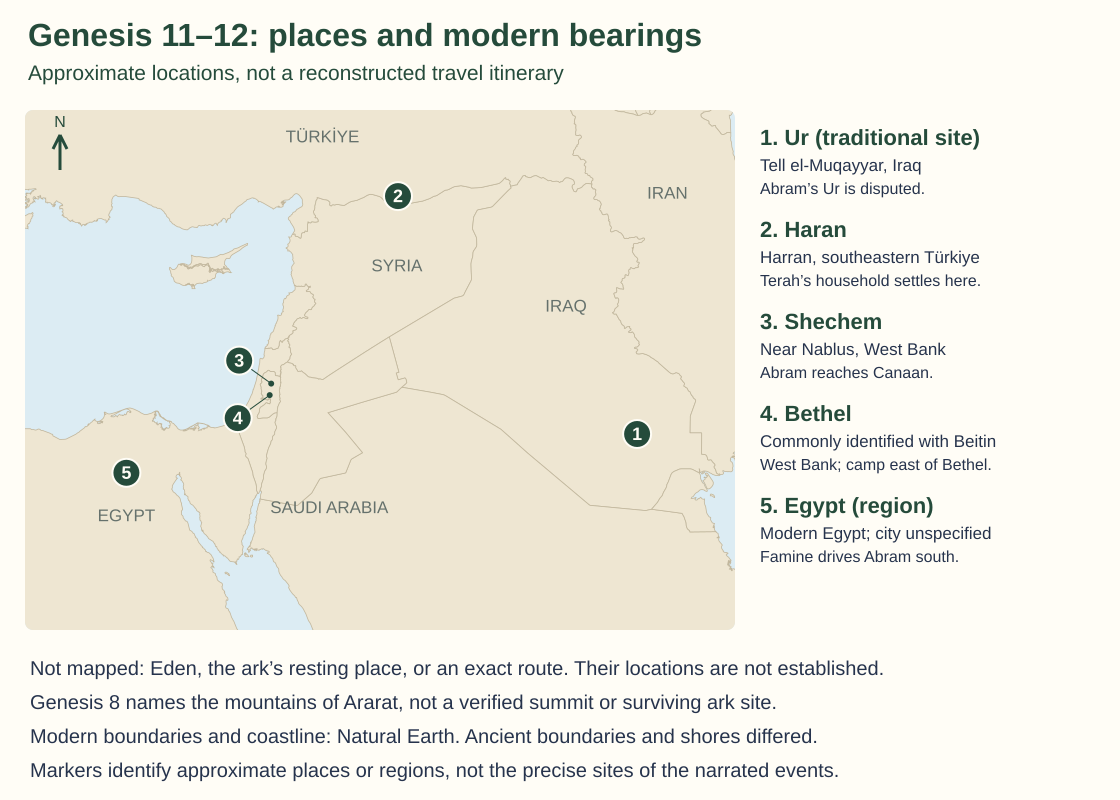
Ancient name → modern bearings: Ur → traditionally Tell el-Muqayyar in southern Iraq, though the identification of Abram’s Ur is disputed; Haran → Harran in southeastern Türkiye; Shechem → near modern Nablus in the West Bank; Bethel → commonly identified with Beitin in the West Bank. Egypt names a country or region here, not a specified city. Abram’s camp was between Bethel and Ai, not necessarily at the Bethel marker. The Negeb is the southern region of the land, broadly the modern Negev.
What we cannot locate confidently: This map does not assign a site to Eden, identify surviving remains of the tower of Babel, or mark an ark landing site. Genesis 8:4 refers to the mountains of Ararat, not explicitly to the modern summit named Mount Ararat. A line connecting these points would imply a precision the text and surviving evidence do not supply.
Map sources: Natural Earth, public-domain modern geographic base; OpenBible.info’s Genesis geographic index, including competing identifications. Modern boundaries and coastlines are orientation aids, not ancient political boundaries. This original locator is not an archaeological survey.
Main teachings
God is the Creator, and his creation is good
Everything depends on God. His speech brings order, life, and blessing. The heavens and earth are his work, not rival gods. The seventh day crowns the creation account with God’s rest.
Every person bears God’s image
Male and female alike bear God’s image. The Hebrew word tselem speaks of an image or representation; here it affirms humanity’s God-given likeness and responsibility before God. Representing his rule is an important dimension, not an exhaustive definition of the image. The divine image remains the ground for respecting human life after the fall. No race, nationality, age, or ability makes a person less human.
Life is a gift with a vocation and a boundary
God provides life, a garden to cultivate and keep, a command to obey, and marriage. Work precedes sin; toil and frustration follow it. Freedom is not independence from the giver of life.
Sin distrusts God and fractures relationships
Disobedience brings shame, hiding, accusation, suffering, and death. God calls the sinners to account rather than overlooking evil. Yet he also clothes them. In Genesis 3:15, the woman’s offspring strikes the serpent’s head, and the serpent strikes his heel. Christians read this conflict within the unfolding promise fulfilled in Christ’s victory over evil (Hebrews 2:14–15; Romans 16:20). Genesis 3:15 does not itself describe the crucifixion or spell out every detail of that fulfillment.
Mercy does not erase moral accountability
God warns Cain before the murder and judges him afterward, while limiting vengeance against him. Humanity’s widening evil grieves God. Noah receives favor; rescue begins with God’s gracious initiative, not humanity’s innocence.
Death is real, but fellowship with God matters
The genealogy carries the creation blessing forward while repeatedly recording death. Enoch’s walk with God interrupts that pattern. The passage invites faithful fellowship without supplying details the narrator does not give.
God judges evil and preserves life
The flood exposes the seriousness of violence and corruption. God provides for Noah’s household and living creatures, remembers them, and brings them out. Noah responds with worship; the renewed world still contains sinful human hearts.
The covenant with Noah protects the continuing world
God establishes his covenant, berit, with Noah, his descendants, and living creatures. This is God’s pledged commitment: never again will floodwaters destroy all flesh and the earth as in this judgment (Genesis 9:11). The rainbow is its sign. The promise is not a denial of all future judgment, nor a guarantee against every local flood. God preserved Noah’s household through the flood; the judgment did not erase the entire human family.
The nations belong to one human family
The narrative connects diverse peoples through Noah’s family. In Genesis 9:20–27, Noah’s curse names Canaan specifically, not Ham or all Ham’s descendants, and not a skin color or modern race. It supplies no permission for racial superiority or enslavement. The same chapter affirms the God-given dignity of human life.
Human greatness cannot replace trust in God
Babel’s builders seek a name and security on their own terms. God frustrates their ambition and scatters them. The text challenges proud self-sufficiency, not ordinary cooperation or the existence of different languages.
God promises blessing for the families of the earth
God calls Abram, promises descendants and land, and intends blessing beyond his household. Abram goes and worships. Acts 7:2–4 places God’s initial appearance and call in Mesopotamia before Abram lived in Haran; Genesis 11:31–12:5 follows the family’s move to Haran and Abram’s onward departure to Canaan. We should not silently relocate the first call to Haran. Galatians 3:8, 16 relates the Abrahamic promise to the gospel and Christ; this concerns the promise to Abraham, not a direct quotation of Genesis 3:15. The fuller covenant ceremonies come later in Genesis.
God’s faithfulness outlasts his servant’s fear
Abram’s fear places Sarai in danger, and Pharaoh rebukes him. God preserves Abram and Sarai despite Abram’s deception, not because the deception was righteous. The narrative records his failure rather than approving it. God’s protection of Sarai and the household keeps the promise from collapsing under Abram’s weakness.
A prayer shaped by Genesis 1–12
Father, you made us for yourself and called your creation good. Forgive our desire to rule apart from you, our excuses, and the harm we do to people who bear your image. Teach us to receive your Word with trust and to obey it. Keep us from treating grace as permission to sin. Make us faithful in ordinary work, honest in our relationships, and generous with the blessings you give. When fear exposes our weakness, turn us back to you. Thank you for carrying your promise of blessing forward to Jesus Christ. Let our lives point others to him. Amen.
Find a topic
Creation and rest
Genesis 1:1–2:3
Image of God and human dignity
Genesis 1:26–28; Genesis 9:5–6
Work, obedience, and marriage
Genesis 2:15–25
Temptation, shame, and mercy
Genesis 3:1–24
Violence and responsibility
Genesis 4:1–16; Genesis 6:11–13
Walking with God
Genesis 5:21–24; Genesis 6:9
Judgment and preservation
Genesis 6:5–8:22
Covenant and the rainbow
Genesis 9:8–17
Nations and pride
Genesis 10:1–11:9
Promise and faithful response
Genesis 12:1–9
Fear and failure
Genesis 12:10–20
Follow the story
God creates, humanity turns from Him, judgment exposes evil, and grace preserves a people and begins the promise through Abram. This outline follows Genesis 1–12 in its literary order; chapter 12 begins the story developed through the rest of Genesis.
Genesis 1:1–2:3 — God creates, blesses, and rests
Genesis 2:4–25 — Life with God in the garden
Genesis 3:1–24 — Sin enters; judgment and mercy follow
Genesis 4:1–26 — Violence spreads, and people call on the Lord
Genesis 5:1–32 — Generations under death, with a witness to walking with God
Genesis 6:1–8:22 — Corruption, flood, preservation, and renewed earth
Genesis 9:1–29 — God’s covenant and continuing human failure
Genesis 10:1–32 — Nations from one human family
Genesis 11:1–9 — Babel: self-exaltation and scattering
Genesis 11:10–32 — From Shem to Terah’s household
Genesis 12:1–9 — God calls Abram to become a blessing
Genesis 12:10–20 — Famine, fear, and God’s protection of the promise
Reading Genesis carefully
Follow each scene and paragraph before applying an isolated sentence. Distinguish what God commands, what he promises to particular people, and what the narrator merely reports.
Christians differ over creation days, the relation of the accounts in chapters 1 and 2, and the scope of the flood. State the text’s claims clearly without presenting one disputed reconstruction as the only faithful reading.
Genealogies identify relationships and carry the story forward. Ancient textual traditions differ in some ages; avoid treating a calculated modern chronology as an explicit biblical date.
Read Genesis 3:15 within the serpent’s judgment first. Its place in the Bible’s unfolding hope supports a Christian reading toward Christ, but the verse does not narrate every later detail of redemption.
Do not turn a character’s behavior into a command. Polygamy, murder, drunkenness, and Abram’s deception are narrated, not automatically endorsed.
Genesis 9 never calls its pronouncement a curse on Black people. The name is Canaan, not a modern racial category. Racist uses of this passage contradict the dignity of all image bearers.
The “sons of God,” the Nephilim, and some ancient place identifications remain debated. Do not build certainty from what the text leaves unexplained.
Let promises keep their original addressees. Abram’s land and offspring promises are not guarantees that every reader will receive wealth, children, or a particular territory.
Use Hebrew word notes as aids to meaning in context, not as secret definitions that override a sentence. Our response questions are selective because not every verse contains a direct instruction to us.
Building on the Old Testament work
The existing Aiming for Jesus Old Testament Companion, expanded through Abraham and Sarah, offers illustrated scenes and an overview. This Genesis 1–12 review complements it with close reading, verse notes, cross-references, and selective response questions; it does not replace that companion.
BibleProject’s Genesis 1–11 overview helps trace the movement from creation to Babel. Its Genesis 12–50 overview supplies context for the turn toward Abram, but this installment studies only chapter 12 of that larger section.
Keep the biblical text primary. Reference works and video overviews are teaching aids to evaluate against Scripture, not substitutes for reading it.
- Existing Genesis overview
- Ten illustrated Genesis scenes — scenes 1–6 complement this installment; later scenes extend beyond chapter 12.
- Old Testament Reference
Study every verse
Read each verse with the sentences around it. For example, Genesis 12:2–3 first gives promises to Abram; its blessing reaches the nations through the unfolding biblical story, not a guarantee of wealth for every reader.
Each entry includes two related passages and a Hebrew word behind selected English wording. The meanings describe this context rather than every dictionary sense.
Living the Word: James 1:22 calls us to be doers, not hearers only. Selected passages ask what to obey, turn from, or trust. Respond to God’s grace rather than trying to purchase it.
Chapter 1 — God creates a good world
Genesis 1:1–31 · Hebrew interlinear
Genesis 1:1
Read the verse: Genesis 1:1 BLB
Study notes
The Bible begins with God, not an account of His origin. The heavens and earth depend on Him; they are not rival gods. This opening announces the Creator before describing His ordering work. The verb itself does not explain every physical process; the wider biblical witness teaches that all things owe their existence to God.
English wording → Hebrew word → meaning
- “created” → bara → create; here God brings the heavens and earth into existence
Teacher’s comment — John MacArthur (paraphrase, source)
MacArthur begins his exposition by stressing that the opening verse presents the universe as the result of God’s creative act. This comment identifies the sermon’s central theological claim, not an endorsement of all its scientific arguments.
Read alongside
John 1:1–3 BLB — The eternal Word is with God, is God, and is the agent of all creation.
Hebrews 11:3 BLB — Faith recognizes that the visible world depends on God’s word.
Genesis 1:2
Read the verse: Genesis 1:2 BLB
Study notes
The earth is not yet ordered and filled as it will be. Darkness and the deep are not independent powers defeating God. His Spirit is present over the waters. The text does not describe a prior civilization or explicitly insert a catastrophe between verses 1 and 2; such reconstructions go beyond what this sentence says.
English wording → Hebrew word → meaning
- “hovering” → rachaph → hover or flutter; here God’s Spirit is actively present over the waters
Read alongside
Jeremiah 4:23 BLB — Jeremiah reuses the language of formlessness and emptiness to portray judgment as an undoing of order.
Deuteronomy 32:11 BLB — The hovering eagle image uses the same Hebrew verb in another setting.
Genesis 1:3
Read the verse: Genesis 1:3 BLB
Study notes
God speaks, and light exists. The repeated pattern of command and fulfillment presents His effective authority, not a struggle against another deity. Light precedes the appointed heavenly lights within the narrative. Later Scripture uses this event to illustrate God’s power to bring spiritual illumination, while Genesis first describes His work in creation.
English wording → Hebrew word → meaning
- “light” → or → light, the first named result of God’s spoken commands
Read alongside
Psalm 33:6–9 BLB — Creation responds to the Lord’s command.
2 Corinthians 4:6 BLB — Paul applies creation’s light to God revealing Christ in human hearts.
Genesis 1:4
Read the verse: Genesis 1:4 BLB
Study notes
God evaluates the light as good and distinguishes it from darkness. The recurring judgment of goodness gives creation its value through His wise purpose. Darkness here is part of the ordered day-and-night cycle, not identified as moral evil. The verse establishes distinction and order before the world is populated.
English wording → Hebrew word → meaning
- “good” → tov → good or fitting; here meeting the Creator’s purpose
Read alongside
Psalm 104:19–23 BLB — Day and night provide ordered times for creatures and human work.
1 Timothy 4:4 BLB — Paul affirms the goodness of what God created.
Genesis 1:5
Read the verse: Genesis 1:5 BLB
Study notes
God names Day and Night, and the account marks evening and morning. Within this verse, day names both the light portion and the numbered day. Christians differ about how the creation days relate to measured time; that discussion should acknowledge the repeated evening-and-morning pattern rather than ignore it. The text unmistakably presents ordered divine work.
English wording → Hebrew word → meaning
- “day” → yom → day; used here for the light period and the numbered creation day
Read alongside
Exodus 20:8–11 BLB — Israel’s weekly pattern is grounded in God’s creation work and rest.
Psalm 74:16 BLB — Both day and night belong to God.
Genesis 1:6
Read the verse: Genesis 1:6 BLB
Study notes
God commands an expanse that separates waters. Genesis describes an ordered world using the language of the visible sky, not the vocabulary of modern atmospheric science. Its central point is that the heavens have their place by God’s command. Detailed reconstructions of a water canopy or its physical properties are not supplied here.
English wording → Hebrew word → meaning
- “expanse” → raqia → expanse or extended space; here separating waters
Read alongside
Psalm 19:1 BLB — The heavens and expanse proclaim God’s glory.
Psalm 148:4–5 BLB — The heavens and waters are summoned to praise their Creator.
Genesis 1:7
Read the verse: Genesis 1:7 BLB
Study notes
The command is carried out: God makes the expanse and separates the waters. The repetition stresses that what He intends comes to be. The narrative is arranging a habitable world through boundaries. It does not invite us to treat the waters as divine or to fill its brief description with scientific details it does not state.
English wording → Hebrew word → meaning
- “separated” → badal → separate or distinguish
Read alongside
Job 38:8–11 BLB — God sets bounds for the sea.
Psalm 104:5–9 BLB — The psalm celebrates God’s ordering of the waters and earth.
Genesis 1:8
Read the verse: Genesis 1:8 BLB
Study notes
God calls the expanse Heaven, completing the second day. The same Hebrew word can refer to the sky or heavens in different settings; here its immediate referent is the expanse. The naming continues the portrayal of God’s authority over every realm. The absence of a separate goodness statement here does not pronounce this day bad.
English wording → Hebrew word → meaning
- “Heaven” → shamayim → heavens or sky; here the expanse God names
Read alongside
Nehemiah 9:6 BLB — The Lord made the heavens and sustains their host.
Psalm 147:4–5 BLB — The ordered heavens display God’s wisdom and greatness.
Genesis 1:9
Read the verse: Genesis 1:9 BLB
Study notes
At God’s word, waters are gathered and dry ground appears. A place for land life is prepared before its occupants are introduced. The sentence emphasizes the command’s accomplishment, not an explanation of geological mechanics. Later acts of deliverance through water echo this pattern of God making a way where His people could not provide one.
English wording → Hebrew word → meaning
- “dry land” → yabbashah → dry ground as distinct from surrounding water
Read alongside
Exodus 14:21–22 BLB — God makes dry ground through the sea for Israel.
Psalm 95:5 BLB — The sea and dry land belong to their Maker.
Genesis 1:10
Read the verse: Genesis 1:10 BLB
Study notes
God names Earth and Seas and declares the arrangement good. Land and water are distinguished parts of one created world under His care. The sea may become an image of threat elsewhere, but here it is neither evil nor beyond His rule. God’s evaluation precedes human usefulness as the measure of creation’s worth.
English wording → Hebrew word → meaning
- “Seas” → yam → sea; the plural here names the gathered waters
Read alongside
Psalm 24:1–2 BLB — Earth and its inhabitants belong to the Lord.
Psalm 146:6 BLB — The Maker of heaven, earth, and sea is worthy of trust.
Genesis 1:11
Read the verse: Genesis 1:11 BLB
Study notes
The land is commanded to produce vegetation with seed and fruit. God provides ongoing fruitfulness, not merely a momentary display. Reproduction according to kinds emphasizes recognizable continuity in the living world. The word kinds should not simply be equated with a modern biological classification; the passage’s concern is ordered abundance under the Creator.
English wording → Hebrew word → meaning
- “seed” → zera → seed; here the means by which vegetation reproduces
Read alongside
Psalm 104:14–15 BLB — God’s provision of plants supports human and animal life.
Mark 4:26–29 BLB — Jesus later uses the ordinary growth of seed as an illustration of God’s kingdom.
Genesis 1:12
Read the verse: Genesis 1:12 BLB
Study notes
The earth brings forth what God commanded, including plants and fruit trees that carry seed. The repeated fulfillment makes His provision concrete. Living things are equipped to continue beyond their first appearance. The goodness statement includes this fruitful order, giving reason for gratitude rather than treating food and the land as self-originating possessions.
English wording → Hebrew word → meaning
- “fruit” → peri → fruit or produce yielded by a plant
Read alongside
Psalm 65:9–13 BLB — The psalm praises God for watering the earth and making it fruitful.
Acts 14:17 BLB — Rain and fruitful seasons testify to God’s generosity.
Genesis 1:13
Read the verse: Genesis 1:13 BLB
Study notes
The third day closes with evening and morning after the gathering of waters and production of vegetation. The numbered sequence helps the reader follow God’s ordered preparation of the world. This brief refrain is not an independent command to us; it belongs to the account’s structure and connects the day’s completed work with what follows.
English wording → Hebrew word → meaning
- “third” → shelishi → third in an ordered sequence
Read alongside
Genesis 1:9–12 BLB — The preceding verses describe the two works completed on this day.
Exodus 20:11 BLB — The creation week becomes the pattern invoked in Israel’s Sabbath command.
Genesis 1:14
Read the verse: Genesis 1:14 BLB
Study notes
The lights are assigned functions: distinguishing day and night and marking signs, seasons, days, and years. They serve God’s order rather than govern human destiny as gods. Appointed times can include recurring seasons and calendrical occasions. The verse does not authorize astrology or treating celestial events as independent revelations that override God’s Word.
English wording → Hebrew word → meaning
- “seasons” → moed → appointed time; here the times marked by the heavenly lights
Read alongside
Psalm 104:19 BLB — The moon marks seasons within God’s provision.
Deuteronomy 4:19 BLB — Israel is warned not to worship the heavenly bodies.
Genesis 1:15
Read the verse: Genesis 1:15 BLB
Study notes
The heavenly lights are to shine on the earth, and the command is fulfilled. Their purpose is expressed in relation to the world God is preparing. The account remains concerned with God’s authority and provision, not with a complete catalog of astronomical causes. The lights are gifts within creation, never substitutes for their Creator.
English wording → Hebrew word → meaning
- “lights” → maor → luminary or light-bearer
Read alongside
Jeremiah 31:35 BLB — The Lord appoints the sun, moon, and stars in their regular order.
Psalm 136:7–9 BLB — The heavenly lights are celebrated as expressions of God’s steadfast love.
Genesis 1:16
Read the verse: Genesis 1:16 BLB
Study notes
God makes the greater and lesser lights and the stars. Calling them by function rather than divine names underscores their created status. Their rule is delegated and limited to day and night. This verse describes their place in God’s ordered world; it does not give the sun or moon personal authority to be worshiped.
English wording → Hebrew word → meaning
- “rule” → memshalah → dominion or governance; here the lights’ assigned function
Read alongside
Deuteronomy 17:2–5 BLB — Worship of sun, moon, or heavenly host violates loyalty to God.
Psalm 8:3–4 BLB — The moon and stars prompt wonder at God’s care for human beings.
Genesis 1:17
Read the verse: Genesis 1:17 BLB
Study notes
God places the lights in the heavens to illuminate the earth. Their position and service are portrayed as intentional. The narrative’s repeated references to giving light reinforce the benefit of God’s ordering work. Human beings will enter a world already supplied with rhythms and resources they did not create for themselves.
English wording → Hebrew word → meaning
- “set” → nathan → give or place; here God places the lights in their appointed setting
Read alongside
Psalm 19:4–6 BLB — The sun’s course illustrates the heavens’ witness to God.
Acts 17:24–25 BLB — The Creator supplies life and everything people need.
Genesis 1:18
Read the verse: Genesis 1:18 BLB
Study notes
The lights govern their appointed times and distinguish light from darkness. God calls their work good. Authority within creation is therefore purposeful service under Him, not independence from Him. The verse completes the fourth day’s commission and reinforces the ordered boundaries first introduced with light and darkness on the first day.
English wording → Hebrew word → meaning
- “darkness” → choshekh → darkness; here the night distinguished from daylight
Read alongside
Genesis 1:4–5 BLB — The first day establishes the distinction now served by the heavenly lights.
Jeremiah 33:20–21 BLB — The regularity of day and night illustrates God’s reliability.
Genesis 1:19
Read the verse: Genesis 1:19 BLB
Study notes
Evening and morning close the fourth day, gathering its works into the account’s repeated rhythm. The verse does not add another object of creation; it marks the completion of the lights’ appointment. Reading it with verses 14–18 keeps us focused on what God made and what those lights are to do.
English wording → Hebrew word → meaning
- “fourth” → revii → fourth in the creation-day sequence
Read alongside
Genesis 1:14–18 BLB — The preceding section explains the lights’ assigned purposes.
Psalm 136:7–9 BLB — The psalm responds to the heavenly lights with thanksgiving.
Genesis 1:20
Read the verse: Genesis 1:20 BLB
Study notes
God calls for abundant life in the waters and birds above the earth. The Hebrew expression translated living creatures is also used of humanity in chapter 2; its use here does not erase human uniqueness in God’s image. Creaturely life is His gift, and the occupied realms correspond to the spaces He has prepared.
English wording → Hebrew word → meaning
- “living creatures” → nephesh chayyah → living being; here the creatures of the waters
Read alongside
Psalm 104:24–26 BLB — Sea creatures display the richness of God’s works.
Genesis 2:7 BLB — The man also becomes a living creature, with his distinctive calling explained in context.
Genesis 1:21
Read the verse: Genesis 1:21 BLB
Study notes
Even the great sea creatures belong among God’s works. The text does not portray them as rival powers whom He must defeat to create. Waters and sky teem with varied life according to their kinds, and God calls it good. The breadth of life magnifies the Creator rather than providing new objects of worship.
English wording → Hebrew word → meaning
- “great sea creatures” → tannin → large sea creature; here a creature God made
Read alongside
Psalm 148:7 BLB — Sea creatures are summoned to praise the Lord.
Psalm 104:25–26 BLB — The vast sea contains creatures of many kinds under God’s care.
Genesis 1:22
Read the verse: Genesis 1:22 BLB
Study notes
God blesses the living creatures with multiplication. Life’s continuation depends on His generous provision, not merely on the creatures’ own possession of existence. This is the first explicit blessing in the chapter. The commission is addressed to these creatures; it is not a promise that every individual creature or person will produce offspring.
English wording → Hebrew word → meaning
- “blessed” → barak → bless; here bestow fruitfulness and increase
Read alongside
Genesis 8:17 BLB — After the flood, creatures are again commissioned to multiply.
Psalm 104:27–30 BLB — Living things depend on God for food, breath, and renewal.
Genesis 1:23
Read the verse: Genesis 1:23 BLB
Study notes
The fifth day closes after the creation and blessing of sea life and birds. The refrain links the abundance just described to the ordered progression of the whole chapter. The next day will fill the land, so this brief sentence helps readers see both the distinct works and the unified creation account.
English wording → Hebrew word → meaning
- “fifth” → chamishi → fifth in the creation-day sequence
Read alongside
Genesis 1:20–22 BLB — The fifth day’s creatures receive life and blessing.
Psalm 146:6 BLB — Heaven, earth, sea, and their occupants belong to God’s creative work.
Genesis 1:24
Read the verse: Genesis 1:24 BLB
Study notes
God commands the earth to bring forth land animals in their various groupings. Livestock, creeping things, and beasts describe familiar kinds of land life rather than a modern scientific taxonomy. The fulfillment formula again emphasizes God’s authority. The land is populated before humanity receives the task of exercising responsible dominion within it.
English wording → Hebrew word → meaning
- “livestock” → behemah → beast or animal; here the livestock category of land animals
Read alongside
Psalm 50:10–11 BLB — Wild animals and birds belong to God.
Job 12:7–10 BLB — The life of every creature is in the Lord’s hand.
Genesis 1:25
Read the verse: Genesis 1:25 BLB
Study notes
The land animals are made according to their kinds, and God judges them good. The text honors their place in creation before mentioning their usefulness to humans. Diversity is ordered rather than accidental within the account’s presentation. We should not demand that this ancient grouping supply every category used by modern biology.
English wording → Hebrew word → meaning
- “kinds” → min → kind or grouping; here the continuity of distinct animal life
Read alongside
Psalm 104:10–18 BLB — God supplies habitats and food for varied creatures.
Proverbs 12:10 BLB — Righteous conduct includes regard for the life of an animal.
Genesis 1:26
Read the verse: Genesis 1:26 BLB
Study notes
Humanity is made in God’s image and entrusted with rule over other creatures. This establishes dignity and responsibility, not permission for cruelty. The plural language invites attention, but this verse alone does not fully explain the Trinity; Christian understanding draws on later revelation. Humans represent God’s rule as creatures accountable to Him, never as His equals.
English wording → Hebrew word → meaning
- “image” → tselem → image or representation; here humanity’s God-given likeness and vocation
Read alongside
Psalm 8:4–8 BLB — Human dignity and delegated dominion are celebrated together.
Colossians 1:15–16 BLB — Christ is the image of the invisible God and Lord of all creation.
Genesis 1:27
Read the verse: Genesis 1:27 BLB
Study notes
The verse repeats creation in God’s image and names male and female together. Neither sex possesses a lesser share of human worth. The statement grounds bodily and relational life in God’s design rather than reducing image-bearing to power, achievement, or intelligence. Later Scripture appeals to this creation passage when discussing marriage and human conduct.
English wording → Hebrew word → meaning
- “male” → zakhar → male; paired here with female in humanity’s creation
Read alongside
Matthew 19:4–6 BLB — Jesus cites male and female creation alongside the one-flesh marriage text.
James 3:9–10 BLB — God’s likeness makes cursing human beings a serious contradiction.
Genesis 1:28
Read the verse: Genesis 1:28 BLB
Study notes
God blesses humanity and gives a task: multiply, fill the earth, and exercise dominion. This authority remains accountable to the Creator and must be read with the garden’s work-and-keep calling. The collective commission does not make marriage or biological parenthood a requirement for every individual to have dignity or a faithful vocation.
English wording → Hebrew word → meaning
- “subdue” → kabash → bring into subjection; here humanity is commissioned to bring the earth under its rule
Read alongside
Genesis 2:15 BLB — Human work includes tending and keeping the place God provides.
1 Corinthians 7:7–8 BLB — Paul recognizes faithful singleness alongside marriage.
Genesis 1:29
Read the verse: Genesis 1:29 BLB
Study notes
God gives seed-bearing plants and fruit trees as food. Provision precedes the later prohibition concerning one tree: humanity begins surrounded by generosity, not deprivation. Food is received from the Creator rather than treated as self-produced independence. The narrative later addresses meat in another setting, so this verse should be located within its own stage of the story.
English wording → Hebrew word → meaning
- “given” → nathan → give; here God provides plants and fruit for food
Read alongside
Genesis 2:16–17 BLB — The broad permission to eat frames the one stated boundary.
Genesis 9:3 BLB — After the flood, God explicitly grants animals as food.
Genesis 1:30
Read the verse: Genesis 1:30 BLB
Study notes
God also provides vegetation for animals, birds, and creeping things. Human and nonhuman life both depend on His provision. The phrase behind the English wording refers to living creatures, not a separate claim here about the mechanics of breathing. The verse presents a world sustained by God’s gift, before chapter 3 introduces human disobedience.
English wording → Hebrew word → meaning
- “breath of life” → nephesh chayyah → living being; the Hebrew phrase underlies this description of animal life
Read alongside
Psalm 145:15–16 BLB — God satisfies living things with His provision.
Matthew 6:26 BLB — Jesus points to God’s care for birds to teach trust.
Genesis 1:31
Read the verse: Genesis 1:31 BLB
Study notes
God surveys everything He has made and calls it very good. The whole creation, including humanity and bodily life, is affirmed as His good work. Sin is not presented as a necessary ingredient of that goodness. The sixth day closes, directing us toward the completion and rest of chapter 2 rather than ending with human achievement.
English wording → Hebrew word → meaning
- “very” → meod → exceedingly or very; intensifies God’s declaration of goodness
Read alongside
Ecclesiastes 7:29 BLB — God made humanity upright, but people pursued many schemes.
Revelation 21:1–5 BLB — The final renewal answers the world’s brokenness with God dwelling among His people.
Chapter 2 — Garden, vocation, and marriage
Genesis 2:1–25 · Hebrew interlinear
Genesis 2:1
Read the verse: Genesis 2:1 BLB
Study notes
Creation is presented as complete, including its entire host. The word host here gathers the occupants of heaven and earth, not only armies or angels. This closing statement belongs with the six-day account and prepares for the seventh day. God’s finished work becomes the basis for rest rather than an unfinished task abandoned midway.
English wording → Hebrew word → meaning
- “finished” → kalah → complete or bring to an end
Read alongside
Exodus 20:11 BLB — The Sabbath command recalls the completion of God’s creation work.
Nehemiah 9:6 BLB — God made and sustains the heavens, earth, and all their host.
Genesis 2:2
Read the verse: Genesis 2:2 BLB
Study notes
God rests because His creative work is finished, not because He is exhausted. The verb emphasizes cessation. Later Scripture develops this seventh-day rest into instruction and promise, but the immediate scene concerns God’s completion. Human rest therefore acknowledges limits and dependence; it does not imply that God stops sustaining the world.
English wording → Hebrew word → meaning
- “rested” → shabat → cease or stop; here cease from the completed work of creation
Read alongside
Isaiah 40:28 BLB — The Creator does not grow weary.
Hebrews 4:3–10 BLB — Hebrews draws on God’s completed work and rest when calling readers to faith.
Genesis 2:3
Read the verse: Genesis 2:3 BLB
Study notes
God blesses the seventh day and sets it apart. The creation pattern gives time a sacred dimension: life is not only production and accumulation. Israel later receives a specific Sabbath command rooted in this event. Christians should trace that development carefully rather than assume every later Sabbath regulation is already stated in this verse.
English wording → Hebrew word → meaning
- “made it holy” → qadash → set apart as holy
Read alongside
Exodus 20:8–11 BLB — Israel is commanded to honor the Sabbath in light of creation.
Mark 2:27–28 BLB — Jesus teaches the Sabbath’s purpose and His lordship over it.
Genesis 2:4
Read the verse: Genesis 2:4 BLB
Study notes
This heading moves from the broad creation account to the human story within it. The recurring generations formula organizes Genesis. LORD God brings the covenant name into the narrative, identifying Israel’s Lord with the Creator already described. The focus now narrows to the man, garden, and woman rather than supplying an unrelated creator or world.
English wording → Hebrew word → meaning
- “generations” → toledot → account of what follows or develops from what is named
Read alongside
Genesis 5:1 BLB — A related heading introduces Adam’s descendants.
Exodus 3:14–15 BLB — God’s personal name is central to His self-disclosure to Moses.
Genesis 2:5
Read the verse: Genesis 2:5 BLB
Study notes
The verse describes a setting in which field vegetation has not yet developed because rain and human cultivation are absent. Its terms and focus differ from the broad vegetation statement in chapter 1. Readers debate how the accounts relate in detail, but this paragraph’s clear concern is the ground’s preparation and humanity’s appointed agricultural work.
English wording → Hebrew word → meaning
- “work” → abad → work or serve; here cultivate the ground
Read alongside
Genesis 1:11–12 BLB — The earlier account describes God bringing forth vegetation.
Genesis 2:15 BLB — The man’s task in the garden supplies the human worker anticipated here.
Genesis 2:6
Read the verse: Genesis 2:6 BLB
Study notes
Water rises from the land and moistens the ground. The unusual Hebrew word is rendered mist in the ESV and understood as a stream or flow by some interpreters. The passage establishes provision for the soil, but does not provide a complete account of pre-flood weather. We should not build an entire climate model from this word.
English wording → Hebrew word → meaning
- “mist” → ed → a mist or flow of water; the precise sense is debated
Read alongside
Job 36:27–28 BLB — Another difficult water-cycle passage uses related language of mist and rain.
Psalm 104:10–13 BLB — God’s watering of the earth supports its life.
Genesis 2:7
Read the verse: Genesis 2:7 BLB
Study notes
God forms the man from ground-dust and gives him the breath of life. Human life is embodied and dependent; dignity comes from God’s action, not from being made of superior material. The man becomes a living creature. This phrase describes the living person and should not be pressed alone into a complete theory of body and soul.
English wording → Hebrew word → meaning
- “formed” → yatsar → form or fashion, as a maker shapes material
Read alongside
Psalm 103:14 BLB — God remembers that human beings are dust.
1 Corinthians 15:45–49 BLB — Paul contrasts Adam’s creaturely life with the risen Christ’s life-giving significance.
Genesis 2:8
Read the verse: Genesis 2:8 BLB
Study notes
God plants a garden in Eden and places the man there. The setting is a divine provision, not a human achievement. Eden names the region in which the garden is situated. The description includes geographic associations, but it does not allow a secure modern map pinpointing the garden’s original boundaries or exact location.
English wording → Hebrew word → meaning
- “garden” → gan → garden or cultivated enclosure
Read alongside
Ezekiel 28:13 BLB — Eden becomes an image of beauty and privileged abundance.
Genesis 2:15 BLB — The man’s placement includes responsibility to work and keep the garden.
Genesis 2:9
Read the verse: Genesis 2:9 BLB
Study notes
God provides trees that are both pleasing and nourishing, including the tree of life and the tree of the knowledge of good and evil. Beauty and provision belong together. The named trees prepare for the coming command and test of trust. The text does not identify the forbidden fruit’s species or authorize calling it an apple.
English wording → Hebrew word → meaning
- “life” → chay → life or living; here in the name of the tree of life
Read alongside
Genesis 3:22–24 BLB — Access to the tree of life becomes central after the fall.
Revelation 22:1–2 BLB — The tree of life appears again in the renewed creation.
Genesis 2:10
Read the verse: Genesis 2:10 BLB
Study notes
A river waters the garden and divides into four branches. This portrays Eden as a source of abundant water, not a barren place into which people must force life. Later biblical river imagery can recall this provision. The ancient description does not by itself identify a surviving modern confluence from which Eden can confidently be located.
English wording → Hebrew word → meaning
- “river” → nahar → river or large flowing watercourse
Read alongside
Psalm 46:4 BLB — A river symbolizes the gladness and security of God’s city.
Revelation 22:1 BLB — The river of life flows from God’s throne in the final vision.
Genesis 2:11
Read the verse: Genesis 2:11 BLB
Study notes
The first named river winds around Havilah, a land associated with gold. Genesis gives particular names rather than an abstract landscape, yet those names are not enough to resolve every modern geographic question. Several identifications have been proposed. The responsible reader distinguishes the text’s specificity from our incomplete ability to reconstruct its ancient setting.
English wording → Hebrew word → meaning
- “Pishon” → Pishon → the name of the first river; its modern identification is uncertain
Read alongside
Genesis 10:7 BLB — Havilah also appears among the names in the table of nations.
Genesis 25:18 BLB — Another reference to Havilah helps illustrate the difficulty of locating ancient names precisely.
Genesis 2:12
Read the verse: Genesis 2:12 BLB
Study notes
The land’s gold is described as good, and two other valuable materials are named. The setting’s richness reinforces God’s generous provision. The identification of bdellium and the stone translated onyx involves lexical questions, so these details should not be turned into unwarranted geographic certainty. Their value also does not make wealth humanity’s highest good.
English wording → Hebrew word → meaning
- “gold” → zahav → gold, the precious metal
Read alongside
Numbers 11:7 BLB — Bdellium is used as a comparison in the description of manna.
Psalm 19:10 BLB — God’s judgments are valued above fine gold.
Genesis 2:13
Read the verse: Genesis 2:13 BLB
Study notes
The second river is associated with Cush. Although Cush often designates lands south of Egypt elsewhere, fitting this name into Eden’s four-river description is disputed. The verse should be allowed to retain its ancient reference without forcing a modern location. The broader picture remains one of a richly watered setting prepared by God.
English wording → Hebrew word → meaning
- “Gihon” → Gichon → the name of the second river; not securely identified here
Read alongside
Genesis 10:6–8 BLB — Cush appears in the table of nations and the ancestry of Nimrod.
Isaiah 11:11 BLB — Cush is one of several named lands in a later restoration prophecy.
Genesis 2:14
Read the verse: Genesis 2:14 BLB
Study notes
The Tigris and Euphrates connect the account with familiar great rivers of the ancient Near East. Their recognition does not solve the identification of the other rivers or the garden. Assyria supplies another geographic marker meaningful to readers. A modern locator can show these rivers while plainly marking Eden’s exact location as unknown.
English wording → Hebrew word → meaning
- “Tigris” → Chiddeqel → the river known as the Tigris
Read alongside
Daniel 10:4 BLB — Daniel places a vision beside the Tigris.
Genesis 15:18 BLB — The Euphrates appears again in the land-promise description.
Genesis 2:15
Read the verse: Genesis 2:15 BLB
Study notes
The man is placed in the garden to work it and keep it. Work is therefore part of God’s good purpose before the curse makes labor painful. Serving and guarding language also appears in later sacred contexts, but the immediate task is care for God’s garden. Dominion must be exercised as accountable stewardship, not destructive ownership.
English wording → Hebrew word → meaning
- “keep” → shamar → keep, guard, or attend carefully to
Read alongside
Numbers 3:7–8 BLB — Related serving and keeping language describes the Levites’ entrusted duties.
Colossians 3:23–24 BLB — Work is to be done faithfully before the Lord.
Genesis 2:16
Read the verse: Genesis 2:16 BLB
Study notes
God’s command begins with generous permission to eat from the garden’s trees. The Hebrew construction emphasizes that freedom. The following boundary is framed by abundant provision rather than scarcity. Obedience is the creature’s fitting response to the Creator, and the man receives God’s instruction before the later deception challenges its truth and goodness.
English wording → Hebrew word → meaning
- “commanded” → tsavah → command or give an authoritative instruction
Read alongside
James 1:17 BLB — Good gifts come from the Father.
Genesis 3:1 BLB — The serpent’s question distorts the setting of God’s generous command.
Genesis 2:17
Read the verse: Genesis 2:17 BLB
Study notes
God prohibits eating from one tree and warns of death. The issue is trust in His authority, not a claim that knowledge itself is evil. The text states a real boundary and consequence. Chapter 3 unfolds alienation and expulsion, while later Scripture connects Adam’s disobedience with humanity’s death; God’s patience does not cancel His warning.
English wording → Hebrew word → meaning
- “die” → mut → die; the emphatic construction underscores the certainty of the warning
Read alongside
Romans 5:12–19 BLB — Paul connects sin and death with Adam and contrasts Christ’s obedience.
Deuteronomy 30:15–20 BLB — God’s later covenant instruction likewise sets life and death before His people.
Genesis 2:18
Read the verse: Genesis 2:18 BLB
Study notes
For the first time something is called not good: the man is alone. God determines to provide a helper corresponding to him. Helper describes needed partnership, not a lesser human status; Scripture also uses the word for God’s help. This passage leads specifically toward marriage while reminding us that human life is not designed for isolated self-sufficiency.
English wording → Hebrew word → meaning
- “helper” → ezer → help or helper; the word does not itself imply inferior worth
Read alongside
Psalm 121:1–2 BLB — The same noun describes help from the Lord.
1 Corinthians 11:11–12 BLB — Paul stresses the mutual dependence of man and woman in the Lord.
Genesis 2:19
Read the verse: Genesis 2:19 BLB
Study notes
God brings the animals to the man, who names them. The scene develops human responsibility and prepares the contrast with the woman. Interpreters discuss the relation of the formation language to chapter 1, but the narrative’s point here is not a modern chronology chart. No animal will prove to be the human counterpart the man needs.
English wording → Hebrew word → meaning
- “called” → qara → call or name
Read alongside
Genesis 1:26–28 BLB — Humanity’s dominion gives context to this naming task.
Genesis 2:20 BLB — The next verse makes the absence of a suitable counterpart explicit.
Genesis 2:20
Read the verse: Genesis 2:20 BLB
Study notes
Naming the animals displays the man’s engagement with the living world, yet none is a helper corresponding to him. The text neither disparages animals nor treats companionship with them as equivalent to human partnership. Their difference prepares the reader to recognize the woman as sharing his humanity in a way the animals do not.
English wording → Hebrew word → meaning
- “names” → shem → name or designation
Read alongside
Genesis 2:18 BLB — God has already identified the need for a corresponding helper.
Genesis 2:23 BLB — The man recognizes the woman as sharing his bone and flesh.
Genesis 2:21
Read the verse: Genesis 2:21 BLB
Study notes
God puts the man into deep sleep and takes from his side while closing the place. The woman’s creation is God’s work, not the man’s accomplishment or purchase. The Hebrew word rendered rib can denote a side in other contexts. The account’s emphasis is their shared humanity and God’s provision, not an anatomical theory supplied by the reader.
English wording → Hebrew word → meaning
- “deep sleep” → tardemah → deep sleep imposed or brought about here by God
Read alongside
Genesis 15:12 BLB — A deep sleep also marks Abram’s dependence during God’s covenant act.
1 Corinthians 11:8–9 BLB — Paul refers to the woman’s origin from the man in discussing creation.
Genesis 2:22
Read the verse: Genesis 2:22 BLB
Study notes
God makes the woman and brings her to the man. The verb often means build, highlighting deliberate formation, while the scene places God at the origin of their union. The woman is neither an animal companion nor an independent rival species. The man receives her as God’s provision, a person who shares his humanity.
English wording → Hebrew word → meaning
- “made” → banah → build; here God forms the woman from what He took from the man
Read alongside
Proverbs 18:22 BLB — A wife is described as a good gift within the wisdom tradition.
Matthew 19:4–6 BLB — Jesus treats the creation account as the foundation for marriage.
Genesis 2:23
Read the verse: Genesis 2:23 BLB
Study notes
The man responds with recognition and delight: this one shares his bone and flesh. The Hebrew wordplay between man and woman expresses relationship, not a complete historical derivation of the words. The speech emphasizes a shared nature that the animals did not share with him. The woman is to be received as kin, not treated as property.
English wording → Hebrew word → meaning
- “Woman” → ishshah → woman; the verse pairs it in wordplay with ish, man
Read alongside
Ephesians 5:28–29 BLB — Husbands are called to love their wives as their own bodies.
Genesis 29:14 BLB — Bone and flesh language also expresses family kinship elsewhere.
Genesis 2:24
Read the verse: Genesis 2:24 BLB
Study notes
The narrator draws a principle from the first union: a man leaves his parents and holds fast to his wife in one flesh. Marriage establishes a new, enduring family bond without denying duties toward parents. Jesus cites this verse in teaching about marriage’s permanence. Paul also shows that bodily union is morally significant, not merely casual contact.
English wording → Hebrew word → meaning
- “hold fast” → dabaq → cling or remain closely joined
Read alongside
Matthew 19:5–6 BLB — Jesus applies the one-flesh union to marriage’s God-given permanence.
1 Corinthians 6:16–20 BLB — Paul uses this verse to explain the seriousness of sexual union.
Genesis 2:25
Read the verse: Genesis 2:25 BLB
Study notes
The couple’s nakedness is accompanied by no shame. The verse portrays unbroken openness before the distrust, hiding, and accusation of chapter 3. It is not a command to reproduce their clothing situation after the fall. The contrast prepares readers to see sin’s damage to relationships, not merely the breaking of an arbitrary rule.
English wording → Hebrew word → meaning
- “ashamed” → bosh → be ashamed or experience disgrace
Read alongside
Genesis 3:7–10 BLB — After disobedience, nakedness is associated with shame and hiding.
Romans 8:1 BLB — In Christ, condemnation is removed, though final restoration is still awaited.
Chapter 3 — Rebellion, judgment, and mercy
Genesis 3:1–24 · Hebrew interlinear
Genesis 3:1
Read the verse: Genesis 3:1 BLB
Study notes
The serpent begins by questioning what God said, recasting generous permission as deprivation. Genesis introduces a creature, not a second creator. The identification of the ancient serpent with the devil comes explicitly in later Scripture. The scene warns us to compare persuasive words with God’s actual instruction rather than allowing suspicion to determine what we think He meant.
English wording → Hebrew word → meaning
- “crafty” → arum → shrewd or crafty; here skill used deceptively
Read alongside
2 Corinthians 11:3 BLB — Paul recalls the serpent’s deception as a warning against corrupted devotion to Christ.
Revelation 12:9 BLB — The later vision explicitly identifies the ancient serpent with the devil.
Genesis 3:2
Read the verse: Genesis 3:2 BLB
Study notes
The woman initially corrects the claim that all garden fruit is forbidden. She acknowledges their permission to eat, preserving something of the generosity in God’s command. The exchange nevertheless keeps her in conversation with the tempter’s distorted premise. The story unfolds through speech before action, showing how trust can be challenged before a visible act of disobedience.
English wording → Hebrew word → meaning
- “eat” → akal → eat or consume
Read alongside
Genesis 2:16 BLB — God’s original instruction begins with broad freedom to eat.
Matthew 4:1–4 BLB — Jesus answers temptation by relying on the written Word of God.
Genesis 3:3
Read the verse: Genesis 3:3 BLB
Study notes
The woman includes a prohibition against touching the tree that is not recorded in God’s command in chapter 2. The narrative does not explain how that addition arose, so we should not invent an intervening conversation. The essential boundary remains God’s warning about eating and death. Careful attention to His words matters when temptation is already twisting them.
English wording → Hebrew word → meaning
- “touch” → naga → touch or come into contact with
Read alongside
Genesis 2:17 BLB — The recorded command concerns eating from the tree and its consequence.
Deuteronomy 4:2 BLB — Israel is warned neither to add to nor subtract from God’s commands.
Genesis 3:4
Read the verse: Genesis 3:4 BLB
Study notes
Questioning now becomes direct contradiction. The serpent denies the consequence God announced. Sin’s attractiveness is strengthened by the claim that disobedience will not cost what God says it will. The verse is a lie spoken within Scripture, not a truth endorsed by Scripture; readers must identify the speaker before applying a sentence as doctrine.
English wording → Hebrew word → meaning
- “die” → mut → die; the serpent explicitly denies God’s warning
Read alongside
John 8:44 BLB — Jesus describes the devil as a liar and the father of lies.
Romans 6:23 BLB — Paul states sin’s deadly consequence and contrasts God’s gift in Christ.
Genesis 3:5
Read the verse: Genesis 3:5 BLB
Study notes
The serpent attacks God’s character, portraying the command as a way of withholding desirable likeness to Him. The couple already bears His image; the temptation offers autonomy beyond the relationship He established. Some awareness will indeed follow, but the promise conceals shame and death. Truth mixed with deception can serve a false picture of God’s goodness.
English wording → Hebrew word → meaning
- “knowing” → yada → know; here moral knowledge claimed through the forbidden act
Read alongside
Genesis 1:26–27 BLB — Humanity already possesses God-given likeness and dignity.
James 1:13–17 BLB — God is the giver of good gifts, not the author of sinful temptation.
Genesis 3:6
Read the verse: Genesis 3:6 BLB
Study notes
The woman evaluates the tree by appetite, appearance, and its promise of wisdom, then eats and gives to her husband, who also eats. The narrator does not excuse him or describe his disobedience as unavoidable. Trust in God gives way to self-directed judgment. The fruit’s species is unnamed; the decisive issue is rejecting His command.
English wording → Hebrew word → meaning
- “delight” → taavah → desire or something desirable; here the tree’s visual attraction
Read alongside
James 1:14–15 BLB — Desire, sin, and death form a destructive progression.
Romans 5:19 BLB — Paul identifies Adam’s disobedience as consequential for humanity.
Genesis 3:7
Read the verse: Genesis 3:7 BLB
Study notes
Their eyes open, but the immediate result is awareness of nakedness and an attempt to cover themselves. The promised gain has brought vulnerability and shame rather than godlike security. Sewing leaves addresses what they feel exposed about, but it does not repair their broken trust in God. The narrative contrasts this response with their earlier unashamed openness.
English wording → Hebrew word → meaning
- “opened” → paqach → open, especially eyes; here a new awareness of nakedness
Read alongside
Genesis 2:25 BLB — Their earlier nakedness involved no shame.
Isaiah 59:2 BLB — Sin brings separation that human self-protection cannot resolve.
Genesis 3:8
Read the verse: Genesis 3:8 BLB
Study notes
The couple hears the LORD God and hides among the very trees He provided. The setting of fellowship has become a place of avoidance. The wording presents God’s approach in narrative terms; it does not settle every question about the physical manner of His appearance. Their reaction reveals fear of being known rather than freedom in His presence.
English wording → Hebrew word → meaning
- “hid” → chaba → hide or conceal oneself
Read alongside
Psalm 139:7–12 BLB — No place can conceal a person from God.
Hebrews 4:13 BLB — All people are exposed before the One to whom they must give account.
Genesis 3:9
Read the verse: Genesis 3:9 BLB
Study notes
God calls to the man with a question that draws him into accountability. The question need not imply that the Creator lacks information. Throughout Scripture, divine questions uncover human motives and invite an answer. Here the man is addressed rather than simply left hidden; God initiates the encounter that will expose sin and announce its consequences.
English wording → Hebrew word → meaning
- “called” → qara → call or summon
Read alongside
Genesis 4:9–10 BLB — God similarly questions Cain before exposing his guilt.
Luke 19:10 BLB — Jesus describes His saving mission as seeking the lost.
Genesis 3:10
Read the verse: Genesis 3:10 BLB
Study notes
The man explains his hiding in terms of fear and nakedness. His answer describes his distress without yet acknowledging the disobedience behind it. Fear has entered the relationship in which he previously received provision and purpose. The account teaches us to look beneath the symptoms of shame to the wrong that needs honest confession.
English wording → Hebrew word → meaning
- “afraid” → yare → fear or be afraid
Read alongside
Proverbs 28:13 BLB — Concealing sin is contrasted with confessing and forsaking it.
1 John 1:8–9 BLB — Believers are called to honesty about sin and trust in God’s forgiveness.
Genesis 3:11
Read the verse: Genesis 3:11 BLB
Study notes
God’s questions connect the man’s awareness with the forbidden action. The focus is not simply whether he feels ashamed, but whether he has disobeyed God’s command. Moral responsibility is brought into the open. God’s earlier instruction was clear enough to hold the man accountable, and the man is given opportunity to answer directly.
English wording → Hebrew word → meaning
- “commanded” → tsavah → command; God recalls the precise boundary already given
Read alongside
Genesis 2:16–17 BLB — The original permission, prohibition, and warning establish responsibility.
Romans 3:19–20 BLB — God’s law exposes sin and silences self-justification.
Genesis 3:12
Read the verse: Genesis 3:12 BLB
Study notes
The man points to the woman and indirectly to God, who gave her to him. A gift once received with joy becomes the basis of an excuse. He admits eating, yet frames his action through others’ involvement. The narrative exposes blame shifting without denying that others may also have sinned; each person must answer for his own response.
English wording → Hebrew word → meaning
- “gave” → nathan → give; here used in the man’s attempt to shift responsibility
Read alongside
James 1:13–14 BLB — People must not blame God for their temptation to evil.
Romans 14:12 BLB — Each person will give an account to God.
Genesis 3:13
Read the verse: Genesis 3:13 BLB
Study notes
The woman points to the serpent’s deception and acknowledges that she ate. Her deception is real, but it does not erase the disobedience. The account identifies more than one responsible participant without treating their roles as identical. Later Scripture recalls both the deception and the transgression, while Genesis now turns to God’s judgments.
English wording → Hebrew word → meaning
- “deceived” → nasha → deceive or mislead
Read alongside
2 Corinthians 11:3 BLB — Paul explicitly recalls Eve’s deception.
1 Timothy 2:14 BLB — Paul distinguishes the deception described in the account without absolving Adam.
Genesis 3:14
Read the verse: Genesis 3:14 BLB
Study notes
God addresses the serpent with a curse and an image of humiliation. The text describes going on the belly and eating dust but does not explain a prior anatomy or require us to invent one. The judgment removes any suggestion that the tempter has escaped God’s authority. The apparent success of evil is not the final word.
English wording → Hebrew word → meaning
- “cursed” → arar → curse; announce an adverse judgment
Read alongside
Isaiah 65:25 BLB — Dust remains the serpent’s food in a later vision of restoration.
Micah 7:17 BLB — Licking dust is also used as an image of humbled enemies.
Genesis 3:15
Read the verse: Genesis 3:15 BLB
Study notes
God announces hostility between the serpent and the woman and between their offspring. The woman’s offspring strikes the serpent’s head; the serpent strikes his heel. Christians recognize the beginning of hope fulfilled in Christ’s victory over evil. This reading follows the unfolding biblical story: the verse itself does not describe the crucifixion or supply every later detail of redemption.
English wording → Hebrew word → meaning
- “offspring” → zera → seed or descendants; a collective term that can focus on a representative
Teacher’s comment — Charles Spurgeon (paraphrase, source)
Spurgeon emphasizes the mercy in God announcing the serpent’s eventual defeat before pronouncing the human sentences. He reads the promised victorious offspring in light of Christ, whose suffering does not prevent His triumph.
Read alongside
Romans 16:20 BLB — Paul promises God’s defeat of Satan beneath His people’s feet.
Hebrews 2:14–15 BLB — Through death, Christ defeats the devil’s deadly hold and frees His people.
Genesis 3:16
Read the verse: Genesis 3:16 BLB
Study notes
The woman hears of multiplied pain in childbearing and a damaged relationship with her husband. Interpreters debate the precise force of desire here, including how it relates to the wording in 4:7. Whatever that question, domination and suffering belong to the fall’s brokenness. This judgment is not permission for husbands to mistreat or control their wives.
English wording → Hebrew word → meaning
- “desire” → teshuqah → desire or longing; its precise force in this sentence is debated
Read alongside
Genesis 4:7 BLB — The same rare word for desire appears in God’s warning to Cain.
Ephesians 5:25–29 BLB — Husbands are commanded to love sacrificially, not exploit the fall’s disorder.
Genesis 3:17
Read the verse: Genesis 3:17 BLB
Study notes
God identifies the man’s specific failure: he ate despite the command. Listening to his wife is not condemned as intrinsically wrong; following her into disobedience is. The ground is cursed because of him, making the work he was already given painful. Creation’s goodness is now experienced amid frustration rather than removed from all value.
English wording → Hebrew word → meaning
- “ground” → adamah → ground or soil; here cursed in connection with the man’s disobedience
Read alongside
Genesis 2:15 BLB — Work existed before sin and is not itself the curse.
Romans 8:20–22 BLB — Creation now groans under frustration while awaiting liberation.
Genesis 3:18
Read the verse: Genesis 3:18 BLB
Study notes
Thorns and thistles illustrate the resistance the ground will present to human labor. Food will still be available, but not without painful effort. The sentence describes a changed condition of cultivation, not a rule that people must refuse help or agricultural tools. God’s judgment is real, yet His continuing provision remains visible within the hardship.
English wording → Hebrew word → meaning
- “thorns” → qots → thorn or thornbush
Read alongside
Hebrews 6:7–8 BLB — Thorns become an image of land producing what is worthless.
Matthew 13:7–22 BLB — Jesus uses choking thorns to illustrate cares that obstruct fruitful hearing.
Genesis 3:19
Read the verse: Genesis 3:19 BLB
Study notes
Human labor will continue under hardship until death returns the man to the ground. The warning of death is not an empty threat. His dependence on God, evident when formed from dust, now confronts him in mortality. Later resurrection hope does not deny this judgment; it announces God’s victory over a death humans cannot undo.
English wording → Hebrew word → meaning
- “dust” → aphar → dust or loose earth; the material associated with humanity’s creaturely origin
Read alongside
Ecclesiastes 12:7 BLB — The body’s return to dust is part of human mortality.
1 Corinthians 15:21–22 BLB — Paul contrasts death in Adam with resurrection life in Christ.
Genesis 3:20
Read the verse: Genesis 3:20 BLB
Study notes
The man names his wife Eve because she is the mother of all living. After the announcement of death, the name points toward the continuation of human life. It may express hope, but the narrator does not explicitly describe all of Adam’s inward reasoning. God’s purposes continue through the family even after their failure.
English wording → Hebrew word → meaning
- “Eve” → Chavvah → Eve; the narrative associates the name with living
Read alongside
Genesis 4:1 BLB — The next chapter begins with Eve bearing a child.
Acts 17:26 BLB — Paul emphasizes the shared origin of the human nations.
Genesis 3:21
Read the verse: Genesis 3:21 BLB
Study notes
God provides garments of skins and clothes the couple. His care continues even while He judges their sin. Christian readers may see a fitting anticipation of God providing what sinners cannot provide, but the verse does not explicitly describe an altar, a commanded sacrifice, or blood atonement. Those doctrines require their own clear biblical foundations.
English wording → Hebrew word → meaning
- “clothed” → labash → clothe or put clothing on someone
Read alongside
Isaiah 61:10 BLB — God’s saving provision is pictured as garments of salvation.
Hebrews 9:22 BLB — Hebrews explicitly discusses blood and forgiveness in its sacrificial context.
Genesis 3:22
Read the verse: Genesis 3:22 BLB
Study notes
God describes humanity’s acquired knowledge and prevents access to endless life in its fallen condition. The statement must be read with the serpent’s deceptive promise: new awareness has not brought blessed independence. The plural speech does not erase the distinction between Creator and creature. Access to life must now await God’s provision rather than human seizure.
English wording → Hebrew word → meaning
- “forever” → olam → lasting duration; here life without an endpoint
Read alongside
Genesis 3:5 BLB — The serpent promised a likeness that concealed sin’s destructive consequences.
Revelation 22:14 BLB — Access to the tree of life reappears in the final restoration.
Genesis 3:23
Read the verse: Genesis 3:23 BLB
Study notes
God sends the man out of Eden to work the ground from which he was taken. The task continues, but the setting and experience have changed through sin. Expulsion is not simply an emotional feeling of distance; it is a judgment enacted in the story. The rest of Scripture unfolds God’s way of bringing His people into His presence.
English wording → Hebrew word → meaning
- “sent” → shalach → send or send away
Read alongside
Genesis 2:15 BLB — The earlier garden assignment contrasts with life outside it.
Ephesians 2:13–18 BLB — Through Christ those far away are brought near and given access to the Father.
Genesis 3:24
Read the verse: Genesis 3:24 BLB
Study notes
God drives out the man and guards the way to the tree of life with cherubim and a flaming sword. Humanity cannot undo the fall by forcing a return. Cherubim later appear in sanctuary imagery, linking guarded holiness with God’s presence. The biblical story ends with restored access through God’s redemptive work, not through human conquest of Eden.
English wording → Hebrew word → meaning
- “guard” → shamar → guard or keep; here prevent unauthorized access
Read alongside
Exodus 25:18–22 BLB — Cherubim accompany the place associated with God’s presence over the ark.
Revelation 22:1–5 BLB — The final vision restores life, fellowship, and freedom from the curse.
Chapter 4 — Cain, Abel, and the spreading human family
Genesis 4:1–26 · Hebrew interlinear
Genesis 4:1
Read the verse: Genesis 4:1 BLB
Study notes
Life continues outside Eden. Eve recognizes the LORD's help in the birth of Cain, even though the parents now live under the consequences of sin. Her words express gratitude and hope; they do not identify Cain as the promised deliverer. The chapter will show that receiving life from God does not itself produce a heart obedient to God.
English wording → Hebrew word → meaning
- “knew” → yadaʿ → know; here, the intimate marital relationship
Read alongside
Genesis 3:20 BLB — Eve is named as the mother of all living.
Psalm 127:3 BLB — Children are received as a gift from the LORD.
Genesis 4:2
Read the verse: Genesis 4:2 BLB
Study notes
The brothers pursue different kinds of work: Abel tends sheep and Cain cultivates the ground. Neither occupation is condemned. Farming was already part of humanity's calling, and keeping animals also uses God's provision. The later contrast concerns the men and their offerings, not a rule that animal husbandry is spiritual while agriculture is not.
English wording → Hebrew word → meaning
- “keeper” → raʿah → tend or shepherd; here, caring for a flock
Read alongside
Genesis 2:15 BLB — God gives humanity work in the garden before the fall.
Hebrews 11:4 BLB — The later biblical explanation emphasizes Abel’s faith.
Genesis 4:3
Read the verse: Genesis 4:3 BLB
Study notes
Cain brings produce from the ground as an offering. Genesis does not record a prior instruction here requiring every offering to contain blood, so the rejection should not be explained by inventing such a command. Later Scripture permits grain offerings. The story directs attention to Cain's relationship with God and his response when God confronts him.
English wording → Hebrew word → meaning
- “offering” → minḥah → a gift or tribute offered to another; here, to the LORD
Read alongside
Leviticus 2:1 BLB — The law later provides for an acceptable grain offering.
Proverbs 15:8 BLB — God distinguishes the worship of the wicked from the prayer of the upright.
Genesis 4:4
Read the verse: Genesis 4:4 BLB
Study notes
Abel brings the firstborn and their fat portions, language that presents a valued gift rather than leftovers. The LORD regards Abel and his offering together. Hebrews explains that Abel offers by faith. We should not separate the outward act of worship from the worshiper's trust, nor imagine that the gift purchases God's favor.
English wording → Hebrew word → meaning
- “firstborn” → bekhorah → firstborn animals; here, the first offspring of the flock
Read alongside
Hebrews 11:4 BLB — Abel’s sacrifice is explicitly associated with faith.
1 Samuel 16:7 BLB — God sees the heart rather than merely outward appearance.
Genesis 4:5
Read the verse: Genesis 4:5 BLB
Study notes
Cain's rejection becomes an occasion for anger rather than humble examination. His fallen face displays what is happening within. The text does not describe Abel provoking him; Cain's grievance begins with God's assessment. Resentment toward God can quickly turn against another person whose acceptance exposes our unwillingness to repent.
English wording → Hebrew word → meaning
- “angry” → ḥarah → burn with anger; here, Cain’s resentful reaction
Read alongside
1 John 3:12 BLB — John connects Cain’s violence with the contrast between his deeds and his brother’s.
James 1:19–20 BLB — Human anger does not produce God’s righteousness.
Genesis 4:6
Read the verse: Genesis 4:6 BLB
Study notes
The LORD questions Cain before Cain attacks Abel. The questions are a merciful confrontation, opening space for him to recognize and address his anger. God does not flatter the resentment or treat it as harmless. Cain is being warned while another response is still possible, before inward hostility becomes outward violence.
English wording → Hebrew word → meaning
- “fallen” → naphal → fall; here, the lowering of Cain’s face in anger
Read alongside
Genesis 3:9–11 BLB — God’s questions expose wrongdoing and summon a response.
Psalm 139:23–24 BLB — The worshiper asks God to reveal what needs correction.
Genesis 4:7
Read the verse: Genesis 4:7 BLB
Study notes
God describes sin as a crouching threat seeking mastery. Cain must not excuse his resentment or surrender to it. The difficult wording about acceptance can also suggest lifting up, in contrast with his fallen face. The warning concerns his immediate moral responsibility; it is not a claim that fallen people can save themselves by unaided effort.
English wording → Hebrew word → meaning
- “crouching” → rabaṣ → lie down or crouch; sin is pictured as a threatening presence
Read alongside
James 1:14–15 BLB — Desire, when welcomed, develops into sin and death.
Romans 6:12–14 BLB — Believers must not let sin reign, living instead under grace.
Genesis 4:8
Read the verse: Genesis 4:8 BLB
Study notes
Cain's anger culminates in the deliberate killing of his brother. The repeated family relationship makes the violation especially stark: the one he should love becomes the one he destroys. Some textual witnesses include an invitation to the field, noted in Bible footnotes; the central fact is clear in all: Cain rises against Abel and kills him.
English wording → Hebrew word → meaning
- “killed” → harag → kill or slay
Read alongside
1 John 3:11–15 BLB — Cain’s act warns against hatred within the family of God.
Matthew 5:21–24 BLB — Jesus addresses the anger and broken relationships behind murder.
Genesis 4:9
Read the verse: Genesis 4:9 BLB
Study notes
Cain answers God's question with both a lie and a dismissive question. He does know what happened to Abel. Asking whether he is his brother's keeper attempts to reject responsibility after violating it. The narrative exposes a false choice: love does not require control over another person's life, but it does forbid treating that life as expendable.
English wording → Hebrew word → meaning
- “keeper” → shamar → guard, watch, or keep
Read alongside
Leviticus 19:18 BLB — God commands love for one’s neighbor rather than vengeance.
1 John 3:16–18 BLB — Love acts for another’s good instead of remaining empty words.
Genesis 4:10
Read the verse: Genesis 4:10 BLB
Study notes
The murdered brother cannot speak, yet his blood cries to God. Hidden violence is not hidden from the Judge. This vivid language assures the reader that God hears the claim of the victim. Hebrews later contrasts Abel's blood with Jesus' better-speaking blood, locating the deepest hope not in endless revenge but in Christ's saving work.
English wording → Hebrew word → meaning
- “crying” → ṣaʿaq → cry out, especially for help or redress
Read alongside
Hebrews 12:24 BLB — Jesus’ sprinkled blood speaks a better word than Abel’s.
Psalm 9:12 BLB — God remembers bloodshed and does not forget the afflicted.
Genesis 4:11
Read the verse: Genesis 4:11 BLB
Study notes
The ground that Cain cultivated becomes part of the sentence against him because it received Abel's blood. His violence has disrupted not only a family but his relationship with the land on which he depends. The judgment is morally connected to his act, not a random misfortune or a curse placed on an ethnic group.
English wording → Hebrew word → meaning
- “cursed” → arar → place under a curse or judicial sentence
Read alongside
Genesis 3:17–19 BLB — The earlier judgment already links human disobedience with painful life on the ground.
Numbers 35:33 BLB — Later law speaks of bloodshed polluting the land.
Genesis 4:12
Read the verse: Genesis 4:12 BLB
Study notes
Cain will no longer receive the ground's strength in the same way and will live as a fugitive and wanderer. The judgment touches livelihood and stability. Later city-building does not erase God's verdict; it shows human activity continuing under it. Sin promises self-assertion but leaves Cain with a more insecure existence.
English wording → Hebrew word → meaning
- “wanderer” → nud → wander or move restlessly
Read alongside
Deuteronomy 28:38–40 BLB — The covenant warnings later include frustrated agricultural labor.
Proverbs 13:15 BLB — The way of the treacherous brings hardship.
Genesis 4:13
Read the verse: Genesis 4:13 BLB
Study notes
Cain complains that his punishment is more than he can bear. The Hebrew term can name guilt or its consequences, and translations differ in how they express the sentence. In the surrounding words Cain chiefly describes exile and danger. The text records distress over consequences without explicitly presenting a confession of love for his murdered brother.
English wording → Hebrew word → meaning
- “punishment” → ʿavon → iniquity or its consequences; here, punishment is the ESV rendering
Read alongside
Genesis 4:14 BLB — Cain explains his distress in terms of expulsion and fear.
2 Corinthians 7:10 BLB — Paul distinguishes life-giving repentance from merely destructive sorrow.
Genesis 4:14
Read the verse: Genesis 4:14 BLB
Study notes
Cain fears separation from the ground and from God's face, and imagines being killed in turn. The story does not identify every person he fears or provide a complete population history. Genesis later records other sons and daughters of Adam. His fear should not make us fill the narrative's gaps with unsupported identities or timelines.
English wording → Hebrew word → meaning
- “hidden” → sathar → be concealed or hidden
Read alongside
Genesis 5:4 BLB — Adam’s family includes other sons and daughters.
Psalm 51:11 BLB — David’s prayer shows the gravity of separation from God’s presence.
Genesis 4:15
Read the verse: Genesis 4:15 BLB
Study notes
God restrains vengeance by providing a protective sign for Cain. Judgment remains, but other people are not authorized to turn Cain's guilt into unrestricted violence. Scripture never describes the sign's appearance or identifies it with skin color. Racial theories about this mark are inventions, not conclusions warranted by the passage.
English wording → Hebrew word → meaning
- “mark” → oth → a sign identifying or confirming something
Read alongside
Romans 12:19 BLB — Vengeance belongs to God rather than private retaliation.
Ezekiel 18:23 BLB — God’s justice does not mean delight in a sinner’s destruction.
Genesis 4:16
Read the verse: Genesis 4:16 BLB
Study notes
Cain goes farther east, away from the LORD's presence, to a region named Nod, a name associated with wandering. This is a theological and relational departure, not an escape from God's ability to see. The geographical movement continues the theme of exile begun when Adam and Eve were sent out from Eden.
English wording → Hebrew word → meaning
- “presence” → panim → face or presence; here, Cain’s departure from the LORD’s presence
Read alongside
Genesis 3:24 BLB — The way to the garden is guarded after humanity’s expulsion.
Psalm 139:7–12 BLB — No geographical distance places a person beyond God’s knowledge.
Genesis 4:17
Read the verse: Genesis 4:17 BLB
Study notes
Cain's line begins to build a settled community, named for his son Enoch. This Enoch is not the later Enoch in Seth's genealogy. The account records cultural development in a family marked by violence and exile. Building a city is not itself condemned, but human achievement must not be mistaken for reconciliation with God.
English wording → Hebrew word → meaning
- “city” → ʿir → a settled town or city
Read alongside
Genesis 11:4 BLB — A later city project reveals humanity’s temptation to secure its own name.
Hebrews 11:10 BLB — Abraham looks for a city whose builder is God.
Genesis 4:18
Read the verse: Genesis 4:18 BLB
Study notes
The genealogy traces Cain's descendants from Enoch through Irad, Mehujael, and Methushael to Lamech. The similar names in the next chapter require careful reading; these lists are not interchangeable. Here the sequence prepares for Lamech's household and boast. The verse gives ancestry, not enough information to reconstruct each man's character or career.
English wording → Hebrew word → meaning
- “fathered” → yalad → beget or bring forth; here, successive fathers in the family line
Read alongside
Genesis 4:23–24 BLB — This genealogy leads to the account of Lamech’s escalating violence.
Genesis 5:21–25 BLB — The distinct line of Seth also contains Enoch and Methuselah.
Genesis 4:19
Read the verse: Genesis 4:19 BLB
Study notes
Lamech takes two wives, Adah and Zillah. Genesis records the arrangement without presenting it as the creation ideal. The earlier picture of a man joined to his wife provides the standard against which later family patterns are read. The record of a practice is not automatically an instruction to imitate it.
English wording → Hebrew word → meaning
- “wives” → ishshah → woman or wife; the plural here names two wives
Read alongside
Genesis 2:24 BLB — The creation account describes the one-flesh marriage union.
Matthew 19:4–6 BLB — Jesus returns to the creation pattern when teaching about marriage.
Genesis 4:20
Read the verse: Genesis 4:20 BLB
Study notes
Jabal is identified as a founding figure for a pastoral way of life involving tents and livestock. The description develops Cain's family history beyond individual births into patterns of human work. Such useful skills can flourish even where the surrounding family story includes serious sin; technical accomplishment and moral faithfulness are different questions.
English wording → Hebrew word → meaning
- “livestock” → miqneh → possessions in the form of herds or livestock
Read alongside
Genesis 13:2 BLB — Abram later possesses livestock as part of his household resources.
Psalm 8:6–8 BLB — Human stewardship includes responsibility for domesticated animals.
Genesis 4:21
Read the verse: Genesis 4:21 BLB
Study notes
Jubal is associated with the development of instrumental music. The text does not blame music for the family's corruption or claim that artistic gifts prove spiritual maturity. Music is a human capacity that can be directed toward many purposes. Later Scripture shows instruments serving praise, while this verse simply records their place in cultural life.
English wording → Hebrew word → meaning
- “lyre” → kinnor → a stringed musical instrument
Read alongside
Psalm 150:3–5 BLB — Instruments are later summoned to praise the LORD.
1 Samuel 16:23 BLB — David’s instrumental skill brings relief to Saul.
Genesis 4:22
Read the verse: Genesis 4:22 BLB
Study notes
Tubal-cain develops work with bronze and iron, and the verse also names his sister Naamah. It does not tell us what all the tools were used for or make Naamah responsible for later events. The family possesses artistic, agricultural, and technical achievements, but the next speech shows that these advances do not cure violence.
English wording → Hebrew word → meaning
- “forger” → latash → sharpen or work metal; here, skilled metalworking
Read alongside
Exodus 31:3–5 BLB — Craftsmanship can be placed in the service of God’s purposes.
Ecclesiastes 7:29 BLB — Human ingenuity does not by itself restore moral uprightness.
Genesis 4:23
Read the verse: Genesis 4:23 BLB
Study notes
Lamech boasts of lethal retaliation for an injury. His speech to his wives magnifies the pattern first seen in Cain: another person's life becomes expendable when pride is wounded. The parallel descriptions of a man and a young man need not identify two separate victims. The emphasis falls on disproportionate violence and arrogant self-assertion.
English wording → Hebrew word → meaning
- “wounding” → petsaʿ → a wound or injury
Read alongside
Proverbs 16:32 BLB — Self-control is better than the power to capture a city.
Matthew 5:38–39 BLB — Jesus challenges the retaliatory spirit that demands personal payback.
Genesis 4:24
Read the verse: Genesis 4:24 BLB
Study notes
Lamech turns God's restraint of vengeance against Cain into a boast of far greater revenge for himself. He is not repeating a divine command. His multiplication of retaliation exposes how sin can become a celebrated family value. Jesus' teaching on repeated forgiveness offers a striking contrast to the escalating numbers in Lamech's boast.
English wording → Hebrew word → meaning
- “revenge” → naqam → take vengeance or exact retribution
Read alongside
Genesis 4:15 BLB — God’s protective word about Cain is the statement Lamech distorts.
Matthew 18:21–22 BLB — Jesus uses multiplied numbers to teach forgiveness rather than revenge.
Genesis 4:25
Read the verse: Genesis 4:25 BLB
Study notes
After Abel's death, Eve receives Seth as another offspring appointed by God. The verse joins grief over murder with renewed hope in God's provision. Seth does not make Abel's death insignificant, nor does the passage imply that one child simply replaces another emotionally. The family line through which the narrative will continue is established by God's gift.
English wording → Hebrew word → meaning
- “appointed” → shith → set, place, or appoint
Read alongside
Genesis 3:15 BLB — The promise concerning offspring continues to shape the larger story.
Genesis 5:3–8 BLB — The next genealogy develops the line through Seth.
Genesis 4:26
Read the verse: Genesis 4:26 BLB
Study notes
With Enosh's generation, people begin to call on the name of the LORD. The account sets this practice beside Lamech's self-exalting violence, pointing toward dependence on God rather than confidence in retaliation. It does not mean that no one had ever spoken to God before. Public invocation becomes a marked feature of this part of the family story.
English wording → Hebrew word → meaning
- “call” → qaraʾ → call or invoke; here, calling on the LORD’s name
Read alongside
Genesis 12:8 BLB — Abram later builds an altar and calls on the LORD’s name.
Romans 10:13 BLB — Paul announces salvation for everyone who calls on the Lord.
Chapter 5 — Generations, death, and walking with God
Genesis 5:1–32 · Hebrew interlinear
Genesis 5:1
Read the verse: Genesis 5:1 BLB
Study notes
The genealogy begins by returning to creation: human life originates with God and bears His likeness. The story of sin has not cancelled that identity. This family record links Adam to Noah and introduces the world before the flood. Read it as a theological account of real human succession, not merely as a list of numbers to skip.
English wording → Hebrew word → meaning
- “generations” → toledoth → family history or generations
Read alongside
Genesis 1:26–27 BLB — The creation account establishes humanity’s identity in God’s image.
1 Chronicles 1:1–4 BLB — Chronicles preserves the same line from Adam to Noah.
Genesis 5:2
Read the verse: Genesis 5:2 BLB
Study notes
Both male and female belong to the humanity God creates, blesses, and names. The collective name translated Man here embraces both, rather than reducing human dignity to males. The genealogy will focus on selected fathers and sons, but its opening reminds us that women equally share the Creator's gift and the human calling.
English wording → Hebrew word → meaning
- “blessed” → barakh → bless; here, God’s favor and commission upon humanity
Read alongside
Genesis 1:28 BLB — God’s blessing and commission are given to the man and woman together.
James 3:9 BLB — Human beings bear God’s likeness and must not be cursed contemptuously.
Genesis 5:3
Read the verse: Genesis 5:3 BLB
Study notes
Adam fathers Seth in his own likeness and image, echoing the description of humanity made in God's image. Family continuity carries the human condition into the next generation. The verse should not be used to claim that the divine image disappeared after the fall; Genesis will continue to ground the worth of human life in that image.
English wording → Hebrew word → meaning
- “likeness” → demuth → resemblance or likeness
Read alongside
Genesis 9:6 BLB — The divine image remains the basis for protecting human life after the flood.
Luke 3:38 BLB — Luke traces Jesus’ human ancestry through Seth to Adam.
Genesis 5:4
Read the verse: Genesis 5:4 BLB
Study notes
The named line is selective. Adam has sons and daughters beyond Cain, Abel, and Seth, so the narrative has never claimed those three were the entire human population. Eight hundred years after Seth's birth belong to Adam's remaining lifetime. The verse gives a framework for the family history, not names or dates for every child.
English wording → Hebrew word → meaning
- “sons” → ben → son; here, male offspring within Adam’s wider family
Read alongside
Genesis 4:14–17 BLB — The wider family helps explain why Cain’s story can mention other people.
Acts 17:26 BLB — Paul affirms the common ancestry of the nations.
Genesis 5:5
Read the verse: Genesis 5:5 BLB
Study notes
Adam's long life ends in death, confirming the consequence announced in Eden. The repeated ending throughout this chapter prevents impressive lifespans from becoming a story of human immortality. Longevity does not remove the need for redemption. Adam's death introduces the sober rhythm against which Enoch's different departure will stand out.
English wording → Hebrew word → meaning
- “died” → muth → die; the repeated end of ordinary human life in this genealogy
Read alongside
Genesis 3:19 BLB — God tells Adam that he will return to the dust.
Romans 5:12 BLB — Paul connects the entrance of sin with death spreading through humanity.
Genesis 5:6
Read the verse: Genesis 5:6 BLB
Study notes
The family record moves from Seth to Enosh. The stated age concerns the birth of the son selected for this line, not a claim that every earlier or later child is listed. Enosh already appeared in the account of calling on the LORD. The connection ties the genealogy to the story of worship outside Eden.
English wording → Hebrew word → meaning
- “fathered” → yalad → beget; here, Seth becoming Enosh’s father
Read alongside
Genesis 4:26 BLB — Enosh’s generation is associated with calling on the LORD.
1 Chronicles 1:1 BLB — Chronicles names Adam, Seth, and Enosh together.
Genesis 5:7
Read the verse: Genesis 5:7 BLB
Study notes
Seth's life continues for eight hundred seven years after Enosh's birth, with other sons and daughters. The record keeps the chosen ancestral line in view without erasing the wider human family. The brevity of the notice does not make these other lives unimportant; they simply lie outside the line the narrator is tracing.
English wording → Hebrew word → meaning
- “lived” → ḥayah → live; here, the continuation of Seth’s earthly life
Read alongside
Genesis 5:4 BLB — Adam’s notice uses the same pattern of a selected son and wider family.
Psalm 139:16 BLB — God’s knowledge of a life is fuller than any human record.
Genesis 5:8
Read the verse: Genesis 5:8 BLB
Study notes
Seth's total of nine hundred twelve years is followed by the same final word as Adam's life: he dies. Being the son through whom this genealogy continues does not exempt Seth from mortality. The narrative preserves continuity and hope while refusing to hide the burden of the fall carried by each generation.
English wording → Hebrew word → meaning
- “days” → yom → day; in the plural here, the span of Seth’s life
Read alongside
Genesis 5:5 BLB — Adam’s death establishes the recurring pattern in the genealogy.
Hebrews 9:27 BLB — Human beings face death and accountability to God.
Genesis 5:9
Read the verse: Genesis 5:9 BLB
Study notes
Enosh fathers Kenan at the recorded age of ninety. The genealogy carries the reader patiently through the generations rather than jumping directly from Adam to Noah. Nothing in this verse gives a separate spiritual biography of Kenan. We should value the continuity it establishes without constructing hidden stories from an ancestor's name.
English wording → Hebrew word → meaning
- “fathered” → yalad → beget; here, Enosh becoming Kenan’s father
Read alongside
1 Chronicles 1:2 BLB — Kenan appears in the later biblical genealogy.
Luke 3:37–38 BLB — Luke includes these ancestors in Jesus’ human lineage.
Genesis 5:10
Read the verse: Genesis 5:10 BLB
Study notes
Enosh's other sons and daughters remind us again that the genealogy is not a complete census. The story traces one line amid a multiplying human family. God's purposes advance through generations whose everyday lives are mostly unrecorded here. The text supplies a remaining lifespan, not a basis for imagining that all those years were free from hardship.
English wording → Hebrew word → meaning
- “daughters” → bath → daughter; here, female offspring in Enosh’s household
Read alongside
Genesis 5:7 BLB — The record of Seth likewise acknowledges children outside the named line.
Genesis 6:1 BLB — The next chapter describes the multiplication of humanity.
Genesis 5:11
Read the verse: Genesis 5:11 BLB
Study notes
Enosh reaches nine hundred five years and dies. The report makes no special accusation that explains his death as punishment for a particular recorded offense. It places him within the shared human condition introduced by Adam. Readers should not equate a longer or shorter life in this list with a measured degree of righteousness.
English wording → Hebrew word → meaning
- “died” → muth → die
Read alongside
Romans 5:14 BLB — Death reigns over humanity after Adam.
Ecclesiastes 9:2 BLB — The reality of death is shared across different kinds of human lives.
Genesis 5:12
Read the verse: Genesis 5:12 BLB
Study notes
Kenan is seventy when he fathers Mahalalel. The repeated form gives stability to the record and emphasizes continuity rather than dramatic episodes. At this point the narrator offers neither a speech nor an achievement to evaluate. The person's place in the family history matters even when the Bible provides only a few facts about him.
English wording → Hebrew word → meaning
- “lived” → ḥayah → live
Read alongside
1 Chronicles 1:2 BLB — Kenan and Mahalalel are retained in Israel’s record of human origins.
Luke 3:37 BLB — These names also occur in the genealogy leading to Jesus.
Genesis 5:13
Read the verse: Genesis 5:13 BLB
Study notes
Kenan's life includes eight hundred forty years after Mahalalel's birth and other children. The structure distinguishes the named descendant from a larger household. It also prevents us from treating the genealogy as a record of isolated men with no relationships beyond one son. Generations overlap and families grow while the effects of sin remain.
English wording → Hebrew word → meaning
- “sons” → ben → son; plural here, additional male descendants
Read alongside
Genesis 5:10 BLB — Enosh’s family notice follows the same inclusive pattern.
Genesis 1:28 BLB — The multiplication of families continues the original creation blessing.
Genesis 5:14
Read the verse: Genesis 5:14 BLB
Study notes
Kenan's nine hundred ten years conclude with death. Scripture reports these unusually long lives without providing a biological mechanism for them. Readers may discuss chronological questions, but should not let speculation conceal the narrator's repeated message: life is God's gift, generations continue, and death is still an unresolved human enemy.
English wording → Hebrew word → meaning
- “years” → shanah → year; here, the units used for Kenan’s lifespan
Read alongside
Genesis 6:3 BLB — The later statement about human days raises further questions about duration and judgment.
1 Corinthians 15:26 BLB — Paul identifies death as the last enemy to be destroyed.
Genesis 5:15
Read the verse: Genesis 5:15 BLB
Study notes
Mahalalel fathers Jared at sixty-five. The verse is one link in the line that will lead to Enoch and Noah. It does not invite us to make the father's age a general rule for marriage or parenthood. Descriptive family history must not be turned into a command that Scripture has not given.
English wording → Hebrew word → meaning
- “fathered” → yalad → beget; here, Mahalalel becoming Jared’s father
Read alongside
1 Chronicles 1:2 BLB — Chronicles preserves Mahalalel and Jared in the same sequence.
Luke 3:37 BLB — Luke’s genealogy also places Jared after Mahalalel in this ancestral line.
Genesis 5:16
Read the verse: Genesis 5:16 BLB
Study notes
Mahalalel has other sons and daughters during the eight hundred thirty years after Jared's birth. Women remain part of the human story even when this particular genealogy follows a male ancestral sequence. Its selectivity reflects the narrative's purpose, not a statement that unnamed daughters or sons lack worth before their Creator.
English wording → Hebrew word → meaning
- “daughters” → bath → daughter; plural here, other female children
Read alongside
Genesis 5:2 BLB — The genealogy begins by affirming God’s creation and blessing of both sexes.
Genesis 5:13 BLB — The wider family is acknowledged throughout the record.
Genesis 5:17
Read the verse: Genesis 5:17 BLB
Study notes
Mahalalel dies after eight hundred ninety-five years. Another impressive number ends with the same unavoidable event. The accumulation of these notices gives weight to the exception that follows in Enoch's story. The reader is being prepared to see that fellowship with God holds hope beyond the repeated boundary of human death.
English wording → Hebrew word → meaning
- “died” → muth → die
Read alongside
Genesis 5:24 BLB — Enoch’s departure will interrupt the recurring death formula.
Psalm 49:15 BLB — The psalmist expresses hope that God will receive him beyond the grave’s power.
Genesis 5:18
Read the verse: Genesis 5:18 BLB
Study notes
Jared fathers Enoch at one hundred sixty-two. This Enoch belongs to Seth's line and must be distinguished from Cain's son of the same name. Care with names matters: sharing a name does not merge two people or their stories. The genealogy now approaches a person whose relationship with God receives unusual attention.
English wording → Hebrew word → meaning
- “fathered” → yalad → beget; here, Jared becoming Enoch’s father
Read alongside
Genesis 4:17 BLB — Cain’s son Enoch belongs to a different family line.
Genesis 5:19
Read the verse: Genesis 5:19 BLB
Study notes
Jared lives eight hundred years after Enoch's birth and has other sons and daughters. The ordinary family formula remains around the extraordinary account of Enoch. Faithfulness is not presented as requiring removal from family life: Enoch himself will also have children. The genealogy records worship and ordinary human relationships in the same world.
English wording → Hebrew word → meaning
- “lived” → ḥayah → live
Read alongside
Genesis 5:22 BLB — Enoch’s walk with God occurs during years that include family life.
Deuteronomy 6:6–7 BLB — Later instruction locates faithfulness within everyday household life.
Genesis 5:20
Read the verse: Genesis 5:20 BLB
Study notes
Jared's nine hundred sixty-two years end with death. His long life does not make him the center of the chapter; the next notices turn to Enoch's walk with God. The contrast warns against measuring a life only by its length. The repeated years and deaths frame a deeper question about the One with whom a person walks.
English wording → Hebrew word → meaning
- “died” → muth → die
Read alongside
Psalm 90:12 BLB — Wisdom seeks to use one’s days rightly, not merely to count them.
Hebrews 11:5–6 BLB — Enoch’s significance lies in faith and pleasing God.
Genesis 5:21
Read the verse: Genesis 5:21 BLB
Study notes
Enoch fathers Methuselah at sixty-five. This is the transition after which the text especially describes his walk with God, but it does not explain why that description begins here. We should not invent a conversion event or a prophecy attached to the child's birth. The record gives a son, an age, and then a distinctive life description.
English wording → Hebrew word → meaning
- “fathered” → yalad → beget; here, Enoch becoming Methuselah’s father
Read alongside
Genesis 5:22 BLB — The next verse describes Enoch’s continuing walk with God.
1 Chronicles 1:3 BLB — Enoch and Methuselah remain linked in the later genealogy.
Genesis 5:22
Read the verse: Genesis 5:22 BLB
Study notes
Enoch's three hundred years are described as walking with God. The phrase depicts an ongoing relationship expressed in life, not a brief spiritual experience. His family life continues during these years. Hebrews interprets his story in terms of faith, teaching that pleasing God rests on trust rather than merely possessing a remarkable ancestry.
English wording → Hebrew word → meaning
- “walked” → halakh → walk; in this form, habitual conduct or continued fellowship
Read alongside
Hebrews 11:5–6 BLB — Enoch is presented as an example of faith that pleases God.
Micah 6:8 BLB — Walking humbly with God is linked with justice and steadfast love.
Genesis 5:23
Read the verse: Genesis 5:23 BLB
Study notes
Enoch's three hundred sixty-five years are far fewer than the surrounding lifespans, yet his account receives greater spiritual emphasis. The narrator is not teaching that longer life automatically means greater favor. This total prepares for the extraordinary ending of his story, where the familiar statement that he died is not used.
English wording → Hebrew word → meaning
- “days” → yom → day; plural here, Enoch’s total earthly lifetime
Read alongside
Genesis 5:20 BLB — Jared’s much longer lifespan ends with the ordinary death formula.
Philippians 1:20–21 BLB — Paul measures life by honoring Christ rather than by duration alone.
Genesis 5:24
Read the verse: Genesis 5:24 BLB
Study notes
Enoch walks with God and then is no longer present because God takes him. Genesis gives no detailed description of the event. Hebrews makes explicit that he did not experience death in the ordinary way. This is a particular act of God, not a promise that all faithful people will avoid death before Christ returns.
English wording → Hebrew word → meaning
- “took” → laqach → take or receive; here, God’s action toward Enoch
Read alongside
Hebrews 11:5 BLB — Hebrews explains Enoch’s taking as not seeing death.
2 Kings 2:11 BLB — Elijah’s later departure offers another exceptional act of divine taking.
Genesis 5:25
Read the verse: Genesis 5:25 BLB
Study notes
Methuselah fathers Lamech at one hundred eighty-seven. This Lamech is Noah's father in Seth's genealogy, not the boastful Lamech in Cain's line. The repeated names make it especially important to follow the family sequence rather than assume identity. The record is approaching the household through which God will preserve life during the flood.
English wording → Hebrew word → meaning
- “fathered” → yalad → beget; here, Methuselah becoming Lamech’s father
Read alongside
Genesis 4:18–24 BLB — The earlier Lamech belongs to Cain’s line and has a different story.
Genesis 5:28–29 BLB — This Lamech will name Noah with hope for relief.
Genesis 5:26
Read the verse: Genesis 5:26 BLB
Study notes
Methuselah's life continues seven hundred eighty-two years after Lamech's birth, with additional sons and daughters. The verse does not say when he heard of the coming flood or how he responded to it. We should not supply a spiritual biography from his longevity or from a disputed interpretation of his name.
English wording → Hebrew word → meaning
- “lived” → ḥayah → live
Read alongside
Genesis 5:27 BLB — The following verse completes Methuselah’s reported lifespan.
Deuteronomy 29:29 BLB — Revealed truth should be distinguished from matters God has not disclosed.
Genesis 5:27
Read the verse: Genesis 5:27 BLB
Study notes
Methuselah's nine hundred sixty-nine years are the longest reported lifespan in this genealogy, yet his notice still ends with death. Adding the Masoretic chronology places his death in the flood year, but this verse does not state its cause or whether he died before the waters came. Numerical calculation must not become an invented narrative.
English wording → Hebrew word → meaning
- “died” → muth → die
Read alongside
Genesis 7:6 BLB — Noah’s age at the flood supplies part of the later chronological calculation.
Psalm 90:10–12 BLB — The proper response to mortal life is humble wisdom before God.
Genesis 5:28
Read the verse: Genesis 5:28 BLB
Study notes
Lamech becomes a father at one hundred eighty-two. Unlike most notices, the son's name is delayed until the next verse so the narrator can explain the hope expressed in it. The pause signals that Noah will be more than another link in the list. The family's longing is bound to the curse upon the ground.
English wording → Hebrew word → meaning
- “son” → ben → son
Read alongside
Genesis 5:29 BLB — The next verse explains the name Noah and Lamech’s hope.
Genesis 3:17 BLB — Painful labor on the cursed ground is the background for that hope.
Genesis 5:29
Read the verse: Genesis 5:29 BLB
Study notes
Lamech names Noah while hoping for relief from the painful work imposed by the cursed ground. The naming speech links this family directly to Eden's loss. Noah's name and the verb for comfort form a wordplay, not an exact identity of roots. God's later preservation of the earth advances hope, but Noah will not permanently remove sin or death.
English wording → Hebrew word → meaning
- “relief” → naḥam → comfort or bring relief; here, the hope voiced at Noah’s naming
Read alongside
Genesis 3:17–19 BLB — The curse and toil supply the setting for Lamech’s words.
Genesis 8:21–22 BLB — After the flood God promises the continuing rhythms of the earth.
Genesis 5:30
Read the verse: Genesis 5:30 BLB
Study notes
Lamech has sons and daughters beyond Noah during the remaining five hundred ninety-five years of his life. The flood narrative will focus on Noah's household, not explain the histories of every relative. This verse cautions against treating a selective genealogy as an exhaustive report of all human lives before the flood.
English wording → Hebrew word → meaning
- “daughters” → bath → daughter; plural here, other children in Lamech’s household
Read alongside
Genesis 5:4 BLB — The chapter consistently acknowledges children beyond the selected ancestral line.
Genesis 6:10 BLB — The narrative narrows its attention to Noah and his three sons.
Genesis 5:31
Read the verse: Genesis 5:31 BLB
Study notes
Lamech's life totals seven hundred seventy-seven years and ends in death. His hopeful speech about Noah does not exempt him from the condition shared by his ancestors. The repeated sevens may attract interpretation, but the text does not explain a symbolic meaning for this number. His explicit contribution is the longing for relief recorded earlier.
English wording → Hebrew word → meaning
- “died” → muth → die
Read alongside
Genesis 5:29 BLB — Lamech’s recorded words point toward relief from the curse.
Romans 8:20–23 BLB — Creation’s bondage and the hope of redemption remain major biblical themes.
Genesis 5:32
Read the verse: Genesis 5:32 BLB
Study notes
Noah's three sons are introduced together as he reaches five hundred years. This summary does not require that they were triplets or that the listed order is their birth order. Genesis later gives further age and family details. The genealogy ends with the household that will become central to judgment, preservation, and the renewed spread of humanity.
English wording → Hebrew word → meaning
- “fathered” → yalad → beget; the summary introduces Noah’s sons
Read alongside
Genesis 7:13 BLB — Noah’s sons and their wives enter the ark with him.
Genesis 11:10 BLB — Shem’s later age notice helps readers avoid assuming simultaneous births.
Chapter 6 — Human violence and Noah’s calling
Genesis 6:1–22 · Hebrew interlinear
Genesis 6:1
Read the verse: Genesis 6:1 BLB
Study notes
Humanity multiplies, fulfilling an aspect of the creation blessing, but numerical growth is not the same as moral health. The mention of daughters prepares for the marriages described next. The chapter moves from the genealogies to a widespread disorder that affects relationships and society. God's concern is not that humanity exists in large numbers but that its life has become corrupt.
English wording → Hebrew word → meaning
- “multiply” → rababh → become many or increase
Read alongside
Genesis 1:28 BLB — Multiplication belongs to the Creator’s original blessing.
Genesis 6:5 BLB — The explanation of coming judgment centers on human wickedness.
Genesis 6:2
Read the verse: Genesis 6:2 BLB
Study notes
The sons of God take wives from those they choose. Their identity is debated: major readings understand heavenly beings, rulers claiming divine status, or men from the godly line intermarrying with the ungodly. The phrase must not be treated as self-explanatory. The movement from seeing attractiveness to taking recalls Genesis 3 and introduces a world increasingly ruled by unrestrained desire.
English wording → Hebrew word → meaning
- “chose” → baḥar → choose or select
Read alongside
Genesis 3:6 BLB — The earlier fall also involves seeing, desiring, and taking.
Job 1:6 BLB — The phrase sons of God can refer to heavenly beings, an important reason for one interpretation here.
Genesis 6:3
Read the verse: Genesis 6:3 BLB
Study notes
God sets a limit rather than permitting human evil to continue unchecked. The difficult verb translated abide has been understood in several ways. The one hundred twenty years may indicate a period before judgment or a limit on human lifespan; interpreters differ. Later biblical lifespans above one hundred twenty warn against stating that every individual immediately faced that absolute ceiling.
English wording → Hebrew word → meaning
- “flesh” → basar → flesh; here, humanity in its mortal creaturely condition
Read alongside
Genesis 11:10–17 BLB — Post-flood lifespans remain longer than one hundred twenty years.
1 Peter 3:20 BLB — Peter remembers God’s patience while the ark was being prepared.
Genesis 6:4
Read the verse: Genesis 6:4 BLB
Study notes
The verse associates the period with the Nephilim and renowned mighty men, but does not explain every detail of their origin or identity. The popular translation giants does not resolve the Hebrew term's meaning. Their fame is not God's commendation. The passage turns immediately to wickedness, refusing to equate impressive reputation with faithfulness or goodness.
English wording → Hebrew word → meaning
- “mighty men” → gibbor → a mighty person or warrior; plural here
Read alongside
Numbers 13:33 BLB — The spies later invoke Nephilim in their fearful report; that report must be read in its own setting.
Psalm 20:7 BLB — Human confidence in strength is contrasted with trust in the LORD.
Genesis 6:5
Read the verse: Genesis 6:5 BLB
Study notes
God sees pervasive wickedness reaching into human purposes, not merely occasional outward mistakes. The language piles up extent and persistence: evil is great and continually shapes the heart's intentions. This diagnosis explains the judgment that follows. It does not deny that people can perform socially useful acts; it exposes the deep disorder of humanity before the holy God.
English wording → Hebrew word → meaning
- “intention” → yetser → a formation or inclination; here, the shaping purpose of thought
Read alongside
Genesis 8:21 BLB — The later assessment still recognizes evil in the human heart.
Mark 7:21–23 BLB — Jesus identifies the heart as the source of corrupt thoughts and actions.
Genesis 6:6
Read the verse: Genesis 6:6 BLB
Study notes
Human wickedness grieves the LORD. The text speaks of God's sorrow in language we can understand, revealing that judgment is not cold indifference. His regret does not mean that He sinned or discovered an unforeseen mistake. Scripture also affirms His faithfulness and knowledge; both truths must shape how we read this deeply personal response to evil.
English wording → Hebrew word → meaning
- “grieved” → ʿatsab → be hurt or grieved
Read alongside
Ephesians 4:30 BLB — The New Testament likewise warns that sin grieves the Holy Spirit.
Numbers 23:19 BLB — God is not unreliable or deceptive like a human being.
Genesis 6:7
Read the verse: Genesis 6:7 BLB
Study notes
The LORD announces the removal of human life and the creatures sharing its world. The wording answers the corruption of creation with a terrible undoing, not a trivial punishment. The broad reach of the sentence shows that human evil has consequences beyond the individual sinner. The next verse introduces favor and preservation within this setting of deserved judgment.
English wording → Hebrew word → meaning
- “blot out” → maḥah → wipe away or erase
Read alongside
Genesis 1:24–27 BLB — The creation of land creatures and humanity is the order now threatened.
2 Peter 3:5–7 BLB — Peter uses the flood as a warning against dismissing divine judgment.
Genesis 6:8
Read the verse: Genesis 6:8 BLB
Study notes
Noah finds favor in the LORD's sight. This decisive contrast appears before the description of his righteous life and introduces God's preserving mercy. It does not portray Noah as buying rescue or saving himself. The following account joins grace with faith and obedience: the man who receives God's favor listens to His warning and acts on it.
English wording → Hebrew word → meaning
- “favor” → ḥen → favor or gracious regard
Read alongside
Hebrews 11:7 BLB — Noah prepares the ark by faith in response to God’s warning.
Ephesians 2:8–10 BLB — Salvation is God’s gift, issuing in a life of good works.
Genesis 6:9
Read the verse: Genesis 6:9 BLB
Study notes
Noah is described as righteous and blameless among his contemporaries, walking with God in a corrupt world. Blameless does not mean sinless, and it does not describe supposedly pure racial genetics. The focus is moral integrity and fellowship with God. His later failure will confirm that the one preserved by grace still needs that grace.
English wording → Hebrew word → meaning
- “blameless” → tamim → whole or sound; here, integrity of life
Read alongside
Genesis 5:22–24 BLB — Enoch’s walk with God supplies a close narrative parallel.
Genesis 9:20–21 BLB — Noah’s later drunkenness prevents treating him as sinlessly perfect.
Genesis 6:10
Read the verse: Genesis 6:10 BLB
Study notes
Shem, Ham, and Japheth identify the family around which the coming narrative will unfold. Their names connect the genealogy before the flood with the nations described afterward. The verse does not assign spiritual merit to each son or rank peoples by worth. It establishes a shared family story within God's preservation of humanity.
English wording → Hebrew word → meaning
- “sons” → ben → son; plural here, the three named sons of Noah
Read alongside
Genesis 5:32 BLB — The three sons were introduced at the end of Adam’s genealogy.
Genesis 10:1 BLB — Their descendants become the focus of the post-flood table of nations.
Genesis 6:11
Read the verse: Genesis 6:11 BLB
Study notes
The earth is corrupt before God and filled with violence. These are not merely breaches of ritual: human life together has become destructive. God's evaluation sees what a society may normalize or celebrate. The repeated stress on violence connects the coming judgment to the world of Cain and Lamech rather than presenting the flood as arbitrary anger.
English wording → Hebrew word → meaning
- “violence” → ḥamas → violence, injustice, or harmful wrongdoing
Read alongside
Genesis 4:8 BLB — Cain’s murder begins the narrative’s explicit record of violence.
Psalm 11:5 BLB — The LORD’s moral judgment opposes those who love violence.
Genesis 6:12
Read the verse: Genesis 6:12 BLB
Study notes
God sees the corruption of the earth and of the way all flesh lives upon it. The wording deliberately repeats corruption, emphasizing a ruined moral order. It is a grim contrast with God's earlier evaluation of creation as very good. The passage does not blame the material world itself; the creatures' way has become corrupt within God's good creation.
English wording → Hebrew word → meaning
- “corrupted” → shaḥath → spoil, ruin, or corrupt
Read alongside
Genesis 1:31 BLB — God’s original assessment of His completed creation was very good.
Romans 8:20–22 BLB — Creation now shares the consequences of human disorder and longs for liberation.
Genesis 6:13
Read the verse: Genesis 6:13 BLB
Study notes
God tells Noah that the end of all flesh has come because the earth is filled with violence. The repeated root for corruption and destruction gives the judgment a fitting moral connection: the ruin people practice will meet God's decisive answer. Noah is told what God will do, then shown the means of preservation rather than left to invent one.
English wording → Hebrew word → meaning
- “destroy” → shaḥath → ruin or destroy; the same root has described corruption
Read alongside
Genesis 6:11–12 BLB — The prior verses explain the corruption and violence behind the sentence.
Hebrews 11:7 BLB — Noah’s faith responds to a warning about events not yet seen.
Genesis 6:14
Read the verse: Genesis 6:14 BLB
Study notes
God instructs Noah to build an ark with compartments and waterproofing. The species meant by gopher wood is uncertain; a modern wood identification should not be presented as settled fact. The Hebrew word for ark also describes Moses' basket, another vessel of preservation. Similarity of words invites comparison without making every construction detail a hidden symbol.
English wording → Hebrew word → meaning
- “ark” → tevah → a chest or vessel; here, the boat appointed for preservation
Read alongside
Exodus 2:3 BLB — The same word is used for the basket that preserves Moses.
Hebrews 11:7 BLB — Building the ark expresses Noah’s faith in God’s warning.
Genesis 6:15
Read the verse: Genesis 6:15 BLB
Study notes
The ark's length, breadth, and height are specified, giving Noah a concrete task rather than a vague impression. A cubit's exact modern length varied, so conversions should be labeled approximate. The proportions belong to the narrated vessel; the verse does not supply every engineering detail or require invented explanations about how each feature worked.
English wording → Hebrew word → meaning
- “cubits” → ammah → cubit, a length based on the forearm
Read alongside
Genesis 6:22 BLB — Noah’s response is measured by doing what God commands.
Exodus 25:9 BLB — God later gives specific directions for another distinct sacred construction project.
Genesis 6:16
Read the verse: Genesis 6:16 BLB
Study notes
The instructions include an upper feature translated roof in the ESV, a side door, and three levels. The exact arrangement of the upper opening is debated, as translation notes indicate. We can affirm the practical structure described without claiming a complete modern blueprint. The ark is God's appointed means of preservation, with room for the lives He will bring into it.
English wording → Hebrew word → meaning
- “door” → pethaḥ → opening or doorway
Read alongside
Genesis 7:16 BLB — The LORD later shuts Noah inside the ark.
Genesis 8:6 BLB — Noah later opens a window as the waters recede.
Genesis 6:17
Read the verse: Genesis 6:17 BLB
Study notes
God announces a flood that will destroy flesh possessing the breath of life under heaven. The language is comprehensive within the narrative and must not be weakened into an insignificant local inconvenience. Christians debate some geographical and scientific questions, but the theological claim is clear: God judges a violent world and preserves life by His own provision.
English wording → Hebrew word → meaning
- “flood” → mabbul → the overwhelming flood described in the Noah narrative
Read alongside
Genesis 7:21–23 BLB — The later narrative describes the sweeping loss of life in the flood.
Matthew 24:37–39 BLB — Jesus treats Noah’s days as a warning about unpreparedness for judgment.
Genesis 6:18
Read the verse: Genesis 6:18 BLB
Study notes
God promises to establish His covenant with Noah and directs him to enter the ark with his household. This is the first explicit use of covenant in Genesis. The promise will be developed after the flood and extended to living creatures. It is a specific preserving commitment, not a general assurance that believers will never face disaster.
English wording → Hebrew word → meaning
- “covenant” → berith → a binding covenant relationship or commitment
Read alongside
Genesis 9:8–17 BLB — The covenant is later explained with its promise and sign.
1 Peter 3:20–21 BLB — Peter reflects on the preserved household and relates the event to salvation through Christ.
Genesis 6:19
Read the verse: Genesis 6:19 BLB
Study notes
Noah is to bring male and female pairs of living creatures into the ark so that their life may continue. Judgment does not erase God's purpose for the creatures He made. Chapter 7 will give further instructions concerning clean animals and birds; the general command here should be read alongside that later specification, not in isolation.
English wording → Hebrew word → meaning
- “keep them alive” → ḥayah → preserve life; here, the verb is used causatively
Read alongside
Genesis 7:2–3 BLB — Further instructions distinguish clean animals and birds.
Genesis 1:22 BLB — God’s blessing includes the continued multiplication of living creatures.
Genesis 6:20
Read the verse: Genesis 6:20 BLB
Study notes
The animals will come to Noah according to their kinds, and he is responsible to preserve them. The categories recall the creation account. Kind is not a technical term matching every modern biological rank. The verse emphasizes God's ordering and preservation of animal life rather than answering every later question about classification or transportation.
English wording → Hebrew word → meaning
- “kind” → min → a kind or grouping of living creatures
Read alongside
Genesis 1:24–25 BLB — Land creatures are created according to their kinds.
Genesis 7:9 BLB — The narrative reports the pairs coming into the ark as God commanded.
Genesis 6:21
Read the verse: Genesis 6:21 BLB
Study notes
Noah must gather food for himself and for the creatures. Trust in God's promise does not cancel practical preparation or care for those entrusted to him. The instruction integrates faith with ordinary work: collect, store, and provide. It offers an example of responsible obedience, not a universal command for every reader to prepare for a flood.
English wording → Hebrew word → meaning
- “food” → maʾakhal → food or something eaten
Read alongside
Genesis 1:29–30 BLB — God’s initial provision includes food for people and other creatures.
Proverbs 6:6–8 BLB — Wise preparation is commended through the example of the ant.
Genesis 6:22
Read the verse: Genesis 6:22 BLB
Study notes
The chapter closes with Noah doing all that God commands. This obedience does not replace the favor already announced in verse 8; it is the response of faith to God's word. The narrator stresses completion rather than merely hearing or approving the instructions. God provides the warning and way of rescue, and Noah acts upon them.
English wording → Hebrew word → meaning
- “commanded” → tsavah → command or give an authoritative instruction
Read alongside
Hebrews 11:7 BLB — Hebrews explicitly describes the building of the ark as an act of faith.
James 1:22 BLB — Hearing God’s word should lead to doing it.
Chapter 7 — The flood and God’s preserving care
Genesis 7:1–24 · Hebrew interlinear
Genesis 7:1
Read the verse: Genesis 7:1 BLB
Study notes
God invites Noah and his household into the ark He commanded Noah to build. Noah's righteousness distinguishes him within his generation; it does not mean that he is sinless or that his family purchases deliverance through moral achievement. God's gracious initiative and Noah's trusting obedience belong together in this account.
English wording → Hebrew word → meaning
- “righteous” → tsaddiq → right in conduct and standing before God within a corrupt generation
Read alongside
Genesis 6:8–9 BLB — Grace and righteous conduct already frame Noah's introduction.
Hebrews 11:7 BLB — Noah's preparation of the ark expresses faith in God's warning.
Genesis 7:2
Read the verse: Genesis 7:2 BLB
Study notes
The distinction between clean and unclean animals appears before the Sinai legislation, without a full explanation of its criteria here. Additional clean animals allow for the sacrifice that follows the flood while preserving their kinds. The instruction shows that God's provision concerns worship as well as survival.
English wording → Hebrew word → meaning
- “clean” → tahor → classified as suitable for sacred use, especially sacrifice
Read alongside
Genesis 8:20 BLB — Noah later offers clean animals and birds.
Leviticus 11:1–8 BLB — Israel subsequently receives a detailed clean-and-unclean classification.
Genesis 7:3
Read the verse: Genesis 7:3 BLB
Study notes
The birds also receive provision for continued life. God's judgment is not a rejection of creation itself: He preserves creatures so they can reproduce afterward. The repeated attention to male and female and to offspring links the rescue with the original blessing of fruitful life upon the earth.
English wording → Hebrew word → meaning
- “offspring” → zera → seed, here the continuing descendants of living creatures
Read alongside
Genesis 1:22 BLB — God originally blesses the birds to multiply.
Genesis 8:17 BLB — The preserved creatures are released to become fruitful again.
Genesis 7:4
Read the verse: Genesis 7:4 BLB
Study notes
God announces both a final interval and the coming forty days and nights of rain. Noah acts in response to a definite divine warning rather than weather forecasting. The forty days describe the rain, not the whole duration of the flood or the entire period spent in the ark.
English wording → Hebrew word → meaning
- “seven days” → shivʿat yamim → a specified final interval before the rain begins
Read alongside
Genesis 7:12 BLB — The announced forty days of rain are fulfilled.
Matthew 24:37–39 BLB — Jesus uses the flood to illustrate the danger of being unprepared for judgment.
Genesis 7:5
Read the verse: Genesis 7:5 BLB
Study notes
Noah's obedience is stated simply, without reporting his private emotions or describing every difficulty of preparing the ark. The emphasis rests on doing what God said. Faith here is neither mere agreement nor independent heroism: Noah receives God's warning and follows the means of preservation God supplies.
English wording → Hebrew word → meaning
- “commanded” → tsavah → gave authoritative instructions
Read alongside
Genesis 6:22 BLB — The same pattern of comprehensive obedience appears during construction.
James 2:17 BLB — Living faith is distinguished from faith that produces no action.
Genesis 7:6
Read the verse: Genesis 7:6 BLB
Study notes
Noah's age anchors the event within the genealogy and the chronological framework of the account. The narrative treats the flood as an event in Noah's life, not merely an abstract moral illustration. It does not provide sufficient information here to convert that age into an uncontested modern calendar date.
English wording → Hebrew word → meaning
- “flood” → mabbul → the catastrophic deluge in the Noah narrative
Read alongside
Genesis 5:32 BLB — Noah's earlier age situates his family within the genealogy.
Genesis 9:28–29 BLB — His remaining years are counted after the flood.
Genesis 7:7
Read the verse: Genesis 7:7 BLB
Study notes
The household enters together: Noah, his wife, his three sons, and their wives. Their preservation is concrete and familial, but the text does not claim that family membership automatically saves every person spiritually. The New Testament remembers these eight people when discussing God's patience and deliverance through judgment.
English wording → Hebrew word → meaning
- “sons” → ben → sons, here the male children entering with their parents and wives
Read alongside
1 Peter 3:20 BLB — Peter identifies the eight persons preserved in the ark.
Genesis 6:18 BLB — God had already promised preservation involving this household.
Genesis 7:8
Read the verse: Genesis 7:8 BLB
Study notes
The list reaches beyond familiar livestock to the small creatures moving on the ground. Their inclusion reinforces the breadth of God's care for terrestrial life. Clean and unclean creatures alike are preserved, so the distinction does not mean that one class is worthless or outside God's creative concern.
English wording → Hebrew word → meaning
- “creeps” → ramas → moves or crawls close to the ground
Read alongside
Genesis 1:24–25 BLB — Ground-moving creatures belong to God's good creation.
Genesis 6:19–20 BLB — God's earlier instructions include every relevant category of living creature.
Genesis 7:9
Read the verse: Genesis 7:9 BLB
Study notes
The paired entry underlines the ordered fulfillment of God's instruction and the preservation of male and female life. This description need not cancel the additional numbers of clean animals already specified: pairs describe how they enter, while the earlier instruction distinguishes how many are to be preserved.
English wording → Hebrew word → meaning
- “two and two” → shenayim shenayim → in pairs, emphasizing orderly entry
Read alongside
Genesis 7:2–3 BLB — The earlier instructions distinguish the numbers of clean animals and birds.
Genesis 6:22 BLB — Noah's conduct is measured by God's command.
Genesis 7:10
Read the verse: Genesis 7:10 BLB
Study notes
The waiting period ends just as God said. The verse joins promise, patience, and fulfillment without inviting readers to speculate about what Noah said to neighbors during those seven days. God's delayed judgment was not an empty threat, and Noah's readiness rested on the word he had already received.
English wording → Hebrew word → meaning
- “waters” → mayim → water, here the approaching floodwaters
Read alongside
Genesis 7:4 BLB — The seven-day warning precedes this fulfillment.
2 Peter 3:5–7 BLB — Peter recalls judgment by water when addressing denial of future judgment.
Genesis 7:11
Read the verse: Genesis 7:11 BLB
Study notes
The precise date and the imagery of opened depths and heavens present a dramatic undoing of the habitable world's order. The language identifies water from below and above; it is not a technical description of modern geological mechanisms. The narrative's theological emphasis is God's judgment upon a violence-filled world.
English wording → Hebrew word → meaning
- “deep” → tehom → the watery depths beneath or surrounding the ordered land
Read alongside
Genesis 1:6–10 BLB — The creation account describes waters separated and dry land appearing.
Genesis 6:11–13 BLB — Human corruption and violence explain the coming judgment.
Genesis 7:12
Read the verse: Genesis 7:12 BLB
Study notes
The promised rain now falls for forty days and nights. Repetition connects fulfillment to God's warning and gives the catastrophe narrative weight. These forty days should not be confused with the longer hundred-and-fifty-day period of prevailing waters, which includes the rain or with the much longer interval before the occupants leave the ark.
English wording → Hebrew word → meaning
- “rain” → geshem → falling rain
Read alongside
Genesis 7:4 BLB — God announced this duration before the flood.
Genesis 7:24 BLB — The waters prevail for a longer period than the rainfall alone.
Genesis 7:13
Read the verse: Genesis 7:13 BLB
Study notes
The narrative names Noah's sons and gathers the whole household into the ark at the decisive moment. Its repetition slows the reader down and emphasizes that the promised rescue actually takes place. God's preservation does not spare them the surrounding disaster; it gives them refuge within it.
English wording → Hebrew word → meaning
- “entered” → boʾ → came into a place, here the ark
Read alongside
Genesis 6:18 BLB — The household enters in accordance with God's covenant promise.
Hebrews 11:7 BLB — Noah's faith concerns the saving of his household.
Genesis 7:14
Read the verse: Genesis 7:14 BLB
Study notes
The repeated categories recall the creation story as representatives of land and flying creatures enter the ark. The Hebrew category translated kinds should not be equated confidently with any single modern biological classification. The passage's purpose is to show comprehensive preservation within the narrative's creature groups, not to supply a taxonomy.
English wording → Hebrew word → meaning
- “kinds” → min → categories of living creatures in the account
Read alongside
Genesis 1:21–25 BLB — Creation is described using the same category language.
Genesis 8:19 BLB — The preserved animals later leave in their ordered groupings.
Genesis 7:15
Read the verse: Genesis 7:15 BLB
Study notes
The creatures entering are described as living beings that possess breath. This shared creaturely dependence connects human and animal life without erasing their distinctions. In a narrative approaching widespread death, their entry emphasizes that life itself is sustained by God's provision, not secured by a creature's strength or ingenuity.
English wording → Hebrew word → meaning
- “breath” → ruach → breath or life-spirit that marks living creatures
Read alongside
Genesis 6:17 BLB — The threatened destruction is described in terms of creatures possessing breath.
Psalm 104:29–30 BLB — The psalm connects creaturely life and death to God's sustaining action.
Genesis 7:16
Read the verse: Genesis 7:16 BLB
Study notes
Noah obeys the command to enter, and the Lord closes him in. Human obedience and divine protection are not competitors in this scene. The closed ark marks both shelter and the seriousness of judgment outside; readers should not turn its every feature into a separate symbolic doctrine unsupported by Scripture.
English wording → Hebrew word → meaning
- “shut” → sagar → closed securely
Read alongside
Genesis 6:18 BLB — The act protects the household named in God's promise.
2 Peter 2:5 BLB — Peter remembers God's preservation of Noah amid judgment on the ancient world.
Genesis 7:17
Read the verse: Genesis 7:17 BLB
Study notes
The same waters that devastate the earth lift the ark. The account distinguishes the experience of those inside from the world outside without suggesting that the flood itself is gentle. Their security rests in God's appointed refuge, while the growing waters reveal the scale and seriousness of the judgment.
English wording → Hebrew word → meaning
- “bore up” → nasaʾ → raised or carried upward
Read alongside
Genesis 7:4 BLB — The announced rain produces the event God warned about.
1 Peter 3:20–21 BLB — Peter connects preservation through water with Christian salvation, while carefully explaining baptism.
Genesis 7:18
Read the verse: Genesis 7:18 BLB
Study notes
The waters grow dominant and the ark moves upon their surface. Noah is not portrayed as navigating the vessel toward safety by superior skill. The narrative places the occupants within a judgment they cannot control and stresses the effectiveness of the refuge God provided rather than their mastery of circumstances.
English wording → Hebrew word → meaning
- “prevailed” → gavar → became strong or dominant
Read alongside
Genesis 6:14–16 BLB — God's instructions supplied the vessel before the crisis.
Psalm 29:10 BLB — The psalm portrays the Lord enthroned over the flood.
Genesis 7:19
Read the verse: Genesis 7:19 BLB
Study notes
The account describes the waters with sweeping, comprehensive language: even the high mountains are covered. Readers debate how this wording relates to the flood's geographical extent. That debate should not obscure what the narrator foregrounds: overwhelming judgment and the inability of ordinary high-ground refuge to provide escape.
English wording → Hebrew word → meaning
- “mountains” → har → mountains or elevated land
Read alongside
Genesis 6:13 BLB — God announces judgment upon the corrupted earth.
2 Peter 3:6 BLB — Peter treats the ancient world's destruction by water as a serious judgment.
Genesis 7:20
Read the verse: Genesis 7:20 BLB
Study notes
The depth above the mountains reinforces the preceding description of overwhelming water. A cubit is an ancient body-based measure whose exact length can vary; a modern conversion should therefore be approximate. The detail serves the narrative's account of total inundation rather than establishing a modern elevation survey.
English wording → Hebrew word → meaning
- “cubits” → ʾammah → an ancient forearm-based unit of length
Read alongside
Genesis 7:19 BLB — This verse develops the statement that the mountains were covered.
Genesis 6:15 BLB — The same ancient unit is used to specify the ark's dimensions.
Genesis 7:21
Read the verse: Genesis 7:21 BLB
Study notes
The list of creatures dying echoes the categories of creatures preserved in the ark. The contrast is deliberate and sobering. Genesis presents this destruction as judgment upon a corrupted world, not entertainment or a reason for contempt toward suffering; the preservation of life stands alongside the terrible reality of death.
English wording → Hebrew word → meaning
- “died” → gavaʿ → expired or perished
Read alongside
Genesis 6:7 BLB — The earlier announcement names the living categories facing destruction.
Romans 8:20–22 BLB — Paul describes creation's subjection to frustration and its longing for release.
Genesis 7:22
Read the verse: Genesis 7:22 BLB
Study notes
The statement specifies breathing creatures on dry land. It should not be expanded into a claim that every aquatic organism also dies, which the verse does not say. The language stresses the loss of land-based life outside the ark and contrasts it with the creatures God had directed Noah to preserve.
English wording → Hebrew word → meaning
- “dry land” → charavah → land as distinct from the waters
Read alongside
Genesis 2:7 BLB — Human life is portrayed as dependent on God's gift of breath.
Genesis 7:15 BLB — The ark contains creatures possessing the breath of life.
Genesis 7:23
Read the verse: Genesis 7:23 BLB
Study notes
The repeated description of destruction ends with the survivors: Noah and those with him in the ark. Survival is not attributed to their position in society or to a less dangerous location. They remain because God warned, provided, and preserved, and Noah responded by entering the refuge He appointed.
English wording → Hebrew word → meaning
- “left” → shaʾar → remained or survived
Read alongside
Genesis 6:8 BLB — Noah first appears as a recipient of the Lord's favor.
2 Peter 2:5 BLB — Noah's preservation becomes an example of God's ability to rescue amid judgment.
Genesis 7:24
Read the verse: Genesis 7:24 BLB
Study notes
The hundred and fifty days summarize the period during which the waters prevail. The chronology should be read together with the dated events that follow, not by automatically adding every repeated time statement into a new total. The narrative now prepares for the turn from rising destruction toward God's sustaining remembrance.
English wording → Hebrew word → meaning
- “prevailed” → gavar → remained dominant or powerful
Read alongside
Genesis 8:3–4 BLB — Recession and the ark's resting are linked with the end of the hundred and fifty days.
Genesis 8:14–16 BLB — The occupants leave only after the later drying of the earth.
Chapter 8 — God remembers and the earth emerges
Genesis 8:1–22 · Hebrew interlinear
Genesis 8:1
Read the verse: Genesis 8:1 BLB
Study notes
God's remembering does not imply that He had forgotten Noah during the storm. It marks His faithful action on behalf of the people and creatures He has preserved. The wind and the subsiding waters begin the narrative's movement toward a renewed habitable world, recalling the ordering of creation without simply repeating it.
English wording → Hebrew word → meaning
- “remembered” → zakhar → turned faithful attention toward someone, here acting to preserve
Read alongside
Genesis 1:2 BLB — The creation scene also connects God's activity with waters and spirit or wind.
Exodus 2:24 BLB — God's remembering His covenant likewise introduces saving action.
Genesis 8:2
Read the verse: Genesis 8:2 BLB
Study notes
The sources opened at the flood's beginning are now closed, and the rain is restrained. Judgment has limits set by God rather than continuing uncontrollably. The passage speaks in the narrative's own language of depths and heavenly openings; it does not explain the processes with a modern scientific model.
English wording → Hebrew word → meaning
- “fountains” → maʿyan → springs or sources of water
Read alongside
Genesis 7:11–12 BLB — These are the sources and rainfall described at the flood's onset.
Job 38:8–11 BLB — God's address portrays Him setting boundaries for the sea.
Genesis 8:3
Read the verse: Genesis 8:3 BLB
Study notes
The waters withdraw progressively, and the hundred and fifty days are brought back into view. This is a turning point within a sustained process, not an instantaneous disappearance of every trace of water. Reading the repeated time notices together helps avoid treating the flood as merely a forty-day event.
English wording → Hebrew word → meaning
- “receded” → shuv → returned or withdrew, here the retreat of floodwaters
Read alongside
Genesis 7:24 BLB — The earlier summary establishes the hundred and fifty days.
Genesis 8:5 BLB — The recession continues until mountain summits become visible.
Genesis 8:4
Read the verse: Genesis 8:4 BLB
Study notes
The ark comes to rest in the mountains of Ararat, a regional designation rather than the identification of one modern summit. Grounding does not mean that the land is immediately ready for habitation. The dated resting point begins a further period of waiting while the surrounding waters continue to decrease.
English wording → Hebrew word → meaning
- “rest” → nuach → settled or came to rest
Read alongside
Genesis 8:5 BLB — Mountain summits appear only later in the sequence.
2 Kings 19:37 BLB — Ararat also appears as a regional place name in later biblical history.
Genesis 8:5
Read the verse: Genesis 8:5 BLB
Study notes
Only after further recession do the mountain summits become visible. The chronology distinguishes the ark's earlier grounding from the later appearance of exposed high ground. Restoration unfolds patiently, and Noah must still wait before the earth becomes suitable for the household and animals to leave their protected enclosure.
English wording → Hebrew word → meaning
- “tops” → roʾsh → heads or summits, here the uppermost parts of mountains
Read alongside
Genesis 8:4 BLB — The ark had already come to rest before this observation.
Genesis 8:14–16 BLB — Departure waits for the later dry-land condition and God's instruction.
Genesis 8:6
Read the verse: Genesis 8:6 BLB
Study notes
Noah opens the window after another specified interval. In the narrative sequence, these forty days follow the notice about visible mountain tops; they are not a second account of the original forty days of rain. The opening begins a practical examination of conditions outside while Noah remains within the ark.
English wording → Hebrew word → meaning
- “window” → challon → an opening through which Noah can observe outside
Read alongside
Genesis 7:12 BLB — The initial forty days concerned falling rain.
Genesis 8:7–12 BLB — The following bird releases test the changing conditions.
Genesis 8:7
Read the verse: Genesis 8:7 BLB
Study notes
The raven goes out and continues moving to and fro as the earth dries. The text records its movement but does not assign it a moral character. Treating the raven as an image of an unbelieving person would go beyond the account; its immediate role is within Noah's assessment of the landscape.
English wording → Hebrew word → meaning
- “raven” → ʿorev → the raven, a scavenging bird
Read alongside
Leviticus 11:13–15 BLB — The raven later appears among birds not eaten by Israel.
Genesis 8:8–9 BLB — The dove provides a further test of accessible resting ground.
Genesis 8:8
Read the verse: Genesis 8:8 BLB
Study notes
Noah sends out a dove to learn whether the waters have subsided. Faith in God's preservation does not exclude careful observation of the world. He tests conditions rather than rushing out on the basis of a hopeful impression, while the narrative reserves the actual command to leave for God.
English wording → Hebrew word → meaning
- “dove” → yonah → a dove, here the bird sent to examine conditions
Read alongside
Genesis 8:9 BLB — The dove's return shows that suitable resting conditions are not yet available.
Genesis 8:15–16 BLB — God ultimately tells Noah when to leave.
Genesis 8:9
Read the verse: Genesis 8:9 BLB
Study notes
The dove finds no place to settle and returns to Noah, who draws it back inside. Its return supplies useful information about conditions beyond the ark. The gentle, practical detail belongs to a narrative of preserved life; it should not be made into a coded spiritual meaning for every movement.
English wording → Hebrew word → meaning
- “place” → manoach → a resting place or place to settle
Read alongside
Genesis 8:8 BLB — Noah sent the dove specifically to assess the waters.
Genesis 8:11 BLB — A later return will bring different evidence of recovery.
Genesis 8:10
Read the verse: Genesis 8:10 BLB
Study notes
Noah allows another seven days before repeating the test. The recurring intervals portray deliberate patience during a long recovery rather than a hurried exit. We should distinguish the narrative example from a universal rule: this verse does not require believers to wait seven days before every important decision.
English wording → Hebrew word → meaning
- “waited” → chul → waited or remained in expectation
Read alongside
Genesis 8:12 BLB — Noah waits a further seven days before the final dove release.
Psalm 27:14 BLB — The psalm commends courage and patience in waiting for the Lord.
Genesis 8:11
Read the verse: Genesis 8:11 BLB
Study notes
The dove returns with a freshly plucked olive leaf, giving Noah concrete evidence of renewed access to vegetation. The leaf functions first as information about the earth, not as an abstract emblem detached from the story. Even with this encouraging sign, Noah does not immediately order everyone out of the ark.
English wording → Hebrew word → meaning
- “olive leaf” → ʿaleh zayit → a leaf from an olive tree
Read alongside
Genesis 8:8 BLB — The observation answers the question that prompted Noah's test.
Genesis 8:15–17 BLB — The final departure follows God's word rather than the leaf alone.
Genesis 8:12
Read the verse: Genesis 8:12 BLB
Study notes
After another week the dove does not return, indicating that conditions outside have changed enough for it to remain away. The narrative still distinguishes a bird's ability to live outside from the household's authorized departure. Noah's patient testing continues within, not in place of, his dependence upon God's instruction.
English wording → Hebrew word → meaning
- “return” → shuv → came back to the ark
Read alongside
Genesis 8:9 BLB — The first dove returned because it found no resting place.
Genesis 8:16 BLB — God's explicit instruction authorizes the human household's departure.
Genesis 8:13
Read the verse: Genesis 8:13 BLB
Study notes
At the beginning of Noah's six hundred and first year, he removes the covering and sees the ground's drying surface. This observation is not yet the departure date. The narrative differentiates stages in the drying process, so readers should follow its sequence rather than compress all signs of recovery into one moment.
English wording → Hebrew word → meaning
- “covering” → mikseh → the protective covering removed from the ark
Read alongside
Genesis 7:11 BLB — The flood began in Noah's six hundredth year.
Genesis 8:14 BLB — The next dated notice records the earth's later dry condition.
Genesis 8:14
Read the verse: Genesis 8:14 BLB
Study notes
The earth is reported dry on the twenty-seventh day of the second month. Compared with the flood's starting date, the account spans a year and ten days by its stated month-and-day dates, though exact modern-day totals depend on calendar assumptions. The full confinement is much longer than forty days.
English wording → Hebrew word → meaning
- “dried out” → yavesh → dried out
Read alongside
Genesis 7:11 BLB — The beginning date supplies the comparison for the flood chronology.
Genesis 8:15–19 BLB — God's command and the ordered departure follow this drying.
Genesis 8:15
Read the verse: Genesis 8:15 BLB
Study notes
God speaks again after the long sequence of recession, observation, and waiting. The renewed word parallels His earlier instructions to enter the ark and confirms that the next step is also under His direction. The household's preservation and its return to ordinary life belong to one continuous act of faithful care.
English wording → Hebrew word → meaning
- “said” → dabar → spoke or communicated
Read alongside
Genesis 7:1 BLB — God previously commanded Noah to enter the ark.
Genesis 8:16–17 BLB — The content of the new instruction concerns leaving and renewed fruitfulness.
Genesis 8:16
Read the verse: Genesis 8:16 BLB
Study notes
God releases the entire household from its shelter. The ark was a necessary refuge during judgment, not a permanent replacement for human life upon the earth. Having entered in obedience, Noah is now to leave in obedience, receiving renewed life in the world as a gift and responsibility.
English wording → Hebrew word → meaning
- “Go out” → yatsaʾ → leave or come forth
Read alongside
Genesis 7:7 BLB — The same family entered the ark together.
Genesis 9:1 BLB — Their renewed life is immediately connected with blessing and fruitfulness.
Genesis 8:17
Read the verse: Genesis 8:17 BLB
Study notes
The preserved creatures are brought out to multiply upon the earth. God's purpose reaches beyond the mere survival of a few specimens to the renewal of creaturely life. The language recalls the first creation blessing, showing continuity between the world God made and the world He has sustained through judgment.
English wording → Hebrew word → meaning
- “be fruitful” → parah → produce offspring and flourish
Read alongside
Genesis 1:22–25 BLB — The original creation receives the blessing of fruitful life.
Genesis 9:7 BLB — Humanity likewise receives a renewed commission to multiply.
Genesis 8:18
Read the verse: Genesis 8:18 BLB
Study notes
The departure fulfills God's instruction as the earlier entry fulfilled His warning. Noah and his household step into a changed world with no claim to self-sufficiency. The repeated naming of the family keeps the account grounded in actual human lives and prepares for both renewed blessing and later family failure.
English wording → Hebrew word → meaning
- “went out” → yatsaʾ → left the ark
Read alongside
Genesis 8:16 BLB — The departure directly follows God's command.
Genesis 9:18–19 BLB — The account next identifies this household as the source of the repopulated earth.
Genesis 8:19
Read the verse: Genesis 8:19 BLB
Study notes
The animals depart according to their groupings, matching the ordered preservation described before the flood. The scene emphasizes the restoration of diverse life rather than the triumph of humanity over other creatures. God's concern includes the animals, which also appear explicitly in His covenant commitment in the next chapter.
English wording → Hebrew word → meaning
- “families” → mishpachah → groupings or clans, here ordered creature groups
Read alongside
Genesis 7:14 BLB — The animals entered in their different kinds.
Genesis 9:9–10 BLB — God's covenant explicitly includes the living creatures preserved with Noah.
Genesis 8:20
Read the verse: Genesis 8:20 BLB
Study notes
Noah's first recorded action outside is worship. He builds an altar and offers clean animals and birds as burnt offerings, acknowledging God rather than celebrating his own achievement. The text does not command believers today to reproduce this sacrifice; later Scripture directs Christian worship through Christ's once-for-all offering.
English wording → Hebrew word → meaning
- “altar” → mizbeach → a place for sacrificial offering
Read alongside
Genesis 7:2–3 BLB — The extra clean animals and birds anticipate this act without exhausting their kinds.
Hebrews 10:10–14 BLB — Christ's completed offering governs how Christians understand sacrifice.
Genesis 8:21
Read the verse: Genesis 8:21 BLB
Study notes
God receives Noah's offering and resolves not to repeat this destruction, even though human hearts remain bent toward evil. The flood has not cured humanity's sinful inclination. The promise therefore rests on God's merciful determination, not on a claim that the survivors or their descendants will establish a sinless world.
English wording → Hebrew word → meaning
- “pleasing aroma” → reach nichoach → an acceptable, restful fragrance describing received sacrifice
Teacher’s comment — Charles H. Spurgeon (paraphrase, source)
Spurgeon emphasizes that humanity remains sinful after the flood. He reads the accepted sacrifice in light of Christ, locating hope in divine mercy rather than the idea that outward change can repair the human heart.
Read alongside
Genesis 6:5 BLB — The earlier diagnosis of human evil makes the continuing problem unmistakable.
Genesis 9:11 BLB — The promise is explicitly stated as a covenant against another destructive flood.
Genesis 8:22
Read the verse: Genesis 8:22 BLB
Study notes
God promises dependable rhythms while the earth remains: planting and harvest, seasons, day and night. This is not a guarantee that every individual crop will succeed or that particular regions will avoid disaster. It establishes the continuing order within which human work and creaturely life can resume under divine patience.
English wording → Hebrew word → meaning
- “seedtime” → zeraʿ → the season or activity of sowing
Read alongside
Jeremiah 33:20–21 BLB — The dependable order of day and night illustrates God's faithfulness.
Acts 14:16–17 BLB — Paul points to fruitful seasons as witnesses to God's goodness.
Chapter 9 — Covenant, human dignity, and Noah’s family
Genesis 9:1–29 · Hebrew interlinear
Genesis 9:1
Read the verse: Genesis 9:1 BLB
Study notes
God blesses Noah and his sons and renews the commission to multiply and fill the earth. The world's continuation begins with divine generosity, not simply human determination to recover. The repeated creation language shows both continuity with God's original purpose and a fresh beginning amid the enduring reality of sin.
English wording → Hebrew word → meaning
- “blessed” → barakh → bestowed favor and fruitful capacity
Read alongside
Genesis 1:28 BLB — The original human blessing also includes fruitfulness and filling the earth.
Genesis 8:21–22 BLB — God's commitment sustains life despite continuing human evil.
Genesis 9:2
Read the verse: Genesis 9:2 BLB
Study notes
Humanity's relationship with animals is now described in terms of fear and dread, while the creatures are delivered into human hands. This authority does not erase their status as God's creatures or excuse cruelty. The verse describes a changed relationship within the world after the flood, not permission for unlimited exploitation.
English wording → Hebrew word → meaning
- “fear” → moraʾ → fear or alarm
Read alongside
Genesis 1:26 BLB — Human rule over other creatures is part of the original commission.
Proverbs 12:10 BLB — The righteous person's treatment of animals is marked by care.
Genesis 9:3
Read the verse: Genesis 9:3 BLB
Study notes
God permits animal food alongside the plants previously given. The gift is generous, but the next verse establishes a boundary, so this sentence should not be isolated from its paragraph. Receiving creation for nourishment calls for gratitude and respect for the Giver rather than assuming that appetite has no limits.
English wording → Hebrew word → meaning
- “food” → ʾokhlah → what may be eaten for nourishment
Read alongside
Genesis 1:29 BLB — Plant food was explicitly granted in the creation account.
1 Timothy 4:4–5 BLB — Paul teaches grateful reception of God's good creation.
Genesis 9:4
Read the verse: Genesis 9:4 BLB
Study notes
The permission to eat animals is limited by a prohibition involving their blood. Life belongs to God, and taking food must not become a denial of that sacred dependence. Later biblical instructions develop the importance of blood further; their applications should be examined in context rather than assuming every covenantal setting is identical.
English wording → Hebrew word → meaning
- “blood” → dam → blood as the sign and bearer of creaturely life
Read alongside
Leviticus 17:10–14 BLB — Israel's legislation explains the connection between blood and life.
Acts 15:19–21 BLB — The Jerusalem council includes abstention from blood in its instructions to Gentile believers.
Genesis 9:5
Read the verse: Genesis 9:5 BLB
Study notes
God requires an accounting for human blood, whether shed by an animal or another human being. The verse resists treating a person's death as an insignificant private matter. Every human life falls under God's concern, and the following verse grounds that concern in humanity's creation in the divine image.
English wording → Hebrew word → meaning
- “require a reckoning” → darash → require an accounting or demand responsibility
Read alongside
Exodus 21:28–29 BLB — Later law addresses responsibility when an animal kills a person.
Genesis 4:10 BLB — Abel's blood cries out to God rather than disappearing without moral consequence.
Genesis 9:6
Read the verse: Genesis 9:6 BLB
Study notes
Human life bears God's image even after the fall and flood. The verse requires the shedding of a murderer's blood by human agency, grounding this grave penalty in the victim's God-given dignity. Its judicial setting must not be turned into permission for private revenge or treating any group as less human. Christians debate its application within contemporary legal systems.
English wording → Hebrew word → meaning
- “image” → tselem → a representation or likeness, here humanity's God-given dignity
Read alongside
Genesis 1:26–27 BLB — The image of God belongs to humanity, male and female.
Romans 12:19–13:4 BLB — Paul distinguishes forbidden personal vengeance from the governing authority's responsibility for justice.
Genesis 9:7
Read the verse: Genesis 9:7 BLB
Study notes
The renewed call to multiply follows the protection of human life, placing the commission within God's intention for flourishing rather than violence. It addresses Noah's household in the repopulation of the earth. It should not be turned into a judgment that unmarried people or those unable to have children are failing God.
English wording → Hebrew word → meaning
- “multiply” → ravah (rabah) → become numerous
Read alongside
Genesis 9:1 BLB — The chapter opens with the same blessing and commission.
1 Corinthians 7:7–8 BLB — Paul recognizes faithful singleness as a genuine gift.
Genesis 9:8
Read the verse: Genesis 9:8 BLB
Study notes
God addresses Noah and his sons together, preparing to announce a covenant that extends beyond one individual's experience. The whole surviving household stands at the threshold of a renewed world. Their hearing of this promise highlights its public, generational character rather than a private assurance available only to Noah.
English wording → Hebrew word → meaning
- “sons” → ben → sons or descendants in the immediate family
Read alongside
Genesis 6:18 BLB — God had previously announced a covenant to Noah.
Genesis 9:9–10 BLB — The promise explicitly extends to descendants and living creatures.
Genesis 9:9
Read the verse: Genesis 9:9 BLB
Study notes
God establishes His covenant with Noah's household and their future descendants. Its scope is broader than the later covenant with Abraham's particular family and should not be confused with a promise that every human being is spiritually redeemed. Here God binds Himself to preserve the world from the repeated catastrophe specified next.
English wording → Hebrew word → meaning
- “covenant” → berit → a binding commitment established by God
Read alongside
Genesis 17:7 BLB — The later Abrahamic covenant has its own stated recipients and promises.
Genesis 9:11 BLB — This covenant's specific flood-related commitment is explained.
Genesis 9:10
Read the verse: Genesis 9:10 BLB
Study notes
The covenant includes birds, livestock, and wild animals alongside humanity. God's preservation of the earth therefore cannot be reduced to human convenience alone. The repeated breadth of the promise encourages reverence toward the whole living world, while keeping the distinction between this creature-preserving covenant and the saving benefits promised in Christ.
English wording → Hebrew word → meaning
- “living creature” → nephesh chayyah → a living being, here the animals sharing the covenant's protection
Read alongside
Genesis 8:1 BLB — God's remembrance already included the animals in the ark.
Hosea 2:18 BLB — A later covenant image likewise includes peace involving creatures of the land.
Genesis 9:11
Read the verse: Genesis 9:11 BLB
Study notes
God promises not to destroy all flesh again by the waters of a flood. This does not mean that local floods will cease or that the world will never face divine judgment of another kind. The promise's comfort is strongest when its actual terms are respected rather than enlarged beyond what God says.
English wording → Hebrew word → meaning
- “never again” → loʾ … ʿod → not again, expressing the stated limit on future flood judgment
Read alongside
Isaiah 54:9–10 BLB — The Lord invokes His oath concerning Noah to express enduring mercy.
2 Peter 3:6–7 BLB — Peter distinguishes the ancient flood from future judgment.
Genesis 9:12
Read the verse: Genesis 9:12 BLB
Study notes
God provides a sign for the covenant between Himself, the household, and living creatures through future generations. A sign directs attention to the promise behind it; it does not independently control God or remove the need to hear His word. The visible reminder serves people who live after the original event.
English wording → Hebrew word → meaning
- “sign” → ʾot → a visible reminder that points to God's covenant
Read alongside
Genesis 17:11 BLB — Circumcision serves as a sign in a distinct covenant setting.
Exodus 31:16–17 BLB — The Sabbath likewise functions as a covenant sign with its own specified meaning.
Genesis 9:13
Read the verse: Genesis 9:13 BLB
Study notes
God appoints the bow in the clouds as the covenant sign. The text explains its covenantal significance without requiring a claim that the physical phenomenon had never existed before. Its meaning comes from God's attached promise: the earth's future is sustained by His commitment, not by humanity's moral perfection.
English wording → Hebrew word → meaning
- “bow” → qeshet → a bow, here the bow visible in the clouds
Read alongside
Genesis 9:11–12 BLB — The preceding verses identify the promise and purpose of the sign.
Ezekiel 1:28 BLB — The bow's appearance later contributes to imagery of divine glory.
Genesis 9:14
Read the verse: Genesis 9:14 BLB
Study notes
Clouds that might recall the terror of the flood can also bear the visible sign of God's promise. The assurance is anchored in His word rather than in the absence of threatening weather. This verse does not promise that each storm will display a rainbow or that believers will never experience a destructive flood.
English wording → Hebrew word → meaning
- “clouds” → ʿanan → cloud masses in the sky
Read alongside
Genesis 9:13 BLB — God has assigned the bow its covenant meaning.
Genesis 8:21–22 BLB — The earlier commitment sustains the world's continuing rhythms.
Genesis 9:15
Read the verse: Genesis 9:15 BLB
Study notes
God speaks of remembering His covenant when the bow appears. As with His remembering Noah, the language describes faithful attention, not the correction of divine forgetfulness. The promise includes all flesh and sets a specific limit upon judgment by flood, giving later generations a word of stability outside their own control.
English wording → Hebrew word → meaning
- “remember” → zakhar → keep a commitment in faithful view and act accordingly
Read alongside
Genesis 8:1 BLB — Divine remembrance introduces the recession of the waters.
Exodus 6:5–6 BLB — God's remembering His covenant likewise leads to concrete saving action.
Genesis 9:16
Read the verse: Genesis 9:16 BLB
Study notes
The covenant is described as enduring and again includes every living creature. Its repeated terms invite confidence in the God who commits Himself, not confidence that creation has become independent of Him. Enduring preservation must also be distinguished from the distinct promise of eternal life through Jesus Christ.
English wording → Hebrew word → meaning
- “everlasting” → ʿolam → enduring through the generations within the promise's scope
Read alongside
Genesis 9:12 BLB — The sign is given for future generations.
John 3:16 BLB — Eternal life through the Son is a distinct saving promise, not identical to the flood covenant.
Genesis 9:17
Read the verse: Genesis 9:17 BLB
Study notes
The final statement gathers the covenant announcement around its sign and its broad recipients. Repetition gives the promise weight and clarity before the narrative turns to the household's failures. Human sin will continue, but the pledged stability of the earth is grounded in God's commitment rather than the family's flawless performance.
English wording → Hebrew word → meaning
- “established” → qum → set in place or confirmed
Read alongside
Genesis 9:9–11 BLB — The covenant's establishment and content have already been explicitly stated.
Genesis 8:21 BLB — God's commitment was made with human sinfulness fully acknowledged.
Genesis 9:18
Read the verse: Genesis 9:18 BLB
Study notes
The narrator identifies Noah's three sons and singles out Ham as Canaan's father, preparing for the later family episode. This notice should not be turned into a racial classification or a judgment on all Ham's descendants. Its literary purpose becomes clearer when Canaan, specifically, is named in Noah's curse.
English wording → Hebrew word → meaning
- “father” → ʾav → a parent or ancestor
Read alongside
Genesis 10:6 BLB — Ham has several named sons, of whom Canaan is only one.
Genesis 9:25 BLB — The curse names Canaan rather than Ham or all his descendants.
Genesis 9:19
Read the verse: Genesis 9:19 BLB
Study notes
The surviving family becomes the source of the earth's repopulation in the narrative. This common ancestry undermines attempts to divide humanity into inherently superior and inferior kinds. The next chapter develops the many peoples descending from this household, while the Babel account explains another stage in their scattering.
English wording → Hebrew word → meaning
- “dispersed” → naphats → spread out or dispersed widely
Read alongside
Genesis 10:32 BLB — The table of nations traces peoples to Noah's family.
Acts 17:26 BLB — Paul affirms humanity's common origin under God's providence.
Genesis 9:20
Read the verse: Genesis 9:20 BLB
Study notes
Noah resumes the work of cultivating the ground and plants a vineyard. Farming itself is not condemned; it belongs to human life in the renewed world. The narrative moves from this ordinary work to Noah's misuse of its product, showing that deliverance through judgment has not removed human vulnerability to sin.
English wording → Hebrew word → meaning
- “vineyard” → kerem → a cultivated planting of grapevines
Read alongside
Genesis 2:15 BLB — Humanity's early vocation includes cultivating and keeping the garden.
Proverbs 20:1 BLB — Wisdom warns of the danger of being led astray by intoxicating drink.
Genesis 9:21
Read the verse: Genesis 9:21 BLB
Study notes
Noah becomes drunk and lies uncovered in his tent. Scripture records the failure of the man it has described as righteous without excusing him or erasing God's earlier grace. The episode warns against confusing genuine faith with immunity to serious wrongdoing; a new environment alone does not renew the human heart.
English wording → Hebrew word → meaning
- “drunk” → shakar → became intoxicated
Read alongside
Genesis 6:9 BLB — Noah's earlier righteousness makes the later failure especially sobering.
Ephesians 5:18 BLB — Paul explicitly prohibits drunkenness and directs believers toward the Spirit's influence.
Genesis 9:22
Read the verse: Genesis 9:22 BLB
Study notes
Ham sees his father's nakedness and tells his brothers outside. The text presents his response as dishonoring, especially beside their contrasting restraint, but does not explicitly describe a sexual assault or other proposed reconstruction. Responsible teaching should distinguish what is narrated from attempts to fill the account's unexplained details.
English wording → Hebrew word → meaning
- “saw” → raʾah → looked upon or observed
Read alongside
Exodus 20:12 BLB — The command to honor parents provides a clear moral comparison.
Genesis 9:23 BLB — The brothers' careful covering clarifies the contrast in conduct.
Genesis 9:23
Read the verse: Genesis 9:23 BLB
Study notes
Shem and Japheth act together to cover their father while avoiding his exposed body. They do not celebrate his humiliation or repeat Ham's conduct. Their action illustrates respectful restraint in the face of real wrongdoing, not a rule that family loyalty requires hiding abuse or preventing appropriate accountability.
English wording → Hebrew word → meaning
- “covered” → kasah → concealed or clothed what was exposed
Read alongside
Proverbs 17:9 BLB — Wisdom contrasts loving restraint with the repeated circulation of an offense.
Galatians 6:1 BLB — Restoration of someone caught in wrongdoing calls for gentleness and self-watchfulness.
Genesis 9:24
Read the verse: Genesis 9:24 BLB
Study notes
Noah awakens and learns what his younger son has done. The account does not explain how he learned it or specify additional acts beyond the preceding scene. The reader should resist filling those gaps with certainty. The narrative's stated contrast remains the dishonor shown and the respectful action of the other brothers.
English wording → Hebrew word → meaning
- “knew” → yadaʿ → became aware of or understood
Read alongside
Genesis 9:22–23 BLB — The preceding verses supply the actions actually described.
Deuteronomy 29:29 BLB — The distinction between revealed and hidden matters cautions against claiming unsupported knowledge.
Genesis 9:25
Read the verse: Genesis 9:25 BLB
Study notes
Noah's curse names Canaan, not Ham, Africa, or a modern racial group. Why Canaan receives it is not fully explained here. The saying anticipates relationships involving Canaan's descendants; it provides no warrant for racial hierarchy, the Atlantic slave trade, or treating any people as lacking the image of God.
English wording → Hebrew word → meaning
- “Canaan” → Kenaʿan → the named son of Ham, not a designation for all Ham's descendants
Read alongside
Genesis 10:6 BLB — Canaan is distinguished from Ham's other sons.
Genesis 9:6 BLB — The same chapter grounds every human being's dignity in God's image.
Genesis 9:26
Read the verse: Genesis 9:26 BLB
Study notes
Noah blesses the Lord, the God of Shem, rather than declaring Shem morally flawless. The focus falls on the relationship with God that will become significant in the unfolding story. The service language concerning Canaan must remain within this ancient narrative and cannot authorize a permanent racial caste system.
English wording → Hebrew word → meaning
- “Blessed” → barakh → praised or honored, here directed to the Lord
Read alongside
Genesis 11:10–26 BLB — The line of Shem leads toward Abram.
Genesis 12:3 BLB — The coming promise aims at blessing all families of the earth.
Genesis 9:27
Read the verse: Genesis 9:27 BLB
Study notes
Noah prays for Japheth's enlargement and speaks of dwelling in Shem's tents. Interpreters debate whether the dwelling subject is Japheth or God; the verse should not be made more certain than its wording permits. Whatever interpretation is adopted, it does not establish a hierarchy of modern races or nations.
English wording → Hebrew word → meaning
- “enlarge” → pathah → make spacious or extend, with a wordplay on Japheth's name
Read alongside
Genesis 10:2–5 BLB — Japheth's descendants are portrayed as spreading into their lands.
Genesis 12:3 BLB — God's later promise extends blessing beyond a single household to all families.
Genesis 9:28
Read the verse: Genesis 9:28 BLB
Study notes
Noah lives for three hundred and fifty years after the flood. This notice returns the narrative to the genealogical pattern of measured lives and connects the catastrophe with subsequent generations. The text records extraordinary longevity but gives no biological explanation that a reader is entitled to present as established fact.
English wording → Hebrew word → meaning
- “lived” → chayah → continued in life
Read alongside
Genesis 5:28–32 BLB — The earlier genealogy supplies Noah's family setting and age notices.
Genesis 11:10–11 BLB — The next genealogy also dates lives in relation to the flood.
Genesis 9:29
Read the verse: Genesis 9:29 BLB
Study notes
Noah's story closes with his full lifespan and death. His preservation from the flood was remarkable but did not abolish mortality or the deeper problem of sin. The repeated genealogical ending points beyond temporary rescue toward the fuller hope Scripture develops: God must finally overcome death itself.
English wording → Hebrew word → meaning
- “died” → muth → came to the end of mortal life
Read alongside
Genesis 5:5 BLB — The earlier genealogy likewise closes human lives with death.
1 Corinthians 15:21–22 BLB — Paul locates the final answer to death in Christ's resurrection.
Chapter 10 — The families of the nations
Genesis 10:1–32 · Hebrew interlinear
Genesis 10:1
Read the verse: Genesis 10:1 BLB
Study notes
Genesis turns from Noah’s household to the peoples who emerge after the flood. This family record places Israel’s later story within the larger human family. Its concern is theological as well as geographical: the nations are related descendants of survivors, not separate kinds of human beings with different degrees of dignity.
English wording → Hebrew word → meaning
- “generations” → toledot → family history or descendants that follow
Read alongside
Genesis 9:18–19 BLB — The three sons become the source of the post-flood population.
Acts 17:26 BLB — Paul describes the nations as sharing one human origin.
Genesis 10:2
Read the verse: Genesis 10:2 BLB
Study notes
The names associated with Japheth introduce peoples beyond Israel’s immediate homeland. Some are linked elsewhere with regions north and west of Israel, but not every identification is certain. The list is an ancient family-and-nations account; it should not be forced into a map of modern states or racial classifications.
English wording → Hebrew word → meaning
- “sons” → ben → sons or descendants, here introducing branches of a family
Read alongside
1 Chronicles 1:5 BLB — Chronicles preserves the same family list.
Ezekiel 27:13 BLB — Javan, Tubal, and Meshech appear as trading peoples.
Genesis 10:3
Read the verse: Genesis 10:3 BLB
Study notes
The account follows one branch of Japheth through Gomer. Names that may seem remote to us belong within the Bible’s picture of a populated, interconnected world. Later prophetic references help locate some peoples broadly, but they do not authorize identifying every ancient name with a modern political nation.
English wording → Hebrew word → meaning
- “sons” → ben → sons or descendants in a lineage
Read alongside
1 Chronicles 1:6 BLB — The Gomer branch is repeated in Israel’s genealogy.
Jeremiah 51:27 BLB — Ashkenaz appears among kingdoms named in a later judgment oracle.
Genesis 10:4
Read the verse: Genesis 10:4 BLB
Study notes
Javan’s descendants extend the picture toward maritime peoples. The list’s ancient names should be read with humility about precise locations. Dodanim has a textual counterpart, Rodanim, in Chronicles; recognizing this variation is better than pretending every name can be plotted with certainty on a modern map.
English wording → Hebrew word → meaning
- “sons” → ben → sons or descendants connected with an ancestor
Read alongside
1 Chronicles 1:7 BLB — Chronicles gives the related list with the form Rodanim.
Ezekiel 27:7 BLB — Elishah is associated with coastlands in the description of Tyre’s trade.
Genesis 10:5
Read the verse: Genesis 10:5 BLB
Study notes
The summary groups peoples by lands, languages, clans, and nations. Those categories overlap but are not identical. Chapter 10 describes the resulting distribution, while chapter 11 returns to the event associated with divided speech. Genesis therefore need not be read as though every paragraph advances in strict chronological sequence.
English wording → Hebrew word → meaning
- “language” → lashon → tongue, here the language spoken by a people
Read alongside
Genesis 11:7–9 BLB — The following account explains the confusion and dispersion of language.
Revelation 7:9 BLB — God’s redeemed people include many nations and languages without erasing their diversity.
Genesis 10:6
Read the verse: Genesis 10:6 BLB
Study notes
Ham’s line includes several peoples important in Israel’s later history. Egypt translates the Hebrew name Mizraim, while Cush and Put should not be reduced to a modern racial label. Nothing in this list declares all Ham’s descendants cursed; Noah’s earlier words named Canaan specifically.
English wording → Hebrew word → meaning
- “sons” → ben → sons or descendants forming the named branches
Read alongside
Genesis 9:25 BLB — The earlier curse names Canaan, not every descendant of Ham.
1 Chronicles 1:8 BLB — Chronicles preserves these four branches of Ham’s family.
Genesis 10:7
Read the verse: Genesis 10:7 BLB
Study notes
Cush’s descendants broaden the nations table toward areas associated with northeastern Africa and Arabia, though exact identifications remain debated. The repeated names Sheba and Dedan elsewhere show why simplistic one-name-to-one-modern-country equations are risky. The passage’s main point is the growth and connectedness of families, not a racial ranking.
English wording → Hebrew word → meaning
- “sons” → ben → sons or descendants within the family grouping
Read alongside
1 Chronicles 1:9 BLB — Chronicles repeats the Cush and Raamah branches.
Genesis 25:3 BLB — Sheba and Dedan also appear in a later family branch.
Genesis 10:8
Read the verse: Genesis 10:8 BLB
Study notes
Nimrod receives narrative attention within an otherwise compact genealogy. His strength and the kingdom named next make him a significant figure in the rise of concentrated power. The verse does not narrate all the later legends attached to him; those traditions must not be silently inserted into Genesis.
English wording → Hebrew word → meaning
- “mighty man” → gibbor → a strong or powerful man, here a figure of exceptional prominence
Read alongside
Genesis 10:10 BLB — The following description connects Nimrod with a kingdom.
1 Chronicles 1:10 BLB — Chronicles also singles him out as a mighty man.
Genesis 10:9
Read the verse: Genesis 10:9 BLB
Study notes
Nimrod’s reputation becomes proverbial. The phrase about his activity before the LORD describes him in God’s sight, but by itself does not settle whether the narrator is praising his devotion or portraying defiant power. Claims that he hunted human beings are not stated in this verse and should not be presented as its wording.
English wording → Hebrew word → meaning
- “hunter” → tsayid → hunting, here describing Nimrod’s activity as a hunter
Read alongside
Genesis 10:8–10 BLB — The surrounding verses connect his prominence with political beginnings.
Psalm 33:13–15 BLB — All human activity and power remain within the LORD’s sight.
Genesis 10:10
Read the verse: Genesis 10:10 BLB
Study notes
The first named centers of Nimrod’s kingdom lie in Shinar, the setting to which the Babel story returns. This links the nations table with the development of cities and organized rule. Ancient place names can have later forms, but the verse does not provide a timetable for every later Babylonian empire.
English wording → Hebrew word → meaning
- “kingdom” → mamlakah → kingdom or realm under a ruler
Read alongside
Genesis 11:2–4 BLB — Shinar becomes the setting for the city and tower.
Daniel 1:1–2 BLB — Shinar reappears in the account of Judah’s exile and the temple vessels.
Genesis 10:11
Read the verse: Genesis 10:11 BLB
Study notes
The ESV follows Nimrod’s movement into Assyria and names further city-building. The Hebrew construction has also been understood as Asshur going out, so the subject has a recognized interpretive difficulty. Either way, the passage situates major Mesopotamian centers within the broad history of related peoples after the flood.
English wording → Hebrew word → meaning
- “built” → banah → to build or establish a settlement
Read alongside
Jonah 1:2 BLB — Nineveh later becomes the city to which God sends Jonah.
Micah 5:6 BLB — Assyria and the land of Nimrod are associated in a later prophecy.
Genesis 10:12
Read the verse: Genesis 10:12 BLB
Study notes
Resen completes the brief account of northern city-building. The exact ancient site and the reference of the phrase describing the great city are not beyond dispute. Readers should resist filling that gap with confident speculation. The narrative’s concern is the emergence of powerful urban centers within Noah’s extended family.
English wording → Hebrew word → meaning
- “city” → ir → city or settled urban community
Read alongside
Genesis 10:11 BLB — The previous verse supplies the connected cities and setting.
Jonah 3:3 BLB — A later text describes Nineveh as a great city.
Genesis 10:13
Read the verse: Genesis 10:13 BLB
Study notes
Egypt is presented as an ancestral branch from which several peoples develop. These collective names remind us that genealogies can portray relationships among peoples as well as individual births. The text supplies their place in the family account without explaining each group’s language, appearance, or complete later history.
English wording → Hebrew word → meaning
- “fathered” → yalad → to beget or bring forth, here introducing descendants
Read alongside
1 Chronicles 1:11 BLB — Chronicles repeats these Egyptian-associated peoples.
Genesis 10:20 BLB — The branch is summarized in terms of clans, languages, lands, and nations.
Genesis 10:14
Read the verse: Genesis 10:14 BLB
Study notes
The parenthetical reference identifies a connection with the Philistines, who become prominent later in Israel’s story. Amos also associates their migration with Caphtor. These compressed notices need not supply the same stage of their history, and we should not claim Genesis gives a complete reconstruction of their movements.
English wording → Hebrew word → meaning
- “Philistines” → Pelishti → Philistine people, a national name rather than a moral description
Read alongside
Amos 9:7 BLB — God recalls bringing the Philistines from Caphtor.
Deuteronomy 2:23 BLB — Caphtorim are connected with settlement near Gaza.
Genesis 10:15
Read the verse: Genesis 10:15 BLB
Study notes
Sidon and Heth begin Canaan’s branch, preparing readers for peoples and places encountered by Abraham and later Israel. Sidon is associated with the coastal city, while Heth stands behind the Hittite designation in Genesis. The genealogy introduces neighbors with a shared ancestry, not people outside God’s creation or concern.
English wording → Hebrew word → meaning
- “firstborn” → bekor → the firstborn son or first named primary descendant
Read alongside
Genesis 23:3–4 BLB — Abraham later deals with the Hittites over Sarah’s burial place.
Joshua 11:8 BLB — Sidon appears in the geography of Israel’s later conflicts.
Genesis 10:16
Read the verse: Genesis 10:16 BLB
Study notes
The list names three groups familiar from the later land promises and settlement accounts. Their inclusion here prepares the geographical and historical setting of those narratives. It does not describe every individual’s conduct or authorize hatred toward a modern population imagined to descend from one of these ancient groups.
English wording → Hebrew word → meaning
- “Jebusites” → Yebusi → the Jebusite people
Read alongside
Genesis 15:18–21 BLB — These peoples appear within the later description of the promised land.
2 Samuel 5:6–7 BLB — The Jebusites are associated with Jerusalem before David takes the stronghold.
Genesis 10:17
Read the verse: Genesis 10:17 BLB
Study notes
The Canaanite branch continues with Hivites, Arkites, and Sinites. The narrative names more peoples than it describes, asking us to recognize the breadth of Canaan’s inhabitants without inventing biographies or ethnic stereotypes. Later passages provide details about particular communities, but those details should not be projected indiscriminately onto every member.
English wording → Hebrew word → meaning
- “Hivites” → Chivvi → the Hivite people
Read alongside
Joshua 9:7 BLB — The Hivites appear in the encounter with Gibeon’s representatives.
1 Chronicles 1:15 BLB — Chronicles preserves the same sequence of peoples.
Genesis 10:18
Read the verse: Genesis 10:18 BLB
Study notes
The closing names extend Canaan’s family picture along the Levant, and the narrative notes their dispersion. Human movement is not an incidental detail: the earth is becoming populated through multiple clans and settlements. The list describes this development without giving boundaries that can be transferred unchanged to present-day political disputes.
English wording → Hebrew word → meaning
- “dispersed” → puts → to scatter or spread abroad
Read alongside
1 Chronicles 1:16 BLB — Chronicles preserves the same closing names in Canaan’s branch.
Genesis 10:32 BLB — The whole chapter ends with the spreading of nations after the flood.
Genesis 10:19
Read the verse: Genesis 10:19 BLB
Study notes
Canaan’s extent is described by recognizable ancient landmarks rather than modern border lines. Some locations remain uncertain, especially Lasha. The mention of Sodom and nearby cities anticipates the later narrative. This geographical sketch orients the reader; it is not by itself a command concerning present-day territorial arrangements.
English wording → Hebrew word → meaning
- “territory” → gebul → boundary or the region enclosed by it
Read alongside
Genesis 13:10–12 BLB — Lot’s choice brings the narrative toward Sodom and its surroundings.
Genesis 15:18–21 BLB — God later describes the land promise in its covenant setting.
Genesis 10:20
Read the verse: Genesis 10:20 BLB
Study notes
This summary closes Ham’s branch using the same kinds of distinctions applied to other branches: clans, languages, territories, and nations. The parallel wording matters. Genesis treats these peoples as participants in the common history of humanity, not as a lesser class whose dignity can be denied.
English wording → Hebrew word → meaning
- “clans” → mishpachah → families or kinship groups within a people
Read alongside
Genesis 10:5 BLB — Japheth’s descendants are described using corresponding categories.
Genesis 1:27 BLB — Human dignity rests on God’s creation of people in His image.
Genesis 10:21
Read the verse: Genesis 10:21 BLB
Study notes
Shem’s line brings Eber into view before Genesis narrows toward Abram. The family relationship between Shem and Japheth has a translation question about which is older; that issue need not obscure their brotherhood. The unfolding focus on one line serves God’s later purpose to bless the wider human family.
English wording → Hebrew word → meaning
- “children” → ben → sons or descendants, here the descendants of Eber
Read alongside
Genesis 11:10–26 BLB — The next genealogy follows Shem’s line toward Abram.
Genesis 12:3 BLB — The call of Abram has blessing for all families in view.
Genesis 10:22
Read the verse: Genesis 10:22 BLB
Study notes
Shem’s branches include names associated with Mesopotamia and surrounding regions. Arpachshad will receive special attention because the narrative follows his descendants toward Terah and Abram. Selection of one line for the continuing story does not mean the other peoples disappear from God’s providence or fall outside His concern.
English wording → Hebrew word → meaning
- “sons” → ben → sons or descendants in the named ancestral branches
Read alongside
1 Chronicles 1:17 BLB — Chronicles preserves the corresponding Shem list.
Genesis 11:10–13 BLB — Arpachshad becomes a link in the genealogy leading to Abram.
Genesis 10:23
Read the verse: Genesis 10:23 BLB
Study notes
Aram’s descendants extend another branch of Shem’s family. Uz is also a place name in Job, but this brief list does not identify the precise homeland of Job or resolve every ancient geographical question. It gives a family connection while leaving many details for other passages or unknown to us.
English wording → Hebrew word → meaning
- “sons” → ben → sons or descendants of the named ancestor
Read alongside
1 Chronicles 1:17 BLB — The related genealogy includes these names, with a form variant.
Genesis 10:24
Read the verse: Genesis 10:24 BLB
Study notes
The account now traces Arpachshad through Shelah to Eber. These names become important not through a story of their achievements but through their place in the line that leads to Abram. God’s unfolding purpose includes generations about whose daily lives Scripture tells us very little.
English wording → Hebrew word → meaning
- “fathered” → yalad → to beget, here connecting successive generations
Read alongside
Genesis 11:12–17 BLB — The next chapter supplies ages and expands this family sequence.
1 Chronicles 1:18 BLB — Chronicles repeats this direct connection.
Genesis 10:25
Read the verse: Genesis 10:25 BLB
Study notes
Peleg’s name is connected with a division of the earth in his days. The following Babel account makes division among peoples a natural contextual connection, although this verse does not specify the mechanism. It should not be used as a stand-alone proof of continental drift, a global geological event, or an exact modern chronology.
English wording → Hebrew word → meaning
- “divided” → palag → to divide or separate; the verse associates this with Peleg’s name
Read alongside
Genesis 11:8–9 BLB — The next narrative describes the scattering of peoples from Babel.
1 Chronicles 1:19 BLB — Chronicles preserves the naming explanation and Joktan’s relationship.
Genesis 10:26
Read the verse: Genesis 10:26 BLB
Study notes
The record follows Joktan’s branch before returning to the line through Peleg. Several names are commonly associated with Arabian regions, but the text does not identify each with certainty. Giving space to this branch shows that the nations table is broader than a bare list of Abraham’s direct ancestors.
English wording → Hebrew word → meaning
- “fathered” → yalad → to beget or become the ancestor of descendants
Read alongside
1 Chronicles 1:20 BLB — Chronicles repeats the opening names of Joktan’s branch.
Genesis 10:29–30 BLB — The following verses complete the family and describe its region.
Genesis 10:27
Read the verse: Genesis 10:27 BLB
Study notes
The genealogy continues through names that receive no separate narrative here. Their obscurity to modern readers is not a reason to invent hidden spiritual meanings for each name. In context, they contribute to the ordered picture of peoples spreading through the world before God calls Abram.
English wording → Hebrew word → meaning
- “Hadoram” → Hadoram → a personal or ancestral name; no certain contextual definition is supplied
Read alongside
1 Chronicles 1:21 BLB — The same names appear in the later genealogical summary.
Genesis 10:32 BLB — The chapter identifies its overall subject as the families and nations after the flood.
Genesis 10:28
Read the verse: Genesis 10:28 BLB
Study notes
Another Sheba appears within Joktan’s family. Because Sheba occurs in more than one ancestral list, caution is needed when matching names to later communities. The verse supplies a genealogical setting, not a complete explanation of how the various groups bearing a familiar name are related.
English wording → Hebrew word → meaning
- “Sheba” → Sheva → Sheba, a name identifying a person or people in this genealogy
Read alongside
Genesis 10:7 BLB — Sheba also appears in Raamah’s branch.
1 Chronicles 1:22 BLB — Chronicles preserves this Joktan list, with an Obal/Ebal form variation.
Genesis 10:29
Read the verse: Genesis 10:29 BLB
Study notes
Ophir, Havilah, and Jobab complete the named descendants of Joktan. Later texts associate Ophir with valuable goods, but its exact location remains debated. The verse’s clear claim is family connection; a modern map should distinguish that claim from proposed locations rather than make guesses look like biblical certainties.
English wording → Hebrew word → meaning
- “sons” → ben → sons or descendants collectively belonging to the branch
Read alongside
1 Chronicles 1:23 BLB — Chronicles closes Joktan’s list with the same names.
1 Kings 9:28 BLB — Ophir appears later as a source of gold.
Genesis 10:30
Read the verse: Genesis 10:30 BLB
Study notes
Joktan’s descendants are given a broad settlement description, from Mesha toward Sephar and eastern hill country. Precise identification of these landmarks is uncertain. The description matters as evidence of settled communities beyond the main later storyline, but it cannot bear a detailed modern reconstruction without additional evidence.
English wording → Hebrew word → meaning
- “territory” → moshab → dwelling place or region of settlement
Read alongside
Genesis 10:26–29 BLB — The named family branch supplies the people in view.
Genesis 10:31 BLB — The following summary connects family, speech, land, and nation.
Genesis 10:31
Read the verse: Genesis 10:31 BLB
Study notes
Shem’s branch closes with the same organizing categories used for the others. Language and territory distinguish communities without breaking their shared human origin. The coming story of Abram begins within this many-peopled world; God’s choice of one family will be directed toward blessing beyond that family.
English wording → Hebrew word → meaning
- “languages” → lashon → tongues, here the languages of the peoples
Read alongside
Genesis 10:20 BLB — Ham’s branch receives a parallel summary.
Galatians 3:8 BLB — Paul reads the promise to Abraham as good news reaching the nations.
Genesis 10:32
Read the verse: Genesis 10:32 BLB
Study notes
The chapter concludes by drawing the many names together: they belong to Noah’s families and spread after the flood. This is a framework for understanding humanity as related, diverse, and accountable to one Creator. It prepares both the Babel account and God’s promise that blessing will reach all families through Abram.
English wording → Hebrew word → meaning
- “nations” → goy → peoples or nations, not modern nation-states by definition
Read alongside
Genesis 12:1–3 BLB — God calls one man with the blessing of the nations in view.
Acts 17:26–27 BLB — Paul connects common human origin, peoples’ dwelling places, and seeking God.
Chapter 11 — Babel, genealogy, and Terah’s household
Genesis 11:1–32 · Hebrew interlinear
Genesis 11:1
Read the verse: Genesis 11:1 BLB
Study notes
After listing peoples with different languages, Genesis returns to a time of shared speech. This change of perspective explains rather than contradicts chapter 10’s resulting distribution. Language enables human cooperation, but the next verses show that cooperation can be directed toward self-exaltation rather than obedient life before God.
English wording → Hebrew word → meaning
- “language” → saphah → lip, used here for a shared language
Read alongside
Genesis 10:5 BLB — The nations table describes the later diversity of languages.
Genesis 11:6 BLB — God identifies common speech as an important feature of the undertaking.
Genesis 11:2
Read the verse: Genesis 11:2 BLB
Study notes
The people find a plain in Shinar and settle there, placing the story in the Mesopotamian world already named in chapter 10. The direction of the journey has translation alternatives, but the destination is clear. Their chosen settlement becomes the setting for a project intended to secure their collective identity.
English wording → Hebrew word → meaning
- “settled” → yashab → to dwell or settle in a place
Read alongside
Genesis 10:10 BLB — Shinar is connected with the beginning of Babel’s kingdom.
Genesis 9:1 BLB — God’s blessing after the flood included filling the earth.
Genesis 11:3
Read the verse: Genesis 11:3 BLB
Study notes
The account notices the builders’ materials and skill. Fired bricks and bitumen make their ambitious project possible, but the story does not condemn technology in itself. The moral issue becomes clear in their stated purpose: their abilities are organized around self-made greatness and resistance to being scattered.
English wording → Hebrew word → meaning
- “bricks” → lebenah → bricks used as building material
Read alongside
Genesis 11:4 BLB — The builders announce the purpose behind their construction.
Exodus 31:3–5 BLB — Skill and craftsmanship can also be exercised in service to God.
Genesis 11:4
Read the verse: Genesis 11:4 BLB
Study notes
The people want a city, a towering monument, and a name they can secure for themselves. Their fear of dispersal drives collective self-protection. The contrast with Abram is striking: they seek to make their own name great, while God will promise to make Abram’s name great for the blessing of others.
English wording → Hebrew word → meaning
- “name” → shem → name, here reputation or lasting public significance
Read alongside
Genesis 12:2 BLB — God promises Abram a great name as His gift, not a self-built achievement.
Psalm 127:1 BLB — Human building cannot establish true security independently of the LORD.
Genesis 11:5
Read the verse: Genesis 11:5 BLB
Study notes
The LORD’s descent exposes the smallness of the human project: the tower imagined as reaching heaven still lies beneath His inspection. This vivid narrative language does not suggest God lacked information. It sets human ambition under divine judgment and reminds readers that impressive achievements do not make people independent of Him.
English wording → Hebrew word → meaning
- “came down” → yarad → to descend; here narrative language for God’s inspection
Read alongside
Genesis 18:20–21 BLB — Similar language introduces God’s examination of Sodom’s condition.
Psalm 113:5–6 BLB — The exalted LORD looks upon heaven and earth.
Genesis 11:6
Read the verse: Genesis 11:6 BLB
Study notes
God’s words recognize the power of united human purpose when shared speech serves rebellion. The statement is not a promise that human beings can become omnipotent. In context, unchecked cooperation would advance this defiant project, so God intervenes to restrain it rather than surrender His purpose for the earth.
English wording → Hebrew word → meaning
- “propose” → zamam → to plan, intend, or devise
Read alongside
Genesis 11:4 BLB — Their stated aim explains what kind of unity is being restrained.
Psalm 2:1–4 BLB — Human rulers can unite in resistance without overthrowing God’s rule.
Genesis 11:7
Read the verse: Genesis 11:7 BLB
Study notes
God answers the builders’ invitation to one another with His own decisive intervention. Their shared speech becomes confused, undoing the cooperation on which the project depended. The plural language has been understood in different ways; Christian readers confess the Triune God from the whole canon rather than treating this phrase alone as a complete explanation.
English wording → Hebrew word → meaning
- “confuse” → balal → to mix or confuse, here disrupting mutual understanding
Read alongside
Genesis 1:26 BLB — The creation account also contains divine plural speech.
Acts 2:6–11 BLB — At Pentecost people hear God’s works in their own languages, a suggestive contrast to Babel.
Genesis 11:8
Read the verse: Genesis 11:8 BLB
Study notes
The outcome directly reverses the builders’ plan to avoid dispersal. God scatters them, and work on the city stops. Judgment here limits collective pride and brings a wider distribution of humanity. It does not mean cities, common projects, or cultural achievements are automatically evil; their purpose and allegiance matter.
English wording → Hebrew word → meaning
- “dispersed” → puts → to scatter people over a wider area
Read alongside
Genesis 11:4 BLB — Their announced fear is precisely what God brings about.
Genesis 9:7 BLB — God had called humanity to multiply and spread through the earth.
Genesis 11:9
Read the verse: Genesis 11:9 BLB
Study notes
The narrative connects Babel’s name with the confusion of language through Hebrew wordplay. This explains the city’s significance in the story rather than providing a modern linguistic derivation of every language. The nations remain under God’s rule, and the next major movement will begin His promise of blessing for them through Abram.
English wording → Hebrew word → meaning
- “confused” → balal → to mix or confuse; the sound is associated here with Babel
Read alongside
Genesis 12:3 BLB — God’s answer to the divided world includes blessing for all families.
Revelation 7:9–10 BLB — The redeemed multitude worships God across national and language differences.
Genesis 11:10
Read the verse: Genesis 11:10 BLB
Study notes
The focus narrows from dispersed humanity to Shem’s family line. The reference to the flood connects this genealogy with God’s preservation of Noah’s household. What follows traces a path toward Abram, showing that the coming promise has a place in the same human history rather than beginning with an unrelated race.
English wording → Hebrew word → meaning
- “generations” → toledot → family history or descendants that follow
Read alongside
Genesis 10:21–24 BLB — The earlier table introduces Shem and the line through Arpachshad.
1 Chronicles 1:24–27 BLB — Chronicles traces this line toward Abram, later called Abraham.
Genesis 11:11
Read the verse: Genesis 11:11 BLB
Study notes
Shem’s life continues for centuries after Arpachshad’s birth, and other sons and daughters are acknowledged. The genealogy is selective: it follows the line needed for the narrative without implying that only one child existed in each generation. God’s long purpose unfolds amid much ordinary family life left undescribed.
English wording → Hebrew word → meaning
- “sons” → ben → sons, here children beyond the named heir in the line
Read alongside
Genesis 5:7 BLB — The earlier genealogy likewise mentions other children beyond the named line.
Genesis 10:22 BLB — Shem’s broader family is represented in the table of nations.
Genesis 11:12
Read the verse: Genesis 11:12 BLB
Study notes
Arpachshad’s place in the sequence is marked by Shelah’s birth. Genesis does not give a personal story about him here, so the significance lies in continuity rather than a hidden lesson drawn from his age or name. The recorded line keeps the reader moving from the flood toward the family of promise.
English wording → Hebrew word → meaning
- “fathered” → yalad → to beget or become the father of a child
Read alongside
Genesis 10:24 BLB — The same connection appears in the earlier nations table.
1 Chronicles 1:24 BLB — Chronicles preserves Arpachshad and Shelah in the ancestral sequence.
Genesis 11:13
Read the verse: Genesis 11:13 BLB
Study notes
The account records Arpachshad’s remaining years and other children rather than ending his significance at one birth. Long lives are presented as part of this early history, but the verse does not explain their physical mechanism. Its clear contribution is the continued life and growth of a family within the selected ancestral line.
English wording → Hebrew word → meaning
- “lived” → chayah → to live or remain alive
Read alongside
Genesis 11:11 BLB — The same two-part pattern appears in Shem’s record.
Genesis 10:24 BLB — The selected line connects Arpachshad, Shelah, and Eber.
Genesis 11:14
Read the verse: Genesis 11:14 BLB
Study notes
Shelah fathers Eber, a name already prominent in the table of nations. The genealogy’s repetition joins the broader account of peoples to the particular line that will lead to Abram. We should follow those stated connections without making every personal name carry a secret theological code.
English wording → Hebrew word → meaning
- “fathered” → yalad → to beget, here naming the next generation
Read alongside
Genesis 10:21 BLB — Shem is introduced as ancestor of Eber’s descendants.
Genesis 10:24 BLB — The earlier account also connects Shelah with Eber.
Genesis 11:15
Read the verse: Genesis 11:15 BLB
Study notes
Shelah has other sons and daughters after Eber’s birth. Although the genealogy follows male ancestors toward Abram, it does not portray the family as consisting only of those men. The brief notice acknowledges a wider community whose lives are real even when their names and individual stories are not recorded.
English wording → Hebrew word → meaning
- “daughters” → bat → daughters, acknowledging children outside the selected male line
Read alongside
Genesis 11:13 BLB — The preceding generation uses the same wider-family notice.
Genesis 1:27–28 BLB — God’s creation blessing belongs to human beings as male and female.
Genesis 11:16
Read the verse: Genesis 11:16 BLB
Study notes
Eber’s son Peleg carries forward the line selected for the rest of this genealogy. Chapter 10 also named Peleg’s brother Joktan and his many descendants. The change of focus is purposeful: the narrator now follows the branch that leads to Abram rather than repeating the entire nations table.
English wording → Hebrew word → meaning
- “fathered” → yalad → to beget, identifying a child in the ancestral line
Read alongside
Genesis 10:25 BLB — Peleg and Joktan are identified as Eber’s sons.
1 Chronicles 1:25 BLB — The later genealogy includes Eber and Peleg in the line toward Abraham.
Genesis 11:17
Read the verse: Genesis 11:17 BLB
Study notes
Eber’s remaining years and other children complete his entry. The form gives both continuity and a sense of generational passage; no special moral judgment is attached to the number itself. The genealogy prepares for God’s call of Abram, whose life will receive much fuller narrative attention.
English wording → Hebrew word → meaning
- “years” → shanah → years, the time measure used in the family record
Read alongside
Genesis 11:16 BLB — Peleg’s birth identifies the particular line being followed.
Genesis 12:1–3 BLB — The developing family record leads to God’s call and promise.
Genesis 11:18
Read the verse: Genesis 11:18 BLB
Study notes
Peleg fathers Reu, moving the selected line beyond the generation associated with division in chapter 10. This verse supplies an ancestral connection, not a further account of that division. Reading it alongside the earlier table helps distinguish what Genesis actually records from later attempts to reconstruct unreported events.
English wording → Hebrew word → meaning
- “fathered” → yalad → to beget, here linking Peleg with Reu
Read alongside
Genesis 10:25 BLB — The earlier verse associates Peleg’s lifetime with the earth’s division.
1 Chronicles 1:25 BLB — Chronicles repeats Peleg and Reu in the ancestral sequence.
Genesis 11:19
Read the verse: Genesis 11:19 BLB
Study notes
Peleg’s remaining lifespan is noticeably shorter than those recorded earlier in this line. Genesis reports the numbers without explaining the process behind the change. We may notice the pattern, but should not turn observation into a scientific explanation or a spiritual verdict about the character of each generation.
English wording → Hebrew word → meaning
- “lived” → chayah → to live or continue living
Read alongside
Genesis 11:17 BLB — Eber’s recorded remaining years provide the immediate comparison.
Psalm 90:10–12 BLB — A later prayer reflects on human brevity and asks for wisdom in numbering days.
Genesis 11:20
Read the verse: Genesis 11:20 BLB
Study notes
Reu’s entry advances the family line to Serug. Scripture gives no account here of Reu’s beliefs, occupation, or achievements, and the study should not invent one. The theological movement lies in God’s continuing purpose through successive generations before the detailed narrative of Abram begins.
English wording → Hebrew word → meaning
- “fathered” → yalad → to beget, here joining Reu to Serug
Read alongside
1 Chronicles 1:25–26 BLB — The later genealogy preserves Reu and Serug in sequence.
Genesis 11:26 BLB — This selected line eventually reaches Terah and Abram.
Genesis 11:21
Read the verse: Genesis 11:21 BLB
Study notes
Reu’s other sons and daughters remind us again that a selected genealogy is not a complete census. The account follows one thread while acknowledging a wider family. This prepares readers to understand Abram’s later selection as God’s purposeful calling within humanity, not as evidence that other families lack value.
English wording → Hebrew word → meaning
- “sons” → ben → sons, here additional children beyond Serug
Read alongside
Genesis 11:19 BLB — Peleg’s record uses the same selective-family pattern.
Genesis 12:3 BLB — The selected family is called for blessing reaching other families.
Genesis 11:22
Read the verse: Genesis 11:22 BLB
Study notes
Serug fathers Nahor, bringing the genealogy closer to the household in which Abram is born. This Nahor is not the same generation as Abram’s brother Nahor named later. Repeated names are common in family histories, so careful attention to relationships prevents confusing two people simply because they share a name.
English wording → Hebrew word → meaning
- “fathered” → yalad → to beget, naming Nahor as Serug’s son
Read alongside
Genesis 11:24–26 BLB — Nahor’s son Terah later has a son also named Nahor.
1 Chronicles 1:26 BLB — Chronicles keeps Serug, Nahor, and Terah in their correct order.
Genesis 11:23
Read the verse: Genesis 11:23 BLB
Study notes
Serug’s remaining years and additional children close his entry. The continuing rhythm makes the genealogy easy to skim, but it connects real successive generations in the account. Its purpose is not to provide equal biography for every person; it carries the reader toward the household where the next major story begins.
English wording → Hebrew word → meaning
- “lived” → chayah → to live or remain alive
Read alongside
Genesis 11:22 BLB — Nahor’s birth supplies the selected generational connection.
Genesis 11:27 BLB — The formal introduction of Terah’s family opens the next narrative section.
Genesis 11:24
Read the verse: Genesis 11:24 BLB
Study notes
Nahor fathers Terah, the father of Abram, Nahor, and Haran. The narrative is approaching people whose relationships will shape later events involving Lot, Rebekah, and the patriarchal households. Here the text establishes only the direct link; later passages must supply the fuller family story.
English wording → Hebrew word → meaning
- “fathered” → yalad → to beget, here identifying Terah as Nahor’s son
Read alongside
Genesis 11:26–29 BLB — Terah’s children and their marriages are named next.
Joshua 24:2 BLB — Joshua later places Terah’s family beyond the Euphrates and describes its former worship.
Genesis 11:25
Read the verse: Genesis 11:25 BLB
Study notes
Nahor’s remaining years and other children complete the entry before Terah takes center stage. The smaller number of years contributes to the genealogy’s changing lifespan pattern, but it is not interpreted as punishment for a named personal sin. Genesis gives a family record, not a diagnosis of each ancestor.
English wording → Hebrew word → meaning
- “daughters” → bat → daughters, part of the wider family beyond Terah
Read alongside
Genesis 11:23 BLB — Serug’s entry provides the immediately preceding lifespan record.
1 Chronicles 1:26 BLB — The later genealogy preserves Nahor’s place before Terah.
Genesis 11:26
Read the verse: Genesis 11:26 BLB
Study notes
Terah’s three sons are introduced together, with Abram placed first because of his importance in the coming story. The wording need not mean triplets or establish Abram as the eldest. The age at the beginning of Terah’s fatherhood should not automatically be assigned as the birth date of every named son.
English wording → Hebrew word → meaning
- “fathered” → yalad → to become a father; the grouped list need not mean simultaneous births
Read alongside
Genesis 5:32 BLB — Noah’s sons are also introduced in a grouped family notice.
Acts 7:4 BLB — Stephen’s chronology is relevant when considering Abram’s departure after his father’s death.
Genesis 11:27
Read the verse: Genesis 11:27 BLB
Study notes
A new family-history heading moves from the compressed ancestry into Terah’s household. Lot is identified as Haran’s son, explaining why he is Abram’s nephew rather than his brother. These relationships matter in later journeys and choices, where the promise to Abram unfolds amid the needs and complications of family life.
English wording → Hebrew word → meaning
- “generations” → toledot → family history that now becomes the narrative focus
Read alongside
Genesis 12:5 BLB — Lot travels with Abram as his brother’s son.
Genesis 13:8–12 BLB — Their family relationship and separate choices shape the next stage of the story.
Genesis 11:28
Read the verse: Genesis 11:28 BLB
Study notes
Haran’s death introduces grief and vulnerability into the family before the journey begins. Ur of the Chaldeans identifies the place for the reader; its precise identification has been debated, though southern Mesopotamian Ur is commonly proposed. The verse is not an invitation to invent details about how Haran died.
English wording → Hebrew word → meaning
- “died” → mut → to die; here Haran dies before his father
Read alongside
Genesis 11:31 BLB — Terah takes Haran’s son Lot with the household on the journey.
Nehemiah 9:7 BLB — A later prayer remembers God bringing Abram from Ur of the Chaldeans.
Genesis 11:29
Read the verse: Genesis 11:29 BLB
Study notes
Abram marries Sarai, while Nahor marries Milcah, identified as Haran’s daughter. The family details prepare for later marriage connections in Genesis. Iscah is named but not identified with Sarai in the text; later traditions making that connection should not be stated as something this verse explicitly teaches.
English wording → Hebrew word → meaning
- “wife” → ishshah → woman or wife; here a marital relationship
Read alongside
Genesis 22:20–23 BLB — Milcah and Nahor’s family later connects with Rebekah.
Genesis 24:15 BLB — Rebekah’s ancestry is traced through Milcah and Nahor.
Genesis 11:30
Read the verse: Genesis 11:30 BLB
Study notes
Sarai’s childlessness is stated plainly before God promises to make Abram a great nation. This is a real sorrow and a narrative obstacle, not evidence of lesser worth or a particular personal sin. The promised future will depend on God’s faithfulness rather than on an obvious human capacity to produce it.
English wording → Hebrew word → meaning
- “barren” → aqar → unable to bear children at this point in the account
Read alongside
Genesis 15:2–6 BLB — Abram later brings his childlessness before God and receives a renewed promise.
Hebrews 11:11–12 BLB — The later account connects the promised birth with God’s faithfulness.
Genesis 11:31
Read the verse: Genesis 11:31 BLB
Study notes
Terah leads a family journey toward Canaan but settles in Haran. Acts recalls that God’s call first reached Abram in Mesopotamia, helping readers relate the movement to divine initiative. The route details do not permit certainty about every motive for stopping; the coming command will bring Abram onward.
English wording → Hebrew word → meaning
- “settled” → yashab → to dwell or make a home; here the household stops in Haran
Read alongside
Acts 7:2–4 BLB — Stephen recalls God’s appearance before Abram lived in Haran.
Genesis 12:4–5 BLB — Abram later departs Haran and arrives in Canaan.
Genesis 11:32
Read the verse: Genesis 11:32 BLB
Study notes
Terah’s death closes this household introduction before Genesis concentrates on Abram’s call. The narrative arranges family histories around their role in the story, so chronological calculations should take the grouped birth notice and other biblical accounts into consideration. What remains clear is the transition from ancestry to God’s promise and Abram’s response.
English wording → Hebrew word → meaning
- “died” → mut → to die, closing Terah’s life record
Read alongside
Genesis 11:26 BLB — The grouped notice of Terah’s sons requires care in calculating ages.
Acts 7:4 BLB — Stephen explicitly connects Abram’s removal from Haran with his father’s death.
Chapter 12 — Abram: call, promise, worship, and fear
Genesis 12:1–20 · Hebrew interlinear
Genesis 12:1
Read the verse: Genesis 12:1 BLB
Study notes
God initiates Abram’s call, requiring departure from country, kinship, and his father’s household for a land God will show him. The command is particular to Abram’s role in God’s plan, not a universal command to abandon family or migrate. Its enduring challenge is trusting God enough to obey what He actually commands.
English wording → Hebrew word → meaning
- “Go” → halak → to go or walk; here a command to leave familiar surroundings
Read alongside
Hebrews 11:8 BLB — Abram’s departure is described as obedient faith without full knowledge of the destination.
Acts 7:2–3 BLB — Stephen recalls God’s initiating appearance and command in Mesopotamia.
Genesis 12:2
Read the verse: Genesis 12:2 BLB
Study notes
God promises Abram nationhood, blessing, and a great name. Unlike Babel’s attempt to manufacture greatness, Abram’s future rests on God’s gift. The purpose reaches beyond Abram’s own advantage: he is to become a blessing. This particular promise unfolds through Israel and ultimately Christ, rather than guaranteeing fame or wealth to every believer.
English wording → Hebrew word → meaning
- “blessing” → berakah → a blessing received from God and extended through the recipient
Teacher’s comment — Charles Spurgeon (paraphrase, source)
Spurgeon distinguishes receiving God’s blessing from becoming a blessing to others: what God gives is not meant to stop with the recipient. (Paraphrase.)
Read alongside
Genesis 11:4 BLB — Babel’s self-made name contrasts with the name God promises to make great.
Galatians 3:8 BLB — Paul connects God’s promise to Abraham with the gospel reaching the nations.
Genesis 12:3
Read the verse: Genesis 12:3 BLB
Study notes
God pledges protection for Abram and promises blessing for all the earth’s families through him. Election here serves a worldwide purpose rather than ending in one household’s privilege. The New Testament identifies the gospel’s blessing to the nations with this promise. The verse should not be reduced to a formula guaranteeing prosperity for particular modern political choices.
English wording → Hebrew word → meaning
- “families” → mishpachah → kinship groups; here the worldwide reach of God’s promised blessing
Read alongside
Galatians 3:8–9 BLB — Those of faith share Abraham’s blessing as the gospel reaches the nations.
Acts 3:25–26 BLB — Peter connects the promise with God’s servant bringing blessing through turning people from wickedness.
Genesis 12:4
Read the verse: Genesis 12:4 BLB
Study notes
Abram responds to the Lord’s word by leaving Haran at seventy-five, and Lot accompanies him. Faith takes visible form in action, although the chapters ahead will also disclose Abram’s failures. His obedience is not a claim that uncertainty has disappeared; it is a response to the trustworthiness of the One who has spoken.
English wording → Hebrew word → meaning
- “went” → halak → to go; Abram’s action answers the command to go
Teacher’s comment — Charles Spurgeon (paraphrase, source)
Spurgeon stresses that Abraham’s faith became actual obedience rather than indefinite delay. Trust in God moved him forward before every difficulty or detail had been resolved. (Paraphrase.)
Read alongside
Hebrews 11:8 BLB — Hebrews interprets Abram’s going as the action of faith.
Genesis 12:1 BLB — Abram’s departure directly answers the Lord’s command.
Genesis 12:5
Read the verse: Genesis 12:5 BLB
Study notes
The journey involves a real household: Sarai, Lot, property, and people acquired in Haran. The reference to people reflects ancient household arrangements; the wording itself does not establish that they were religious converts. Abram and his company reach Canaan, completing the journey Terah had begun but stopped short of finishing.
English wording → Hebrew word → meaning
- “possessions” → rekhush → property or goods accumulated by the household
Read alongside
Genesis 11:31 BLB — Terah had set out toward Canaan but settled in Haran.
Hebrews 11:9 BLB — Abraham’s arrival begins a life of sojourning rather than immediate possession of the promised land.
Genesis 12:6
Read the verse: Genesis 12:6 BLB
Study notes
Abram travels to Shechem and the oak of Moreh. The reminder that Canaanites already occupy the land makes the promise’s difficulty concrete: this is inhabited territory, not an empty landscape awaiting him. Shechem’s later importance gives the location lasting significance, but the text does not report Abram taking possession or displacing its residents here.
English wording → Hebrew word → meaning
- “land” → erets → land or territory; here Canaan, already inhabited
Read alongside
Acts 7:5 BLB — Stephen emphasizes that Abraham did not receive ordinary possession of the land during this period.
Genesis 33:18–20 BLB — Jacob later arrives at Shechem and builds an altar there.
Genesis 12:7
Read the verse: Genesis 12:7 BLB
Study notes
The Lord appears and promises the land to Abram’s offspring, even though Sarai’s childlessness remains unresolved. Abram answers with an altar to the Lord who appeared to him. The promise concerns a future God will bring about, not an achievement Abram has secured; later Scripture develops both its covenantal history and its fulfillment in Christ.
English wording → Hebrew word → meaning
- “offspring” → zera → seed or descendants; here the recipients of the land promise
Read alongside
Genesis 15:18 BLB — God later formalizes the land promise in covenant with Abram.
Galatians 3:16 BLB — Paul identifies Christ as the decisive offspring in the fulfillment of Abraham’s promises.
Genesis 12:8
Read the verse: Genesis 12:8 BLB
Study notes
Abram pitches his tent between Bethel and Ai, builds another altar, and calls on the Lord’s name. His movements are marked by worship, not merely by geographical progress. The tent shows his unsettled circumstances, while the altar publicly identifies the God he trusts. Genesis later returns to this place after the Egyptian episode.
English wording → Hebrew word → meaning
- “called” → qara → to call or invoke; here worship directed to the Lord by name
Read alongside
Genesis 4:26 BLB — Calling on the Lord’s name is an established expression of worship.
Genesis 13:3–4 BLB — Abram returns to this altar and again calls on the Lord’s name.
Genesis 12:9
Read the verse: Genesis 12:9 BLB
Study notes
Abram continues southward into the Negeb, the dry southern region of Canaan. The brief travel notice reinforces his life as a sojourner rather than an established landowner. It also sets the geographical context for the famine and movement toward Egypt. The narrative records stages of travel without supplying a precise itinerary for every camp.
English wording → Hebrew word → meaning
- “journeyed” → nasa → to pull up camp and set out; movement in stages
Read alongside
Genesis 13:1 BLB — Abram later returns from Egypt into the Negeb.
Hebrews 11:9–10 BLB — His tent-dwelling life is placed within a larger hope in God’s promised future.
Genesis 12:10
Read the verse: Genesis 12:10 BLB
Study notes
A severe famine confronts Abram in the very land to which God has called him. He goes to Egypt to reside temporarily. The verse does not explicitly condemn this journey or explain all his motives. It does show that receiving God’s promise does not remove ordinary hardship, and the following verses expose the fear accompanying his response.
English wording → Hebrew word → meaning
- “famine” → raav → severe shortage of food, here affecting the land
Read alongside
Genesis 26:1–3 BLB — Isaac later faces famine and receives explicit guidance about remaining rather than going to Egypt.
Psalm 34:19 BLB — The righteous may encounter many afflictions without being abandoned by God.
Genesis 12:11
Read the verse: Genesis 12:11 BLB
Study notes
Approaching Egypt, Abram speaks about Sarai’s beauty because he fears how others may respond to her. His concern prepares the deception that follows; it does not make Sarai responsible for the danger. The account shifts from God’s promise of protection to Abram’s attempt to manage a feared threat by controlling what others will be told.
English wording → Hebrew word → meaning
- “beautiful” → yapheh → beautiful or fair; here Sarai’s appearance
Read alongside
Genesis 12:12–13 BLB — The next verses disclose the fear and strategy behind Abram’s observation.
Genesis 20:11–13 BLB — A later similar episode further exposes Abram’s fearful reasoning.
Genesis 12:12
Read the verse: Genesis 12:12 BLB
Study notes
Abram imagines that Egyptians will kill him to take his wife while sparing her life. The text reports his expectation, not an established Egyptian policy or an event that has already happened. His fear helps explain his plan but cannot excuse its deception or the danger into which it places Sarai.
English wording → Hebrew word → meaning
- “kill” → harag → to kill or slay; the harm Abram fears
Read alongside
Proverbs 29:25 BLB — Fear of people can become a snare.
Psalm 56:3–4 BLB — The psalm offers trust in God as an answer to fear of human harm.
Genesis 12:13
Read the verse: Genesis 12:13 BLB
Study notes
Abram asks Sarai to conceal their marriage so that he may benefit and survive. Genesis later explains a family relationship behind the claim, but that does not make the intended deception truthful. Its purpose here is to mislead, and its cost falls heavily on Sarai. A partial truth can still become a serious failure of trust and love.
English wording → Hebrew word → meaning
- “sister” → achot → sister; the relationship Abram asks Sarai to present without mentioning marriage
Read alongside
Genesis 20:12 BLB — Abram later explains the family relationship behind the sister claim.
Ephesians 4:25 BLB — Believers are instructed to put away falsehood and speak truthfully.
Genesis 12:14
Read the verse: Genesis 12:14 BLB
Study notes
The Egyptians notice Sarai’s beauty, as Abram had anticipated. But his assessment of one fact does not validate the deceptive strategy built around it. The narrative moves quickly toward consequences he cannot safely control. Sarai remains a person endangered by the plan, not simply a means of preserving Abram’s security.
English wording → Hebrew word → meaning
- “saw” → raah → to see or observe; here the Egyptians notice Sarai
Read alongside
Genesis 12:11–13 BLB — Her noticed beauty follows the fear and scheme Abram had already described.
Genesis 12:15 BLB — The next step brings Sarai into Pharaoh’s household.
Genesis 12:15
Read the verse: Genesis 12:15 BLB
Study notes
Pharaoh’s officials praise Sarai to their ruler, and she is taken into his house. The account gives no speech or consent from her at this point, and readers should not invent either. The danger now touches Abram’s marriage and the promised family’s future, revealing the inadequacy of his attempt to secure himself through concealment.
English wording → Hebrew word → meaning
- “taken” → laqach → to take or bring; here Sarai is brought into Pharaoh’s house
Read alongside
Genesis 20:2–3 BLB — A later wife-sister episode again requires God’s intervention to protect Sarah.
Genesis 12:17 BLB — God acts in response to Sarai’s presence in Pharaoh’s household.
Genesis 12:16
Read the verse: Genesis 12:16 BLB
Study notes
Abram receives livestock and servants because of Sarai. The material gain fulfills his hoped-for advantage while the narrative exposes its moral cost. Prosperity is therefore no reliable proof that a course of action pleases God. The servants listed belong to the ancient household economy; their inclusion should not make their humanity disappear from view.
English wording → Hebrew word → meaning
- “dealt well” → yatab → to do good or treat favorably; here material benefits given to Abram
Read alongside
Genesis 13:2 BLB — Abram’s wealth is noted after his return from Egypt.
Proverbs 16:8 BLB — A smaller gain with righteousness is better than great revenue gained unjustly.
Genesis 12:17
Read the verse: Genesis 12:17 BLB
Study notes
The Lord intervenes against Pharaoh and his household because of Sarai, whom the narrator pointedly identifies as Abram’s wife. God protects the marriage that Abram’s scheme endangered. The text explicitly explains these plagues, but that does not authorize us to diagnose every illness as punishment for a particular sin or to speculate about the exact diseases involved.
English wording → Hebrew word → meaning
- “afflicted” → naga → to strike or touch; here the Lord brings severe affliction
Read alongside
Genesis 20:3–7 BLB — God later warns Abimelech because Sarah is another man’s wife.
Psalm 105:14–15 BLB — The psalm remembers God restraining rulers for the sake of the patriarchs.
Genesis 12:18
Read the verse: Genesis 12:18 BLB
Study notes
Pharaoh confronts Abram for withholding the decisive truth that Sarai is his wife. The chosen bearer of God’s promise receives a justified rebuke from an outsider. Genesis does not polish away this embarrassment. Election does not make every action of its recipient exemplary, and God’s protection does not erase Abram’s responsibility for misleading another person.
English wording → Hebrew word → meaning
- “wife” → ishshah → woman or wife; here Sarai’s actual marital relationship to Abram
Read alongside
Genesis 20:9 BLB — Abimelech later confronts Abraham over the danger caused by a similar deception.
Proverbs 28:13 BLB — Concealing wrongdoing is contrasted with confessing and forsaking it.
Genesis 12:19
Read the verse: Genesis 12:19 BLB
Study notes
Pharaoh identifies the sister claim as the reason he took Sarai and orders Abram to take his wife away. The narrator records no defense from Abram. Sarai’s restoration preserves the promised family’s future, but the deliverance is God’s mercy, not an endorsement of the deception that created the crisis.
English wording → Hebrew word → meaning
- “take” → laqach → to take; here Pharaoh orders Abram to take his wife and leave
Read alongside
Genesis 20:14 BLB — Sarah is later restored to Abraham after another divine intervention.
Genesis 12:7 BLB — God’s promise of offspring remains the larger purpose threatened by this episode.
Genesis 12:20
Read the verse: Genesis 12:20 BLB
Study notes
Pharaoh arranges the departure of Abram, his wife, and his possessions. The chapter closes with the household preserved, but with Abram’s weakness fully exposed. The movement out of Egypt anticipates patterns later prominent in Israel’s story without making the two events identical. God’s faithfulness sustains the promise despite the failure of its recipient.
English wording → Hebrew word → meaning
- “sent him away” → shalach → to send away or release; here an escorted departure from Egypt
Read alongside
Genesis 13:1–4 BLB — Abram returns to Canaan and to the place where he had called on the Lord.
Nehemiah 9:7–8 BLB — The later prayer remembers God’s choice of Abram and faithfulness to His covenant.
Teacher comments and sources
Teacher comments are short, clearly labeled paraphrases. Inclusion is not an endorsement of every statement in a linked resource. The main study notes are original explanations prepared for this review, not quotations from these teachers.
John MacArthur
Charles Spurgeon
Charles H. Spurgeon
Charles Spurgeon
Charles Spurgeon
Overview and language resources
- Genesis introduction: the book’s title — reference for the Greek title and Hebrew literary formula.
- BibleProject: Genesis guide — optional companion overview.
- ESV Global Study Bible: Introduction to Genesis — background reference.
- BibleHub Hebrew interlinear — chapter links accompany the notes.
Verses to memorize
Choose one passage at a time. Read its setting, learn its wording, and ask what faithful response it calls for.
About these study notes
Commentary offered not as authoritative but as a view of the verse drawn from the scriptures presented, other scriptures, and various commentaries. If these thoughts do not line up with the Word then they must be rejected. It is my belief and prayer they are consistent with the Word and are offered as a simple teaching on the Word and as every teaching on the Word each must be carefully compared with the one true and living Word of God. — Hollis McGehee
Scripture is opened through Aiming for Jesus’s existing ESV reading window. This page does not reproduce the full text of Genesis 1–12. ESV® is a registered trademark of Crossway.